Saturday, December 15, 2012

Weekly Funnies, We need them...


Obama: 'Bigger Fish to Fry' Than Pot Smokers Gettin' High

Friday, December 14, 2012 by Common Dreams
President's statement does not make clear how federal agencies will deal with medical dispensaries or if he would support federal legalization efforts- Jon Queally, staff writer

Telling ABC News‘ Barbara Walters that “we’ve got bigger fish to fry,” President Obama broke his administration's silence on how it intends to deal with new marijuana legalization laws in both Washington state and Colorado.

Voters in both those states passed new laws in November that make recreational use and possession of certain amounts of pot legal, and the president's remarks seem to make it clear that federal enforcement agencies would not impose their authority on such infractions.

"It would not make sense for us to see a top priority as going after recreational users in states that have determined that it's legal," Obama's said to Walters in an interview to air Friday, Dec 12, 2012 on ABC.

Despite what may appear clear to many supporters of legalization, the Drug Policy Alliance's Ethan Nadelmann said that a "parsing" of Obama's comments to Walters should be conducted. Citing four specific points that demand closer examination, Nadelmann writes:
  • The first is that he responded in a serious and substantive tone, which contrasted with the jokingly dismissive ways in which he answered questions about marijuana legalization just a few years ago. The ballot initiative victories in Colorado and Washington gave him no choice this time. Marijuana legalization is now a political reality.  
  • The second was his comment -- highlighted by ABC in its news release -- that recreational users of marijuana in states that have legalized the substance should not be a "top priority" of federal law enforcement officials prosecuting the war on drugs. "We've got bigger fish to fry," he said. That statement is not news. Federal law enforcement officials have never prioritized going after users of marijuana. Obama has said much the same regarding medical consumers of marijuana, but that begs the question of whether consumers will be able to make their purchases from legal or only illegal sources.  
  • The third was when Obama told Walters he does not -- "at this point" -- support widespread legalization of marijuana. The caveat "at this point" sounds a lot like how he responded to questions about legalizing gay marriage - until he finally decided it was time to publicly support it. Obama cited shifting public opinion and essentially made clear that this is not an issue on which he wants to provide leadership so long as public opinion is split and Congress unlikely to do anything constructive.  
  • The fourth, and most substantive, comment was the following: "This is a tough problem, because Congress has not yet changed the law," Obama said. "I head up the executive branch; we're supposed to be carrying out laws. And so what we're going to need to have is a conversation about, How do you reconcile a federal law that still says marijuana is a federal offense and state laws that say that it's legal?" What stands out here are the words about the "need to have... a conversation" and the fact that he is framing the conflict between federal and state law as a question to be resolved as opposed to one in which it is simply assumed that federal marijuana prohibition trumps all.

The national trend for support of marijuana legalization has been seen in recent polls, including a USA Today/Gallup poll conducted after November's election which showed that 64% of Americans think the federal government should not interfere with state laws determined by voters and a Quinnipiac poll which found that 51% of registered voters nationwide thought marijuana should be made legal at the federal level.

Monsanto Gets Its Way in Ag Bill

A New Level of Corporate Collusion with Government
by JIM GOODMAN


“The Farmers Assurance Provision” is the title of a rider, Section 733, inserted into the House of Representatives 2013 Agriculture Appropriations Bill. Somehow, as a farmer, I don’t feel the least bit assured.

The only assurance it provides is that Monsanto the devil and the rest of the agriculture biotech industry will have carte blanche to force the government to allow the planting of their biotech seeds.
In addition, the House Agriculture Committee’s 2012 farm bill draft includes three riders – Sections 1011, 10013 and 10014. These amendments would essentially destroy any oversight of new Genetically Modified (GMO) crops by the United States Department of Agriculture (USDA).

If these riders had been in place during the review of GMO alfalfa, Monsanto the devil could have requested – no they could have compelled – the Secretary of Agriculture to allow continued planting of GMO alfalfa even though a federal court had ruled commercialization was illegal pending completion of an environmental impact study.

Essentially, the riders would prevent the federal courts from restricting, in any way, the planting of a GMO crop, regardless of environmental, health or economic concerns. USDA’s mandated review process would be, like court-ordered restrictions, meaningless. A request to USDA to allow planting of a GMO crop awaiting approval would have to be granted.

Wow, who’s next to get in on a deal like this, the drug companies?

Not only will the riders eviscerate the power of USDA and the authority of the courts, but it will also permanently dismiss any input from other agencies, such as the Food and Drug Administration (FDA), Fish and Wildlife Service or Environmental Protection Agency (EPA).

Does Congress really believe it has the right to remove the court’s power of Congressional oversight? Doesn’t that violate the separation of powers guaranteed in the Constitution?

The trade group behind the riders, Biotechnology Industry Organization (BIO), insists that the riders do not, in any way, reduce regulatory requirements for new GMO crops. What? They only eliminate any oversight from the judicial branch – that’s sort of a big thing.

The approval process for new GMO crops is not without its perceived delays. As limited as it may be, review takes time but getting new GMO crops approved is a cakewalk.

StarLink corn and Liberty Link rice slipped through the approval process only to have major contamination and health issues after commercialization. Once a crop is in the USDA pipeline, approval is a near certainty.

BIO insists the riders are necessary to avoid delays in approval. Of course, delays cost them MONEY, which is obviously all they are concerned about. If they were concerned about environmental impacts, or food safety, wouldn’t they request input from EPA and FDA?

So, the “Farmer Assurance “ thing – using farmers as their poster children — is quite disingenuous. The biotech industry cares about farmers because farmers are their meal ticket.

Farmers are not stupid; we’ve learned that the promises of biotech were short lived at best and to various degrees, simply false. The new GMO crops are basically the old GMO crops, just redesigned to resist different, more toxic herbicides while having become less effective at killing insect pests.

No, the Farmer Assurance Provision and the Farm Bill riders – are not about farmers, nor are they about speeding needed crops to the waiting public. They’re about getting fast rubber stamp approval for new, profitable GMO crops.

These riders are an effort to end run Congress, the Courts and the Constitution.

Corporate collusion with government is not new, but this takes it to a new level. By allowing corporations to subvert the Constitution, Congress is saying that corporate influence and profits are more important than the best interests of the people.

Corporations are not people, my friends, despite the Supreme Court’s Citizens United decision.

More Phony Employment Numbers

The fact that the U3 is the official unemployment figure used by the govt and press is bad enough since it's not even the most accurate number on Table A15 (where the figures are presented, see the U6 rate for a more accurate, yet still incomplete rate), but it's how they are able to consider so many people as "having stopped looking because they are discouraged" and don't count them as unemployed even though they need a job as badly as people who haven't stopped looking. I know people unemployed 4 yrs with no hope, yet they still look.--jef


December 8, 2012 |  paul craig roberts


Statistician John Williams (shadowstats.com) calls the government’s latest jobs and unemployment reports “nonsense numbers.”

There are a number of ongoing problems with the released numbers. For example, the concurrent-seasonal factor adjustments are unstable. The birth-death model adds non-existent jobs each month that are then taken out in the annual downward benchmark revisions. Williams calculates that the job overstatement through November averages 45,000 monthly. In other words, employment gains during 2012 have been overstated by about 500,000 jobs. Another problem is that each month’s jobs number is boosted by downside revision of the previous month’s jobs number. Williams reports that the 146,000 new jobs reported for November “was after a significant downside revision to October’s reporting. Net of prior-period revisions, November’s seasonally-adjusted monthly gain was 97,000.”
Even if we believe the government that 146,000 new jobs materialized during November, that is the amount necessary to stay even with population growth and therefore could not be responsible for reducing the unemployment rate from 7.9% to 7.7%. The reduction is due to how the unemployed are counted.

The 7.7% rate is known as the “headline rate.” It is the rate you hear in the news. Its official designation is U.3.

The Bureau of Labor Statistics has another official unemployment rate known as U.6.

The difference is that U.3 does not include discouraged workers who are not currently actively seeking a job. (A discouraged worker is a person who has given up looking for a job because there are no jobs to be found.) The U.6 measure includes workers who have been discouraged for less than one year. The U.6 rate of unemployment is 14.4%, about double the headline rate.
The U.6 rate does not include long-term discouraged workers, those who have been discouraged for more than one year. John Williams estimates this rate and reports the actual rate of unemployment (known as SGS) in November to be 22.9%.


In other words, the headline rate of unemployment is one-third the actual rate.
The drop in the November headline rate of unemployment from 7.9 to 7.7 is due to a 20.4% increase in the number of short-term discouraged workers in November. In other words, unemployed people rolled out of the U.3 measure into the U.6 measure.

Similarly, a number of short-term discouraged workers roll out of the U.6 measure into John Williams’ measure that includes all of the unemployed. Williams reports that “with the continual rollover, the flow of headline workers continues into the short-term discouraged workers (U.6), and from U.6 into long term discouraged worker status (a ShadowStats.com measure), at what has been an accelerating pace. The aggregate November data show an increasing rate of individuals dropping out of the headline (U.3) labor force.” In other words, the headline rate of unemployment can drop even though the unemployed are having a harder time finding jobs.

The U.S. government simply lowers the unemployment rate by not counting all of the unemployed. We owe this innovation to the Clinton administration. In 1994 the Clinton administration redefined “discouraged workers” and limited this group to those who are discouraged for less than one year. Those discouraged for more than one year are no longer considered to be in the labor force and ceased to be counted as unemployed.

If the U.S. government will mislead the public about unemployment, it will also mislead about Syria, Iran, Iraq, Afghanistan, Libya, Somalia, Pakistan, Yemen, Lebanon, Palestine, Russia, China, and 9/11. The government fits its story to its agenda.

A government that wants to cut the social safety net doesn’t want you to know that the unemployment rate is 22.9%. A government that wants to cut the social safety net when between one-fifth and one-fourth of the work force is out of work looks hard-hearted, mean-spirited, and foolish. But if the government reports only one-third of the unemployed and presents that rate as falling, then the government can present its cuts as prudent to avoid falling over a “fiscal cliff.”

If the “free and democratic” Americans cannot even find out what the unemployment rate is, how do they expect to find out about anything?

"Fuck You CNN": How the Press Got It Wrong on Newtown

By Adam Serwer - MotherJones  | Fri Dec. 14, 2012

In the aftermath of the horrific mass shooting at an elementary school in Newtown, Connecticut the immediate question was who had gunned down nearly thirty people, most of them children, before taking his own life.

Early reports, citing Connecticut law enforcement sources, identified the shooter as a twentysomething from Newtown named Ryan Lanza. A Facebook profile fitting that description was easily accessible, and social media users—from professional reporters to online onlookers—immediately assumed they had discovered the Facebook profile of the gunman who had perpetrated the mass shooting at the Sandy Hook Elementary School. News outlets including BuzzFeed, Mediaite, Gawker, and Fox News speculated that the account belonged to the shooter. Journalists from Slate, Huffington Post, CNN, and other news organizations tweeted links to the Facebook profile.

But it was the wrong guy. Press reports are now identifying the shooter as Adam Lanza. Ryan Lanza, identified as Adam's brother, has reportedly been questioned by police. According to the Associated Press, "a law enforcement official mistakenly transposed the brothers' first names." The result was that, for a few brief hours in the middle of the day, based on press speculation about the suspect's identity, social media users brought out the digital equivalent of pitchforks and torches, vilifying the alleged shooter's brother and haranguing Ryan Lanzas all across the intertubes.

Political cartoonist Matt Bors, who was Facebook friends with Ryan Lanza but didn't actually know him personally, was inundated with Facebook messages and friend requests as a result. "I was getting messages from people saying, why are you friends with a monster?" Bors says. Looking at Lanza's page, he saw desperate messages posted denying any involvement in the shooting, and posted them to his Twitter feed. "Fuck you CNN it wasn't me," Lanza's post read. (CNN itself did not post or broadcast the profile, though one of their reporters did tweet it.)

Here's the screenshot from Bors:


Meanwhile, other people named Ryan Lanza with Twitter feeds were deluged by followers and tweets. Facebook exploded with pages devoted to Ryan Lanza with screenshots taken from his profile. Several of them were some variation of this:


Or this:


But these are far from the only ones:


Very far from the only ones:


Lanza appears to have taken down his Facebook page*.

This isn't the first, nor sadly will it be the last time, that journalists and the masses jump to conclusions in the aftermath of a tragedy based on personal details from social media profiles. Shortly after the shootings at a movie theater in Aurora, Colorado in July, ABC reporter Brian Ross speculated on air that the suspect in that shooting, was the same person who had a profile on a tea party website. It turned out they were two different people who merely shared a common name. Ross was pilloried by left and right alike, and eventually apologized for"disseminating that information before it was properly vetted." Then another mass shooting that captured the nation's attention occurred, and lots of other people made the same exact mistake. The temptation to break the news of the shooter's identity overwhelmed the need to make sure they had the right guy.

*It was down for a while and is now back up.

Thursday, December 13, 2012

Why the Fed’s Jobs Program Will Fail

Robert Reich - Thursday, December 13, 2012


For the first time, the Federal Reserve has explicitly linked interest rates to unemployment.

Rates will remain near zero “at least as long” as unemployment remains above 6.5 percent and if inflation is projected to be no more than 2.5 percent, said the Federal Open Market Committee in a statement Wednesday.

Put to one side the question now obsessing stock and bond traders — whether the new standard means higher interest rates will kick in sooner than the middle of 2015, which had been the Fed’s previous position.

By linking interest rates directly to the rate of unemployment, Bernanke is explicitly acknowledging that the Federal Reserve Board has two mandates — not just price but also employment. “The conditions now prevailing in the job market represent an enormous waste of human and economic potential,” said Fed Chairman Ben S. Bernanke.

These are refreshing words at a time when Congress and the White House seem more concerned about reducing the federal budget deficit than generating more jobs.

But the sad fact is near-zero interest rates won’t do much for jobs because banks aren’t allowing many people to take advantage of them. If you’ve tried lately to refinance your home or get a home equity loan you know what I mean.

Banks don’t need to lend to homeowners. They can get a higher return on the almost-free money they borrow from the Fed by betting on derivatives in the vast casino called the global capital market.

Besides, they’ve still got a lot of junk mortgage loans on their books and don’t want to risk adding more.

Low interest rates also lower the cost of capital, which in theory should encourage companies to borrow for expansion and more hiring. But companies won’t expand or hire until they have more customers. And they won’t have more customers as long as most people don’t have additional money to spend.

And here we come to the crux of the problem. Consumers don’t have additional money. The median wage keeps dropping, adjusted for inflation. Most of the new jobs in the economy pay less than the jobs they replaced.

Corporate profits are taking a higher share of the total economy than they have since World War II, but wages are taking the smallest share since then (see graph).

PROFITS
(Business Insider, St. Louis Federal Reserve Board)

WAGES
(Business Insider, St. Louis Federal Reserve Board)

Globalization and technological changes continue to eat away at the American middle class. Yet we’ve done nothing to stop the erosion.

To the contrary, as in Michigan, we continue to undercut labor unions — which for three decades after World War II had been the principal bargaining agents for the working middle class.

Moreover, instead of creating easy paths for people to gain the skills they need for higher wages, we’re doing the opposite. We’re firing teachers and squeezing 30 kids into K-12 classrooms, defunding job training programs and reducing support for public higher education.

Instead of encouraging profit-sharing, we’re facilitating the Walmartization of America — the lowest possible wages along with the fattest possible corporate profits. (Walmart, which directly employs almost one percent of the entire workforce at near-poverty wages, made $27 billion in operating profits last year.)

Republicans want to make corporations and the wealthy even richer — demanding tax cuts and roll-backs of regulations on the pretense that companies and the wealthy are the “job creators.”

But the real job creators are America’s middle class and all those aspiring to join it, whose purchases propel the economy forward. And whose declining earnings are holding the economy back.

So two cheers for Ben Bernanke and the Fed. They’re doing what they can. The failure is in the rest of the government — at both the federal and state levels — still dominated by deficit hawks, supply-siders, and witting and unwitting lackeys of big corporations and the wealthy.

Saturday, December 8, 2012

Friday’s Job Numbers Show Why Job-Creation Must Take Precedence Over Deficit Reduction

Friday, December 7, 2012 by RobertReich.com
by Robert Reich


Friday’s jobs report shows an economy that’s still moving in the right direction but way too slowly, which is why Washington’s continuing obsession with the federal budget deficit is insane. Jobs and growth must come first.

The cost of borrowing is so low — the yield on the ten-year Treasury is near historic lows — and the need for more jobs and better wages so high, and our infrastructure so neglected, that a reasonable government would borrow more to put more Americans to work rebuilding the nation.

Yes, unemployment is down slightly and 146,000 new jobs were created in November. That’s some progress. But don’t be overwhelmed by the hype coming out of Wall Street and the White House, both of which would like the public to believe things are going quite well.

The fact is some 350,000 more people stopped looking for jobs in November, and the percent of the working-age population currently employed continues to drop — now at 63.6%, almost the lowest in 30 years. Meanwhile, the average workweek is stuck at 34.4 hours.

The slowness of the jobs recovery isn’t because of Hurricane Sandy, which it turns out had very little impact on November’s job numbers (the hurricane’s negative effects were more than offset by a Thanksgiving earlier than normal, and an early start to the Christmas buying season). And it’s not because of any uncertainty over the looming “fiscal cliff.” Most consumers in November remained oblivious about any pending cliff.

The reason the economy is still under-performing is overall demand is inadequate. Businesses won’t create more jobs without enough customers. But consumers can’t and won’t spend because they don’t have the money. Unless or until the private sector — businesses and consumers — are able to boost the economy, government must be the spender of last resort.

But the nation has bought into the Republican frame of thinking that we have to “get our fiscal house in order” before the economy can get back on track. Although Barack Obama was reelected and Democrats gained seats in the House and Senate, that frame is still dominating debate.

And even though we’re near a fiscal cliff that illustrates how dangerous deficit reduction can be when so many people are still unemployed, the White House and the Democrats seem incapable of changing the frame of debate.

But remember: Jobs must come first. Job creation must be our first priority.

Older, Eager, and Unemployed: When Even Santa Can’t Get a Job


by Greg Kaufmann
 

In May 2012, Richard Crowe was laid off when the steel mill where he had worked for thirty-four years was shut down. He’d worked there since graduating from high school. New ownership filed for bankruptcy.

“The judge threw the workers’ contract out, the owners walked away with $20 million, and we got nothing,” says Crowe, who is 54, and lives in eastern Ohio.

Seven months later, Crowe is one of 5 million “long-term” unemployed workers in the US who have been looking for work for more than six months. They are disproportionately older (over 50), women, and minorities, and according to Friday’s jobs report, their employment prospects haven’t much improved.

If Congress doesn’t extend the unemployment insurance program by the end of this year, 2 million of these workers will lose their benefits between Christmas and New Years Day; another 1 million by April 2013; and over 5 million people will be without benefits by the end of 2013, according to the National Employment Law Project (NELP). This would occur at a moment when there are still 12 million people unemployed, and there are approximately 3.4 unemployed applicants for every available job opening. (it's more than 12 million unemployed and more than 5 million long-term unemployed but his heart is in the right place--jef)

“The jobs are still not there,” says Edith Harrison, 59, who lives in Colorado Springs and was laid off from her job at a senior assisted living facility in August. “How can you cut unemployment benefits off, and blame someone for not being able to get a job, when they didn’t create the situation?”

“I worked all my life. I paid into unemployment, I paid into Social Security, I paid into everything. I want off this unemployment, I want a job.”

The antipoverty effect of unemployment insurance is significant and undeniable. In 2010, the program lifted 3.2 million people above the poverty line (less than $18,000 for a family of three). In 2011, it lifted 2.3 million people above the line, including 620,000 children. (The program had less of a poverty reducing effect last year in part because a provision in the Recovery Act that paid an additional $25 per week in benefits was allowed to expire.) The average benefit is just $291 per week and it covers approximately 40 percent of a typical family’s food, housing, and transportation costs.

What is most egregious to both Harrison and Crowe is the stereotype—voiced by people who want to cut the program or drug test benefit recipients—that unemployed people are lazy and would rather collect modest benefits than work.

“It’s funny, but it’s pathetic—a lot of people think you’re out here for a handout,” says Crowe. “I worked all my life. I paid into unemployment, I paid into Social Security, I paid into everything. I want off this unemployment, I want a job.”

In fact, Crowe has applied for 157 jobs. He and his wife are willing to relocate—they put their son through college and he is now living independently. Crowe has applied for jobs in Nevada and South Carolina—in the steel industry and in new lines of work.

“In the steel industry, companies are hiring 20 year olds that have never even been in a mill before, and passing on people like me—an experienced operator and maintenance technician,” says Crowe. “Then you go look at other jobs and they say ‘you don’t have no experience.’”

He recalls applying for a job delivering packages for UPS. The interviewer looked over his resume and asked, “Pretty much you worked in the mill all your life?”

“Yeah,” Richard told her.

“Have you ever had any experience delivering packages?”

“I felt like telling her, ‘Yeah, once a year, I play Santa Claus,’” he tells me, laughing. “This is the stuff you go through.”

Harrison says she gets up early every morning—“ just like I’m going to work”—drinks her coffee, and gets on the computer to search for jobs. (this is what nearly all unemployed people do. They want jobs so they treat their job search like a job--jef)

“Retail, restaurants and customer service—most of the jobs out there—they say they want people who are ‘high energy’ for a ‘fast-paced environment’,” she says. “I’m not saying I can’t do it, but I’m 59, and if they have a choice they’re going to take the person who’s younger.”

Crowe also thinks his age is making it difficult for him to land a new opportunity. He has applied for many jobs knowing that he’s overqualified, including warehouse work. Often, he doesn’t even receive a reply, and sees the jobs still being posted months later.

“It’s my age holding me back. I can’t prove that, but I’m getting that feeling after going through all this,” he says. “If they see a 5 or 6 in front of your age—I’m just visualizing when people look at that they just laugh and throw your application off to the side.”

Unemployment benefits are a lifeline for Harrison and Crowe. In 2002, Harrison was laid off from her job as a secretary for the local school district. (She had also previously worked as a secretary in Detroit Public Schools for nineteen years, and as a case manager and skills development specialist for Goodwill Industries.) She ended up homeless, and sleeping on couches in the homes of families and friends. She fears it could happen again.

“I don’t want to go through that again,” she says. “How can you find a job if you don’t have anyplace to stay? When you’re out there, your life is just all up in the air. It takes a long time to come back from that.”

Harrison says her $227 per week benefit helps her “keep the lights on” and pay the rent.

Crowe receives $382 per week and says it covers his utilities and his car payment. He and his wife are also using their retirement savings “just to survive.”

“If they don’t renew these benefits, I won’t have any income,” says Crowe. “I’ll lose my house, I’ll lose everything.”

Judy Conti, federal advocacy coordinator for NELP, says she is “cautiously optimistic” that unemployment insurance will be reauthorized for 2013—either as part of any “grand bargain” or a more limited package of cuts and revenues prior to January 1. She notes that the $30 billion program was included in President Obama’s initial offer to Republicans to avert the fiscal cliff. She also says NELP has had lengthy and productive conversations with Democratic leadership, staff members for most of the Democratic Senate Caucus, and many House members as well.

“All of them really do understand how important and crucial this program is right now,” says Conti.

On the other hand, conservatives continue to demand that any reauthorization of unemployment insurance must be paid for, but Conti says that that shouldn’t be difficult to achieve through any bill that includes significant cuts and savings.

“We’re not really seeing the same kind of pushback we have seen in previous years,” says Conti, “where Representatives have wanted to change the nature of the program, or beat up on the unemployed as lazy.”

It also can’t hurt that Mark Zandi, chief economist of Moody’s, estimates that every $1 in unemployment benefits generates $1.61 in economic activity—since those benefits are spent so quickly. Also, the Congressional Budget Office found that reauthorizing the program for 2013 would create 300,000 jobs.

While she waits to see how this plays out in Congress, Harrison is doing her best to keep her spirits up.

“I used to stay on that computer from the beginning of the day to nighttime looking for work,” she said. “I would have a headache, wouldn’t even eat—had to make myself eat. Now I try to keep balance—get up early in the morning, get on that computer—and after so long and so many resumes, I stop. You don’t want to make yourself sick. I just stay prayerful.”

As for Crowe, he says the ordeal has taken a toll on his family—especially his wife, who he says “worries every day” as they try to cobble together enough money through unemployment benefits, her low-wage work, and their retirement savings.

“I’m doing everything in my power that I can, but I can’t make someone hire me,” he says.

Read more of this post, including relevant numbers and additional resources, here.

An Invented Crisis Threatens the Forgotten Millions

Friday, December 7, 2012 by The New York Times
by Paul Krugman


Let’s get one thing straight: America is not facing a fiscal crisis. It is, however, still very much experiencing a job crisis.

It’s easy to get confused about the fiscal thing, since everyone’s talking about the “fiscal cliff.” Indeed, one recent poll suggests that a large plurality of the public believes that the budget deficit will go up if we go off that cliff.

In fact, of course, it’s just the opposite: The danger is that the deficit will come down too much, too fast. And the reasons that might happen are purely political; we may be about to slash spending and raise taxes not because markets demand it, but because Republicans have been using blackmail as a bargaining strategy, and the president seems ready to enter into the notorious 'grand bargain.'

Moreover, despite years of warnings from the usual suspects about the dangers of deficits and debt, our government can borrow at incredibly low interest rates — interest rates on inflation-protected U.S. bonds are actually negative, so investors are paying our government to make use of their money. And don’t tell me that markets may suddenly turn on us. Remember, the U.S. government can’t run out of cash (it prints the stuff), so the worst that could happen would be a fall in the dollar, which wouldn’t be a terrible thing and might actually help the economy.

Let’s get one thing straight: America is not facing a fiscal crisis.

Yet there is a whole industry built around the promotion of deficit panic. Lavishly funded corporate groups keep hyping the danger of government debt and the urgency of deficit reduction now now now — except that these same groups are suddenly warning against too much deficit reduction. No wonder the public is confused.

Meanwhile, there is almost no organized pressure to deal with the terrible thing that is actually happening right now — namely, mass unemployment. Yes, we’ve made progress over the past year. But long-term unemployment remains at levels not seen since the Great Depression: as of October, 4.9 million Americans had been unemployed for more than six months, and 3.6 million had been out of work for more than a year.

When you see numbers like those, bear in mind that we’re looking at millions of human tragedies: at individuals and families whose lives are falling apart because they can’t find work, at savings consumed, homes lost and dreams destroyed. And the longer this goes on, the bigger the tragedy.

There are also huge dollars-and-cents costs to our unmet jobs crisis. When willing workers endure forced idleness, society as a whole suffers from the waste of their efforts and talents. The Congressional Budget Office estimates that what we are actually producing falls short of what we could and should be producing by around 6 percent of G.D.P., or $900 billion a year.

Worse yet, there are good reasons to believe that high unemployment is undermining our future growth as well, as the long-term unemployed come to be considered unemployable, as investment falters in the face of inadequate sales.

So what can be done? The panic over the fiscal cliff has been revelatory. It shows that even the deficit scolds are closet Keynesians. That is, they believe that right now spending cuts and tax hikes would destroy jobs; it’s impossible to make that claim while denying that temporary spending increases and tax cuts would create jobs. Yes, our still-depressed economy needs more fiscal stimulus.

And, to his credit, President Obama did include a modest amount of stimulus in his initial budget offer; the White House, at least, hasn’t completely forgotten about the unemployed. Unfortunately, almost nobody expects those stimulus plans to be included in whatever deal is eventually reached.

So why aren’t we helping the unemployed? It’s not because we can’t afford it. Given those ultralow borrowing costs, plus the damage unemployment is doing to our economy and hence to the tax base, you can make a pretty good case that spending more to create jobs now would actually improve our long-run fiscal position.

Nor, I think, is it really ideology. Even Republicans, when opposing cuts in defense spending, immediately start talking about how such cuts would destroy jobs — and I’m sorry, but weaponized Keynesianism, the assertion that government spending creates jobs, but only if it goes to the military, doesn’t make sense.

No, in the end it’s hard to avoid concluding that it’s about class. Influential people in Washington aren’t worried about losing their jobs; by and large they don’t even know anyone who’s unemployed. The plight of the unemployed simply doesn’t loom large in their minds — and, of course, the unemployed don’t hire lobbyists or make big campaign contributions.

So the unemployment crisis goes on and on, even though we have both the knowledge and the means to solve it. It’s a vast tragedy — and it’s also an outrage.

Corporate Push for GMO Food Puts Independent Science in Jeopardy

Friday, December 7, 2012 by The Asian Age
by Vandana Shiva

Science is considered science when it is independent, when it has integrity and when it speaks the truth about its search. It was the integrity, independence and sovereignty of science that drew me and propelled me to study physics.

Today, independent science is threatened with extinction. While this is true in every field, it is the field of food and agriculture that I am most concerned about.

At the heart of the food and agriculture debate are genetically modified organisms, also referred to as GMOs. The agrochemical industry’s new avatar is as the GMO industry. According to the industry, GMOs are necessary to remove hunger and are safe.

But evidence from all independent scientists has established that GMOs do not contribute to food security. The UN-sponsored International Assessment of Agricultural Science and Technology for Development (IAASTD) report — written by 400 scientists after a research of three to four years — concluded that there is no evidence that GMOs increase food security. The Union of Concerned scientists concluded in its report, “A Failure to Yield”, that in the US, genetic engineering had not increased the yield. “The GMO Emperor Has No Clothes” — a Global Citizens’ report on the state of GMOs based on field research across the world — also found that genetic engineering has not increased yields. Yet, the propaganda continues that GMOs are the only solution to hunger because GMOs increase yields.

The Supreme Court of India appointed an independent Technical Expert Committee (TEC) to advise it on issues of biosafety. The committee has some of India’s most eminent scientists, including Dr Imran Siddiqui, director of the Centre for Cellular and Molecular Biology, and Dr P.S. Ramakrishnan, India’s leading biodiversity expert and professor emeritus at the Jawaharlal Nehru University.

One would have expected the government to accept the recommendations of this eminent panel and to throw its weight behind the integrity and independence of science.

The most effective road to reducing hunger and malnutrition is to intensify land use in terms of biodiversity and ecological processes of renewal of soil fertility. Biodiverse ecological farms increase food and nutrition output per acre.

Instead, the government is throwing its weight behind the industry and its fraudulent claims. The Centre has joined the industry in opposing the expert committee’s report recommending moratorium on open field trial of GM crops for 10 years. Responding to a direct query from a bench presided over by Justice Swatanter Kumar and Justice S.J. Mukhopadaya, Attorney General G.E. Vahanvati, appearing for the Centre, said that the Centre does not accept the recommendations of the TEC. With the industry also filing objections to the report, the court directed the expert committee to give a final report after considering objections by various parties.

Stressing on the need to introduce GM crops, the Centre has said it would not be able to meet the first millennium development goal (MDG) of cutting the number of hungry people by half without such technologies. A moratorium of 10 years would take the country 20 years back in scientific research, it added.

These are fallacious arguments. Only two per cent of the GMO soy in the US is eaten by humans. The rest is used as biofuel to run cars and as animal feed. More GMOs do not mean more food.

The most effective road to reducing hunger and malnutrition is to intensify land use in terms of biodiversity and ecological processes of renewal of soil fertility. Biodiverse ecological farms increase food and nutrition output per acre.

The real scientific need for India and the world is to do research on agroecology, on how biodiversity and agro-ecosystems can produce more food while using lesser resources.

In the chemical industrial paradigm, seed and soil are empty containers to add toxic chemicals and genes to, and water is limitless. Industrial agriculture is destroying the natural capital on which food security depends.

The industrial agriculture and GMO paradigm has no understanding of the millions of soil organisms that produce soil fertility, the thousands of crop species that feed us, the amazing work of pollinators like bees and butterflies. And because ecological interactions that produce food are a black hole in the GMO paradigm, the impact of the release of GMOs in the environment is also a black hole. Independent science is vital to fill the gaps in knowledge about the ecology of food production and the ecology of biosafety. This is the knowledge gap that the TEC and independent scientists everywhere are trying to fill.

All independent research on safety indicates that GMOs have serious biosafety issues. This is why we have a UN biosafety protocol.

Beginning with Hungarian-born biochemist and nutritionist Dr Arpad Putzai and continuing with French scientist Dr Seralini, the GMO industry and its lobbyists assault every independent scientist whose research shows that GMOs have risks. Dr Putzai’s research, commissioned by the UK government, showed that rats fed with GMO potatoes had shrunken brains, enlarged pancreas and damaged immunity. Dr Putzai was hounded out of his lab and a gag order was put on him.

The publication of a paper in the journal Food and Chemical Toxicology “Long Term Toxicity of a Roundup Herbicide and a Roundup-tolerant GM Maize” by Dr Seralini et al (2012) has generated intense debate on the safety or otherwise of Monsanto the devil’s GM maize NK603.

The European Network of Scientists for Social and Environmental Responsibility (ENSSER) welcomes Dr Seralini’s study. I joined 120 scientists to sign a letter — Seralini and Science: An Open Letter — supporting Dr Seralini’s study.

Independent science is vital to fill the gaps in knowledge about the ecology of food production and the ecology of biosafety.

Russia and Kazakhstan have since halted imports of NK603 maize and, more recently, the Kenyan Cabinet has issued a directive to stop the import of GM foods due to inadequate research done on GMOs and lack of scientific evidence to prove the safety of the food.

This precautionary approach is what India’s Supreme Court-appointed TEC is calling for.

Citizens of California had put up Proposition 37 in the recent elections for something as simple as the “Right to Know Genetically Engineered Food” by having a label on GMO foods. This is recognised as a citizen’s right in Europe and now in India. But the California vote was defeated by industry spending — big food industry players are paying big bucks to battle California’s GMO labelling initiative. According to reports, they are spending as much as $1 million a day on false and misleading advertising.

If citizens don’t have the right to know and scientists don’t have the freedom to speak the truth, we are creating societies that are dangerous — both in terms of loss of democratic freedom and in terms of risking biosafety.

Independent scientists, along with the bees and biodiversity of our plants and seeds, could well become a species threatened with extinction if we do not stop the GMO drone.

Corporate Media Gives Up on Factchecking


How even a Time magazine cover story on factchecking can't find a way to tell the truth

by Peter Hart
 
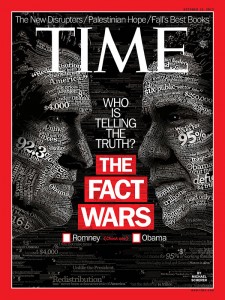
Time's October 15, 2012 cover story: "The Fact Wars"In October, the inevitable was announced: Struggling Newsweek magazine would be finished as a print publication as of the end of the year. But the last mass newsweekly left, Time, also made an announcement of sorts: It was out of the factchecking business.

“Who Is Telling the Truth? The Fact Wars,” read Time’s October 15 cover. With a setup like that, one might have hoped for a bold break from the campaign pack, an acknowledgment that facts matter, and that politicians who run on a record of resisting reality should be exposed.

Instead Time told a more familiar story, one in which both major parties commit comparable “factual recklessness,” because accuracy—and reality—are less important than the appearance of evenhandedness. In the article, and a subsequent response to critics, the magazine essentially waved the white flag in the journalistic war against political deception.

The cover story by Michael Scherer kicked off with some anecdotes meant to be representative. On the one hand, Obama complained about Romney’s repeated, highly publicized claims that the White House is doing away with work requirements under welfare. This was, at certain moments, a central part of the Republican campaign strategy. Scherer correctly noted Romney’s claims were false.

But then, hewing to the idea that one must find political lying in equal measure, he pivoted to a claim from the Obama camp—a campaign strategist’s offhand remark that, if Romney had misrepresented himself to securities regulators, that would be “a felony”—“a conditional accusation, but an accusation nonetheless,” Sherer explains, and justification enough for Romney’s team to “take its turn playing truth-teller.”

The two issues, though juxtaposed, are not remotely equivalent, illustrating one of the most common problems with media factchecking: the need to always be balanced, no matter how unbalanced reality might be. The losers in the Fact Wars, ironically, are the facts themselves.

Indeed, an entire sidebar piece by Alex Altman (“Who Lies More? Yet Another Close Contest”) seemed inspired by the same notion about perfectly symmetrical political lying. The feature chose 10 statements from each side to evaluate. It made for unusual comparisons, considering that one Romney claim was the hyperbolic “We are only inches away from no longer being a free economy.” Not to worry, Altman rated that “highly misleading.”

The equivalent Obama claim—“We do not need an outsourcing pioneer in the Oval office”—was a “distortion,” in Time’s judgment, because while Bain “invested in companies that outsourced jobs, it was not the first to do so,” and Romney was not “directly responsible” when this occurred. Altman got this wrong, actually—Romney was actively running Bain when it “owned companies that were pioneers in the practice of shipping work from the United States to overseas call centers and factories making computer components,” as the Washington Post (6/21/12) reported—but in any case, it’s hardly the same as declaring that the U.S. is on the verge of socialism.

Confronted by the obvious evidence that Romney’s lies and exaggerations were of a different order, Altman came up with a novel explanation:
Compared with the Obama campaign’s, the Romney operation’s misstatements are frequently more brazen. But sometimes the most effective lie is the one that is closest to the truth, and Obama’s team has often outdone Romney’s in the dark art of subtle distortion.
So, to summarize: Romney lies more, and bigger. But Obama tells the more effective kind of lies: the ones that are more accurate. (No, Obama's lies are more sinister. Praising whistleblowers as heroes, then prosecuting more of them than ALL the presidents before him combined. Saying that marijuana legalization is a states' right, and that state law trumps federal law, then working on a way to overturn the recent Washington and Colorado elections which legalized marijuana use. It's one thing to report on the lack of factchecking, but saying both parties don't lie in similar ways to the same ends is being willfully ignorant.--jef)

This kind of analysis allows Scherer to confidently and categorically equate the two campaigns when it comes to reckless disregard for the truth:
Both of the men now running for the presidency claim that their opponent has a weak grasp of the facts and a demonstrated willingness to mislead voters. Both profess an abiding personal commitment to honesty and fair play. And both run campaigns that have repeatedly and willfully played the American people for fools, though their respective violations vary in scope and severity.
In the last phrase, actually, Scherer acknowledges that one side may specialize in lying more than the other—but nowhere in the piece does he give any indication which side that might be. It’s an exercise for the reader, apparently.

Scherer does seem troubled by the sheer volume of political lying he detected in the campaign, and thinks he knows who’s to blame: the people. He wrote:
So what explains the factual reck-lessness of the campaigns? The most obvious answer can be found in the penalties, or lack thereof, for wander-ing astray. Voters just show less and less interest in punishing those who deceive. (because they are only allowed to vote for candidates from just 2 political parties, and they are both corrupt. So we the voters only get to decide from corrupt candidate A or corrupt candidate B. How does change presume to begin when its champions from which we are limited to choose are both corrupt to begin with?--jef)
Scherer concludes that “until the voting public demands something else, not just from the politicians they oppose but also from the ones they support, there is little reason to suspect that will change.”

Blaming a lazy or partisan public for politicians’ lies seems more than a little odd, especially since there are people whose job it is to hold politicians accountable: Those people are called “journalists.” And if they do not make politicians pay a price for lying, those politicians are not likely to stop any time soon.

To hear Scherer tell it, though, that’s exactly what journalists have been doing. Unlike in previous campaign seasons, the press “has largely embraced the cause of correcting politicians when they run astray.” This year’s campaign “witnessed a historic increase in fact-checking efforts by the media, with dozens of reporters now focused full time on sniffing out falsehood.”
Some of that sniffing has been partisan, though, so Scherer offers this bizarre advice:
The pundits on MSNBC, the Huffington Post and the editorial page of the New York Times do a fine job of calling out the deceptions of Romney, but if you want to hear where Obama is going wrong, you might be better served on the Drudge Report, Fox News or the Wall Street Journal editorial page.
Sure—if you want some factchecking of Barack Obama, watch an hour of Sean Hannity. It’s bizarre, but it’s what you’re left with once you buy the premise that it’s impossible to discern fact from fiction and the only option is to read coverage equally skewed in opposite directions.

The problem, Scherer explains, is that voters doesn’t want to hear the “other side’s” factchecking: “Instead the public increasingly takes issue with those who deliver the facts.”

Ironically, he quotes former Al Gore press secretary Chris Lehane making the exact opposite point: “In the past, the press effectively played the role of umpire.... Now they are effectively in the bleachers.”

So maybe the real problem isn’t that the public has no love for “those who deliver the facts.” It might be—as Lehane says—that they don’t think journalists actually do that.

Reporters appear to be wedded to a set of “rules” that say they are not allowed to convey reality to their readers and viewers. On the Time Swampland blog (10/9/12), Scherer wrote in response to complaints about his cover story:
I would love to be able to tell you that Mitt Romney is misleading more than Barack Obama or vice versa.... The problem is that there is no existing mechanism for carrying this sacred duty out in real time.... There are just too many subjective judgements that have to be made to come to any conclusion.
This point of view, as Extra! editor Jim Naureckas responded (FAIR Blog, 10/9/12), should not be called impartiality or objectivity. It’s really “radical post-modernism—a denial that anything can ever really be known about the world, that all we really can do is report various claims about the world.”

For Scherer, the biggest fear seems to be that the facts might pile up on one side. He approvingly quotes Brooks Jackson of FactCheck.org, who explains that truth-evaluating operations like his are only pretending to try to set firm standards by which political dishonesty can be measured:
Even if we could come up with a scholarly and factual way to say that one candidate is being more deceptive than another, I think we probably wouldn’t just because it would look like we were endorsing the other candidate.
So long as the fear of being seen as unfair defines the corporate media’s approach to factchecking, they will not be “those who deliver the facts.” Rather, they are people who carefully arrange each chip in an effort to create the illusion that they let the chips fall where they may.
A Sign That Obama Will Repeat Economic Mistakes

Friday, December 7, 2012 by TruthDig.com
by Robert Scheer

Please don’t tell me that these reports in the business press touting Sallie Krawcheck as a front-runner for chairman of the SEC or even a possible candidate to be the next Treasury secretary are true. Who is she? Oh, just another former Citigroup CFO, and therefore a prime participant in the great banking hustle that has savaged the world’s economy. Krawcheck was paid $11 million in 2005 while her bank contributed to the toxic mortgage crisis that would cost millions their jobs and homes. Sallie Krawcheck.

Not that you would know that sordid history from reading the recent glowing references to Krawcheck in the New York Times, the Wall Street Journal and Bloomberg News that stress her pioneering role as a leading female banker—a working mother no less—but manage to avoid her role in a bank that led the way in destroying the lives of so many women, men and their children. Nor did her financial finagling end with Citigroup, as Krawcheck added a troubling stint in the leadership at Merrill Lynch and Bank of America to her résumé.

A woman who would be an excellent choice as the most experienced as well as principled candidate to head the SEC or Treasury is Sheila Bair, former head of the FDIC, who labored to protect consumers rather than undermine them. Indeed, her outstanding book “Bull by the Horns,” chronicling her fight in the last two administrations to hold the banksters accountable, should be required reading for the president and those who are advising him on selecting his new economic team.

The SEC is supposed to supervise the banks rather than abet them in their chicanery. And although the Treasury Department has been a captive of Wall Street lobbyists for most of the modern era, one would expect something better from the second coming of Barack Obama. Those are key appointments in determining whether the president can turn around the still-moribund economy by channeling the spirit of Franklin D. Roosevelt. Or will he continue to plod along on the course set by George W. Bush, bailing out the banks while ignoring beleaguered homeowners and the many other victims of this banking-engineered crisis?

Obama was given a pass on the economy by voters only because Mitt Romney was an even more craven enabler of Wall Street greed. But the outlines of the Bush Wall Street payoff remain in place, with the Federal Reserve continuing to bail out the banks with virtually free money and the purchase of $40 billion in toxic mortgage-based bonds every month to add to the more than trillion dollars in that junk that the Fed previously had taken off the banks’ books.

The money printing by the Fed is at the heart of the massive debt crisis. But it has been great for the bankers, with compensation at the 32 largest banks slated to hit an all-time high of $207 billion this year, according to a Wall Street Journal estimate. This reward for ripping off the public is almost three times the amount the federal government spends on education. Once again the bankers are blessed for their failures, receiving such wildly excessive compensation despite the fact that banking revenue is down 7.2 percent over the last two years.

A prime example is Krawcheck’s old bank, Citigroup, whose new CEO this week announced that the company has been forced to engage in a major retrenchment, eliminating 11,000 jobs and closing 84 branches. The bank has been deeply troubled ever since the housing meltdown it helped trigger first began, and it was saved from bankruptcy only by a direct infusion of $45 billion in taxpayer money and a commitment of an additional $300 billion in underwriting of Citigroup’s bad paper.

The ugly tale of America’s Great Recession is inextricably entwined with the deplorable practices of Citigroup, the too-big-to-fail bank made legal by Bill Clinton’s signing off on reversing the Glass-Steagall law that prevented the merger of investment and commercial banks. The first beneficiary of the revised law was the newly created Citigroup, saved from bankruptcy a decade later by the taxpayers.

I shouldn’t be surprised that Krawcheck would be considered a viable nominee for a central position in managing our economy. After all, her colleague in the top ranks at Citigroup during the years of financial depravity, Robert Rubin, is considered a significant adviser to the Obama administration, and his protégés, led by Treasury Secretary Timothy Geithner, are still directing policy. It was Rubin who pushed through the reversal of Glass-Steagall, an act of betrayal of the public interest that was rewarded with obscene amounts of money when he ultimately took the job of leading the bank he made legal.

The very fact that these folks remain influential, as witnessed by Krawcheck being considered to head the SEC rather than being the subject of one of its much-needed investigations, gives further evidence of the enduring but ultimately terminal illness of crony capitalism.

The US Military Approves Bombing Children

Robert Dreyfuss on December 4, 2012

In October, I blogged about an incident in Afghanistan in which three small children were killed in a US airstrike.

In that one small incident, which drew little attention at the time and since, three children aged 12, 10 and 8 were blown to smithereens in a NATO bombing while they were out gathering dung for fuel.

Now, in a despicable article in Military Times, the US military says that children are legitimate targets in the war in Afghanistan because sometimes the Taliban and other insurgents use kids.

In the original incident, which I cited in October, The New York Times reported it this way:
The…case of three children allegedly killed in a coalition strike was reported by local officials in Helmand Province’s Nawa district. The officials said that the children were killed in a NATO strike on Sunday afternoon as they were gathering dung to burn as fuel, a common practice in the desert reaches of southern Afghanistan where there are few trees.

“When we reached the area I saw the three bodies of children, two boys and one girl, ages 8 to 12 years old. They were from the same family,” said Haji Hayatullah, a member of the tribal council in the Nawa district. Their family is in the livestock business and raises goats and sheep on government land, he said.

Mr. Hayatullah added: “They had been collecting the animal dung and were heading home. I saw a sack of dung and another sack that was contaminated with their blood, and I saw three to four holes in the area. It seems the insurgents were digging them to plant mines, but I did not see any men’s bodies.”

The children were identified as Borjan, 12; Sardar Wali, 10; and Khan Bibi, 8, said Haji Abdul Manaf Khan, the governor of the neighboring Marja district. The deaths occurred near the border of the Marja and Nawa districts.

The Marja governor said that NATO forces watched as improvised explosive devices were being planted, and targeted the insurgents planting them. “As a result two I.E.D. planters were killed and the shrapnel killed the three children who were wandering nearby,” he said. Other reports said that three insurgents had been killed.

A spokesman for the international forces, Maj. Adam Wojack, said that the coalition forces were aware of the allegations and that the episode was being investigated. “I.S.A.F. did conduct a precision airstrike on three insurgents in Nawa district, and the strike killed all three insurgents,” he said.

“None of our reporting shows any civilian casualties or any children.”
But on December 3 Gannett, which owns Military Times, ran an article headlined: “Some Afghan Kids Aren’t Bystanders.” It said:
When Marines in Helmand province sized up shadowy figures that appeared to be emplacing an improvised explosive device, it looked like a straightforward mission. They got clearance for an airstrike, a Marine official said, and took out the targets.

It wasn’t that simple, however. Three individuals hit were 12, 10 and 8 years old, leading the International Security Assistance Force in Kabul to say it may have “accidentally killed three innocent Afghan civilians.”

But a Marine official here raised questions about whether the children were “innocent.” Before calling for the M142 High Mobility Artillery Rocket System mission in mid-October, Marines observed the children digging a hole in a dirt road in Nawa district, the official said, and the Taliban may have recruited the children to carry out the mission.
Shockingly, the article quotes a senior officer saying that the military isn’t just out to bomb “military age males,” anymore, but kids, too:
“It kind of opens our aperture,” said Army Lt. Col. Marion “Ced” Carrington, whose unit, 1st Battalion, 508th Parachute Infantry Regiment, was assisting the Afghan police. “In addition to looking for military-age males, it’s looking for children with potential hostile intent.”
“Opens our aperture,” indeed.

The article:

 Some Afghan kids aren’t bystanders
By Dan Lamothe and Joe Gould - Staff writers
Monday Dec 3, 2012

CAMP LEATHERNECK, Afghanistan — When Marines in Helmand province sized up shadowy figures that appeared to be emplacing an improvised explosive device, it looked like a straightforward mission. They got clearance for an airstrike, a Marine official said, and took out the targets.

It wasn’t that simple, however. Three individuals hit were 12, 10 and 8 years old, leading the International Security Assistance Force in Kabul to say it may have “accidentally killed three innocent Afghan civilians.”

But a Marine official here raised questions about whether the children were “innocent.” Before calling for the M142 High Mobility Artillery Rocket System mission in mid-October, Marines observed the children digging a hole in a dirt road in Nawa district, the official said, and the Taliban may have recruited the children to carry out the mission.

The incident underscores a continuing problem across Afghanistan. The use of children by the Taliban — through recruitment and as human shields — complicates coalition forces’ efforts to eliminate enemy fighters from the battlefield without angering civilians.

The New York Times reported that the dead children’s family members said they had been sent to gather dung, which farmers use for fuel. Taliban fighters were laying the bombs near the children, who were mistakenly killed, they said.

Regardless, it’s one of many times the children have been involved in the war. In a case this year, Afghan National Police in Kandahar province’s Zharay district found two boys, ages 9 and 11, with a male 18-year-old carrying 1-liter soda bottles full of enough potassium chlorate to kill coalition forces on a foot patrol.

“It kind of opens our aperture,” said Army Lt. Col. Marion “Ced” Carrington, whose unit, 1st Battalion, 508th Parachute Infantry Regiment, was assisting the Afghan police. “In addition to looking for military-age males, it’s looking for children with potential hostile intent.”

There were 316 documented cases of underage recruitment in the war last year, most of them attributed to the Taliban and other armed groups like the Haqqani network, according to a U.N. report released in April. Eleven children, including an 8-year-old girl, were killed in Afghanistan last year carrying out suicide attacks, the report said.

Marines in Helmand say the Taliban regularly recruit children to serve as spotters, letting armed insurgents know when U.S. or Afghan forces reach designated points on a patrol so they can prepare an ambush.

An ISAF spokesman, Lt. Col. Jimmie Cummings, said insurgents continue to use children as suicide bombers and IED emplacers, even though Taliban leader Mullah Omar has ordered them to stop harming civilians.
++++++++++++++++++++

But isn't the point to be less evil than the people we are fighting? If they use children to carry out their goals, does that mean we now have carte blanche in killing children? Does this not seem evil to anybody?

Obama administration considering ways to overturn marijuana legalization in Washington and Colorado


"States' rights trump federal rights every time." ~ Barack Obama, before he was president, when he just wanted the job and said anything to get elected.


Published: 07 December, 2012

New legislation in Washington state went into effect this week that legalizes for the first time in ages the possession of marijuana. Federal law still says otherwise, though, setting up the Justice Department to make some serious determinations.

Even as smoking up became protected by state law in Washington starting Thursday, coast-to-coast prohibition as provided by a long-standing federal ruling remains on the books. For marijuana advocates in the Pacific Northwest, the lifting of the ban is a pretty big victory. That doesn’t mean that the Justice Department has ruled out an intervention, though.

Since voters in Washington and Colorado opted on Election Day to legalize small amounts of marijuana for recreational use, the Department of Justice has been relatively quiet over how it will handle what is likely to become a heated debate regarding states’ rights. In an article published by The New York Times this week, reporter Charlie Savage says senior White House and Justice Department officials are already attempting to tackle how to handle the new marijuana laws, and are amid deliberations right now that will determine when, where and how national law enforcement can intervene.

Savage cites anonymous sources familiar with the discussions in DC, whom he says are considering plans for legal action against the states of Colorado and Washington. Meanwhile this week the Obama administration once again chimed in on the topic, but as with earlier abbreviated statements, the only words out of the nation’s capital forecast an ominous battle likely to brew for some time.

When the results of the legislations up for vote in both states trickled through on the evening of Election Day, the Justice Department dispatched a short statement clarifying the federal classification of marijuana as an illegal substance. This week, the United States attorney for Seattle, WA once again warned that federal law is still on the books.

“In enacting the Controlled Substances Act, Congress determined that marijuana is a Schedule I controlled substance,” state attorney Jenny A. Durkan announced in a statement. “Regardless of any changes in state law, including the change that will go into effect on December 6 in Washington State, growing, selling or possessing any amount of marijuana remains illegal under federal law.”

Additionally, the New York Times quotes Durkan as saying the Justice Department maintains that its "responsibility to enforce the Controlled Substances Act remains unchanged," meaning federal law enforcement isn’t necessarily interested in adhering to local rules.

A similar legislation approved during last month’s Election Day is expected to go on the books in Colorado in the coming weeks. Even before becoming official, however, some important state institutions have announced that they won’t be cooperating with the end of prohibition.

"In order not to lose federal funds, we need to comply with federal law," University of Colorado at Boulder spokeswoman Malinda Hiller-Huey told The Denver Post.

Speaking to NBC, Colorado Governor John Hickenlooper acknowledged even before the new law was approved that it would be an uphill battle for local marijuana advocates given the feds’ insistence in playing by their own rules.

"It's probably going to pass, but it's still illegal on a federal basis. If we can't make it legal here because of federal laws, we certainly want to decriminalize it,” he said.

Seattle City Attorney Pete Holmes tells NPR station KUOW that in his state, residents should be thankful that local law enforcement won’t be tasked with what is largely considered not just a non-issue, but an expensive endeavor. Whereas schools and universities in Colorado aren’t considering the new law for the sake of saving money, Holmes says the legislation in Washington will actually save the state bundles.

"I think that they should acknowledge this newfound right," he says to KUOW. "I think they should celebrate in the privacy of their homes if they choose to do so. And be thankful that we’re no longer arresting some 10,000 Washingtonians a year in the state of Washington and spending well over $100 million in law enforcement resources on that."

Meanwhile, more liberal minded lawmakers in the District are hoping to iron out a way to ensure that state laws are protected before federal agents can have their way. Rep. Diana DeGette (D-Colorado) introduced a bipartisan legislation before Congress that will amend the US Controlled Substances Act to provide that federal law shall not preempt state marijuana laws.

"I am proud to join with colleagues from both sides of the aisle on the 'Respect States' and Citizens' Rights Act' to protect states' rights and immediately resolve any conflict with the federal government," Rep. DeGette said upon introducing House Bill 6606. "In Colorado we've witnessed the aggressive policies of the federal government in their treatment of legal medicinal marijuana providers. My constituents have spoken and I don't want the federal government denying money to Colorado or taking other punitive steps that would undermine the will of our citizens."

According to a recent survey conducted by Public Policy Polling, nearly six out of ten Americans want marijuana legalization on a widespread scale. In a separate Angus Reid Public Opinion poll published last week, over 60 percent of Americans surveyed said they expect marijuana to be federally permitted within the next decade.

The Plutocrats and the Placeholder President

*Sigh* Yes, the Democrats suck just as hard ads the Republicans do. Obama will bend over for the Republicans' bullshit 'the sky is falling' austerity and cut deep gouges out of social security and other important programs even though it's unnecessary. (Hint) just let the Bush tax cuts expire, end the wars, bring the troops home, and cut the military budget. A conventional military is outdated and unneeded in this age of warfare. Problem solved.--jef

+++++++++++

Austerity, Obama-Style
by ROB URIE


In Quentin Tarantino’s movie ‘Jackie Brown’ the illegal arms dealer played by Samuel L. Jackson laughs as he recounts the sales slogan used by the manufacturer of the ‘Tech Nine’ semi-automatic weapon—“the most popular gun in American crime, like they proud of that shit.” Mere weeks after Barack Obama was re-elected, farce is added to tragedy with his supporters complaining that while the Republican proposal to cut Federal government spending and social insurance programs is all bluster and misdirection, their guy (Mr. Obama) has a real plan to do so—like they’re proud of that shit. Thanks just the same folks, but I’ll take the fake plan.

The moment when the New Deal as we knew it became history by bi-partisan consensus was a long time coming. A trans-generational core of inherited wealth and right-wing cranks has been trying to undo the New Deal since Social Security became fact in 1935. Ronald Reagan echoed anti-New Deal cries of ‘socialism,’ first as a paid spokesperson of the AMA (American Medical Association) against the implementation of Medicare and Medicaid, and later through his racist caricature of the ‘welfare queen’ living fat on public largesse. Despite the fact that Social Security is an insurance program paid for by its participants, much the same as private insurance but without the executive looting, the charge has always been of an undeserving public sucking on “a milk cow with 310 million tits.”

Democrats first joined the effort in earnest with Bill Clinton’s plan to partially privatize Social Security. The idea was to let our good friends on Wall Street manage a bit of the money for us, for a fee of course. That proposal faltered when Mr. Clinton was impeached. As was the fashion in European Central Bank circles in 2009, Mr. Obama took up the torch of fiscal austerity of his own initiative by creating his very own deficit commission. This should have come as no surprise to anyone paying attention—Mr. Obama publicly stated his intention to ‘fix’ Social Security, Medicare and Medicaid when he allied himself with the Wall Street friendly ‘Hamilton Project’ in 2006.

(In Between Democrats Clinton and Obama came Republican George W. Bush who also tried to partially privatize Social Security. Mr. Bush quickly retreated when he saw the depth of political opposition to the effort. As the saying goes, it takes a Democrat to gut the New Deal).

For the uninitiated, the Hamilton Project is the demon spawn of the Clintonite contingent of the Democratic Party led by former Treasury Secretary and disgraced Citicorp Board member Robert Rubin. The kindest take on the Wall Street lootocracy populating the organization is that they don’t know how money is created (the U.S. has a fiat currency), making them morons. The less kind take is that their greed has no limits. Whichever is more applicable (neither is mutually exclusive), if one group of Wall Street politicos bears responsibility for the economic catastrophe that an unregulated Wall Street has visited upon the world in recent years, the Hamilton Project is it.

Never one to let the wish list of the entrenched plutocracy go unfulfilled, Barack Obama chose Democrat, inheritance baby and Wall Street ‘welfare queen’ Erskine Bowles, to co-head his (Mr. Obama’s) very own ‘deficit commission.’ Of course Mr. Obama knew nothing of Mr. Bowles experience leading the earlier effort to (partially) privatize Social Security when he appointed him to the position. In his speech welcoming the Hamilton Project into existence (link above), Mr. Obama additionally described himself as an enthusiastic ‘free trader’ committed to globalization. And of current relevance, he ascribed fiscal ‘discipline’ as the proximate cause of the Clinton economic ‘boom,’ deftly ignoring the greatest stock market bubble (as measured by price / earnings ratio—twice that of 1929) in human history.

One could be forgiven for believing that Mr. Obama, or any other placeholder Democrat for that matter, has something of a point regarding ‘entitlement’ spending if his words are the only that are listened to. People in the U.S. are living longer and a strapped citizenry simply cannot afford the lavish promises made in an earlier age of plenty goes the toxic bullshit. By leaving out class divisions this formulation simply furthers the shift in social resources upward from poor to rich. As economist Paul Krugman has effectively argued, the rich are living longer and the working class and poor are not. Additionally, unless those in the ‘gap’ years between the old and new eligibility ages for Medicare simply forgo health care, the change will force them to purchase private health insurance under whatever terms the ‘market’ will bear. But of course, private insurance companies always act in the public interest when people’s backs are to the wall.

At the end of the day this charade is a struggle over social resources. The ‘too-big-to-fail’ guarantee of the banks, which is the only reason why insolvent, predatory Wall Street remains in business, is an entitlement program for connected bankers—for which they pay nothing. The bloated, murderous, military industry that lobbies the U.S. into unnecessary wars for their own benefit and that of corporate welfare receiving multi-national corporations is an entitlement program. And the aforementioned corporate welfare that perpetuates the puffy, gray corporate executives behind the ‘Fix the Debt’ campaign for whom official Washington now apparently works is an entitlement program. So if we want to have a public ‘discussion’ of entitlement spending, by all means let’s do so.

And as far as entitlement programs go, government guarantees and redistribution schemes are only a starting point. As economist Dean Baker has argued, America’s professional class retains monopoly pricing power for their labor through trade restrictions while the working class has been thrown to the wolves. The Federal Reserve has spent upwards of four trillion dollars to entitle the fortunes of the investor class since 2008, returning the already rich to their former wealth. And corporate executives have entitled themselves to robber-baron sized paychecks through the combination of trade policies that have so reduced the fortunes of the working class, tax abatements that have bled the public weal for some forty years, and through the financialization of the economy that has favored, along with Federal Reserve policies, the financial wealth that executives pay themselves with. All of these and more are entitlement programs that have redistributed ever more social wealth from the working class and poor up to the Washington establishment’s beloved plutocrats.

But the trillions of dollars in health care expenditures that we deadbeats intend to sponge off of the blessedly deserving rich is the really big money, right? When Erskine Bowles wakes with night terrors, it is my herniated disk and your gall bladder operation that will sink the country, right? The U.S. pays 30% – 50% more per person than other first world nations for health care that is of substantially lower quality because we have a largely private health care system. Were the system totally public—Medicare for all, we would realize some material proportion of these savings and most likely vastly improve the health of the citizenry. Were the monopoly entitlements of doctors and pharmaceutical companies reduced or eliminated, further cost reductions would be realized. So quickly, who are the main beneficiaries of America’s ‘bloated’ entitlement programs?

As Mr. Obama will offer, his proposals include reducing payments to health care providers and negotiating lower prices for prescription drugs. However, the private health care system in America is the global leader in shifting costs to those with the least social power. Cuts in public payments to private providers have a long history of popping up elsewhere, as health insurer profits will attest. For instance, Mr. Obama’s health care ‘reform’ program, the ACA (Affordable Care Act), requires insurance companies to spend fixed percentages of their revenues providing health care or to rebate the difference to their customers. As corporations constitute the majority of their ‘customers,’ corporations apparently now have an incentive to shop around for health insurers that provide the lowest proportion of health care to their employees to maximize the rebates. (The central business of insurers was already to provide the appearance of coverage without providing actual coverage). And health insurance providers can gain market share, if at lower margins, by doing exactly this. Welcome to America.

Last, any honest discussion of ‘entitlements’ would be to the benefit of America’s poor and working classes. The globetrotting plutocrats behind current ‘discussions’ see working class product as their due. This is the very definition of entitlement. We can either disabuse them of this notion or roll over and play dead. Or better yet, roll over and vote Democrat.