The banks' ranks are based on how shamelessly they game the political process through lobbying, revolving door politics and campaign donations.
By Sarah Jaffe and Joshua Holland,
AlterNet
Posted on October 19, 2011
The economic crash led to the
loss of 9 million jobs and the
biggest drop in American home-ownership since the Great Depression.
Long-term unemployment, poverty and hunger have increased dramatically. People are angry. The
Occupy Wall Street movement, a stand against Wall Street's greed, excess and criminality, has captured the imagination and participation of millions across the nation and the globe.
The giant mortgage bubble and the irresponsible and corrupt practices that caused the catastrophic economic crash didn't emerge out of thin air. They were a consequence of decades of pay-to-play politics rife with conflicts of interest; a political system awash in cash and legal pay-offs, designed to undermine the checks and balances that could have prevented the meltdown.
Many of these checks and balances were implemented during the Great Depression. How they were eroded and eventually abandoned is the story of a small group of banks, financial companies and elites involved in major conflicts of interest, revolving-door politics and backroom deal-making -- all to protect the interests of the global elite at the expense of the American public.
Big Finance has a long history of working hard to deregulate the American economic system on behalf of global capitalism run amok. One of its biggest coups was the overturning of the
Glass-Steagall Act, a Depression-era law that created a firewall between investment banking and the commercial banks that hold deposits and make loans.
The first victory in the quest to overturn this major protection came in 1986. Under intense pressure from Wall Street, the Federal Reserve reinterpreted a key section of
Glass-Steagall, deciding that commercial banks could make up to 5 percent of their gross revenues from investment banking. After the board heard arguments from
Citicorp,
J.P. Morgan and Bankers Trust, it loosened the restrictions further: in 1989, the limit was raised to 10 percent of revenues, and in 1996, they hiked it up to 25 percent.
Then, according to a
report by
PBS' Frontline, “In the 1997-'98 election cycle, the finance, insurance, and real estate industries (known as the FIRE sector), spen[t] more than $200 million on lobbying and [made] more than $150 million in political donations” – most of which were “targeted to members of Congressional banking committees and other committees with direct jurisdiction over financial services legislation.”
The following year, after 12 unsuccessful attempts,
Glass-Steagall, which would have made the crash of 2007-2009 impossible, was finally repealed. And it was only then that the explosion of shaky mortgage-backed securities began.
“Subprime” loans, which made the
mortgage system so vulnerable, made up 5 percent of all mortgages in the U.S. the year before repeal, but had skyrocketed to 30 percent of the total at the time of the crash.
The
Glass-Steagall act was killed by financial interests seeking to maximize deregulation. The result was a casino-like environment that almost destroyed the U.S. and global economy. The giants of Wall Street enjoyed a massive bailout courtesy of American taxpayers, and they're still hard at work gaming the system, lobbying hard against new regulations that might avert the next bubble-led crash.
AlterNet, in partnership with the
Media Consortium, looked at the five banks that exert the most influence on our democracy. Based on their size, the amount of money they spend on campaign donations and lobbying, and the number of employees who’ve gone through the revolving door into public service, or vice versa, we determined which banks have had the worst impact on the country. We’ll rank each one based on our research, and come up with the worst of the worst--the big bank that’s done the most damage to America's economy and society.
A word of caution is in order.
This report is based only on what the banks are forced to disclose. It doesn't include lobbying by corporate front-groups like the
Chamber of Commerce, and it doesn't include the “independent” campaign spending that has exploded in the wake of the
Supreme Court's Citizens United decision, which corporations are no longer required to disclose to the public.
This is a classic story of American political corruption writ large.
Meet the Big Banks
You’re no doubt familiar with
Bank of America. Just recently BofA has made news because it's been sued for
$10 billion over “toxic” mortgage-backed securities, and it's imposing an arbitrary and unfair
$5-a-month fee for customers who use their debit cards. Bank of America’s on shaky ground these days and its stock price has dropped significantly, in part because of its purchase of
Countrywide Financial, a mortgage lender that wrote a huge chunk of the bad mortgages that broke the economy. Still, it remains a giant company, ranked number 9 on the
Fortune 500 list of largest corporations for 2011, right under
General Motors and right above
Ford.
BofA is the behemoth it is because the bank has taken over 13 other financial institutions since the 1990s, including US Trust, NationsBank, BayBanks, and most recently the large investment company
Merrill Lynch, but it's no longer the biggest of all. According to its
most recent filings,
JPMorgan Chase is the biggest financial firm in the country (it ranks number 13 on the
Fortune 500, right below
AT&T), with $2.29 trillion in assets. In 2010, the bank had $115 billion in revenues, and turned a neat profit of $17.4 billion. Chase is the conglomerate’s retail banking and credit branch, while JP Morgan has been the investment, asset management and private banking end of operations since the merger in 2000 of
JP Morgan and
Chase Manhattan. In 2008, JPMorgan Chase swallowed up
Bear Stearns and
Washington Mutual; despite common complaints of “too big to fail,” the big banks mostly got even bigger after the economic crisis. JPMorgan Chase is now headquartered in midtown Manhattan, many blocks north of the
Occupy Wall Street encampment in the financial district.
Bank of America still has $2.22 trillion in assets even after a steep decline. Last year, it made $134 billion in revenues, and reported a loss of $2.24 billion. (The protest group US Uncut loves to point out that Bank of America received a
$1 billion tax refund in 2010.) It's headquartered in Charlotte and has branches around the country -- though it may be closing
up to 600 of them. Interestingly, the Democratic party will hold its 2012 convention in Charlotte, where BofA is the big dog in town.
Hot on JPMorgan and BofA’s heels in the size race is
Citigroup, which just announced this week that it would be charging its depositors a
$15 monthly fee if they don’t maintain a $6,000 balance in their checking accounts--yet another unfair and regressive fee, even though Citigroup isn’t exactly hurting for money. It is number 14 on the Fortune 500, with $1.91 trillion in assets, $111 billion in revenues and $10.6 billion in profits in 2010.
Wells Fargo reported profits of $12.36 billion last year, and sits at number 23 on the
Fortune list, just above
Procter & Gamble. The California-headquartered bank acquired
Wachovia, which had itself previously absorbed First Union and the Money Store among others, in 2008, in the throes of the financial meltdown, and as of 2010 has $1.26 trillion in assets and $93 billion in revenues.
Goldman Sachs, the famed “vampire squid” in Matt Taibbi’s formulation, is the only investment bank on our list. However, no look at the corrupting influence of Big Finance would be complete without it. It's “only” at 54 on
Fortune’s list, but still higher than, among others,
Intel, Chrysler and
Sears, with $911.3 billion in assets and $46 billion in revenues, and profits of $8.35 billion in 2010. For many, Goldman Sachs is the face of all that’s wrong with Wall Street, stoking massive anger when CEO Lloyd Blankfein told a reporter that he was “doing God’s work.”
Meet Their Bailouts
The big banks weathered the economic crash thanks to large injections of taxpayer dollars. The original bailout plan, the
Troubled Asset Relief Program, was signed into law by George W. Bush and gave direct handouts to the banks to keep them from collapsing.
Economist Dean Baker told AlterNet that Big Finance “never wanted to see the removal of the government from the market. They wanted the government to come in and bail them out.”
They were also happy to accept “government deposit insurance or the back-up lines of credit provided by the Fed through the discount window,” he said. “What the financial industry wants is to have these incredibly valuable government safeguards without restrictions on the banks' behavior.”
Among our big five, Citigroup was the largest beneficiary of these funds, with $45 billion, but even Goldman Sachs got $10 billion. Wachovia/Wells Fargo and JPMorgan got $25 billion each, while Bank of America got $30 billion. According to
ProPublica’s calculations, the big five have all paid back their TARP funds.
But
TARP was only one way in which the federal government subsidized the big banks. The Federal Reserve also handed out trillions in unsupervised loans during the so-called crisis period.
Dean Baker noted in his book
False Profits that the Fed loans were actually more significant than the bailouts. “The vote on the
TARP was a way to get Congress’s fingerprints on the policy of subsidizing the banks,” he wrote, “just as the war authorization bill approved in October 2002 implicated Congress in President Bush’s subsequent decision to wage war on Iraq under false pretenses.”
And if those numbers weren't big enough, just this August
Bloomberg reported even more secret Fed loans to the big banks: “The $1.2 trillion peak on Dec. 5, 2008 -- the combined outstanding balance under the seven programs tallied by
Bloomberg -- was almost three times the size of the U.S. federal budget deficit that year and more than the total earnings of all federally insured banks in the U.S. for the decade through 2010, according to data compiled by
Bloomberg.”
These staggering numbers in direct bailouts and loans don’t even take into account the other ways in which these banks benefited from federal handouts: loans to other banks that were used to pay back debts to the big five; government support for consolidation, making the too-big-to-fail banks even bigger. For instance, in addition to its own bailout funds,
Goldman Sachs got $12.9 billion from the funds the government used to bail out insurance giant/seller of derivatives
AIG.
“Without question, direct government support was critical in stabilizing the financial system, and we benefitted from it,”
Goldman’s Lloyd Blankfein said.
Campaign Donations
The big banks are some of the biggest donors to political campaigns in the country. Yet, when you compare what they spend on candidates to what they got in bailouts, it’s pennies on the dollar. In other words, it’s a worthwhile investment to spend money on candidates.
Corporations can't give money directly to politicians running for federal office. They get around that sticking point in several ways. First, they can donate to campaigns through their
political action committees (PACs). (A corporation can't fund its PACs from its revenues directly; it can create a PAC, pick up its administrative costs, and then solicit contributions from the company's executives and shareholders.) But corporate PACs can give no more than $5,000 a year to a given federal candidate.
Another way is through the use of what's known as
“soft money.” Soft money is used to build party infrastructure or to buy political ads that are produced independently from a campaign. Soft money ads are ostensibly used to educate voters about various issues, but they often look exactly like campaign ads that convey a clear message of whom a voter should or shouldn't support.
“Bundling” is another way corporations inject money into politics. There are limits on how much an individual can give to a candidate for federal office, so wealthy donors seek out contributions from friends, family and business associates, and “bundle” them into large pots of cash. In exchange, they usually become part of a club – like the Bush “Rangers” – and get invited to insiders' events where they have plenty of opportunities to influence a candidate.
OpenSecrets.org's list of the top all-time political donors from 1989 to 2012 includes contributions from individuals associated with a company, from Corporate PACs and soft money through 2010 (more on that below). Where do the banks stack up? Goldman Sachs is number 25, five slots higher than the
National Rifle Association. It also spends more on candidates than the
American Hospital Association, the
AFL-CIO and defense contractor
Lockheed Martin. Citigroup (number 39 on the list, just above
Microsoft), JPMorgan Chase (number 46, just below
Blue Cross/Blue Shield) and Bank of America (number 50) are all heavy hitters. Of our big-spending financial institutions, only Wells Fargo didn't make the cut for the top 50.
As far as corporate PACs alone, Bank of America leads among commercial banks this election cycle, despite – or perhaps because of – its struggles, having already spent $249,500 on candidates for 2012--$153,000 of that on Republicans. Wells Fargo and JPMorgan Chase are close on its heels, with $171,500 and $166,499 respectively, and they both follow the trend, in 2012, of leaning Republican. (The finance industry as a whole gives about 69 percent of its donations to the GOP). Citigroup's PAC donated $56,000 thus far for 2012. And Goldman Sachs leads the pack among investment banks this cycle, having already shelled out nearly $300,000.
Just who are the recipients of all this largesse? There are many, but most play key roles on Congressional committees that oversee their businesses. Consider just one example:
Senator Chuck Schumer, D-New York, one of the most powerful members of Congress (Schumer is known as “the senator from Wall Street”).
According to the
National Journal's
rankings, Schumer is tied with two others as the 10th “most liberal” member of the upper chamber.
But he owes his career to Wall Street. As
Salon editor Steve Kornacki
noted, in the early 1980s, when he was a little-known back-bencher in the House, Schumer managed to get himself a seat on the House Banking Committee, and immediately “set about making friends on Wall Street, tapping the city’s top law firms and securities houses for campaign donations.” "I told them I looked like I had a very difficult reapportionment fight. If I were to stand a chance of being re-elected, I needed some help," he would later tell the
Associated Press.
Wall Street would continue to have his back as his career progressed. According to
Open Secrets, between 2007 and the current cycle, Schumer raked in $3.9 million from the securities, banking and insurance industries – over 20 percent of all his fundraising. He has raised more from Wall Street than any other lawmaker over the last two years. Over the course of his political career, the securities and investment industries are his top contributors; the four most generous institutions during his time in the Senate have been Goldman Sachs, Citigroup, Morgan Stanley and JPMorgan Chase, in that order.
The ostensibly liberal senator from New York, who sits on the
Senate Finance and Banking, Housing and Urban Affairs Committees – and chairs the all-important
Committee on Rules and Administration (which deal with, among other things, lobbying restrictions) – has returned that friendship consistently.
Although he voted for the
Dodd-Frank financial reform bill in 2010, earlier this year, he joined several other lawmakers in a
letter urging federal legislators not to adopt new regulations on derivatives, arguing that they would “inevitably result in significant competitive disadvantages for U.S. firms operating globally.” He voted to extend the Bush tax cuts on capital gains in both 2005 and 2006.
In 2008, the
New York Times analyzed Schumer's voting record, and
found that he has consistently sided with Wall Street on issue after issue, often crossing the aisle to do so.
That's just Congress. The presidential election in 2012 will be the most expensive in history; Barack Obama has already raised over $89 million for his reelection, while his GOP opponents are raising and spending boatloads of cash as well.
The banking industry is by and large leaning more Republican for 2012 than it did in 2008 (This only includes direct contributions to the campaigns; it doesn't include money Obama has raised for the Democratic National Committee, which will help support his re-election efforts). Through the 2nd quarter of 2011, the Obama campaign has only raised $857,000 from the securities and investment industries, $44,750 from Goldman Sachs, the only one of our top five to make it onto
OpenSecrets’ top contributors' list.
Two of Obama’s top bundlers are also connected to Goldman Sachs.
Vicki Heyman has brought in between $100,000 and $200,000 for Obama, according to
OpenSecrets, and
David Solow between $50,000 and $100,000. (In comparison, by the end of the 2008 election, Obama had gotten $1,013,000 from Goldman Sachs, $808,000 from JPMorgan Chase and $736,000 from Citigroup.)
Mitt Romney is the clear favorite candidate of Wall Street this year, having taken in $2,339,588 from securities and investment companies. Goldman Sachs is the top contributor to Romney’s campaign, having given $293,250 between political action committees, employees and their families. Bank of America has kicked in $59,000, Wells Fargo and JPMorgan around $45,000 each and Citigroup brings up the rear with $33,000.
Wells Fargo tossed a few thousand to
Newt Gingrich and
Herman Cain as well. It's always good to cover one's bases.
We should note that this report, like all others on this topic, is necessarily incomplete. Corporations don't like airing their campaign spending in public, and there are two ways they can and do avoid it.
First, corporate front-groups like the
Chamber of Commerce effectively
“launder” corporate campaign cash, keeping a company's fingerprints from appearing on lobbying and campaign disclosure reports. The Chamber is not required, and does not disclose its members, but according to
Think Progress, “several confirmed Chamber members are banks which were bailed out by taxpayers.” These include Citigroup, Marshall & Ilsley Bank and the New York Private Bank & Trust. According to
Americans for Financial Reform, Bank of America, JPMorgan, Morgan Stanley, PNC Financial Services and M&I Bank are also Chamber members.
Prior to the Supreme Court's 2010 ruling in
Citizens' United v. FEC, there were limits on corporations' (and unions') independent expenditures and on “electioneering communications” – ads that explicitly call for the election or defeat of a candidate before an election. All campaign spending had to come from individual execs and shareholders or be funneled through corporate PACs. But the decision changed the entire landscape, allowing corporations and unions to spend unlimited dollars on politics, directly from their treasuries and without the disinfecting light of disclosure. Following the decision, a bill that would have forced corporations to disclose these donations had enough bipartisan support for passage, but a vote on the measure was blocked three times by Senate Republicans.
Lobbying
After the economic crisis, one might have expected the big banks to have less money to spend on lobbying. But financial reform was on Washington's agenda, so the bankers coughed up the cash for lobbyists in an effort to make sure the final result wasn't too hard on them or their bottom line. The lobbying numbers for all five of the banks in our report went up dramatically in recent years, starting their dramatic spike in 2006 and peaking in 2010, when the
Dodd-Frank financial reform bill was under consideration.
Banks have spent more than any other sector on lobbying between 1998 and 2011, and Citigroup, JPMorgan Chase, Bank of America, Goldman Sachs, and Wells Fargo were at the top, dropping $12,020,000 between them in 2011 alone. And those efforts have paid off for them, as they’ve been able to maintain most of their business practices practically unchanged since before the crash.
Their interests were clear. According to a report by the inspector general of the
Troubled Assets Relief Program, the banks lobbied heavily against limitations on executive pay that legislators had tried to attach to the bailout money. They worked hard to preserve their fat bonuses, their right to virtually no oversight and their ability to continue business as usual.
Anupama Narayanswamy at the
Sunlight Foundation wrote of the
Dodd-Frank Wall Street Reform and Consumer Protection Act, “The Wall Street reform bill was a mammoth undertaking, consisting of more than 2,300 pages, and requiring agencies to write a total of more than 240 new regulations. With 108 new rules due to be adopted this summer on the first anniversary of its enactment, and a dozen bills introduced by Republican members to repeal the bill in whole or in part, government-relations wings of the Wall Street banks and lobbying firms in Washington, D.C., have been busy.”
Bill Allison, also at
Sunlight, reported, “Since passage of
Dodd-Frank, federal agencies implementing the law have logged more than 2,100 meetings with interests aiming to influence the many new rules that
Dodd-Frank requires, including 83 with executives and lobbyists for Goldman Sachs, 73 with JP Morgan Chase, 58 with Morgan Stanley and 55 with Bank of America.”
The
banks also lobby through the
American Bankers Association, which has spent $4.6 million this year alone on lobbyists, and the
Financial Services Roundtable, which the
New York Times’ Ben Protess describes as “a fellow trade group that represents 100 of the nation’s largest financial firms.” These two organizations and others helped fund the slew of lobbyists fighting to keep regulators from having much of an impact on the financial sector.
The
vast army of lobbyists that represent the big banks in Washington include some former power brokers from Congress;
former Democratic House Majority Leader Dick Gephardt, through his
Gephardt Group, got $60,000 from Goldman Sachs to argue for their cause, which according to the
Center for Responsive Politics, he did personally.
John Breaux, former Democratic Senator from Louisiana, also lobbies for Goldman, and his partner in the Breaux Lott Leadership Group,
Trent Lott, driven out of his position as
Senate Minority Leader for comments that appeared to endorse
Strom Thurmond’s segregationist campaign for president, represents both Goldman and Citigroup. (Citigroup paid them $180,000 for lobbying last year, and Goldman a full $300,000, as much as
General Electric.)
The Gephardt Group took in $3.2 million just last year, from
Boeing,
Comcast,
Sodexho and many more as well as Goldman Sachs, and Breaux and Lott pocketed nearly $6 million from clients ranging from Citigroup and
Delta Airlines to
AT&T and defense
contractor
Raytheon.
Bank of America and Wells Fargo both retain the services of the
Podesta Group, run by well-known Washington insider
Tony Podesta, who was a founder of
People for the American Way. (Podesta's brother, John Podesta, is president of the
Center for American Progress, an influential liberal DC think tank and a former Clinton chief of staff -- he also headed Obama's transition.) Wells Fargo paid the Podesta Group $340,000 in 2011, $100,000 more than
Wal-Mart, another Podesta client.
While JPMorgan Chase’s lobbyist roster doesn’t have quite the pedigree of some of the others, it makes up for that in sheer spending power, having dropped $66,696,173 in lobbying dollars between 1998 and 2011. In total spending it still comes in second, though, behind Citigroup’s $82,350,000, handing it the crown for biggest spender as far as lobbying goes.
All together, the finance sector is the top spender on lobbying between the years of 1998 and 2011, according to the
Center for Responsive Politics, having poured
$4,631,844,938 into lobbyists’ pockets. $230,200,953 of that came directly from the five banks surveyed here.
And what did they get for all that money?
Nomi Prins, a former managing director at Goldman Sachs and author of the new book
Black Tuesday, explained to
AlterNet:
“The Dodd-Frank Bill contains a slew of minor, cosmetic adjustments to the status quo manner in which the largest banks operate, and even they are being battled against by the financial industry lobbyists. The bottom line is that this bill does not fundamentally alter the structure of Wall Street - it does not separate banks cleanly, or in any other way remotely reminiscent of the Glass-Steagall Act of 1933, into commercial banks that deal with the basics of deposit and lending operations vs. investment banks that create dangerous and complex securities and leverage them into all manner of speculative activity.
She continued,
“Even though the bill calls for a consumer financial protection agency, it should be noted that such a department existed already within the Fed during the build-up to this crisis, that by virtue of political weakening and position within the Fed and political hierarchy was rendered ineffective in practice. The bill does not end the conflicts of interest and the revolving doors between the regulatory bodies and other key positions in Washington vs. those coming from, or going to, Wall Street.”
Revolving Door
Perhaps the most alarming aspect of the financial industry's influence on our political system is the extent to which financial insiders end up in positions where they're actually making policy.
The “revolving door” works both ways. According to
Open Secrets, fully 74 percent of registered lobbyists for the finance and insurance industry previously worked in government, many of them for members of Congress sitting on committees that set banking regulations, or for the regulatory agencies that enforce them.
The nuts and bolts of legislation is crafted by Congressional staffers, and in the Senate, the Finance Committee (117) is second only to the Judicial Committee (119) in the number of staffers-turned-lobbyists or lobbyists-turned-staffers.
Building relationships as an elected official, regulator or legislative staffer can later bring rich financial rewards when one moves to the private sector. Economists Jordi Blanes Vidal, Mirko Draca and Christian Fons-Rosen tried to figure how much those relationships were worth in a 2010 study conducted for the
Center for Economic Performance (
PDF). Using disclosure forms, they looked at how former staffers-turned-lobbyists' income changed when their former bosses left Congress. The researchers found “evidence that the existence of a powerful politician to whom the lobbyist is connected is a key determinant of the revenue that he or she is able to generate... in other words, lobbyists are able to 'cash in on their connections,' since connections are an asset with a separate value to their experience, human capital or general knowledge of how government works.”
Specifically, they found that
when a senator left office, their former staffers-turned-lobbyists saw their incomes drop by an average of 24 percent and when members of the House left office, their old staffers' incomes dropped by 10 percent. But those are the averages. They also found, “Consistent with the notion that lobbyists sell access to powerful politicians," that lobbyists lost more revenue if their departing ex-bosses were more senior and held powerful committee assignments.
As you can see in the graphic below, Citigroup leads through Congress' revolving door, followed by JPMorgan Chase, Bank of America, Wells Fargo and followed up by Goldman Sachs, according to Legistorm's database.
| Lobbyists who worked for members of Congress or were themselves legislators |
 | 20 |
Including Sanders Larsen Adu, former staff director of a House Financial Services subcommittee, Tim Keeler, former staffer on the Senate Finance Committee (Keeler has also lobbied on behalf of BofA and JP Morgan Chase, among others) and Chris Rosello, a former staffer on the House Financial Services Committee. |
 | 81 |
Including former Senator John Breaux, D-Louisiana, who was a senior member of the Senate Finance Committee, and chairman of the Subcommittee on Social Security and Family Policy. |
 | 72 |
Including former Rep. Rick Lazio, R-NY, who served as Deputy Majority Whip, Assistant Majority Leader, and chairman of the House Banking Subcommittee on Housing and Community Opportunity. |
 | 39 |
Including, until recently, Senator Dan Coats, R-Indiana, who served in the Senate until 1999, retired to lobby his former colleagues and serve a stint as ambassador to Germany, and then returned to the Senate this year. The New York Times reported that Coats, lobbying for Cooper Industries, “served as co-chairman of a team of lobbyists in 2007 who worked behind the scenes to successfully block Senate legislation that would have terminated a tax loophole worth hundreds of millions of dollars in additional cash flow” for the company. Coats curently sits on the Joint Economic Committee. |
 | 18 |
Including former Rep Dick Gephardt, D-Missouri and former Rep. Harold Ford, Sr., D-TN. Gephardt served as the House Majority leader; Ford sat on the House Banking Committee. |
The revolving door between Wall Street and government doesn't just lead into and out of Congress. Consider
the circuitous career path taken by former White House Chief of Staff
Joshua Bolten. Bolten graduated with a law degree in the early 1980s, and between 1985 and 1989, he bounced between the Office of the U.S. Trade Representative, the law firm of O'Melveny & Myers, which represents Goldman Sachs -- and is a registered lobbyist for Citigroup, according to
Legistorm (
$$) -- and the Senate Finance Committee.
After a brief stint in the first Bush administration, Bolten went over to Goldman Sachs, where he served as executive director of legislative affairs for five years. Then he became policy director on
George W. Bush's 2000 campaign. After the election, he worked his way up from assistant to the president to director of the Office of Management and Budget and, finally, to White House Chief-of-Staff, which some believe to be the second most powerful position in the government. In that role, he was
credited with recruiting then-
Goldman CEO Henry Paulson to head up the Treasury Department, where he would preside over the bank bailouts – much to Goldman's benefit. After leaving the White House, Bolten got a cushy sinecure as the John L. Weinberg/Goldman Sachs & Co. Visiting Professor at Princeton.
It's an exceptional career, but not an unusual story.
Robert Rubin, Bill Clinton's Treasury Secretary, was vice-chairman at Goldman before helping to orchestrate the deregulation of just the kinds of complex financial instruments that took down the economy. After his stint at Treasury, Rubin landed at Citigroup, where
he raked in $128 million over the course of eight years. In 2008, as the financial sector was teetering on the brink of collapse – and just after Citi had written down $24 billion in losses due in large part to, as
Fortune put it, “greed, cynicism, and bad judgment” -- Rubin downplayed the mess he'd helped create, saying it was "all part of a cycle of periodic excess leading to periodic disruption." He blamed the crash “on just about everyone but the major U.S. financial players.”
The Obama White House is no exception to the rule. Last spring, Politico reported that Rubin, who “watched his reputation as an economic titan shatter after he left the Clinton White House...still wields enormous influence in Barack Obama’s Washington, chatting regularly with a legion of former employees who dominate the ranks of the young administration’s policy team.”
Lewis Alexander went from the Federal Reserve to the Commerce Department and then did a stint at Citi before returning to politics as a counselor at the Treasury Department, and
Maura Solomon went from the Office of Thrift Supervision, one of the bank regulators, to Citigroup, where she is presumably better compensated. And so, of course, did
Peter Orzsag. Jacob J. Lew, who replaced Orzsag at the Office of Management and Budget (an office he also held under President Clinton), spent his time between those appointments as executive vice president of New York University and then at Citigroup.
Gary Gensler, a former assistant secretary of the Treasury who spent 18 years at Goldman Sachs, now oversees the Commodity Futures Trading Association.
According to the
Project on Government Oversight (POGO), the
Securities and Exchange Commission – the primary agency for policing the financial industry – is inundated with former bankers. POGO's database of lobbyists includes, “219 former SEC employees [who] filed 789 statements between 2006 and 2010 announcing their intent to appear before the SEC or communicate with its staff on behalf of private clients.”
"Many former SEC employees leave the agency to join [lobbying] firms that represent clients in the securities industry. Several recent reports by the SEC Inspector General have raised troubling questions about whether the promise of future employment representing Wall Street causes some SEC officials to treat potential employers and their clients with a lighter touch."
Social Costs
Does anyone need to be reminded how the big banks broke the economy and then pocketed billions of tax dollars in bailouts?
Have people already forgotten Henry Paulson (Treasury Secretary, 2006-2008; Goldman Sachs, 1974-2006) standing before Congress and demanding $700 billion in nearly oversight-free money to buy up the banks’ “toxic assets”—which were, of course, bad mortgages packaged into securities that were suddenly worthless. The bailouts received bipartisan support, and Obama pressed for the passage of what eventually became
TARP, proving the value of those bipartisan campaign donations.
Perhaps you are underwater on your mortgage because of the crash in home values after the popping of the housing bubble, which was created by the insatiable need for profits, for more mortgages to package into securities to sell on the market. Perhaps you’re dealing with Bank of America or another one of the banks that are still unwilling to modify the
majority of mortgages, continuing to foreclose on homes and throw families out.
Or perhaps you rent, but are unemployed. Perhaps you have a job but haven’t seen a raise since the crash, or have been pressured to put in more hours. The core problem in the brick-and-mortar economy is a lack of demand, and that drop in demand is a result of the $14 trillion in household wealth lost in the crash that Wall Street’s gamblers precipitated -- from stocks and bonds, real estate values and retirement accounts. The popping of the housing bubble alone and the corresponding drop in home values, according to Dean Baker, creates the loss of some $8 trillion in wealth, or $110,000 per homeowner.
The size of the financial industry alone is worrisome. As Katrina vanden Heuvel pointed out at the
Washington Post,
“Obama has said that we can't go back to an economy where the banks make 40 percent of all corporate profits. But the big banks are emerging from the crisis more concentrated than ever, and financial sector profits are already up to nearly 30 percent of total corporate profits.” Banking, like trucking, is known as an “intermediary good” -- nothing is produced by the industry – and if any other intermediary good represented around 10 percent of the U.S. economy, people would consider that a major problem.
To create those complex financial instruments, finance has begun to cannibalize the “
best and brightest” college graduates--or at least those looking for the fattest paychecks, whether purely out of greed or a need to pay off heavy student loan burdens (often owed to the same banks).
Pat Garofalo at
Think Progress noted that “The four biggest banks issue 50 percent of mortgages and 66 percent of credit cards: Bank of America, JPMorgan Chase, Wells Fargo and Citigroup issue one out of every two mortgages and nearly two out of every three credit cards in America.” Not only that, but he also pointed out that the five banks we’ve tracked here are the ones that control 95 percent of the derivatives in the country--the complex financial instruments that investor
Warren Buffet called “financial Weapons of Mass Destruction.”
Perhaps the most pernicious effect of Wall Street’s influence is yet to come. By watering down or killing off new regulations designed to prevent the next bubble-induced meltdown, they imperil future generations’ prosperity just as they did when they lobbied hard to kill financial regulations in the 1990s--resulting in, to give one example, the passage of the
Commodity Futures Modernization Act in 2000, which kept derivatives and credit default swaps unregulated and allowed the banks to keep gambling without oversight.
The banks have simply gotten too powerful; ”too big to fail” has become too big to regulate. Yet, even as they grow, spend on lobbying and campaigns and institute fees, they represent a giant ticking time bomb at the heart of our economy.
It can be difficult to gauge which of the big banks has had the greatest negative impact on society, as so many of the problems were created by the combined practices of the entire industry. Bank of America stands out for its sheer size. It is the country’s biggest bank, controlling 12 percent of the nation’s deposits, and 20 to 25 percent of the mortgage market (and a huge chunk of its mortgage fraud as well). While it continues to face lawsuit after lawsuit for
fraudulently selling securities -- from both the
government and
private companies -- its plummeting stock price is bringing it ever closer to collapse. What’s the endgame if America’s largest bank runs out of money? If ever a bank was too big to fail, it is Bank of America.
Robert Kuttner, co-founder of the
American Prospect, wrote of the prospect of the giant going under:
"Worst of all would be to let a large institution like Bank of America just fail. Outside of the hard-core Tea Party right, nobody supports this.
"The second worst policy would be to just keep throwing money at a zombie institution to keep up the pretense that it is solvent. We tried that policy in 2008 and 2009. It helped entrenched bankers keep their jobs and their outsized profits, but a wounded banking system continued to be a lead weight on the rest of the economy."
Bank of America is no doubt the biggest lead weight on the economy right now, and its zombie status keeps everyone wondering what the endgame will be. One of the things that was included in the
Dodd-Frank bill was a provision that would allow the FDIC to take failing banks into receivership, seize them, break them up and reorganize them. The question is, will an administration that’s proven unwilling to make any serious changes to the financial industry take that step? Or will it instead bail out BofA yet again -- a step that Kuttner warns could be a political and economic disaster.
Even with all this, it's hard to rank the banks in this category. Citigroup just last weekend had 24 people arrested for criminal trespass in New York City when they attempted to close out their accounts, and is hiking fees while its
profits soar. JPMorgan's purchase of the failing
Washington Mutual was nearly as toxic as Bank of America's purchase of Countrywide, taking over more fraudulent loans. Goldman Sachs has
tentacles in absolutely everything; Wells Fargo has some of the worst predatory lending practices
to people of color. It's clear that the social costs of the banking industry as a whole are simply too big to bear.
And the Winner Is...
| Ranking of 'Worst' Mega Banks in Political Corruption |
| Campaign Contributions | Lobbying | Revolving Door | Negative Social Costs | "Worst" Score |
| Citigroup | 2 | 1 | 1 | 2 | 18 |
| JP Morgan Chase | 3 | 2 | 2 | 3 | 14 |
| Bank of America | 4 | 3 | 3 | 1 | 13 |
| Goldman Sachs | 1 | 4 | 5 | 4 | 10 |
| Wells Fargo | 5 | 5 | 4 | 5 | 5 |
|
A bank gets 5 points for being the 'worst' in a category, 4 for second worst, etc.
|
Ranking the big banks isn’t an easy task. Sure, it’s easy enough to add up the size of the bailouts and the amount spent on campaign donations, or the number of people who’ve spun through the revolving door. It’s harder to gauge the impact on millions of people as the economy collapsed and continues to sputter. And the story of lobbyists and well-placed former employees isn’t just one of numbers, but of influence and success.
Still, when we looked at all of our research, there was one bank that came in first in two categories, and second in another.
That bank is Citigroup. It was the clear winner in lobbying spending with $82,350,000, has the most former politicians, executives and lobbyists spinning through its revolving door, and followed only Goldman Sachs in terms of measurable campaign donations.
It’s the current employer of former Office of Management and Budget chief Peter Orszag and former employer of ex-Treasury Secretary Robert Rubin, the donor of nearly $17 million to campaigns Republican and Democratic, and the recipient of $45 billion in TARP funds.
Of course, one could make an argument for nearly every bank on this list. Goldman Sachs far outspends the others on campaign donations, and Citi might have won the overall lobbying spending race but has been outspent in the past few years by JPMorgan Chase--by nearly $3 million. And Bank of America’s snowballing legal troubles seem evidence enough of malfeasance.
What is clear, any way you slice it, is that
the big banks have far too much influence over our politics, and it has enabled them to gain far too much influence over our entire economy.
We are living with the results:
real unemployment in the double digits, falling incomes, skyrocketing debt. What can we do about it? With the banks’ deep connections to both parties in Washington, it has long seemed that reining them in is an uphill battle. Yet Wall Street appears to have over-reached, and we're now seeing the blow-back as tens of thousands of people join the
Occupy Movement in cities and towns across the country and across the world. Americans are tired of the reign of the big banks, and they're coming together to do something about it. People are
moving their money to credit unions, they're
fighting to keep families in their homes and they're
taking their anger directly to the Titans of Wall Street. Most importantly, they're building a people-powered movement to hold the banks accountable, and if history is any guide, once united in a cause,
the American people usually win.
 When a little birdie dropped the End Game memo through my window, its content was so explosive, so sick and plain evil, I just couldn’t believe it.
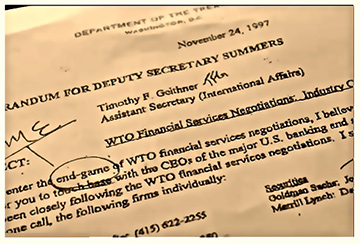 When a little birdie dropped the End Game memo through my window, its content was so explosive, so sick and plain evil, I just couldn’t believe it.


