Showing posts with label corporate health care bill. Show all posts

Tuesday, January 21, 2014

The ACA and America’s Health-Care Mess


by Gerald Friedman

While it was enacted in 2010 without a single Republican vote, the Patient Protection and Affordable Care Act (ACA), a.k.a. “Obamacare,” was built model first proposed by the conservative Heritage Foundation in the 1990s and implemented by Republican Governor Mitt Romney in Massachusetts in 2006. The ACA extends the public safety net to more of the working poor but otherwise keeps the private health insurance system intact. Rather than replacing the private system—and far from the “government takeover of health care” its critics claim—it provides subsidies for individuals to buy private health insurance through state-level “exchanges.”

As social policy, the ACA is a qualified failure. The expansion of Medicaid and mandates for individuals to buy subsidized private insurance will expand health insurance to an additional 30 million people. Regulations establishing minimum standards for coverage and barring exclusions for pre-existing conditions will improve coverage for many. On the other hand, by maintaining the existing system of for-profit medicine and private insurance, the ACA does little to rein in out-of-control cost growth while leaving millions without coverage. We can hope that the ACA’s strengths and its failures will soon pave the way for a rational universal system such as single payer health care.

Not Everyone Will Be Insured: While the ACA will provide health insurance to millions of Americans, millions of others will remain uninsured. While over 25 million will gain coverage either through the expansion of Medicaid or by buying subsidized private insurance, somewhat more will remain without coverage. Some are not covered by the act (including undocumented immigrants); others will be excused from the requirement to have insurance because of cost; and others will not comply (see Figure 1).


Figure 1: Projected Effects of ACA on the Uninsured, 2013-2023


Problems of People with Insurance Will Remain: Because it builds on the existing private health-insurance system, the ACA does little to reduce access problems for people with health insurance. Those with insurance have dramatically fewer problems accessing health care (including seeing doctors, arranging follow-up visits, and filling prescriptions) than those without. But even insured Americans are twice as likely as citizens of countries with public insurance to have trouble getting care (see Figue 2).


Figure 2: Cost-Related Access Problems


States Rejecting Medicaid Expansion and Exchanges Are Lowering Enrollment: The ACA’s Medicaid expansion would cover everyone with incomes up to 133% of the federal poverty level. Half the states, all with Republican governors, rejected expansion, denying coverage to 7.5 million people. States can establish “health exchanges” for people to choose a health plan and sign up for federal subsidies. Republicans refused to establish exchanges in 34 states.

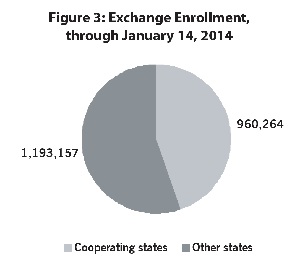
After a slow start, enrollment has picked up states with their own exchanges. Problems with the federal website slowed errollment elsewhere, though it has recently surged as well. Including those newly covered by the Medicaid expansion, the ACA has now extended coverage to about 4% of the uninsured in non-cooperating states, compared to over 15% of those in the cooperating states. If the proportion enrolling were the same in the non-cooperating states as in states with their own websites, an additional 4 million Americans would now have health insurance (see Figure 3).

Figure 3: Exchange Enrollment, through January 14, 2014


The ACA Is Highly Redistributive: The ACA will reduce out-of-pocket spending on uncovered expenses, deductibles, and copayments. Federal subsidies will reduce premiums while coverage expansion will lower reduce hospital surcharges for the uninsured. Public spending will increase, on Medicaid and subsidies; expenditures paid for with other savings taxes on expensive insurance plans, and increases in the Medicare payroll tax for high-income individuals. Taxing the rich to provide health care for the working poor, the ACA is the largest redistributive program enacted since the 1960s (see Figure 4).


Figure 4: Projected Effects on Health Spending by Source, 2010-2022


The ACA Does Not Control Costs; Single-Payer Would: The ACA does not establish a sustainable health-care finance system in the United States. Under the ACA, health care spending will continue to increase significantly faster than the economy as a whole and the share of the economy going towards health care will rise in the next decade to nearly 20%. By controlling administrative costs and drug prices, a single-payer system can hold healthcare spending to less than 17% of the GDP (see Figure 5).

Figure 5: Health Care Spending as a Percentage of GDP, ACA vs. Single-Payer, 2006-2022

Friday, October 11, 2013

ObamaCare: Worse Than Doing Nothing?

Keeping the Insurance Companies in Command by RUSSELL MOKHIBER


That’s the conclusion of single payer advocate Dr. Quentin Young, national coordinator for Physicians for a National Health Program (PNHP), in his just released autobiography – Everybody In, Nobody Out: Memoirs of a Rebel Without a Pause.

“Had I been in Congress, I would have unequivocally voted against Obamacare,” Young writes. “It’s a bad bill. Whether it’s worse than what we have now could be argued. We rather think because of its ability to enshrine and solidify the corporate domination of the health system, it’s worse than what we have now. But whether it is somewhat better or a lot worse is immaterial. The health system isn’t working in this country — fiscally, medically, socially, morally.”

Young rejects the idea that President Obama should have compromised on single payer in the face of industry opposition.

“I don’t have any sympathy for the idea that the president had to compromise because his opposition was strong,” Young writes. “Winning is not always winning the election. Winning is making a huge fight and then taking the fight to the people — re-electing people who are supporting your program and defeating those who aren’t.”

Young first met the young Barack Obama in the mid-1990s at social gatherings.

At the time, Obama was lecturing at the University of Chicago Law School and practicing law.

“We did not become bosom buddies after a few of these social gatherings — I just viewed him as a nice, bright guy living in the neighborhood,” Young says.

When Obama ran for the Illinois Senate, Young supported him.

“I was happy with his views on health care,” Young writes. “He recognized that major reform was necessary and indicated support for a single-payer approach. No blushing friend, I took every opportunity to solidify his position. While not an official adviser, I tried to influence him as much as I could. My colleagues and I sent him notes touting the advantages of single-payer and the form it might take and talked with him and his staff about it whenever I had the chance.”

“I felt I did influence him,” Young said.

When Obama ran for the Senate in 2003, Obama told the Illinois AFL-CIO:

I happen to be a proponent of a single payer universal health care program. I see no reason why the United States of America, the wealthiest country in the history of the world, spending 14 percent of its Gross National Product on health care cannot provide basic health insurance to everybody. And that’s what Jim is talking about when he says everybody in, nobody out. A single payer health care plan, a universal health care plan. And that’s what I’d like to see. But as all of you know, we may not get there immediately. Because first we have to take back the White House, we have to take back the Senate, and we have to take back the House.”

But just a year later, Obama had flipped and came out against single payer in Illinois.

“I was very disappointed by his move to the right to keep the insurance companies in command,” Young told the Springfield State Journal Register in 2004. “I’m not accusing him of lying or misconduct. I’m accusing him of a lack of courage.”

But despite Obama’s “lack of courage,” Young supported Obama in his run for U.S. Senate and later for president. Young was just setting himself up for more disappointment.

At a town hall meeting in Portsmouth, New Hampshire in August 2009, Obama was asked whether he supported a universal health care plan.

“First of all, I want to make a distinction between a universal plan versus a single-payer plan, because those are two different things,” Obama said.

“A single-payer plan would be a plan like Medicare for all, or the kind of plan that they have in Canada, where basically government is the only person — is the only entity that pays for all health care. Everybody has a government-paid-for plan, even though in, depending on which country, the doctors are still private or the hospitals might still be private. In some countries, the doctors work for the government and the hospitals are owned by the government. But the point is, is that government pays for everything, like Medicare for all. That is a single-payer plan.”

“I have not said that I was a single-payer supporter because, frankly, we historically have had a employer-based system in this country with private insurers, and for us to transition to a system like that I believe would be too disruptive. So what would end up happening would be, a lot of people who currently have employer-based health care would suddenly find themselves dropped, and they would have to go into an entirely new system that had not been fully set up yet. And I would be concerned about the potential destructiveness of that kind of transition.”

“All right? So I’m not promoting a single-payer plan,” Obama said.

In March 2010, Congress passed the Affordable Care Act — Obamacare — by a narrow margin.

“PNHP’s policy experts did a line-by-line examination of the bill and, while acknowledging that it contains some modest benefits that make changes around the edges of our existing system, basically gave it two thumbs down,” Young writes. “To this day, much to the chagrin of many of our friends who wanted reform, I remain adamant in my rejection of Obamacare.”

“Why? We want a system that excludes the private insurance companies,” Young writes. “ We demand such exclusion not because these companies are good or evil (although we think they’re pretty evil). Rather, the reason to exclude them is that they don’t address the needs of the American people.”

Young also rejects the idea of a “public option,” pushed by Democrats such as Howard Dean. A public option “would not have made any significant difference on the overall impact” of Obamacare “contrary to the view of many progressive who believed that it would,” Young says.

“Since WWII, we have learned a lot about disease and certainly have had dramatic improvements in what we can do,” Young writes. “I’m talking about surgery of the heart, vaccination, nutrition issues. All these things have been largely defined in the last half-century. We’ve had something approaching a 12-year life expectancy rise just from scientific intervention.”

“We have all this knowledge, all these options, but we have a very backward financing and delivery system and the result is a great deal of human suffering,” Young says. “And that’s why we remain opposed to the Affordable Care Act. We think we have a winning proposition despite the reality in Congress. Polls repeatedly vindicate our position. A solid majority of the public and 59 percent of doctors support the single payer approach.”

“President Obama could have made it happen,” Young says. “He could have stuck to all the virtues of single payer. And I won’t deny he may have been defeated in the first round. There’s no question that this fight has been dirty and it’s going to get dirtier.”

Friday, September 28, 2012

Reflections on a Medical Career

The Impending Collapse of American Medicine
by Robert S. Dotson, M.D.


Just as is every issue in the US, Obamacare and the wider question of the state of American health care are obscured by propaganda and disinformation. In the article below, Dr. Robert S. Dobson looks back on a lifetime of medical practice and provides facts and insights that might help us to understand our situation.

The US medical system is the most expensive on earth without being the best and without providing full coverage. One-sixth of the American population has no medical coverage.

There are two main reasons that US medicine is so expensive. One is that profits are piled upon profits. In addition to wages and salaries for doctors, nurses, and medical personnel, the American health care system has to provide profits for private hospitals, diagnostic centers, insurance companies, and for the accountants, attorneys and management consultants made necessary by the enormous litigation and regulatory compliance cost. American medicine is the most regulated in the world and the most criminalized.

What “Obamacare” does is to divert Medicare and Medicaid monies to the profits of private insurance companies. Instead of providing medical care to those in need, the taxpayers’ money will provide bonuses for insurance executives and profits for their shareholders. It is the height of folly for Obama worshipers to defend a law written by the private insurance companies that uses public revenues to provide insurers with 50 million more customers and to add yet another layer of profits to the cost of American medicine. ~ Paul Craig Roberts
_________________________________________________________________________________________

Reflections on a Medical Career
Robert S. Dotson, M.D.

All lovely things will have an ending, All lovely things will fade and die; And youth, that’s now so bravely spending, Will beg a penny by and by.
~Conrad Aiken (“Disenchantment IV”- 1916)

Thirty years have passed since a much younger physician opened his ophthalmology practice in East Tennessee. A lifetime of hopes and expectations, intermingled with the usual collection of fears and uncertainties, has sped past at blinding speed. Children came, grew up, and moved on to their own lives. Parents and grandparents, aunts and uncles, many friends and colleagues have returned to dust in advance of their fading photos.

Patients and their parents and children and grandchildren have moved in and out of this world, too, inextricably woven into the fabric of my life. Sadly, a few may have been hurt by lapses in judgment or the arrogance of youthful physician pride and overconfidence. But, at the end of the day, most were helped. I was fortunate to be recognized as a “doctor’s doctor” early on and, though there was no attendant reward other than the respect of peers, that was a sufficiently gratifying laurel to carry.

As in any human story, joy and pain, love and sorrow, have marked these same years. The Millstone of Time has also worn away foolish aspirations and vainglorious pretensions. There is no one left to impress, no accolades to seek, no rank to which to aspire. Consequently, I feel freed to offer some end-of-life reflections on my profession and career.

Any thinking American knows that there is something terribly wrong with the health care system in this country. Throughout my career, the political ruling elite has been enacting piecemeal a version of “universal” healthcare coverage to satisfy the demands of an increasingly vocal, but also increasingly disenfranchised citizenry. Our overlords, of course, have been more motivated by enhancing corporate bottom lines and enriching themselves, than in genuinely helping the peasantry.

Every U.S. President since Kennedy in 1962 has dealt with the issue in one way or another – by policy statement or passage of legislation. LBJ oversaw the creation of Medicare and Medicaid in 1965. Nixon oversaw the passage of the HMO Act (Health Maintenance Organization) in 1973 and ERISA (Employee Retirement Income Security Act) in 1974. Amazingly, he also introduced CHIA (Comprehensive Health Insurance Act) in 1974. Even more incredible was the spectacle of Ted Kennedy working to ensure its defeat. Doubtless, Kennedy regretted that in future years. Following the untimely departure of the 37th President, Gerald Ford signed ERISA into law in 1974 on his behalf, thereby introducing some minimal regulations to ensure that separated employees could maintain benefits, such as health insurance, for a limited time.

Carter campaigned in favor of National Health Insurance, but failed to pass anything similar during his time in office. He cited Kennedy’s opposition to CHIA and to his own proposals as the main reason for failure. Reagan’s era witnessed the passage of EMTALA (Emergency Medical Treatment and Active Labor Act) and COBRA (Consolidated Omnibus Budget Reconciliation Act) in 1986 that, among other things, provided for emergency medical treatment coverage for anyone who could drag themselves into an emergency room (of course, such a visit might bankrupt them unless they were lucky enough to be an illegal alien). Medical labs and imaging centers (and, the providers staffing them) were given “special attention” under CLIA (1988).

The first President Bush had little time for national health care issues, as he was primarily focused on launching the NWO. Poppy’s “Thousand Points of Light” degenerated into in-coming tracers from the illuminated Angel of Death – simply more “peace, freedom and liberty” being delivered to millions of innocents across Battlefield Earth. It seems so trivial now, but Bush was unseated after reneging on his pledge of “no new taxes,” not for offshoring the US economy or taking the first step toward turning US foreign policy into the pursuit of world hegemony.

The Clinton administration tried to force through “Hillarycare” in 1993, but met with stiff opposition from their Republican opponents (of course, the opposition was due to perceived threats to corporate profit margins). Nonetheless, Team Clinton was able to push through HIPAA (1996) (Health Insurance Portability and Accountability Act) and SCHIP (1997) (State Children’s Health Insurance Program) which, contrary to the titles of the acts, neither improved health insurance portability or accountability nor improved the health of children.

The Clinton White House had more important fish to fry: war in the Balkans; the liberal distribution of depleted uranium and cruise missiles across the globe; test wars on Americans at places like Ruby Ridge, Waco, and Oklahoma City (OKC); the appearance of numerous “Arkan-cide” victims whose mortal remains seemed to be discovered at the most inconvenient times; and, a semen-stained blue dress. The first versions of the Patriot Act were trotted out in response to the false flag event of OKC, but Congress and even the Imperial Senate balked at moving so precipitously toward the New Amerikan Security State.

The ascension of son Bush and his neoconservative cabal turned the government to the drive toward world hegemony. The serendipitous events of 9/11 opened the door for passage of the neocon’s PATRIOT Act and for the still on-going implementation of their Project for the New American Century (PNAC). New alphabet agencies like DHS and TSA were created to augment existing departments and agencies (FDA, DHHS, IRS, FTC, FCC, EPA, FEMA, DEA, BATF, FBI, NSA, CIA, and DOD) charged with dominating the nation and the planet beyond. Orwell’s dystopia, 1984, became reality: “War is Peace. Freedom is Slavery, Ignorance is Strength.” President Bush modeled Big Brother’s third slogan for an admiring populace more concerned with Harry Potter and Janet Jackson’s nipple than with the deadly machinations of the psychopath in charge.

It seems likely that steps toward the Third World War were taken during Bush II’s reign with “war, war, WAR” being unconstitutionally declared against the nebulous (some might say, non-existent) terrorists lurking under every bed and in every closet, cave, and country on the planet. In spite of a premature proclamation of “Mission Accomplished” from a flag-festooned carrier in 2003 by the Decider-In-Chief, the killings have continued with little pause up to this day. The Great Decider used the opportunity of “victory” abroad, however, to turn his attention to the healthcare needs of his subjects.

What could be a better bone to throw to the peasants than the expansion of pharmaceutical coverage for those under Medicare? And, what could be a better pay-off for corporate buddies than massive new government wealth transfers of taxpayers’ dollars to Big Pharma via such a plan? It was a perfect “win-win” for the oligarchs at the top of the pyramid and a “lose-lose” for the peons at the bottom. To the great joy of Big Pharma, the Medicare Prescription Drug, Improvement and Modernization Act (Medicare, Part D) was launched in 2003 to insure unimaginable profits for its corporate members and more expense for the common people it was alleged to help. As in any casino, our healthcare croupiers are well trained to leave no dollar on the table.

President Obama, a corporate stooge par excellence, was able to ram through “universal healthcare” with the help of a Howdy Doody smile, his corporate sponsors, and the slavish devotion of an ever-delusional, pseudo-Left. It mattered not that the legislation was written by the insurance companies who had been profiting from the misery of patients for decades.

It is no accident – and would be comical, if it were not so serious – that there will be no true, equitable national health care system under the Patient Protection and Affordable Care Act of 2010 (aka, “Romneycare II” or “Obamacare” or, lately, “Robertscare” in homage to a Supreme Court judge) and its accompanying legislation, the Health Care and Education Reconciliation Act. No Single Payer. No mutual insurance system that provides a basic level of healthcare for the proles of this collapsing Security State. Instead, we are witnessing the imposition of a system that will further enslave and impoverish the peasants here in Gulag Amerika. How poetic that a self-identifying “black man” is the front for resurrecting a 21st century version of chattel slavery in the twilight years of Empire.

Obama was positively beaming in his many photo-ops with the sponsoring corporatist representatives of Corporate Medicine, Big Insurance, Big Pharma, and Big Government who enabled the Prince of Change to achieve this milestone deception of America. The very fact that this “wonderful” new system – lauded by supporters as “revolutionary” – is to be enforced by a projected army of 16,500 new IRS agents should give us pause.

Notwithstanding passage of the legislation, decades of bad healthcare policy and corporatist plunder are finally taking their toll. The collapse of the ill-conceived US health care system might be near.

Ever more intrusive regulations are driving up the cost of medical care, and the practice of medicine is being criminalized. Even with all of their flaws, Medicare and Medicaid have provided a safety net for the elderly and disadvantaged since their inception. Those systems’ days are numbered, however, as they are being gutted to turn health care into profits not for doctors and hospitals but for insurance companies and Big Pharma. For starters, large sums have been ear-marked to be taken from Medicare and Medicaid to help fund PPACA (Patient Protection and Affordable Care Act). Is looting Social Security and Medicare “change one can believe in”?

If this system is bad for patients, what does it mean for doctors? It means falling reimbursement rates and rising overhead costs for providers, onerous government mandates and regulations, and institutionalized, legalized larceny by Big Pharma, Big Insurance and Corporate Medicine. As an example of how time and circumstance have affected my own profession of ophthalmology, one need only look at Medicare approved reimbursement rates for cataract surgery.

In reflecting back over my many years in the field of ophthalmology (as of this writing, I am 63 years old and feeling pretty shop-worn), I am staggered by the changes that have occurred. When I opened my practice in 1982, Medicare approved surgical fees for cataract and implant surgery were near $1200. By 2012, that approved charge had dropped to about $570 in Tennessee. (There is some variance within states based on rural versus metro areas and between states where some are declared to have higher costs of doing business.)

Additionally, the US dollar has declined in value an average of almost 2.5% per year over the past 30 year period. Needless to say, overhead operating costs – salary, rent, insurance, personnel costs, taxes, and normal business expenses – have exploded during this same 30 year period. My office rent was raised 20% in the Fall of 2011, for instance.

To further illustrate the absurdity of the situation, it is worth recounting an anecdote. Several years ago, a patient excitedly told me of the vision restoring cataract surgery that her poodle had received at the local veterinary college. It “only cost $2600 for both eyes!” At the time, Medicare was paying about $1400 for two eyes in a human – including work up, surgical fee, post-op care for 90 days, and the very real liability associated with being a physician in a litigious society.

I do not begrudge my animal doctor friends their success, but surely the worth of human care should at least approximate that for a poodle. Although I know veterinarians who are struggling in their own practices due to the economic recession, at least they do not have to deal with government fee-setting and the liability and costs associated with treating humans. They are able to price their services sufficiently to keep their practices open and to provide for their own health care and retirement.

In my own practice, the amount of “write off” on charges for legitimate services rendered began to climb as we entered the 21st Century. For years, the “disallowed” charges by Medicare and private insurers resulted in “discounts” of 20-25%. As the economic upheaval of 2008 rolled around, those fee adjustments (actually theft of labor from providers) began to climb – 30%, 32%, 35%, and in my last year of practice over 60%! For years, I had been able to subsidize my Medicare (cataract) side of the practice by offering elective refractive surgery procedures (LASIK, PRK, etc.) to my patients. As these were private pay cases, they offset the draconian cuts in Medicare and insurance fee “adjustments.” The economic collapse of 2008, however, reduced that income stream for many ophthalmologists and, subsequently, led to the closing of many practices throughout the country.

Most general ophthalmologists are, by definition, primarily cataract surgeons. Many people – including Medicare recipients – do not realize that the fees paid to their physician are fixed by the U.S. Government after consultation with its many corporate sponsors within Big Insurance, Big Pharma, and Corporate Medicine. Patients also do not realize that those reimbursement levels are set by central planners at below-cost levels.

Medicare issues cut across all specialties, and ophthalmology has not been alone in experiencing cutbacks. Primary care physicians have increasingly become “piece good workers” – managed by corporate pencil pushers to see a patient every 6-8 minutes while being forced to carry all the liability and manage all the data and coding previously done by insurers.  

Who can diagnose, much less treat a patient in 6-8 minutes?

My own solo cardiologist was forced to close his practice last Fall and seek employment with an area hospital, due to declining reimbursement levels. More than 51% of cardiologists in the U.S. are now hospital employees. One of my medical school classmates, a successful internal medicine specialist, has recently given up the fight and has plans to enter some other line of work. Several friends in Radiology have seen their incomes decline as more and more work is “outsourced” to tele-docs in Asia. Still other long-time friends who are general surgeons are struggling to survive (a surgical fee for incisional cholecystectomy, for instance, is now under $400). Several have retired prematurely and others are looking for other work to do. As a final example, another of my friends is one of five physicians in a busy urology practice (2 offices and 26 employees) and they are now borrowing from the bank to make payroll. A recent article from CNN, “Doctors Going Broke,” confirms the growing problem. http://money.cnn.com/2012/01/05/smallbusiness/doctors_broke/index.htm

As income reductions are being imposed on private practice, costs are being driven up by exploding regulations. In addition, the plethora of new mandates and laws have increasingly criminalized every aspect of the practice of medicine and created vast new armies of armed bureaucrats whose sole aim is to impose civil and criminal penalties on any provider unlucky enough to be singled out for attention. The old Soviet dictum attributed to Lavrenti Beria (Stalin’s NKVD chief), “Show me the man and I’ll find you the crime,” is in full force in Amerika.

The present puppet in the White House has completed the work begun by his predecessors in moving the nation into a police state. The NDAA passed in the Fall of 2011 was the final nail in the coffin of personal freedoms guaranteed by the US Constitution. By suspending habeas corpus and even trial by judge or jury, the Act has made certain that no person is safe from being violated by a power-mad Security State. At the mere movement of the Unitary Executive’s pen, it is now permissible to “disappear” or even execute anyone on the planet – all on the whim of the unaccountable psychopath in charge. Judge Andrew P. Napolitano has reported that our present Unitary Exec spends every Tuesday morning reviewing and signing off on a kill list supplied by his loyal minions. Nobel Peace Prize worthy stuff, indeed!

One is presumed guilty now in Amerika until proven otherwise and nowhere has this been more demonstrated than in the policing of medicine. Heaven help the poor provider who is targeted by the Medicare Police – or now, one supposes, by the new IRS Medical Special Branch. If targeted, his or her practice will be shut down without due process. His or her assets will be seized without due process (assuring the inability to even defend oneself). Finally, the unlucky guilty-until-proved-innocent physician will be permanently discredited (libeled) in his or her community with the ready help of the Government’s countless propaganda organs – press, radio, and TV – all before any day in court is seen.

New restrictions, rules, and regulations on healthcare – on providers and patients alike – have imposed legal constraints with which full compliance is impossible. Medicare rules and regs alone fill tens of thousands of pages, and ignorance of any of them is no defense for the unlucky. The original HIPAA legislation has been amplified with many additions since its inception in 1996: FERPA, HITECH, ARRA (2009). Each additional act or regulation has further criminalized the practice of medicine.

Finally, the entire health care system is being forced to switch to electronic health records (EHRs) and, soon, to a completely new coding system (from ICD-9 to ICD-10). Failure to comply with these mandates will result in further reductions in provider payments with every year that they remain unimplemented. For a solo physician practice, it is estimated that each mandate will cost as much as $80,000 to implement initially and, then, $10-15,000 annually to maintain. For multi-physician practices, costs run as high as three times (or more) that of a single provider practice. Of course, the purpose behind all of this is to make each person’s most private and personal information available to government bureaucrats and regulators while also ensuring its accessibility to the Security State’s many law enforcement tentacles and to all the corporate members of the Medical-Industrial complex.

Unfettered access to this information will ensure that the Corporate State can maximize its profits, largely avoid all risk and liability, and eliminate any potential competition (such as, often cheaper and more effective alternative medicine providers and therapies, non-GMO whole foods, and nutritional supplements). It will also ensure that medicine is practiced/delivered within strict cookbook guidelines that are carefully written by non-physician bureaucrats to maintain corporate profits and government power. All of this is well along in implementation.

A recent article, “Efforts to implement Obamacare law raise concerns of massive government expansion” from Fox News, 5 July 2012, (http://www.foxnews.com/politics/2012/07/03/efforts-to-implement-obamacare-law-raise-concerns-massive-government-expansion/#ixzz1ziuZDCSV) informs us that lawyers have already “drafted more than 13,000 pages of Obamacare regulations and that this number will increase further over coming months. In addition, we are told that DHHS (Department of Health and Human Services) has been given more than one billion dollars to date in order to begin oversight of this mess and that more than 180 “commissions, boards, and bureaus” within the Agency are already hard at work implementing the final destruction of American medicine.

Widespread vaccination of the population with untested “stabs” will be mandated and enforced. As long predicted by Tin Hatters around the planet, this will permit biometric “nano-chipping” of the citizenry without the unpleasant need to ask their permission.

Vast sums will be committed to “preventive” medicine which will prevent nothing and will only expand the reach of the Medical-Industrial complex into every nook and cranny of a person’s life – and, into every wallet. Certain corporate profit-driven diets and treatment regimens will be mandated and enforced; access to nutritional supplements and alternative medicine practices will be limited or banned altogether; behavior patterns of all types will be monitored and carefully scripted and controlled (what we see, hear, read, do, eat, drink, and breathe – where and how we work, play, and live) under the guise of State Security concerns and its new companion, Public Health or Public Good; and, finally, the Corporate State will deploy “death panels” to decide when a person has outlived his or her economic usefulness to the State. In spite of Obama’s denials that such bodies exist and Palin’s diversionary, hysterical rantings at Tea Party rallies, there is clear provision in the Act for bureaucratic decision-making bodies which will make end-of-life decisions for us all. These entities are already being formed and deployed across the land. Our Anglo cousins in the UK are showing us the way by withholding food and fluids from as many as 29% of their hospital patients now who are judged to be living beyond their government-dictated “use-by” dates (pragmatically justified “to free up beds” – oh, those Brits and their refined sense of humor).

What can be done about the failing American health care system and the wider collapse of the economy and civil liberty? Frankly, very little. The system is rigged against the people as it has always been, only now one can be “black-bagged” and disappeared at any time. Protest too loudly and one is liable to literally see a grim Reaper overhead with one’s personal biometrics programmed into its fire control system. Like every other institution within the United States, the medical system is totally and completely broken. It can no longer be fixed by “voting” for the lesser of evils, by printing bales of fiat currency, or even by deploying fleets of obsolete aircraft carriers across the planet.

If as it seems we are arriving at the end of an age, if we can survive the end, something better might arise from the ashes. The prospect of collapse turns one’s thoughts to escape and survival. Can you do either? Volumes have been written about preparedness in a time of chaos, so I will spare readers a rehash. But, a few comments about healthcare, in particular, might be in order.

In a perfect world, it is my opinion that we should have some form of single payer healthcare system and divorce ourselves from corporate medicine. In my opinion, this will not happen without the complete collapse of the present system. Since that is unlikely to occur before more seasons of national election fraud are imposed on us, a few “in-the-meantime” suggestions follow:

Avoid contact with the existing health care system as far as possible. Yes, emergencies arise that require the help of physicians, but by and large one can learn to care for one’s own minor issues. Though it is flawed, the internet has been an information leveler for the masses and permits each person to be his or her own physician to a large degree. Take advantage of it! Educate yourself about your own body and learn to fuel and maintain it as you would an expensive auto or a pet poodle. One does not need a medical degree to:

  1. avoid excessive use of tobacco or alcohol or, for that matter, caffeine;
  2. avoid poisons like fluoride, aspartame, high fructose corn syrup, and addictive drugs (legal or illicit);
  3. avoid unnecessary and potentially lethal imaging studies (TSA’s radiation pornbooths, excessive mammography, repetitive CT scans – exposure to all significantly increases cancer risk);
  4. avoid excessive cell phone use and exposure to other forms of EMR pollution where possible (the NSA is recording everything you say and text anyway);
  5. avoid daily fast food use and abuse (remember: pink slime and silicone) ;
  6. avoid untested GMO foods (do you really want to become “Roundup Ready?”);
  7. avoid most vaccinations and pharmaceutical agents promoted by the establishment;
  8. avoid risky behaviors (and, we do not need a bunch of Nanny State bureaucrats to define and police these);
  9. exercise moderately;
  10. get plenty of sleep;
  11. drink plenty of good quality water (buy a decent water filter to remove fluoride, chloride, and heavy metals);
  12. wear protective gear at work and play where appropriate (helmets, eye-shields, knee and elbow pads, etc.);
  13. seek out locally-grown, whole, organic foods and support your local food producers;
  14. take appropriate nutritional supplements (multi-vitamins, Vitamin C, Vitamin D3);
  15. switch off the TV and the mainstream media it represents;
  16. educate yourself while you can;

And, lastly…

17. QUESTION AUTHORITY!

Doing these simple, common-sense things will add healthy years to a person’s life and help one avoid most medical encounters during his or her allotted time on earth.

Finally, we have a responsibility to our neighbors and our families. We need to reach out to those around us – talk to them, listen to them – sympathize and empathize. Take time especially to listen to those who are in pain and are suffering and to help them by being humane. If you do this, you will discover that we have more in common with each other than the ruling elite wants us to believe. Governments obtain power and control by taking advantage of divisions along religious, ethnic, class, economic, ideological, and nationalistic lines. We must awaken to this fact if the 99% are to prevail against the 1%.

As for me, I was finally forced to close my practice earlier this year. Nearly two years of consulting with multiple attorneys, accountants, practice management consultants, and bankers, and expending most of my resources in a vain effort to keep operating, were simply not enough. It seemed only poetic that April Fool’s Day 2012 should be chosen for turning out the lights and ringing down the curtain. Patients and employees and suppliers were notified of the end. Many had been with me for my entire career and leaving them was and remains painful. More than nine thousand active charts were transferred to the care of a younger ophthalmologist still trying to stay afloat.

I share the heartache of many physicians forced out of medicine by the high cost of practicing it. As the health system is stripped of medical care in behalf of corporate profits, its exploitative character will become clear to all. In the meantime, don’t give in or give up. Plan for something better on the other side of chaos.

I wanted a perfect ending. Now I’ve learned, the hard way, that some poems don’t rhyme, and some stories don’t have a clear beginning, middle and end.
~ Gilda Radner

Glossary of Terms:

ARRA American Recovery and Reinvestment Act of 2009
CHIA Comprehensive Health Insurance Act
CIA Central Intelligence Agency
CLIA Clinical Laboratory Improvement Amendments of 1988 – administered by CMS
CMS Centers for Medicare and Medicaid Services
COBRA Consolidated Omnibus Budget Reconciliation Act of 1985
DHHS Department of Health and Human Services
DHS Department of Homeland Security
DOD Department of Defense
EMR Electromagnetic radiation
EMTALA Emergency Medical Treatment and Active Labor Act – part of COBRA1986
EPA Environmental Protection Agency
ERISA Employee Retirement Income Security Act
FEMA Federal Emergency Management Agency
FBI Federal Bureau of Investigation
FDA Food and Drug Administration
FERPA Family Educational Rights and Privacy Act (1974 original legislation)
GMO Genetically Modified Organisms
HCERA Health Care and Education Reconciliation Act of 2010 – supplement to PPACA
HIPAA Health Insurance Portability and Accountability Act
HITECH Health Information Technology for Economic and Clinical Health Act (2009)
HMO Health Maintenance Organization
ICD-10 International Statistical Classification of Diseases and Related Health Problems 10th Revision
IRS Internal Revenue Service
NDAA National Defense Authorization Act
NSA National Security Agency
NWO New World Order
PPACA Patient Protection and Affordable Care Act
SCHIP State Children’s Health Insurance Program
TSA Transportation Security Administration
USAPA Unifying and Strengthening America by Providing Appropriate Tools Required to Intercept and Obstruct Terrorism – aka, The Patriot Act

****

Whether you agree or disagree with his points, you have to agree that it was a compelling read.--jef

Thursday, April 12, 2012

What is ObamaCare?

A wasted opportunity--no public option, no single payer--no good!--jef

High-Cost Privatized Medicine that Guarantees Billions of Dollars in Profits to Private Insurance Companies
by PAUL CRAIG ROBERTS

Growing up in the post-war era (after the Second World War), I never expected to live in the strange Kafkaesque world that exists today. The US government can assassinate any US citizen that the executive branch thinks could possibly be a “threat” to the US government, or throw the hapless citizen into a dungeon for the rest of his or her life without presenting any evidence to a court or obtaining a conviction of any crime, or send the “threat” to a puppet foreign state to be tortured until the “threat” confesses to a crime that never occurred or dies at the hands of “freedom and democracy” while professing innocence.

It has never been revealed how a single citizen, or any number thereof, could possibly comprise a threat to a government that has a trillion plus dollars to spend each year on security and weapons, the world’s largest navy and air force, 700 plus military bases across the world, large numbers of nuclear weapons, 16 intelligence agencies plus the intelligence agencies of its NATO puppet states and the intelligence service of Israel.

Nevertheless, air travelers are subjected to porno-scanning and sexual groping. Cars traveling on Interstate highways can expect to be stopped, with traffic backed up for miles, while Homeland Security and the federalized state or local police conduct searches.

I witnessed one such warrantless search on Easter Sunday. The south bound lanes of I-185 heading into Columbus, Georgia, were at a standstill while black SUV and police car lights flashed. US citizens were treated by “security” forces that they finance as if they were “terrorists” or “domestic extremists,” another undefined class of Americans devoid of constitutional protections.

These events are Kafkaesque in themselves, but they are ever more so when one considers that these extraordinary violations of the US Constitution fail to be overturned in the Supreme Court. Apparently, American citizens lack standing to defend their civil liberties.

Yet, ObamaCare is before the US Supreme Court. The conservative majority might now utilize the “judicial activism” for which conservatives have criticized liberals. Hypocrisy should no longer surprise us. However, the fight over ObamaCare is not worth five cents.

It is extraordinary that “liberals,” “progressives,” “Democrats,” whatever they are, are defending a “health program” that uses public monies to pay private insurance companies and that raises the cost of health care.

Americans have been brainwashed that “a single-payer system is unaffordable” because it is “socialized medicine.” Despite this propaganda, accepted by many Americans, European countries manage to afford single-payer systems. Health care is not a stress, a trauma, an unaffordable expense for European populations. Among the Western Civilized Nations, only the richest, the US, has no universal health care.

The American health care system is the most expensive of all on earth. The reason for the extraordinary expense is the multiple of entities that must make profits. The private doctors must make profits. The private testing centers must make profits.The private specialists who receive the referrals from general practitioners must make profits. The private hospitals must make profits. The private insurance companies must make profits. The profits are a huge cost of health care.

On top of these profits come the costs of preventing and combatting fraud. Because private insurance companies resist paying and Medicare pays a small fraction of the medical charges, private health care providers charge as much as they possibly can, knowing that the payments will be cut to the bone. But a billing mistake of even $300 can bankrupt a health care provider from legal expenses defending him/her self from fraud accusations.

The beauty of a single-payer system is that it takes the profits out of the system. No one has to make profits. Wall Street cannot threaten insurance companies and private health care companies with being taken over because their profits are too low. No health-provider in a single-payer system has to worry about being displaced in a takeover organized by Wall Street because the profits are too low.

Because a single-payer system eliminates the profits that drive up the costs, Wall Street, Insurance companies, and “free market economists” hate a “socialized” medical care system. They prefer a socialized “private” health care system in which public monies flow into private insurance companies.

To make the costs as high as possible, conservatives and the private insurance companies devised ObamaCare. The bill was written by conservative think tanks and the private insurance companies. What the “socialistic” ObamaCare bill does is to take income taxes paid by citizens and use the taxes to subsidize the private medical premiums charges by private health care providers in order to provide “private” health care to US citizens who cannot afford it.

The extremely high costs of ObamaCare is not “socialistic medicine.” ObamaCare is high-cost privatized medicine that guarantees billions of dollars in profits to private insurance companies.

It remains to be seen whether such a ridiculous health care scheme, nowhere extant on earth except in Romney’s Massachusetts, will provide health care or just private profits.

Wednesday, September 22, 2010

Private Health Care Insurers Skirt New Health Care Law

(Is there anyone else left in the country who doesn't understand that the insurance industry--particularly the health insurance industry--is run by scumbag assholes who are interested in nothing but profits--NOT your health or especially the health of your children, particularly those with health problems? If not, raise your hand and read this article or the others I've posted about the subject. Insurance executives are the scum of the earth. They are corporate Hitlers and deserve the bad that will happen to them if they keep denying sick children unabated access to health care.--jef)

***


Democrats were extra proud when they put a requirement that insurance companies cover children with pre-existing conditions in their new health care law. Now, I bet the CEOs at the country’s largest for-profit insurance companies are even more proud of themselves for easily finding a way around this regulation: simply stop offering child-only policies. From the Denver Post:
At least six major companies — including Anthem, Aetna, Cigna and Humana — have said they will stop writing new policies for individual children not covered by their parents’ or other plans, insurance officials said.
They blamed health reform mandates taking effect Thursday requiring companies that write such policies as of that date to also cover sick children up to age 19.
Of course, President Obama and the rest of the Democrats have already begun pretending to shake their fists in anger at the insurance companies for being evil and putting profits over people. From the Washington Post:
But officials of the Obama administration said the move contradicted a letter from the leader of one of the insurance industry’s most important trade groups after the law’s adoption in March. Karen Ignagni, president of America’s Health Insurance Plans, expressed support for the law’s provisions concerning children with preexisting conditions and promised to “fully comply” with them.
“We expect [insurance companies] to honor that commitment. Insurers shouldn’t break their promise and turn their backs on some of our most vulnerable Americans,” said Jessica Santillo, a spokeswoman for the Department of Health and Human Services.
Frankly, the complaining from Obama is just sad. Either it is hollow grandstanding, or Obama actually thought that the private, for-profit health insurance companies were honest brokers he could trust to not try to find loopholes in the new regulations. If it is the latter, President Obama’s much-touted intellect needs a reevaluation.

At this point, for Democrats to blame the for-profit insurance companies is pathetic. Private insurers are the scorpion in the story of turtle and the scorpion. They have proven for decades they will do anything to avoid regulation, and will always put profits over the health care needs of regular Americans. Heck, by law, as for-profit corporations, they are required to put profits over everything else. Democrats let insurance companies hop on their back, and now they are smack-dab in the middle of the river with them. Don’t scream when they sting you–it is just their nature.

Of course, watching this recent action should fill all Americans with dread. Democrats actually chose to expand coverage to millions by forcing them to buy insurance exclusively from these same misbehaving private companies. If Democrats really believe the job of the government is to insure every American, then they should have had the government do it directly–and more cost effectively–through expanding Medicare for all or a public option, instead of outsourcing it to untrustworthy private insurers that put profits before people.

Signs don’t point to sunny skies ahead

This most recent revelation, cutting out new child policies, combined with the latest massive and apparently unstoppable rate hikes is just more proof of what I spent months warning about: the new law leaves the health insurance companies completely unchecked and the regulations are almost meaningless due to a lack proper enforcement. Frankly, given the billions at stake, and the drive of the for-profit insurance companies to maximize profits, I don’t even know that a really well-designed regulator system could prevent insurers continuing to exploit loopholes.

This might be one of the first examples how, due to poor design, weak regulation, and weaker enforcement, the new law fails to live up to expectations, but I promise you (as someone who read the entire law thoroughly, which apparently even Sen. Max Baucus didn’t) it won’t be the last.

***

(I too read just about every page of the law and there are a ton of potential--and purposefully included--loopholes the scumbags of the for-profit health insurance industry will exploit. There's the other loophole for denying adults with pre-existing conditions: purposefully underfunding the account that will pay for their medical requirements so that when the full law goes into place in 2014, those with pre-existing conditions who expected to be covered won't be. There are many more that will come to light soon enough. I've listed several here on my blog and in discourse with others on Google Buzz.


When you allow corporate/industry lobbyists to write ALL of your laws, you should expect them to include as many loopholes as they think they can get away with. And they will keep doing it as long as THEY ARE WRITING THE LAWS!!!


This law will go down in history as one of the biggest fleecings the corporations have ever put over on the government. And it will be Obama's legacy.--jef)

Saturday, August 7, 2010

Howard Dean: Individual mandate will disappear from HC Bill

By Daniel Tencer | Friday, August 6th, 2010

The individual mandate requiring people to buy health insurance will disappear before health care reform is fully implemented in 2014, Howard Dean said Friday.

The former Democratic Party chairman and vocal champion of health care reform told MSNBC that "by the time this thing goes into effect in 2014, I think the mandate will be gone either through the courts or because it's unpopular."

But Dean said he didn't see this as a problem, pointing to his own state's health care reforms in the 1990s, which did not include an individual mandate.

"The mandate's not essential to the plan anyway," Dean said. "It never was essential to the plan. They did it in Massachusetts and had a mandate, but we have universal health care for kids in my state [Vermont] without a mandate."

Host Savannah Guthrie pointed out that the White House has been arguing the mandate is necessary because, without it, people would only purchase health insurance when they get sick, but Dean rejected the notion.

"There will be two or three percent of the people who cheat," he said. "That is not enough to bring the system to a halt and people don't like to be told what to do."

Dean's comments come in the wake of a Virginia judge's decision earlier this week to allow a constitutional challenge to the individual mandate to go ahead. Legislators in at least 38 states have proposed measures to curb the federal health reform law, with many of the proposals focusing on the individual mandate.

But Dean's argument that the mandate is unnecessary was challenged by Ian Millhiser, a policy analyst at the Center for American Progress. Responding to Dean's comments, Millhiser said Dean was wrong that the lack of an individual mandate wouldn't affect insurance premiums.

Quoting MIT economist and CAP contributor Jonathan Gruber, Millhiser argued that not having an individual mandate would mean people who aren't sick would see buying health care as a "bad deal" and would wait until they got sick. That, in turn would result in fewer people carrying coverage and higher premiums for those who do. Millhiser wrote:

[S]even states attempted to ban preexisting conditions discrimination without also requiring everyone to carry a minimum level of coverage, and all of them saw their premiums skyrocket. According to a scholarly study of Vermont’s health plan, Vermont’s premiums shot up after it enacted a ban on preexisting conditions discrimination but no mandate in 1993. Between 1994 and 1996, most of the country only experienced single-digit increases in its insurance costs. In Vermont, however, average premiums increased by 16 percent during this same two year period.

In Massachusetts, the one state to enact a minimum coverage provision along with its ban on discrimination, the numbers are very different. There, individual premiums fell a massive 40 percent in the years after Massachusetts’ minimum coverage law went into effect, while the rest of the nation experienced a 14 percent increase.

Millhiser also argues that the courts may not strike down the individual mandate. If the courts see the issue as being a case of eliminating discrimination against the sick (by forcing insurers to cover them), they could give the government broad leeway to apply the policy in an effective way -- including an individual mandate, Millhiser writes.

Wednesday, July 14, 2010

Obama’s Health Care Bill Is Enough to Make You Sick

by Chris Hedges | July 12, 2010 by TruthDig.com

A close reading of the new health care legislation, which will conveniently take effect in 2014 after the next presidential election, is deeply depressing. The legislation not only mocks the lofty promises made by President Barack Obama, exposing most as lies, but sadly reconfirms that our nation is hostage to unchecked corporate greed and abuse. The simple truth, that single-payer nonprofit health care for all Americans would dramatically reduce costs and save lives, that the for-profit health care system is the problem and must be destroyed, is censored out of the public debate by a media that relies on these corporations as major advertisers and sponsors, as well as a morally bankrupt Democratic Party that is as bought off by corporations as the Republicans.

The 2,000-page piece of legislation, according to figures compiled by Physicians for a National Health Plan (PNHP), will leave at least 23 million people without insurance, a figure that translates into an estimated 23,000 unnecessary deaths a year among people who cannot afford care. It will permit prices to climb so that many of us will soon be paying close to 10 percent of our annual income to buy commercial health insurance, although this coverage will only pay for about 70 percent of our medical expenses. Those who become seriously ill, lose their incomes and cannot pay skyrocketing premiums will be denied coverage. And at least $447 billion in taxpayer subsidies will now be handed to insurance firms. We will be forced by law to buy their defective products. There is no check in the new legislation to halt rising health care costs. The elderly can be charged three times the rates provided to the young. Companies with predominantly female work forces can be charged higher gender-based rates. The dizzying array of technical loopholes in the bill-written in by armies of insurance and pharmaceutical lobbyists-means that these companies, which profit off human sickness, suffering and death, can continue their grim game of trading away human life for money.

"They named this legislation the Patient Protection and Affordable Care Act, and as the tradition of this nation goes, any words they put into the name of a piece of legislation means the opposite," said single-payer activist Dr. Margaret Flowers when I heard her and Helen Redmond dissect the legislation in Chicago at the Socialism 2010 Conference last month. "It neither protects patients nor leads to affordable care."

"This legislation moves us further in the direction of the commodification of health care," Flowers went on. "It requires people to purchase health insurance. It takes public dollars to subsidize the purchase of that private insurance. It not only forces people to purchase this private product, but uses public dollars and gives them directly to these corporations. In return, there are no caps on premiums. Insurance companies can continue to raise premiums. We estimate that because they are required to cover people with pre-existing conditions, although we will see if this happens, they will argue that they will have to raise premiums."

The legislation included a few tiny improvements that have been used as bait to sell it to the public. The bill promises, for example, to expand community health centers and increase access to primary-care doctors. It allows children to stay on their parent's plan until they turn 26. It will include those with pre-existing conditions in insurance plans, although Flowers warns that many technicalities and loopholes make it easy for insurance companies to drop patients. Most of the more than 30 million people currently without insurance, and the 45,000 who die each year because they lack medical care, essentially remain left out in the cold, and things will not get better for the rest of us.

"We are still a nation full of health care hostages," Redmond said. "We live in fear of losing our health care. Millions of people have lost their health care. We fear bankruptcy. The inability to pay medical bills is the No. 1 cause of bankruptcy. We fear not being able to afford medications. Millions of people skip medications. They skip these medications to the detriment of their health. We are not free. And we won't be free until health care is a human right, until health care is not tied to a job, because we still have an employment-based system, and until health care has nothing to do with immigration status. We don't care if you are documented or undocumented. It should not matter what your health care status is, if you have a disease or you don't. It should not matter how much money you have or don't, because many of our programs are based on income eligibility rules. Until we abolish the private, for-profit health insurance industry in this county we are not free. Until we take the profit motive out of health care we cannot live in the way we want to live. This legislation doesn't do any of that. It doesn't change those basic facts of our health care system."

Redmond held up a syringe.

"I take a medication that costs $1,700 every single month," she said. "I inject this medication. It costs $425 a week for 50 milligrams of medication. I would do almost anything to get this medication because without it I don't have much of a life. The pharmaceutical industry knows this. They price these drugs accordingly to the level of desperation that people feel. Billy Tauzin, the former CEO of [the trade organization of] Big Pharma, negotiated a secret deal with President Obama to extend the patents of biologics, this new revolutionary class of drugs, for 12 years. And Obama also promised in this deal that he would not negotiate drug prices for Medicare."

Obama's numerous betrayals-from his failure to implement serious environmental reform at Copenhagen, to his expansion of the current wars, to his refusal to create jobs for our desperate class of unemployed and underemployed, to his gutting of public education, to his callous disregard for the rights of workers and funneling of trillions in taxpayer money to banks-is a shameful list. Passing universal, single-payer nonprofit health care for all Americans might have delivered to Obama, who may well be a one-term president, at least one worthwhile achievement. Single-payer nonprofit health care has widespread popular support, with nearly two-thirds of the public behind it. It is backed by 59 percent of doctors. And it would have helped roll back, at least a bit, the corporate assault on the citizenry.

Medical bills lead to 62 percent of personal bankruptcies, and nearly 80 percent of these people had insurance. The U.S. spends twice as much as other industrialized nations on health care, $8,160 per capita. Private insurance bureaucracy and paperwork consume 31 percent of every health care dollar. Streamlining payment through a single nonprofit payer would save more than $400 billion per year-enough, PNHP estimates, to provide comprehensive, high-quality coverage for all Americans.

Candidate Obama promised to protect women's rights under Roe. v. Wade, something this legislation does not do. He told voters he would create a public option and then refused to consider it. The health care reform bill, to quote a statement released by PNHP, has instead "saddled Americans with an expensive package of onerous individual mandates, new taxes on workers' health plans, countless sweetheart deals with the insurers and Big Pharma, and a perpetuation of the fragmented, dysfunctional, and unsustainable system that is taking such a heavy toll on our health and economy today."

"Obama said he was going to have everybody at the table," Redmond said, "but that was a lie. Our voice was not allowed to be there. There was a blackout on our movement. We did not get media attention. We did actions all over the country but we could not get coverage. We had the ‘Mad as Hell Doctors' go across the country in a caravan, and they had rallies and meetings. If that had been a bunch of AMA Republican doctors, Cooper Anderson would have been on the caravan reporting live. NPR would have done a series. Instead, they did not get much coverage. And neither did the sit-ins and arrests at insurance companies, although we have never seen that level of activity. They turned us into a fringe movement, although poll after poll shows that the majority of people want some kind of single-payer system."

Our for-profit health system is driven by insurance companies whose goal is to avoid covering the elderly and the sick. These groups, most in need of medical care, diminish profits. Medicare, paid for by the government, removes responsibility for many of the old. Medicaid, also paid for by the government, removes the poor people, who have a greater tendency to have chronic health problems. Hefty premiums, which those who are seriously ill and lose their jobs often cannot pay, remove the very sick. If you are healthy and employed, which means you are less likely to need expensive or complex treatment, the insurance companies swoop down like birds of prey. These corporations need to control our perceptions of health care. Patients must be viewed as consumers. Doctors, identified as "health care providers," must be seen as salespeople.

Insurance companies, which will soon be able to use billions in taxpayer dollars to bolster their lobbying efforts and campaign contributions, know that single-payer nonprofit insurance means their extinction. And they will employ considerable resources to make sure single-payer nonprofit coverage is denied to the public. They correctly see this as a battle for their lives. And if human beings have to die so they can survive, they are willing to make us pay this price.

The for-profit health care industry, along with the Democratic Party, consciously set out to confuse the public debate. It created Health Care for America NOW! in 2008 and provided it with tens of millions of dollars to supposedly build a public campaign for a public option. But the organization had no intention of permitting a public option. The organization was, as Dr. Flowers said, "a very clever way to distract members of the single-payer movement and co-op some of them. They told them that the public option would become single payer, that it was a back door to single payer, although there was no evidence that was true."

Physicians for a National Health Plan attempted to fight back. It worked with a number of organizations under a coalition called the Leadership Conference for Guaranteed Health Care. The group, which included the National Nurse's Union and Health Care Now, sought meetings with members of Congress. Flowers and other advocates asked Congress members to include them in committee debates about the health care bill. But when the first debate on the health care reform took place in the Senate Finance Committee, chaired by Sen. Max Baucus, a politician who gets over 80 percent of his campaign contributions from outside his home state of Montana, they were locked out. Baucus invited 41 people to testify. None backed single payer.

The Leadership Conference, which represents more than 20 million people, again requested that one of their members testify. Baucus again refused. When the second committee meeting took place, Flowers and seven other activists stood one by one in the room and asked why the voices of the patients and the health care providers were not being heard. The eight were arrested and removed from the committee hearing.

Single-payer advocates were eventually heard on a few of the House and Senate committees. But the hearings were a charade, part of Washington's cynical political theater. It was the insurance and pharmaceutical lobbyists who were in charge. They dominated the public debate. They wrote the legislation. They determined who received lavish campaign contributions and who did not. And they won.

"We are talking about life and death, about the difference between living your life and dying," Redmond said. "And once again it came down to the Democratic Party trumping the needs of the people."

Monday, April 19, 2010

Frontline Fronts for Corporations...

...Not the Public

By Dr. MARGARET FLOWERS, M.D.

It was with a sense of déjà vu that I watched the latest Frontline documentary about health care. “Obama’s Deal” endeavored to reveal the significant influence of health industry dollars on our political process; however, as in Frontline’s "Sick Around America," the producers did a disservice by the failure to educate the public about the bigger picture of the health care situation in this nation and the range of possible solutions.

Curiously, just as it was in the health “debate,” single payer, improved Medicare for All, was also excluded from the film. The major point of the influence of health industry dollars on the reform process which should have been mentioned is that these dollars were spent in order to restrict the debate and protect industry profits. The lucrative status quo would have been threatened if single payer had been openly discussed because a publicly-financed national health program can provide high quality universal health care and control health care costs, something that a private insurance based system cannot accomplish.

After watching this film, viewers would have no idea that single payer exists or know that there is a strong movement for it. Considering that there have been attempts to push for a national health program for over 100 years in this nation and that, because of a strong grassroots movement, single payer legislation was nearly introduced on the floor of the House in November and was actually introduced on the floor of the Senate for the first time in this nation last December, the omission appears to be intentional.

Those of us in the single payer movement are accustomed to being censored by the corporate media. The reason for our exclusion is known: health insurance and pharmaceutical corporations advertise heavily on these airwaves and wield considerable power over the programming. This was described clearly by Fairness and Accuracy in Reporting’s August 2009 piece titled “Single-Payer & Interlocking Directorates: The corporate ties between insurers and media companies” by Kate Murphy.

The producers at Frontline carefully cut single payer out of the film. When the host, Mr. Kirk, interviewed me for “Obama’s Deal,” we spoke extensively of the single payer movement and my arrest with other single payer advocates in the Senate Finance Committee last May. However, our action in Senate Finance was then misidentified as “those on the left” who led a “counterattack” because of “liberal outrage” at being excluded. This occurred despite an email exchange following the release of the preview in which I specifically requested that the producers identify that we are a nonpartisan group fighting for single payer: a health reform model based on evidence of what is effective here and abroad and on health policy principles. This mischaracterization unfortunately mirrors the way in which the health industry has portrayed the single payer movement (verified by Wendell Potter, a former Cigna executive).

“Obama’s Deal” contained a segment on those who oppose health reform, but nowhere were single payer advocates given a chance to explain their proposal or motivations. Neither was it noted that the hatred and fear seen at the summer Town Halls and that factored in the election of Scott Brown were assisted by the stealth organizing efforts of ultra-conservative Dick Armey of FreedomWorks and others.

We have the resources in this nation to achieve the same high quality health outcomes and health security that exist in other advanced nations. One reason for our failure is the intentional misinformation and omission of information in corporate media. Our public media does a disservice by leaving out the full picture of our broken political process, its effect on the health and economic wellbeing of our people and the truth of what we can achieve.

Saturday, April 3, 2010

Healthcare reformageddon

As I recall, Tom Tomorrow was very critical of the health care bill prior to its passing, like I was. I still don't like its loophole ridden arse, but I also don't consider it something worth dividing the nation for.

Wednesday, March 31, 2010

Insurance Industry Already Finding Ways to Game New System

Loopholes, kids. The bill is full of 'em!


Insurance Industry Already Finding Ways to Game New System
by Dan Froomkin

The insurance industry's attempt to weasel out of one of the few provisions of the new health care reform law that took effect immediately is a harbinger of what's to come.

In this case, the companies that were balking at covering sick children quickly relented under media, congressional and White House pressure.

But far from being satisfied with a windfall of new customers and massive government subsidies, the nation's insurance companies appear to already be busy devising ways to game the new system. Their goal, as ever: Maximizing profits by paying out as little on actual health care as possible.

And next time they start to weasel, Congress and the White House -- and the media -- may not be paying attention anymore.

"This is what you're going to see as each element in this plan comes up for implementation," said Marcia Angell, a former editor of The New England Journal of Medicine who now teaches at Harvard Medical School. "This insurance industry is going to give up nothing."

In the short run, companies are expected to keep doing what they've been doing, which means, among other things, jacking up their rates. "There's nothing to stop them from raising their premiums, and that's what they're going to do," said Angell, a supporter of "single-payer" health insurance.

The new law's ban on discriminating against adults with preexisting conditions doesn't kick in until 2014.

"In the meantime, they can continue to cherry pick the healthiest customers, while foisting the sick into the new high-risk pool," said Wendell Potter, a former senior health insurance executive at CIGNA who went rogue and became a consumer advocate.

That's only the beginning, though.

"They also will continue to try to shift more and more of the cost of health care from them to the people that are enrolled in their plans," Potter said. That involves moving people currently in managed care, with its relatively modest co-pays, "out of those plans and into high-deductible plans that make people pay thousands of dollars before the company will pay a dime," Potter said.

"Managed care was last decade's silver bullet," he told HuffPost. "The new silver bullet for the insurance industry is the high-deductible plan. More and more people will not get a dime from their insurance companies."

And for people who can't afford to pay the full deductible, that's a lot like not having insurance at all.

What else will the industry do? "The companies will certainly be tightening up internal practices to avoid paying claims," Potter said. "One way to do that is to make it more burdensome on providers and make it more difficult for providers to get the reimbursements that they're due. They already are difficult to work with for a lot of providers."

The more burdensome the paperwork, the more likely a provider is to make a mistake. "And if they make a mistake, the claim is kicked out," Potter said.

In the longer run, companies will still be in a race for more profits. The trick will be coming up with ingenious new ways to avoid covering the sick.

One particularly ripe area of speculation concerns how aggressively and imaginatively the insurance companies will market themselves to attract profitable healthy clients and avoid the sick and the old.

"You can do little things with marketing materials," said John Gorman, chief executive officer of Gorman Health Group, a Washington, D.C.-based managed care consulting firm. "How you set up your Web site" could make a difference, he said; so could "where you put certain drugs on your formulary" -- i.e. which drugs cost how much.

"And the plans will play those games," Gorman said. "You're going to see a lot of marketing materials with rocket bodies on the cover."

Potter agrees: "They'll certainly be offering programs that will appeal to people that are younger and more likely or able to exercise and otherwise lead healthier lifestyles."

Henry Aaron, a senior fellow at the Brookings Institution think tank, told HuffPost he recently overheard a major insurance company executive joking about the prospect of being forced to sell plans to the elderly. "We'll sponsor dances and make our pitch at 11 p.m.," Aaron recalled the executive saying. Another possibility Aaron mentioned, only half joking: putting the company's offices on the second floor -- with no elevator.

But Gorman also noted that "at the end of the day, there really isn't any place to run and hide from these patients anymore," and that companies need to start preparing for an influx of clients who were "pre-existed" or medically underwritten out of the current system: "Very sick people with health and medical needs that have been unaddressed for years."

The new law, Gorman pointed out, does include some modest efforts at "risk adjustment" to level the playing field. The government will apply some sort of formula so that "based on diagnostic codes, the government will either tack on or take away a little money" from insurers, depending on how sick or healthy their clients are.

There is one provision in the new law that could limit insurance company revenue: It concerns the "medical loss ratio". (The industry considers the amount of each premium dollar spent on actual medical care to be a "loss".)

In 1993, 95 cents of the average premium dollar went to health care, Potter said. Now the average is closer to 80 cents, and as low as 75 cents for some major companies. The rest of the money goes to overhead -- and profit.

The new law requires companies to maintain a medical loss ratio of at least 80 to 85 percent.

But there are still ways to game even that limit. One is, paradoxically, to spend more on health care, either by offering more services or driving up costs. Insurance companies typically want to spend less on this stuff, but if the 80 percent slice gets bigger, so can the 20 percent slice. Another way, of course, is to label more and more company expenses as health care.

And Angell told HuffPost that come 2014, despite no longer being allowed to raise rates or deny coverage to adults explicitly based on preexisting conditions, insurance companies will still find a way to discriminate.

One provision she expects them to exploit is the one allowing companies to charge as much as 50 percent more for people who engage in unhealthy behaviors. "With anyone who's chronically ill, you can always find an unhealthy behavior," she said.

"So that's the new preexisting condition."

Angell also pointed out that there's been very little coverage of the fact that insurance companies will still be allowed to charge older people (over age 55) much more than younger people. Three times as much, to be precise.

As a result, people between ages 55 and 65 (when Medicare kicks in) who don't have enough income to pay high premiums will be left with two options: Not buying insurance and being hit with a fine; or paying premiums they can't afford.

"These people are not going to be the annoyance they might be now, because either they're going to pay through the nose -- or they're not going to buy insurance," Angell said.

"This is a bonanza. They get captive customers. They get to charge whatever they want."

The industry is also mobilizing on other fronts.

"The insurance companies have dozens if not hundreds of lawyers and lobbyists scouring this legislation for any possible loopholes they can take advantage of," Potter said. "They absolutely will look for any way they can to circumvent any part of the legislation that they think might make them spend more for medical care than they want to spend," he said.

"One thing in particular is they'll be trying to manipulate how regulations are written." The intent of the regulations is set forth in the law, but not spelled out; that job has been left to the Health and Human Services Department (HHS) and the National Association of Insurance Commissioners (NAIC), Potter said. "The industry will spend an enormous amount of money to try to influence how those regulations are written."

Potter recently attended a NAIC conference. There are 50-plus insurance commissioners. Potter was there as one of 29 consumer representatives. "There were 1700 representatives of the health insurance industry there," Potter said. "They converge on these meetings just as lobbyists converge on Capitol Hill."

And each state legislature has to implement the regulations individually, including establishing their own regulations for the new health-insurance exchanges, where people not covered through their employers would be able to comparison shop for insurance at competitive rates.

"A key question is how the 50 states are going to handle the implementation of the health insurance exchanges, which they are tasked to do," said Henry Aaron of Brookings. "Whether they will and what happens if they don't is, I think, going to be a very interesting thing to see."

Companies won't just be selling insurance on those regulated exchanges, either. And they may try to game that distinction as well.

"I think the worst-case scenario is they keep cheap customers in plans offered outside the exchanges, and leave the exchanges with high-cost customers, making it look like the exchanges are inefficient," Aaron said.

A lot of these dynamics would have been completely different if people had a so-called public option: A government-run insurance plan without the same toxic incentive structure. Then consumers would have had an alternative when private industry rates shoot up and services decline. But there is no such option in the new law.

And without it, the law's goal of reforming the insurance market is much more of a challenge.

"It's asking this industry not to do what it's set up to do," Angell said. "What it's set up to do is to profit."

The corporate damage rolls in due to HC Bill

this is from the Wall Street Journal, so take it with a grain of salt...

The ObamaCare Writedowns
Democrats are shocked!

It's been a banner week for Democrats: ObamaCare passed Congress in its final form on Thursday night, and the returns are already rolling in. Yesterday AT&T announced that it will be forced to make a $1 billion writedown due solely to the health bill, in what has become a wave of such corporate losses.

This wholesale destruction of wealth and capital came with more than ample warning. Turning over every couch cushion to make their new entitlement look affordable under Beltway accounting rules, Democrats decided to raise taxes on companies that do the public service of offering prescription drug benefits to their retirees instead of dumping them into Medicare. We and others warned this would lead to AT&T-like results, but like so many other ObamaCare objections Democrats waved them off as self-serving or "political."

Perhaps that explains why the Administration is now so touchy. Commerce Secretary Gary Locke took to the White House blog to write that while ObamaCare is great for business, "In the last few days, though, we have seen a couple of companies imply that reform will raise costs for them." In a Thursday interview on CNBC, Mr. Locke said "for them to come out, I think is premature and irresponsible."

Meanwhile, Henry Waxman and House Democrats announced yesterday that they will haul these companies in for an April 21 hearing because their judgment "appears to conflict with independent analyses, which show that the new law will expand coverage and bring down costs."

In other words, shoot the messenger. Black-letter financial accounting rules require that corporations immediately restate their earnings to reflect the present value of their long-term health liabilities, including a higher tax burden. Should these companies have played chicken with the Securities and Exchange Commission to avoid this politically inconvenient reality? Democrats don't like what their bill is doing in the real world, so they now want to intimidate CEOs into keeping quiet.

On top of AT&T's $1 billion, the writedown wave so far includes Deere & Co., $150 million; Caterpillar, $100 million; AK Steel, $31 million; 3M, $90 million; and Valero Energy, up to $20 million. Verizon has also warned its employees about its new higher health-care costs, and there will be many more in the coming days and weeks.

As Joe Biden might put it, this is a big, er, deal for shareholders and the economy. The consulting firm Towers Watson estimates that the total hit this year will reach nearly $14 billion, unless corporations cut retiree drug benefits when their labor contracts let them.

Meanwhile, John DiStaso of the New Hampshire Union Leader reported this week that ObamaCare could cost the Granite State's major ski resorts as much as $1 million in fines, because they hire large numbers of seasonal workers without offering health benefits. "The choices are pretty clear, either increase prices or cut costs, which could mean hiring fewer workers next winter," he wrote.

The Democratic political calculation with ObamaCare is the proverbial boiling frog: Gradually introduce a health-care entitlement by hiding the true costs, hook the middle class on new subsidies until they become unrepealable, but try to delay the adverse consequences and major new tax hikes so voters don't make the connection between their policy and the economic wreckage. But their bill was such a shoddy, jerry-rigged piece of work that the damage is coming sooner than even some critics expected.

Monday, March 29, 2010

Coverage Now for Sick Children? Check Fine Print

(Oh those classy health insurance corporations DON'T WANNA cover children with pre-existing conditions, whether the bill says it or not.

Remember those loopholes I was talking about that exist all over this bill...--jef)

****

Coverage Now for Sick Children? Check Fine Print
By ROBERT PEAR

WASHINGTON — Just days after President Obama signed the new health care law, insurance companies are already arguing that, at least for now, they do not have to provide one of the benefits that the president calls a centerpiece of the law: coverage for certain children with pre-existing conditions.

Mr. Obama, speaking at a health care rally in northern Virginia on March 19, said, “Starting this year, insurance companies will be banned forever from denying coverage to children with pre-existing conditions.”

The authors of the law say they meant to ban all forms of discrimination against children with pre-existing conditions like asthma, diabetes, birth defects, orthopedic problems, leukemia, cystic fibrosis and sickle cell disease. The goal, they say, was to provide those youngsters with access to insurance and to a full range of benefits once they are in a health plan.

To insurance companies, the language of the law is not so clear.

Insurers agree that if they provide insurance for a child, they must cover pre-existing conditions. But, they say, the law does not require them to write insurance for the child and it does not guarantee the “availability of coverage” for all until 2014.

William G. Schiffbauer, a lawyer whose clients include employers and insurance companies, said: “The fine print differs from the larger political message. If a company sells insurance, it will have to cover pre-existing conditions for children covered by the policy. But it does not have to sell to somebody with a pre-existing condition. And the insurer could increase premiums to cover the additional cost.”

Congressional Democrats were furious when they learned that some insurers disagreed with their interpretation of the law.

“The concept that insurance companies would even seek to deny children coverage exemplifies why we fought for this reform,” said Representative Henry A. Waxman, Democrat of California and chairman of the Energy and Commerce Committee.

Senator John D. Rockefeller IV, Democrat of West Virginia and chairman of the Senate commerce committee, said: “The ink has not yet dried on the health care reform bill, and already some deplorable health insurance companies are trying to duck away from covering children with pre-existing conditions. This is outrageous.”

The issue is one of many that federal officials are tackling as they prepare to carry out the law, with a huge stream of new rules, official guidance and brochures to educate the public. Their decisions will have major practical implications.

Insurers say they often limit coverage of pre-existing conditions under policies sold in the individual insurance market. Thus, for example, an insurer might cover a family of four, including a child with a heart defect, but exclude treatment of that condition from the policy.

The new law says that health plans and insurers offering individual or group coverage “may not impose any pre-existing condition exclusion with respect to such plan or coverage” for children under 19, starting in “plan years” that begin on or after Sept. 23, 2010.

But, insurers say, until 2014, the law does not require them to write insurance at all for the child or the family. In the language of insurance, the law does not include a “guaranteed issue” requirement before then.

Consumer advocates worry that instead of refusing to cover treatment for a specific pre-existing condition, an insurer might simply deny coverage for the child or the family.

“If you have a sick kid, the individual insurance market will continue to be a scary place,” said Karen L. Pollitz, a research professor at the Health Policy Institute at Georgetown University.

Experts at the National Association of Insurance Commissioners share that concern.

“I would like to see the kids covered,” said Sandy Praeger, the insurance commissioner of Kansas. “But without guaranteed issue of insurance, I am not sure companies will be required to take children under 19.”

A White House spokesman said the administration planned to issue regulations setting forth its view that “the term ‘pre-existing’ applies to both a child’s access to a plan and his or her benefits once he or she is in a plan.” But lawyers said the rules could be challenged in court if they went beyond the law or were inconsistent with it.

Starting in January 2014, health plans will be required to accept everyone who applies for coverage.

Until then, people with pre-existing conditions could seek coverage in high-risk insurance pools run by states or by the secretary of health and human services. The new law provides $5 billion to help pay claims filed by people in those pools.

Federal officials will need to write rules or guidance to address a number of concerns. The issues to be resolved include defining the “essential health benefits” that must be offered by all insurers; deciding which dependents are entitled to stay on their parents’ insurance; determining who qualifies for a “hardship exemption” from the requirement to have insurance; and deciding who is eligible for a new long-term care insurance program.

As originally conceived, most of the new federal requirements would have taken effect at the same time, in three or four years. The requirements for people to carry insurance, for employers to offer it and for insurers to accept all applicants were tied together.

But as criticism of their proposal grew, Democrats wanted to show that the legislation would produce immediate, tangible benefits. So they accelerated the ban on “pre-existing condition exclusions” for children.

Consumers will soon gain several other protections. By July 1, the health secretary must establish a Web site where people can identify “affordable health insurance coverage options.” The site is supposed to provide information about premiums, co-payments and the share of premium revenue that goes to administrative costs and profits, rather than medical care.

In addition, within six months, health plans must have “an effective appeals process,” so consumers can challenge decisions on coverage and claims.