Showing posts with label offshoring jobs. Show all posts

Thursday, September 4, 2014

The Underbelly Of Corporate America: Insider Selling, Stock Buy-Backs, Dodgy Profits

The hollowing out of corporate strengths to enable short-term profiteering by the handful at the top leads to systemic fragility.
Submitted by Charles Hugh-Smith of OfTwoMinds blog,

Anonymous comments on message boards must be taken with a grain of salt, but this comment succinctly captures the underbelly of Corporate America: massive insider selling, borrowing billions to buy back their own stocks to push valuations to the moon so shares granted as compensation can be sold for a fortune, and dodgy accounting strategies that boost headline profits and hide the gutting of investments in long-term growth.

Here's the comment:
"I’m occupying a vantage point that allows me to see what is going on inside the top Fortune 50 companies. I have never seen such rot before. Of the 50, at least 30 have debt at 120% of cash. Most have cut capex, R&D and maintenance by 80%. Most have been borrowing money to do stock buy-backs, while simultaneously selling off business units and doing layoffs.
 
Of the 50, at least 20 have 100% insider selling. For some, you would have to go back decades to find a point where all of the acting board of directors are selling. In essence, they are paying the mortgage with their credit cards. Without bookkeeping games, there are no solid earnings. There will be no earnings growth.
 
“Executive compensation based on stock performance” is killing corporate America.
 
A black swan is not needed to make it fall, a gentle breeze will do just fine."
(source message thread)
So let's try contesting these points.
 
Where is the data showing insiders buying hand over fist at these valuations?
 
Insider selling has been raising red flags since March 2014: In-the-know insiders are dumping stocks
 
Where is the data proving Corporate America isn't borrowing billions of dollars and using the nearly-free money to buy back shares? Buying back shares reduces the float (stocks available for purchase by the public), reducing supply and creating demand which pushes prices higher.
 
Stocks’ Biggest Gains Are an Inside JobCompanies spent $598.1 billion on stock buybacks last year, according to Birinyi Associates in Westport, Conn. That was the second highest annual total in history, behind only 2007, Birinyi calculated. The pace picked up in the first quarter of 2014, when companies spent $188 billion, the highest quarterly amount since 2007.
 
Where is the data showing Corporate America has added jobs?
 
Who actually creates jobs: Start-ups, small businesses or big corporations? During the 1990s, American multinational companies added 2.7 million jobs in foreign countries and 4.4 million in the United States. But over the following decade, those firms continued adding positions overseas (another 2.4 million) while cutting 2.9 million jobs in the United States.
 
As for dodgy accounting: when the dodgy accounting has been institutionalized, it's no longer viewed as dodgy. Which brings us to the money shot of the comment: “Executive compensation based on stock performance” is killing corporate America.
 
When executives and others at the top of the corporate pyramid have such an enormous incentive (stock options worth tens of millions of dollars) if they can push the stock price higher with buy-backs paid with borrowed money and accounting gimmicks that inflate headline earnings, then why wouldn't they do precisely that?
 
The profits are as bogus as the stock prices: both are relentlessly gamed to make sure fortunes can be reaped in a few years by those at the top.
 
As the comment noted, this hollowing out of corporate strengths to enable short-term profiteering by the handful at the top leads to systemic fragility. No shock is needed to bring down these fragile corporate structures: existing debt and the slightest tremor of global recession will be enough to topple the rickety facade.

The Truth about the American Economy

A Lie That Serves The Rich
Paul Craig Roberts, John Titus, and Dave Kranzler

The labor force participation rate has declined from 66.5% in 2007 prior to the last downturn to 62.7% today. This decline in the participation rate is difficult to reconcile with the alleged economic recovery that began in June 2009 and supposedly continues today. Normally a recovery from recession results in a rise in the labor force participation rate.

The Obama regime, economists, and the financial presstitutes have explained this decline in the participation rate as the result of retirements by the baby boomers, those 55 and older. In this five to six minute video, John Titus shows that in actual fact the government’s own employment data show that baby boomers have been entering the work force at record rates and are responsible for raising the labor force participation rate above where it would otherwise be.


It is not retirees who are pushing down the participation rate, but those in the 16-19 age group whose participation rate has fallen by 10.4%, those in the 22-14 age group whose participation rate has fallen by 5.4%, and those in the 24-54 age group whose participation rate is down 2.5%.

The offshoring of US manufacturing and tradable professional service jobs has resulted in an economy that can only create new jobs in lowly paid, increasingly part-time non-tradable domestic service jobs, such as waitresses, bartenders, retail clerks, and ambulatory health care workers. These are not jobs that can support an independent existence. However, these jobs can supplement retirement incomes that have been hurt by many years of the Federal Reserve’s policy of zero or negative interest rates. Those who were counting on interest earnings on their savings to supplement their retirement and Social Security incomes have reentered the labor force in order to fill the gaps in their budgets created by the Fed’s policy. Unlike the young who lack savings and retirement incomes, the baby boomers’ economic lives are not totally dependent on the lowly-paid, part-time, no-benefits domestic service jobs.

Lies are told in order to make the system look acceptable so that the status quo can be continued. Offshoring America’s jobs benefits the wealthy. The lower labor costs raise corporate profits, and shareholders’ capital gains and performance bonuses of corporate executives rise with the profits. The wealthy are benefiting from the fact that the US economy no longer can create enough livable jobs to keep up with the growth in the working age population.

The clear hard fact is that the US economy is being run for the sole benefit of a few rich people.

Friday, May 16, 2014

How Parasite Corporations Like Pfizer are Chucking U.S. Citizenship to Escape from Taxes

AlterNet / By Lynn Stuart Parramore
May 11, 2014 |


Let’s say you’re a giant American corporation like Pfizer, founded in Brooklyn way back in 1849. The fact that you exist and make a profit is largely due to the generous support of U.S. taxpayers. It’s the taxpayers, after all, who pony up for the National Institutes of Health, which does the basic research you rely on to develop drugs on which you make gigantic sums. And it’s the taxpayers who shell out large amounts of money to protect your patents, broker trade treaties in your favor, and protect your interests around the world in international negotiations. The same ones who pay for the public education of your employees and the costly infrastructure—the highways, airports, etc.—needed to move your products. The very folks who pay the billions in federal contracts you receive.

So what do you do? Do you pay your share of taxes to return some of this largesse?

Oh, no. You vigorously lobby for lower taxes and leave no loophole unexploited.
You are not satisfied to have received $2.2 billion in federal tax refunds from 2010-2012 while raking in $43 billion worldwide even though 40 percent of your sales are in America. You’re not ashamed in the least that in 2012, you stashed $73 billion in profits offshore on which you paid zilch in U.S. income taxes.

Your greed and irresponsibility demand still more. So you decide to get out of paying a single nickel to the country that feeds you. You rig up an overseas purchase so you can “officially” relocate to a place with a lower tax rate and in doing so deliver a giant middle finger to your fellow Americans.

Last week, New York-based drugmaker Pfizer finally admitted why it wants to buy British drugmaker AstraZeneca, which is based in London. Sure, it will get some experimental drugs out of the deal, but that’s not what it’s really after. What Pfizer wants is to cheat American taxpayers.
Ian Read, CEO Hall of Shame

Pfizer is willing to shell out $100 billion for AstraZeneca so it can get a new tax home and lower its tax rate from the roughly 27 percent it paid last year, to the UK tax rate, which is now 21 percent and will drop down to 20 percent in 2015.

Let’s pause for a moment to consider the CEO of Pfizer, Ian Read, who is orchestrating this move. According to Forbes , he is a poster boy for grossly overblown executive salaries, hauling in almost $19 million bucks last year. Read looted the company for this obscene amount of money, despite the fact that under his leadership, profits actually declined in 2013. So instead of trying to make money by doing productive things, like, for example, investing in research and development for new products, Read is looking for shortcuts that are less about doing anything useful for society and more about plain destroying it.

Fiduciary Duty to Cheat?

Right on cue, Read trotted out the predictable nonsense that he has a fiduciary responsibility to maximize value for Pfizer shareholders, and therefore must make the tax-dodging move.

Actually, that is baloney, as economist William Lazonick has repeatedly pointed out.

Shareholder value ideology is merely an absurdity that has been spread through American business schools since the go-go 1980s — a specious justification that allows executives to turn corporations into predatory extraction machines at the expense of stakeholders like workers and taxpayers. The fiduciary-duty-to-shareholders argument would be laughed out of court in nearly all circumstances (such as the exceptional case when a company is going to be sold). The reason for this is simple. Any idiot can figure out that sometimes a company must take short-term profit hits in order to do things that are in the long-term interest of the company.

Shareholder value ideology is only about boosting stock prices in the short-term, which often depends on moves that decrease the company’s value over the longer time horizon,as Lazonick has tirelessly pointed out. So Read is utterly full of it. But things have gotten so out of hand in corporate America that executives now actually believe, as hedge fund legend Jim Chanos has observed, that they have a fiduciary duty to cheat .

There was a time when an American CEO would not dare to officially state the kind of complete disregard for the public that Read is expressing. We shouldn't underestimate the importance of shaming such anti-social CEOs for daring to do so now. Social norms matter for things like executive compensation and the consideration of stakeholders rather than just shareholders (people who own stock). Read should be made to feel that there is nothing normal, or acceptable, about his twisted logic.

A Modest Proposal

Read said that Pfizer would keep its corporate headquarters in the U.S. (a very swanky affair on 42nd Street in Manhattan) and keep its listing on the New York Stock Exchange. Which essentially means that his company will still be located in the place where it will not be paying any taxes. Which would make Pfizer a giant, blood-sucking parasite.

Of course, part of the problem is that mega-companies in other industries, like Boeing, actually pay no taxes at all, and that makes the Pfizers very upset. If other multinationals get off scott-free, why can’t they?

H. David Rosenbloom, an attorney at Caplin & Drysdale in Washington and director of the international tax program at New York University's law school, explained his view of Pfizer’s plans to Bloomberg: "This is basically an opportunity to go outside the U.S. and still sell in the U.S. and strip the tax base…If we ever had a legislature in the United States, we could do something about this, but I don't expect to live that long."

Which brings us to the question of what can be done about this looting. Some Democrats, like Sen. Carl Levin, are making noises about curbing offshore tax moves in the wake of Pfizer’s announcement. Will anything happen? Doubtful. Passing any meaningful legislation on international tax policy, as Rosenbloom points out, is all but impossible in a deadlocked Congress.

Since countries around the world are basically in a race to the bottom to lower corporate tax rates, causing companies to shift their tax burden by pretending to set up shop in places like Ireland, Switzerland and Bermuda, it may be that trying to collect corporate taxes is going to be a futile exercise in the future. Perhaps a better way, as Thomas Piketty suggests in his recent book, Capital in the 21st Century, is simply to tax individual income and wealth. We could start with Ian Read ( and don’t tell me he’s Scottish)— he’s living in the U.S. and doing his business here, so he should be paying taxes.

Here’s another idea, just for the heck of it: How about if the citizens simply occupy Pfizer’s headquarters in New York? Let us not forget that in 2010, after receiving millions of tax breaks to create jobs in New York City, Pfizer turned around and pinkslipped hundreds of employees . If Pfizer doesn’t want to pay any taxes in the U.S., then let's reclaim all the stuff we paid for, and consider Pfizer headquarters to be stolen goods. The fancy artwork in the company gallery would fetch a nice price at auction, and the office space could rent at a premium. An effort to pay back companies like Pfizer in their own coin might remind them that they can’t simply go on looting indefinitely. At some point, the looters may get looted.

Monday, May 5, 2014

US Economy Is A House Of Cards

Paul Craig Roberts

The US economy is a house of cards. Every aspect of it is fraudulent, and the illusion of recovery is created with fraudulent statistics.

American capitalism itself is an illusion. All financial markets are rigged. Massive liquidity poured into financial markets by the Federal Reserve’s Quantitative Easing inflates stock and bond prices and drives interest rates, which are supposed to be a measure of the cost of capital, to zero or negative, with the implication that capital is so abundant that its cost is zero and can be had for free. Large enterprises, such as mega-banks and auto manufacturers, that go bankrupt are not permitted to fail. Instead, public debt and money creation are used to cover private losses and keep corporations “too big to fail” afloat at the expense not of shareholders but of people who do not own the shares of the corporations.

Profits are no longer a measure that social welfare is being served by capitalism’s efficient use of resources when profits are achieved by substituting cheaper foreign labor for domestic labor, with resultant decline in consumer purchasing power and rise in income and wealth inequality. In the 21st century, the era of jobs offshoring, the US has experienced an unprecedented explosion in income and wealth inequality. I have made reference to this hard evidence of the failure of capitalism to provide for the social welfare in the traditional economic sense in my book, The Failure of Laissez Faire Capitalism, and Thomas Piketty’s just published book, Capital in the 21st Century, has brought an alarming picture of reality to insouciant economists, such as Paul Krugman. As worrisome as Piketty’s picture is of inequality, I agree with Michael Hudson that the situation is worse than Piketty describes. http://michael-hudson.com/2014/04/pikettys-wealth-gap-wake-up/

Capitalism has been transformed by powerful private interests whose control over governments, courts, and regulatory agencies has turned capitalism into a looting mechanism. Wall Street no longer performs any positive function. Wall Street is a looting mechanism, a deadweight loss to society. Wall Street makes profits by front-running trades with fast computers, by selling fraudulent financial instruments that it is betting against as investment grade securities, by leveraging equity to unprecedented heights, making bets that cannot be covered, and by rigging all commodity markets.

The Federal Reserve and the US Treasury’s “Plunge Protection Team” aid the looting by supporting the stock market with purchases of stock futures, and protect the dollar from the extraordinary money-printing by selling naked shorts into the Comex gold futures market.

The US economy no longer is based on education, hard work, free market prices and the accountability that real free markets impose. Instead, the US economy is based on manipulation of prices, speculative control of commodities, support of the dollar by Washington’s puppet states, manipulated and falsified official statistics, propaganda from the financial media, and inertia by countries, such as Russia and China, who are directly harmed, both economically and politically, by the dollar payments system.

As the governments in most of the rest of the world are incompetent, Washington’s incompetence doesn’t stand out, and this is Washington’s salvation.

But it is not a salvation for Americans who live under Washington’s rule. As all statistical evidence makes completely clear, the share of income and wealth going to the bulk of the US population is declining. This decline means the end of the consumer market that has been the mainstay of the US economy. Now that the mega-rich have even more disproportionate shares of the income and wealth, what happens to an economy based on selling imports and off-shored production of goods and services to a domestic consumer market? How do the vast majority of Americans purchase more when their incomes have not grown for years and have even declined and they are too impoverished to borrow more from banks that won’t lend?

The America in which I grew up was self-sufficient. Foreign trade was a small part of the economy. When I was Assistant Secretary of the Treasury, the US still had a trade surplus except for oil. Offshoring of America’s jobs had not begun, and US earnings on its foreign investments exceeded foreign earnings on US investments. Therefore, America’s earnings abroad covered its energy deficit in its balance of trade.

The economic stability achieved during the Reagan administration was shattered by Wall Street greed. Wall Street threatened corporations with takeovers if the corporations did not produce higher profits by relocating their production of goods and services for American markets abroad. The lower labor costs boosted earnings and stock prices and satisfied Wall Street’s cravings for ever more earnings, but brought an end to the rise in US living standards except for the mega-rich. Financial deregulation loaded the economy with the risks of asset bubbles.

Americans are an amazingly insouciant people. By now any other people would have burnt Wall Street to the ground.

Washington has unique subjects. Americans will take endless abuse and blame some outside government for their predicament–Iraq, Afghanistan, Libya, China, Russia. Such an insouciant and passive people are ideal targets for looting, and their economy, hollowed-out by looting, is a house of cards.

Wednesday, January 29, 2014

How Economists and Policymakers Murdered Our Economy

Enabling Greed
by PAUL CRAIG ROBERTS

The economy has been debilitated by the offshoring of middle class jobs for the benefit of corporate profits and by the Federal Reserve’s policy of Quantitative Easing in order to support a few oversized banks that the government protects from market discipline. Not only does QE distort bond and stock markets, it threatens the value of the dollar and has resulted in manipulation of the gold price.

When US corporations send jobs offshore, the GDP, consumer income, tax base, and careers associated with the jobs go abroad with the jobs. Corporations gain the additional profits at large costs to the economy in terms of less employment, less economic growth, reduced state, local and federal tax revenues, wider deficits, and impairments of social services.

When policymakers permitted banks to become independent of market discipline, they made the banks an unresolved burden on the economy. Authorities have provided no honest report on the condition of the banks. It remains to be seen if the Federal Reserve can create enough money to monetize enough debt to rescue the banks without collapsing the US dollar. It would have been far cheaper to let the banks fail and be reorganized.

US policymakers and their echo chamber in the economics profession have let the country down badly. They claimed that there was a “New Economy” to take the place of the “old economy” jobs that were moved offshore. As I have pointed out for a decade, US jobs statistics show no sign of the promised “New Economy.”

The same policymakers and economists who told us that “markets are self-regulating” and that the financial sector could safely be deregulated also confused jobs offshoring with free trade. Hyped “studies” were put together designed to prove that jobs offshoring was good for the US economy. It is difficult to fathom how such destructive errors could consistently be made by policymakers and economists for more than a decade. Were these mistakes or cover for a narrow and selfish agenda?

In June, 2009 happy talk appeared about “the recovery,” now 4.5 years old. As John Williams (shadowstats.com) has made clear, “the recovery” is entirely the artifact of the understated measure of inflation used to deflate nominal GDP. By under-measuring inflation, the government can show low, but positive, rates of real GDP growth. No other indicator supports the claim of economic recovery.

John Williams writes that consumer inflation, if properly measured, is running around 9%, far above the 2% figure that is the Fed’s target and more in line with what consumers are actually experiencing. We have just had a 6.5% annual increase in the cost of a postage stamp.

The Fed’s target inflation rate is said to be low, but Simon Black points out that the result of a lifetime of 2% annual inflation is the loss of 75% of the purchasing power of the currency. He uses the cost of sending a postcard to illustrate the decline in the purchasing power of median household income today compared to 1951. That year it cost one cent to send a post card. As household income was $4,237, the household could send 423,700 postcards. Today the comparable income figure is $51,017. As it costs 34 cents to send one postcard, today’s household can only afford to send 150,050 postcards. Nominal income rose 12 times, and the cost of sending a postcard rose 34 times.

Just as the American people know that there is more inflation than is reported, they know that there is no recovery. The Gallup Poll reported this month that only 28% of Americans are satisfied with the economy.

From hard experience, Americans have also caught on that “free trade agreements” are nothing but vehicles for moving their jobs abroad. The latest effort by the corporations to loot and defraud the public is known as the “Trans-Pacific Partnership.” “Fast-tracking” the bill allowed the corporations to write the bill in secret without congressional input. Some research shows that 90% of Americans will suffer income losses under TPP, while wealth becomes even more concentrated at the top.

TPP affects every aspect of our lives from what we eat to the Internet to the environment. According to Kevin Zeese in Alternet, “the leak of the [TPP] Intellectual Property Chapter revealed that it created a path to patent everything imaginable, including plants and animals, to turn everything into a commodity for profit.”

The secretly drafted TPP also creates authority for the executive branch to change existing US law to make the laws that were not passed in secret compatible with the secretly written trade bill. Buy American requirements and any attempt to curtail jobs offshoring would become illegal “restraints on trade.”

If the House and Senate are willing to turn over their legislative function to the executive branch, they might as well abolish themselves.

The financial media has been helping the Federal Reserve and the banks to cover up festering problems with rosy hype, but realization that there are serious unresolved problems might be spreading. Last week interest rates on 30-day T-bills turned negative. That means people were paying more for a bond than it would return at maturity. Dave Kranzler sees this as a sign of rising uncertainty about banks. Reminiscent of the Cyprus banks’ limits on withdrawals, last Friday (January 24) the BBC reported that the large UK bank HSBC is preventing customers from withdrawing cash from their accounts in excess of several thousand pounds.

If and when uncertainty spreads to the dollar, the real crisis will arrive, likely followed by high inflation, exchange controls, pension confiscations, and resurrected illegality of owning gold and silver. Capitalist greed aided and abetted by economists and policymakers will have destroyed America.

Friday, November 1, 2013

The Republic of Denial

Ignored Reality Is Going To Wipe Out The Human Race
by PAUL CRAIG ROBERTS


To inform people is hard slugging. Everything is lined up against the public being informed, or the policymakers for that matter. News is contaminated by its service to special interests and hidden agendas. Many scientists or their employers are dependent on federal money. Even psychologists and anthropologists were roped into the government’s torture and occupation programs. Economists tell lies for corporations and Wall Street. Plant and soil scientists tell lies for agribusiness and Monsanto the devil. Truth tellers are slandered and persecuted. However, persistence can eventually win out. In the long-run, truth sometimes emerges. But not always. And not always in time.

I have been trying to inform the American people, economists, and policymakers for more than a decade about the adverse impacts of jobs offshoring on the US economy.

The word has eventually gotten out. Last week I was contacted by 8th grade students competing for their school in CSPAN’s StudentCam Documentary Contest. They want to interview me on the subject of jobs offshoring for their documentary film.

America is a strange place. Here are eighth graders far ahead of the economics profession, the President, the Congress, the Federal Reserve, Wall Street, and the financial press in their understanding of one of the fundamental problems of the US economy. Yet, people say the public schools are failing. Obviously, not the one whose students contacted me.

Is it too late? I know much, but not all. So this is not the final word. I think it might be too late. When skilled jobs are sent abroad, the skills disappear at home. So do the supply chains and the businesses associated with the skills. Things close down, and abilities are lost. Why take a major in collage for a job that is offshored. A culture disappears.

But we can start them back up, right? Perhaps not. When a First World country exports its technology and know-how abroad to a Third World country in order to benefit from lower cost labor, how does the First World country get the work back? Living standards and the cost of living in Third World countries are much lower than in First World countries. The populations of First World countries cannot pay their mortgages, car payments, student loans, medical care, and grocery bills with the wages of Third World countries.

When First World wages drop, mortgage, car, credit card, and student loan payments do not drop. Americans cannot live on Chinese, Indian, and Indonesian wages. Once the technology and know-how is transferred, the low wage country has the advantage in the absence of tariff protection.

For America to revive, our economy would have to be walled off with high tariffs, and subsidies would have to be provided in order to recreate US industry and manufacturing. But many corporations now produce offshore, and America is broke. The government has been $1 trillion dollars in the hole each year for the last 5 years.

Jobs offshoring diminished the US tax base. When a job is sent abroad, so is that job’s contribution to US GDP and tax base. When millions of jobs are sent abroad, US GDP and tax base cannot support government spending levels. To the extent that there are any replacement jobs, they are in lowly paid domestic services, such as waitresses, bartenders, retail clerks, and hospital orderlies. These jobs do not provide a tax base or consumer spending power comparable to manufacturing jobs and tradable professional services such as software engineering and information technology.

Republicans and increasingly Democrats, as both parties are dependent on the same sources of campaign contributions, blame “entitlements.” By entitlements they mean welfare.

In fact, entitlements consist of Social Security and Medicare. Entitlements are funded by the payroll tax, approximately 15% of payroll. The fact that a person pays the payroll tax all his working life is why the person is entitled to Social Security and Medicare if they live to retirement age. Welfare, such as food stamps and housing subsidies, are a small part of the federal budget and are not entitlements.

Every since President Reagan was betrayed three decades ago by Alan Greenspan and David Stockman, both of whom sold out to Wall Street and raised the Social Security payroll tax above what was needed to pay Social Security benefits in order to protect Wall Street’s stock and bond portfolios from exaggerated deficit fears, Social Security payroll tax revenues have exceeded Social Security payments. As of today, Social Security revenues exceed payments to beneficiaries by an accumulated $2 trillion. The money was used by the federal government to pay for its wars and other spending programs. The Social Security Trust Fund holds non-marketable IOUs from the Treasury. These IOUs can only be made good from an excess of tax revenues over expenditures or by the Treasury selling $2 trillion in bonds, notes, and bills and paying off its IOUs to the Social Security Trust Fund. This is not going to happen.

The Federal Reserve could not care less about the US population. The Fed was established for the purpose of protecting and aiding banks. Currently, the Fed, as if America were a Banana Republic which America appears to be becoming, is printing one thousand billion dollars per year in order to support the banks and to finance the federal deficit.

This is bad news for Americans, as it means that their fiat money is being created at a far greater rate than the demand for the dollar. The implication for our future is a drop in the dollar’s value. As there are no jobs, a drop in the dollar’s value means high inflation on top of unemployment and double the misery of the Great Depression.

As bad as this is, it is minor compared to the destruction of the planet’s environment. Online information shows that the Gulf of Mexico ecosystem is in crisis after the BP spill and use of Corexit, a dispersant used to hide, not clean up, the spilled oil. The Fukushima catastrophe has hardly begun. Yet already the radioactive water pouring into the Pacific Ocean has made fish dangerous to eat unless a person is willing to accept a higher risk of cancer.

Fukushima has the potential of making Japan uninhabitable and of polluting the air, water, and soil of the US with radioactivity. Yet the crisis is seldom mentioned in the US media. In Japan the government just passed a law that could be used to imprison Japanese journalists who report truthfully on the dire situation.

Take the time to familiarize yourself with the online information about Fukushima.. According to the presstitute media, Americans face threats from Iran and Syria and from whistleblowers such as Edward Snowden. The real threats are simply not in the news.

If you search Fukushima, you will find information that the presstitute media hides from you. See for example, http://www.globalresearch.ca/28-signs-that-the-west-coast-is-being-absolutely-fried-with-nuclear-radiation-from-fukushima/5355280

There are a number of other threats to the environment on which our lives depend. One is the effort to extract more productivity from the soil by use of GMOs. Monsanto has altered the genes of several crops so that the crops can be sprayed with RoundUp to eliminate weeds. The results have been to deplete the soil of nutrients, to destroy the micro-biology of the soil so that new plant diseases and funguses are activated, and to produce superweeds that require heavier doses of the glyphosate in RoundUp. The heavier dose of RoundUp worsens the aforementioned problems. US agricultural soil is losing its potency.

Now we come to chemtrails, branded another “conspiracy theory.” http://en.wikipedia.org/wiki/Chemtrail_conspiracy_theory However, the US government’s efforts to geo-engineer weather as a military weapon and as a preventative of global warming appear to be real. The DARPA and HAARP programs are well known and are discussed publicly by scientists. See, for example, http://news.sciencemag.org/2009/03/darpa-explore-geoengineering Search Chemtrails, and you will find much information that is kept from you. See, for example, http://www.globalresearch.ca/chemtrails-a-planetary-catastrophe-created-by-geo-engineering/5355299 and http://www.geoengineeringwatch.org

Some describe chemtrails as a plot by the New World Order, the Rothchilds, the Bilderbergers, or the Masons, to wipe out the “useless eaters.” Given the amount of evil that exists in the world, these conspiracy theories might not be as farfetched as they sound.

However, I do not know that. What does seem to be possibly true is that the scientific experiments to modify and control weather are having adverse real world consequences. The claim that aluminum is being sprayed into the atmosphere and when it comes to earth is destroying the ability of soil to be productive might not be imaginary. Those concerned about chemtrails say that weather control experiments have deprived the western United States of rainfall, while sending the rain to the east where there have been hurricane level deluges and floods.

In the West, sparse rainfall and lightening storms without rain are resulting in forests drying out and burning down. Deforestation adversely affects the environment in many ways, including the process of photosynthesis by which trees convert carbon dioxide into oxygen. The massive loss of forests means more carbon dioxide and less oxygen.

Watershed and species habitat are lost, and spreading aridity further depletes ground and surface water. If these results are the consequences of weather modification experiments, the experiments should be stopped.

In North Georgia where I spend some summers, during 2013 it rained for 60 consecutive days, not all day, but every day, and some days the rainfall was 12 inches–hurricane level–and roads were washed out. I received last summer 4 automated telephone warnings from local counties not to drive and not to attempt to drive through accumulations of water on the highways.

One consequence of the excess of water in the East is that this year there are no acorns in North Georgia. Zilch, zero, nada. Nothing. There is no food for the deer, the turkeys, the bear, the rodents. Starving deer will strip bark from the trees. Bears will be unable to hibernate or will be able only to partially hibernate, forced to seek food from garbage. Black bears are already invading homes in search of food.

Unusual drought in the West and unusual flood in the East could be coincidental or they could be consequences of weather modification experiments.

The US, along with most of the world, already had a water problem prior to possible disruptions of rainfall by geo-engineering. In his book, Elixir, Brian Fagan tells the story of humankind’s mostly unsuccessful struggle with water. Both groundwater and surface water are vanishing. The water needs of large cities, such as Los Angeles and Phoenix, and the irrigation farming that depends on the Ogallala aquifer are unsustainable. Fagan reminds us that “the world’s supply of freshwater is finite,” just like the rest of nature’s resources. Avoiding cataclysm requires long-range thinking, but humanity is focused on immediate needs. Long-range thinking is limited to finding another water source to deplete. Cities and agriculture have turned eyes to the Great Lakes.

Los Angeles exists because the city was able to steal water from hundreds of miles away. The city drained Owens Lake, leaving a huge salt flat in its place, drained the Owens Valley aquifer, and diverted the Owens River to LA via aqueduct. Farming and ranching in the Owens Valley collapsed. Today LA takes water from the Colorado River, which originates in Wyoming and Colorado, and from Lake Perris 440 miles away.

Water depletion is not just an American problem. Fagan reports that “underground aquifers in many places are shrinking so rapidly that NASA satellites are detecting changes in the earth’s gravity.”

If the government is experimenting with weather engineering, scientists are playing God when they have no idea of the consequences. It is a tendency of scientists to become absorbed by the ability to experiment and to ignore unintended consequences.

Readers have asked me to write about Fukushima and chemtrails because they trust me to tell them the truth. The problem is that I am not qualified to write about these matters with anything approaching the same confidence that I bring to economic, war and police state matters.

The only advice I can give is that when you hear the presstitute media smear a concern or explanation as “conspiracy theory,” have a closer look. The divergence between what is happening and what you are told is so vast that it pays to be suspicious, cynical even, of what “your” government and “your” presstitute media tell you. The chances are high that it is a lie.

Sunday, May 5, 2013

Hypocrites With Fat Wallets: CEOs Want It All

Sunday, 05 May 2013 | By Sam Pizzigati, Inequality.org

America’s top corporate executives love lecturing the rest of us about ‘fiscal responsibility.’ They want us to expect less from government. But they expect more, and a new report shows how they’re getting it.

Last week, federal unemployment benefits for the 400,000 Californians out of work since last fall dropped almost 18 percent, a $52 cut out of an average $297 weekly check. Similar cuts have already started rolling out in other states.

In all, 3.8 million long-term unemployed Americans will on average lose near $1,000 each by September 30, the date that ends the 2012 federal fiscal year.

The direct cause of all these cuts: the “sequester,” the $85 billion in federal austerity budget reductions that kicked in this past March 1.

Who deserves the “credit” for this meat-axe sequester? Credit the power suits who occupy Corporate America’s loftiest executive suites. These top corporate executives — organized in groups like “Fix the Debt” and the Business Roundtable — have been lobbying relentlessly for deep cuts in federal spending.

Only significant cutbacks in programs near and dear to average Americans, these executives proclaim, can save the nation from debt disaster.

But these same top executives, says a new report released last week, are actually running up the federal debt — purely to enrich themselves.

The giant firms these execs manage, details this new report from the Institute for Policy Studies and the Campaign for America’s Future, “are exploiting the U.S. tax code to send taxpayers the bill for the huge rewards they’re doling out to their top executives.”

How huge do these rewards go? UnitedHealth Group CEO Stephen Hemsley, a “Fix the Debt” endorser, pulled in $199 million between 2009 and 2011.

A convenient federal tax loophole — in place since 1993 — let UnitedHealth deduct $194 million of that windfall compensation on its corporate tax return. That deduction, in turn, saved UnitedHealth — and denied the federal treasury — $68 million, enough to extend full federal unemployment benefits for the rest of the 2013 fiscal year to over 65,000 jobless Americans.

The loophole UnitedHealth so lucratively exploited lets companies deduct off their taxes every dollar of “performance pay” they shovel into their executives’ personal pockets. UnitedHealth, of course, hardly stands alone here. All American corporate and banking giants play the “performance pay” game.

The 90 giant firms that belong to “Fix the Debt” play the game particularly well. Between 2009 and 2011, the deductions these 90 claimed for top executive “performance pay” added at least $953 million — and maybe as much as $1.6 billion — to America’s national debt.

The U.S. tax code’s exceedingly bountiful “performance pay” loophole has its roots in an earlier epoch of American public outrage at excessive CEO pay. Back in 1992, Bill Clinton campaigned against over-the-top executive pay in his drive for the White House. Congress, just months after Clinton’s inauguration, would go on to pass legislation that lawmakers hailed as a check on CEO excess.

The new law allowed corporations to deduct off their taxes no more than $1 million in compensation per executive. But the law had a huge escape hatch. Firms could exempt any “performance-based” pay from the $1 million limit.

The predictable result? An explosion of “performance-based” compensation, particularly in the form of stock options, an explosion that would keep CEO pay soaring. CEOs had been averaging 42 times U.S. worker pay in 1982. By 1992, the gap had jumped to 201 times. The average gap today: 354 times.

The “performance pay” loophole, the new Institute for Policy Studies and the Campaign for America’s Future report stresses, has served “as a critical subsidy for excessive compensation.”

“The larger the executive payout, the less the corporation pays in taxes,” the report explains. “And average taxpayers wind up footing the bill.”

That footing would end if legislation Representative Barbara Lee from California has introduced ever became law. Her Income Equity Act would deny corporations a tax deduction on any executive compensation that runs over 25 times the pay of a company’s lowest-paid workers or $500,000.

Interestingly, the Affordable Health Care Act enacted in President Obama’s first term sets a $500,000 cap, effective this year, on how much health insurers like UnitedHealth can deduct for executive compensation.

With this cap now law for health care execs, notes the new Institute for Policy Studies and the Campaign for America’s Future report, “taxpayers won’t have to worry so much about their hard-earned dollars going to subsidize fat paychecks for CEOs like Stephen Hemsley of UnitedHealth.”

“But,” sums up the study, “taxpayers may want to wonder why — at a time of scarce government resources — their tax dollars are subsidizing fat paychecks at any American corporate giant.”

Sunday, April 28, 2013

Recovery for the 7 Percent

April 28, 2013 — Paul Craig Roberts

“From the end of the recession in 2009 through 2011 (the last year for which Census Bureau wealth data are available), the 8 million households in the U.S. with a net worth above $836,033 saw their aggregate wealth rise by an estimated $5.6 trillion, while the 111 million households with a net worth at or below that level saw their aggregate wealth decline by an estimated $600 billion.” ~ Pew Research, An Uneven Recovery, by Richard Fry and Paul Taylor.

Since the recession was officially declared to be over in June 2009, I have assured readers that there has been no recovery. Gerald Celente, John Williams (shadowstats.com), and no doubt others have also made it clear that the alleged recovery is an artifact of an understated inflation rate that produces an image of real economic growth.

Now comes the Pew Research Center with its conclusion that the recession ended only for the top 7 percent of households that have substantial holdings of stocks and bonds. The other 93% of the American population is still in recession.

The Pew report attributes the recovery for the affluent to the rise in the stock and bond markets, but does not say what caused these markets to rise.

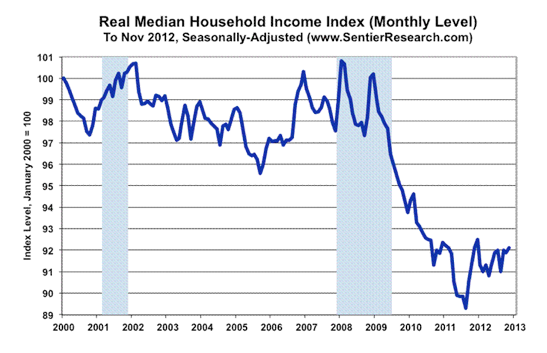
The stock market’s recovery does not reflect rising consumer purchasing power and retail sales. The labor force is shrinking, not growing. Job growth lags population growth, and the few jobs that are created are primarily dead-end jobs in lowly paid domestic services. Retail sales adjusted for inflation and real median household income have been bottom bouncing since 2009.

To the extent that there is profit growth in US corporations, it comes from labor cost savings from offshoring US jobs and from bringing in foreign workers on work visas. By lowering labor costs, corporations boost profits and thereby capital gains for those 7 percent who have large holdings of financial assets. Those in the 93 percent who are displaced by foreign workers experience income reductions. This transfer of the incomes of the 93 percent to the 7 percent via jobs offshoring and work visas is the reason for the stark rise in US income inequality.
Another source of the stock market’s rise is the Federal Reserve’s policy of quantitative easing, that is, the printing of $1,000 billion dollars annually with which to support the too-big-to-fail banks’ balance sheets and to finance the federal budget deficit. The cash that the Fed is pouring into the banks is not finding its way into business and consumer loans, but the money is available for the banks to speculate in derivatives and stock market futures. Thus, the Fed’s policy, which is directed at keeping afloat a few oversized banks, also benefits the 7 percent by driving up the value of their stock portfolios.

The reason bond prices are so high that real interest rates are negative is that the Fed is purchasing $1,000 billion of mortgage-backed “securities” and US Treasury debt annually. The lower the Fed forces interest rates, the higher go bond prices. If you are among the 7 percent, the Fed has produced capital gains for your bond portfolio. But if you are a saver among the 93 percent, you are losing purchasing power because the interest you receive is less than the rate of inflation.

The Pew report puts it this way: Since the “recovery” that began in June 2009, wealthy households experienced a 28 percent rise in their net worth, while everyone else lost 4 percent of their assets.

Is this the profile of a democracy in which government serves the public interest, or is it the profile of a financial aristocracy that uses government to grind the population under foot?

Tuesday, March 26, 2013

Americans’ Economic Prospects And Civil Liberties Have Been Stolen

March 24, 2013 |  — Paul Craig Roberts


My latest book, The Failure Of Laissez Faire Capitalism And Economic Dissolution of the West, is available as an ebook in English as of March 2013. My book is endorsed by Michael Hudson and Nomi Prims and has a 5 star rating from Amazon reviewers (as of March 23, 2013). Pam Martens’ review at Wall Street On Parade is available here.

Libertarians who have not read the book have had an ideological knee-jerk reaction to the title. They demand to know how can I call the present system of crony capitalism laissez faire. I don’t. The current system of government supported crony capitalism is the end result of a 25-year process of deregulation. Deregulation did not produce libertarian nirvana. It produced economic concentration and crony capitalism.

Below is my Introduction to my book.

Not only has your economy been stolen from you but also your civil liberties. My coauthor Lawrence Stratton and I provide the scary details of the entire story in The Tyranny of Good Intentions. In the US law is no longer a shield of the people against arbitrary government. Instead, law has been transformed into a weapon in the hands of the government.

Josie Appleton documents that in England also law has been turned into a weapon against the people. Anglo-American law, the foundation of liberty and one of the greatest human achievements, lies in ruins.

Libertarians think that liberty is a natural right, and some Christians think that it is a God-given right. In fact, liberty is a human achievement, fought for by Englishmen over the centuries. In the late 17th century, the achievement of the Glorious Revolution was to hold the British government accountable to law. William Blackstone heralded the achievement in his famous Commentaries On The Laws Of England, a bestseller in pre-revolutionary America and the foundation of the US Constitution.
In the late 20th century and early 21st century, governments in the US and Great Britain chafed under the requirement that government, like the people, is ruled by law and took steps to free government from accountability to law.

Appleton says that the result is a “tectonic shift in the relationship between the state and the citizen.” Citizens of the US and UK are once again without the protection of law and subject to arbitrary arrests and indictments or to indefinite detention in the absence of indictments.

In the US, citizens can be detained indefinitely and even executed without due process of law.
There is no basis in the US Constitution for these asserted powers. The unconstitutional powers exist only because Congress, the judiciary and the American people have accepted the lie that the loss of civil liberty is the price paid for protection against terrorists.

In a very short time the raw power of the state has been resurrected. Most Americans are oblivious to this outcome. As long as government is imprisoning and killing without trials demonized individuals whom Americans have been propagandized to fear, Americans approve. Americans do not understand that a point is reached when demonization becomes unnecessary and that precedents have been established that revoke the Bill of Rights.

Introduction to The Failure of Laissez Faire Capitalism and Economic
Dissolution of the West: Towards a New Economics for a Full World

The collapse of the Soviet Union in 1991 and the rise of the high speed Internet have proved to be the economic and political undoing of the West. “The End Of History” caused socialist India and communist China to join the winning side and to open their economies and underutilized labor forces to Western capital and technology. Pushed by Wall Street and large retailers, such as Wal-Mart, American corporations began offshoring the production of goods and services for their domestic markets. Americans ceased to be employed in the manufacture of goods that they consume as corporate executives maximized shareholder earnings and their performance bonuses by substituting cheaper foreign labor for American labor. Many American professional occupations, such as software engineering and Information Technology, also declined as corporations moved this work abroad and brought in foreigners at lower renumeration for many of the jobs that remained domestically. Design and research jobs followed manufacturing abroad, and employment in middle class professional occupations ceased to grow. By taking the lead in offshoring production for domestic markets, US corporations force the same practice on Europe. The demise of First World employment and of Third World agricultural communities, which are supplanted by large scale monoculture, is known as Globalism.

For most Americans income has stagnated and declined for the past two decades. Much of what Americans lost in wages and salaries as their jobs were moved offshore came back to shareholders and executives in the form of capital gains and performance bonuses from the higher profits that flowed from lower foreign labor costs. The distribution of income worsened dramatically with the mega-rich capturing the gains, while the middle class ladders of upward mobility were dismantled. University graduates unable to find employment returned to live with their parents.

The absence of growth in real consumer incomes resulted in the Federal Reserve expanding credit in order to keep consumer demand growing. The growth of consumer debt was substituted for the missing growth in consumer income. The Federal Reserve’s policy of extremely low interest rates fueled a real estate boom. Housing prices rose dramatically, permitting homeowners to monetize the rising equity in their homes by refinancing their mortgages.

Consumers kept the economy alive by assuming larger mortgages and spending the equity in their homes and by accumulating large credit card balances. The explosion of debt was securitized, given fraudulent investment grade ratings, and sold to unsuspecting investors at home and abroad.

Financial deregulation, which began in the Clinton years and leaped forward in the George W. Bush regime, unleashed greed and debt leverage. Brooksley Born, head of the federal Commodity Futures Trading Commission, was prevented from regulating over-the-counter derivatives by the chairman of the Federal Reserve, the Secretary of the Treasury, and the chairman of the Securities and Exchange Commission. The financial stability of the world was sacrificed to the ideology of these three stooges that “markets are self-regulating.” Insurance companies sold credit default swaps against junk financial instruments without establishing reserves, and financial institutions leveraged every dollar of equity with $30 dollars of debt.

When the bubble burst, the former bankers running the US Treasury provided massive bailouts at taxpayer expense for the irresponsible gambles made by banks that they formerly headed. The Federal Reserve joined the rescue operation. An audit of the Federal Reserve released in July, 2011, revealed that the Federal Reserve had provided $16 trillion–a sum larger than US GDP or the US public debt–in secret loans to bail out American and foreign banks, while doing nothing to aid the millions of American families being foreclosed out of their homes. Political accountability disappeared as all public assistance was directed to the mega-rich, whose greed had produced the financial crisis.

The financial crisis and plight of the banksters took center stage and prevented recognition that the crisis sprang not only from the financial deregulation but also from the expansion of debt that was used to substitute for the lack of growth in consumer income. As more and more jobs were offshored, Americans were deprived of incomes from employment. To maintain their consumption, Americans went deeper into debt.

The fact that millions of jobs have been moved offshore is the reason why the most expansionary monetary and fiscal policies in US history have had no success in reducing the unemployment rate.
In post-World War II 20th century recessions, laid-off workers were called back to work as expansionary monetary and fiscal policies stimulated consumer demand. However, 21st century unemployment is different. The jobs have been moved abroad and no longer exist. Therefore, workers cannot be called back to factories and to professional service jobs that have been moved abroad.

Economists have failed to recognize the threat that jobs offshoring poses to economies and to economic theory itself, because economists confuse offshoring with free trade, which they believe is mutually beneficial. I will show that offshoring is the antithesis of free trade and that the doctrine of free trade itself is found to be incorrect by the latest work in trade theory. Indeed, as we reach toward a new economics, cherished assumptions and comforting theoretical conclusions will be shown to be erroneous.

This book is organized into three sections. The first section explains successes and failures of economic theory and the erosion of the efficacy of economic policy by globalism. Globalism and financial concentration have destroyed the justifications of market capitalism. Corporations that have become “too big to fail” are sustained by public subsidies, thus destroying capitalism’s claim to be an efficient allocator of resources. Profits no longer are a measure of social welfare when they are obtained by creating unemployment and declining living standards in the home country.

The second section documents how jobs offshoring or globalism and financial deregulation wrecked the US economy, producing high rates of unemployment, poverty and a distribution of income and wealth extremely skewed toward a tiny minority at the top. These severe problems cannot be corrected within a system of globalism.

The third section addresses the European debt crisis and how it is being used both to subvert national sovereignty and to protect bankers from losses by imposing austerity and bailout costs on citizens of the member countries of the European Union.

I will suggest that it is in Germany’s interest to leave the EU, revive the mark, and enter into an economic partnership with Russia. German industry, technology, and economic and financial rectitude, combined with Russian energy and raw materials, would pull all of Eastern Europe into a new economic union, with each country retaining its own currency and budgetary and tax authority. This would break up NATO, which has become an instrument for world oppression and is forcing Europeans to assume burdens of the American Empire.

Sixty-seven years after the end of World War II, twenty-two years after the reunification of Germany, and twenty-one years after the collapse of the Soviet Union, Germany is still occupied by US troops. Do Europeans desire a future as puppet states of a collapsing empire, or do they desire a more promising future of their own?

Tuesday, March 5, 2013

Why Outsourcing and De-Skilling are the Real Culprits (Not Technology)

A Robot Didn’t Steal Your Job
by ROB URIE


When Barack Obama first entered office the financial crisis created by Wall Street banks was at its peak and hundreds of thousands of people per week were losing their jobs. As writer Ron Suskind reported, at that time Mr. Obama presented his thesis to his economics team, such as it was, that the reason for the job losses was ‘productivity gains.’ That is, in the midst of the largest economic calamity since the 1930s, the reason for massive job losses was that technological innovation had instantaneously rendered millions of formerly employed persons ‘redundant.’

As uninformed as this view may seem, and it reportedly seemed so even to the head of Mr. Obama’s economics team, Larry Summers, the premises behind it are conventional wisdom in the economics departments of prestigious universities and amongst ‘professional’ economists occupying chairs and proffering investment advice on Wall Street.

The reason for revisiting the issue is the paradigmatic form is once again making the official rounds, most recently in an NPR (National Public Radio) piece by degree even more idiotic than their usual economics reporting. Elsewhere, Harvard’s ‘boy genius’ Greg Mankiw, now no longer a boy in the chronological sense, and even the occasionally esteemed Paul Krugman, have offered up technology ‘models’ that are the veritable duct tape of the economics profession—the multi-purpose tool with which virtually any group of items, related or not, can be bound together to form a grouping. And as with Mr. Obama’s spectacularly implausible conceit regarding ‘productivity,’ the discourse on technology, income and employment will inform real economic policies.

‘Technology’
is today the joint explanation for high unemployment, weak job growth, highly concentrated income and wealth distribution and high corporate profits in a period of broad economic weakness. Technology in theory ties to productivity—the amount of economic output given what went into producing it, as the ‘efficient’ transfer mechanism, the machine that produces more with less. Banks formerly had large rooms filled with accountants and paper processors to do what a few people with computers can now do. And automakers now have robots that don’t need bathroom breaks and have no inclination toward collective bargaining to build cars. What ties technology, in these theories, to income and wealth concentration are the brave entrepreneurs who risk it all to build modern efficient companies and who so justly deserve the rewards. On their face, the attributes assigned to technology appear plausible.

By analogy: unbeknownst to many, there are hundreds of functional airplanes parked in the desert of the Southwestern U.S. As these unused airplanes suggest, technology is more than just machines. Many of these airplanes, those of more recent vintage that have been well maintained, could be put back into service. But a broad set of circumstances ranging from the history of aeronautics to labor relations in the airline ‘industry’ to ‘deregulation’ that changed existing institutional arrangements to the price of fuel to the financing arrangements for these specific airplanes together contributed to their current circumstance. Outside of their use value in the existing economy, the airplanes are technology in the sense of being machines, but those parked in the desert neither reduce the need for human labor nor serve to concentrate wealth.

The point here is that technology is a cog in a much larger economic wheel, not an end in itself. Economists like to imagine it is self-generated, that it comes from nowhere and nothing, appearing as Cartesian mental object dissociated from, and disinterested in, the historical struggle from whence it sprang. The airplanes themselves have imperial roots dating back several centuries for the raw materials that went into their construction. The parts were made in factories that benefited from fat contracts from governments and were carried over roads financed by citizenries. The engineers who designed them were educated at universities that receive government funding and their designs derived from aeronautical science created by the military. The price of their fuel is a function of standing militaries, past wars, threats, and alliances and comes at the cost of millions of dead, maimed and displaced persons. The American invasion, occupation and near total destruction of Iraq to secure cheap oil are but one example.

The airplanes are labor saving in the sense they can transport people and goods from New York to Los Angeles in five hours whereas driving takes a week and horseback takes months. Since air travel was developed people travel places they never would have traveled without it. Tourist economies dependent on it have developed and the rapid distribution of goods and services over long distances has been facilitated where it was previously unimagined. Business practices have developed around air travel and business people regularly travel for purposes that wouldn’t be without it. And while stagecoach drivers lost jobs with the development of automobiles and railroad conductors lost jobs with the growth of air travel, these technologies and others are broadly credited with increasing, or at least co-existing with growing, total employment. And jobs are but one aspect of the economic context of technology.

An airplane, as with computers and robotics, is in theory a productivity-enhancing device–technology. But outside a far-reaching economic context, it is a large paperweight parked in the desert. Technology is in fact social practice, ways of doing things, not inanimate machines. Antique economist Adam Smith developed his ‘division of labor’ theory of breaking complex economic production into constituent parts and having experts in each constituent come together to jointly create the whole.

There are no machines necessary to the theory—it works in the sense it does because the division of labor, where it exists, is social practice promoted with theories of economic efficiency, not a fact of nature. The division of labor is technology in the same sense the term is today being attributed to machines. To those to whom this narrow idea of economic efficiency is attractive, the division of labor is one plausible mode of social organization to achieve it. But there exist both broader concepts of economic efficiency and entirely unrelated modes of social organization. In this sense, technology in its current meaning is ideology.

Robotics, computers and other energy consuming machines are part of the broader technology of energy extraction, conversion, distribution and consumption. To the extent this energy complex produces externalities, costs of extraction, conversion, distribution and consumption not borne by energy ‘producers,’ technologies tied to it produce them as well (there would be no energy industry without customers for the energy). Add in the ancillary costs, broadly considered, of the standing armies, wars, occupations, murders, maiming and destruction that go into energy extraction and consider that parties who do not benefit from cheap energy largely pay them. Further add in the environmental destruction now aggregating to global warming. These are all part of the technology of robotics and computerization.

Wall Street economists endorse the argument technology is the sole explanation for the current malaise amongst we humans and for cheer in the plutocracy because the financing of machines is the only plausibly useful thing modern finance does. The financial system is in this sense also part of the technology of robotics and computerization. Machines bought with the ‘savings’ of capitalists, the mythology behind the ‘Ivy League’ economic models, raise the question of where these savings came from? To the extent they result from positive or negative externalities not of the capitalist’s making, the savings are social savings—benefits produced or costs borne by others that rightfully belong to these others, not the capitalist. These find themselves embodied in plants and equipment and through negative externalities from the financial system itself. One can imagine a financial system not fully existent from public welfare receipts and ongoing guarantees, but that is not the system that exists. Both the savings of capitalists deposited with banks and embodied in factories and equipment and the money created by banks by degree exist as embodied externalities, the detritus in capitalist theory that constitutes its core in capitalist fact.

The airline industry, from whence the airplanes parked in the desert arose, itself arose through historical development. The airplanes didn’t one day appear from nowhere so some capitalist could fire the railroads because airplanes were more ‘efficient.’ The business of the airlines came from social practice—travel in the context of the industrial move toward increased mechanization. As outlined above, tourist businesses dependent on air travel and the modern practice of business travel grew from its development—they didn’t exist before the creation of the air travel industry, of which the airplane—the machine, is but a constituent. And the railroads that arose from land grants backed by military force shifted from transporting people to transporting commodities, many of which were taken through imperial force and which left behind costs in terms of social and environmental destruction that are still being borne today. The point here is technology narrowly considered—the idiot object if you will, exists within historical development, not tucked inside the anti-history of Western economists.

When Mitt Romney, or any other pirate financier, buys a company to ‘harvest’ its value by replacing human labor with machines, where does the harvested value come from? Put another way, I can shoot you and your family and move all of your stuff into my house, but what then makes it ‘mine?’ Just because Mr. Romney and his compatriots have masses of social wealth in their pockets doesn’t make it theirs. The companies from which value is harvested are the product of a wide array of social inputs. Test pilots for the military gave their lives to develop the safety devices and protocols used in modern commercial aviation. How much business would an airline have if every third airplane crashed in a fiery ball? Tech and pharma likewise came into being through public, and only later and occasional ‘private,’ investment. Pirate financiers build nothing; their claim is to have made what already existed more efficient. But as with the airplanes parked in the desert, technology is part of a broad context of social relations, not inanimate machines. How efficient is a computer if there is no energy to run it and no broader set of economic relations that make it ‘useful?’– Again, it in nothing but an expensive paperweight.

The NPR story of how ‘technology’ is behind high unemployment is worth another mention. The story is based on a homebuilder who has an office that combines basic administrative functions with architectural design and that has construction workers building houses in the field. The owner of the company replaced several office personnel with computers and now outsources the building of constituent house parts to an outside company leaving only one company employee at each of the houses being built. Computerization of the office comes about twenty years later than most of the homebuilder’s competitors and modular construction of houses dates to the 1940s. (Were these explanations for high unemployment, they would have been so twenty years ago, not today). Modular construction reifies Adam Smith’s ‘division of labor’ and adds larger scale input pricing. The division of labor in this case ‘de-skills’ the construction process that typically requires skilled labor (or else what has been changed is the geographic location of production, not the number of people needed to produce it). To be clear, the ‘technology’ purported to be behind the NPR story is a web of social practices including outsourcing and de-skilling, not replacing humans with machines.

De-skilling is only efficient to the extent skilled workers find other employment for which they are compensated for their skill. By analogy, airplanes parked in the desert can, depending on context, raise incomes for airlines through the elimination of ‘unprofitable’ routes, but that depends both on the shift in the airlines’ function from utility serving the public to profit seeking corporation and on the paradox that waste is efficient. Prior to the 1970s serving unprofitable routes was a requirement for the right to fly commercial aircraft in the U.S. The change in ‘technology’ that made the airlines occasionally profitable was the elimination of the public service requirement. And to the extent waste is ‘efficient,’ this finds its breadth in the observation that the most ‘efficient’ countries on the planet are the most wasteful. De-skilling presupposes both an absence of skill when entering a job and upon leaving it, however many years later that might be. As even an investment banker or an economist could learn a bit about refrigerators by selling them for thirty years, de-skilling is the ultimate waste of human potential.

The ‘bugaboo’ in the room for mainstream economists is China with modern factories, some of which have been designed to build goods using robots. From the several advisors to the Chinese government with whom I’ve spoken, the factories are part of a financial technology that has the government providing advantageous financing to build export based factories and is part of export technology premised on cheap fuel and a particular arrangement of currency exchange rates. Put another way, were the value of the U.S. dollar to fall enough relative to the Chinese Renminbi and / or the cost of shipping these goods to rise enough the production cost advantage enjoyed by the automated Chinese factories would disappear.

The Western economists’ practice is to hold these variables—the price of fuel, currency exchange rates, industrial policy etc. ‘constant’ to assess particular effect, but particular effect will never and has never occurred outside the context of the actual world. This practice of suspending time and context leads to the bottomless pit of nonsense where economists are never wrong because they would have been right if only the world had behaved itself.

As I’ve argued above, technology in the modern mythology requires complete de-contextualization to serve as an explanation for skewed income distribution and weak labor ‘markets.’ Even within the narrow confines of economists’ models there is no definition of ‘efficiency,’ the magical attribute awarded technology, that withstands either competing definitions or the point that basing social organization on such a constrained concept is both ideologically driven and stunningly, emphatically unimaginative.

To the first, as global warming and widespread economic dislocations demonstrate, the local rationalities where technology plays a crucial role don’t necessarily aggregate to global rationalities. To the latter, all economic technologies are social in the sense they only exist socially. With ‘de-skilling’ as a defining technology of our age, there exist few such dismal views of human existence, and therefore the possibilities for social organization, possible.

And remember, if "discouraged workers" were still counted as unemployed, like they were prior to the 1990s, the unemployment rate (U3) would double (U6) or even triple (SGS) what it is reported as. It's easily higher than 18% currently. Don't ever forget that.

Thursday, January 31, 2013

Whatever Happened to “Good Jobs”?

Poverty on a Vast Scale
by CARL GINSBURG

It is hard to pinpoint the precise moment when “good jobs” disappeared from national discourse, ignored by our leaders and the media that cover their agenda. The phrase was invoked during President Obama’s campaign—that is, his first run for the presidency. But it soon disappeared in a West Wing dominated by Wall Street men. This time around it was altogether gone from campaign rhetoric, a vanishing act with the potential for catastrophic consequences for millions of Americans. “Good jobs” continues to be banished from national discourse, as if the censors of capital wished it away.

Corporations have nothing to say on the subject, intent to hold down wages and sit on vast amounts of capital – some $3.4 trillion, by last count. Over the next decade, 7 of 10 new jobs will be low wage, reports the Bureau of Labor Statistics. The rate of corporate profit is at its highest level in more than a century, according to Bloomberg. That’s quite a record… Coolidge, Harding, Eisenhower, Reagan, Clinton, Bush II… all left in the dust.

Wall Street is thriving. The stock market S&P index shot up 13% in 2012, and JPMorgan Chase had its best year ever that same year, with Goldman Sachs close behind. Indeed, the 1% continues to accumulate vast wealth, as U.S. economic inequality becomes even more pronounced, while alarms go off at the International Monetary Fund and elsewhere, sounding off that inequality undercuts growth with emphasis on the U.S.

In spite of it all, everyone knows this central truth: life is at a dead end in this country without a full-time job at a good wage and with decent benefits: a good payroll job.

Since the Inauguration earlier this month, official debate has focused on debt ceilings, women in combat roles and most recently on immigration. These are hardly irrelevant matters; but in the end they fill front pages and newscasts where we should see and hear the clamoring for good jobs.

The immediate goal of the Robin Hood Tax, whose profile has come up fast in just a year, is to put revenue into the many communities still reeling from the effects of the financial collapse of 2008. An estimated $350 billion can be raised annually from a small sales tax on Wall Street financial transactions, today embodied in The Inclusive Prosperity Act, sponsored by Rep. Keith Ellison (D-MN). He has 16 co-sponsors, to date. More than 125 organizations – labor, religious, consumer, health advocates and others – have endorsed the bill. Together these groups total millions in membership. They join financial transaction tax movements worldwide; 40 countries have such a tax in place today, as economists, even leading business executives, are raising their voices in support. The European Union moved forward this month towards implementation in 11 member countries, to start January 1, 2014.

Meanwhile, the corporate sector in this country staunchly refuses to invest in good jobs, making government action on jobs an essential step to move forward. Robin Hood tax revenue for good jobs in healthcare, in education, to provide a clean environment and to rebuild a deteriorating infrastructure would mark a significant turnaround.

Many millions need these jobs and communities need assistance without delay. There are a staggering 22 million adult Americans who are without full-time jobs today and for whom the hardship of enduring unemployment is taking a terrible toll. Some are recent college graduates, loaded down with debt from escalating school costs. A Rutgers University survey found that half the college grads in this country over the last six years do not have full-time employment. Robin Hood funds can help them get a start in life.

What we do not need are more of the low wage jobs being offered, as the numbers of working poor escalate each year to astonishing levels. According to the Census Bureau, one-third of adults who live in poverty are working but do not earn enough to support themselves and their families. A quarter of jobs in America pay below the federal poverty line for a family of four – $23,050. Close to half of food stamp allocation goes to households where an adult is working full-time- that’s taxpayer money paid to workers whose bosses won’t pay a living wage. Even with this critical food assistance, we have reached a point, the Department of Agriculture says, where nearly 1 in 4 young children in the U.S. lived with insufficient food in the last year.

Our government should join Rep. Ellison and his co-sponsors and embrace the Robin Hood tax and its call for good jobs in a real economy. Without it, and the yearly revenue it would provide for an enduring recovery, the legacy of our nation’s leaders will be poverty on a vast scale.

Wednesday, January 23, 2013

New Labor Stats Show GOP Assault on Public Unions Is Working

Wednesday, January 23, 2013 by Common Dreams
Numbers 'reflect concerted attack on organized labor'
- Jon Queally, staff writer
 
As the Washington Post's Jim Tankersley points out and new data from the US Department of Labor released on Wednesday confirms, the Republican push to destroy public sector unions in the last several years is having its desired effect.
 
According to the Bureau of Labor Statistics' new figures on unionization, the percentage of organized workers in the US took a sharp—and 'unusual'—decline last year, dropping from 11.8 percent in 2011 to 11.3 percent in 2012.

Moreover, as the New York Times highlights, the largest dip came not from the typical source of private union attrition caused by offshoring or factory closings, but from job losses in the public sector, which caused overall public sector union rates to drop more than full point in one year—from 37 percent to 35.9 percent.

Private sector unions—long in decline due to outsourcing linked to corporate globalization policies—now currently have about 7 million members, whereas public employee unions have roughly 7.3 million members.

The curious trend that Tankersley points out is the role that government-pushed austerity has played in union attrition. He writes:
The big culprit for last year’s drop doesn’t appear to be outsourcing (though union factory employment has fallen since the recession, while non-union employment has risen). The issue was austerity.

Specifically, state and local governments laid off a lot of workers last year to help balance their budgets. That means they let a lot of union members go. The Labor Department reports that more than half of all U.S. union members work in the public sector; government is nearly 36 percent unionized, while the private-sector union membership rate is less than 7 percent. (Last year’s stats suggest that some Republican governors’ efforts to reduce unionization in their state public sectors is working – Wisconsin posted a 2.1 percentage point drop in union membership from 2011 to 2012.)

Asking labor leaders to respond to the statistics on membership, Tankersley said they 'roundly' agreed that the drop in rates "reflected a concerted attack on organized labor and an austerity hit to the economy that affects everyone, not just folks with a union card."

“The economic crisis—and the politicians who took advantage of it for their own anti-worker purposes—had a negative impact,” Lee Saunders, president of the American Federation of State, County and Municipal Employees, told Tankersley.

And Richard Trumka, president of the A.F.L.-C.I.O., the nation’s main union federation, added: “Working women and men urgently need a voice on the job today, but the sad truth is that it has become more difficult for them to have one, as today’s figures on union membership demonstrate.”

Tuesday, January 15, 2013

Inequality Rages as Dwindling Wages Lock Millions in Poverty

Tuesday, January 15, 2013 by Common Dreams 
New study shows just how hard 'working poor' got hit in wake of 2008 crisis
- Jon Queally, staff writer

The official unemployment rate in the US may be slowly ticking down (mainly due to the fact that after a year, unemployed workers are no longer considered unemployed even though they still need work and aren't included in the BLS data), but the rank of those who classify as 'the working poor' has continued to skyrocket, according to a new report.

Hit hardest by the trend of stagnant wages are those in service industries, like retail jobs, food preparation, clerical work and customer assistance.

Along with overall income inequality growth in the US, a new report by Working Poor Families Project says that over 200,000 families fell into poverty in 2011 even with both parents working.

National job growth saw a recovery from the worst days following the 2008 housing crash and subsequent financial crisis, but even as the recession ebbed in some areas or for some groups, many middle class or lower-middle class workers who returned to employment did so with much reduced wages.

As lead author of the report, Brandon Roberts, points out in an op-ed at Reuters on Tuesday:
These are not just the unemployed. Rather they are families that, despite having a working adult in the home, earn less than twice the federal poverty income threshold – a widely recognized measure of family self-sufficiency. They are working, but making too little to build economically secure lives. And their number has grown steadily over the past five years.

They are cashiers and clerks, nursing assistants and lab technicians, truck drivers and waiters. Either they are unable to find good, full-time jobs, or their incomes are inadequate and their prospects for advancement are poor.

The report, which analyzed figures from the US Census in 2011, determined that nearly 10.4 million such families - or 47.5 million Americans - now live at or below poverty, defined as earning less than $45,622 for a family of four.

Data showed that the top 20 percent of Americans received 48 percent of all income while those in the bottom 20 percent got less than 5 percent.

Statistics also showed that roughly 23.5 million, or 37 percent, of U.S. children lived in working poor families compared with about 21 million, or 33 percent, in 2007, the report said.

"Although many people are returning to work, they are often taking jobs with lower wages and less job security, compared with the middle-class jobs they held before the economic downturn," the report said. "This means that nearly a third of all working families ... may not have enough money to meet basic needs."

“We’re not on a good trajectory,” Brandon Roberts, who manages the privately-funded Working Poor Families Project, told The Washington Post. “The overall number of low-income working families is increasing despite the recovery.”

And Reuters reports:
The group's analysis adds to the body of data focused on the slipping U.S. middle class even as there are signs of the nation's economy slowly coming back to life with improvements in the housing sector and lower unemployment rate.

For some Americans, the comeback has yet to begin.

Data showed that the top 20 percent of Americans received 48 percent of all income while those in the bottom 20 percent got less than 5 percent, the report said.

The analysis also found regional differences.

States in the South, such as Georgia and South Carolina, and those in the West, such as Arizona and Nevada, had the greatest increase in the number of working poor. The increase was slower in the Mid-Atlantic and Northeast.

"It's important to draw attention to the fact that there are real families behind those statistics," said Alan Essig, who heads the Georgia Budget and Policy Institute, adding that his state is still struggling with housing and unemployment.

And the Washington Post adds:
The growth in the ranks of the working poor coincides with continued growth in income inequality. Many of the occupations experiencing the fastest job growth during the recovery also pay poorly. Among them are retail jobs, food preparation, clerical work and customer assistance.

Tuesday, January 8, 2013

Washington’s Hegemonic Ambitions Are Not in Sync With Its Faltering Economy

January 7, 2013 | Paul Craig Roberts

In November the largest chunk of new jobs came from retail and wholesale trade. Businesses gearing up for Christmas sales added 65,700 jobs or 45% of November’s 146,000 jobs gain. With December sales a disappointment, these jobs are likely to reverse when the January payroll jobs report comes out in February. Family Dollar Stores CEO Howard Levine told analysts that his company’s customers were unable to afford toys this holiday season and focused instead on basic needs such as food. Levine said that his customers “clearly don’t have as much for discretionary purchases as they once did.”

For December’s new jobs we return to the old standbys: health care and social assistance and waitresses and bartenders. These four classifications accounted for 93,000 of December’s new jobs, 60% of the 155,000 jobs.

Obviously, the economy is not going anywhere except down.

It takes approximately 150,000 new jobs each month to stay even with population growth and new entrants into the work force.  

Few of the jobs that are being created pay well, and the constant, consistent demand for more poorly paid waitresses, bartenders and hospital orderlies is difficult to believe. If Americans cannot afford toys for their kid’s Christmas, how can they afford to eat and drink out?

Media spin seeks to create a recovery out of thin air, but these graphs from John Williams (shadowstats.com) show the reality:


Keep in mind that the 7.8% unemployment rate (U.3) that is headlined by the financial media does not include discouraged workers who have ceased to look for jobs. The government’s U.6 rate includes workers who have been too discouraged to seek work for less than a year. This rate of unemployment is 14.4%, almost twice the U.3 rate that the media prefers to report.

In 1994 the US government defined out of existence unemployed Americans who have been discouraged from finding work for more than a year. John Williams estimates the long term discouraged workers. When his estimate is added to the U.6 measure, the US unemployment rate stands at 23%, three times the reported rate.

The rate of unemployment is so high because millions of US jobs have been offshored and given to Chinese, Indian, and other workers and because remaining businesses have been concentrated in few hands in violation of the anti-trust laws. (Go to this URL to see the concentration of the media: http://frugaldad.com/2011/11/22/media-consolidation-infographic/ )

We need to be concerned about a financial media and economics profession that believes a recovery is underway when the unemployment rate is so high and the real median income is so low. It is a mystery how any set of policymakers could possibly have believed that a country whose economy is driven by consumer expenditures can continue to expand when the jobs that produce the incomes that drive the economy are given to foreigners in foreign lands.

Essentially, Americans were told a packet of lies designed to win their gullible acceptance to an economy that produces high returns for Wall Street, shareholders, and corporate executives at the expense of everyone else in the country. The wage savings from the use of overseas labor means large rewards for the one percent and Family Dollar customers who cannot afford to buy toys for their children at Christmas.