Showing posts with label cancer. Show all posts

Monday, October 6, 2014

Monsanto's Roundup Linked to Cancer - Again

Monday, 06 October 2014
 By Jeff Ritterman, M.D., Truthout

A brilliant and celebrated inventor, John Franz, gave us an herbicide, Roundup, which has changed the face of agriculture. This herbicide has become the foundation for an entirely novel approach to farming - biotech agriculture - that has expanded rapidly throughout the globe.

Monsanto makes seeds for soy, corn, canola, cotton, alfalfa and sugar beets that are genetically engineered to be tolerant to Roundup. The seeds are marketed in 120 countries. Throughout the world, Roundup is sprayed heavily as a weed killer without fear of damaging the cash crops, which have been engineered to survive the herbicide's effects.

"The change in how agriculture is produced has brought, frankly, a change in the profile of diseases. We've gone from a pretty healthy population to one with a high rate of cancer, birth defects and illnesses seldom seen before."

Roundup seemed, at first, to be the perfect herbicide. It blocks the ESPS synthase enzyme, which prevents the synthesis of amino acids that plants need for growth. Since animals don't have this enzyme, it was initially hypothesized that they would be safe from Roundup's effects.

Unfortunately, Roundup has now been shown to affect much more than the EPSP synthase enzyme. The herbicide has been proven to cause birth defects in vertebrates, including in humans, and it may also be the cause of a fatal kidney disease epidemic.

An increasing number of studies are now linking the herbicide to cancer.

Roundup Linked to Increased Cancer in "Soy Republic"
Roundup is now heavily sprayed in what is known as the "Soy Republic," an area of Latin America larger than the state of California. This region has undergone a profound transformation since genetically modified (GM) crops were first introduced in 1996. Some 125 million acres in Argentina, Brazil, Bolivia, Uruguay and Paraguay are now devoted to GM soy production.

Doctors serving these areas have documented an alarming increase in cancers. A group of dedicated physicians formed an organization, Doctors of Fumigated Towns. They held a national conference in August of 2010 in Córdoba, the center of Argentina's soy region. The Department of Medical Sciences of the National University at Córdoba sponsored the conference. An estimated 160 doctors from throughout the country attended.

Dr. Medardo Avila Vazquez, a pediatrician specializing in environmental health, explained his concerns:
"The change in how agriculture is produced has brought, frankly, a change in the profile of diseases. We've gone from a pretty healthy population to one with a high rate of cancer, birth defects and illnesses seldom seen before. What we have complained about for years was confirmed and especially what doctors say about the sprayed towns and areas affected by industrial agriculture. Cancer cases are multiplying as never before in areas with massive use of pesticides."

Dr. Avila Vazquez blamed the biotech agricultural corporations for placing their profits over the public's health:
"The tobacco companies denied the link between smoking and cancer, and took decades to recognize the truth. The biotech and agrochemical corporations are the same as the tobacco industry; they lie and favor business over the health of the population."

It was the health of the population that concerned Dr. Damian Verzeñassi, professor of social and environmental health from the National University at Rosario. In 2010, he began a house-to-house epidemiological study of 65,000 people in Santa Fe, also in Argentina's soy region. He found cancer rates two to four times higher than the national average, with increases in breast, prostate and lung cancers.\

Dr. Verzeñassi commented on his findings: "Cancer has skyrocketed in the last fifteen years."

Much the same was found in Chaco, Argentina's poorest province. In 2012, two villages were compared, the heavily sprayed farming village of Avia Terai and the non-sprayed ranching village of Charadai. In the farming village, 31 percent of residents had a family member with cancer while only 3 percent of residents in the ranching village had one.

Carlos Fria lives in Avia Terai. He has complained about glyphosate spraying in close proximity to his home:
"If the wind changes, the agrochemicals come into the house. My uncle just died of cancer. My wife too, passed away from cancer. Now many, many people are dying of cancer. It didn't used to be like that. In my opinion, this has to do with the poison they put on the fields."

Roundup Linked to Lymphoma
Research has also been done in the United States, Canada, Europe, Australia and New Zealand investigating possible links between glyphosate, Roundup's active ingredient, and cancer. A large number of studies have focused on glyphosate's possible association with non-Hodgkin's lymphoma.

Scientists from the International Agency for Research on Cancer (IARC) have analyzed studies spanning almost three decades. The IARC is the branch of the World Health Organization that promotes cancer research. Scientists throughout the world with skills in epidemiology, laboratory sciences and biostatistics are brought together to identify the causes of cancer so that preventive measures may be instituted. The agency views cancers as linked, directly or indirectly, to environmental factors.

The research shows that Roundup is linked to a host of cancers in those living in the heavily sprayed regions of Latin America. It has also been linked to B cell lymphoma, and to brain cancer.

In April of 2014, scientists at the IARC published their review of twenty-five years of research on the relationship between pesticide exposure and non-Hodgkin's lymphoma. They found a positive association between organo-phosphorus herbicides, like glyphosate, and this cancer. The B cell lymphoma sub-type, in particular, was strongly associated with glyphosate exposure.
 
Roundup Linked to Brain Cancer
The linkage to lymphoma is the most recent research raising concerns about glyphosate's connection to cancer. Scientists from the Agency for Toxic Substances and Disease Registry, a branch of the US Department of Health and Human Services, specialize in illnesses caused by toxic substances. They published the results of the US Atlantic Coast Childhood Brain Cancer Study in 2009. Children with brain cancer from Florida, New Jersey, New York and Pennsylvania were compared to age matched controls. The researchers found that if either parent had been exposed to Roundup during the two years before the child's birth, the chances of the child developing brain cancer doubled.

Roundup and Cancer: Human Observations Summarized
The research shows that Roundup is linked to a host of cancers in those living in the heavily sprayed regions of Latin America. It has also been linked to B cell lymphoma, and to brain cancer.

While the epidemiological studies show close correlation, they cannot prove causality. The gold standard for scientific proof is a randomized controlled trial, which would be unethical in this instance. You cannot ethically expose humans to an herbicide. Scientists therefore use a variety of experimental models to assess cancer risk.

Roundup Causes DNA Damage,  Errors During Cell Division
Cancer risk can be evaluated by experiments that measure Roundup's ability to induce DNA damage.
One of the initial steps in the development of cancers is often damage to our DNA. Each of our cells gets its operating instructions from its DNA. If the DNA is damaged, the faulty operating instructions can re-program cells to divide rapidly and chaotically. When this happens, cells become transformed into cancers.

A number of experiments have been done using various animal models, all showing the same results: after exposure to Roundup, cells exhibited DNA damage. This was true in fruit fly larvae, in mice, in the blood cells of the European eel and in the lymphocytes of cows.

Another experimental model that has been used to judge glyphosate's cancer risk focuses on the herbicide's impact on cell division. Cells are vulnerable to being turned into cancers if an error is made during this delicate process. In the process of cell division, the DNA must be copied precisely. Each daughter cell must receive from its parent cell an identical copy of the DNA. If a mistake is made, the daughter cells will receive faulty DNA copies. Cells with damaged DNA can turn into cancers.

In a 2004 study done at the National Scientific Research Center and the University of Pierre and Marie Curie in France, Roundup caused significant errors in the cell division of sea urchin embryos. The scientists commented that these abnormalities are hallmarks of cancer and delivered a particularly chilling warning: The concentration of Roundup needed to cause these errors was 500 to 4,000 times lower than the dose to which humans may be exposed by aerial spraying or handling of the herbicide.

Roundup Damages Human DNA
The most worrisome of the DNA studies are the ones that show DNA damage in humans.

Dr. Fernando Manas, a biologist at the National University of Rio Cuarto in Argentina, has been investigating the effects of pesticides for years. He believes that glyphosate spraying is causing cancer by inducing DNA damage. His research has documented genetic damage in those exposed. When Dr. Manas studied pesticide sprayers working in the soy industry in Córdoba, he found significantly more DNA damage in their lymphocytes than in those of an unexposed group of controls. Roundup was one of the most commonly used pesticides.

The pesticide sprayers in Córdoba, the Ecuadorians living in Sucumbíos, and the normal volunteers all developed Roundup-induced DNA damage in their lymphocytes.

Genetics researchers from the Pontifical Catholic University in Quito, Ecuador evaluated Ecuadorians living in the Sucumbíos district in northern Ecuador for evidence of DNA damage. This area was heavily sprayed with Roundup by the Colombian government to eradicate illicit crops. Those exposed to the herbicide developed a number of acute symptoms, including abdominal pain, vomiting, diarrhea, fever, heart palpitations, headaches, dizziness, numbness, insomnia, depression, shortness of breath, blurred vision, burning of eyes, blisters and rash. When compared to a control group, they also showed significantly more DNA damage.

Interestingly, scientists have known since 1998 that when normal human lymphocytes were exposed to Roundup in a test tube, the lymphocytes developed DNA damage.

The pesticide sprayers in Córdoba, the Ecuadorians living in Sucumbíos, and the normal volunteers all developed Roundup-induced DNA damage in their lymphocytes. A cancer of the lymphocytes is known as a "lymphoma," the very same type of cancer that the International Agency for Research on Cancer showed to be strongly associated with glyphosate exposure.

Roundup Boosts Cancer in Tissue Culture Studies
Another method that scientists have used to assess Roundup's cancer risk is to expose cells grown in "tissue culture" to the herbicide. Sheets of cells are grown on a small dish with nutrients. Glyphosate is added and its effects are observed.

In 2010, researchers in India exposed mouse skin cells grown in tissue culture to Roundup. When the herbicide was added, the cells became cancerous.

Scientists in Thailand studied the impact of Roundup on human estrogen-responsive breast cancer cells in tissue culture. They published their results in 2013. Hormone-responsive breast cancer cells are known to grow when exposed to estrogen. Roundup also stimulated these cells to grow. The herbicide was able to bind to the cancer's estrogen receptors, thus mimicking the effects of estrogen and accelerating tumor growth.

Roundup's effects have been assessed in studies with a variety of test animals for more than three decades.
One of the earliest studies was done in 1979-1981, under the auspices of the United Nations Environmental Program, the International Labor Organization and the World Health Organization. Rats exposed to low levels of the herbicide developed testicular cancer. A larger dose did not produce the cancer. Unfortunately, at the time of the experiment, it was not understood that certain substances have more potent effects at lower doses than at higher doses. The evaluators erroneously dismissed the results showing the low-dose effect.

In a study from the Institute of Biology at the University of Caen in France, researchers studied glyphosate's effects on rats. Originally published in 2012, the resulting report was retracted after the biotech agriculture industry complained. After extensive review failed to show any fraud or problem with the data, the report was re-published in 2014. In this study, Roundup was shown to double the incidence of mammary gland tumors. These cancers developed much faster in rats exposed to Roundup than in controls. There was also an increase in cancers of the pituitary gland.

Rounding Up the Evidence
Epidemiological studies in humans, in the soy regions of Argentina and in Europe, the United States, Canada, Australia and New Zealand have shown Roundup to be linked to an increase in cancer risk. There is a strong association between Roundup and B cell lymphoma, brain cancer and a variety of other cancers in those living in heavily sprayed areas.

In addition to these epidemiological observations, laboratory studies have shown that Roundup causes DNA damage, disturbs cell division, increases cancer growth in tissue culture and induces cancer when fed to test animals.

Proving Causality
Does the evidence linking Roundup to cancer prove causality? In the 1964 landmark Surgeon General's Report, which for the very first time linked tobacco to cancer, Surgeon General Dr. Luther Terry presented criteria for the establishment of a cause and effect relationship in a scientific study.

To meet Dr. Terry's criteria, an association must be strong, specific and consistent. Cause must precede effect. And the association must be biologically plausible.

Biotech agriculture's most powerful backer, it seems, is the government of the United States.

How well does the association between Roundup and cancer fit these criteria?

Roundup exposure is consistently and specifically associated with precancerous abnormalities in a wide variety of experimental settings. Epidemiological observations show a tight linkage between glyphosate and cancer. In the laboratory research, as well as in the epidemiological studies in the field, exposure to the herbicide precedes the development of the abnormalities. There are plausible biological mechanisms that explain how glyphosate can transform cells into cancers.

In citing the Surgeon General's report, Drs. Wild and Seber, in their highly regarded statistics textbook, Chance Encounters, provide an example of a strong association. If an "illness is four times as likely among people exposed to a possible cause as it is for those who are not exposed," the association is considered strong.

Most of the glyphosate exposure experiments and epidemiological observations show a doubling of cancer risk. This leaves some room for doubt.

But who, given the science, would want to expose their loved ones to Roundup?

The State of the Science vs. the Science of the State
Roundup has now been conclusively proven to cause birth defects and to be closely linked to cancer. If we do not want this herbicide to accumulate in our water, land, and food, we need to stop using it.

In the final sad irony, when the cancer cells reach their growth peak, they kill their host and die in the process.

The science is clear, but powerful economic interests have, thus far, prevailed. The executives of the biotech agricultural corporations and their backers have ignored or denied the science documenting Roundup's harm.
Biotech agriculture's most powerful backer, it seems, is the government of the United States.

This official policy was explained in a 2010 US State Department cable from former Secretary of State Hillary Clinton:
"Our biotech outreach objectives for 2010 are to increase access to, and markets for, biotech as a means to help address the underlying causes of the food crisis, and to promote agricultural technology's role in mitigating climate change and increasing biofuel production."
The US government has been willing to exercise its muscle in support of the biotech agricultural corporations.
In El Salvador, for example, the United States recently pressured the government to buy Monsanto's GM seeds or risk losing $277 million in development aid. El Salvador refused and stood firm, preferring to buy the seeds from its own struggling farmers.

Cancer's Lessons
There is a disturbing parallel between the exponential growth of biotech agriculture and the spread of a cancer in the human body.

Cancers are cells that reproduce rapidly and haphazardly with no regard for the greater good of the organism. Cancer cells consume valuable energy, starving out normal cells. They grow so wildly and so quickly that they crowd out their neighbors. They send off emissaries to start new cancer colonies. They make harmful substances that damage healthy cells. They spread relentlessly. In the final sad irony, when the cancer cells reach their growth peak, they kill their host and die in the process.

Like a cancer, biotech agriculture has crowded out its neighbors and is spreading relentlessly. Also like a cancer, it makes harmful substances. Roundup is one of them. As more acreage comes under GM cultivation, we can expect Roundup use to continue to increase.

Roundup kills plants, causes birth defects in vertebrates, and is linked to cancer. Can a living planet withstand the continuous assault from this poison any more than the human body can withstand the attack from an aggressive cancer?

Do we need to fight biotech agriculture with the same persistence, commitment and force that we bring to bear in battling cancers?

Thursday, September 11, 2014

People Who Live Near Fracking More Likely To Become Sick, Study Finds


People Who Live Near Fracking More Likely To Become Sick, Study Finds
by Emily Atkin
September 10, 2014

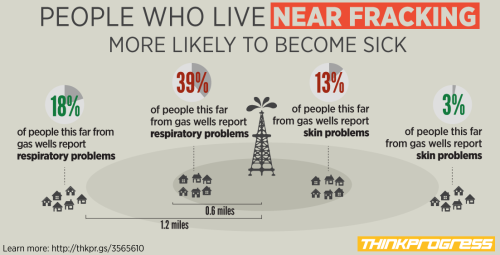
People living close to natural gas wells in southwestern Pennsylvania are more than twice as likely to report respiratory illnesses and skin problems than those living farther away, according to a new study from Yale University.

Dr. Peter Rabinowitz, a former Yale School of Medicine professor who now teaches at the University of Washington’s School of Public Health, got the results by randomly surveying 180 households with 492 people in Washington County, Pennsylvania. Washington County is in the heart of the Marcellus Shale, one of one of America’s fracking hotspots — and arguably the epicenter of fracking-related pollution complaints and industrial accidents.

Of those surveyed, Rabinowitz found that 39 percent of people living less than 0.6 miles from a gas well reported upper-respiratory problems like sinus infections and nosebleeds, compared to just 18 percent of people living more than 1.2 miles away. For skin problems like rashes, 13 percent living close to the wells reported irritation, compared to only 3 percent living further away who said the same.

Rabinowitz said that his findings represent “the largest study to date of general health status of people living near natural gas wells.”

The study, published in the peer-reviewed journal Environmental Health Perspectives, is careful not to claim outright that the fracking itself is causing the health problems. Rather, it solely states that there are higher rates of illness in households closer to gas wells. To say that drilling or fracking causes illness would require more research, Rabinowitz said.

“It’s more of an association than a causation,” Rabinowitz told the New Haven Register. “We want to make sure people know it’s a preliminary study. … To me it strongly indicates the need to further investigate the situation and not ignore it.”

Rabinowitz is not the first to assert that more research needs to be done into the health impacts of fracking.

Just last week, scientists at the University of Texas published research stating that 30 percent of water wells near Texas fracking sites contained higher-than-normal levels of arsenic. However, the researchers stated that their findings were not conclusive in stating that the contamination is because of fracking.

“We think that the strongest argument we can say is that this needs more research,” Brian Fontenot, the paper’s lead author, said at the time.

In addition, preliminary scientific research is finding more and more of a connection between birth defects and the proximity of the child’s mother to a natural gas well. Still, scientists generally agree that more research needs to be done before a conclusive statement can be made about whether that proximity to natural gas drilling actually causes birth defects or other health problems in babies and mothers.

Fracking is a controversial yet popular technique used to stimulate natural gas wells underground by injecting high-pressure water, sand, and chemicals miles-deep into subsurface rock, effectively cracking or “fracturing” it, making the gas easier to extract. It has been controversial in part because of how quickly the practice has spread in the United States, without much credible scientific information regarding the potential impact on public health.

Pennsylvania has had more than 6,000 hydraulic fracturing wells drilled within the last six years, and zero state studies on their health impacts. Because of the lack of research, it’s been increasingly hard to prove that families can be sickened by drilling.

Natural gas drilling in Pennsylvania has skyrocketed under Gov. Tom Corbett. He has expanded fracking in Pennsylvania’s state parks and forests, and in 2012 implemented a controversial state oil and gas law, known as Act 13, which severely restricts the ability of local governments to have control over drilling in their area. Multiple portions of the law have since been ruled unconstitutional by the state Supreme Court.

Thursday, May 2, 2013

Study finds 'soup of toxic chemicals' in the air near Arkansas ExxonMobil spill site

RT: April 30, 2013 04:03

While many questions remain following ExxonMobil’s March 29 tar sands oil spill in Mayflower, Arkansas, a new independent study has revealed the existence of high levels of cancer-causing chemicals in the area.

The new research, co-published by the Faulkner County Citizens Advisory Group and Global Community Monitor, indicates that the 500,000 gallons of heavy bitumen oil released by a gash in ExxonMobil’s aging Pegasus pipeline has released hazardous air pollutants (HAPs) as defined by the 1990 US Clean Air Act.

According to a press release in conjunction with the new study, the total of 30 toxic chemicals include benzene, toluene, ethylbenzene, n-hexane and xylenes. Consequences of exposure to these chemicals include damage to the human nervous system, muscular weakness and blurred vision, while breathing ethylbenzene and benzene in particular can cause cancer and reproductive issues.

According to April Lane of the Faulkner County Citizens Advisory Group, health reports collected from residents in the four weeks following the spill show they are demonstrating symptoms consistent with exposure to hazardous chemicals and independent air testing.

“Even four weeks later, residents are still feeling symptoms from the chemical exposure. People have consistently talked about gastrointestinal problems, headaches, respiratory problems, skin irritation including chemical burns, and extreme fatigue,” says Lane.

According to Dr. Neil Carman, a member of the Lone Star Chapter of the Sierra Club and a former member of the Texas Commission on Environmental Quality, analysis of these HAPs could present any number of public health concerns.

“Thirty toxic hydrocarbons were measured above the detection limits. Each of the thirty hydrocarbons measured in the Mayflower release is a toxic chemical on its own and may pose a threat to human health depending on various exposure and individual factors,” said Carman, who described the ambient air in the affected spill region as a “soup of toxic chemicals.”

The study comes only a week after another independent test performed by Opflex Solutions on nearby Lake Conway disputed ExxonMobil’s claims that bitumen heavy crude oil had not reached the lake.

While the oil giant’s official statement read that “the main body of Lake Conway and Palarm Creek remain oil free,” the CEO of Opflex, a company specializing in oil spill cleanups, confirmed a different truth.

"Yes, there's oil in Lake Conway and there's oil downstream flowing into the Arkansas River," said Smith. "I have found methylene chloride and barium in concentrations indicative of tar sands oil," he added.

According to Inside Climate News, which has been closely following ExxonMobil’s response during the Mayflower spill’s cleanup, a number of discrepancies in its statements make it unclear when the Pegasus pipeline began leaking, how the company found out about the initial spill, or how quickly the company moved to contain the breach.

As of yet, a definitive answer on how much oil spilled from the 22-foot-long pipeline gash remains in dispute. Three groups are currently looking into the spill: The Pipeline and Hazardous Materials Safety Administration (PHMSA), US Representative Ed Markey (D-Mass) and Arkansas Attorney General Dustin McDaniel. McDaniel recently received over 12,500 pages of documents from ExxonMobil following a subpoena.

Last week, local news channel THV11 reported on a Mayflower town hall meeting hosted by the Faulkner County Citizens Advisory Group. At that meeting John Hammons, a local resident near a smaller body of water adjacent to Lake Conway, reported his concern of consequences from oil spill contamination:

"We can smell it. So I know it's there," Hammons said, who is concerned for his wife, who is seven months pregnant."She's broken out in hives, had nose bleeds, (and) respiratory problems," added Hammons.

See also:

ExxonMobil keeping quiet as Mayflower residents report increasing health problems

Fracking Ourselves to Death in America

Thursday, May 2, 2013 by TomDispatch.com
The Downwinders: In Pennsylvania and elsewhere, big energy equals big pollution
by Ellen Cantarow

More than 70 years ago, a chemical attack was launched against Washington State and Nevada. It poisoned people, animals, everything that grew, breathed air, and drank water. The Marshall Islands were also struck. This formerly pristine Pacific atoll was branded “the most contaminated place in the world.” As their cancers developed, the victims of atomic testing and nuclear weapons development got a name: downwinders. What marked their tragedy was the darkness in which they were kept about what was being done to them. Proof of harm fell to them, not to the U.S. government agencies responsible.

Now, a new generation of downwinders is getting sick as an emerging industry pushes the next wonder technology -- in this case, high-volume hydraulic fracturing. Whether they live in Texas, Colorado, or Pennsylvania, their symptoms are the same: rashes, nosebleeds, severe headaches, difficulty breathing, joint pain, intestinal illnesses, memory loss, and more. “In my opinion,” says Yuri Gorby of Rensselaer Polytechnic Institute, “what we see unfolding is a serious health crisis, one that is just beginning.”

The process of “fracking” starts by drilling a mile or more vertically, then outward laterally into 500-million-year-old shale formations, the remains of oceans that once flowed over parts of North America. Millions of gallons of chemical and sand-laced water are then propelled into the ground at high pressures, fracturing the shale and forcing the methane it contains out. With the release of that gas come thousands of gallons of contaminated water. This “flowback” fluid contains the original fracking chemicals, plus heavy metals and radioactive material that also lay safely buried in the shale.

The industry that uses this technology calls its product “natural gas,” but there’s nothing natural about up-ending half a billion years of safe storage of methane and everything that surrounds it. It is, in fact, an act of ecological violence around which alien infrastructures -- compressor stations that compact the gas for pipeline transport, ponds of contaminated flowback, flare stacks that burn off gas impurities, diesel trucks in quantity, thousands of miles of pipelines, and more -- have metastasized across rural America, pumping carcinogens and toxins into water, air, and soil.

"Natural gas corporations... are imposing on us the requirement to locate our homes, hospitals and schools inside their industrial space.”

Sixty percent of Pennsylvania lies over a huge shale sprawl called the Marcellus, and that has been in the fracking industry’s sights since 2008. The corporations that are exploiting the shale come to the state with lavish federal entitlements: exemptions from the Clean Air, Clean Water, and Clean Drinking Water Acts, as well as the Superfund Act, which requires cleanup of hazardous substances. The industry doesn’t have to call its trillions of gallons of annual waste “hazardous.” Instead, it uses euphemisms like “residual waste.” In addition, fracking companies are allowed to keep secret many of the chemicals they use.

Pennsylvania, in turn, adds its own privileges. A revolving door shuttles former legislators, governors, and officials from the state’s Department of Environmental Protection (DEP) into gas industry positions. The DEP itself is now the object of a lawsuit that charges the agency with producing deceptive lab reports, and then using them to dismiss homeowners’ complaints that shale gas corporations have contaminated their water, making them sick. The people I interviewed have their own nickname for the DEP: “Don’t Expect Protection.”

The Downwinders

Randy Moyer is a pleasant-faced, bearded 49-year-old whose drawl reminds you that Portage, his hardscrabble hometown in southwestern Pennsylvania, is part of Appalachia. He worked 18 years -- until gasoline prices got too steep -- driving his own rigs to haul waste in New York and New Jersey. Then what looked like a great opportunity presented itself: $25 an hour working for a hydraulic-fracturing subcontractor in northeastern Pennsylvania.

In addition to hauling fracking liquid, water, and waste, Randy also did what’s called, with no irony, “environmental.” He climbed into large vats to squeegee out the remains of fracking fluid. He also cleaned the huge mats laid down around the wells to even the ground out for truck traffic. Those mats get saturated with “drilling mud,” a viscous, chemical-laden fluid that eases the passage of the drills into the shale. What his employer never told him was that the drilling mud, as well as the wastewater from fracking, is not only highly toxic, but radioactive.

In the wee hours of a very cold day in November 2011, he stood in a huge basin at a well site, washing 1,000 mats with high-pressure hoses, taking breaks every so often to warm his feet in his truck. “I took off my shoes and my feet were as red as a tomato,” he told me. When the air from the heater hit them, he “nearly went through the roof.”

Once at home, he scrubbed his feet, but the excruciating pain didn’t abate. A “rash” that covered his feet soon spread up to his torso. A year and a half later, the skin inflammation still recurs. His upper lip repeatedly swells. A couple of times his tongue swelled so large that he had press it down with a spoon to be able to breathe. “I’ve been fried for over 13 months with this stuff,” he told me in late January. “I can just imagine what hell is like. It feels like I’m absolutely on fire.”

Family and friends have taken Moyer to emergency rooms at least four times. He has consulted more than 40 doctors. No one can say what caused the rashes, or his headaches, migraines, chest pain, and irregular heartbeat, or the shooting pains down his back and legs, his blurred vision, vertigo, memory loss, the constant white noise in his ears, and the breathing troubles that require him to stash inhalers throughout his small apartment.

In an earlier era, workers’ illnesses fell into the realm of “industrial medicine.” But these days, when it comes to the U.S. fracking industry, the canaries aren’t restricted to the coalmines. People like Randy seem to be the harbingers of what happens when a toxic environment is no longer buried miles beneath the earth. The gas fields that evidently poisoned him are located near thriving communities. “For just about every other industry I can imagine,” says Anthony Ingraffea of Cornell University, coauthor of a landmark study that established fracking’s colossal greenhouse-gas footprint, “from making paint, building a toaster, building an automobile, those traditional kinds of industry occur in a zoned industrial area, inside of buildings, separated from home and farm, separated from schools.” By contrast, natural gas corporations, he says, “are imposing on us the requirement to locate our homes, hospitals and schools inside their industrial space.”

The Death and Life of Little Rose

Little Rose was Angel Smith’s favorite horse. When the vet shod her, Angel told me proudly, she obligingly lifted the next hoof as soon as the previous one was done. “Wanna eat, Rosie?” Angel would ask, and Rosie would nod her head. “Are you sure?” Angel would tease, and Rosie would raise one foreleg, clicking her teeth together. In Clearville, just south of Portage, Angel rode Little Rose in parades, carrying the family’s American flag.

In 2002, a “landman” knocked on the door and asked Angel and her husband Wayne to lease the gas rights of their 115-acre farm to the San Francisco-based energy corporation PG&E (Pacific Gas & Electric.) At first, he was polite, but then he started bullying. “All your neighbors have signed. If you don’t, we’ll just suck the gas from under your land.” Perhaps from weariness and a lack of information (almost no one outside the industry then knew anything about high-volume hydraulic fracturing), they agreed. Drilling began in 2002 on neighbors’ land and in 2005 on the Smith’s.

On January 30, 2007, Little Rose staggered, fell, and couldn’t get up. Her legs moved spasmodically. When Wayne and Angel dragged her to a sitting position, she’d just collapse again. “I called every vet in the phone book,” says Angel. “They all said, ‘Shoot her.’” The couple couldn’t bear to do it. After two days, a neighbor shot her. “It was our choice,” says Angel, her voice breaking. “She was my best friend.”

Soon, the Smiths’ cows began showing similar symptoms. Those that didn’t die began aborting or giving birth to dead calves. All the chickens died, too. So did the barn cats. And so did three beloved dogs, none of them old, all previously healthy. A 2012 study by Michelle Bamberger and Cornell University pharmacology professor Robert Oswald indicates that, in the gas fields, these are typical symptoms in animals and often serve as early warning signs for their owners’ subsequent illnesses.

The Smiths asked the DEP to test their water. The agency told them that it was safe to drink, but Angel Smith says that subsequent testing by Pennsylvania State University investigators revealed high levels of arsenic.

Meanwhile, the couple began suffering from headaches, nosebleeds, fatigue, throat and eye irritation, and shortness of breath. Wayne’s belly began swelling oddly, even though, says Angel, he isn’t heavy. X-rays of his lungs showed scarring and calcium deposits. A blood analysis revealed cirrhosis of the liver. “Get him to stop drinking,” said the doctor who drew Angel aside after the results came in. “Wayne doesn’t drink,” she replied. Neither does Angel, who at 42 now has liver disease.

By the time the animals began dying, five high-volume wells had been drilled on neighbors’ land. Soon, water started bubbling up under their barn floor and an oily sheen and foam appeared on their pond. In 2008, a compressor station was built half a mile away. These facilities, which compress natural gas for pipeline transport, emit known carcinogens and toxins like benzene and toluene.

The Smiths say people they know elsewhere in Clearville have had similar health problems, as have their animals. For a while they thought their own animals’ troubles were over, but just this past February several cows aborted. The couple would like to move away, but can’t. No one will buy their land.

The Museum of Fracking

Unlike the Smiths, David and Linda Headley didn’t lease their land. In 2005, when they bought their farm in Smithfield, they opted not to pay for the gas rights under their land. The shallow gas drilling their parents had known seemed part of a bygone era and the expense hardly seemed worth the bother.

With its hills and valleys, the creek running through their land, and a spring that supplied them with water, the land seemed perfect for hiking, swimming, and raising their son Grant. Adam was born after all the trouble started.

Just as the couple had completed the purchase, the bulldozers moved in. The previous owner had leased the gas rights without telling them. And so they found themselves, as they would later put it, mere “caretakers” on a corporate estate.

Today, the Headleys’ property is a kind of museum of fracking. There are five wells, all with attendant tanks that separate liquids from the gas, and a brine tank where flowback is stored. Four of the wells are low-volume vertical ones, which use a fracking technology that predates today’s high-volume method. A couple minutes’ walk from the Headleys’ front door stands a high-volume well. A pipeline was drilled under their creek.

“Accidents” have been a constant. When the well closest to the house was fracked, their spring, which had abounded in vegetation, crawfish, and insects, went bad. The DEP told the Headleys, as it did the Smiths, that the water was still safe to drink. But, says David, “everything in the spring died and turned white.” Adam had just been born. “No way was I exposing my kids to that.” For two years he hauled water to the house from the homes of family and friends and then he had it connected to a city water line.

All the brine tanks have leaked toxic waste onto the Headley’s land. Contaminated soil from around the high-volume tank has been alternately stored in dumpsters and in an open pit next to the well. The Headleys begged the DEP to have it removed. David says an agency representative told them the waste would have to be tested for radioactivity first. Eventually, some of it was hauled away; the rest was buried under the Headleys’ land. The test for radioactivity is still pending, though David has his own Geiger counter which has measured high levels at the site of the well.

An independent environmental organization, Earthworks, included the Headleys among 55 households it surveyed in a recent study of health problems near gas facilities. Testing showed high levels of contaminants in the Headleys’ air, including chloromethane, a neurotoxin, and trichloroethene, a known carcinogen.

Perhaps more telling is the simple fact that everyone in the family is sick. Seventeen-year-old Grant has rashes that, like Randy Moyer’s, periodically appear on different parts of his body. Four-year-old Adam suffers from stomach cramps that make him scream. David says he and Linda have both had “terrible joint pain. It’s weird stuff, your left elbow, your right hip, then you’ll feel good for three days, and it’ll be your back.” At 42, with no previous family history of either arthritis or asthma, Linda has been diagnosed with both. Everyone has had nosebleeds -- including the horses.

Five years into the Marcellus gas rush in this part of Pennsylvania, symptoms like Randy Moyer’s, the Smiths', and the Headleys' are increasingly common. Children are experiencing problems the young almost never have, like joint pain and forgetfulness. Animal disorders and deaths are widespread. The Earthworks study suggests that living closer to gas-field infrastructure increases the severity of 25 common symptoms, including skin rashes, difficulty breathing, and nausea.

Don’t Expect Protection

DEP whistleblowers have disclosed that the agency purposely restricts its chemical testing so as to reduce evidence of harm to landowners. A resident in southwestern Pennsylvania’s Washington County is suing the agency for failing fully to investigate the drilling-related air and water contamination that she says has made her sick. In connection with the lawsuit, Democratic state representative Jesse White has demanded that state and federal agencies investigate the DEP for “alleged misconduct and fraud.”

In the absence of any genuine state protection, independent scientists have been left to fill the gap. But as the industry careens forward, matching symptoms with potential causes is a constant catch-up effort. A 2011 study by Theo Colborn, founder of the Endocrine Disruption Exchange and recipient the National Council for Science and Environment’s Lifetime Achievement Award, identified 353 industry chemicals that could damage the skin, the brain, the respiratory, gastrointestinal, immune, cardiovascular, and endocrine (hormone production) systems. Twenty-five percent of the chemicals found by the study could cause cancers.

David Brown is a veteran toxicologist and consultant for an independent environmental health organization, the Southwest Pennsylvania Environmental Health Project. According to him, there are four routes of exposure to gas-field chemicals: water, air, soil, and food. In other words, virtually everything that surrounds us.

Exposure to water comes from drinking, but showering and bathing makes possible water exposure through the skin and inhaling water vapor. “Air exposure is even more complicated,” says Brown. The impacts of contaminated air, for example, are greater during heavy activity. “Children running around,” he says, “are more apt to be exposed than older people.” What further complicates the emerging toxicology is that chemicals act not as single agents but synergistically. “The presence of one agent,” says Brown, “can increase the toxicity of another by several-fold.”

Brown deplores the government’s failures to heed citizens’ cries for help. “No one is asking, ‘What happened to you? Are there other people who have been affected in your area?’ I teach ethics. There’s a level of moral responsibility that we should have nationally. We seem to have decided that we need energy so badly... that we have in almost a passive sense identified individuals and areas to sacrifice.”

Circles of Trust

No one I interviewed in communities impacted by fracking in southwestern Pennsylvania drinks their water anymore. In fact, I came to think of a case of Poland Spring as a better house gift than any wine (and I wasn’t alone in that). Breathing the air is in a different universe of risk. You can’t bottle clean air, but you can donate air purifiers, as one interviewee, who prefers to be unnamed, has been doing.

Think of her as a creator of what a new Pennsylvania friend of mine calls “circles of trust.” The energy industry splits communities and families into warring factions. Such hostilities are easy to find, but in the midst of catastrophe I also found mutual assistance and a resurgence of the human drive for connection.

Ron Gulla, a John Deere heavy equipment salesman, is driven by fury at the corporation that ruined his soil -- his was the second farm in Pennsylvania to be fracked -- but also by deep feeling for the land: “A farm is just like raising a child. You take care of it, you nurture it, and you know when there are problems.”

Gulla credits Barbara Arindell, founder of the country’s first anti-fracking organization, Pennsylvania’s Damascus Citizens for Sustainability, with teaching him about the dangers of the industry’s efforts. Now, he is a central figure in an ever-widening network of people who are becoming their own documentarians. Everyone I interviewed brought out files of evidence to show me: photographs, videos, news reports, and their own written records of events.

Moreover, in the midst of ongoing stress, many have become activists. Linda Headley and Ron Gulla, for instance, traveled with other Pennsylvanians to Albany this past February to warn New York State officials not to endorse fracking. “A lot of people have said, ‘Why don’t you just walk away from this?’” says Gulla. “[But] I was raised to think that if there was something wrong, you would bring it to people’s attention.’”

“You have to believe things happen for a reason,” says David Headley. “It’s drawn so many people together we didn’t know before. You have these meetings, and you’re fighting [for] a common cause and you feel so close to the people you’re working with. Including you guys, the reporters. It’s made us like a big family. Really. You think you’re all alone, and somebody pops up. God always sends angels.”

Still, make no mistake: this is an alarming and growing public health emergency. “Short of relocating entire communities or banning fracking, ending airborne exposures cannot be done,” David Brown said in a recent address in New York State. “Our only option in Washington County... has been to try to find ways for residents to reduce their exposures and warn them when the air is especially dangerous to breathe.”

In the vacuum left by the state’s failure to offer protection to those living in fracking zones, volunteers, experts like Brown, and fledgling organizations like the Southwest Pennsylvania Environmental Health Project have become the new protectors of citizens’ health. Growing numbers of fracking victims, including Angel and Wayne Smith, are also suing gas corporations. “If I could go back to 2000, I’d show them the end of the road and say, ‘Don’t come back,’” Angel told me. “But we’re in the situation now. Fight and go forward.”

Friday, April 26, 2013

Roundup Herbicide Could Be Linked To Parkinson's, Cancer And Other Health Issues

Reuters   Posted:

April 25 (Reuters) - Heavy use of the world's most popular herbicide, Roundup, could be linked to a range of health problems and diseases, including Parkinson's, infertility and cancers, according to a new study.

The peer-reviewed report, published last week in the scientific journal Entropy, said evidence indicates that residues of "glyphosate," the chief ingredient in Roundup weed killer, which is sprayed over millions of acres of crops, has been found in food.

Those residues enhance the damaging effects of other food-borne chemical residues and toxins in the environment to disrupt normal body functions and induce disease, according to the report, authored by Stephanie Seneff, a research scientist at the Massachusetts Institute of Technology, and Anthony Samsel, a retired science consultant from Arthur D. Little, Inc. Samsel is a former private environmental government contractor as well as a member of the Union of Concerned Scientists.

"Negative impact on the body is insidious and manifests slowly over time as inflammation damages cellular systems throughout the body," the study says.

We "have hit upon something very important that needs to be taken seriously and further investigated," Seneff said.

Environmentalists, consumer groups and plant scientists from several countries have warned that heavy use of glyphosate is causing problems for plants, people and animals.

The EPA is conducting a standard registration review of glyphosate and has set a deadline of 2015 for determining if glyphosate use should be limited. The study is among many comments submitted to the agency.

Monsanto the devil is the developer of both Roundup herbicide and a suite of crops that are genetically altered to withstand being sprayed with the Roundup weed killer.

These biotech crops, including corn, soybeans, canola and sugarbeets, are planted on millions of acres in the United States annually. Farmers like them because they can spray Roundup weed killer directly on the crops to kill weeds in the fields without harming the crops.

Roundup is also popularly used on lawns, gardens and golf courses.

Monsanto the devil and other leading industry experts have said for years that glyphosate is proven safe, and has a less damaging impact on the environment than other commonly used chemicals.

Jerry Steiner, Monsanto the devil's executive vice president of sustainability, reiterated that in a recent interview when questioned about the study.

"We are very confident in the long track record that glyphosate has. It has been very, very extensively studied," he said.

Of the more than two dozen top herbicides on the market, glyphosate is the most popular. In 2007, as much as 185 million pounds of glyphosate was used by U.S. farmers, double the amount used six years ago, according to Environmental Protection Agency (EPA) data.

Wednesday, December 26, 2012

Banning BPA

 And there was rejoicing!-jef

A Poisonous Coating
by KARL GROSSMAN


It’s what the county legislature in Suffolk County, New York is noted for—passing first-in-the-nation laws. It’s done that with laws banning the hand-held use of cell phones while driving, the sale of drop-side cribs and the supplement ephedra, and many statutes prohibiting smoking in public places. The measures have often been replicated statewide and nationally.

And the panel did it again this month passing a measure that bans receipts coated with the chemical BPA. BPA, the acronym for Bisphenol-A, has been found to be a cause of cancer and other health maladies.
“Once again this institution is going to set the standard for other states to follow,” declared Legislator Steve Stern of Huntington after the passage of his bill December 4.

The top elected official of Suffolk County, which encompasses eastern Long Island, County Executive Steve Bellone plans to sign the measure into law next week.

BPA has become common. It is used widely to harden plastics and as a coating inside cans of beverages and food. Another use is coating the paper used for receipts enabling it to become “thermal paper” and react to heat to print numbers and words.

In 2009, the Suffolk County Legislature enacted a first-in-the-nation law—also authored by Stern—prohibiting the use of BPA in baby bottles and other beverage containers used by children under three. Stern was made aware of the health dangers of BPA by Karen Joy Miller, founder of Prevention is the Cure, an initiative of the Huntington Breast Cancer Action Coalition. Prevention is the Cure emphasizes the elimination of the causes of cancer.

Ms. Miller testified at the legislative session at which the measure passed 16-to-1: “We’ve got to end this disease [cancer], and a bad-acting chemical like [BPA] is at the top of the list.” After the vote, she applauded “Legislator Stern and the Suffolk County Legislature for taking this important step to protect public health.”

Stern’s “Safer Sales Slip Act” was also backed by Dr. Philip Landrigan, chair of the Department of Preventive Medicine and dean for Global Health with the Children’s Environmental Health Center at Mt. Sinai School of Medicine in New York City. It will protect “the health of the public by reducing exposures to BPA for all Suffolk County families and, most especially, pregnant or nursing women, and women of childbearing age…As leaders in pediatrics and preventive medicine, we strongly support this legislation.”

Meanwhile, claiming at the legislative session that BPA is safe was Stephen Rosario of the American Chemistry Council. Millions of tons of BPA are now manufactured annually and the American Chemistry Council has led in defending the substance.

The Stern bill declares that the Suffolk Legislature “finds and determines that BPA is a synthetic estrogen which disrupts healthy development and can lead to an altered immune system, hyperactivity, learning disabilities, reproductive health problems, increased risk of breast and prostate cancer, obesity and diabetes.”

It refers to his earlier “Toxin Free Toddlers and Babies Act” and notes that since the passage of “this groundbreaking ban,” a national counterpart of the measure was enacted—“finally, this summer”—by the U.S. Food and Drug Administration.

Of receipts coated with BPA, the BPA on this “thermal paper can transfer onto anything it contacts, including skin” and through the skin “be absorbed…into the body,” says the bill.

This “dermal exposure to BPA poses a risk to public health and particularly to those whose employment requires distribution of such receipts.” Moreover, “the thermal paper containing BPA is also utilized in bank receipts and at Automated Teller Machines and gas pump receipts, creating multiple and ubiquitous points of exposure in daily life.”

Further, research has determined that “workers employed at retail and food service industries, where BPA-containing thermal paper is most commonly used, have an average of 30% more BPA in their bodies than adults employed in other professions.”

And, critically, as the measure notes, “there are several manufacturers that produce thermal paper that does not contain BPA.” That’s the way it is for toxic products and processes: there are safe alternatives for them. There are safe substitutes for virtually every deadly product and process. The problem: the vested interests that continue to push and defend them.

The Stern law carries penalties of $500 for the first violation and $1,000 “for each subsequent violation.”

It hopefully will be replicated far and wide. And, bans on BPA should be extended to the use of all plastics with BPA along with cans of beverages and food that have a coating of this poison inside.

Friday, December 7, 2012

Tamoxifen Makes Women Live Longer (Says Pfizer, AstraZeneca)

 The medical establishment, guided by the corrupt profiteering of Big Pharma, makes sick people sicker and kills more people than the diseases they "attempt" (profit from) to cure.--jef

+++++

Pfizer’s Elixir of Youth?
by MARTHA ROSENBERG


It was a great moment in Pharma funded physician “education.” At a symposium at the American Psychiatric Association’s 2010 meeting called “Mood, Memory and Myths: What Really Happens at Menopause,” two Wyeth/Pfizer funded speakers tried to resurrect the benefits of cancer-linked hormone therapy. But the mostly-female audience was having none of it: what can we do about our “tamoxifen brain” from the cancer we already have, they wanted to know.

Women are to be forgiven if they are cynical about this week’s news about the cancer drug tamoxifen saving lives. Since the 1940s women were told they needed to be on hormone replacement therapy (HRT) for the rest of their lives only to find in 2002 it was causing breast cancer, heart disease, strokes and blood clots. Studies that looked as solid as this week’s tamoxifen study assured women that lifelong HRT would prevent heart disease, dementia and other blights –when it turned out to be just the opposite.

The harm from HRT, recommended by the medical mainstream for decades, was so dramatic, when women quit HRT in 2002, the incidence of US breast cancer fell 15 percent among women with estrogen-fed cancer. Fourteen thousand women who were expected to get breast cancer didn’t because they eliminated the source, said news reports. Rather than a “cure” for breast cancer, this was a literal “cause.” Unfortunately, women, their clinicians and the medical press have already forgotten this man-made cause of cancer and HRT is making a comeback.

Why should women be cynical about this week’s study in the Lancet that finds women who stay on the blockerbuster cancer drug Nolvadex/tamoxifen for 10 years instead of the usual five years are less likely to die and have cancer recur? (Inspiring some to already suggest women should stay on tamoxifen, “for life.”)

The first reason is because the study was partially funded by AstraZeneca who makes Nolvadex or tamoxifen. AstraZeneca, formerly Zeneca, co-founded National Breast Cancer Awareness Month as a “public relations scam” says the Center for Media and Democracy’s SourceWatch, even as its parent company, ICI Pharmaceuticals/Imperial Chemicals Industries, manufactured pesticides and organophosphates linked to breast cancer. Some accused the drug giant of literally playing both sides of the street, especially since tamoxifen shares some chemical properties with endocrine disrupting pesticides.

The second reason for cynicism is: tamoxifen carries its own risks which are not such a great trade off (unless you are Big Pharma). “Treatment with 5 years of tamoxifen can cause side-effects such as endometrial cancer and thromboembolic disease and continuing tamoxifen for an additional 5 years is likely to increase these side-effects,” says the Lancet article. 3.1 percent of women undergoing the extra 5 years of tamoxifen therapy got endometrial cancer in the study versus 1.6 percent who did have extra years of the drug.

There is an increasing backlash among women breast cancer survivors against tamoxifen and such trade-offs. “My cancer had a one percent chance or recurring and I was told tamoxifen would cut my chances in half,” says Kay, a Chicago fitness instructor who underwent surgery and radiation for ductal carcinoma in situ (DCIS) at the age of 50. “That means if I exposed myself to the risks and side effects of tamoxifen, my chance of recurrence would be .5 percent. No thinking women would agree to that.”

And there is a another source of cynicism for women beyond the downside of tamoxifen and the external causes of cancer, including prescribed hormones, being ignored. In November the New England Journal of Medicine published a study estimating that mammograms have caused more than a million American women to be diagnosed with early stage breast cancers, in the last three decades, that would not have proved fatal if left undetected and untreated. The millions, perhaps billions, spent in health care dollars because of such overdiagnosis and overtreatment and the suffering of women have yet to be fully quantified.

“There is more money in treating breast cancer than preventing it,” declares Kay who says she studied profiteering on the disease or what she calls “Breast Cancer Inc” since her own diagnosis. “That is why they call DCIS which is stage 0, precancer–’cancer.‘ There is more money in treating it.”

Thursday, October 11, 2012

The Fracking Frenzy's Impact on Women

Hydraulic fracturing, or "fracking," has generated widespread media attention this year. The process, which injects water and chemicals into the ground to release "natural" gas and oil from shale bedrock, has been shown to contribute significantly to air and water pollution and has even been linked to earthquakes. But little has been reported on the ways in which fracking may have unique impacts on women. Chemicals used in fracking have been linked to breast cancer and reproductive health problems and there have been reports of rises in crimes against women in some fracking "boom" towns, which have attracted itinerant workers with few ties to the community.

Toxins in Fracking Process Linked to Breast Cancer
Not only has the chemical cocktail inserted into the ground been shown to contaminate groundwater and drinking water, but fracking fluid also picks up toxins on its trip down to the bedrock and back up again that had previously been safely locked away underground. Chemicals linked to cancer are present in nearly all of the steps of extraction -- in the fracking fluids, the release of radioactive and other hazardous materials from the shale, and in transportation and drilling related air pollution and contaminated water disposal.

Some reports indicate that more than 25 percent of the chemicals used in natural gas operations have been linked to cancer or mutations, although companies like Haliburton have lobbied hard to keep the public in the dark about the exact formula of fracking fluids. According to the U.S. Committee on Energy and Commerce, fracking companies used 95 products containing 13 different known and suspected carcinogens between 2005 and 2009 as part of the fracking fluid that is injected in the ground. These include naphthalene, benzene, and acrylamide. Benzene, which the U.S. EPA has classified as a Group A, human carcinogen, is released in the fracking process through air pollution and in the water contaminated by the drilling process. The Institute of Medicine released a report in December 2011 that links breast cancer to exposure to benzene.

Up to thirty-seven percent of chemicals in fracking fluids have been identified as endocrine-disruptors -- chemicals that have potential adverse developmental and reproductive effects. According to the U.S. EPA, exposure to these types of chemicals has also been implicated in breast cancer.

The Marcellus Shale in the northeast part of the United States also naturally contains radioactive materials, including radium, which is largely locked away in the bedrock. The New York's Department of Environmental Conservation (DEC) analyzed 13 samples of water, contaminated by the fracking process, as a result of the hydraulic fracturing of the shale during the extraction process. The DEC found that the resulting water contained levels of radium-226, some as high as 267 times the limit for safe discharge into the environment and more than 3000 times the limit safe for people to drink. One gas well can produce over a million gallons of contaminated water. A New York Times expose in 2011, released secret EPA documents that illustrated how this water is sometimes sent to sewage plants that are not designed to process the dangerous chemicals or radiation which in some instances are used in municipal drinking supplies or are released into rivers and streams that supply drinking water.

Emerging data points to a problem requiring more study. In the six counties in Texas which have seen the most concentrated gas drilling, breast cancer rates have risen, while over the same period the rates for this kind of cancer have declined elsewhere in the state. The average of the six counties' rates has risen from 58.7 cases per 100,000 people in 2005 to about 60.7 per 100,000 in 2008. Similarly, in western New York, where traditional gas drilling processes have been used for decades before hydrofracking came along, has been practiced for nearly two centuries, rural counties with historically intensive gas industry activity show consistently higher cancer death rates (PDF) than rural counties without drilling activity. For women, this includes breast, cervix, colon, endocrine glands, larynx, ovary, rectal, uterine, and other cancers.

Toxins linked to Spontaneous Abortion and Birth Defects
Certain compounds, such as toluene, that are released as gas at the wellhead and also found in water contaminated by fracking have the potential to harm pregnant women or women wishing to become pregnant. According to the U.S. EPA, studies have shown that toluene can cause an assortment of developmental disorders in children born to pregnant women that have been exposed to toulene. Pregnant women also carry an increase risk of spontaneous abortion from exposure to toluene. Wyoming, which contains some of the most active drilling fields in the country, failed to meet federal standards for air quality due to fumes containing toluene and benzene in 2009.

Sandra Steingraber, an acclaimed ecologist and author of "Raising Elijah" -- a book on how to raise a child in an age of environmental hazards, takes the strong stand that fracking violates a woman's reproductive rights. "If you want to plan a pregnancy and someone else's chemicals sabotage that -- it's a violation of your rights as a woman to have agency over your own reproductive destiny," she said.

Steingraber sees banning fracking as an issue that both the pro-choice and anti-abortion camps can rally behind. She has been giving talks on why opposition to fracking should be considered a feminist issue. The author won a Heinz award -- which recognizes individuals for their contributions in areas including the environment -- for her work on environmental toxins. She dedicated the $100,000 prize to the fight against fracking.

Crimes Against Women on the Rise in Some Energy Boom Towns
Beyond concerns about cancer and toxins are other societal ills related to fracking that disproportionately impact women. Some areas across the country where fracking has boomed have noted an increase in crime -- including domestic violence and sexual assault. In Dickinson, North Dakota, there has been at least a 300% increase in assault and sex crimes over the past year. The mayor has attributed the increase in crime to the oil and "natural" gas boom in their area.

The Executive Director of the Abuse & Rape Crisis Center in Bradford County, Pennsylvania, Amy Miller, confirmed that there has been an increase in unknown assailant rapes since the gas industry moved into the region -- which are much harder to prosecute. Miller also noted that domestic abuse has spiked locally, with the cases primarily from gas industry families. The county has more than 700 wells drilled, with more than 300 of these operational, and another 2,000 drilling permits have been issued.

The Gas Industry's Pink Rig
Even though fracking and drilling are dependent on a potpourri of carcinogenic chemicals, big energy companies don't hesitate to slap on pink paint in PR campaigns championing breast cancer awareness.

In 2009, a "natural" gas drilling rig in Colorado was painted pink with a percentage of the daily profits from the unit going to the Breast Cancer Foundation. This and other showy gestures by the shale gas and oil industry appear to do little to alleviate concerns about the impact that fracking chemicals and practices may be having on public health and safety.

Monday, September 24, 2012

The Tobacco Conspiracy

Whenever people say large scale conspiracies are impossible, I point to the tobacco industry:


Saturday, September 8, 2012

Documents show TSA intends to deploy body scanners at Rail, Bus, Ferry terminals

this is WAY too much.--jef

Banoosh
 
Yet more documents uncovered under the Freedom of Information Act have revealed that in the year prior to rolling out radiation body scanners in airports, the TSA was drawing up long term plans to deploy the machines at “ferry terminals, railway, and mass transit stations” as well as unspecified “other locations.”

The documents, dating from 2008 were released to engineer Jon Corbett who made headlines last year by infamously posted a video of himself demonstrating how the body scanners can easily be bypassed.

“You can expect [the scanners] at train stations, bus stations, subways, highways, cruise ships, and anywhere that “transportation” happens (i.e., everywhere).” Corbett writes. “And, where the body scanners go, so does the groping, since the body scanners have at least a 40% false positive rate which needs to be resolved by blue-gloved gestapo,” he adds.

The documents also detail the fact that the TSA refused to conduct any form of study on what effect the radiation firing scanners would have on the environments they are placed into.

Indeed, the DHS specifically issued an order “exempting” the scanners from environmental review. 

HIGHLIGHTS
Scrutiny over radiation exposure was heightened last year following apparent efforts by the TSA to cover-up a “cluster” of cancer cases amongst scanner operators at Boston-Logan airport.

According to FOIA documents obtained by the Electronic Privacy Information Center (EPIC), when Union representatives in Boston discovered a “cancer cluster” amongst TSA workers linked with radiation from the body scanners, the TSA sought to downplay the matter and refused to issue employees with dosimeters to measure levels of exposure. infowars.com
The documents indicated how, “A large number of TSA workers have been falling victim to cancer, strokes and heart disease.” 

In addition, further documents obtained by EPIC show how the TSA “publicly mischaracterized” findings of the National Institute of Standards and Technology (NIST), in stating that the agency had positively confirmed the safety of full body scanners in tests.

Meanwhile, previous EPIC FOIA work also produced records showing that the DHS is actively moving to install radiation firing scanners in all manner of public places. 

The technologies include “intelligent video,” backscatter x-ray, Millimeter Wave Radar, and Terahertz Wave, and could be deployed at subway platforms, sidewalks, sports arenas, and shopping malls.

EPIC filed a specific lawsuit against the DHS for attempting to keep the program secret.

Sunday, August 19, 2012

Pot Treats Cancer Without The Devastating Effects of Chemotherapy

Research shows THC and other compounds found only in marijuana don't just soothe symptoms; they can shrink tumors and slow the spread of cancer. 
By Martin A. Lee

Smoke Signals: A Social History of Marijuana -- Medical, Recreational, and Scientific [2] (Simon and Schuster, 2012):

Peer-reviewed scientific studies in several countries show THC and other compounds found only in marijuana are effective not only for cancer symptom management (pain, nausea, loss of appetite, fatigue, and so on), but they confer a direct antitumoral effect as well.

Animal experiments conducted by Manuel Guzmán at Madrid’s Complutense University in the late 1990s revealed that a synthetic cannabinoid injected directly into a malignant brain tumor could eradicate it. Reported in Nature Medicine, this remarkable finding prompted additional studies in Spain and elsewhere that confirmed the anticancer properties of marijuana-derived compounds. Guzmán’s team administered pure THC via a catheter into the tumors of nine hospitalized patients with glioblastoma (an aggressive form of brain cancer) who had failed to respond to standard therapies. This was the first clinical trial assessing the antitumoral action of cannabinoids on human beings, and the results, published in the British Journal of Cancer, were very promising. THC treatment was associated with significantly reduced tumor cell proliferation in all test subjects.

Guzmán and his colleagues found that THC and its synthetic emulators selectively killed tumor cells while leaving healthy cells unscathed. No Big Pharma chemotherapy drugs could induce apoptosis (cell death) in cancer cells without trashing the whole body. Up to 90 percent of advanced cancer patients suffer cognitive dysfunction from “chemo brain,” a common side effect of corporate cancer meds that indiscriminately destroy brain matter, whereas cannabinoids are free-radical scavengers that protect brain tissue and stimulate brain cell growth.

There is mounting evidence that cannabinoids may “represent a new class of anticancer drugs that retard cancer growth, inhibit angiogenesis [the formation of new blood vessels] and the metastatic spreading of cancer cells,” according to the scientific journal Mini-Reviews in Medicinal Chemistry. Studies from scientists around the world have documented the anticancer properties of cannabinoid compounds for various malignancies, including (but not limited to):
  • Prostate cancer. Researchers at the University of Wisconsin found that the administration of the synthetic cannabinoid WIN-55,212–2, a CB-1and CB-2 agonist, inhibited prostate cancer cell growth and also induced apoptosis.
  • Colon cancer. British researchers demonstrated that THC triggers cell death in tumors of the colon, the second leading cause of cancer deaths in the United States.
  • Pancreatic cancer. Spanish and French scientists determined that cannabinoids selectively increased apoptosis in pancreatic cell lines and reduced the growth of tumor cells in animals, while ignoring normal cells.
  • Breast cancer. Scientists at the Pacific Medical Centers in San Francisco found that THC and other plant cannabinoids inhibited human breast cancer cell proliferation and metastasis and shrank breast cancer tumors. 1.3 million women worldwide are diagnosed yearly with breast cancer and a half million succumb to the disease.
  • Cervical cancer. German researchers at the University of Rostock reported that THC and a synthetic cannabinoid suppressed the invasion of human cervical carcinoma into surrounding tissues by stimulating the body’s production of TIMP-1, a substance that helps healthy cells resist cancer.
  • Leukemia. Investigators at St. George’s University and Bartholomew’s Hospital in London found that THC acts synergistically with conventional antileukemia therapies to enhance the effectiveness of anti-cancer agents in vitro (in a test tube or petri dish). Scientists had previously shown that THC and cannabidiol were both potent inducers of apoptosis in leukemic cell lines.
  • Stomach cancer. According to Korean researchers at the Catholic Uni- versity in Seoul, WIN-55,212–2, the synthetic cannabinoid, reduced the proliferation of stomach cancer cells.
  • Skin carcinoma. Spanish researchers noted that the administration of synthetic cannabinoids “induced a considerable growth inhibition of malignant tumors” on the skin of mice.
  • Cancer of the bile duct. The administration of THC inhibits bile-duct cancer cell proliferation, migration, and invasion and induces biliary cancer cell apoptosis, according to experiments conducted at Rangsit University in Patum Thani, Thailand.
  • Lymphoma, Hodgkin’s and Kaposi’s sarcoma. Researchers at the University of South Florida ascertained that THC thwarts the activation and replication of the gamma herpes virus. This virus increases a person’s chances of developing cancers such as Hodgkin’s, non-Hodgkin’s lymphoma, and Kaposi’s sarcoma.
  • Liver cancer. Italian scientists at the University of Palermo found that a synthetic cannabinoid caused programmed cell death in liver cancer.
  • Lung cancer. Harvard University scientists reported that THC cuts tumor growth in common lung cancer in half and “significantly reduces the ability of the cancer to spread.” Lung cancer is the number one cancer killer in the world. More Americans die of lung cancer each year than any other type of cancer.

Monday, July 23, 2012

Bisphenol A's 'twin' may have more potent hormone effects

Another Plastics Ingredient Raises Safety ConcernsBy Janet Raloff, Science News

A largely ignored contaminant doesn’t just resemble bisphenol A, the chemical found to leach out of hard plastic water bottles. It’s BPA’s fluorinated twin — on steroids.

New laboratory studies in Japan indicate that the twin, called bisphenol AF, or BPAF, may be even more potent than BPA in altering the effects of steroid hormones such as estrogens in the body.

The unusual way that BPAF blocks some estrogen actions and fosters others “could make this a vicious compound, a very toxic compound,” says Jan-Åke Gustafsson, a molecular endocrinologist at the University of Houston. The chemical is an ingredient of many plastics, electronic devices, optical fibers and more.

The last letter in bisphenol AF’s name denotes the substitution of fluorine atoms for six hydrogens and explains why the compound is sometimes referred to as hexafluoro-BPA. These fluorines also make BPAF behave differently than BPA in the body, biochemist Yasuyuki Shimohigashi of Kyushu University in Fukuoka, Japan, and his colleagues report online April 28 in Environmental Health Perspectives.

Both chemicals act on estrogen receptors, molecular locks found in cells throughout the body. Estrogen hormones serve as their keys, turning on genes that control time-sensitive activities such as ovulation in young women. Certain contaminants, such as BPA and BPAF, can mimic those keys.

But some mimics are better than others and may even, like skeleton keys, act on a variety of locks. Most of BPA’s estrogen-mimicking effect, Shimohigashi’s group found in 2006, comes from activating a cellular switch known as human estrogen-related receptor gamma, or ERR-gamma.  It’s an “orphan” receptor, meaning a lock with no known natural key.

In its latest study, the Japanese group performed tests in isolated cells and receptor proteins. And BPAF, the researchers now report, all but ignores ERR-gamma. Instead, the chemical’s fluorine atoms appear to give it a strong affinity for the two best-studied estrogen receptors, ER-alpha and ER-beta. Indeed, the fluorines bind to ER-alpha some 20 time more effectively than BPA does, and to ER-beta almost 50 times more effectively.

After binding, BPAF proved a potent activator of ER-alpha, unleashing its actions just as the body’s own estrogen would. The big surprise, Shimohigashi says, was finding that despite BPAF’s even stronger affinity for ER-beta, it elicited no activity from this lock. The chemical enters the receptor and then just sits there like a dud. In so doing, it blocks the receptor’s access to the body’s own estrogen — preventing it from unlocking any of the myriad operations normally controlled via this important receptor.

Where ER-alpha can promote reproductive cancers, actions triggered through ER-beta tend to inhibit cancer development and foster health in a range of tissues throughout the body. “So simplistically speaking,” Gustafsson says, “ER-alpha is the bad guy and ER-beta is the good one.” Generally, he says, their actions tend to balance one another.

And that’s what appears to make BPAF such a “double-edged sword,” he contends. By increasing ER-alpha activity and shutting down ER-beta’s countervailing functions, BPAF appears to shift endocrine action toward greater toxicity, he says.

Early hints of BPAF’s hormonal alter ego prompted the National Toxicology Program in late 2008 to target it for federal toxicity testing in rodents. Shimohigashi says his team will soon begin similar studies to investigate how the newly unveiled endocrine effects play out in whole animals.

Little is known about the quantity of BPAF produced each year or likely human exposures. One federal study conducted nearly three decades ago estimated that some 4,400 U.S. workers likely encountered the chemical at the time, according to a brief online report by the National Toxicology Program. That report also notes that the contaminant has been detected in women’s fat — a sign that it could, during breastfeeding, be passed along to a baby.

+++++++


The Chemical Marketplace Series - Bisphenol AF
by Bill Chameides

Introducing bisphenol AF, BPA’s more toxic sibling.
By now, you've no doubt heard about Bisphenol A (aka BPA) and its potential for toxic mischief when leached from various plastic containers. You’ve probably also heard that companies are now falling all over themselves to declare their products ”BPA-free." (And some people claim that the public can't catalyze a national green movement.)

All in the BP Family


But you may not know that BPA is only one of a cornucopia of chemical bisphenols, or BPs, running amok in the world. (The "BP” referred to here should not be confused with a certain petroleum company that has received a good deal of media attention of late.)

Among the alphabet soup of chemical BPs are BPB, BPC, BPF, BPAF, BPE, and BPS. In fact, the National Toxicological Program lists 38 compounds [pdf] that are structurally similar to BPA. The common thread is that they all begin with the same basic bisphenol chemical structure of C12H10(OH)2 — two phenyl groups each bonded to a hydroxyl (OH) group — then are subtly added to and/or otherwise modified. For example, in the case of BPA, two methyl groups (CH3) are added along with an extra atom of carbon (C) to the basic bisphenol building block.

What About Bisphenol AF (BPAF)?


Well, not all that surprising, given the "F" in its appellation, BPAF has the same configuration as BPA except the hydrogen atoms in the methyl group have been replaced by fluorine atoms. (Technically speaking, substituting fluorine for hydrogen in the methyl groups turns them into trifluoromethyl compounds.)

From the point of view of a chemical engineer, the addition of the fluorine atoms improves BPA’s chemical, thermal and mechanical properties, making it attractive for lots of applications in plastics, electronic devices, optical fibers, and more. Thus, BPAF is one more example of a compound with wondrous new properties produced by replacing hydrogen atoms with halogen atoms (in this case fluorine) in an organic molecule.

But, alas, there is a problem: many of those halogenated compounds turn out to be mixed blessings at best. They can be quite toxic and they can be slow to break down or metabolize in the environment and in the human body. Examples include PBDEs, PCBs [video], DDT and Freons.

Lots of Unknowns With BPAF

As for BPAF, the fact is we don't know very much about its toxic properties. But recent results from short-term studies have suggested that it may act as an aggressive endocrine disruptor. Indeed, in 2008 it was one of only six chemicals accepted for further study by the National Toxicological Program.

While that work is just getting started, data trickling in from other sources are not reassuring. There are signs that BPAF may be a more effective endocrine disruptor than BPA. For example, a study published last spring in Environmental Health Perspectives by Ayami Matsushima of Kyushu University in Japan and colleagues suggests that BPAF packs a one-two punch on the reproductive system: effectively shutting off gene receptors that promote reproductive health and inhibit reproductive cancers, while activating the receptor that can promote reproductive cancers.

Okay, that's not great, but what are the chances any of us are being exposed to BPAF in dangerous quantities? I can't give you a definitive answer, but here's what TheGreenGrok team has been able to find out.

It's rather incredible to me but the National Toxicology Program reports [pdf] that there does not yet exist a comprehensive database on the types of products that contain BPAF. One application that has been documented: BPAF is used in food-contact polymers such as fluoroelastomer gaskets and in hoses used in food-processing equipment. BPAF may also be used in dental resins and plastics used to wrap foods. Not exactly what one would want to hear for a potentially toxic compound.

Patent records [pdf] indicate that we haven’t been making BPAF all that long, only since the late 1970s. According to the Environmental Protection Agency’s most recent chemical inventory database from 2006 (the inventory is updated every four years), between 10,000 and 500,000 pounds of BPAF are manufactured, imported or used annually in the United States. Why such a large range? That’s the way EPA does it; here’s the agency's explanation [pdf].

These amounts, reports EPA, have remained essentially flat since 1986. But are they significant? It's hard to say since we don't know that much about how BPAF moves through the environment or whether a significant amount leaches from products and gets into our bodies. Two relevant things to note:
  • On the positive side, the amount of BPAF in use in the United States is considerably less than that of BPA (at one billion pounds or greater).
  • On the other, BPAF has been detected in the environment (albeit at levels lower than that of BPA). A study in Germany found detectable levels of BPAF in about three-fourths of the surface water and sewage samples collected and in more than half of the sediment samples collected.
So that's the story on BPAF. One of some 80,000 chemicals used here that go unregulated and virtually unstudied. Are the products you use exposing you to BPAF? Your guess is as good as mine.