Showing posts with label genetically engineered (GE) salmon. Show all posts

Friday, March 9, 2012

What You Should Know About the Company Pushing Genetically Engineered Salmon on Consumers

If approved AquAdvantage would be the first GE animal greenlighted for human consumption.

By Ari LeVaux, AlterNet
Posted on March 7, 2012

AquaBounty Technologies, maker of genetically engineered salmon, is almost out of money. It's been more than two decades since the prototype of its AquAdvantage salmon was spliced into existence, and a decade since AquaBounty applied for FDA approval, but the fish remains on the sidelines of a salmon-hungry market.

The approval process is the first use of FDA's guidelines for GE animals, and if approved AquAdvantage would be the first GE animal greenlighted for human consumption. Further complicating matters, the FDA chose to treat the salmon as a "New Animal Drug," rather than a food. The drug per se is the genetically engineered part of each piece of AquAdvantage DNA, and is found in every cell of the fish.

The AquAdvantage salmon is an Atlantic salmon with genes inserted from a Chinook salmon and an ocean pout. The Chinook gene codes for growth hormone, and the pout gene keeps the Chinook gene locked in the "on" position. The extra growth hormone helps the AquAdvantage salmon reach market size twice as fast as non-GE salmon.

The approval process hasn't moved significantly since September 2010, when FDA announced it would redo a previous environmental assessment on the fish. The assessment is problematic because the fish aren't produced in the U.S. Eggs fertilized on Prince Edward Island, Canada, are shipped to a containment facility in interior Panama.

Meanwhile, the regulation of AquAdvantage salmon as a new animal drug, rather than as food, is causing side effects of its own. On February 8, an alliance of consumer advocacy groups submitted a petition to FDA requesting that AquAdvantage salmon be regulated as a food.

FDA regulation as a food additive is called for, says the petition, in cases where "breeding or selection through genetic engineering reasonably expects to alter the substance's nutritive value or the concentration of constituents."

One such constituent is IGF-1, a hormone found in some animal products that's linked to cancer in high doses. The petitioners suspect AquAdvantage salmon of harboring elevated levels of IGF-1, and challenge AquaBounty's claim that IGF-1 levels in AquAdvantage salmon are no greater than in normal salmon. The petition says AquaBounty's own data suggest IGF-1 levels could be higher in the GE salmon.

Since the fish is being considered as a new animal drug, the scientific issues around AquAdvantage salmon are being reviewed by FDA's Veterinary Medicine Advisory Committee (VMAC). The VMAC has been criticized for not containing experts in relevant fields, like allergenicity, or endocrinology. "Most of the people on VMAC are veterinarians that deal with large animals," said Michael Hansen, chief scientist of the Consumers Union, by phone.

Two weeks before the most recent VMAC meeting, in September 2010, FDA announced it considered AquAdvantage salmon to be safe. Huge public protests filled the unusually short 14-day comment period that followed. At the September VMAC meeting it was announced that a new environmental assessment would be done.

According to the transcript of the VMAC meeting, Dr. Gary Thorgaard of Washington State University said: "I would not feel alarmed about eating this kind of fish certainly. I am not worried about it." Nonetheless, Thorgaard, a fish geneticist, voiced concern about the environmental risk of an AquAdvantage salmon escaping into the wild, and endorsed the idea of a new EA.

Earlier in the meeting Dr. Erik Silberhorn, who produced an environmental safety assessment on behalf of AquaBounty, was asked for information on native fish and amphibians in the area surrounding the grow-out facility in Panama.

"No I do not have information on native fish ..." Silberhorn replied. "The assessment of the local environment is still under the jurisdiction of the Panamanian government, and the same thing would occur in Canada."

It's appropriate that Panama and Canada should be in charge of protecting their own environments. But will they? And when the "drugs" in question can swim thousands of miles across international borders and potentially mate with fish from elsewhere, a fish pharm becomes a matter of global reach and responsibility. If it gets approved in Panama, where will the next facility be?

AquaBounty's method for sterilizing its salmon is 98.9 percent effective, according to its own data. The environmental significance of that fertile 1.1 percent was compelling enough to help AquaBounty get a $500,000 FDA grant, in September 2011, to improve its sterilization practices.

Oddly, the sterility numbers the company reports far exceed the FDA requirement of 95% sterility. If the company is already exceeding the threshold by nearly four percentage points, why would it need grant money to further improve sterility techniques?

Things aren't adding up on AquaBounty's balance sheet either. On March 22, shareholders will vote on a proposed restructure to trim costs, raise operating capital, and continue waiting out the FDA approval process. A private sale of stock to company insiders will raise enough funds to float the company for 10 months more of its upstream voyage.

AquaBounty acknowledged in a February 22 letter to shareholders it "does not expect significant sales until 2014 and thus anticipates a need to raise further funds before that time." This raises the question: why fundraise for 10 months when you need, in a best-case scenario, about two years?

AquaBounty stock currently sits at $4 a share, down from $150 in 2006, when the company went public. The last time ABTX showed any life was in August, 2010, when the FDA announced it considered AquAdvantage safe. The stock had shot from $4 to $25 in days, before settling back down after the VMAC meeting, two weeks later, when the significance of a new EA set in.

More positive remarks from FDA could send the stock back up again, giving AquaBounty the opportunity to raise more capital. Maybe that's what AquaBounty is hoping will happen in the next ten months. Or perhaps the company is biding its time to see who wins the election, or is waiting for another FDA grant to come in. Or maybe 10 month's worth is all the money AquaBounty could raise at this juncture, which wouldn't bode well for its future stability.

AquaBounty did not respond to requests for comment, so we're stuck guessing why, after a 23-year haul, it's kicking the can ten months down the road.

Sunday, November 7, 2010

New Report Refutes Industry Argument that Genetically Modified Salmon will Feed Hungry World Populations

Thursday, November 4, 2010 by Food and Water Watch Europe

Brussels - Food & Water Europe released a report today outlining why the genetically engineered (GE) salmon currently being considered by the US Food and Drug Administration (FDA) for approval as a human food will not alleviate global hunger.

GE Salmon Will Not Feed the World outlines several reasons why this transgenic fish is likely to be more expensive to produce than perceived, as well as problematic for the environment, fishing communities and consumers. The report was released a day after Scottish MP Rob Gibson motioned to petition the Scottish Government to monitor the FDA's approval process, noting that escapees are likely to occur through time and could easily reach the shores of Scotland, "altering forever the genetic integrity of wild Atlantic salmon and of quality Scottish farmed salmon."

"The company producing this experimental fish, AquaBounty, is the only one who will be profiting from it, despite misleading claims that this product could be a means to feed growing populations around the world," said Wenonah Hauter, Executive Director of Food & Water Europe.

Since GE salmon can require large amounts of food, display deformities and likely have higher oxygen demands, they can be costly to produce. These projected costs, combined with the various potential human health and ecological concerns associated with GE fish, will not likely add up to a more financially advantageous product for growers or consumers.

Furthermore, farmed salmon in general may not be as nutritious or safe as wild salmon. They contain on average 35 percent fewer omega-3 fatty acids - which are important for human health, but not produced by the body. Also, farmed salmon often contain higher levels of contaminants in their fat (which they can have more of than wild salmon), including 10 times the amount of polychlorinated biphenyls (PCBs). GE salmon are also known to have higher levels of insulin-like growth factor 1, which has been associated with increased risk of certain types of cancer.

These worrying food safety issues are compounded by the environmental damage GE salmon would add to the already unsustainable salmon farming industry. The small, wild fish used in salmon feed are a major food source for marine mammals, birds and larger fish as well as low-income, food insecure populations around the world. In 2006, the aquaculture sector alone consumed nearly 90 percent of small prey fish captured worldwide. GE salmon may require about five times the amount of feed as a non-altered salmon to grow faster. This will further exacerbate the decline of available wild fish for marine wildlife and people in countries that need it most. If fish are not used in feed, it is entirely likely that the fish would be fed on industrial soya-which is associated with serious environmental and human rights impacts as well. Escapes of GE salmon into the wild could also threaten wild salmon, by competing for food, habitat and mates.

"GE salmon is an inefficient way to produce food that comes with more costs than benefits," says Hauter. "We should be concerned about protecting consumers and our wild fish populations rather than pushing forward to approve this potentially dangerous product."

Read the report - http://www.foodandwaterwatch.org/world/europe/factsheets/ge-salmon-will-not-feed-the-world-europe/

Tuesday, October 5, 2010

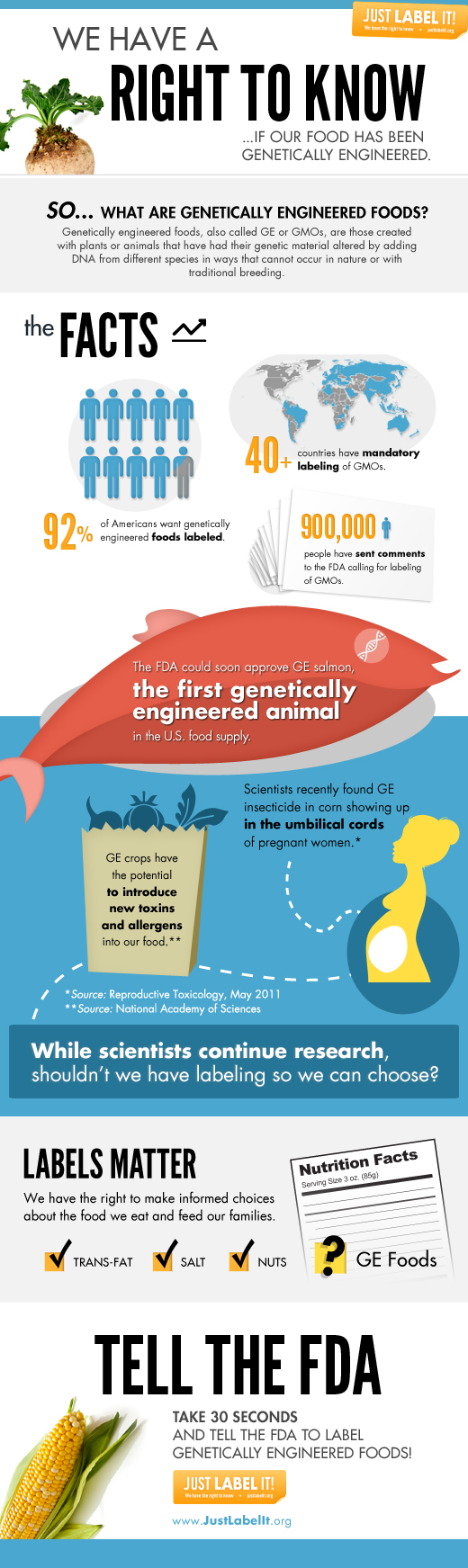
Do We Have the Right to Know If Our Food Has Been Genetically Modified?

Source: Washington's Blog

The FDA is close to approving genetically modified (gm) salmon. See this and this.

We know that at least some genetically modified foods may harm the environment. See this.

And serious questions have been raised about whether some gm foods might increase allergies or cause other health problems in humans and other organisms. See thisthis,thisthisthisthisthis and this.

Indeed, as Mother Jones pointed out last week, gm salmon may itself increase allergies:
Consumers Union senior scientist Michael Hansen called the company's food safety tests "woefully incomplete," and the group pointed out that the FDA approval panel is mostly comprised of GE [i.e. genetic engineering] cheerleaders, with no fish ecologists or allergists. Why is an allergist important? Because the company's own tests suggest that the new salmon could be much more allergenic than regular salmon.
In order to understand the allergy tests, a bit of backstory on how AquAdvantage salmon are made is necessary. First, genetic engineers create a "diploid" fish, meaning like people, it has two sets of chromosomes. Then, to make the final market product, they add genetic material from other fish and breed a new salmon with three sets of chromosomes—a "triploid" female that can't reproduce. AquaBounty researchers compared the allergenicity—or potential to cause an allergic reaction—of a control group of salmon to both the genetically engineered diploids and triploids. They found (PDF, see page 102) that the diploid salmon were 40 percent more allergenic than the control, while the triploid group was 19 percent more allergenic. 
AquaBounty says that the triploids' allergenicity level wasn't statistically significant, and although the diploids' level is significant, it doesn't matter because only triploids will be sold. But Hansen of the Consumers Union finds a few problems with this argument. For starters, the test wasn't double blind, meaning the researchers knew which fish were part of which test group. Second, the sample size of triploid fish was tiny—only six fish in all. Third, although AquaBounty is going to try to turn all its market-bound fish into triploid sterile females, the process isn't perfect, and some 5 percent could end up as the more allergenic diploid. Especially scary when you consider that unlike the triploids, the diploids aren't sterile. So if they escaped, they could breed with wild salmon. 
The FDA simply doesn't have enough information to determine whether AquaBounty's salmon are likely to cause more allergic reactions than their non-GE counterparts. But there is good reason to be concerned about the potential allergenicity of all GE foods, says Margaret Mellon, director of the scientist Union of Concerned Scientsts' Food and Environment Program. "You have this technology that allows you to essentially move proteins around from food to food," she says. "You can move a highly allergenic protein into a new food, and no one will know to avoid the new food."
Indeed, a 1996 study published in the New England Journal of Medicinefound that people who were allergic to Brazil nuts were also allergic to soy beans that had been implanted with a Brazil nut protein. There is also some evidence that even proteins don't usually cause allergies can become allergenic when they are moved to a new food. A 2005 Australian studyfound that mice who were fed peas containing a typically non-allergenic protein from kidney beans experienced allergic reactions. 
Another worry is that potentially allergenic GE crops might "escape" into foods. In the late '90s, the pharmaceutical giant Aventis introduced StarLink, a genetically engineered variety of corn. StarLink was approved for sale in the US, but only for non-food uses, since it contained a potentially allergenic protein. But then, traces of it started turning up in food (most famously, Taco Bell taco shells), and 28 people claimed they had suffered allergic reactions to foods containing StarLink. Although the CDC later found no medical evidence that any of those people had an allergy to the corn, an EPA advisory panel acknowledged that the CDC's tests did "not eliminate StarLink...protein as a potential cause of allergic symptoms." 
The bottom line: It's not that genetically engineered foods are inherently more allergenic than traditional foods, but transfering genes does make it more likely that allergens might pop up in unexpected places. "There can be a lot of unintended side effects when you do genetic modification, which means you have to test very carefully," says Wenonah Hauter, executive director of the watchdog group Food and Water Watch. "In the case of salmon, one test on six fish just seems very insufficient for something that will open the floodgates to other GE meat and fish."
Allergic reactions can - in a small percentage of people - be more severe than just a sniffle or stomach ache. Some people die from allergic reactions.

At least genetically modified salmon will be labeled as such, so people can avoid it if they wish. Right?

Wrong.

As the Washington Post notes:

The FDA says it cannot require a label on the genetically modified food once it determines that the altered fish is not "materially" different from other salmon - something agency scientists have said is true. 
Perhaps more surprising, conventional food makers say the FDA has made it difficult for them to boast that their products do not contain genetically modified ingredients.
Unfortunately, stifling the ability of producers of traditional foods to tell consumers they are not using an additive is nothing new. For example, Monsanto (the devil) has sued milk producers who labeled their product as not containing growth hormone.

Similarly, Scientific American notes that gm seed producers control research, so that independent scientists can't study the effects of gm:
Scientists must ask corporations for permission before publishing independent research on genetically modified crops.
Liberals and conservatives, progressives and libertarians should all be up in arms about this.
We have a right to know what we're eating.

Postscript: Farmed salmon contains less of the healthy Omega 3 fatty acids and more pollutants than wild salmon. See this and this. GM salmon will be farmed (unless it escapes into the ocean). So eating wild salmon may potentially be one way to avoid gm salmon, reduce exposure to pollutants, and increase healthy Omega 3s.

The reason that wild salmon has more Omega 3s than farmed salmon is that wild salmon eat Omega 3 rich foods. It is the same reason that grass-fed beef contains more Omega 3s than beef from cows fed corn, meat or other "modern" feeds. See this & this.

Eating Omega 3 rich foods can increase gray matter in adults and boost neurological development in children. Conversely, low dietary levels of Omega 3s in mothers can reduce their kids' IQ.

This is not entirely surprising, given that (1) our  brains are about 60% fat, and (2) leading nutritionists say that humans evolved to consume alot of Omega 3 fatty acids in the wild game and fish which they ate (more), and that a low Omega 3 diet is a very new trend within the last 100 years or so.

Tuesday, September 28, 2010

The FDA and Frankenfoods

Will the Agency Protect Consumers or the Profits of a Few Corporations
By JEFF DEASY

The U.S. Food and Drug Administration (FDA) has sent enforcement letters warning food makers that they cannot label their products as free of genetically modified or genetically engineered ingredients.

The letters were sent as a heated debate is taking place over whether the agency should approve a genetically engineered (GE) salmon that grows at twice the rate of salmon in the wild.

Sarah Alexander of the nonprofit Food & Water Watch says, “The FDA has a flawed process for approving these GE salmon and unfortunately for us, the process isn't focused on what happens to people who eat genetically engineered animals. If the FDA moves forward, these salmon would be the first GE animals approved for human consumption.”

An article in the Washington Post quotes Marion Nestle, a professor in the Nutrition, Food Studies and Public Health Department at New York University. She said, “The public wants to know and the public has a right to know. I think the agency has discretion, but it's under enormous political pressure to approve [the salmon] without labeling.”

The nonprofit Union of Concerned Scientists states on its web site:
So far, scientists have identified a number of ways in which genetically engineered organisms could potentially adversely impact both human health and the environment…In addition to posing risks of harm that we can envision and attempt to assess, genetic engineering may also pose risks that we simply do not know enough to identify.
Shades of the rBGH Milk Controversy

The FDA previously warned companies that they could not label products as hormone free. Ben & Jerry’s Homemade Inc., one of the first companies to label its ice cream as free of the synthetic hormone rBGH, joined a national campaign that included Stonyfield Farm and Organic Valley to block that effort.

According to the ice cream maker’s web site, “We’re still working to oppose the use of rBGH, a genetically engineered hormone given to cows to increase their milk production. We believe rBGH is an unnecessary technology that causes increased health risks to cows.”

The Concern About rBGH Dangers is International

Many countries, including Australia, New Zealand, Canada, Japan, and the European Union have banned rBGH due to health risks. According to Jeffrey M. Smith, the author of Seeds of Deception and Genetic Roulette, milk from cows given rBGH have much higher levels of IGF-1, a hormone considered to be a high risk factor for breast, prostate, colon, lung, and other cancers. The milk also has a lower nutritional value, leads to increased use of antibiotics, and more pus from infected udders.

Mr. Smith cites a statement from Fredrich-Wilhelm Graefe zu Baringdorf, former Vice President of the Agriculture Committee of the European Commission, “We feel fairly confident in being able to demonstrate that the safety of European citizens who consume [rBGH] products cannot be guaranteed.”

GE Labeled Food Unlikely to Appeal to Consumers

Many believe the biotechnology industry does not want genetically engineered food labeled as such because consumers do not want to buy it. There doesn’t seem to be a single company that has voluntarily labeled its products as genetically engineered.

Among the recent enforcement letters, one company was told a label that included a red circle with a line through it and the words "GMO," implied that there was something wrong with genetically engineered food and could not be used.

Many people are unaware that they are regularly consuming GE foods because they are not labeled. As Elise Pearlstein, producer of the Oscar nominated film Food Inc. has said, "It's outrageous that genetically modified foods don't need to be labeled...Whatever your position, you should have the right to make informed choices, and we don't."

GE Foods Are Not the Answer to World Hunger

As for the claim that GM foods are needed to feed a hungry world, Doug Gurian-Sherman, a senior scientist in the Union of Concerned Scientists Food and Environment Program has concluded "...that GE (genetic engineering) has done little to increase overall crop yields." And a major study conducted at the University of Kansas has found that the controversial technology actually reduces crop yields.

In May of 2009, the American Academy of Environmental Medicine called on “Physicians to educate their patients, the medical community, and the public to avoid GM (genetically modified) foods when possible and provide educational materials concerning GM foods and health risks."

Monday, September 6, 2010

Fast-growing GM fish ruled safe to eat by 'scientists'

'Frankensalmon' ruled safe to eat

By SEAN POULTER
6th September 2010

Genetically modified salmon, which grows at a superfast rate, is safe to be farmed and eaten, American scientists have declared.


The move by experts advising U.S. watchdogs will clear the way for the first GM creature to be sold as food. 


The first GM salmon could be on American dinner tables within two to three years, and possibly on British plates soon after that, paving the way for the genetic modification of other fish and food animals into what critics are calling 'Frankenfood'. 


salmon graphic


Shares in the company behind the technology leapt by 26 per cent on the London Stock Exchange on Friday, providing evidence that analysts see GM as the future of fish production. 


However, the science is highly controversial and consumers will have questions about the impact on human health and the environment. 


Critics of GM food fear the technology leads to the creation of mutant misshapen fish and could harm wild fish populations if they escape. 


Research on GM trout in Canada found that while they grew faster and were much bigger, a number developed misshapen heads and bloated bodies. 


The firm behind the GM Atlantic Salmon, Aqua Bounty, says its fish are normal but for the fact they grow up to three times more quickly. 


As a result, the AquAdvantage Salmon reach a market weight of around 3kg (6.6lb) in 16-18 months instead of the three years for farmed fish. In theory, they would reach around 6kg after three years, which would be double the size of most natural salmon of the same age. 


The growth is speeded up by the insertion of two genes, one linked to the production of growth hormone and a second to ensure growth continues even in very cold temperatures. 


The technology allows fish farmers to produce many more salmon at much lower cost, so boosting output and profits. 


The scientists behind the salmon have created safeguards to prevent any danger of them escaping and breeding with the wild population. These include ensuring all the fish involved are female and sterile. 


Now, two expert reports commissioned by the U.S. Food & Drug Administration have concluded it is safe for GM salmon to go into production. 


On health, the scientists on the Veterinary Medicines Advisory Committee said there are 'no material differences' between GM and conventional salmon. They say the fish contains the expected amounts of nutritionally important omega-3 and omega-6 fatty acids. 


They concluded: 'Food from AquAdvantage Salmon is as safe to eat as food from other Atlantic salmon.' And they added 'there is a reasonable certainty of no harm from consumption'. 


However, they admitted there are gaps in the research looking at whether some types of GM fish  -  not those currently planned for dinner tables  -  might cause an allergic reaction. 


On the environment, a second team of scientists concluded the safeguards put in place by Aqua Bounty would be sufficient to allow production to go ahead. 


Initially, the eggs would be produced in Canada, then shipped to Panama to be grown and then killed. Over time the technology would be extended worldwide. 


The FDA is due to make a final decision this month on whether to approve the GM salmon. 


But a coalition of 31 U.S. consumer, animal welfare, environmental and fisheries groups is opposing approval. 


They claim tests used to show the safety of the GM salmon were based on very small samples and point out that some of the fish had higher levels of growth hormone in their bloodstream, which is claimed to create a cancer risk. 


While the GM fish are supposed to be sterile, critics said up to 5% might be able to conceive and breed if they got into the wild. 


Pete Riley, director of campaign group GM Freeze, said: 'We are extremely concerned about the potential for these fish to escape.'

Tuesday, June 29, 2010

Giant Salmon Will Be First GM Animal Available for Eating

(ugh, gross, I will not be eating GMO salmon!--jef)

***

June 28, 2010 by the Telegraph/UK
by Louise Gray

Usually Atlantic salmon do not grow during the winter and take three years to fully mature.

A gene-engineered fish, top, and a natural one of the same age. (AquaBounty) But by implanting genetic material from an eel-like species called ocean pout that grows all year round, US scientists have managed to make the fish grow to full size in 18 months.

They hope that the sterile GM salmon can offer an efficient and safe way to breed salmon in fish farms, so that the wild fish can be left in the oceansUS watchdog the Food and Drug Administration is currently considering whether the GM Atlantic salmon, called AquAdvantage, is safe to eat. The fish could be on supermarket shelves within a year.

But environmental campaigners question whether the GM material is safe for humans to consume and fear the sterile salmon will mutate in the wild and be able to breed.

At the moment only GM crops like corn or soy are available for human consumption. Also the Daily Telegraph revealed recently that most animal products available in supermarkets, like meat, eggs or dairy, are from livestock fed GM.

But despite the creation of a GM mouse as early as the 1980s, the idea of eating modified animals does not appeal to the public.

AquaBounty, the Massachusetts company behind the GM salmon, say the fish will be sterile and therefore poses no risk to the wild.

The AquAdvantage would also be a much more energy efficient way to produce a nutritional food source, they claim.

Another project at the University of Guelph in Canada is developing a pig bred to digest food more effectively.

But Lord Melchett, policy director at the Soil Association, said the new technology is not worth the risk.

"Once you have bombarded an animal with other genes, the DNA is unstable, and there is no guarantee these fish remain sterile. It poses far too great a risk to wild salmon. A fish that grows that quickly is likely to lose some of its environmental benefits. There is no such thing as a free salmon lunch and we will pay the price," he said.

It will be a huge victory for the biotechnology industry if a GM animal becomes available for human consumption.

But in the UK, the public remains suspicious of 'Frankenfoods'. A Food Standards Agency survey to find out what the public think of the new technology is currently stalling after two leading academics resigned in protest at the government body's 'pro-GM' stance.