Showing posts with label CEO salaries. Show all posts

Tuesday, March 31, 2015

Low-wage jobs drive the recovery

By Ned Resnikoff -msnbc

It’s not uncommon to hear economics writers dismiss post-recession job growth as evidence of a “McJobs Recovery.” Sure, jobs may be slowly coming back, the argument goes, but not good jobs. Instead, employment growth seems to be largely concentrated in the sectors of the economy where wages are lowest.

That argument received some empirical ballast with the release of a report from the National Employment Law Project (NELP) that finds low-wage industries have grown at a disproportionately high rate since the end of the recession. The report’s author, policy analyst Michael Evangelist, finds that 44% of job growth since the end of the recession has been concentrated in industries where the median wage is $13.33 or less. That includes food service, retail, and administrative services (which includes jobs like security, maintenance, and janitorial work).

This is only the most recent in a series of NELP reports on the McJobs Recovery, all of which have found similar results. Evangelist told msnbc the consistency suggests this might be more than a hiccup on the road back to relative prosperity.

“Early on when we were doing these reports, we just speculated cyclical factors,” he said. “So one year into the recovery, consumer demand was growing and you’d see more growth in the restaurant food service industry.” But as food service continued to grow at a disproportionately high rate, NELP analysts came to see unbalanced growth as a more stable feature of the economic landscape.

“Now we’re five years into this and these are still the industries that are growing quickly,” said Evangelist.

Food service isn’t just one of the economy’s most fecund sectors: It’s also its most unequal, according to another report released last week by the left-leaning think tank Demos. In that study, Demos policy analyst Catherine Ruetschlin found that food services and retail had bigger worker-to-CEO compensation gaps than any other sector of the economy.

The steady encroachment of low-wage jobs may help to explain why median income in the United States has begun to stagnate even as the wealth of the country’s economic elite soars into previously unexplored altitudes. Last week, The New York Times reported that America no longer leads the world in median wealth, having been surpassed by Canada for the first time in at least decades.

Sunday, May 5, 2013

Hypocrites With Fat Wallets: CEOs Want It All

Sunday, 05 May 2013 | By Sam Pizzigati, Inequality.org

America’s top corporate executives love lecturing the rest of us about ‘fiscal responsibility.’ They want us to expect less from government. But they expect more, and a new report shows how they’re getting it.

Last week, federal unemployment benefits for the 400,000 Californians out of work since last fall dropped almost 18 percent, a $52 cut out of an average $297 weekly check. Similar cuts have already started rolling out in other states.

In all, 3.8 million long-term unemployed Americans will on average lose near $1,000 each by September 30, the date that ends the 2012 federal fiscal year.

The direct cause of all these cuts: the “sequester,” the $85 billion in federal austerity budget reductions that kicked in this past March 1.

Who deserves the “credit” for this meat-axe sequester? Credit the power suits who occupy Corporate America’s loftiest executive suites. These top corporate executives — organized in groups like “Fix the Debt” and the Business Roundtable — have been lobbying relentlessly for deep cuts in federal spending.

Only significant cutbacks in programs near and dear to average Americans, these executives proclaim, can save the nation from debt disaster.

But these same top executives, says a new report released last week, are actually running up the federal debt — purely to enrich themselves.

The giant firms these execs manage, details this new report from the Institute for Policy Studies and the Campaign for America’s Future, “are exploiting the U.S. tax code to send taxpayers the bill for the huge rewards they’re doling out to their top executives.”

How huge do these rewards go? UnitedHealth Group CEO Stephen Hemsley, a “Fix the Debt” endorser, pulled in $199 million between 2009 and 2011.

A convenient federal tax loophole — in place since 1993 — let UnitedHealth deduct $194 million of that windfall compensation on its corporate tax return. That deduction, in turn, saved UnitedHealth — and denied the federal treasury — $68 million, enough to extend full federal unemployment benefits for the rest of the 2013 fiscal year to over 65,000 jobless Americans.

The loophole UnitedHealth so lucratively exploited lets companies deduct off their taxes every dollar of “performance pay” they shovel into their executives’ personal pockets. UnitedHealth, of course, hardly stands alone here. All American corporate and banking giants play the “performance pay” game.

The 90 giant firms that belong to “Fix the Debt” play the game particularly well. Between 2009 and 2011, the deductions these 90 claimed for top executive “performance pay” added at least $953 million — and maybe as much as $1.6 billion — to America’s national debt.

The U.S. tax code’s exceedingly bountiful “performance pay” loophole has its roots in an earlier epoch of American public outrage at excessive CEO pay. Back in 1992, Bill Clinton campaigned against over-the-top executive pay in his drive for the White House. Congress, just months after Clinton’s inauguration, would go on to pass legislation that lawmakers hailed as a check on CEO excess.

The new law allowed corporations to deduct off their taxes no more than $1 million in compensation per executive. But the law had a huge escape hatch. Firms could exempt any “performance-based” pay from the $1 million limit.

The predictable result? An explosion of “performance-based” compensation, particularly in the form of stock options, an explosion that would keep CEO pay soaring. CEOs had been averaging 42 times U.S. worker pay in 1982. By 1992, the gap had jumped to 201 times. The average gap today: 354 times.

The “performance pay” loophole, the new Institute for Policy Studies and the Campaign for America’s Future report stresses, has served “as a critical subsidy for excessive compensation.”

“The larger the executive payout, the less the corporation pays in taxes,” the report explains. “And average taxpayers wind up footing the bill.”

That footing would end if legislation Representative Barbara Lee from California has introduced ever became law. Her Income Equity Act would deny corporations a tax deduction on any executive compensation that runs over 25 times the pay of a company’s lowest-paid workers or $500,000.

Interestingly, the Affordable Health Care Act enacted in President Obama’s first term sets a $500,000 cap, effective this year, on how much health insurers like UnitedHealth can deduct for executive compensation.

With this cap now law for health care execs, notes the new Institute for Policy Studies and the Campaign for America’s Future report, “taxpayers won’t have to worry so much about their hard-earned dollars going to subsidize fat paychecks for CEOs like Stephen Hemsley of UnitedHealth.”

“But,” sums up the study, “taxpayers may want to wonder why — at a time of scarce government resources — their tax dollars are subsidizing fat paychecks at any American corporate giant.”

Wednesday, May 1, 2013

Tracking CEO Compensation

The Best Indicator of Inequality is the Gap Between What CEOs and Their Workers are Paid
by SAM PIZZIGATI


Under current U.S. law, all our publicly traded corporations must annually disclose exactly what they pay their top executives. So why do all those CEO pay scorecards we see every spring show such different results?

USA Today found an 8 percent hike in 2012 CEO pay while The New York Times detected an 18.7 percent increase. Towers Watson, a corporate consulting firm, announced that CEO pay growth “slowed considerably,” rising at just a 1.2 percent rate last year.

What explains all these wildly divergent results? Let’s start with how corporations pay their top execs. This can get tricky.

Most executive pay today comes as stock-related compensation. Stock “options” give executives the right, down the road, to buy shares of their company stock at today’s share price. If that share price jumps, the execs can buy low and sell high. Instant windfall.

“Restricted” stock awards, on the other hand, give executives actual shares of stock, not just an option to buy them. Execs do have to wait a few years before they can actually claim these shares. No big deal. The shares will still have value in future years even if a company’s stock takes a hit.

But how should we value all this share-related compensation right now? Should CEO pay scorekeepers estimate how much stock awards granted this year will be worth in years to come? Or should scorekeepers only tally stock-related awards when execs actually profit personally from them?

Different executive pay scorekeepers give different answers. Scorekeepers also keep score on different sets of corporations. USA Today‘s new scorecard for 2012 tallies pay at 170 firms, the New York Times at just 100.

Given all this, do we have any single stat that tells us what we need to know? We do. That stat: the divide between worker and top executive pay.

America’s big-time CEOs, labor researchers at the AFL-CIO report, are now making 354 times the pay of average U.S. workers, the “largest pay gap in the world.”

Three decades ago, in 1982, American CEOs averaged just 42 times more than average U.S. workers. Two decades ago, in 1992, the gap stood at 201 times. A decade ago: 281 times.

The overall trend line, in other words, couldn’t be clearer. How can we reverse it? Identifying the specific pay gap between individual CEOs and their own workers would be a good first step.

Corporations have had to publish, for decades now, how much they pay their top execs. They haven’t had to reveal publicly how much — or how little — they pay their workers. The Dodd-Frank Wall Street Reform and Consumer Protection Act enacted in 2010 changes this dynamic, at least on paper.

Dodd-Frank requires corporations to annually disclose the gap between what they pay their CEOs and their most typical workers. But a corporate lobbying blitz has kept the Securities and Exchange Commission from writing the regulations needed to enforce this disclosure mandate.

Why do our biggest corporations so fervently oppose disclosing their CEO-worker pay ratios? Disclosure by itself, after all, won’t shove down CEO pay levels. But disclosure could open the door to other steps that could curb CEO pay excess.

Lawmakers could, for instance, choose to deny government contracts or tax breaks to corporations that pay their top executives over 25 or even 50 times what their own workers are making.

Far-fetched? Current law already denies government contracts to companies that discriminate by race or gender in their employment practices. As a society, we’ve concluded that our tax dollars must not go to corporations that widen racial or gender inequality.

So why should we let our tax dollars enrich corporations that widen our economic divide?

Sunday, May 6, 2012

CEOs were paid 231 times more than workers in 2011.

Thursday, May 3, 2012 by Common Dreams
How CEO Compensation Is Fueling Inequality
New analysis from the Economic Policy Institute (EPI) details how massive compensation to CEOs is driving inequality.

(cartoon by Khalil Bendib)
 
“CEOs have fared far better than the typical worker, the stock market and the U.S. economy as a whole since the late-1970s,” EPI President Lawrence Mishel said. “Compensation growth for executives and for top-tier financial-sector workers has fueled the enormous growth of incomes at the top.”

According to the new analysis from EPI, on average, CEOs were paid a staggering 231 times more than workers in 2011. In contrast, in 1965, CEOs were paid 20 times more than workers.

The analysis also shows that CEO compensation increased more than 725 percent from 1978 to 2011, while worker compensation only grew by 5.7 percent during the same period.

EPI writes in its ssue brief: "Just as wage inequality is a key driver of income inequality, a key driver of wage inequality is the growth of chief executive officer earnings and compensation and the expansion of and high compensation in the financial sector"

EPI's analysis CEO pay and the top 1%: How executive compensation and financial-sector pay have fueled income inequality, is part of “The State of Working America, 12th Edition,” to be released in August.
* * *
CEO pay and the top 1%: How executive compensation and financial-sector pay have fueled income inequality
Lawrence Mishel and Natalie Sabadish, EPI
Growing income inequality has a number of sources, but a distinct aspect of rising inequality in the United States is the wage gap between the very highest earners—those in the upper 1.0 percent or even upper 0.1 percent—and other earners, including other high-wage earners. Driving this ever-widening gap is the unequal growth in earnings enjoyed by those at the top. The average annual earnings of the top 1 percent of wage earners grew 156 percent from 1979 to 2007; for the top 0.1 percent they grew 362 percent (Mishel, Bivens, Gould, and Shierholz 2012).
In contrast, earners in the 90th to 95th percentiles had wage growth of 34 percent, less than a tenth as much as those in the top 0.1 percent tier. Workers in the bottom 90 percent had the weakest wage growth, at 17 percent from 1979 to 2007.
The large increase in wage inequality is one of the main drivers of the large upward distribution of household income to the top 1 percent, the others being the rising inequality of capital income and the growing share of income going to capital rather than wages and compensation (Mishel and Bivens 2011). The result of these three trends was a more than doubling of the share of total income in the United States received by the top 1 percent between 1979 and 2007 and a large increase in the income gap between those at the top and the vast majority. In 2007, average annual incomes of the top 1 percent of households were 42 times greater than in­comes of the bottom 90 percent (up from 14 times greater in 1979), and incomes of the top 0.1 percent were 220 times greater (up from 47 times greater in 1979). [...]
  • The significant income growth at the very top of the income distribution over the last few decades was largely driven by households headed by someone who was either an executive or was employed in the financial sector. Executives, and workers in finance, accounted for 58 percent of the expansion of income for the top 1 percent and 67 percent of the increase in income for the top 0.1 percent from 1979 to 2005. These estimates understate the role of executive compensation and the financial sector in fueling income growth at the top because the increasing presence of working spouses who are executives or in finance is not included.
  • From 1978 to 2011, CEO compensation increased more than 725 percent, a rise substantially greater than stock market growth and the painfully slow 5.7 percent growth in worker compensation over the same period.
  • Using a measure of CEO compensation that includes the value of stock options granted to an executive, the CEO-to-worker compensation ratio was 18.3-to-1 in 1965, peaked at 411.3-to-1 in 2000, and sits at 209.4-to-1 in 2011.
  • Using an alternative measure of CEO compensation that includes the value of stock options exercised in a given year, CEOs earned 20.1 times more than typical workers in 1965, 383.4 times more in 2000, and 231.0 times more in 2011.

Wednesday, April 25, 2012

Bank CEOs Gain as Millions Lose Dreams, Retirement to Foreclosure

Wednesday, April 25, 2012 by The Newark Star-Ledgerby John Cavanagh and Scott Klinger


Inside and outside of Wells Fargo’s annual meeting in San Francisco yesterday, thousands of angry protesters decried the bank’s leading role in the loss of millions of American homes to foreclosure.

If you want to know why the protesters are so angry, consider this double standard. For most Americans, retirement security lies in the value of their homes. Millions of these people have been losing that security as the nation’s largest banks have foreclosed on them. Yet the CEOs of these banks are reaping giant pay packages and padding their own retirement security with profits squeezed from ordinary people.

For many American families, a paid-off home is part of the dream of a secure retirement. The roof over their heads has long comprised the largest element of most families’ net worth. The housing crisis brought to us by the country’s biggest bankers has stolen the dreams of the nearly 4 million families who have lost their homes to foreclosure since the housing crisis began in 2007.

Of those who continue to live in their homes, more than a quarter have lost so much equity that they now owe more on their mortgage than their residence is worth. Even those who have never missed a payment on these underwater mortgages have found it all but impossible to refinance their loans to take advantage of record low rates that would cut hundreds of dollars from their monthly payments.

As American families struggle with their shrinking equity, Wells Fargo is enjoying record profits. Its earnings clocked in at more than $4 billion during the first quarter of 2012.

Wells Fargo and Bank of America are the country’s two largest mortgage servicers. Over the past three years, the number of homes foreclosed upon by the two giant banks has steadily grown. At the end of 2011, they reported to federal banking regulators that they held $22.5 billion and $19 billion worth of foreclosed houses, respectively.

While foreclosures have devastated the financial security of millions of American families, the CEOs of Wells Fargo and Bank of America have seen their retirement packages balloon.

The pension assets of Wells Fargo CEO John Stumpf stand at $16 million, according to the company’s proxy statement. The vast majority of these assets came from a special plan available only to the company’s top executives. As high as Stumpf’s retirement assets have soared, they’re exceeded by those of another Wells Fargo executive. Mark Oman oversees the company’s consumer lending division, where most of its ill-fated subprime loans were made and where many customers have lost their homes to foreclosure. His retirement assets top $17 million.

Bank of America CEO Brian Moynihan’s pension assets now total $6.8 million. His nest egg came mainly from a special "supplemental" pension plan.

It’s long past time that banking regulators stopped these dream-stealers from laughing their way to their gold-plated retirements. Protesters are insisting that the corporate funds diverted to prop up the lavish lifestyles of those responsible for upending the lives of the millions of American families who have lost their homes be redirected toward principal relief for homeowners devastated by these banks’ actions.

The Wells Fargo action was just the start. Don’t be surprised when thousands more protesters show up when Bank of America shareholders gather on May 9 in Charlotte, N.C.

Friday, December 23, 2011

When Democracy Becomes Disposable

by Roger Bybee 
 
The Laboratory for Our Future is the ominous subtitle of Charles Bowden's haunting 1998 book about Ciudad Juarez, Mexico.

The seedy but highly profitable laboratory revealed by Bowden, also author of the harrowing book Murder City about narco wars in Juarez, brings together the 19th-century model of sweatshop labor with 21st-century technology to generate maximum earnings for the U.S.-owned firms while offering minimal pay under NAFTA's protections.

In 1999, for example, GE CEO Jack Welch collected $92 million in compensation, more than his 15,000 Mexican workers combined. U.S.-based corporations pay no taxes and only minimal annual fees in Juarez,  so the vast majority of social costs are borne by the citizenry. As former Juarez Mayor Gustavo Elizondo explains, "We have no way to provide water, sewage, and sanitation works. Every year we get poorer and poorer even though we create more and more wealth."

But at the opposite end of the globalization process from Juarez, there's another laboratory conducting a related experiment : Benton Harbor, Mich., which once hosted jobs that have moved to places like Juarez. Like the workers in Juarez, impoverished residents of Benton Harbor—which is 92 percent African-American—have been stripped of democratic rights.

In Juarez, the prevalence of fraudulent political elections stolen and brutal repression have deprived the mostly female "maquiladora" workforce in assembly plants of any meaningful voice in either their workplaces or society.

In Benton Harbor, a unionized manufacturing workforce has been cast aside and the presence of nearly 10,000 overwhelmingly poor and black people are a potential obstacle to corporations like Whirlpool implementing a plan for redeveloping the area. Benton Harborites, too, have been rendered utterly powerless.

Thanks to Public Act 4, promoted by a Whirlpool ally and signed by GOP Gov. Rick Snyder, Benton Harbor Emergency Manager Joe Harris gained expanded powers to override decisions made by the democratically elected City Council and School Board. He literally expelled the elected mayor from his own office. Harris and other managers can also negate union contracts and other city agreements.

Gov. Snyder seems to believe that a state takeover of cities is more essential to their health than providing actual financial aid, which has been reserved for Michigan corporations in the form of $1.7 billion in tax cuts. Meanwhile, in part because of state budget cuts, Harris plans to raise water rates by about 40 percent even though 20 percent of the city's residents can't or won't pay city fees.

The Whirlpool Corp., headquartered in Benton Harbor, is playing a huge role in re-shaping the city, specifically in two major projects:
  • A heavily taxpayer "incentivized" new corporate campus for 4,000 professionals, as Whirlpool began off-shoring jobs in the 1980s (its Fort Smith Ark. plant is being relocated to Mexico)
  • A 530-acre Harbor Shores development including a Jack Nicolaus-designed golf course, high-end shopping, and condominiums. Whirlpool is also busy promoting an "Arts District" that attracts many affluent whites but few local black residents.
Whirlpool's role is not universally praised, as the New York Times Magazine' Jonathan Mahler reports in his December 18 cover story:
To skeptics of the redevelopment of Benton Harbor, Whirlpool looks less like a good corporate citizen than another company manipulating the system, leveraging its power to maximize its tax breaks and taking advantage of the town's access to federal and state grant money. (It's worth noting that Whirlpool hasn't paid any federal corporate income taxes in the United States for the last three years, partly, the company says, because of losses due to the recession.)
But the recession explanation covers only a small part of Whirlpool's tax picture, according to Matt Gardner, executive director of the Washington, DC-based Institute for Taxation and Economic Policy. Losses in recent years of economic troubles in the U.S. have been offset by foreign profits.

Further, in 2007, Whirlpool reported U.S. profits of $103 million, but earned an additional $701 million abroad that will not be taxed until Whirlpool brings the money back into the United States. Moreover, Whirlpool got a federal tax rebate of $28 million that year. In 2006, $231 million in U.S. earnings were topped off by another  $388 million in foreign profits.

Whirlpool's central role in the town and redevelopment plans has led many Benton Harbor residents to feel that the corporation views them as distinctly disposable and mainly a barrier to their plans. As Mahler summarizes,
It's being converted into a resort town for wealthy weekenders and Whirlpool employees that, when all is said and done, its struggling black population will either be driven out by the development or reduced to low-wage jobs cleaning hotel rooms, carrying golf bags or cutting grass.
Mahler observes,
The juxtaposition of Benton Harbor's impoverished population and its two rising monuments to wealth -- all wedged into a little more than four square miles -- make it almost a caricature of economic disparity in America.
But at the same time, it offers a window into one possible future for towns across the country, places that can no longer support their own economies or take care of their citizens and may ultimately have no choice but to turn their fate over to private industry and nonprofits. The way things are going, more and more states may start to look like Michigan, and more and more towns may start to look like Benton Harbor.
The Benton Harbor scenario is actually a familiar one for other de-industrialized cities wracked by massive industrial job loss or poor cities wrecked by natural disasters. As Hurricane Katrina tore off roofs and exposed the destroyed interiors of homes, it also peeled back the genteel veneer of elite opinion about New Orleans revealing that many top corporate and political figures viewed the majority of its residents to be essentially irrelevant, if not an outright impediment, to the restructuring of the city's devastated economy.

The flight of the city's poorest citizens was viewed openly as a chance for a fresh start. It not only removed a substantial part of the Big Easy's poor, black population for whom the city's economic leaders no longer saw as their responsibility to provide employment, but it also severely diminished their voting power and ability to have a role in determining how the city would be rebuilt.

The Arts District formula being applied to Benton Harbor has also been tried out in my hometown of Racine, Wis.,  a factory town of 80,000 hollowed out by the loss of well over 40 percent of its manufacturing base since 1980.

The solution: replacing more than 13,000 mostly unionized factory jobs with a new art museum and a cluster of art galleries and crafts shops. New York Times reporter Robert Sharoff fully bought into this re-invented Racine, a vision seemingly derived from the work of neo-liberal urbanist Richard Florida:
This formerly gritty industrial city roughly 70 miles north of Chicago and 30 miles south of Milwaukee on the shores of Lake Michigan has been trying for much of the last decade to reinvent itself as an artistÕs colony and tourist destination. The efforts have included the opening of the $11 million Racine Art Museum on Main Street in 2003 and the creation of a gallery district centering on nearby Sixth Street.
This stunning premise that the museum and 12 art galleries could significantly fill in the economic Grand Canyon left by the destruction of 13,000 family-supporting factory jobs reflects the same mentality that can view the Harbor Shores development as a path to prosperity for Benton Harbor's impoverished African-American population.

Despite Mahler's moving and insightful description of a de-industrialized city being re-shaped by those who destroyed the economic base, with the victims being deprived of any voice, he fails to point out several fundamental features:
  • Those harmed most by past corporate decisions are treated as disposable people standing in the way of corporate-defined reconstruction.
  • Democracy and public participation are early victims to this process.
  •  With corporate elites having shrunken government's public-interest role in planning and economic development, major "job-creation projects" must be shaped around generating profit with the needs of the majority a negligible concern.
But despite all the rhetoric about corporations rushing to the rescue of troubled cities--whether New Orleans, Benton Harbor, or Racine—massive public subsidies to CEOs advocating "free enterprise" are an essential element.

It's a formula for private benefit with public funding, for a distorted form of "development" devoid of democracy or public benefit.

The few, the proud, the very rich

Much of the current political and popular discourse has focused on inequalities that exist in the U.S. In particular the Occupy movement has brought the huge disparities in wealth to the forefront. There are a few questions floating around about wealth. First, how skewed is the distribution? Second, it is true that the rich have gotten much richer over time? —a statement I often heard my Grandma make.
Well, there is a plethora of statistics (e.g. here, here, & here) out there but here are two. The share of wealth held by the top fifth is about 87.2 percent while the bottom four-fifths share the remaining 12.8 percent of wealth—so the Occupiers are correct in their assessment.

And, the riches of those in the top 1 percent are about 225 times greater than that held by the typical family—it was 125 times in 1962—so, Grandma was correct too.

But, let’s look a bit further. The triennial Survey of Consumer Finances (SCF) is one of the best sources for data on wealth in the U.S. And, of course the Forbes 400 estimates the worth of the wealthiest amongst us—all 400 wouldn’t be captured in the SCF. If we look at both the SCF and the Forbes 400 we can glean some interesting insights.

In 2007 (the most recent SCF) the cumulative wealth of the Forbes 400 was $1.54 trillion or roughly the same amount of wealth held by the entire bottom fifty percent of American families. This is a stunning statistic to be sure.


Upon closer inspection, the Forbes list reveals that six Waltons—all children (one daughter-in-law) of Sam or James “Bud” Walton the founders of Wal-Mart—were on the list. The combined worth of the Walton six was $69.7 billion in 2007—which equated to the total wealth of the entire bottom thirty percent!

BTW the new 2011 Forbes 400 has the inherited worth of these six Waltons at $93 billion.

The 2010 SCF data that is slated for release spring of 2012 will almost certainly show a further widening of the wealth gap given that corporate profits, stocks and CEO pay have all recovered while housing values & equity (the lion’s share of wealth for average American’s), wages and family incomes have yet to turn around.

These revelations renewed my interest in the inheritance and estate tax debates. Also, didn’t I just read somewhere that Wal-Mart is substantially rolling back health care coverage for part-time workers and significantly raising premiums for many full-time staff?

We’ve got to get serious about reversing the long term trend of the ever increasing concentration of income and wealth into the hands of a few at the expense of the many. At stake is nothing less than our economy and our democracy.

Monday, December 19, 2011

Movie executives see record profits, salaries despite piracy fear-mongering

By Stephen C. Webster - RAW Story
Tuesday, December 13, 2011


Movie industry lobbyists like to say that online piracy costs their clients billions of dollars every year, and it’s getting worse — but that’s doesn’t quite seem to be the case, according to data released this week by the nonpartisan Congressional Research Service (CRS).

The CRS report (embedded below) shows that the movie industry is doing very well, earning record profits and paying executives more than ever, even as it hires fewer workers than it did just a decade ago. 

Although a recent National Crime Prevention Council ad campaign tries to make the point that piracy kills jobs, the CRS found that total gross revenues and box office receipts have doubled in the last 15 years. Grosses went from $52.8 billion in 1995 to $104.4 billion in 2009, while box office receipts went from $5.3 billion in 1995 to $10.6 billion in 2010 — yet hiring still went down.

One thing that has gone up, higher than ever, is executive pay. The CRS report noted that News Corporation paid CEO Rupert Murdoch $33,292,753 in 2011; Viacom gave CEO Philippe Dauman $84,515,308; Time Warner CEO Jeffrey Bewkes took home $26,303,071; while Disney CEO Robert A. Lger earned $29,617,964. Sony CEO Howard Stringer was at the bottom of the bunch at $4.3 million, having taken a 14 percent pay cut due to losses.

Those salaries are quite hefty compared to the top earners just a decade and a half ago. At Disney, former CEO Michael Eisner’s total compensation was $10 million in 1994, while Time Warner was compensating former CEO Gerald M. Levin $5 million, the CRS reported. Historical data for the other executives was not included.

The CRS report further shows that employment by film studios and related service companies has remained relatively stable since 1998. Though there have been spikes and slumps in hiring over the years, about 374,000 people worked full or part time making movies last year, down from 392,000 in 1998. That’s on the upswing from a low in 2009, when employment dipped just below 370,000.

Despite what the industry’s lobbyists are telling lawmakers, it’s impossible to say whether a minor slump in hiring is really reflective of piracy’s effects. That seemingly proves the industry’s biggest concern is not the Jack Sparrows of the Internet, but rather Netflix CEO Reed Hastings.

“Revenues from the U.S. movie industry’s home entertainment sector have been declining in recent years,” the report noted. “According to the Digital Entertainment Group, an industry-funded nonprofit, total U.S. spending on home entertainment, including movies and television content, was $13.9 billion in 1999. Spending rose to a peak of $21.8 billion in 2004, before declining gradually to $18.8 billion in 2010. The decline partly reflects the shift to less expensive video-on-demand services, such as Netflix.”

Netflix said that as of Sept. 30, it had 23.79 million customers, a slight decline over the previous quarter due to subscriber losses after a recent price hike. And in spite of the CRS report, Netflix insists it is good for studios.

Netflix is a boon to the entertainment industry, paying more than $1 billion a year to the studios for licensing rights to stream movies and TV shows over the internet for more than 20 million Netflix members to instantly watch,” spokesman Steve Swasey told Raw Story. “In addition, Netflix purchases DVDs for more than 10 million Netflix members who receive discs by mail.”

With their convenience factor and low cost of entry, Netflix has become a tremendous success, even as it has depressed sales of home videos. Much like what Apple’s iTunes did for music, driving down piracy and opening up new revenue, albeit in smaller streams than what the industry once knew, Netflix is doing for movies. But instead of working with them to provide a compelling alternative to piracy, studios are playing hardball with Netflix, raising prices on their streaming contracts.

Netflix is expected to pay over $1.98 billion next year to keep the bulk of its online library, up from $180 million in 2010. To make matters worse for Netflix, network owners like Time Warner and Comcast are rolling out their own video-on-demand services and setting caps on users’ bandwidth consumption. That will ultimately make them pay more for streaming large chunks of data, which cuts into the amount of time people can spend watching Netflix or downloading pirated content.

Netflix at present time accounts for up to 30 percent of Internet traffic in North America during peak hours, according to network measurement firm Sandvine (PDF). That means Netflix far outweighs movies being downloaded from the peer-to-peer network bittorrent, which Sandvine estimates accounts for roughly 21 percent of Internet traffic.

Breaking that figure down further still, a study into online piracy conducted by intelligence firm Envisional Inc., commissioned by NBC Universal and often cited by movie industry lobbyists, claims that just 35 percent of bittorrent traffic was people trading movies illegally. By comparison, another 35 percent was dedicated to sharing pornography not under copyright to studios, and another 29 percent was television shows, books, music, software and games.

But even with those numbers, it is impossible to extrapolate exactly what percentage of the total is purely infringing traffic, as some bittorrent downloads are legitimate. And even if that figure could be determined, studies have shown that those most involved in copyright infringement are typically the movie industry’s best customers, meaning a final total number for overall losses due to piracy is impossible to calculate.

As entertainment industry lobbyists hammer members of Congress about the need to fundamentally change the structure of the Internet by passing the Protect IP Act and the Stop Online Piracy Act, Parker Higgins, a spokesperson for technology advocacy group The Electronic Frontier Foundation, said he hopes they remember that even today’s declining home video market was once in the studios’ cross-hairs.

“The home video market is one that the movie industry tried to crush in its infancy, by trying to outlaw the VCR,” he told Raw Story. “This is an industry whose take on new technology you can’t really trust.”

The MPAA did not respond to a request for comment.

The full CRS report follows.
####

CRS Memo

Tuesday, October 11, 2011

The Class Warfare the Rich Don't Understand


Monday, October 10, 2011 by Al-Jazeera-English

The Masters of the Universe evaded responsibility and defiantly demanded more sacrifice from their victims, says author.
by Heather Digby Parton

"Those who own the country ought to govern it."
                 
- Founding father, John Jay

There have been rumblings in the corners of the Tea party movement for some time, but the minute president Obama announced that he was going to ask wealthy Americans to kick in a small bit more in taxes to help pay for some infrastructure improvements in his jobs proposal, the Republicans have been clutching their pearls and gasping for breath like Aunt Pittypat awaiting the arrival of the marauding Yankees.
 
GOP leader Rush Limbaugh called for the smelling salts, saying "If [Obama] would get all of this actually passed, it would represent perhaps a fatal blow to the US private sector ... I don't know how anyone could even argue about the fact that this is on purpose anymore. To boldly lie that it's not class warfare? It is class warfare. Specifically and purposefully class warfare."
Republican economic guru Paul Ryan dolefully declared, "Class warfare may make for good politics, but it makes for rotten economics. We don't need a system that seeks to divide people.

We don't need a system that seeks to prey on people's fear, envy, and anxiety." Indeed. What could be more destructive to the average American than to ask the upper one per cent to kick in what amounts to tip money? The guilt they will feel at such unfairness is bound to create a profound spiritual crisis throughout the land.

A false hope
One would have thought that in 2011, the term "class warfare" would be as out of fashion as Nehru jackets, but after watching the Republicans spend the first two years of Obama's presidency apoplectic over what they defined as hard core socialism put in practice, it stands to reason the old standard would make a comeback. No matter what you call it, rich people complaining about taxes is evergreen. It is also completely ridiculous.

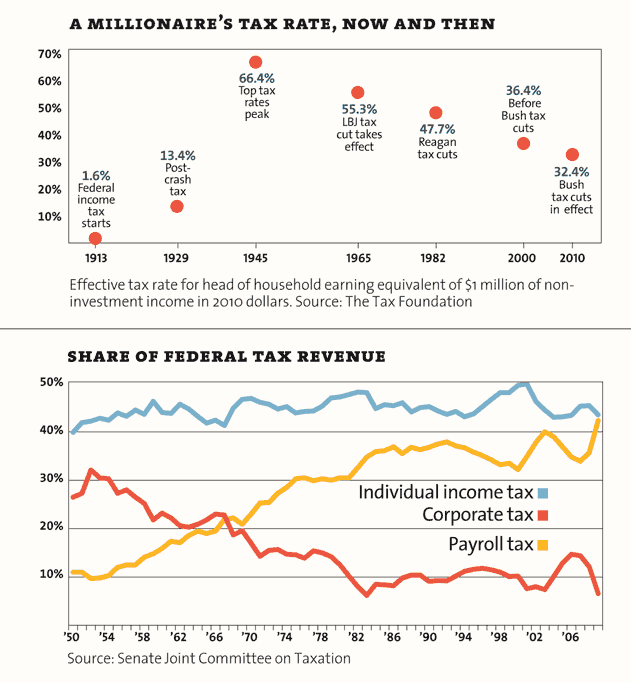
The fact is that the mega-rich have been gobbling up a greater and greater share of the national wealth for several decades now: in 1976 the top 1 per cent of households received 8.9 per cent of all pre-tax income - by 2008, its share had more than doubled to 21.0 per cent. Between 1979 and 2009, the top 5 per cent of American families saw their real incomes increase 72.7 per cent, according to Census data. Over the same period, the lowest-income fifth saw a decrease in real income of 7.4 per cent (by contrast, the 1947-79 period all income groups saw similar income gains, with the lowest income group actually seeing the largest gains). And perhaps most astonishingly, the tax rate for the highest earners was 91 per cent in 1960, 70 per cent in 1980 and only 35 per cent today, the lowest ever with the exception of a couple of years in the late 80s and early 90s.

And it's not as if these people have been suffering during this recession. Unlike the bottom 99 per cent, they've quite smartly recovered from the 2008 unpleasantness. For instance, according to a recent New York Times report, executive pay at 200 big US companies last year went up by an average 23 per cent over 2009 - the median executive salary was 10.8m USD. Meanwhile, the average American family's household net worth declined 23 per cent between 2007 and 2009.

Considering this somewhat ostentatious disparity, one would think that those who are doing well would decide to lay low and quietly count their money so as not to draw undue attention to their good fortune. One might even have expected them to take up good works and be especially generous in order to deflect the anger and resentment that any sentient being could see might result from such blatant unfairness. But no. They have instead waged a public campaign of extravagant whining, complaining incessantly that they are being scapegoated for the nation's economic ills and throwing tantrums at the mere suggestion that they might need to contribute a little bit more in taxes to make up for the carnage their bad bets left in their wake.

Wednesday, October 5, 2011

Executive Pay Spiraling Upward As Corporations Race To Pay Their Bosses The Most

("Why are people protesting..? I don't understand..." Oh, are these the jobs being created by the job creators? Well, no wonder there are so few of them! Look what they pay.--jef)


+++++


The American economy may be faltering, but corporate executives needn't worry: Regardless of how well they perform, each one of them stands a good chance of getting paid as much as all the others -- if not more.

That's because of a practice known as "peer benchmarking" -- a widely used method wherein corporations set pay for their executives at or above the median level of, well, other executives. No company wants their top brass leaving for another job with better pay, so executives are often compensated not based on how well they do, but on how much their competitors in the industry make.

The result? Salaries at the top are inching higher all the time, according to research cited by the Washington Post.

The financial crisis and subsequent worldwide economic slowdown haven't stopped executives from taking home bigger paychecks, both in salaries and bonuses. In 2010, JPMorgan CEO Jamie Dimon received a pay raise of more than $19 million, while Lloyd Blankfen, CEO of Goldman Sachs, collected an additional $3.6 million in bonuses and saw his salary more than triple.

In general, executive salaries have grown far faster than the incomes of average workers in the years since the crisis. Median CEO compensation pay rose by 27 percent in 2010, compared with an increase of just 2.1 percent for workers.

Such figures suggest that the prevalence of peer benchmarking, as outlined in a recent Washington Post article, may play an important role in the United States' ever-widening wealth gap.

Recent studies have shown that the richest 1 percent of Americans control about 24 percent of the country's wealth -- an imbalance that has grown especially pronounced in recent decades, as the salaries of the affluent climbed higher and higher while middle- and lower-class incomes became more or less stagnant.

The growing distance between America's wealthiest citizens and its poorest -- of whom there are more than ever before, with a record 46.2 million people counted in poverty last year -- may be contributing to the frustrating slowness of the economic recovery.

Even though the recession officially ended two years ago, the U.S. has added few new jobs and growth has slowed to a near-standstill.

The high levels of income inequality may have something to do with that. A recent study shows that countries with a more equitable income distribution tend to have longer periods of economic growth -- and that "more inequality lowers growth," in the words of one of the study's authors.

The wealth discrepancy has been cited as one of the principal grievances of the Occupy Wall Street movement, a grassroots protest that began in lower Manhattan's Financial District last month and has since spread to more than 100 cities.

The participants of Occupy Wall Street, more than 700 of whom were arrested during a march over the Brooklyn Bridge this weekend, have called for a more fair distribution of wealth, as well as greater repercussions for the banks at the center of the financial crisis and the end of corporate influence in the political process.

Nor are concerns over income inequality limited to the Wall Street protesters. A recent poll found that the number of Americans who see the country as divided between affluent "haves" and struggling "have-nots" rose in 2011 for the second year in a row.

Friday, September 2, 2011

Executive Pay and the Great Tax Dodge


Before the deficit reduction “super-committee” embarks on a $1–2 trillion course of human slashonomics, it should take a hard look at the Institute for Policy Studies’ (IPS) eighteenth annual executive compensation report, which details how corporations are rewarding CEOs for aggressive tax avoidance—to the tune of at least $100 billion in lost tax revenues every year.

Executive Excess 2011: The Massive CEO Rewards for Tax Dodging reveals that last year twenty-five of the 100 most highly paid CEOs took home salaries greater than the amount their companies paid in 2010 federal income taxes. And it wasn’t because the corporations weren’t making dough—they averaged global profits of $1.9 billion, and only seven reported losses in US pre-tax income.

But these twenty-five companies shielded their profits in 556 tax haven subsidiaries in places like the Cayman Islands, Isle of Man, and Singapore, which proved to be a lucrative tax dodging strategy for the CEOs themselves: the twenty-five CEOs averaged $16.7 million in compensation, compared to $10.8 million for their peers in the S&P 500.

“What we’re seeing here is tax dodging, pure and simple,” says Sarah Anderson, who directs the global economy project at IPS and has coauthored the Executive Excess report for eighteen years running. “And tax dodging that’s benefiting the CEOs of these companies personally.”

It’s not that the corporations are breaking the law. Indeed, the report co-authors emphasize that tax dodging isn’t illegal. But Anderson points out that the laws are “the result of a corrupt system where hundreds of millions of dollars spent lobbying can result in these kinds of crazy, corporate tax loopholes.

That’s why twenty of the twenty-five companies who paid their CEOs more than they paid in federal income taxes also spent more on lobbying lawmakers, and eighteen contributed more to the political campaigns of their preferred candidates than they paid to the IRS.

“GE is sort of our world champion when it comes to tax dodging," says Anderson. “They were also number one in lobbying and political campaign spending, with about $42 million spent on that last year.”

GE paid CEO Jeff Immelt—who also is chairman of President Obama’s Council on Jobs and Competitiveness—$15.2 million. The company had more than $5 billion in US profits, yet reaped $3.3 billion in federal income tax refunds. (You should be receiving your thank-you note in the mail any day now.)

Report co-author Chuck Collins, who directs the IPS program on inequality and the common good, notes that the offshore tax havens have created a “two-tier” corporate system in which domestic businesses that pay closer to the 35 percent statutory rate are competing against global businesses that game the system.
“This is really bad for business and bad for local domestic businesses in particular,” says Collins.

IPS is working with business allies to close loopholes, broaden the tax base  and reduce rates, creating a fairer system. Collins also points out that the common conservative argument that US companies pay one of the highest tax rates in the world at 35 percent is a canard. In fact, thanks to all the gimmicks courtesy of corporate lobbyists and an obliging Congress, the effective rate was 25 percent in 1988 and has plummeted to 10.5 percent today—among the lowest in the world.

“Two generations ago some of the CEOs of these very same companies would have been embarrassed to be so lavishly compensated while at the same time reneging on their responsibility to pay their fair share in taxes,” says Collins. “It’s not just a trend in terms of compensation and tax avoidance. We’re looking at a multigenerational ethical shift away from a civic and corporate leadership.”

The Stop Tax Haven Abuse Act sponsored by Senator Carl Levin and Congressman Lloyd Doggett would plug up some of the corporate-preferred offshore mechanisms and secrecy jurisdictions. IPS has a petition in support of the legislation, and members of Congress should also be contacted and urged to cosponsor. The voices of small-business owners in particular are an important counter to corporations that claim they need these tax havens to create jobs.

The report also illustrates that exorbitant CEO salaries—fueled in part by these tax avoidance schemes—have led to a dramatic increase in the gap between CEO and average worker pay: it was 263:1 in 2009, and shot up to 325:1 last year. Anderson notes that the ratio was just around 40:1 in the 1980s.

“It’s clearly not due to some huge increase of talent at the top—some kind of managerial brilliance,” she says. “Instead it’s the result of a perverse system where CEOs are outrageously rewarded for short-term thinking: tax dodging, reckless investments, slashing jobs, cooking the books or using accounting tricks. Meanwhile, board members approving the pay packages are often executives at other companies who don’t want to rock the boat, or who find the rising compensation mutually beneficial.”

Fortunately, as a result of the Dodd-Frank bill, shareholders now have a right to an annual (though non-binding) “say-on-pay” vote on executive compensation packages, and Anderson says about forty have been rejected.

“This is a growing area of activism,” says Anderson. “But we can’t just leave it to shareholders to solve all the problems.”

Other key proposals that need citizen-activists’ support include California Congresswoman Barbara Lee’s Income Equity Act that would deny corporate tax deductions on any executive pay that runs over twenty-five times the lowest-paid employee, or $500,000, whichever is higher.

There is also a need for citizens to get involved in an underreported fight over the Dodd-Frank requirement that corporations disclose the gap between its CEO and median worker’s pay. The potential for public backlash has led corporate lobbyists to make repeal a priority before the disclosure takes effect. The House will likely vote to repeal, and there is concern that conservative Democrats in the Senate will see it as a bone to throw to Big Business contributors heading into the 2012 elections.

Already, this report has had a positive impact: it led Maryland Democratic Congressman Elijah Cummings to call for hearings “to examine the extent to which the problems in CEO compensation that led to the economic crisis continue to exist today” and “the extent to which our tax code may be encouraging these growing disparities.”

Executive Excess has also received coverage from the Washington Post, the New York Times, Reuters, MSNBC, the Atlanta Journal Constitution and Bloomberg, among others—and that’s just on the first day of its release.

IPS has done a real service in drawing these connections between CEO pay and an absurdly unfair tax system. It’s time for street heat, letters to the editor, calls to Congress, and driving this issue into 2012. It’s time to restore some sanity to pay equity and corporate taxes.

Thursday, September 1, 2011

Some US Firms Paid More to CEOs and/or Lobbyists Than Taxes


by Nanette Byrnes 
 
WASHINGTON - Twenty-five of the 100 highest paid U.S. CEOs earned more last year than their companies paid in federal income tax, a pay study said on Wednesday.

It also found many of the companies spent more on lobbying than they did on taxes.

At a time when lawmakers are facing tough choices in a quest to slash the national debt, the report from the Institute for Policy Studies (IPS), a left-leaning Washington think tank, quickly hit a nerve.

After reading it, Democratic Representative Elijah Cummings, ranking member of the Committee on Oversight and Government Reform, called for hearings on executive compensation.

In a letter to that committee's chairman, Republican Darrell Issa, Cummings asked "to examine the extent to which the problems in CEO compensation that led to the economic crisis continue to exist today."

He also asked "why CEO pay and corporate profits are skyrocketing while worker pay stagnates and unemployment remains unacceptably high," and "the extent to which our tax code may be encouraging these growing disparities."

In putting together its study, IPS chose to compare CEO pay to current U.S. taxes paid, excluding foreign and state and local taxes that may have been paid, as well as deferred taxes which can often be far larger than current taxes paid.

The group's rationale was that deferred taxes may or may not be paid, and that current U.S. taxes paid are the closest approximation in public documents to what companies may have actually written a check for last year.

$16.7 MILLION AVERAGE

Compensation for the 25 CEOs with pay surpassing corporate taxes averaged $16.7 million, according to the study, compared to a $10.8 million average for S&P 500 CEOs. Among the companies topping the IPS list:
  • eBay whose CEO John Donahoe made $12.4 million, but which reported a $131 million refund on its 2010 current U.S. taxes.
  • Boeing, which paid CEO Jim McNerney $13.8 billion, sent in $13 million in federal income taxes, and spent $20.8 million on lobbying and campaign spending
  • General Electric where CEO Jeff Immelt earned $15.2 million in 2010, while the company got a $3.3 billion federal refund and invested $41.8 million in its own lobbying and political campaigns.

Though the companies come from different industries, their tax breaks fall into two primary areas.

Two-thirds of the firms studied kept their taxes low by utilizing offshore subsidiaries in tax havens such as Bermuda, Singapore and Luxembourg. The remaining companies benefited from accelerated depreciation.

Shareholders have responded favorably when companies in which they invest keep a tax bill low through legal methods, thereby benefiting earnings. But Chuck Collins, an IPS senior scholar and co-author of the report, said that is a mistake.

"I think it's an exposure of weakness in a company if their profitability is dependent on their accounting department and not on making better widgets," he said.

In prior reports, Collins said, out-sized CEO pay was often a red flag of bigger problems to come. The IPS has been putting a pay report together for 18 years. Among those whose leaders have made the high pay list in years past, only to have their businesses falter: Tyco, Enron and WorldCom.

Wednesday, June 22, 2011

32 Corporations Spent More on Compensation for Top Executives in 2010 Than They Paid in Income Taxes

Wednesday 22 June 2011
by: Pat Garofalo, ThinkProgress | News Analysis 
 
Over the last few decades, executive pay at large corporations has skyrocketed. Today, American CEOs make 263 times the average compensation for American workers, up from the 30 to 1 ratio in the 1970s. In 2010 alone, CEO pay went up 27 percent while average worker pay went up just 2 percent.

At the same time, corporate tax revenue has plunged to historic lows. During the 1960s, for instance, the United States consistently raised nearly 4 percent of GDP in corporate revenue. During the 1970s, the total was still above 2.5 percent of GDP. But the U.S. now raises less than 1.5 percent of GDP from the corporate income tax.
 
According to a new report called “S.& P. 500 Executive Pay: Bigger Than …Whatever You Think It Is,” put together by the independent research firm R. G. Associates, there are currently 32 companies that actually spent more on compensation for their top executives in 2010 than they paid in corporate income taxes:
Total executive pay increased by 13.9 percent in 2010 among the 483 companies where data was available for the analysis. The total pay for those companies’ 2,591 named executives, before taxes, was $14.3 billion…Warming to his subject, Mr. Ciesielski also determined that 158 companies paid more in cash compensation to their top guys and gals last year than they paid in audit fees to their accounting firms. Thirty-two companies paid their top executives more in 2010 than they paid in cash income taxes.
This isn’t really surprising when you consider that several of the largest U.S. corporations simply paid no taxes at all last year. General Electric, for instance, made more than $5 billion last year, but had a tax rate of -64 percent, meaning it received billions in tax benefits. Boeing hasn’t paid any federal income tax in three years, while CEO Jim McNerny made $19 million last year.

At the moment, a slew of multinational corporations — who already pay exceedingly low taxes — are lobbying for yet another tax boondoggle that would cost the government nearly $80 billion in revenue over the next ten years. With corporate taxes already so low, and corporations flush with cash and paying tens of millions to their CEOs, there’s little reason to grant these huge companies yet another giant tax giveaway.

+++++++
(In fact, the way the economy is, giving these unrepentant fools another tax break counts as treason to these eyes.--jef)

Sunday, May 8, 2011

CEOs at the Nation's Largest Companies Were Paid Better Last Year Than They Were In 2007...

...When Unemployment Was Roughly Half What It Is Today"
 

Washington’s Blog
CNN Money points out:
Just 22% believe the country is on the right track, Rasmussen tells us. According to a new Gallup poll, more than half of us say the economy is in recession or depression, despite the fact that output has been expanding since the summer of 2009. In fact, more of us (29%) say the country is in a depression than say the economy is growing (27%).

There's a good reason for this: As inflation surges at the store and the gas pump, the economy is stalling. And the heart of the problem could very well be the Federal Reserve's $600 billion "QE2" money-printing initiative, which was implemented last November to great fanfare on Wall Street and is set to end in June.

***

Yes, the stock market has posted impressive gains since the idea of QE2 surfaced....

But stock ownership is concentrated among the wealthy: On average, just 12% of households worth $100,000 or less own stocks and mutual fund shares outside their retirement plans -- a group that comprises 74% of the total population. While many more own shares through 401ks and IRAs, they're not in a position to easily tap that wealth for current spending.

At the same time, QE2 has pushed up borrowing costs [?], pressing down the prices of homes -- a much more widely held asset. The Case-Shiller Home Price Index started falling last summer as the idea of QE2 was floated, and it hasn't stopped since. The broad 20-city index now sits below 2009 levels.

This is a continuation of trends that have been in place since the recession ended in 2009. According to Credit Suisse equity strategist Douglas Cliggott, it suggests the improvement in net worth during the past two and half years "has been heavily skewed towards that relatively small part of the U.S. population that has significant equity holdings."

While the program has helped push up the cost of living for all of us -- sending inflation into the red zone and damaging consumer confidence -- evidence suggests its benefits have accrued only to the top tier of the net-worth ladder.

In other words, the Fed's "stimulus" has made the rich richer, with limited impact in terms of new spending. It's made the vast majority of people poorer, and less able to spend. It's this tradeoff that threatens to snuff out the feeble, three-year-old economic recovery.
And salaries have only gone up for the very top. AP notes:
CEOs at the nation's largest companies were paid better last year than they were in 2007, when the economy was booming, the stock market set a record high and unemployment was roughly half what it is today.
Indeed, the government's policies have been geared towards redistributing wealth upwards. See this, this, this, this, this and this.

Thursday, May 5, 2011

How Does Big Oil Gouge Us? Let Us Count the Ways


It's not just at the gas pump. The oil companies don't pay much in federal income taxes, either. Over the past five years Exxon has paid at a 3.6% rate (federal tax as a percentage of total pre-tax profits). Chevron was little better at 5.6%. Marathon paid 12%, Conoco Phillips 17%.

They use American research, infrastructure, and national security to make record profits. ExxonMobil, BP, Shell, Chevron, and ConocoPhillips realized a combined 42% increase in profits in the first quarter of 2011. Together, the five biggest oil companies made almost $1 trillion in profits over the past decade.

Goldman Sachs noted that speculation on oil prices is causing the price at the pump to go up. But according to the Huffington Post, the resulting oil company profits "are not finding their way back into the communities from which they came; are not being used to create more jobs; and are not being invested in new equipment and exploration." Instead, the money is going to dividends and stock buybacks. "They're basically enriching themselves," said Daniel J. Weiss, a senior fellow at the Center for American Progress.

The big profits are certainly not being used to create jobs and stimulate the economy, or to pursue alternative energy research. The Wall Street Journal reports that the big five oil firms are holding $70 billion in cash. Meanwhile, they're paying an average of $15 million apiece in annual salaries to their CEOs. Occidental and Chesapeake each paid over $100 million to their CEOs in 2009.

And then we have the continued flow of taxpayer subsidies to the oil industry, totaling about $4 billion a year. We just awarded a $42 million no-bid contract to BP to supply fuel to the Air Force, even as a criminal investigation continues over its Gulf of Mexico ineptitude. Why no-bid? Because the contract was called "an unusual and compelling urgency," which made it a national security issue.

Adding insult to gougery is the attitude of oil company executives, who have apparently convinced themselves of their righteous ways. An Exxon VP referred to his company as "a leading U.S. taxpayer." An American Petroleum Institute spokesman said that "everyday Americans," including teachers and firefighters, benefit from oil industry profits.

What they're saying, in effect, is that it's good not to pay taxes, because that leaves more money to invest in America. Gouging us again, in doublespeak.

Sunday, April 24, 2011

America's 10 Most Overpaid CEOs

The CEO who got a 449% raise for keeping his company in the red, and more tales of executive excess.

The recession is far from over for millions of Americans, but prosperity has returned to the nation's boardrooms and corner offices. After two years of declines in the wake of the financial crisis, executive pay is skyrocketing. CEOs at the country's 200 largest companies earned an average of 20 percent more last year than in 2009, according to recent corporate filings. By comparison, average pay for workers in the private sector rose just 2.1 percent last year—nearly the smallest increase in decades.

While some CEOs, such as Apple's Steve Jobs, took symbolic $1 salaries last year, many kept drawing outsized checks. Below, we list 10 of 2010's most egregiously overcompensated executives. They're selected not just on the size of their pay packages, but how much more they were paid than their peers at similar companies, as well as the disparity between their personal bottom line and their companies'. These 10 vividly illustrate what veteran compensation consultant Bud Crystal views as a broad problem in many boardrooms: "You have almost no relationship between pay and performance when it comes to the CEO."


Philippe Dauman, Viacom

Compensation: $84.5 million
Stock performance (change 2009-2010): +30%

Viacom CEO Philippe Dauman's staggering $84.5 million take makes him the highest paid chief executive in the nation. After getting a 149 percent raise in 2010, his pay bested that of the fourth- and fifth-highest-earning CEOs combined—and that was only for nine months on the job (Viacom changed its fiscal year in 2010 to end in September). During that time, Dauman brought home an average of $312,963 a day. To be sure, Viacom, the gargantuan media conglomerate that runs Paramount Pictures, MTV, Comedy Central, and Nickelodeon, saw respectable growth last year. It defended Dauman's pay by arguing that $54.5 million of it was a one-time signing bonus tied to a six-and-a-half-year extension of his contract. Even if that bonus is averaged over that period, Dauman would still be, on a monthly basis, the highest paid CEO in America, overseeing a company whose stock price closed out the 2010 fiscal year down 12 percent from its 2007 high.


Ray Irani, Occidental Petroleum

Compensation: $76.1 million
Stock performance: 23%

In 2009, Occidental Petroleum's Ray Irani was already the highest paid CEO in the energy biz. In 2010, his pay more than doubled. Since Irani took the helm in 1990, he's earned more than $1 billion in salary and stock options. This includes a windfall of $400 million in 2006, one of the biggest single-year payouts in US corporate history. His compensation far outstrips that at other high-performing energy firms. In an unprecedented vote last May, Occidental's shareholders advised it to reject Irani's pay deal—one of only three shareholder rebukes to management on executive pay last year. Irani will take a salary cut this year and retire.


Lawrence J. Ellison, Oracle
Compensation: $70.1 million
Stock performance: +16%

Larry Ellison, the third richest man in America, gets props for taking a pay cut last year even as Oracle shares rose in value. Even so, the America's Cup winner still earned more than all but two CEOs. While Ellison founded Oracle and turned it into a tech giant, the days of triple digit growth at the software and server company are long gone. Oracle's 16 percent stock return last year barely outdid the S&P 500's average. And any karmic debt that Oracle owes its founder has surely been repaid. During the aughts, the company gave Ellison a total of $1.84 billion, making him the best paid CEO of the decade.


Wiliam Weldon, Johnson & Johnson

Compensation:
$21.6 million
Stock performance: -0.5%


In 2009, Johnson & Johnson's sales declined for the first time since the Great Depression, battering its blue chip stock. A wave of product recalls last year further drove down share prices. But there are no more tears for CEO William Weldon, who earned $9.3 million in salary and stock options and a fat $12 million bonus, making him the nation's 12th-highest-paid CEO. It may help that Weldon chairs the J&J board and has personally nominated many of its members—the same people who approve his pay package. In its 2009 annual report, the board commended Weldon for his "strong leadership during a very demanding year." In the first four months of this year, the company's stock has fallen four percent.


John Chambers, Cisco Systems

Compensation:
$18.9 million
Stock performance: +5%

"We have disappointed our investors and we have confused our employees," Cisco CEO John Chambers apologized to his employees last month after a year of anemic growth and profits. But he wasn't sorry enough to take a pass on his $18.9 million in pay, double what he earned in 2009. That figure includes $8.2 million in stock options, more than what 75 percent of his industry peers received. Cisco's shares fetch 35 percent less today than in 2006, when Chambers started as the chairman of its board. More bad news: Two years after buying the maker of the Flip video camera for $590 million, Cisco has just announced that it's spiking the product.


John Stumpf, Wells Fargo

Compensation:
$17.6 million
Stock performance: +16%

In 2009, when Wells Fargo still owed the federal government $25 billion in bailout funds, CEO John Stumpf got a $5 million raise. The resulting hurricane of bad publicity may be why Wells Fargo cut Stumpf's base pay in 2010. But it still gave him a $3.3 million cash bonus, leaving his total earnings almost unchanged. He remains one of the country's highest-paid bank CEOs. A few secrets to his success: Profiting from foreclosing on homeowners and hoarding liquid assets to shore up the bank's bottom line.


Michael Strianese, L-3 Communications
Compensation:
$16.5 million
Stock performance: -17.2%

This major defense contractor's shares plunged in 2010 due to fears of military spending cuts, an alleged Air Force security breach, and public backlash against its full-body airport "porno" scanners. Even so, CEO Michael Strianese got a raise, raking in $16.5 million. Since Strianese became CEO in 2006, his pay has jumped 70 percent even as L-3's shares have seesawed. As the budget debate began heating up last year, Defense Secretary Robert Gates told defense contractors to start delivering cost savings lest the government force them to do it. In response, Lockheed Martin announced modest cuts to its executive compensation. L-3, however, gave its head honchos a 22 percent pay hike.


Shantanu Narayen, Adobe Systems

Compensation:
$12.2 million
Stock performance: -20.8 %

Last year, Shantanu Narayen earned about as much as the CEOs of eBay and Texas Instruments, tech firms with much better stock returns and double Adobe's market cap and profits. Narayen received a 143 percent raise even as Abobe, the maker of Flash, Photoshop, and PDF readers, released a disappointing earnings forecast in September that sent its shares plunging by 20 percent. Abobe claims to emphasize long-term growth over quick gains; like many companies, it grants most of its executive pay in the form of stock. Yet with its shares in the gutter, even a modest recovery this year could quickly give Narayen another windfall.


John Surma, United States Steel

Compensation:
$8.3 million
Stock performance: 6.4%

Weak demand from beleaguered US manufacturers caused US Steel to underperform the rest of the S&P 500 last year. Nevertheless, CEO John Surma's pay shot up by a staggering 449 percent. To be fair, Surma earns a lot less than many of executives, and his raise reflects a pay cut that he took in 2009 as part of a turnaround plan. Yet that anticipated turnaround isn't complete. US Steel shaved its annual losses from $1.4 billion in 2009 to $482 million last year—not bad, but hardly in the clear yet.


Craig Dubow, Gannett

Compensation:
$7.9 million
Stock performance: 2.8%

In January, the ailing newspaper giant announced that it would extend a two-year program of mandatory furloughs for its workers. CEO Craig Dubow would share in the pain by giving back a week's worth of pay. But he wouldn't return his 80 percent raise, which he'd earned while boosting profits through layoffs and wage cuts. Not that the downsizing has helped: In the past three years, the company's flagship USA Today has lost 20 percent of its readership; the company's stock is down by nearly half. On the Gannett Blog, a watchdog site run by a former USA today editor, reaction to Dubow's pay package was withering. "Pure and simple," one commenter wrote, "a laugh in every employee's face."