Showing posts with label radiation. Show all posts

Friday, October 24, 2014

Unprecedented catastrophe underway at Fukushima… Radioactive material will keep coming across to North America for centuries


Oct. 20, 2014 Chronic and long-lasting radioactive releases are [ongoing]… Fukushima continues to bleed into the ocean, because those nuclear cores have melted down and are in direct contact with the groundwater. It will bleed for centuries perhaps, and certainly decades to come. So when you compare these nuclear accidents… [Chernobyl] didn’t hit groundwater… The bottom line is that accidents are getting worse… Chernobyl contaminated all of Europe – 


Fukushima is contaminating the entire Pacific. >> Watch presentation here Kevin Kamps, nuclear waste watchdog, Oct. 21, 2014 (at 46:00 in): It shows what’s really been expected, that the massive releases of radioactivity — both atmospheric, that fell out on the ocean, and liquid, that are still on a daily basis pouring into the ocean — are slowly, or not so slowly, making their way to the North American coastline… This is going to keep going on for years, decades, even centuries into the future… Everyday, it’s 300 tons of radioactive groundwater that flows into the sea – every single day for the past nearly 4 years now — 300 tons of radioactive groundwater, containing a toxic alphabet soup of radioactive poisons, cesium… strontium-90, plutonium isotopes. That’s each and every day, so it is an unprecedented catastrophe for the oceans… The significance is — that is open ocean sea water. The bioaccumulation, biomagnification — we’re talking about orders of magnitude concentration of these radioactive poisons. First plankton, then go up the food chain — we are at the top of that food chain. So that’s just going to get worse the further up the food chain you go. It’s a very significant issue that the US federal government and the state governments are not paying attention to.

Monday, September 30, 2013

Some Facts You Should Know About Fukushima

A Letter to All Young Athletes Who Dream of Coming to Tokyo in 2020
by TAKASHI HIROSE

 On September 7, 2013 Japan’s Prime Minister Shinzo Abe said to the 125th session of the International Olympic Committee, the following:
Some may have concerns about Fukushima. Let me assure you, the situation is under control. It has never done and will never do any damage to Tokyo.

This will surely be remembered as one of the great lies of modern times. In Japan some people call it the “Abesolute Lie”. Believing it, the IOC decided to bring the 2020 Olympics to Tokyo.

Japanese government spokespersons defend Abe’s statement by saying that radiation levels in the Pacific Ocean have not yet exceeded safety standards.

This recalls the old story of the man who jumped off a ten-storey building and, as he passed each storey, could be heard saying, “So far, so good”.

We are talking, remember, about the Pacific Ocean – the greatest body of water on earth, and for all we know, in the universe. Tokyo Electric Power Company – TEPCO – has been pouring water through its melted-down reactor at Fukushima and into the ocean for two and a half years, and so far the Pacific Ocean has been able to dilute that down to below the safety standard. So far so good. But there is no prospect in sight of turning off the water.

Here are eight things you need to know.


A letter to All Young Athletes ENGLISH (1)_html_7c908f6a


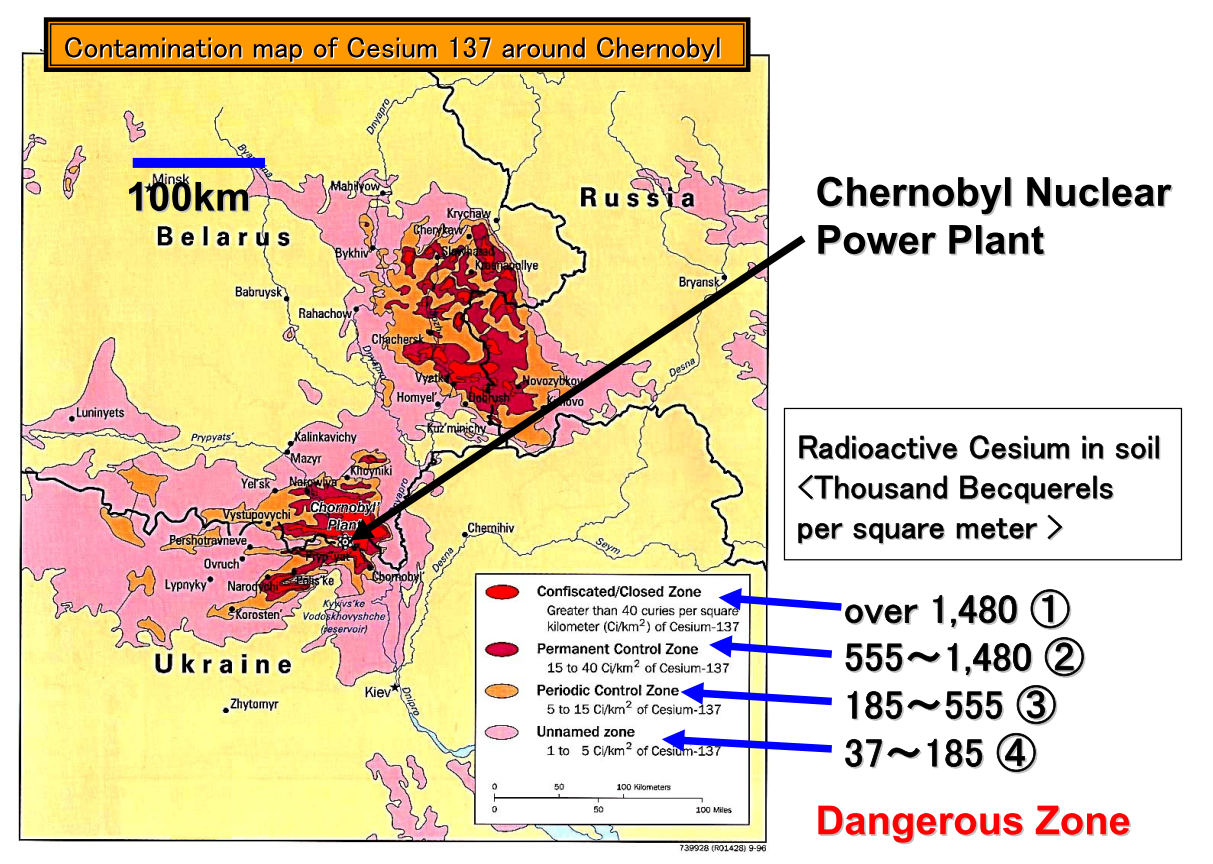
1. In a residential area park in Tokyo, 230 km from Fukushima, the soil was found to have a radiation level of 92,335 Becquerels per square meter. This is a dangerous level, comparable to what is found around Chernobyl ④ zone (the site of a nuclear catastrophe in 1986). One reason this level of pollution is found in the capital is that between Tokyo and Fukushima there are no mountains high enough to block radioactive clouds. In the capital people who understand the danger absolutely avoid eating food produced in eastern Japan.


A letter to All Young Athletes ENGLISH (1)_html_2ccd6755


2. Inside Fukushima Daiichi Nuclear Reactors #1 – #3 the pipes (which had circulated cooling water) are broken, which caused a meltdown. This means the nuclear fuel overheated, melted, and continued to melt anything it touched. Thus it melted through the bottom of the reactor, and then through the concrete floor of the building, and sank into the ground. As mentioned above, for two and a half years TEPCO workers have been desperately pouring water into the reactor, but it is not known whether the water is actually reaching the melted fuel. If a middle-strength earthquake comes, it is likely to destroy totally the already damaged building. And as a matter of fact, in the last two and a half years earthquakes have continued to hit Fukushima. (And as an additional matter of fact, just as this letter was being written Fukushima was hit by another middle-strength earthquake, but it seems that the building held up one more time. So far so good.) Especially dangerous is Reactor #4, where a large amount of nuclear fuel is being held in a pool, like another disaster waiting for its moment.

3. The cooling water being poured into the reactor is now considered the big problem in Japan. Newspapers and TV stations that previously strove to conceal the danger of nuclear power, are now reporting on this danger every day, and criticizing Shinzo Abe for the lie he told the IOC. The issue is that the highly irradiated water is entering and mixing with the ground water, and this leakage can’t be stopped, so it is spilling into the outer ocean. It is a situation impossible to control. In August, 2013 (the month prior to Abe’s IOC speech) within the site of Fukushima Daiichi Reactor, radiation was measured at 8500 micro Sieverts per hour. That is enough to kill anyone who stayed there for a month. This makes it a very hard place for the workers to get anything done. In Ohkuma-machi, the town where the Daiichi Nuclear Reactor is located, the radiation was measured in July, 2013 (two months before Abe’s talk) at 320 micro Sieverts per hour. This level of radiation would kill a person in two and a half years. Thus, over an area many kilometers wide, ghost towns are increasing.

4. For the sake of the 2020 Tokyo Olympics, an important fact has been left out from reports that go abroad. Only the fact that irradiated water is leaking onto the surface of the ground around the reactor is reported. But deep under the surface the ground water is also being irradiated, and the ground water flows out to sea and mixes with the seawater through sea-bottom springs. It is too late to do anything about this.

5. If you go to the big central fish market near Tokyo and measure the radiation in the air, it registers at about 0.05 micro Sieverts – a little higher than normal level. But if you measure the radiation near the place where the instrument that measures the radiation of the fish is located, the level is two or three times greater (2013 measurement). Vegetables and fish from around the Tokyo area, even if they are irradiated, are not thrown away. This is because the level established by the Japanese Government for permissible radiation in food – which if exceeded the food must not be sold – is the same as the permissible level of radiation in low-level radioactive wastes. Which is to say, in Japan today, as the entire country has been contaminated, we have no choice but to put irradiated garbage on the dinner table. The distribution of irradiated food is also a problem. Food from near Fukushima will be sent to another prefecture, and then sent on, relabeled as produced in the second prefecture. In particular, food distributed by the major food companies, and food served in expensive restaurants, is almost never tested for radiation.

6. In Japan, the only radiation from Fukushima Daiichi Nuclear Reactors that is being measured is the radioactive cesium. However large amounts of strontium 90 and tritium are spreading all over Japan. Strontium and tritium’s radiation consists of beta rays, and are very difficult to measure. However both are extremely dangerous: strontium can cause leukemia, and tritium can cause chromosome disorder.

7. More dangerous still: in order, they say, to get rid of the pollution that has fallen over the wide area of Eastern Japan, they are scraping off the top layer of the soil, and putting it in plastic bags as garbage. Great mountains of these plastic bags, all weather-beaten, are sitting in fields in Eastern Japan subject of course to attack by heavy rain and typhoons. Eventually the plastic will split open and the contents will come spilling out. When that happens, there will be no place left to take them.

8. On 21 September, 2013 (again, as this letter was being composed) the newspaper Tokyo Shimbun reported that Tokyo Governor Naoki Inose said at a press conference that what Abe expressed to the IOC was his intention to get the situation under control. “It is not,” Inose said, “under control now.”

Sunday, September 15, 2013

Fukushima is Out of Control says TEPCO Official

Friday, September 13, 2013 by Common Dreams
Statement contradicts assurances of Japanese PM, comes as fresh steam is spotted billowing from reactor
- Sarah Lazare


"I’m sorry, but we consider the situation is not under control."

Those were the words of Kazuhiko Yamashita, executive-level fellow for Fukushima plant operator Tokyo Electric Power Company when he was pressed by the opposition Democratic Party of Japan.

His statements directly contradict the claims of Japanese Prime Minister Shinzō Abe, who assured the International Olympic Committee meeting in Buenos Aires Saturday that the situation is under control.

TEPCO officials moved quickly to cover Yamashita's tracks, releasing a statement Friday declaring
It is our understanding that the Prime Minister intended his statement ‘the situation is under control’ to mean that the impact of radioactive materials is limited to the area within the port of the power station, and that the densities of radioactive materials on the surrounding waters are far below the referential densities and have not been on continuous upward trends. According to this understanding, we share the same views.

Yet, all evidence suggests that the crisis is far beyond the current abilities of the Japanese government and operator TEPCO to contain it.

Each day brings new disasters, with fresh reports on Friday that steam is billowing from a reactor. Radiation levels at the plant were found to be 18 times higher than TEPCO previously claimed, climbing to a high of 1800 millisieverts per hour—enough to kill a person in just four hours.

TEPCO has poured thousands of tons of water to cool the melted reactors, yet has no sustainable plan for storing it once contaminated. The temporary tanks where the radioactive water is currently being held are springing leaks, releasing the water into the groundwater, and by extension, the sea. TEPCO says it has resorted to patching tank leaks with plastic tape.

The Japanese government announced in early September it will invest $500 million to build a giant 'wall of ice' surrounding the plant. Yet, experts predict it will take at least 2 years to complete, and there is no evidence that this is enough to stem what has become a ballooning crisis.

The disaster was touched off by Japan's March 2011 earthquake and tsunami that led to the meltdown of fuel-rods at several reactors and continues to unleash toxic radiation into the air and sea. Over 160,000 people have been evacuated, transforming nearby areas into ghost towns in the worst nuclear disaster since Chernobyl. The Japanese government has been criticized for moving to re-start other nuclear facilities as the Fukushima crisis spirals.

Friday, September 6, 2013

Radiation at Fukushima Soars to Highest Level Yet


As officials tout 'ice wall' experiment, more lethal levels of radioactivity detected
- Andrea Germanos, staff writer

Record high radiation levels were detected at the disaster-stricken Fukushima nuclear plant, Japan's nuclear regulator and plant operator TEPCO said on Wednesday, raising more concerns that the spiraling catastrophe has no end in sight.

Officials said they had detected radiation of levels of 2,200 millisieverts per hour on Tuesday near contaminated water storage tanks. That's a rise of 20% from the previous high, the Guardian reports.

The announcement comes just days after officials said they had detected lethal radiation levels 18 times higher than previously documented because the testing equipment they were using could only read measurements of up to a maximum of 100 millisieverts per hour.

Reuters notes that "both [the 2,200 and 1,800] levels would be enough to kill an unprotected person within hours."

Also festering at the plant is the buildup of contaminated water, which has proven an unsustainable crisis. There has also been as a series of leaks from storage tanks and pipes.

Mycle Schneider, lead author for the World Nuclear Industry status reports, told BBC News last month that the problem of water leaks "is much worse than we have been led to believe, much worse." There are leaks "not just from the tanks. It is leaking out from the basements, it is leaking out from the cracks all over the place," he said. Further, the head of Japan's nuclear regulatory body warned on Monday that there may be no other option than to dump radioactive waste water into the Pacific.

In a desperate attempt to stop the leaks, Japanese Prime Minister Shinzo Abe announced Tuesday the government plans to invest nearly $500 million in a giant "ice wall" surrounding the plant.

Nuclear engineer Arjun Makhijani of the Institute for Energy and Environmental Research called the wall of ice plan a "risky experiment." Speaking on PBS Newshour, Makhijani explained:
I don't know that an ice wall like this has been tried before.

It's like building a dam underground, but with ice, by freezing all the poor water in the soil, all soil has -- so there's water coming in from uphill, through the side and going into the ocean, all underground. It's an aquifer. Some of that water contacts the molten fuel and is becoming contaminated.

And they hope to build -- to freeze the soil, basically, with a giant freezing machine, just like your freezer at home, put cooling coils in the soil, lots and lots of them. It takes an enormous amount of electricity and they would freeze it. Of course, it contains the water behind it like a dam, but eventually it's going to overtop the dam, as it did before. [...]

It is an experiment. And I think it's a risky experiment, because if the power fails, you know, just like if your -- when the power goes out with your refrigerator, everything will de-freeze in -- defrost in the freezer.

So, if this ice melts suddenly and it's blocking an enormous amount of contaminated water behind it, then you have got a problem. At the same time, you know, the tanks are themselves something of a threat, if there's another earthquake and this highly contaminated water gets into the ocean. And so they have a got a very -- couple of very, very serious problems of containing the water.

Last month, Makhijani warned, "This is an accident that’s shockingly not stopping."

Amidst the fight to contain the nuclear disaster, Japan is brushing aside concerns of radioactivity as it makes its bid to be the host of the 2020 Olympics.

“The radiation level in Tokyo is the same as London, New York and Paris,” said Tsunekazu Takeda, an IOC member and president of the Japanese Olympic committee. “It’s absolutely safe, 35 million people living there in very normal conditions. We have no worries.”

Saturday, August 31, 2013

Wrecking the Earth: Fracking has grave radiation risks few talk about

by Christopher Busby, who is an expert on the health effects of ionizing radiation and Scientific Secretary of the European Committee on Radiation Risk.

RT - August 28, 2013


Environmentalists point to various dangerous consequences of using fracking technology, but none can be compared to the issue of radiation exposure and radioactive contamination of the development areas it poses.

UK government plans to use fracking technology in populated areas of the country recently drew hundreds of people to the streets in protests. Protesters pointed to the dangerous example of the US, the worldwide leader in fracking, where hydraulic fracturing (which consumes vast amounts of water) led to areas of Arkansas, Colorado, New Mexico, Oklahoma, Texas, Utah and Wyoming facing a dire water crisis.

Fracking involves toxic chemicals being lowered into kilometer-deep holes drilled in the ground to isolate gas and oil from shale. The toxic chemicals can then float into lakes and rivers or contaminate the ground. Also, fracking produces a disproportionate amount of waste, including radioactive water, which then has to be dumped somewhere.

The key to fracking

Uranium is the key element to fracking, or hydraulic fracturing, to use its proper name. In the real-world version of Phineas Fogg’s “Eighty Days Around the World,” burning the ship’s masts and furniture to make steam, governments are now encouraging the oil and gas merchants to blast their way deep into the Earth to squeeze the last ounce of oil and gas from that poor creature. But there will be a terrible revenge. Locked up in the strata into which they pump the pressurized process water, to fracture and thus create the huge surface area sponge which will yield up its cargo of gas and oil, is a monstrous amount of natural uranium and its deadly daughter Radium-226. And vast amounts of the radioactive alpha emitting gas Radon-222, and its own daughters Bismuth 214, Lead-210 and the alpha emitter Polonium-210. Remember Polonium-210? That was the material used when a few millionths of a gram poisoned ex-Russian agent Alexander Litvinenko.

Deep down in the earth, there is a lot of radioactivity, which is safe enough, so long as it is not brought up to the surface. The technical term is NORM (Naturally Occurring Radioactive Material). When it is brought to the surface it becomes Technologically Enhanced, or TENORM, and it is a serious health problem near oil wells and gas production sites. It is in the production water, in the oil, in the gas, around the production sites, the groundwater, in the pipes and tanks – and in your kitchen.

The easy oil and gas deposits are those where there are subterranean reservoirs, and the oil and gas can obtained by drilling into the reservoir and then pumping down water to displace the oil back up the drill pipe. These are now running out, or are owned by people who control the flow and the price. But there are many other deposits, where the resource is spread throughout the rock, like water in a sponge. Fracking comprises any method employed to break up the solid rock, shale or sandstone to provide channels that allow the oil or gas in the strata to more easily be pumped to the surface. Fracking is not a new idea, but there are some new technologies being employed that make it easy to obtain gas economically from such hitherto unassailable rock sources. For reasons which I will outline, this development has some worrying aspects.

The gas or oil will not normally be available because it is trapped in and interspersed through solid rock. To get it out you have to drill horizontally along the solid organic clay material, the shale, (or whatever oil-bearing rock type is there) and then break that unto small pieces in various ways so that the gas or oil can be pushed by the water you pump in back to the well pipe and up to the surface. The methods of breaking up the rock and holding the subsequent channels apart vary; put together they are “fracking”.

The shale strata are between 1,000 and 8,000 feet deep. Owing the weight of rock above, the pressure on the rocks in the gas bearing strata at these depths is enormous. The drill has to pass a tube (the “gun”) along the stratum for as long a length as possible and then this has to become perforated along its length with holes that allow the gas or oil to get into the tube and up to the surface.

Historically difficult. But technology has come to the rescue in the manifestation of specially designed explosives called “shaped charges.” These are cone-shaped dense metal explosive devices that send the explosive energy in an enormously powerful directed jet of metal atoms that act as a drill and melt the rock or shale along the length of the jet. This creates a radially distributed set of channels along and around the length of the drill tube, in the shape of a bottle-cleaning brush. Once this is done, water containing a whole range of acids and chemical additives is injected under immense pressure and this is followed up by small balls and sand or grit, termed “proppant” like the pit props in a mine, to hold the channels formed open. The extreme pressure pushes the weight of the upper layers of rock upwards and releases the tension in the strata where the gas is trapped. It has been noticed that the effect of all this on geophysical stability of the local deep earth results in small earth tremors and shocks, noticed by people living nearby. But the real cause of these tremors may be more sinister.

Nuclear implications

The metal which was formerly employed for the shaped charge head or “gun” was copper. This creates a pressure of 300,000 atmospheres which pushes the rock aside by plastic deformation. But in 1984 a US patent (US 4441428) was filed by one Thomas Wilson, entitled “Conical Shaped Charge Liner of Depleted Uranium.” The patent begins: “this invention relates to a novel blasting device especially adapted for drilling oil and gas wells.” Wilson records that DU is 5-times as efficient as copper in terms of the length of the jetted hole, creating a pressure of 600,000 atmospheres. Because of the uranium’s greater chemical reactivity it actually creates new chemical compounds with the material in the rock (and the oil and gas).

The DU cuts through the rock like butter, just as the military versions of this technology, which we believe has been fitted to missiles can cut through concrete reinforced bunkers. The multiple-shaped charge explosions will certainly shake the ground. The earth tremors and earthquakes are then not so hard to explain. Where do the process water acids, chemical compounds end up? At the surface? In the local aquifer? In the local rivers? Yes. But where to the DU nanoparticles from the shaped charge end up? Perhaps the mix of process water and chemicals spilled at the surface. Perhaps in the oil or in the gas. In your kitchen? No one looks, but someone should, since we know from the Iraq wars what these things can do to human health.

In case you might think this is all scaremongering, academic and unrelated to fracking, another patent was filed more recently in 2011 (US Patent 20110000669) by Halliburton (think: oil, gas, armaments, missiles, Dick Cheney) entitled “Perforating gun assembly and method for controlling wellbore pressure during perforating”. The patent specifically refers to Depleted Uranium.

So not only is there a lot of natural radioactive material surfacing in the gas or oil stream, and the production water, there is the possibility also a lot of unnatural radioactivity coming up from the DU shaped charges. And besides the fact that Depleted Uranium is the most efficient of these shaped charge metals, let’s not forget the attraction to the US nuclear industry of a way of getting rid of its vast stocks of Depleted Uranium, or even natural Uranium, or even nuclear waste. I mean, who is going to look at the radioactivity in the process water? It will be radioactive from the Radium and Radon daughters anyway. You would need to carry out some sophisticated analysis to see if it contained any nasty man-made radionuclides, especially DU nanoparticles. Who will do that?

Fracking contamination

The issue of natural radioactivity and fracking gas was raised by my friend, Marvin Resnikoff, who was an expert on the NORM cases. He has examined the fracking situation in relation to the exploitation of the Marcellus Shale gas, New York State. He pointed out that there were two critical issues. There is the concentration of Radium-226 in the rock. Then there is the length of time it takes for the gas to get to the kitchen.

Radon has a half-life of about four days, and so if the gas takes a short time to get from the well production site to the consumer, then levels in the kitchen can be significant. He calculated that there would be between 1,000 and 30,000 extra lung cancers in New York State from such an exposure. And that no one in environmental protection agencies had paid any attention to this issue.

This is certainly of concern, but there are other issues. The process water (and chemicals) certainly contaminates the areas around the gas production machinery. In a recent court case I was involved with in Louisiana there was a gas distribution plant that was scarily radioactive, and the land around it was also radioactive. I also studied oil well production areas in a Kentucky court case. The process water dissolves Radium-226 and this precipitates as scale on the pipes and tanks and is left on the ground near the wellheads and distribution facilities. The transfer pipes are radioactive. One of the worst radionuclides left behind is the Radon daughter Lead-210 which has a longish half-life (22 years) and builds up in these situations as a fine dust. It gets into the gas stream as nanoparticles and I believe it remains in the gas stream. It decays to Bismuth-210 which immediately decays to the alpha emitter Polonium-210 with a half-life of 138 days.

Fracking will increase the amount of Radon in the extracted gas. Why? Because of the high surface area created by smashing up the rock. In the simple gas or oil well there is a big cavern. The radon seeps out of the wall which has a surface area equal to that of the cavern wall. But in the case of the fracked strata, the surface area out of which the Radon can seep is enormously enhanced. So a faster Radon transfer can occur.

Burning our ship

So I conclude that fracking carries with it some serious health issues relating to radiation exposure and local contamination, issues which, as Marvin Resnikoff points out in his articles, have not been addressed properly (or at all) by the environmental impact statements published by the operators, or by the Environmental Protection Agency in the USA. The well heads and distribution areas will become radioactively contaminated. Isolated wells along the south coast of England, the Texas-ification of Sussex being encouraged by Prime Minister David Cameron, will not be like windmills. The contamination from the process water will get into the groundwater and drinking water. And let’s not forget the Depleted Uranium.

I don’t want to be all negative: oil and gas are valuable resources, and techniques for increasing availability have to be applauded, even if examined with more caution than they have been. But let’s finish by stepping back from all of this and asking what it’s for. The short answer, of course, is that it’s for money and cheaper energy, security, independence in energy terms from remote suppliers. But we know what it’s really for. It is the necessary fuel for the continuing economic system, the market-forces-driven, short-attention-span, continued global extravaganza of manufacturing, working, buying and selling that life has now become. Of course this can’t last since (fracking or not) the fossil fuel (and other fuels) will eventually run out, and/or the limited biosphere will die off from the toxic waste products of the activity, something that is currently happening at a frightening rate. But fracking will buy them more time.

Saturday, September 8, 2012

Documents show TSA intends to deploy body scanners at Rail, Bus, Ferry terminals

this is WAY too much.--jef

Banoosh
 
Yet more documents uncovered under the Freedom of Information Act have revealed that in the year prior to rolling out radiation body scanners in airports, the TSA was drawing up long term plans to deploy the machines at “ferry terminals, railway, and mass transit stations” as well as unspecified “other locations.”

The documents, dating from 2008 were released to engineer Jon Corbett who made headlines last year by infamously posted a video of himself demonstrating how the body scanners can easily be bypassed.

“You can expect [the scanners] at train stations, bus stations, subways, highways, cruise ships, and anywhere that “transportation” happens (i.e., everywhere).” Corbett writes. “And, where the body scanners go, so does the groping, since the body scanners have at least a 40% false positive rate which needs to be resolved by blue-gloved gestapo,” he adds.

The documents also detail the fact that the TSA refused to conduct any form of study on what effect the radiation firing scanners would have on the environments they are placed into.

Indeed, the DHS specifically issued an order “exempting” the scanners from environmental review. 

HIGHLIGHTS
Scrutiny over radiation exposure was heightened last year following apparent efforts by the TSA to cover-up a “cluster” of cancer cases amongst scanner operators at Boston-Logan airport.

According to FOIA documents obtained by the Electronic Privacy Information Center (EPIC), when Union representatives in Boston discovered a “cancer cluster” amongst TSA workers linked with radiation from the body scanners, the TSA sought to downplay the matter and refused to issue employees with dosimeters to measure levels of exposure. infowars.com
The documents indicated how, “A large number of TSA workers have been falling victim to cancer, strokes and heart disease.” 

In addition, further documents obtained by EPIC show how the TSA “publicly mischaracterized” findings of the National Institute of Standards and Technology (NIST), in stating that the agency had positively confirmed the safety of full body scanners in tests.

Meanwhile, previous EPIC FOIA work also produced records showing that the DHS is actively moving to install radiation firing scanners in all manner of public places. 

The technologies include “intelligent video,” backscatter x-ray, Millimeter Wave Radar, and Terahertz Wave, and could be deployed at subway platforms, sidewalks, sports arenas, and shopping malls.

EPIC filed a specific lawsuit against the DHS for attempting to keep the program secret.

Sunday, July 15, 2012

FDA Engaged in Widespread Spying on Whistleblowers


The Food and Drug Administration (FDA) engaged in widespread spying on its own scientists, a New York Times story exposes.


The surveillance began over a group of scientists "claims that faulty review procedures at the agency had led to the approval of medical imaging devices for mammograms and colonoscopies that exposed patients to dangerous levels of radiation," the Times reports.

The Times explains that the FDA used "spy software designed to help employers monitor workers, captured screen images from the government laptops of the five scientists as they were being used at work or at home. The software tracked their keystrokes, intercepted their personal e-mails, copied the documents on their personal thumb drives and even followed their messages line by line as they were being drafted, the documents show."

Stephen M. Kohn, the Executive Director of the National Whistleblower Center and the lead attorney for the FDA whistleblowers, says that the surveillance program described in the Times "was illegal. The story demonstrated how government mangers used a covert spying program to interfere with the ability of federal employees to lawfully report significant threats to the public safety to Congress, law enforcement officials and the American people. We hope that these public disclosures will mark the beginning of the end of government spying on employees who report misconduct to the appropriate authorities."

"It is well established that American citizens do not forgo their First or Fourth Amendment Constitutional rights when they work for the government. The opposite is true. The U.S. Supreme Court and numerous lower courts have recognized the importance of protecting government workers who expose wrongdoing. These protections are vital to a democratic society. Government whistleblowers are often the most important source of information exposing government misconduct, corruption and the waste of taxpayer money."

"The conduct by FDA managers, designed to undermine a group of doctors and scientists who reported significant health and safety violations, is deplorable. Those involved must be held accountable," stated Kohn.

Tuesday, December 27, 2011

The Leading Cause of Breast Cancer?

by JOHN LaFORGE
Profiteers in the medical CT scan business took a big hit last week from a major new government report on the causes of breast cancer.

Published by the Institute of Medicine (IOM), the health arm of the National Academy of Sciences, the exhaustive analysis found that medical radiation, particularly the large radiation dose delivered by CT scans, is the foremost identifiable cause of breast cancer.[1]

Almost 230,480 new cases of breast cancer will be diagnosed this year in the United States, and about 40,000 women will die of the disease, roughly one out of every 3,875 women.

The new Institute of Medicine report probably doesn’t sit well with the industry, hospitals and clinics that make so many millions of dollars selling and over-using CT machines. The authors suggest that women avoid “unnecessary” or “inappropriate” medical radiation, a thinly veiled criticism of the industry that will give you a CT scan for a tooth ache if you don’t object to it.

In 1980, there were 3 million CT scans performed in this country. The number rose to 62 million in 2006,[2] to about 70 million by 2007,[3] and, according to NBC, to 72 million this year.[4] It’s a growth industry that doesn’t care if it promotes tumor growth.

The IOM committee made several suggestions for preventive actions that women can take, and the very first one is to “avoid inappropriate medical radiation exposure.” In the “Question & Answer” section of the IOM analysis online, the authors recommend “Avoiding medical radiation and hormone therapy, unless they are medically necessary, is a good idea.”

This suggestion has a vexing corollary since so-called mammography is just a lower dose of X-radiation given directly to breast tissue. Yet the new IOM study’s authors say in a footnote, “While recognizing the risks of ionizing radiation exposure, particularly for certain higher-dose methods (such as CT scans), it is not the committee’s intent to dissuade women from routine mammography screening.” Yet the advisability of mammography has been under attack ever since the British medical journal The Lancet in Oct. 2006 reported on a study by Dr. Peter Gotzsche that found the produced no health benefits. The late Dr. John Gofman argued for his entire career that X-rays caused more breast cancer then they detect, a position defended at length by Dr. Samuel Epstein in his book The Politics of Cancer.

CT Scans may cause 29,000 cancers and 15,000 cancer deaths every year
NBC News said in 2009 that each whole-body CT scan can deliver as much radiation in 10 minutes as 440 chest X-rays.[5]

The IOM’s authoritative warning against CT scans has to be considered in view of a 2009 study led by the National Cancer Institute which showed that CT scans administered in the year 2007 alone may have contributed to 29,000 new cancer cases and nearly 15,000 cancer deaths in the United States. NBC News noted the report in its Dec. 14, 2009 broadcast under the headline, “15,000 will die from CT scans done in 1 year.”[6]

Dr. Rita Redberg, U. of Calif. San Francisco, told NBC, “We’re getting a lot of radiation from CT scans, there’s a lot of variability in the radiation that we’re getting from different types of CT scans, and there are a lot of excess cancers.”[7]

In view of the license to kill that CT scanners seem to have been given, patients considering medical radiation have to ask themselves Dirty Harry’s famous question, “Do I feel lucky?”

Friday, December 23, 2011

Is Cancer Epidemic in America?


by RUSSELL D. HOFFMAN
 
A friend and I were looking back at 2011.

She remarked about all the cancer she’s seen this year.  Last month she lost a close friend — a woman in her 30s.  Another friend, 40, has bladder cancer for the second time.

My step-mother recently made a similar remark about cancer in my own family.  She lives on the other side of the country and the family is scattered all over the globe.  One brother-in-law has stomach cancer which has metastasized, and many of us are cancer survivors (including me (bladder, 2007)).  And on my own newsletter list I know of a number of ongoing cancer cases as well.

It feels like an epidemic, but of course, the epidemiologists who work for the state or the federal government would undoubtedly tell us they can’t discern anything “statistically significant” (they love that phrase!) from our “data” — it’s just a few random points, it doesn’t show a trend.  That’s true of course — but we’re talking about real lives of our friends and families, not raw, impersonal numbers.  We’re looking for answers.

The epidemiologist will also point out that cancer will strike about one in two Americans at some point in their lives, and will be the underlying cause of death for somewhere between one in four, and one in three of us.  So they’re not really looking for an epidemic.  They’re looking for a worsening trend within an ONGOING epidemic.

Baseline radiation values vary enormously from one location to another.  Accurate data isn’t available.  By the time something is occurring so frequently that researchers find it to be “statistically significant,” it might already be killing tens of thousands of people annually, or even more.

As an example, it took thousands of carefully-done studies to show there was a legally-defensible, statistically-significant connection between cigarettes and lung cancer, heart disease,throat, lip, esophageal, stomach, colon, and rectal cancer, and low birth weight among the babies of smokers.  All these and many additional health effects are now well-established, yet each connection was hard to prove.

But even today about a billion people think the statistics are wrong, or that they don’t apply to them for any of about a billion reasons.  They smoke anyway (including my friend, who’s excuse is that she only smokes one or two cigarettes a day).

Radiation deaths are far more difficult to prove than smoking deaths, because the source is almost always unknown in its quantity, who it was delivered to, and when.  A two-pack-a-day smoker knows he or she is a two-pack a day-smoker.

Who got what dose from Fukushima?  Nobody knows, not even in Japan.  So proper epidemiological studies will be nearly impossible to accomplish.  Three radiation experts — Robert Alvarez, Joseph Mangano, and Janette Sherman — have made an attempt to calculate Fukushima’s impact.  They estimate that nearly 14,000 excess deaths may have occurred (including over 800 infants) in America in the first few months after Fukushima (see below).

The nuclear industry will tell you they don’t see anything unusual going on.  They’ll remind you that: “No one was harmed by Three Mile Island.”  Independent studies indicate otherwise.  They’ll remind you that: “No one has ever been harmed by living downwind of a properly operating nuclear reactor”.  Again, independent studies indicate otherwise.  And they’ll tell you that: “Hardly anyone was harmed by Chernobyl” but again, independent analysis indicates as many as a MILLION people have already died because of Chernobyl.

And of course, they’ll say that: “No member of the public was harmed by Fukushima” but they’ll be wrong about that, too.

People don’t like to talk about cancer.  But ever since cancer “came out of the closet” about forty years ago, it’s felt like an epidemic even though the obituaries stopped routinely listing the CAUSE of death — about thirty years ago.  Independent studies of cancer clusters have become much more difficult since we all started clamming up about who we are, where we live, where we work, and so on.  Studies are even more difficult because we move so often, change jobs and companies, partners and eating habits.

And when a victim does manage to reach a settlement with a polluter, the terms and conditions are invariably kept secret, making the clusters that much harder to find for everyone else.

My friend is not a nuclear activist and wasn’t talking about Fukushima and its aftermath.

She just was wondering why so many people seem to have cancer these days.

“Could be Fukushima” I said.

“What’s that?” she responded.

“Remember that nuclear accident in Japan last spring?  It’s still spewing radioactive poisons into the environment, and is still out of control.  We need to shut them all down, including San Onofre.”   (SanO is our local pair of poorly-run nuclear reactors, about 15 miles away.)

“Where will we get our energy?” she asked.

I answered that San Onofre only supplies about 7% of California’s power, which could easily be replaced by solar, wind, etc..  If I had more time, I would have made her aware of some other considerations besides just where our electricity will come from.

Here are some other reasons she might be thinking we can’t shut San Onofre:

“Wind turbines kill birds!” 

They do.  So do plate glass windows in high-rise buildings, and so do cars, trucks, busses, trains and airplanes, deforestation and climate change — but no one seems to care about those!  Only wind turbines.  And there are a variety of ways to increase wind turbine blade visibility to birds, ways to site them and so on, that can greatly reduce the incidence of bird strikes.

“You’d have to cover the whole country with solar panels!” 

Not true.  Actually an area in the southwest approximately 100 miles on each side would be enough — and much of that can be found on existing rooftops, which are mostly just tar-covered, wasted space anyway!

“Hydroelectric power damages the river life.”

You can install anything improperly if you like.  Or you can build fish ladders, you can control the water levels in the rivers appropriately, you can locate the dams properly and make existing dams more efficient and so on.

“Mining for Rare Earth Elements (REEs) is extremely polluting — but all the renewable energy sources needs REEs!” 

That’s right:  For example, they need “permanent” magnets made of REEs.  However, these are 100% recyclable!  And don’t forget that “rare” is just a name:  These elements are fairly abundant, actually.

“Nuclear power has worked for 50 years.”

No it hasn’t!  Accidents have been covered up, and when that isn’t possible, they’ve been swept from the front pages of the news even as they’re still happening!  Fukushima is no longer the top item in the news each day, and yet it’s an ongoing tragedy — the most massive single environmental catastrophe the world has ever seen — and capable of an even-more catastrophic “hydrovolcanic explosion” if any of the molten cores hit the water table underneath.

Lastly but most importantly, she might think:

“They’ve solved the nuclear waste problem, it’s just a political issue now.”

Completely false!  In fact, the Yucca Mountain scientific team was allowed to come up with ANY scientifically-viable alternative to Yucca Mountain if they could.  They only thing they couldn’t consider was the same thing in a different location.  They couldn’t come up with anything else that would work, and neither will Obama’s “Blue Ribbon Committee.”

Nothing else works any better than Yucca Mountain would, but Yucca Mountain  wouldn’t work, either:  It’s geography is unstable, it suffers from water seepage, the population centers nearby are too close, transporting the waste there would be a nightmare.

Unfortunately, any OTHER location will have the same problems, or worse!  Therefore, the  only solution to the nuclear dilemma — and it’s a partial one — is to stop making more waste.

But unfortunately, the average adult in America has no idea what “radiation” is.  They don’t know an element from an isotope from a molecule from a sub-atomic particle, and couldn’t care less.  The word “epidemiology” causes their eyes to glaze over.  And cancer scares them.

How will it be possible for a “democratic” society (let alone any other) to fulfill its promise to protect its citizens, when those same citizens are ignorant of the dangers they face?  When the problems are too complex to grasp in a sound bite?  When there is always an opposing view, who usually sounds just as passionate or more so (after all, their livelihoods are usually at stake)?

My hope for 2012 is that the world will educate itself more about the problems it faces.
It is our duty to our children to learn how to protect them.

My friend has a wonderful child.  But she is probably unaware that radiation harms young children at roughly 10 times the rate it harms adults.  Infants are a hundred times more vulnerable, and fetuses a thousand — or thousands of times — more so, because their cells are differentiating.

The Nuclear Age has been an epic failure so far, and is destined only to be more so in the future.  A third of a trillion dollars are projected to be put into a dozen (or more) genocidal, environmentally-devastating nuclear-armed and nuclear powered submarines for the next generation to play war games with.  Then those sailors will need jobs in the industry.  Same as now.  But nuclear weapons have not prevented war, as was promised, and nuclear power plants have only made us vulnerable.  Electricity has not been “too cheap to meter,” as was also promised. Nothing’s worked out for the nuclear industry — except their ability to fool the public.

After 2011, the world is three meltdowns more polluted than it was in 2010.  It also has about 20,000 tons of NEW “High Level Radioactive Waste” from ~500 commercial reactors still operating around the world.  This new “HLRW” waste (mostly used nuclear reactor cores) is about ten million times more hazardous than before it was put in the reactor (and it was no picnic then, either).

TEPCO, the owners of the stricken reactors, lie constantly.  The reactors spew radioactive waste constantly.

The Japanese government lies constantly.  No one knows what’s really going on anyway.  Everyone is now admitting that it will take “40 years” to put Fukushima into “Safe Store”, a fictitious state of temporary nuclear bliss.
 
2012, here we come.

Saturday, December 10, 2011

TEPCO: Fukushima Radiation Isn’t Our Problem

by JOHN LaFORGE
 
In the amoral milieu of the corporate bottom line, you can’t blame Tokyo Electric Power Co. for trying.

Tepco owns the 6-reactor Fukushima complex that was wrecked by Japan’s March 11 earthquake and smashed by the resulting tsunami. It faces more than $350 billion in compensation and clean-up costs, as well as likely prosecution for withholding crucial information that may have prevented some radiation exposures and for operating the giant station after being warned about the inadequacy of its protections against disasters.

So when the company was hauled into Tokyo District Court Oct. 31 by the Sunfield Golf Club, which was demanding decontamination of the golf course, Tepco lawyers tried something novel. They claimed the company isn’t liable because it no longer “owned” the radioactive poisons that were spewed from its destroyed reactors.

“Radioactive materials that scattered and fell from the Fukushima No. 1 nuclear plant belong to individual landowners there, not Tepco,” the company said. This stunned the Court, the plaintiffs and the press. An attorney for the golf club said, “We are flabbergasted….”

The court rejected Tepco’s notion that its cancer-causing pollution is owned by the areas it contaminated. But you have to hand it to Tepco. For brash balderdash there’s hardly a match in the world.

Even Union Carbide, whose toxic gas in Bhopal, India killed 15,000 people in 1984, hasn’t tried that one. Dow Chemical, which bought Union Carbide in 2001, is still fighting India’s demand for $1.7 billion in compensation. Perhaps Dow could try Tepco’s dodge: “The gas belongs to the breather now, since possession is nine-tenths of the law.”

Meanwhile, babies in Japan may be in for a life of debilitation and disease because radioactive cesium-137 and cesium-134 was recently found in infant milk powder. A December 6 announcement by the Meiji Holdings Company, Inc. said it was recalling 400,000 cans of its “Meiji Step,” powdered milk for babies older than 9 months. The powder was packaged in April — at the height of Fukushima’s largest radiation releases — distributed mostly in May and has an October 2012 expiration date.

The amount of cesium in one serving of the milk powder was about eight percent of the total contamination allowed by the government. But no one knows how much formula individual babies may have consumed prior to the recall. It is well known that fetuses, infants, children and women are harmed by doses of radiation below officially allowed exposures. Most exposure standards have been established in view of radiation’s projected effect on “Reference Man,” a hypothetical 20 to 30 year old white male, rather than women and children, the most vulnerable.

Even tiny amounts of internal radioactive contamination can damage DNA, cause cancer and weaken the immune system. Fukushima’s meltdowns dispersed radioactive contamination found in vegetables, milk, seafood, water, grain, animal feed and beef. Green tea grown 250 miles from Fukushima was found contaminated. Rice harvested this fall from 154 farms in Fukushima Prefecture was found in November to be poisoned with cesium 25 percent above the allowable limit. Shipments of rice from those farms were banned, but not before many tons had been sold. Presumably, that radiation is now the property of each consumer under the inventive assertion of Tepco’s corporate attorneys.

Monday, September 26, 2011

Early success in cancer drug trial gives patients 'promising' future

Medics halted tests of the life-extending drug because it would have been “unethical” not to offer the treatment to all 922 cancer sufferers taking part in the trial.

Patients who were given the drug found that it eased pain and caused only minor side effects.

The new drug accurately targets tumours using alpha radiation, which doctors conducting the study said is the most effective form of radiation to eliminate cancer because it limits damage to surrounding tissue.

Dr Chris Parker, lead researcher on the project at the Royal Marsden Hospital, said: “It’s more damaging. It takes one, two, three hits to kill a cancer cell compared with thousands of hits for beta particles.”

The drug, Radium-223 Chloride – known as Alpharadin TM – will also do less damage to surrounding tissue because it accurately targets calls, the doctors said.

Speaking at an international gathering of cancer experts, Dr Parker, a consultant clinical oncologist, said: “They have such a tiny range, a few millionths of a metre. So we can be sure that the damage is being done where it should be.”

Patients taking the drug has a 30% lower rate of death compared to patients taking a placebo pill.

“It would have been unethical not to offer the active treatment to those taking placebo,” Dr. Parker said.

Radium-223 has “a completely different safety profile” to chemotherapy, he added.

The trial’s results were presented this week at the 2011 European Multidisciplinary Cancer Congress in Stockholm.

The researchers, who have pointed out the urgent need for an effective treatment for prostate cancer, will now submit their findings for approval by regulators.

Prof Gillies McKenna, Cancer Research UK’s radiotherapy expert said: “This appears to be an important study using a highly targeted form of radiation to treat prostate cancer that has spread to the bones.

“This research looks very promising and could be an important addition to approaches available to treat secondary tumours – and should be investigated further.”

Wednesday, September 21, 2011

Thursday, August 18, 2011

Fukushima Radiation Levels Alarm Doctors


Japanese doctors warn of public health problems caused by Fukushima radiation.
by Dahr Jamail

Scientists and doctors are calling for a new national policy in Japan that mandates the testing of food, soil, water, and the air for radioactivity still being emitted from Fukushima's heavily damaged Daiichi nuclear power plant.

"How much radioactive materials have been released from the plant?" asked Dr Tatsuhiko Kodama, a professor at the Research Centre for Advanced Science and Technology and Director of the University of Tokyo's Radioisotope Centre, in a July 27 speech to the Committee of Health, Labour and Welfare at Japan's House of Representatives.

"The government and TEPCO have not reported the total amount of the released radioactivity yet," said Kodama, who believes things are far worse than even the recent detection of extremely high radiation levels at the plant.

There is widespread concern in Japan about a general lack of government monitoring for radiation, which has caused people to begin their own independent monitoring, which are also finding disturbingly high levels of radiation.

Kodama's centre, using 27 facilities to measure radiation across the country, has been closely monitoring the situation at Fukushima - and their findings are alarming.

According to Dr Kodama, the total amount of radiation released over a period of more than five months from the ongoing Fukushima nuclear disaster is the equivalent to more than 29 "Hiroshima-type atomic bombs" and the amount of uranium released "is equivalent to 20" Hiroshima bombs.

Kodama, along with other scientists, is concerned about the ongoing crisis resulting from the Fukushima situation, as well as what he believes to be inadequate government reaction, and believes the government needs to begin a large-scale response in order to begin decontaminating affected areas.

Distrust of the Japanese government's response to the nuclear disaster is now common among people living in the effected prefectures, and people are concerned about their health.
Recent readings taken at the plant are alarming.

When on August 2nd readings of 10,000 millisieverts (10 sieverts) of radioactivity per hour were detected at the plant, Japan's science ministry said that level of dose is fatal to humans, and is enough radiation to kill a person within one to two weeks after the exposure.

10,000 millisieverts (mSv) is the equivalent of approximately 100,000 chest x-rays.

It is an amount 250 per cent higher than levels recorded at the plant in March after it was heavily damaged by the earthquake and ensuing tsunami.

The operator of Japan's crippled Fukushima Daiichi nuclear power plant, Tokyo Electric Power Company (TEPCO), that took the reading, used equipment to measure radiation from a distance, and was unable to ascertain the exact level because the device's maximum reading is only 10,000 mSv.

TEPCO also detected 1,000 millisieverts (mSv) per hour in debris outside the plant, as well as finding 4,000 mSv per hour inside one of the reactor buildings.

The Fukushima disaster has been rated as a "level seven" on the International Nuclear and Radiological Event Scale (INES). This level, the highest, is the same as the Chernobyl nuclear disaster in 1986, and is defined by the scale as: "[A] major release of radioactive material with widespread health and environmental effects requiring implementation of planned and extended countermeasures."

The Fukushima and Chernobyl disasters are the only nuclear accidents to have been rated level seven on the scale, which is intended to be logarithmic, similar to the scale used to describe the comparative magnitude of earthquakes. Each increasing level represents an accident approximately ten times more severe than the previous level.

Doctors in Japan are already treating patients suffering health effects they attribute to radiation from the ongoing nuclear disaster.

"We have begun to see increased nosebleeds, stubborn cases of diarrhoea, and flu-like symptoms in children," Dr Yuko Yanagisawa, a physician at Funabashi Futawa Hospital in Chiba Prefecture, told Al Jazeera.

She attributes the symptoms to radiation exposure, and added: "We are encountering new situations we cannot explain with the body of knowledge we have relied upon up until now."
"The situation at the Daiichi Nuclear facility in Fukushima has not yet been fully stabilised, and we can't yet see an end in sight," Yanagisawa said. "Because the nuclear material has not yet been encapsulated, radiation continues to stream into the environment."

Health concerns
Al Jazeera's Aela Callan, reporting from Japan's Ibaraki prefecture, said of the recently detected high radiation readings: "It is now looking more likely that this area has been this radioactive since the earthquake and tsunami, but no one realised until now."

Workers at Fukushima are only allowed to be exposed to 250 mSv of ionising radiation per year.

Junichi Matsumoto, a TEPCO spokesman, said the high dose was discovered in an area that does not hamper recovery efforts at the stricken plant.

Yet radioactive cesium exceeding the government limit was detected in processed tea made in Tochigi City, about 160km from the troubled Fukushima Daiichi nuclear plant, according to the Tochigi Prefectural Government, who said radioactive cesium was detected in tea processed from leaves harvested in the city in early July.

The level is more than 3 times the provisional government limit.

Yanagisawa's hospital is located approximately 200km from Fukushima, so the health problems she is seeing that she attributes to radiation exposure causes her to be concerned by what she believes to be a grossly inadequate response from the government.

From her perspective, the only thing the government has done is to, on April 25, raise the acceptable radiation exposure limit for children from 1 mSv/year to 20 mSv/year.

"This has caused controversy, from the medical point of view," Yanagisawa told Al Jazeera. "This is certainly an issue that involves both personal internal exposures as well as low-dose exposures."

Junichi Sato, Greenpeace Japan Executive Director, said: "It is utterly outrageous to raise the exposure levels for children to twenty times the maximum limit for adults."

"The Japanese government cannot simply increase safety limits for the sake of political convenience or to give the impression of normality."

Authoritative current estimates of the health effects of low-dose ionizing radiation are published in the Biological Effects of Ionising Radiation VII (BEIR VII) report from the US National Academy of Sciences.

The report reflects the substantial weight of scientific evidence proving there is no exposure to ionizing radiation that is risk-free.

The BEIR VII estimates that each 1 mSv of radiation is associated with an increased risk of all forms of cancer other than leukemia of about 1-in-10,000; an increased risk of leukemia of about 1-in-100,000; and a 1-in-17,500 increased risk of cancer death.

Dr Helen Caldicott, the founding president of Physicians for Social Responsibility, a group that was awarded the Nobel Peace Prize in 1985, is equally concerned about the health effects from Japan's nuclear disaster.

"Radioactive elements get into the testicles and ovaries, and these cause genetic disease like diabetes, cystic fibrosis, and mental retardation," she told Al Jazeera. "There are 2,600 of these diseases that get into our genes and are passed from generation to generation, forever."

So far, the only cases of acute radiation exposure have involved TEPCO workers at the stricken plant. Lower doses of radiation, particularly for children, are what many in the medical community are most concerned about, according to Dr Yanagisawa.

"Humans are not yet capable of accurately measuring the low dose exposure or internal exposure," she explained, "Arguing 'it is safe because it is not yet scientifically proven [to be unsafe]' would be wrong. That fact is that we are not yet collecting enough information to prove the situations scientifically. If that is the case, we can never say it is safe just by increasing the annual 1mSv level twenty fold."

Her concern is that the new exposure standards by the Japanese government do not take into account differences between adults and children, since children's sensitivity to radiation exposure is several times higher than that of adults.

Al Jazeera contacted Prime Minister Naoto Kan's office for comment on the situation.
Speaking on behalf of the Deputy Cabinet Secretary for Public Relations for the Prime Minister's office, Noriyuki Shikata said that the Japanese government "refers to the ICRP [International Commission on Radiological Protection] recommendation in 2007, which says the reference levels of radiological protection in emergency exposure situations is 20-100 mSv per year. The Government of Japan has set planned evacuation zones and specific spots recommended for evacuation where the radiation levels reach 20 mSv/year, in order to avoid excessive radiation exposure."

The prime minister's office explained that approximately 23bn yen ($300mn) is planned for decontamination efforts, and the government plans to have a decontamination policy "by around the end of August", with a secondary budget of about 97bn yen ($1.26bn) for health management and monitoring operations in the affected areas.

When questioned about the issue of "acute radiation exposure", Shikata pointed to the Japanese government having received a report from TEPCO about six of their workers having been exposed to more than 250 mSv, but did not mention any reports of civilian exposures.

Prime Minister Kan's office told Al Jazeera that, for their ongoing response to the Fukushima crisis, "the government of Japan has conducted all the possible countermeasures such as introduction of automatic dose management by ID codes for all workers and 24 hour allocation of doctors. The government of Japan will continue to tackle the issue of further improving the health management including medium and long term measures".

Shikata did not comment about Kodama's findings.

Kodama, who is also a doctor of internal medicine, has been working on decontamination of radioactive materials at radiation facilities in hospitals of the University of Tokyo for the past several decades.

"We had rain in Tokyo on March 21 and radiation increased to .2 micosieverts/hour and, since then, the level has been continuously high," said Kodama, who added that his reporting of radiation findings to the government has not been met an adequate reaction. "At that time, the chief cabinet secretary, Mr Edano, told the Japanese people that there would be no immediate harm to their health."

Kodama is an expert in internal exposure to radiation, and is concerned that the government has not implemented a strong response geared towards measuring radioactivity in food.
"Although three months have passed since the accident already, why have even such simple things have not been done yet?" he said. "I get very angry and fly into a rage."

According to Kodama, the major problem caused by internal radiation exposure is the generation of cancer cells as  the radiation causes unnatural cellular mutation.

"Radiation has a high risk to embryos in pregnant women, juveniles, and highly proliferative cells of people of growing ages. Even for adults, highly proliferative cells, such as hairs, blood, and intestinal epithelium cells, are sensitive to radiation."

'Children are at greater risk'
Early on in the disaster, Dr Makoto Kondo of the department of radiology of Keio University's School of Medicine warned of "a large difference in radiation effects on adults compared to children".

Kondo explained the chances of children developing cancer from radiation exposure was many times higher than adults.

"Children's bodies are underdeveloped and easily affected by radiation, which could cause cancer or slow body development. It can also affect their brain development," he said.

Yanagisawa assumes that the Japanese government's evacuation standards, as well as their raising the permissible exposure limit to 20mSv "can cause hazards to children's health," and therefore "children are at a greater risk".

Nishio Masamichi, director of Japan's Hakkaido Cancer Centre and a radiation treatment specialist, published an article on July 27 titled: "The Problem of Radiation Exposure Countermeasures for the Fukushima Nuclear Accident: Concerns for the Present Situation".
In the report, Masamichi said that such a dramatic increase in permitted radiation exposure was akin to "taking the lives of the people lightly". He believes that 20mSv is too high, especially for children who are far more susceptible to radiation.

"No level of radiation is acceptable, for children or anyone else," Caldicott told Al Jazeera. "Children are ten to 20 times more sensitive than adults. They must not be exposed to radiation of any level. At all."

In early July, officials with the Japanese Nuclear Safety Commission announced that approximately 45 per cent of children in the Fukushima region had experienced thyroid exposure to radiation, according to a survey carried out in late March. The commission has not carried out any surveys since then.

"Now the Japanese government is underestimating the effects of low dosage and/or internal exposures and not raising the evacuation level even to the same level adopted in Chernobyl," Yanagisawa said. "People's lives are at stake, especially the lives of children, and it is obvious that the government is not placing top priority on the people's lives in their measures."

Caldicott feels the lack of a stronger response to safeguard the health of people in areas where radiation is found is "reprehensible".

"Millions of people need to be evacuated from those high radiation zones, especially the children."

Dr Yanagisawa is concerned about what she calls "late onset disorders" from radiation exposure resulting from the Fukushima disaster, as well as increasing cases of infertility and miscarriages.

"Incidence of cancer will undoubtedly increase," she said. "In the case of children, thyroid cancer and leukemia can start to appear after several years. In the case of adults, the incidence of various types of cancer will increase over the course of several decades."

Yanagisawa said it is "without doubt" that cancer rates among the Fukushima nuclear workers will increase, as will cases of lethargy, atherosclerosis, and other chronic diseases among the general population in the effected areas.

Yanagisawa believes it is time to listen to survivors of the atomic bombings. "To be exposed to radiation, to be told there is no immediate effect, and afterwards to be stricken with cancer - what it is like to suffer this way over a long period of time, only the survivors of the atomic bombings can truly understand," she told Al Jazeera.

Radioactive food and water
An August 1 press release from Japan's MHLW said no radioactive materials have been detected in the tap water of Fukushima prefecture, according to a survey conducted by the Japanese government's Nuclear Emergency Response Headquarters.

The government defines no detection as "no results exceeding the 'Index values for infants (radioactive iodine)'," and says "in case the level of radioactive iodine in tap water exceeds 100 Bq/kg, to refrain from giving infants formula milk dissolved by tap water, having them intake tap water … "

Yet, on June 27, results were published from a study that found 15 residents of Fukushima prefecture had tested positive for radiation in their urine.

Dr Nanao Kamada, professor emeritus of radiation biology at Hiroshima University, has been to Fukushima prefecture twice in order to take internal radiation exposure readings and facilitated the study.

"The risk of internal radiation is more dangerous than external radiation," Dr Kamada told Al Jazeera. "And internal radiation exposure does exist for Fukushima residents."

According to the MHLW, distribution of several food products in Fukushima Prefecture remain restricted. This includes raw milk, vegetables including spinach, kakina, and all other leafy vegetables, including cabbage, shiitake mushrooms, bamboo shoots, and beef.

The distribution of tealeaves remains restricted in several prefectures, including all of Ibaraki, and parts of Tochigi, Gunma, Chiba, Kanagawa Prefectures.

Iwate prefecture suspended all beef exports because of caesium contamination on August 1, making it the fourth prefecture to do so.
 
Jyunichi Tokuyama, an expert with the Iwate Prefecture Agricultural and Fisheries Department, told Al Jazeera he did not know how to deal with the crisis. He was surprised because he did not expect radioactive hot spots in his prefecture, 300km from the Fukushima nuclear plant.

"The biggest cause of this contamination is the rice straw being fed to the cows, which was highly radioactive," Tokuyama told Al Jazeera.

Kamada feels the Japanese government is acting too slowly in response to the Fukushima disaster, and that the government needs to check radiation exposure levels "in each town and village" in Fukushima prefecture.

"They have to make a general map of radiation doses," he said. "Then they have to be concerned about human health levels, and radiation exposures to humans. They have to make the exposure dose map of Fukushima prefecture. Fukushima is not enough. Probably there are hot spots outside of Fukushima. So they also need to check ground exposure levels."

Caldicott said people around the world should be concerned about the ongoing nuclear crisis at the Fukushima Daiichi plant. Radiation that continues to be released has global consequences.

More than 11,000 tonnes of radioactive water has been released into the ocean from the stricken plant.

Scientists warn that tuna caught off the Pacific coastal prefecture in northern Japan are now at risk of being radioactive [EPA]

"Those radioactive elements bio-concentrate in the algae, then the crustaceans eat that, which are eaten by small then big fish," Caldicott said. "That's why big fish have high concentrations of radioactivity and humans are at the top of the food chain, so we get the most radiation, ultimately."

On August 6, the 66th anniversary of the US nuclear bombing of Hiroshima, Japanese Prime Minister Naoto Kan said: "Regarding nuclear energy, we will deeply reflect over the myth that nuclear energy is safe. We will thoroughly look into the cause of the [Fukushima] accident, and to secure safety, we'll implement fundamental measures while also decreasing the degree of dependence on nuclear power generation, to aim for a society that does not rely on nuclear power."

But doctors, scientists, agricultural experts, and much of the general public in Japan feel that a much more aggressive response to the nuclear disaster is needed.

Kodama believes the government needs to begin a large-scale response in order to begin decontaminating affected areas. He cited Japan's itai itai disease, when cadmium poisoning from mining resulted in the government eventually having to spend 800 billion yen to decontaminate an area of 1,500 hectares.

"How much cost will be needed if the area is 1,000 times larger?"

Monday, August 1, 2011

Record High Radiation at Crippled Japan Nuke Plant


TOKYO — Tokyo Electric Power Co. (TEPCO) said Monday it had monitored record high radiation at the Fukushima Daiichi nuclear power plant crippled by the March 11 quake and tsunami.

TEPCO said radiation levels reached at least 10 sieverts per hour near the debris left between the number one and number two reactors of the plant at the center of the ongoing nuclear crisis.

The previous record was three to four sieverts per hour monitored inside the number one reactor on June 3.

"Three plant workers were exposed to a dosage of four millisieverts while they were monitoring radiation," a TEPCO spokeswoman said. "We are still checking the cause of such high levels of radioactivity."

The government and TEPCO say they remain on target to bring the reactors to a safe state of cold shutdown by January at the latest now that a water circulation system has been established.

Efforts to stabilize the worst nuclear crisis since Chernobyl 25 years ago have continued since a 9.0 magnitude earthquake triggered a tsunami, sparking reactor meltdowns at the plant and spewing radiation into the environment.

The government has said radiation levels around the plant, which lies 220 kilometers (136 miles) from Tokyo, had fallen to "two-millionths" of the peak recorded March 15.

Tens of thousands of people remain evacuated from homes, businesses and farms in a no-go zone around the plant.

Monday, July 18, 2011

How Gravity Works (A Different Theory)

(heard this guy on the radio earlier this evening and found his theories interesting.--jef)


(I don't know how legitimate his theories are, but his examples made sense on a rudimentary level. For more info, click on the images which are linked to his site.--jef)

Thursday, July 7, 2011

Health experts unheard on health effects of Fukushima

Tuesday, July 5, 2011 by Extra!
Industry Views Prevail on Radiation Risks
by Steve Rendall and Patrick Morrison
 
U.S. media coverage of the nuclear disaster in Japan contains vanishingly little serious discussion of the human health risks posed by the radiation escaping from the Fukushima nuclear facility.

In place of a discussion informed by experts on these risks, journalism largely conveys vague, industry-friendly reassurances, frequently including no sources with expertise on the health effects of radiation on humans. U.S. media coverage of the nuclear disaster in Japan contains vanishingly little serious discussion of the human health risks posed by the radiation escaping from the Fukushima nuclear facility. (photo: SandoCap)

New York Times reporter William Broad reported (3/22/11) that “health experts” deemed a radiation plume that had reached the U.S. from Japan to be harmless:
Health experts said that the plume’s radiation had been diluted enormously in its journey of thousands of miles and that—at least for now, with concentrations so low—its presence will have no health consequences in the United States. In a similar way, faint radiation from the Chernobyl disaster spread around the globe and reached the West Coast in 10 days, its levels detectable but minuscule.

Who were Broad’s “health experts”? He didn’t name any, unless you count the Department of Energy, which is better known for promoting nuclear energy than for its medical expertise. Broad wrote that the DOE said that the radiation plumes, in his words, “posed no health hazard.”

There is scientific disagreement about the risks of ionizing radiation. Some scientists hold that there’s no evidence that low-level radiation is harmful (e.g., Health Physics Society, 7/10), or insist, for instance, that the accidental radiation release at Three Mile Island caused little or no harm to humans (NRC Backgrounder, 8/09). But the prevailing scientific view is that there’s no threshold below which radiation exposure is safe—in other words, that all radiation, including the ever-present background radiation, is a potential health risk—and that the risk decreases linearly, so that even decreasing a radiation dose by 99 percent still leaves 1 percent of the risk. According to this “linear, no-threshold” model of radiation risk, a given amount of human radiation exposure will produce the same number of cancers, no matter how many people it is distributed among.

In 2006, the National Academy of Sciences concluded, in the final paragraph of its 323-page report on the biological effect of ionizing radiation, that current scientific evidence “is consistent with the hypothesis that there is a linear, no-threshold dose-response relationship between exposure to ionizing radiation and the development of cancer in humans.”

An Extra! survey of New York Times and Washington Post coverage and commentary on the first eight days of the Fukushima story found that Broad’s reporting was typical. Out of 89 Fukushima articles appearing in the two papers during the period (3/12–19/11), no story mentioned the NAS’s conclusions specifically, nor generally described the notion that there was no safe level of radiation exposure.

Just 6 percent of total sources were presented as health experts—that is, medical or scientific experts with specialized knowledge of the effects of ionizing radiation on humans—and of these, only two-thirds were actually identified by name. These sources were used to comment on, for instance, comparisons between the Fukushima and Chernobyl accidents, the wisdom of taking iodine to ward off thyroid cancer, whether or not Japanese imports posed a threat to the U.S., and the levels of radiation exposure facing Japanese reactor workers and civilians.

With few exceptions, these sources did not play down radiation risks in Japan, but neither paper cited a single health expert warning that radiation from Japan might pose any real threat to the United States. For instance, regarding the radioactive plume passing over the U.S. from Japan, the Times (3/19/11) quoted a spokesperson from the California Department of Public Health saying that “all data from state and federal sources show that harmful levels of radiation won’t reach California.’’

In the case of the unnamed experts, identified, for instance, as “health experts,” “scientists” or “studies,” it wasn’t clear that the journalists had actually consulted with sources. For instance, the Times (3/17/11) reported, “Health and nuclear experts emphasize that radiation in the plume will be diluted as it travels and, at worst, would have extremely minor health consequences in the United States, even if hints of it are ultimately detectable.”

So dismissive was the coverage of health concerns that among articles that mentioned radiation and human health issues, just 30 percent (17 of 57) included one or more sources identified or presented as a health experts including unnamed sources—a rate that held constant in both papers.

Reassuring claims were often attributed to sources with no identified expertise in relevant scientific fields, as in a Times article (3/16/11) that reported that “experts say” Japanese officials had “taken precautions” concerning public health that would prevent Fukushima from “becoming another Chernobyl, even if additional radiation is released.”

Journalists may like to seek simple (and reassuring) answers from “science,” but science is rarely so straightforward. A 1990 Columbia University study found that local increases in cancers following the Three Mile Island accident couldn’t be conclusively attributed to radiation releases (American Journal of Epidemiology, 9/90). But a 1997 follow-up by the University of North Carolina, led by epidemiologist Steve Wing (see "Coverage of Radiation Risks 'Astonishingly Irresponsible,'" Extra!, 7/11), faulted the Columbia researchers, whose court-ordered study allowed insurance companies to influence scientific questions, for accepting unreasonably low assumptions about the magnitude of radiation releases in the disaster. Wing’s team concluded that the releases had contributed to cancer increases (Environmental Health Perspectives, 1/97). Corporate journalists, however, virtually always reflect the Columbia study’s findings (e.g., Associated Press, 3/16/11; Washington Post, 9/14/10).

Even within scientific circles that acknowledge the harmful effects of low-level radiation, there is a spectrum of views. The United Nations Scientific Committee on the Effects of Atomic Radiation Chernobyl assessment (2008) predicted 6,000 additional cases of thyroid cancer, but little other low-level radiation damage to people. Using some of the same data, the Union of Concerned Scientists (4/22/11) predicted that Chernobyl would end up causing 50,000 excess cancers, and 25,000 additional deaths. A large array of scientific publications assessed in the book Chernobyl: Consequences of the Catastrophe for People and the Environment (New York Academy of Sciences, 2009) suggested that Chernobyl has already contributed to hundreds of thousands of excess deaths.

While it might be beyond the abilities of daily journalists to determine who is right in these scientific disagreements, it’s not hard to convey that they exist, a fact that would be hard to glean from corporate media. But the short history of scientific literature about the effects of ionizing radiation on humans demonstrates that the scientists who have urged more caution have had their views vindicated over time.

For decades, distinguished scientists who insisted, contra industry claims, that there was no safe level of radiation exposure suffered professional marginalization for challenging the nuclear establishment. The late nuclear chemist and medical researcher John Gofman first argued against the notion there were safe levels of radiation in the 1960s as the director of the Biomedical Research Division at the DOE’s Lawrence Livermore National Laboratory in California. Gofman’s clashes with the DOE over its notions of safe radiation levels resulted in his being stripped of research funding and his departure from Livermore in the early 1970s.
However, in recent years several major scientific organizations have adopted the views of Gofman and his colleagues. In addition to the NAS, Gofman’s no-threshold model has been adopted by the UN Scientific Committee on the Effects of Atomic Radiation (2000), the National Council on Radiation Protection and Measurements (2001) and the United States Research Council (an arm of the NAS, 2004), among others.

In reporting on technical scientific issues such as radiation effects, journalists inexpert in the relevant fields of science are wrong to take sides. The best they can do is to inform readers on the range of opinions and the track records and relative independence of the researchers behind them. This is clearly not being done with regard to the Fukushima fallout—a failing that could have dangerous consequences.