Showing posts with label Federal Reserve. Show all posts
Showing posts with label Federal Reserve. Show all posts
Friday, October 17, 2014


Thursday, July 10, 2014
The Deteriorating Economic Outlook
July 8, 2014
Paul Craig Roberts, Dave Kranzler, and John Williams
The third and final estimate (until the annual GDP revisions) of first quarter 2014 real GDP growth released June 25 by the US Bureau of Economic Analysis was a 2.9% contraction in GDP growth, a 5.5 percentage point difference from the January forecast of 2.6% growth. Apparently, the first quarter contraction was dismissed by those speculating in equities as weather related, as stock averages rose with the bad news.
Stock market participants might be in for a second quarter surprise. The result of many years of changes made to the official inflation measures is a substantially understated inflation rate. John Williams (www.shadowstats.com) provides inflation estimates based on previous official methodology when the Consumer Price Index still represented the cost of a constant standard of living. The 1.26% inflation measure used to deflate first quarter nominal GDP is unrealistic, as Americans who make purchases are aware.
A reasonable correction to the understated deflator gives a much higher first quarter contraction. The two main causes of inflation’s understatement are the substitution principle introduced during the Clinton regime and the hedonic adjustments ongoing since the 1980s that redefine price rises as quality improvements. Correcting for excessive hedonic adjustments gives a first quarter real GDP contraction of 5%. Correcting for hedonic and substitution adjustments gives a first quarter real GDP contraction of 8.5%.
Realistic economic analysis is a rarity. The financial press echoes Wall Street, and Wall Street economists are paid to help sell financial instruments. Gloomy analysis is frowned upon. Even negative quarters are given a positive spin.
Years of understatement of inflation has resulted in years of overstatement of GDP growth. Thinking about the many years of misstatement, we realized that the typical computation in nominal terms of the ratio of debt to GDP is seriously misleading.
Consider that debt is issued in nominal terms and repaid in nominal terms (except for a few Treasury bonds with inflation adjustments). However, nominal wealth or nominal GDP overstates real economic strength. The debt is growing, but both the nominal and real values of the output of goods and services are not keeping up with the rise in debt.
To understand how risky the rise of debt is, nominal debt must be compared to real GDP. Spin masters might dismiss this computation as comparing apples to oranges, but such a charge constitutes denial that the ratio of nominal debt to nominal GDP understates the wealth dilution caused by the government’s ability to issue and repay debt in nominal dollars. We know that inflation favors debtors, because debts can be repaid in inflated dollars.
The graph below shows three different debt to GDP ratios. The bottom line is nominal debt to nominal GDP, the financial press ratio. The middle line is the ratio of nominal debt to the official measure of real GDP. The top line is the ratio of nominal GDP to Shadowstats’ corrected measure of real GDP that puts back in some of the inflation that is no longer included in official measures. The basis for this corrected measure is also 2000, but as the GDP number for 2000 is lower due to correction, this graph begins with the ratio at a slightly higher point.

The nominal debt to GDP ratio shows that as of the end of the first quarter of 2014 total US Treasury debt outstanding is 103 percent of US GDP.
The ratio of Treasury debt to official real GDP shows debt at 136% of GDP.
The ratio of debt to real GDP deflated with more a more realistic measure of inflation, one more in keeping with the experience of consumers, puts US public debt at 185% of GDP. In other words, the burden of US debt on the real economy is almost twice the burden that is normally perceived.
The Shadowstats adjustment we made to real GDP does not fully correct for what we believe has been a growing understatement of inflation since the 1980s. The adjustment we made corrects the implicit price deflator for a two-percentage point understatement of annual inflation due to hedonic distortion. Real GDP with this correction since 2000 looks like this:

We have calculated the ratios of US public debt to nominal GDP and to two measures of real GDP. The ratios of debt to GDP would be much higher if we used total credit outstanding, or total public and private debt, and if we used the government’s unfunded liabilities. The fact seems clear that debt is a major and unappreciated issue for the US economy. The enormous debt, especially with the middle class economy largely offshored, implies substantially lower living standards for the 99 percent.
The first quarter contraction, especially our corrected number, implies a second quarter negative real GDP. In other words, the years of Quantitative Easing (money printing) by the Federal Reserve has not resulted in economic recovery from the 2008 downturn and has not prevented further contraction.
Massive money creation and huge fiscal deficits have protected the balance sheets of “banks too big to fail” but have harmed the American people. Retirees and pension funds have been deprived for years of interest income as the Federal Reserve engineered zero or negative interest rates for the sake of a handful of oversized banks.
The extraordinary creation of new dollars diluted the dollars held by peoples, companies, institutions, and central banks throughout the world, raising fears that the dollar would lose exchange value and its role as world reserve currency.
Washington’s use of financial sanctions to force other countries to bend to Washington’s will is causing countries to leave the dollar payments system. Russian President Vladimir Putin’s advisor has said that the dollar must be crashed as the only way to prevent US aggression. The Chinese have called for “de-americanizing the world.”
The imperialistic US Foreign Account Tax Compliance Act (FATCA), which comes into full force July 1, 2015, imposes such heavy reporting costs on foreign financial institutions that these institutions might opt out of dollar transactions. All together, the result could be a serious tumble in the value of the US dollar, more wealth contraction, higher inflation via import prices, and less US wealth available to support US debt.
In view of this reality, why is Washington pushing its puppet in Kiev toward war with Russia? Why is Washington pushing NATO to spend more money and build more bases on which to deploy more troops in the Baltics and Eastern Europe, especially when Washington’s contribution will be the largest part of the cost? Why is Washington re-entering the Middle East conflict that Washington began by inciting Sunni and Shia against one another? Why is Washington constructing new naval and air bases from the Philippines to Vietnam in order to encircle China?
If Washington is this unaware of its budget constraints and its financial predicament, it cannot be long before Americans experience economic catastrophe.
Paul Craig Roberts, Dave Kranzler, and John Williams
The third and final estimate (until the annual GDP revisions) of first quarter 2014 real GDP growth released June 25 by the US Bureau of Economic Analysis was a 2.9% contraction in GDP growth, a 5.5 percentage point difference from the January forecast of 2.6% growth. Apparently, the first quarter contraction was dismissed by those speculating in equities as weather related, as stock averages rose with the bad news.
Stock market participants might be in for a second quarter surprise. The result of many years of changes made to the official inflation measures is a substantially understated inflation rate. John Williams (www.shadowstats.com) provides inflation estimates based on previous official methodology when the Consumer Price Index still represented the cost of a constant standard of living. The 1.26% inflation measure used to deflate first quarter nominal GDP is unrealistic, as Americans who make purchases are aware.
A reasonable correction to the understated deflator gives a much higher first quarter contraction. The two main causes of inflation’s understatement are the substitution principle introduced during the Clinton regime and the hedonic adjustments ongoing since the 1980s that redefine price rises as quality improvements. Correcting for excessive hedonic adjustments gives a first quarter real GDP contraction of 5%. Correcting for hedonic and substitution adjustments gives a first quarter real GDP contraction of 8.5%.
Realistic economic analysis is a rarity. The financial press echoes Wall Street, and Wall Street economists are paid to help sell financial instruments. Gloomy analysis is frowned upon. Even negative quarters are given a positive spin.
Years of understatement of inflation has resulted in years of overstatement of GDP growth. Thinking about the many years of misstatement, we realized that the typical computation in nominal terms of the ratio of debt to GDP is seriously misleading.
Consider that debt is issued in nominal terms and repaid in nominal terms (except for a few Treasury bonds with inflation adjustments). However, nominal wealth or nominal GDP overstates real economic strength. The debt is growing, but both the nominal and real values of the output of goods and services are not keeping up with the rise in debt.
To understand how risky the rise of debt is, nominal debt must be compared to real GDP. Spin masters might dismiss this computation as comparing apples to oranges, but such a charge constitutes denial that the ratio of nominal debt to nominal GDP understates the wealth dilution caused by the government’s ability to issue and repay debt in nominal dollars. We know that inflation favors debtors, because debts can be repaid in inflated dollars.
The graph below shows three different debt to GDP ratios. The bottom line is nominal debt to nominal GDP, the financial press ratio. The middle line is the ratio of nominal debt to the official measure of real GDP. The top line is the ratio of nominal GDP to Shadowstats’ corrected measure of real GDP that puts back in some of the inflation that is no longer included in official measures. The basis for this corrected measure is also 2000, but as the GDP number for 2000 is lower due to correction, this graph begins with the ratio at a slightly higher point.
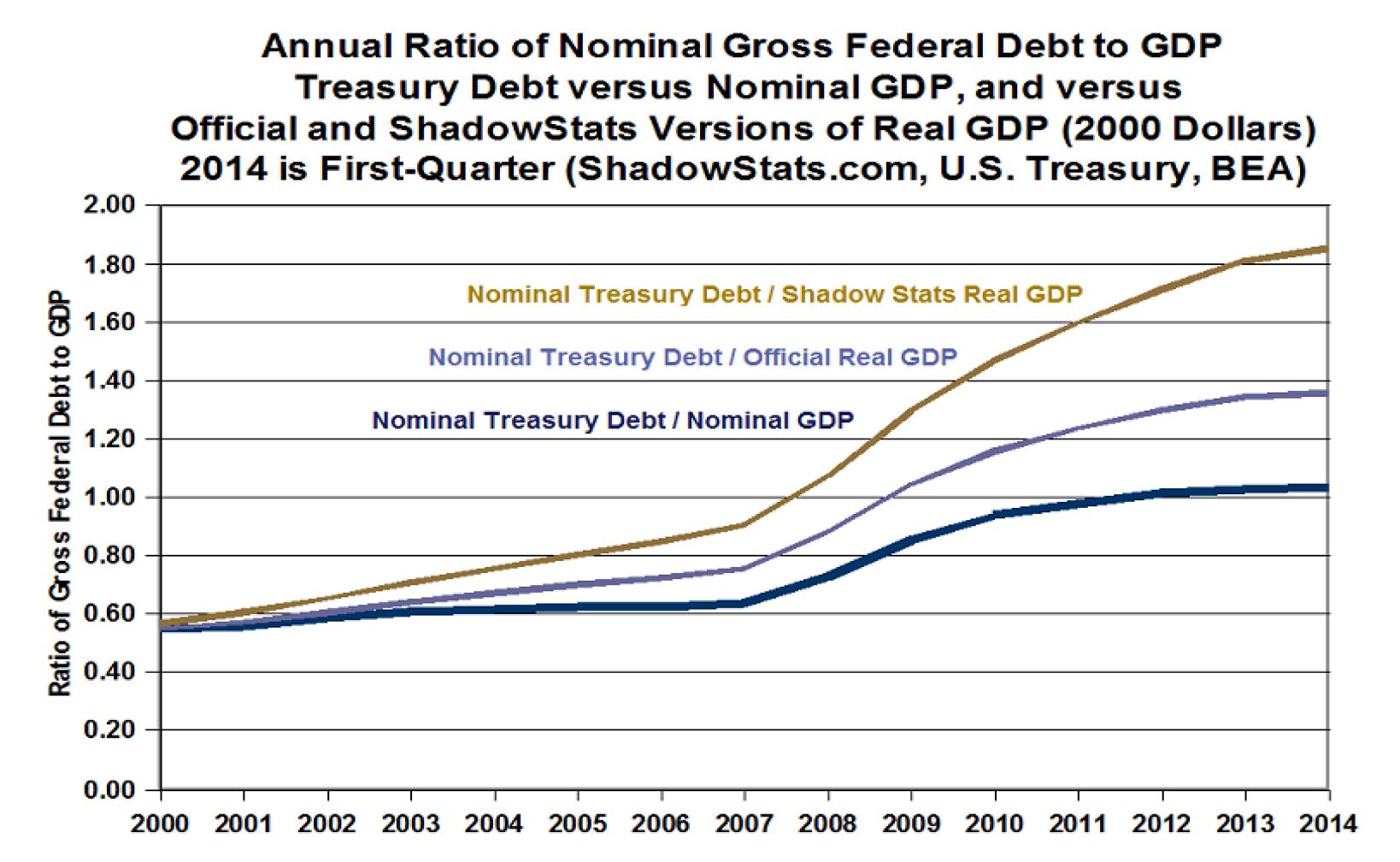
The nominal debt to GDP ratio shows that as of the end of the first quarter of 2014 total US Treasury debt outstanding is 103 percent of US GDP.
The ratio of Treasury debt to official real GDP shows debt at 136% of GDP.
The ratio of debt to real GDP deflated with more a more realistic measure of inflation, one more in keeping with the experience of consumers, puts US public debt at 185% of GDP. In other words, the burden of US debt on the real economy is almost twice the burden that is normally perceived.
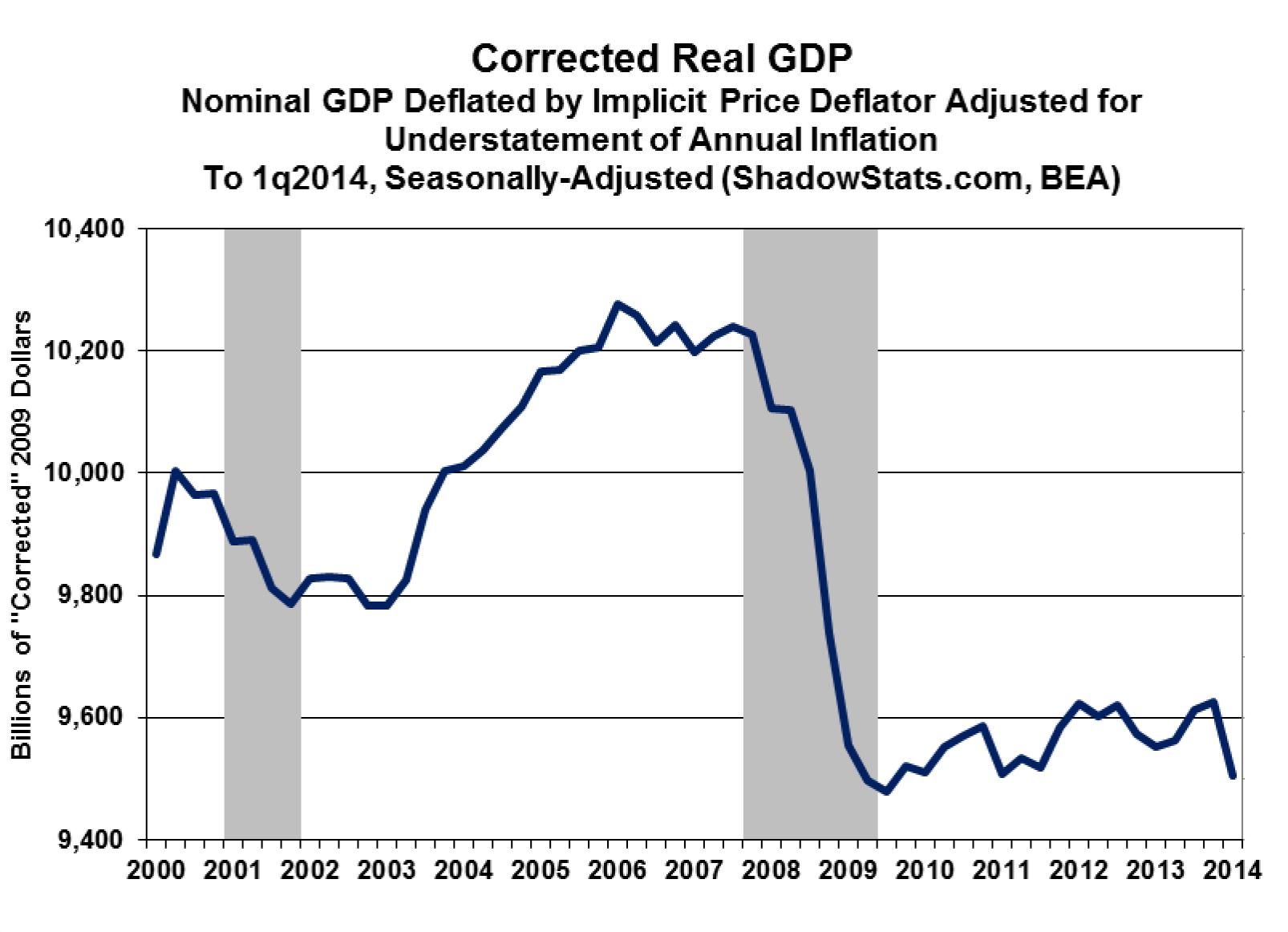
The Shadowstats adjustment we made to real GDP does not fully correct for what we believe has been a growing understatement of inflation since the 1980s. The adjustment we made corrects the implicit price deflator for a two-percentage point understatement of annual inflation due to hedonic distortion. Real GDP with this correction since 2000 looks like this:
We have calculated the ratios of US public debt to nominal GDP and to two measures of real GDP. The ratios of debt to GDP would be much higher if we used total credit outstanding, or total public and private debt, and if we used the government’s unfunded liabilities. The fact seems clear that debt is a major and unappreciated issue for the US economy. The enormous debt, especially with the middle class economy largely offshored, implies substantially lower living standards for the 99 percent.
The first quarter contraction, especially our corrected number, implies a second quarter negative real GDP. In other words, the years of Quantitative Easing (money printing) by the Federal Reserve has not resulted in economic recovery from the 2008 downturn and has not prevented further contraction.
Massive money creation and huge fiscal deficits have protected the balance sheets of “banks too big to fail” but have harmed the American people. Retirees and pension funds have been deprived for years of interest income as the Federal Reserve engineered zero or negative interest rates for the sake of a handful of oversized banks.
The extraordinary creation of new dollars diluted the dollars held by peoples, companies, institutions, and central banks throughout the world, raising fears that the dollar would lose exchange value and its role as world reserve currency.
Washington’s use of financial sanctions to force other countries to bend to Washington’s will is causing countries to leave the dollar payments system. Russian President Vladimir Putin’s advisor has said that the dollar must be crashed as the only way to prevent US aggression. The Chinese have called for “de-americanizing the world.”
The imperialistic US Foreign Account Tax Compliance Act (FATCA), which comes into full force July 1, 2015, imposes such heavy reporting costs on foreign financial institutions that these institutions might opt out of dollar transactions. All together, the result could be a serious tumble in the value of the US dollar, more wealth contraction, higher inflation via import prices, and less US wealth available to support US debt.
In view of this reality, why is Washington pushing its puppet in Kiev toward war with Russia? Why is Washington pushing NATO to spend more money and build more bases on which to deploy more troops in the Baltics and Eastern Europe, especially when Washington’s contribution will be the largest part of the cost? Why is Washington re-entering the Middle East conflict that Washington began by inciting Sunni and Shia against one another? Why is Washington constructing new naval and air bases from the Philippines to Vietnam in order to encircle China?
If Washington is this unaware of its budget constraints and its financial predicament, it cannot be long before Americans experience economic catastrophe.
Thursday, February 6, 2014
A Clear and Present Danger to Financial Stability
The Fed's Taper Sends Global Shares and Emerging Markets Tumbling
by MIKE WHITNEY
The selloff that began in May 2013, when the Fed announced its plan to scale back its asset purchases, resumed with a vengeance on Monday as global shares were slammed in heavy trading sending the Dow Jones for a 326 point-loss on the day. The proximate cause of the rout was a worse-than-expected manufacturing report and sluggish construction spending, but the underlying source of the trouble was the Fed’s decision to wind down QE which, according to Bloomberg news, “helped drive the S and P 500 up 157 percent from a 12-year low in 2009.” The Fed’s tightening has reversed the dynamic that pushed equities into the stratosphere and generated an unprecedented boom in the emerging markets. Now capital is fleeing the EMs to the safety of US Treasuries while jittery investors ditch stocks and wait to see if the storm passes or gradually gains strength.
The mood on Wall Street has turned bearish overnight as markets in Europe and Asia continue to hemorrhage led by another bloodletting on Japan’s Nikkei which has slumped by a full a 14 percent since its Dec. 30 peak. Societe Generale’s emerging market strategist, Benoit Anne, summed up the mood in a terse note to her clients saying, “There is no point spending too much time trying to pick and choose when faced with a severe market crisis like the one we are witnessing in front of our screens. Right now, sell everything.”
Markets have entered a new phase in the ongoing financial crisis, a crisis which originated on Wall Street where trillions of dollars of fraudulently-manufactured “toxic” assets were produced by a criminal bank cartel and sold to unsuspecting investors around the world. Rather than write down the losses and restructure the banking system, policymakers at the Central Bank and US Treasury opted to conceal the damage with massive bailouts, financial repression, zero rates and regular infusions of liquidity, all of which helped to hide the rot at the heart of the system. The Fed’s plan to taper has removed the veil and exposed the weakness of an undercapitalized system that has been made more unstable by 5 years of misguided policy. This is real source of the problem.
Just as the Fed’s uber-accommodationist policy lifted stocks to record highs in the months preceding its taper announcement, so too, the withdrawal of central bank support is likely to increase the pace of the decline. That is why we expect the taper to be implemented in a stutter-step manner, stopping and starting sporadically depending on conditions in the market. Naturally, this will undermine the Fed’s attempts to send investors a clear message about the direction of policy. It also means that new Fed chairman Janet Yellen is going to spend less time trying to maintain the Fed’s mandate of “price stability and full employment” then simply putting out fires. Here’s a clip from Naked Capitalism with some background on the turmoil:
This is the logic of selling early even though the reduction of asset purchases is still in its opening phase. There’s no sense in waiting until the last minute and taking a chance of getting trampled in the stampede to the exits. Just cash in and relax.
The Fed’s trillion cash injections have created a fantasy world of ever-rising stock prices that’s gradually giving way to the emerging reality of dismal earnings, chronic-high unemployment, droopy incomes, stagnant wages, swollen P/E ratios and a bloated financial sector that requires a larger and larger share of the nation’s wealth to avoid another devastating collapse. This is the situation we find ourselves in today, a situation that is papered over with propaganda about meaningless data points that fail to identify the real source of the problem, which is the gigantic capital hole created by the toxic assets that have not yet been written down, but are still sucking the life out of the bedraggled economy via debt servicing, rate and liquidity subsidies, and the reshaping of economic policy to preserve zombie institutions which need to be euthanized.
The problem is not hard to grasp, in fact, most people will understand what’s going on by just reading this two-paragraph excerpt from an article which appeared in Forbes magazine back in February, 2009. Here’s a clip from the piece titled “Zombie Firms and Zombie Banks”:
Sound familiar? This same phenom is playing out in the US today. The Fed has spared no expense to perpetuate the illusion that the zombie banking system is solvent and that the trillions of dollars in losses from worthless assets has somehow vanished into thin air. But they haven’t vanished. They are either hidden-away via accounting trickery, passed off to gullible, yield-crazed investors, or transferred onto the Fed’s bulging balance sheet. In any event, the debts are real, they’re impeding the recovery, they’re sucking the life’s blood out of the economy, and they’re clear and present danger to financial stability.
The red ink has to be purged, just as the rickety, Potemkin banking system has to be put out of its misery. We need a fresh start.
by MIKE WHITNEY
The selloff that began in May 2013, when the Fed announced its plan to scale back its asset purchases, resumed with a vengeance on Monday as global shares were slammed in heavy trading sending the Dow Jones for a 326 point-loss on the day. The proximate cause of the rout was a worse-than-expected manufacturing report and sluggish construction spending, but the underlying source of the trouble was the Fed’s decision to wind down QE which, according to Bloomberg news, “helped drive the S and P 500 up 157 percent from a 12-year low in 2009.” The Fed’s tightening has reversed the dynamic that pushed equities into the stratosphere and generated an unprecedented boom in the emerging markets. Now capital is fleeing the EMs to the safety of US Treasuries while jittery investors ditch stocks and wait to see if the storm passes or gradually gains strength.
The mood on Wall Street has turned bearish overnight as markets in Europe and Asia continue to hemorrhage led by another bloodletting on Japan’s Nikkei which has slumped by a full a 14 percent since its Dec. 30 peak. Societe Generale’s emerging market strategist, Benoit Anne, summed up the mood in a terse note to her clients saying, “There is no point spending too much time trying to pick and choose when faced with a severe market crisis like the one we are witnessing in front of our screens. Right now, sell everything.”
Markets have entered a new phase in the ongoing financial crisis, a crisis which originated on Wall Street where trillions of dollars of fraudulently-manufactured “toxic” assets were produced by a criminal bank cartel and sold to unsuspecting investors around the world. Rather than write down the losses and restructure the banking system, policymakers at the Central Bank and US Treasury opted to conceal the damage with massive bailouts, financial repression, zero rates and regular infusions of liquidity, all of which helped to hide the rot at the heart of the system. The Fed’s plan to taper has removed the veil and exposed the weakness of an undercapitalized system that has been made more unstable by 5 years of misguided policy. This is real source of the problem.
Just as the Fed’s uber-accommodationist policy lifted stocks to record highs in the months preceding its taper announcement, so too, the withdrawal of central bank support is likely to increase the pace of the decline. That is why we expect the taper to be implemented in a stutter-step manner, stopping and starting sporadically depending on conditions in the market. Naturally, this will undermine the Fed’s attempts to send investors a clear message about the direction of policy. It also means that new Fed chairman Janet Yellen is going to spend less time trying to maintain the Fed’s mandate of “price stability and full employment” then simply putting out fires. Here’s a clip from Naked Capitalism with some background on the turmoil:
“Since Bernanke started talking about “tapering off” Quantitative Easing, the bond markets have freaked out. This is a very logical reaction….Bernanke and other Federal Reserve economists appear bewildered by this phenomenon. The impression one gets from their follow-up comments is that they wished they could ask bond speculators “did you read the damn speech?” The answer, of course, is no and for good reason.
All investors need to know is the conditions under which QE … will be pursued has changed. Now the substantive change may actually be relatively minor, but that’s irrelevant to speculators. The reason is very simple: those holding assets with longer maturities will take huge capital losses with relatively small changes in interest rates ……It is better to exit now when those future changes are uncertain then take even more massive losses.” (“Market rout continues, proving abject failure of Fed’s forecasts and policies”, Naked Capitalism)
This is the logic of selling early even though the reduction of asset purchases is still in its opening phase. There’s no sense in waiting until the last minute and taking a chance of getting trampled in the stampede to the exits. Just cash in and relax.
The Fed’s trillion cash injections have created a fantasy world of ever-rising stock prices that’s gradually giving way to the emerging reality of dismal earnings, chronic-high unemployment, droopy incomes, stagnant wages, swollen P/E ratios and a bloated financial sector that requires a larger and larger share of the nation’s wealth to avoid another devastating collapse. This is the situation we find ourselves in today, a situation that is papered over with propaganda about meaningless data points that fail to identify the real source of the problem, which is the gigantic capital hole created by the toxic assets that have not yet been written down, but are still sucking the life out of the bedraggled economy via debt servicing, rate and liquidity subsidies, and the reshaping of economic policy to preserve zombie institutions which need to be euthanized.
The problem is not hard to grasp, in fact, most people will understand what’s going on by just reading this two-paragraph excerpt from an article which appeared in Forbes magazine back in February, 2009. Here’s a clip from the piece titled “Zombie Firms and Zombie Banks”:
”Beginning in 1991, Japan experienced a financial crisis that has been documented and studied by many. Japan’s crisis was triggered by a real estate and equity price bubble followed by a collapse of equity and real estate prices. But unlike the examples I cited above, Japanese policymakers met the crisis with prolonged denial and then, when conditions forced recognition of the severity of the problem, very halting steps to address it. Banks were not forced to recognize the condition of their balance sheets and were encouraged to continue lending to firms that were themselves unprofitable. Anil Kashyap labels these “zombie firms.”
Zombie banks continued to direct capital to zombie firms. This charade continued for more than a decade, with the result that the once-powerful Japanese economy was completely stagnant for that period. The government’s main response was to dramatically increase spending on infrastructure and frantically try to get Japanese households to save less and consume more. The resulting “lost decade” of economic growth cost Japan more than 20% of GDP.” (“Zombie Firms And Zombie Banks”, Thomas F. Cooley, Forbes)
Sound familiar? This same phenom is playing out in the US today. The Fed has spared no expense to perpetuate the illusion that the zombie banking system is solvent and that the trillions of dollars in losses from worthless assets has somehow vanished into thin air. But they haven’t vanished. They are either hidden-away via accounting trickery, passed off to gullible, yield-crazed investors, or transferred onto the Fed’s bulging balance sheet. In any event, the debts are real, they’re impeding the recovery, they’re sucking the life’s blood out of the economy, and they’re clear and present danger to financial stability.
The red ink has to be purged, just as the rickety, Potemkin banking system has to be put out of its misery. We need a fresh start.
Tuesday, February 4, 2014
Prelude to a Crash
Margin Debt Hits All-Time High in December
by MIKE WHITNEY
The Fed’s easy money policies have pushed margin debt on the New York Stock Exchange (NYSE) to record levels laying the groundwork for a severe correction or another violent market crash.
In December, margin debt rose by $21 billion to an all-time high of $445 billion.
Buying equities on margin, that is, with loads of borrowed cash, is a sign of excessive risk taking the likes of which invariably takes place whenever the Central Bank creates subsidies for speculation by keeping interest rates pegged below the rate of inflation or by pumping trillions of dollars into the bloated financial system through misguided liquidity programs like QE.
Investors have shrugged off dismal earnings reports, abnormally-high unemployment, flagging demand, droopy incomes, stagnant wages and swollen P/E ratios and loaded up on stocks confident that the Fed’s infusions of liquidity will keep prices going higher. It’s only a matter of time before they see the mistake they’ve made.
The chart below illustrates how zero rates and QE lead to excessive risk taking. The correlation between the stratospheric rise of margin debt and the Fed’s destabilizing monetary policy is hard to avoid. This is what bubblemaking looks like in real time.

In the minutes of the FOMC’s December meeting, FOMC officials acknowledge the froth they’ve created in financial assets which is why they’ve begun to scale back their asset purchases. The Fed hopes that by gradually winding down QE they’ll be able to stage a soft landing rather than a full-blown crash. Here’s an excerpt from the FOMC’s minutes:
There you have it, the Fed sees the results of its work; the distortions in P/E ratios, the exuberant stock buybacks (“equity repurchases”), the deterioration in the quality of leveraged loans, and the steady rise in margin debt. They see it all, all the bubbles they’ve created with their gargantuan $3 trillion surge of liquidity. Now they have started to reverse the policy by reducing their asset purchase from $85 bil to $65 bil per month, the effects of which can already be seen in the Emerging Markets.
The bubble in Emerging Markets has burst sending foreign currencies plunging and triggering a sharp reversal in capital flows. The hot money that flooded the EMs,–(which lowered the cost of borrowing for businesses and consumers)–is entirely attributable to the Fed’s policy. QE pushes down long-term interest rates forcing investors to search for higher yield in other markets. Thus, the cost of money drops in EMs creating a boom that abruptly ends when the policy changes (as it has).
Capital is fleeing EMs at an unprecedented pace precipitating a dramatic slowdown in economic activity, higher consumer prices and widespread public distress. The Fed is 100% responsible for the turmoil in emerging markets, a fact which even mainstream news outlets blandly admit. Here’s an excerpt from an article in Bloomberg just this week:
The Fed doesn’t care if other countries are hurt by its policies. What the Fed worries about is how the taper is going to effect Wall Street. If the slightest reduction in asset purchases causes this much turbulence abroad, then what’s it going to do to US stock and bond markets?
The answer, of course, is that stocks are going to fall…hard. It can’t be avoided. And while the amount of margin debt is not a reliable tool for calling a top; it’s safe to say that the recent spike in investor leverage has moved the arrow well into the red zone. Investors are going to cash out long before the Fed ends QE altogether, which means the selloff could persist for some time to come much like after the dot.com bubble popped and stocks drifted lower for a full year. Now check out this clip from Alhambra Investment Partners newsletter titled “The Year of Leverage”:
Repeat: “The $142 billion leveraged bet on stocks far surpasses any twelve month period in history.”
Investors are “all-in” because they think that the Fed has their back. They think that Bernanke (or Yellen) will not allow stocks to fall too far without intervening. (This is called the “Bernanke Put”) So far, that’s been a winning strategy, but that might be changing. The Fed’s determination to taper suggests that it wants to withdraw its stimulus to avoid being blamed for the bursting bubble. (“Plausible deniability”?) That’s what’s driving the current policy. Here’s more on margin debt from Wolf Richter at Testosterone Pit:
Stock market crashes are always connected to massive leverage, loosey-goosey monetary policy and irrational exuberance (“excessive risk taking”), the toxic combo that presently rules the markets. The Federal Reserve is invariably the source of all bubblemaking and financial instability.
As we noted earlier, equity repurchases or stock buybacks are another sign of froth. Here’s an excellent summary on the topic by Alhambra Investment Partners:

In other words, corporate managers are doing the same thing as your average margin investor. They are loading up on financial assets–not because they think they are a good value or because they expect higher earnings –but because Fed policy supports artificially-high prices. That’s what’s driving the bull market, the Fed’s thumb on the scale. Remove the thumb, and you have a whole new ballgame (as we see in the EMs). There’s also a bubble in high yield “junk” bonds which just had their second biggest year on record (Total issuance $324 billion) Investors are only too happy to dump their money into high-risk debt believing that companies never default or that the Fed will save the day again credit tightens and the dominoes start tumbling through the debt markets. According to Testosterone Pit:
Why, indeed? Of course, the author is just being rhetorical, after all, he knows why people are piling into junk. It’s because the Fed has kept a gun to their heads for 5 years, forcing them to grab higher yield wherever they can find it. That’s how Bernanke’s dogwhistle monetary policy works. By slashing rates to zero, the Fed coerces investors to speculate on any type of garbage that’s available. That why junk “just had its second biggest year on record.” You can thank Bernanke.
Housing is also in a bubble due to the Fed’s zero rates, withheld inventory, government modification programs, and an unprecedented uptick in all-cash investors. Clearly, there’s never been a market more manipulated than housing. It’s a joke.
The surge of Wall Street liquidity has spilled over into housing distorting prices and reducing the number of firsttime homebuyers to an all-time low. The homeownership rate is actually falling even while prices climb higher, which is just one of many anomalies created by the Fed’s policy. (Who’s ever heard of a housing boom, where the number of firsttime homebuyers is dropping?)
Also, the Central Bank has purchased more than $1 trillion in mortgage-backed securities (MBS) via QE, which begs the question: How can housing prices NOT be in a bubble?
As we noted earlier, the Fed understands the impact its policies have had. They know the markets are overheated and they’re determined to do something about it. A recent article in Bloomberg explains the Fed’s plan for winding down QE “without doing damage to the economy”. Here’s a short excerpt from the piece:
You got that?
So the Fed is going into the “bubble-deflating” biz.
Check.
And uber-dove Yellen is going to put things right. She’s going to eliminate the price distortions and gradually return the markets to normalcy.
Right, again.
She’s going to wind down QE and start to reduce the Fed’s $4 trillion balance sheet.
Oakie dokie.
And she’s going to do all of this without raising interest rates or sending stocks into freefall?
Right. It’s a pipedream. The first sign of trouble and old Yellen will be scuttling across the floor of the New York Stock Exchange with a punch bowl the size of Yankee Stadium.
You can bet on it.
by MIKE WHITNEY
The Fed’s easy money policies have pushed margin debt on the New York Stock Exchange (NYSE) to record levels laying the groundwork for a severe correction or another violent market crash.
In December, margin debt rose by $21 billion to an all-time high of $445 billion.
Buying equities on margin, that is, with loads of borrowed cash, is a sign of excessive risk taking the likes of which invariably takes place whenever the Central Bank creates subsidies for speculation by keeping interest rates pegged below the rate of inflation or by pumping trillions of dollars into the bloated financial system through misguided liquidity programs like QE.
Investors have shrugged off dismal earnings reports, abnormally-high unemployment, flagging demand, droopy incomes, stagnant wages and swollen P/E ratios and loaded up on stocks confident that the Fed’s infusions of liquidity will keep prices going higher. It’s only a matter of time before they see the mistake they’ve made.
The chart below illustrates how zero rates and QE lead to excessive risk taking. The correlation between the stratospheric rise of margin debt and the Fed’s destabilizing monetary policy is hard to avoid. This is what bubblemaking looks like in real time.
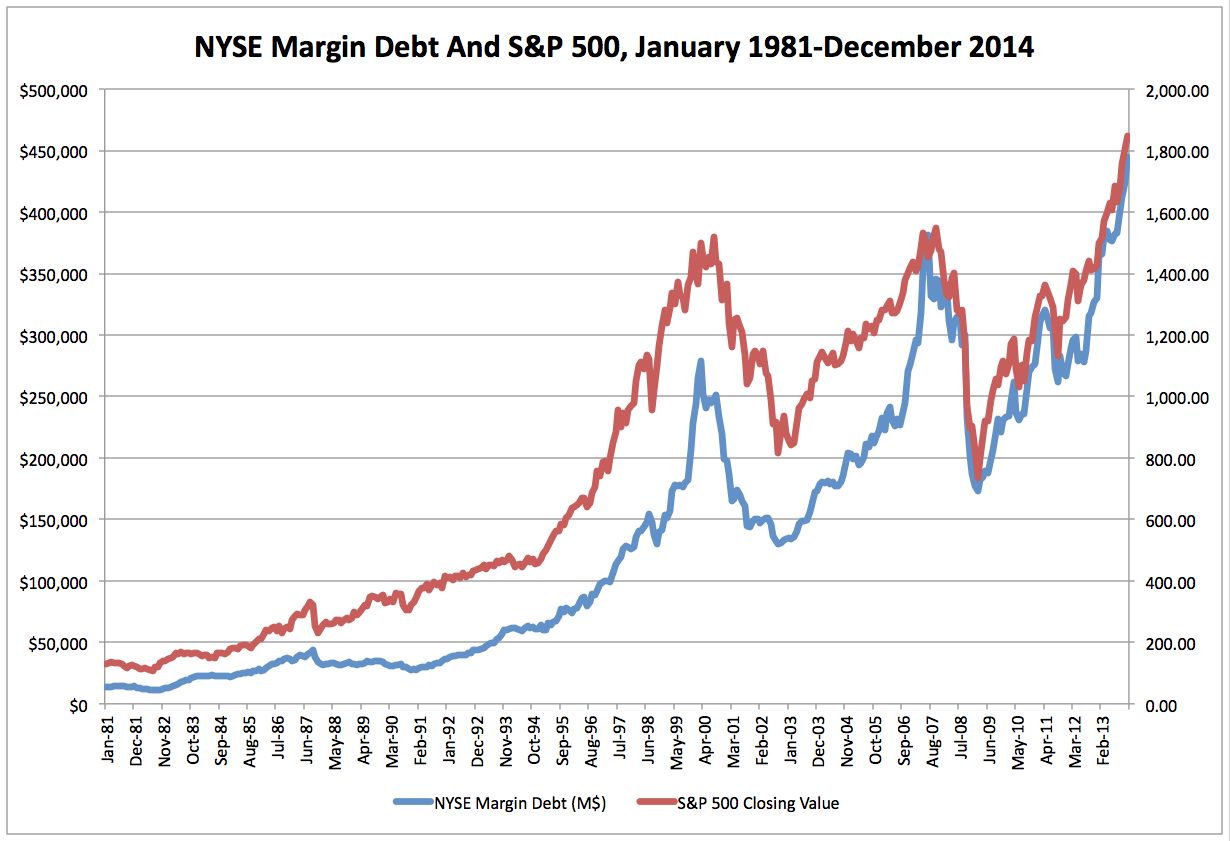
Chart: Seeking Alpha.
In the minutes of the FOMC’s December meeting, FOMC officials acknowledge the froth they’ve created in financial assets which is why they’ve begun to scale back their asset purchases. The Fed hopes that by gradually winding down QE they’ll be able to stage a soft landing rather than a full-blown crash. Here’s an excerpt from the FOMC’s minutes:
“In their discussion of potential risks, several participants commented on the rise in forward price-to-earnings ratios for some smallcap stocks, the increased level of equity repurchases, or the rise in margin credit. One pointed to the increase in issuance of leveraged loans this year and the apparent decline in the average quality of such loans.”
There you have it, the Fed sees the results of its work; the distortions in P/E ratios, the exuberant stock buybacks (“equity repurchases”), the deterioration in the quality of leveraged loans, and the steady rise in margin debt. They see it all, all the bubbles they’ve created with their gargantuan $3 trillion surge of liquidity. Now they have started to reverse the policy by reducing their asset purchase from $85 bil to $65 bil per month, the effects of which can already be seen in the Emerging Markets.
The bubble in Emerging Markets has burst sending foreign currencies plunging and triggering a sharp reversal in capital flows. The hot money that flooded the EMs,–(which lowered the cost of borrowing for businesses and consumers)–is entirely attributable to the Fed’s policy. QE pushes down long-term interest rates forcing investors to search for higher yield in other markets. Thus, the cost of money drops in EMs creating a boom that abruptly ends when the policy changes (as it has).
Capital is fleeing EMs at an unprecedented pace precipitating a dramatic slowdown in economic activity, higher consumer prices and widespread public distress. The Fed is 100% responsible for the turmoil in emerging markets, a fact which even mainstream news outlets blandly admit. Here’s an excerpt from an article in Bloomberg just this week:
“Investors are pulling money from exchange-traded funds that track emerging markets at the fastest rate on record…More than $7 billion flowed from ETFs investing in developing-nation assets in January, the most since the securities were created, data compiled by Bloomberg show…
Emerging economies have benefited from cheap money as three rounds of Fed bond buying pushed capital into their borders in search of higher returns…
The Fed’s asset purchases had helped fuel a credit boom in developing nations from Turkey to Brazil. Accumulated capital inflows to developing-country’s debt markets since 2008 reached $1.1 trillion, or $470 billion more than their long-term trend, according to a study by the International Monetary Fund in October.” (“Record Cash Leaves Emerging Market ETFs on Lira Drop“, Bloomberg)
The Fed doesn’t care if other countries are hurt by its policies. What the Fed worries about is how the taper is going to effect Wall Street. If the slightest reduction in asset purchases causes this much turbulence abroad, then what’s it going to do to US stock and bond markets?
The answer, of course, is that stocks are going to fall…hard. It can’t be avoided. And while the amount of margin debt is not a reliable tool for calling a top; it’s safe to say that the recent spike in investor leverage has moved the arrow well into the red zone. Investors are going to cash out long before the Fed ends QE altogether, which means the selloff could persist for some time to come much like after the dot.com bubble popped and stocks drifted lower for a full year. Now check out this clip from Alhambra Investment Partners newsletter titled “The Year of Leverage”:
“For the year, total margin debt usage jumped by an almost incomprehensible $123 billion, while cash balances declined by $19 billion. That $142 billion leveraged bet on stocks far surpasses any twelve month period in history. The only times that were even close to as leveraged were the year leading up to June 2007 (-$89 billion) and the twelve months preceding February and March 2000 (-$77 billion). Both of those marked significant tops in the market.” ( Alhambra Investment Partners newsletter titled “The Year of Leverage“)
Repeat: “The $142 billion leveraged bet on stocks far surpasses any twelve month period in history.”
Investors are “all-in” because they think that the Fed has their back. They think that Bernanke (or Yellen) will not allow stocks to fall too far without intervening. (This is called the “Bernanke Put”) So far, that’s been a winning strategy, but that might be changing. The Fed’s determination to taper suggests that it wants to withdraw its stimulus to avoid being blamed for the bursting bubble. (“Plausible deniability”?) That’s what’s driving the current policy. Here’s more on margin debt from Wolf Richter at Testosterone Pit:
“On the New York Stock Exchange, margin credit has been hitting new records for months. All three mega-crashes in my investing lifetime have been accompanied by record-setting peaks in margin debt. In September 1987, a month before the crash, margin credit peaked at 0.88% of GDP. In March 2000, when the crash began, margin credit peaked at 2.7% of GDP. In July 2007, three months before the downdraft started, margin credit peaked at 2.6% of GDP. Now, margin credit has already reached 2.5% of GDP.” (“Plagued By Indigestion, Fed Issues Asset-Bubble Warning”, Testosterone Pit)
Stock market crashes are always connected to massive leverage, loosey-goosey monetary policy and irrational exuberance (“excessive risk taking”), the toxic combo that presently rules the markets. The Federal Reserve is invariably the source of all bubblemaking and financial instability.
As we noted earlier, equity repurchases or stock buybacks are another sign of froth. Here’s an excellent summary on the topic by Alhambra Investment Partners:
“In the third quarter of 2013, share repurchases totaled $128.2 billion, the highest level since Q4 2007. For the twelve months ended in September 2013, aggregate share repurchases were an astounding $445.3 billion; the only twelve-month period greater than that total was the calendar year of 2007 and its $589 billion.
The common argument advanced in favor of such share repurchases is that companies are using cash to recognize undervalued stocks, but that is total hogwash…
…corporate managers are no different than the reviled stereotypical retail investor. Both leverage themselves further and further as the market goes higher, not in recognizing undervalued stocks or companies but in full froth of chasing obscene values via rationalizations.” ( Alhambra Investment Partners newsletter titled “The Year of Leverage”)
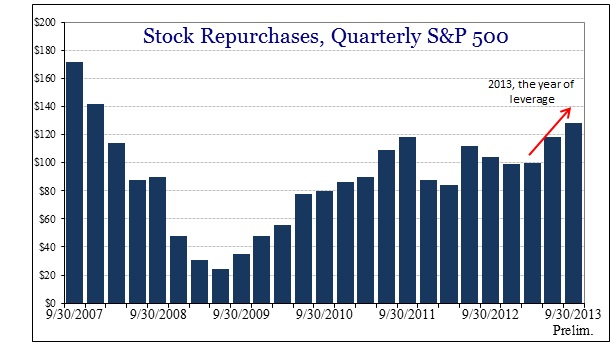
In other words, corporate managers are doing the same thing as your average margin investor. They are loading up on financial assets–not because they think they are a good value or because they expect higher earnings –but because Fed policy supports artificially-high prices. That’s what’s driving the bull market, the Fed’s thumb on the scale. Remove the thumb, and you have a whole new ballgame (as we see in the EMs). There’s also a bubble in high yield “junk” bonds which just had their second biggest year on record (Total issuance $324 billion) Investors are only too happy to dump their money into high-risk debt believing that companies never default or that the Fed will save the day again credit tightens and the dominoes start tumbling through the debt markets. According to Testosterone Pit:
“The cost of a high-yield bond on an absolute coupon basis is as low as it’s ever been,” explained Baratta, king of Blackstone’s $53 billion in private equity assets. Even the riskiest companies are selling the riskiest bonds at low yields… Why would anyone buy this crap?” (“Bubble Trouble: Record Junk Bond Issuance, A Barrage Of IPOs, “Out Of Whack” Valuations, And Grim Earnings Growth”, Testosterone Pit)
Why, indeed? Of course, the author is just being rhetorical, after all, he knows why people are piling into junk. It’s because the Fed has kept a gun to their heads for 5 years, forcing them to grab higher yield wherever they can find it. That’s how Bernanke’s dogwhistle monetary policy works. By slashing rates to zero, the Fed coerces investors to speculate on any type of garbage that’s available. That why junk “just had its second biggest year on record.” You can thank Bernanke.
Housing is also in a bubble due to the Fed’s zero rates, withheld inventory, government modification programs, and an unprecedented uptick in all-cash investors. Clearly, there’s never been a market more manipulated than housing. It’s a joke.
The surge of Wall Street liquidity has spilled over into housing distorting prices and reducing the number of firsttime homebuyers to an all-time low. The homeownership rate is actually falling even while prices climb higher, which is just one of many anomalies created by the Fed’s policy. (Who’s ever heard of a housing boom, where the number of firsttime homebuyers is dropping?)
Also, the Central Bank has purchased more than $1 trillion in mortgage-backed securities (MBS) via QE, which begs the question: How can housing prices NOT be in a bubble?
As we noted earlier, the Fed understands the impact its policies have had. They know the markets are overheated and they’re determined to do something about it. A recent article in Bloomberg explains the Fed’s plan for winding down QE “without doing damage to the economy”. Here’s a short excerpt from the piece:
“Janet Yellen probably will confront a test during her tenure as Federal Reserve chairman that both of her predecessors flunked: defusing asset bubbles without doing damage to the economy…
Yellen is ‘going to be trying to do something that no one has ever done,’ said Stephen Cecchetti, former economic adviser for the Bank for International Settlements, the Basel, Switzerland-based central bank for monetary authorities. She needs ‘to ensure that accommodative monetary policy doesn’t create significant financial stability risks,’ he said in an interview…
The Fed’s ‘first, second and third lines of defense” for dealing with such imbalances is to rely on supervision, regulation and so-called macro-prudential policies, such as mortgage loan-to-value restrictions, Bernanke told the Brookings Institution in Washington on Jan. 16. ….Only as a last resort would it consider raising interest rates.’ (“Yellen Faces Test Bernanke Failed: Ease Bubbles“, Bloomberg)
You got that?
So the Fed is going into the “bubble-deflating” biz.
Check.
And uber-dove Yellen is going to put things right. She’s going to eliminate the price distortions and gradually return the markets to normalcy.
Right, again.
She’s going to wind down QE and start to reduce the Fed’s $4 trillion balance sheet.
Oakie dokie.
And she’s going to do all of this without raising interest rates or sending stocks into freefall?
Right. It’s a pipedream. The first sign of trouble and old Yellen will be scuttling across the floor of the New York Stock Exchange with a punch bowl the size of Yankee Stadium.
You can bet on it.
Wednesday, January 29, 2014
How Economists and Policymakers Murdered Our Economy
Enabling Greed
by PAUL CRAIG ROBERTS
The economy has been debilitated by the offshoring of middle class jobs for the benefit of corporate profits and by the Federal Reserve’s policy of Quantitative Easing in order to support a few oversized banks that the government protects from market discipline. Not only does QE distort bond and stock markets, it threatens the value of the dollar and has resulted in manipulation of the gold price.
When US corporations send jobs offshore, the GDP, consumer income, tax base, and careers associated with the jobs go abroad with the jobs. Corporations gain the additional profits at large costs to the economy in terms of less employment, less economic growth, reduced state, local and federal tax revenues, wider deficits, and impairments of social services.
When policymakers permitted banks to become independent of market discipline, they made the banks an unresolved burden on the economy. Authorities have provided no honest report on the condition of the banks. It remains to be seen if the Federal Reserve can create enough money to monetize enough debt to rescue the banks without collapsing the US dollar. It would have been far cheaper to let the banks fail and be reorganized.
US policymakers and their echo chamber in the economics profession have let the country down badly. They claimed that there was a “New Economy” to take the place of the “old economy” jobs that were moved offshore. As I have pointed out for a decade, US jobs statistics show no sign of the promised “New Economy.”
The same policymakers and economists who told us that “markets are self-regulating” and that the financial sector could safely be deregulated also confused jobs offshoring with free trade. Hyped “studies” were put together designed to prove that jobs offshoring was good for the US economy. It is difficult to fathom how such destructive errors could consistently be made by policymakers and economists for more than a decade. Were these mistakes or cover for a narrow and selfish agenda?
In June, 2009 happy talk appeared about “the recovery,” now 4.5 years old. As John Williams (shadowstats.com) has made clear, “the recovery” is entirely the artifact of the understated measure of inflation used to deflate nominal GDP. By under-measuring inflation, the government can show low, but positive, rates of real GDP growth. No other indicator supports the claim of economic recovery.
John Williams writes that consumer inflation, if properly measured, is running around 9%, far above the 2% figure that is the Fed’s target and more in line with what consumers are actually experiencing. We have just had a 6.5% annual increase in the cost of a postage stamp.
The Fed’s target inflation rate is said to be low, but Simon Black points out that the result of a lifetime of 2% annual inflation is the loss of 75% of the purchasing power of the currency. He uses the cost of sending a postcard to illustrate the decline in the purchasing power of median household income today compared to 1951. That year it cost one cent to send a post card. As household income was $4,237, the household could send 423,700 postcards. Today the comparable income figure is $51,017. As it costs 34 cents to send one postcard, today’s household can only afford to send 150,050 postcards. Nominal income rose 12 times, and the cost of sending a postcard rose 34 times.
Just as the American people know that there is more inflation than is reported, they know that there is no recovery. The Gallup Poll reported this month that only 28% of Americans are satisfied with the economy.
From hard experience, Americans have also caught on that “free trade agreements” are nothing but vehicles for moving their jobs abroad. The latest effort by the corporations to loot and defraud the public is known as the “Trans-Pacific Partnership.” “Fast-tracking” the bill allowed the corporations to write the bill in secret without congressional input. Some research shows that 90% of Americans will suffer income losses under TPP, while wealth becomes even more concentrated at the top.
TPP affects every aspect of our lives from what we eat to the Internet to the environment. According to Kevin Zeese in Alternet, “the leak of the [TPP] Intellectual Property Chapter revealed that it created a path to patent everything imaginable, including plants and animals, to turn everything into a commodity for profit.”
The secretly drafted TPP also creates authority for the executive branch to change existing US law to make the laws that were not passed in secret compatible with the secretly written trade bill. Buy American requirements and any attempt to curtail jobs offshoring would become illegal “restraints on trade.”
If the House and Senate are willing to turn over their legislative function to the executive branch, they might as well abolish themselves.
The financial media has been helping the Federal Reserve and the banks to cover up festering problems with rosy hype, but realization that there are serious unresolved problems might be spreading. Last week interest rates on 30-day T-bills turned negative. That means people were paying more for a bond than it would return at maturity. Dave Kranzler sees this as a sign of rising uncertainty about banks. Reminiscent of the Cyprus banks’ limits on withdrawals, last Friday (January 24) the BBC reported that the large UK bank HSBC is preventing customers from withdrawing cash from their accounts in excess of several thousand pounds.
If and when uncertainty spreads to the dollar, the real crisis will arrive, likely followed by high inflation, exchange controls, pension confiscations, and resurrected illegality of owning gold and silver. Capitalist greed aided and abetted by economists and policymakers will have destroyed America.
by PAUL CRAIG ROBERTS
The economy has been debilitated by the offshoring of middle class jobs for the benefit of corporate profits and by the Federal Reserve’s policy of Quantitative Easing in order to support a few oversized banks that the government protects from market discipline. Not only does QE distort bond and stock markets, it threatens the value of the dollar and has resulted in manipulation of the gold price.
When US corporations send jobs offshore, the GDP, consumer income, tax base, and careers associated with the jobs go abroad with the jobs. Corporations gain the additional profits at large costs to the economy in terms of less employment, less economic growth, reduced state, local and federal tax revenues, wider deficits, and impairments of social services.
When policymakers permitted banks to become independent of market discipline, they made the banks an unresolved burden on the economy. Authorities have provided no honest report on the condition of the banks. It remains to be seen if the Federal Reserve can create enough money to monetize enough debt to rescue the banks without collapsing the US dollar. It would have been far cheaper to let the banks fail and be reorganized.
US policymakers and their echo chamber in the economics profession have let the country down badly. They claimed that there was a “New Economy” to take the place of the “old economy” jobs that were moved offshore. As I have pointed out for a decade, US jobs statistics show no sign of the promised “New Economy.”
The same policymakers and economists who told us that “markets are self-regulating” and that the financial sector could safely be deregulated also confused jobs offshoring with free trade. Hyped “studies” were put together designed to prove that jobs offshoring was good for the US economy. It is difficult to fathom how such destructive errors could consistently be made by policymakers and economists for more than a decade. Were these mistakes or cover for a narrow and selfish agenda?
In June, 2009 happy talk appeared about “the recovery,” now 4.5 years old. As John Williams (shadowstats.com) has made clear, “the recovery” is entirely the artifact of the understated measure of inflation used to deflate nominal GDP. By under-measuring inflation, the government can show low, but positive, rates of real GDP growth. No other indicator supports the claim of economic recovery.
John Williams writes that consumer inflation, if properly measured, is running around 9%, far above the 2% figure that is the Fed’s target and more in line with what consumers are actually experiencing. We have just had a 6.5% annual increase in the cost of a postage stamp.
The Fed’s target inflation rate is said to be low, but Simon Black points out that the result of a lifetime of 2% annual inflation is the loss of 75% of the purchasing power of the currency. He uses the cost of sending a postcard to illustrate the decline in the purchasing power of median household income today compared to 1951. That year it cost one cent to send a post card. As household income was $4,237, the household could send 423,700 postcards. Today the comparable income figure is $51,017. As it costs 34 cents to send one postcard, today’s household can only afford to send 150,050 postcards. Nominal income rose 12 times, and the cost of sending a postcard rose 34 times.
Just as the American people know that there is more inflation than is reported, they know that there is no recovery. The Gallup Poll reported this month that only 28% of Americans are satisfied with the economy.
From hard experience, Americans have also caught on that “free trade agreements” are nothing but vehicles for moving their jobs abroad. The latest effort by the corporations to loot and defraud the public is known as the “Trans-Pacific Partnership.” “Fast-tracking” the bill allowed the corporations to write the bill in secret without congressional input. Some research shows that 90% of Americans will suffer income losses under TPP, while wealth becomes even more concentrated at the top.
TPP affects every aspect of our lives from what we eat to the Internet to the environment. According to Kevin Zeese in Alternet, “the leak of the [TPP] Intellectual Property Chapter revealed that it created a path to patent everything imaginable, including plants and animals, to turn everything into a commodity for profit.”
The secretly drafted TPP also creates authority for the executive branch to change existing US law to make the laws that were not passed in secret compatible with the secretly written trade bill. Buy American requirements and any attempt to curtail jobs offshoring would become illegal “restraints on trade.”
If the House and Senate are willing to turn over their legislative function to the executive branch, they might as well abolish themselves.
The financial media has been helping the Federal Reserve and the banks to cover up festering problems with rosy hype, but realization that there are serious unresolved problems might be spreading. Last week interest rates on 30-day T-bills turned negative. That means people were paying more for a bond than it would return at maturity. Dave Kranzler sees this as a sign of rising uncertainty about banks. Reminiscent of the Cyprus banks’ limits on withdrawals, last Friday (January 24) the BBC reported that the large UK bank HSBC is preventing customers from withdrawing cash from their accounts in excess of several thousand pounds.
If and when uncertainty spreads to the dollar, the real crisis will arrive, likely followed by high inflation, exchange controls, pension confiscations, and resurrected illegality of owning gold and silver. Capitalist greed aided and abetted by economists and policymakers will have destroyed America.
The New Wave of Financial Instability
Is This the Big One?
by MIKE WHITNEY
Global stocks were hammered on Friday for a second straight day on news of a slowdown in China and turbulence in emerging markets. The Dow Jones Industrials suffered its worse drubbing in more than two years, tumbling 318 points on Friday to end a 490 point two-day rout. Emerging markets currencies were whipsawed by capital flight as foreign investors fled to the safety of U.S. Treasuries. Turkey’s lira and the Argentine peso were particularly hard hit setting record lows in the 48 hour period. The scaling back of the Fed’s $85 billion per month asset purchase program, called QE, has altered the dynamic that made emerging markets the “engines for global growth”. The policy reversal has triggered a selloff in risk assets and sent EM currencies plunging. Here’s a summary from Bloomberg:
Paradoxically, Bloomberg editors blame the victims of the Fed’s failed policy for the current ructions in the markets. In an article titled, “What’s Behind the Emerging-Market Meltdown” the editors say,”emerging-market governments … should recognize that this week’s financial-market turmoil was, to varying degrees, their own fault.” … “the best way for emerging-market governments to restore confidence would be to improve their policies.”
Logically, one would assume that the editors would throw their support behind capital controls or other means of stemming the destructive flow of speculative capital into domestic markets. But that’s not the case. What the editors really want, is policies that trim deficits, slash public spending, and allow foreign investors to continue to wreak havoc on vulnerable economies that follow their free market diktats. The article is a defense of the status quo, of maintaining the same ruinous policies so that profit-taking can continue apace.
The Fed was warned early on that its uber-accommodative monetary policy was spilling over into emerging markets and creating conditions for another financial crisis. Take a look at this excerpt from an article in Bloomberg back in 2010 where Nobel prize winning economist, Joseph Stiglitz, explicitly warns the Fed of the dangers of QE.
Bloomberg:
Events have unfolded exactly as Stiglitz predicted they would, which means the Fed is 100% responsible the carnage in the stock and currencies markets.
The policy has pumped nearly “$7 trillion of foreign funds” into EMs since QE was first launched in 2009. According to the Telegraph’s Ambrose Evans-Pritchard, “much of it “hot money” going into bonds, equities and liquid instruments that can be sold quickly….Officials are concerned that this footloose capital could leave fast in a crisis, setting off a cascade effect,” Pritchard adds ominously.
Whether last week’s bloodbath was just a prelude to a bigger crash is impossible to say, but it is worth noting that the Fed has only reduced its purchases by a mere $10 billion per month while still providing $75 billion every 30 days. That suggests that markets will probably face greater turmoil in the months ahead. Check out this clip from USA Today:
So, is this the Big One, the beginning of the next financial crisis?
It’s too early to say, but investors and analysts are worried. Fed tightening (via “taper”) will be felt in markets around the world. The trouble in emerging markets will intensify deflationary pressures in the Eurozone and put a damper on China’s growth. Slower global growth, in turn, will create balance sheets problems for undercapitalized and over-leveraged banks and other financial institutions which will increase the probability of another Lehman Brothers-type default.
According to Reuters, a normalizing of interest rates in the US, (which most analysts expect) “could cut financial inflows to developing countries by as much as 80 percent for several months. In such a case, nearly a quarter of developing countries could experience sudden stops in their access to global capital, throwing some economies into a balance of payments or financial crisis, the Bank said.” (“Rout in emerging markets may only be in Phase One,” Reuters)
Clearly, the potential for another financial meltdown is quite real.
For more than four years, the Fed has buoyed stock prices and increased corporate margins through massive injections of free cash into the financial markets. Now the Central Bank wants to change the policy and ease its foot off the gas pedal. That’s causing investors to rethink their positions and take more money off the table. What started as a selloff in emerging markets could snowball into a broader panic that could wipe out the gains of the last four years.
The Federal Reserve is entirely responsible for this new wave of financial instability.
by MIKE WHITNEY
Global stocks were hammered on Friday for a second straight day on news of a slowdown in China and turbulence in emerging markets. The Dow Jones Industrials suffered its worse drubbing in more than two years, tumbling 318 points on Friday to end a 490 point two-day rout. Emerging markets currencies were whipsawed by capital flight as foreign investors fled to the safety of U.S. Treasuries. Turkey’s lira and the Argentine peso were particularly hard hit setting record lows in the 48 hour period. The scaling back of the Fed’s $85 billion per month asset purchase program, called QE, has altered the dynamic that made emerging markets the “engines for global growth”. The policy reversal has triggered a selloff in risk assets and sent EM currencies plunging. Here’s a summary from Bloomberg:
“The worst selloff in emerging-market currencies in five years is beginning to reveal the extent of the fallout from the Federal Reserve’s tapering of monetary stimulus, compounded by political and financial instability.
Investors are losing confidence in some of the biggest developing nations, extending the currency-market rout triggered last year when the Fed first signaled it would scale back stimulus. While Brazil, Russia, India, China and South Africa were the engines of global growth following the financial crisis in 2008, emerging markets now pose a threat to world financial stability.” (“Contagion Spreads in Emerging Markets as Crises Grow,” Bloomberg)
Paradoxically, Bloomberg editors blame the victims of the Fed’s failed policy for the current ructions in the markets. In an article titled, “What’s Behind the Emerging-Market Meltdown” the editors say,”emerging-market governments … should recognize that this week’s financial-market turmoil was, to varying degrees, their own fault.” … “the best way for emerging-market governments to restore confidence would be to improve their policies.”
Logically, one would assume that the editors would throw their support behind capital controls or other means of stemming the destructive flow of speculative capital into domestic markets. But that’s not the case. What the editors really want, is policies that trim deficits, slash public spending, and allow foreign investors to continue to wreak havoc on vulnerable economies that follow their free market diktats. The article is a defense of the status quo, of maintaining the same ruinous policies so that profit-taking can continue apace.
The Fed was warned early on that its uber-accommodative monetary policy was spilling over into emerging markets and creating conditions for another financial crisis. Take a look at this excerpt from an article in Bloomberg back in 2010 where Nobel prize winning economist, Joseph Stiglitz, explicitly warns the Fed of the dangers of QE.
Bloomberg:
“The U.S. Federal Reserve’s plan to boost purchases of bonds poses “considerable” risks by increasing capital inflows to emerging markets, Nobel Prize- winning economist Joseph Stiglitz said in Santiago today.
“All this liquidity that they’re creating is not going back to grow the American economy and is going to Asia and other emerging markets where it’s not wanted,” Stiglitz said…..Increased capital inflows could cause emerging market currencies to appreciate and could create asset bubbles, he said.” (“Stiglitz Says Fed Stimulus Poses `Considerable’ Risks for Emerging Markets,” Bloomberg, Dec 2010)
Events have unfolded exactly as Stiglitz predicted they would, which means the Fed is 100% responsible the carnage in the stock and currencies markets.
The policy has pumped nearly “$7 trillion of foreign funds” into EMs since QE was first launched in 2009. According to the Telegraph’s Ambrose Evans-Pritchard, “much of it “hot money” going into bonds, equities and liquid instruments that can be sold quickly….Officials are concerned that this footloose capital could leave fast in a crisis, setting off a cascade effect,” Pritchard adds ominously.
Whether last week’s bloodbath was just a prelude to a bigger crash is impossible to say, but it is worth noting that the Fed has only reduced its purchases by a mere $10 billion per month while still providing $75 billion every 30 days. That suggests that markets will probably face greater turmoil in the months ahead. Check out this clip from USA Today:
“Emerging markets need the hot money but capital is exiting now,” says (Blackrock’s Russ) Koesterich. “What you have is people saying, ‘I don’t want to own emerging markets.’…
The bigger fear is if the current crisis in currency markets morphs into a full-blown economic crisis and leads to financial contagion, says Matthias Kuhlmey, managing director of HighTower’s Global Investment Solutions.
“The currency story is fascinating and can be a slippery slope – be cautious,” says Kuhlmey, adding that the Asian crisis in the summer of 1997 that started with a sharp drop in the value of Thailand’s baht, turned into a broader economic crisis that engulfed Indonesian, South Korea and a handful of other countries. It also rocked financial markets.” (“Why emerging markets worry Wall Street,” USA Today)
So, is this the Big One, the beginning of the next financial crisis?
It’s too early to say, but investors and analysts are worried. Fed tightening (via “taper”) will be felt in markets around the world. The trouble in emerging markets will intensify deflationary pressures in the Eurozone and put a damper on China’s growth. Slower global growth, in turn, will create balance sheets problems for undercapitalized and over-leveraged banks and other financial institutions which will increase the probability of another Lehman Brothers-type default.
According to Reuters, a normalizing of interest rates in the US, (which most analysts expect) “could cut financial inflows to developing countries by as much as 80 percent for several months. In such a case, nearly a quarter of developing countries could experience sudden stops in their access to global capital, throwing some economies into a balance of payments or financial crisis, the Bank said.” (“Rout in emerging markets may only be in Phase One,” Reuters)
Clearly, the potential for another financial meltdown is quite real.
For more than four years, the Fed has buoyed stock prices and increased corporate margins through massive injections of free cash into the financial markets. Now the Central Bank wants to change the policy and ease its foot off the gas pedal. That’s causing investors to rethink their positions and take more money off the table. What started as a selloff in emerging markets could snowball into a broader panic that could wipe out the gains of the last four years.
The Federal Reserve is entirely responsible for this new wave of financial instability.
Saturday, November 30, 2013
The Money Changers Serenade: A New Plot Hatches
Paul Craig Roberts
Former Treasury Secretary Timothy Geithner, a protege of Treasury Secretaries Rubin and Summers, has received his reward for continuing the Rubin-Summers-Paulson policy of supporting the “banks too big to fail” at the expense of the economy and American people. For his service to the handful of gigantic banks, whose existence attests to the fact that the Anti-Trust Act is a dead-letter law, Geithner has been appointed president and managing director of the private equity firm, Warburg Pincus and is on his way to his fortune.
A Warburg in-law financed Woodrow Wilson’s presidential campaign. Part of the reward was Wilson’s appointment of Paul Warburg to the first Federal Reserve Board. The symbiotic relationship between presidents and bankers has continued ever since. The same small clique continues to wield financial power.
Geithner’s career is illustrative. In the 1980s, Geithner worked for Kissinger Associates. In the mid to late 1990s, Geithner served as a deputy assistant Treasury secretary. Under Rubin and Summers he moved up to undersecretary of the Treasury.
From the Treasury he went to the Council on Foreign Relations and from there to the International Monetary Fund (IMF). From there he was appointed president of the Federal Reserve Bank of New York, where he worked to make banks more profitable by allowing higher ratios of debt to capital, thus contributing to the financial crisis.
Geithner arranged the sale of the failed Wall Street firm of Bear Stearns, helped with the taxpayer bailout of AIG, and rejected saving Lehman Brothers from bankruptcy in order to create the crisis atmosphere needed to more fully subordinate US economic policy to the needs of the few large banks.
Rubin, a 26-year veteran of Goldman Sachs, was rewarded by Citibank for his service to the banks while Treasury Secretary with a $50 million compensation package in 2008 and $126,000,000 between 1999 and 2009.
When a person becomes a Treasury official it is made clear that the choice is between serving the banks and becoming rich or trying to serve the public and becoming poor. Few make the latter choice.
As MIchael Hudson has informed us, the goal of the financial sector has always been to convert all income, from corporate profits to government tax revenues, to the service of debt. From the bankers standpoint, the more debt the richer the bankers. Rubin, Summers, Paulson, Geithner, and now banker Treasury Secretary Jack Lew faithfully serve this goal.
The Federal Reserve describes its policy of Quantitative Easing — the creation of new money with which the Fed purchases Treasury debt and mortgage backed securities — as a low interest rate policy in order to stimulate employment and economic growth. Economists and the financial media have parroted this cover story.
In contrast, I have exposed QE as a scheme for pumping profits into the banks and boosting their balance sheets. The real purpose of QE is to drive up the prices of the debt-related derivatives on the banks’ books, thus keeping the banks with solvent balance sheets.
Writing in the Wall Street Journal (“Confessions of a Quantitative Easer,” November 11, 2013), Andrew Huszar confirms my explanation to be the correct one. Huszar is the Federal Reserve official who implemented the policy of QE. He resigned when he realized that the real purposes of QE was to drive up the prices of the banks’ holdings of debt instruments, to provide the banks with trillions of dollars at zero cost with which to lend and speculate, and to provide the banks with “fat commissions from brokering most of the Fed’s QE transactions.” (See: www.paulcraigroberts.org )
This vast con game remains unrecognized by Congress and the public. At the IMF Research Conference on November 8, 2013, former Treasury Secretary Larry Summers presented a plan to expand the con game.
Summers says that it is not enough merely to give the banks interest free money. More should be done for the banks. Instead of being paid interest on their bank deposits, people should be penalized for keeping their money in banks instead of spending it.
To sell this new rip-off scheme, Summers has conjured up an explanation based on the crude and discredited Keynesianism of the 1940s that explained the Great Depression as a problem caused by too much savings. Instead of spending their money, people hoarded it, thus causing aggregate demand and employment to fall.
Summers says that today the problem of too much saving has reappeared. The centerpiece of his argument is “the natural interest rate,” defined as the interest rate at which full employment is established by the equality of saving with investment. If people save more than investors invest, the saved money will not find its way back into the economy, and output and employment will fall.
Summers notes that despite a zero real rate of interest, there is still substantial unemployment. In other words, not even a zero rate of interest can reduce saving to the level of investment, thus frustrating a full employment recovery. Summers concludes that the natural rate of interest has become negative and is stuck below zero.
How to fix this? The way to fix it, Summers says, is to charge people for saving money. To avoid the charges, people would spend the money, thus reducing savings to the level of investment and restoring full employment.
Summers acknowledges that the problem with his solution is that people would take their money out of banks and hoard it in cash holdings. In other words, the cash form of money provides consumers with a freedom to save that holds down consumption and prevents full employment.
Summers has a fix for this: eliminate the freedom by imposing a cashless society where the only money is electronic. As electronic money cannot be hoarded except in bank deposits, penalties can be imposed that force unproductive savings into consumption.
Summers’ scheme, of course, is a harebrained one. With governments running huge deficits, who would purchase bonds at negative interest rates? How would pension and retirement funds operate? Would they also be subject to an annual percentage confiscation?
We know that the response of consumers to the long term decline in real median family income, to the loss of jobs from labor arbitrage across national borders (jobs offshoring), to rising homelessness, to cuts in the social safety net, to the transformation of their full time jobs to part time jobs (employers’ response to Obamacare), has been to reduce their savings rate. Indeed, few have any savings at all. The US personal saving rate is currently 2 percentage points, about 30%, below the long term average. Retired people, unable to earn any interest on their savings from the Fed’s zero interest rate policy, are being forced to draw down their savings in order to pay their bills.
Moreover, it is unclear whether the savings rate is an accurate measure or merely a residual of other calculations. With so many people having to draw down their savings, I wouldn’t be surprised if an accurate measure showed the personal savings rate to be negative.
But for Summers the plight of the consumer is not the problem. The problem is the profits of the banks. Summers has the solution, and the establishment, including Paul Krugman, is applauding it. Once the economy officially turns down again, watch out.
Former Treasury Secretary Timothy Geithner, a protege of Treasury Secretaries Rubin and Summers, has received his reward for continuing the Rubin-Summers-Paulson policy of supporting the “banks too big to fail” at the expense of the economy and American people. For his service to the handful of gigantic banks, whose existence attests to the fact that the Anti-Trust Act is a dead-letter law, Geithner has been appointed president and managing director of the private equity firm, Warburg Pincus and is on his way to his fortune.
A Warburg in-law financed Woodrow Wilson’s presidential campaign. Part of the reward was Wilson’s appointment of Paul Warburg to the first Federal Reserve Board. The symbiotic relationship between presidents and bankers has continued ever since. The same small clique continues to wield financial power.
Geithner’s career is illustrative. In the 1980s, Geithner worked for Kissinger Associates. In the mid to late 1990s, Geithner served as a deputy assistant Treasury secretary. Under Rubin and Summers he moved up to undersecretary of the Treasury.
From the Treasury he went to the Council on Foreign Relations and from there to the International Monetary Fund (IMF). From there he was appointed president of the Federal Reserve Bank of New York, where he worked to make banks more profitable by allowing higher ratios of debt to capital, thus contributing to the financial crisis.
Geithner arranged the sale of the failed Wall Street firm of Bear Stearns, helped with the taxpayer bailout of AIG, and rejected saving Lehman Brothers from bankruptcy in order to create the crisis atmosphere needed to more fully subordinate US economic policy to the needs of the few large banks.
Rubin, a 26-year veteran of Goldman Sachs, was rewarded by Citibank for his service to the banks while Treasury Secretary with a $50 million compensation package in 2008 and $126,000,000 between 1999 and 2009.
When a person becomes a Treasury official it is made clear that the choice is between serving the banks and becoming rich or trying to serve the public and becoming poor. Few make the latter choice.
As MIchael Hudson has informed us, the goal of the financial sector has always been to convert all income, from corporate profits to government tax revenues, to the service of debt. From the bankers standpoint, the more debt the richer the bankers. Rubin, Summers, Paulson, Geithner, and now banker Treasury Secretary Jack Lew faithfully serve this goal.
The Federal Reserve describes its policy of Quantitative Easing — the creation of new money with which the Fed purchases Treasury debt and mortgage backed securities — as a low interest rate policy in order to stimulate employment and economic growth. Economists and the financial media have parroted this cover story.
In contrast, I have exposed QE as a scheme for pumping profits into the banks and boosting their balance sheets. The real purpose of QE is to drive up the prices of the debt-related derivatives on the banks’ books, thus keeping the banks with solvent balance sheets.
Writing in the Wall Street Journal (“Confessions of a Quantitative Easer,” November 11, 2013), Andrew Huszar confirms my explanation to be the correct one. Huszar is the Federal Reserve official who implemented the policy of QE. He resigned when he realized that the real purposes of QE was to drive up the prices of the banks’ holdings of debt instruments, to provide the banks with trillions of dollars at zero cost with which to lend and speculate, and to provide the banks with “fat commissions from brokering most of the Fed’s QE transactions.” (See: www.paulcraigroberts.org )
This vast con game remains unrecognized by Congress and the public. At the IMF Research Conference on November 8, 2013, former Treasury Secretary Larry Summers presented a plan to expand the con game.
Summers says that it is not enough merely to give the banks interest free money. More should be done for the banks. Instead of being paid interest on their bank deposits, people should be penalized for keeping their money in banks instead of spending it.
To sell this new rip-off scheme, Summers has conjured up an explanation based on the crude and discredited Keynesianism of the 1940s that explained the Great Depression as a problem caused by too much savings. Instead of spending their money, people hoarded it, thus causing aggregate demand and employment to fall.
Summers says that today the problem of too much saving has reappeared. The centerpiece of his argument is “the natural interest rate,” defined as the interest rate at which full employment is established by the equality of saving with investment. If people save more than investors invest, the saved money will not find its way back into the economy, and output and employment will fall.
Summers notes that despite a zero real rate of interest, there is still substantial unemployment. In other words, not even a zero rate of interest can reduce saving to the level of investment, thus frustrating a full employment recovery. Summers concludes that the natural rate of interest has become negative and is stuck below zero.
How to fix this? The way to fix it, Summers says, is to charge people for saving money. To avoid the charges, people would spend the money, thus reducing savings to the level of investment and restoring full employment.
Summers acknowledges that the problem with his solution is that people would take their money out of banks and hoard it in cash holdings. In other words, the cash form of money provides consumers with a freedom to save that holds down consumption and prevents full employment.
Summers has a fix for this: eliminate the freedom by imposing a cashless society where the only money is electronic. As electronic money cannot be hoarded except in bank deposits, penalties can be imposed that force unproductive savings into consumption.
Summers’ scheme, of course, is a harebrained one. With governments running huge deficits, who would purchase bonds at negative interest rates? How would pension and retirement funds operate? Would they also be subject to an annual percentage confiscation?
We know that the response of consumers to the long term decline in real median family income, to the loss of jobs from labor arbitrage across national borders (jobs offshoring), to rising homelessness, to cuts in the social safety net, to the transformation of their full time jobs to part time jobs (employers’ response to Obamacare), has been to reduce their savings rate. Indeed, few have any savings at all. The US personal saving rate is currently 2 percentage points, about 30%, below the long term average. Retired people, unable to earn any interest on their savings from the Fed’s zero interest rate policy, are being forced to draw down their savings in order to pay their bills.
Moreover, it is unclear whether the savings rate is an accurate measure or merely a residual of other calculations. With so many people having to draw down their savings, I wouldn’t be surprised if an accurate measure showed the personal savings rate to be negative.
But for Summers the plight of the consumer is not the problem. The problem is the profits of the banks. Summers has the solution, and the establishment, including Paul Krugman, is applauding it. Once the economy officially turns down again, watch out.
Wednesday, May 1, 2013
The Fed, Apple, and Trickle-Down Economics: A Story for May Day
by robert reich
The Fed’s policy of keeping interest rates near zero is another form of trickle-down economics.
For evidence, look no further than Apple’s decision to borrow a whopping $17 billion and turn it over to its investors in the form of dividends and stock buy-backs.
Apple is already sitting on $145 billion. But with interest rates so low, it’s cheaper to borrow. This also lets Apple avoid U.S. taxes on its cash horde socked away overseas where taxes are lower.
Other big companies are doing much the same on a smaller scale.
Who gains from all this? The richest 10 percent of Americans who own 90 percent of all shares of stock.
But little or nothing is trickling down. The average American can’t borrow at nearly the low rates Apple or any other big company can. Most Americans no longer have a credit rating that allows them to borrow much of anything.
It would be one thing if Apple and other giant companies were borrowing in order to expand operations and create new jobs. But that’s not what’s going on. Apple, remember, is still sitting on $145 billion.
The reason big companies aren’t creating more jobs is consumers aren’t buying enough to justify the expansion. And government is cutting back on spending.
Big corporations are borrowing simply in order to push stock prices up and reward their investors.
It’s a sump pump with the Fed on one end buying up bonds to keep interest rates low, and shareholders on the other end raking in the returns.
Get it? Easy money from the Fed can’t get the economy out of first gear when the rest of government is in reverse.
Trickle-down economics is the first cousin of austerity economics. Austerity is nuts when so many millions are out of work. And as we’ve learned before, trickle-down is a fraud. Nothing ever trickles down.
The Fed’s policy of keeping interest rates near zero is another form of trickle-down economics.
For evidence, look no further than Apple’s decision to borrow a whopping $17 billion and turn it over to its investors in the form of dividends and stock buy-backs.
Apple is already sitting on $145 billion. But with interest rates so low, it’s cheaper to borrow. This also lets Apple avoid U.S. taxes on its cash horde socked away overseas where taxes are lower.
Other big companies are doing much the same on a smaller scale.
Who gains from all this? The richest 10 percent of Americans who own 90 percent of all shares of stock.
But little or nothing is trickling down. The average American can’t borrow at nearly the low rates Apple or any other big company can. Most Americans no longer have a credit rating that allows them to borrow much of anything.
It would be one thing if Apple and other giant companies were borrowing in order to expand operations and create new jobs. But that’s not what’s going on. Apple, remember, is still sitting on $145 billion.
The reason big companies aren’t creating more jobs is consumers aren’t buying enough to justify the expansion. And government is cutting back on spending.
Big corporations are borrowing simply in order to push stock prices up and reward their investors.
It’s a sump pump with the Fed on one end buying up bonds to keep interest rates low, and shareholders on the other end raking in the returns.
Get it? Easy money from the Fed can’t get the economy out of first gear when the rest of government is in reverse.
Trickle-down economics is the first cousin of austerity economics. Austerity is nuts when so many millions are out of work. And as we’ve learned before, trickle-down is a fraud. Nothing ever trickles down.
Wednesday, February 6, 2013
Want to Fix the Economy? Spend More Money
Can't Get No Stimulation
by MIKE WHITNEY
The economy operates on a simple principle: When people spend money, the economy grows. That means the goal of economic policy should be to maintain a level of spending that keeps the economy growing and minimizes the unavoidable peaks and valleys of the business cycle. This can’t be done without government intervention, mainly because free market capitalism tends to be too erratic (spending can fall sharply) and crisis prone. (See: Lehman Brothers 2008). Dramatic fluctuations in the markets, typically result in anemic business investment which leads to higher unemployment, slower growth and weaker demand. This problem was largely solved by British economist John Maynard Keynes. Keynes understood that when private sector spending dropped off, public sector (government) spending had to increase or output would shrink, unemployment would rise, and the economy would begin to sputter.
Interestingly, all of the main players who are currently setting policy in the Obama administration and at the Federal Reserve have some understanding of Keynes’ theories and how they can be used to put the economy back on track. The fact that Keynes remedies have been rejected in favor of unconventional and ineffective theories like QE (Quantitative Easing), suggests that the supporters of these policies are less interested in reviving the economy and putting people back to work, then they are with rewarding powerful constituents. 5 years of experimentation, has resulted in chronic high unemployment, droopy consumer confidence, negative wage growth, sky-high foreclosures and personal bankruptcies, record food stamp usage, and a sharp increase in extreme poverty. At the same time, the 3 main stock indicies have more than doubled in value while financial institutions and corporations are raking in record profits. There’s no doubt that QE has served the interests of the few while hurting the interests of the many.
The reason Keynes theories experienced a “comeback” in 2009 is not hard to grasp. Congress and the White House were afraid that the financial system was about to collapse. That’s why Obama’s team of economics advisors–led by Lawrence Summers–pushed through the $800 billion American Recovery and Reinvestment Act (ARRA), because, when the chips were down, economists turned to the tried-and-true remedies of John Maynard Keynes. And they worked, too, the only drawback was that the amount of the stimulus was too small to produce the recovery that had been promised. (For the latest on the effectiveness of the stimulus, see: “Joe Scarborough’s Attack on Stimulus“, Dean Baker, CEPR)
Critics of Obama’s fiscal stimulus say that “It didn’t work”, but the claim is ridiculous. How could it not work? Stimulus is not some magic elixir that works on one subject and not on another. It’s spending. Spending is activity, spending is growth, spending is demand, spending is hiring, spending is stimulus. Spending is everything. When the government spends money, it has the same effect as when a consumer spends money or a business spends money. Therefore, the stimulus worked.
The economy is not a sentient being. The economy doesn’t care if private citizens do the spending or the government does the spending. It doesn’t care if the money comes from personal bank accounts or budget deficits. The economy doesn’t care if the money is spent on cancer research or pet rocks. It doesn’t matter, because all spending increases activity, strengthens demand, and leads to more hiring. Saving has the opposite effect. While saving may be the necessary and sensible choice for an individual, it’s poison for the economy. When people save, the velocity of money decreases, demand weakens and growth slows. This whole question of saving vs spending is basic to Keynes’ view of how the economy works. Here’s an example which helps to explain:
While imperfect, this analogy helps us get a better fix on what’s going on in the economy today. Presently, output is below what it should be by more than $1 trillion per year, thus, unemployment is high and growth is weak. At the same time, personal savings have risen from near-zero in 2007 to almost 4 percent today. The increase in savings has decreased spending which, in turn, has reduced activity and demand. According to Keynes, the state should step in and boost its spending to employ more of the economy’s resources and put more people back to work. Then, as the recovery gains momentum, the state can reduce its contribution and trim the deficits.
The GOP deficit hawks in Congress want to do the exact opposite. They want to want to reduce the deficits by cutting public spending on popular social programs like Medicare and Social Security. This is a mistake that will only deepen the crisis and pave the way for another slump. It is fairly easy to see what’s wrong with this view by looking at last week’s Commerce Department report on GDP. On Thursday, the Commerce Department reported that 4th Quarter growth (2012) had slipped into negative territory due to a sharp reduction in business inventories and defense spending. This sent off alarms across the country. Was the report a “one off” or is the economy really headed back into recession? That’s what everyone wants to know. (A recession is defined as two consecutive quarters of negative growth)
Now many people think that less money going to fatcat defense contractors is a good thing, and I agree. But as we said earlier, the economy doesn’t make value judgements like that. Spending is spending, and when government spending falls (as it did), the economy edges closer to recession. Now apply this same rule to the recommendations of the GOP deficit hawks. The hawks say they want “fiscal responsibility”, but what they’re opting for is another slump because the trillion dollar deficits (which represent $1 trillion of additional government spending) are the only thing keeping the economy from sliding back into recession. (See the breakdown of GDP report here).
So how do we reduce the deficits without pushing the economy back into recession?
Increase personal consumption? That seems like the logical choice, after all, if consumers go on another spending spree, then businesses will hire more workers, the economy will grow, federal revenues will balloon, and the deficits will vanish automatically. Problem solved, right?
The only thing is that–according to the data—personal consumption is just about back to normal now. That suggests that the problem isn’t consumption, the problem is that people are not spending as much as they did during the bubble years when residential construction was at its peak and homeowners were feeling flush due to rising housing prices. That hyper-spending was a result of fictitious equity, lax lending standards, low interest rates and massive fraud. The goal of policy should not be to create those same conditions again, (and increase the probability of another meltdown!) but to look for solutions elsewhere.
So, where do we look if not to more personal consumption? Business investment?
It’s unreasonable to expect businesses to make more products when demand is weak. They’d rather issue bigger dividends or buyback more of their own stock (which they have been doing) instead of building more widgets that will just sit on warehouse shelves.
So if neither consumers nor businesses can fill the gap (and reduce the deficits), then what about the government? In the short-term, that’s the best choice, especially since money is so cheap. Presently, the gov can borrow money at historic low rates–(10-year US Treasuries are currently below 2%). The administration should take advantage of these low rates and deploy more stimulus to kickstart the economy. As the economy gets back to full-steam, the deficits will shrink on their own and policymakers can work on a plan for long-term debt reduction.
So what should Obama be doing?
The Obama administration should launch an aggressive government-funded jobs program aimed at lowering unemployment by rebuilding the nation’s dilapidated infrastructure. The commitment of trillions of dollars in fiscal stimulus to the stated project would push the dollar lower which would reduce the trade deficit (US exports would become more competitive) while increasing domestic national savings. Full employment would put more money in the hands of people who would spent it quickly which would increase activity, demand and growth.
So the way to fix the economy is to use government resources to put people back to work. As Keynes opined in his masterpiece “The General Theory of Employment, Interest and Money”: “I am now somewhat sceptical of the success of a merely monetary policy directed towards influencing the rate of interest. I expect to see the State… taking an ever greater responsibility for directly organising investment; since it seems likely that the fluctuations in the market estimation of the marginal efficiency of different types of capital…. will be too great to be offset by any practicable changes in the rate of interest.”
In other words, interest rates and monetary policy alone, won’t get the job done. (Isn’t that obvious after 5 years of zero interest rate policy, ZIRP, and QE??) The government has to take the lead in directing investment to produce a strong and sustainable recovery. That’s what Obama should be doing.
by MIKE WHITNEY
The economy operates on a simple principle: When people spend money, the economy grows. That means the goal of economic policy should be to maintain a level of spending that keeps the economy growing and minimizes the unavoidable peaks and valleys of the business cycle. This can’t be done without government intervention, mainly because free market capitalism tends to be too erratic (spending can fall sharply) and crisis prone. (See: Lehman Brothers 2008). Dramatic fluctuations in the markets, typically result in anemic business investment which leads to higher unemployment, slower growth and weaker demand. This problem was largely solved by British economist John Maynard Keynes. Keynes understood that when private sector spending dropped off, public sector (government) spending had to increase or output would shrink, unemployment would rise, and the economy would begin to sputter.
Interestingly, all of the main players who are currently setting policy in the Obama administration and at the Federal Reserve have some understanding of Keynes’ theories and how they can be used to put the economy back on track. The fact that Keynes remedies have been rejected in favor of unconventional and ineffective theories like QE (Quantitative Easing), suggests that the supporters of these policies are less interested in reviving the economy and putting people back to work, then they are with rewarding powerful constituents. 5 years of experimentation, has resulted in chronic high unemployment, droopy consumer confidence, negative wage growth, sky-high foreclosures and personal bankruptcies, record food stamp usage, and a sharp increase in extreme poverty. At the same time, the 3 main stock indicies have more than doubled in value while financial institutions and corporations are raking in record profits. There’s no doubt that QE has served the interests of the few while hurting the interests of the many.
The reason Keynes theories experienced a “comeback” in 2009 is not hard to grasp. Congress and the White House were afraid that the financial system was about to collapse. That’s why Obama’s team of economics advisors–led by Lawrence Summers–pushed through the $800 billion American Recovery and Reinvestment Act (ARRA), because, when the chips were down, economists turned to the tried-and-true remedies of John Maynard Keynes. And they worked, too, the only drawback was that the amount of the stimulus was too small to produce the recovery that had been promised. (For the latest on the effectiveness of the stimulus, see: “Joe Scarborough’s Attack on Stimulus“, Dean Baker, CEPR)
Critics of Obama’s fiscal stimulus say that “It didn’t work”, but the claim is ridiculous. How could it not work? Stimulus is not some magic elixir that works on one subject and not on another. It’s spending. Spending is activity, spending is growth, spending is demand, spending is hiring, spending is stimulus. Spending is everything. When the government spends money, it has the same effect as when a consumer spends money or a business spends money. Therefore, the stimulus worked.
The economy is not a sentient being. The economy doesn’t care if private citizens do the spending or the government does the spending. It doesn’t care if the money comes from personal bank accounts or budget deficits. The economy doesn’t care if the money is spent on cancer research or pet rocks. It doesn’t matter, because all spending increases activity, strengthens demand, and leads to more hiring. Saving has the opposite effect. While saving may be the necessary and sensible choice for an individual, it’s poison for the economy. When people save, the velocity of money decreases, demand weakens and growth slows. This whole question of saving vs spending is basic to Keynes’ view of how the economy works. Here’s an example which helps to explain:
“Let’s imagine there are only two people in the world, you and your friend…..You make $100 a week by selling milk to your friend at $1 a bottle, and he makes $100 a week because you buy chocolate from him at $1 a bar. The entire income in this economy (its Gross Domestic Product or GDP) is $200, which corresponds to 100 bottles of milk and 100 bars of chocolate.
One day you make a decision to save $20 out of your $100 and hold it in cash. Consequently, my income falls to $80, and the sum income in the economy is now $180, and the economy produces 20 chocolate bars less than before. In the subsequent week, I only have $80 to spend, hence your takings also fall to $80, and you buy a smaller amount of my milk.
In the end, you and your friend’s incomes are smaller and you are producing and consuming less than is potentially possible. Your economy has fallen into recession.
So now we have a recession but how do we get out of it? Well the neoclassical free market thinking is that you simply do nothing and the forex market will correct itself. In our example you will reduce the price of milk until you are selling 100 bottles again. Your friend does the same and he is now selling 100 bars of chocolate again. The recession is over.
However, this doesn’t happen overnight and could take a while, months even years. So Keynes advocates intervention by the state. Say the state printed $20 and bought your unsold produce, then you would be back to a monthly income of $100 and so would your friend because your income is his income. Full production is immediate therefore no recession and no reduction in GDP.” (“The Basics of Keynesian Economics”, etoro.com)
While imperfect, this analogy helps us get a better fix on what’s going on in the economy today. Presently, output is below what it should be by more than $1 trillion per year, thus, unemployment is high and growth is weak. At the same time, personal savings have risen from near-zero in 2007 to almost 4 percent today. The increase in savings has decreased spending which, in turn, has reduced activity and demand. According to Keynes, the state should step in and boost its spending to employ more of the economy’s resources and put more people back to work. Then, as the recovery gains momentum, the state can reduce its contribution and trim the deficits.
The GOP deficit hawks in Congress want to do the exact opposite. They want to want to reduce the deficits by cutting public spending on popular social programs like Medicare and Social Security. This is a mistake that will only deepen the crisis and pave the way for another slump. It is fairly easy to see what’s wrong with this view by looking at last week’s Commerce Department report on GDP. On Thursday, the Commerce Department reported that 4th Quarter growth (2012) had slipped into negative territory due to a sharp reduction in business inventories and defense spending. This sent off alarms across the country. Was the report a “one off” or is the economy really headed back into recession? That’s what everyone wants to know. (A recession is defined as two consecutive quarters of negative growth)
Now many people think that less money going to fatcat defense contractors is a good thing, and I agree. But as we said earlier, the economy doesn’t make value judgements like that. Spending is spending, and when government spending falls (as it did), the economy edges closer to recession. Now apply this same rule to the recommendations of the GOP deficit hawks. The hawks say they want “fiscal responsibility”, but what they’re opting for is another slump because the trillion dollar deficits (which represent $1 trillion of additional government spending) are the only thing keeping the economy from sliding back into recession. (See the breakdown of GDP report here).

So how do we reduce the deficits without pushing the economy back into recession?
Increase personal consumption? That seems like the logical choice, after all, if consumers go on another spending spree, then businesses will hire more workers, the economy will grow, federal revenues will balloon, and the deficits will vanish automatically. Problem solved, right?
The only thing is that–according to the data—personal consumption is just about back to normal now. That suggests that the problem isn’t consumption, the problem is that people are not spending as much as they did during the bubble years when residential construction was at its peak and homeowners were feeling flush due to rising housing prices. That hyper-spending was a result of fictitious equity, lax lending standards, low interest rates and massive fraud. The goal of policy should not be to create those same conditions again, (and increase the probability of another meltdown!) but to look for solutions elsewhere.
So, where do we look if not to more personal consumption? Business investment?
It’s unreasonable to expect businesses to make more products when demand is weak. They’d rather issue bigger dividends or buyback more of their own stock (which they have been doing) instead of building more widgets that will just sit on warehouse shelves.
So if neither consumers nor businesses can fill the gap (and reduce the deficits), then what about the government? In the short-term, that’s the best choice, especially since money is so cheap. Presently, the gov can borrow money at historic low rates–(10-year US Treasuries are currently below 2%). The administration should take advantage of these low rates and deploy more stimulus to kickstart the economy. As the economy gets back to full-steam, the deficits will shrink on their own and policymakers can work on a plan for long-term debt reduction.
So what should Obama be doing?
The Obama administration should launch an aggressive government-funded jobs program aimed at lowering unemployment by rebuilding the nation’s dilapidated infrastructure. The commitment of trillions of dollars in fiscal stimulus to the stated project would push the dollar lower which would reduce the trade deficit (US exports would become more competitive) while increasing domestic national savings. Full employment would put more money in the hands of people who would spent it quickly which would increase activity, demand and growth.
So the way to fix the economy is to use government resources to put people back to work. As Keynes opined in his masterpiece “The General Theory of Employment, Interest and Money”: “I am now somewhat sceptical of the success of a merely monetary policy directed towards influencing the rate of interest. I expect to see the State… taking an ever greater responsibility for directly organising investment; since it seems likely that the fluctuations in the market estimation of the marginal efficiency of different types of capital…. will be too great to be offset by any practicable changes in the rate of interest.”
In other words, interest rates and monetary policy alone, won’t get the job done. (Isn’t that obvious after 5 years of zero interest rate policy, ZIRP, and QE??) The government has to take the lead in directing investment to produce a strong and sustainable recovery. That’s what Obama should be doing.
Wednesday, January 23, 2013
There is No Hope for Change
Four More Years of "It Could Have Been Worse"
by DEAN BAKER
There have been two momentous events in the last week. Of course President Obama’s swearing in for a second term is a big deal, even if somewhat less historic than his inauguration back in 2009. The other big event was the release of the Federal Reserve Board’s transcripts from the 2007 meetings of the Fed’s Open Market Committee (FOMC).
If the FOMC sounds like a nerdy and irrelevant concern that is a big problem. It is the Fed’s job to prevent disasters like the one we are now living through as a result of the collapse of an $8 trillion housing bubble. We already knew from previous years’ transcripts that the Fed was almost entirely oblivious to the growth of the housing bubble. It took little notice as house prices grew ever more out of line with fundamentals and mortgage financing became ever more sketchy.
Alan Greenspan, Ben Bernanke (he was governor during most of the run-up), and the rest also seemed oblivious to the extent to which the housing market was driving the economy. There was little appreciation of the fact that an unsustainable building boom and surge in consumption driven by ephemeral housing wealth were the major factors driving the economy in the years 2002-2007.
The 2007 transcripts show that this crew was still oblivious even as the economy was beginning to collapse all around them. This is the captain and crew of the Titanic planning their stay in New York after the ship had already hit the iceberg.
Somehow no one ever raises the issue of how the economy will replace the demand created by the collapse of the bubble. If housing construction just fell back to its normal share of GDP, it would have created a hole in demand of more than 2 percentage points of GDP (at $320 billion annually in today’s economy). If the evaporation of bubble-generated housing equity led saving rates to return to more normal levels, it would imply a hit to annual demand of another 4 percentage points of GDP (at $640 billion annually in today’s economy).
This $960 billion in lost annual demand doesn’t even capture the secondary hit to state and local governments due to lost tax revenue or the fact that non-residential real estate was also experiencing a bubble. But the massive loss of demand associated with a collapse of the bubble did not seem to be on the mind of anyone at the FOMC even as the collapse of the bubble was picking up steam and the economy entered the recession at the end of the year.
With President Obama beginning his second term, it is a good time to take stock of where the economy stands. In spite of having dropped 2.2 percentage points from its peak, at 7.8 percent the unemployment rate is still as high as the peak in the 1990-1991 recession and more than a full percentage point above the peak of the 2001 recession. We are down almost 4 million jobs from the pre-recession peak in 2007 and more than 9 million jobs below where we would be if the economy had continued its trend growth path.
The collapse of the bubble wiped out a large portion of the wealth of the baby boom cohorts that are now reaching retirement age. The typical household among the 55-64 cohort has just $170,000 in wealth. This means that if they took all their assets they would have almost enough money to pay off the mortgage on a typical home, which now sells for $180,000. After this they would be entirely dependent on Social Security to support them in retirement. The typical younger baby boomer, ages 45-54, has around $80,000 in wealth. And both groups have to worry about politicians in Washington who want to pare back their Social Security and cut their Medicare.
The cumulative loss in GDP to date compared with what the Congressional Budget Office projected back in January of 2008, before it recognized the recession, is $6.2 trillion. That comes to $80,000 in lost output for an average family of four. This is money that was just thrown in the garbage because the economy was operating below its potential.
The worst part of this story is that there is little prospect that things will get much better. At the current rate at which the economy is adding jobs, we won’t make up our jobs deficit until the middle of the next decade. And as long as the labor market is so weak, there is little likelihood that workers will be in a position to get their share of wage gains.
But the weak state of the economy is not even on the agenda in Washington. The national debate is focused like a laser beam on how to reduce the deficit caused by the collapse of the economy. It would be funny if there were not so many people seeing their lives ruined.
In 2008, President Obama ran on a platform of hope and change. After four years, the biggest change is that there is no hope.
by DEAN BAKER
There have been two momentous events in the last week. Of course President Obama’s swearing in for a second term is a big deal, even if somewhat less historic than his inauguration back in 2009. The other big event was the release of the Federal Reserve Board’s transcripts from the 2007 meetings of the Fed’s Open Market Committee (FOMC).
If the FOMC sounds like a nerdy and irrelevant concern that is a big problem. It is the Fed’s job to prevent disasters like the one we are now living through as a result of the collapse of an $8 trillion housing bubble. We already knew from previous years’ transcripts that the Fed was almost entirely oblivious to the growth of the housing bubble. It took little notice as house prices grew ever more out of line with fundamentals and mortgage financing became ever more sketchy.
Alan Greenspan, Ben Bernanke (he was governor during most of the run-up), and the rest also seemed oblivious to the extent to which the housing market was driving the economy. There was little appreciation of the fact that an unsustainable building boom and surge in consumption driven by ephemeral housing wealth were the major factors driving the economy in the years 2002-2007.
The 2007 transcripts show that this crew was still oblivious even as the economy was beginning to collapse all around them. This is the captain and crew of the Titanic planning their stay in New York after the ship had already hit the iceberg.
Somehow no one ever raises the issue of how the economy will replace the demand created by the collapse of the bubble. If housing construction just fell back to its normal share of GDP, it would have created a hole in demand of more than 2 percentage points of GDP (at $320 billion annually in today’s economy). If the evaporation of bubble-generated housing equity led saving rates to return to more normal levels, it would imply a hit to annual demand of another 4 percentage points of GDP (at $640 billion annually in today’s economy).
This $960 billion in lost annual demand doesn’t even capture the secondary hit to state and local governments due to lost tax revenue or the fact that non-residential real estate was also experiencing a bubble. But the massive loss of demand associated with a collapse of the bubble did not seem to be on the mind of anyone at the FOMC even as the collapse of the bubble was picking up steam and the economy entered the recession at the end of the year.
With President Obama beginning his second term, it is a good time to take stock of where the economy stands. In spite of having dropped 2.2 percentage points from its peak, at 7.8 percent the unemployment rate is still as high as the peak in the 1990-1991 recession and more than a full percentage point above the peak of the 2001 recession. We are down almost 4 million jobs from the pre-recession peak in 2007 and more than 9 million jobs below where we would be if the economy had continued its trend growth path.
The collapse of the bubble wiped out a large portion of the wealth of the baby boom cohorts that are now reaching retirement age. The typical household among the 55-64 cohort has just $170,000 in wealth. This means that if they took all their assets they would have almost enough money to pay off the mortgage on a typical home, which now sells for $180,000. After this they would be entirely dependent on Social Security to support them in retirement. The typical younger baby boomer, ages 45-54, has around $80,000 in wealth. And both groups have to worry about politicians in Washington who want to pare back their Social Security and cut their Medicare.
The cumulative loss in GDP to date compared with what the Congressional Budget Office projected back in January of 2008, before it recognized the recession, is $6.2 trillion. That comes to $80,000 in lost output for an average family of four. This is money that was just thrown in the garbage because the economy was operating below its potential.
The worst part of this story is that there is little prospect that things will get much better. At the current rate at which the economy is adding jobs, we won’t make up our jobs deficit until the middle of the next decade. And as long as the labor market is so weak, there is little likelihood that workers will be in a position to get their share of wage gains.
But the weak state of the economy is not even on the agenda in Washington. The national debate is focused like a laser beam on how to reduce the deficit caused by the collapse of the economy. It would be funny if there were not so many people seeing their lives ruined.
In 2008, President Obama ran on a platform of hope and change. After four years, the biggest change is that there is no hope.
Thursday, December 13, 2012
Why the Fed’s Jobs Program Will Fail
Robert Reich - Thursday, December 13, 2012
For the first time, the Federal Reserve has explicitly linked interest rates to unemployment.
Rates will remain near zero “at least as long” as unemployment remains above 6.5 percent and if inflation is projected to be no more than 2.5 percent, said the Federal Open Market Committee in a statement Wednesday.
Put to one side the question now obsessing stock and bond traders — whether the new standard means higher interest rates will kick in sooner than the middle of 2015, which had been the Fed’s previous position.
By linking interest rates directly to the rate of unemployment, Bernanke is explicitly acknowledging that the Federal Reserve Board has two mandates — not just price but also employment. “The conditions now prevailing in the job market represent an enormous waste of human and economic potential,” said Fed Chairman Ben S. Bernanke.
These are refreshing words at a time when Congress and the White House seem more concerned about reducing the federal budget deficit than generating more jobs.
But the sad fact is near-zero interest rates won’t do much for jobs because banks aren’t allowing many people to take advantage of them. If you’ve tried lately to refinance your home or get a home equity loan you know what I mean.
Banks don’t need to lend to homeowners. They can get a higher return on the almost-free money they borrow from the Fed by betting on derivatives in the vast casino called the global capital market.
Besides, they’ve still got a lot of junk mortgage loans on their books and don’t want to risk adding more.
Low interest rates also lower the cost of capital, which in theory should encourage companies to borrow for expansion and more hiring. But companies won’t expand or hire until they have more customers. And they won’t have more customers as long as most people don’t have additional money to spend.
And here we come to the crux of the problem. Consumers don’t have additional money. The median wage keeps dropping, adjusted for inflation. Most of the new jobs in the economy pay less than the jobs they replaced.
Corporate profits are taking a higher share of the total economy than they have since World War II, but wages are taking the smallest share since then (see graph).


Globalization and technological changes continue to eat away at the American middle class. Yet we’ve done nothing to stop the erosion.
To the contrary, as in Michigan, we continue to undercut labor unions — which for three decades after World War II had been the principal bargaining agents for the working middle class.
Moreover, instead of creating easy paths for people to gain the skills they need for higher wages, we’re doing the opposite. We’re firing teachers and squeezing 30 kids into K-12 classrooms, defunding job training programs and reducing support for public higher education.
Instead of encouraging profit-sharing, we’re facilitating the Walmartization of America — the lowest possible wages along with the fattest possible corporate profits. (Walmart, which directly employs almost one percent of the entire workforce at near-poverty wages, made $27 billion in operating profits last year.)
Republicans want to make corporations and the wealthy even richer — demanding tax cuts and roll-backs of regulations on the pretense that companies and the wealthy are the “job creators.”
But the real job creators are America’s middle class and all those aspiring to join it, whose purchases propel the economy forward. And whose declining earnings are holding the economy back.
So two cheers for Ben Bernanke and the Fed. They’re doing what they can. The failure is in the rest of the government — at both the federal and state levels — still dominated by deficit hawks, supply-siders, and witting and unwitting lackeys of big corporations and the wealthy.
For the first time, the Federal Reserve has explicitly linked interest rates to unemployment.
Rates will remain near zero “at least as long” as unemployment remains above 6.5 percent and if inflation is projected to be no more than 2.5 percent, said the Federal Open Market Committee in a statement Wednesday.
Put to one side the question now obsessing stock and bond traders — whether the new standard means higher interest rates will kick in sooner than the middle of 2015, which had been the Fed’s previous position.
By linking interest rates directly to the rate of unemployment, Bernanke is explicitly acknowledging that the Federal Reserve Board has two mandates — not just price but also employment. “The conditions now prevailing in the job market represent an enormous waste of human and economic potential,” said Fed Chairman Ben S. Bernanke.
These are refreshing words at a time when Congress and the White House seem more concerned about reducing the federal budget deficit than generating more jobs.
But the sad fact is near-zero interest rates won’t do much for jobs because banks aren’t allowing many people to take advantage of them. If you’ve tried lately to refinance your home or get a home equity loan you know what I mean.
Banks don’t need to lend to homeowners. They can get a higher return on the almost-free money they borrow from the Fed by betting on derivatives in the vast casino called the global capital market.
Besides, they’ve still got a lot of junk mortgage loans on their books and don’t want to risk adding more.
Low interest rates also lower the cost of capital, which in theory should encourage companies to borrow for expansion and more hiring. But companies won’t expand or hire until they have more customers. And they won’t have more customers as long as most people don’t have additional money to spend.
And here we come to the crux of the problem. Consumers don’t have additional money. The median wage keeps dropping, adjusted for inflation. Most of the new jobs in the economy pay less than the jobs they replaced.
Corporate profits are taking a higher share of the total economy than they have since World War II, but wages are taking the smallest share since then (see graph).
PROFITS
(Business Insider, St. Louis Federal Reserve Board)
WAGES
(Business Insider, St. Louis Federal Reserve Board)
Globalization and technological changes continue to eat away at the American middle class. Yet we’ve done nothing to stop the erosion.
To the contrary, as in Michigan, we continue to undercut labor unions — which for three decades after World War II had been the principal bargaining agents for the working middle class.
Moreover, instead of creating easy paths for people to gain the skills they need for higher wages, we’re doing the opposite. We’re firing teachers and squeezing 30 kids into K-12 classrooms, defunding job training programs and reducing support for public higher education.
Instead of encouraging profit-sharing, we’re facilitating the Walmartization of America — the lowest possible wages along with the fattest possible corporate profits. (Walmart, which directly employs almost one percent of the entire workforce at near-poverty wages, made $27 billion in operating profits last year.)
Republicans want to make corporations and the wealthy even richer — demanding tax cuts and roll-backs of regulations on the pretense that companies and the wealthy are the “job creators.”
But the real job creators are America’s middle class and all those aspiring to join it, whose purchases propel the economy forward. And whose declining earnings are holding the economy back.
So two cheers for Ben Bernanke and the Fed. They’re doing what they can. The failure is in the rest of the government — at both the federal and state levels — still dominated by deficit hawks, supply-siders, and witting and unwitting lackeys of big corporations and the wealthy.
Saturday, November 3, 2012
Project Censored: Top 10 under reported stories from 2012
The expanding police state tops the annual list of stories underreported by the mainstream media


People who get their information exclusively from mainstream media sources may be surprised at the lack of enthusiasm on the left for President Barack Obama in this crucial election. But that’s probably because they weren’t exposed to the full online furor sparked by Obama’s continuation of his predecessor’s overreaching approach to national security, such as signing the 2012 National Defense Authorization Act, which allows the indefinite detention of those accused of supporting terrorism, even U.S. citizens.
We’ll never know how this year’s election would be different if the corporate media adequately covered the NDAA’s indefinite detention clause and many other recent attacks on civil liberties. What we can do is spread the word and support independent media sources that do cover these stories. That’s where Project Censored comes in.
Project Censored has been documenting inadequate media coverage of crucial stories since it began in 1967 at Sonoma State University. Each year, the group considers hundreds of news stories submitted by readers, evaluating their merits. Students search Lexis Nexis and other databases to see if the stories were underreported, and if so, the stories are fact-checked by professors and experts in relevant fields.
A panel of academics and journalists chooses the Top 25 stories and rates their significance. The project maintains a vast online database of underreported news stories that it has “validated” and publishes them in an annual book. Censored 2013: Dispatches from the Media Revolution will be released Oct. 30.
For the second year in row, Project Censored has grouped the Top 25 list into topical “clusters.” This year, categories include “Human cost of war and violence” and “Environment and health.” Project Censored Director Mickey Huff told us the idea was to show how various undercovered stories fit together into an alternative narrative, not to say that one story was more censored than another.
In May, while Project Censored was working on the list, another 2012 list was issued: the Fortune 500 list of the biggest corporations, whose influence peppers the Project Censored list in a variety of ways.
Consider this year’s top Fortune 500 company: ExxonMobil. The oil company pollutes everywhere it goes, yet most stories about its environmental devastation go underreported. Weapons manufacturers Lockheed Martin (58 on the Fortune list), General Dynamics (92), and Raytheon (117) are tied into stories about U.S. prisoners in slavery conditions manufacturing parts for their weapons and the underreported war crimes in Afghanistan and Libya.
These powerful corporations work together more than most people think. In the chapter exploring the “global 1 percent,” writers Peter Philips and Kimberly Soeiro explain how a small number of well-connected people control the majority of the world’s wealth. In it, they use Censored story number 6, “Small network of corporations run the global economy,” to describe how a network of transnational corporations are deeply interconnected, with 147 of them controlling 40 percent of the global economy’s total wealth.
For example, Philips and Soeiro write that in one such company, BlackRock Inc., “The 18 members of the board of directors are connected to a significant part of the world’s core financial assets. Their decisions can change empires, destroy currencies and impoverish millions.”
Another cluster of stories, “Women and Gender, Race and Ethnicity,” notes a pattern of underreporting stories that affect a range of marginalized groups. This broad category includes only three articles, and none are listed in the top 10. The stories reveal mistreatment of Palestinian women in Israeli prisons, including being denied medical care and shackled during childbirth, and the rape and sexual assault of women soldiers in the U.S. military. The third story in the category concerns an Alabama anti-immigration bill, H.B. 56, that caused immigrants to flee Alabama in such numbers that farmers felt a dire need to “help farms fill the gap and find sufficient labor.” So the Alabama Department of Agriculture and Industries approached the state’s Department of Corrections about making a deal where prisoners would replace the fleeing farm workers.
But with revolutionary unrest around the world, and the rise of a mass movement that connects disparate issues together into a simple, powerful class analysis — the 99 percent versus the 1 percent paradigm popularized by Occupy Wall Street — this year’s Project Censored offers an element of hope.
It’s not easy to succeed at projects that resist corporate dominance, and when it does happen, the corporate media is sometimes reluctant to cover it. Number seven on the Top 25 list is the story of how the United Nations designated 2012 the International Year of the Cooperative, recognizing the rapid growth of co-op businesses, organizations that are part-owned by all members and whose revenue is shared equitably among members. One billion people worldwide now work in co-ops.
The Year of the Cooperative is not the only good-news story discussed by Project Censored this year. In Chapter 4, Yes! Magazine’s Sarah Van Gelder lists “12 ways the Occupy movement and other major trends have offered a foundation for a transformative future.” They include a renewed sense of “political self-respect” and fervor to organize in the United States, debunking of economic myths such as the “American dream,” and the blossoming of economic alternatives such as community land trusts, time banking and micro-energy installations.
As Dr. Nafeez Mosaddeq Ahmed writes in the book’s foreword, “The majority of people now hold views about Western governments and the nature of power that would have made them social pariahs 10 or 20 years ago.”
Citing polls from the corporate media, Mosaddeq writes: “The majority are now skeptical of the Iraq War; the majority want an end to U.S. military involvement in Afghanistan; the majority resent the banks and financial sector, and blame them for the financial crisis; most people are now aware of environmental issues, more than ever before, and despite denialist confusion promulgated by fossil fuel industries, the majority in the United States and Britain are deeply concerned about global warming; most people are wary of conventional party politics and disillusioned with the mainstream parliamentary system.”
“In other words,” he writes, “there has been a massive popular shift in public opinion toward a progressive critique of the current political economic system.”
And ultimately, it’s the public — not the president and not the corporations—that will determine the future. There may be hope after all. Here’s Project Censored’s Top 10 list for 2013:
1. Signs of an emerging police state
President George W. Bush is remembered largely for his role in curbing civil liberties in the name of his “war on terror.” But it’s President Obama who signed the 2012 NDAA, including its clause allowing for indefinite detention without trial for terrorism suspects. Obama promised that “my administration will interpret them to avoid the constitutional conflict” — leaving us adrift if and when the next administration chooses to interpret them otherwise. Another law of concern is the National Defense Resources Preparedness Executive Order that Obama issued in March 2012. That order authorizes the president, “in the event of a potential threat to the security of the United States, to take actions necessary to ensure the availability of adequate resources and production capability, including services and critical technology, for national defense requirements.” The president is to be advised on this course of action by “the National Security Council and Homeland Security Council, in conjunction with the National Economic Council.” Journalist Chris Hedges, along with co-plaintiffs including Noam Chomsky and Daniel Ellsberg, won a case challenging the NDAA’s indefinite detention clause on Sept. 1, when a federal judge blocked its enforcement, but her ruling was overturned on Oct. 3, so the clause is back.
2. Oceans in peril
Big banks aren’t the only entities that our country has deemed “too big to fail.” But our oceans won’t be getting a bailout anytime soon, and their collapse could compromise life itself. In a haunting article highlighted by Project Censored, Mother Jones reporter Julia Whitty paints a tenuous seascape — overfished, acidified, warming — and describes how the destruction of the ocean’s complex ecosystems jeopardizes the entire planet, not just the 70 percent that is water. Whitty compares ocean acidification, caused by global warming, to acidification that was one of the causes of the “Great Dying,” a mass extinction 252 million years ago. Life on Earth took 30 million years to recover. In a more hopeful story, a study of 14 protected and 18 non-protected ecosystems in the Mediterranean Sea showed dangerous levels of biomass depletion. But it also showed that the marine reserves were well-enforced, with five to 10 times larger fish populations than in unprotected areas. This encourages establishment and maintenance of more reserves.
3. U.S. deaths from Fukushima
A plume of toxic fallout floated to the U.S. after Japan’s tragic Fukushima nuclear disaster on March 11, 2011. The U.S. Environmental Protection Agency found radiation levels in air, water and milk that were hundreds of times higher than normal across the United States. One month later, the EPA announced that radiation levels had declined, and they would cease testing. But after making a Freedom of Information Act request, journalist Lucas Hixson published emails revealing that on March 24, 2011, the task of collecting nuclear data had been handed off from the U.S. Nuclear Regulatory Commission to the Nuclear Energy Institute, a nuclear industry lobbying group. And in one study that got little attention, scientists Joseph Mangano and Jeanette Sherman found that in the period following the Fukushima meltdowns, 14,000 more deaths than average were reported in the U.S., mostly among infants. Later, Mangono and Sherman updated the number to 22,000.
4. FBI agents responsible for terrorist plots
We know that FBI agents go into communities such as mosques, both undercover and in the guise of building relationships, quietly gathering information about individuals. This is part of an approach to finding what the FBI now considers the most likely kind of terrorists, “lone wolves.” Its strategy: “seeking to identify those disgruntled few who might participate in a plot given the means and the opportunity. And then, in case after case, the government provides the plot, the means, and the opportunity,” writes Mother Jones journalist Trevor Aaronsen. The publication, along with the Investigative Reporting Program at the University of California-Berkeley, examined the results of this strategy, 508 cases classified as terrorism-related that have come before the U.S. Department of Justice since the 9/11 terrorist attacks of 2001. In 243 of these cases, an informant was involved; in 49 cases, an informant actually led the plot. And “with three exceptions, all of the high-profile domestic terror plots of the last decade were actually FBI stings.”
5. Federal Reserve loaned trillions to major banks
The Federal Reserve, the U.S.’s quasi-private central bank, was audited for the first time in its history this year. The audit report states, “From late 2007 through mid-2010, Reserve Banks provided more than a trillion dollars ... in emergency loans to the financial sector to address strains in credit markets and to avert failures of individual institutions believed to be a threat to the stability of the financial system.” These loans had significantly less interest and fewer conditions than the high-profile TARP bailouts, and were rife with conflicts of interest. Some examples: the CEO of JP Morgan Chase served as a board member of the New York Federal Reserve at the same time that his bank received more than $390 billion in financial assistance from the Fed. William Dudley, who is now the New York Federal Reserve president, was granted a conflict of interest waiver to let him keep investments in AIG and General Electric at the same time the companies were given bailout funds. The audit was restricted to Federal Reserve lending during the financial crisis. On July 25, 2012, a bill to audit the Fed again, with fewer limitations, authored by Rep. Ron Paul, passed the House of Representatives. H.R. 459 was expected to die in the Senate, but the movement behind Paul and his calls to hold the Fed accountable, or abolish it altogether, seem to be growing.
6. Small network of corporations run the global economy
Reporting on a study by researchers from the Swiss Federal Institute in Zurich didn’t make the rounds nearly enough, according to Censored 2013. They found that, of 43,060 transnational companies, 147 control 40 percent of total global wealth. The researchers also built a model visually demonstrating how the connections between companies — what it calls the “super entity” — works. Some have criticized the study, saying control of assets doesn’t equate to ownership. True, but as we clearly saw in the 2008 financial collapse, corporations are capable of mismanaging assets in their control to the detriment of their actual owners. And a largely unregulated super entity like this is vulnerable to global collapse.
7. The International Year of Cooperative
Can something really be censored when it’s straight from the United Nations? According to Project Censored evaluators, the corporate media underreported the U.N. declaring 2012 to be the International Year of the Cooperative, based on the co-op business model’s stunning growth. The U.N. found that, in 2012, 1 billion people worldwide are co-op member-owners, or one in five adults over age 15. The largest is Spain’s Mondragon Corporation, with more than 80,000 member-owners. The U.N. predicts that by 2025, worker-owned co-ops will be the world’s fastest growing business model. Worker-owned cooperatives provide for equitable distribution of wealth, genuine connection to the workplace, and, just maybe, a brighter future for our planet.
8. NATO war crimes in Libya
In January 2012, the BBC “revealed” how British Special Forces agents joined and “blended in” with rebels in Libya to help topple dictator Muammar Gadaffi, a story that alternative media sources had reported a year earlier. NATO admits to bombing a pipe factory in the Libyan city of Brega that was key to the water supply system that brought tap water to 70 percent of Libyans, saying that Gadaffi was storing weapons in the factory. In Censored 2013, writer James F. Tracy makes the point that historical relations between the U.S. and Libya were left out of mainstream news coverage of the NATO campaign; “background knowledge and historical context confirming Al-Qaeda and Western involvement in the destabilization of the Gadaffi regime are also essential for making sense of corporate news narratives depicting the Libyan operation as a popular ‘uprising.’”
9. Prison slavery in the U.S.
On its website, the UNICOR manufacturing corporation proudly proclaims that its products are “made in America.” That’s true, but they’re made in places in the U.S. where labor laws don’t apply, with workers often paid just 23 cents an hour to be exposed to toxic materials with no legal recourse. These places are U.S. prisons. Slavery conditions in prisons aren’t exactly news. It’s literally written into the Constitution; the 13th Amendment, which abolished slavery, outlaws “slavery nor involuntary servitude, except as a punishment for crime whereof the party shall have been duly convicted.” But the articles highlighted by Project Censored this year reveal the current state of prison slavery industries, and its ties to war. The majority of products manufactured by inmates are contracted to the Department of Defense. Inmates make complex parts for missile systems, battleship anti-aircraft guns and landmine sweepers, as well as night-vision goggles, body army and camouflage uniforms. Of course, this is happening in the context of record high imprisonment in the U.S., where grossly disproportionate numbers of African Americans and Latinos are imprisoned, and can’t vote even after they’re freed. As psychologist Elliot D. Cohen puts it in this year’s book: “This system of slavery, like that which existed in this country before the Civil War, is also racist, as more than 60 percent of U.S. prisoners are people of color.”
10. H.R. 347 criminalizes protest
H.R. 347, sometimes called the “criminalizing protest” or “anti-Occupy” bill, made some headlines. But concerned lawyers and other citizens worry that it could have disastrous effects for the First Amendment right to protest. Officially called the Federal Restricted Grounds Improvement Act, the law makes it a felony to “knowingly” enter a zone restricted under the law, or engage in “disorderly or disruptive” conduct in or near the zones. The restricted zones include anywhere the Secret Service may be — places such as the White House, areas hosting events deemed “National Special Security Events,” or anywhere visited by the president, vice president and their immediate families; former presidents, vice presidents and certain family members; certain foreign dignitaries; major presidential and vice presidential candidates (within 120 days of an election); and other individuals as designated by a presidential executive order. These people could be anywhere, and NSSEs have notoriously included the Democratic and Republican National Conventions, Super Bowls and the Academy Awards. So far, it seems the only time H.R. 347 has kicked in is with George Clooney’s high-profile arrest outside the Sudanese embassy. Clooney ultimately was not detained without trial — information that would be almost impossible to censor — but what about the rest of us who exist outside of the mainstream media’s spotlight?
Subscribe to:
Posts (Atom)