Showing posts with label Fukushima Daiichi Nuclear Plant. Show all posts

Friday, October 24, 2014

Unprecedented catastrophe underway at Fukushima… Radioactive material will keep coming across to North America for centuries


Oct. 20, 2014 Chronic and long-lasting radioactive releases are [ongoing]… Fukushima continues to bleed into the ocean, because those nuclear cores have melted down and are in direct contact with the groundwater. It will bleed for centuries perhaps, and certainly decades to come. So when you compare these nuclear accidents… [Chernobyl] didn’t hit groundwater… The bottom line is that accidents are getting worse… Chernobyl contaminated all of Europe – 


Fukushima is contaminating the entire Pacific. >> Watch presentation here Kevin Kamps, nuclear waste watchdog, Oct. 21, 2014 (at 46:00 in): It shows what’s really been expected, that the massive releases of radioactivity — both atmospheric, that fell out on the ocean, and liquid, that are still on a daily basis pouring into the ocean — are slowly, or not so slowly, making their way to the North American coastline… This is going to keep going on for years, decades, even centuries into the future… Everyday, it’s 300 tons of radioactive groundwater that flows into the sea – every single day for the past nearly 4 years now — 300 tons of radioactive groundwater, containing a toxic alphabet soup of radioactive poisons, cesium… strontium-90, plutonium isotopes. That’s each and every day, so it is an unprecedented catastrophe for the oceans… The significance is — that is open ocean sea water. The bioaccumulation, biomagnification — we’re talking about orders of magnitude concentration of these radioactive poisons. First plankton, then go up the food chain — we are at the top of that food chain. So that’s just going to get worse the further up the food chain you go. It’s a very significant issue that the US federal government and the state governments are not paying attention to.

Friday, December 6, 2013

TEPCO to Dump Fukushima Radiation Into the Pacific Ocean

by WashingtonsBlog

TEPCO is planning on dumping all of the radioactive water stored at Fukushima into the ocean.

The industry-controlled nuclear regulators are pushing for dumping the radiation, as well.

As EneNews reports:
Juan Carlos Lentijo, head of IAEA’s mission to Fukushima Daiichi, Dec. 4, 2013: “Controlled discharge is a regular practice in all the nuclear facilities in the world. And what we are trying to say here is to consider this as one of the options to contribute to a good balance of risks and to stabilize the facility for the long term.”

Shunichi Tanaka, chairman of Japan’s Nuclear Regulation Authority, Dec. 4, 2013: “You cannot keep storing the water forever. We have to make choice comparing all risks involved.”

Xinhua, Dec. 4, 2013: Lentijo said that TEPCO should weigh the possible damaging effects of discharging toxic water against the total risks involved in the overall decommissioning work process. [...] Tanaka highlighted the fact that while highly radioactive water could be decontaminated in around seven years, the amount of water containing tritium will keep rising, topping 700,000 tons in two years. [...] nuclear experts have repeatedly pointed out that [tritium] is still a significant radiation hazard when inhaled, ingested via food or water, or absorbed through the skin. [...] fisherman, industries and fisheries bodies in the Fukushima area and beyond in Japan’s northeast, have collectively baulked at the idea of releasing toxic water into the sea [...] TEPCO will be duty-bound to submit assessments of the safety and environmental impact [...]

NHK, Dec. 4, 2013: IAEA team leader Juan Carlos Lentijo [...] said it is necessary and indispensable to assess the impact the tritium discharge might have on human health and the environment, and to get government approval as well as consent from concerned people.

Japan Times, Dec. 4, 2013: “Of course . . . public acceptance for this purpose is necessary,” said Lentijo, adding strict monitoring of the impact of the discharge would also be essential.

AFP, Dec. 4, 2013: [L]ocal fishermen, neighbouring countries and environmental groups all oppose the idea.

See also: Gundersen: They want to dump all Fukushima’s radioactive water in Pacific — Tepco: It will be diluted, then released — Professor suggests pumping it out in deep ocean (VIDEOS)

In the real world, there is no safe level of radiation.

And there are alternatives.

Dr. Arjun Makhijani – a recognized expert on nuclear power, who has testified before Congress, served as an expert witness in Nuclear Regulatory Commission proceedings, and has been interviewed by many of the largest news organizations – told PBS in March:
We actually sent a proposal to Japan two years ago, some colleagues of mine and I, saying you should park a supertanker or a large tanker offshore, and put the water in it, and send it off someplace else so that the water treatment and the water management is not such a huge, constant issue. But [the Japanese declined].

TEPCO – with no financial incentive to actually fix things – has been  irresponsible and has only been pretending to contain Fukushima. And see this.

Instead of doing something to contain the radiation, they’re going to dump it.


Monday, September 30, 2013

Some Facts You Should Know About Fukushima

A Letter to All Young Athletes Who Dream of Coming to Tokyo in 2020
by TAKASHI HIROSE

 On September 7, 2013 Japan’s Prime Minister Shinzo Abe said to the 125th session of the International Olympic Committee, the following:
Some may have concerns about Fukushima. Let me assure you, the situation is under control. It has never done and will never do any damage to Tokyo.

This will surely be remembered as one of the great lies of modern times. In Japan some people call it the “Abesolute Lie”. Believing it, the IOC decided to bring the 2020 Olympics to Tokyo.

Japanese government spokespersons defend Abe’s statement by saying that radiation levels in the Pacific Ocean have not yet exceeded safety standards.

This recalls the old story of the man who jumped off a ten-storey building and, as he passed each storey, could be heard saying, “So far, so good”.

We are talking, remember, about the Pacific Ocean – the greatest body of water on earth, and for all we know, in the universe. Tokyo Electric Power Company – TEPCO – has been pouring water through its melted-down reactor at Fukushima and into the ocean for two and a half years, and so far the Pacific Ocean has been able to dilute that down to below the safety standard. So far so good. But there is no prospect in sight of turning off the water.

Here are eight things you need to know.


A letter to All Young Athletes ENGLISH (1)_html_7c908f6a


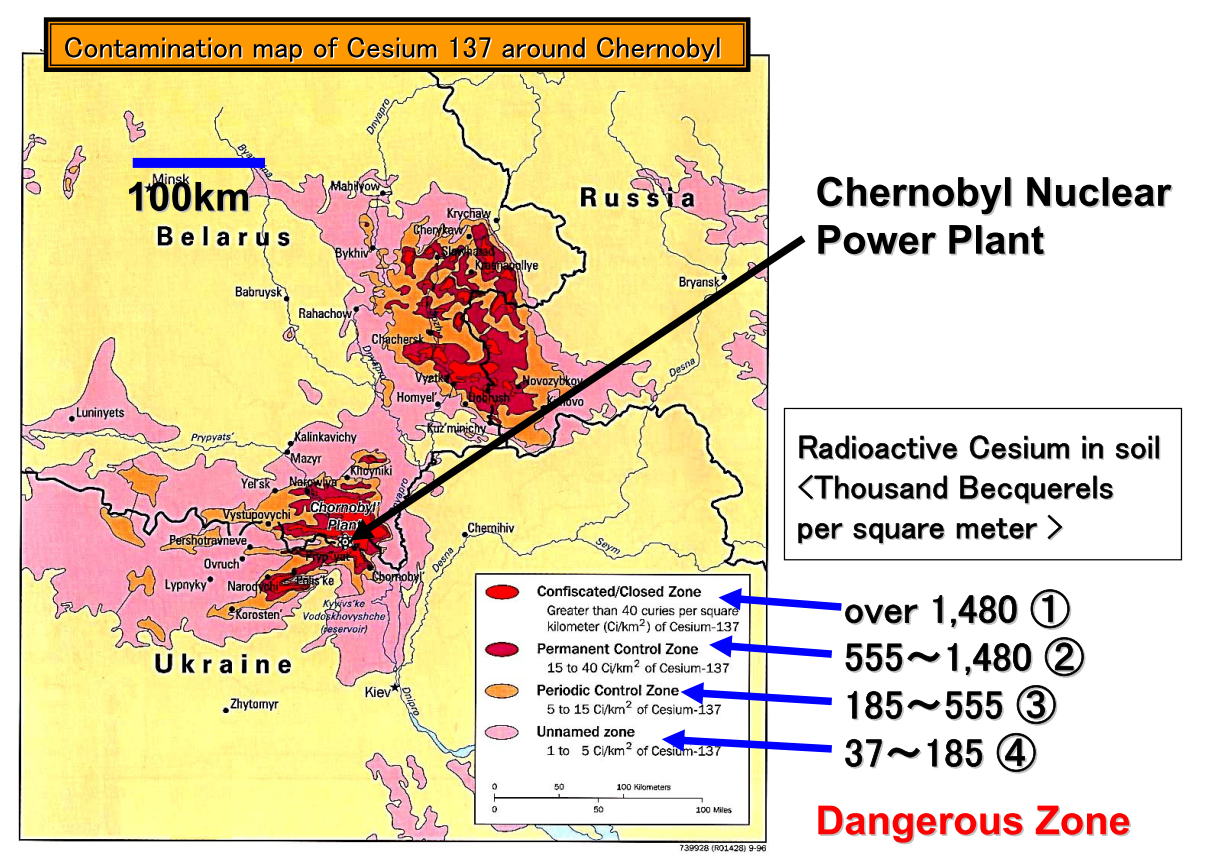
1. In a residential area park in Tokyo, 230 km from Fukushima, the soil was found to have a radiation level of 92,335 Becquerels per square meter. This is a dangerous level, comparable to what is found around Chernobyl ④ zone (the site of a nuclear catastrophe in 1986). One reason this level of pollution is found in the capital is that between Tokyo and Fukushima there are no mountains high enough to block radioactive clouds. In the capital people who understand the danger absolutely avoid eating food produced in eastern Japan.


A letter to All Young Athletes ENGLISH (1)_html_2ccd6755


2. Inside Fukushima Daiichi Nuclear Reactors #1 – #3 the pipes (which had circulated cooling water) are broken, which caused a meltdown. This means the nuclear fuel overheated, melted, and continued to melt anything it touched. Thus it melted through the bottom of the reactor, and then through the concrete floor of the building, and sank into the ground. As mentioned above, for two and a half years TEPCO workers have been desperately pouring water into the reactor, but it is not known whether the water is actually reaching the melted fuel. If a middle-strength earthquake comes, it is likely to destroy totally the already damaged building. And as a matter of fact, in the last two and a half years earthquakes have continued to hit Fukushima. (And as an additional matter of fact, just as this letter was being written Fukushima was hit by another middle-strength earthquake, but it seems that the building held up one more time. So far so good.) Especially dangerous is Reactor #4, where a large amount of nuclear fuel is being held in a pool, like another disaster waiting for its moment.

3. The cooling water being poured into the reactor is now considered the big problem in Japan. Newspapers and TV stations that previously strove to conceal the danger of nuclear power, are now reporting on this danger every day, and criticizing Shinzo Abe for the lie he told the IOC. The issue is that the highly irradiated water is entering and mixing with the ground water, and this leakage can’t be stopped, so it is spilling into the outer ocean. It is a situation impossible to control. In August, 2013 (the month prior to Abe’s IOC speech) within the site of Fukushima Daiichi Reactor, radiation was measured at 8500 micro Sieverts per hour. That is enough to kill anyone who stayed there for a month. This makes it a very hard place for the workers to get anything done. In Ohkuma-machi, the town where the Daiichi Nuclear Reactor is located, the radiation was measured in July, 2013 (two months before Abe’s talk) at 320 micro Sieverts per hour. This level of radiation would kill a person in two and a half years. Thus, over an area many kilometers wide, ghost towns are increasing.

4. For the sake of the 2020 Tokyo Olympics, an important fact has been left out from reports that go abroad. Only the fact that irradiated water is leaking onto the surface of the ground around the reactor is reported. But deep under the surface the ground water is also being irradiated, and the ground water flows out to sea and mixes with the seawater through sea-bottom springs. It is too late to do anything about this.

5. If you go to the big central fish market near Tokyo and measure the radiation in the air, it registers at about 0.05 micro Sieverts – a little higher than normal level. But if you measure the radiation near the place where the instrument that measures the radiation of the fish is located, the level is two or three times greater (2013 measurement). Vegetables and fish from around the Tokyo area, even if they are irradiated, are not thrown away. This is because the level established by the Japanese Government for permissible radiation in food – which if exceeded the food must not be sold – is the same as the permissible level of radiation in low-level radioactive wastes. Which is to say, in Japan today, as the entire country has been contaminated, we have no choice but to put irradiated garbage on the dinner table. The distribution of irradiated food is also a problem. Food from near Fukushima will be sent to another prefecture, and then sent on, relabeled as produced in the second prefecture. In particular, food distributed by the major food companies, and food served in expensive restaurants, is almost never tested for radiation.

6. In Japan, the only radiation from Fukushima Daiichi Nuclear Reactors that is being measured is the radioactive cesium. However large amounts of strontium 90 and tritium are spreading all over Japan. Strontium and tritium’s radiation consists of beta rays, and are very difficult to measure. However both are extremely dangerous: strontium can cause leukemia, and tritium can cause chromosome disorder.

7. More dangerous still: in order, they say, to get rid of the pollution that has fallen over the wide area of Eastern Japan, they are scraping off the top layer of the soil, and putting it in plastic bags as garbage. Great mountains of these plastic bags, all weather-beaten, are sitting in fields in Eastern Japan subject of course to attack by heavy rain and typhoons. Eventually the plastic will split open and the contents will come spilling out. When that happens, there will be no place left to take them.

8. On 21 September, 2013 (again, as this letter was being composed) the newspaper Tokyo Shimbun reported that Tokyo Governor Naoki Inose said at a press conference that what Abe expressed to the IOC was his intention to get the situation under control. “It is not,” Inose said, “under control now.”

Sunday, September 15, 2013

Fukushima is Out of Control says TEPCO Official

Friday, September 13, 2013 by Common Dreams
Statement contradicts assurances of Japanese PM, comes as fresh steam is spotted billowing from reactor
- Sarah Lazare


"I’m sorry, but we consider the situation is not under control."

Those were the words of Kazuhiko Yamashita, executive-level fellow for Fukushima plant operator Tokyo Electric Power Company when he was pressed by the opposition Democratic Party of Japan.

His statements directly contradict the claims of Japanese Prime Minister Shinzō Abe, who assured the International Olympic Committee meeting in Buenos Aires Saturday that the situation is under control.

TEPCO officials moved quickly to cover Yamashita's tracks, releasing a statement Friday declaring
It is our understanding that the Prime Minister intended his statement ‘the situation is under control’ to mean that the impact of radioactive materials is limited to the area within the port of the power station, and that the densities of radioactive materials on the surrounding waters are far below the referential densities and have not been on continuous upward trends. According to this understanding, we share the same views.

Yet, all evidence suggests that the crisis is far beyond the current abilities of the Japanese government and operator TEPCO to contain it.

Each day brings new disasters, with fresh reports on Friday that steam is billowing from a reactor. Radiation levels at the plant were found to be 18 times higher than TEPCO previously claimed, climbing to a high of 1800 millisieverts per hour—enough to kill a person in just four hours.

TEPCO has poured thousands of tons of water to cool the melted reactors, yet has no sustainable plan for storing it once contaminated. The temporary tanks where the radioactive water is currently being held are springing leaks, releasing the water into the groundwater, and by extension, the sea. TEPCO says it has resorted to patching tank leaks with plastic tape.

The Japanese government announced in early September it will invest $500 million to build a giant 'wall of ice' surrounding the plant. Yet, experts predict it will take at least 2 years to complete, and there is no evidence that this is enough to stem what has become a ballooning crisis.

The disaster was touched off by Japan's March 2011 earthquake and tsunami that led to the meltdown of fuel-rods at several reactors and continues to unleash toxic radiation into the air and sea. Over 160,000 people have been evacuated, transforming nearby areas into ghost towns in the worst nuclear disaster since Chernobyl. The Japanese government has been criticized for moving to re-start other nuclear facilities as the Fukushima crisis spirals.

Friday, September 6, 2013

Radiation at Fukushima Soars to Highest Level Yet


As officials tout 'ice wall' experiment, more lethal levels of radioactivity detected
- Andrea Germanos, staff writer

Record high radiation levels were detected at the disaster-stricken Fukushima nuclear plant, Japan's nuclear regulator and plant operator TEPCO said on Wednesday, raising more concerns that the spiraling catastrophe has no end in sight.

Officials said they had detected radiation of levels of 2,200 millisieverts per hour on Tuesday near contaminated water storage tanks. That's a rise of 20% from the previous high, the Guardian reports.

The announcement comes just days after officials said they had detected lethal radiation levels 18 times higher than previously documented because the testing equipment they were using could only read measurements of up to a maximum of 100 millisieverts per hour.

Reuters notes that "both [the 2,200 and 1,800] levels would be enough to kill an unprotected person within hours."

Also festering at the plant is the buildup of contaminated water, which has proven an unsustainable crisis. There has also been as a series of leaks from storage tanks and pipes.

Mycle Schneider, lead author for the World Nuclear Industry status reports, told BBC News last month that the problem of water leaks "is much worse than we have been led to believe, much worse." There are leaks "not just from the tanks. It is leaking out from the basements, it is leaking out from the cracks all over the place," he said. Further, the head of Japan's nuclear regulatory body warned on Monday that there may be no other option than to dump radioactive waste water into the Pacific.

In a desperate attempt to stop the leaks, Japanese Prime Minister Shinzo Abe announced Tuesday the government plans to invest nearly $500 million in a giant "ice wall" surrounding the plant.

Nuclear engineer Arjun Makhijani of the Institute for Energy and Environmental Research called the wall of ice plan a "risky experiment." Speaking on PBS Newshour, Makhijani explained:
I don't know that an ice wall like this has been tried before.

It's like building a dam underground, but with ice, by freezing all the poor water in the soil, all soil has -- so there's water coming in from uphill, through the side and going into the ocean, all underground. It's an aquifer. Some of that water contacts the molten fuel and is becoming contaminated.

And they hope to build -- to freeze the soil, basically, with a giant freezing machine, just like your freezer at home, put cooling coils in the soil, lots and lots of them. It takes an enormous amount of electricity and they would freeze it. Of course, it contains the water behind it like a dam, but eventually it's going to overtop the dam, as it did before. [...]

It is an experiment. And I think it's a risky experiment, because if the power fails, you know, just like if your -- when the power goes out with your refrigerator, everything will de-freeze in -- defrost in the freezer.

So, if this ice melts suddenly and it's blocking an enormous amount of contaminated water behind it, then you have got a problem. At the same time, you know, the tanks are themselves something of a threat, if there's another earthquake and this highly contaminated water gets into the ocean. And so they have a got a very -- couple of very, very serious problems of containing the water.

Last month, Makhijani warned, "This is an accident that’s shockingly not stopping."

Amidst the fight to contain the nuclear disaster, Japan is brushing aside concerns of radioactivity as it makes its bid to be the host of the 2020 Olympics.

“The radiation level in Tokyo is the same as London, New York and Paris,” said Tsunekazu Takeda, an IOC member and president of the Japanese Olympic committee. “It’s absolutely safe, 35 million people living there in very normal conditions. We have no worries.”

Saturday, November 3, 2012

Project Censored: Top 10 under reported stories from 2012

The expanding police state tops the annual list of stories underreported by the mainstream media
By Yael Chanoff

PCensored_art_1.jpg
People who get their information exclusively from mainstream media sources may be surprised at the lack of enthusiasm on the left for President Barack Obama in this crucial election. But that’s probably because they weren’t exposed to the full online furor sparked by Obama’s continuation of his predecessor’s overreaching approach to national security, such as signing the 2012 National Defense Authorization Act, which allows the indefinite detention of those accused of supporting terrorism, even U.S. citizens.

We’ll never know how this year’s election would be different if the corporate media adequately covered the NDAA’s indefinite detention clause and many other recent attacks on civil liberties. What we can do is spread the word and support independent media sources that do cover these stories. That’s where Project Censored comes in.
Project Censored has been documenting inadequate media coverage of crucial stories since it began in 1967 at Sonoma State University. Each year, the group considers hundreds of news stories submitted by readers, evaluating their merits. Students search Lexis Nexis and other databases to see if the stories were underreported, and if so, the stories are fact-checked by professors and experts in relevant fields.

A panel of academics and journalists chooses the Top 25 stories and rates their significance. The project maintains a vast online database of underreported news stories that it has “validated” and publishes them in an annual book. Censored 2013: Dispatches from the Media Revolution will be released Oct. 30.

For the second year in row, Project Censored has grouped the Top 25 list into topical “clusters.” This year, categories include “Human cost of war and violence” and “Environment and health.” Project Censored Director Mickey Huff told us the idea was to show how various undercovered stories fit together into an alternative narrative, not to say that one story was more censored than another.

In May, while Project Censored was working on the list, another 2012 list was issued: the Fortune 500 list of the biggest corporations, whose influence peppers the Project Censored list in a variety of ways.

Consider this year’s top Fortune 500 company: ExxonMobil. The oil company pollutes everywhere it goes, yet most stories about its environmental devastation go underreported. Weapons manufacturers Lockheed Martin (58 on the Fortune list), General Dynamics (92), and Raytheon (117) are tied into stories about U.S. prisoners in slavery conditions manufacturing parts for their weapons and the underreported war crimes in Afghanistan and Libya.

These powerful corporations work together more than most people think. In the chapter exploring the “global 1 percent,” writers Peter Philips and Kimberly Soeiro explain how a small number of well-connected people control the majority of the world’s wealth. In it, they use Censored story number 6, “Small network of corporations run the global economy,” to describe how a network of transnational corporations are deeply interconnected, with 147 of them controlling 40 percent of the global economy’s total wealth.

For example, Philips and Soeiro write that in one such company, BlackRock Inc., “The 18 members of the board of directors are connected to a significant part of the world’s core financial assets. Their decisions can change empires, destroy currencies and impoverish millions.”

Another cluster of stories, “Women and Gender, Race and Ethnicity,” notes a pattern of underreporting stories that affect a range of marginalized groups. This broad category includes only three articles, and none are listed in the top 10. The stories reveal mistreatment of Palestinian women in Israeli prisons, including being denied medical care and shackled during childbirth, and the rape and sexual assault of women soldiers in the U.S. military. The third story in the category concerns an Alabama anti-immigration bill, H.B. 56, that caused immigrants to flee Alabama in such numbers that farmers felt a dire need to “help farms fill the gap and find sufficient labor.” So the Alabama Department of Agriculture and Industries approached the state’s Department of Corrections about making a deal where prisoners would replace the fleeing farm workers.

But with revolutionary unrest around the world, and the rise of a mass movement that connects disparate issues together into a simple, powerful class analysis — the 99 percent versus the 1 percent paradigm popularized by Occupy Wall Street — this year’s Project Censored offers an element of hope.

It’s not easy to succeed at projects that resist corporate dominance, and when it does happen, the corporate media is sometimes reluctant to cover it. Number seven on the Top 25 list is the story of how the United Nations designated 2012 the International Year of the Cooperative, recognizing the rapid growth of co-op businesses, organizations that are part-owned by all members and whose revenue is shared equitably among members. One billion people worldwide now work in co-ops.

The Year of the Cooperative is not the only good-news story discussed by Project Censored this year. In Chapter 4, Yes! Magazine’s Sarah Van Gelder lists “12 ways the Occupy movement and other major trends have offered a foundation for a transformative future.” They include a renewed sense of “political self-respect” and fervor to organize in the United States, debunking of economic myths such as the “American dream,” and the blossoming of economic alternatives such as community land trusts, time banking and micro-energy installations.

As Dr. Nafeez Mosaddeq Ahmed writes in the book’s foreword, “The majority of people now hold views about Western governments and the nature of power that would have made them social pariahs 10 or 20 years ago.”

Citing polls from the corporate media, Mosaddeq writes: “The majority are now skeptical of the Iraq War; the majority want an end to U.S. military involvement in Afghanistan; the majority resent the banks and financial sector, and blame them for the financial crisis; most people are now aware of environmental issues, more than ever before, and despite denialist confusion promulgated by fossil fuel industries, the majority in the United States and Britain are deeply concerned about global warming; most people are wary of conventional party politics and disillusioned with the mainstream parliamentary system.”

“In other words,” he writes, “there has been a massive popular shift in public opinion toward a progressive critique of the current political economic system.”

And ultimately, it’s the public — not the president and not the corporations—that will determine the future. There may be hope after all. Here’s Project Censored’s Top 10 list for 2013:

1. Signs of an emerging police state
President George W. Bush is remembered largely for his role in curbing civil liberties in the name of his “war on terror.” But it’s President Obama who signed the 2012 NDAA, including its clause allowing for indefinite detention without trial for terrorism suspects. Obama promised that “my administration will interpret them to avoid the constitutional conflict” — leaving us adrift if and when the next administration chooses to interpret them otherwise. Another law of concern is the National Defense Resources Preparedness Executive Order that Obama issued in March 2012. That order authorizes the president, “in the event of a potential threat to the security of the United States, to take actions necessary to ensure the availability of adequate resources and production capability, including services and critical technology, for national defense requirements.” The president is to be advised on this course of action by “the National Security Council and Homeland Security Council, in conjunction with the National Economic Council.” Journalist Chris Hedges, along with co-plaintiffs including Noam Chomsky and Daniel Ellsberg, won a case challenging the NDAA’s indefinite detention clause on Sept. 1, when a federal judge blocked its enforcement, but her ruling was overturned on Oct. 3, so the clause is back.


2. Oceans in peril
Big banks aren’t the only entities that our country has deemed “too big to fail.” But our oceans won’t be getting a bailout anytime soon, and their collapse could compromise life itself. In a haunting article highlighted by Project Censored, Mother Jones reporter Julia Whitty paints a tenuous seascape — overfished, acidified, warming — and describes how the destruction of the ocean’s complex ecosystems jeopardizes the entire planet, not just the 70 percent that is water. Whitty compares ocean acidification, caused by global warming, to acidification that was one of the causes of the “Great Dying,” a mass extinction 252 million years ago. Life on Earth took 30 million years to recover. In a more hopeful story, a study of 14 protected and 18 non-protected ecosystems in the Mediterranean Sea showed dangerous levels of biomass depletion. But it also showed that the marine reserves were well-enforced, with five to 10 times larger fish populations than in unprotected areas. This encourages establishment and maintenance of more reserves.

3. U.S. deaths from Fukushima
A plume of toxic fallout floated to the U.S. after Japan’s tragic Fukushima nuclear disaster on March 11, 2011. The U.S. Environmental Protection Agency found radiation levels in air, water and milk that were hundreds of times higher than normal across the United States. One month later, the EPA announced that radiation levels had declined, and they would cease testing. But after making a Freedom of Information Act request, journalist Lucas Hixson published emails revealing that on March 24, 2011, the task of collecting nuclear data had been handed off from the U.S. Nuclear Regulatory Commission to the Nuclear Energy Institute, a nuclear industry lobbying group. And in one study that got little attention, scientists Joseph Mangano and Jeanette Sherman found that in the period following the Fukushima meltdowns, 14,000 more deaths than average were reported in the U.S., mostly among infants. Later, Mangono and Sherman updated the number to 22,000.

4. FBI agents responsible for terrorist plots
We know that FBI agents go into communities such as mosques, both undercover and in the guise of building relationships, quietly gathering information about individuals. This is part of an approach to finding what the FBI now considers the most likely kind of terrorists, “lone wolves.” Its strategy: “seeking to identify those disgruntled few who might participate in a plot given the means and the opportunity. And then, in case after case, the government provides the plot, the means, and the opportunity,” writes Mother Jones journalist Trevor Aaronsen. The publication, along with the Investigative Reporting Program at the University of California-Berkeley, examined the results of this strategy, 508 cases classified as terrorism-related that have come before the U.S. Department of Justice since the 9/11 terrorist attacks of 2001. In 243 of these cases, an informant was involved; in 49 cases, an informant actually led the plot. And “with three exceptions, all of the high-profile domestic terror plots of the last decade were actually FBI stings.”


5. Federal Reserve loaned trillions to major banks
The Federal Reserve, the U.S.’s quasi-private central bank, was audited for the first time in its history this year. The audit report states, “From late 2007 through mid-2010, Reserve Banks provided more than a trillion dollars ... in emergency loans to the financial sector to address strains in credit markets and to avert failures of individual institutions believed to be a threat to the stability of the financial system.” These loans had significantly less interest and fewer conditions than the high-profile TARP bailouts, and were rife with conflicts of interest. Some examples: the CEO of JP Morgan Chase served as a board member of the New York Federal Reserve at the same time that his bank received more than $390 billion in financial assistance from the Fed. William Dudley, who is now the New York Federal Reserve president, was granted a conflict of interest waiver to let him keep investments in AIG and General Electric at the same time the companies were given bailout funds. The audit was restricted to Federal Reserve lending during the financial crisis. On July 25, 2012, a bill to audit the Fed again, with fewer limitations, authored by Rep. Ron Paul, passed the House of Representatives. H.R. 459 was expected to die in the Senate, but the movement behind Paul and his calls to hold the Fed accountable, or abolish it altogether, seem to be growing.


6. Small network of corporations run the global economy
Reporting on a study by researchers from the Swiss Federal Institute in Zurich didn’t make the rounds nearly enough, according to Censored 2013. They found that, of 43,060 transnational companies, 147 control 40 percent of total global wealth. The researchers also built a model visually demonstrating how the connections between companies — what it calls the “super entity” — works. Some have criticized the study, saying control of assets doesn’t equate to ownership. True, but as we clearly saw in the 2008 financial collapse, corporations are capable of mismanaging assets in their control to the detriment of their actual owners. And a largely unregulated super entity like this is vulnerable to global collapse.

7. The International Year of Cooperative
Can something really be censored when it’s straight from the United Nations? According to Project Censored evaluators, the corporate media underreported the U.N. declaring 2012 to be the International Year of the Cooperative, based on the co-op business model’s stunning growth. The U.N. found that, in 2012, 1 billion people worldwide are co-op member-owners, or one in five adults over age 15. The largest is Spain’s Mondragon Corporation, with more than 80,000 member-owners. The U.N. predicts that by 2025, worker-owned co-ops will be the world’s fastest growing business model. Worker-owned cooperatives provide for equitable distribution of wealth, genuine connection to the workplace, and, just maybe, a brighter future for our planet.

8. NATO war crimes in Libya
In January 2012, the BBC “revealed” how British Special Forces agents joined and “blended in” with rebels in Libya to help topple dictator Muammar Gadaffi, a story that alternative media sources had reported a year earlier. NATO admits to bombing a pipe factory in the Libyan city of Brega that was key to the water supply system that brought tap water to 70 percent of Libyans, saying that Gadaffi was storing weapons in the factory. In Censored 2013, writer James F. Tracy makes the point that historical relations between the U.S. and Libya were left out of mainstream news coverage of the NATO campaign; “background knowledge and historical context confirming Al-Qaeda and Western involvement in the destabilization of the Gadaffi regime are also essential for making sense of corporate news narratives depicting the Libyan operation as a popular ‘uprising.’”

9. Prison slavery in the U.S.
On its website, the UNICOR manufacturing corporation proudly proclaims that its products are “made in America.” That’s true, but they’re made in places in the U.S. where labor laws don’t apply, with workers often paid just 23 cents an hour to be exposed to toxic materials with no legal recourse. These places are U.S. prisons. Slavery conditions in prisons aren’t exactly news. It’s literally written into the Constitution; the 13th Amendment, which abolished slavery, outlaws “slavery nor involuntary servitude, except as a punishment for crime whereof the party shall have been duly convicted.” But the articles highlighted by Project Censored this year reveal the current state of prison slavery industries, and its ties to war. The majority of products manufactured by inmates are contracted to the Department of Defense. Inmates make complex parts for missile systems, battleship anti-aircraft guns and landmine sweepers, as well as night-vision goggles, body army and camouflage uniforms. Of course, this is happening in the context of record high imprisonment in the U.S., where grossly disproportionate numbers of African Americans and Latinos are imprisoned, and can’t vote even after they’re freed. As psychologist Elliot D. Cohen puts it in this year’s book: “This system of slavery, like that which existed in this country before the Civil War, is also racist, as more than 60 percent of U.S. prisoners are people of color.”


10. H.R. 347 criminalizes protest
H.R. 347, sometimes called the “criminalizing protest” or “anti-Occupy” bill, made some headlines. But concerned lawyers and other citizens worry that it could have disastrous effects for the First Amendment right to protest. Officially called the Federal Restricted Grounds Improvement Act, the law makes it a felony to “knowingly” enter a zone restricted under the law, or engage in “disorderly or disruptive” conduct in or near the zones. The restricted zones include anywhere the Secret Service may be — places such as the White House, areas hosting events deemed “National Special Security Events,” or anywhere visited by the president, vice president and their immediate families; former presidents, vice presidents and certain family members; certain foreign dignitaries; major presidential and vice presidential candidates (within 120 days of an election); and other individuals as designated by a presidential executive order. These people could be anywhere, and NSSEs have notoriously included the Democratic and Republican National Conventions, Super Bowls and the Academy Awards. So far, it seems the only time H.R. 347 has kicked in is with George Clooney’s high-profile arrest outside the Sudanese embassy. Clooney ultimately was not detained without trial — information that would be almost impossible to censor — but what about the rest of us who exist outside of the mainstream media’s spotlight?

Tuesday, May 29, 2012

Fukushima and the Japan Tsunami: Neverending Disasters (3 articles)

Tuesday, May 29, 2012 by Common Dreams 
Fukushima Radiation Found in Tuna Off California
 
Detectable amounts of cesium-137 and cesium-134 were found in bluefin tuna caught off the coast of California about four months after the Fukushima nuclear disaster in Japan, US scientists reported on Monday.

The timing is important because it shows that migrating fish carried radiation much further and faster than either wind or ocean currents. In addition, of course, the bluefin are a highly prized edible fish found in sushi restaurants all over the world.

Without making a definitive judgment on the safety of the fish, lead author Daniel Madigan of Stanford University's Hopkins Marine Station told Reuters that the amount of radioactive material detected was far less than the Japanese safety limit. 
 
"I wouldn't tell anyone what's safe to eat or what's not safe to eat," she said. "It's become clear that some people feel that any amount of radioactivity, in their minds, is bad and they'd like to avoid it."
*  *  *
Reuters reports:
There was about five times the background amount of cesium 137 in the bluefin tuna they tested, but that is still a tiny quantity, Madigan said: 5 becquerels instead of 1 becquerel. (It takes 37 billion becquerels to equal 1 curie; for context, a pound of uranium-238 has 0.00015 curies of radioactivity, so one becquerel would be a truly miniscule proportion.)
The researchers figured that the elevated levels of cesium 137 and all of the cesium 134 they detected came from Fukushima because of the way bluefin tuna migrate across the Pacific.
Bluefin tuna spawn only in the western Pacific, off the coasts of Japan and the Philippines. As young fish, some migrate east to the California coast, where upwelling ocean water brings lots of food for them and their prey. They get to these waters as juveniles or adolescents, and remain there, fattening up.
Judging by the size of the bluefin tuna they sampled - they averaged about 15 pounds (6 kg) - the researchers knew these were young fish that had left Japanese water about a month after the accident.
Most of the radiation was released over a few days in April 2011, and unlike some other compounds, radioactive cesium does not quickly sink to the sea bottom but remains dispersed in the water column, from the surface to the ocean floor.
Fish can swim right through it, ingesting it through their gills, by taking in seawater or by eating organisms that have already taken it in, Madigan said.
*  *  *
The Guardian adds:
The results "are unequivocal. Fukushima was the source", said Ken Buesseler of the Woods Hole Oceanographic Institution, who played no part in the research.
Japan's chief cabinet secretary, Osamu Fujimura, conceded that the findings suggested the monitoring of radiation levels in fish outside Japanese waters may have to be stepped up. [...]
"We were frankly kind of startled," said Nicholas Fisher, an expert at Stony Brook University in New York who took part in the study. "That's a big ocean. To swim across it and still retain these radionuclides is pretty amazing."
The operator of the Fukushima Daiichi plant, Tokyo Electric Power, estimates that 18,000 terabecquerels of radioactive materials flowed into the Pacific after the accident, either in the form of fallout, or through mixing with water that leaked from the facility. A terabecquerel is equal to 1tn becquerels.


* * *

Monday, May 28, 2012 by Common Dreams
Growing Fear Over Fukushima Fuel Pool 4 as Wall Bulge Detected
TEPCO admits a bulge detected in the walls of Unit 4, stoking fears over the building’s stability


A new bulge in the walls of the Fukushima Unit 4 nuclear plant has driven growing new fears over in Japan.

The No. 4 reactor building at Tokyo Electric Power Co.'s Fukushima Dai-ichi nuclear power plant in Okuma, Fukushima Prefecture, Japan, Saturday, May 26, 2012. New concerns have risen after its operator reported a bulging of the building's wall. (Toshiaki Shimizu/Japan Pool) [Yellow reactor containment dome at left background.] Attention has focused on Unit 4’s spent fuel pool because of the large number of assemblies filled with rods that are stored high above the ground at that severly damaged reactor building. Three other reactor buildings at the site are also badly damaged, but their pools hold fewer used assemblies.

On Saturday Japan’s government sent Environment and Nuclear Minister Goshi Hosonoto to inspect Unit 4.

Mr Hosono said the government accepted the Tokyo Electric Power Company's assurances that reinforcement work had shored up the building.

But many Japanese have scoffed at such assurances and point out that the pool's cooling system has malfunctioned several times.

''The No. 4 reactor is visibly damaged and in a fragile state, down to the floor that holds the spent fuel pool,'' said Hiroaki Koide, an assistant professor at Kyoto University's Research Reactor Institute. ''Any radioactive release could be huge and go directly into the environment.''
* * *
The New York Times reports:

What passes for normal at the Fukushima Daiichi plant today would have caused shudders among even the most sanguine of experts before an earthquake and tsunami set off the world’s second most serious nuclear crisis after Chernobyl.

Fourteen months after the accident, a pool brimming with used fuel rods and filled with vast quantities of radioactive cesium still sits on the top floor of a heavily damaged reactor building, covered only with plastic.

The public’s fears about the pool have grown in recent months as some scientists have warned that it has the most potential for setting off a new catastrophe, now that the three nuclear reactors that suffered meltdowns are in a more stable state, and as frequent quakes continue to rattle the region.

Senator Wyden, whose state could lie in the path of any new radioactive plumes, is among those pushing for faster action. After his recent visit to the ravaged plant, he said the pool at No. 4 poses “an extraordinary and continuing risk” and the retrieval of spent fuel “should be a priority, given the possibility of further earthquakes.”The worries picked up new traction in recent days after the operator of the plant, Tokyo Electric Power Company, or Tepco, said it had found a slight bulge in one of the walls of the reactor building, stoking fears over the building’s safety.

To try to quell such worries, the government sent the environment and nuclear minister to the plant on Saturday, where he climbed a makeshift staircase in protective garb to look at the structure supporting the pool, which he said appeared sound. The minister, Goshi Hosono, added that although the government accepted Tepco’s assurances that reinforcement work had shored up the building, it ordered the company to conduct further studies because of the bulge. [...]

“The No. 4 reactor is visibly damaged and in a fragile state, down to the floor that holds the spent fuel pool,” said Hiroaki Koide, an assistant professor at Kyoto University’s Research Reactor Institute and one of the experts raising concerns. “Any radioactive release could be huge and go directly into the environment.”

Senator Ron Wyden, Democrat of Oregon, expressed similar concerns during a trip to Japan last month.

The fears over the pool at Reactor No. 4 are helping to undermine assurances by Tepco and the Japanese government that the Fukushima plant has been stabilized, and are highlighting how complicated the cleanup of the site, expected to take decades, will be. The concerns are also raising questions about whether Japan’s all-out effort to convince its citizens that nuclear power is safe kept the authorities from exploring other — and some say safer — options for storing used fuel rods.

“It was taboo to raise questions about the spent fuel that was piling up,” said Hideo Kimura, who worked as a nuclear fuel engineer at the Fukushima Daiichi plant in the 1990s. “But it was clear that there was nowhere for the spent fuel to go.”

The worst-case situations for Reactor No. 4 would be for the pool to run dry if there is another problem with the cooling system and the rods catch fire, releasing enormous amounts of radioactive material, or for fission to restart if the metal panels that separate the rods are knocked over in a quake. That would be especially bad because the pool, unlike reactors, lacks containment vessels to hold in radioactive materials. (Even the roof that used to exist would be no match if the rods caught fire, for instance.)

Senator Wyden, whose state could lie in the path of any new radioactive plumes and who has studied nuclear waste issues, is among those pushing for faster action. After his recent visit to the ravaged plant, he said the pool at No. 4 poses “an extraordinary and continuing risk” and the retrieval of spent fuel “should be a priority, given the possibility of further earthquakes.”
Attention has focused on No. 4’s spent fuel pool because of the large number of assemblies filled with rods that are stored at that reactor building. Three other reactor buildings at the site are also badly damaged, but their pools hold fewer used assemblies.

According to Tepco, the pool at the No. 4 reactor, which was not operating at the time of the accident, holds 1,331 spent fuel assemblies, which each contain dozens of rods. Several thousand rods were removed from the core just three months before so the vessel could be inspected. Those rods, which were not fully used up, could more easily support chain reactions than the fully spent fuel.
* * *
 

The damaged No. 4 reactor building stands at Tokyo Electric Power Co.'s Fukushima Dai-ichi nuclear power plant in Okuma, Fukushima prefecture, Japan, Saturday, May 26, 2012. Japanese Environment and Nuclear Minister Goshi Hosono, accompanied by the media, has visited the crippled Fukushima Dai-ichi nuclear power plant to inspect a reactor building and its spent fuel pool at the center of safety concerns. (Tomohiro Ohsumi, Pool)


Goshi Hosono, Japan's environment and nuclear minister, third from left, wearing a red helmet, along with members of the media, walks on the No. 4 reactor building at Tokyo Electric Power Co.'s (TEPCO) Fukushima Dai-ichi nuclear power plant in Okuma, Fukushima prefecture, Japan, Saturday, May 26, 2012. Japan's environment and nuclear minister Hosono visited the tsunami-crippled nuclear power plant Saturday to inspect a spent fuel pool at the center of safety concerns. [Yellow reactor containment dome at left background.] (Tomohiro Ohsumi, Pool)
 

Workers walk in front of the No. 4 reactor building at Tokyo Electric Power Co.'s tsunami-crippled Fukushima Dai-Ichi nuclear power plant in Okuma town, Fukushima prefecture, Japan, Saturday, May 26, 2012. (Tomohiro Ohsumi, Pool)


Japan's Environment and Nuclear Minister Goshi Hosono, second from left, inspects a pool containing spent fuel rods inside the No. 4 reactor building at Tokyo Electric Power Co. 's tsunami-crippled Fukushima Dai-ichi nuclear power plant in Okuma, Fukushima Prefecture, Japan, Saturday, May 26, 2012. The pool, located at the top of the building above the reactor, remains one of the plant's biggest risks due to its vulnerability to earthquakes. (Toshiaki Shimizu, Japan Pool)

 
A pool for spent fuel rods is seen inside the No. 4 reactor building of Tokyo Electric Power Co.'s tsunami-crippled Fukushima Dai-ichi nuclear power plant in Okuma, Fukushima prefecture, Japan, Saturday, May 26, 2012. The pool, located at the top of the building above the reactor, remains one of the plant's biggest risks due to its vulnerability to earthquakes. (Toshiaki Shimizu, Japan Pool)
 
Goshi Hosono, Japan's environment and nuclear minister, inspects the No. 4 reactor building at Tokyo Electric Power Co.'s Fukushima Dai-ichi nuclear power plant in Okuma, Fukushima Prefecture, Japan, Saturday, May 26, 2012. The visit by Hosono, apparently aimed at demonstrating the safety of the facility, came amid renewed concerns about conditions at the plant's No. 4 reactor after its operator reported a bulging of the building's wall. (Toshiaki Shimizu, Japan Pool) [Yellow reactor containment dome at center background.]

* * *


Monday, May 28, 2012 by Common Dreams
Japan's Toxic Tsunami Debris Heads Towards North America
Chris Pallister of the Gulf of Alaska Keeper Organization: "This is more hazardous than oil"

As the heavier debris from the March 2011 tsunami that struck Japan makes its way across the Pacific Ocean, scientists warn of the ecological threat of toxic, chemical debris headed towards North America's western coast.

Chemical contamination "could be a real threat," Dr. M. Sanjayan, the lead scientist at conservation group the Nature Conservancy, tells CBC News. (screenshot from CNN video below) Chemical contamination "could be a real threat," Dr. M. Sanjayan, the lead scientist at conservation group the Nature Conservancy, tells CBC News. "Finding one drum of, say, paint thinner, or something you might find in your garage, it's not hugely toxic. But if you find 50 of them all washed up on a rocky shore and then breaking and leaking, then you have some problems."

"This is more hazardous than oil," Chris Pallister of the Gulf of Alaska Keeper Organization warns the Homer Tribune. "Entire communities went into the ocean — industrial, household chemicals, anything you can think of in your garage — and it's all coming here. This is like a great big toxic spill that is widely dispersed."

Chris Pallister, who's been cleaning marine debris on Alaska's Montague Island for 15 years, told CNN, "The influx of tsunami debris really concerns us mostly because of the amount of Styrofoam that's coming with it and also the toxic chemicals that are coming. We think they're going to have a really detrimental impact on the environment out here long term."

* * *

CBC News: Chemicals in tsunami debris could pose coastal threat
The spill and spread of industrial chemicals across the coastline of British Columbia is a possibility as slower-moving tsunami debris from Japan approaches the west coast, according to experts observing its movements.
The risk of chemical contamination is sizable, especially considering that many of the tsunami-affected areas on the Japanese coast were industrial and used many different types of toxic chemicals in manufacturing operations.
"[Chemical contamination] could be a real threat," said Dr. M. Sanjayan, the lead scientist at conservation group the Nature Conservancy. "For example, it's very hard to imagine how 50 drums [filled] with something could all show up at the same time, unless it's an event like this. That's where it can be a little dangerous. [...]
Dianna Parker of the NOAA notes that the majority of the debris is heavier and slower-moving than the more buoyant items that have been found on coastlines in recent months. Objects that ride high, such as plastic containers, bottles and buoys, travel much faster than intact and possibly dangerous industrial chemical containers. The bulk of the debris pulled out to sea by the tsunami is still suspended north of the main Hawaiian Islands in the Pacific. [...]
The Nature Conservancy and the NOAA believe that publicity surrounding the debris field will bring attention to the fact that ocean-going debris from the tsunami merely added to an ever-growing pile of junk accumulating in the Pacific and on shorelines. The estimated five million tonnes of debris from the Japanese tsunami represents less than one per cent of what's already out there in the Pacific.
* * *
NOAA map as of May 15, 2012 of tsunami debris


Mother Nature Network: Japan tsunami debris looms off U.S. coasts
The Pacific Ocean is no stranger to litter, thanks to a big maritime mess known as the Great Pacific Garbage Patch. But for the past 14 months, a different type of debris has been sailing around the Pacific — not the familiar bits of plastic found in the garbage patch, but some 5 million tons of detritus that washed offshore after the deadly Japanese earthquake and tsunami of March 2011. [...]
While it pales in comparison to the disaster that sent it there, some worry all this debris could pose environmental dangers for the U.S. and Canada, possibly even on par with an oil spill. "This is more hazardous than oil," Chris Pallister of the Gulf of Alaska Keeper Organization tells the Homer Tribune. "Entire communities went into the ocean — industrial, household chemicals, anything you can think of in your garage — and it's all coming here. This is like a great big toxic spill that is widely dispersed." [...]
Nonetheless, many people from Alaska to California say tsunami debris is already flooding in, and they want immediate action. "The time for talk is over," Sen. Mark Begich, D-Alaska, said in a recent statement. "The prospect of debris coming to our shorelines is not just a theory, it is here." Begich and other lawmakers have pushed the Obama administration to allocate emergency funds to study the tsunami debris, and to reconsider a planned budget cut for NOAA's Marine Debris Program.

Wednesday, April 25, 2012

Why Fukushima is a Greater Disaster Than Chernobyl

Warning Signs for the US
by ROBERT ALVAREZ


In the aftermath of the world’s worst nuclear power disaster, the news media is just beginning to grasp that the dangers to Japan and the rest of the world posed by the Fukushima-Dai-Ichi site are far from over. After repeated warnings by former senior Japanese officials, nuclear experts, and now a U.S. Senator, it is sinking in that the irradiated nuclear fuel stored in spent fuel pools amidst the reactor ruins may have far greater potential offsite consequences than the molten cores.

After visiting the site recently, Senator Ron Wyden (D-OR) wrote to Japan’s ambassador to the U.S. stating that, “loss of containment in any of these pools could result in an even greater release than the initial accident.”

This is why:
  • Each pool contains irradiated fuel from several years of operation, making for an extremely large radioactive inventory without a strong containment structure that encloses the reactor cores;
  • Several pools are now completely open to the atmosphere because the reactor buildings were demolished by explosions; they are about 100 feet above ground and could possibly topple or collapse from structural damage coupled with another powerful earthquake;
  • The loss of water exposing the spent fuel will result in overheating can cause melting and ignite its zirconium metal cladding – resulting in a fire that could deposit large amounts of radioactive materials over hundreds of miles.
Irradiated nuclear fuel, also called “spent fuel,” is extraordinarily radioactive. In a matter of seconds, an unprotected human one foot away from a single freshly removed spent fuel assembly would receive a lethal dose of radiation within seconds. As one of the most dangerous materials in the world, spent reactor fuel poses significant long-term risks, requiring isolation in a geological disposal site that can protect the human environment for tens of thousands of years.

It’s almost 26 years since the Chernobyl reactor exploded and caught fire releasing enormous amounts of radioactive debris. The Chernobyl accident revealed the folly of not having an extra barrier of thick concrete and steel surrounding the reactor core that is required for modern plants in the U.S., Japan and elsewhere. The Fukushima Dai-Ichi accident revealed the folly of storing huge amounts of highly radioactive spent fuel in vulnerable pools, high above the ground.

What both accidents have in common is widespread environmental contamination from cesium-137. With a half-life of 30, years, Cs-137 gives off penetrating radiation, as it decays. Once in the environment, it mimics potassium as it accumulates in biota and the human food chain for many decades. When it enters the human body, about 75 percent lodges in muscle tissue, with perhaps the most important muscle being the heart. Studies of chronic exposure to Cs-137 among the people living near Chernobyl show an alarming rate of heart problems, particularly among children.

As more information is made available, we now know that the Fukushima Dai-Ichi site is storing 10,833 spent fuel assemblies (SNF) containing roughly 327 million curies of long-lived radioactivity About 132 million curies is cesium-137 or nearly 85 times the amount estimated to have been released at Chernobyl.

The overall problem we face is that nearly all of the spent fuel at the Dai-Ichi site is in vulnerable pools in a high risk/consequence earthquake zone. The urgency of the situation is underscored by the ongoing seismic activity around NE Japan in which 13 earthquakes of magnitude 4.0 – 5.7 have occurred off the NE coast of Honshu in the last 4 days between 4/14 and 4/17. This has been the norm since the first quake and tsunami hit the site on March 11th of last year. Larger quakes are expected closer to the power plant.

Last week, Tokyo Electric Power Company (TEPCO) revealed plans to remove 2,274 spent fuel assemblies from the damaged reactors that will probably take at least a decade to accomplish. The first priority will be removal of the contents in Pool No. 4. This pool is structurally damaged and contains about 10 times more cesium-137 than released at Chernobyl. Removal of SNF from the No. 4 reactor is optimistically expected to begin at the end of 2013. A significant amount of construction to remove, debris and reinforce the structurally-damaged reactor buildings, especially the fuel- handling areas, will be required.

Also, it is not safe to keep 1,882 spent fuel assemblies containing ~57 million curies of long-lived radioactivity, including nearly 15 times more cs-137 than released at Chernobyl in the elevated pools at reactors 5, 6, and 7, which did not experience melt-downs and explosions.

The main reason why there is so much spent fuel at the Da-Ichi site, is that it was supposed to be sent to the Rokkasho reprocessing plant, which has experienced 18 lengthy delays throughout its construction history. Plutonium and uranium was to be extracted from the spent fuel there, with the plutonium to be used as fuel at the Monju fast reactor.

After several decades and billions of dollars, the United States effectively abandoned the “closed” nuclear fuel cycle 30 years ago for cost and nuclear non-proliferation reasons. Over the past 60 years, the history of fast reactors using plutonium is littered with failures the most recent being the Monju project in Japan. Monju was cancelled in November of last year, dealing a fatal blow to the dream of a “closed” nuclear fuel cycle in Japan.

The stark reality, if TEPCO’s plan is realized, is that nearly all of the spent fuel at the Da-Ichi containing some of the largest concentrations of radioactivity on the planet will remain indefinitely in vulnerable pools. TEPCO wants to store the spent fuel from the damaged reactors in the common pool, and only to resort to dry, cask storage when the common pool’s capacity is exceeded. At this time, the common pool is at 80 percent storage capacity and will require removal of SNF to make room. TEPCO’s plan is to minimize dry cask storage as much as possible and to rely indefinitely on vulnerable pool storage. Senator Wyden finds that TEPCO’s plan for remediation carries extraordinary and continuing risk. He sensibly recommends that retrieval of spent fuel in existing on-site spent fuel pools to safer storage in dry casks should be a priority.

Given these circumstances, a key goal for the stabilization of the Fukushima-Daichi site is to place all of its spent reactor fuel into dry, hardened storage casks. This will require about 244 additional casks at a cost of about $1 mllion per cask. To accomplish this goal, an international effort is required – something that Senator Ron Wyden (D-OR) has called for. As we have learned, despite the enormous destruction from the earthquake and tsunami at the Dai-Ich Site, the nine dry casks and their contents were unscathed. This is an important lesson we should not ignore.

Friday, December 23, 2011

Is Cancer Epidemic in America?


by RUSSELL D. HOFFMAN
 
A friend and I were looking back at 2011.

She remarked about all the cancer she’s seen this year.  Last month she lost a close friend — a woman in her 30s.  Another friend, 40, has bladder cancer for the second time.

My step-mother recently made a similar remark about cancer in my own family.  She lives on the other side of the country and the family is scattered all over the globe.  One brother-in-law has stomach cancer which has metastasized, and many of us are cancer survivors (including me (bladder, 2007)).  And on my own newsletter list I know of a number of ongoing cancer cases as well.

It feels like an epidemic, but of course, the epidemiologists who work for the state or the federal government would undoubtedly tell us they can’t discern anything “statistically significant” (they love that phrase!) from our “data” — it’s just a few random points, it doesn’t show a trend.  That’s true of course — but we’re talking about real lives of our friends and families, not raw, impersonal numbers.  We’re looking for answers.

The epidemiologist will also point out that cancer will strike about one in two Americans at some point in their lives, and will be the underlying cause of death for somewhere between one in four, and one in three of us.  So they’re not really looking for an epidemic.  They’re looking for a worsening trend within an ONGOING epidemic.

Baseline radiation values vary enormously from one location to another.  Accurate data isn’t available.  By the time something is occurring so frequently that researchers find it to be “statistically significant,” it might already be killing tens of thousands of people annually, or even more.

As an example, it took thousands of carefully-done studies to show there was a legally-defensible, statistically-significant connection between cigarettes and lung cancer, heart disease,throat, lip, esophageal, stomach, colon, and rectal cancer, and low birth weight among the babies of smokers.  All these and many additional health effects are now well-established, yet each connection was hard to prove.

But even today about a billion people think the statistics are wrong, or that they don’t apply to them for any of about a billion reasons.  They smoke anyway (including my friend, who’s excuse is that she only smokes one or two cigarettes a day).

Radiation deaths are far more difficult to prove than smoking deaths, because the source is almost always unknown in its quantity, who it was delivered to, and when.  A two-pack-a-day smoker knows he or she is a two-pack a day-smoker.

Who got what dose from Fukushima?  Nobody knows, not even in Japan.  So proper epidemiological studies will be nearly impossible to accomplish.  Three radiation experts — Robert Alvarez, Joseph Mangano, and Janette Sherman — have made an attempt to calculate Fukushima’s impact.  They estimate that nearly 14,000 excess deaths may have occurred (including over 800 infants) in America in the first few months after Fukushima (see below).

The nuclear industry will tell you they don’t see anything unusual going on.  They’ll remind you that: “No one was harmed by Three Mile Island.”  Independent studies indicate otherwise.  They’ll remind you that: “No one has ever been harmed by living downwind of a properly operating nuclear reactor”.  Again, independent studies indicate otherwise.  And they’ll tell you that: “Hardly anyone was harmed by Chernobyl” but again, independent analysis indicates as many as a MILLION people have already died because of Chernobyl.

And of course, they’ll say that: “No member of the public was harmed by Fukushima” but they’ll be wrong about that, too.

People don’t like to talk about cancer.  But ever since cancer “came out of the closet” about forty years ago, it’s felt like an epidemic even though the obituaries stopped routinely listing the CAUSE of death — about thirty years ago.  Independent studies of cancer clusters have become much more difficult since we all started clamming up about who we are, where we live, where we work, and so on.  Studies are even more difficult because we move so often, change jobs and companies, partners and eating habits.

And when a victim does manage to reach a settlement with a polluter, the terms and conditions are invariably kept secret, making the clusters that much harder to find for everyone else.

My friend is not a nuclear activist and wasn’t talking about Fukushima and its aftermath.

She just was wondering why so many people seem to have cancer these days.

“Could be Fukushima” I said.

“What’s that?” she responded.

“Remember that nuclear accident in Japan last spring?  It’s still spewing radioactive poisons into the environment, and is still out of control.  We need to shut them all down, including San Onofre.”   (SanO is our local pair of poorly-run nuclear reactors, about 15 miles away.)

“Where will we get our energy?” she asked.

I answered that San Onofre only supplies about 7% of California’s power, which could easily be replaced by solar, wind, etc..  If I had more time, I would have made her aware of some other considerations besides just where our electricity will come from.

Here are some other reasons she might be thinking we can’t shut San Onofre:

“Wind turbines kill birds!” 

They do.  So do plate glass windows in high-rise buildings, and so do cars, trucks, busses, trains and airplanes, deforestation and climate change — but no one seems to care about those!  Only wind turbines.  And there are a variety of ways to increase wind turbine blade visibility to birds, ways to site them and so on, that can greatly reduce the incidence of bird strikes.

“You’d have to cover the whole country with solar panels!” 

Not true.  Actually an area in the southwest approximately 100 miles on each side would be enough — and much of that can be found on existing rooftops, which are mostly just tar-covered, wasted space anyway!

“Hydroelectric power damages the river life.”

You can install anything improperly if you like.  Or you can build fish ladders, you can control the water levels in the rivers appropriately, you can locate the dams properly and make existing dams more efficient and so on.

“Mining for Rare Earth Elements (REEs) is extremely polluting — but all the renewable energy sources needs REEs!” 

That’s right:  For example, they need “permanent” magnets made of REEs.  However, these are 100% recyclable!  And don’t forget that “rare” is just a name:  These elements are fairly abundant, actually.

“Nuclear power has worked for 50 years.”

No it hasn’t!  Accidents have been covered up, and when that isn’t possible, they’ve been swept from the front pages of the news even as they’re still happening!  Fukushima is no longer the top item in the news each day, and yet it’s an ongoing tragedy — the most massive single environmental catastrophe the world has ever seen — and capable of an even-more catastrophic “hydrovolcanic explosion” if any of the molten cores hit the water table underneath.

Lastly but most importantly, she might think:

“They’ve solved the nuclear waste problem, it’s just a political issue now.”

Completely false!  In fact, the Yucca Mountain scientific team was allowed to come up with ANY scientifically-viable alternative to Yucca Mountain if they could.  They only thing they couldn’t consider was the same thing in a different location.  They couldn’t come up with anything else that would work, and neither will Obama’s “Blue Ribbon Committee.”

Nothing else works any better than Yucca Mountain would, but Yucca Mountain  wouldn’t work, either:  It’s geography is unstable, it suffers from water seepage, the population centers nearby are too close, transporting the waste there would be a nightmare.

Unfortunately, any OTHER location will have the same problems, or worse!  Therefore, the  only solution to the nuclear dilemma — and it’s a partial one — is to stop making more waste.

But unfortunately, the average adult in America has no idea what “radiation” is.  They don’t know an element from an isotope from a molecule from a sub-atomic particle, and couldn’t care less.  The word “epidemiology” causes their eyes to glaze over.  And cancer scares them.

How will it be possible for a “democratic” society (let alone any other) to fulfill its promise to protect its citizens, when those same citizens are ignorant of the dangers they face?  When the problems are too complex to grasp in a sound bite?  When there is always an opposing view, who usually sounds just as passionate or more so (after all, their livelihoods are usually at stake)?

My hope for 2012 is that the world will educate itself more about the problems it faces.
It is our duty to our children to learn how to protect them.

My friend has a wonderful child.  But she is probably unaware that radiation harms young children at roughly 10 times the rate it harms adults.  Infants are a hundred times more vulnerable, and fetuses a thousand — or thousands of times — more so, because their cells are differentiating.

The Nuclear Age has been an epic failure so far, and is destined only to be more so in the future.  A third of a trillion dollars are projected to be put into a dozen (or more) genocidal, environmentally-devastating nuclear-armed and nuclear powered submarines for the next generation to play war games with.  Then those sailors will need jobs in the industry.  Same as now.  But nuclear weapons have not prevented war, as was promised, and nuclear power plants have only made us vulnerable.  Electricity has not been “too cheap to meter,” as was also promised. Nothing’s worked out for the nuclear industry — except their ability to fool the public.

After 2011, the world is three meltdowns more polluted than it was in 2010.  It also has about 20,000 tons of NEW “High Level Radioactive Waste” from ~500 commercial reactors still operating around the world.  This new “HLRW” waste (mostly used nuclear reactor cores) is about ten million times more hazardous than before it was put in the reactor (and it was no picnic then, either).

TEPCO, the owners of the stricken reactors, lie constantly.  The reactors spew radioactive waste constantly.

The Japanese government lies constantly.  No one knows what’s really going on anyway.  Everyone is now admitting that it will take “40 years” to put Fukushima into “Safe Store”, a fictitious state of temporary nuclear bliss.
 
2012, here we come.

Saturday, December 10, 2011

TEPCO: Fukushima Radiation Isn’t Our Problem

by JOHN LaFORGE
 
In the amoral milieu of the corporate bottom line, you can’t blame Tokyo Electric Power Co. for trying.

Tepco owns the 6-reactor Fukushima complex that was wrecked by Japan’s March 11 earthquake and smashed by the resulting tsunami. It faces more than $350 billion in compensation and clean-up costs, as well as likely prosecution for withholding crucial information that may have prevented some radiation exposures and for operating the giant station after being warned about the inadequacy of its protections against disasters.

So when the company was hauled into Tokyo District Court Oct. 31 by the Sunfield Golf Club, which was demanding decontamination of the golf course, Tepco lawyers tried something novel. They claimed the company isn’t liable because it no longer “owned” the radioactive poisons that were spewed from its destroyed reactors.

“Radioactive materials that scattered and fell from the Fukushima No. 1 nuclear plant belong to individual landowners there, not Tepco,” the company said. This stunned the Court, the plaintiffs and the press. An attorney for the golf club said, “We are flabbergasted….”

The court rejected Tepco’s notion that its cancer-causing pollution is owned by the areas it contaminated. But you have to hand it to Tepco. For brash balderdash there’s hardly a match in the world.

Even Union Carbide, whose toxic gas in Bhopal, India killed 15,000 people in 1984, hasn’t tried that one. Dow Chemical, which bought Union Carbide in 2001, is still fighting India’s demand for $1.7 billion in compensation. Perhaps Dow could try Tepco’s dodge: “The gas belongs to the breather now, since possession is nine-tenths of the law.”

Meanwhile, babies in Japan may be in for a life of debilitation and disease because radioactive cesium-137 and cesium-134 was recently found in infant milk powder. A December 6 announcement by the Meiji Holdings Company, Inc. said it was recalling 400,000 cans of its “Meiji Step,” powdered milk for babies older than 9 months. The powder was packaged in April — at the height of Fukushima’s largest radiation releases — distributed mostly in May and has an October 2012 expiration date.

The amount of cesium in one serving of the milk powder was about eight percent of the total contamination allowed by the government. But no one knows how much formula individual babies may have consumed prior to the recall. It is well known that fetuses, infants, children and women are harmed by doses of radiation below officially allowed exposures. Most exposure standards have been established in view of radiation’s projected effect on “Reference Man,” a hypothetical 20 to 30 year old white male, rather than women and children, the most vulnerable.

Even tiny amounts of internal radioactive contamination can damage DNA, cause cancer and weaken the immune system. Fukushima’s meltdowns dispersed radioactive contamination found in vegetables, milk, seafood, water, grain, animal feed and beef. Green tea grown 250 miles from Fukushima was found contaminated. Rice harvested this fall from 154 farms in Fukushima Prefecture was found in November to be poisoned with cesium 25 percent above the allowable limit. Shipments of rice from those farms were banned, but not before many tons had been sold. Presumably, that radiation is now the property of each consumer under the inventive assertion of Tepco’s corporate attorneys.

Wednesday, September 21, 2011

Monday, August 29, 2011

Japan's Cesium Leak Equal to 168 '45 A-Bombs


NISA compares contamination to Hiroshima blast

The amount of radioactive cesium ejected by the Fukushima reactor meltdowns is about 168 times higher than that emitted in the atomic bombing of Hiroshima, the government's nuclear watchdog said Friday.

The blast wave of "Little Boy," dropped on Hiroshima on Aug. 6, 1945, destroyed most of the city and eventually killed as many as 140,000 people. The Nuclear and Industrial Safety Agency provided the estimate at the request of a Diet panel but noted that making a simple comparison between an instantaneous bomb blast and a long-term accidental leak is problematic and could lead to "irrelevant" results.

The report said the crippled Fukushima No. 1 plant has released 15,000 terabecquerels of cesium-137, which lingers for decades and can cause cancer, compared with the 89 terabecquerels released by the U.S. atomic bombing of Hiroshima.

The report estimated each of the 16 isotopes released by the "Little Boy" bomb and 31 of those detected at the Fukushima plant. NISA has said the radiation released at Fukushima was about one-sixth of that released during the 1986 Chernobyl disaster.

"Little Boy," dropped Aug. 6, 1945, destroyed most of the city and eventually killed as many as 140,000 people.

Most of the Hiroshima victims were killed in the initial heat wave, while others died from the neutron rays generated by the midair explosion or the deadly radioactive fallout. No one has died yet from radiation emitted by the Fukushima plant, where explosions caused by unvented hydrogen blew apart the upper halves of the reactor buildings but left the reactor cores in place.

The report estimated that iodine-131, another isotope that accumulates in the thyroid gland, and strontium-90, which has a 28-year half-life and can accumulate in bones, leaked from the plant in amounts roughly equal to 2½ higher than the Hiroshima atomic bomb.

A separate government report released Thursday said that 22 percent of cesium-137 and 13 percent of iodine-131 released from the plant landed on the ground, with the remainder landing either in the ocean or outside its simulation area.

The National Institute for Environmental Studies said its simulation of aerial flow, diffusion and deposition of the two isotopes released from the tsunami-hit plant showed their impact reached most of eastern Japan, stretching from Iwate Prefecture in the north and to Tokyo and Shizuoka Prefecture further south.

The study also showed that iodine-131 tended to spread radially and cesium-137 tended to create "hot spots."