Showing posts with label Consumer Price Index (CPI). Show all posts

Saturday, March 1, 2014

How Govt. Hides the Poor:--Formula for Measuring Poverty Dates to When a Loaf of Bread Cost 22 Cents

Depressing stats.
By Steven Rosenfeld
February 24, 2014 |

Why is Congress still measuring poverty based on a 1963 trip to the grocery store?

To determine who is officially poor in America, the federal government compares a family’s annual cash income to a figure produced by an arcane formula that's based on the price of food [3] in 1963, when a loaf of bread was 22 cents and a burger less than a quarter. Starting under President Lyndon Johnson, the government's official way of defining who is poor comes from calculating [4] a minimum food budget for a family of four, tripling that figure to cover other living costs, and then indexing it annually for inflation.

The result is the federal poverty level. For 2014, that threshold was $23,850 for a family of four. Smaller families can subtract $4,060 per person. Individuals making $11,670 or less in 2014 were officially poor. Many government programs, from School Lunch to the Earned Income Tax Credit to Obamacare's subsidies, decide eligibility by comparing one’s annual cash income to the official poverty level—or to a multiple of it, say 150 percent.

Cities, states, advocates and academics have known for years that this measure of who is poor undercounts millions of Americans. They know that the 1960s-based formula ignores modern living costs, such as today's cheaper food but higher housing and other expenses. And they have developed [5] alternative ways to track living costs that confirm poverty and economic insecurity of households just above the poverty line is far more widespread than Congress wants to admit.

But the 1960s poverty formula persists, and not without other pernicious effects. This heads-in-the-sand approach works against Congress spending more on current programs because lawmakers aren't using numbers that honestly depict the extent of economic insecurities. And an outdated methodology pre-empts a contemporary discussion of what a basic, dignified living standard costs, based on variables such as family size, one’s age and stage in life, and location.

“In the 1960s, the poverty measure was a focal point for the nation’s growing concern about poverty,” an April 2013 report [5] by New York City’s Center for Economic Opportunity said, recounting this history and shortcomings. “Over the decades, society evolved and policies have shifted, but the official poverty measure remains frozen in time. As a result it has lost its credibility and usefulness.”

“In 2011, our poverty line for the two-adult, two-child family comes to $30,945,” the NYC agency said [5], after using a more sophisticated modern formula. “The 2011 official [federal] poverty threshold for the corresponding family was $22,811.”

Looking back to 2005, New York City found that its poverty rate consistently was 2 percent higher than the official federal rate. The federal formula did not just ignore changes in real life expenses, but also decades of government programs that didn’t pay out cash but kept more money in poorer people’s pockets.

“In recent years an increasing share of what government programs do to support low-income families takes the form of tax credits and in-kind benefits," the Center for Economic Opportunity said. "If policymakers or the public want to know how these programs affect poverty, the official measure cannot provide an answer.”

There have been notable efforts in recent decades by government institutions, including Congress, to update, expand and replace the 1963 formula. But those efforts, while drawing a more realistic picture of who is poor in America, still aren’t framing federal policy. That’s because when it comes to Congress, better metrics aren’t used to create policy and law. One result is that anti-poverty advocates continually urge Congress to look at real living costs, and use more up-to-date numbers.

“Policymakers considering changes to social insurance programs such as Social Security and Medicare must consider the economic realities confronting older Americans,” a 2013 report [6] by the Economic Policy Institute said, in one such example. EPI based its analysis on a more comprehensive but unofficial measure used by the Census Bureau—the same one used by New York City. Not surprisingly, EPI found that poverty and near-poverty were more widespread among the elderly than the government admitted.

“Many of America’s 41 million seniors are just one bad economic shock away from significant material hardship,” it reported [6]. “Most seniors live on modest retirement incomes, which are often barely adequate—and sometimes inadequate—to cover the costs of basic necessities and support a simple, yet dignified, quality of life.”

But official Washington holds firm, using its arcane 1960s formula instead of adopting a more honest measure of tracking poverty and economically insecure Americans.

A Better Baseline

Social scientists have known for decades that the 1963-based poverty line didn’t include necessities such as shelter, utilities, healthcare, childcare, clothes, commuting and other out-of-pocket costs. In 1995, Congress asked the National Academy of Sciences (NAS) to create a formula including those factors. It did, but for years that sat on the shelf. It was used for academic research but not to recalibrate government policy and actions.

However, a decade after it was created, the NAS formula was adopted [5] by several cities and states. Starting in 2005, New York, Philadelphia, Connecticut, Georgia, Illinois, Masachusetts, Minnesota and Wisconsin used the NAS formula and soon found out there were many more households living just above and below the poverty line.

Starting in March 2010, the Census Bureau started applying [7] the 1995 formula, which it called the Supplemental Poverty Measure (SPM), and started issuing reports comparing the official and unofficial measures. For 2012, the “official measure” of poverty level income for “two-adult, two-child” households was $23,283, while the SPM was $31,060. For seniors, the Census Bureau said [7], “Note that poverty rates for those 65 years of age and over were higher under the SPM measure compared with the official measure.”

This Obama administration initiative, which was not embraced by the Congress, was noticed and praised by New York City Mayor Michael Bloomberg, who encouraged his city’s Center for Economic Opportunity to do a better job measuring poverty even if it meant acknowledging that New York had more poor people than previously thought.

“If we are going to successfully fight poverty, we need data that captures the challenges that poor households face as well as the benefits conveyed by our most significant government supports,” he said in 2011, when the Census released its first report using the NAS formula. “The decision to adopt this measure is not one that was made lightly; we know that a greater proportion of the American people are poor under this Supplemental Measure, and this is, if course an attention-grabbing finding. But it is important to have a measure that can accurately tell us what is going on.”

What’s going on, as Bloomberg puts it, is that Congress is in the dark about the extent of economic insecurity and the role of government programs to offset it. Perhaps the best example is Social Security, which is not just an anti-poverty program paying the elderly a monthly benefit, but also helps millions [8] of people with disabilities as well as children in families who lose a parent.

A recent Boston College study [9] found that the country’s latest generation of retirees lack $6.6 trillion to maintain current lifestyles as they age, underscoring just how important Social Security will be for their quality of life. For millions of baby boomers, especially people of color and women, it will make up 90 percent or more of retirement income, according to experts like the non-partisan National Academy of Social Insurance.

In June 2013, the Social Security Administration said [8] that there were 37 million retirees receiving benefits. Of those recipients, 23 percent of married couples and 46 percent of unmarried individuals relied on Social Security for 90 percent or more of their income. Those percentages are expected to grow in coming years, advocates say.

Washington’s current budget debate highlights this omission. President Obama is pushing to raise the minimum wage to $10.10 a hour, or $21,000 a year—saying that's a living wage. But absent from public debate is what it costs to keep vulnerable Americans, young and old, from falling into poverty or hovering above it by paying for household necessities.

How Much Is Needed?

When EPI experts Elise Gould and David Cooper looked [6] at replacing the official poverty line with the more modern Supplemental Poverty Measure, they found that seniors with a household income (via any mix of social insurance benefits or savings) that was less than double the SPM could be thrown into poverty by a “single economic shock.”

“There is a large share of elderly Americans who are economicaly vulnerable; a single shock could push them precariously close to or into outright material deprivation,” they wrote [6]. “With nearly half of all seniors in the United States falling below the threshold of economic vulnerability, policymakers must be especially careful when considering changes to social insurance programs—predominantly Social Security and Medicare—that protect this group.”

EPI’s conclusion that elderly Americans needed a monthly income twice that of the SPM is backed up ny an even more detailed poverty-line tool developed by the Washington-based advocacy group, Wider Opportunities for Women [10]. It has an online index [11] where anyone, from families with children to seniors, can plug in information on family type, income, location, savings and other expenses to calculate basic living costs below which [12] one becomes impoverished—not being able to pay for necessities.

All of these tools and indices—the Supplemental Poverty Measure, EPI’s finding that elderly Americans need to earn double the SPM to weather inevitable crises, WOW’s economic security index—are a far cry from the official federal poverty threshold. They suggest that Congress and the White House should be looking at a different big picture: what it costs to live today and how far social insurance programs fall short of that line.

There's no need to measure poverty and economic insecurity by indexing family food budgets based on large eggs costing 45 cents a dozen and macaroni-and-cheese dinners 39 cents, as they did in Wisconsin in 1963.

Monday, April 15, 2013

Money for Militarism Not for People

Obama’s Betrayal of Social Security 
by DAVE LINDORFF


What’s wrong with the Obama administration’s proposal to change the way Social Security checks are adjusted for inflation from using the Consumer Price Index (CPI) to instead using something called a “chained” CPI?

Let’s start with the fundamental problem: Social Security is not a cause of the federal budget deficit, and will not be for years, even if nothing is done to raise more revenue for the program.

Sure the US will eventually have to come up with more money to pay the benefits earned by retirees in the Baby Boom generation, but that problem of an eventual shortfall in Social Security tax revenues can be easily solved by simply eliminating the cap — currently $113,000 in annual income — that is subject to the FICA tax. If the cap were completely eliminated, so that all income was subject to the tax, as is the case with the Medicare tax, the shortfall would be nearly eliminated. Any remaining shortfall could be erased too, by extending some kind of FICA tax to unearned income from investments. My favorite is one that is common in Europe: a small — say 0.25% — tax on short-term stock and bond trades.

But there is a bigger problem with this Obama proposal to cut both Social Security benefits and Medicare funding: Adopting a long-time Republican proposal, it only looks at those programs in isolation, and concludes that they need to be cut. Our Nobel Peace Prize-winning president does not look at the biggest and most wasteful spending in the entire federal budget, which is the military. That bloated white elephant, which this year is sucking up close to $800 billion, not counting the interest on money borrowed to pay for past wars and armaments, could be cut in half or even by three-quarters, and it would still leave the US military budget larger than any other nation’s in the world. The US would be no less safe in that case. In fact, it would be a hell of a lot safer because we would no longer have US troops stationed expensively and provocatively in 1000 foreign locations.

Nobody in Congress is talking about slashing military spending and spending the savings on medical care, Social Security, education and other pressing needs. The public needs to demand this.

But let’s leave those two points aside for a moment, important as they are.

What the Obama administration is calling for — a switch from the Bureau of Labor Statistics’ CPI to a new chained-CPI to determine inflation adjustments in Social Security checks each year — is a brazen attempt to cut benefits for the elderly without admitting it. This is unconscionable, and as poorly reported as the story has been, the American people, regardless of age, are smart enough to be solidly opposed to the idea. People old enough to be drawing Social Security benefits, or who are close to filing for Social Security, know it’s stealing from them. But younger people, who almost all have parents or grandparents who are depending on Social Security, also know intuitively that this is a bad idea, and are opposed to it.

Chained-CPI has long been a favorite scam among by Republicans and conservative Democrats, who are in thrall to business interests that want to reduce the payroll taxes they have to pay into the Social Security system. But their claim that it is a “more accurate” way to measure inflation’s impact on the cost of living is clearly a fraud and a lie.

The rationale behind a chained-CPI calculation of inflation is a theory that when the price of some good or service rises too much, people supposedly switch to a cheaper alternative, so that alternative should be substituted in the “market-basked” used to calculate the cost of living.

Now sometimes that may be true. When gasoline prices soared during the Bush invasion of Iraq, many people downsized their cars to cut their gasoline bills. That move to smaller cars also cut families’ overall transportation expenses because small cars are generally cheaper than big ones. A chained-CPI would account for this by substituting small cars in the market basket, and might also lower the allocation for gasoline, since people would be buying less.

But the theory falls down, especially when it comes to older people, who drive a lot fewer miles than those who are commuting every day to work, and who also tend not to buy new cars. The old gas-guzzler they have, which doesn’t get many miles put on it in a year, is kept on the road and repaired as needed. They continue to buy whatever gasoline it takes to drive the thing. (I had a great aunt who died in the mid-1970s. We discovered that the 1950s Rambler she drove, which was in mint condition because it was kept in a garage, only had 10,000 miles on it because she just used it to go to the store once a week. When my cousin, who inherited it, tried to drive it home to New York, she discovered, out on the highway, that she couldn’t get it to go over 30 mph. Taking it back to the garage she learned from the mechanic that there was so much wear on the metal throttle arm that rode over a rod to move the carburator fuel control, that it would hang up on a ridge formed where it rested at 30 mph — the fastest my aunt ever drove. She would never have traded that car in for a new smaller one to save on gas.)

Old people and the disabled also spend vastly more on health care than most other people, and the cost of that health care is rising much faster than most other things.That’s a point the CPI, chained or not, doesn’t factor in. And the elderly and disabled have little choice about making substitutions on health care. They don’t — and shouldn’t — change doctors. And if you need an operation, you go where your doctor practices. If you need heart medication or cholesterol-lowering medication, you buy what is prescribed, whatever it costs. If you need Medi-gap insurance to cover your health needs, you buy it, whatever the inflated premium. Even Medicare itself has become more expensive at a pace well above the inflation rate!

Housing is another problem area. Young people, if their rent goes up, can move to cheaper digs. Old people can’t do that so easily. If they are in some kind of senior housing, it’s probably the only one in their neighborhood, and they’re not going to move to some place cheaper where they don’t know anyone, or where they are too far from their family, or to the son or daughter who lives nearest and who has been helping them out as needed. Nor should we expect them to move just to save money. If they are in their family home, it is where they are comfortable. It would take a lot to make them move, so they probably won’t. (Add to that the fact that with housing prices still way down thanks to the housing collapse, it would be a terrible thing for them to have to sell at a time like this — akin to selling out of the stock market right after a crash.)

Food is another area where the elderly have a harder time making substitutions. As people get older, they tend to get much more set in their ways. A young person can decide that buying salmon is too expensive, so they’re going to switch to mackerel or sardines, but an older person can get very fussy. They may not know how to cook a new fish, and won’t even try to switch. They may not even be doing that much cooking, and are relying on prepared foods that can be put in a microwave. There’s not much room for switching there.

All in all, this chained-CPI proposal from the White House is a disgusting betrayal by a president who swore as a candidate that he would stand firm against any cuts in Social Security or Medicare. As economics professor Michael Hudson so succinctly explains in an interview in Counterpunch, chained-CPI isn’t really a consumer price index, it’s a “cost of lower living standards index.” He says, “If living standards are ground down and down (through substitutions of cheaper goods and services) because people are poor, then the government can say, ‘Because you’re getting poorer and poorer, your living standards have declined, so we don’t have to pay you so much to live.’ … Poverty will cascade downward, and so will the chained CPI. This gives new means to the working class being put in chains.”

There are only two proper responses to this betrayal. One: we must demand that there be no cuts in Social Security or Medicare benefits, or increases in the taxes paid by those already paying taxes into the program or receiving benefits, until the military budget is first cut by at least 50 percent. Two: We must demand that no change be made in the index used to adjust Social Security benefits for inflation unless or until the government conducts an honest, unbiased and transparent academic study to develop a valid market basket for the elderly and disabled, to determine what their actual costs of living are, and how they are impacted by inflation. And no index should be based on simply adjusting as the elderly and disabled adjust to becoming increasingly destitute.

Monday, April 8, 2013

Minding the reality gap

Minding the Gap
Matt Asher - Probability and statistics blog


Officially, unemployment in the US is declining. It’s fallen from a high of 9.1% a couple years ago, to 7.8% in recent months. This would be good news, if the official unemployment rate measured unemployment, in the everyday sense of the word. It doesn’t. The technical definition of “U3″ unemployment, the most commonly reported figure, excludes people who’ve given up looking for work, those who’ve retired early due to market conditions, and workers so part time they clock in just one hour per week.

Most critically, unemployment excludes the 14 million American on disability benefits, a number which has quadrupled over the last 30 years. If you include just this one segment of the population in the official numbers, the unemployment rate would double. On Saturday, This American Life devoted their entire hour to an exploration of this statistic. Russ Robert’s, who’s podcast I’ve recommend in the past, discussed the same topic last year. Despite the magnitude of the program and the scale of the change, these are the only outlets I know of to report on the disability number, and on the implications it has for how we interpret the decline in U3 unemployment.

Targeting the number, not the reality

Statistics, in the sense of numerical estimates, are measures which attempt to condense the complex world of millions of people into a single data point. Honest statistics come with margins of error (the most honest indicate, at least qualitatively, a margin of error for their margin of error). But even the best statistical measures are merely symptoms of some underlying reality; they reflect some aspect of the reality as accurately as possible. The danger with repeated presentations of any statistic (as in the quarterly, monthly, and even hourly reporting of GDP, unemployment, and Dow Jones averages), is that we start to focus on this number by itself, regardless of the reality it was created to represent. It’s as if the patient has a high fever and all anyone talks about is what the thermometer says. Eventually the focus becomes, “How do we get the thermometer reading down?” All manner of effort goes into reducing the reading, irrespective of the short, and certainly long-term, health of the patient. When politicians speak about targeting unemployment figures, this is what they mean, quite literally. Their goal is to bring down the rate that gets reported by the Bureau of Labor Statistics, the number discussed on television and in every mainstream source of media.

Politicians focus on high profile metrics, and not the underlying realities, because the bigger and more complicated the system, the easier it is to tweak the method of measurement or its numeric output, relative to the difficulty of fixing the system itself. Instead of creating conditions which allow for growth in employment (which would likely require a reduction in politicians’ legislative and financial powers), the US has quietly moved a huge segment of its population off welfare, which counts against unemployment, and into disability and prisons — the incarcerated also don’t count in U3, whether they are slaving away behind bars or not.

How metrics go bad

Over time, all social metrics diverge from the reality they were created to reflect. Sometimes this is the result of a natural drift in the underlying conditions; the metric no longer captures the same information it had in the past, or no longer represents the broad segment of society it once did. For example, the number of physical letters delivered by the postal service no longer tracks the level of communication between citizens.

Statistics and the reality they were designed to represent are also forced apart through deliberate manipulation. Official unemployment figures are just one example of an aggressively targeted/manipulated metric. Another widely abused figure is the official inflation rate, or core Consumer Price Index. This measure excludes food and energy prices, for the stated reason that they are highly volatile. Of course, these commodities represent a significant fraction of nearly everyone’s budget, and their prices can be a leading indicator of inflation. The CPI also uses a complex formula to calculate “hedonics,” which mark down reported prices based on how much better the new version of a product is compared to the old one (do a search for “let them eat iPads”).

I don’t see it as a coincidence that unemployment and inflation figures are among the most widely reported and the most actively manipulated. In fact, I take the following to be an empirical trend so strong I’m willing to call it a law: the greater the visibility of a metric, the more money and careers riding on it, the higher the likelihood it will be “targeted.” In this light, the great scandal related to manipulation of LIBOR, a number which serves as pivot point for trillions of dollars in contracts, is that the figure was assumed to be accurate to begin with.

Often the very credibility of the metric, built up over time by its integrity and ability to reflect an essential feature of the underlying reality, is cashed in by those who manipulate it. Such was the case with the credit ratings agencies: after a long run of prudent assessments, they relaxed their standards for evaluating mortgage bundles, cashing in on the windfall profits generated by the housing bubble.

Why we don’t see the gaps

It might seem like the disconnect between a statistic and reality would cause a dissonance that, once large enough to be clearly visible, would lead to reformulation of the statistic, bringing it back in line with the underlying fundamentals. Clearly there are natural pressures in that direction. For example, people laid off at the beginning of a recession are unlikely to believe that the recovery has begun until they themselves go back to work. Their skepticism of the unemployment figure erodes its credibility. Unfortunately, two powerful forces work against the re-alignment of metric and reality: the first related to momentum and our blindness to small changes, the second having to do with the effects of reflexivity and willful ignorance.

In terms of inertia, humans have a built-in tendency to believe that what has been will continue to be. More sharply, the longer a trend has continued, the longer we presume it will continue — if it hasn’t happened yet, how could it happen now? Laplace’s rule of succession is our best tool for estimating probabilities under the assumption of a constant generating process, one that spits out a stream of conditionally independent (exchangeable) data points. But the rule of succession fails utterly, at times spectacularly, when the underlying conditions change. And underlying conditions always change!

These changes, when they come slowly, pass under our radar. Humans are great at noticing large differences from one day to the next, but poor at detecting slow changes over long periods of time. Ever walked by an old store with an awning or sign that’s filthy and falling apart? You wonder how the store owner could fail to notice the problem, but there was never any one moment when it passed from shiny and new to old and decrepit. If you think you’d never be as blind as that shop keeper, look down at your keyboard right now. As with our environment, if the gap between statistic and reality changes slowly, over time, we may not see the changes. Meanwhile, historical use of the statistic lends weight to it’s credibility, reducing the chance that we’d notice or question the change — it has to be right, it’s what we’ve always used!

The perceived stability of slowly changing systems encourages participants to depend on or exploit it. This, in turn, can create long term instabilities as minor fluctuations trigger extreme reactions on the part of participants. Throughout the late 20th century and the first years of the 21st, a large number of investors participated in the “Carry Trade,” a scheme which depended on the long term stability of the Yen, and of the differential between borrowing rates in Japan and interest rates abroad. When conditions changed in 2008, investors “unwound” these trades at full speed, spiking volatility and encouraging even more traders to exit their positions as fast as they could.

These feedback loops are an example of reflexivity, the tendency in some complex systems for perception (everyone will panic and sell) to affect reality (everyone panics and sells). Reflexivity can turn statistical pronouncements into self-fulfilling prophecies, at least for a time. The belief that inflation is low, if widespread, can suppress inflation in and of itself! If I believe that the cash in my wallet and the deposits in my bank account will still be worth essentially the same amount tomorrow or in a year, then I’m less likely to rush out to exchange my currency for hard goods. Conversely, once it’s clear that my Bank of Zimbabwe Bearer Cheques have a steeply declining half-life of purchasing power, then I’m going to trade these paper notes for tangible goods as quickly as possible, nominal price be damned!


Don’t look down


If perception can shape reality, then does the gap between reality and statistic matter? Clearly, the people who benefit most from the status quo do their best to avoid looking down, lest they encourage others to do the same. More generally, though, can we keep going forward so long as we don’t look down, like Wile E. Coyote chasing the road runner off a cliff?

The clear empirical answer to that questions is: “Yes, at least for a while.” The key is that no one knows how long this while can last, nor is it clear what happens when the reckoning comes. Despite what ignorant commentators might have said ex post facto, by 2006 there was wide understanding that housing prices were becoming un-sustainably inflated. In 2008, US prices crashed back down to earth. North of the border, in Canada, the seemingly equally inflated housing market stumbled, shrugged, then continued along at more level, but still gravity-defying trajectory.

The high cost of maintaining the facade

Even as the pressures to close the gap grow along with its size, the larger the divergence between official numbers and reality, the greater the pressures to keep up the facade. If the fictional single entity we call “the economy” appears to be doing better, politicians get re-elected and consumers spend more money. When the music finally stops, so too will the gravy-train for a number of vested interests. So the day of reckoning just keeps getting worse and worse as more and more resources go into maintaining the illusion, into reassuring the public that nothing’s wrong, into extending, pretending, and even, if need be, shooting the messenger.

It’s not just politicians and corporations who become invested in hiding and ignoring the gap. We believe official statistics because we want to believe them, and we act as if we believe them because we believe that others believe them. We buy houses or stocks at inflated prices on the hope that someone else will buy them from us at an even more inflated price.

My (strong) belief is that most economic and political Black Swans are the result of mass delusion, based on our faith in the quality and meaning of prominently reported, endlessly repeated, officially sanctioned statistics. The illustration at the beginning of this post comes from a comic I authored about a character who makes his living off just this gap between official data and the reality on the ground, a gap that always closes, sooner or later, making some rich and toppling others.

Saturday, April 6, 2013

Destroying the Economy and the Democrats

Saturday, April 6, 2013 by The American Prospect
Amid disappointing jobs numbers, the president's budget proposal gives away his party's crown jewels: their defense of Social Security and Medicare.
by Robert Kuttner


Job creation slowed to just 88,000 in March, signaling a sluggish economy (which is what it has been for 5 years now). And President Obama, with unerring timing, picked this moment to put out an authorized leak that he is willing to put Social Security and Medicare on the block as part of a grand budget bargain that will only slow the economy further.

The deterioration in economic performance was all too predictable, given the combined lead weights of the March 1 $85 billion of budget cuts in the sequester and the January deal to raise payroll taxes by about $120 billion. (The tax hike on working people was almost double the much-hyped tax increase on the top one percent, which totaled a little over $60 billion.)

Taken together, these twin deflationary deals cut the deficit by around $270 billion dollars this year. That’s close to two percent of GDP. And according to the Congressional Budget Office, this combined contractionary pressure will cut the 2013 year’s growth rate in half. So the slowdown in job creation is just what you’d expect.

The grand bargain that, for the moment, is mercifully eluding President Obama and the Republicans, would apply the same sort of medicine for nine more years, and with the same results—a prolonged slowdown growth and jobs. Obama and the Republicans are talking of a decade of cuts in the 3 to 4 trillion-dollar range.

What could possibly go wrong with this bold, new strategy? ... Just about everything.

Has everyone lost their minds? No, but the entire elite has been influenced by the economic myths of the Robert Rubin-Pete Peterson-Fix the Debt propagandists.

You can understand Republicans wanting to crush government and hoping to slow the recovery in a way that harms the Democrat in the 2014 midterm elections. But what is the president thinking?

Listen to a “senior economic official,” as quoted in today’s New York Times’s authoritative story revealing that the administration will offer to cut Social Security (by the backdoor method of reducing the cost of living adjustment via the “chained” Consumer Price Index) and Medicare if the Republicans will reciprocate with tax increases. “[T]he things like C.P.I. that Republican leaders have pushed hard for will only be accepted if Congressional Republicans are willing to do more on revenues.”

According to the Times story, the president has decided to pick up where he left off with Speaker John Boehner and put the final deal on the table, opening with big cuts in the two most popular programs that voters count on Democrats to defend. Reporter Jackie Calmes tells us, “In a significant shift in fiscal strategy, Mr. Obama on Wednesday will send a budget plan to Capitol Hill that departs from the usual presidential wish list that Republicans typically declare dead on arrival. Instead it will embody the final compromise offer that he made to Speaker John A. Boehner late last year.”

What could possibly go wrong with this bold, new strategy? (Actually the same strategy that has failed Obama since January 2009). Just about everything.

  1. First, even if works, the ten-year grand bargain that results will condemn the economy to a decade of low level depression.
  2. Second, the Republicans have a well-established history of taking the White House final offer as the starting point. As any smart negotiator knows, you don’t offer your final position in the opening bid.
  3. Last, the strategy gives away the Democrats’ crown jewels—their defense of Social Security and Medicare, which should not be part of a budget deal in the first place. Now voters can conclude that they can’t trust either party.

Is their any silver lining? Maybe House Speaker Boehner, once again, will save the president from himself by failing to deliver enough Republicans for a tax increase. Maybe outraged rank and file Democrats in the House and Senate will get energized and refuse to support Obama’s proposed deal. And maybe the slowing of the economy, after this year’s down-payment on a grand budget bargain, will get Obama’s attention.

How much evidence do we need that neither austerity nor appeasement is smart strategy?

Obama Allegedly to Cut back Social Security and Medicare in New Budget

 The Great Capitulator capitulates once again and...

Accepts GOP Austerity Cat Food War on the Unwealthy
MARK KARLIN, EDITOR OF BUZZFLASH AT TRUTHOUT


It's back to the Simpson-Bowles cat food for the elderly and poor budget as far as the White House is concerned, according to The New York Times (NYT) on Friday:

President Obama next week will take the political risk of formally proposing cuts to Social Security and Medicare in his annual budget in an effort to demonstrate his willingness to compromise with Republicans and revive prospects for a long-term deficit-reduction deal, administration officials say.

Once again, a Democratic president is conceding to the GOP "frame" of austerity being vital to the future of America, when it was the Republicans who ran up the deficit – after Clinton left Bush a balanced budget – with a profligate tax cut for the super rich, two wars, and things like a multi-billion gift to the pharmaceutical industry by prohibiting government negotiations on drug prices in Medicare Part D.

This amidst a historical moment when income redistribution and asset ownership disparities have reached record levels in the US. But Obama appears to have an aversion to discussing or rectifying a morally unacceptable imbalance in wealth in America.

In return, Obama will get some crumbs of revenue enhancement, but take at a look at some of his leaked proposed reductions:

Deficits would be reduced another $930 billion through 2023 as a result of spending cuts and other cost-saving changes to domestic programs, and $200 billion more due to reduced interest payments on the federal debt.

Mr. Obama’s proposed spending reductions include about $400 billion from health programs and $200 billion from other areas, including farm subsidies, federal employee retirement programs, the Postal Service and the unemployment compensation system.

Cutting domestic programs such as pensions and unemployment?

In its defense, the White House claims that it is proposing increased infrastructure investment (too little) and more taxes on the wealthy (not a whole lot more).

Meanwhile the elderly on a pittance of Social Security will have imposed on them the dreaded chained CPI, says the NYT:
Besides the tax increases that most Republicans continue to oppose, Mr. Obama’s budget will propose a new inflation formula that would have the effect of reducing cost-of-living payments for Social Security benefits, though with financial protections for low-income and very old beneficiaries, administration officials said. The idea, known as chained C.P.I., has infuriated some Democrats and advocacy groups to Mr. Obama’s left, and they have already mobilized in opposition.

Obama either continues to believe in the now inexcusably naïve notion of "bi-partisanship" or he is, as some will argue, at heart a fiscal corporate neo-liberal Wall Street true believer:
Together with the $2.5 trillion in deficit reductions that Mr. Obama and Congressional Republicans have agreed to since 2010, that would bring the total deficit reduction to more than $4.3 trillion over 10 years by the administration’s computations — just over the goal that both parties have set for stabilizing the growth of the national debt.

The NYT, which clearly received the leak about the Obama budget from White House sources, is reflecting an Oval Office viewpoint that the president is compromising in order to win over "moderate" Republican votes. Say what? Earth to planet Obama: have you learned nothing from continually starting negotiations with the Republicans letting them advance to 10 yards of their goal – and them allowing them to walk over into the end zone for a victory twist and shake?

If you want to know the low threshold of weakness Obama is negotiating from, read the viewpoint of his aides, as reported in the NYT:
Neither the president nor senior aides privately hold much hope that Republican leaders — Mr. Boehner and Senator Mitch McConnell of Kentucky, the Senate Republican leader — will compromise. So Mr. Obama’s strategy of reaching out to other Senate Republicans reflects a calculation that enough of them might cut a budget deal with the Democratic Senate majority. If that happens, the reasoning goes, a Senate-passed compromise would put pressure on the House to go along.

Uh, so the White House can't get even a basically Republican budget passed – with some crumbs of federal spending. They have to, as they see it, concede grovel and pray.

Bill Clinton said a long time back: "We [Democrats] have got to be strong. When we look weak in a time where people feel insecure, we lose. When people feel uncertain, they'd rather have somebody who's strong and wrong than somebody's who's weak and right."

Doesn't Obama run the danger, in his budget and many of his legislative proposals of appearing both weak and wrong?

Or is it that he actually believes in what he is proposing?

BuzzFlash at Truthout is not clairvoyant, so we can't say.

But history will judge him – and the seniors, unemployed, and poor who watch helplessly -- as President Obama thrusts a stake through the heart of the New Deal, while perpetuating a system of systemic oligarchy.

Monday, March 11, 2013

Staring Armageddon In The Face But Hiding It With Official Lies

March 10, 2013 | Paul Craig Roberts

According to the Bureau of Labor Statistics, the US economy created 236,000 new jobs in February. If you believe that, I have a bridge in Brooklyn that I’ll let you have at a good price.

Where are these alleged jobs? The BLS says 48,000 were created in construction. That is possible, considering that revenue-starved real estate developers are misreading the housing situation. t

Then there are 23,700 new jobs in retail trade, which is hard to believe considering the absence of consumer income growth and the empty parking lots at shopping malls.

The real puzzle is 20,800 jobs in motion picture and sound recording industries. This is the first time in the years that I have been following the jobs reports that there has been enough employment for me to even notice this category.

The BLS lists 10,900 jobs in accounting and bookkeeping, which, as it is approaching income tax time, is probably correct; 21,000 jobs in temporary help and business support services; 39,000 jobs in health care and social assistance; and 18,800 jobs in the old standby–waitresses and bartenders.

That leaves about 50,000 jobs sprinkled around the various categories, but not in numbers large enough to notice.

The presstitute media attributed the drop in the headline unemployment rate (U3) to 7.7% from 7.9% to the happy jobs report. But Rex Nutting at Market Watch says that the unemployment rate fell because 130,000 unemployed people who have been unable to find a job and became discouraged were dropped out of the U3 measure of unemployment. The official U6 measure which counts some discouraged workers shows an unemployment rate of 14.3%. Statistician John Williams’ measure, which counts all discourage workers (people who have ceased looking for a job), is 23%.

In other words, the real rate of unemployment is 2 to 3 times the reported rate.

Nutting believes that the U3 unemployment rate has become too politicized to have any meaning. He suggests using instead the work force participation rate. This rate is falling substantially, reflecting the discouragement that occurs from inability to find jobs.

John Williams (shadowstats.com) says that distortions in seasonal factor adjustments overstate monthly payroll employment by about 100,000 jobs. The jobs data that is not seasonally adjusted shows about 1.5 million fewer jobs in the economy.

In a recent communication, statistician John Williams (shadowstats.com) reports that the rigged official annual rate of consumer inflation (CPI) of 1.6% is in fact, as measured by the official US government methodology of 1990, 9.2%. In other words, the rate of inflation is 5.75 times greater than the reported rate. If Williams is correct, the interest rate on bonds is extremely negative.

Over the years the official measure of inflation has been altered in two ways. One is the introduction of substitution for what formerly was a constant weighted basket of goods. In the former measure, if a price of an item in the basket (index) rose, the CPI rose by the weight of that item in the basket.

In the substitution-based measure, if a price of an item in the basket goes up, the item is removed from the basket, and a cheaper item is put in its place. For example, if the price of New York strip steak rises, the new CPI will substitute the price of a cheaper cut.

In this new measure, inflation is held down by measuring not a fixed standard of living but a declining standard of living.

The other adjustment used to restrain the measure of inflation is to re-classify many price rises as “quality improvements.” Price rises declared to be quality improvements do not translate into a higher measure of inflation. In other words, if a product rises in price, the price increase or some portion of it can be assigned to improved quality, not to a rise in component or energy costs. As the incentive is to hold down the inflation measure in order to save money for the government on Social Security cost-of-living-adjustments, quality improvements are over-estimated.

Consumers have to pay the higher prices, and as incomes, except for the 1 percent, are not growing, higher product prices, regardless of whether they are or are not quality improvements, mean a lower standard of living for the 99 percent.

The understated new measure of inflation allows the government to show real GDP growth and thus the end of the December 2007 recession, and it allows the government to show in the latest report real retail sales again matching the pre-recession level. However, when measured correctly, as by statistician John Williams, the true picture of retail sales shows a steep decline from 2007 through 2009 and bottom bouncing since.

The reason real retail sales cannot recover is that real average weekly earnings continues its downward path. Earlier in this new century, the lack of income growth for the bulk of the US population was masked by a rise in consumer debt. Americans borrowed to spend, and this kept the economy going until the point was reached that consumers had more debt than they could service.

John Williams report of real average weekly earnings shows that Americans are taking home less purchasing power than they did in the 1960s and 1970s.

Reflecting the dollar’s loss of purchasing power, the price of gold and silver in dollars has risen dramatically during the Bush and Obama regimes.

For the last year or two the Federal Reserve and its dependent banks have operated to cap the price of gold at around $1,750. They do this by selling naked shorts in the paper speculative gold market.

There are two gold markets. One is a market for physical possession by individuals and central banks. The rising demand in the physical bullion market points to a rising price for gold.

The other market is the speculative paper market in which financial institutions bet on the future gold price. By placing large amounts of shorts, this market can be used to suppress price rises in the physical market. The Federal Reserve, which can print money without limit, can cover any losses on its agents’ paper contracts.

It is important to the Federal Reserve’s low interest rate policy to suppress the bullion price. If the prices of gold and silver continue to rise relative to the US dollar, the Fed cannot keep the prices of bonds high and interest rates low. If the dollar is widely perceived to be declining in value in relation to gold, the price of dollar-denominated assets will also decline, including bonds. If the dollar loses value, the Fed loses control over interest rates, and the US financial bubble pops, with hell to pay.

To forestall armageddon, the Fed and its dependent banks cap the price of gold.

The Fed’s fix is temporary, and as the Fed continues to create ever more dollars, the price of gold will eventually escape the Fed’s control as will interest rates and inflation.

The Fed has produced a perfect storm that could consume the US and perhaps the entire Western world.

Sunday, December 23, 2012

Democrats, Social Security and the Fiscal Cliff

A Web of Convenient Fictions
by ROB URIE


With democrats ecstatic that political dysfunction has postponed their cutting the social insurance programs that Americans have paid for and count on for a few weeks, discussion of the intricacies of ‘chained CPI’ (Consumer Price Index) versus other measures of inflation used to adjust Social Security can now apparently wait for the New Year. Still, this probably isn’t a bad time to ask: why? Why cut Social Security? The program is currently solvent, is expected to remain solvent for decades to come, and projected shortfalls in the future could be better addressed by raising the incomes of the people who pay into the program, not by cutting payments to those who depend on them. What is to be gained by ‘solving’ a problem that isn’t?

If cutting Social Security isn’t necessary, why then is it being proposed?
Barack Obama provided copious evidence in prior proposals, television interviews and speeches that doing so is his intent. Congressional democrats and labor leaders quickly acceded to his proposal to do so, with former House Speaker Nancy Pelosi going so far as to actively lie that proposed cuts will ‘strengthen’ the program. And given the cuts will eventually put tens of millions of Americans into dire poverty from a program they paid into for all of their working lives, what rationale could possibly justify doing so?

The reason I ask is a coalition of democrats, labor, liberals and progressives just re-elected Mr. Obama and democrats in Congress to what—cut Social Security? Mr. Obama created the ‘fiscal cliff’ to first push his stacked (in favor of cutting social insurance programs) ‘deficit commission’ to develop a plan to cut government spending and second, to force the issue to be revisited immediately after the election if no plan was agreed to. And Republican threats to refuse to raise the debt ceiling for leverage to ‘force’ spending cuts are idiotic—George W. Bush and congressional Republicans just led the largest increase in government spending in modern history. And that is not a difficult point to make. (And had it been on beneficial programs, it would have been laudable).

Ultimately the entire ‘debate’ is nonsense—the U.S. doesn’t fund spending directly from taxes. As the Federal Reserve is in the process of demonstrating with its QE (Quantitative Easing) programs, it can buy an unlimited quantity of government debt with money it ‘creates’ –the ‘debt limit’ is an arbitrary misdirection. This isn’t to argue that there is no relationship between economic production and money creation, but it is to point out that the ‘Federal budget’ is a convenient fiction. So, given his repeated analogy of the Federal budget to a family budget, is Mr. Obama ignorant of government finances or does he understand them and is purposely using the misleading analogy to further unstated goals?

The ‘Fix the Debt’ committee of politicians, corporate executives and connected financiers claiming to be concerned about the Federal deficit isn’t discussing eliminating the ‘carried interest’ deduction that benefits billionaire hedge fund managers, raising effective corporate tax rates that are currently the lowest in modern history, materially cutting end-of-empire levels of military spending and raising personal income tax rates on the titans of finance who would be begging for change in the street were it not for Federal government largesse in the (ongoing) bank bailouts. But they are deeply concerned about the Federal deficit, as are Mr. Obama and congressional democrats.

But again, why? The web of convenient fictions currently in play amongst both democrats and republicans in Washington—corporate tax cuts promote economic growth and job creation, government spending ‘crowds out’ more productive private sector spending, ‘excessive’ government debt will cause a financial market rebellion (bond vigilantes) and handing social insurance programs to private market profiteers is beneficial to the insured, are all demonstrably nonsense with only a cursory look at ‘the evidence.’

Effective corporate tax rates are the lowest in modern history
and job creation, even before the economic calamity began in 2008, is the weakest since the 1930s. As global warming caused by largely private production and the predatory, dysfunctional private sector demonstrate on a daily basis, the ‘efficiencies’ of private production come from cost shifting, not by levels of human motivation intrinsic to capitalism. As QE is demonstrating, the Federal Reserve can control both short and long term interests rates—the ‘bond vigilantes’ are only in control when they provide cover for private interests. And Barack Obama didn’t choose the ‘least bad’ option with his healthcare ‘reform,’ he chose the private option to which he is ideologically committed.

Without apparent irony, these convenient fictions are straight from the IMF (International Monetary Fund) and World Bank playbooks circa 1980. While couched in the language of ‘economic development,’ IMF policies were / are extractive, designed to exert control over political economies and were / are tools of economic imperialism. The ‘austerity’ of IMF policies, cutting social spending to divert funds to service external debt, was rarely accompanied by even the pretense it benefited those whose social insurance programs were being looted. Cut to Mr. Obama and Democratic Speaker Nancy Pelosi mirroring the Vietnam Warism that to strengthen Social Security we must weaken it. Welcome to neo-Colonial America.

Also without apparent irony, the neo-Keynesian wing of the Democratic Party claims to have correctly analyzed current economic travails and prescribed the necessary and sufficient solutions if only Mr. Obama and the DC democrats would listen. In the first, this leaves the great mystery of why they haven’t listened and have actively articulated the policies of the radical right instead? In the second, Keynesian solutions imply that ‘we are all in this together,’ economically speaking, decades after official Washington and America’s plutocracy made it abundantly clear they believe they are responsible for their lot and we for ours, except when they need a few trillion dollars for a bailout. Finally, the ‘we’re all in this together’ monetary policies of the neo-Keynesians have benefited America’s richest 10% who own financial assets alone. (For explanations see Minsky’s essays on inflation and Marx’s Capital, Volume II).

With no respect whatsoever, this leads to the observation that Mr. Obama and his co-conspirators in the Democratic Party haven’t ‘caved,’ ‘capitulated,’ ‘relented,’ ‘given in,’ ‘submitted’ or ‘yielded’ by agreeing to cut social insurance programs. Mr. Obama’s far-right-of-center policies of his first term were just affirmed by the coalition that re-elected him. He will propose cutting Social Security again in just a few weeks. And democrats, labor, liberals and progressives will again be sincerely debating the merits of chained CPI versus other measures of inflation by which to cut Social Security. But while the effects of cuts will be real, the ‘debate’ won’t be. Put another way, the goal is to cut Social Security, not to ‘strengthen’ it.

In his speech at the Hamilton Project launch (link above) in 2006 Mr. Obama articulated the ‘slippery slope’ argument he believed was the ‘left’ position against ‘modernizing’ America’s social insurance programs. He argued supporters of these programs feared minor ‘adjustments’ were a pretext for the wholesale cuts desired by the radical right. But what this explanation leaves out is context. Were the ‘discussion’ taking place as the economic prospects of the poor and working classes were dramatically rising– rapid income gains, increasing income security, rising food security and income and wealth distribution resembling economic democracy, interpreted intent might be benign. But with Mr. Obama and congressional democrats several decades into giving voice to the desires and policies of the radical right, it would require a fool to believe benign intent today.

Hopefully I am underestimating the political pushback proposed cuts will engender. But given the propensity of democrats, labor, liberals and progressives to sincerely debate irrelevancies while giving unwavering support to the increasingly debased policies of their leaders, I doubt it. The bourgeois of these constituencies will likely break with the poor and working class and accede to the bogus rationale that the programs must be weakened so they may be strengthened, calculating that they’ll be all right in any case. And the pundit class will do the narrow calculus of cutting this program to save that without noticing the unwavering trajectory toward neo-liberal hell of the last forty years. To the folks who support the Democratic Party without apparently knowing what their policies are, good luck with that Social Security thing and all. To everyone else, we didn’t ask for this, but it’s coming our way anyhow.

Monday, October 29, 2012

The Virtual Recovery


October 29, 2012 | Paul Craig Roberts

Since mid-2009 the US has been enjoying a virtual recovery courtesy of a rigged inflation measure that understates inflation. The financial Presstitutes spoon out the government’s propaganda that prices are rising less than 2%. But anyone who purchases food, fuel, medical care or anything else knows that low inflation is no more real that Saddam Hussein’s weapons of mass destruction or Gadhafi’s alleged attacks on Libyan protesters or Iran’s nuclear weapons. Everything is a lie to serve the power-brokers.

During the Clinton administration, Republican economists pushed through a change in the way the CPI is measured in order to save money by depriving Social Security retirees of their cost-of-living adjustment. Previously, the CPI measured the change in the cost of a constant standard of living. The new measure assumes that consumers adjust to price increases by lowering their standard of living by substituting lower quality, lower priced items. If the price, for example, of New York strip steak goes up, consumers are assumed to substitute the lower quality round steak. In other words, the new measure of inflation keeps inflation down by reflecting a lowered standard of living.

Statistician John Williams (shadowstats.com), who closely follows the collecting and reporting of official US economic statistics, reports that consumer inflation, as measured by the 1990 official government methodology has been running at about 5%. If the 1980 official methodology for measuring the CPI is used, John Williams reports that the current rate of US inflation is about 9%.

The 9% figure is more consistent with people’s experience in grocery stores.

Officially the recession that began in 2007 ended in June 2009 after 18 months, making the Bush Recession the longest recession since World War II. However, John Williams says that the recession has not ended. He says that only the GDP reporting, distorted by an erroneous measurement of inflation, shows a recovery. Other, more reliable measures of economic activity, show no recovery.

Williams reports that the economy began turning down in 2006, falling lower in 2008 and 2009, and bottom-bouncing ever since. Not only is there no sign of any recovery, but “the economic downturn now is intensifying once again.” The absence of an economic recovery “is evident in the [official] reporting of nearly all major economic series. Not one of these series shows a pattern of activity that confirms the recovery [shown] in the GDP series.”

Williams concludes that “the official recovery simply is a statistical illusion created by the government’s use of understated inflation in deflating the GDP.” In other words, the reported gains in GDP are accounted for by price increases, not increases in real output.

The result of the US government’s economic deception is the same as the deception Washington has used to start wars all over the Middle East. The government propaganda produces a make-believe virtual reality that bears no relationship to real reality. In history there have been many governments who have prevailed by deceiving the people, but Washington has moved this success to a new peak. As long as Americans believe anything Washington says, they are doomed.

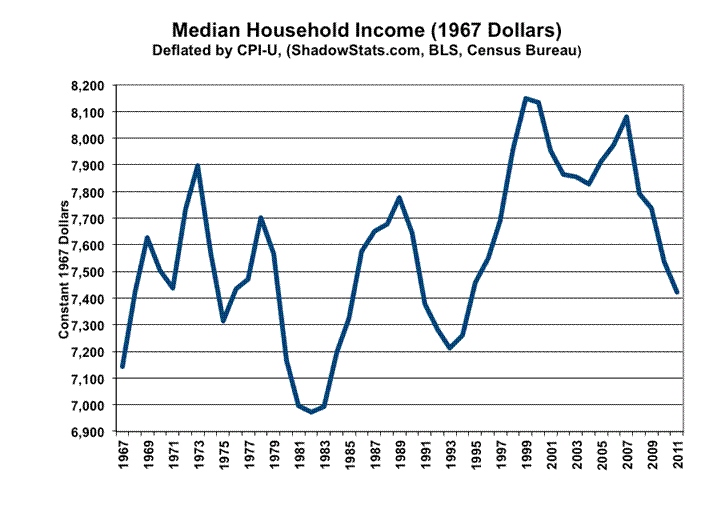
It is easy to see why there is no economic recovery and cannot be an economic recovery. Look at the chart below (courtesy of John Williams, shadowstats.com).


Real median household income at the end of 2011 is back where it was in 1967-68. Moreover, Williams has deflated household income to get its real value by using the official inflation measure, which substantially understates inflation. If Williams had used the 1990 or 1980 official government methodology for calculating the consumer price index, the real median incomes of households would show a larger decline.

Moreover, the low 2011 real median household income is the summation, in most cases, of two household earners, whereas in 1967-68 one earner could produce the same real income. As Nobel economist Gary Becker, my former colleague as Business Week columnist, pointed out, when both husband and wife have to work in order to maintain the same purchasing power, household income from the wife’s in-kind household services is eliminated. Therefore, the monetary measure of the dual household income overstates income, because it is not adjusted for the lost benefits formerly provided by the wife who at home managed the household.

Americans are far more oppressed by the power brokers in Washington than statistics display. Moreover, the young are born into the oppressive, exploitative American system and do not know any different. They are fed by the Presstitute media with endless propaganda about how fortunate they are and how indispensable their wonderful country is. Americans are kept in a constant state of amusement, and many never grasp the loss of their civil liberties, job and career opportunities, and respect that the US won during the decades-long cold war with Soviet Communism.

On September 13, Federal Reserve Chairman Ben “Helicopter” Bernanke announced Quantitative Easing 3. Bernanke said that the recovery is weak and needs more Fed stimulus. He said the Fed will purchase $40 billion of mortgage bonds per month in order to drive interest rates further below the rate of inflation and help to sell more houses.

But how do you sell houses to households who are getting by with 1967-68 levels of real income and who have absolutely no job security? Their company can be taken over and offshored tomorrow or they can be replaced by foreign workers on H-1B visas. Housing prices have dropped, but not to 1967-68 levels.

Bernanke’s announcement that the Fed’s purchase of mortgage bonds is to spur housing and the economy is disinformation. Bernanke is purchasing the bonds in order to boost the values of the derivatives and debt instruments in the banks’ portfolios. Lower interest rates raise the value of the debt instruments on the banks’ balance sheets. By depriving American savers of a real interest rate on their savings, Bernanke makes the busted banks look solvent.

This is what is happening in “freedom and democracy” America. The vast majority of Americans, especially the retired, are forced to consume their savings and draw down their capital because they can get no real interest on their savings. The beneficiaries are the banksters, who can borrow at near zero interest rates, charge consumers 16% on their credit cards, and use the Federal Reserve’s largess to speculate on interest rate swaps and credit default swaps. The American taxpayers hold the bag for the banksters’ uncovered gambles.

Would you not gamble if the American taxpayers had to cover your bets, but your winnings were yours alone?

The future of the American political order is in doubt. The Bush and Obama regimes have so badly abused the Constitution and statutory law, that the America that Ronald Reagan left to us no longer exists. America is on the path to collapse or tyranny.

Suppose that a miracle produces an economic recovery. What becomes of the enormous excess bank reserves that the Federal Reserve has provided the banks?

If these bank reserves are used for expanding loans, the money supply will outstrip the production of goods and services, and inflation will rise.

If the Fed tries to take the excess reserves out of the banking system by selling bonds, interest rates will rise, thus destroying the wealth of bond holders and draining liquidity from the stock market. In other words, another depression that wipes out the remaining American wealth.

The Federal Reserve’s announcement of QE3 shows that the Fed will continue to create new money in order to protect the values of the insolvent banks’ questionable assets. The Federal Reserve represents the banksters, not the American public. Like every other American government institution, the Federal Reserve is far removed from concerns about American citizens.

In my opinion, the Federal Reserve’s purchase of bonds in order to drive down interest rates has produced a bond market bubble that is larger than the real estate and derivative bubbles. Economically, it is nonsensical for a bond to carry a negative real interest rate, especially when the government issuing the bond is running large budget deficits that it seems unable to reduce and when the central bank is monetizing the debt.

The bubble has been protected by the euro “crisis,” which possibly is more of a virtual crisis than a real one. The euro crisis has caused money to seek refuge in dollars, thus supporting the dollar’s value even while the Federal Reserve prints money with which to purchase the never-ending flow of the governments’ bonds to finance trillion dollar plus annual budget deficits–about 5 times the “Reagan deficits” that Wall Street alleged would wreck the US economy.

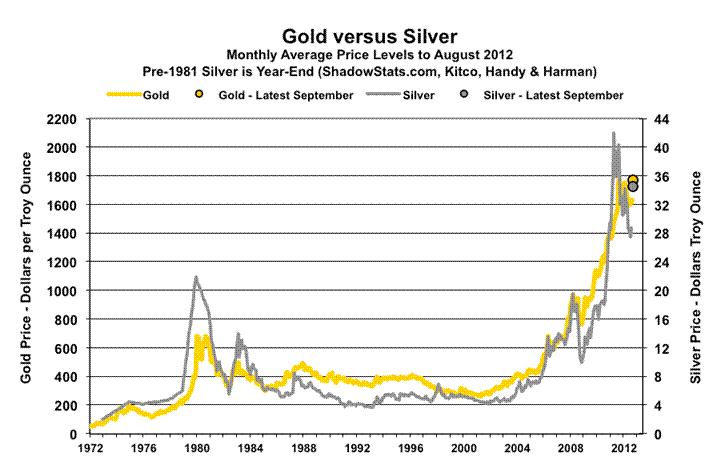
Indeed, the US dollar’s exchange value is itself a bubble waiting to pop. The sharp rise in the dollar price of gold and silver since 2003 indicates a flight from the US dollar. (The chart is courtesy of John Williams, shadowstats.com.)

The bond market bubble will pop if the dollar bubble pops. The Federal Reserve can sustain the bond market bubble by purchasing bonds, and there are no limits on the Federal Reserve’s ability to purchase bonds. However, the endless monetization of debt, even if the new money is stuck in the banks and does not find its way into the economy, can spook foreign holders of dollar-denominated assets.

Foreign central banks can decide that they want to hold fewer dollars and more precious metals as their reserves. Other countries, sensing the US dollar’s demise,


are organizing to conduct their trade without the use of the world’s reserve currency. Brazil, Russia, India, China, and South Africa intend to conduct their trade with one another in their own currencies. China and Japan have also negotiated to settle their trade balances with one another in their own currencies.

These agreements substantially reduce the use of the US dollar in international trade and, thus, the demand for dollars. When demand falls, so does price, unless the supply shrinks. But the Federal Reserve has announced, essentially, unlimited supply of US dollars. So we are faced with a paradox. The US dollar is supposed to remain valuable despite its enormous increase in supply

In addition, China, America’s largest creditor and in the past a reliable purchaser of US Treasury bonds, holds some two trillion in dollar-denominated assets, primarily Treasury bonds. How is Washington treating its largest foreign creditor? Not with appreciation or deference. Washington is surrounding China with naval and air bases, interfering in China’s disputes with other countries, and bringing contrived actions against China in the World Trade Organization. Washington claims that US corporations are deserting the US not because of the lower cost of labor in China, but because of Chinese “subsidies” to the relocated US firms.

In my April 30 column, “Brewing a Conflict with China,” I wrote that Washington would like to substitute a cold war with China for the hot wars in the Middle East. The problem with the hot wars is the loss of superpower face from Washington’s inability to prevail after eleven years, and although the hot wars are profitable for the military/security complex, the wars don’t generate the level of profits that would flow from a high-tech arms race with China. Moreover, Washington believes that diverting Chinese investment from the economy into a military buildup would slow the rate at which the Chinese economy is overtaking the US economy.

What if instead of taking the bait from Washington, China targets Washington’s Archilles heel–the dollar’s role as reserve currency–and decides it is cheaper to dump one trillion dollars of US Treasury debt on the bond market than to commit to a 30 year arms race? To keep the price of Treasuries from collapsing, the Federal Reserve could print the money to buy the bonds. But if China then dumps the printed one trillion dollars in the foreign exchange markets, Washington cannot print euros, British pounds, Russian rubles, Swiss francs, and other currencies in order to buy up the dollars.

Frantic, Washington would try to arrange currency swaps with foreign countries in order to acquire the foreign exchange with which to buy up the dollars that, otherwise, will drive down the dollar exchange rate and destroy the Federal Reserve’s control over interest rates.

But if the Chinese don’t want the dollars, will other countries want to swap their currencies for the abandoned US dollar?

Some of Washington’s puppet states will comply, but the wider world will rejoice in the termination of Washington’s financial hegemony and refuse the offer.

Sooner or later the dollar will collapse from Washington’s abuse of the dollar’s role as reserve currency, and the dollar will lose its “safe haven” status. US inflation will rise, and US political stability, along with America’s hegemonic power, will wane.

The rest of the world will sigh with relief. And China will have defeated the superpower without an arms race or firing a shot.

Monday, July 30, 2012

Nationalize Money, Not Banks

We Don’t Have To Be In Financial Crisis
Herman Daly
Emeritus Professor, University of Maryland School of Public Policy


If our present banking system, in addition to fraudulent and corrupt, also seems “screwy” to you, it should. Why should money, a public utility (serving the public as medium of exchange, store of value, and unit of account), be largely the by-product of private lending and borrowing? Is that really an improvement over being a by-product of private gold mining, as it was under the gold standard? The best way to sabotage a system is hobble it by tying together two of its separate parts, creating an unnecessary and obstructive connection. Why should the public pay interest to the private banking sector to provide a medium of exchange that the government can provide at little or no cost? Why should seigniorage (profit to the issuer of fiat money) go largely to the private sector rather than entirely to the government (the commonwealth)?

Is there not a better away? Yes, there is. We need not go back to the gold standard. Keep fiat money, but move from fractional reserve banking to a system of 100% reserve requirements. The change need not be abrupt—we could gradually raise the reserve requirement to 100%. Already the Fed has the authority to change reserve requirements but seldom uses it. This would put control of the money supply and seigniorage entirely with the government rather than largely with private banks. Banks would no longer be able to live the alchemist’s dream by creating money out of nothing and lending it at interest. All quasi-bank financial institutions should be brought under this rule, regulated as commercial banks subject to 100% reserve requirements.

Banks cannot create money under 100% reserves (the reserve deposit multiplier would be unity), and banks would earn their profit by financial intermediation only, lending savers’ money for them (charging a loan rate higher than the rate paid to savings or “time-account” depositors) and charging for checking, safekeeping, and other services. With 100% reserves every dollar loaned to a borrower would be a dollar previously saved by a depositor (and not available to the depositor during the period of the loan), thereby re-establishing the classical balance between abstinence and investment. With credit limited by saving (abstinence from consumption) there will be less lending and borrowing and it will be done more carefully—no more easy credit to finance the leveraged purchase of “assets” that are nothing but bets on dodgy debts.

To make up for the decline and eventual elimination of bank- created, interest-bearing money, the government can pay some of its expenses by issuing more non interest-bearing fiat money.

However, it can only do this up to a strict limit imposed by inflation. If the government issues more money than the public voluntarily wants to hold, the public will trade it for goods, driving the price level up. As soon as the price index begins to rise the government must print less. Thus a policy of maintaining a constant price index would govern the internal value of the dollar. The external value of the dollar could be left to freely fluctuating exchange rates.

Alternatively, if we instituted John M. Keynes’ international clearing union, the external value of the dollar, along with that of all other currencies, could be set relative to the “bancor,” a common denominator accounting unit used by the payments union. The bancor would serve as an international reserve currency for settling trade imbalances—a kind of “gold substitute”.

The United States opposed Keynes’ plan at Bretton Woods precisely because under it the dollar would not function as the world’s reserve currency, and the US would lose the enormous international subsidy that results from all countries having to hold large transaction balances in dollars.

The payments union would settle trade balances multilaterally. Each country would have a net trade balance with the rest of the world (with the payments union) in bancor units. Any country running a persistent deficit would be charged a penalty, and if continued would have its currency devalued relative to the bancor. But persistent surplus countries would also be charged a penalty, and if the surplus persisted their currency would suffer an appreciation relative to the bancor.

Keynes’ goal was balanced trade, and both surplus and deficit nations would be expected to take measures to bring their trade into balance. With trade in near balance there would be little need for a world reserve currency, and what need there was could be met by the bancor. Freely fluctuating exchange rates would also in theory keep trade balanced and reduce or eliminate the need for a world reserve currency. Which system would be better is a complicated issue not pursued here. In either case the IMF could be abolished since there would be little need for financing trade imbalances (the IMF’s main purpose) in a regime whose goal is to eliminate trade imbalances.

Returning to domestic institutions, the Treasury would replace the Fed (which is owned by and operated in the interests of the commercial banks). The interest rate would no longer be a target policy variable, but rather left to market forces. The target variables of the Treasury would be the money supply and the price index. The treasury would print and spend into circulation for public purposes as much money as the public voluntarily wants to hold. When the price index begins to rise it must cease printing money and finance any additional public expenditures by taxing or borrowing from the public (not from itself). The policy of maintaining a constant price index effectively gives the fiat currency the “backing” of the basket of commodities in the price index.

In the 1920s the leading academic economists, Frank Knight of Chicago and Irving Fisher of Yale, along with others including underground economist and Nobel Laureate in Chemistry, Frederick Soddy, strongly advocated a policy of 100% reserves for commercial banks. Why did this suggestion for financial reform disappear from discussion? The best answer I have received is that the great depression and subsequent Keynesian emphasis on growth swept it aside because limiting bank lending to actual savings was too restrictive on growth, which became the big panacea. Also there is the obvious vested interest of commercial banks in retaining the privilege of creating money and lending it at interest.

Now suppose for a moment that aggregate growth has begun to increase environmental and social costs faster than production benefits, thus becoming uneconomic growth. There is much evidence that this is the case. Then a financial constraint on growth (balancing investment with abstinence) would be much needed, and 100% reserves would be a good way to accomplish it. If, however, growth remains the summum bonum of the economy, then we will inevitably borrow against our hoped for larger future income to finance the investments needed to produce it.

Financing investment by saving would require less present consumption, which many will deem to be an unacceptable drag on growth. But real growth has encountered the biophysical and social limits of a “full world.” Financial growth is being stimulated ever more in the hope that it will pull real growth behind it, but it is in fact pushing uneconomic growth- — growth of ”illth.” Since illth is negative wealth it can hardly redeem the growing debt that is financing it.

The original 100% reserve proponents mentioned above were in favor of aggregate growth, but wanted it to be steady growth in wealth, not speculative boom and bust cycles. Soddy was especially cautious about uncontrolled physical growth, but his main concern was with the symbolic financial system and its disconnect from the real system that it was supposed to symbolize. The result was confusion between wealth and debt. One need not advocate a steady-state economy to favor 100% reserves, but if one does favor a steady state the attractions of 100% reserves are increased.

How would the 100% reserve system serve the steady-state economy?

  • First, as just mentioned it would restrict borrowing for new investment to existing savings, greatly reducing speculative growth ventures—for example the leveraging of stock purchases with huge amounts of borrowed money (created by banks ex nihilo rather than saved out of past earnings) would be severely limited. Down payment on houses would be much higher, and consumer credit would be greatly diminished. Credit cards would become debit cards. Long term lending would have to be financed by long term time deposits, or by carefully sequenced rolling over of shorter term deposits. Growth economists will scream, but a steady-state economy does not aim to grow, for the very good reason that growth has become uneconomic.
  • Second, the money supply no longer has to grow in order for people to pay back the principal plus the interest required by the loan responsible for the money’s very existence in the first place. The repayment of old loans with interest continually threatens to diminish the money supply unless new loans compensate. With 100% reserves money becomes neutral with respect to growth rather than biasing the system toward growth by requiring more loans just to keep the money supply from shrinking.
  • Third, the financial sector will no longer be able to capture such a large share of the nation’s profits (around 40%!), freeing some smart people for more productive, less parasitic, activity. 
  • Fourth, the money supply would no longer expand during a boom, when banks like to loan lots of money, and contract during a recession, when banks try to collect outstanding debts, thereby reinforcing the cyclical tendency of the economy.
  • Fifth, with 100% reserves there is no danger of a run on a bank leading to a cascading collapse of the credit pyramid, and the FDIC could be abolished, along with its consequent moral hazard. The danger of collapse of the whole payment system due to the failure of one or two “too big to fail” banks would be eliminated. Congress then could not be frightened into giving huge bailouts to some banks to avoid the “contagion” of failure, because the money supply is no longer controlled by the private banks. Any given bank could fail by making imprudent loans, but its failure, even if a large bank, would not disrupt the public utility function of money. The club that the banks used to beat Congress into giving bailouts would have been taken away.
  • Sixth, the explicit policy of a constant price index would reduce fears of inflation and the resultant quest to accumulate more as a protection against inflation. Also it in effect provides a multi-commodity backing to our fiat money.

Keynes bancor scheme or a regime of fluctuating exchange rates would automatically balance international trade accounts, eliminating large surpluses and deficits. Thus, there would no longer be any need for the International Monetary Fund and the austerity its “conditionality” imposes on weaker economies.

To dismiss such sound policies as “extreme” in the face of the repeatedly demonstrated failure and fraud of our current financial system is quite absurd. The idea is not to nationalize banks, but to nationalize money, which is a natural public utility in the first place. The fact that this idea is hardly discussed today, in spite of its distinguished intellectual ancestry and common sense, is testimony to the power of vested interests over good ideas. It is also testimony to the veto power that our growth fetish exercises over the thinking of economists today.

Thursday, July 12, 2012

American Freefall

Misery Rising
by PAUL CRAIG ROBERTS

Washington has been at war since October, 2001. This war took a back seat when Bush concocted another excuse to order the invasion of Iraq in 2003, a war that went on without significant success for 8 years and has left Iraq in chaos with dozens more killed and wounded every day, a new strong man in place of the illegally executed former strongman, and the likelihood of the ongoing violence becoming civil war.

Upon his election, President Obama foolishly sent more troops to Afghanistan and renewed the intensity of that war, now in its eleventh year, to no successful effect.

These two wars have been expensive. According to estimates by Joseph Stiglitz and Linda Bilmes, when all costs are counted, the Iraq invasion cost US taxpayers $3 trillion dollars. Ditto for the Afghan war. In other words, the two gratuitous wars doubled the US public debt. This is the reason there is no money for Social Security, Medicare, Medicaid, food stamps, the environment, and the social safety net.

Americans got nothing out of the wars, but as the war debt will never be paid off, US citizens and their descendants will have to pay interest on $6,000 billion of war debt in perpetuity.

Not content with these wars, the Bush/Obama regime is conducting military operations in violation of international law in Pakistan, Yemen, and Africa, organized the overthrow by armed conflict of the government in Libya, is currently working to overthrow the Syrian government, and continues to marshall military forces against Iran.

Finding the Muslim adversaries insufficient for its energies and budget, Washington has encircled Russia with military bases and has begun the encirclement of China. Washington has announced that the bulk of its naval forces will be shifted to the Pacific over the next few years, and Washington is working to reestablish its naval base in the Philippines, construct a new one on a South Korean island, acquire a naval base in Viet Nam, and air and troop bases elsewhere in Asia.

In Thailand Washington is attempting to purchase with the usual bribes an air base used in the Vietnam war. There is opposition as the country does not wish to be drawn into Washington’ s orchestrated conflict with China. Downplaying the real reason for the airbase, Washington, according to Thai newspapers, told the Thai government that the base was needed for “humanitarian missions.” This didn’t fly, so Washington had NASA ask for the air base in order to conduct “weather experiments.” Whether this ruse is sufficient cover remains to be seen.

US Marines have been sent to Australia and elsewhere in Asia. To corral China and Russia (and Iran) is a massive undertaking for a country that is financially busted. With wars and bankster bailouts, Bush and Obama have doubled the US national debt while failing to address the disintegration of the US economy and rising hardships of US citizens.

The annual US budget deficit is adding to the accumulated debt at about $1.5 trillion per year with no prospect of declining. The financial system is broken and requires ongoing bailouts. The economy is busted and has been unable to create high-paying jobs, indeed any jobs. Despite years of population growth, payroll employment as of mid-2012 is the same as in 2005 and substantially below 2008. Yet, the government and financial presstitute media tell us that we have a recovery.

According to the US Bureau of Labor Statistics, employment in 2011 was only 1 million more than in 2002. As it takes about 150,000 new jobs each month to stay even with population growth, that leaves a decade long job deficit of 15 million jobs.

The US unemployment and inflation rates are far higher than reported. In previous columns I have explained, based on statistician John Williams’ work (shadowstats.com), the reasons that the government’s headline numbers are serious understatements.
 The headline (U3) unemployment rate of 8.2% counts no discouraged workers who have given up on finding a job. The government has a second unemployment rate (U6), seldom reported, which includes short-term discouraged workers. That rate is 15%. When the long-term discouraged workers are added in, the current US unemployment rate is 22%, a number closer to the unemployment rate of the Great Depression than to the unemployment rates of postwar recessions. (in fact, it's higher than all but 2 or 3 years during the Great Depression...


Changes in the way inflation is measured have destroyed the Consumer Price Index (CPI) as a measure of the cost of living. The new methodology is substitution based. If the price of an item in the index rises, a lower priced alternative takes its place. In addition, some price rises are labeled quality improvements whether they are or not and thus do not show up in the CPI. People still have to pay the higher price, but it is not counted as inflation.

Currently, the substitution-based rate of inflation is about 2%. However, when inflation is measured as the actual cost of living, the rate of inflation is 5%.

The Misery Index is the sum of the inflation and unemployment rates. The level of the current Misery Index depends on whether the new rigged measures are used, which understate the misery, or the former methodology that accurately measures it. Prior to the November 1980 election, the Misery Index hit 22%, which was one reason for Reagan’s victory over President Carter. Today if we use previous methodology, the Misery Index stands at 27%. But if we use the new rigged methodology, the Misery Index is 10%.

The understatement of inflation serves to boost Gross Domestic Product (GDP). GDP is calculated in current dollars. To be able to determine whether GDP rose because of price rises or because of increases in real output, GDP is deflated by the CPI. The higher the inflation rate, the less the growth in real output and vice versa. When the substitution based methodology is used to measure inflation, the US economy experienced real growth in the 21st century except for the sharp dip during 2008-2010.

However, if the cost-of-living based methodology is used, except for a short period during 2004, the US economy has experienced no real growth since 2000. The lack of employment and real GDP growth go together with the decline in real household median income. The growth in consumer debt substituted for the lack of income growth and kept the economy going until consumers exhausted their ability to take on more debt. With the consumer dead in the water, the outlook for economic recovery is poor.

Politicians and the Federal Reserve are making the outlook even worse. At a time of high unemployment and debt-stressed households, politicians at local, state, and federal levels are cutting back on government provision of health care, pensions, food stamps, housing subsidies and every other element of the social safety net. These cutbacks, of course, further reduce aggregate demand and the ability of incomestressed Americans to survive.

The Federal Reserve has interest rates so low that retirees and others living on their savings can earn nothing on their money. The interest rates paid on bank CDs and government and corporate bonds are lower than the rate of inflation. To live on interest income, a person has to purchase Greek, Spanish, or Italian bonds and run the risk of capital loss. The Federal Reserve’s policy of negative interest rates forces retirees to spend down their capital in order to live. In other words, the Fed’s policy is destroying personal savings as people are forced to spend their capital in order to cover living expenses.

In June the Federal Reserve announced that it was going to continue its policy of driving nominal interest rates even lower, this time focusing on long-term Treasury bonds. The Fed said it would be purchasing $400 billion of the Treasury’s 30-year bonds. Driving interest rates down means driving bond prices up. With 5-year Treasury bonds paying only seven-tenths of one percent and 10-year Treasuries paying only 1.6%, below even the official rate of inflation, Americans desperate for yield move into 30-year bonds currently paying 2.7%. However, the the high bond prices mean that the risk of capital loss is very high.

The Fed’s debt monetization, or a drop in the exchange value of the dollar as other countries move away from its use to settle their balance of payments, could set off inflation that would take interest rates out of the Fed’s control. As interest rates rise, bond prices fall.

In other words, bonds are now the bubble that real estate, stocks, and derivatives were. When this bubble pops, Americans will take another big hit to their remaining wealth.

It makes no sense to invest in long-term bonds at negative interest rates when the federal government is piling up debt that the Federal Reserve is monetizing and when other countries are moving away from the flood of dollars. The potential for a rising rate of inflation is high from debt monetization and from a drop in the dollar’s exchange value. Yet, bond fund portfolio managers have to follow the herd into longer term maturities or see their performance relative to their peers drop to the bottom of the rankings.

Some individual investors and foreign central banks, anticipating the dollar’s loss of value, are accumulating gold and silver bullion. Realizing the danger to the dollar and its policy from the rapid rise in the price of bullion during 2011, the Federal Reserve has arranged offsetting action. When the demand for physical bullion drives up the price, short sales of bullion in the paper market are used to drive the price back down. Similarly, when investors begin to flee Treasuries, thus causing interest rates to rise, J.P. Morgan and other dependencies of the Federal Reserve sell interest-rate swaps, thus offsetting the effect on interest rates of the bond sales. (Keep in mind that interest rates rise when bond prices fall and vice versa.)

The point of all this information is to establish that except for the 1 percent, the incomes and wealth of Americans are being cut back across the board. From 2002 through 2011 the economy lost 3.5 million manufacturing jobs. These jobs were replaced with lowerpaying waitress and bartender jobs (1,189,000), ambulatory health care service jobs (1,512,000) and social assistance jobs (578,000).

These replacement jobs in domestic services mean that on a net basis US consumer income was moved out of the country. Potential aggregate demand in the US dropped by the differences in pay in the job categories. Clearly and unambiguously, jobs offshoring lowered US disposable income and US GDP and, thereby, employment.

Despite the lack of an economic base, Washington’s hegemonic aspirations continue unabated. Other countries are amused at Washington’s unawareness. Russia, China, India, Brazil, and South Africa are forming an agreement to abandon the US dollar as the currency for international settlement between themselves.

On July 4 the China Daily reported: “Japanese politicians and prominent academics from China and Japan urged Tokyo on Tuesday to abandon its outdated foreign policy of leaning on the West and accept China as a key partner as important as the United States. The Tokyo Consensus, a joint statement issued at the end of the Beijing-Tokyo Forum, also called on both countries to expand trade and promote a free-trade agreement for China, Japan and South Korea. “

This means that Japan is in play.

The Chinese government, more intelligent than Washington, is responding to Washington’s military threats by enticing away Washington’s two key Asian allies. As the Chinese economy is now as large as the US and on far firmer footing, and as Japan now has more trade with China than with the US, the enticement is appealing.

Moreover, China is next door, and Washington is distant and drowning in its hubris. Washington, which flicked its middle finger to international law and to its own law and Constitution with its arrogance and gratuitous and illegal wars and with its assertion of the right to murder its own citizens and those of its allies, such as Pakistan, has made the United States a pariah state.

Washington still controls its bought-and-paid-for NATO puppets, but these puppet states are overwhelmed with derivative debt problems brought to them by Wall Street and by sovereign debt problems, some of which were covered up by Wall Street’s Goldman Sachs.

Europe is on the ropes and has no money with which to subsidize Washington’s wars of hegemony.

Washington is becoming an isolated and despised element of the world community. Washington has purchased Europe, Canada, Australia, the former Soviet state of Georgia (and almost Ukraine), and Columbia, and continues its effort to purchase the entire world, but sentiment is turning against the rising Gestapo state that has shown itself to be lawless, ruthless, and indifferent, even hostile, to human life and human rights.

A government, whose military was unable with the help of the UK to occupy Iraq after eight years and was forced to end the conflict by putting the “insurgents” on the US military payroll and to pay them to stop killing American troops, and a government whose military has been unable to subdue a few thousand lightly armed Taliban after 11 years, is over the top when it organizes war against Iran, Russia, and China.

The only prospect Washington has of prevailing in such an undertaking is first use of nuclear weapons, of catching its demonized opponents off guard by nuking them out of the blue. In other words, by the elimination of life on earth.

Is this Washington’s program revealed by the neoconservative warmonger, Bill Kristol, who had no shame to ask publicly: “What’s the good of nuclear weapons if you can’t use them?