Showing posts with label Astronomy. Show all posts

Tuesday, March 5, 2013

New comet's potential Mars collision in 2014 explained

Comet Siding Spring will actually be the second close shave of Mars by a passing comet within a time span of just over a year.

By Joe Rao, SPACE.com
Tue, Mar 05 2013

A newfound comet is apparently on course to have an exceedingly close call with the planet Mars in October 2014, and there is a chance — albeit small — that the comet may even collide with the Red Planet.

The new comet C/2013 A1 (Siding Spring) was discovered Jan. 3 by the Scottish-Australian astronomer Robert H. McNaught, a prolific observer of both comets and asteroids who has 74 comet discoveries to his name.

McNaught is a participant in the Siding Spring Survey a program that hunts down asteroids that might closely approach the Earth. He discovered the new comet using the 0.5-meter Uppsala Schmidt Telescope at Siding Spring Observatory, New South Wales, Australia.

Pre-discovery images of the comet from Dec. 8, 2012 by the Catalina Sky Survey in Arizona were quickly found. Because the comet was discovered as part of its survey for asteroids, it bears the name of the observatory, Siding Spring. Officially it is catalogued as C/2013 A1.

When it was discovered, Comet Siding Spring was 669 million miles (1.07 billion kilometers) from the sun. Based on its orbital eccentricity, it is apparently a new or "virgin" comet, traveling in a parabolic orbit and making its very first visit to the vicinity of the sun. It is expected to pass closest to the sun (called perihelion) on Oct. 25, 2014 at a distance of 130 million miles (209 million km).

But, less than a week earlier, on Oct. 19, 2014, the comet — whose nucleus is estimated to be anywhere from 5 to 30 miles (8 to 50 km) in diameter — is projected to cross the orbit of Mars and pass very close to that planet. Preliminary calculations suggest that nominally at closest approach, Comet Siding Spring will come to within 63,000 miles (101,000 km) of Mars.

However, because the comet is currently very far out in space and has been under scrutiny for less than three months, the circumstances of its orbit will likely need to be refined in the coming weeks and months. As such, the comet's approach to Mars might ultimately end up being farther or closer than what current predictions suggest. In fact, last Wednesday (Feb. 27) observations made by Leonid Elenin, a reputable Russian astronomer who works at the Keldysh Institute of Applied Mathematics,suggested that the comet could pass even closer — just 25,700 miles (41,300 km) from the center of Mars.

According to Elenin: "On the 19th October 2014, the comet might reach apparent magnitude of -8 to -8.5, as seen from Mars!” (This would make the comet 15 to 25 times brighter than Venus). "Perhaps it will be possible to acquire high-resolution images from the Mars Reconnaissance Orbiter (MRO)," he added.

Then there is also the small possibility that the comet could collide with Mars.

Moving at 35 miles (56 km) per second, such a collision could create an impact crater on Mars up to ten times the diameter of the comet's nucleus and up to 1.25 miles (2 km) deep, with an energy equivalent up to of 2 x 10^10 megatons!

Most readers will recall Comet Shoemaker-Levy's plunge into Jupiter in July 1994 which left dark telltale scars on Jupiter’s cloud tops for many months thereafter.

Collision or not, Comet Siding Spring will definitely come extremely close to Mars less than 20 months from now. Incredibly, this will actually be the second close shave of Mars by a passing comet within a time span of just over a year.

On Oct. 1 of this year, the much awaited Comet ISON is due to pass 6.5 million miles (10.5 million km) from Mars on its way toward a grazing encounter with the sun in November. That rendezvous is close enough in its own right to be categorized as exceptional and yet, Siding Spring will approach about 100 times closer.

Tuesday, June 5, 2012

Venus Transit


Please install latest Flash Player to run SunAeon Venus Transit 2012

Wednesday, April 4, 2012

Dark Energy Confirmed

How ancient sound waves shaped the entire universe
BY ALASDAIR WILKINS APR 3, 2012

Just 30,000 years after the Big Bang, the universe started singing. Vast soundwaves rang out and expanded through the primordial cosmos, their ripples determining the universe's large-scale structure. And this all fits perfectly with one particularly theory of dark energy.

The Baryon Oscillation Spectroscopic Survey, or BOSS, has just completed a massive survey of a whopping 327,349 galaxies. These galaxies are on average about six billion light-years away, which was quite possibly the most momentous time in the universe's history since the Big Bang itself. Six billion years ago, the universe reached a tipping point, where the matter in the universe became spread out enough that the force of gravity could no longer slow down the universe's attraction. Instead, the repulsive force of dark energy took hold, and the universe has been speeding up its expansion ever since.

By studying these hundreds of thousands of galaxies, all dating back to right about the time dark energy emerged as the dominant force in the universe, cosmologists can hopefully learn more about this mysterious...something. Dark energy is everywhere - it likely accounts for about 73% of all the mass-energy in the universe - and fifteen years of astronomical observations tell us that it's absolutely essential to explaining the behavior of the universe.

And yet, it's difficult to even conceptualize what it is even in the vaguest of terms, in part because we may not even have the physics yet to explain what it is. (In case that makes you skeptical of dark energy's very existence, I'd recommend our own Dr. Dave Goldberg's spirited defense of the stuff.) The hope is that the data we get from BOSS - which includes their distances from each other and the universe's age and rate of expansion relative to each galaxy - can help eliminate some dark energy models while illuminating others.

The good news from BOSS is that it really does look like astrophysicists are on the right track when it comes to dark energy, and one model in particular is coming away looking very good. Central to these findings are baryon acoustic oscillations. These are the primordial soundwaves I mentioned earlier. These acoustic waves were formed just 30,000 years after the Big Bang, as regular matter started collapsing around dense dark matter.

The resultant pressure forged these waves, which oscillated outwards for about 350,000 years, tracing out the future structure of the universe as they went. By the time the universe had cooled enough to stall these waves, matter had clumped around the center and edges of the wave, causing more galaxies to form in these areas than elsewhere.

That's the theory behind these baryon acoustic oscillations, or BAOs, and it turns out all the galaxies spotted by BOSS are exactly where they should be according to the BAO model...assuming dark energy was also there to direct how these countless galaxies cluster together. Speaking to BBC News, Professor Will Percival of the University of Portsmouth explains how all the measurements confirm both BAOs and dark energy:
"Because you can trace this pattern all the way through the Universe, it tells you a lot about its content. If it had a different content - it had more matter, or it had less matter, or it had been expanding at a different rate - then you'd see a different map of the galaxies. So, the fundamental observation is this map. What we find is everything is very consistent with Einstein's theory of general relativity, coupled with the cosmological constant that he put into his equations. He put it in originally to make the Universe static, and then took it out. But if we put constant in with the opposite sign, we can get acceleration. And if we do that, we find equations that are perfectly consistent with what we're seeing."
In particular, the BOSS survey found a number of pairs of galaxies that were separated by a distance of some 500 milllion light-years. That's the precise distance predicted by the cosmological constant. This constant is simply the idea that the amount of repulsive energy - dark energy, in other words - is uniform across all space, and this amount is proportional to the size of the universe.

The cosmological constant isn't necessarily an elegant solution, insofar as it introduces a new arbitrary constant that is apparently hardwired into the structure of the universe just because. And yet all this BOSS data suggests that it's the cosmological constant at the heart of dark energy, even if that simply shifts the big mystery back one step. Still, for anyone looking for real, tangible evidence of dark energy's existence, look no further than BOSS.

And there's still plenty more where that came from. The survey itself is still only about a third complete, and the more galaxies cosmologists have to play around with, the more we can restrict with models of dark energy work and which do not. There are dark energy tests that won't work with just a few hundred thousand galaxies that could reveal major breakthroughs if we have millions to work with.

That's why the European Space Agency's Euclid mission, slated to launch around 2019, is so exciting - it is set to measure the precise positions of some 50 million galaxies going back over 10 billion years. Dark energy is officially running out of places to hide.

arXiv via BBC News.

Friday, September 16, 2011

NASA's Kepler telescope finds planet orbiting two suns

An artist's conception of Kepler-16b, which orbits two stars
An artist's conception of Kepler-16b
A planet orbiting two suns - the first confirmed alien world of its kind - has been found by Nasa's Kepler telescope, the US space agency announced.
It may resemble the planet Tatooine from the film Star Wars, but scientists say Luke Skywalker, or anyone at all, is unlikely to be living there.

Named Kepler-16b, it is thought to be an uninhabitable cold gas giant, like Saturn.
The newly detected body lies some 200 light years from Earth.

Though there have been hints in the past that planets circling double stars might exist - "circumbinary planets", as they are known - scientists say this is the first confirmation.
It means when the day ends on Kepler-16b, there is a double sunset, they say.

'Stunning' Kepler-16b's two suns are smaller than ours - at 69% and 20% of the mass of our Sun - making the surface temperature an estimated -100 to -150F (-73 to -101C).
The planet eclipses, or transits, both stars; and the stars regularly eclipse each other too
 
Two suns (Credit: Nasa/JPL-Caltech)The planet orbits its two suns every 229 days at a distance of 65m miles (104m km) - about the same distance out as Venus.

The Kepler telescope, launched in 2009, is designed to scour our section of the Milky Way for Earth-like planets.

"This is really a stunning measurement by Kepler," said Alan Boss of the Carnegie Institution for Science near Washington DC, a co-author of the study.

"The real exciting thing is there's a planet sitting out there orbiting around these two stars."
Kepler finds stars whose light is regularly dimmed when an orbiting planet passes between the star and the telescope.

In this case, the team was also able to observe dimming when one star passed in front of the other.

Nasa's scientists saw additional dips in the light in both stars at alternating but regular times, confirming the dual orbit of the planet.

Data collected by the Kepler telescope allows for very precise measurements of the mass, radius and trajectories of all three bodies - the best ever estimates of a extra-solar planet.

The finding was reported in Friday's issue of the journal Science.

Tuesday, August 23, 2011

Hoping to Contact Extraterrestrials? Think Again

(Didn't Hawking already do this bit? Perhaps they've already been here, found us to be ridiculous, and bolted toward greener petri dishes...--jef)

Monday, August 22, 2011

Astronomers who have been searching for extraterrestrial intelligence for decades are suddenly saying such an encounter might not be a happy one.

Aliens might destroy life on Earth or plan to eat or enslave humans if they sense our civilization was expanding too rapidly and could harm others, according to a latest study.

The scenario was brought up in a joint study by Seth Baum, Jacob Haqq-Misra and Shawn Domagal-Goldman.

Researchers say extraterrestrials might behave the way we humans have behaved whenever we have discovered other previously unknown intelligent beings on Earth, like unfamiliar humans or chimpanzees and gorillas.

"Just as we did to those beings, the extraterrestrials might proceed to kill, infect, dissect, conquer, displace or enslave us, stuff us as specimens for their museums or pickle our skulls and use us for medical research," according to the study, which was published in the journal Acta Astronautica.

Why should we worry about aliens? The simple reason is that if they can find us, they would be more advanced than humans.

"A core concern is that ETI will learn of our presence and quickly travel to Earth to eat or enslave us," the study says.

The authors speculate that extraterrestrials might try to spread their beliefs through evangelism or to use humans for entertainment.

Just because an ETI civilization holds universalist ethics does not mean that it would never seek our harm. This is because ETI may be quite different from us and could conclude that harming us would help maximize whatever they value intrinsically.

For example, if ETI place intrinsic value on lives, then perhaps they could bring about more lives by destroying us and using our resources more efficiently for other lives. Other forms of intrinsic value may cause a universalist ETI to seek our harm or destruction as long as more value is produced without us than with us.

Aliens also could harm or destroy us if they believe we are a threat to other civilizations. Rapidly expanding civilizations may have a tendency to destroy other civilizations in the process, just as humanity has already destroyed many species on Earth.

Though this scenario might seem unlikely given the likelihood of our technological inferiority relative to other civilizations, we would be at the receiving end if ET thinks that our resources could be used more efficiently to generate or retain other civilizations.

Perhaps ETI is observing rapid and destructive expansion on Earth and could become concerned at our trajectory.

ETI might prefer that our civilization change its ways to survive, but if it doubts that our course can be changed, it may seek to preemptively destroy us to protect other civilizations from us.

A preemptive strike would be particularly likely in the early phases of our expansion because a civilization may become increasingly difficult to destroy as it continues to expand.

"Humanity may just now be entering the period in which its rapid civilizational expansion could be detected by an ETI because our expansion is changing the composition of Earth's atmosphere (e.g. via greenhouse gas emissions), which therefore changes the spectral signature of Earth," the study's authors say, Human civilization affects ecosystems so strongly that some ecologists have begun calling this epoch of Earth's history the anthropocene, a new and unprecedented phase in the planet's history.

If the goal is to maximize ecosystem health, then perhaps it would be better if humanity did not exist, or at least if it existed in significantly reduced form. Since at least some humans believe so, invoking universalist ethical principles, then it is likely that ETI might agree.

But since we don't know what kind of aliens we will end up meeting, there are certain steps humans should take when making contact, the authors urge. Those steps include not sharing details of our biology and DNA structure, and not appearing as if we are rapidly expanding off the Earth.

Saturday, April 23, 2011

Sunday, August 22, 2010

An 18 Billion Mile Journey is almost complete!


Posted on: August 19, 2010 by Ethan Siegel


copernicus.gif

"Either you repeat the same conventional doctrines everybody is saying, or else you say something true, and it will sound like it's from Neptune." -Noam Chomsky
You might remember when the Solar System had nine planets, but as unbelievable as it sounds, for a very long time we only had six.
Why? Because only the planets Mercury, Venus, Mars, Jupiter, and Saturn are visible from Earth with the naked eye. Even though the telescope was invented in the early 1600s, it wasn't until 1781 that a planet out beyond Saturn was found! When William Herschel finally discovered Uranus, it was absolutely fascinating to astronomers! (And shown here, as imaged by Hubble, during a Solar eclipse caused by its moon, Ariel.)


060901190042.jpegWhy? Well, for as good as our laws of gravity and planetary motion were, they were really only based on objects that had been known since ancient times. You see, one of the hallmarks of any good scientific theory or model is that it doesn't just explain what you've already observed, it makes predictions that should tell you what you're going to observe in a new situation!
Well, Uranus comes along, and now we've got a new situation to test out good old Kepler's laws of planetary motion:
  • 1.) Planets move in ellipses with the Sun at one focus.
  • 2.) Planets move along that ellipse at such a speed that they sweep out equal areas in equal times.
  • 3.) The period of a planet's orbit squared is proportional to its semimajor axis (i.e., for a circular orbit, the radius) cubed.
Now, because the planets farther out take so much longer to orbit, it took us a long time to test whether Uranus was obeying Kepler's laws or not. After 60 years, here was the data on Uranus, with Saturn and Jupiter's orbits also shown.

uranus_trail.gif

Moving in an ellipse? Check.
Taking around 84 years to orbit, based on how far it is from the Sun? Check.
But sweeping out equal areas in equal times? No, it didn't. The planets orbit counterclockwise in the image above. For the first 20 years, it moved too quickly. For the next 20 years, it moved at the right speed, leading many to believe that maybe the early data was flawed. But then for the third 20 year period, it moved too slowly!
What was going on? Independently, John Couch Adams in England and Urbain Le Verrier in France came up with exactly the same idea.


The great idea was that, perhaps, there was another planet, even more distant than Uranus, that was affecting the 7th planet's orbit! Let's take a look at the first 20 years.


If this new planet were ahead of Uranus in its orbit during this time, it would exert an "extra gravitational pull" in the direction Uranus is moving, causing it to speed up, or move too quickly!
neptune_trail_a.gifBut, being an inner planet, Uranus is bound to catch up.


For around the next 20 years, Uranus would be directly between the Sun and this new planet, so that the extra force would neither cause Uranus to slow down nor speed up. Therefore, it ought to look like it was in perfect agreement with Kepler's second law.
But then, subsequently, the relative positions would have changed once more.


neptune_trail_c.gif

Two men, two countries, with one idea. But in this case, it would come down to mathematics. Who, working from observations of Uranus' orbit, could better predict where this new world ought to be, based solely on the laws of gravity?
Adams came up with 6 distinct predictions that varied from one another by up to 12 degrees during the years 1845 and 1846, but none of the British astronomers he contacted -- James Challis or George Biddell Airy -- were able to locate the proposed planet. (Even though Challis observed it twice in August of 1846, he mistakenly thought it was a star!)


But Le Verrier simply proved to be the better man for this job. After performing his painstaking calculations once, he announced his results publically on August 31, 1846 in front of the French Academy. He then composed a letter detailing his prediction to astronomer Johann Galle at the Berlin Observatory; the letter arrived September 23. That evening, Galle and his assistant, d'Arrest, pointed their telescope towards the exact location Le Verrier predicted.

neptunes.gifAnd right there, less than 1 degree away from the exact spot Le Verrier predicted, was the new planet: Neptune. So while there are many who contend Adams deserves equal creditfor Neptune's discovery, I am not among them.
And that was nearly 164 years ago. But what you might not know is that, being 30 times farther away from the Sun than Earth is, Neptune takes nearly 165 years to complete a single orbit!
Which means, for the first time since its discovery, Neptune is about to return to the same position in space that it occupied the day it was discovered. And what date will that be?
July 12th or 13th, 2011. (Thanks to Ian for nailing down the date.) An 18 billion mile (28 billion km) journey, for a single Neptunian year, is about to be completed. After nearly 165 complete Earth years, Neptune can finally check off the number "1".


planet_orbits2.jpeg
And for those of you who still think of Pluto as a planet, waiting around for its 248 year orbit to return it to its position at the time of its discovery won't happen until 2178! It's taken us a long time to learn so much about where we live in this Universe, so don't forget this remarkable anniversary!

Sunday, April 25, 2010

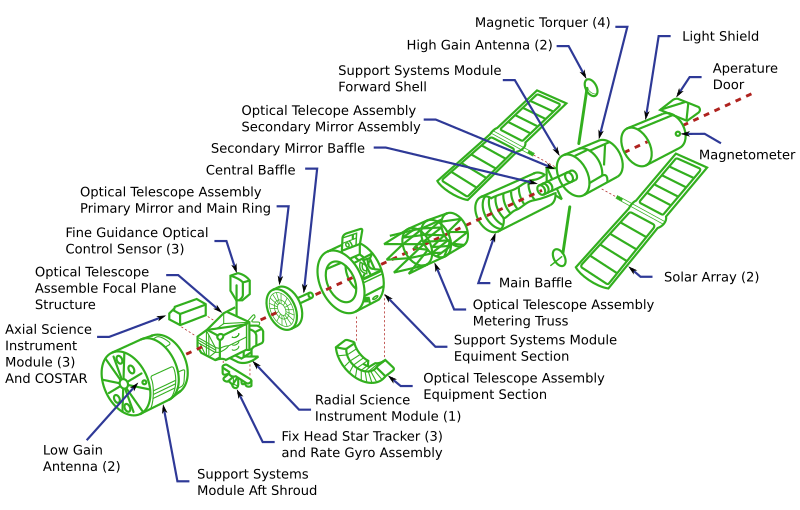
Hubble Space Telescope turns 20 Years Old

Gosh, it was 20 years ago that we were making fun of NASA for an important mirror that had been ground to the wrong shape causing the images to be out of focus.


Hubble turns 20: a retrospective in pictures


The Hubble Space Telescope broke free from its terrestrial confines on April 24, 1990 aboard the space shuttle Discovery. In the 20 years since, it has seen near total failure and has brought back some of the most important and astounding images of the Universe humankind has ever seen. In celebration of Hubble's 20 years of service, Nobel Intent has taken a moment to look back at some of the most significant images that the flying observatory has brought us.

Saturn

Image Credit: NASA, ESA, J. Clarke (Boston University), and Z. Levay (STScI)
While the HST has given us a glimpse of some of the farthest reaches of the Universe, some of its most incredible images come from an object in its own backyard: the planet Saturn. Seen in the image along with the planet itself is an aurora around one of Saturn's magnetic poles. Combined with measurements from the Cassini spacecraft, it taught astronomers that Saturn's aurora differ from their counterparts on Earth and Jupiter.

Light "echo"

Image Credit: NASA and The Hubble Heritage Team (AURA/STScI)
Reminiscent of Vincent van Gogh's "Starry Night" is an image of a light "echo" illuminating trillions of miles of interstellar dust around the Red Giant star V838 Monocerotis. The image, taken in 2004, was snapped two years after a brief period of the sudden brightening of V838 Monocerotis—it shows the dust that exists two light years from the main star. The dust and gas are believed to be the remnants from a previous brightening event that occurred tens of thousands of years ago. Hubble has monitored this light pulse since near the beginning of the event and has continued to follow its progress through the interstellar dust in the years since.

Pillars of creation

Image Credit: NASA, ESA, STScI, J. Hester and P. Scowen (Arizona State University)
Perhaps one of the most recognizable and iconic images ever sent back by the HST is that of the Pillars of Creation within the Eagle Nebula. Released in 1995, the image gave the first glimpse of what a stellar nursery looks like. Each "pillar" is a massive cloud of dust, light-years in length, inside of which massive, dense pockets of molecular gas begin to collapse under their own weight and form new stars.

M74

Image Credit: NASA, ESA, and the Hubble Heritage (STScI/AURA)-ESA/Hubble Collaboration
Not only has Hubble revealed the beauty of planets, stars, dust, and gas, it has revealed the utter beauty inherent in other galaxies. This image, of spiral galaxy M74, doesn't represent any piece of breakthrough science, or pose any new questions in astrophysics; it simply shows the beauty that can be contained in the images returned by Hubble.

Gravitational lensing

Image Credit: NASA, ESA, Richard Ellis (Caltech) and Jean-Paul Kneib (Observatoire Midi-Pyrenees, France)
Einstein's theory of general relativity states that gravity is really a manifestation of mass-energy density in the Universe and that everything, light included, is affected by this since it alters the nature of the fabric of spacetime itself. A corollary to this central hypothesis is that areas of high density, such as stars, or, on a larger scale, galactic clusters, will cause light to appear bent as though it passed through a lens—actually, light will follow a straight line in bent space, a geodesic. This image, looking through galactic cluster Abell 2218, allowed astronomers to use the cluster's immense mass to gravitationally lense the light coming from a baby galaxy 13.4 billion light years away. It clearly highlights the (correct) prediction that mass can affect the very path of light and lends clear experimental support to general relativity being correct at large scales.

Ultra Deep Field

Image Credit: NASA, ESA, G. Illingworth (UCO/Lick Observatory and the University of California, Santa Cruz), R. Bouwens (UCO/Lick Observatory and Leiden University), and the HUDF09 Team
I have been to a number of major art museums around the world, and have looked at what are considered to be some of the greatest works of art that mankind has produced. To me, this image belongs in the pantheon of great works of art alongside the other triumphs of humanity. The Ultra-deep field image taken by Hubble shows the sheer enormity of space itself. Each speck of light in this image, of the deepest reaches of the Universe, is an entire separate galaxy made up of billions of stars each. In my opinion, this image puts us in perspective and shows us the beauty of the cosmos in a way that cannot be otherwise shown. While there was once a time where a single human could know all there was to know in the collective of human knowledge, this picture shows exactly how little we truly know, yet how aware of that fact we are.
After 20 years of service, the Hubble Space Telescope has expanded our horizons beyond our wildest imagination. It has answered a number of outstanding astronomical and astrophysical questions, yet, as any good work of science does, has opened the door to countless more. As its successor, the James Webb Space Telescope, is built and prepped to be launched in 2014, Hubble will live out its last days carrying out the mission it always has. It is calculated that without an orbital boost, it will deorbit sometime in the 2020s. At the end, it is only one of many telescopes that will reside in space all bringing us data that could never be obtained from the confines of Earth, all advancing our knowledge at a rate previously unimagined by humankind.