Showing posts with label teens. Show all posts
Showing posts with label teens. Show all posts
Monday, June 18, 2012


Sunday, June 10, 2012
CDC: Teens now favor pot over cigarettes
Well, at least they'll live longer...-jef
The CDC’s annual Youth Risk Behavior Survey tracks drug abuse, among other potential destructive behaviors, by surveying high school students across the country. The agency said it collected data from more than 15,000 surveys taken in 43 states and 21 large urban school districts.
The result: Marijuana is officially more popular than cigarettes among U.S. teens, for the first time ever. A full 23 percent of students surveyed told the CDC they had used marijuana within the last month, whereas just 18 percent said they had smoked cigarettes.
The findings are consistent with a Raw Story analysis of the 2011 Partnership for a Drug-Free America report on teen drug abuse, which found that marijuana’s popularity has exploded since 2008. By comparing the Partnership’s data to prior CDC studies, Raw Story concluded that marijuana use had finally exceeded cigarette smoking among U.S. teens, which the CDC has now confirmed directly.
The Partnership’s report noted that almost half of American teens (47 percent) said they have used marijuana at least once, representing a 21 percent increase over their 2008 study. The CDC, on the other hand, noted in 2009 that 30 percent of high school students reported having experimented with cigarette smoking at least once, down from 39 percent in 2000, while about 24 percent had used a tobacco product (including chewing tobacco) recently, down from 34.5 percent.
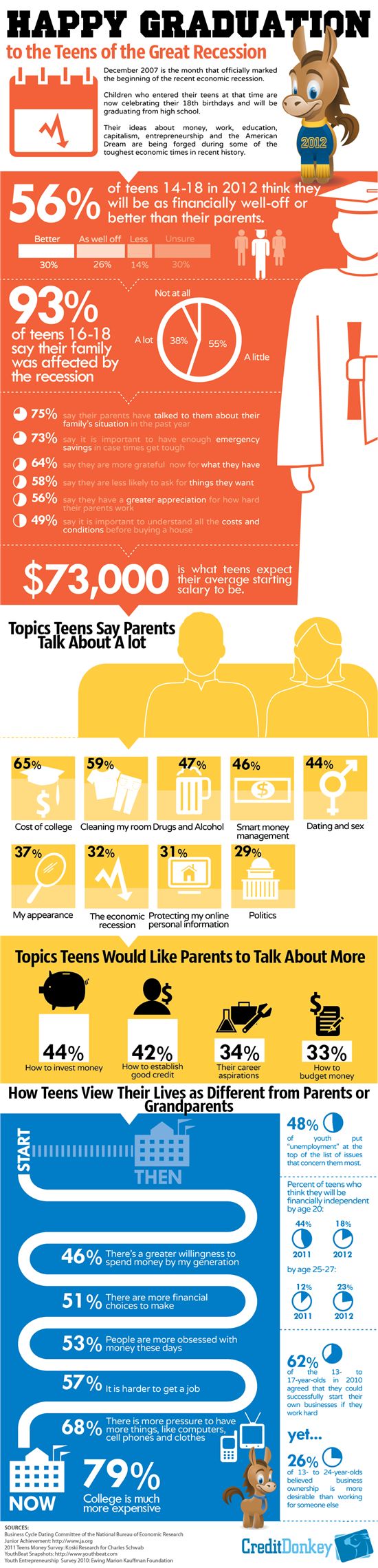
There are several possible ways to contextualize the swing among American teens from cigarettes to marijuana, but one sticks out above all the rest: the economic recession.
Researchers at the University of New Hampshire reported in 2010 that they had debunked the “gateway drug” theory through scientific analysis of assorted risk factors that contribute to the desire to abuse more destructive drugs like heroin or prescription pills. Instead of early experiences with marijuana weighing significantly on that decision, researchers found that other stress factors like unemployment weigh much more in determining a teen’s likelihood to become addicted to harder, potentially lethal drugs.
“Employment in young adulthood can protect people by ‘closing’ the marijuana gateway, so over-criminalizing youth marijuana use might create more serious problems if it interferes with later employment opportunities,” one of the study’s authors said in a press release.
The U.S. Bureau of Labor Statistics reported in April that teen unemployement was hovering around 25 percent, down from 27 percent in 2009 — its highest rate since the Great Depression, and roughly 10 percent higher than the teen unemployment rate in the years leading up to the near economic collapse of 2008.
Added: Since no such regulatory framework exists for marijuana, and since drug dealers do not tend to check IDs, most youths told the National Center on Addiction and Substance Abuse in 2009 (PDF) that pot is easier to purchase than regulated substances.
The Campaign for Tobacco-Free Kids has consistently raised issue with “youth-penalty laws” (PDF) that punish kids for using tobacco, saying the laws are favored by tobacco companies because they oppose the truly effective means of control, like public education, restrictions on marketing and increased retail prices. By agreeing to penalize the end user, the Campaign claims that lawmakers ultimately just “divert the police from their efforts to stop retailers from illegally selling tobacco products to kids,” which results in breeding “disrespect for the law” among young people.
The Drug Policy Alliance, America’s leading drug policy reform group, says something startlingly similar about marijuana.
“It’s time to step back and ask ourselves what’s the best way to solve the problem we’re trying to solve—how to reduce drug abuse and addiction—and use the best available evidence to guide us,” Jag Davies, publications manager for The Drug Policy Alliance, said in a recent advisory. “And, ultimately, it’s time to bring marijuana out of the shadows and under the rule of law. The evidence shows that the most effective way to reduce teen marijuana use would be to regulate it in a manner similar to alcohol, with age limits, licensing controls, and other regulatory restrictions.”
Saturday, October 16, 2010
Another Epidemic? Half of US teens ‘meet criteria for mental disorder’
(God, this is so transparent... Pharmaceutical Drug Cos. fund a "study" that *SURPRISE* determines half of all teens are mentally ill and would need to be prescribed *SURPRISE SURPRISE* drugs they manufacture! What a coincidence! I mean, the odds of this happening? And you know, it's all about those kids' mental health, not the huge new profit source their study created for them.
I imagine the study resembled this:
(It blows me away that they are trying to categorize puberty and all its fun emotions, hormone levels, and confusion as a mental illness!--jef )
By Agence France-Presse - Thursday, October 14th, 2010
WASHINGTON — Around half of US teens meet the criteria for a mental disorder and nearly one in four report having a mood, behavior or anxiety disorder that interferes with daily life, American researchers say.
Fifty-one percent of boys and 49 percent of girls aged 13-19 have a mood, behavior, anxiety or substance use disorder, according to the study published in the Journal of the American Academy of Child and Adolescent Psychiatry.
In 22.2 percent of teens, the disorder was so severe it impaired their daily activities and caused great distress, says the study led by Kathleen Merikangas of the National Institutes of Mental Health (NIMH). (NIMH? Really? Don't guess these shrinks ever read the books with the same name?--jef)
"The prevalence of severe emotional and behavior disorders is even higher than the most frequent major physical conditions in adolescence, including asthma or diabetes," the study says.
Mental problems do not get the same attention from public health authorities even though they cost US families around a quarter of a trillion dollars a year, according to the study.
Around nine percent of all US children have asthma and less than a quarter of one percent of all people under the age of 20 have diabetes, according to the Centers for Disease Control and Prevention (CDC).
Merikangas and a team of researchers analyzed data from the National Comorbidity Study-Adolescent Supplement, which surveyed more than 10,000 US teens.
The study is the first to track the prevalence of a broad range of mental disorders in a nationally representative sample of US teens.
They found that nearly a third of the teens met the criteria for the most common mental disorder among US youth, anxiety disorders, which include social phobia and panic "attacks".
This class of disorder also had the earliest median onset age, occurring in children as young as six years old.
Behavior disorders, including attention deficit hyperactivity disorder, were the next most common condition (19.1 percent), followed by mood disorders (14.3 percent) such as depression.
Eleven percent of teens with a mood disorder, 10 percent with behavior disorders and eight percent who had anxiety disorders, especially social phobics, met the criteria for severe impairment, meaning their condition affected their day-to-day life and caused them great distress.
Teen mental disorder rates mirror those seen in adults, suggesting that most adults develop a mental disorder before adulthood, say the researchers, calling for earlier intervention and prevention, and more research to determine what the risk factors are for mental disorders in youth.
I imagine the study resembled this:
1. Are you ever sad?
2. Have you ever been depressed?
3. Do you ever wear black colored clothing?
4. Have you ever heard a sad song or seen a sad movie?
5. Has anyone of whom you've ever been aware ever died?
6. Has anyone ever broken up with you or you them?
If you answered "yes" to any of these questions, you are likely mentally ill. Take this survey to your local government approved corporate drug distribution center and pick up your total immersion Paxil/Zoloft/Prozac booster pack immediately. School admission is dependent upon student having been administered booster pack. A blood test may be necessary for confirmation.)
(It blows me away that they are trying to categorize puberty and all its fun emotions, hormone levels, and confusion as a mental illness!--jef )
***
By Agence France-Presse - Thursday, October 14th, 2010
WASHINGTON — Around half of US teens meet the criteria for a mental disorder and nearly one in four report having a mood, behavior or anxiety disorder that interferes with daily life, American researchers say.
Fifty-one percent of boys and 49 percent of girls aged 13-19 have a mood, behavior, anxiety or substance use disorder, according to the study published in the Journal of the American Academy of Child and Adolescent Psychiatry.
In 22.2 percent of teens, the disorder was so severe it impaired their daily activities and caused great distress, says the study led by Kathleen Merikangas of the National Institutes of Mental Health (NIMH). (NIMH? Really? Don't guess these shrinks ever read the books with the same name?--jef)
"The prevalence of severe emotional and behavior disorders is even higher than the most frequent major physical conditions in adolescence, including asthma or diabetes," the study says.
Mental problems do not get the same attention from public health authorities even though they cost US families around a quarter of a trillion dollars a year, according to the study.
Around nine percent of all US children have asthma and less than a quarter of one percent of all people under the age of 20 have diabetes, according to the Centers for Disease Control and Prevention (CDC).
Merikangas and a team of researchers analyzed data from the National Comorbidity Study-Adolescent Supplement, which surveyed more than 10,000 US teens.
The study is the first to track the prevalence of a broad range of mental disorders in a nationally representative sample of US teens.
They found that nearly a third of the teens met the criteria for the most common mental disorder among US youth, anxiety disorders, which include social phobia and panic "attacks".
This class of disorder also had the earliest median onset age, occurring in children as young as six years old.
Behavior disorders, including attention deficit hyperactivity disorder, were the next most common condition (19.1 percent), followed by mood disorders (14.3 percent) such as depression.
Eleven percent of teens with a mood disorder, 10 percent with behavior disorders and eight percent who had anxiety disorders, especially social phobics, met the criteria for severe impairment, meaning their condition affected their day-to-day life and caused them great distress.
Teen mental disorder rates mirror those seen in adults, suggesting that most adults develop a mental disorder before adulthood, say the researchers, calling for earlier intervention and prevention, and more research to determine what the risk factors are for mental disorders in youth.
Subscribe to:
Posts (Atom)