Showing posts with label data mining. Show all posts

Tuesday, December 17, 2013

'Snowden Vindicated': Judge Rules Against 'Indiscriminate' NSA Spying

Monday, December 16, 2013 by Common Dreams
Snowden: "Today, a secret program authorized by a secret court was, when exposed to the light of day, found to violate Americans’ rights."
- Sarah Lazare, staff writer

In the biggest legal blow to the National Security Council since the dragnet spying scandal broke in June, a federal judge ruled Monday that the U.S. government "almost certainly" violated the constitution by mass collecting data on nearly every single phone call within or to the United States.

“Today, a secret program authorized by a secret court was, when exposed to the light of day, found to violate Americans’ rights," declared NSA whistleblower Edward Snowden in a statement on the ruling released by journalist Glenn Greenwald Monday afternoon. "It is the first of many."
"This is a vindication for our fellow citizen Edward Snowden who came forward because he believed the government was violating our constitutional rights." –Glenn Greenwald, journalist

In a 68-page statement released Monday, U.S. District Court Judge Richard Leon issued stinging criticisms of NSA metadata snooping, declaring, “I cannot imagine a more ‘indiscriminate’ and ‘arbitrary invasion’ than this systematic and high-tech collection and retention of personal data on virtually every single citizen for purposes of querying it and analyzing it without judicial approval."

Leon, who was appointed by former President George W. Bush, ruled in response to a lawsuit brought by conservative activist Larry Klayman that phone metadata collection violates Fourth Amendment protections against unlawful searches and seizures without demonstrating any role in preventing "terrorist" attacks.

Leon granted Klayman's demand for a temporary injunction on the grounds that the lawsuit was likely to win. Yet, he did not immediately implement his ruling, pending a government appeal.

Nonetheless, Leon's opinion is being widely lauded as "the first significant legal setback for the NSA’s surveillance program since it was disclosed in June," as Josh Gerstein writes for Politico.

Because it takes aim at a 1979 Supreme Court ruling that the Obama administration says justifies the NSA secret spying, Leon's legal argument could have far-reaching consequences. "If upheld on appeal, the judge's reasoning could force the spy agency to reconsider other domestic spying programs that involve warrantless collection of "metadata" about Americans' communication," writes Andrea Peterson for The Washington Post.

The ruling is certain to "influence other federal courts hearing similar arguments from the American Civil Liberties Union," write Spencer Ackerman and Dan Roberts in The Guardian.

“This is a strongly worded and carefully reasoned decision that ultimately concludes, absolutely correctly, that the NSA’s call-tracking program can’t be squared with the Constitution," declared ACLU Deputy Legal Director Jameel Jaffer in a statement emailed to Common Dreams. "We hope that Judge Leon’s thoughtful ruling will inform the larger conversation about the proper scope of government surveillance powers, especially the debate in Congress about the reforms necessary to bring the NSA’s surveillance activities back in line with the Constitution."

Snowden and his supporters say the ruling underscores the vital importance of Snowden's revelations.

“I acted on my belief that the N.S.A.'s mass surveillance programs would not withstand a constitutional challenge, and that the American public deserved a chance to see these issues determined by open courts,” said Snowden.

"This [ruling] is a vindication of the constitutional rights of American citizens, who had intimate information collected about us without our consent," said Glenn Greenwald on a Monday MSNBC interview about Leon's ruling.

He added, "This is a vindication for our fellow citizen Edward Snowden who came forward because he believed the government was violating our constitutional rights."

Friday, November 1, 2013

The Corporate State of Surveillance

Opting Out
by RALPH NADER

America was founded on the ideals of personal liberty, freedom and democracy. Unfortunately, mass spying, surveillance and the unending collection of personal data threaten to undermine civil liberties and our privacy rights. What started as a necessary means of reconnaissance and intelligence gathering during World War II has escalated into an out-of-control snoop state where entities both governmental and commercial are desperate for as much data as they can grab. We find ourselves in the midst of an all-out invasion on what’s-none-of-their-business and its coming from both government and corporate sources. Snooping and data collection have become big business. Nothing is out of their bounds anymore.

The Patriot Act-enabled National Security Agency (NSA) certainly blazed one trail. The disclosures provided by Edward Snowden has brought into light the worst fears that critics of the overwrought Patriot Act expressed back in 2001. The national security state has given a blank check to the paranoid intelligence community to gather data on nearly everyone. Internet and telephone communications of millions of American citizens and millions more citizens and leaders of other countries. Even friendly ones such as Germany, France and Brazil have been surveillance targets –over 30 foreign leaders such as German Chancellor Angela Merkel and Brazilian president Dilma Rousseff have reportedly been targeted by this dragnet style data-collecting. More blatantly, covert devices were reportedly placed in European Union offices and earlier by Hillary Clinton’s State Department on the United Nations to eavesdrop on diplomats. World leaders are not pleased, to put it mildly.

Many Americans are not pleased either. And while most of the recent public outrage in the U.S. has been directed at instances of government snooping, giant private corporations are equally as guilty of the troubling invasion of peoples’ selves. Companies such as Google, Apple, Microsoft and Facebook blatantly collect and commercialize personal data — often covering their tracks with complicated fine-print user agreement contracts that most people, whose property it is, “agree” to without any consideration. Clicking “I agree” on an expansive, non-negotiable user agreement for a website or a software program is, to most people, just another mindless click of the mouse in the signup process.

These “take-it-or-leave-it” contracts leave the consumer with little power to protect their own interest. (See here for our extensive work on this issue. Also, visit “Terms of Service; Didn’t Read” for a valuable resource that summarizes and reviews online contracts so that users can have a better understanding of what they are agreeing to.)

Just last week, news broke that Google plans to roll out a new advertising feature called “Shared Endorsements.” This policy allows Google the right to create user endorsements in online advertisements. So, if a Googler happens to share their preference for a particular product online, his or her endorsement might end up featured in an ad without any notice or compensation. Of course, users are welcome to “opt-out” of this program — but how many millions will remain ignorant of the fact that they unwillingly opted-in by clicking their consent to contract terms they did not bother to read out of habit. (Google’s official statement claims the move is to “ensure that your recommendations reach the people you care about.”)

Opting-out should be the default option for all these types of agreements.

School children are also being targeted by mass data collectors. InBloom, a nonprofit organization based in Atlanta, offers a database solution for student records between grades K-12. In theory, this service is supposed to make it easier for teachers to utilize emerging educational products and tools. But in practice, many parents are concerned about how this data will be used — in one instance, for example, student social security numbers were uploaded to the service. One parent told the New York Times:
It’s a new experiment in centralizing massive metadata on children to share with vendors… and then the vendors will profit by marketing their learning products, their apps, their curriculum materials, their video games, back to our kids.

Facebook poses another data mining risk for young children. Although Facebook does not currently allow children younger than 13 to join — the Children’s Online Privacy Protection Act prevents the online collection of data of children without parental permission — reportedly more than five million underage children use the social media website anyway. This exposes them (and their personal information) to thousands of advertisers that use Facebook to collect marketing data and promote their products. See the Center for Digital Democracy’s recent report “Five Reasons Why Facebook is Not Suitable For Children Under 13.” Notably, Facebook recently changed their privacy policy to allow teenagers between the ages of 13 and 17 to opt-in to sharing their postings with the entire world, as opposed to just their “friend network.”

The insatiable appetite for data is reaching beyond the digital realm, as well.

The Washington Post recently reported that Mondelez International, the company behind snack brands like Chips Ahoy and Ritz, has plans to deploy electronic camera sensors in snack food shelves to collect shopper data. These “smart shelves” can scan and save a customer’s facial structure, age, weight and even detect if they picked something up off the shelf. The device can then use that gathered data to target the consumers with “personalized ads.” For example, at the checkout line, a video screen might offer you 10 percent off the box of cookies you picked up but ultimately chose not to purchase. The Post reports: “The company expects the shelf to help funnel more of the right products to the right consumers, and even convince undecideds to commit to an impulse buy.”

The smart shelf builds on the Microsoft “Kinect” camera technology, which has the ability to scan and remember faces, detect movement and even read heart beats. Microsoft developed the Kinect camera as a video game control device for the home. In light of Microsoft’s reported connection to the NSA PRISM data gathering program, why would anyone willingly bring such a sophisticated spy cam into their living room?

Along the same lines, certain retailers are using smart phones to track the movement of customers in their store to gather information on what products they look at and for how long — similar to how Amazon tracks online shopper habits so it can direct them to other products that algorithms determine they might be interested in. Sen. Chuck Schumer (D-NY) has called on the Federal Trade Commission to regulate this disturbing practice. He recently announced a deal with eight analytic companies to institute a “code of conduct” for utilizing this seemingly Orwellian technology. Sen. Schumer told the Associated Press: “When you go into your store for your Christmas shopping, there’ll be a sign out there that says that you’re being tracked and if you don’t want to be, you can very simply opt out.” The details on how exactly one opts-out of this invasive technology, short of leaving their cell phone at home, is not yet clear.

With all these instances of Big Brother encroachment, one might want to opt out of the digital world entirely, and avoid supermarkets and retail chains that spy on customers. Unfortunately, that is becoming more and more difficult in an increasingly technology-obsessed world.

It’s time for citizens to stand up and demand their right to privacy, which is a personal property. Mass surveillance and rampant data collection are not acceptable and should not be the status quo. Recall that there was once a time when the federal government could defend our nation without limitless access to computer records, emails, online search histories and wiretapping phone calls without open judicial authorization. Businesses could be successful without tracking and saving your shopping habits and student records were not commodities to be traded away. Why do they now do what they do? Because they can.

Remember, what you allow to be taken from you by the private companies can also end up in the files of government agencies.

This Saturday, a coalition of groups including the ACLU, Public Citizen, the Electronic Privacy Information Center (EPIC), the Libertarian Party and many more are gathering on the National Mall to protest mass surveillance by the National Security Agency. This is a positive first step in letting our elected officials know that ceasing the collection of private personal information about you is important and mass surveillance should be prohibited. Visit here for more information about this weekend’s rally. Join the movement to end these burgeoning, tyranny-building abuses by runaway federal agencies.

Friday, March 22, 2013

The Ugly Truth Behind Obama’s Cyber-War

Net Intrusion
by ALFREDO LOPEZ


Last week, a top U.S. government intelligence official named James Clapper warned Congress that the threat of somebody using the Internet to attack the United States is “even more pressing than an attack by global terrorist networks”. At about the same time, Keith Alexander, the head of the National Security Agency, announced that the government is forming 13 teams to conduct an international “cyber offensive” to pre-empt or answer “Internet attacks” on this country.

This, as they say, means war.

Clapper issued his melodramatic assessment during an appearance before the Senate Intelligence Committee. As Director of National Intelligence, he testified jointly with the heads of the CIA and FBI as part of their annual “Threat To the Nation” assessment report.

While undoubtedly important, these “threat assessment” appearances are usually a substitute for sleeping pills. The panel of Intelligence honchos parades out a list of “threats” ranked by a combination of potential harm and probability of attack. Since they began giving this report (shortly after 9/11), “Islamic fundamentalist terrorist networks” have consistently ranked number one. Hence the sleep-provoking predictability of it all.

But Clapper’s ranking of “cyber terrorism” as the number one threat would wake up Rip Van Winkle.

“Attacks, which might involve cyber and financial weapons, can be deniable and unattributable,” he intoned. “Destruction can be invisible, latent and progressive.” After probably provoking a skipped heartbeat in a Senator or two, he added that he didn’t think any major attack of this type was imminent or even feasible at this point.

So why use such “end of the world” rhetoric to make a unfeasible threat number one?

The answer perhaps was to be found in the House of Representatives where, on that same day, Gen. Alexander was testifying before the Armed Services Committee about, you got it, “cyber-war”.

Besides being head of the NSA, Alexander directs the United States Cyber Command. I’m not joking. Since 2010, the United States military has had a “Cyber Command”, comprised of a large network of “teams” some of whose purpose is to plan and implement what he called “an offensive strategy”.

Up to now, the Obama Adminstration’s stated policy has been to prioritize protection and defense of its own Internet and data systems and, unsurprisingly, those of U.S. corporations. Now we realize that the President has been cooking another dish on the back burner. When these military leaders talk about “offensive strategy”, they mean war and in warfare, the rules change and warriors see democracy as a stumbling block at least and a potential threat at worst.
Is there a “cyber threat”? Sure, just like there’s a “personal security threat” at your front door. You live among other humans and a few of them sometimes rob people. The Internet is a neighborhood of two billion people in constant communication. To do what it was developed to do, it has to be an open, world-wide communications system and so people can exploit that by harming your website or stealing your data if you don’t protect these things adequately. Developing protections is part of what technologists in every setting, including government services, do every day and they do it well, minimizing the incidence of an on-line hack.

That’s contemporary society. You lock the door to your house, turn on your car alarm on and protect your computer’s data. Most of the time it’s unnecessary but you do it for those rare occasions that it might be called for.

You do not, however, break into a thief’s home, kill him or her and wipe out everyone in the house. That’s what President Obama is proposing. No longer is this Administration interested in just “protection of data”; it now plans to pre-emptively attack data operations and Internet systems in other countries. The non-euphemistic term for this kind of “offensive strategy” is hacking and hacking takes two forms: data theft and disruption of service. In other words, the government plans to do what it throws people in jail for doing.

Clearly, this isn’t only about data theft or service disruption. It’s entwined with the political conflicts Washington has with other countries like China and Iran. The Internet is now another battlefield and this offensive strategy gives our government another weapon in its ceaseless war on the world.

While this weapon might sound benign, almost game-like, compared to other military adventures, it is actually a vicious and punishing strategy promising a festival of unavoidable collateral damage.

A “cyber offensive” can target just about anything in a country (like the computers running an Iranian power plant) and, depending on how the Internet systems are inter-connected, almost automatically cut service to people, schools, hospitals, security services and governments themselves. This is the digital version of nuclear warfare, horrific for its impact and its fundamental immorality.

When the announcements were made, the mainstream media flew into a frenzy of evaluation and analysis. Is this cyber threat real, commentators asked? Most of them found that, at this point, it isn’t. But that’s not the point and it isn’t the real threat.

The carefully planned and coordinated Clapper/Alexander testimony provides a pretext for the array of repressive Internet-governing laws, strategies and programs the Administration already has in place. Their purpose is a ratcheting control of the Internet by the government, a redefinition of our constitutional rights and the eviscerating of our, and the world’s, freedoms. Now, with this “cyber war” scenario, these measures can be more easily defended and made permanent.

We can group those laws and programs into three categories.

1 - ”Extreme Data Collection”

The Obama Administration is building a huge data center in Bluffdale, Utah whose role is to capture and store all data everyone in this country (and most of the world) transmits. You read that right.

“Flowing through its servers and routers and stored in near-bottomless databases will be all forms of communication,” wrote James Bamford in Wired Magazine, “including the complete contents of private emails, cell phone calls, and Google searches, as well as all sorts of personal data trails — parking receipts, travel itineraries, bookstore purchases, and other digital ‘pocket litter.’”

While having your entire on-line life tracked and stored in Utah is pretty creepy, the more pressing issue is how government officials plan to use this data and how they are collecting it. To mine its value, they need to order it to make searches, filtering and lists possible. You need a strategy and while Obama officials have been pretty open about what they’re building, they are closed-mouth about what they intend to do with it.

We know they are working hard on developing code-breaking technology which would allow them to read data which is super-encrypted, the last wall of privacy and protection we have. We also know that, to get this data, they have a remarkable system of surveillance that includes direct capture (capturing data from your on-line sessions), satellite surveillance and the tapping (through easily available data captures) of major information gatherers like Google and Yahoo. The fact that they plan to open this center in September, 2013 means that the intense surveillance and data gathering is in place. You are now never alone.

This is the kind of information on “the enemy” they need in a cyber-war but this information is about us and so the question pertains: who is the enemy here?

2 - “Internet Usage Restriction”

If you’re conducting a war, you can’t have people running around the battlefield trading information and distributing it because, after all, you need secrecy. But collecting and distributing information is entirely what the Internet is about.

No reasonable person expects the entire shut-down of the Internet but the curtailment of on-line expression is now happening and getting worse, re-defining the meaning of free speech and making it an embattled concept.

Under the law, for instance, any corporation or individual can claim you are violating their copyright and demand you remove offending material from a website. You can challenge and litigate that but it doesn’t really matter because, under the Digital Millenium Copyright Act your web hosting service faces huge penalties if they keep the site on-line and the copyright violation is proven. So, to avoid the legal fees and the risk, they’ll just wipe your website. This happens all the time.

If the hosting service stands strong — as some progressive providers do — the people claiming the violation will just go “upstream” to the company that provides your web hosting service’s connection to the Internet and, to avoid legal problems, that “upstream provider” will just unplug the server. Servers host many websites, sometimes in the hundreds, and other services and so not only do you lose your site but everyone else on the server has theirs taken off-line. And this happens without even going in front of a judge.

Sure, there is still robustly exercised “freedom of speech” on the Internet. But the laws are in place to curtail it and, if the government wants, it can (and will) curtail. It’s a modern-day version of benevolent dictatorship which can, as history demonstrates, become pretty darn malevolent pretty fast.

3 — “Selective Repression”

There are hundreds of criminal cases against Internet activists world-wide right now and scores in the United States. The ones most of us are most familiar with, those involving Aaron Swartz and Bradley Manning, are only the tip of the frightening iceberg.

A day after the testimony before Congress, for example, federal authorities announced the case of a techie named Matthew Keys . Keys, who worked for a tv station in Los Angeles owned by the Tribune Company, is accused of leaking a username and password to an activist from the well-known hacker organization Anonymous. Authorities say the Anonymous activist used that user/password combo to satirically alter a headline on the website of the Tribune-owned Los Angeles Times.

Keys is now charged with conspiracy to transmit information to damage a protected computer; transmitting information to damage a protected computer and attempted transmission of information to damage a protected computer. Each count carries a 10 year jail sentence, three years of supervised release and a fine of $250,000. For giving someone who changed a headline a username and password!

Last year, we at May First/People Link were raided by the FBI which literally stole a server from one of our server installations in New York City. They were investigating terroristic emails from some lunatic to people at the University of Pittsburgh and the dozens of servers this bozo used included one of ours. We have some anonymous servers which means there are no records of who used them, no traces…no information about the person sending the email; it’s to protect whistle-blowers and others needing total anonymity.

The FBI knew this but they stole the server anyway and then, about a week later, put it back. They never informed us of any of this. We found out because one of our techies went into the server installation and found one of the servers gone and installed a hidden camera which caught the agents when they returned the machine.

If all these developments seem disturbing to you, that’s justified. These repressive and intrustive measures target the very essence and purpose of the Internet. Created as a way for people to communicate with each other world-wide, this marvel of human interaction is now being turned into a field across which countries shoot programming bombs at each other while repressing and even punishing ordinary people’s communication: dividing us, perpetuating the feeling of loneliness that’s a constant in today’s societies and crippling the struggles for change that combat the division and loneliness and depend on the Internet to do it.

The Internet’s true purpose is to bring the world’s people closer to each other. The Obama Administration is doing just the opposite. It would advisable for those of us who have consistently opposed and fought against wars of all kinds to view this “cyber war” as an equally dangerous and destructive threat.

Wednesday, September 26, 2012

Big Pharma, With the Questionable Help of Facebook, Is Watching


Worried about online privacy? You should be. To help target and sell ads - Big Pharma already spends about $1 billion on them - Facebook has quietly partnered with data-mining company Datalogix to track what 70 million Americans households buy at over 1,000 retailers, including drugstores. If you don't want Facebook to know when you buy tampons at your local CVS, you can opt out, though it's a somewhat labyrinthian process. 

~ Common Dreams
Or just always pay in cash. I can't see how you can get out of it  if a prescription is involved though.--jef

Thursday, February 23, 2012

How to Remove Your Google Search History Before Google's New Privacy Policy Takes Effect

FEBRUARY 21, 2012 | BY EVA GALPERIN | Electronic Frontier Foundation

[UPDATE 2/22/2012] It is important to note that disabling Web History in your Google account will not prevent Google from gathering and storing this information and using it for internal purposes. More information at the end of this post.

On March 1st, Google will implement its new, unified privacy policy, which will affect data Google has collected on you prior to March 1st as well as data it collects on you in the future. Until now, your Google Web History (your Google searches and sites visited) was cordoned off from Google's other products. This protection was especially important because search data can reveal particularly sensitive information about you, including facts about your location, interests, age, sexual orientation, religion, health concerns, and more. If you want to keep Google from combining your Web History with the data they have gathered about you in their other products, such as YouTube or Google Plus, you may want to remove all items from your Web History and stop your Web History from being recorded in the future.

Here's how you can do that:

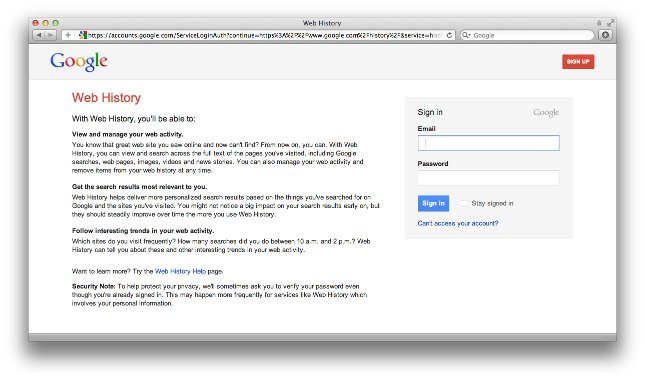
1. Sign into your Google account.

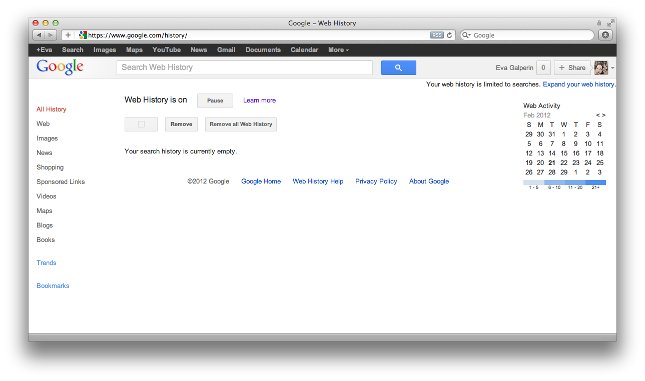
2. Go to https://www.google.com/history


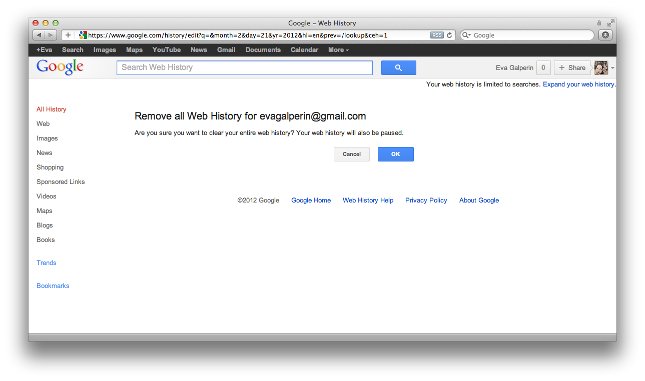
3. Click "remove all Web History."


4. Click "ok."


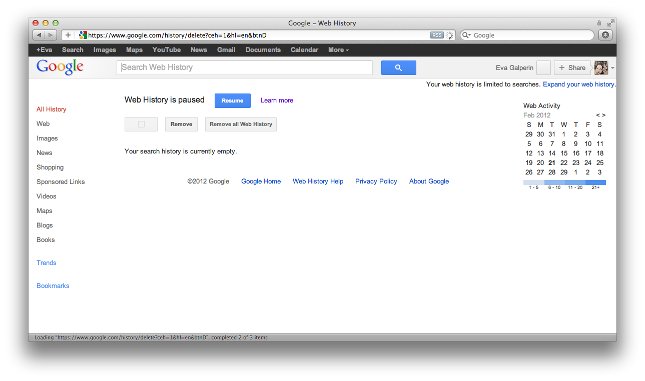
Note that removing your Web History also pauses it. Web History will remain off until you enable it again.


[UPDATE 2/22/2012]: Note that disabling Web History in your Google account will not prevent Google from gathering and storing this information and using it for internal purposes. It also does not change the fact that any information gathered and stored by Google could be sought by law enforcement.


With Web History enabled, Google will keep these records indefinitely; with it disabled, they will be partially anonymized after 18 months, and certain kinds of uses, including sending you customized search results, will be prevented. If you want to do more to reduce the records Google keeps, the advice in EFF's Six Tips to Protect Your Search Privacy white paper remains relevant.


If you have several Google accounts, you will need to do this for each of them.