Showing posts with label Free Trade Agreements (FTAs). Show all posts

Friday, May 16, 2014

Obama Is Negotiating the Biggest Trade Deal in Human History - It Would Gouge the American Economy

AlterNet/ By Thom Hartmann
May 12, 2014 |

Right now - the Obama administration is negotiating the biggest trade deal in human history.

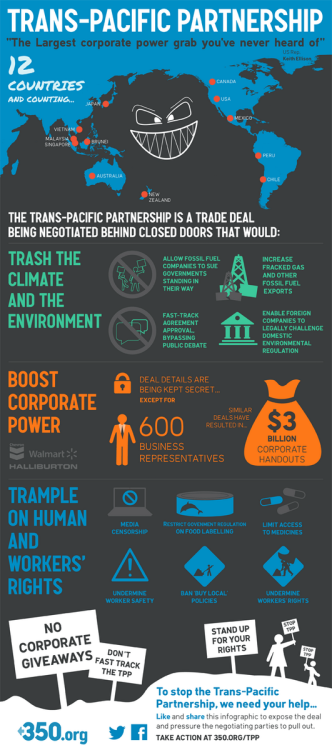
If approved - The Trans-Pacific Partnership - or TPP for short - would create a whole new set of rules regulating the economies of twelve countries on four different continents bordering the Pacific Ocean. While TPP is its official acronym, because it's a deal that involves Southern Hemisphere Asian countries as well as us and others, I prefer, instead of TPP, to call it the "Southern Hemisphere Asian Free Trade Agreement" or SHAFTA.

Because SHAFTA or the TPP is being negotiated almost entirely in secret - we don’t know a lot about it - and what we do know comes almost entirely from leaks. And according to those leaks - the TPP/SHAFTA would give big pharmaceutical companies virtual monopoly patent power - it would let corporations sue countries in international courts over regulations that those corporations don’t like - and and it would gut American environmental and financial rules. The TPP/SHAFTA is a huge deal - the type of story about which the media should be informing the American people. But here’s the problem: almost no one in the mainstream media is talking about it.

According to Media Matters for America - during one six month period between August 2013 and February 2014 - only one nightly network news show - The PBS Newshour - mentioned the trade deal - and they only mentioned it once.

And that one mention occurred essentially as a plug for the TPP/SHAFTA, when a scholar from a right-wing DC think tank said that signing on to the TPP was essential for “improving relations with Asian nations."

Cable news did a little better when it comes to TPP coverage. While Fox So-Called News had no mentions - CNN talked about it once and MSNBC talked about it thirty-two times. But those thirty-two mentions were mostly on one show - “The Ed Show” - and because MSNBC is only available by premium subscription - there’s a very good chance most Americans never watched Ed talk about the TPP/SHAFTA.

Of course - the only thing worse than not talking about the TPP/SHAFTA - like TV news networks have been doing - is talking about it in a misleading way.

And that’s exactly what most mainstream newspapers have been doing. Fairness and Accuracy in Reporting recently looked into TPP/SHAFTA coverage at two of the country’s most influential newspapers - the New York Times and the Washington Post - and found that “…on the rare occasions the papers covered TPP/SHAFTA over the last year, the sources they quoted tilted heavily in favor of the treaty.”

The total media blackout on actually critical coverage of the TPP/SHAFTA is a story in and of itself. Here we are, about to enter an once-in-a-generation economy-changing free trade deal, and the people who are supposed to be telling us the truth are either silent or on the side of giant multinational corporations.

Americans deserve to know what their government and big business are doing together behind closed doors.

And it’s outrageous that the mainstream media doesn’t seem think this is true when it comes to the TPP.

Monday, July 22, 2013

Manufactured Poverty: a reality but not a necessity


The history of poverty in the United States is depressing. So we repress it. Instead our history books talk about industrial revolutions, wars, economic prosperity, global trade, and so on. The consequences that such events have on the poor and oppressed are either whitewashed or legitimized. Our history books serve as an example of a larger ideological mission to naturalize poverty and to give us reasons to ignore it. In other words, there has been a direct and systematic attempt to make poverty appear to be innate, unchanging, irreversible, and everlasting. If people can be convinced to accept poverty, then the incentive to alleviate it is removed.

Even well meaning progressives will, unsuspectingly, get caught up in a regressive language. They will say, “Poverty is complex.” But the perception of poverty’s complexity has been conditioned in us in order to overwhelm our motivation. What if we accepted the uncontroversial fact that a small fraction of US military spending could feed, house, and educate everyone on the planet, 10 times over. If we wanted to eliminate poverty in the United States, it could be done within a week.

What is our impediment? There is a concerted effort, by those with economic and political power, to manufacture and to maintain poverty. Currently, an effort is underway to eliminate the minimum wage. On the surface, advocates will unabashedly argue that the goal is to create the cheapest possible labor force. But it should be lost on no one that the ability to push the working class into economic desperation is, in itself, a political end. People who are merely trying to survive do not have the time, the energy, or the resources for political advocacy. Economic exploitation always accompanies marginalization.

The desire to eliminate the minimum wage is only the most recent and flagrant part of an organized effort to barricade the halls of wealth and power. The series of so-called free trade agreements in the 1990s consistently lowered human rights standards abroad while, simultaneously, forcing US workers to compete with third world labor. The intent is clear: to drive down real wages and to decrease the quality of life of the working class. The tax cuts of Bush the Second’s presidency redistributed wealth from the bottom to the top in an explicit effort to further consolidate economic and political power. These efforts coincided with a national push for ‘right to work laws’ (or really, right to work for nothing laws) so that workers were politically disenfranchised while also being economically exploited. No politician worthy of the name would be foolish enough to discuss these practices in public, but the strategy is unmistakable. There is a political motivation to fossilize poverty.

Unfortunately, the Obama years have made the problem worse. The bailouts of the banks assured the financial sector that they will always be protected. In order to guarantee poverty, the powerful maintain this simple equation: privatize profits, socialize losses. After the downturn of 2008, everyone has become poorer except the people who caused the crash. To call this an accident ignores the facts and ignores the history. Still, there are people, many people, who genuinely want to combat poverty. But this needs to be done with eyes wide open. To face poverty is not to fight laziness or circumstance or ability; these are mirages. To combat poverty is to take the fight directly against those who have consciously made poverty one of the most shameful institutions of the United States.

Thursday, April 4, 2013

Activists on Both Sides of Atlantic Denounce US/EU FTA as Corporate Power Grab

Wednesday, April 3, 2013 by Common Dreams
President Obama's plan for a trade liberalization may be blocked
- Jon Queally, staff writer

Obama's proposal for a "Free Trade" agreement (FTA) between the US and European Union is being championed by large corporations, but public interest groups and environmentalists on both sides of the Atlantic are vowing to fight the deal.

President Barack Obama announced plans for a trans-Atlantic trade agreement in his State of the Union speech on Feb 12. But European farmers, consumer protection groups and Internet activists may block an agreement.

Long-opposed to the nefarious role that so-called "FTAs" play in the erosion of state sovereignty, critics object to the way such arrangements undermine labor and environmental protections, creating a "global race to the bottom" in the name of "liberalizing" trade and economic growth.

This newest deal comes at a time of ascendent corporate power and at the height of austerity-style economics and would be the largest between developed nations since NAFTA in the mid-90s.

As the Huffington Post reports:
Traditionally, this proposed political empowerment for corporations has been defended as a way to protect companies from arbitrary governments or weakened court systems in developing countries. But the expansion of the practice to first-world relations exposes that rationale as disingenuous. Rule of law in the U.S. and EU is considered strong; the court systems are among the most sophisticated and expert in the world. Most cases brought against the United States under NAFTA have been dismissed or abandoned before an international court issued a ruling.
But companies have grown increasingly ambitious in recent years, with major outfits including Exxon Mobil and Dow Chemical challenging Canadian rules that apply to offshore oil drilling, hydraulic fracturing ("fracking") and the use of pesticides. In December, drug giant Eli Lilly brought a NAFTA case against the Canadian government after it invalidated a patent for one of the company's medications.

Speaking out against the deal are US-based groups like Sierra Club and Public Citizen. And in Europe, coalitions of farmers and trade unionists are already up in arms about the impact that corporate-controlled trade agreements would have on them.

As Der Spiegel in Germany recently reported, there is specific opposition to US agricultural products—including industrially-processed meat and genetically-modified crops.
"Transparency, freedom of choice and the principle of foresight cannot be sacrificed to the free movement of goods in Europe," says Christoph Then, managing director of Testbiotech, a non-profit association opposed to genetic engineering.

The American farm lobby has long fought against European trade barriers for genetically modified potatoes and hormone-treated beef. Now the free trade treaty will provide them with considerable leverage for cracking the European front. [...]

For example, American farmers use the hormone rBST, developed by the agricultural corporation Monsanto. The drug is intended to increase milk production by up to 20 percent and meat yield by up to 30 percent. But it is also suspected of causing cancer in human beings. In addition, high-performance cows require additional antibiotic treatment, because their mammary glands are more likely to become infected.

The concern for US environmentalists like Sierra Club are centered around the power that corporations stand to gain by the emasculation of the regulatory authority of governments.

The provisions of the agreement, the environmental group's trade specialist Ilana Solomon said to HuffPost, "elevate corporations to the level of nation states and allow them to sue governments over nearly any law or policy which reduces their future profits."

And Lori Wallach, director of Public Citizen's Trade Watch, was quoted:
The dirty little secret about [the negotiation] is that it is not mainly about trade, but rather would target for elimination the strongest consumer, health, safety, privacy, environmental and other public interest policies on either side of the Atlantic.

The starkest evidence ... is the plan for it to include the infamous investor-state system that empowers individual corporations and investors to skirt domestic courts and laws and drag signatory governments to foreign tribunals.

Sunday, December 2, 2012

The Trans-Pacific Partnership: What "Free Trade" Actually Means

Saturday, 01 December 2012
By Andrew Gavin Marshall, Occupy.com | News Analysis

To discuss “free trade agreements” or the “free market,” we must first identify the theoretical versus the functional definitions of these terms – because theoretical definitions look at what those terms should mean, whereas functional definitions look at what the terms mean actually.

The theoretical definition of a “free market” is one in which every individual actor in the realm of exchange exists in a state of equality of opportunity; where all compete with one another to produce the best products at the cheapest prices for consumers, thus the most innovative and efficient producers succeed while others fail, unregulated - and unhelped - by the state. Within “free markets,” what we call “free trade agreements” are meant to reduce barriers such as tariffs, subsidies and regulations so that market "competitors" can freely move products and goods across borders and compete in an ever-expanding global “free market."

The functional, or technical, definition of a “free market” is one in which the state regulates the market – the realm of economic exchange and activity – for the benefit of large transnational corporations and banks.

Barriers to profits, such as environmental, labor, safety and financial regulations, are dismantled. Meanwhile, subsidies and legal rights and protections are granted to major corporations, undermining competition and supporting monopolization. So while the rhetoric of “free markets” tends to be all about reducing state interference in the economy, in actuality state interference increases - but only for the benefit of large corporations and banks.

At the same time, state “interference” decreases in sectors that benefit the actual population, such as welfare, social services, pensions, healthcare, education, labor protections and so on. In the actual "free market," these protections are dismantled, subjecting populations to “market discipline” quite unlike the large corporations and banks that receive direct protection against “market discipline.” The most obvious example of this is the post-2008 bank bailouts.

In a theoretical “free market,” all the banks that gambled badly would have failed and collapsed. But with the functional “free market” we have today, the banks went to the state and got bailed out with trillions of dollars of taxpayer money.

The same dichotomy exists for the term “free trade agreement,” which in theory is the opposite of “protectionism,” where states intervene in the market by establishing tariffs, regulations, subsidies and protections for various imports and exports, thus undermining the “free market.”

The technical definition, however, is one in which protectionism is rampant, with enormous subsidies and protective barriers, and very often includes thousands of pages of regulations and provisions. But because all of this is done to protect corporate and financial interests, it is called “free trade.” It is “protectionism” if the barriers, regulations and protections benefit the nation or population and prevent transnational corporations and banks from having unhindered access to the “market”?

Likewise, is it “free trade” if the barriers, regulations, and protections benefit corporations and banks at the expense of the nation and population? In actuality, so-called “free trade” is a drain on the economy, creates enormous national debts, undermines labor, creates poverty and exploitation, wastes natural resources and devastates the environment. However, it is very profitable for banks and corporations, so is endlessly repeated as something “good” and “necessary.”

In theory, “free trade” would enhance competition because it would allow all parties to compete on an even playing field internationally, thus companies would have to find ways to lower their costs of production while increasing their product standards, ultimately decreasing the final price to consumers. In this theoretical form of "free trade," the best and cheapest product, the company that made it, and the consumer and society as a whole would all benefit.

The reality is the exact opposite: the production cycle is broken up (this is commonly called “offshoring”), which increases the use of transportation, resources and the overall cost of production, making the final product more expensive to consumers. Case in point is the North American Free Trade Agreement (NAFTA), where competition between corporations is undermined while access to resources and markets is enhanced, subsidized and protected.

Corporate cooperation with each other and the state is enhanced while the poor, working and middle classes of Canada, the United States and Mexico are put in direct competition with each other. Corporations in Canada and the U.S. close their factories and move them to Mexico where labor is cheaper, increasing unemployment and poverty, destroying unions and labor protections, and forcing down wages while costs and corporate profits increase.

The role of the state is to regulate these markets and agreements for the benefit of the corporations and banks, and to force the populations to compete with each other in a race to the bottom: market monopolization for the elite, and market discipline for the population.

The break-up of the production cycle, especially from the late 1980s onward, has redefined what “trade” actually is. Typically, we think of trade as a system where countries export and import products or goods. With the era of “free trade,” the production cycle was no longer confined within national borders, and was broken up between several countries.

The result was that a large percentage of what we call “trade” is actually one corporation moving parts or goods to a subsidiary or another corporation in a different country, to continue the production cycle until it returns to the home country as a finished product for consumption.

This is referred to as “intra-industry trade” (transporting parts or goods between corporations) or “intra-firm trade” (transporting parts or goods between a corporation and its subsidiaries). When the parts move across borders, often several times before the final product is created, customs agents at borders register the cumulative value of those products as a “traded” good, and these numbers are then used to determine the “actual contribution” of that good to the economy.

For example, a product which has parts manufactured in Canada, assembled in Mexico, and sold in the United States, would have to cross borders several times before it becomes a final product. Each time the parts cross a border, the total value of those parts at that time of transport gets registered as an import/export, instead of differentiating between the value added at each part of the production cycle. Thus, the statistics of exports and imports become heavily skewed and inflated since they do not account for “value-added.” While the production cycle is broken up over several countries, the determination of “value” is not broken up to fit the actual trading system as it exists.

For a hypothetical comparison to reveal how absurd this process is, imagine a country that attempts to measure the total education of its population by including in its statistics the degrees and credentials of all the tourists who entered the country for short periods of time. The recorded education level of the country’s population would be enormously inflated, since the educated tourists entering the nation would not be staying and contributing their education to the benefit of the society. Something similar happens when parts move across borders several times before they become a finished product, yet have their total value registered each time they cross a border.

According to a report from a Canadian think tank, the Conference Board of Canada, if countries were to apply a “value-added” measurement of trade instead of using inflated numbers applied to the cumulative value of a good, the actual contribution of trade to a country would rapidly diminish. In conventional measurements, trade accounts for 35% of Canada’s economy, but with the value-added measurement, it drops to 24%. These manipulations are important because they serve as a basis for claiming that countries like Canada are “trade dependent” nations, which justify implementing more “free trade” agreements.

When a country imports more than it exports, it builds up a large amount of debt called a trade deficit. When a country exports more than it imports, it establishes a trade surplus. However, because the process of determining the value of imports and exports is enormously inflated and misleading, countries are saddled with inflated and inaccurate debts. They are then pressured into reducing those debts through austerity measures, which punish those countries' populations into poverty.

Apple is a great example of this process, often hailed as one of the great corporate success stories, being enormously profitable and therefore “good for the economy.” As the Asian Development Bank Institute in Tokyo reported in 2010, while Apple is a U.S.-based company, the iPhone is itself considered to be a Chinese export to the U.S. The iPhone is produced in many different pieces and parts through several Asian and European countries, which are then transported to China where they are assembled and shipped to the United States and elsewhere.

The estimated value of the Chinese laborers in assembling the iPhone was 3.6% (or $6.50) of the total value of the finished product, estimated at $178.96 in 2009. Yet, the wholesale cost of the shipped iPhone is credited to China as an export. China was merely the last stop in the production cycle, but China records the total value of the finished product as an export, while the United States records it as an import. Thus, the researchers at the Asian Development Bank Institute concluded that “even high-tech products invented by U.S. companies will not increase U.S. exports.”

Pascal Lamy, director-general of the World Trade Organization (WTO), commented, “What we call ‘Made in China’ is indeed assembled in China, but what makes up the commercial value of the product comes from the numerous countries... The concept of country of origin for manufactured goods has gradually become obsolete.”

If trade statistics were adjusted to reflect the actual value contributed to a given product by a country, the U.S. trade deficit with China (which in 2010 stood at $226.88 billion) would likely be cut in half. In 2009, the iPhone left the United States with a $1.9 billion trade deficit with China, but if the value-added approach to determining trade statistics were applied, the United States would have a $48 million trade surplus with China (in relation to the iPhone alone).

With the production cycle broken up and scattered around the globe, this adds enormous costs to transportation of equipment, machinery, goods and products between these nations, which in turn requires enormous quantities of oil and fuel to facilitate this transport system, and thus produces unnecessary amounts of pollution. Because of the high costs of transportation, fuel, and assembly, the value of the end product goes up, making it far more costly than if it were simply produced in one or two countries.

With countries determining their exports and imports based on inflated and inaccurate statistics, populations are saddled with enormous debts and thus the financial cost of breaking up the production cycle lands on the shoulders of the population, who were already subjected to increased competition between labor forces, reduced environmental and social protections, dismantled subsidies and regulations, increased personal debt and poverty.

So if “free trade agreements” are bad for people, bad for labor – at home and abroad – and bad for the environment and the nation as a whole, why are they pursued?

The answer is simple: they create enormous profits for banks and corporations, whose losses are subsidized by the state. In an actual “free market,” breaking up the production cycle would be far too costly to be a rational choice for a corporation, but because the state takes on the cost of doing so (largely through its trade deficit), the process continues.

When it comes to agreements like the Trans-Pacific Partnership, it is not difficult to see what the results will be: increased subsidies, protections and regulations for the benefit of large corporations and banks (notably the 600 corporations involved in secretly drafting the agreement over recent years) and decreased protections, subsidies and regulations that benefit the population, environment and society as a whole.

The TPP advances corporate monopolistic protections through intellectual property rights; undermines labor protections, putting the working class of 11 different nations in direct competition with one another; dismantles environmental protections and financial regulations; and expands corporate rights and privileges to allow undemocratic corporate institutions to challenge national laws through an unaccountable international tribunal of corporate lawyers who are given powers to overturn national laws or demand immense compensation from any nations that hinder those corporations' “potential profits,” thus further increasing the heavy cost of “free trade.”

The Occupy movement and other activists have a strong mandate to oppose the TPP and all related “free trade agreements.” Popular opinion is swinging against “free trade” as people seem instinctively to recognize – even without all the details – that such agreements undermine labor, increase debt and benefit only the rich.

But while public opinion may oppose the TPP in principle, the bigger problem is that "the public" does not know the TPP even exists. This is a challenge that the Occupy movement can step up to: promoting an educational campaign that crosses borders, organizing international protests and actions against the TPP, and establishing a “free market” of resistance based upon the “free trade” of information.

As corporate rights expand and democratic rights decrease, so must people demand an end to the TPP. Organized resistance, information and action have stopped “free trade agreements” in the past, and they can – and must – do so in the future. The coming corporate tyranny of the Trans-Pacific Partnership can only be defeated through a democratic movement of Transnational People Power.

Our already frail and dying democratic institutions lack the capacity to take up the challenge, so the challenge now rests with the people alone.

Wednesday, June 13, 2012

TPP secrets: Obama covertly granting more power to multinational corporations

Published: 13 June, 2012 - RT


Despite the White House’s efforts to keep a proposed free trade agreement concealed from the public — and even Congress — an excerpt from the TPP leaked Wednesday reveals that President Obama is prepared to bow to multinational corporations.

The United States has been engaged in discussion with eight Pacific nations to come to agreement on the terms of the proposed Trans-Pacific Partnership, a free trade contract that would allow for a more open system of exchange between the US and less developed nations. Critics have been concerned, however, over how provisions of the project could drive up the price of medications and other goods across the world. The White House’s reluctance to provide details to even leading lawmakers responsible for America’s trade plans has caused a rift within the president’s own political party as his administration remains adamant about protecting the items being heard.

A section of the proposed Trans-Pacific Partnership was leaked to the Web early Wednesday, and its contents suggest that US President Barack Obama was perhaps not so genuine with promises made while campaigning in 2008 and even offers some insight into why his administration has been eerily secretive about the TPP.

Details about negotiations determined during meetings between White House officials and leaders from the eight Pacific nations involved in the TPP have been so hidden from the public that even some members of the US Congress have called on the president to come forth with information. In a leak published this week by the advocacy website Public Citizen, though, it’s made clear that the Obama administration has every intention of backpedaling on previous promises that could largely impact regulations that will directly affect the safety and financial security of millions of Americans and international citizens.

According to the leaked excerpt, the Obama administration has been considering TPP provisions that would allow foreign corporations operating within the United States to appeal regulations on the environment and banking that would be forced on American-owned businesses with no chance of reprieve. While the United States could be sanctioned for failing to impose regulations on American-run businesses, multinational corporations are practically encouraged to do as much because the TPP outlines a clear avenue to file an appeal. If one of the eight Pacific nations chooses to do as much, their plea would be heard by an international tribunal that could overrule US law.

Such key components of the leaked TPP document conflict directly with campaign promises harped by then-candidate President Obama while vying for the White House. Huffington Post reports that during the 2008 campaign, Barack Obama was clear in emphasizing, "We will not negotiate bilateral trade agreements that stop the government from protecting the environment, food safety or the health of its citizens; give greater rights to foreign investors than to US investors; require the privatization of our vital public services; or prevent developing country governments from adopting humanitarian licensing policies to improve access to life-saving medications.”

On the contrary, President Obama is reportedly not so concerned today. Condemning the president over how the TPP could alter intellectual property standards are many critics who fear that the agreement would lead to the monopolization of life-saving drugs and thus propel the prices to an unaffordable amount.

"Bush was better than Obama on this," Judit Rius of Doctors Without Borders Access to Medicines Campaign tells HuffPo. "It's pathetic, but it is what it is. The world's upside-down."

Last month, Senator Ron Wyden (D-Oregon) introduced legislation that specifically targets the Obama administration by demanding that the White House open up on details about the proposed TPP. Despite serving as chair of the United States Senate Finance Subcommittee on International Trade, Customs, and Global Competitiveness, Sen. Wyden has been largely left uninformed about the details of the TPP all while the White House has opened up to the multinational corporations expected to profit through the proposal.

“The majority of Congress is being kept in the dark as to the substance of the TPP negotiations, while representatives of U.S. corporations – like Halliburton, Chevron, PHRMA, Comcast, and the Motion Picture Association of America – are being consulted and made privy to details of the agreement,” said Wyden. The senator’s legislation would require the United States Trade Representative office “to provide documents related to trade negotiations to members of Congress and their staff upon request.”

U.S. trade proposal would let corporations overrule laws

By Stephen C. Webster - RAW Story
Wednesday, June 13, 2012


The Trans-Pacific Partnership (TPP), a forthcoming U.S. trade agreement that looks to solidify a seamless regional economy in the Pacific-rim, would give multinational corporations the power to challenge and even avoid compliance with laws in member countries — including the U.S. — provided a super-national corporate tribunal agrees with their claim.

That’s according to documents leaked this week by the Citizens Trade Campaign, an activist group responsible for leaking TPP proposals on intellectual property last year. The latest leak details a TPP draft chapter on “investments,” which proposes an independent dispute arbitration process that would be empowered to supersede domestic laws or regulatory actions in member states if they are seen as conflicting with the TPP’s framework.

Consumer advocacy group Public Citizen said Wednesday that it “has verified that the text is authentic,” and described the proposals as being fraught with “dangers.”

“It reveals that negotiators already have agreed to many radical terms granting expansive new rights and privileges for foreign investors and their private corporate enforcement through extra-judicial ‘investor-state’ tribunals,” they explained.

“Although TPP has been branded as a ‘trade’ agreement, the leaked text shows that TPP would limit how signatory countries may regulate foreign firms operating within their boundaries, with requirements to provide them greater rights than domestic firms,” Public Citizen’s analysis added. “The leaked text reveals a two-track legal system, with foreign firms empowered to skirt domestic courts and laws to directly sue TPP governments in foreign tribunals. There they can demand compensation for domestic financial, health, environmental, land use laws and other laws they claim undermine their new TPP privileges.”

The tribunals, which already exist under the framework established by prior trade deals during the Clinton and Bush administrations — like NAFTA and CAFTA — are also problematic, according to Public Citizen. Because their proceedings are conducted in private, no media may access their deliberations, and various international trade attorneys take turns filling the role of judges, who are selected by stakeholders.

In the event of a dispute between two entities incorporated in two different countries that are both members of one of these treaties, a trade tribunal serves essentially as a parallel legal system that exists outside of national laws and wields the power to knock down those laws or free multinational corporations from their obligation to comply with them. Considerations pertaining to labor rights or environmental protections are often not factored in to these decisions.

Although President Barack Obama had pledged during the 2008 presidential campaign to “not support NAFTA style trade agreements in the future,” he appears to have embraced them instead.

The TPP agreement has been in negotiations for years now, with major revisions being made during each successive round of talks, so it’s not clear if these proposals are set in stone just yet. Public Citizen noted that while nearly all of the TPP member states have agreed to these terms — including New Zealand, Singapore, Malaysia, Vietnam, Chile and Peru — Australia has not, which could hold up the continuing talks, set to resume this July in San Diego.

One of the reasons Australia appears hesitant is the country’s own experience with corporate trade tribunals organized through the World Trade Organization (WTO). British American Tobacco has admitted that it provided assistance to other big tobacco companies looking to use that system to fight forthcoming regulations that ban artwork on cigarette packaging. By incorporating in a country that has a trade agreement with Australia that’s similar to the TPP proposal, those tobacco companies gain access to the WTO’s trade tribunal process, which could ultimately overrule the country’s own laws.

But even if Australia’s reluctance does cause a problem for TPP negotiators, the press and public won’t likely find out about it, as U.S. trade talks are always conducted behind closed doors and usually with stakeholders from private industry present. With the TPP talks, that secrecy has been particularly contentious, and even some of President Barack Obama’s own allies in Congress have called upon him to force the U.S. Trade Representative to open the meetings to press and publish documents online.

Despite the push-back from members of his own party, President Obama has called the creation of “a seamless regional economy” in the Pacific-rim a “top priority” for his administration. “And we consider it a top priority because we’re not going to be able to put our folks back to work and grow our economy and expand opportunity unless the Asia-Pacific region is also successful,” he explained last November.

Public Citizen’s Lori Wallach explained in prepared text that the most startling details in TPP’s leaked “investment” chapter “may well be why U.S. trade officials have been so extremely secretive about these past two years of TPP negotiations.”

“Via closed-door negotiations, U.S. officials are rewriting swaths of U.S. law that have nothing to do with trade and in a move that will infuriate left and right alike have agreed to submit the U.S. government to the jurisdiction of foreign tribunals that can order unlimited payments of our tax dollars to foreign corporations that don’t want to comply with the same laws our domestic firms do,” she said.

The U.S. Trade Representative’s public affairs office did not respond to Raw Story’s request for comment.

Thursday, March 15, 2012

Corporate Win, Loss for the 99%: U.S.-Korea Free Trade Agreement Takes Effect

Thursday, March 15, 2012 by Common Dreams
“Just how damaging this deal is to the 99 percent in both countries has been repeatedly revealed"

The U.S.- Korea Free Trade Agreement (KORUS) takes effect today, and is being met with heated protests over the deal's rewarding the interests of big business while crushing the 99%.  Messaging that the agreement will create jobs has been slammed as "some rosy fantasy" fabricated by multinational corporations.

The deal means that almost 80 percent of U.S. exports of industrial products to Korea are now duty-free and nearly two-thirds of U.S. exports of agricultural products to Korea are now duty-free.

Agence France-Presse reports:
The agreement was originally signed in July 2007 but was approved by the US Congress only last October, after a partial renegotiation to address US auto industry complaints.

South Korea's parliament approved it last November despite vehement protests from opposition lawmakers, one of whom exploded a tear gas canister in the assembly.

Critics say the deal is lop-sided and serves big business at the expense of South Korea's farmers and service industries.
"This is a lose-lose deal that will destroy jobs in both countries."

PressTV reports that thousands gathered in Seoul hours before the agreement officially went into effect to protest the agreement:

About 1,200 activists rallied in downtown Seoul on Wednesday, chanting slogans against the deal and demanding the resignation of President Lee Myung-Bak.

The rally, which was also attended by members of major opposition parties, came hours before the agreement came into force at midnight local time.

Protesters said the deal would crush South Korea's economy and hurt people's livelihood. They also complained that it would damage the country's farming and service industries by flooding the market with cheaper imports.

The activists vowed to keep protesting until the government nullifies the agreement.

Public Citizen writes that the trade deal was rushed to beat the Korean parliamentary elections in April and notes that polls showed the elections would "elevate a political party that has vowed to terminate the pact unless the 'investor-state' enforcement system is altered."

Lori Wallach, director of Public Citizen’s Global Trade Watch, stated that the KORUS is a bad deal for "99%" in both the U.S. and South Korea:
“Just how damaging this deal is to the 99 percent in both countries has been repeatedly revealed from this latest disgrace of trying to outrun the democratic accountability of Korea’s election to the White House, notably canceling a public bill-signing ceremony after the FTA was passed here. By rushing the implementation, the Obama administration is trying to cement in the extreme NAFTA-style corporate investor privileges that candidate Obama pledged would not be included in his trade agreements and that a large majority of Korea’s parliament also opposes.”

While U.S. Trade Representative Ron Kirk said in a statement today, “Starting today, Korea’s doors are wide open for Made-In-America exports that will support well-paying jobs here at home," research from the Economic Policy Institute in July of 2010 shows that KORUS will bring a loss of 159,000 American jobs:
Unlike USITC’s [U.S. International Trade Commission's] forecast of a small positive impact, EPI’s research shows it will increase the U.S. trade deficit with Korea by about $16.7 billion, and displace about 159,000 American jobs within the first seven years after it takes effect.


Writing on The Hill today, Chun Jung-bae, member of the National Assembly of the Republic of Korea and member of the Supreme Council of the Democratic Party of Korea, reiterates that job creation from KORUS is "some rosy fantasy" and "is a fabrication of multinational corporations."

There is some rosy fantasy that the pending U.S.-Korea Free Trade Agreement will create tens of thousands of well-paying jobs in both countries and strengthen and expand the U.S. relationship with Korea. This is a fabrication of multinational corporations that have no allegiance to either country. As a member of the Korean National Assembly, I would like to set the record straight: In reality, the deal is lose-lose. [...]

[T]his trade deal will have a negative impact on the middle-class in the U.S. and Korea. This is a lose-lose deal that will destroy jobs in both countries. How can that be? The deal is expected to increase the overall U.S. trade deficit, which would lead to net job loss in the U.S. But it is the deal’s low domestic content requirement that would encourage both U.S. and Korean corporations to offshore jobs to low-wage countries.

Christine Ahn and Albie Miles have written on the devastation the agreement would bring to Koreans:
The Korea FTA is the latest in a long history of aggressive U.S. foreign policies toward Korea that have significantly undermined Korean farmers. The current FTA will further erode Korea’s agricultural sector and food security while contributing to its environmental degradation through reduced emission standards and potential exposure to contaminated U.S. beef and transgenic crops. With this FTA, Koreans also stand to lose their national healthcare system as U.S. financial services and pharmaceutical firms await the opportunity to use the Investor to State Dispute (ISD) mechanisms to sue governments for infringing on their right to profit.

Ahn and Miles also reported that the trade agreement may mean more genetically modified food going to South Korea:
It's also unclear how much the FTA has been used to dismantle South Korea’s 2000 genetic engineering (GE) labeling law and undermine its commitment to the Cartagena Protocol on Biosafety, an international supplemental agreement to the UN Convention on Biological Diversity. The Cartagena Protocol seeks to protect biological diversity from risks posed by transgenic organisms resulting from biotechnology. Under the protocol, developing nations can restrict and/or label GE organisms to protect their biodiversity and/or public health if inadequate scientific evidence guarantees that a product is safe. The FTA negotiations overturned Korea’s 2000 GE labeling law that had largely kept transgenic imports out of Korea’s food supply. In 2007, the Washington-based Biotechnology Industry Organization hailed the conclusion of the Korea FTA for “providing additional market access opportunities in Korea for U.S. biotechnology companies.” It specifically lauded the U.S. agricultural negotiator for ensuring “that trade of biotech-derived crops, foods, and feeds continues without disruption.” Despite widespread opposition to GE foods in Korea, transgenic imports no longer have to be labeled.

The FTA lifted the floodgates for massive imports of GE foods and feedstock, namely U.S. GE corn. In February 2008, less than a year after the ag-biotech deal was signed, the Korean Corn Processing Industry Association purchased 697,000 metric tons of U.S. GE maize, the first major GE shipment destined for food use to arrive in Korea since 2000. Korean approvals of GE imports have since skyrocketed. By February 2008, Korea had approved 102 transgenic organisms for import as feed or food, 70 percent from U.S. firms Monsanto, DuPont, and Dow Chemical.

Monday, March 12, 2012

"Free Trade" is Not Free – Why We All Need to Oppose the Trans Pacific Partnership

Monday, March 12, 2012 by Common Dreams
by John Kinsman

There are always winners and losers in free trade. The winners are the 1% - the wealthy at the top. The losers are the 99% - that means the rest of us.

The latest free trade deal which is now being rushed by President Obama through Congress is known as the Trans Pacific Partnership (TPP). Thirty years ago, the first free trade deals were enacted under the auspices of the World Trade Organization (WTO), including the North American Free Trade Agreement (NAFTA), the Central American Free Trade Agreement (CAFTA), the Australia/US Free Trade Agreement (AUSFTA), and many more. During this time, the global economic crisis accelerated at an alarming rate with only the 1% reaping the profits. This ongoing crisis will not end until these destructive free trade agreements are repealed and fair trade becomes the norm.

Most recently, the Korea/US Free Trade Agreement (KORUS) was signed, over the objections of many labor, farm, and consumer groups in both countries. According to the Feb. 8. 2012 edition of the Korea Times, the leader of the Democratic United Party (DUP) vowed to nullify this deal with the United States once in power. Current predictions show the DUP winning this year’s general election. In an open letter to Obama, vice president Biden, and House Speaker Boehner, the DUP called upon the US “to reconsider the KORUS FTA in order to truly strengthen the long term relationship between our countries. If our cordial and earnest request is overlooked by your administration, we will have to take all measures possible to freeze the implementation of the KORUS FTA.”

Why would anyone expect anything but another race to the bottom in terms of farm prices, worker wages, environmental standards and human rights with passage of the TPP? We need only look at what happened in the years following NAFTA where over two million Mexican farmers were driven off their land by subsidized US corn being dumped into the market. Risking their lives, the farmers migrated across the border in search of work – families torn apart as fathers, mothers, brothers, and sisters disappear. Some died in the desert, others were murdered by traffickers (coyotes) and rightwing vigilantes. So devalued as human beings, their lives were not even worth counting. Similarly, in the US and Canada thousands of family farmers and small business owners have seen their livelihoods sacrificed on the altar of greater corporate profit.

Those in the 1% who are now pushing the TPP hope to take advantage of the huge supply of cheap labor and natural resources to be found in the Pacific Rim. The recent expose of the Chinese sweatshops behind Apple’s iPhones, where workers regularly commit suicide by jumping off factory rooftops, is just the tip of the iceberg when it comes to the horrific conditions that are spawned by these free trade deals.

Who else will lose under the TPP? US dairy farmers fear they will go bankrupt as cheap foreign powder imports like milk protein concentrate (MPC) flood the domestic market. US consumers will likely face more contaminated products – whether it is pet food laced with melamine or children’s toys coated with lead paint. US pharmaceutical giants are poised to undermine access to generic drugs by imposing their expensive patents on Australia and New Zealand where people currently enjoy better and more affordable healthcare than is found here. Japanese farmers and consumers will be forced to accept genetically engineered crops and hormone-tainted meat exported by US agribusiness that they do not even want. So much for freedom under "free trade."

As Congress considers the TPP, we need to express our opposition – not only to convince our elected officials that this will just lead to more economic chaos on top of the current crisis, but to also let our friends across the Pacific know that they are not alone in opposing free trade deals that are only designed to profit the 1%. Those of us in the 99% will end up losers if we do not repeal KORUS and stop the TPP. We could ALL be winners if we worked together in constructive cooperation for a new global economic system based upon fair trade instead.

Wednesday, October 19, 2011

America’s Real Industrial Policy: Maximize Profits at All Cost


by Roger Bybee 
 
The Occupy Wall Street movement—which has gained the support of 54 percent of Americans, according to a Time poll—has, remarkably, apparently inspired free-marketeer House Majority Leader Eric Cantor to address America’s Pakistan-level inequality in speech on Friday.
 
Cantor intends to explain how to uplift “a single working mom…a small business owner...and how we make sure the people at the top stay there.” (The last category, of course, has seemingly been the entire purpose of Cantor’s political career.)

But despite some Democrats like Nancy Pelosi embracing OWS, it's becoming clear that the movement must also directly challenge the president and leading Democrats on whether they are serious about preserving America’s productive base and raising the incomes of working families who are part of the 99 percent. Will these political leaders support a concerted “industrial policy” to achieve these critical goals, or will they side with Corporate America as jobs disappear, wages keep plunging and inequality reaches new heights?

Unfortunately, the Obama administration has come closer and closer to fully admitting the wrong thing: that it is willing to sacrifice more of the nation’s industrial base. The three  NAFTA-style “free trade” agreements approved last week by Congress at Obama’s urging —illustrate how Obama’s eagerness to promote more off-shoring of jobs and capital at the expense of his working-class constituents. (U.S. corporations’ offshoring of jobs alarms fully 86% of Americans)

Obama's new stance in favor of the deceptively-labeled "free trade" doctrine turns one of his most fundamental appeals in 2008 absolutely counterfeit. "Free" does not accurately describe the repressive anti-labor conditions favored by US firms. Nor does "trade" do justice to the majority of transactions, which actually occur within the same firm, like GE "exporting" machinery and parts to Mexico and "importing" finished products.

AUTO BAILOUT CHAIR ATTACKS INDUSTRIAL POLICY
Even with this disturbing backdrop of the newly inked NAFTA-style deals, it was still stunning to read Sunday's attack on industrial policy by Wall Street tycoon Steven Rattner, whom Obama selected to head up the auto bailout Task Force, which was dominated by fellow financiers. His op-ed was titled "Let's Admit It: Globalization Has Losers."

Rattner’s New York Times commentary was an open admission that a very key Democratic player utterly rejects any systematic effort to save the U.S. industrial base.

First, Rattner’s piece illuminates the mentality that made the GM and Chrysler bailouts so much less constructive than they could have been. Progressives had envisioned the crisis at GM and Chrysler as an opportunity to link Obama’s aim of stimulating the economy with enhanced spending power for workers with building a green economy, by converting some auto factories to the production of high-speed rail vehicles and other non-gasoline powered transportation equipment.

But dominated as it was by Wall Street heavyweights like Rattner (net worth: $188 million to $688 million) and chief economic advisor Lawrence Summers, the Task Force failed even to ensure that the maximum number of jobs possible were retained in the U.S. The final version of GM's recovery plan—closely tailored to the demands of the Task Force—appallingly called for an enormous 98-percent increase in autos produced in Mexico, China, South Korea and Japan for the U.S. market.

Speaking with authority gained from this over-rated “success,” Rattner outlines a strategy for surrendering almost all of what is left of America’s still-considerable manufacturing base and settling instead on an economy built chiefly around financial and computer-based services.

Bizarrely enough, Rattner premises his economic strategy on supposedly trying to aid working families whose incomes have plummeted chiefly, he admits, as a result of corporate “globalization.” But the solution, Rattner insists, is to let go of our "nostalgic" feelings about manufacturing and allow the offshoring of jobs to continue, while focusing our efforts on service industries:
While America still leads in sectors like defense and aviation, our greatest strength, and a source of high-paying jobs, lies in service industries with high intellectual content, like education, entertainment, digital media, and yes, even financial services. Facebook, Google and Microsoft are all American creations, as are the global credit card companies American Express, Visa and MasterCard. ...
We should resist the temptation to plunge deeply into industrial policy. ... Washington is ill-equipped to pick winners and should concentrate its capital on infrastructure and other public investments that the private sector won’t make.
Rattner can imagine a limited role for continued manufacturing here:
We should follow the example of successful high-wage exporters in concentrating on products where we have an advantage, as Germany has done with products like sophisticated machine tools.
Unfortunately, Rattner doesn't know what he's talking about. Milwaukee, for example, was long proudly known as “the Machine Tool Capital of the World.” But with many of the city’s biggest firms—Briggs & Stratton, Johnson Controls, Rockwell International (formerly Allen-Bradley), AO Smith (later Tower) and MasterLock—shifting substantial portions of their production to Mexico, Milwaukee has lost 80 percent of its manufacturing jobs since 1977, according to Marc Levine of the Center on Economic Development at the University of Wisconsin-Milwaukee.

As a result, machine-tool makers requiring highly-skilled workers were no longer located in proximity to the companies they once worked with closely, and they largely went out of business or relocated.

Generally, “the machine tool industry is almost extinct across the US,” says Frank Emspak, professor emeritus at the UW-Madison School for Workers, who serves on a German government commission working on that nation’s industrial policy.

“The U.S. also used to be the leader in railroad equipment, from air brakes to signals, and all that is gone. Even in computer chip manufacturing, the U.S. is no longer number one. Steve Jobs' big innovation was not only to develop sophisticated chips, but to produce them in low-wage, high-skill corporations like FoxCom [in China] where a number of workers have committed suicide in response to the conditions there.”

In Emspak’s view, “industrial policy” is crucial to coordinating government efforts on technology, taxation, energy, and training to protect and expand America’s manufacturing base. By stressing the importance of keeping jobs within the U.S., industrial policy not only means preserving the current production jobs, it also permits U.S. engineers to observe the production process closely and make innovations.

“When you have the separation of production from engineering, once you start production of anything sophisticated, then you lose the capacity for innovation,” Emspak said. "So with General Electric moving its medical equipment headquarters from Waukesha [Wis.], Waukesha becomes just a branch plant and the innovations and advances will take place in Shanghai.”

Contrary to conventional wisdom, Emspak says, “We do have a very clear industrial policy: that is the financial industry policy of making the largest profits as quickly as possible, and everything is subordinated to that.The financial people have won the internal debates in both parties.

"The only principle is the maximization of profit, wherever it occurs, and it has little or nothing to do with the needs of the country,” he declared.

Ironically, those like Rattner who claim to be forward-looking are effectively destroying the nation’s capacity to innovate and create new types of jobs when they call for letting manufacturing jobs go offshore.
Moreover, the majority of jobs left behind are low-wage and will contribute only to further income decline, and an even bigger gap between the top 1 percent and the rest of us, says Emspak.

Obama’s Jobs Bill and Other Fictions

by ROB URIE
 
 
Several seemingly well meaning pundits have asked: if Occupy Wall Street wants jobs, why don’t they come out and support President Obama’s jobs bill? Answering only for myself, the better question is: why doesn’t Obama support his own jobs bill? The White House is claiming that it needs sixty votes to pass the jobs bill in the Senate to overcome a threatened filibuster by Republicans. Maybe, but are these the same Republicans who just passed his toxic free-trade agreement with South Korea, Panama and Colombia with bipartisan support from Democrats? Why yes they are.

At this point in history, the evidence is in that these free trade agreements are a neo-liberal hoax to transfer jobs from the U.S. to low wage countries. Anyone who cares to can view the facts for themselves in the government statistics—the decline in U.S. manufacturing jobs has a very high correlation with the advent and implementation of free-trade agreements. Not only have manufacturing jobs been in absolute decline for more than a decade, the Participation Rate, the percentage of the working age population that is employed has been declining with it. As for the purported benefits of so-called free trade, where are they?

So Obama is willing to go to the mat with Republicans to send U.S. jobs elsewhere with a free-trade agreement but he is making only a symbolic effort to pass his weak, pathetic three-and-one-half-years late jobs bill because he needs more votes than George W. Bush ever needed to get his legislation passed?

But what has Obama accomplished with his jobs bill? The panel of pundits on a recent NPR roundtable agreed that he has gotten his poll numbers up on “who cares more about the economy, the president or congressional Republicans” by a full ten points. That is, Obama got what he wanted, an increase in his poll numbers, by creating the appearance of trying to create jobs without creating any jobs. And he did this while destroying jobs in the U.S. with a free trade agreement passed by the same Republicans he claims are holding his jobs bill hostage.

So, support Obama’s jobs bill? Thanks anyway, but Barack Obama and the dysfunctional political system that he represents is the problem. Getting cynical opportunists like him out of public office is the priority, not forever playing the patsy to his misdirections.

Wednesday, October 5, 2011

Free Trade Is Ravaging National Economies

by: Thom Hartmann, Berrett-Koehler Publishers
Tuesday 4 October 2011
In the great days of the USA, Henry Ford stated that he wanted to pay high wages to his employees so that they could become his customers and buy his cars. Today we are proud of the fact that we pay low wages. We have forgotten that the economy is a tool to serve the needs of society, and not the reverse. The ultimate purpose of the economy is to create prosperity with stability.
—Billionaire speculator Sir James Goldsmith, 1993 1


Equal trade, fair trade, honest, decent trade requires reasonable balance between trading partners and strong domestic economies. When that happens, Adam Smith’s model works pretty well: prices for labor, materials, and finished goods all settle near the area where they “naturally” should be.

But as we’ve seen from the immensely imbalanced statistics on distribution of wealth, something is not working the way Smith envisioned. Wages appear to be dwindling, and the number of strong, healthy competitors appears to be shrinking.

Watch: Free Trade - POOF goes the Money & the Stimulus

Teddy Roosevelt Weighs In
President Theodore Roosevelt brilliantly defined the American Dream in the context of the dynamic difference between a business that is a builder of community and one that hollows out community. “We are a business people,” Roosevelt said at the Ohio Constitutional Convention in Columbus in 1912.
The tillers of the soil, the wage workers, the business men—these are the three big and vitally important divisions of our population. The welfare of each division is vitally necessary to the welfare of the people as a whole.
The great mass of business is of course done by men whose business is either small or of moderate size.
The middle-sized business men form an element of strength which is of literally incalculable value to the nation. Taken as a class, they are among our best citizens. They have not been seekers after enormous fortunes; they have been moderately and justly prosperous, by reason of dealing fairly with their customers, competitors, and employees. They are satisfied with a legitimate profit that will pay their expenses of living and lay by something for those who come after, and the additional amount necessary for the betterment and improvement of their plant.
The average business man of this type is, as a rule, a leading citizen of his community, foremost in everything that tells for its betterment, a man whom his neighbors look up to and respect; he is in no sense dangerous to his community, just because he is an integral part of his community, bone of its bone and flesh of its flesh. His life fibers are intertwined with the life fibers of his fellow citizens...
So much for the small business man and the middle-sized business man. Now for big business.
It is imperative to exercise over big business a control and supervision which is unnecessary as regards small business. All business must be conducted under the law, and all business men, big or little, must act justly....“Big business” in the past has been responsible for much of the special privilege which must be unsparingly cut out of our national life.
I do not believe in making mere size of and by itself criminal.
The mere fact of size, however, does unquestionably carry the potentiality of such grave wrongdoing that there should be by law provision made for the strict supervision and regulation of these great industrial concerns doing an interstate business, much as we now regulate the transportation agencies which are engaged in interstate business. The antitrust law does good in so far as it can be invoked against combinations which really are monopolies or which restrict production or which artificially raise prices....
The important thing is this: that, under such government recognition as we may give to that which is beneficent and wholesome in large business organizations, we shall be most vigilant never to allow them to crystallize into a condition which shall make private initiative difficult.
It is of the utmost importance that in the future we shall keep the broad path of opportunity just as open and easy for our children as it was for our fathers during the period which has been the glory of America’s industrial history— that it shall be not only possible but easy for an ambitious man, whose character has so impressed itself upon his neighbors that they are willing to give him capital and credit, to start in business for himself, and, if his superior efficiency deserves it, to triumph over the biggest organization that may happen to exist in his particular field.
Whatever practices upon the part of large combinations may threaten to discourage such a man, or deny to him that which in the judgment of the community is a square deal, should be specifically defined by the statutes as crimes. And in every case the individual corporation officer responsible for such unfair dealing should be punished.
We grudge no man a fortune which represents his own power and sagacity exercised with entire regard to the welfare of his fellows. We have only praise for the business man whose business success comes as an incident to doing good work for his fellows. But we should so shape conditions that a fortune shall be obtained only in honorable fashion, in such fashion that its gaining represents benefit to the community....
We stand for the rights of property, but we stand even more for the rights of man.
We will protect the rights of the wealthy man, but we maintain that he holds his wealth subject to the general right of the community to regulate its business use as the public welfare requires.2
In this speech Roosevelt identified the key distinction and pointed directly to the situation the world finds itself in now.

Corporations have become so large and powerful that We the People— citizens and their governments around the world—no longer have the ability to control or restrain corporate misbehavior when it endangers the common good. And so we have epidemics of cancer, acid rain, ozone holes, and massive species die-offs as multinational corporations roam the world, strip-mining it for human labor, minerals, fossil fuels, and the fragile remaining bounty of its forests and oceans.

The ultimate in unequal trade has ensued from increasing corporate influence. Very large corporations—Roosevelt’s “big businesses”—have now become able to sue an entire nation, in a court that they, the companies, lob- bied to create, and can overturn the laws of independent nations with virtually no appeal. And unlike any court in the civilized world, this court is as secret, private, and difficult to appeal to as any military tribunal.

Free Trade Ravages National Economies
Free trade is a phrase behind which multinational corporations have essentially strip-mined both the developed and the developing world. That’s strong language, but the metaphor holds up under examination. In strip-mining, a company comes in, strips off anything necessary to get at what it wants, and leaves. Similarly, the developing world is being mined for its resources, including human labor. At the same time, the already-developed world is being mined for its wealth, as its middle class and working poor sink farther into debt while multinational corporations become richer than any historic kingdom the planet has ever seen.

To understand what we can do about this, we first need to understand the mechanism. And there most definitely is a mechanism. When properly executed, it works quite reliably.3
Every product from shoes to nails to computers requires some human labor to manufacture. This can be done under working conditions that are safe and comfortable (or unsafe and uncomfortable) and using chemicals, techniques, and energy from toxic or safe/renewable sources.

For the cost of one American or European or Australian laborer, a company can hire between fifteen and fifty laborers in a developing country; and as an added bonus, the company can go back to using toxic chemicals banned in the United States over the past fifty years and buying cheap electricity from coal-fired power plants that would be illegal in this country. And when workers are injured or die, there’s virtually no cost to the company.

Thus as transnational corporate lobbying succeeded in bringing about a “flat” world opened for free trade, about 4 billion people suddenly came into the same labor market that was once a protected space occupied by about a half-billion, and the other costs of manufacturing fell through the floor.

The first result of this was that companies that moved manufacturing from the developed world to the developing world were able to decrease labor and externality costs and increase earnings (profits). As companies used this principle to their advantage and built empires in industries from shoes to retailing by selling products made in low-labor-cost nations into the retail channels of the high-labor-cost nations, it seemed like it was a good thing (it was certainly promoted as a good thing!). Cheaper products were available in the wealthy nations, jobs were created in the poorer nations, and the people who made it all happen got rich.

But there were complications.
  • If an American company wanted to compete with the one that had gone offshore for labor or to avoid environmental regulations, it faced only two choices: shut its domestic factories and move manufacturing offshore, or go out of business. The result—on a vast scale—has been that the larger companies have moved offshore and the smaller companies that lacked the resources to do that have gone out of business. The number of competitors has dwindled, and markets have become concentrated in fewer and fewer hands.
  • As a consequence well-paying manufacturing jobs in the developed world have evaporated at a startling pace. This echoes all the way up from the local level, through state and national economies, finally showing up as a general lowering of the standard of living in the developed world. Wages drop, benefits vanish, jobs become scarce, and people become insecure.
  • Along with the economic changes come social changes. The worst of it shows up at the bottom first—the number of people in prison explodes, as do other negative social indicators. Antidepressant drug use goes up, suicide goes up (particularly among teenagers, who are developmentally most fragile and are watching their future earnings prospects evaporate), and spouses and even children go to work to help support the household. Debt goes up as the society becomes progressively poorer.
  • Wealthy nations respond to the offshore challenge by trying to be competitive, which means further lowering wages and benefits. Companies may even cut promised benefits to their longtime employees who have already retired. But even if the local company cuts wages in half (doing enormous damage to the local economy), a transnational corporation is still able to hire a dozen or more workers for the same job in a poor nation. Consequently, the race to the bottom gathers momentum—the bottom is where more than 6 billion people compete for the same work that was, until recently, performed in a tariff-protected economy of 1 billion people (the developed world). Resources won’t stretch that far. The bottom is worldwide poverty supervised by a wealthy few, also known as feudalism.
  • In the developing nations where these “new jobs are created,” people who have been doing traditional farming leave the land for the sweat-shops, and the land is turned over to intensive corporate agriculture. People who in previous generations were independent, self-sufficient farmers become urban slum-dwellers, the working poor, dependent on agribusiness and supermarkets for their food.
  • When the new sweatshop nation’s urban working poor begin demanding higher wages and benefits, clean air and water, and a safe workplace, the corporations move to another country where labor is cheaper and regulations are looser. It happened in the 1990s when a mass exodus of multinational corporations left Korea, Taiwan, and Thailand for the ultracheap labor of Vietnam, Myanmar (Burma), and China, shattering the economies of those former “Asian tigers.”* Poverty explodes as slums overflow with crime, drugs, and prostitution—the symptoms of desperate people seeking some sort of income when the real jobs are gone. It is just like strip-mining, and it’s a sign of the worst sort of corporate citizen—one without the slightest concern for the impact it has.
  • In the process the multinational corporations become richer, moving their “mining” activities from one nation to another as profits dictate. As multinational corporate wealth increases, stock prices go up and the top few percent of the socioeconomic pyramid become wealthier. Nations learn to watch the stock market, thinking—in complete error— that it is an accurate indicator of the nation’s wealth and economic health. In fact, from the Dutch tulip market collapse in 1637 to the U.S. stock market rises and crashes of 1929 and 2008, rapidly increasing markets have historically been indicators of an economy on the edge of implosion or undergoing radical social transformation.
As Sir James Goldsmith suggested in the epigraph of this chapter, we have forgotten that the purpose of economies—the whole reason why humans began trading with each other from the earliest days—was to provide for social stability. Your country makes good cheese, we make good clothing, another country makes good wine: let’s all trade these products with one another so all three of us can enjoy good cheese, clothing, and wine.

But in a “flat” free-trade world dominated by corporate values instead of human values, social stability is not a consideration unless or until it affects profits. This is the lesson of unequal values. And when a country becomes socially unstable, rather than working to restore the stability of the nation, multinationals simply leave town and go somewhere else, as Asian nations learned in the 1990s and Argentina learned in 2002.

This is not a new model, by the way. It’s how the East India Company treated India, the early American colonies, and numerous smaller countries that it considered its property. It reflects the mentality not of communities but of pirates, a mentality that gives birth to phrases like robber baron, corporate raider, and private equity.

Herman Daly and Robert Goodland used to work at the World Bank. They didn’t like what they saw. Consider this prophetic 1992 comment, two years before GATT was approved:
If by wise policy or blind luck, a country has managed to control its population growth, provide social insurance, high wages, reasonable working hours and other benefits to its working class (i.e., most of its citizens), should it allow these benefits to be competed down to the world average by unregulated trade?...
This leveling of wages will be overwhelmingly downward due to the vast number and rapid growth rate of under-employed populations in the third world. Northern laborers will get poorer, while Southern laborers will stay much the same.4
And this is exactly what we have seen happening.

The Corrective, Balancing Power of Tariffs
Historically, nations used tariffs—taxes on imported goods—to equalize differences between nations. Expensive-labor nations would charge tariffs on imported goods that were labor-intensive in their manufacture, to protect their domestic industries. Nations that wanted to protect unique natural resources or strategic products would use import/export policy to ensure their long-term survival and wise use. Trade was possible—it’s always happened among nations—but it was fair trade, fair to the humans in the trading nations and in the interest of the nations themselves.

Now multinational corporations have finally succeeded in freeing themselves from the constraints of social commitment to any nation whatsoever.

In the absence of tariffs and self-interested national trade policies, they are free to roam anywhere on a moment’s notice, looking for minerals, rain forests, and cheap labor. And because increasingly all money flows through them, they have essentially infinite power in all negotiations.

Finally, in a replay of events on American shores, they have in some cases taken roles in governments around the world. More than 150 countries have joined the WTO, and the giant transnational corporations are now dangling the carrot of cash to the leaders of the poorer nations. We’ve seen this movie before; it’s easy to tell what happens next. These governments readily comply, join the WTO, and subscribe to free trade. But what they get may not be quite what they bargained for. That’s what happened to no less a power than America.

How US Legislators React
The world’s largest transnational corporations are among the biggest contributors to politicians in America, and most members of Congress have supported the WTO even if they get a bit testy when the Dispute Resolution Panels rule against their favorite legislation. One good example comes from a speech to Congress by Representative John D. Dingell of Michigan on June 21, 2000:
Our major trading partners, including Japan, Korea, and the EU [European Union nations], have turned the WTO dispute settlement process into a de facto appeals court that reviews U.S. trade agency determinations and strikes down our trade laws. Japan and Korea have gone so far as to say they will launch WTO appeals of every U.S. trade determination that is adverse to their interests. Already, WTO decisions are gutting the effectiveness of U.S. trade remedies in ways that the Administration and Congress expressly rejected during the negotiations on the agreement establishing the WTO.
Increasingly, both governments and citizens of nations all over the world are expressing concern about the WTO’s process of leveling the corporate playing field across 153 member nations. Corporations manufacturing and exporting from countries that have lax or minimal environmental and labor laws are aggressively challenging and striking down the stronger laws passed in more-developed nations.

Countries with laws that banned the import or marketing of products they consider dangerous to their citizens are finding those laws struck down because other countries with weaker laws can now, to some extent, define the standard to which every WTO-member nation must be held accountable. They do this through WTO’s primary trade-law model, which says that a country cannot ban the import of a product because of how or with what type of labor it was produced.

Overturning Our Laws
Thus it’s now largely illegal to ban the import of products made by slaves or under inhumane conditions or made with chemicals that poisoned the local environment. This has sparked an explosion of industrial activity in labor-cheap and environmentally lax nations. At the same time, the industrial core of more-developed nations with higher labor and environmental standards has been hollowed out in just the past few decades, leaving vast landscapes of abandoned factories and a populace increasingly on edge about employment security.

In a developing nation where there is little or no cost or penalty to dump-ing toxins into the air or water, manufacturing is vastly more profitable than in a developed nation where toxins must be captured, stored, tracked, and cleanly disposed of in environmentally responsible ways. In the developed world, we have minimum-wage laws, laws regarding the maximum hours that may be worked per week, and safety and environmental laws. In the past, if an offshore product wasn’t made in ways we approved, we either banned its import or added taxes or tariffs to give our cleaner domestic companies a competitively level playing field.

For example, say there’s an hour’s work in the manufacture of a pair of American-made shoes. In the United States, that hour costs $12.77, including benefits and overhead.5 That same labor may be 10 cents an hour in Malaysia. So for the past century or so, the United States would have added a tariff, or tax, of $12.67 on any shoe imported from Malaysia that had an hour’s labor in it. That way U.S. shoe manufacturers could stay in business. It would level the playing field between the two cultures and nations, thus providing for fair trade.
 
Nations have often used tariffs to discourage manufacturing operations from moving their factories and jobs to less regulated nations.

But according to WTO, those tariffs are considered “restraint of free trade.” It’s illegal under WTO rules to consider how or who makes a product or at what level of pay it is manufactured. The loss of jobs to offshore began decades ago, but the elimination of tariffs during the Reagan and Clinton administrations accelerated it markedly. In the past few decades, more than 20 million Americans in labor-intensive industries have lost their jobs.

The other upshot of this is a dramatic increase in people around the world who are working either as overt slaves or at a wage rate that makes them virtual slaves in dangerous and toxic workplaces and living in an environment of company stores and company housing.

The developed world, and particularly the United States, at first appeared to have benefited from this. It allows our consumer-based economy to continue to hum, with low inflation and rising profits, just as the American South benefited so much from cheap slave labor before the Civil War. But at best this was a short-term benefit.

The “New World Order”
In most nations of the world today, there are basically two types of political parties. Those two parties stand on either side of a nearly invisible line—one party huge and imposing and the other thin and sickly, a political sumo wrestler pitted against an aging and infirm Woody Allen. The parties, regardless of local labels, are “We Who Represent the Interests of Multinational Corporations” and “We Who Represent the Interests of Human Beings.” The first group has gotten laws passed that allow the easy movement of capital from nation to nation under rules far different and more relaxed than those for humans.

In the United States and most other developed nations, most of the distinctions between politicians are becoming increasingly blurred, and in many nations all the local politicians have joined the parties of the corporations. Those parties and politicians that exist to represent the interests of human beings have been marginalized or overwhelmed by the parties and politicians that exist to represent the interests of the corporations. The reason for this is simple: most of the world has followed our lead regarding “free speech” campaign contributions.

After the end of apartheid in South Africa, American corporations donated the services of corporate lawyers to help draft the new South African constitution. Pointing to the 1886 Santa Clara case, they essentially said that in America corporations have the same constitutional status as humans, so you should write this into your constitution, too.

South Africa did that, as have many other countries that have emerged or developed or separated from the former Soviet Union. It’s a challenge to find the details and the statistics, and I’m hopeful that this book may spur somebody to do that hard, nation-by-nation, language-by-language research, but it appears that many of the countries of the world have written corporations-as-persons into their constitutions or laws, thinking that they were following the original intent of the Framers of the U.S. Constitution, which, of course, is not the case.

The result is that corporations have functionally taken control of governments the world over, particularly through their participation in the funding of the electoral process. Thus, corporations have become the honey pot from which many politicians and political parties draw their nourishment.

In a Democracy...
In the 1996 election cycle in the United States, 96 percent of Americans didn’t make any direct contribution whatsoever to a politician or political party, and fewer than one-quarter of 1 percent of Americans gave more than $200. By contrast, each of America’s top five hundred corporations gave more than $0.5 million to the Democrats and the Republicans during the decade preceding the 1996 elections.

In the 1998 election cycle, which was not even a presidential election year, those corporations contributed $660 million to candidates, while the last remaining organized groups that represent workers—unions, which are not considered persons in the United States and most other countries but are instead regulated as artificial persons—were able to pony up only $60 million in campaign contributions raised from their members.

Unions have to operate under the same types of rules and laws that corporations did before 1886, and, in fact, additional restrictions have been placed on them since then. So-called “paycheck protection” legislation is being pro- moted by corporate lobbyists that would essentially criminalize union contributions to candidates. And, increasingly, in corporate-controlled nations around the world, unions are being deemed illegal, political, or even labeled as terrorist organizations and ferociously stamped out.
Can it change? I believe so. But only if the word gets out.


Notes: 
The collapse of “the Asian tigers” also had much to do with IMF structural adjustment programs, according to many commentators.
1. Sir James Goldsmith in an interview with Yves Messarovitch, published as The Trap (New York: Carroll & Graf, 1994).
2. Theodore Roosevelt, “A Charter for Democracy” speech at the Ohio State Constitu- tional Convention, February 21, 1912, http://teachingamericanhistory.org/library/ index.asp?document=1126.
3. A more detailed explanation of the concepts in these points is found in Goldsmith’s The Trap (see note 1 above).
4. Herman Daly and Robert Goodland, “An Ecological-economic Assessment of Dereg- ulation of International Commerce under GATT” (Washington, DC: World Bank, 1992), quoted in The Trap (see note 1 above).
5. Example from http://www.aflcio.org.