Showing posts with label Robert Rubin. Show all posts

Saturday, November 30, 2013

The Money Changers Serenade: A New Plot Hatches

Paul Craig Roberts

Former Treasury Secretary Timothy Geithner, a protege of Treasury Secretaries Rubin and Summers, has received his reward for continuing the Rubin-Summers-Paulson policy of supporting the “banks too big to fail” at the expense of the economy and American people. For his service to the handful of gigantic banks, whose existence attests to the fact that the Anti-Trust Act is a dead-letter law, Geithner has been appointed president and managing director of the private equity firm, Warburg Pincus and is on his way to his fortune.

A Warburg in-law financed Woodrow Wilson’s presidential campaign. Part of the reward was Wilson’s appointment of Paul Warburg to the first Federal Reserve Board. The symbiotic relationship between presidents and bankers has continued ever since. The same small clique continues to wield financial power.

Geithner’s career is illustrative. In the 1980s, Geithner worked for Kissinger Associates. In the mid to late 1990s, Geithner served as a deputy assistant Treasury secretary. Under Rubin and Summers he moved up to undersecretary of the Treasury.

From the Treasury he went to the Council on Foreign Relations and from there to the International Monetary Fund (IMF). From there he was appointed president of the Federal Reserve Bank of New York, where he worked to make banks more profitable by allowing higher ratios of debt to capital, thus contributing to the financial crisis.

Geithner arranged the sale of the failed Wall Street firm of Bear Stearns, helped with the taxpayer bailout of AIG, and rejected saving Lehman Brothers from bankruptcy in order to create the crisis atmosphere needed to more fully subordinate US economic policy to the needs of the few large banks.

Rubin, a 26-year veteran of Goldman Sachs, was rewarded by Citibank for his service to the banks while Treasury Secretary with a $50 million compensation package in 2008 and $126,000,000 between 1999 and 2009.

When a person becomes a Treasury official it is made clear that the choice is between serving the banks and becoming rich or trying to serve the public and becoming poor. Few make the latter choice.

As MIchael Hudson has informed us, the goal of the financial sector has always been to convert all income, from corporate profits to government tax revenues, to the service of debt. From the bankers standpoint, the more debt the richer the bankers. Rubin, Summers, Paulson, Geithner, and now banker Treasury Secretary Jack Lew faithfully serve this goal.

The Federal Reserve describes its policy of Quantitative Easing — the creation of new money with which the Fed purchases Treasury debt and mortgage backed securities — as a low interest rate policy in order to stimulate employment and economic growth. Economists and the financial media have parroted this cover story.

In contrast, I have exposed QE as a scheme for pumping profits into the banks and boosting their balance sheets. The real purpose of QE is to drive up the prices of the debt-related derivatives on the banks’ books, thus keeping the banks with solvent balance sheets.

Writing in the Wall Street Journal (“Confessions of a Quantitative Easer,” November 11, 2013), Andrew Huszar confirms my explanation to be the correct one. Huszar is the Federal Reserve official who implemented the policy of QE. He resigned when he realized that the real purposes of QE was to drive up the prices of the banks’ holdings of debt instruments, to provide the banks with trillions of dollars at zero cost with which to lend and speculate, and to provide the banks with “fat commissions from brokering most of the Fed’s QE transactions.” (See: www.paulcraigroberts.org )

This vast con game remains unrecognized by Congress and the public. At the IMF Research Conference on November 8, 2013, former Treasury Secretary Larry Summers presented a plan to expand the con game.

Summers says that it is not enough merely to give the banks interest free money. More should be done for the banks. Instead of being paid interest on their bank deposits, people should be penalized for keeping their money in banks instead of spending it.

To sell this new rip-off scheme, Summers has conjured up an explanation based on the crude and discredited Keynesianism of the 1940s that explained the Great Depression as a problem caused by too much savings. Instead of spending their money, people hoarded it, thus causing aggregate demand and employment to fall.

Summers says that today the problem of too much saving has reappeared. The centerpiece of his argument is “the natural interest rate,” defined as the interest rate at which full employment is established by the equality of saving with investment. If people save more than investors invest, the saved money will not find its way back into the economy, and output and employment will fall.

Summers notes that despite a zero real rate of interest, there is still substantial unemployment. In other words, not even a zero rate of interest can reduce saving to the level of investment, thus frustrating a full employment recovery. Summers concludes that the natural rate of interest has become negative and is stuck below zero.

How to fix this? The way to fix it, Summers says, is to charge people for saving money. To avoid the charges, people would spend the money, thus reducing savings to the level of investment and restoring full employment.

Summers acknowledges that the problem with his solution is that people would take their money out of banks and hoard it in cash holdings. In other words, the cash form of money provides consumers with a freedom to save that holds down consumption and prevents full employment.

Summers has a fix for this: eliminate the freedom by imposing a cashless society where the only money is electronic. As electronic money cannot be hoarded except in bank deposits, penalties can be imposed that force unproductive savings into consumption.

Summers’ scheme, of course, is a harebrained one. With governments running huge deficits, who would purchase bonds at negative interest rates? How would pension and retirement funds operate? Would they also be subject to an annual percentage confiscation?

We know that the response of consumers to the long term decline in real median family income, to the loss of jobs from labor arbitrage across national borders (jobs offshoring), to rising homelessness, to cuts in the social safety net, to the transformation of their full time jobs to part time jobs (employers’ response to Obamacare), has been to reduce their savings rate. Indeed, few have any savings at all. The US personal saving rate is currently 2 percentage points, about 30%, below the long term average. Retired people, unable to earn any interest on their savings from the Fed’s zero interest rate policy, are being forced to draw down their savings in order to pay their bills.

Moreover, it is unclear whether the savings rate is an accurate measure or merely a residual of other calculations. With so many people having to draw down their savings, I wouldn’t be surprised if an accurate measure showed the personal savings rate to be negative.

But for Summers the plight of the consumer is not the problem. The problem is the profits of the banks. Summers has the solution, and the establishment, including Paul Krugman, is applauding it. Once the economy officially turns down again, watch out.

Sunday, September 22, 2013

Larry Summers: Goldman Sacked

By Greg Palast for Vice Magazine
Monday, 16 September 2013

Joseph Stiglitz couldn't believe his ears. Here they were in the White House, with President Bill Clinton asking the chiefs of the US Treasury for guidance on the life and death of America's economy, when the Deputy Secretary of the Treasury Larry Summers turns to his boss, Secretary Robert Rubin, and says, "What would Goldman think of that?"

Huh?

Then, at another meeting, Summers said it again: What would Goldman think?

A shocked Stiglitz, then Chairman of the President's Council of Economic Advisors, told me he’d turned to Summers, and asked if Summers thought it appropriate to decide US economic policy based on “what Goldman thought.” As opposed to say, the facts, or say, the needs of the American public, you know, all that stuff that we heard in Cabinet meetings on The West Wing.

Summers looked at Stiglitz like Stiglitz was some kind of naive fool who'd read too many civics books.

R.I.P. Larry Summers
On Sunday afternoon, facing a revolt by his own party’s senators, Obama dumped Larry as likely replacement for Ben Bernanke as Chairman of the Federal Reserve Board.

Until news came that Summers’ torch had been snuffed, I was going to write another column about Larry, the Typhoid Mary of Economics. (My first, in The Guardian, 15 years ago, warned that “Summers is, in fact, a colony of aliens sent to Earth to turn humans into a cheap source of protein.”)

But the fact that Obama even tried to shove Summers down the planet’s throat tells us more about Obama than Summers—and whom Obama works for. Hint: You aren’t one of them.

All these Cabinet discussions back in the 1990s requiring the blessing of Goldman Sachs revolved around the Rubin-Summers idea of ending regulation of the US banking system. To free the US economy, Summers argued, all you'd have to do is allow commercial banks to bet government-guaranteed savings on new "derivatives products," let banks sell high-risk sub-prime mortgage securities and cut their reserves against losses.

What could possibly go wrong?
Stiglitz, who would go on to win the Nobel Prize in Economics, tried to tell them exactly what would go wrong. But when he tried, he was replaced and exiled.

Summers did more than ask Rubin to channel the spirit of Goldman: Summers secretly called and met with Goldman's new CEO at the time, Jon Corzine, to plan out the planet’s financial deregulation. I’m not guessing: I have the confidential memo to Summers reminding him to call Corzine.

[For the complete story of that memo and a copy of it, read “The Confidential Memo at the Heart of the Global Financial Crisis”.]

Summers, as Treasury official, can call any banker he damn well pleases. But not secretly. And absolutely not to scheme over details of policies that could make a bank billions. And Goldman did make billions on those plans.

Example: Goldman and clients pocketed $4 billion on the collapse of “synthetic collateralized debt obligations”—flim-flam feathers sold to suckers and dimwits i.e. the bankers at RBS. (See Did Fabrice Tourre Really Create The Global Financial Crisis?)

Goldman also cashed in big on the implosion of Greece’s debt via secret derivatives trades permitted by Summers’ decriminalization of such cross-border financial gaming.

The collapse of the euro-zone and the US mortgage market caused by Bankers Gone Wild was made possible only by Treasury Secretary Summers lobbying for the Commodities Futures Modernization Act which banned regulators from controlling the 100,000% increase in derivatives assets, especially super-risky "naked" credit-default swaps.

The CMFA was the financial equivalent of a fire department banning smoke alarms.

Summers took over the Treasury's reins from Rubin who’d left to become director of a strange new financial behemoth: The combine of Citibank with and an investment bank, Travelers. The new bank beast went bankrupt and required $50 billion in bail-out funds. (Goldman did not require any bail-out funds–but took $10 billion anyway.)

Other banks-turned-casinos followed Citi into insolvency. Most got bail-outs ... and got Larry Summers–or, at least, Larry's lips for "consulting" or for gold-plated speaking gigs.

Derivatives trader D.E. Shaw paid Summers $5 million for a couple of years of "part-time" work. This added to payments from Citigroup, Goldman and other finance houses, raising the net worth of this once penurious professor to more than $31 million.

Foreclosure fills the Golden Sacks
When Summers left Treasury in 2000, The New York Times reports that a grateful Rubin got Summers the post of President of Harvard University—from which Summers was fired. He gambled away over half a billion dollars of the university’s endowment on those crazy derivatives he’d legalized. (Given Summers’ almost pathological inability to understand finance, it was most odd that, while President of the university, he suggested that humans with vaginas aren’t very good with numbers.)

In 2009, Summers, Daddy of the Deregulation Disaster, returned to the Cabinet in triumph. Barack Obama crowned him “Economics Tsar,” allowing Summers to run the Treasury without having to be questioned by Congress in a formal confirmation hearing.

As Economics Tsar in Obama's first term, did Summers redeem himself?

Not a chance.

In 2008, both Democrat Hillary Clinton and Republican John McCain called for using the $300 billion remaining in the "bail-out' fund for a foreclosure-blocking program identical to the one Franklin Roosevelt had used to pull the US out of the Great Depression. But Tsar Larry would have none of it, although banks had been given $400 billion from the same fund.

Indeed, on the advice of Summers and his wee assistant, Treasury Secretary Tim Geithner, Obama spent only $7 billon of the $300 billion available to save US homeowners.

What would Goldman think?
As noted, Goldman and clients pocketed billions as a result of Obama’s abandonment of 3.9 million families whose homes were repossessed during his first term. While American homeowners were drowning, Tsar Summers torpedoed their lifeboat: a plan to prevent foreclosures by forcing banks to write-off the overcharges in predatory sub-prime mortgages. Notably, Summers’ action (and Obama's inaction) saved Citibank billions.

Loan Shark Larry
The deregulation disaster machinery is not done with mangling Americans. While not-for-profit credit unions, lenders of last resort for working people and the poor in the US, have been under legal and political attack, a new kind of banking operation has bubbled out of the minds of the grifters looking for a way to make loan-sharking legit.

One new outfit, for example, called “Lending Club,” has figured out a way to collect fees for arranging loans charging as much as 29%. Lending Club claims it cannot and should not be regulated by the Federal Reserve or other banking police. The recent addition to its Board of Directors: Larry Summers.

If you want to know why Obama would choose such a grifter and gamer to head the Fed, you have to ask, Who picked Obama? Ten years ago, Barry Obama was a nothing, a State Senator from the South Side of Chicago.

But then, he got lucky. A local bank, Superior, was shut down by regulators for mortgage shenanigans ripping off Black folk. The bank’s Chairwoman, Penny Pritzker was so angry at regulators, she decided to eliminate them: and that required a new President.

The billionaires connected Obama to Jamie Dimon of J.P. Morgan, but most importantly to Robert Rubin, former Treasury Secretary, but most important, former CEO of Goldman Sachs and mentor of Larry Summers. Without Rubin’s blessing and overwhelming fundraising power, Obama would still be arguing over zoning on Halsted Street.

Rubin picked Obama and Obama picks whom Rubin picks for him.

Because, in the end, Obama knows he must choose a Fed chief based on the answer to one question: What would Goldman think?

Saturday, August 31, 2013

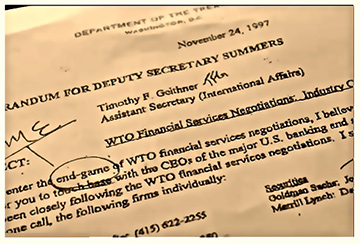
Larry Summers and the Secret “End-Game” Memo

August 26, 2013


palast1When a little birdie dropped the End Game memo through my window, its content was so explosive, so sick and plain evil, I just couldn’t believe it.

The Memo confirmed every conspiracy freak’s fantasy: that in the late 1990s, the top US Treasury officials secretly conspired with a small cabal of banker big-shots to rip apart financial regulation across the planet. When you see 26.3% unemployment in Spain, desperation and hunger in Greece, riots in Indonesia and Detroit in bankruptcy, go back to this End Game memo, the genesis of the blood and tears. The Treasury official playing the bankers’ secret End Game was Larry Summers. Today, Summers is Barack Obama’s leading choice for Chairman of the US Federal Reserve, the world’s central bank. If the confidential memo is authentic, then Summers shouldn’t be serving on the Fed, he should be serving hard time in some dungeon reserved for the criminally insane of the finance world.

The memo is authentic.

To get that confirmation, I would have to fly to Geneva and wangle a meeting with the Secretary General of the World Trade Organization, Pascal Lamy. I did. Lamy, the Generalissimo of Globalization, told me,
“The WTO was not created as some dark cabal of multinationals secretly cooking plots against the people…. We don’t have cigar-smoking, rich, crazy bankers negotiating.”

Then I showed him the memo.

It begins with Summers’ flunky, Timothy Geithner, reminding his boss to call the then most powerful CEOs on the planet and get them to order their lobbyist armies to march:
“As we enter the end-game of the WTO financial services negotiations, I believe it would be a good idea for you to touch base with the CEOs….”
To avoid Summers having to call his office to get the phone numbers (which, under US law, would have to appear on public logs), Geithner listed their private lines. And here they are:
Goldman Sachs: John Corzine (212)902-8281

Merrill Lynch: David Kamanski (212)449-6868

Bank of America, David Coulter (415)622-2255

Citibank: John Reed (212)559-2732

Chase Manhattan: Walter Shipley (212)270-1380

Lamy was right: They don’t smoke cigars. Go ahead and dial them. I did, and sure enough, got a cheery personal hello from Reed–cheery until I revealed I wasn’t Larry Summers. (Note: The other numbers were swiftly disconnected. And Corzine can’t be reached while he faces criminal charges.)

It’s not the little cabal of confabs held by Summers and the banksters that’s so troubling. The horror is in the purpose of the “end game” itself.

Let me explain:

The year was 1997. US Treasury Secretary Robert Rubin was pushing hard to de-regulate banks. That required, first, repeal of the Glass-Steagall Act to dismantle the barrier between commercial banks and investment banks. It was like replacing bank vaults with roulette wheels.

Second, the banks wanted the right to play a new high-risk game: “derivatives trading.” JP Morgan alone would soon carry $88 trillion of these pseudo-securities on its books as “assets.”

Deputy Treasury Secretary Summers (soon to replace Rubin as Secretary) body-blocked any attempt to control derivatives.

But what was the use of turning US banks into derivatives casinos if money would flee to nations with safer banking laws?

The answer conceived by the Big Bank Five: eliminate controls on banks in every nation on the planet – in one single move. It was as brilliant as it was insanely dangerous.

How could they pull off this mad caper? The bankers’ and Summers’ game was to use the Financial Services Agreement, an abstruse and benign addendum to the international trade agreements policed by the World Trade Organization.

Until the bankers began their play, the WTO agreements dealt simply with trade in goods–that is, my cars for your bananas. The new rules ginned-up by Summers and the banks would force all nations to accept trade in “bads” – toxic assets like financial derivatives.

Until the bankers’ re-draft of the FSA, each nation controlled and chartered the banks within their own borders. The new rules of the game would force every nation to open their markets to Citibank, JP Morgan and their derivatives “products.”

And all 156 nations in the WTO would have to smash down their own Glass-Steagall divisions between commercial savings banks and the investment banks that gamble with derivatives.

The job of turning the FSA into the bankers’ battering ram was given to Geithner, who was named Ambassador to the World Trade Organization.

Bankers Go Bananas

Why in the world would any nation agree to let its banking system be boarded and seized by financial pirates like JP Morgan?

The answer, in the case of Ecuador, was bananas. Ecuador was truly a banana republic. The yellow fruit was that nation’s life-and-death source of hard currency. If it refused to sign the new FSA, Ecuador could feed its bananas to the monkeys and go back into bankruptcy. Ecuador signed.

And so on–with every single nation bullied into signing.

Every nation but one, I should say. Brazil’s new President, Inacio Lula da Silva, refused. In retaliation, Brazil was threatened with a virtual embargo of its products by the European Union’s Trade Commissioner, one Peter Mandelson, according to another confidential memo I got my hands on. But Lula’s refusenik stance paid off for Brazil which, alone among Western nations, survived and thrived during the 2007-9 bank crisis.

China signed–but got its pound of flesh in return. It opened its banking sector a crack in return for access and control of the US auto parts and other markets. (Swiftly, two million US jobs shifted to China.)

The new FSA pulled the lid off the Pandora’s box of worldwide derivatives trade. Among the notorious transactions legalized: Goldman Sachs (where Treasury Secretary Rubin had been Co-Chairman) worked a secret euro-derivatives swap with Greece which, ultimately, destroyed that nation. Ecuador, its own banking sector de-regulated and demolished, exploded into riots. Argentina had to sell off its oil companies (to the Spanish) and water systems (to Enron) while its teachers hunted for food in garbage cans. Then, Bankers Gone Wild in the Eurozone dove head-first into derivatives pools without knowing how to swim–and the continent is now being sold off in tiny, cheap pieces to Germany.

Of course, it was not just threats that sold the FSA, but temptation as well. After all, every evil starts with one bite of an apple offered by a snake. The apple: The gleaming piles of lucre hidden in the FSA for local elites. The snake was named Larry.

Does all this evil and pain flow from a single memo? Of course not: the evil was The Game itself, as played by the banker clique. The memo only revealed their game-plan for checkmate.

And the memo reveals a lot about Summers and Obama.

While billions of sorry souls are still hurting from worldwide banker-made disaster, Rubin and Summers didn’t do too badly. Rubin’s deregulation of banks had permitted the creation of a financial monstrosity called “Citigroup.” Within weeks of leaving office, Rubin was named director, then Chairman of Citigroup—which went bankrupt while managing to pay Rubin a total of $126 million.

Then Rubin took on another post: as key campaign benefactor to a young State Senator, Barack Obama. Only days after his election as President, Obama, at Rubin’s insistence, gave Summers the odd post of US “Economics Tsar” and made Geithner his Tsarina (that is, Secretary of Treasury). In 2010, Summers gave up his royalist robes to return to “consulting” for Citibank and other creatures of bank deregulation whose payments have raised Summers’ net worth by $31 million since the “end-game” memo.

That Obama would, at Robert Rubin’s demand, now choose Summers to run the Federal Reserve Board means that, unfortunately, we are far from the end of the game.

Tuesday, May 15, 2012

Deficit Reduction: The Great Distraction


by Dean Baker
 
 
This is the week of the third annual Deficit Fest, the event sponsored by Wall Street billionaire Peter G. Peterson. At this event, many of the people most responsible for the current downturn come together to tell us why we should be worried about the deficit at a time when 45 million people are unemployed, underemployed or have given up looking for work altogether and millions face the prospect of losing their homes.

Past deficit fests included exchanges where Peter Peterson and former Treasury Secretary and Citigroup honcho Robert Rubin mused about their comparative net worth. We also got to witness President Clinton bemoan the fact that the Democratic and Republican leadership in Congress teamed up to prevent him from cutting Social Security. Had Clinton gotten his way, millions of seniors would be getting by on Social Security checks that are more than 10 percent smaller than what they now receive.

Peterson is also known for his sponsorship of the "Economic Sleepwalk" tour, which was officially billed as the "Fiscal Wakeup" tour. This involved sending a group of policy wonks around the country to complain about the budget deficit at a time when the housing bubble was growing to ever more dangerous levels. While some of us were doing our best to warn of the imminent disaster, Peterson was using his money and political connections to dominate media space at a time when the country's debt-to-GDP ratio was actually falling.

But why harp on the past? We should be focused on the future.

And one of the items that this group would like to see in our future is a deficit deal like the one proposed by Erskine Bowles and former Senator Alan Simpson, the co-chairs of President Obama's deficit commission. (The Bowles-Simpson plan is inaccurately referred to on the commission's website as a report of the commission, ironically on a page titled "Moment of Truth." In fact, it is only the report of the co-chairs since it did not receive the 14 votes needed to be approved as an official report of the commission.)

This plan includes a wide range of budget cuts, including cuts to Social Security and Medicare. It would reduce the annual Social Security cost-of-living adjustment by 0.3 percent, which would lower lifetime benefits by an average of more than 3 percent. It would also raise the retirement age for Social Security. To balance these cuts to programs that benefit tens of millions of ordinary workers, Bowles and Simpson would cut the corporate tax rate from 35 to 28 percent and would lower the tax rate paid by the very wealthy from 40 percent to 28 percent. While these reductions in tax rates are supposed to be offset by the elimination of loopholes that benefit the wealthy, people have good cause for skepticism.

If these policies seem out of step with the interests of ordinary workers, it should not be surprising given their parentage. Erskine Bowles in particular could be the poster boy for everything that is wrong in national politics today. Bowles rose to become chief of staff in the Clinton White House in the 90s. He then twice competed unsuccessfully for Senate seats in North Carolina. As a consolation prize he became the President of the University of North Carolina.

Since it is hard to make ends meet on a university president's salary these days, Mr. Bowles also did a little bowling for dollars. He moonlighted as a director on corporate boards, serving stints at Morgan Stanley, the huge Wall Street investment bank, General Motors (until it went bankrupt), and most recently Facebook.

Being a director on a corporate board typically involves attending 4-8 meetings a year. For this, directors receive several hundred thousands of dollars in compensation. For example, in 2008 Erskine Bowles received $335,000 in compensation for his work on Morgan Stanley's board.

This year is noteworthy because Morgan Stanley's dealings in mortgage-backed securities brought it to the edge of bankruptcy in the fall of 2008. It was only saved from disaster by the generous intervention of Ben Bernanke. He allowed the bank to change its status in the middle of the post-Lehman crisis, and become a bank holding company. This gave it the protection of the Fed and the FDIC.

Given this near brush with death, shareholders might ask what Mr. Bowles did for the $335,000 that we paid him. "We" is appropriate in this sentence, since much of the public has a stake in Morgan Stanley either through an index fund in a 401(k) that likely holds some of the company's stock or the defined benefit pensions that most state and local governments still have for their workers.

In fact, we should be asking this question of directors more generally. When shareholders voted "no" last month on the pay package of Citigroup's CEO, Vikram Pandit, they were saying that the company's well-paid board was not doing its job. These directors were getting paid $250,000 each year for just a few days' work. Their job is precisely to prevent such outlandish pay packaged for top management.

The failure of these highly paid directors is a major national problem. Their compensation looks more like payoffs than paychecks. After their palms get greased, they look the other way when the CEOs walk away with tens or even hundreds of millions of dollars of the shareholders' money. And the outsized pay of the CEOs corrupts pay scales throughout the economy. Even heads of charities can now command pay packages in excess of $1 million a year.

Anyhow, when we hear Erskine Bowles and his friends rant about the deficit this week, we should remember that once again they are distracting the public from the country's real problems. And this crew is at the center of those problems; it is not the solution.

Thursday, February 2, 2012

The Democrats Who Unleashed Wall Street and Got Away With It

Thursday, February 2, 2012 by TruthDig.com
by Robert Scheer

That Lawrence Summers, a president emeritus of Harvard, is a consummate distorter of fact and logic is not a revelation. That he and Bill Clinton, the president he served as treasury secretary, can still get away with disclaiming responsibility for our financial meltdown is an insult to reason.

Yet, there they go again. Clinton is presented, in a fawning cover story in the current edition of Esquire magazine, as “Someone we can all agree on. ... Even his staunchest enemies now regard his presidency as the good old days.” In a softball interview, Clinton is once again allowed to pass himself off as a job creator without noting the subsequent loss of jobs resulting from the collapse of the housing derivatives bubble that his financial deregulatory policies promoted.

At least Summers, in a testier interview by British journalist Krishnan Guru-Murthy of Channel 4 News, was asked some tough questions about his responsibility as Clinton’s treasury secretary for the financial collapse that occurred some years later. He, like Clinton, still defends the reversal of the 1933 Glass-Steagall Act, a 1999 repeal that destroyed the wall between investment and commercial banking put into place by Franklin Roosevelt in response to the Great Depression.

“I think the evidence is that I am right about that. If you look at the big players, Lehman and Bear Stearns were both standalone investment banks,” Summers replied, referring to two investment banks allowed to fold. Summers is very good at obscuring the obvious truth—that the too-big-to-fail banks, made legal by Clinton-era deregulation, required taxpayer bailouts.

The point of Glass-Steagall was to prevent jeopardizing commercial banks holding the savings of average citizens. Summers knows full well that the passage of the repeal of Glass-Steagall was pushed initially by Citigroup, a mammoth merger of investment and commercial banking that create the largest financial institution in the world, an institution that eventually had to be bailed out with taxpayer funds to avoid economic disaster for millions of ordinary Americans. He also knows that Citigroup—where Robert Rubin, who preceded Summers as Clinton’s treasury secretary, played leading roles during a critical time—specialized in precisely the mortgage and other debt packages and insurance scams that were the source of America’s economic crisis.

Even Clinton, in a rare moment of honest appraisal of his record, conceded that his signing of the Commodity Futures Modernization Act (CFMA), legalizing those credit default swaps and collateralized debt obligations, was based on bad advice. That advice would have had to come from Summers, his point man pushing the CFMA legislation, which Clinton signed into law during his lame-duck days.

When the British interviewer reminded him of Clinton’s comment, Summers, as is his style, simply bristled: “Again, you make everything so simple, when in fact it’s complicated. Would it have been better if the whole financial reform legislation had passed in 1999, or 1998, or 1992? Yes, of course it would have been better. But … at the time Bill Clinton was president, there essentially were no credit default swaps. So the issue that became a serious problem really wasn’t an issue that was on the horizon.”

That is a lie. Credit default swaps had been sold at least since 1991, and collateralized debt obligations of all sorts quickly became the rage during the Clinton years. Summers surely remembers that Brooksley Born, the legal expert on such matters that Clinton appointed to head the Commodity Futures Trading Commission (CFTC), warned about the ballooning danger of those unregulated derivatives. Born, who served with Summers as one of four members of the President’s Working Group on Financial Markets, tried repeatedly and in vain to get her colleagues to act. When her pleas fell on deaf ears she issued a “concept release” calling attention to an unregulated derivatives market that was even then spiraling out of control.

The CFMA legislation that Summers pushed and Clinton signed was a specific rebuke to Born’s efforts. As Summers testified at the time before a Senate committee: “As you know, Mr. Chairman, the CFTC’s recent concept release has been a matter of great concern, not merely to Treasury, but to all those with an interest in the OTC [over-the-counter] derivatives market. In our view, the Release has cast the shadow of regulatory uncertainty over an otherwise thriving market—raising risks for stability and competitiveness of American derivative trading. We believe it quite important that the doubts be eliminated.”

Those doubts were eliminated by the new law exempting all of that troubling OTC derivatives trading from all existing regulations and regulatory agencies. Summers argued in his congressional testimony that there was no reason for any government regulation of what turned out to be tens of trillions of dollars in toxic assets:

“First, the parties to these kinds of contracts are largely sophisticated financial institutions that would appear to be eminently capable of protecting themselves from fraud and counterparty insolvencies and most of which are already subject to basic safety and soundness regulation under existing banking and securities law.

“Second, given the nature of the underlying assets involved—namely supplies of financial exchange and other financial instruments—there would seem to be little scope for market manipulation of the kind seen in traditional agricultural commodities, the supply of which is inherently limited and changeable.”

Has any economist ever gotten it so wrong?

Thursday, August 4, 2011

The Change That Didn't Happen

Obama and the Capitalists
By ERIC TOUSSAINT and DANIEL MUNEVAR

With the announcement of the candidacy of Barack Obama for President of the United States in 2012, the campaign trail has officially started. Contrary to what one might have expected two years ago, Obama faces a tough re-election challenge. Furthermore, a victory does not seem guaranteed. Despite the stabilization of the financial system, achieved through a massive handout of public resources without any type of restrictions to the same people responsible for generating the crisis, the real economy is still awaiting the arrival of a true economic recovery.

While 89% of the benefits of economic growth in the United States during the Obama administration have gone to the corporate sector, ordinary citizens continue to face a harsh situation characterized by high levels of unemployment, a reduction of income as well as record numbers of foreclosures across the nation. It is precisely the inability of the administration to provide answers and solutions to the pressing problems of the population that calls into question its ability to win the election, despite having an advertisement budget of more than a billion dollars available for this purpose.

However, this situation is not surprising if we take into consideration the decisions Obama has made since 2008. A large proportion of the millions of voters who supported him were expecting for the new elected president to appoint a team of progressive economists which would  promote a modern version of the New Deal. A large proportion of the millions of voters who supported him were expecting for the new elected president to appoint a team of progressive economists which would  promote a modern version of the New Deal, with the objective of reforming capitalism and starting a new era of regulation of the economy. As it happened, reality was quite different. Obama instead decided to chose the most conservative economists close to the Democrats. Those responsible of promoting the de-regulation of the financial system under President Bill Clinton. When we stop and observe three emblematic names, the coherence of his choice is revealing.

The first of these advisers is Robert Rubin, Secretary of the Treasury from 1995 to 1999. Rubin was co-chair and co-CEO of Goldman Sachs from 1990-92 before he joined the Clinton administration. Upon arrival to the Treasury, Rubin was faced with the first major failure of the neoliberal model in the nineties, the Tequila Crisis in Mexico. Afterwards he strongly supported, along the IMF, the implementation of harsh austerity measures that aggravated the financial crisis experienced by South East Asia countries in 1997-1998, shortly followed by the crisis in Russia and Latin America. Rubin has never doubted the benefits of liberalization and decisively contributed to impose policies on developing countries that undermined the living conditions of its population and greatly increased inequality. In the United States, exerted its powerful influence to secure the repeal of the Glass Steagall Act, enacted in 1933. This law, among other things, made emphasis in the incompatibility of deposit and investment banking, creating a clear cut division among the two activities. Once Glass Steagall was abolished, the door was open for all sorts of greedy rentiers eager for maximum profits regardless of the risk, which ended up creating the conditions for the recent economic crisis. To close the loop, the repeal of the Glass Steagall Act allowed the merger of Citicorp with Travelers Group to form the banking giant Citigroup. In 2000, Robert Rubin joined the leadership of Citigroup, which the U.S. government had to bailout in November 2008, guaranteeing more than 300 billion dollars in assets! Its important to point out that the services provided by Rubin as chairman of Citigroup's executive committee were generously rewarded. According to the Financial Times, Rubin received over 118 million dollars in salary plus bonuses and stock between 1999 and 2008. (3) However, it was during his participation of the Board of Directors when Citigroup plunged into an increasingly risky financial policy that led to the fiasco which ended up costing the U.S. Treasury the astronomical sum of 45 billion dollars.

The second adviser on stage is Lawrence Summers, who inherited the post of director of the National Economic Council at the White House during the first half of the Obama administration. However, his career includes a number of stains which should be permanent. In December 1991, while he was chief economist of the World Bank, Summers dared to write in a memo: "Countries with small populations in Africa have a very low pollution. Air quality is uselessly higher than in Los Angeles or Mexico. It is necessary to encourage the movement of polluting industries to the LDCs. There must be some degree of pollution in countries where wages are lower. I think the economic logic which dictates that toxic waste should be directed where wages are lower is inexorable. [...] The concern [about the toxic agents] will obviously be higher in a country where people live many years and therefore more likely get cancer, than in a country where infant mortality in children under 5 years old, is 200 per thousand. With Summers in charge, productivist capitalism would enjoy a splendid future.

Having been named Secretary of the Treasury under President Clinton in 1999, Summers put pressure on the World Bank president, James Wolfensohn, to get rid of Joseph Stiglitz who had succeeded him in the post of chief economist of the Bank. Stiglitz was very critical of neoliberal policies that Summers and Rubin pursued in all parts of the world where financial crisis took place. After the arrival of George W. Bush, Summers continued his career by becoming president of Harvard University in 2001. He came back to the spotlight in February 2005, when he won the enmity of the entire university community after a discussion at the National Bureau of Economic Research (NBER) . Asking himself questions about the reasons why there are few women in prominent positions in science, Summers pointed out that women are less equipped than men for science, ruling out any other possible explanation such as social or family background or tendencies towards discrimination. This statement caused great controversy, both inside and outside the university . Despite of apologizing for his remarks, the protests of a majority of teachers and students of Harvard forced him to resign in 2006.

His biography, which is available on the website of Harvard University at the time of his presidency, stated that he "led the effort implementation of most important financial deregulation of the past 60 years". You could not be clearer! Lawrence Summers resigned in September 2010 to his post in the National Economic Council at the White House.

The third adviser in question is Paul Volcker, who as chairman of the Federal Reserve dramatically increased interest rates in the United States in October of 1979. This interest rate hike became the main trigger of the public debt crisis in both South and the North of the planet, in the early 80's

The fourth adviser chosen by Obama, Timothy Geithner, has been named Secretary of the Treasury. Before his appointment in the cabinet, Geithner was  the President of the New York Federal Reserve. He was deputy Secretary of the Treasury for International Relations between 1998 and 2001, working under the supervision of Rubin and Summers, and active in Brazil, Mexico, Indonesia, South Korea and Thailand. All these countries which suffered severe crisis during that period and became symbols of the disasters brought by neoliberalism. The policies promoted by the aforementioned group of economists displaced the burden of the cost of the financial crisis upon the back of the population of the countries affected. Rubin and Summers are Geithner mentors. In February 2009, Geithner was about to lose his appointment because the press revealed that he had defrauded the Treasury by hiding a payment received from the IMF. The loss for the Treasury due to uncollected taxes amounted to 34.000 dollars . Finally, to secure his nomination, Geithner repaid his debt to the Treasury. With Obama, Geithner continues to defend the major private financial institutions, deaf to the fundamental human rights, ridiculed in the U.S. and everywhere because of the economic policies he vehemently defends.

Barack Obama's decision was not trivial. He was in a position to change the terms of the policy discussion by appointing advisors with a Keynesian background. Economists like Joseph Stiglitz, Paul Krugman, Nouriel Roubini and James K. Galbraith were willing to take on this responsibility. Nevertheless, Obama chose some economists responsible for the deregulation of the financial sector in the 90‘s. In other words, friends or agents of Wall Street.

The economic policies that Barack Obama and his team enacted in 2009 are far from those proposed in 1933 by Franklin D. Roosevelt's in the first 100 days of his administration.

The Change That Was Not
Despite being elected on the premise of hope and change, 2 years in power have shown that Obama is more than happy to fulfill the role of a mere guardian of the status quo. Contrary to the expectations of certain sectors, the Obama administration stayed on the course set by the Bush administration in key issues on foreign and economic policy. The difference between the two governments has been then more a matter of style than substance.

The lack of concrete actions to address the social crisis that originated in the economic and financial collapse of 2008, have eroded the liberal base which initially supported the Obama administration. To date, 14.4 million families have lost their homes since the beginning of the crisis and about 25 million people are in a situation of unemployment or precarious employment. The policies implemented so far, have been designed to support and ensure the survival of financial institutions responsible for the economic crisis instead of addressing the urgent needs of a large segment of the U.S. population.

Given the composition of the Obama administration's economic team the path followed should not have represented any surprises. People directly responsible for the excesses of financial institutions in their capacity as regulators of the system, such as Timothy Geithner or Ben Bernanke, faced from the beginning serious conflicts of interest. Their interest rest squarely on concealing their responsibility rather than on promoting the implementation of measures aimed at overcoming the economic crisis. Losing sight of this element of individual responsibility, on political and legal terms, would prevent understanding how on the face of allegations of abuse by financial institutions in the eviction of families from their homes or speculation with the bailout funds provided by the government, The White House has defended the interests of Wall Street over and over again.

However, it is clear that the biggest capitulation to the financial sector was the Frank-Dodd Financial Reform Act. Missing on the opportunity to restrain the excesses of financial sector that was presented with the crisis, the Obama administration carried out the implementation of a reform that completely fails to impose controls on critical areas of operation of finance. 

Adopted in 2010, this law not only allows the use of dubious accounting practices which allow to hide losses in the balance sheets of financial institutions, but also strengthens the prerogatives of the institutions deemed "too big to fail". It also completely brushes aside the regulation of financial derivatives. It is this lenient attitude towards the financial sector by the Obama administration which allows to understand how not a single executive of the sector has been prosecuted for a financial collapse, that as early as 2004 the FBI had characterized as an epidemic of mortgage fraud.

On the face of this situation is not surprising that the American people has turned their backs to the Democratic Party in the Congress and Senate elections that were held in November 2010. With an ultra-conservative discourse, and taking advantage of the uncertainty and anxiety cause by the economic crisis, the Republican Party regained control of Congress and threatens to take control of the Senate in 2012. In response to the loss of Congress, Obama ordered some changes in its economic team, with the departure of prominent members, such as Lawrence Summers, Cristina Roehmer and Paul Volcker. However, the name of the replacements indicates that the changes are merely cosmetic in nature. These include Gene Sperling, another former Clinton administration advisor which strongly advocates in favor of tax cuts, and William Daley, the former Midwest Chairman of JPMorgan, running the Chicago office. 

Since taking control of the Congress in of November 2010, the Republicans have consistently blocked all of the initiatives brought forward by the Obama administration, taking full advantage of the control that the Congress has over the government budget and the debt ceiling. The Republican strategy of systematically blocking government efforts, thus decreasing the chances of its reelection, has reached its clearest expression with the ongoing battle to raise the Federal debt ceiling. A prerogative of the Congress of the United States, the debt ceiling sets a maximum amount of debt that can be issued by the Federal Government and was created as a mechanism to exercise control by the legislative branch of the government over the executive power. Historically, the increases of the debt ceiling have been carried out as an afterthought of the political process. However in the current situation, and as it was the case in 1995, the Republicans have used their control of Congress to force the government to make cuts in social spending at the risk of refusing to raise the debt limit. The 2nd of August, Obama gave in to their demands.

If we can learn from recent history, the most affected by cuts in public spending will be the unemployed and poor of the American society, while bankers and speculators will continue to be protected by the Obama administration. This definitely was not the change that the American people had in mind when they voted for Obama in 2008.

Thursday, August 26, 2010

List of Goldman Sachs People in the Obama Government

Names Attached to the Giant Squid’s Tentacles 
By: fflambeau Tuesday April 27, 2010

At a time when Congressional hearings are set to call testimony from some Goldman Sachs employees, it is vital to understand how widespread that institution’s ties are to the Obama administration. This diary shows the pervasive influence of Goldman Sachs and Goldman created institutions (like the Hamilton Project embedded in the Brookings Institution), employees and influence peddlers in the Obama administration.

While many of the people listed below formerly worked for Goldman Sachs or its offshoots (like the Hamilton Project, including all three of that project’s first Directors) influence can be exerted not only through people but through money, awards, sponsored scholarship, and creation of an agenda favorable to Goldman Sachs (which is where Brookings and the Hamilton Project come in and have proved especially useful to Goldman Sachs).

It is further of note that although Goldman Sachs has been the center of attention especially since Matt Taibbi’s insightful investigative journalism, that I have not been able to find a comprehensive list of the influence of Goldman Sachs in this administration. Recently in the New York Post, for instance, Michelle Malkin wrote a good article called "All the President’s Goldman Men" but she only listed the usual suspects like Larry Summers, Timothy Geithner, Rahm Emanuel, Gary Gensler and Mark Patterson.

But that’s just the tip of the Goldman Sachs iceberg. Here you will find, I believe, the most comprehensive list of people-groups yet available to show how Obama’s administration has really become the Goldman Sachs administration. But I need your help. I suspect there are far more people out there with such ties that I have missed even though I have spent lots of time researching this issue. If you know of other people who should be on this list, please help out and give the details in a comment to this diary.

One further caveat. The Obama administration is not the first administration that Goldman has infiltrated, although it is perhaps the one that has been most completely co-opted from top to bottom. Recall that former Secretary of the Treasury Paulson in the George W. Bush era came from–Goldman Sachs where he was its chief. Recall too that the brilliant, late economist John K. Galbreath has written an entire chapter of a book devoted to the Great Depression and the economic collapse of Wall St. that accompanied it to the role of Goldman Sachs.

Law professor William Black, who participated in actions against individuals in the Savings and Loan collapses decades ago, recently told Bill Moyers recently that:
"The highest return on assets is always a political contribution."
In this spirit we name the first two links between Goldman entities and the Obama administration: they are out of alphabetical order for obvious reasons. All the others are in alphabetical order.

Let’s look at the Goldman Sachs government that we have in place now, that is masked by Barack Obama. Fittingly, we begin with Obama:

OBAMA, BARACK
Although to my knowledge he has never directly worked for Goldman, he has taken boatloads of their money (an investment repaid many times) and he calls Robert Rubin, the former head of Goldman Sachs "my friend Bob". (See the video clip of then Senator Barack Obama’s address to the Goldman-Rubin funded Hamilton Project in a link below where he uses these words and calls for cuts in entitlements and more NAFTA-type agreements).

Jesse Unruh, the late California politician and political thinker, once called "money the mother’s milk of politics." Certainly, Obama sucked at the teats of Goldman Sachs more than any other politician in recent times. It began for him as little-known Senator from Illinois with a razor- thin resume whose ambitions outshine his accomplishments. Obama’s eloquent, heavily prepped address to the Democratic National Convention caught not only the eyes of the Democratic top brass, but that of the big bankers. As early as the Spring of 2006, Senator Barack Obama was intimately involved with Bob Rubin and Goldman Sachs through his involvement with the Hamilton Project.

Fittingly, Senator Obama was chosen by Rubin and the Hamilton Project to give the inaugural address of the Hamilton Project in April, 2006. An excellent, seminal discussion of the Hamilton Project by Dr. Kirk James Murphy, M.D., can be found here. A video clip of then Senator Barack Obama speaking at the inauguration of the Hamilton Project in April, 2006 can be found here and here (with an excellent discussion) and here. Here Obama heaps lavish praise on Robert Rubin ("my friend Bob") and on the Hamilton Project while setting out its (and his subsequent administration’s agenda) of cuts in entitlements, the need for more NAFTA-type free trade pacts and a pro-big corporation government. In 2006 then, Obama was a Goldie and articulating its desires and policies.

Little wonder then, that Goldman and Rubin heavily funded Obama as a Senator (his biggest campaign contributor) and as a presidential candidate. Goldman Sachs employees (and they were not the floor cleaners) contributed $994,795 to Obama’s presidential bid, almost four times the amount they gave to his Republican opponent, according to OpenSecrets. Over Obama’s entire career, Goldman has been his second biggest contributor, according to OpenSecrets, giving him more than $1,051,000. Goldman not only wanted Obama to win, they paid lots of money to insure that their man would occupy the White House. Again, as William Black noted:
"The highest return on assets is always a political contribution."
Goldman’s 30 pieces of silver investment in Obama reaped them billions of dollars in returns as the TARP bailouts and the subsequent news about Goldman Sachs has shown. So although Obama may never have "worked for" Goldman in the traditional sense, he’s one of Robert Rubin’s boys and on Goldman’s books.

University of Minnesota political scientist Prof. Lawrence Jacobs, described the giant squid’s attachment to the Obama administration:
...almost everything that the White House has done has been haunted by the personnel and the money of Goldman . . . as well as the suspicion that the White House, particularly early on, was pulling its punches out of deference to Goldman and its war chest.

BIDEN, JOE
Is it any wonder that between his service as "Senator Credit Card", his efforts to limit busing for desegregation, and his five draft deferments at the height of the Vietnam War that Joe Biden is attached to one of Goldman’s tentacles? Goldman has been a major campaign contributor to Biden and according to OpenSecrets, Biden in 2007 alone took almost $25,000 from the Robert Rubin related Citigroup (Rubin was its head as well as being a former head of Goldman).

And guess who was the keynote speaker at the Hamilton Project 2010 kickoff event a few days ago (April 20th, 2010) Tuesday morning at the Renaissance Mayflower Hotel? That’s right: Vice President Joe Biden spoke at Goldman Sachs/Robert Rubin’s Rosemary’s Baby. You can see some pics of Biden at the Hamilton Project event along with who else–Robert Rubin–here.

As described by the Huffington Post:
Biden was speaking at the relaunch of the Hamilton Project, a think tank founded by ultimate Wall Street Democrat Robert Rubin to publicly despair about the deficit and other things bankers worry about the most.
Note too that in his address Biden paid tribute to Obama’s bipartisan deficit commission, something that the Hamilton Project and Robert Rubin (and Goldman) have been pushing for years because it really means cuts in entitlements (again, have a look at Sen. Obama’s 2006 speech at the Hamilton Project where he calls for entitlement cuts).


ALTMAN, ROGER
Interestingly, the man who introduced Joe Biden at the Hamilton Project’s relaunch (described above) was none other than Roger Altman, who is connected to the Hamilton Project.

Altman may not hold down a desk job in the Obama administration–he’s too big a fish for that just as is Robert Rubin–but he is one of those power brokers with all encompassing contacts within the Democratic Party. Altman is a Hamilton Project member, according to Dan Frumkin’s excellent article in the Huffington Post, as well as having served as Assistant Secretary of the Treasury under none other than Mr. Goldman Sachs, Robert Rubin. He is now now Chairman of Evercore Partners, which the Hamilton Project program described as "the most active investment banking boutique in the world." (and the Obama administration is trying to sell itself as one that is getting tough on big banks and Goldman?).

Like so many of the Goldman people, Altman has a touch of scandal/criminality about him. According to Wikipedia, Altman was forced from his position as Assistant Treasury Secretary because of a records keeping scandal.

Altman is a co-author, along with Robert Rubin, of the Hamilton Project’s "From Recession to Recovery to Renewal: An Economic Strategy to Achieve Broadly Shared Growth." Some of Altman’s ties to the Goldman-Rubin funded Hamilton Project can be seen here.


BRAINARD, LAEL
Brainard is the United States Under Secretary of the Treasury for International Affairs in the administration of President Barack Obama. She is an associate and protege of Mr. Goldman Sachs, Robert Rubin. She has written numerous articles and bookson the joys of outsourcing work overseas.

Brainard also worked at Brookings which has embedded within in Goldman Sachs and Robert Rubin’s Hamilton Project. Goldman was clever in doing this because they hid a conservative thinking, pro business group like a Trojan Horse in what is generally perceived as a liberal think tank.

Like Timothy Geithner, who is her boss, Brainard is a brainy person who had trouble with income tax rules and regulations, thus joining quite a lengthy list of Goldies who ape the law. The Washington Post reported that:
Brainard’s nomination was held up by Republican concerns over allegations that she failed to pay property taxes on time. (What is it with Treasury and tax problems?)

BUFFETT, WARREN
Speaking of big fish, Warren doesn’t need to work for the US government or for Goldman. But he’s invested billions in Goldman expecting even greater returns. Obama has also admitted in the debates to "pal’in around" with the Sage of Omaha and Buffett is one of Obama’s fundraisers and economic advisers.
For more on Buffett see this written by Michael Winship at Truthout:
On Friday, Susan Pulliam reported on the front page of The Wall Street Journal that, "A Goldman Sachs Group Inc. director tipped off a hedge-fund billionaireabout a $5 billion investment in Goldman by Warren Buffett’s Berkshire Hathaway Inc. before a public announcement of the deal at the height of the 2008 financial crisis, a person close to the situation says." 
As the Journal notes, the Buffet deal came at a key point in the Wall Street collapse, restoring confidence in the markets and lifting Goldman’s stock from a 40 percent slide to a 45 percent surge. The hedge-fund billionaire in question is Raj Rajaratnam, whose Galleon Group currently is embroiled in one of the biggest insider trading scandals in history: 21, including Rajaratnam, have been charged; 11 already have pled guilty.

CLINTON, HILLARY
Although Barack Obama was the overwhelming favorite of Goldman Sachs to be president in 2008, for he could serve as their Trojan Horse, they were smart enough to hedge their bets, so to speak and back Hillary too. According to the Washington Examiner, Goldman Sachs in 2008 alone gave:
($415,595.63 inflation adjusted), which was itself almost three times as much as Bush received as well.
And of course, it was Hillary’s hubby Bill Clinton who chose ex-Goldman chief Robert Rubin to serve in his White House. Bill, Hillary and Bob Rubin are Washington, D.C. kissing cousins.


CRAIG, GREGORY
Another example of the revolving door between Goldman Sachs and Obama’s administration. Craig served as Obama’s White House Counsel and after resigning, has taken on a position as Goldman Sach’s chief lawyer in defending against its SEC suit. A former Goldie, Robert Hormats, sits at the top of SEC’s enforcement group too. What a hoot!

Note that Craig is a lawyer and lawyer’s rules of professional responsibility prohibit not only direct conflicts of interest but anything that hints at a conflict of interest.

Here is doubtlessly why Goldman wanted Craig as its top lawyer in the SEC complaint:
Greg Craig, Obama’s first White House counsel, has joined Goldman, we learned this week. He may not have too much pull in the West Wing, which drove him out for hewing too close to Obama’s campaign promises, but as a former insider he will provide valuable intelligence to the world’s largest investment bank.
Read more at the Washington Examiner:


DONILON, THOMAS
Thomas Donilon is Deputy National Security Adviser to Barack Obama (despite having a career that is mostly involved with domestic politics). Donilon was a lawyer at O’Melveny and Myers and made almost $4 million representing meltdown clients including Penny Pritzker (of Chicago) and Goldman. This from Michelle Malkin’s article RealClearPolitics. More information is available on Donilon over at Whorunsgov.com.


DUDLEY, BILL
Joined Goldman in 1986; partner and managing director until 2007. Federal Reserve Bank of New York President since January 2009 (replacing none other than Timothy Geithner, his Goldman compadre). This all from the Wall Street Journal.


ELMENDORF, DOUGLAS
Elmendorf became Obama’s Director of the Congressional Budget Office in January 2009. Elmendorf previously was the Director of the Hamilton Project; it’s third.

Note too that the first 3 Directors of the Hamilton Project ALL serve in the Obama administration. While other journalists/writers have explored the links between Goldman Sachs and Obama, few have looked at the connection between the Hamilton Project and the Obama administration. Note again that the Hamilton Project was funded by Robert Rubin and Goldman Sachs. Note too that the current director of the Hamilton Project, its 4th since its founding in 2006, is Michael Greenstone. How long will it be before Greenstone goes to the Obama administration, making it a perfect 4 for 4 for Directors of the Goldman funded Hamilton Project? To show that there is a revolving door between the Obama Administration and Goldman/Rubin/Hamilton Project, Greenstone served as of Obama’s chief economic advisers.


EMANUEL, RAHM
Rahm, of course, is Obama’s Chief of Staff, the very first person Obama selected to be in his administration. Rahm has lengthy and fruitful ties to Goldman, and vice versa. Rahm took in about $75,000 from Goldman Sachs as a Congressman and was on a $3,000 a month retainer from Goldman while he worked as Bill Clinton’s chief fund raiser.

Timothy Carney has explored some of the links between Emanuel and Goldman Sachs:
…one of Barack Obama’s top sources of funds in this past election, Goldman has always had some particularly strong allies within government. Emanuel is one such ally.
An interesting early chapter in the Goldman-Emanuel relationship took place in the setting of Bill Clinton’s campaign for the White House in 1992. Clinton hired Emanuel as his chief fundraiser. 
At the same time, however, Emanuel was on the payroll of Goldman Sachs, receiving $3,000 per month from the firm to “introduce us to people,” in the words of one Goldman partner at the time. This is certainly a noteworthy relationship, but it’s one that has almost entirely escaped scrutiny. 
Corporations and partnerships are and were at the time prohibited by law from contributing to federal candidates out of the corporate coffers. So, while Rahm tapped Goldman employees personally for six figures in gifts to Clinton’s candidacy—more than any other firm—Goldman, as a company, was helping keep Clinton’s top fundraiser well-fed.

In his four terms in Congress, Emanuel has raised $74,750 from Goldman, making the firm his number four source of funds. Goldman has helped Emanuel. How has Emanuel helped Goldman? 
The most obvious answer, as mentioned in this column two weeks ago, is in Emanuel’s lead role in shepherding the “$700 billion” bailout—first proposed by former a Goldman CEO, Bush Treasury Secretary Henry Paulson—through the skeptical House. 
Of course, back in the Clinton days, Goldman benefited from NAFTA and the bailout of the Mexican currency, with Emanuel pushing NAFTA through Congress, and Rubin hammering out the peso bailout.
McClatchey newspaper’s Greg Gordon, in his article entitled, "Goldman’s White House Connections Raise Eyebrows" also noted how Rahm and Goldman worked together to make money:
One White House insider who knows something about how Wall Street does business is chief of staff Emanuel, who earned millions of dollars in investment banking after he left the Clinton White House. His work for the Chicago-based financial services firm Wasserstein Perella & Co. intersected with Goldman in at least one deal. 
In 1999, Emanuel was a key player representing Unicom Corp., the parent of Commonwealth Edison, in forging its merger with Peco Energy Co. to create utility giant Exelon Corp. Goldman was also advising Unicom. 
The White House declined immediate comment on that connection.
So how real is the Obama/Democratic party’s supposed new toughness on big banks when the administration’s point guard was on the Goldman payroll and become a multi-millionaire through big banks and Wall St. deals?


FARRELL, DIANA
Diana Farrell is Deputy Director of the National Economic Council (since January, 2009) in the administration of President Barack Obama. She formerly worked for two years at Goldman Sachs in New York according to Whorunsgov.com.

In 2003, Farrell was the author of a paper, "Perspective on Outsourcing" in which she argued that sending American jobs overseas might be "as beneficial to the U.S. as to the destination country, probably more so." In a book titled “The Economists’ Voice: Top Economists Take on Today’s Problems,” Farrell wrote a chapter titled “U.S. Offshoring: Small Steps to make it Win-Win.” Her chapter, published in 2008,centered on offshoring.

In the Obama administration, Farrell works with a coven of Goldies including Timothy Geithner and Larry Summers, who is her boss.


FRIEDMAN, STEPHEN
Chairman of Obama’s Foreign Intelligence Advisory Board.

According to Wikipedia, Friedman worked for much of his career with Goldman Sachs, holding numerous executive roles. He served as the company’s co-chief operating officer from 1987 to 1990, was the company’s co-chairman from 1990 to 1992, and the sole chairman from 1992 to 1994; he still serves on the company board.

Friedman was another Goldie involved in controversy, as many of the Goldies have been in government service, involving his former employer. His actions, like other affiliated with Goldman, show scant respect for rules, regulations or laws.

Wikipedia notes:
On May 7, 2009 Friedman resigned as Chairman of the Federal Reserve Bank of New York in response to criticism of his December 2008 purchase of $3 million of stock in Goldman Sachs. Friedman, who remains a member of Goldman Sachs’ board, came into violation of Federal Reserve policy when Goldman was converted to a bank holding company in September 2008, thereby placing it under the regulatory authority of the New York Fed. Friedman requested a waiver from this violation when the conversion occurred, which was granted roughly two and a half months later.

FROHMAN, MICHAEL
Robert Rubin’s Chief of Staff while Rubin served as Secretary of the Treasury and an Obama “head hunter” according to “Rubin Proteges Change Their Tune as They Join Obama’s Team” in the New York Times.


FURMAN, JASON
Furman served as the second Director of the Hamilton Project after Peter Orszag’s departure for the Obama administration and he in turn left the Hamilton Project in June 2008 to direct economic policy for the Obama Presidential Campaign.


FUDGE, ANNE
Obama just appointed Fudge to his budget deficit reduction committee. Fudge has been the pr craftsman for some of America’s largest corporations. She sits, according to the Washington Post, as a Trustee of the Brookings Institution within which the Hamilton Project is embedded.


GALLOGLY, MARK
Gallogly sits on the Hamilton Project’s advisory council. He is also, according to Wikipedia, currently a member of President Barack Obama’s President’s Economic Recovery Advisory Board.


GEITHNER, TIMOTHY
He’s one of the most documented of all people within the Obama administration while serving as Obama’s Secretary of the Treasury. He was named head of the New York Fed by none other George W. Bush, again perhaps underscoring Gore Vidal’s observation that American is run by one corporate party and it has two wings: Republican and Democratic.

While at the head of the New York Fed, Geithner prior to the crisis not only failed to see storm clouds on the horizon, he also in 2008 ordered the bailed out AIG not to disclose its sweetheart payments to big banks including, you guessed it, Goldman Sachs. Geithner also worked with W’s Treasury Secretary Paulson to fashion the TARP agreements whereby billions were handed out to Wall St.

Geithner is a protoge of both Robert Rubin and Larry Summers.

Like other Goldies, Geithner has had trouble with rules, tax regulations and various. Recall that he had trouble at his confirmation hearings over his tax returns. Whorunsgov sums them up:
At the end of the Clinton administration, Geithner moved to the International Monetary Fund, where he was director of policy development. That period led to a blot on his personal record. The IMF, unlike most employers, does not pay the employer match on Social Security and Medicare taxes. Geithner was responsible for paying those taxes himself. He did not to do so until he was audited in 2005, and even then only paid the back taxes for 2003 and 2004. He did not pay the back taxes for 2001 and 2002 until after Obama tapped him to be Treasury secretary at the end of 2008.
Many of Geithner’s actions profited Goldman Sachs directly or indirectly, such as Geithner’s decision to deny Goldman’s competitor the same treatment he gave Goldman. As Time magazine noted:
[Geithner]Would not grant Lehman Brothers the right to become a bank-holding company — a status given to both Morgan Stanley and Goldman Sachs just days after Lehman filed for bankruptcy
Lehman Brothers collapsed, leaving Goldman Sachs with fewer competitors and a greater market share.


GENSLER, GARY
Gensler was a Goldman Sachs partner who is Obama’s Commodity Futures Trading Commission head. Gensler is the guy who as a former Treasury official exempted the $58 trillion credit default market from oversight. Those financial instrumentals played a key role in the global economic downturn and led to billions of dollars in profits for banks like Goldman Sachs.


GREENSTONE, MICHAEL
Greenstone is the 4th Director of the Hamilton Project. Just as attorney Craig went from advising Obama to defending Goldman Sachs against the SEC complaint, Greenstone has used the revolving door to go from went an economic adviser position to Obama to one of the Goldman Sachs outlets, in this case its think tank embedded in the Brookings Institution and funded by Goldman and Robert Rubin. All 3 previous Directors of the Hamilton Project work in the Obama administration.


HAMILTON PROJECT, THE
The pro-corporatist think group funded by Goldman Sachs and Robert Rubin and cleverly hidden in the Brookings Institution as their Rosemary’s Baby/Trojan Horse. Espouses cutbacks in entitlements, strict budgetary thinking applied to all social programs (but not the defense department); outsourcing of American jobs overseas; more NAFTA-type agreements. Three of the first 4 Directors of the Hamilton Project serve in the Obama Administration. The fourth went from an economic adviser to Obama to the Hamilton Project.

It might also help to recall that the name "Hamilton Project" is significant. Recall that Alexander Hamilton, after whom the institute was named, had as his most famous dictum that "the people are a great beast." Hamilton espoused a powerful state bank and centralized government and presidency.

Note too that Sen. Barack Obama was the inaugural speaker at the Hamilton Project and lavished praise on "my friend Bob [Rubin]" and called for cuts in entitlements (Social Security) and more NAFTA agreements. This is the same guy who lied to the electorate, then, in union states like Ohio and Pennsylvania during the Democratic primaries when he said "NAFTA needs rethinking." He is firmly and totally behind NAFTA and has done no "rethinking" of it while President and with his party in firm control of Congress.

For more information, see the reading listed below on this subject and the Project’s web site.


HORMATS, ROBERT
The top economics official at Obama’s State Department, Hormats spent the prior 27 years at Goldman Sachs, including as the Vice Chairman of Goldman’s international arm.
Hormat’s appointment to the Obama administration led Glenn Greenwald to this observation:
A Goldman executive as COO of the SEC’s enforcement division. This is all consistent with the observation of Desmond Lachman — previously chief emerging market strategist at Salomon Smith Barney and IMF deputy director — regarding "Goldman Sachs’s seeming lock on high-level U.S. Treasury jobs," which he cited as but one of the many "parallels between U.S. policymaking and what we see in emerging markets."
Imagine how this will play out. The SEC has lodged a complaint against Goldman Sachs. Goldman’s former Vice President in charge of Business Intelligence sits in the SEC’s enforcement division while Obama’s former top lawyer, White House Counsel Gregory Craig, has gone to defend Goldman Sachs!


KASHKARI, NEEL
Former Vice President of Goldman Sachs in San Francisco where he where he led Goldman’s Information Technology Security Investment Banking practice. Kashkari served under Treasury Secretary Paulson and was kept on by Obama after his inauguration for a limited period to work on TARP oversight.


KORNBLUH, KAREN
Sometimes called "Obama’s brain", she serves as Obama’s Ambassador to the OECD. Kornbluh was Deputy Chief of Staff to Mr. Goldman Sachs, Robert Rubin.


LEW, JACOB (AKA "JACK") J.
Lew is the United States Deputy Secretary of State for Management and Resources. According toWikipedia, Lew sits on the Brookings-Rubin funded Hamilton Project Advisory Board. He also served with Robert Rubin in Bill Clinton’s cabinet as Director of OMB.

Like many affiliates of the Hamilton Project, along with Barack Obama, Lew believes that fiscal discipline needs to be applied to Social Security (not much talk about runaway costs in the military budget).According to the New York Times, Lew has testified that:
“Fiscal discipline is essential to protect Social Security and strengthen Medicare, so that both will be there in the years ahead. Reducing the accumulated federal debt will help us to protect these important programs.” (Congressional testimony in March 2000.)
Also like Robert Rubin, Lew has worked with Citicorp. The New York Times reported (same link as above) that:
As executive vice president of New York University, he tangled with a union representing graduate students who help teach courses.

LIPTON, DAVID A
According to Paul Krugman, Lipton is at now at Obama’s National Economic Council and the National Security Council. Lipton worked with Larry Summers and Timothy Geithner, again according to Krugman, on the US response to the Asian financial crisis of the 1990’s. MergeFoundations reports that Lipton worked closely with Robert Rubin:
...[he] advised and assisted Secretary Rubin on many key aspects of international economic policy.

MINDICH, ERIC
Eric Mindich, while not officially serving in the Obama administration, is a strong Obama supporter with extensive ties to the President, according to a Ben Smith/Politico article. Mindich is a hedge fund manager and sits on the Advisory Council of the Hamilton Project and has worked at Goldman Sachs. In fact, he was the youngest ever partner with Goldman Sachs at the age of 27.

According to Wikipedia:
Prior to forming Eton Park in 2004, Mindich spent 15 years at Goldman Sachs in two main roles: leading the firm’s equities risk arbitrage business and managing the firm’s equities division. He joined the firm in 1988 in the equities arbitrage department and ran that department from 1992 until 2000.[1] In 1994, at age 27, he became the youngest partner ever in the history of Goldman Sachs.[1] In 2000, he became co-chief operating officer of the equities division and in 2002 became co-head of the equities division and a member of the Goldman Sachs Management Committee. In 2003, Mindich joined the Executive Office as senior strategy officer and chair of the Firmwide Strategy Committee. 
Another website, Operational Due Diligence at Checkfundmanager, indicates the following about Mindich:
In March of 2009, Eton Park’s [hedge fund founded by him] assets under management were estimated to be around $13 billion. 
An article from April of 2009 lists Mr. Mindich among the “inner circle” of economic advisors to Lawrence H. Summers, who is the current chief economic adviser to President Barack Obama. Mr. Mindich is also listed in another article as being a top level Democrat fundraiser. 
…Eric Mindich, founder of Eton Park fund, reportedly supports Barack Obama’s presidential candidacy (2007). 
…A February 2005 article rattles off a number of impressive credentials for Eric Mindich, including launching the largest hedge fund in history, graduating summa cum laude from Harvard, becoming the youngest ever partner at Goldman Sachs, and being endorsed by former Secretary of the Treasury Robert Rubin.

ORSZAG, PETER
Obama’s Budget Director was the founding director of the Hamilton Project, funded by Goldman Sachs and Robert Rubin. Furthermore, Wikipedia indicates that Robert Rubin, Goldman’s ex-head, was one of Orszag’s mentors.

A BBC article notes Orsag’s commitment to Hamilton Project ideals like cutting the budget (mostly by cutting entitlements) and his ties to Goldman Sachs:
Mr Obama has signalled his determination to keep the budget deficit in check by appointing Peter Orszag, the head of the Congressional Budget Office (CBO), to head the Office of Management and Budget (OMB). 
It is the OMB, rather than the Treasury, that allocates government spending and estimates the size of future budget deficits. 
His appointment could help ease the new president’s relations with Congress.
Peter Orszag is well-known as a fiscal conservative, who is concerned to keep spending and tax cuts in check. 
He was one of the first directors of the Hamilton Project, a Brookings think tank initiative backed by Robert Rubin…
The BBC failed to point out that Goldman Sachs also contributed to funding the Hamilton Project, and he was not "one of the first directors of the Hamilton Project" he was its first Director.


PATTERSON, MARK
Former lobbyist for Goldman Sachs who serves under Timothy Geithner as his top deputy and overseer of TARP bailout funds, $10 billion of which went to Goldman.


RATTNER, STEVE
Ratner is the shady billionaire financier who Obama appointed as his “car czar” and who resigned after it was revealed that his company, the Quadrangle Group, was apparently involved in “pay to play” for a billion dollars or so of New York State pension funds, and was under possible indictment by the New York AG and the SEC, also sits on the Advisory Council of the Goldman funded Hamilton Project.

Rattner is yet another Goldie-Hamilton Project person in trouble with the law. He was the main financial supporter of Harold Ford’s aborted New York Senate run and speculation was that Rattner wanted a Senator to help protect him.


REISCHAUER, ROBERT D
He was a member of the Medicare Payment Advisory Commission from 2000-2009 and was its vice chair from 2001-2008. He too sits on the Hamilton Project’s advisory board.

From this excellent discussion at "Meet Robert Rubin" here’s more information on Reischauer and his extensive links to Robert Rubin:
Robert Reischauer, another policy insider who penned a memo in 2009 with fellow Brookings Institution elites calling for Obama to take "action to stem the growth of Social Security and Medicare," were recently nominated by Obama to be Social Security Trustees. (The Blahous pick he apparently owed to Senator Mitch McConnell.) 
Reischauer has close ties to economic wrecking ball Robert Rubin—the Goldman Sachs chairman who became Clinton Treasury Secretary and pushed through radical deregulatory banking laws, then went to Citigroup to score $120 million for driving his company into the ground. Rubin and Reischauer knew each other at both the Harvard Corporation and the Clinton White House, where Reischauer was director of CBO. Reischauer is on the advisory board of Rubin’s Hamilton Project, and the two most recent CBO directors have come straight from Hamilton.
NOTE: since writing this, it appears the above (and the quote below on Alice Rivkin) comes word for word from an Alternet article by Matthew Skomarovsky found here.


RIVLIN, ALICE
Obama just named in March Alice Rivlin to his so called deficit reduction commission. Have a look at her background and you’ll see why and that Obama has stacked that commission with people who want cuts in entitlements.

Again, an excellent summary of her Goldman-Brookings (read Hamilton Project) Obama connections:
One of Reischauer’s co-signers of the Brookings memo, Alice Rivlin, is another fox Obama has put in charge of the Social Security henhouse. Former Vice Chair of the Federal Reserve under Greenspan at the peak of the tech bubble, and also a Hamilton Project board member, Rivlin will likely make another great Wall Street ally on the commission. In 2004 Rivlin co-authored (with Obama’s current Office of Management and Budget Director Peter Orszag, among others) a 138-page Brookings report titled "Restoring Fiscal Sanity" advocating $47 billion in entitlement cuts, including an "increase in the retirement age under Social Security" and "more accurate inflation adjustments to Social Security benefits."
Wikipedia also says of her:
She is currently on the board of directors of the New York Stock Exchange.
Wikipedia also notes that she has extensive Brookings Institution connections (within which the Hamilton Project is now embedded) including from 1957–66, 1969–75, 1983–93, and 1999 to the present.

Rivlin is a frequent speaker at the Hamilton Project as shown by this page at the Hamilton Project’s web site; you can see videos of her talks and the subjects of her papers here.


RUBIN, JAMES
Son of Robert Rubin (see next entry). Served as a headhunter for Obama per the New York Times article, "Rubin Proteges Change Their Tune as They Join Obama’s Team".


RUBIN, ROBERT
Mr. Goldman Sachs and co-funder, along with Goldman, of the Hamilton Project. Served as the 70th U.S. Sect. of the Treasury under Bill Clinton and spent 26 years at Goldman Sachs becoming its Co-Chairman from 1990-1992. He also served as Chairman of Citigroup. Along with Goldman Sachs, Rubin funded the Hamilton Project embedded in the Brookings Institution. In other words, he embedded within what is perceived as a liberal think tank a Trojan Horse that espouses cutbacks in entitlements (but not Defense budgets), more NAFTA like agreements, outsourcing of jobs overseas and strict budget consciousness applied to health care. Rubin used the same tactic with Barack Obama: choosing an essentially ambitious yet cautious conservative and turning him into a Trojan Horse for his causes and those of Goldman’s/the Hamilton Project’s. Rubin is the de facto President of the United States and he and the Hamilton Project tell Obama and his administration what to do. Obama gets to ride on Air Force One.

According to a recent Politico article:
Behind the scenes, Rubin still wields enormous influence in Barack Obama’s Washington, chatting regularly with a legion of former employees who dominate the ranks of the young administration’s policy team. He speaks regularly to Treasury Secretary Timothy Geithner, who once worked for Rubin at Treasury.

SPERLING, GENE
Prior to advising Timothy Geithner on bailouts, Sperling was paid the paltry sum of $887,727 by Goldman Sachs for one year of consulting work. Sperling, another acolyte of Robert Rubin’s raked in even more that year, according to William Grieder at the Nation:
...[he was paid in addition] $480,051 as a director of the Philadelphia Stock Exchange, plus $250,000 for his quarterly briefings to two hedge funds, plus the speaking gigs [$158,000] (including an appearance before the Stanford Group in Houston subsequently charged with running a Ponzi scheme). Meantime, his day job at the Council on Foreign Relations paid $116,653. A busy, busy wonk.

STORCH, ADAM
Storch worked for Goldman Sachs for 5 years reaching the position of Vice President in the Business Intelligence Group. He is Obama’s Managing Executive of the Security and Exchange Commission’s Division of Enforcement.


SUMMERS, LARRY
It didn’t take Larry Summers long to land a big time job after he crashed and burned as Harvard’s President. He sits at Obama’s right hand as Obama’s chief economic adviser and head of the National Economic Counsel. Summers’s boss at Goldman was non other than Robert Rubin, former co-Chairman of Goldman and also former head of Citicorp.

Summers has reaped nearly $2.8 million in speaking fees to banks and institutions he is now supposed to be helping to regulate and oversee.

Goldman Sachs paid him $135,000 for a single speech he gave in April, 2008, a very good investment repaid many times to Goldman.


CONCLUSION
Although a lot of work and research was put into this list, I am sure I missed many people. But it gives the most comprehensive look ever published at how extensive the Goldman Sachs ties are in the Obama administration and the revolving door between the two (See attorney Craig’s description above).

It also shines light on a subject that has virtually received no mainstream media attention: the importance of the Hamilton Project (funded by Robert Rubin and Goldman Sachs) as the policy voice for their pro-corporate interests. While Matt Taibbi has dissected Goldman, no journalist has looked at the Hamilton Project (Taibbi misses it too) despite the fact that all three of its first directors serve now in the Obama administration. Its current director, its fourth, worked as an economic adviser to Obama Administration and at MIT. It formulate the pro-big business that Goldman wants and spreads it through academia and the Obama administration.

Robert Rubin and Goldman Sachs cleverly disguished their Rosemary’s baby, the Hamilton Project, within the essentially liberal Brookings Institution. Lots of journalists (including the BBC) have been misled by this, thinking that if it comes out of Brookings, it must be liberal or even progressive. Discussing Peter Orszag, the BBC made this blunder:
He was one of the first directors of the Hamilton Project, a Brookings think tank initiative backed by Robert Rubin which aimed to combine fiscal responsibility with progressive politics.
~/~0~/~ 
Not so! The clear message from the Hamilton Project is this: 
1) entitlements must be cut, including Social Security;
2) more jobs must be outsourced overseas;
3) more NAFTA-type agreements must be drafted and entered into;
4) strict budgetary policies must be applied to entitlements and especially health care "reform" (whereas the defense department is skirted).
One only has to look at the Hamilton Project, at Obama’s speech to that group in April, 2006, and the numerous articles and books that they have peddled to see that their outlook is overwhelmingly corporatist and pro-big business. It is, then, ant-iprogressive not liberal and certainly not progressive.

RECOMMENDED FURTHER READING:
1. Greg Gordon (McClatchy Newspapers), "Goldman’s White House Connections Raise Eyebrows" April 21, 2010.
2. Fflambeau, "With the Obama Administration Infested With Goldman Sachs People, How Real is the Obama/Democratic Attack on Big Banks" FDL Diary, April 21, 2010.
3. "More Investigations of Goldman Sachs, A Double-Edge Swords for Obama and Democrats"
4. "Meet Robert Rubin" at MyOpera/Personal Finance Blog
5. Paul Street’s article showing that Obama held corporatist ideas long before elected and his indebtedness to the interests of big business.
6. Matthew Skomarovsky, "Obama Packs Debt Commission with Social Security Looters", March 28, 2010 at Alternet.

ESSENTIAL READING ON THE HAMILTON PROJECT AND ITS TIES TO THE OBAMA ADMINISTRATION:
1. Kirk James Murphy, M.D. "The Hamilton Project: Same Corporatist Whine In New DLC Vessels." THE seminal article on the Hamilton Project which also features a video clip of then Senator Barack Obama talking about "my friend, Bob [Rubin]" and espousing cuts in entitlements and the "need" for more free trade pacts like NAFTA.
2. Fflambeau, "Obama’s ‘Smoking Gun’: His Hamilton Project Speech Shows His Links to Goldman, Entitlement Cuts, Part 1.
3. Fflambeau, "Obama’s ‘Smoking Gun’: His Hamilton Project Speech Shows His Links to Goldman, Entitlement Cuts, Part 2".
4. Another source for Obama’s Hamilton Project speech of April 2006. Contains video clip.
5. James Kirk Murphy, M.D., "Remember the Hamilton Project?" Dr. Murph’s latest look at the Hamilton Project.
6. David Sirota, "Wall Street Democrats Unveil Plan to Undermine Progessives", April 5, 2006.