Showing posts with label Lawrence Summers. Show all posts

Tuesday, March 4, 2014

The Group of Thirty, Financial Crisis Kingpins

February 26, 2014
By Andrew Gavin Marshall
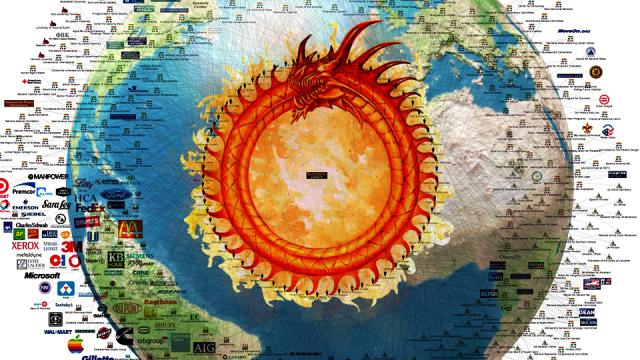


Following parts onetwo and three of the Global Power Project's Group of Thirty series, this fourth and final installment focuses on a few of the G30 members who have played outsized roles both in creating and managing various financial crises, providing a window on to the ideas, institutions and individuals who help steer this powerful global group.


The Assassin of Argentina

Prior to 2008, one of the most notable examples of a highly destructive financial crisis took place in Argentina which, heavily in debt, faced a large default and was brutally punished by financial markets and the speculative assault of global finance, otherwise known as "capital flight." Less known in the story of Argentina’s 1998 to 2002 economic catastrophe was the significant role played by just one man: Domingo Cavallo.

A longtime member of the Group of Thirty, Cavallo formerly served both as Governor of the Central Bank and Minister of Economy in Argentina. He has been referred to by Pulitzer Prize-winning economic researcher Daniel Yergin as “one of the most influential figures in recasting the relationship of state and marketplace in Latin America.”

Between 1976 and 1983, Argentina, ruled by a ruthless military dictatorship, was marred by excessive human rights abuses and persecution of intellectuals and dissidents during the so-called "Dirty War" in which as many as 30,000 people were killed or disappeared. The terror was reminiscent of nearby Chile, where a coup that brought dictator Augusto Pinochet to power in 1973, with the help of the CIA, provided a petri-dish experiment in the implementation of neoliberal "reforms." It was Chile’s dictatorship that set the example, and Argentina’s soon followed.

In a 2002 interview, Domingo Cavallo noted that, “The experience of Chile during the '80s was very instructive, I think, for most Latin American economies, and many politicians in Latin America, because Chile was successful by opening up and trying to expand their exports and in general their foreign trade and getting more integrated into the world economy... And of course we used, particularly here in Argentina, the experience of Chile to go ahead with our own reforms.”

Asked about the association between economic "reforms" in Chile and the ruthless dictatorship that implemented them, Cavallo explained, “There were discussions on the feasibility of implementing market reforms in a democracy. But in 1990... the first democratic president after Pinochet maintained the reforms and also tried to improve on them [and] it was demonstrated that itwould be possible to implement similar reforms under a democratic regime.”

What specific reforms was Cavallo referring to? Under Argentina's military dictatorship, Cavallo served for one year as Governor of the Central Bank in 1982, where he was responsible for implementing a state bailout of corporations and banks. After, Cavallo returned to academic life. But all that changed with the election of Carlos Menem in 1989, who served as president until 1999. In 1991, Menem appointed Cavallo as Minister for Economy, a position he held until 1996.

Cavallo led the neoliberal restructuring of Argentina: pegging the Argentine peso to the U.S. dollar, trying to reduce inflation, undertaking massive privatizations while opening up the economy to “free trade,” and deregulating financial markets. The New York Times in 1996 heaped praise on Cavallo for his “constructive” role in leading the economy “back to vitality and international respectability,” despite the fact that his reforms “brought high unemployment and painful reductions in social programs.”

Another NYT article credited Cavallo for the “stability” brought to Argentina through his “economic miracle,” while noting, without irony, that Cavallo’s miracle had “left million of Argentines... without a safety net” and with record-high unemployment, the emergence of urban slums, abandoned street children, over-crowded food banks, homeless shelters in churches, and even some people who were forced to eat cats in desperation. The "miracle” was so great, in fact, that despite all of the so-called stability it facilitated, President Menem ultimately dismissed Cavallo to the jubilation of tens of thousands of protesters in the streets. Though the people were pleased, financial markets expressed their disapproval.

With multiple economic and financial crises erupting around the world and in neighboring nations, Argentina, which pegged its currency to the U.S. dollar, found it could no longer compete. The touted neoliberal reforms were taking a toll as the country plunged into recession. Menem was replaced in 1999 by President Fernando De la Rua, who quickly sought support from the IMF to help repay the country’s debts owed to foreign – largely American – banks.

But Cavallo wasn't out. In 2001, he was re-appointed as the country's Minister of Economy just in time to receive emergency powers enabling him handle the country’s ongoing financial crisis that he helped to create. At that point, financial markets felt Argentina could not be trusted to repay its debt and the IMF refused to provide further loans, on the basis that the country had not implemented enough neoliberal reforms to meet its demands. The economy crashed and the “much-hated” Cavallo had to resign, as did the President, who fled by helicopter from the Casa Rosada as Argentines protested en masse.

Even the Federal Reserve Bank of San Francisco noted in 2002 that there was “some truth” to the view that “Argentina’s debt position would have been sustainable if only market uncertainty had not triggered a crisis." But, it added, had Argentina made the effort asked of it to reduce its debt, it could have avoided “potentially destabilizing shifts in market sentiment."


America’s Crisis-Causers

The role played by former Federal Reserve Chairman Alan Greenspan in creating the conditions that led to the 2008 global financial meltdown is known to many. What is less known is that Greenspan, too, is a former member of the Group of Thirty. Greenspan did not work alone, of course, in his efforts to deregulate the financial system and spur the growth of the derivatives markets, which laid the groundwork for the worst financial crisis in modern times. Larry Summers, who then served as deputy secretary and later Secretary of Treasury under Bill Clinton, was also very helpful in this regard. Summers, too, is a current member of the Group of Thirty.

Currently serving as President Emeritus and as a professor at Harvard University, Summers was the former director of President Obama’s National Economic Council from 2009 to 2011. Previously, he was President of Harvard (2001 to 2009) and, prior to his positions during the Clinton administration he was Chief Economist at the World Bank (1991 to 1993). Currently, Summers is a member not only of the G30 but of the Council on Foreign Relations, the Trilateral Commission, and he was also a member of the Steering Committee of the Bilderberg Group.

While Chief Economist at the World Bank, Summers signed an infamous 1991 memo in which it was suggested that rich countries should dump their toxic waste and pollutants in the poorest African nations — because by the time the toxins spurred the growth of cancer in the local population, they would already statistically be dead due to already high mortality rates. The memo noted: “I think the economic logic behind dumping a load of toxic waste in the lowest wage country is impeccable and we should face up to that.”

When Summers later went to work for the Clinton administration under Treasury Secretary Robert Rubin, he along with Rubin and Fed Chairman Greenspan formed the "Three Marketeers," as Time referred to them, dedicated to “inventing a 21st century financial system” where they placed their “faith [in] financial markets.”

In the final two years of the Clinton presidency, Summers served as the Treasury Secretary alongside his deputy and protégé, Timothy Geithner, another member of the G30 who would go on to make a mark on the financial crisis — largely by convincing President Obama to bail out the Wall Street banks that crashed the economy, with zero penalty to them. Under the Obama administration, Summers served for nearly two years as Chair of the National Economic Council and was a highly influential policymaker. In 2009, he had spoken at the highly influential ultra-conservative think tank, the Peterson Institute for International Economics, where he explained the administration’s approach to the economic recovery, noting that, “Our approach sought to go as much as possible with the grain of the market” as opposed to regulating markets.

When Summers left the Obama administration in late 2010, he returned to Wall Street and made a fortune working for the hedge fund D. E. Shaw & Co. and Citigroup. This past summer, he was considered Obama’s favorite pick to replace Ben Bernanke as Fed Chairman, but faced such stiff opposition within the Democratic Party that he withdrew his name, leaving Janet Yellen – the Vice Chair of the Fed and herself a former member of the Group of Thirty – to step in.

What we see, in this analysis of the Group of Thirty, are the connections between those in positions of power to respond to and manage economic and financial crises, and those in positions of power who created such crises. Naturally, as well, the G30's membership includes numerous bankers who, as fortune had it, shared handsomely in the profits of those crises. Put simply, the G30 can be thought above all as an exclusive club of financial crisis kingpins. And it is a club, no doubt, that will continue to play a significant and not altogether helpful role in global financial management for years to come — or until something is done to stop them.
Saturday, November 30, 2013

The Money Changers Serenade: A New Plot Hatches

Paul Craig Roberts

Former Treasury Secretary Timothy Geithner, a protege of Treasury Secretaries Rubin and Summers, has received his reward for continuing the Rubin-Summers-Paulson policy of supporting the “banks too big to fail” at the expense of the economy and American people. For his service to the handful of gigantic banks, whose existence attests to the fact that the Anti-Trust Act is a dead-letter law, Geithner has been appointed president and managing director of the private equity firm, Warburg Pincus and is on his way to his fortune.

A Warburg in-law financed Woodrow Wilson’s presidential campaign. Part of the reward was Wilson’s appointment of Paul Warburg to the first Federal Reserve Board. The symbiotic relationship between presidents and bankers has continued ever since. The same small clique continues to wield financial power.

Geithner’s career is illustrative. In the 1980s, Geithner worked for Kissinger Associates. In the mid to late 1990s, Geithner served as a deputy assistant Treasury secretary. Under Rubin and Summers he moved up to undersecretary of the Treasury.

From the Treasury he went to the Council on Foreign Relations and from there to the International Monetary Fund (IMF). From there he was appointed president of the Federal Reserve Bank of New York, where he worked to make banks more profitable by allowing higher ratios of debt to capital, thus contributing to the financial crisis.

Geithner arranged the sale of the failed Wall Street firm of Bear Stearns, helped with the taxpayer bailout of AIG, and rejected saving Lehman Brothers from bankruptcy in order to create the crisis atmosphere needed to more fully subordinate US economic policy to the needs of the few large banks.

Rubin, a 26-year veteran of Goldman Sachs, was rewarded by Citibank for his service to the banks while Treasury Secretary with a $50 million compensation package in 2008 and $126,000,000 between 1999 and 2009.

When a person becomes a Treasury official it is made clear that the choice is between serving the banks and becoming rich or trying to serve the public and becoming poor. Few make the latter choice.

As MIchael Hudson has informed us, the goal of the financial sector has always been to convert all income, from corporate profits to government tax revenues, to the service of debt. From the bankers standpoint, the more debt the richer the bankers. Rubin, Summers, Paulson, Geithner, and now banker Treasury Secretary Jack Lew faithfully serve this goal.

The Federal Reserve describes its policy of Quantitative Easing — the creation of new money with which the Fed purchases Treasury debt and mortgage backed securities — as a low interest rate policy in order to stimulate employment and economic growth. Economists and the financial media have parroted this cover story.

In contrast, I have exposed QE as a scheme for pumping profits into the banks and boosting their balance sheets. The real purpose of QE is to drive up the prices of the debt-related derivatives on the banks’ books, thus keeping the banks with solvent balance sheets.

Writing in the Wall Street Journal (“Confessions of a Quantitative Easer,” November 11, 2013), Andrew Huszar confirms my explanation to be the correct one. Huszar is the Federal Reserve official who implemented the policy of QE. He resigned when he realized that the real purposes of QE was to drive up the prices of the banks’ holdings of debt instruments, to provide the banks with trillions of dollars at zero cost with which to lend and speculate, and to provide the banks with “fat commissions from brokering most of the Fed’s QE transactions.” (See: www.paulcraigroberts.org )

This vast con game remains unrecognized by Congress and the public. At the IMF Research Conference on November 8, 2013, former Treasury Secretary Larry Summers presented a plan to expand the con game.

Summers says that it is not enough merely to give the banks interest free money. More should be done for the banks. Instead of being paid interest on their bank deposits, people should be penalized for keeping their money in banks instead of spending it.

To sell this new rip-off scheme, Summers has conjured up an explanation based on the crude and discredited Keynesianism of the 1940s that explained the Great Depression as a problem caused by too much savings. Instead of spending their money, people hoarded it, thus causing aggregate demand and employment to fall.

Summers says that today the problem of too much saving has reappeared. The centerpiece of his argument is “the natural interest rate,” defined as the interest rate at which full employment is established by the equality of saving with investment. If people save more than investors invest, the saved money will not find its way back into the economy, and output and employment will fall.

Summers notes that despite a zero real rate of interest, there is still substantial unemployment. In other words, not even a zero rate of interest can reduce saving to the level of investment, thus frustrating a full employment recovery. Summers concludes that the natural rate of interest has become negative and is stuck below zero.

How to fix this? The way to fix it, Summers says, is to charge people for saving money. To avoid the charges, people would spend the money, thus reducing savings to the level of investment and restoring full employment.

Summers acknowledges that the problem with his solution is that people would take their money out of banks and hoard it in cash holdings. In other words, the cash form of money provides consumers with a freedom to save that holds down consumption and prevents full employment.

Summers has a fix for this: eliminate the freedom by imposing a cashless society where the only money is electronic. As electronic money cannot be hoarded except in bank deposits, penalties can be imposed that force unproductive savings into consumption.

Summers’ scheme, of course, is a harebrained one. With governments running huge deficits, who would purchase bonds at negative interest rates? How would pension and retirement funds operate? Would they also be subject to an annual percentage confiscation?

We know that the response of consumers to the long term decline in real median family income, to the loss of jobs from labor arbitrage across national borders (jobs offshoring), to rising homelessness, to cuts in the social safety net, to the transformation of their full time jobs to part time jobs (employers’ response to Obamacare), has been to reduce their savings rate. Indeed, few have any savings at all. The US personal saving rate is currently 2 percentage points, about 30%, below the long term average. Retired people, unable to earn any interest on their savings from the Fed’s zero interest rate policy, are being forced to draw down their savings in order to pay their bills.

Moreover, it is unclear whether the savings rate is an accurate measure or merely a residual of other calculations. With so many people having to draw down their savings, I wouldn’t be surprised if an accurate measure showed the personal savings rate to be negative.

But for Summers the plight of the consumer is not the problem. The problem is the profits of the banks. Summers has the solution, and the establishment, including Paul Krugman, is applauding it. Once the economy officially turns down again, watch out.

Sunday, September 22, 2013

Larry Summers: Goldman Sacked

By Greg Palast for Vice Magazine
Monday, 16 September 2013

Joseph Stiglitz couldn't believe his ears. Here they were in the White House, with President Bill Clinton asking the chiefs of the US Treasury for guidance on the life and death of America's economy, when the Deputy Secretary of the Treasury Larry Summers turns to his boss, Secretary Robert Rubin, and says, "What would Goldman think of that?"

Huh?

Then, at another meeting, Summers said it again: What would Goldman think?

A shocked Stiglitz, then Chairman of the President's Council of Economic Advisors, told me he’d turned to Summers, and asked if Summers thought it appropriate to decide US economic policy based on “what Goldman thought.” As opposed to say, the facts, or say, the needs of the American public, you know, all that stuff that we heard in Cabinet meetings on The West Wing.

Summers looked at Stiglitz like Stiglitz was some kind of naive fool who'd read too many civics books.

R.I.P. Larry Summers
On Sunday afternoon, facing a revolt by his own party’s senators, Obama dumped Larry as likely replacement for Ben Bernanke as Chairman of the Federal Reserve Board.

Until news came that Summers’ torch had been snuffed, I was going to write another column about Larry, the Typhoid Mary of Economics. (My first, in The Guardian, 15 years ago, warned that “Summers is, in fact, a colony of aliens sent to Earth to turn humans into a cheap source of protein.”)

But the fact that Obama even tried to shove Summers down the planet’s throat tells us more about Obama than Summers—and whom Obama works for. Hint: You aren’t one of them.

All these Cabinet discussions back in the 1990s requiring the blessing of Goldman Sachs revolved around the Rubin-Summers idea of ending regulation of the US banking system. To free the US economy, Summers argued, all you'd have to do is allow commercial banks to bet government-guaranteed savings on new "derivatives products," let banks sell high-risk sub-prime mortgage securities and cut their reserves against losses.

What could possibly go wrong?
Stiglitz, who would go on to win the Nobel Prize in Economics, tried to tell them exactly what would go wrong. But when he tried, he was replaced and exiled.

Summers did more than ask Rubin to channel the spirit of Goldman: Summers secretly called and met with Goldman's new CEO at the time, Jon Corzine, to plan out the planet’s financial deregulation. I’m not guessing: I have the confidential memo to Summers reminding him to call Corzine.

[For the complete story of that memo and a copy of it, read “The Confidential Memo at the Heart of the Global Financial Crisis”.]

Summers, as Treasury official, can call any banker he damn well pleases. But not secretly. And absolutely not to scheme over details of policies that could make a bank billions. And Goldman did make billions on those plans.

Example: Goldman and clients pocketed $4 billion on the collapse of “synthetic collateralized debt obligations”—flim-flam feathers sold to suckers and dimwits i.e. the bankers at RBS. (See Did Fabrice Tourre Really Create The Global Financial Crisis?)

Goldman also cashed in big on the implosion of Greece’s debt via secret derivatives trades permitted by Summers’ decriminalization of such cross-border financial gaming.

The collapse of the euro-zone and the US mortgage market caused by Bankers Gone Wild was made possible only by Treasury Secretary Summers lobbying for the Commodities Futures Modernization Act which banned regulators from controlling the 100,000% increase in derivatives assets, especially super-risky "naked" credit-default swaps.

The CMFA was the financial equivalent of a fire department banning smoke alarms.

Summers took over the Treasury's reins from Rubin who’d left to become director of a strange new financial behemoth: The combine of Citibank with and an investment bank, Travelers. The new bank beast went bankrupt and required $50 billion in bail-out funds. (Goldman did not require any bail-out funds–but took $10 billion anyway.)

Other banks-turned-casinos followed Citi into insolvency. Most got bail-outs ... and got Larry Summers–or, at least, Larry's lips for "consulting" or for gold-plated speaking gigs.

Derivatives trader D.E. Shaw paid Summers $5 million for a couple of years of "part-time" work. This added to payments from Citigroup, Goldman and other finance houses, raising the net worth of this once penurious professor to more than $31 million.

Foreclosure fills the Golden Sacks
When Summers left Treasury in 2000, The New York Times reports that a grateful Rubin got Summers the post of President of Harvard University—from which Summers was fired. He gambled away over half a billion dollars of the university’s endowment on those crazy derivatives he’d legalized. (Given Summers’ almost pathological inability to understand finance, it was most odd that, while President of the university, he suggested that humans with vaginas aren’t very good with numbers.)

In 2009, Summers, Daddy of the Deregulation Disaster, returned to the Cabinet in triumph. Barack Obama crowned him “Economics Tsar,” allowing Summers to run the Treasury without having to be questioned by Congress in a formal confirmation hearing.

As Economics Tsar in Obama's first term, did Summers redeem himself?

Not a chance.

In 2008, both Democrat Hillary Clinton and Republican John McCain called for using the $300 billion remaining in the "bail-out' fund for a foreclosure-blocking program identical to the one Franklin Roosevelt had used to pull the US out of the Great Depression. But Tsar Larry would have none of it, although banks had been given $400 billion from the same fund.

Indeed, on the advice of Summers and his wee assistant, Treasury Secretary Tim Geithner, Obama spent only $7 billon of the $300 billion available to save US homeowners.

What would Goldman think?
As noted, Goldman and clients pocketed billions as a result of Obama’s abandonment of 3.9 million families whose homes were repossessed during his first term. While American homeowners were drowning, Tsar Summers torpedoed their lifeboat: a plan to prevent foreclosures by forcing banks to write-off the overcharges in predatory sub-prime mortgages. Notably, Summers’ action (and Obama's inaction) saved Citibank billions.

Loan Shark Larry
The deregulation disaster machinery is not done with mangling Americans. While not-for-profit credit unions, lenders of last resort for working people and the poor in the US, have been under legal and political attack, a new kind of banking operation has bubbled out of the minds of the grifters looking for a way to make loan-sharking legit.

One new outfit, for example, called “Lending Club,” has figured out a way to collect fees for arranging loans charging as much as 29%. Lending Club claims it cannot and should not be regulated by the Federal Reserve or other banking police. The recent addition to its Board of Directors: Larry Summers.

If you want to know why Obama would choose such a grifter and gamer to head the Fed, you have to ask, Who picked Obama? Ten years ago, Barry Obama was a nothing, a State Senator from the South Side of Chicago.

But then, he got lucky. A local bank, Superior, was shut down by regulators for mortgage shenanigans ripping off Black folk. The bank’s Chairwoman, Penny Pritzker was so angry at regulators, she decided to eliminate them: and that required a new President.

The billionaires connected Obama to Jamie Dimon of J.P. Morgan, but most importantly to Robert Rubin, former Treasury Secretary, but most important, former CEO of Goldman Sachs and mentor of Larry Summers. Without Rubin’s blessing and overwhelming fundraising power, Obama would still be arguing over zoning on Halsted Street.

Rubin picked Obama and Obama picks whom Rubin picks for him.

Because, in the end, Obama knows he must choose a Fed chief based on the answer to one question: What would Goldman think?

Saturday, August 31, 2013

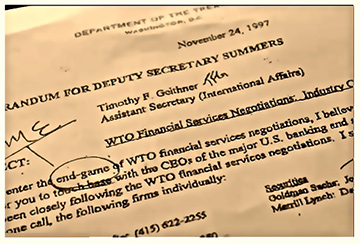
Larry Summers and the Secret “End-Game” Memo

August 26, 2013


palast1When a little birdie dropped the End Game memo through my window, its content was so explosive, so sick and plain evil, I just couldn’t believe it.

The Memo confirmed every conspiracy freak’s fantasy: that in the late 1990s, the top US Treasury officials secretly conspired with a small cabal of banker big-shots to rip apart financial regulation across the planet. When you see 26.3% unemployment in Spain, desperation and hunger in Greece, riots in Indonesia and Detroit in bankruptcy, go back to this End Game memo, the genesis of the blood and tears. The Treasury official playing the bankers’ secret End Game was Larry Summers. Today, Summers is Barack Obama’s leading choice for Chairman of the US Federal Reserve, the world’s central bank. If the confidential memo is authentic, then Summers shouldn’t be serving on the Fed, he should be serving hard time in some dungeon reserved for the criminally insane of the finance world.

The memo is authentic.

To get that confirmation, I would have to fly to Geneva and wangle a meeting with the Secretary General of the World Trade Organization, Pascal Lamy. I did. Lamy, the Generalissimo of Globalization, told me,
“The WTO was not created as some dark cabal of multinationals secretly cooking plots against the people…. We don’t have cigar-smoking, rich, crazy bankers negotiating.”

Then I showed him the memo.

It begins with Summers’ flunky, Timothy Geithner, reminding his boss to call the then most powerful CEOs on the planet and get them to order their lobbyist armies to march:
“As we enter the end-game of the WTO financial services negotiations, I believe it would be a good idea for you to touch base with the CEOs….”
To avoid Summers having to call his office to get the phone numbers (which, under US law, would have to appear on public logs), Geithner listed their private lines. And here they are:
Goldman Sachs: John Corzine (212)902-8281

Merrill Lynch: David Kamanski (212)449-6868

Bank of America, David Coulter (415)622-2255

Citibank: John Reed (212)559-2732

Chase Manhattan: Walter Shipley (212)270-1380

Lamy was right: They don’t smoke cigars. Go ahead and dial them. I did, and sure enough, got a cheery personal hello from Reed–cheery until I revealed I wasn’t Larry Summers. (Note: The other numbers were swiftly disconnected. And Corzine can’t be reached while he faces criminal charges.)

It’s not the little cabal of confabs held by Summers and the banksters that’s so troubling. The horror is in the purpose of the “end game” itself.

Let me explain:

The year was 1997. US Treasury Secretary Robert Rubin was pushing hard to de-regulate banks. That required, first, repeal of the Glass-Steagall Act to dismantle the barrier between commercial banks and investment banks. It was like replacing bank vaults with roulette wheels.

Second, the banks wanted the right to play a new high-risk game: “derivatives trading.” JP Morgan alone would soon carry $88 trillion of these pseudo-securities on its books as “assets.”

Deputy Treasury Secretary Summers (soon to replace Rubin as Secretary) body-blocked any attempt to control derivatives.

But what was the use of turning US banks into derivatives casinos if money would flee to nations with safer banking laws?

The answer conceived by the Big Bank Five: eliminate controls on banks in every nation on the planet – in one single move. It was as brilliant as it was insanely dangerous.

How could they pull off this mad caper? The bankers’ and Summers’ game was to use the Financial Services Agreement, an abstruse and benign addendum to the international trade agreements policed by the World Trade Organization.

Until the bankers began their play, the WTO agreements dealt simply with trade in goods–that is, my cars for your bananas. The new rules ginned-up by Summers and the banks would force all nations to accept trade in “bads” – toxic assets like financial derivatives.

Until the bankers’ re-draft of the FSA, each nation controlled and chartered the banks within their own borders. The new rules of the game would force every nation to open their markets to Citibank, JP Morgan and their derivatives “products.”

And all 156 nations in the WTO would have to smash down their own Glass-Steagall divisions between commercial savings banks and the investment banks that gamble with derivatives.

The job of turning the FSA into the bankers’ battering ram was given to Geithner, who was named Ambassador to the World Trade Organization.

Bankers Go Bananas

Why in the world would any nation agree to let its banking system be boarded and seized by financial pirates like JP Morgan?

The answer, in the case of Ecuador, was bananas. Ecuador was truly a banana republic. The yellow fruit was that nation’s life-and-death source of hard currency. If it refused to sign the new FSA, Ecuador could feed its bananas to the monkeys and go back into bankruptcy. Ecuador signed.

And so on–with every single nation bullied into signing.

Every nation but one, I should say. Brazil’s new President, Inacio Lula da Silva, refused. In retaliation, Brazil was threatened with a virtual embargo of its products by the European Union’s Trade Commissioner, one Peter Mandelson, according to another confidential memo I got my hands on. But Lula’s refusenik stance paid off for Brazil which, alone among Western nations, survived and thrived during the 2007-9 bank crisis.

China signed–but got its pound of flesh in return. It opened its banking sector a crack in return for access and control of the US auto parts and other markets. (Swiftly, two million US jobs shifted to China.)

The new FSA pulled the lid off the Pandora’s box of worldwide derivatives trade. Among the notorious transactions legalized: Goldman Sachs (where Treasury Secretary Rubin had been Co-Chairman) worked a secret euro-derivatives swap with Greece which, ultimately, destroyed that nation. Ecuador, its own banking sector de-regulated and demolished, exploded into riots. Argentina had to sell off its oil companies (to the Spanish) and water systems (to Enron) while its teachers hunted for food in garbage cans. Then, Bankers Gone Wild in the Eurozone dove head-first into derivatives pools without knowing how to swim–and the continent is now being sold off in tiny, cheap pieces to Germany.

Of course, it was not just threats that sold the FSA, but temptation as well. After all, every evil starts with one bite of an apple offered by a snake. The apple: The gleaming piles of lucre hidden in the FSA for local elites. The snake was named Larry.

Does all this evil and pain flow from a single memo? Of course not: the evil was The Game itself, as played by the banker clique. The memo only revealed their game-plan for checkmate.

And the memo reveals a lot about Summers and Obama.

While billions of sorry souls are still hurting from worldwide banker-made disaster, Rubin and Summers didn’t do too badly. Rubin’s deregulation of banks had permitted the creation of a financial monstrosity called “Citigroup.” Within weeks of leaving office, Rubin was named director, then Chairman of Citigroup—which went bankrupt while managing to pay Rubin a total of $126 million.

Then Rubin took on another post: as key campaign benefactor to a young State Senator, Barack Obama. Only days after his election as President, Obama, at Rubin’s insistence, gave Summers the odd post of US “Economics Tsar” and made Geithner his Tsarina (that is, Secretary of Treasury). In 2010, Summers gave up his royalist robes to return to “consulting” for Citibank and other creatures of bank deregulation whose payments have raised Summers’ net worth by $31 million since the “end-game” memo.

That Obama would, at Robert Rubin’s demand, now choose Summers to run the Federal Reserve Board means that, unfortunately, we are far from the end of the game.

Sunday, July 29, 2012

The Plan to Gut Social Security

Behind Obama’s Fake Recovery
by MIKE WHITNEY
 
Last week’s dismal “data dump” has ended all talk of a strong recovery in the US. Retail sales, factory output, jobless claims, consumer confidence, business investment and existing home sales are all down sharply indicating that the US economy is decelerating and may be headed for recession.

The Obama administration was warned repeatedly that activity would slow when the $800 billion fiscal stimulus (ARRA) ran out and net government spending became a drag on growth.

But Obama’s chief economics advisor, Lawrence Summers, shrugged off these warnings in order to keep the economy sputtering along at half-speed. Summers figured that bigger deficits and slower growth would create the rationale for slashing entitlement spending and crushing organised labor (particularly, public unions) In other words, the economy is weak, because the policy was designed to make it weak. Mission accomplished.

Not everyone in the Obama administration played along with this scam. Economist Christina Romer, for example, wanted the stimulus to be $1 trillion more than was eventually approved by Summers. That’s what she figured it would take to kick-start the growth engine and put tens of millions of unemployed Americans back to work. Here’s the story from Huffington Post’s Sam Stein:
“…members of the president’s economic team felt that if they were to properly fill the hole caused by the recession, they would need a bill that priced at $1.8 trillion — $600 billion more than was previously believed to be the high-water mark for the White House.
The $1.8 trillion figure was included in a December 2008 memo authored by Christina Romer (the incoming head of the Council of Economic Advisers) and obtained by Scheiber in the course of researching his book.
“When Romer showed [Larry] Summers her $1.8 trillion figure late in the week before the memo was due, he dismissed it as impractical. So Romer spent the next few days coming up with a reasonable compromise: roughly $1.2 trillion,” Scheiber writes.”
The idea that Summers rejected Romer’s plan as “impractical” is pure public relations.

Summers had a different agenda altogether. What he wanted was exactly what he got, a slow, underperforming economy with high unemployment and huge deficits. Does anyone really think that an economist with Summers’ impressive education and experience could be $1 trillion off in his calculations? (The American Recovery and Reinvestment Act of 2009 was eventually whittled down to $787 billion) It’s ridiculous. Summers wanted a flagging economy so he could torpedo Social Security, Medicare and Medicaid. These were the targets from the very beginning.

As for Obama, well, he probably figured that the $800 billion fiscal package would be enough to carry him over the finish-line in the 2012 elections, but not so big that it would subvert the goals of his chief economics advisor who was beholden to Wall Street and big business. In truth, Obama wanted the same thing as Summers, a justification for attacking the meager programs that keep the elderly and vulnerable from destitution.

Neither Summers nor Obama anticipated the downturn in China or the severity of the crisis in Europe both of which have weighed heavily on growth in the US and around the world. Here’s how Nouriel Roubini summed it up in a recent article on Project Syndicate:
“…the first-half growth rate looks set to come in closer to 1.5% at best, even below 2011’s dismal 1.7%. And now, after getting the first half of 2012 wrong, many are repeating the fairy tale that a combination of lower oil prices, rising auto sales, recovering house prices, and a resurgence of US manufacturing will boost growth in the second half of the year and fuel above-potential growth by 2013.
The reality is the opposite: for several reasons, growth will slow further in the second half of 2012 and be even lower in 2013 – close to stall speed.”
Global growth is pretty much deteriorating everywhere; China, India, Japan, Brazil, emerging markets. The eurozone is particularly concerning as ongoing bank runs in the south accelerate increasing the likelihood of a full-blown banking system collapse. The uncertainty is reflected in 10-year US Treasuries which have seen yields drop to record-lows in the last week. The flight to safety has intensified as frightened investors try to get their money out of Europe to avoid the deepening crisis and possible breakup of the 17-member monetary union.

On Tuesday, the Wall Street Journal announced that the “Fed Moves Closer to Action”. The news ignited a short rally, but soon faded. Confidence in the Fed is at its nadir. Another round of bond buying (QE3) might give equities a temporary jolt, but no one believes it will change the overall direction of the market or lead to an economic rebound. Interest rates are already at historic lows, so stuffing the banks with more reserves will neither increase lending or reduce unemployment. It is an exercise in futility. The Fed is at the limits of its effectiveness.

The current slowdown could have been avoided or at least mitigated had the Obama team followed Romer’s recommendation and provided the fiscal stimulus that was needed.

Now–due to political gridlock in congress–a second round of stimulus is out of the question which means the economy will continue its downward trend.

So, what should Obama do?

For starters, he should take a page out of FDR’s Depression handbook and hire more public workers. Here’s a clip from an article by economist Marshall Auerback who details some of the programs that Roosevelt implemented:
“[Roosevelt’s] government hired about 60 per cent of the unemployed in public works and conservation projects that planted a billion trees, saved the whooping crane, modernized rural America, and built such diverse projects as the Cathedral of Learning in Pittsburgh, the Montana state capitol, much of the Chicago lakefront, New York’s Lincoln Tunnel and Triborough Bridge complex, the Tennessee Valley Authority and the aircraft carriers Enterprise and Yorktown. It also built or renovated 2,500 hospitals, 45,000 schools, 13,000 parks and playgrounds, 7,800 bridges, 700,000 miles of roads, and a thousand airfields. And it employed 50,000 teachers, rebuilt the country’s entire rural school system, and hired 3,000 writers, musicians, sculptors and painters, including Willem de Kooning and Jackson Pollock.”
Or Obama could allocate $300 billion per year to rehire the 650,000 teachers and other state and local workers who’ve been laid off since the crash. That would be the easiest thing to do.

Skip all the red-tape connected to infrastructure and gov job’s programs and just rehire the people who got their pink slip after the crash. The money spent on jobs would more than pay for itself by raising state revenues and boosting economic activity by many orders of magnitude.

Have you seen a graph of how many (state and local) jobs have been lost under Obama? It’s shocking! Take a look:


We need to get these people back to work so they can feed their families and pay the bills. If we can afford $11 trillion to bail out crooked bankers, we can certainly afford a measly $300 mil for hard-working middle class families. It’s just a matter of priorities.

Economist Dean Baker has posted an article on his blog that supports my general thesis that Obama is planning to cut Social Security etc following the election. Here’s an excerpt from the post:
“The plan is that we will get the rich folks’ deal regardless of who wins the election….The deal that this gang … is hatching will inevitably include some amount of tax increases and also large budget cuts. At the top of the list… are cuts to Social Security and Medicare. ….
Social Security amounts to 90 percent or more of the income for one-third of seniors. For this group, the proposed cut in benefits would be a considerably larger share of their income that the higher taxes faced by someone earning $300,000 a year as a result of the repeal of the Bush tax cuts on high income earners…
(“The One Percent Want Your Social Security and Medicare and Steven Pearlstein Is Trying to Help”, Dean Baker, CEPR)
There it is in black and white. Obama is just as committed to gutting Social Security as Romney. The only difference is that he’s a better pitchman. Much better.

Thursday, February 2, 2012

The Democrats Who Unleashed Wall Street and Got Away With It

Thursday, February 2, 2012 by TruthDig.com
by Robert Scheer

That Lawrence Summers, a president emeritus of Harvard, is a consummate distorter of fact and logic is not a revelation. That he and Bill Clinton, the president he served as treasury secretary, can still get away with disclaiming responsibility for our financial meltdown is an insult to reason.

Yet, there they go again. Clinton is presented, in a fawning cover story in the current edition of Esquire magazine, as “Someone we can all agree on. ... Even his staunchest enemies now regard his presidency as the good old days.” In a softball interview, Clinton is once again allowed to pass himself off as a job creator without noting the subsequent loss of jobs resulting from the collapse of the housing derivatives bubble that his financial deregulatory policies promoted.

At least Summers, in a testier interview by British journalist Krishnan Guru-Murthy of Channel 4 News, was asked some tough questions about his responsibility as Clinton’s treasury secretary for the financial collapse that occurred some years later. He, like Clinton, still defends the reversal of the 1933 Glass-Steagall Act, a 1999 repeal that destroyed the wall between investment and commercial banking put into place by Franklin Roosevelt in response to the Great Depression.

“I think the evidence is that I am right about that. If you look at the big players, Lehman and Bear Stearns were both standalone investment banks,” Summers replied, referring to two investment banks allowed to fold. Summers is very good at obscuring the obvious truth—that the too-big-to-fail banks, made legal by Clinton-era deregulation, required taxpayer bailouts.

The point of Glass-Steagall was to prevent jeopardizing commercial banks holding the savings of average citizens. Summers knows full well that the passage of the repeal of Glass-Steagall was pushed initially by Citigroup, a mammoth merger of investment and commercial banking that create the largest financial institution in the world, an institution that eventually had to be bailed out with taxpayer funds to avoid economic disaster for millions of ordinary Americans. He also knows that Citigroup—where Robert Rubin, who preceded Summers as Clinton’s treasury secretary, played leading roles during a critical time—specialized in precisely the mortgage and other debt packages and insurance scams that were the source of America’s economic crisis.

Even Clinton, in a rare moment of honest appraisal of his record, conceded that his signing of the Commodity Futures Modernization Act (CFMA), legalizing those credit default swaps and collateralized debt obligations, was based on bad advice. That advice would have had to come from Summers, his point man pushing the CFMA legislation, which Clinton signed into law during his lame-duck days.

When the British interviewer reminded him of Clinton’s comment, Summers, as is his style, simply bristled: “Again, you make everything so simple, when in fact it’s complicated. Would it have been better if the whole financial reform legislation had passed in 1999, or 1998, or 1992? Yes, of course it would have been better. But … at the time Bill Clinton was president, there essentially were no credit default swaps. So the issue that became a serious problem really wasn’t an issue that was on the horizon.”

That is a lie. Credit default swaps had been sold at least since 1991, and collateralized debt obligations of all sorts quickly became the rage during the Clinton years. Summers surely remembers that Brooksley Born, the legal expert on such matters that Clinton appointed to head the Commodity Futures Trading Commission (CFTC), warned about the ballooning danger of those unregulated derivatives. Born, who served with Summers as one of four members of the President’s Working Group on Financial Markets, tried repeatedly and in vain to get her colleagues to act. When her pleas fell on deaf ears she issued a “concept release” calling attention to an unregulated derivatives market that was even then spiraling out of control.

The CFMA legislation that Summers pushed and Clinton signed was a specific rebuke to Born’s efforts. As Summers testified at the time before a Senate committee: “As you know, Mr. Chairman, the CFTC’s recent concept release has been a matter of great concern, not merely to Treasury, but to all those with an interest in the OTC [over-the-counter] derivatives market. In our view, the Release has cast the shadow of regulatory uncertainty over an otherwise thriving market—raising risks for stability and competitiveness of American derivative trading. We believe it quite important that the doubts be eliminated.”

Those doubts were eliminated by the new law exempting all of that troubling OTC derivatives trading from all existing regulations and regulatory agencies. Summers argued in his congressional testimony that there was no reason for any government regulation of what turned out to be tens of trillions of dollars in toxic assets:

“First, the parties to these kinds of contracts are largely sophisticated financial institutions that would appear to be eminently capable of protecting themselves from fraud and counterparty insolvencies and most of which are already subject to basic safety and soundness regulation under existing banking and securities law.

“Second, given the nature of the underlying assets involved—namely supplies of financial exchange and other financial instruments—there would seem to be little scope for market manipulation of the kind seen in traditional agricultural commodities, the supply of which is inherently limited and changeable.”

Has any economist ever gotten it so wrong?

Monday, October 24, 2011

President Obama’s “Unforced Errors”

 
On January 27, 2010, Rachel Maddow said, “Republicans have been as unanimous as they can be in opposition to every major thing this president has tried to do and they expect to continue to be as best as I can tell, calculating that the political benefit of stopping a president from accomplishing anything is worth a lot more than any risk of being seen as obstructionist.”

Are the Republicans to blame for Obama’s apparent deviation from his campaign promises, as many now claim, or does plain evidence demonstrate that the problem is much deeper, residing within President Obama himself? From economic policy to drug policy to foreign policy and human rights to his policies on the environment, President Obama has repeatedly made unilateral decisions that call this conventional storyline into question.

It has been thoroughly documented that the President is a Constitutional scholar. Yet, President Obama has declared the innocence of those responsible for the national and global financial collapse, despite ongoing investigations, stating, “One of the biggest problems…is that a lot of this stuff wasn’t necessarily illegal, it was just immoral or inappropriate or reckless.” In an attempt to comfort those who suffered the consequences of the perfectly legal misrepresentation and fraud perpetrated by the financial sector, the President reminds us that the members of the financial sector were simply doing their job.

Can we really blame them for “looking for ways to make money”? Meanwhile, President Obama has been pressuring U.S. attorneys general to accept a settlement that includes blanket immunity from future prosecution, which is confusing considering the lack of illegal behavior. But the confusion lifts once one sees the revolving door at the White House.
President Obama promised change. Yet, he reserved many of the most important and influential positions for former Clinton officials, the same officials candidate Obama criticized for their role in creating the conditions that would be exploited by all those innocent bankers.

The appointment of Larry Summers as Director of the National Economic Council, a position free of the need for Senate confirmation, is incomprehensible. It was Summers, along with Robert Rubin, who encouraged Congress to pass the Gramm-Leach-Bliley Act in 1999, effectively overturning Glass-Steagall. Lawrence Summers, as published in the Wall Street Journal in April 2009, “received about $5.2 million over the past year in compensation from hedge fund D.E. Shaw, and also received hundreds of thousands of dollars in speaking fees from major financial institutions.” Those major financial institutions included J.P. Morgan, Citigroup, Goldman Sachs and Lehman Brothers. Nothing to see here; no conflict of interests.

Destroy the national and global economy, leading to massive unemployment and home foreclosures and you are declared innocent by our president before the conclusion of an investigation, grow and distribute medical marijuana to those who benefit from it, including cancer patients, and to whom it is prescribed by licensed doctors and face the wrath of President Obama. In 2007, Senator Obama stated, “The Justice Department going after sick individuals using this as a palliative instead of going after serious criminals makes no sense.” Apparently, the President has changed his mind. In Rhode Island, Governor Chafee has decided not to move forward with the licensing of three medical marijuana dispensaries or, as Chafee refers to them, “medical marijuana compassion centers.” Why? Because Chafee has received communications from Obama’s Department of Justice that dispensaries “will be potential targets of ‘vigorous’ criminal and civil enforcement efforts by the federal government.”

In April, the President made another foray into the judiciary, announcing his verdict in the case of Bradley Manning, whistleblower and alleged Wikileaks source, claiming that Manning “broke the law.” Manning spent ten months in solitary confinement and was forced to undergo degrading treatment such as forced nudity. The UN Human Rights Committee and the Committee Against Torture believe solitary confinement alone could amount to violations of the International Covenant on Civil and Political Rights and the Convention Against Torture and other Cruel, Inhuman and Degrading Treatment or Punishment, both of which the U.S. has ratified. Yet, President Obama stated that Manning’s confinement met “our basic standards.” The President doubled-down on this assessment, forcing PJ Crowley, former U.S. Assistant Secretary of State for Public Affairs, to resign because of his honest assessment that Manning’s conditions of confinement were “ridiculous and counterproductive and stupid.”

Despite Manning’s obvious guilt and the just conditions in which he was imprisoned, Obama has refused repeated requests from the UN Special Rapporteur on Torture, Juan Mendez, for private access to Manning. This led Mendez to say, “I am deeply disappointed and frustrated by the prevarication of the US government with regard to my attempts to visit Mr. Manning.” That might not sound like much, but in diplomatic-speak that’s a serious tongue-lashing.

Though President Obama chose “to look forward as opposed to looking backwards” when it comes to members of the Bush Administration, who have openly admitted to authorizing torture, and the activities of many on Wall Street, his Department of Justice has waged an unprecedented assault on whistleblowers. Notwithstanding the President’s 2009 expression of esteem for whistleblowers who are “often the best source of information about waste, fraud, and abuse in government,” the Obama administration has charged five individuals with violating the Espionage Act, more than all previous administrations combined. Take for example Thomas Drake, former senior official with the NSA and decorated veteran of the U.S. military. Drake was accused of espionage, the charge being motivated by his blowing the whistle on illegal NSA activities and mismanagement of billions of dollars.

The Bush administration executed a search warrant of Drake’s home in 2007. By the time President Bush left office, no indictment was forthcoming. Yet, 2 ½ years later, Obama’s DOJ decided to move forward with the case. Judge Richard Bennett lambasted the DOJ, stating, “That’s four years of hell that a citizen goes through. It was not proper. It doesn’t pass the smell test…I don’t think that deterrence should include an American citizen waiting two and a half years after their home is searched to find out if they’re going to be indicted or not. I find that unconscionable. Unconscionable.” This case was dead until President Obama decided to resuscitate it. Fortunately, Judge Bennett had the wisdom to put it back down.

Perhaps President Obama’s record on human rights is stronger abroad. If we were to judge him on his words alone, the answer would be a resounding ‘yes’. In May, the President threw his support behind the Arab Spring’s demand for the fulfillment of their rights, stating that “every man and woman is endowed with certain inalienable rights.” He continued, “And now we cannot hesitate to stand squarely on the side of those who are reaching for their rights, knowing that their success will bring about a world that is more peaceful, more stable, and more just.” Obama’s support for human rights, of course, all depends on whether we need the cooperation of an oppressive government in allowing the U.S. to assassinate its own citizens, including teenagers, within the oppressive regime’s territory. Remember, indefinite detention bad, targeted assassinations and summary executions good.

And let us not forget all of the innocent victims of our human-guided robot warfare. In a 2010 speech, Yemeni Nobel Peace Prize Laureate Tawakkul Karman stated, “We also support the fight against terror. However, we do not accept that this fight against terror be carried out at the expense of innocent civilians….This is what happened exactly in 2009 in December, when tens of women and children were killed in Majalah, in Abyan. They were killed by U.S. drone airplanes, with a shameful coordination with the Yemeni government.” Karman provides just one example of an ever growing list of deaths that continue to soak this country’s hands in blood.

As witnessed in Yemen, as well as Bahrain, President Obama wasn’t actually talking about all movements for more responsive government and more rights. In Bahrain, dozens have been killed, many more injured, and even more arrested and fired from their jobs for participating in the Arab Spring, not to mention the arrest of medics who provided care for injured protesters, but their movement happens to be in the wrong country. Instead of Security Council resolutions condemning Bahrain, the government awaits a $53 million weapons contract with the U.S. Republicans had nothing to do with this, President Obama could have chosen a different path, but didn’t.

It could be that Obama’s policies on Yemen and Bahrain are but bad apples. It could be, but isn’t. The President is currently pressuring Congress to waive restrictions on military aid to Uzbekistan. Uzbekistan was designated by Freedom House as one of the nine “Worst of the Worst” countries in the world in terms of political rights and civil liberties. In the report it states, “Having silenced nearly all critics and perceived opponents of the regime—including independent journalists, rights activists, and political opponents—in 2010, the state went after individuals who spoke about or showed aspects of the country that the government felt damaged Uzbekistan’s image both domestically and abroad.” To the people of Uzbekistan, I am sorry that President Obama sees our war in Afghanistan as more important than supporting your inalienable rights.

I would be remiss if I omitted the very real dangers faced by union leaders and labor activists in Colombia, the lucky recipient of a free trade agreement facilitated by, you guessed it, President Obama. In 2008, according to Amnesty International, “Year after year, Colombia has symbolised the most serious and consistent abuses of this human right [to form and join trade unions]…So far this year, some 22 trade unionists have been killed in Colombia, a significant increase on the number killed in the same period last year.”

Thank goodness for the President’s record on the environment. Otherwise, this would all be bad news. President Obama, he who was going to facilitate “the moment when the rise of the oceans began to slow and our planet began to heal,” stated in North Carolina on Monday that the Republican plan for this country means “dirtier air, dirtier water.” Yet the President, from his own volition, continued use of BP’s low estimates of the rate of the spill in the Gulf, despite both the Wikileaks revelation that the administration was fully aware of similar manipulation by BP in Azerbaijan and the findings by research scientists that the flow was significantly higher than official estimates. In May 2010, NPR conducted an analysis of the flow rate. Steven Wereley, Associate Professor of Mechanical Engineering at Purdue University, concluded the rate of the spill was 70,000 barrels a day, while the President continued to propagate the rate being 5,000 barrels a day. There is also the President’s unilateral decision not to change the smog standards, as recommended by the EPA, from 75 parts per billion measured over eight hours to 70 parts per billion. In other words, it is the President’s plan that means dirtier air.

Blaming the Republicans for all of President Obama’s failed policies and weak compromises is a failure to understand reality. That the Republicans have not bargained in good faith is something I fully recognize, but I also recognize the need to objectively assess the policies of this president. Failure to do so leads to the partisan trap, one in which members of both sides of the partisan divide vehemently defend the indefensible and use terms like ‘pragmatic’ to do so. Lucky for us, the only thing that stands in the way of the indefensible Keystone XL pipeline is President Barack Obama. As stated by James Hansen, Director of NASA’s Goddard Institute for Space Studies, the President’s next unforced error, approval of the pipeline, would mean “game over” for the long-term health of this planet.

Thursday, September 29, 2011

The Men We Trusted to Lead Us


Now he tells us. On Wednesday Federal Reserve Chairman Ben Bernanke referred to the nation’s unemployment rate as a “national crisis,” an obvious if depressing fact of life to the 25 million Americans who have been unsuccessfully attempting to find full-time employment. 

But to finally hear those words from the man George W. Bush and Barack Obama both appointed to lead us out of the great recession is a bracing reminder of how markedly the policies of both those presidents have failed: “We’ve had close to 10 percent unemployment now for a number of years, and of the people who are unemployed, about 45 percent have been unemployed for six months or more,” Bernanke said. “This is unheard of.”

But why is Bernanke just now discovering this after having overseen the Fed’s purchase of trillions in toxic mortgage-backed securities from the too-big-to-fail banks that sacrificed people’s homes in a giant Ponzi scheme? Why did he throw all of that money at the banks without getting anything back in the way of relief for the people the bankers swindled?

The housing meltdown, which has robbed Americans of a considerable portion of their net worth, has led to the continued depressed consumer confidence that is the prime cause of crisis-level unemployment. In another of his too-late-to-matter moments, Bernanke acknowledged that “strong housing policies to help the market recover” would “clearly be very useful,” but he failed to suggest any.

Bernanke, along with then-New York Fed President Timothy Geithner, helped implement the Bush strategy of saving the banks in the hope that their rising tide would lift our little boats. That remained the strategy when President Obama rewarded Geithner for having saved AIG and Citigroup by naming him treasury secretary in the incoming government.

With the Geithner appointment, and the even more disturbing selection of Lawrence Summers to be his top economic adviser, Obama sealed his own fate as president.
By turning to those disciples of Clinton-era Treasury Secretary Robert Rubin, a prime enabler of Wall Street greed, the new president fatally betrayed his promise of hope.

If you still need confirmation of just how decisive a betrayal those appointments were, check out Ron Suskind’s new book, Confidence Men, a devastating insider account of the Obama White House that clearly identifies as the source of this president’s failure “Rubin’s B-Team,” Summers and Geithner, “two men whose actions had contributed to the very financial disaster they were hired to solve.” Suskind quotes then-Sen. Byron Dorgan, D-N.D., one of the few who dared stand up to the Wall Street lobbyists, as telling Obama, “I don’t understand how you could do this; you’ve picked the wrong people!”

Of course the Democrats from the Clinton era don’t bear all of the responsibility for the radical deregulation of the financial industry that ended the sensible restraints on greed installed by Franklin Roosevelt in response to the Great Depression. Indeed, the inspiration came from Republicans led by Phil Gramm, the then-senator from Texas who as head of the Banking Committee authored the legislation that Wall Street lobbyists had long pushed unsuccessfully.

The mayhem they wrought and the subsequent big-money rewards to Rubin and Gramm do not seem to have shocked this president or the leading contenders for the Republican presidential nomination. Rubin became chairman of Citigroup and was rewarded with $120 million while he guided the bank to the edge of bankruptcy. Gramm went to a leading position at the Swiss-based UBS, the continually troubled institution now in the midst of its latest scandal, involving fraudulent trading. In addition to a $45 billion direct TARP bailout, Citigroup got $99.5 billion, and Gramm’s UBS $77.2 billion from a $1.2 trillion secret Fed loan fund.

Gramm and Rubin were partners in what should be considered the crime of the century, speaking in moral and not legal terms since, as regards the financial world, the bad guys get to write the laws. Thanks to their efforts, which allowed the creation of the “too-big-to-fail banks” and a totally unregulated derivatives market in toxic home mortgage securities, we entered the Great Recession, but neither of its authors has ever been held seriously accountable for the enormous suffering he caused.

On the contrary, Gramm and Rubin’s “just free Wall Street to do its thing” ideology still dominates the economic policies of both major political parties. Rubin’s acolytes have controlled the Obama administration’s economic strategy of saving Wall Street by betraying Main Street, and Gramm, who recently endorsed his former student at Texas A&M, Rick Perry, for president, remains the free-market-mayhem guru for Republicans.

On Election Day, whoever wins, we lose.

Thursday, August 18, 2011

George W. Obama? The Bush-Obama Presidency

The Saved and the Sacked
By DAVID BROMWICH

Is it too soon to speak of the Bush-Obama presidency?

The record shows impressive continuities between the two administrations, and nowhere more than in the policy of "force projection" in the Arab world. With one war half-ended in Iraq, but another doubled in size and stretching across borders in Afghanistan; with an expanded program of drone killings and black-ops assassinations, the latter glorified in special ceremonies of thanksgiving (as they never were under Bush); with the number of prisoners at Guantanamo having decreased, but some now slated for permanent detention; with the repeated invocation of "state secrets" to protect the government from charges of war crimes; with the Patriot Act renewed and its most dubious provisions left intact -- the Bush-Obama presidency has sufficient self-coherence to be considered a historical entity with a life of its own.

The significance of this development has been veiled in recent mainstream coverage of the national security state and our larger and smaller wars. Back in 2005-2006, when the Iraqi insurgency refused to die down and what had been presented as "sectarian feuding" began to look like a war of national liberation against an occupying power, the American press exhibited an uncommon critical acuteness. But Washington's embrace of "the surge" in Iraq in 2007 took that war off the front page, and it -- along with the Afghan War -- has returned only occasionally in the four years since.

This disappearance suited the purposes of the long double-presidency. Keep the wars going but normalize them; make them normal by not talking about them much; by not talking about them imply that, while "victory" is not in sight, there is something else, an achievement more realistic and perhaps more grown-up, still available to the United States in the Greater Middle East. This other thing is never defined but has lately been given a name. They call it "success."

Meanwhile, back at home...

The usual turn from unsatisfying wars abroad to happier domestic conditions, however, no longer seems tenable. In these August days, Americans are rubbing their eyes, still wondering what has befallen us with the president's "debt deal" -- a shifting of tectonic plates beneath the economy of a sort Dick Cheney might have dreamed of, but which Barack Obama and the House Republicans together brought to fruition. A redistribution of wealth and power more than three decades in the making has now been carved into the system and given the stamp of permanence.

Only a Democratic president, and only one associated in the public mind (however wrongly) with the fortunes of the poor, could have accomplished such a reversal with such sickening completeness.

One of the last good times that President Obama enjoyed before the frenzy of debt negotiations began was a chuckle he shared with Jeff Immelt, former CEO of General Electric and now head of the president's outside panel of economic advisers. At a June 13th meeting of the president's Council on Jobs and Competitiveness, a questioner said he assumed that President Obama knew about the difficulties caused by the drawn-out process of securing permits for construction jobs. Obama leaned into the microphone and offered a breezy ad-lib: "Shovel ready wasn't as, uh, shovel-ready as we expected" -- and Immelt got off a hearty laugh. An unguarded moment: the president of "hope and change" signifying his solidarity with the big managers whose worldly irony he had adopted.

A certain mystery surrounds Obama's perpetuation of Bush's economic policies, in the absence of the reactionary class loyalty that accompanied them, and his expansion of Bush's war policies in the absence of the crude idea of the enemy and the spirited love of war that drove Bush. But the puzzle has grown tiresome, and the effects of the continuity matter more than its sources.

We knew the meaning of Bush, and the need for resistance was clear. Obama makes resistance harder. During a deep crisis, such a nominal leader, by his contradictory words and conduct and the force of his example (or rather the lack of force in his example), becomes a subtle disaster for all those whose hopes once rested with him.

The philosopher William James took as a motto for practical morality: "By their fruits shall ye know them, not by their roots."

Suppose we test the last two and a half years by the same sensible criterion. Translated into the language of presidential power -- the power of a president whose method was to field a "team of rivals" and "lead from behind" -- the motto must mean: by their appointments shall ye know them.

Let us examine Obama, then, by the standard of his cabinet members, advisers, and favored influences, and group them by the answers to two questions: Whom has he wanted to stay on longest, in order to profit from their solidity and bask in their influence? Which of them has he discarded fastest or been most eager to shed his association with? Think of them as the saved and the sacked. Obama's taste in associates at these extremes may tell us something about the moral and political personality in the middle.

The Saved

Advisers whom the president entrusted with power beyond expectation, and sought to keep in his administration for as long as he could prevail on them to stay:

1. Lawrence Summers: Obama's chief economic adviser, 2009-2010. As Bill Clinton's secretary of the treasury, 1999-2001, Summers arranged the repeal of the New Deal-era Glass-Steagall Act, which had separated the commercial banks -- holders of the savings of ordinary people -- from the speculative action of the brokerage houses and money firms. The aim of Glass-Steagall was to protect citizens and the economy from a financial bubble and collapse. Demolition of that wall between savings and finance was a large cause of the 2008 meltdown. In the late 1990s, Summers had also pressed for the deregulation of complex derivatives -- a dream fully realized under Bush. In the first years of the Obama era, with the ear of the president, he commandeered the bank bailouts and advised against major programs for job creation. He won, and we are living with the results.

In 2009-2010, the critical accessory to Summers's power was Timothy Geithner, Obama's treasury secretary. Most likely, Geithner was picked for his position by the combined recommendations of Summers and Bush's Treasury Secretary Hank Paulson. The latter once described Geithner as "a very unusually talented young man," and worked with him closely in 2008 when he was still president of the New York Fed. At that time, he concurred with Paulson on the wisdom of bailing out the insurance giant AIG and not rescuing Lehman Brothers. Obama for his part initiated several phone consultations with Paulson during the 2008 campaign -- often holding his plane on the tarmac to talk and listen. This chain is unbroken. Any tremors in the president's closed world caused by Summers's early departure from the administration have undoubtedly been offset by Geithner's recent reassurance that he will stay at the Treasury beyond 2011.

Postscript: In 2011, Summers has become more reformist than Obama. On The Charlie Rose Show on July 13th, he criticized the president's dilatoriness in mounting a program to create jobs. Thus he urged the partial abandonment of his own policy, which Obama continues to defend.

2. Robert Gates: A member of the permanent establishment in Washington, Gates raised to the third power the distinction of massive continuity: First as CIA director under George H.W. Bush, second as secretary of defense under George W. Bush, and third as Obama's secretary of defense. He remained for 28 months and departed against the wishes of the president. Gates sided with General David Petraeus and Chairman of the Joint Chiefs of Staff Admiral Mike Mullen in 2009 to promote a massive (called "moderate") escalation of the Afghan War; yet he did so without rancor or posturing -- a style Obama trusted and in the company of which he did not mind losing. In the Bush years, Gates was certainly a moderate in relation to the extravagant war aims of Vice President Dick Cheney, Secretary of Defense Donald Rumsfeld, and their neoconservative circle. He worked to strengthen U.S. militarism through an ethic of bureaucratic normalization.

His approach has been endorsed and will be continued -- though probably with less canniness -- by his successor Leon Panetta. Without a career in security to fortify his confidence, Panetta is really a member of a different species: the adaptable choice for "running things" -- without regard to the nature of the thing or the competence required. Best known as the chief of staff who reduced to a semblance of order the confusion of the Clinton White House, he is associated in the public mind with no set of views or policies.

3. Rahm Emanuel: As Obama's White House chief of staff, Emanuel performed much of the hands-on work of legislative bargaining that President Obama himself preferred not to engage in. (Vice President Joe Biden also regularly took on this role.) He thereby incurred a cheerless gratitude, but he is a man willing to be disliked. Obama seems to have held Emanuel's ability in awe; and such was his power that nothing but the chance of becoming mayor of Chicago would have plucked him from the White House. Emanuel is credited, rightly or not, with the Democratic congressional victory of 2006, and one fact about that success, which was never hidden, has been too quickly forgotten. Rahm Emanuel took pains to weed out anti-war candidates.

Obama would have known this, and admired the man who carried it off. Whether Emanuel pursued a similar strategy in the 2010 midterm elections has never been seriously discussed. The fact that the category "anti-war Democrat" hardly exists in 2011 is, however, an achievement jointly creditable to Emanuel and the president.

4. Cass Sunstein: Widely thought to be the president's most powerful legal adviser. Sunstein defended and may have advised Obama on his breach of his 2008 promise (as senator) to filibuster any new law that awarded amnesty to the telecoms that illegally spied on Americans. This was Obama's first major reversal in the 2008 presidential campaign: he had previously defended the integrity of the Foreign Surveillance Intelligence Act against the secret encroachment of the National Security Agency (NSA).

At that moment, Obama changed from an accuser to a conditional apologist for the surveillance of Americans: the secret policy advocated by Dick Cheney, approved by President Bush, executed by NSA Director Michael Hayden, and supplied with a rationale by Cheney's legal counsel David Addington. In his awkward public defense of the switch, Obama suggested that scrutiny of telecom records and their uses by the inspectors general in the relevant agencies and departments should be enough to restore the rule of law.

When it comes to national security policy, Sunstein is a particularly strong example of Bush-Obama continuity. Though sometimes identified as a liberal, from early on he defended the expansion of the national security state under Cheney's Office of the Vice President, and he praised the firm restraint with which the Ashcroft Justice Department shouldered its responsibilities. "By historical standards," he wrote in the fall of 2004, "the Bush administration has acted with considerable restraint and with commendable respect for political liberty. It has not attempted to restrict speech or the democratic process in any way. The much-reviled and poorly understood Patriot Act, at least as administered, has done little to restrict civil liberty as it stood before its enactment." This seems to have become Obama's view.

Charity toward the framers of the Patriot Act has, in the Obama administration, been accompanied by a consistent refusal to initiate or support legal action against the "torture lawyers." Sunstein described the Bush Justice Department memos by John Yoo and Jay Bybee, which defended the use of the water torture and other extreme methods, in words that stopped short of legal condemnation: "It's egregiously bad. It's very low level, it's very weak, embarrassingly weak, just short of reckless." Bad lawyering: a professional fault but not an actionable offense.

The Obama policy of declining to hold any high official or even CIA interrogators accountable for violations of the law by the preceding administration would likely not have survived opposition by Sunstein. A promise not to prosecute, however, has been implicit in the findings by the Obama Justice Department -- a promise that was made explicit by Leon Panetta in February 2009 when he had just been named President Obama's new director of the CIA.

As head of the president's Office of Information and Regulatory Affairs, with an office in the White House, Sunstein adjudicates government policy on issues of worker and consumer safety; yet his title suggests a claim of authority on issues such as the data-mining of information about American citizens and the government's deployment of a state secrets privilege. He deserves wider attention, too, for his 2008 proposal that the government "cognitively infiltrate" discussion groups on-line and in neighborhoods, paying covert agents to monitor and, if possible, discredit lines of argument which the government judges to be extreme or misleading.

5. Eric Holder: Holder once said that the trial of suspected 9/11 "mastermind" Khalid Sheikh Mohammed in a New York City courtroom would be "the defining event of my time as attorney general." The decision to make KSM's a civilian trial was, however, scuttled, thanks to incompetent management at the White House: neither the first nor last failure of its kind. The policy of trying suspected terrorists in civilian courts seems to have suffered from never being wholeheartedly embraced by the administration's inside actors. Local resistance by the New York authorities was the ostensible reason for the failure and the change of venue back to a military tribunal at Guantanamo. No member of the administration besides Holder has been observed to show much regret.

During his 30-month tenure, in keeping with Obama's willingness to overlook the unpleasant history of CIA renditions and "extreme interrogations," Holder has made no move to prosecute any upper-level official of any of the big banks and money firms responsible for the financial collapse of 2008. His silence on the subject has been taken as a signal that such prosecutions will never occur. To judge by public statements, the energies of the attorney general, in an administration that arrived under the banner of bringing "sunshine" and "transparency" to Washington, have mainly been dedicated to the prosecution of government whistle-blowers through a uniquely rigorous application of the Espionage Act of 1917. More people have been accused under that law by this attorney general than in the entire preceding 93 years of the law's existence.

Again, this is a focus that Bush-era attorney generals John Ashcroft, Alberto Gonzales, and Michael Mukasey might have relished, but on which none would have dared to act on so boldly. Extraordinary delays in grand jury proceedings on Army Private Bradley Manning, suspected of providing government secrets to WikiLeaks, and Julian Assange, who ran that website, are said to have come from a protracted attempt to secure a legal hold against one or both potential defendants within the limits of a barbarous and almost dormant law.

6. Dennis Ross: Earlier in his career, Obama seems to have cherished an interest in the creation of an independent Palestinian state. In Chicago, he was a friend of the dissident Middle East scholar Rashid Khalidi; during his 2007 primary campaign, he sought and received advice from Robert Malley, former special assistant to President Clinton for Arab-Israeli affairs, and Zbigniew Brzezinski, former national security adviser to President Jimmy Carter. Both were "realist" opponents of the expansionist policy of Israel's right-wing coalition government, which subsidizes and affords military protection to Jewish settlements on the occupied West Bank.

Under pressure from the Israel lobby, however, Obama dissociated himself from all three chosen advisers.

Ross, as surely as Gates, is a member of Washington's permanent establishment. Recruited for the Carter Defense Department by Paul Wolfowitz, he started out as a Soviet specialist, but his expertise migrated with a commission to undertake a Limited Contingency Study on the need for American defense of the Persian Gulf. An American negotiator at the 2000 Camp David summit, Ross was accused of being an unfair broker, having always "started from the Israeli bottom line."

He entered the Obama administration as a special adviser to Hillary Clinton on the Persian Gulf, but was moved into the White House on June 25, 2009, and outfitted with an elaborate title and comprehensive duties: Special Assistant to the President and Senior Director for the Central Region, including all of the Middle East and the Persian Gulf, Afghanistan, Pakistan and South Asia. Ross has cautioned Obama to be "sensitive" to domestic Israeli concerns.

In retrospect, his installation in the White House looks like the first step in a pattern of concessions to Israeli Prime Minister Benjamin Netanyahu that undid Obama's hopes for an agreement in the region. Here, caution precluded all inventiveness. It could have been predicted that the ascendancy of Ross would render void the two-state solution Obama anticipated in his carefully prepared and broadly advertised speech to the Arab world from Cairo University in June 2009.

7. Peter Orzag: Director of the Office of Management and Budget from January 2009 to August 2010, Orzag was charged with bringing in the big health insurers to lay out what it would take for them to support the president's health-care law. In this way, Orzag -- along with the companies -- exerted a decisive influence on the final shape of the Patient Protection and Affordable Care Act of 2010. In January 2011, he left the administration to become vice chairman of global banking at Citigroup. A few days out of the White House, he published an op-ed in the New York Times advising the president to extend the Bush-era tax cuts for the top 2% of Americans -- adding that Obama should indicate that the cuts would continue in force only through 2012. Obama took the advice.

8. Thomas Donilon: National Security Adviser and (after the departure of Gates) Obama's closest consultant on foreign policy. Donilon supported the 34,000 troop-escalation order that followed the president's inconclusive 2009 Afghanistan War review. He encouraged and warmly applauded Obama's non-binding "final orders" on Afghanistan, which all the participants in the 2009 review were asked formally to approve. (The final orders speak of "a prioritized comprehensive approach" by which the U.S. will "work with [Afghan President Hamid] Karzai when we can" to set "the conditions for an accelerated transition," to bring about "effective sub-national governance," and to "transfer" the responsibility for fighting the war while continuing to "degrade" enemy forces.)

Donilon comes from the worlds of business, the law, and government in about equal measure: a versatile career spanning many orthodoxies. His open and unreserved admiration for President Obama seems to have counted more heavily in his appointment than the low opinion of his qualifications apparently held by several associates. As Assistant Secretary of State for Public Affairs during the Clinton administration, he helped arrange the eastward expansion of NATO after the Cold War: perhaps the most pointless and destructive bipartisan project of the epoch. He was Executive Vice President for Law and Policy at Fannie Mae, 1999-2005.

The Sacked

Advisers and nominees with views that were in line with Obama's 2008 election campaign or his professed goals in 2009, but who have since been fired, asked to resign or step down, or seen their nominations dropped:

1. General James Jones: Former Marine Corps Commandant and a skeptic of the Afghanistan escalation, Jones became the president's first National Security Adviser. He was, however, often denied meetings with Obama, who seems to have looked on Gates as a superior technocrat, Petraeus as a more prestigious officer, and Donilon as a more fervent believer in the split-the-difference war and diplomatic policies Obama elected to pursue. Jones resigned in October 2010, under pressure.

A curious point: Obama had spoken to Jones only twice before appointing him to so high a post and seems hardly to have come to know him by the time he resigned.

2. Karl Eikenberry: Commander of Combined Forces in Afghanistan before he was made ambassador, Eikenberry, a retired Lieutenant General, had seniority over both Petraeus and then war commander General Stanley McChrystal when it came to experience in that country and theater of war. He was the author of cables to the State Department in late 2009, which carried a stinging rebuke to the conduct of the war and unconcealed hostility toward any new policy of escalation. The Eikenberry cables were drafted in order to influence the White House review that fall; they advised that the Afghan war was in the process of being lost, that it could never be won, and that nothing good would come from an increased commitment of U.S. troops.

Petraeus, then Centcom commander, and McChrystal were both disturbed by the cables -- startled when they arrived unbidden and intimidated by their authority. Obama, astonishingly, chose to ignore them. This may be the single most baffling occasion of the many when fate dealt a winning card to the president and yet he folded. Among other such occasions: the 2008-2009 bank bailouts and the opening for financial regulation; the BP oil spill in the Gulf of Mexico and the opportunity for a revised environmental policy; the Fukushima nuclear plant meltdowns and a revised policy toward nuclear energy; the Goldstone Report and the chance for an end to the Gaza blockade. But of all these as well as other cases that might be mentioned, the Eikenberry cables offer the clearest instance of persisting in a discredited policy against the weight of impressive evidence.

Ambassador Eikenberry retired in 2011, and Obama replaced him with Ryan Crocker, the Foreign Service officer brought into Iraq by Bush to help General Petraeus manage the details and publicity around the Iraq surge of 2007-2008.

3. Paul Volcker: Head of the Federal Reserve under Presidents Carter and Reagan, Volker had a record (not necessarily common among upper-echelon workers in finance) entirely free of the reproach of venality. A steady adviser to the 2008 Obama campaign, he lent gravity to the young candidate's professions of competence in financial matters. He also counseled Obama against the one-sidedness of a recovery policy founded on repayment guarantees to financial outfits such as Citigroup and Bank of America: the policy, that is, favored by Summers and Geithner in preference to massive job creation and a major investment in infrastructure. "If you want to be a bank," he said, "follow the bank rules. If Goldman Sachs and the others want to do proprietary trading, then they shouldn't be banks." His advice -- to tighten regulation in order to curb speculative trading -- was adopted late and in diluted form. In January 2010, Jeff Immelt, CEO of General Electric, which paid no federal taxes that year, replaced him.

4. Dennis Blair: As Director of National Intelligence, Blair sought to limit the expansion of covert operations by the CIA. In this quest he was defeated by CIA Director Leon Panetta -- a seasoned infighter, though without any experience in intelligence, who successfully enlarged the Agency's prerogatives and limited oversight of its activities during his tenure. Blair refused to resign when Obama asked him to, and demanded to be fired. He finally stepped down on May 21, 2010.

Doubtless Blair hurt his prospects irreparably by making clear to the president his skepticism regarding the usefulness of drone warfare: a form of killing Obama favors as the most politic and antiseptic available to the U.S. Since being sacked, Blair has come out publicly against the broad use of drones in Pakistan and elsewhere.

On his way out, he was retrospectively made a scapegoat for the November 2009 Fort Hood, Texas, killing spree by Army psychiatrist Major Nidal Hasan; for the "underwear" bomber's attempt to blow up a plane on its way to Detroit on Christmas day 2009; and for the failed Times Square car bombing of May 2010 -- all attacks (it was implied) that Blair should have found the missing key to avert, even though the Army, the FBI, and the CIA were unable to do so.

5. James Cartwright: As vice-chairman of the Joint Chiefs of Staff, General Cartwright passed on to Obama, and interpreted for him, a good deal of information that proved useful in the Afghanistan War review. Their friendship outlasted the process and he came to be known as Obama's "favorite general," but Cartwright stirred the resentment from both Petraeus and Mullen for establishing a separate channel of influence with the president. Like Eikenberry, he had been a skeptic on the question of further escalation in Afghanistan. His name was floated by the White House as the front-runner to become chairman of the Joint Chiefs after the retirement of Mullen. Informed of the military opposition to the appointment, Obama reversed field and chose Army Chief of Staff General Martin Dempsey, a figure more agreeable to Petraeus and Mullen.

6. Dawn Johnsen: Obama's first choice to head the Office of Legal Council, a choice generally praised and closely watched by constitutional lawyers and civil libertarians. Her name was withdrawn after a 14-month wait, and she was denied a confirmation process. The cause: Republican objections to her writings and her public statements against the practice of torture and legal justifications for torture.

This reversal falls in with a larger pattern: the putting forward of candidates for government positions whose views are straightforward, publicly available, and consistent with the pre-2009 principles of Barack Obama -- followed by Obama's withdrawal of support for the same candidates. A more recent instance was the naming (after considerable delay) of Elizabeth Warren as a special advisor to organize the Consumer Financial Protection Bureau, followed by the decision in July not to nominate her as the first director of the bureau.

Avoidance of a drag-out fight in confirmation hearings repeatedly seems to be the recurrent motive here. Of course, the advantage of such a fight, given an articulate and willing nominee, is the education of public opinion. But in every possible instance, President Obama has been averse to any public engagement in the clash of ideas. "Bottom line is that it was going to be close," a Senate Democratic source told ABC's Jake Tapper when Johnsen's name was withdrawn. "If they wanted to, the White House could have pushed for a vote. But they didn't want to 'cause they didn't have the stomach for the debate."

Where the nomination of an "extreme" candidate might have hardened the impression of Obama as an extremist, might not a public hearing have helped eradicate the very preconception that a frightened withdrawal tends to confirm? This question is not asked.

7. Greg Craig: For two years special counsel in the Clinton White House, he led the team defending the president in the impeachment proceedings in Congress. Craig's declaration of support for Obama in March 2007 was vital to the insurgent candidate, because of his well-known loyalty to the Clintons. Obama made him White House Counsel, and his initial task was to draw up plans for the closing of Guantanamo, a promise made by the president on his first day in the Oval Office. But once the paper was signed, Obama showed little interest in the developing plans. Others were more passionate. Dick Cheney worked on a susceptible populace to resurrect old fears. The forces against closure rallied and spread panic, while the president said nothing. Craig was defeated inside the White House by the "realist" Rahm Emanuel, and sacked.

8. Carol Browner: A leading environmentalist in the Clinton administration, Browner was given a second shot by Obama as director of the White House Office of Energy and Climate Change Policy. She found her efforts thwarted within the administration as well as in Congress: in mid-2010 Obama decided that -- as a way to deal with global warming -- cap-and-trade legislation was a loser for the midterm elections. Pressure on Obama from the U.S. Chamber of Commerce to heed business interests served as a strong incitement in forcing Browner's resignation after the democratic "shellacking" in midterm elections, a result that his quiet abandonment of cap-and-trade had failed to prevent. The White House had no backup plan for addressing the disaster of global warming. After Browner's resignation in March 2011, her position was abolished. Since then, Obama has seldom spoken of global warming or climate change.

Moral and Political Limbo

The Obama presidency has been characterized by a refined sense of impossibility. A kind of suffocation sets in when a man of power floats carefully clear of all unorthodox stimuli and resorts to official comforters of the sort exemplified by Panetta. As the above partial list of the saved and the sacked shows, the president lives now in a world in which he is certain never to be told he is wrong when he happens to be on the wrong track. It is a world where the unconventionality of an opinion, or the existence of a possible majority against it somewhere, counts as prima facie evidence against its soundness.

So alternative ideas vanish -- along with the people who represent them. What, then, does President Obama imagine he is doing as he backs into one weak appointment after another, and purges all signs of thought and independence around him? We have a few dim clues.

A popular book on Abraham Lincoln, Team of Rivals, seems to have prompted Obama to suppose that Lincoln himself "led from behind" and was committed to bipartisanship not only as a tactic but as an always necessary means to the highest good of democracy. A more wishful conceit was never conceived; but Obama has talked of the book easily and often to support a "pragmatic" instinct for constant compromise that he believes himself to share with the American people and with Lincoln.

A larger hint may come from Obama's recently released National Strategy for Counterterrorism, where a sentence in the president's own voice asserts: "We face the world as it is, but we will also pursue a strategy for the world we seek." If the words "I face the world as it is" have a familiar sound, the reason is that they received a trial run in Obama's 2009 Nobel Prize speech. Those words were the bridge across which an ambivalent peacemaker walked to confront the heritage of Mahatma Gandhi and Martin Luther King with the realities of power as experienced by the leader of the only superpower in the world.

Indeed, Obama's understanding of international morality seems to be largely expressed by the proposition that "there's serious evil in the world" -- a truth he confided in 2007 to the New York Times conservative columnist David Brooks, and attributed to the theologian Reinhold Niebuhr -- combined with the assertion that he is ready to "face the world as it is." The world we seek is, of course, the better world of high morality. But morality, properly understood, is nothing but a framework for ideals. Once you have discharged your duty, by saying the right words for the right policies, you have to accommodate the world.


This has become the ethic of the Bush-Obama administration in a new phase. It explains, as nothing else does, Obama's enormous appetite for compromise, the growing conventionality of his choices of policy and person, and the legitimacy he has conferred on many radical innovations of the early Bush years by assenting to their logic and often widening their scope. They are, after all, the world as it is.

Obama's pragmatism comes down to a series of maxims that can be relied on to ratify the existing order -- any order, however recent its advent and however repulsive its effects. You must stay in power in order to go on "seeking." Therefore, in "the world as it is," you must requite evil with lesser evil. You do so to prevent your replacement by fanatics: people, for example, like those who invented the means you began by deploring but ended up adopting. Their difference from you is that they lack the vision of the seeker. Finally, in the world as it is, to retain your hold on power you must keep in place the sort of people who are normally found in places of power.