Showing posts with label wealth and political power. Show all posts

Monday, March 16, 2015

Robert Reich: Why Americans Are Fucked and Europeans Are Not

The U.S. economy is picking up steam but most Americans aren’t feeling it.
The U.S. economy is picking up steam but most Americans aren’t feeling it. By contrast, most European economies are still in bad shape, but most Europeans are doing relatively well.

What’s behind this? Two big facts.

First, American corporations exert far more political influence in the United States than their counterparts exert in their own countries.

In fact, most Americans have no influence at all. That’s the conclusion of Professors Martin Gilens of Princeton and Benjamin Page of Northwestern University, who analyzed 1,799 policy issues — and found that “the preferences of the average American appear to have only a miniscule, near-zero, statistically non-significant impact upon public policy.”

Instead, American lawmakers respond to the demands of wealthy individuals (typically corporate executives and Wall Street moguls) and of big corporations – those with the most lobbying prowess and deepest pockets to bankroll campaigns.

The second fact is most big American corporations have no particular allegiance to America. They don’t want Americans to have better wages. Their only allegiance and responsibility to their shareholders — which often requires lower wages  to fuel larger profits and higher share prices.

When GM went public again in 2010, it boasted of making 43 percent of its cars in place where labor is less than $15 an hour, while in North America it could now pay “lower-tiered” wages and benefits for new employees.

American corporations shift their profits around the world wherever they pay the lowest taxes. Some are even morphing into foreign corporations.

As an Apple executive told The New York Times, “We don’t have an obligation to solve America’s problems.”

I’m not blaming American corporations. They’re in business to make profits and maximize their share prices, not to serve America.

But because of these two basic facts – their dominance on American politics, and their interest in share prices instead of the wellbeing of Americans – it’s folly to count on them to create good American jobs or improve American competitiveness, or represent the interests of the United States in global commerce.

By contrast, big corporations headquartered in other rich nations are more responsible for the wellbeing of the people who live in those nations.

That’s because labor unions there are typically stronger than they are here — able to exert pressure both at the company level and nationally.

VW’s labor unions, for example, have a voice in governing the company, as they do in other big German corporations. Not long ago, VW even welcomed the UAW to its auto plant in Chattanooga, Tennessee. (Tennessee’s own politicians nixed it.)

Governments in other rich nations often devise laws through tri-partite bargains involving big corporations and organized labor. This process further binds their corporations to their nations.

Meanwhile, American corporations distribute a smaller share of their earnings to their workers than do European or Canadian-based corporations. 

And top U.S. corporate executives make far more money than their counterparts in other wealthy countries.
The typical American worker puts in more hours than Canadians and Europeans, and gets little or no paid vacation or paid family leave. In Europe, the norm is five weeks paid vacation per year and more than three months paid family leave.

And because of the overwhelming clout of American firms on U.S. politics, Americans don’t get nearly as good a deal from their governments as do Canadians and Europeans.

Governments there impose higher taxes on the wealthy and redistribute more of it to middle and lower income households. Most of their citizens receive essentially free health care and more generous unemployment benefits than do Americans.

So it shouldn’t be surprising that even though U.S. economy is "doing better," most Americans are not.

The U.S. middle class is no longer the world’s richest. After considering taxes and transfer payments, middle-class incomes in Canada and much of Western Europe are higher than in U.S. The poor in Western Europe earn more than do poor Americans.

Finally, when at global negotiating tables – such as the secretive process devising the “Trans Pacific Partnership” trade deal — American corporations don’t represent the interests of Americans. They represent the interests of their executives and shareholders, who are not only wealthier than most Americans but also reside all over the world.

Which is why the pending Partnership protects the intellectual property of American corporations — but not American workers’ health, safety, or wages, and not the environment.

The Obama administration is casting the Partnership as way to contain Chinese influence in the Pacific region. The agents of America’s interests in the area are assumed to be American corporations.

But that assumption is incorrect. American corporations aren’t set up to represent America’s interests in the Pacific region or anywhere else.
Either we lessen the dominance of big American corporations over American politics. Or we increase their allegiance and responsibility to America.

What’s the answer to this basic conundrum? Either we lessen the dominance of big American corporations over American politics. Or we increase their allegiance and responsibility to America.

It has to be one or the other. Americans can’t thrive within a political system run largely by big American corporations — organized to boost their share prices but not boost America.

Tuesday, June 3, 2014

The Great Economic Misdirection

by ROB URIE
 
A central challenge for left critiques of capitalism as it exists today is the distance between the mythologies that craft understanding of the issues for the great majority and more probable explanations based on examination and analysis. The issues are that concentrated wealth is claims on social resources; that wealth ‘creation’ is an artifact of particular arrangement of social circumstances / relations and that wealth distribution is the social distribution of economic and political power. Concentrated wealth as it exists is hardly likely to distribute this power away from itself. And conspicuously missing is class-consciousness in any revolutionary sense amongst the poor and middle classes whose circumstances in the ‘developed’ West are in rapid decline. Taken together this is a formula for escalating consolidation of economic and political power against people who have little apparent understanding of the economic forces that are overtaking them. Were it not for the risk of growing political and economic dysfunction and its likely effects in social and environmental catastrophes— wars for resources to benefit the residual plutocracy, the inability to address global warming because doing so lowers corporate ‘profits’ and the increasing immiseration of a broadening swath of the socially dis-empowered, concern might rightly be considered effete.

For instance, a survey of public perceptions of wealth distribution undertaken by Michael Norton and Dan Ariely in 2011 found wide disparities between wealth distribution as it is perceived and as it actually is. Even that study grossly understated the concentration of income and wealth because the researchers were working with overly broad categories—quintiles, or fifths, of wealth distribution when the real concentration is at the very top. On the other side of public perceptions is the tiny group of very wealthy who see their wealth, even inherited wealth, as deserved, and who frame challenges to the idea that it is in psychological terms, as ‘envy.’ Adding to social misdirection is the mainstream economic frame that views concentrated ‘capital’ in some confused conflagration of money, quasi-money and things as the prerequisite to economic production. The predominant economic mythologies surrounding income and wealth distribution clearly work the service of the very rich.


urihead1

Graph (1) above: Most people have no conception of how concentrated incomes and wealth are at the very top. When Norton and Ariely (link above) asked people what they believed this concentration to be respondents tended to underestimate concentration in the top 20%. Illustrated above is that even within the top 10% of incomes average executive compensation is so great that the average top incomes are barely visible. With the extremes illustrated in this graph as evidence, looking at the issue in quintiles, as Norton and Ariely did, obscures more than it illuminates. But this written, the authors found that even when viewed in quintiles there was broad objection to such concentrated incomes and wealth. One can only imagine responses if the issue were more precisely framed. Sources are the Federal Reserve Survey of Consumer Finances and Forbes. Units are in thousands of dollars.


Capitalist mythology has it that incomes and wealth are largely ‘earned.’ This myth unites the wages of the poor and middle classes in social understanding with those of the very wealthy in a hierarchy of justly differentiated outcomes—the incomes and wealth of hedge fund managers and corporate executives are perceived to be analogous to the paychecks received by truck drivers and service workers, only larger. In fact, through expression of social power in ‘public’ policies that decide which industries get subsidized and bailed out and through granting monopoly and cartel privileges to favored industries and industrialists, the incomes and wealth of the wealthy are not commensurate with the wages of labor in either type or scale. The contrived division of economic and political power that is a central precept of capitalist democracy serves to hide the role of concentrated wealth in crafting ‘political’ decisions that benefit the already wealthy. This is the central factor driving perceptions of political dysfunction in the West when the political system is working just as the plutocracy wishes it to work.


urihead2

Graph (2) above: The growth of finance and the rise in financial asset prices has played a large role in inflating executive compensation. Captive Boards of Directors grant huge stock options to corporate executives who now earn hundreds of times more than their workers do. The mythology that the stock market reflects the ‘true’ value of companies ignores the role of the Federal government and the Federal Reserve in subsidizing corporate profits and in raising stock prices through monetary policies specifically designed to do so. Source: Forbes.


One reasonably well-known example of the public sources of corporate ‘profits’ is Wal-Mart, which is dependent upon government subsidies of both its customers and its employees. The heirs to the Wal-Mart ‘fortune’ are individually amongst the richest people in the world. Wal-Mart employees are the largest beneficiaries of Medicaid and food stamp expenditures in a number of states and the company has admitted (link above) that its sales and revenues are dependent on food stamp (SNAP– Supplemental Nutrition Assistance Program) payments to its customers. Another way of saying this is that many Wal-Mart employees couldn’t afford to work for the company if Federal and state governments weren’t subsidizing their paychecks and many of its customers couldn’t afford to shop at Wal-Mart if they didn’t receive food assistance. Left un-addressed is the use of coerced and / or sweatshop labor to manufacture the products Wal-Mart and the rest of ‘retail’ America sells. The use of overseas labor requires a subsidized global infrastructure for the transfer of resources, a standing army to assure repatriation of profits and the social means of coercing labor at ‘profitable’ wages. Historical examples of this latter tendency can be seen in U.S. military invasions throughout Central and South America and Haiti when the institution of higher minimum wages was threatened.


urihead3

Graph (3) above: The pretense / premise of Western economics is that ‘we are all in this economy together.’ This was / is the improbable foundation that has kept variations on ‘trickle-down’ economics alive in economics departments across the West. Without apparent irony or much public comment is that executive compensation and the need for food assistance have risen in tandem since the 1980s. The need for food assistance is evidence of severe poverty. Not illustrated is the rapid increase in those living at half of the poverty level or less since financial asset prices and executive compensation began to ‘recover’ in 2009. Sources: U.S. Department of Agriculture and Forbes.


As can be seen in Graph (2) above, in addition to government bailouts, subsidies and protections that boost corporate profits, a rising stock market also contributes to inflated executive compensation. Many people believe / assume that the stock market is unaffected by ‘external’ factors and therefore reflects ‘true’ market values for company stock. In fact, in recent decades the ‘monetary’ policies of the Federal Reserve have been designed to inflate the values of financial assets.  Low interest rates affect the price of the borrowing (leverage) used to buy financial assets on margin and quantitative easing (QE) is the direct purchase of financial assets by the Federal Reserve. Interest rates intentionally kept low by former Fed Chair Alan Greenspan inflated the dot-com and housing bubbles and the policies of subsequent Fed Chairs Ben Bernanke and Janet Yellen have re-inflated financial asset prices since 2009. There is nothing ‘natural’ about these sequential bubbles. Through the role that rising stock prices play in inflating executive compensation and the salaries and bonuses of bankers and hedge fund managers a tiny group of connected insiders has been made wealthy beyond the conception of most people. And the low interest rate policies of the Federal Reserve can also be seen as a subsidy of corporate profits through lowering the borrowing costs of corporations.


urihead4

Graph (4) above: There are multiple ways of valuing the stock market. Most of those in use today incorporate the extreme valuations of the dot-com bubble of the 1990s and 2000s thereby making recent valuations appear more typical than they really are. When compared to long term corporate earnings (CAPE—Cyclically Adjusted Price Earnings) ‘cycles’ over one-hundred and thirty-five years of stock market history today’s valuations are very far above typical valuation levels and are currently at levels only seen a few times before in history at bubble peaks. With executive compensation coming from bubble level stock market valuations corporate executives can try to claim that they’ve ‘earned’ their compensation. But the more plausible explanation is that the Federal Reserve and a financial system run amok are far more responsible for it. Source: Robert Shiller.


urihead5

Graph (5) above: Part of the explanation that the Federal Reserve gives for policies favoring the rise in financial asset prices is the ‘wealth effect,’ the tendency for people to spend more because they feel richer when stock prices rise. While some statistical analyses suggest that this may be true, who benefits from rising stock markets are the people who own stocks. As is illustrated above, the richest twenty-percent of households own almost all of the stock market. Again, as with income distribution, the true concentration of ownership of financial assets is at the very top of the top ten percent. Federal Reserve policies to raise stock prices overwhelmingly benefit already wealthy households. As Graph (3) illustrates, the contention that everyone benefits from policies to make the rich richer faces the reality that extreme poverty is rising as the rich are being made richer.

The great misdirection of Western economics in recent decades is conflation of financial wealth with economic ‘value’ creation. Apparently left unconsidered by much of the ‘income inequality’ crowd is that were financial asset prices to implode, as they did in 2001 and again in 2008, some fair proportion of the mechanism of concentrated income and wealth distribution would implode with it. This goes far in explaining the complete devotion of the political and financial establishments to resurrecting banking and finance since 2008 while ignoring the plight of the vast majority on the other side of this system. Many of the homes of the housing boom and bust are still standing but under new ownership by the financiers who took them, the role of finance in economic production exists as facilitator and not as producer. The role of facilitator could come straight from Western governments through their ability to create and distribute fiat currency ‘out of thin air.’ That this wasn’t the route taken from 2008 forward illustrates the control that the existing plutocracy has over ‘political’ policies. The real tragedy is still underway— the incapacity for social and environmental reconciliation without major social upheaval. Anyone who doubts this should spend time with the flaccid hallucinations posed as economic ‘explanation’ coming from the banker ghettoes in New York and London.

Thursday, April 17, 2014

Princeton Concludes What Kind of Government America Really Has, and It's Not a Democracy

By Tom McKay April 16, 2014 


The news: A new scientific study from Princeton researchers Martin Gilens and Benjamin I. Page has finally put some science behind the recently popular argument that the United States isn't a democracy any more. And they've found that in fact, America is basically an oligarchy.

An oligarchy is a system where power is effectively wielded by a small number of individuals defined by their status called oligarchs. Members of the oligarchy are the rich, the well connected and the politically powerful, as well as particularly well placed individuals in institutions like banking and finance or the military.
For their study, Gilens and Page compiled data from roughly 1,800 different policy initiatives in the years between 1981 and 2002. They then compared those policy changes with the expressed opinion of the United State public. Comparing the preferences of the average American at the 50th percentile of income to what those Americans at the 90th percentile preferred, as well as the opinions of major lobbying or business groups, the researchers found out that the government followed the directives set forth by the latter two much more often.

It's beyond alarming. As Gilens and Page write, "the preferences of the average American appear to have only a minuscule, near-zero, statistically non-significant impact upon public policy." In other words, their statistics say your opinion literally does not matter.

That might explain why mandatory background checks on gun sales supported by 83% to 91% of Americans aren't in place, or why Congress has taken no action on greenhouse gas emissions even when such legislation is supported by the vast majority of citizens.

This problem has been steadily escalating for four decades. While there are some limitations to their data set, economists Thomas Piketty and Emmanuel Saez constructed income statistics based on IRS data that go back to 1913. They found that the gap between the ultra-wealthy and the rest of us is much bigger than you would think, as mapped by these graphs from the Center On Budget and Policy Priorities:


Piketty and Saez also calculated that as of September 2013 the top 1% of earners had captured 95% of all income gains since the Great Recession ended. The other 99% saw a net 12% drop to their income. So not only is oligarchy making the rich richer, it's driving policy that's made everyone else poorer.

What kind of oligarchy? As Gawker's Hamilton Nolan explains, Gilens and Page's findings provide support for two theories of governance: economic elite domination and biased pluralism. The first is pretty straightforward and states that the ultra-wealthy wield all the power in a given system, though some argue that this system still allows elites in corporations and the government to become powerful as well. Here, power does not necessarily derive from wealth, but those in power almost invariably come from the upper class. Biased pluralism on the other hand argues that the entire system is a mess and interest groups ruled by elites are fighting for dominance of the political process. Also, because of their vast wealth of resources, interest groups of large business tend to dominate a lot of the discourse. America, the findings indicate, tends towards either of these much more than anything close to what we call "democracy."

In either case, the result is the same: Big corporations, the ultra-wealthy and special interests with a lot of money and power essentially make all of the decisions. Citizens wield little to no political power. America, the findings indicate, tends towards either of these much more than anything close to what we call "democracy" — systems such as majoritarian electoral democracy or majoritarian pluralism, under which the policy choices pursued by the government would reflect the opinions of the governed.

Nothing new: And no, this isn't a problem that's the result of any recent Supreme Court cases — at least certainly not the likes FEC v. Citizens United or FEC v. McCutcheon. The data is pretty clear that America has been sliding steadily into oligarchy for decades, mirrored in both the substantive effect on policy and in the distribution of wealth throughout the U.S. But cases like those might indicate the process is accelerating.

"Perhaps economic elites and interest group leaders enjoy greater policy expertise than the average citizen does," Gilens and Page write. "Perhaps they know better which policies will benefit everyone, and perhaps they seek the common good, rather than selfish ends, when deciding which policies to support.

"But we tend to doubt it."

Friday, April 11, 2014

Rigging the Electoral System for the Rich

Wednesday, April 9, 2014 by OtherWords
Either through electoral channels or a constitutional amendment, the American people must fight back against Supreme Court rulings like Citizens United and McCutcheon.
by Marge Baker


A poll conducted late last year found that more than seven in ten voters think our election system is “biased in favor of the candidate with the most money.

While nothing about this number is surprising — except, perhaps, that it’s not even higher — it does reveal the depth of cynicism characterizing Americans’ perceptions of our political system. We believe, correctly, that the system is rigged for the rich.
Especially in the wake of this month’s McCutcheon v. FEC Supreme Court decision that allowed our country’s wealthiest to dump even more money directly into our elections, it’s easy to feel overwhelmed by the enormity of America’s money in politics problem.

But as always, the biggest dangers create the biggest opportunities for change. With the McCutcheon ruling, the Supreme Court added fuel to an already awakened giant — a nationwide movement to reclaim our democracy that’s gaining steam like never before.

More than 150 events took place in 41 states and the District of Columbia the day the ruling came out, with activists pushing for a full range of long and short-term solutions.

A stream of rally photos showed thousands of committed citizens who are rejecting cynicism and pushing for change.

Of course, one avenue toward reducing the extent to which money is distorting politics is the courts themselves. When we cast our ballots in the last presidential elections, some of us were thinking about the connection between who we elect as president and the outcomes of campaign finance cases decided by the Supreme Court.

But not everyone recognizes that there’s a direct link. When you vote for a president, or for a senator, you’re not only electing those people for their term of office; in many ways, their most lasting legacy is who they will nominate and who gets confirmed to sit on our nation’s judiciary.

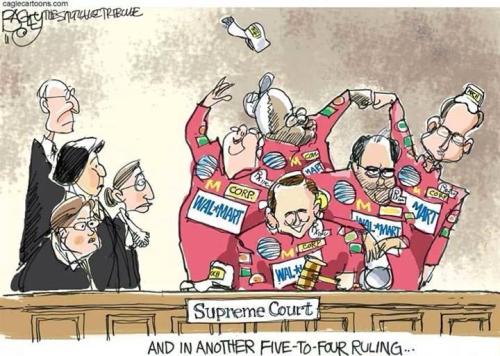
A change in the composition of the Supreme Court could have massive implications for our democracy. Both Citizens United v. FEC, the infamous case that opened the door to unlimited corporate political spending, and this month’s McCutcheon v. FEC were decided 5-4 with strong dissents. Some sitting justices have spoken out against Citizens United since it was decided.

It’s important for voters to know that our democracy was upended by a single vote. Justices Breyer and Ginsburg went out of their way to issue a separate statement in a 2012 Montana corporate spending case calling into question whether “in light of the huge sums currently deployed to buy candidates’ allegiance, Citizens United should continue to hold sway.”

As we elect new presidents who appoint new justices – and elect new senators who confirm or reject them – we can help turn the tide back toward restoring the constitutional power of the American people to impose reasonable limits on money in politics, a power demolished by the arch-conservatives on the Roberts Court.

Another equally important and parallel change effort we should be supporting is the push for a constitutional amendment to overturn Supreme Court decisions like Citizens United and McCutcheon. Constitutional amendments are, and should be rare — reserved for the direst circumstances.

But with the power of regulating our elections and protecting our democracy stripped away from “We the People,” this is one of those moments. Everyday Americans and elected officials across the country agree: More than 16 states and 500 towns and cities have already gone on record in support of an amendment that would overturn these cases.

And 149 Members of the House and Senate are now on record in support of constitutional remedies. Such an amendment would establish an important bulwark against future right-wing Supreme Courts.

Whether by changing the court or changing the Constitution, the decisions that have gutted our campaign finance laws have got to go. Our democracy is too valuable to be undermined by a court interested in protecting wealthy special interests at the expense of the rest of us.

Thursday, April 3, 2014

SCOTUS Strikes Down Political Spending Limits for Rich Donors

The US govt is corrupt in every branch, every level. Wealth owns everyone and everything. Democracy--game over....


The New Citizens United
 Wednesday, 02 April 2014
By Mike Ludwig, Truthout


Demonstrations were held across the country Wednesday as the Supreme Court continued chipping away at federal campaign finance reforms with a 5-4 ruling striking down the federal cap on the total amount of money an individual donor can spend supporting candidates and political parties during a two-year election cycle.

The ruling, which split the high court along ideological lines, eliminates the aggregate the cap on the total amount of money an individual can donate to candidates and party fundraising committees during an election season, which was set at $123,200 for 2013 and 2014. That cap was so high that only a several hundred mega-rich donors reached it during the last election cycle.

Campaign finance watchdogs now estimate that a single wealthy donor could spread up to $3.6 million among candidates, party committees and some political action groups affiliated with a single party during a single election cycle. A single donor could theoretically spend twice that amount by supporting candidates and committees from both parties, according to the Sunlight Foundation.

Conservatives are hailing the ruling as a victory for free speech. Liberals and progressives say the ruling will only increase the corrupting influence that ultra-rich donors can have on politicians, dealing yet another fundamental blow to the legitimacy of American democracy. Activists organized about 140 demonstrations and events in 38 states to protest the ruling and call for legislative action.

The ruling is not as sweeping as the Supreme Court's infamous 2010 Citizens United decision, which removed caps on the amount of money that corporations and unions can spend influencing federal elections and unleashed a tidal wave of corporate campaign cash that made the 2012 elections by far the most expensive in history.

But the ruling - one of several rulings under Chief Justice John Roberts that have eroded federal and state campaign finance laws in recent years - surely will increase the ability of rich Americans to impact elections.

The ruling also could inflate the power of joint fundraising committees, which take large donations from donors and funnel the cash to candidates and party committees with full knowledge of who signed the original check.

"Eliminating these limits will now allow a single politician to solicit, and a single donor to give, up to $3.6 million through the use of joint fundraising committees," said Michael Walden, president of the Brennan Center for Justice. "Following the Citizens United decision, this will further inundate a political system already flush with cash, marginalize average voters, and elevate those who can afford to buy political access."

Wednesday's ruling in McCutcheon vs. Federal Election Commission does not touch limits on the amount of money an individual can give to a single federal candidate, which currently is set at $2,600.

Free Speech or Plutocracy?

The majority opinion, delivered by Roberts, claims these limits on individual donations will keep political corruption in check. The Roberts opinion, which was supported by the court's conservative justices, argues that the cap on the total amount and individual can spend during an election cycle can prevent a donor from giving to as many candidates as he or she chooses, which violates free speech rights under the First Amendment.

Like the Citizens United ruling, the majority opinion views political speech and the money spent by wealthy donors to support candidates and influence elections as one and the same.

"Contributing money to a candidate is an exercise of an individual’s right to participate in the electoral process through both political expression and political association," Roberts wrote for the majority. " ... The Government may no more restrict how many candidates or causes a donor may support than it may tell a newspaper how many candidates it may endorse."

Writing for the four dissenting justices on the liberal side of the bench, Justice Stephen Breyer argued that the ruling created a "loophole" allowing rich donors to donate millions to candidates and parties, and, coupled with the Citizens United ruling, "eviscerates our Nation’s campaign finance laws, leaving a remnant incapable of dealing with the grave problems of democratic legitimacy that those laws were intended to resolve."

The case was brought before the court by the national Republican Party and Shaun McCutcheon; a wealthy businessman from Alabama who argued the cap on aggregate donations violated his First Amendment rights by prevented him from donating to Republican candidates he wanted to support in recent elections.

"Today, the court made clear that restraints on the political speech of those whose views you don't like must fail; free speech is the right of all Americans and not a revocable grant from the government of the day," said Dan Backer, the lead political counsel for McCutcheon and the Republican Party.

Campaign finance reformers, however, said the ruling is not a victory for free speech. It's a victory for the plutocracy.

"No matter what five Supreme Court justices say, the First Amendment was never intended to provide a giant megaphone for the wealthiest to use to shout down the rest of us," said Robert Weissman, president of Public Citizen, a progressive watchdog group that supports campaign finance reforms. "Our only hope of overturning this McCutcheon travesty - along with Citizens United - is if millions of Americans band together in saying 'Enough!' to plutocracy."

Growing Grass-Roots Momentum

For several years, a broad grass-roots movement has pushed to overturn Citizens United, either through legislation or amending the Constitution to declare that money spent influencing elections is not the same as free speech. Activists also are pushing for federal legislation that would amplify the impact of small political donations made by average Americans.

Jonah Minkoff-Zern, an activist with Public Citizen who helped organize protests in response to the McCutcheon decision, said the ruling would only spark more grassroots momentum.

"The rallies are a way for us to say, this is not going to be a dark day in history but a day of organizing hope and a call for change," Minkoff-Zern told Truthout.

In recent years, lawmakers in at least 16 states have passed resolutions calling for a constitutional amendment to overturn Citizens United. Minkhoff-Zern said at least 150 members of Congress have signed on in support of similar resolutions.

Tuesday, March 4, 2014

The Group of Thirty, Financial Crisis Kingpins

February 26, 2014
By Andrew Gavin Marshall


Following parts onetwo and three of the Global Power Project's Group of Thirty series, this fourth and final installment focuses on a few of the G30 members who have played outsized roles both in creating and managing various financial crises, providing a window on to the ideas, institutions and individuals who help steer this powerful global group.


The Assassin of Argentina

Prior to 2008, one of the most notable examples of a highly destructive financial crisis took place in Argentina which, heavily in debt, faced a large default and was brutally punished by financial markets and the speculative assault of global finance, otherwise known as "capital flight." Less known in the story of Argentina’s 1998 to 2002 economic catastrophe was the significant role played by just one man: Domingo Cavallo.

A longtime member of the Group of Thirty, Cavallo formerly served both as Governor of the Central Bank and Minister of Economy in Argentina. He has been referred to by Pulitzer Prize-winning economic researcher Daniel Yergin as “one of the most influential figures in recasting the relationship of state and marketplace in Latin America.”

Between 1976 and 1983, Argentina, ruled by a ruthless military dictatorship, was marred by excessive human rights abuses and persecution of intellectuals and dissidents during the so-called "Dirty War" in which as many as 30,000 people were killed or disappeared. The terror was reminiscent of nearby Chile, where a coup that brought dictator Augusto Pinochet to power in 1973, with the help of the CIA, provided a petri-dish experiment in the implementation of neoliberal "reforms." It was Chile’s dictatorship that set the example, and Argentina’s soon followed.

In a 2002 interview, Domingo Cavallo noted that, “The experience of Chile during the '80s was very instructive, I think, for most Latin American economies, and many politicians in Latin America, because Chile was successful by opening up and trying to expand their exports and in general their foreign trade and getting more integrated into the world economy... And of course we used, particularly here in Argentina, the experience of Chile to go ahead with our own reforms.”

Asked about the association between economic "reforms" in Chile and the ruthless dictatorship that implemented them, Cavallo explained, “There were discussions on the feasibility of implementing market reforms in a democracy. But in 1990... the first democratic president after Pinochet maintained the reforms and also tried to improve on them [and] it was demonstrated that itwould be possible to implement similar reforms under a democratic regime.”

What specific reforms was Cavallo referring to? Under Argentina's military dictatorship, Cavallo served for one year as Governor of the Central Bank in 1982, where he was responsible for implementing a state bailout of corporations and banks. After, Cavallo returned to academic life. But all that changed with the election of Carlos Menem in 1989, who served as president until 1999. In 1991, Menem appointed Cavallo as Minister for Economy, a position he held until 1996.

Cavallo led the neoliberal restructuring of Argentina: pegging the Argentine peso to the U.S. dollar, trying to reduce inflation, undertaking massive privatizations while opening up the economy to “free trade,” and deregulating financial markets. The New York Times in 1996 heaped praise on Cavallo for his “constructive” role in leading the economy “back to vitality and international respectability,” despite the fact that his reforms “brought high unemployment and painful reductions in social programs.”

Another NYT article credited Cavallo for the “stability” brought to Argentina through his “economic miracle,” while noting, without irony, that Cavallo’s miracle had “left million of Argentines... without a safety net” and with record-high unemployment, the emergence of urban slums, abandoned street children, over-crowded food banks, homeless shelters in churches, and even some people who were forced to eat cats in desperation. The "miracle” was so great, in fact, that despite all of the so-called stability it facilitated, President Menem ultimately dismissed Cavallo to the jubilation of tens of thousands of protesters in the streets. Though the people were pleased, financial markets expressed their disapproval.

With multiple economic and financial crises erupting around the world and in neighboring nations, Argentina, which pegged its currency to the U.S. dollar, found it could no longer compete. The touted neoliberal reforms were taking a toll as the country plunged into recession. Menem was replaced in 1999 by President Fernando De la Rua, who quickly sought support from the IMF to help repay the country’s debts owed to foreign – largely American – banks.

But Cavallo wasn't out. In 2001, he was re-appointed as the country's Minister of Economy just in time to receive emergency powers enabling him handle the country’s ongoing financial crisis that he helped to create. At that point, financial markets felt Argentina could not be trusted to repay its debt and the IMF refused to provide further loans, on the basis that the country had not implemented enough neoliberal reforms to meet its demands. The economy crashed and the “much-hated” Cavallo had to resign, as did the President, who fled by helicopter from the Casa Rosada as Argentines protested en masse.

Even the Federal Reserve Bank of San Francisco noted in 2002 that there was “some truth” to the view that “Argentina’s debt position would have been sustainable if only market uncertainty had not triggered a crisis." But, it added, had Argentina made the effort asked of it to reduce its debt, it could have avoided “potentially destabilizing shifts in market sentiment."


America’s Crisis-Causers

The role played by former Federal Reserve Chairman Alan Greenspan in creating the conditions that led to the 2008 global financial meltdown is known to many. What is less known is that Greenspan, too, is a former member of the Group of Thirty. Greenspan did not work alone, of course, in his efforts to deregulate the financial system and spur the growth of the derivatives markets, which laid the groundwork for the worst financial crisis in modern times. Larry Summers, who then served as deputy secretary and later Secretary of Treasury under Bill Clinton, was also very helpful in this regard. Summers, too, is a current member of the Group of Thirty.

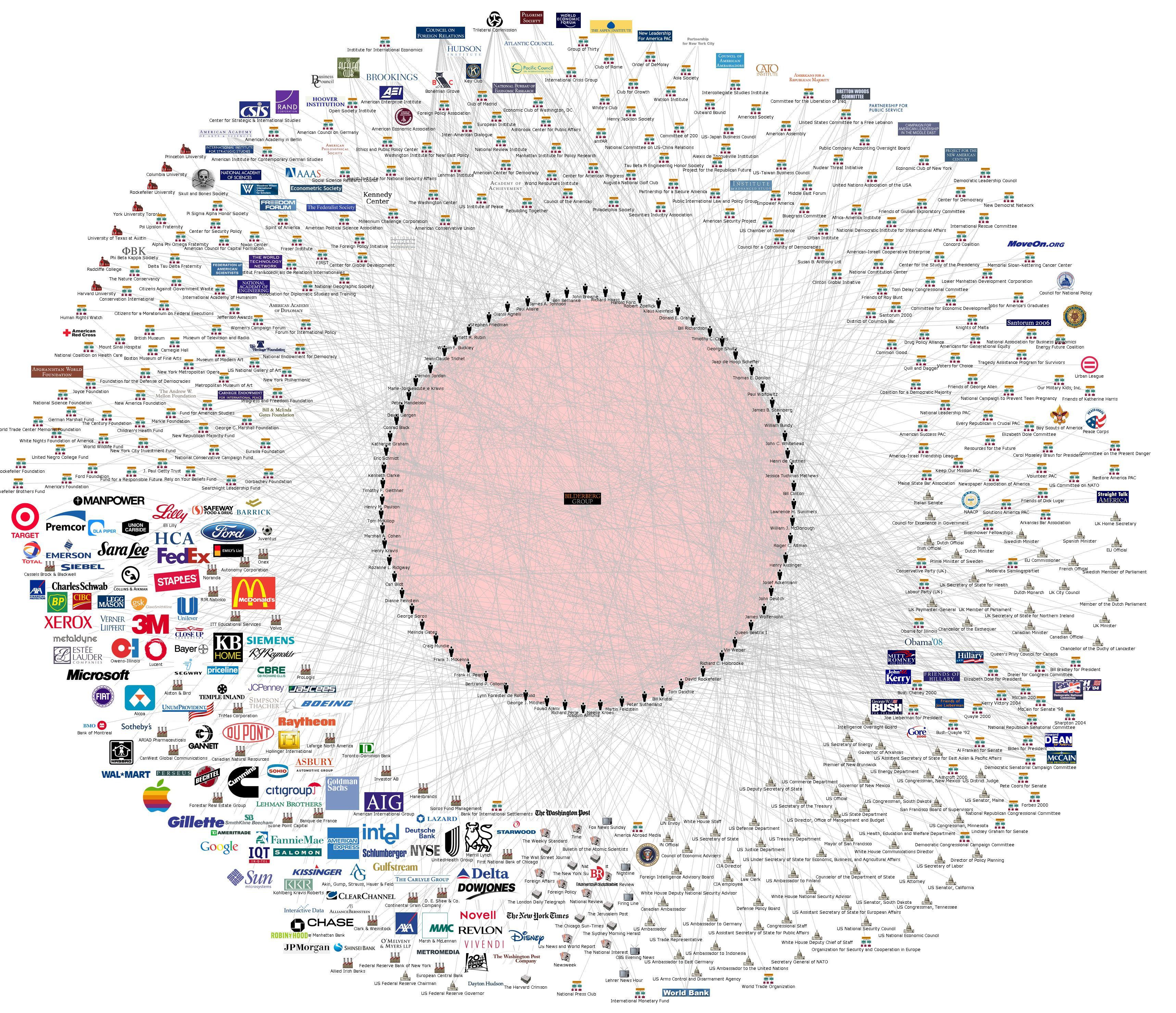
Currently serving as President Emeritus and as a professor at Harvard University, Summers was the former director of President Obama’s National Economic Council from 2009 to 2011. Previously, he was President of Harvard (2001 to 2009) and, prior to his positions during the Clinton administration he was Chief Economist at the World Bank (1991 to 1993). Currently, Summers is a member not only of the G30 but of the Council on Foreign Relations, the Trilateral Commission, and he was also a member of the Steering Committee of the Bilderberg Group.

While Chief Economist at the World Bank, Summers signed an infamous 1991 memo in which it was suggested that rich countries should dump their toxic waste and pollutants in the poorest African nations — because by the time the toxins spurred the growth of cancer in the local population, they would already statistically be dead due to already high mortality rates. The memo noted: “I think the economic logic behind dumping a load of toxic waste in the lowest wage country is impeccable and we should face up to that.”

When Summers later went to work for the Clinton administration under Treasury Secretary Robert Rubin, he along with Rubin and Fed Chairman Greenspan formed the "Three Marketeers," as Time referred to them, dedicated to “inventing a 21st century financial system” where they placed their “faith [in] financial markets.”

In the final two years of the Clinton presidency, Summers served as the Treasury Secretary alongside his deputy and protégé, Timothy Geithner, another member of the G30 who would go on to make a mark on the financial crisis — largely by convincing President Obama to bail out the Wall Street banks that crashed the economy, with zero penalty to them. Under the Obama administration, Summers served for nearly two years as Chair of the National Economic Council and was a highly influential policymaker. In 2009, he had spoken at the highly influential ultra-conservative think tank, the Peterson Institute for International Economics, where he explained the administration’s approach to the economic recovery, noting that, “Our approach sought to go as much as possible with the grain of the market” as opposed to regulating markets.

When Summers left the Obama administration in late 2010, he returned to Wall Street and made a fortune working for the hedge fund D. E. Shaw & Co. and Citigroup. This past summer, he was considered Obama’s favorite pick to replace Ben Bernanke as Fed Chairman, but faced such stiff opposition within the Democratic Party that he withdrew his name, leaving Janet Yellen – the Vice Chair of the Fed and herself a former member of the Group of Thirty – to step in.

What we see, in this analysis of the Group of Thirty, are the connections between those in positions of power to respond to and manage economic and financial crises, and those in positions of power who created such crises. Naturally, as well, the G30's membership includes numerous bankers who, as fortune had it, shared handsomely in the profits of those crises. Put simply, the G30 can be thought above all as an exclusive club of financial crisis kingpins. And it is a club, no doubt, that will continue to play a significant and not altogether helpful role in global financial management for years to come — or until something is done to stop them.

Sunday, February 17, 2013

While Left And Right Fight, Power Wins

February 14, 2013 | John V. Walsh

My experience with the American left and right leads to the conclusion that the left sees private power as the source of oppression and government as the countervailing and rectifying power, while the right sees government as the source of oppression and a free and unregulated private sector as the countervailing and rectifying power. Both are concerned with restraining the power to oppress, but they take opposite positions on the source of the oppressive power and remedy.

The right is correct that government power is the problem, and the left is correct that private power is the problem. Therefore, wherever power is located--the government or private sectors cannot reduce, constrain, or minimize power.

How does the progressive Obama Regime differ from the tax-cut, deregulation Bush/Cheney Regime? Both are complicit in the maximization of executive branch power and in the minimization of citizens’ civil liberties and, thus, of the people’s power. Did the progressive Obama reverse the right-wing Bush’s destruction of habeas corpus and due process? No. Obama further minimized the people’s power. Bush could throw us in prison for life without proof of cause. Obama can execute us without proof of cause. They do this in the name of protecting us from terrorism, but not from their terrorism.

Americans who have no experience with, or knowledge of, tyranny believe that only terrorists will experience the unchecked power of the state. They will believe this until it happens to them, or their children, or their friends.

The view of human nature held by the right and the left depends on whether the human nature is located in the private sector or the government sector (“public sector”). For the right (and for libertarians) human nature in the private sector is good and serves the public; in the government sector human nature is evil and oppressive. For the left, it is the opposite. As the same people go back and forth from one sector to the other, one marvels at the transformations of their character and morality. A good man becomes evil, and an evil man becomes good, depending on the location of his activities.

One of my professors, James M. Buchanan who won a Nobel Prize, pointed out that people are just as self-serving whether they are in the private sector or in government. The problem is how to constrain government and private power to the best extent possible.

Our Founding Fathers’ solution was to minimize the power of government and to rely on contending factions among private interests to prevent the rise of an oligarchy. In the event that contending private interests failed, the oligarchy that seized the government would not have much public power to exercise.

The Founding Fathers’ design more or less worked except for interludes of civil war and economic crisis until the cold war built up the power of government and the deregulation of the Clinton and Bush presidencies built up the power of private interests. It all came together with the accumulation of new, dictatorial powers in the executive branch in the name of protecting us from terrorists and with deregulation’s creation of powerful corporations “too big to fail.”

Now we have a government, whose elected members are beholden to a private oligarchy, consisting of the military/security complex, Wall Street and the financial sector, the Israel Lobby, agribusiness, pharmaceuticals, and the energy, mining, and timber businesses, with the power to shut down people’s protests at their exploitation by robber barons and government alike.

Vast amounts of government debt have been added to taxpayers’ burdens in order to fight wars that only benefit the military/security complex and the Israel Lobby. More vast amounts have been added in order to force taxpayers to cover the reckless gambling bets of the financial sector. Taxpayers are denied interest on their savings in order to protect the balance sheets of a corrupt financial sector. Legitimate protestors are brutalized by police and equated by Homeland Security with “domestic extremists,” defined by Homeland Security as a close relation to terrorists.

Today Americans are not safe from government or private power and suffer at the hands of both.

What can be done? From within probably very little. The right blames the left, and the left blames the right. The two sides are locked in ideological combat while power grows in the private and public sectors, but not the benevolent power that the two ideologies suppose. Instead, a two-headed power monster has risen.

If the power that has been established over the American people is to be shattered, it will come from outside. The Federal Reserve’s continuing monetization of the enormous debt that Washington is generating can destroy the dollar’s exchange value, sending up interest rates, collapsing the bond, stock, and real estate markets, and sinking the economy into deep depression at a time in history when Americans have exhausted their savings and are deeply in debt with high levels of joblessness and homelessness. The rise in import prices from a drop in the dollar’s exchange value would make survival an issue for a large percentage of the population.

Overnight the US could transition from superpower to third world penitent begging for a rescue program.

Who would grant it? The Russians encircled by US military bases and whose internal serenity is disrupted by inflows of American money to dissident groups in an effort to destabilize the Russian State? The Chinese, the government of which is routinely denounced by a hypocritical Washington for human rights abuses while Washington surrounds China with newly constructed military bases and new deployments of troops and naval vessels? South America, a long-suffering victim of Washington’s oppression? Europe, exhausted by conflicts and by Washington’s organization of them as puppet states and use of them as mercenaries in Washington’s wars for hegemony?

No country, except perhaps the bought-and-paid-for puppets of Britain, Canada, Australia, and Japan, would come to Washington’s aid.

In the ensuing collapse, the power of Washington and the power of the private robber barons would evaporate. Americans would suffer, but they would be rid of the power that has been established over them and that has changed them from a free people to exploited serfs.

This is, perhaps, an optimistic conclusion, but those relatively few Americans who are aware need some hope. This is the best that I can do. The majority of Americans remain trapped in their unawareness, which implies a bleak future. The insouciance of the American population is its downfall.

Thursday, June 7, 2012

The Fortunate 400


The Fortunate 400 - top 400 wealthiest Americans pay an average of 11.6% in taxes. The poorest class of Americans pay 25%. In a depressed economy, this doesn't work. I couldn't care any less if the wealthy get tax breaks during a strong economy. But as long as the economy is in the tank, the wealthy need to pony up and help pull us out of the mess they helped to get us into. Once the economy produces substantial growth from which it can gain momentum, give them their tax cuts back, who cares? but the whole philosophy with that should be:

No tax cuts:
A: during a bad economic slump, and/or
B: while funding multiple wars

The dumbest thing any president did (other than riding in an open convertible) is cut taxes while embroiled in two wars. Hello budget problems in a debt based economy!

Friday, May 11, 2012

On the History of the U.S. Economy in Decline

Plutonomy and the Precariat
by NOAM CHOMSKY

The Occupy movement has been an extremely exciting development. Unprecedented, in fact. There’s never been anything like it that I can think of. If the bonds and associations it has established can be sustained through a long, dark period ahead — because victory won’t come quickly — it could prove a significant moment in American history.

The fact that the Occupy movement is unprecedented is quite appropriate. After all, it’s an unprecedented era and has been so since the 1970s, which marked a major turning point in American history. For centuries, since the country began, it had been a developing society, and not always in very pretty ways. That’s another story, but the general progress was toward wealth, industrialization, development, and hope. There was a pretty constant expectation that it was going to go on like this. That was true even in very dark times.

I’m just old enough to remember the Great Depression. After the first few years, by the mid-1930s — although the situation was objectively much harsher than it is today — nevertheless, the spirit was quite different. There was a sense that “we’re gonna get out of it,” even among unemployed people, including a lot of my relatives, a sense that “it will get better.”

There was militant labor union organizing going on, especially from the CIO (Congress of Industrial Organizations). It was getting to the point of sit-down strikes, which are frightening to the business world — you could see it in the business press at the time — because a sit-down strike is just a step before taking over the factory and running it yourself. The idea of worker takeovers is something which is, incidentally, very much on the agenda today, and we should keep it in mind. Also New Deal legislation was beginning to come in as a result of popular pressure. Despite the hard times, there was a sense that, somehow, “we’re gonna get out of it.”

It’s quite different now. For many people in the United States, there’s a pervasive sense of hopelessness, sometimes despair. I think it’s quite new in American history. And it has an objective basis.

On the Working Class

In the 1930s, unemployed working people could anticipate that their jobs would come back. If you’re a worker in manufacturing today — the current level of unemployment there is approximately like the Depression — and current tendencies persist, those jobs aren’t going to come back.

The change took place in the 1970s. There are a lot of reasons for it. One of the underlying factors, discussed mainly by economic historian Robert Brenner, was the falling rate of profit in manufacturing. There were other factors. It led to major changes in the economy — a reversal of several hundred years of progress towards industrialization and development that turned into a process of de-industrialization and de-development. Of course, manufacturing production continued overseas very profitably, but it’s no good for the work force.

Along with that came a significant shift of the economy from productive enterprise — producing things people need or could use — to financial manipulation. The financialization of the economy really took off at that time.

On Banks

Before the 1970s, banks were banks. They did what banks were supposed to do in a state capitalist economy: they took unused funds from your bank account, for example, and transferred them to some potentially useful purpose like helping a family buy a home or send a kid to college. That changed dramatically in the 1970s. Until then, there had been no financial crises since the Great Depression. The 1950s and 1960s had been a period of enormous growth, the highest in American history, maybe in economic history.

And it was egalitarian. The lowest quintile did about as well as the highest quintile. Lots of people moved into reasonable lifestyles — what’s called the “middle class” here, the “working class” in other countries — but it was real. And the 1960s accelerated it. The activism of those years, after a pretty dismal decade, really civilized the country in lots of ways that are permanent.

When the 1970s came along, there were sudden and sharp changes: de-industrialization, the off-shoring of production, and the shift to financial institutions, which grew enormously. I should say that, in the 1950s and 1960s, there was also the development of what several decades later became the high-tech economy: computers, the Internet, the IT Revolution developed substantially in the state sector.

The developments that took place during the 1970s set off a vicious cycle. It led to the concentration of wealth increasingly in the hands of the financial sector. This doesn’t benefit the economy — it probably harms it and society — but it did lead to a tremendous concentration of wealth.

On Politics and Money

Concentration of wealth yields concentration of political power. And concentration of political power gives rise to legislation that increases and accelerates the cycle. The legislation, essentially bipartisan, drives new fiscal policies and tax changes, as well as the rules of corporate governance and deregulation. Alongside this began a sharp rise in the costs of elections, which drove the political parties even deeper into the pockets of the corporate sector.

The parties dissolved in many ways. It used to be that if a person in Congress hoped for a position such as a committee chair, he or she got it mainly through seniority and service. Within a couple of years, they started having to put money into the party coffers in order to get ahead, a topic studied mainly by Tom Ferguson. That just drove the whole system even deeper into the pockets of the corporate sector (increasingly the financial sector).

This cycle resulted in a tremendous concentration of wealth, mainly in the top tenth of one percent of the population. Meanwhile, it opened a period of stagnation or even decline for the majority of the population. People got by, but by artificial means such as longer working hours, high rates of borrowing and debt, and reliance on asset inflation like the recent housing bubble. Pretty soon those working hours were much higher in the United States than in other industrial countries like Japan and various places in Europe. So there was a period of stagnation and decline for the majority alongside a period of sharp concentration of wealth. The political system began to dissolve.

There has always been a gap between public policy and public will, but it just grew astronomically. You can see it right now, in fact. Take a look at the big topic in Washington that everyone concentrates on: the deficit. For the public, correctly, the deficit is not regarded as much of an issue. And it isn’t really much of an issue. The issue is joblessness. There’s a deficit commission but no joblessness commission. As far as the deficit is concerned, the public has opinions. Take a look at the polls. The public overwhelmingly supports higher taxes on the wealthy, which have declined sharply in this period of stagnation and decline, and the preservation of limited social benefits.

The outcome of the deficit commission is probably going to be the opposite. The Occupy movements could provide a mass base for trying to avert what amounts to a dagger pointed at the heart of the country.

Plutonomy and the Precariat

For the general population, the 99% in the imagery of the Occupy movement, it’s been pretty harsh — and it could get worse. This could be a period of irreversible decline. For the 1% and even less — the .1% — it’s just fine. They are richer than ever, more powerful than ever, controlling the political system, disregarding the public. And if it can continue, as far as they’re concerned, sure, why not?

Take, for example, Citigroup. For decades, Citigroup has been one of the most corrupt of the major investment banking corporations, repeatedly bailed out by the taxpayer, starting in the early Reagan years and now once again. I won’t run through the corruption, but it’s pretty astonishing.

In 2005, Citigroup came out with a brochure for investors called “Plutonomy: Buying Luxury, Explaining Global Imbalances.” It urged investors to put money into a “plutonomy index.” The brochure says, “The World is dividing into two blocs — the Plutonomy and the rest.”

Plutonomy refers to the rich, those who buy luxury goods and so on, and that’s where the action is. They claimed that their plutonomy index was way outperforming the stock market. As for the rest, we set them adrift. We don’t really care about them. We don’t really need them. They have to be around to provide a powerful state, which will protect us and bail us out when we get into trouble, but other than that they essentially have no function. These days they’re sometimes called the “precariat” — people who live a precarious existence at the periphery of society. Only it’s not the periphery anymore. It’s becoming a very substantial part of society in the United States and indeed elsewhere. And this is considered a good thing.

So, for example, Fed Chairman Alan Greenspan, at the time when he was still “Saint Alan” — hailed by the economics profession as one of the greatest economists of all time (this was before the crash for which he was substantially responsible) — was testifying to Congress in the Clinton years, and he explained the wonders of the great economy that he was supervising. He said a lot of its success was based substantially on what he called “growing worker insecurity.” If working people are insecure, if they’re part of the precariat, living precarious existences, they’re not going to make demands, they’re not going to try to get better wages, they won’t get improved benefits. We can kick ’em out, if we don’t need ’em. And that’s what’s called a “healthy” economy, technically speaking. And he was highly praised for this, greatly admired.

So the world is now indeed splitting into a plutonomy and a precariat — in the imagery of the Occupy movement, the 1% and the 99%. Not literal numbers, but the right picture. Now, the plutonomy is where the action is and it could continue like this.

If it does, the historic reversal that began in the 1970s could become irreversible. That’s where we’re heading. And the Occupy movement is the first real, major, popular reaction that could avert this. But it’s going to be necessary to face the fact that it’s a long, hard struggle. You don’t win victories tomorrow. You have to form the structures that will be sustained, that will go on through hard times and can win major victories. And there are a lot of things that can be done.

Toward Worker Takeover

I mentioned before that, in the 1930s, one of the most effective actions was the sit-down strike. And the reason is simple: that’s just a step before the takeover of an industry.

Through the 1970s, as the decline was setting in, there were some important events that took place. In 1977, U.S. Steel decided to close one of its major facilities in Youngstown, Ohio. Instead of just walking away, the workforce and the community decided to get together and buy it from the company, hand it over to the work force, and turn it into a worker-run, worker-managed facility. They didn’t win. But with enough popular support, they could have won. It’s a topic that Gar Alperovitz and Staughton Lynd, the lawyer for the workers and community, have discussed in detail.

It was a partial victory because, even though they lost, it set off other efforts. And now, throughout Ohio, and in other places, there’s a scattering of hundreds, maybe thousands, of sometimes not-so-small worker/community-owned industries that could become worker-managed. And that’s the basis for a real revolution. That’s how it takes place.

In one of the suburbs of Boston, about a year ago, something similar happened. A multinational decided to close down a profitable, functioning facility carrying out some high-tech manufacturing. Evidently, it just wasn’t profitable enough for them. The workforce and the union offered to buy it, take it over, and run it themselves. The multinational decided to close it down instead, probably for reasons of class-consciousness. I don’t think they want things like this to happen. If there had been enough popular support, if there had been something like the Occupy movement that could have gotten involved, they might have succeeded.

And there are other things going on like that. In fact, some of them are major. Not long ago, President Barack Obama took over the auto industry, which was basically owned by the public. And there were a number of things that could have been done. One was what was done: reconstitute it so that it could be handed back to the ownership, or very similar ownership, and continue on its traditional path.

The other possibility was to hand it over to the workforce — which owned it anyway — turn it into a worker-owned, worker-managed major industrial system that’s a big part of the economy, and have it produce things that people need. And there’s a lot that we need.

We all know or should know that the United States is extremely backward globally in high-speed transportation, and it’s very serious. It not only affects people’s lives, but the economy. In that regard, here’s a personal story. I happened to be giving talks in France a couple of months ago and had to take a train from Avignon in southern France to Charles De Gaulle Airport in Paris, the same distance as from Washington, DC, to Boston. It took two hours. I don’t know if you’ve ever taken the train from Washington to Boston, but it’s operating at about the same speed it was 60 years ago when my wife and I first took it. It’s a scandal.

It could be done here as it’s been done in Europe. They had the capacity to do it, the skilled work force. It would have taken a little popular support, but it could have made a major change in the economy.

Just to make it more surreal, while this option was being avoided, the Obama administration was sending its transportation secretary to Spain to get contracts for developing high-speed rail for the United States, which could have been done right in the rust belt, which is being closed down. There are no economic reasons why this can’t happen. These are class reasons, and reflect the lack of popular political mobilization. Things like this continue.

Climate Change and Nuclear Weapons

I’ve kept to domestic issues, but there are two dangerous developments in the international arena, which are a kind of shadow that hangs over everything we’ve discussed. There are, for the first time in human history, real threats to the decent survival of the species.

One has been hanging around since 1945. It’s kind of a miracle that we’ve escaped it. That’s the threat of nuclear war and nuclear weapons. Though it isn’t being much discussed, that threat is, in fact, being escalated by the policies of this administration and its allies. And something has to be done about that or we’re in real trouble.

The other, of course, is environmental catastrophe. Practically every country in the world is taking at least halting steps towards trying to do something about it. The United States is also taking steps, mainly to accelerate the threat. It is the only major country that is not only not doing something constructive to protect the environment, it’s not even climbing on the train. In some ways, it’s pulling it backwards.

And this is connected to a huge propaganda system, proudly and openly declared by the business world, to try to convince people that climate change is just a liberal hoax. “Why pay attention to these scientists?”

We’re really regressing back to the dark ages. It’s not a joke. And if that’s happening in the most powerful, richest country in history, then this catastrophe isn’t going to be averted — and in a generation or two, everything else we’re talking about won’t matter. Something has to be done about it very soon in a dedicated, sustained way.

It’s not going to be easy to proceed. There are going to be barriers, difficulties, hardships, failures. It’s inevitable. But unless the spirit of the last year, here and elsewhere in the country and around the globe, continues to grow and becomes a major force in the social and political world, the chances for a decent future are not very high.

Thursday, April 12, 2012

How the richest of the rich stay on top.

Wealth Defense Industry: The Real Reason America's Oligarchs Can Squeeze the Rest of Us

By Jeffrey A. Winters, In These Times
Posted on April 9, 2012
In 2005, Citigroup offered its high net-worth clients in the United States a concise statement of the threats they and their money faced.

The report told them they were the leaders of a “plutonomy,” an economy driven by the spending of its ultra-rich citizens. “At the heart of plutonomy is income inequality,” which is made possible by “capitalist-friendly governments and tax regimes.”

The danger, according to Citigroup’s analysts, is that “personal taxation rates could rise – dividends, capital gains, and inheritance taxes would hurt the plutonomy.”

But the ultra-rich already knew that. In fact, even as America’s income distribution has skewed to favor the upper classes, the very richest have successfully managed to reduce their overall tax burden. Look no further than Republican presidential contender Mitt Romney, who in 2010 paid 13.9 percent of his $21.6 million income in taxes that year, the same tax rate as an individual who earned a mere $8,500 to $34,500.

How is that possible? How can a country make so much progress toward equality on other fronts – race, gender, sexual orientation and disability – but run the opposite way in its policy on taxing the rich?

In 2004, the American Political Science Association (APSA) tried to answer that very question. The explanation they came up with viewed the problem as a classic case of democratic participation: While the poor have overwhelming numbers, the wealthy have higher rates of political participation, more advanced skills and greater access to resources and information. In short, APSA said, the wealthy use their social capital to offset their minority status at the ballot box.

But this explanation has one major flaw. Regardless of the Occupy movement’s rhetoric, most of the growth in the wealth gap has actually gone to a tiny sliver of the 1% – one-tenth of it, or even one-one-hundredth.

Even more shockingly, that 1 percent of the 1% has shifted its tax burden not to the middle class or poor, but to rich households in the 85th to 99th percentile range. In 2007, the effective income tax rate for the richest 400 Americans was below 17 percent, while the “mass affluent” 1% paid nearly 24 percent.

Disparities in Social Security taxes were even greater, with the merely rich paying 12.4 percent of their income, while the super-rich paid only one-one-thousandth of a percent.

It’s one thing for the poor to lose the democratic participation game, but APSA has no explanation for why the majority of the upper class – which has no shortage of government-influencing social capital – should fall so far behind the very top earners. (Of course, relative to middle- and lower-class earners, they’ve done just fine.)

For a better explanation, we need to look more closely at the relationship between wealth and political power. I propose an updated theory of “oligarchy,” the same lens developed by Plato and Aristotle when they studied the same problem in their own times.

A quick review
First, let’s review what we think we know about power in America.

We begin with a theory of “democratic pluralism,” which posits that democracy is basically a tug-of-war with different interest groups trying to pull government policy toward an outcome. In this framework, the rich are just one group among many competing “special interests.”

Of course, it’s hard not to notice that some groups can tug better than others. So in the 1950s, social scientists, like C. Wright Mills, author of The Power Elite, developed another theory of “elites” – those who wield more pull thanks to factors like education, social networks and ethnicity. In this view, wealth is just one of many factors that might help someone become the leader of a major business or gain a government position, thereby joining the elite.

But neither theory explains how the super-rich are turning public policy to their benefit even at the expense of the moderately rich. The mass affluent vastly outnumber the super-rich, and the super-rich aren’t necessarily better-educated, more skilled or more able to participate in politics; nor do the super-rich dominate the top posts of American government – our representatives tend to be among the slightly lower rungs of the upper class who are losing the tax battle.

Also, neither theory takes into account the unique power that comes with enormous wealth – the kind found in that one-tenth of the 1%. Whether or not the super-rich hold any official position in business or government, they remain powerful.

Only when we separate wealth from all other kinds of power can we begin to understand why our tax system looks the way it does – and, by extension, how the top one-tenth of 1% of the income distribution has distorted American democracy.

Enormous wealth is the heart of oligarchy.

So what’s an oligarchy?
Across all political spectrums, oligarchs are people (never corporations or other organizations) who command massive concentrations of material resources (that is, wealth) that can be deployed to defend or enhance their own property and interests, even if they don’t own those resources personally. Without this massive concentration of wealth, there are no oligarchs.

In any society, of course, an extremely unequal wealth distribution provokes conflict. Oligarchy is the politics of the defense of this wealth, propagated by the richest members of society.

Wealth defense can take many forms. In ancient Greece and Rome, the wealthiest citizens cooperated to run institutionalized states that defended their property rights. In Suharto’s Indonesia, a single oligarch led a despotic regime that mostly used state power to support other oligarchs. In medieval Europe, the rich built castles and raised private armies to defend themselves against each other and deter peasants tempted by their masters’ vaults. In all of these cases oligarchs are directly engaged in rule. They literally embody the law and play an active role in coercion as part of their wealth defense strategy.

Contemporary America (along with other capitalist states) instead houses a kind of “civil oligarchy.” The big difference is that property rights are now guaranteed by the impersonal laws of an armed state. Even oligarchs, who can be disarmed for the first time in history and no longer need to rule directly, must submit to the rule of law for this modern “civil” arrangement to work. When oligarchs do enter government, it is more for vanity than to rule as or for oligarchs. Good examples are New York City Mayor Michael Bloomberg, former presidential candidate Ross Perot and former Massachusetts Governor Mitt Romney.

Another feature of American oligarchy is that it allows oligarchs to hire skilled professionals, middle- and upper-class worker bees, to labor year-round as salaried, full-time political advocates and defenders of the oligarchy. Unlike those backing ordinary politicians, the oligarchs’ professional forces require no ideological invigoration to keep going. In other words, they function as a very well-paid mercenary army.

Whatever views and interests may divide the very rich, they are united in being materially focused and materially empowered. The social and political tensions associated with extreme wealth bond oligarchs together even if they never meet, and sets in motion the complex dynamics of wealth defense. Oligarchs do overlap with each other in certain social circles that theorists of the elite worked hard to map. But such networks are not vital to their power and effectiveness. Oligarchic theory requires no conspiracies or backroom deals. It is the minions oligarchs hire who provide structure and continuity to America’s civil oligarchy.

 The US Wealth Defense Industry
The threats to wealth that oligarchs face, and want to overcome, create the enormous profit-making opportunities that motivate the wealth defense industry, or WDI. In American oligarchy, it consists of two components.

The first is the mercenary army of professionals – lawyers, accountants, wealth management agencies – who use highly specialized knowledge to navigate 72,000 pages of tax code and generate a range of tax “products” and advice, enabling oligarchs to collectively save scores of billions of dollars, every year, that would otherwise have to be surrendered to the state. While most of us are what I call “TurboTaxpayers,” buying cheap tax software to navigate our returns and make routine deductions, oligarchs purchase complex “tax opinion letters” from professional firms. These letters are drafted to justify enormous nonpayments of taxes if the IRS ever questions how certain transactions produce losses, or how other accounting gymnastics make it appear that no gains or compensation occurred. The letters can cost up to $3 million each, but can save an oligarch tens or hundreds of millions of dollars in a given year.

Written by some of the most high-powered attorneys and firms in the industry, tax letters serve to intimidate the legal department of the IRS even before a prosecution is contemplated.

The Senate is aware of these letters – noting in a 2003 report on the “tax shelter industry” that “respected professional firms are spending substantial resources … to design, market, and implement hundreds of complex tax shelters, some of which are illegal and improperly deny the U.S. Treasury of billions of dollars in tax revenues” – but getting specific information about them is extremely difficult, since the IRS rarely prosecutes oligarchs. When it does, most cases are sealed, and oligarchs who work with tax attorneys can invoke attorney-client privilege. But in 2003, there was a breach of this fortress of secrecy when the Senate published detailed reports about illegal tax shelters created by the accounting firm KPMG.

According to the Senate, the KPMG tax shelters created “phony paper losses for taxpayers, using a series of complex, orchestrated transactions involving shell corporations, structured finance, purported multi-million dollar loans, and deliberately obscure investments” for 350 clients between 1997 and 2001. The fake losses totaled about $8.4 billion, or $24 million per client; applied against their incomes, these losses reduced the taxes of each oligarch by an average of $8.3 million, or $2.9 billion for the group.

One of the reasons this case was exposed is that it was all rather down-market, using cheap cookie-cutter tax opinion letters priced at a mere $350,000 each.

Not only did all the firms and banks conspiring on behalf of these 350 oligarchs – and the oligarchs themselves – know that the investments “had no reasonable potential for profit,” but KPMG calculated that even if it was fined for failing to disclose the shelters, it would still earn far more in fees than it would pay in fines. The firm was fined $456 million. Even more incredibly, more than a dozen KPMG clients sued the firm for the taxes and penalties incurred after being discovered – the suits claim that KPMG bungled its job of creating shelters for tax evasion with zero legal risks for oligarchs. It’s tantamount to suing your hit man for a sloppy murder.

The second component of the WDI is the nitty-gritty legwork that keeps the tax system sufficiently porous, complex and uncertain enough to be manipulated. Some oligarchs do this work themselves, speed dialing public officials to directly complain about laws and regulations, but most do not. Instead, WDI professionals, motivated to earn a share of annual oligarchic gains, constitute a highly coherent and aggressive network for political pressure. These lobbyists fight to insert favorable material into the tax code, cut sections that cause problems, and block threats on the horizon.

Apologists for havens
Discussions about money in politics often begin with campaign finance reform. Advocates argue that a small fraction of wealthy Americans constitute a powerful donor class that provides the vast majority of candidates’ funds. Long before ordinary citizens get to vote, they say, their choices are reduced to politicians deemed acceptable by the richest Americans via a “wealth primary,” in which candidates straying from a narrow economic agenda are shut out of campaign funding.

“For all their influence at the polls, guys like Joe the Plumber aren’t typically campaign contributors,” explains Sheila Krumholz, executive director of the Center for Responsive Politics. “You’re more likely to see John the Bond Trader bankrolling these campaigns.” And she’s right: Of the roughly 1.4 million individual contributions of $200 or more during the 2008 elections, three-fourths of the money came from a mere one-fifth of the donors, who in turn comprised one-tenth of 1 percent of American adults.

But while this fraction does coincide with our approximation of the size of the American oligarchy, campaign donations are not oligarchs’ primary or even most effective strategy for political influence. Academics Michael Graetz and Ian Shapiro explain this in their 2005 book, Death by a Thousand Cuts: The Fight over Taxing Inherited Wealth.

“Campaign contributions, soft money, spending limits for political candidates and the like have become controversial issues,” they admit, “but they mattered little in the estate tax fight.” The battle was between smaller oligarchs and the biggest players at the top. Believing it unlikely that the elimination of the estate tax could be extended indefinitely, a significant number of wealthy Americans with a net worth between $5 and $15 million wanted the threshold moved up to exempt their estate tax. In exchange, they supported a higher estate tax rate on everyone above the threshold. Big oligarchs took the opposite position. They wanted no estate tax at all. But if Congress was going to bring it back, the ultra-rich supported a lower exemption in exchange for a lower overall rate.

The big oligarchs won again – but not because of campaign finance. “Money mattered more fundamentally in shifting the tectonic plates underlying American tax debates,” Graetz and Shapiro suggest. And this is precisely where oligarchs deploy their resources in the WDI.

Oligarchs’ “three decades of investments in activist, conservative think tanks” has blazed an ideological path that drones in the WDI follow. Activists at institutions like the Heritage Foundation supply “ideological ammunition to the lobbyists and interest groups … who work relentlessly … to keep up the tax-cutting pressure on the Hill.”

This pressure was hard at work in President Obama’s feeble attempt to curtail offshore tax havens in 2009. In the middle of massive public bailouts to the financial system and large bonuses on Wall Street, the president proposed stronger measures to fight against who he called “tax cheats,” the individuals using offshore tax havens to deny the government nearly $70 billion a year – a level equal to about seven cents on every dollar of taxes paid honestly.

But Obama’s proposals were less aggressive than his rhetoric. The president urged Congress to support efforts to sanction nations that maintained secrecy on bank accounts and corporate entities, and sought to hire 800 additional IRS agents “to detect and pursue American tax evaders abroad”; these measures were projected to save a mere $8.7 billion over 10 years – about one percent of the losses from offshore accounts. Despite the timidity, the proposals received only a lukewarm response from Democrats and outright hostility from Republicans, who argued that they would cripple American corporations’ ability to compete globally.

Dan Mitchell, a senior fellow (i.e. mercenary) at the Cato Institute (a think tank financed by American oligarchs), defended tax havens as “outposts of freedom.” If Americans are concerned that “individuals are moving their money to countries with better tax law, that should be a lesson to us that we should fix our tax law.”

In other words: Let’s decrease taxes on the super-rich.

The WDI, arising naturally from the opportunities and risks created by enormous wealth, has spawned its own pile of these opinion-makers, free to spread their ideas through a compliant corporate media while oligarchs themselves are free to look on.

Oligarchy, or Democracy?
To argue that the United States is a thriving oligarchy does not imply that our democracy is a sham: There are many policies about which oligarchs have no shared interests. Their influence in these areas is either small or mutually canceling.

Though it may strike at the heart of elitism, greater democratic participation is not an antidote to oligarchic power. It is merely a potential threat. Only when participation challenges material inequality – when extreme wealth is redistributed – do oligarchy and democracy finally clash.

The answer to the question of inequality, then, is troubling. Wars and revolutions have destroyed oligarchies by forcibly dispersing their wealth, but a democracy never has.

Democracy and the rule of law can, however, tame oligarchs.

A campaign to tame oligarchs is a struggle unlikely to fire the spirits of those outraged by the profound injustices between rich and poor. However, to those enduring the economic and political burdens of living among wild oligarchs, it is an achievement that can improve the absolute welfare of average citizens, even if the relative gap between them and oligarchs widens rather than narrows.

A graduate student in one of my seminars – resisting my terminology – once declared that the “U.S. has rich people, not oligarchs.” More than anything else, that statement claims that somehow American democracy has managed to do something no other political system in history ever has: strip the holders of extreme wealth of their inherent power resources and the political interests linked to protecting those fortunes.
Of course, this hasn’t happened.

But it is endlessly fascinating that we’re now in a moment when Americans are once again asking fundamental questions about how the oligarchic power of wealth distorts and outflanks the democratic power of participation.