Showing posts with label big banks. Show all posts

Sunday, September 29, 2013

Americans warned bank 'bail-ins' coming

Experts say institutions will grab deposits without warning

WASHINGTON – With the United States facing a $17 trillion debt and an acidic debate in Washington over raising that debt limit on top of a potential government shutdown, Congress could mimic recent European action to let banks initiate a “bail-in” to blunt future failures, experts say.

Previously the federal government has taken taxes from consumers, or borrowed the money, to hand out to troubled banks. This could be a little different, and could allow banks to reach directly into consumers’ bank accounts for their cash.

Authority to allow bank “bail-ins” would be in lieu of approving any future taxpayer bailouts of banks that would be in dire need of recapitalization in order to survive.

Some financial experts contend that banks already have the legal authority to confiscate depositors’ money without warning, and at their discretion.

Financial analyst Jim Sinclair warned that the U.S. banks most likely to be “bailed-in” by their depositors are those institutions that received government bail-out funds in 2008-2009.

Such a “bail-in” means all savings of individuals over the insured amount would be confiscated to offset such a failure.

“Bail-ins are coming to North America without any doubt, and will be remembered as the ‘Great Leveling,’ of the ‘great Flushing’ (of Lehman Brothers),” Sinclair said. “Not only can it happen here, but it will happen here.

“It stands on legal grounds by legal precedent both in the U.S., Canada and the U.K.”

Sinclair is chairman and chief executive officer of Tanzania Royalty Exploration Corp. and is the son of Bertram Seligman, whose family started Goldman Sachs, Solomon Brothers, Lehman Brothers, Bache Group and other major investment banking firms.

Some of the major banks which received federal bailout money included Bank of America, Citigroup and JPMorgan Chase.

“When major banks fail, they are going to bail them out by grabbing the money that is in your bank accounts,” according to financial expert Michael Snyder. “This is going to absolutely shatter faith in the banking system and it is actually going to make it far more likely that we will see major bank failures all over the Western world.”

Given the dire financial straits the U.S. finds itself in, these financial experts say that Congress could look at the example of the European Parliament, which recently started to consider action that would allow banks to confiscate depositors’ holdings above 100,000 euros. Generally, funds up to that level are insured.

Finance ministers of the 27-member European Union in June had approved forcing bondholders, shareholders and large depositors with more than 100,000 euros in their accounts to make the financial sacrifice before turning to the government for help with taxpayer funds.

Depositors with less than 100,000 euros would be protected. Considering protection of small depositors a top priority, the E.U. ministers took pride in saying that their action would shield them.

“The E.U. has made a big step towards putting in place the most comprehensive framework for dealing with bank crises in the world,” said Michel Barnier, E.U. commissioner for internal market and services.

The plan as approved outlines a hierarchy of rescuing struggling banks. The first will be bondholders, followed by shareholders and then large depositors.

Among large depositors, there is a hierarchy of whose money would be selected first, with small and medium-sized businesses being protected like small depositors.

“This agreement will effectively move us from ad hoc ‘bail-outs’ to structured and clearly defined ‘bail-ins,’” said Michael Noonan, Ireland’s finance minister.

The European Parliament is expected to finalize the plan by the end of the year.

The purpose of this “bail-in,” patterned after the Cyprus model, is to offset the need for continued taxpayer bailouts that have come under increasing criticism of the more economically well-off countries such as Germany.

Last March, Cyprus had agreed to tap large depositors at its two leading banks for some 10 billion euros in an effort to obtain another 10 billion European Union bailout.

While this action prevented the collapse of Cyprus’ two top banks, the Bank of Cyprus and Popular Bank of Cyprus, it greatly upset depositors with savings more than 100,000 euros.

WND recently revealed that the practice of “bail-ins” by Cyprus a year ago was beginning to spread to other nations as large depositors began to see their balances plunge literally overnight.

A “bail-in,” as opposed to a bailout that countries especially in Europe have been seeking from the International Monetary Fund and the European Union, is a recognition that such outside monetary injections won’t be forthcoming.

Sinclair said that the recent confiscation of customer deposits in Cyprus was not a “one-off, desperate idea of a few Eurozone ‘troika’ officials scrambling to salvage their balance sheets.”

“A joint paper by the U.S. federal Deposit Insurance Corporation (FDIC) and the Bank of England (BOE) dated December 10, 2012 shows, that these plans have been long in the making, that they originated with the G20 Financial Stability Board in Basel, Switzerland, and that the result will be to deliver clear title to the banks of depositor funds,” Sinclair said.

He pointed that while few depositors are aware, banks legally own the depositors’ funds as soon as they are put in the bank.

“Our money becomes the bank’s, and we become unsecured creditors holding IOUs or promises to pay,” Sinclair said.

“But until now, the bank has been obligated to pay the money back on demand in the form of cash,” he said. “Under the FDIC-BOE plan, our IOUs will be converted into ‘bank equity.’ The bank will get the money and we will get stock in the bank.”

“With any luck,” Sinclair said, “we may be able to sell the stock to someone else, but when and at what price? Most people keep a deposit account so they can have ready cash to pay the bills.”

Such plans already are being used, or under consideration, in New Zealand, Poland, Canada and several other countries.

Thursday, August 29, 2013

The Leveraged Buyout of America

Monday, August 26, 2013 by Common Dreams
Giant bank holding companies now own airports, toll roads, and ports; control power plants; and store and hoard vast quantities of commodities of all sorts. They are systematically buying up or gaining control of the essential lifelines of the economy. How have they pulled this off, and where have they gotten the money?
by Ellen Brown

In a letter to Federal Reserve Chairman Ben Bernanke dated June 27, 2013, US Representative Alan Grayson and three co-signers expressed concern about the expansion of large banks into what have traditionally been non-financial commercial spheres. Specifically:
[W]e are concerned about how large banks have recently expanded their businesses into such fields as electric power production, oil refining and distribution, owning and operating of public assets such as ports and airports, and even uranium mining.
After listing some disturbing examples, they observed:
According to legal scholar Saule Omarova, over the past five years, there has been a “quiet transformation of U.S. financial holding companies.” These financial services companies have become global merchants that seek to extract rent from any commercial or financial business activity within their reach. They have used legal authority in Graham-Leach-Bliley to subvert the “foundational principle of separation of banking from commerce”. . . .

It seems like there is a significant macro-economic risk in having a massive entity like, say JP Morgan, both issuing credit cards and mortgages, managing municipal bond offerings, selling gasoline and electric power, running large oil tankers, trading derivatives, and owning and operating airports, in multiple countries.

A “macro” risk indeed – not just to our economy but to our democracy and our individual and national sovereignty. Giant banks are buying up our country’s infrastructure – the power and supply chains that are vital to the economy. Aren’t there rules against that? And where are the banks getting the money?

How Banks Launder Money Through the Repo Market

In an illuminating series of articles on Seeking Alpha titledRepoed!, Colin Lokey argues that the investment arms of large Wall Street banks are using their “excess” deposits – the excess of deposits over loans – as collateral for borrowing in the repo market. Repos, or “repurchase agreements,” are used to raise short-term capital. Securities are sold to investors overnight and repurchased the next day, usually day after day.

The deposit-to-loan gap for all US banks is now about $2 trillion, and nearly half of this gap is in Bank of America, JP Morgan Chase, and Wells Fargo alone. It seems that the largest banks are using the majority of their deposits (along with the Federal Reserve’s quantitative easing dollars) not to back loans to individuals and businesses but to borrow for their own trading. Buying assets with borrowed money is called a “leveraged buyout.” The banks are leveraging our money to buy up ports, airports, toll roads, power, and massive stores of commodities.

Using these excess deposits directly for their own speculative trading would be blatantly illegal, but the banks have been able to avoid the appearance of impropriety by borrowing from the repo market. (See my earlier article here.) The banks’ excess deposits are first used to purchase Treasury bonds, agency securities, and other highly liquid, “safe” securities. These liquid assets are then pledged as collateral in repo transactions, allowing the banks to get “clean” cash to invest as they please. They can channel this laundered money into risky assets such as derivatives, corporate bonds, and equities (stock).

That means they can buy up companies. Lokey writes, “It is common knowledge that prop [proprietary] trading desks at banks can and do invest in a variety of assets, including stocks.” Prop trading desks invest for the banks’ own accounts. This was something that depository banks were forbidden to do by the New Deal-era Glass-Steagall Act but that was allowed in 1999 by the Gramm-Leach-Bliley Act, which repealed those portions of Glass-Steagall.

The result has been a massively risky $700-plus trillion speculative derivatives bubble. Lokey quotes from an article by Bill Frezza in the January 2013 Huffington Post titled “Too-Big-To-Fail Banks Gamble With Bernanke Bucks“:
If you think [the cash cushion from excess deposits] makes the banks less vulnerable to shock, think again. Much of this balance sheet cash has been hypothecated in the repo market, laundered through the off-the-books shadow banking system. This allows the proprietary trading desks at these “banks” to use that cash as collateral to take out loans to gamble with. In a process called hyper-hypothecation this pledged collateral gets pyramided, creating a ticking time bomb ready to go kablooey when the next panic comes around.

That Explains the Mountain of Excess Reserves

Historically, banks have attempted to maintain a loan-to-deposit ratio of close to 100%, meaning they were “fully loaned up” and making money on their deposits. Today, however, that ratio is only 72% on average; and for the big derivative banks, it is much lower. For JPMorgan, it is only 31%. The unlent portion represents the “excess deposits” available to be tapped as collateral for the repo market.

The Fed’s quantitative easing contributes to this collateral pool by converting less-liquid mortgage-backed securities into cash in the banks’ reserve accounts. This cash is not something the banks can spend for their own proprietary trading, but they can invest it in “safe” securities – Treasuries and similar securities that are also the sort of collateral acceptable in the repo market. Using this repo collateral, the banks can then acquire the laundered cash with which they can invest or speculate for their own accounts.

Lokey notes that US Treasuries are now being bought by banks in record quantities. These bonds stay on the banks’ books for Fed supervision purposes, even as they are being pledged to other parties to get cash via repo. The fact that such pledging is going on can be determined from the banks’ balance sheets, but it takes some detective work. Explaining the intricacies of this process, the evidence that it is being done, and how it is hidden in plain sight takes Lokey three articles, to which the reader is referred. Suffice it to say here that he makes a compelling case.

Can They Do That?

Countering the argument that “banks can’t really do anything with their excess reserves” and that “there is no evidence that they are being rehypothecated,” Lokey points to data coming to light in conjunction with JPMorgan’s $6 billion “London Whale” fiasco. He calls it “clear-cut proof that banks trade stocks (and virtually everything else) with excess deposits.” JPM’s London-based Chief Investment Office [CIO] reported:
JPMorgan’s businesses take in more in deposits that they make in loans and, as a result, the Firm has excess cash that must be invested to meet future liquidity needs and provide a reasonable return. The primary reponsibility of CIO, working with JPMorgan’s Treasury, is to manage this excess cash. CIO invests the bulk of JPMorgan’s excess cash in high credit quality, fixed income securities, such as municipal bonds, whole loans, and asset-backed securities, mortgage backed securities, corporate securities, sovereign securities, and collateralized loan obligations.

Lokey comments:

That passage is unequivocal — it is as unambiguous as it could possibly be. JPMorgan invests excess deposits in a variety of assets for its own account and as the above clearly indicates, there isn’t much they won’t invest those deposits in. Sure, the first things mentioned are “high quality fixed income securities,” but by the end of the list, deposits are being invested in corporate securities [stock] and CLOs [collateralized loan obligations]. . . . [T]he idea that deposits are invested only in Treasury bonds, agencies, or derivatives related to such “risk free” securities is patently false.

He adds:
[I]t is no coincidence that stocks have rallied as the Fed has pumped money into the coffers of the primary dealers while ICI data shows retail investors have pulled nearly a half trillion from U.S. equity funds over the same period. It is the banks that are propping stocks.

Another Argument for Public Banking

All this helps explain why the largest Wall Street banks have radically scaled back their lending to the local economy. It appears that JPMorgan’s loan-to-deposit ratio is only 31% not because the bank could find no creditworthy borrowers for the other 69% but because it can profit more from buying airports and commodities through its prop trading desk than from making loans to small local businesses.

Small and medium-sized businesses are responsible for creating most of the jobs in the economy, and they are struggling today to get the credit they need to operate. That is one of many reasons that banking needs to be a public utility. Publicly-owned banks can direct credit where it is needed in the local economy; can protect public funds from confiscation through “bail-ins” resulting from bad gambling in by big derivative banks; and can augment public coffers with banking revenues, allowing local governments to cut taxes, add services, and salvage public assets from fire-sale privatization. Publicly-owned banks have a long and successful history, and recent studies have found them to be the safest in the world.

As Representative Grayson and co-signers observed in their letter to Chairman Bernanke, the banking system is now dominated by “global merchants that seek to extract rent from any commercial or financial business activity within their reach.” They represent a return to a feudal landlord economy of unearned profits from rent-seeking. We need a banking system that focuses not on casino profiteering or feudal rent-seeking but on promoting economic and social well-being; and that is the mandate of the public banking sector globally.

Sunday, August 18, 2013

The “Bankization” of America

Friday, August 16, 2013 by Campaign for America's Future Blog
by Richard Eskow


The share of our national income which goes to corporate profit is the highest it’s been since they started tracking it in 1929, while the share going to people – as salary and wages – is the lowest. And the percentage of that corporate profit which goes to Wall Street is also the highest on record.

We’re becoming a financialized economy. Never before has the manipulation of money counted for so much and the real-world economy of people and consumer goods counted for so little.

And none of it is an accident.

When Wall Street catches a cold …

The Wall Street Journal reported this Thursday that “Stock and bond prices tumbled after stronger-than-expected economic data …”

Why would good news about the economy cause the stock market to fall? The sentences continues: “… raised investor anxiety about a pullback next month in central-bank support for financial markets …”

Investors had been relying on the Federal Reserve to keep pumping up the stock market’s record run, but some mildly favorable economic reports raised fears were raised that the Fed’s market-friendly interventions might come to an end.

“We’re getting another knee-jerk reaction to fears of tapering,” a market analyst told the Journal, referring to the Fed’s monthly purchase of $85 billion in bonds. As Reuters reported last month, “Many on Wall Street believe the Federal Reserve’s monetary policy is behind record corporate earnings and the stock market’s surge to all-time highs this year.”

When Wall Street catches a cold – when it even might catch a cold — the economy catches pneumonia.

Reality Bites

Meanwhile, the “real” economy – the one where people live, and work, and buy things – has suffered even as Wall Street and the stock market have boomed. That trend continued this week, too, Wal-Mart announced disappointing sales and lowered its projections. Its Chief Financial Officer observed that “The retail environment remains challenging in the U.S. and our international markets, as customers are cautious in their spending.”

Cisco also lowered its sales expectations. As the Journal article notes, these announcements added to the fear that the Fed’s interventions might wind down.

This stock market story illustrates the gulf between a stock-market economy increasingly driven by the banking industry – an economy which has been booming, today’s news notwithstanding – and a human economy wracked by consumer fears, falling wages, joblessness, and low-level jobs for a growing number of people who are working.

The gulf between these two economies drove this morning’s stock market story. It’s also driving the long-term depression-like misery which holds millions of Americans in its grip.

This is not the playing out of some divinely-decreed order. The financialization of the US economy is the result of very deliberate governmental choices. Unless different choices are made going forward, we will continue to become a “Bankistan” whose wealth and economic fate is increasingly hijacked by Wall Street.

Financialized

The Federal Reserve’s data on corporate profits were helpfully compiled by a contributor to the investment site The Motley Fool, who notes that financial profits were 11 percent of total corporate profits in the US back in 1947, the first year these numbers were compiled.

These profits soared in the first decade of the 21st Century. After taking a hit in the crisis of 2008 – a crisis which the banking industry caused – they rose again and are now at record highs. Their share of total corporate profits has risen from 11 percent to 42 percent, as of the latest report, and the Fed expects them to keep rising.

Here’s how that looks:


The money nowadays isn’t in manufacturing, or retail, or any of the other traditionally jobs-producing industries. The money now is in money.

How did this happen?

A series of policy decisions enabled this explosive growth, including the deregulation of Wall Street; the repeal of Glass-Steagall, which separated bank customers’ money from money which the bank could invest for its own profit; runaway banker salaries and bonuses, which prompted the “best and the brightest” to flock to Wall Street and apply their ingenuity to flouting the rules; and government’s increasing unwillingness to indict bankers for criminal behavior.

And then, when banker criminality and incompetence created the crisis of 2008, they were rescued by the government without being held financially or legally accountable for their wrongdoing.

The Federal Reserve continues to pursue stimulus policies that moderately help the economy as a whole, but which emphasize the economic health of banks and publicly-traded corporations over that of companies that hire workers – and therefore increase the consumption of consumer goods.

Profit by the slice …

Banks have a bigger share of the corporate-profit pie – and that pie’s bigger than ever. As Floyd Norris notes in the New York Times, the government’s revised estimate of wage and salary income is 42.6 percent of GDP, which matches the 2010 figure as the lowest percentage since this data was first captured in 1929.

Using the latest revisions to the national income and product account (NIPA) data produced by the Bureau of Economic Analysis, Norris also notes that corporate profits are now 9.6 percent of GDP. That’s the highest since these figures were first captured.

As Norris also notes, corporate taxes rose slightly in 2012 as a percentage of GDP but are still well below their historical averages. That’s not an accident either.

Meanwhile, as this chart shows, unemployment remains horrendous:


Wages actually fell for most people after the 2008 crisis, as high-income individuals (the top 1 percent) captured all of the economic gains created by the government-sponsored recovery – and even enlarged their share, capturing 121 percent of the recovery as the rest of the country fell behind.

Indebted

You might think that financial institutions feel indebted to the public for rescuing them. But the opposite is true: We’re indebted to them. According to the latest report from the New York Federal Reserve, auto loan balances increased by $20 billion over the previous quarter while credit card balances and student loan debt increased by $8 billion each.

The falling rates of mortgage debt, driven by range of factors which included falling housing values and foreclosures, resulted in an overall decline in total indebtedness. But these figures show that our household debt in many key areas continues to rise.

As wages and salaries decline, people are struggling to keep up with the way of life they once know. So they fall deeper in debt – a debt which allows them, and the banks, to delay the day of reckoning once again.

Fixing a Hole

These figures paint the picture of an economy that has become seriously unbalanced in favor of the banks – “financialized,” as observers increasingly describe it. How can the economy be rebalanced?

Many solutions are well-known to bank reformers and well-informed voters: Reinstate Glass-Steagall, or something very much like it. Insist on strong regulatory oversight of the banking sector, and give regulators the authority to do their jobs. End “too big to fail” banks, instead of encouraging their consolidation (as the government has done in recent years). Prosecute criminal bankers.

Other solutions are equally important. The interbank database and shell company called MERS must be ended, so that financial institutions can’t collude against consumers and the states. The Federal Reserve must demand that banks perform their central economic function – responsible lending to consumers and job-creating businesses – rather than reward them for speculation and other forms of non-productive profiteering.

(That’s why the choice of Federal Reserve head is so important.)

Genuine shareholder reform is also needed, so bankers don’t overpay themselves at shareholder expense or use the bank’s coffers as a “get out of jail” card for massive settlements caused by their own misdeeds.

Lastly, no comprehensive solution can be found until banks and other corporations are once again taxed at reasonable levels and the revenues are used to create well-paying jobs for the American middle class.

A healthy economy needs banks that lend, and consumers with the money to buy. Until that happens we’ll be living in a highly-financialized “Bankistan” that excludes most of its citizens from sharing in the American dream.

Tuesday, April 23, 2013

Long Past Due: Time for a Sales Tax on Wall Street Financial Transactions (2 articles)

The Robin Hood Tax Campaign
by RALPH NADER


Here are some questions to consider: What do the Wall Street firms do that is so vital for the national interest? How does speculation contribute to our society? It’s time for Wall Street to step up and provide some answers.

The reckless actions of Wall Street institutions led to the collapse of the the U.S. economy and the deep recession of 2008-09. The Wall Street firms looted and gambled trillions in worker pensions and mutual fund savings. The Wall Street traders made billions of dollars in speculative money — bets on bets — holding hostage the real economy where money is made by providing goods and services. And the actions of Wall Street resulted in the loss of more than 8 million jobs.
Despite all the lasting harm caused by the casino capitalists, the big banks are now bigger, richer and more powerful than they were when they were bailed out in late 2008. The only ones who were punished were the U.S. taxpayers, who footed the $600 billion bill for the excesses of Wall Street. Brazenly, many firms still continue to gamble with other people’s money.

Something needs to change. One necessary change lies in a financial transaction tax — often referred to as the “Robin Hood Tax.” The Robin Hood Tax movement began in the United Kingdom in 2010 with the support of hundreds of economists, prominent public figures and social justice organizations.

Yesterday, Rep. Keith Ellison (D-Minn.) reintroduced The Inclusive Prosperity Act — inspired by the Robin Hood Tax. If passed, the bill (H.R. 1579) would create a minuscule tax on the purchase and sale of derivatives, options and stocks. The tax would be small, half a percent or less of the transaction value, depending on the product. This amounts to half a penny or less per dollar.

Consider this fact: American consumers in most states pay sales taxes on the necessities they purchase — cars, appliances, clothes, etc. The rate of such sales tax is, in some areas, as high as 7 percent. For example, a schoolteacher or police officer who buys a $100 pair of shoes pays up to $7 in sales taxes. Most people accept the idea of paying such a tax. But what about the folks on Wall Street? A trader can buy and sell millions of dollars of financial products each day without paying a cent in sales taxes. Why should financial transactions be exempt from a small sales tax?

A financial transaction tax could raise $350 billion annually — money that could be used to repair critical infrastructure, create decent paying jobs, reduce the tax burden on individuals and start to rein in frivolous high-volume trading.

At the news conference announcing the legislation, Rep. Ellison said: “This is a small tax on financial transactions that will allow us to meet the needs of our nation. And didn’t America step up, on very short notice, for Wall Street when it needed help? Well, now the American people need help.”

Critics of a financial transaction tax have all sorts of excuses. They argue it would harm ordinary investors; it wouldn’t, there are protections in place for small investors. Some say it would drive trading to offshore tax havens; but forty countries already have such a tax in place with little compelling evidence showing an adverse effect.

It’s obvious that the casino capitalists won’t give an ounce of their moral obligation without a fight. However, the endorsement of more than a thousand economists speaks volumes. One supporter, the Capital Institute’s John Fullerton (a former managing director at JPMorgan), has stated that a financial transaction tax could have significant impact in lessening the use of high-frequency trading. He has estimated that nearly 70 percent of equity-trading volume falls under this category of highly speculative trading. In June 2012, Fullerton and over 50 other financial industry professionals wrote a letter to the G20 and European leaders advocating for small financial transaction taxes.

The United States had a financial transaction tax from 1914 until 1966. It imposed a tax of 2 cents on every $100 sale or transfer of stock.

The question I posed at the outset was: What does Wall Street do that is so vital for the national interest? To begin to answer it, they can start paying this small tax. As the Robin Hood tax website succinctly puts it with their slogan, it would be “small change for the banks and big change for the people.” The $350 billion raised annually with a financial transaction tax would go a long way in helping American workers and bolstering the economy.

If you agree, stop practicing futility. Show a civic pulse. Write and call your Congressional Representative. Tell them you support “The Inclusive Prosperity Act” and they should support it as well. National Nurses United, the largest union and professional association of registered nurses in the United States, has already done this and much more with their national Robin Hood Tax campaign.

Visit robinhoodtax.org to learn more.

~~~~~~~~~~~~~~~~~~~~~~~

A Wall Street Tax
by DEBORAH BURGER


The nation is now considering cuts to Social Security that would take away a week’s grocery money from elderly women, many already living at the margins. They will join some of the nation’s children eating less, as 10 percent of U.S. households with children are “food insecure” during the year, according to government data. Last month the percentage of men in the workforce aged 45 to 54 reached its lowest point on record. Cuts to housing subsidies are expected to add 140,000 families to the ranks of the homeless next year, on top of the growing numbers of homeless young adults. Sharp increases in risk of heart attack linked to unemployment are now being reported, as well as rising numbers of suicide attempts tied to foreclosures. Nurses see more children with stress disorders normally associated with the adult population. Children, young adults, middle-aged Americans and the elderly are linked together in a downward spiral.

That’s why nurses helped organize the U.S. Robin Hood Tax Campaign, now with more than 140 endorsing organizations, and are supporting the “Inclusive Prosperity Act,” H.R. 1579, reintroduced by Rep. Keith Ellison (D-MN) last week, legislation that embodies Robin’s goals and principles.

The Ellison bill is a small sales tax on Wall Street trading—0.5 percent on stocks, 0.1 percent on bonds and .005 percent on derivatives and other trades. This financial transaction tax (FTT) could raise hundreds of billions of dollars in revenue in the U.S. each year, a feasible amount that can make a very real difference.

The new revenue would serve the entire nation, creating millions of new jobs by rebuilding infrastructure and transitioning to a cleaner environment, providing quality healthcare and schools; subsidies for housing, child care, student tuition assistance and to secure the social safety net. The measure also calls for stepped up funding for international efforts in HIV/AIDS treatment and research and to address climate change.

For millions of Americans the recovery promised after the bank bailout of 2008 simply never materialized. But prosperity did return to the financial institutions made whole with our tax dollars. For them, last year was the second best on record, behind 2006. “We are the richest nation in the history of the world – richer now than we’ve ever been,” wrote former Labor Secretary Robert Reich last month. “But an increasing share of that wealth is held by a smaller and smaller share of the population….” The 1 percent owns fully half the country’s stocks, bonds and mutual funds. The bottom 50 percent, in contrast, own just 0.5 percent of these investments. The tax falls on those who can well afford it.

We all pay sales tax on shoes, school supplies and SUVs, but financial transactions remain untaxed. “Everyone shopping on Main Street today pays sales taxes when they buy things,” said University of Massachusetts-Amherst economist Robert Pollin. “It’s time for Wall Street traders to face up to similar obligations.” Pollin is one of the more than 1,000 economists who endorse an FTT, as do some of our nation’s leading business executives.

There are other very significant reasons to join Robin Hood in supporting H.R. 1579. The markets are dominated by high-frequency trading– some estimates put it as high as 70 percent of market activity. The new tax aims to put a brake on these trades, which have caused financial bubbles, market crashes and the sidelining of capital that ought to be put to productive uses. And the Ellison bill lowers costs in fuel and food, tied to speculation.

The Ellison bill protects average Americans, holding exchanges and brokers primarily responsible for paying the new sales tax, leaving sensible, long-term investors unaffected.

Economist Pollin and others underscore new revenue would serve to raise confidence in the economy overall and induce corporations to invest some of an estimated $2 trillion they are holding in their coffers, capital that would speed a national recovery.

The Ellison bill will add the U.S. to the ranks of nations already collecting financial transaction taxes. Twenty-three nations, and all the major exchanges outside the U.S., collect these taxes. (Americans trading abroad pay these taxes to the treasuries of other countries.) Next year, 11 European countries – France, Germany and Italy among them – will together institute an FTT. “There is now a historical opportunity for the international community to join forces,” wrote Philippe Douste-Blazy, Under-Secretary General of the UN this year. “The successful ‘Robin Hood Tax’ campaign shows that an FTT has enormous grassroots support around the world.”

The time is now for the U.S. to join these forces, support H.R. 1579 and let the national healing begin.

Wednesday, March 13, 2013

Sen. Elizabeth Warren slams Republicans: Worry less about helping big banks

By Eric W. Dolan | RAW Story
Tuesday, March 12, 2013


Democratic Sen. Elizabeth Warren of Massachusetts slammed Republicans on Tuesday for holding up the confirmation of Richard Cordray to be director of the Consumer Financial Protection Bureau.

At a Senate Banking Committee hearing, the progressive senator suggested Republicans were using false arguments to fight the nomination of Cordray. Warren, who was a key figure in setting up the relatively new agency, questioned why Republicans believed it was wrong for the CFPB to have a single director, but was acceptable in the case of numerous other agencies like the Office of the Comptroller of the Currency.

“I see nothing here but a filibuster threat against Director Cordray as an attempt to weaken the consumer agency,” Warren said. “I think the delay in getting him confirmed is bad for consumers, it’s bad for small banks, bad for credit unions, for anyone trying to offer an honest product in an honest market.”

“The American people deserve a Congress that worries less about helping big banks, and more about helping regular people who have been cheated on mortgages, on credit cards, on student loans and on credit reports,” she added.

The Consumer Bureau was created by the Dodd–Frank Wall Street Reform and Consumer Protection Act to regulate financial services such as mortgages and credit cards. The agency issued new rules to restrict high-risk home loans in January and began looking into predatory private student lenders in February.

Senate Republicans previously blocked Cordray’s confirmation to the CFPB in 2011, but Cordray later became the director of the agency through a recess appointment. Republicans have called for the agency to have significantly reduced powers, claiming it currently lacks proper oversight.

Watch video, uploaded to YouTube by Sen. Warren, below:


Monday, March 11, 2013

US Housing: Is the Recovery Real?

Speculators Chasing Yield
by MIKE WHITNEY

“If it weren’t for the activity of investors, including large hedge funds, there would be no market recovery.”

– Larry Roberts, O.C. Housing News

There’s no doubt that housing prices are going up. According to Corelogic, home prices have risen nearly 10 percent in the last year. And sales have been improving, too. In fact, in the last year alone, sales for new “single-family” homes are up 28.9 percent (437,000 homes) while sales for existing homes have increased by 9.1 percent year-over-year. (4.92 million units)

At the same time, inventory is at a 13-year low, which is pushing prices even higher. Across the country, inventory is down 25.3 percent, but it’s much worse in some of the nation’s hotter markets. According to CNBC:
“Listings are down 31 percent in Seattle from a year ago, down 32 percent in Denver, down 20 percent in Houston, down 37 percent in Boston, according to local Realtor associations….

“At the moment it’s a seller’s market again,” said David Fogg, a real estate agent in Burbank, CA. “Very low inventory, very low interest rates, almost no bank inventory of homes, it’s crazy out there. Every good property I’ve listed this year has brought 10-50 offers and sales prices 10-20 percent over comps. Cash is King.” (CNBC)

So, if sales and prices are going up, and inventory is shrinking, then how can anyone dispute that housing is finally recovering?

While it’s true that the data don’t lie, it’s also true that there’s more in the data than meets the eye. For example, did you know that there are currently 9.8 million vacant housing units in the US, but only 1.74 million of those homes are listed for sale on the MLS? That’s less than 20 percent of the total. So where did the rest of the homes go? Did they just vanish into the ether or are they being kept off the market for some other reason, like to keep prices artificially high?

And as we said earlier, inventories are down 25.3 percent from 2012. There are two reasons for this. First, the banks are holding most of their distressed properties off the market to keep prices high. Second, the banks are controlling the number of underwater homeowners who are allowed to sell via short sales, that is, to sell their home for less than the current price of the mortgage. In other words, the banks control the whole shooting match. If the banks want prices to go up, they simply reduce the supply and prices edge higher. So far, the plan appears to be working.
Housing experts figure that roughly 40 percent of the people who would normally put their houses up for sale, are unable to do so because they are still underwater on their mortgage and the amount they’d get from the sale would require them to borrow money to pay the balance. Who wants to do that? It’s cheaper to just stay in the house and stop making the mortgage payment, which is what millions of people have done. Now they’re waiting for the bank to foreclose, but the banks are in no hurry because foreclosing would just add to their mountain of distressed inventory which would push prices down further. So millions of delinquent borrowers are presently living in their homes for free as they have been for the last two or three years. The “housing recovery” cheerleaders rarely mention this part of the story.

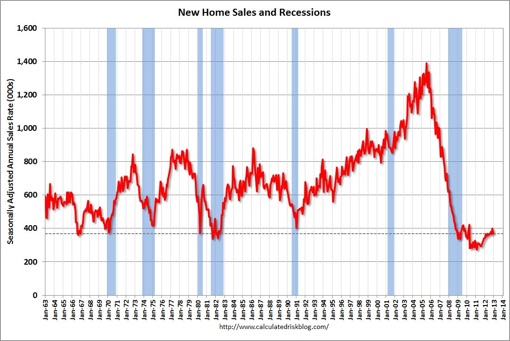
And another thing; while it may sound like houses are selling like hotcakes, the truth is far different. New home sales are less than one-third of what they were at their peak (1.4 million), while existing home sales are merely back to what they were in January 2002 before housing ballooned into a humongous bubble. In other words, the Fed’s record low rates, Obama’s mortgage modification programs, and FHA’s meager 3.5% down payment policy, have barely pushed sales back up to their historic trend. Does that sound like a strong recovery to you?

When you read about the great housing recovery, you should take it with a grain of salt. Take a look at this chart and you’ll see why.


New Home Sales


See that little squiggle at the end of the red line? That’s the housing recovery. That’s what $1.5 trillion dollars worth of mortgage backed securities (MBS) will buy you these days. Such a deal!

Now check out this excerpt from The Burning Platform:
“The contrived elevation of home sales and home prices has been engineered by the very same culprits who crashed our financial system in the first place. This has been planned, coordinated and implemented by a conspiracy of the ruling oligarchythe Federal Reserve, Wall Street, U.S. Treasury, NAR, and the corporate media conglomerates. Ben’s job was to screw senior citizens and drive interest rates low enough that everyone in the country could refinance, attract investors and flippers into the market, and propel home prices higher. Wall Street has been the linchpin to the whole sordid plan. They were tasked with drastically limiting the foreclosure pipeline, therefore creating a fake shortage of inventory. Next, JP Morgan, Blackrock, Citi, Bank of America, and dozens of other private equity firms have partnered with Fannie Mae and Freddie Mac, using free money provided by Ben Bernanke, to create investment funds to buy up millions of distressed properties and convert them into rental properties, further reducing the inventory of homes for sale and driving prices higher. Only the connected crony capitalists on Wall Street are getting a piece of this action. The Wall Street big hanging dicks have screwed the American middle class coming and going. The NAR and media are tasked with what they do best – spew propaganda, misinform, lie, cheerlead and attempt to create a buying frenzy among the willfully ignorant masses. ….. Mortgage applications by real people who want to live in a home are no higher than they were in 2010 when home sales were 33% lower than today. Mortgage applications are lower than they were in 1997 when 4 million existing homes were sold versus the 5 million pace today. The housing recovery is just another Wall Street scam designed to bilk the American middle class of what remains of their net worth.” (“It’s always the best time to buy”, The Burning Platform)

The whole article is a must read for anyone who’s at all interested in housing or government-Wall Street collusion. The author points to another disturbing trend too, the fact that firsttime homebuyers have vanished from the marketplace. Firsttime homebuyers and “move up” buyers used to make up the majority of all housing sales. Now they’ve been replaced by over-extended FHA borrowers (leveraged at 30 to 1) and private equity speculators who represent a full 30% of the market. This new dynamic won’t last, mainly because rising prices reduce profit margins causing speculators to shift to other forms of investment.

Case in point: Just look at Las Vegas where the big Wall Street investors have been buying everyhing that’s not nailed to the floor. This is from Realty Check:
“The Las Vegas market is being fueled by investors, but even the investors can’t find the great bargains anymore….(Mike Brunson, a local appraiser) called Las Vegas the Titanic of the real estate market. It was once thought unsinkable, and even now that the worst is over, he still thinks the market is on a well-provisioned life raft, not on solid ground.

“The only thing that concerns me is that we have been here before and the market itself is not what is driving the price increases. It’s not that we have new employers coming in and creating tens of thousands of new jobs that are leading to people buying new houses. It’s ‘Las Vegas is on sale,’ and investors are buying up everything they can in the used market…..

Brunson… still worries about the fundamentals, such as the slow economic growth and the fact that so much of the funding for new home sales is coming from low down payment, government-backed mortgages.” (“What’s Fueling the Housing Boom in Vegas?” Realty Check)

Brunson crystalizes the views of the housing skeptics (like me), that is, that a recovery that depends on speculators “chasing yield” instead of “organic growth” from working people looking for a place to live, is bound to fail. It’s only a matter of time. Any tightening of rates by the Fed or stock market correction will send the speculators racing for the exits.

Here’s more from Dave Dayen at The New Republic:
Analysts insist that REO-to-rental does not represent a bubble, that the rental revenue streams will satisfy investors and prevent a mass sell-off. But any disruption in the economy would affect the market for rental housing, leading to longer vacancies and lower returns on investment. And the textbook definition of a bubble consists of speculation chasing an appreciating asset. This is precisely what we have in REO-to-rental. In the words of analyst Josh Rosner of Graham Fisher, “the speculative boom has returned.”Investors have begun to pull out of one of the leading edge markets, Phoenix, as most of the foreclosed properties worth purchasing have been snapped up. The big run-up in prices there could collapse as demand collapses, depressing prices and putting the recovery in jeopardy. And any economic downturn would increase rental vacancies and send this entire market reeling. We may not only have a bubble, but already the beginnings of a bust….” (“Your new landlord lives on Wall Street“, Dave Dayen, The New Republic)

Once the PE parasites have stripped the carcas to the bone; they’ll move on to other prey. It’s the nature of the beast. That means that all the markets that rallied in the last 9 months, will see a sharp drop off in demand in 2013 as investment dries up and prices flatten out or retreat. The investment craze is on a very fixed time-line. If lending standards don’t ease, prices will fall. It’s a sure-thing. Low interest rates alone will not keep prices high.

Even so, Fed chairman Ben Bernanke’s zero rate policy (zirp) has helped to fuel another destructive bubble that is setting up borrowers for more excruciating losses. Take a look at the bubble that is developing in California. This is from an article titled More Bubble Trouble in California?:
“In Southern California, home sales have jumped 14 percent over last year and the median price is up 16 percent, some 25 percent in Orange County. We may not quite be at 2007 super-bubble levels but we’re getting there, particularly in the more desirable areas.

Yet, before opening the champagne, we need to look at some of the downsides of this asset recovery. We are not seeing much new construction, particularly of single-family homes, so the supply is not being replenished as inventory sinks. Meanwhile, many of the homebuyers are not families seeking residences, but flippers, Wall Street types and foreign investors. A remarkable one-in-three Southern California home purchasers paid with cash, up from 27 percent from last year.

It’s clear that this increase is not being fueled primarily by income growth among middle-class Californians; these “prices are rising disconnected from household incomes,” notes one analyst….

This leads to what is becoming the biggest problem facing the state – a decline in the rates of affordability. The previous bubble left us a legacy of more-affordable housing, an advantage we may now be losing….The groups hit hardest by this scenario will be middle- and working-class Californians, particularly above the age of 30-35, most of whom desire to own their own home. Unable to qualify, or unwilling to overleverage, many will be forced either to give up their dreams or look elsewhere, taking their talents and, eventually, their offspring, with them.” (“More Bubble Trouble in California?”, Joel Kotkin, New Geography)

As always, the Fed’s meddling creates clear winners and clear losers. In this case, working people are getting shafted while Ben’s facebook friends make off with the lion’s share of the loot. Some things never change.

There’s no way to dispute that prices and sales have been improving. Interest rate stimulus, inventory suppression, and unprecedented speculation have reversed the downward trend and lifted housing off the canvas. But it’s going to take more than that to produce a sustainable housing recovery. It’s going to take a strong economy where unemployment is low and wages are growing.

Don’t hold your breath.

Total Housing Activity Chart: http://advisorperspectives.com/dshort/charts/index.html?guest/2012/LR-Home-TotalActivityIndex-112812.PNG

Thursday, February 28, 2013

JPMorgan Chase (JPM) to Cut 17,000 Jobs

By Susanna Kim - ABC News
Feb 27, 2013

JPMorgan Chase & Co. (NYSE: JPM) has announced it will cut 17,000 jobs by the end of next year, many of them in its mortgage banking business.

JPMorgan Chase is the biggest bank in the country by assets. With Tuesday’s announcement, the company will shed about 6.5 percent of the 260,000 employees it said it had as of May 2012.

JPMorgan CEO James Dimon and other executives made the announcement on Tuesday during an investor day presentation at the bank’s New York City headquarters.

Amy Bonitatibus, spokeswoman for J.P. Morgan, said the bulk of the reductions are in the company’s mortgage banking business.

“Fewer homeowners are falling behind on their mortgages, so we need fewer employees to assist those who are struggling,” she said in a statement. “We will work with affected employees to find openings at Chase or other local companies.”

Anthony Polini, banking industry analyst with Raymond James, said the job cuts were expected given the anticipated revenue decline from mortgage banking and the improvement in mortgage-related credit quality.

“The company can use these expense saves to manage through a tough operating environment and still grow earnings per share,” he said. “More importantly, the company remains committed to growing revenue and returning excess capital. [Its] branch expansion plan and international growth opportunities bode well for longer term growth.”

By all other indications, the bank appears to be among the healthiest in the country. In January, JPMorgan reported $5.7 billion profit in the fourth quarter, better than analysts had expected and up from $3.7 billion a year ago in the same period.

Investors also seem to approve of Tuesday’s announcement. JPMorgan’s stock rose 2.5 percent to $48.81 at 11:15 a.m. ET.

Prior to the earnings announcement last month, JPMorgan said it would take a $700 million charge in the fourth quarter due to the nationwide mortgage foreclosure and servicing settlement with the Justice Department and nine other banks.

Wednesday, February 27, 2013

Bernanke tells Warren ‘too big to fail’ banks ‘will voluntarily reduce their size’

By Stephen C. Webster - RAW StoryWednesday, February 27, 2013

The Chairman of the Federal Reserve looked mighty uncomfortable Tuesday being grilled by Sen. Elizabeth Warren (D-MA), a former Harvard professor and economics expert who posed one very blunt question to him that many Americans have been asking for years: “When are we going to get rid of too big to fail?”

His response: “Banks will voluntarily reduce their size” over an undetermined amount of time.

At the Senate banking committee hearing on monetary policy, Warren stressed that small banks are being crushed by interest rates while big banks have made billions from secret, low-interest Federal Reserve loans since the crash of 2008.

“So I understand that we’re all trying to get to the end of too big to fail, but my question, Mr. chairman, is until we do, should those biggest financial institutions be repaying the American taxpayer that $83 billion [yearly] subsidy they’re getting?” she asked

Bernanke said the aid to big banks through cheaper loans came about because of “market expectations” in 2008 that are no longer correct. “We have an orderly liquidation authority,” he said. “Even in the crisis, in the case of AIG, we wiped out the shareholders.”

Warren stopped him there. “Excuse me though, Mr. chairman, you did not wipe out the shareholders of the largest financial institutions, did you? The big banks?”

“We didn’t have the tools, now we could,” Bernanke insisted.

Moments later, Warren doubled back again. “We’ve now understood this problem for five years,” she said. “When are we going to get rid of too big to fail?”

“Well, as we’ve been discussing, some of these rules take time to develop,” Bernanke said. “The orderly liquidation authority, I think we’ve made progress on that. We’ve got the living wills. I think we’re moving in the right direction. Um, if additional steps are needed then Congress obviously can discuss those, but we do have a plan and I think it’s moving in the right direction.”

“Any idea about when we’re going to arrive in the right direction?” Warren asked.

“It’s, it’s, it’s gonna take…” Bernanke stammered. “It’s not a zero-one thing, it’s over time you’ll see increasing, uh, increasing market expectations that these institutions can fail. I would make another prediction, and predictions is always dangerous, that the benefits of being large are gonna be sm– are gonna decline over time, which means that banks will voluntarily reduce their size because they’re not seeing the benefits they used to get.”

“I read you on this,” Warren said. “I read your predictions on this in your earlier testimony, but so far it looks like they’re getting $83 billion for staying big.”

“Well, that’s one study,” Bernanke said. “You don’t know whether that’s an accurate number.”

The Dallas Federal Reserve reported last March that just five “too big to fail” banks control more than 50 percent of the banking industry’s assets. The top 10 institutions controlled over $7 trillion in 2010, or roughly half the U.S. gross domestic product that year.

Tuesday, January 15, 2013

Yet Another Housing Bubble on the Horizon

Those who do not learn from history are doomed to repeat it. The power structure of the United States is comprised solely of short-sighted, greedy cunts who don't have to suffer the failure they commit over and over. We, the people, do. Fuck them!


The "Qualified Mortgage" Rule
by MIKE WHITNEY


The US Consumer Financial Protection Bureau’s rule defining a “qualified mortgage”, which was announced on Thursday, creates vast new opportunities for the nation’s biggest banks to engage in predatory lending practices with impunity. While the corporate mainstream media describes the rule as an attempt to protect borrowers from the risky types of loans that caused the financial crisis, the opposite is true. The real purpose of the rule is to provide legal protection for the banks from homeowner lawsuits, and to lay the groundwork for more reckless lending that could inflate another housing bubble. In other words, the rule was designed to serve the interests of the banks and the banks alone. This is why bankers everywhere are celebrating the final draft. Take a look at this from Forbes:
“We applaud the Bureau for offering a legal safe harbor to lenders when they originate loans that meet the rigorous ‘qualified mortgage’ standards in the rule,” said Debra Still, chairman of the Mortgage Bankers Association, in a statement. “This approach should allow lenders to offer sustainable mortgage credit to a great number of qualified borrowers without having to risk unreasonable and overly punitive litigation and penalties.” (Could New Tighter Mortgage Rules Actually Ease Lending?” Forbes)

The banks are happy because they got everything they wanted; blanket legal immunity for garbage mortgages they plan to offload onto US taxpayers, a green light to resume extending credit to high-risk borrowers, and a first-rate public relations campaign that makes the entire coup look like genuine consumer protection.

As one cheery bankster quipped, “This was the Superbowl of rules”.

Indeed. It’s a big victory for the banks, but a major defeat for consumers. And the aftershocks will be felt for years to come, because (as we said in an earlier article) housing sales are already above trend and prices are back to normal which means that the only way the banks can reduce their huge backlog of 5 million distressed homes (which will face foreclosure in the next few years) is by creating another housing bubble. And, as we all know, housing bubbles require lax lending standards so that people who are not really creditworthy, end up borrowing hundreds of thousands of dollars that they’ll never be able to repay. This is what the new rule is really all about; it provides new opportunities for predatory lending, but with one notable difference from before, that is, if the loan meets the pitiable standard of a qualified mortgage, then the losses from the defaulting loan will be paid by taxpayers. That’s why the bankers are celebrating.

So, ignore the PR-hype about the banning of “deceptive teaser rates” or “no documentation loans” or “protecting the consumer”. That’s just a smoke screen to confuse you. The meat and potatoes in this rule, is what it doesn’t say. Here’s a clip from the Wall Street Journal that sums it up perfectly:
“Do qualified mortgages have a minimum down payment or credit score requirement?

No. Instead, the rules focus primarily on documenting a borrower’s ability to make monthly payments.” (“What the CFPB Measures Mean For Borrowers”, Wall Street Journal)

Have you ever heard anything more ridiculous in your life?

Didn’t we just go through a massive housing implosion which sent the financial system and the real economy into a 4-year death spiral? And now the agency which is supposed to protect consumers from another similar catastrophe is allowing the banks to issue mortgages that will be guaranteed by the government to applicants who don’t have the wherewithal for a lousy 5 or 10 percent down payment (No “skin in the game”) and whose credit scores will not be used to help decide whether they’re capable of repaying the loan or not?

What sense does that make? Does CFPB Director Richard Cordray think that he’s protecting consumers from the ravages of predatory lending by abandoning traditional standards and criteria for issuing a mortgage? Is that it?

Or is Cordray just another “captured” regulator doing the banks’ bidding? (It was clear that Cordray was another malleable bank toady back in Oct 2012 when this issue first arose. See: “Consumer Protector Caves to the Banks“, CounterPunch)

The media is making a big deal about the “ability-to-repay” provision of the new rule which requires banks to see that borrowers have sufficient assets or income to pay back the loan. But, once again, it’s all fluff. Banks don’t operate on the “honor system”. They’re going to stretch the new QM rule as far as possible, fitting borrowers into loans that will certainly fail sometime in the future. The losses for those loans will then be passed on to taxpayers. This is the same scam that took place during the subprime mortgage crisis. The banks booked profits on all manner of junk loans to high-risk borrowers figuring that the losses would be shifted onto investor groups who purchased the (subprime) bonds in the secondary market. The same nightmare is about to unfold again, only this time the banks won’t get stuck with the tab. Here’s an excerpt from an article in the New York Times that explains:
“As regulators complete new mortgage rules, banks are about to get a significant advantage: protection against homeowner lawsuits … some banking and housing specialists worry that borrowers are losing a critical safeguard. Industries rarely get broad protection from consumer lawsuits, and banks would seem unlikely candidates given the range of abuses revealed during the housing bust.” (“Banks Seek a Shield in Mortgage Rules”, New York Times)

Can you believe it? Even the business-friendly NYT is shocked that the CFPB is giving the banks legal immunity. (“Safe harbor”) Why? Why would the government agree to insure the activities of private industry (through Fannie and Freddie), especially when that industry has shown that it is loaded with crooks and criminals? This is corporate welfare at its worst and, unfortunately, it creates a powerful incentive for the banks to game the system and recklessly extend credit to anyone who can sit upright and sign a mortgage application.

Here’s more from the NYT:

“The Consumer Financial Protection Bureau, the fledgling agency that is shaping the rules, faces a crucial but difficult task. Banks are pressing for a strong version of the legal shield. They also want qualified mortgages to be available to a broad range of borrowers, not just those with pristine credit.”

Of course they do. That’s how they make their money, by creating toxic loans that are passed along to Uncle Sam. How else are the banks going to boost profits in an economy where unemployment is 7.8%, underemployment is tipping 14%, where wages are shrinking, and where the net wealth of the average American has plunged by a harrowing 40 percent in the last decade?

Business investment?

Don’t make me laugh. The only way the banks can survive is by attaching themselves parasitically to the US government and sucking for all they’re worth. Bad loans are simply the modus operandi, the means by which they extract fluid from their victim. Cordray and Co. appear to be only-too-eager to assist them in this task. Here’s more from the Times:
“Big financial institutions have faced an onslaught of litigation since the downturn, although mostly by the government, investors and other companies instead of borrowers. In February, five large mortgage banks reached a $26 billion settlement with government authorities that aimed, in part, to hold banks accountable for foreclosure abuses.”

Okay, so now we’re getting down to brass tacks. The banks want the new rule to shield them from future losses that will naturally accrue when they start ripping people off again. Right? This is why they fought tooth-n-nail to keep Elizabeth Warren off the CFPB board, because they knew she wouldn’t play ball with them. So they turned to “rubber stamp” Cordray instead, who has performed admirably executing Wall Street’s latest big heist with the skillfulness of a paid assassin.

Way to go, Rich.

There’s one more tidbit in the new QM rule that’s worth noting, a provision that states that “loans would be deemed qualified mortgages if borrowers are spending no more than 43% of their pretax income on monthly debt payments.”

“43% pretax income”?

You gotta be kidding me. That means that borrowers can qualify even if they’ll have to fork over 50% or more of their weekly paycheck. How many of those loans are going to get repaid?

Not many, I’d wager. This bill is a joke. Cordray has set up taxpayers for some hefty losses just to ingratiate himself with the Wall Street Bank Mafia. It’s shocking.

Can you see what’s going on?

The banks don’t want to act like banks anymore. They don’t want to hold capital against the loans they issue, they don’t want to keep loans on their books, and they don’t want to pay the losses when the loans blow up. The just want to keep printing private money (credit), booking profits on that money (loans), and then dumping the red ink on Uncle Sam. That’s how the whole thing works.

The QM rule was designed to work hand in hand with the Fed’s $40 billion per month purchases of mortgage backed securities. (MBS) This is key to understanding what’s going on.

The Fed, in concert with the Obama administration and the big banks, has replicated the same conditions that existed just prior to the last big bubble. The Central Bank will play the same role as investors in the secondary market (from 2003 to 2007), that is, the Fed will buy up all the garbage MBS the banks can produce. All the banks have to do is to find mortgage applicants who meet the wretched “no down payment, no credit score” requirements of the CFPB, and then “Let ‘er rip.”

All the pieces are now in place for another humongous, economy-crushing housing bubble. This isn’t going to end well.

Tuesday, January 8, 2013

America's Deceptive Fiscal Cliff

How Today’s Fiscal Austerity is Reminiscent of World War I’s Economic Misunderstandings
by MICHAEL HUDSON

When World War I broke out in August 1914, economists on both sides forecast that hostilities could not last more than about six months. Wars had grown so expensive that governments quickly would run out of money. It seemed that if Germany could not defeat France by springtime, the Allied and Central Powers would run out of savings and reach what today is called a fiscal cliff and be forced to negotiate a peace agreement.

But the Great War dragged on for four destructive years. European governments did what the United States had done after the Civil War broke out in 1861 when the Treasury printed greenbacks. They paid for more fighting simply by printing their own money. Their economies did not buckle and there was no major inflation. That would happen only after the war ended, as a result of Germany trying to pay reparations in foreign currency. This is what caused its exchange rate to plunge, raising import prices and hence domestic prices. The culprit was not government spending on the war itself (much less on social programs).

But history is written by the victors, and the past generation has seen the banks and financial sector emerge victorious. Holding the bottom 99% in debt, the top 1% are now in the process of subsidizing a deceptive economic theory to persuade voters to pursue policies that benefit the financial sector at the expense of labor, industry, and democratic government as we know it.

Wall Street lobbyists blame unemployment and the loss of industrial competitiveness on government spending and budget deficits – especially on social programs – and labor’s demand to share in the economy’s rising productivity. The myth (perhaps we should call it junk economics) is that (1) governments should not run deficits (at least, not by printing their own money), because (2) public money creation and high taxes (at lest on the wealthy) cause prices to rise. The cure for economic malaise (which they themselves have caused), is said to be less public spending, along with more tax cuts for the wealthy, who euphemize themselves as “job creators.” Demanding budget surpluses, bank lobbyists promise that banks can provide the economy with enough purchasing power to grow. Then, when this ends in crisis, they insist that austerity can squeeze out enough income to enable private-sector debts to be paid.

The reality is that when banks load the economy down with debt, this leaves less to spend on domestic goods and services while driving up housing prices (and hence the cost of living) with reckless credit creation on looser lending terms. Yet on top of this debt deflation, bank lobbyists urge fiscal deflation: budget surpluses rather than pump-priming deficits. The effect is to further reduce private-sector market demand, shrinking markets and employment. Governments fall deeper into distress, and are told to sell off land and natural resources, public enterprises, and other assets. This creates a lucrative market for bank loans to finance privatization on credit. This explains why financial lobbyists back the new buyers’ right to raise the prices they charge for basic needs, creating a united front to endorse rent extraction. The effect is to enrich the financial sector owned by the 1% in ways that indebt and privatize the economy at large – individuals, business and the government itself.

This policy was exposed as destructive in the late 1920s and early 1930s when John Maynard Keynes, Harold Moulton and a few others countered the claims of Jacques Rueff and Bertil Ohlin that debts of any magnitude could be paid if governments would impose deep enough austerity and suffering. This is the doctrine adopted by the International Monetary

Fund to impose on Third World debtors since the 1960s, and by European neoliberals defending creditors imposing austerity on Ireland, Greece, Spain and Portugal.

This pro-austerity mythology aims to distract the public from asking why peacetime governments can’t simply print the money they need. Given the option of printing money instead of levying taxes, why do politicians only create new spending power for the purpose of waging war and destroying property, not to build or repair bridges, roads and other public infrastructure? Why should the government tax employees for future retirement payouts, but not Wall Street for similar user fees and financial insurance to build up a fund to pay for future bank over-lending crises? For that matter, why doesn’t the U.S. Government print the money to pay for Social Security and medical care, just as it created new debt for the $13 trillion post-2008 bank bailout? (I will return to this question below.)

The answer to these questions has little to do with markets, or with monetary and tax theory. Bankers claim that if they have to pay more user fees to pre-fund future bad-loan claims and deposit insurance to save the Treasury or taxpayers from being stuck with the bill, they will have to charge customers more – despite their current record profits, which seem to grab everything they can get. But they support a double standard when it comes to taxing labor.

Shifting the tax burden onto labor and industry is achieved most easily by cutting back public spending on the 99%. That is the root of the December 2012 showdown over whether to impose the anti-deficit policies proposed by the Bowles-Simpson commission of budget cutters whom President Obama appointed in 2010. Shedding crocodile tears over the government’s failure to balance the budget, banks insist that today’s 15.3% FICA wage withholding be raised – as if this will not raise the break-even cost of living and drain the consumer economy of purchasing power. Employers and their work force are told to save in advance for Social Security or other public programs. This is a disguised income tax on the bottom 99%, whose proceeds are used to reduce the budget deficit so that taxes can be cut on finance and the 1%. To paraphrase Leona Helmsley’s quip that “Only the little people pay taxes,” the post-2008 motto is that only the 99% have to suffer losses, not the 1% as debt deflation plunges real estate and stock market prices to inaugurate a Negative Equity economy while unemployment rates soar.

There is no more need to save in advance for Social Security than there is to save in advance to pay for war. Selling Treasury bonds to pay for retirees has the identical monetary and fiscal effect of selling newly printed securities. It is a charade – to shift the tax burden onto labor and industry. Governments need to provide the economy with money and credit to expand markets and employment. They do this by running budget deficits, and this can be done by creating their own money. That is what banks oppose, accusing it of leading to hyperinflation rather than help economies grow.

Their motivation for this wrong accusation is self-serving and their logic is deceptive. Bankers always have fought to block government from creating its own money – at least under normal peacetime conditions. For many centuries, government bonds were the largest and most secure investment for the financial elites that hold most savings. Investment bankers and brokers monopolized public finance, at substantial underwriting commissions. The market for stocks and corporate bonds was rife with fraud, dominated by insiders for the railroads and great trusts being organized by Wall Street, and the canal ventures organized by French and British stockbrokers.

However, there was little alternative to governments creating their own money when the costs of waging an international war far exceeded the volume of national savings or tax revenue available. This obvious need quieted the usual opposition mounted by bankers to limit the public monetary option. It shows that governments can do more under force majeur emergencies than under normal conditions. And the September 2008 financial crisis provided an opportunity for the U.S. and European governments to create new debt for bank bailouts. This turned out to be as expensive as waging a war. It was indeed a financial war. Banks already had captured the regulatory agencies to engage in reckless lending and a wave of fraud and corruption not seen since the 1920s. And now they were holding economies hostage to a break in the chain of payments if they were not bailed out for their speculative gambles, junk mortgages and fraudulent loan packaging.

Their first victory was to disable the ability – or at least the willingness – of the Treasury, Federal Reserve and Comptroller of the Currency to regulate the financial sector. Goldman Sachs, Citicorp and their fellow Wall Street giants hold veto power the appointment of key administrators at these agencies. They used this beachhead to weed out nominees who might not favor their interests, preferring ideological deregulators in the stripe of Alan Greenspan and Tim Geithner. As John Kenneth Galbraith quipped, a precondition for obtaining a central bank post is tunnel vision when it comes to understanding that governments can create their credit as readily as banks can. What is necessary is for one’s political loyalties to lie with the banks.

In the post-2008 financial wreckage it took only a series of computer keystrokes for the U.S. Government to create $13 trillion in debt to save banks from suffering losses on their reckless real estate loans (which computer models pretended would make banks so rich that they could pay their managers enormous salaries, bonuses and stock options), insurance bets gone bad (underpricing risk to win business to pay their managers enormous salaries and bonuses), arbitrage gambles and outright fraud (to give the illusion of earnings justifying enormous salaries, bonuses and stock options). The $800 billion Troubled Asset Relief Program (TARP) and $2 trillion of Federal Reserve “cash for trash” swaps enabled the banks to continue their remuneration of executives and bondholders with hardly a hiccup – while incomes and wealth plunged for the remaining 99% of Americans.

A new term, Casino Capitalism, was coined to describe the transformation that finance capitalism was undergoing in the post-1980 era of deregulation that opened the gates for banks to do what governments hitherto did in time of war: create money and new public debt simply by “printing it” – in this case, electronically on their computer keyboards.

Taking the insolvent Fannie Mae and Freddie Mac mortgage financing agencies onto the public balance sheet for $5.2 trillion accounted for over a third of the $13 trillion bailout. This saved their bondholders from having to suffer losses from the fraudulent appraisals on the junk mortgages with which Countrywide, Bank of America, Citibank and other “too big to fail” banks had stuck them. This enormous debt increase was done without raising taxes. In fact, the Bush administration cut taxes, giving the largest cuts to the highest income and wealth brackets who were its major campaign contributors. Special tax privileges were given to banks so that they could “earn their way out of debt” (and indeed, out of negative equity).[1] The Federal Reserve gave a free line of credit (Quantitative Easing) to the banking system at only 0.25% annual interest by 2011 – that is, one quarter of a percentage point, with no questions asked about the quality of the junk mortgages and other securities pledged as collateral at their full face value, which was far above market price.

This $13 trillion debt creation to save banks from having to suffer a loss was not accused of threatening economic stability. It enabled them to resume paying exorbitant salaries and bonuses, dividends to bondholders and also to pay counterparties on casino-capitalist arbitrage bets. These payments have helped the 1% receive a reported 93% of the gains in income since 2008. The bailout thus polarized the economy, giving the financial sector more power over labor and consumers, industry and the government than has been the case since the late 19th-century Gilded Age.

All this makes today’s financial war much like the aftermath of World War I and countless earlier wars. The effect is to impoverish the losers, appropriate hitherto public assets for the victors, and impose debt service and taxes much like levying tribute. “The financial crisis has been as economically devastating as a world war and may still be a burden on ‘our grandchildren,’” Bank of England official Andrew Haldane recently observed. “‘In terms of the loss of incomes and outputs, this is as bad as a world war.’ he said. The rise in government debt has prompted calls for austerity – on the part of those who did not receive the giveaway. ‘It would be astonishing if people weren’t asking big questions about where finance has gone wrong.’”[2]

But as long as the financial sector is winning its war against the economy at large, it prefers that people believe that There Is No Alternative. Having captured mainstream economics as well as government policy, finance seeks to deter students, voters and the media from questioning whether the financial system really needs to be organized in the way it is. Once such a line of questioning is pursued, people may realize that banking, pension and Social Security systems and public deficit financing do not have to be organized in the way they are. There are better alternatives to today’s road to austerity and debt peonage.


The Financial War Against the Economy at Large

Today’s economic warfare is not the kind waged a century ago between labor and its industrial employers. Finance has moved to capture the economy at large, industry and mining, public infrastructure (via privatization) and now even the educational system. (At over $1 trillion, U.S. student loan debt came to exceed credit-card debt in 2012.) The weapon in this financial warfare is no longer military force. The tactic is to load economies (governments, companies and families) with debt, siphon off their income as debt service and then foreclose when debtors lack the means to pay. Indebting government gives creditors a lever to pry away land, public infrastructure and other property in the public domain. Indebting companies enables creditors to seize employee pension savings. And Indebting labor means that it no longer is necessary to hire strikebreakers to attack union organizers and strikers.

Workers have become so deeply indebted on their home mortgages, credit cards and other bank debt that they fear to strike or even to complain about working conditions. Losing work means missing payments on their monthly bills, enabling banks to jack up interest rates to levels that used to be deemed usurious. So debt peonage and unemployment loom on top of the wage slavery that was the main focus of class warfare a century ago. And to cap matters, credit-card bank lobbyists have rewritten the bankruptcy laws to curtail debtor rights, and the referees appointed to adjudicate disputes brought by debtors and consumers are subject to veto from the banks and businesses that are mainly responsible for inflicting injury.

The aim of financial warfare is not merely to acquire land, natural resources and key infrastructure rents as in military warfare; it is to centralize creditor control over society. In contrast to the promise of democratic reform nurturing a middle class a century ago, we are witnessing a regression to a world of special privilege in which one must inherit wealth in order to avoid debt and job dependency.

The emerging financial oligarchy seeks to shift taxes off banks and their major customers (real estate, natural resources and monopolies) onto labor. Given the need to win voter acquiescence, this aim is best achieved by rolling back everyone’s taxes. The easiest way to do this is to shrink government spending, headed by Social Security, Medicare and Medicaid. Yet these are the programs that enjoy the strongest voter support. This fact has inspired what may be called the Big Lie of our epoch: the pretense that governments can only create money to pay the financial sector, and that the beneficiaries of social programs should be entirely responsible for paying for Social Security, Medicare and Medicaid, not the wealthy. This Big Lie is used to reverse the concept of progressive taxation, turning the tax system into a ploy of the financial sector to levy tribute on the economy at large.

Financial lobbyists quickly discovered that the easiest ploy to shift the cost of social programs onto labor is to conceal new taxes as user fees, using the proceeds to cut taxes for the elite 1%. This fiscal sleight-of-hand was the aim of the 1983 Greenspan Commission. It confused people into thinking that government budgets are like family budgets, concealing the fact that governments can finance their spending by creating their own money. They do not have to borrow, or even to tax (at least, not tax mainly the 99%).

The Greenspan tax shift played on the fact that most people see the need to save for their own retirement. The carefully crafted and well-subsidized deception at work is that Social Security requires a similar pre-funding – by raising wage withholding. The trick is to convince wage earners it is fair to tax them more to pay for government social spending, yet not also to ask the banking sector to pay similar a user fee to pre-save for the next time it itself will need bailouts to cover its losses. Also asymmetrical is the fact that nobody suggests that the government set up a fund to pay for future wars, so that future adventures such as Iraq or Afghanistan will not “run a deficit” to burden the budget. So the first deception is to treat only Social Security and medical care as user fees. The second is to aggravate matters by insisting that such fees be paid long in advance, by pre-saving.

There is no inherent need to single out any particular area of public spending as causing a budget deficit if it is not pre-funded. It is a travesty of progressive tax policy to only oblige workers whose wages are less than (at present) $105,000 to pay this FICA wage withholding, exempting higher earnings, capital gains, rental income and profits. The raison d’être for taxing the 99% for Social Security and Medicare is simply to avoid taxing wealth, by falling on low wage income at a much higher rate than that of the wealthy. This is not how the original U.S. income tax was created at its inception in 1913. During its early years only the wealthiest 1% of the population had to file a return. There were few loopholes, and capital gains were taxed at the same rate as earned income.

The government’s seashore insurance program, for instance, recently incurred a $1 trillion liability to rebuild the private beaches and homes that Hurricane Sandy washed out. Why should this insurance subsidy at below-commercial rates for the wealthy minority who live in this scenic high-risk property be treated as normal spending, but not Social Security? Why save in advance by a special wage tax to pay for these programs that benefit the general population, but not levy a similar “user fee” tax to pay for flood insurance for beachfront homes or war? And while we are at it, why not save another $13 trillion in advance to pay for the next bailout of Wall Street when debt deflation causes another crisis to drain the budget?

But on whom should we levy these taxes? To impose user fees for the beachfront reconstruction would require a tax falling mainly on the wealthy owners of such properties. Their dominant role in funding the election campaigns of the Congressmen and Senators who draw up the tax code suggests why they are able to avoid prepaying for the cost of rebuilding their seashore property. Such taxation is only for wage earners on their retirement income, not the 1% on their own vacation and retirement homes.

By not raising taxes on the wealthy or using the central bank to monetize spending on anything except bailing out the banks and subsidizing the financial sector, the government follows a pro-creditor policy. Tax favoritism for the wealthy deepens the budget deficit, forcing governments to borrow more. Paying interest on this debt diverts revenue from being spent on goods and services. This fiscal austerity shrinks markets, reducing tax revenue to the brink of default. This enables bondholders to treat the government in the same way that banks treat a bankrupt family, forcing the debtor to sell off assets – in this case the public domain as if it were the family silver, as Britain’s Prime Minister Harold MacMillan characterized Margaret Thatcher’s privatization sell-offs.

In an Orwellian doublethink twist this privatization is done in the name of free markets, despite being imposed by global financial institutions whose administrators are not democratically elected. The International Monetary Fund (IMF), European Central Bank (ECB) and EU bureaucracy treat governments like banks treat homeowners unable to pay their mortgage: by foreclosing. Greece, for example, has been told to start selling off prime tourist sites, ports, islands, offshore gas rights, water and sewer systems, roads and other property.

Sovereign governments are, in principle, free of such pressure. That is what makes them sovereign. They are not obliged to settle public debts and budget deficits by asset selloffs. They do not need to borrow more domestic currency; they can create it. This self-financing keeps the national patrimony in public hands rather than turning assets over to private buyers, or having to borrow from banks and bondholders.


Why the Fiscal Squeeze Imposes Needless Austerity

The financial sector promises that privatizing roads and ports, water and sewer systems, bus and railroad lines (on credit, of course) is more efficient and will lower the prices charged for their services. The reality is that the new buyers put up rent-extracting tollbooths on the infrastructure being sold. Their break-even costs include the high salaries and bonuses they pay themselves, as well as interest and dividends to their creditors and backers, spending on stock buy-backs and political lobbying.

Public borrowing creates a dependency that shifts economic planning to Wall Street and other financial centers. When voters resist, it is time to replace democracy with oligarchy. “Technocratic” rule replaces that of elected officials. In Europe the IMF, ECB and EU troika insists that all debts must be paid, even at the cost of austerity, depression, unemployment, emigration and bankruptcy. This is to be done without violence where possible, but with police-state practices when grabbers find it necessary to quell popular opposition.

Financializing the economy is depicted as a natural way to gain wealth – by taking on more debt. Yet it is hard to think of a more highly politicized policy, shaped as it is by tax rules that favor bankers. It also is self-terminating, because when public debt grows to the point where investors (“the market”) no longer believe that it can be repaid, creditors mount a raid (the military analogy is appropriate) by “going on strike” and not rolling over existing bonds as they fall due. Bond prices fall, yielding higher interest rates, until governments agree to balance the budget by voluntary pre-bankruptcy privatizations.

Selling Saved-up Treasury Bonds to Fund Public Programs is Like New Deficit Borrowing

If the aim of America’s military spending around the world is to prepare for future warfare, why not aim at saving up a fund of $10 trillion or even $30 trillion in advance, as with Social Security, so that we will have the money to pay for it?

The answer is that selling saved-up Treasury bills to finance Social Security, military spending or any other program has the same monetary and price effect as issuing new Treasury bills. The impact on financial markets – and on the private sector’s holding of government debt – by paying Social Security out of past savings – that is, by selling the Treasury securities in which Social Security funds are invested – is much like borrowing by selling new securities. It makes little difference whether the Treasury sells newly printed IOUs, or sells bonds that it has been accumulating in a special fund. The effect is to increase public debt owed to the financial sector.

If the savings are to be invested in Treasury bonds (as is the case with Social Security), will this pay for tax cuts elsewhere in the budget? If so, will these cuts be for the wealthy 1% or the 99%? Or, will the savings be invested in infrastructure, or turned over to states and cities to help balance their budget shortfalls and underfunded pension plans?

Another problem concerns who should pay for this pre-saving. The taxes needed to pre-fund a savings build-up siphon off income from somewhere in the economy. How much will the economy shrink by diverting income from being spent on goods and services? And whose income will taxed? These questions illustrate how politically self-interested it is to single out taxing wages to save for Social Security in contrast to war-making and beach-house rebuilding.

Government budgets usually are designed to be in balance under normal peacetime conditions, so most public debt has been brought into being by war (prior to today’s financial war of slashing taxes on the wealthy). Adam Smith’s Wealth of Nations (Book V) traced how each new British bond issue to raise funds for a military action had a dedicated tax to pay its interest charges. The accumulation of such war debts thus raised the cost of living and hence the break-even price of labor. To prevent this from undercutting of British competitiveness, Smith urged that wars be waged on a pay-as-you-go basis – by full taxation rather than by borrowing and entailing interest payments and taxes (as the debt itself rarely was amortized). Smith thought that populations should feel the cost of war directly and immediately, presumably leading them to be vigilant in checking grandiose projects of empire.

The United States issued fiat greenback currency to pay for much of its Civil War, but also issued bonds. In analyzing this war finance the Canadian-American astronomer and monetary theorist Simon Newcomb pointed out that all wars must be paid for in the form of tangible material and lives by the generation that fights them. Paying for the war by borrowing from bondholders, he explained, involved levying taxes to pay the interest. The effect was to transfer income from the Western states (taxpayers) to bondholders in the East.

In the case of Social Security today the beneficiary of government debt is still the financial sector. The economy must provide the housing, food, health care, transportation and clothing to enable retirees to live normal lives. This economic surplus can be paid for either out of taxation, new money creation or borrowing. But instead of “the West,” the major payers of the Social Security tax are wage earners across the nation. Taxing labor shrinks markets and forces the economy into austerity.

Quantitative Easing as Free Money Creation – To Subsidize the Big Banks

The Federal Reserve’s three waves of Quantitative Easing since 2008 show how easy it is to create free money. Yet this has been provided only to the largest banks, not to strapped homeowners or industry. An immediate $2 trillion in “cash for trash” took the form of the Fed creating new bank-reserve credit in exchange for mortgage-backed securities valued far above market prices. QE2 provided another $800 billion in 2011-12. The banks used this injection of credit for interest rate arbitrage and exchange rate speculation on the currencies of Brazil, Australia and other high-interest-rate economies. So nearly all the Fed’s new money went abroad rather than being lent out for investment or employment at home.

U.S. Government debt was run up mainly to re-inflate prices for packaged bank mortgages, and hence real estate prices. Instead of alleviating private-sector debt by writing down mortgages in line with the homeowners’ ability to pay, the Federal Reserve and Treasury created money to support property prices – to push the banking system’s balance sheets back above negative net worth. The Fed’s QE3 program in 2012-13 created money to buy mortgage-backed securities each month, to provide banks with money to lend to new property buyers.

For the economy at large, the debts were left in place. Yet commentators focused only on government debt. In a double standard, they accused budget deficits of inflating wages and consumer prices, yet the explicit aim of quantitative easing was to support asset prices. Inflating asset prices on credit is deemed to be good for the economy, despite loading it down with debt. But public spending into the “real” economy, raising employment levels and sustaining consumer spending, is deemed bad – except when this is financed by personal borrowing from the banks. So in each case, increasing bank profits is the standard by which fiscal policy is to be judged!

The result is a policy asymmetry that is opposite from what most epochs have deemed fair or helpful to economic growth. Bankers and bondholders insist that the public sector borrow from them, blocking the government’s power to self-finance its operations – with one glaring exception. That exception occurs when the banks themselves need free money creation. The Fed provided nearly free credit to the banks under QE2, and Chairman Ben Bernanke promised to continue this policy until such time as the unemployment rate drops to 6.5%. The pretense is that low interest rates spur employment, but the most pressing aim is to provide easy credit to revive borrowing and bid asset prices back up.

Fiscal Deflation on Top of Debt Deflation

The main financial problem with funding war occurs after the return to normalcy, when creditors press for budget surpluses to roll back the public debt that has been run up. This imposes fiscal austerity, reducing wages and commodity prices relative to the debts that are owed. Consumer spending shrinks and prices decline as governments spend less, while higher taxes withdraw revenue. This is what is occurring in today’s financial war, much as it has in past military postwar returns to peace.

Governments have the power to resist this deflationary policy. Like commercial banks, they can create money on their computer keyboards. Indeed, since 2008 the government has created debt to support the Finance, Insurance and Real Estate (FIRE) sector more than the “real” production and consumption economy.

In contrast to public spending for goods and services (or social programs that increase market demand), most of the bank credit that led to the 2008 financial collapse was created to finance the purchase property already in place, stocks and bonds already issued, or companies already in existence. The effect has been to load down the economy with mortgages, bonds and bank debt whose carrying charges eat into spending on current output. The $13 trillion bank subsidy since 2008 (to enable banks to earn their way out of negative equity) brings us back to the question of why taxes should be levied on the 99% to pre-save for Social Security and Medicare, but not for the bank bailout.

Current tax policy encourages financial and rent extraction that has become the major economic problem of our epoch. Industrial productivity continues to rise, but debt is growing even more inexorably. Instead of fueling economic growth, this of credit/debt threatens to absorb the economic surplus, plunging the economy into austerity, debt deflation and negative equity.

So despite the fact that the financial system is broken, it has gained control over public policy to sustain and even obtain tax favoritism for a dysfunctional overgrowth of bank credit. Unlike the progress of science and technology, this debt is not part of nature. It is a social construct. The financial sector has politicized it by pressing to privatize economic rent rather than collect it as the tax base. This financialization of rent-extracting opportunities does not reflect a natural or inevitable evolution of “the market.” It is a capture of market structures and fiscal policy. Bank lobbyists have campaigned to shift the economic arena to the political sphere of lawmaking and tax policy, with side battlegrounds in the mass media and universities to capture the hearts and minds of voters to believe that the quickest and most efficient way to build up wealth is by bank credit and debt leverage.

Budget Deficits as an Antidote to Austerity

Public debts everywhere are growing, as taxes only cover part of public spending. The least costly way to finance this expenditure is to issue money – the paper currency and coins we carry in our pockets. Holders of this currency technically are creditors to the government – and to society, which accepts this money in payment. Yet despite being nominally a form of public debt, this money serves as public capital inasmuch as it is not normally expected to be repaid. This government money does not bear interest, and may be thought of as “equity capital” or “equity money,” and hence part of the economy’s net worth.

If taxes did fully cover government spending, there would be no budget deficit – or new public money creation. Government budget deficits pump money into the economy. Conversely, running a budget surplus retires the public debt or currency outstanding. This deflationary effect occurred in the late 19th-century, causing monetary deflation that plunged the U.S. economy into depression. Likewise when President Bill Clinton ran a budget surplus late in his administration, the economy relied on commercial banks to supply credit to use as the means of payment, charging interest for this service. As Stephanie Kelton summarizes this historical experience:

The federal government has achieved fiscal balance (even surpluses) in just seven periods since 1776, bringing in enough revenue to cover all of its spending during 1817-21, 1823-36, 1852-57, 1867-73, 1880-93, 1920-30 and 1998-2001. We have also experienced six depressions. They began in 1819, 1837, 1857, 1873, 1893 and 1929.

Do you see the correlation? The one exception to this pattern occurred in the late 1990s and early 2000s, when the dot-com and housing bubbles fueled a consumption binge that delayed the harmful effects of the Clinton surpluses until the Great Recession of 2007-09.

When taxpayers pay more to the government than the economy receives in public spending, the effect is like paying banks more than they provide in new credit. The debt volume is reduced (increasing the reported savings rate). The resulting austerity is favorable to the financial sector but harmful to the rest of the economy.

Most people think of money as a pure asset (like a coin or a $10 dollar bill), not as being simultaneously a public debt. But to an accountant, a balance sheet always balances: Assets = Liabilities + Net Worth. This liability-side ambivalence is confusing to most people. It takes some time to think in terms of offsetting assets and liabilities as mirror images of each other. Much as cosmologists assume that the universe is symmetrical – with positively charged matter having an anti-matter counterpart somewhere at the other end – so accountants view the money in our pocket as being created by the government’s deficit spending. Holders of the Federal Reserve’s paper currency technically can redeem it, but they will simply get paid in other denominations of the same currency.

The word “redeem” comes from settling debts. This was the purpose for which money first came into being. Governments redeem money by accepting it for tax payment. In addition to issuing paper currency, the Federal Reserve injects money into the economy by writing checks electronically. The recipients (usually banks selling Treasury bonds or, more recently, packages of mortgage loans) gain a deposit at the central bank. This is the kind of deposit that was created by the above-mentioned $13 trillion in new debt that the government turned over to Wall Street after the September 2008 crisis. The price impact was felt in financial asset markets, not in prices for goods and services or labor’s wages.

This Federal Reserve and Treasury credit was not counted as part of the government’s operating deficit. Yet it increased public debt, without being spent on “real” GDP. The banks used this money mainly to gamble on foreign exchange and interest-rate arbitrage as noted above, to buy smaller banks (helping make themselves Too Big To Fail), and to keep paying their managers high salaries and bonuses.

This monetization of debt shows how different government budgets are from family budgets. Individuals must save to pay for retirement or other spending. They cannot print their own money, or tax others. But governments do not need to “save” (or tax) to pay for their spending. Their ability to create money means that they do not need to save in advance to pay for wars, Social Security or other needs.

Keynesian Deficit Spending vs. Bailing out Wall Street to Keep the Debt Overhead in Place

There are two kinds of markets: hiring labor to produce goods and services in the “real” economy, and transactions in financial assets and property claims in the FIRE sector. Governments can run budget deficits by financing either of these two spheres. Since President Franklin Roosevelt’s WPA programs in the 1930s, along with his public infrastructure investment in roads, dams and other construction – and military arms spending after World War II broke out – “Keynesian” spending on goods and services has been used to hire labor or pay for social programs. This pumps money into the economy via the GDP-type transactions that appear in the National Income and Product Accounts. It is not inflationary when unemployment exists.

However, the debt that characterized the Paulson-Geithner bailout of Wall Street was created not to spend on goods and services, but to buy (or take liability for) mortgages and bank loans, insurance default bets and arbitrage gambles. The aim was to subsidize financial losses while keeping the debt overhead in place, so that banks and other financial institutions could “earn their way” out of negative net worth, at the economy’s expense. The idea was that they could start lending again to prevent real estate prices from falling further, saving them from having to write down their debt claims to bring levels back down within the ability to be paid.
The Ideological Crisis Underlying Today’s Tax and Financial Policy

From antiquity and for thousands of years, land, natural resources and monopolies, seaports and roads were kept in the public domain. In more recent times railroads, subway lines, airlines, and gas and electric utilities were made public. The aim was to provide their basic services at cost or at subsidized prices rather than letting them be privatized into rent-extracting opportunities. The Progressive Era capped this transition to a more equitable economy by enacting progressive income and wealth taxes.

Economies were liberating themselves from the special privileges that European feudalism and colonialism had granted to favored insiders. The aim of ending these privileges – or taxing away economic rent where it occurs naturally, as in the land’s site value and natural resource rent – was to lower the costs of living and doing business. This was expected to make progressive economies more competitive, obliging other countries to follow suit or be rendered obsolete. The era of what was considered to be socialism in one form or another seemed to be at hand – rising role of the public sector as part and parcel of the evolution of technology and prosperity.

But the landowning and financial classes fought back, seeking to expunge the central policy conclusion of classical economics: the doctrine that free-lunch economic rent should serve as the tax base for economies seeking to be most efficient and fair. Imbued with academic legitimacy by the University of Chicago (which Upton Sinclair aptly named the University of Standard Oil) the new post-classical economics has adopted Milton Friedman’s motto: “There Is No Such Thing As A Free Lunch” (TINSTAAFL). If it is not seen, it has less likelihood of being taxed.

The political problem faced by rentiers – the “idle rich” siphoning off most of the economy’s gains for themselves – is to convince voters to agree that labor and consumers should be taxed rather than the financial gains of the wealthiest 1%. How long can they defer people from seeing that making interest tax-exempt pushes the government’s budget further into deficit? To free financial wealth and asset-price gains from taxes – while blocking the government from financing its deficits by its own public option for money creation – the academics sponsored by financial lobbyists hijacked monetary theory, fiscal policy and economic theory in general. On seeming grounds of efficiency they claimed that government no longer should regulate Wall Street and its corporate clients. Instead of criticizing rent seeking as in earlier centuries, they depicted government as an oppressive Leviathan for using its power to protect markets from monopolies, crooked drug companies, health insurance companies and predatory finance.

This idea that a “free market” is one free for Wall Street to act without regulation can be popularized only by censoring the history of economic thought. It would not do for people to read what Adam Smith and subsequent economists actually taught about rent, taxes and the need for regulation or public ownership. Academic economics is turned into an Orwellian exercise in doublethink, designed to convince the population that the bottom 99% should pay taxes rather than the 1% that obtain most interest, dividends and capital gains. By denying that a free lunch exists, and by confusing the relationship between money and taxes, they have turned the economics discipline and much political discourse into a lobbying effort for the 1%.

Lobbyists for the 1% frame the fiscal question in terms of “How can we make the 99% pay for their own social programs?” The implicit follow-up is, “so that we (the 1%) don’t have to pay?” This is how the Social Security system came to be “funded” and then “underfunded.” The most regressive tax of all is the FICA payroll tax at 15.3% of wages up to about $105,000. Above that, the rich don’t have to contribute. This payroll tax exceeds the income tax paid by many blue-collar families. The pretense is that not taxing these free lunchers will make economies more competitive and pull them out of depression. The reality is the opposite: Instead of taxing the wealthy on their free lunch, the tax burden raises the cost of living and doing business. This is a major reason why the U.S. economy is being de-industrialized today.

The key question is what the 1% do with their revenue “freed” from taxes. The answer is that they lend it out to indebt the 99%. This polarizes the economy between creditors and debtors. Over the past generation the wealthiest 1% have rewritten the tax laws to a point where they now receive an estimated 66% – two thirds – of all returns to wealth (interest, dividends, rents and capital gains), and a reported 93% of all income gains since the Wall Street bailout of September 2008.

They have used this money to finance the election campaigns of politicians committed to shifting taxes onto the 99%. They also have bought control of the major news media that shape peoples’ understanding of what is happening. And as Thorstein Veblen described nearly a century ago, businessmen have become the heads most universities and directed their curriculum along “business friendly” lines.

The clearest way to analyze any financial system is to ask Who/Whom. That is because financial systems are basically a set of debts owed to creditors. In today’s neo-rentier economy the bottom 99% (labor and consumers) owe the 1% (bondholders, stockholders and property owners). Corporate business and government bodies also are indebted to this 1%. The degree of financial polarization has sharply accelerated as the 1% are making their move to indebt the 99% – along with industry, state, local and federal government – to the point where the entire economic surplus is owed as debt service. The aim is to monopolize the economy, above all the money-creating privilege of supplying the credit that the economy needs to grow and transact business, enabling them to extract interest and other fees for this privilege.

The top 1% have nearly succeeded in siphoning off the entire surplus for themselves, receiving 93% of U.S. income growth since September 2008. Their control over the political process has enabled them to use each new financial crisis to strengthen their position by forcing companies, states and localities to relinquish property to creditors and financial investors. So after monopolizing the economic surplus, they now are seeking to transfer to themselves the economic infrastructure, land and natural resources, and any other asset on which a rent-extracting tollbooth can be placed.

The situation is akin to that of medieval Europe in the wake of the Nordic invasions. The supra-national force of Rome in feudal times is now situated in Washington, with Christianity replaced by the Washington Consensus wielded via the IMF, World Bank, WTO and its satellite institutions such as the European Central Bank, backed by the moral and ideological role academic economists rather than the Church. And on the new financial battlefield, Wall Street underwriters have used the crisis as an opportunity to press for privatization. Chicago’s strong Democratic political machine sold rights to install parking meters on its sidewalks, and has tried to turn its public roads into privatized toll roads. And the city’s Mayor Rahm Emanuel has used privatization of its airport services to break labor unionization, Thatcher-style. The class war is back in business, with financial tactics playing a leading role barely anticipated a century ago.

This monopolization of property is what Europe’s medieval military conquests sought to achieve, and what its colonization of foreign continents replicated. But whereas it achieved this originally by military conquest of the land, today’s 1% do it l by financializing the economy (although the military arm of force is not absent, to be sure, as the world saw in Chile after 1973).

The financial quandary confronting us

The economy’s debt overhead has grown so large that not everyone can be paid. Rising default rates pose the question age-old question of Who/Whom. The answer almost always is that big fish eat little fish. Big banks (too big to fail) are eating little banks, while the 1% try to take the lion’s share for themselves by annulling public and corporate debts owed to the 99%. Their plan is to downgrade Social Security and Medicare savings to “entitlements,” as if it is a matter of sound fiscal choice not to pay low-income payers whilerentiers at the top re-christen themselves “job creators,” as if they have made their gains by helping wage-earners rather than waging war against them.

The problem is not Social Security, which can be paid out of normal tax revenue, as in Germany’s pay-as-you-go system. This fiscal problem – untaxing real estate, oil and gas, natural resources, monopolies and the banks – has been depicted as financial – as if one needs to save in advance by a special tax to lend to the government to cut taxes on the 99%.

The real pension cliff is with corporate, state and local pension plans, which are being underfunded and looted by financial managers. The shortfall is getting worse as the downturn reduces local tax revenues, leaving states and cities unable to fund their programs, to invest in new public infrastructure, or even to maintain and repair existing investments. Public transportation in particular is suffering, raising user fees to riders in order to pay bondholders. But it is mainly retirees who are being told to sacrifice. (The sanctimonious verb is “share” in the sacrifice, although this evidently does not apply to the 1%.)

The bank lobby would like the economy to keep trying to borrow its way out of debt and thus dig itself deeper into a financial hole that puts yet more private and public property at risk of default and foreclosure. The idea is for the government to “stabilize” the financial system by bailing out the banks – that is, doing for them what it has not been willing to do for recipients of Social Security and Medicare, or for states and localities no longer receiving revenue sharing, or for homeowners in negative equity suffering from exploding interest rates even while bank borrowing costs from the Fed have plunged. The dream is that the happy Greenspan financial bubble can be recovered, making everyone rich again, if only they will debt-leverage to bid up real estate, stock and bond prices and create new capital gains.

Realizing this dream is the only way that pension funds can pay retirees. They will be insolvent if they cannot make their scheduled 8+%, giving new meaning to the term “fictitious capital.” And in the real estate market, prices will not soar again until speculators jump back in as they did prior to 2008. If student loans are not annulled, graduates face a lifetime of indentured servitude. But that is how much of colonial America was settled, after all – working off the price of their liberty, only to be plunged into the cauldron of vast real estate speculations and fortunes-by-theft on which the Republic was founded (or at least the greatest American fortunes). It was imagined that such bondage belonged only to a bygone era, not to the future of the West. But we may now look back to that era for a snapshot of our future.

The financial plan is for the government is to supply nearly free credit to the banks, so that they can to lend debtors enough – at the widest interest-rate markups in recent memory (what banks charge borrowers and credit-card users over their less-than-1% borrowing costs) – to pay down the debts that were run up before 2008.

This is not a program to increase market demand for the products of labor. It is not the kind of circular flow that economists have described as the essence of industrial capitalism. It is a financial rake-off of a magnitude such as has not existed since medieval European times, and the last stifling days of the oligarchic Roman Empire two thousand years ago.

Imagining that an economy can be grounded on these policies will further destabilize the economy rather than alleviate today’s debt deflation. But if the economy is saved, the banks cannot be. This is why the Obama Administration has chosen to save the banks, not the economy. The Fed’s prime directive is to keep interest rates low – to revive lending not to finance new business investment to produce more, but simply to inflate the asset prices that back the bank loans that constitute bank reserves. It is the convoluted dream of a new Bubble Economy – or more accurately a new Great Giveaway.

Here’s the quandary: If the Fed keeps interest rates low, how are corporate, state and local pension plans to make the 8+% returns needed to pay their scheduled pensions? Are they to gamble more with hedge funds playing Casino Capitalism?

On the other hand, if interest rates rise, this will reduce the capitalization multiple at which banks lend against current rental income and profits. Higher interest rates will lower prices for real estate, corporate stocks and bonds, pushing the banks (and pension funds) even deeper into negative equity.

So something has to give. Either way, the financial system cannot continue along its present path. Only debt write-offs will “free” markets to resume spending on goods and services. And only a shift of taxes onto rent-yielding property and tollbooths, finance and monopolies will save prices from being loaded down with extractive overhead charges and refocus lending to finance production and employment. Unless this is done, there is no way the U.S. economy can become competitive in international markets, except of course for military hardware and intellectual property rights for escapist cultural artifacts.

The solution for Social Security, Medicare and Medicaid is to de-financialize them. Treat them like government programs for military spending, beachfront rebuilding and bank subsidies, and pay their costs out of current tax revenue and new money creation by central banks doing what they were founded to do.

Politicians shy away from confronting this solution mainly because the financial sector has sponsored a tunnel vision that ignores the role of debt, money, and the phenomena of economic rent, debt leverage and asset-price inflation that have become the defining characteristics of today’s financial crisis. Government policy has been captured to try and save – or at least subsidize – a financial system that cannot be saved more than temporarily. It is being kept on life support at the cost of shrinking the economy – while true medical spending for real life support is being cut back for much of the population.

The economy is dying from a financial respiratory disease, or what the Physiocrats would have called a circulatory disorder. Instead of freeing the economy from debt, income is being diverted to pay credit card debt and mortgage debts. Students without jobs remain burdened with over $1 trillion of student debt, with the time-honored safety valve of bankruptcy closed off to them. Many graduates must live with their parents as marriage rates and family formation (and hence, new house-buying) decline. The economy is dying. That is what neoliberalism does.

Now that the debt build-up has run its course, the banking sector has put its hope in gambling on mathematical probabilities via hedge fund capitalism. This Casino Capitalist has become the stage of finance capitalism following Pension Fund capitalism – and preceding the insolvency stage of austerity and property seizures.

The open question now is whether neofeudalism will be the end stage. Austerity deepens rather than cures public budget deficits. Unlike past centuries, these deficits are not being incurred to wage war, but to pay a financial system that has become predatory on the “real” economy of production and consumption. The collapse of this system is what caused today’s budget deficit. Instead of recognizing this, the Obama Administration is trying to make labor pay. Pushing wage-earners over the “fiscal cliff” to make them pay for Wall Street’s financial bailout (sanctimoniously calling their taxes “user fees”) can only shrink of market more, pushing the economy into a fatal combination of tax-ridden and debt-ridden fiscal and financial austerity.

The whistling in the intellectual dark that central bankers call by the technocratic term “deleveraging” (paying off the debts that have been run up) means diverting yet more income to pay the financial sector. This is antithetical to resuming economic growth and restoring employment levels. The recent lesson of European experience is that despite austerity, debt has risen from 381% of GDP in mid-2007 to 417% in mid—2012. That is what happens when economies shrink: debts mount up at arrears (and with stiff financial penalties).

But even as economies shrink, the financial sector enriches itself by turning its debt claims – what 19th-century economists called “fictitious capital” before it was called finance capital – into a property grab. This makes an unrealistic debt overhead – unrealistic because there is no way that it can be paid under existing property relations and income distribution – into a living nightmare. That is what is happening in Europe, and it is the aim of Obama Administration of Tim Geithner, Ben Bernanke, Erik Holder et al. They would make America look like Europe, wracked by rising unemployment, falling markets and the related syndrome of adverse social and political consequences of the financial warfare waged against labor, industry and government together. The alternative to the road to serfdom – governments strong enough to protect populations against predatory finance – turns out to be a detour along the road to debt peonage and neofeudalism.

So we are experiencing the end of a myth, or at least the end of an Orwellian rhetorical patter talk about what free markets really are. They are not free if they are to pay rent-extractors rather than producers to cover the actual costs of production. Financial markets are not free if fraudsters are not punished for writing fictitious junk mortgages and paying ratings agencies to sell “opinions” that their clients’ predatory finance is sound wealth creation. A free market needs to be regulated from fraud and from rent seeking.

The other myth is that it is inflationary for central banks to monetize public spending. What increases prices is building interest and debt service, economic rent and financial charges into the cost of living and doing business. Debt-leveraging the price of housing, education and health care to make wage-earners pay over two-thirds of their income to the FIRE sector, FICA wage withholding and other taxes falling on labor are responsible for de-industrializing the economy and making it uncompetitive.

Central bank money creation is not inflationary if it funds new production and employment. But that is not what is happening today. Monetary policy has been hijacked to inflate asset prices, or at least to stem their decline, or simply to give to the banks to gamble. “The economy” is less and less the sphere of production, consumption and employment; it is more and more a sphere of credit creation to buy assets, turning profits and income into interest payments until the entire economic surplus and repertory of property is pledged for debt service.

To celebrate this as a “postindustrial society” as if it is a new kind of universe in which everyone can get rich on debt leveraging is a deception. The road leading into this trap has been baited with billions of dollars of subsidized junk economics to entice voters to act against their interests. The post-classical pro-rentier financial narrative is false – intentionally so. The purpose of its economic model is to make people see the world and act (or invest their money) in a way so that its backers can make money off the people who follow the illusion being subsidized. It remains the task of a new economics to revive the classical distinction between wealth and overhead, earned and unearned income, profit and rentier income – and ultimately between capitalism and feudalism.

Notes.
[1] No such benefits were given to homeowners whose real estate fell into negative equity. For the few who received debt write-downs to current market value, the credit was treated as normal income and taxed!

[2] Philip Aldrick, “Loss of income caused by banks as bad as a ‘world war’, says BoE’s Andrew Haldane,” The Telegraph, December 3, 2012. Mr. Haldane is the Bank’s executive director for financial stability.