Showing posts with label Executive Compensation. Show all posts

Thursday, September 4, 2014

The Underbelly Of Corporate America: Insider Selling, Stock Buy-Backs, Dodgy Profits

The hollowing out of corporate strengths to enable short-term profiteering by the handful at the top leads to systemic fragility.
Submitted by Charles Hugh-Smith of OfTwoMinds blog,

Anonymous comments on message boards must be taken with a grain of salt, but this comment succinctly captures the underbelly of Corporate America: massive insider selling, borrowing billions to buy back their own stocks to push valuations to the moon so shares granted as compensation can be sold for a fortune, and dodgy accounting strategies that boost headline profits and hide the gutting of investments in long-term growth.

Here's the comment:
"I’m occupying a vantage point that allows me to see what is going on inside the top Fortune 50 companies. I have never seen such rot before. Of the 50, at least 30 have debt at 120% of cash. Most have cut capex, R&D and maintenance by 80%. Most have been borrowing money to do stock buy-backs, while simultaneously selling off business units and doing layoffs.
 
Of the 50, at least 20 have 100% insider selling. For some, you would have to go back decades to find a point where all of the acting board of directors are selling. In essence, they are paying the mortgage with their credit cards. Without bookkeeping games, there are no solid earnings. There will be no earnings growth.
 
“Executive compensation based on stock performance” is killing corporate America.
 
A black swan is not needed to make it fall, a gentle breeze will do just fine."
(source message thread)
So let's try contesting these points.
 
Where is the data showing insiders buying hand over fist at these valuations?
 
Insider selling has been raising red flags since March 2014: In-the-know insiders are dumping stocks
 
Where is the data proving Corporate America isn't borrowing billions of dollars and using the nearly-free money to buy back shares? Buying back shares reduces the float (stocks available for purchase by the public), reducing supply and creating demand which pushes prices higher.
 
Stocks’ Biggest Gains Are an Inside JobCompanies spent $598.1 billion on stock buybacks last year, according to Birinyi Associates in Westport, Conn. That was the second highest annual total in history, behind only 2007, Birinyi calculated. The pace picked up in the first quarter of 2014, when companies spent $188 billion, the highest quarterly amount since 2007.
 
Where is the data showing Corporate America has added jobs?
 
Who actually creates jobs: Start-ups, small businesses or big corporations? During the 1990s, American multinational companies added 2.7 million jobs in foreign countries and 4.4 million in the United States. But over the following decade, those firms continued adding positions overseas (another 2.4 million) while cutting 2.9 million jobs in the United States.
 
As for dodgy accounting: when the dodgy accounting has been institutionalized, it's no longer viewed as dodgy. Which brings us to the money shot of the comment: “Executive compensation based on stock performance” is killing corporate America.
 
When executives and others at the top of the corporate pyramid have such an enormous incentive (stock options worth tens of millions of dollars) if they can push the stock price higher with buy-backs paid with borrowed money and accounting gimmicks that inflate headline earnings, then why wouldn't they do precisely that?
 
The profits are as bogus as the stock prices: both are relentlessly gamed to make sure fortunes can be reaped in a few years by those at the top.
 
As the comment noted, this hollowing out of corporate strengths to enable short-term profiteering by the handful at the top leads to systemic fragility. No shock is needed to bring down these fragile corporate structures: existing debt and the slightest tremor of global recession will be enough to topple the rickety facade.

Wednesday, February 6, 2013

Corporate Personhood and the Culture of Pathology

Morality Turned Upside Down
by NOZOMI HAYASE


With drone attacks, torture and drug money laundering, the interlocking network of the corporate military-industrial complex and banking cartels continue the age-old Western pattern of colonization around the world. From Iraq to Afghanistan; from Lybia to Mali, bloody resource wars are camouflaged behind the fear-based rhetoric of ‘national security’ and ‘humanitarian intervention’.

Western societies are rapidly losing their moral center. The employment of reason in the majority of society now seems divorced from the basic capacity for empathy. Government war criminals walk free, while whistleblowers reporting their crimes are punished. Bankers who commit massive fraud are bailed out while taxpayers have their futures foreclosed. When a culture rewards selfish deeds and immunizes the criminal acts of its leaders, it skews the norm toward depravity. How has this happened? How is it that Western civilization has devolved into something like a global rouge state?

Michael Nagler, professor and peace activist once said, “There is something deeper than our culture (at the root of the problem) and that is our spiritual predisposition, which means who we think we are”. We have seen deeply embedded racism, growing exploitation and militarism and an explosion of the gap between the rich and poor. So many social problems that have manifested in the world throughout the last century seem to have radiated from a particular view of humanity.

The State of Power 2013 report reveals the concentration of wealth and power in the world. Fewer than 1% of the world’s transnational corporations, mostly banks, control 40% of global businesses. .001% of the population control assets worth $14.6 trillion — or over 20% of the world’s annual GDP. Corporate institutions, with a narrow mandate of maximizing profit at great human or environmental cost are the real governing forces in most countries, controlling health, safety, environment, monetary systems and food supplies. This is affecting all aspects of our lives.

We are born into a corporate state. Children as early as three are prey to corporate marketing. Education in America and abroad has become a dumbing-down of creativity and reduced to a simple vocational training. Critical thinking is discouraged and most schools just offer skills for serving the corporate work force. The corporate-consumer mindset has grown exponentially and has insidiously worked itself into the very fabric of life.

The first beginnings of this ever-increasing spread of corporate power can be traced back to a pivotal moment in US history, when a little known Supreme Court clerk made a notation from an off-hand comment of a Supreme Court Judge in 1886, which launched the legal fiction of corporate personhood. Economist and author, David Korten (2000) outlined this crucial turning point:

“In 1886, . . . in the case of Santa Clara County v. Southern Pacific Railroad Company, the U.S. Supreme Court decided that a private corporation is a person and entitled to the legal rights and protections the Constitutions affords to any person. …Thus it was that a two-sentence [off hand] assertion by a single judge elevated corporations to the status of persons under the law, prepared the way for the rise of global corporate rule, and thereby changed the course of history”. (pp. 185-186)

With this ruling, corporations were granted the Constitutional rights of personhood under the equal protection clause of the Constitution. Ever since then, corporations and the men that serve them have successfully drawn the notion of “We the People” in a direction determined by corporate motives of ‘profit at any cost.’ By defining these entities as artificial persons (corporations are not actual human beings), no one can be held accountable for their actions. Yet, they are afforded the freedoms and protections that the Constitution guarantees for each person, while wielding enormous power and resources not available to any one person.

Corporations were initially granted existence with short-term charters meant to serve the community. They often involved large projects such as building a bridge or a railroad. Then over time, through a series of legal maneuvers and this constructed fiction of corporate personhood, the tendency to monopolize markets through ever-expanding growth was cemented. Then, self-preservation was incorporated into their very structure. When the law of limited-liability and hierarchical style of management were implemented, the corporate character became prone to excess.

The ‘corporate mentality’ that has evolved now serves only selfish and narrow interests. The system filters out those CEOs and board members who don’t exhibit this kind of ruthless character. Thus, the people at the top tend to be those who have developed this limited mentality. The end result is a small number of giant companies that gain more money and power than whole countries.

The transnational corporation, with limited liability, an ethos of profit at any cost and the drive for insatiable expansion has become a callous machine. When these patterns of behavior are carefully examined, they can be seen as pathological in nature. The 2003 documentary film The Corporation  psychoanalyzed the actions and patterns of this historically unique entity as if it were a person. It examined the personality and characteristic attributes of the corporation and concluded that its psychological orientation is a textbook example of a psychopath. It consistently meets the diagnostic criteria of psychopaths designated in the DSM-IV, namely a lack of empathy, conscience, the incapacity to feel guilt, as well as a callous disregard for safety of others.

Psychoanalyst Adolf Guggenbuhl-Craig (1990) said the defining characteristic of the psychopath is someone that does not have a capacity to feel guilt. He described how an element that “connects us to our environment” (p. 89) is lacking, then, manipulation, control and domination will take over (p. 92). He noted that many researchers recognized this lack of connection as primary characteristic of psychopathy.

Aside from the psychopathic element, the behaviors of corporate entities seem to consistently exhibit behavioral traits of a soul driven to addiction. In the thirst for ever-expanding material accumulation, we can see an internal hunger that is seemingly never satisfied. Like addicts that engage in destructive behaviors, lust for greed and power becomes an uncontrollable force and in many cases spins out of control.

Canadian physician Gabor Maté used the Buddhist mandala, the wheel of life as metaphor. He described addicts as inhabitants of the realm of hungry ghosts or the Buddhist version of hell:

“…. the creatures in it are depicted as people with large empty bellies, small mouths and scrawny thin necks. They can never get enough satisfaction. They can never fill their bellies. They’re always hungry, always empty, always seeking it from the outside. That speaks to a part of us that I have and everybody in our society has, where we want satisfaction from the outside, where we’re empty, where we want to be soothed by something in the short term, but we can never feel that or fulfill that insatiety from the outside. The addicts are in that realm all the time”.

Corporate personhood sucks people into this false caricature of humanity and tends to shape their wills within the restricted neuro-pathways that repeat a vicious circle of obsessive pursuit of profits. Hungry ghosts, with their pathological need to fill ever-empty stomachs, will do anything for that goal at the expense of all others. Anyone who has lived with an addict understands how destructive their behaviors can be to those around them.

Huge segments of society have become cogs in the corporate machine. They are trained to execute efficiency through blocking feelings for their environment and care for others. This process divorces them from the development of social morality and they remain cut off from the consequences of their actions.

On January 21, 2010, the increase of corporate influence in political and social life reached a zenith in the US, with the ruling in Citizens United v. Federal Election Commission. The Supreme Court proclaimed that corporations are persons, entitled by the U.S. Constitution with their massive wealth to buy elections and run governments from behind a curtain of anonymity.

Unchecked corporate power is expanding around the globe. It seems to have morphed into a force of exploitation, similar to colonialism. Transnational corporations jump between countries; to China and Mexico for cheap labor and to occupation Green Zones like the Las Vegas of Baghdad, where the water of life decays into the Black-water of death. The corporate-state subverts laws and political structures and has turned the living earth into a materialized playground for consumption and exploitation. It seduces people to the vapid and soulless pursuit of power and preaches eternal life in the material kingdom. This artificial person pulls human beings into a false conception of their own humanity, one that is essentially inhuman.

When culture becomes pathological, morality is turned upside down. Cruelty and dehumanizing behaviors are rewarded, while kindness, justice and compassion are punished. Maté (2010) described the root cause of addictive behaviors: “At the core of all addictions there lies a spiritual void.” (p. 83). He explained how “Addiction floods in where self-knowledge — and therefore divine knowledge — are missing. To fill the unendurable void, we become attached to things of the world that cannot possibly compensate us for the loss of who we are.” (p. 413).

Maybe the true nature of corporate power is that of a rootless orphan whose destructive sociopathic behavior is a desperate call to be understood. When culture becomes pathological, restoring sanity starts from each person deeply connecting with what makes them truly human; what makes them real. Only then can we transform and heal our brutal, pathological society and create a humane culture embedded in communal values and connection to the earth.


References:
Guggenbuhl-Craig, A. (1999). The emptied soul: On the nature of the psychopath. Woodstock, CT: Spring.
Korten D. (2000). The post- corporate world, life after capitalism. SF: Berrett Koehler Publishers.
Mate, G. (2010). In the realm of hungry ghosts: Close encounters with addiction. Berkeley, CA: North Atlantic Books.

Tuesday, May 29, 2012

How the "Job Creators" REALLY Spend Their Money


by Paul Buchheit
 
In his "Gospel of Wealth," Andrew Carnegie argued that average Americans should welcome the concentration of wealth in the hands of a few, because the "superior wisdom, experience, and ability" of the rich would ensure benefits for all of us. More recently, Edward Conard, the author of "Unintended Consequences: Why Everything You've Been Told About the Economy Is Wrong, said: "As a society, we're not offering our talented few large enough rewards. We're underpaying our 'risk takers.'"

Does wealthy America have a point, that giving them all the money will ensure it's disbursed properly, and that it will create jobs and stimulate small business investment while ultimately benefiting society? Big business CEOs certainly think so, claiming in a letter to Treasury Secretary Timothy Geithner that an increase in the capital gains tax would reduce investment "when we need capital formation here in America to create jobs and expand our economy."

They don't cite evidence for their claims, because the evidence proves them wrong. Here are the facts:

The Very Rich Don't Like Making Risky Investments

Marketwatch estimates that over 90% of the assets owned by millionaires are held in a combination of low-risk investments (bonds and cash), the stock market, and real estate. According to economist Richard Wolff, about half of the assets of the richest 1% are held in unincorporated business equity (personal business accounts). The Wall Street Journal notes that over three-quarters of individuals worth over $20 million are invested in hedge funds.

Angel investing (capital provided by affluent individuals for business start-ups) accounted for less than 1% of the investable assets of high net worth individuals in North America in 2011.

The Mendelsohn Affluent Survey confirmed that the very rich spend less than two percent of their money on new business startups. The last thing most of them want, apparently, is the risky business of hiring people for new innovation.

The Very Rich Don't Like Taking On Risky Jobs

CEOs, upper management, and financial professionals made up about 60 percent of the richest 1% of Americans in 2005. Only 3 percent were entrepreneurs. A recent study found that less than 1 percent of all entrepreneurs came from very rich or very poor backgrounds.The biggest investment by corporations is overseas, where they keep 57 percent of their cash and fill their factories with low-wage workers. Commerce Department figures show that U.S. companies cut their work forces by 2.9 million from 2000 to 2009 while increasing overseas employment by 2.4 million.

In fact, the very rich may not care about U.S. jobs in any form. Surveys reveal that 60 percent of investors worth $25 million or more are investing up to a third of their total assets overseas. Back home, the extra wealth created by the Bush tax cuts led to "worst track record" for jobs in recorded history. The true American job creator, as venture capitalist Nick Hanauer would agree, is the middle-class consumer.

The Very Rich Corporations Don't Like Spending On America

How do corporations spend their money? To a good extent, they don't. According to Moody's, cash holdings for U.S. non-financial firms rose 3 percent to $1.24 trillion in 2011. The corporate cash-to-assets ratio nearly tripled between 1980 and 2010. It has been estimated that the corporate stash of cash reserves held in America could employ 3.5 million more people for five years at an annual salary of $40,000.

The top holders of cash, including Apple and Google and Intel and Coca Cola and Chevron, are spending their money on stock buybacks (which increase stock option prices), dividends to investors, and subsidiary acquisitions. According to Bloomberg, share repurchasing is at one of its highest levels in 25 years.

Apple claims to have added 500,000 jobs to the economy, but that includes app-building tech enthusiasts and Fedex drivers delivering iPhones. The company actually has 47,000 U.S. employees, about one-tenth of General Motors' workforce in the 1990s.

The biggest investment by corporations is overseas, where they keep 57 percent of their cash and fill their factories with low-wage workers. Commerce Department figures show that U.S. companies cut their work forces by 2.9 million from 2000 to 2009 while increasing overseas employment by 2.4 million. They also tap into a "brain drain" of foreign entrepreneurs, scientists, and medical professionals rather than supporting education in America.

One last way corporations see fit to spend their money: executive bonuses. Especially at the banks, where the extra stipends are often paid for with zero interest loans from the Federal Reserve.

The richest individuals and corporations are really good at building up fortunes. They're even better at building up their "job creator" myth.

Sunday, May 6, 2012

CEOs were paid 231 times more than workers in 2011.

Thursday, May 3, 2012 by Common Dreams
How CEO Compensation Is Fueling Inequality
New analysis from the Economic Policy Institute (EPI) details how massive compensation to CEOs is driving inequality.

(cartoon by Khalil Bendib)
 
“CEOs have fared far better than the typical worker, the stock market and the U.S. economy as a whole since the late-1970s,” EPI President Lawrence Mishel said. “Compensation growth for executives and for top-tier financial-sector workers has fueled the enormous growth of incomes at the top.”

According to the new analysis from EPI, on average, CEOs were paid a staggering 231 times more than workers in 2011. In contrast, in 1965, CEOs were paid 20 times more than workers.

The analysis also shows that CEO compensation increased more than 725 percent from 1978 to 2011, while worker compensation only grew by 5.7 percent during the same period.

EPI writes in its ssue brief: "Just as wage inequality is a key driver of income inequality, a key driver of wage inequality is the growth of chief executive officer earnings and compensation and the expansion of and high compensation in the financial sector"

EPI's analysis CEO pay and the top 1%: How executive compensation and financial-sector pay have fueled income inequality, is part of “The State of Working America, 12th Edition,” to be released in August.
* * *
CEO pay and the top 1%: How executive compensation and financial-sector pay have fueled income inequality
Lawrence Mishel and Natalie Sabadish, EPI
Growing income inequality has a number of sources, but a distinct aspect of rising inequality in the United States is the wage gap between the very highest earners—those in the upper 1.0 percent or even upper 0.1 percent—and other earners, including other high-wage earners. Driving this ever-widening gap is the unequal growth in earnings enjoyed by those at the top. The average annual earnings of the top 1 percent of wage earners grew 156 percent from 1979 to 2007; for the top 0.1 percent they grew 362 percent (Mishel, Bivens, Gould, and Shierholz 2012).
In contrast, earners in the 90th to 95th percentiles had wage growth of 34 percent, less than a tenth as much as those in the top 0.1 percent tier. Workers in the bottom 90 percent had the weakest wage growth, at 17 percent from 1979 to 2007.
The large increase in wage inequality is one of the main drivers of the large upward distribution of household income to the top 1 percent, the others being the rising inequality of capital income and the growing share of income going to capital rather than wages and compensation (Mishel and Bivens 2011). The result of these three trends was a more than doubling of the share of total income in the United States received by the top 1 percent between 1979 and 2007 and a large increase in the income gap between those at the top and the vast majority. In 2007, average annual incomes of the top 1 percent of households were 42 times greater than in­comes of the bottom 90 percent (up from 14 times greater in 1979), and incomes of the top 0.1 percent were 220 times greater (up from 47 times greater in 1979). [...]
  • The significant income growth at the very top of the income distribution over the last few decades was largely driven by households headed by someone who was either an executive or was employed in the financial sector. Executives, and workers in finance, accounted for 58 percent of the expansion of income for the top 1 percent and 67 percent of the increase in income for the top 0.1 percent from 1979 to 2005. These estimates understate the role of executive compensation and the financial sector in fueling income growth at the top because the increasing presence of working spouses who are executives or in finance is not included.
  • From 1978 to 2011, CEO compensation increased more than 725 percent, a rise substantially greater than stock market growth and the painfully slow 5.7 percent growth in worker compensation over the same period.
  • Using a measure of CEO compensation that includes the value of stock options granted to an executive, the CEO-to-worker compensation ratio was 18.3-to-1 in 1965, peaked at 411.3-to-1 in 2000, and sits at 209.4-to-1 in 2011.
  • Using an alternative measure of CEO compensation that includes the value of stock options exercised in a given year, CEOs earned 20.1 times more than typical workers in 1965, 383.4 times more in 2000, and 231.0 times more in 2011.

Monday, December 19, 2011

Movie executives see record profits, salaries despite piracy fear-mongering

By Stephen C. Webster - RAW Story
Tuesday, December 13, 2011


Movie industry lobbyists like to say that online piracy costs their clients billions of dollars every year, and it’s getting worse — but that’s doesn’t quite seem to be the case, according to data released this week by the nonpartisan Congressional Research Service (CRS).

The CRS report (embedded below) shows that the movie industry is doing very well, earning record profits and paying executives more than ever, even as it hires fewer workers than it did just a decade ago. 

Although a recent National Crime Prevention Council ad campaign tries to make the point that piracy kills jobs, the CRS found that total gross revenues and box office receipts have doubled in the last 15 years. Grosses went from $52.8 billion in 1995 to $104.4 billion in 2009, while box office receipts went from $5.3 billion in 1995 to $10.6 billion in 2010 — yet hiring still went down.

One thing that has gone up, higher than ever, is executive pay. The CRS report noted that News Corporation paid CEO Rupert Murdoch $33,292,753 in 2011; Viacom gave CEO Philippe Dauman $84,515,308; Time Warner CEO Jeffrey Bewkes took home $26,303,071; while Disney CEO Robert A. Lger earned $29,617,964. Sony CEO Howard Stringer was at the bottom of the bunch at $4.3 million, having taken a 14 percent pay cut due to losses.

Those salaries are quite hefty compared to the top earners just a decade and a half ago. At Disney, former CEO Michael Eisner’s total compensation was $10 million in 1994, while Time Warner was compensating former CEO Gerald M. Levin $5 million, the CRS reported. Historical data for the other executives was not included.

The CRS report further shows that employment by film studios and related service companies has remained relatively stable since 1998. Though there have been spikes and slumps in hiring over the years, about 374,000 people worked full or part time making movies last year, down from 392,000 in 1998. That’s on the upswing from a low in 2009, when employment dipped just below 370,000.

Despite what the industry’s lobbyists are telling lawmakers, it’s impossible to say whether a minor slump in hiring is really reflective of piracy’s effects. That seemingly proves the industry’s biggest concern is not the Jack Sparrows of the Internet, but rather Netflix CEO Reed Hastings.

“Revenues from the U.S. movie industry’s home entertainment sector have been declining in recent years,” the report noted. “According to the Digital Entertainment Group, an industry-funded nonprofit, total U.S. spending on home entertainment, including movies and television content, was $13.9 billion in 1999. Spending rose to a peak of $21.8 billion in 2004, before declining gradually to $18.8 billion in 2010. The decline partly reflects the shift to less expensive video-on-demand services, such as Netflix.”

Netflix said that as of Sept. 30, it had 23.79 million customers, a slight decline over the previous quarter due to subscriber losses after a recent price hike. And in spite of the CRS report, Netflix insists it is good for studios.

Netflix is a boon to the entertainment industry, paying more than $1 billion a year to the studios for licensing rights to stream movies and TV shows over the internet for more than 20 million Netflix members to instantly watch,” spokesman Steve Swasey told Raw Story. “In addition, Netflix purchases DVDs for more than 10 million Netflix members who receive discs by mail.”

With their convenience factor and low cost of entry, Netflix has become a tremendous success, even as it has depressed sales of home videos. Much like what Apple’s iTunes did for music, driving down piracy and opening up new revenue, albeit in smaller streams than what the industry once knew, Netflix is doing for movies. But instead of working with them to provide a compelling alternative to piracy, studios are playing hardball with Netflix, raising prices on their streaming contracts.

Netflix is expected to pay over $1.98 billion next year to keep the bulk of its online library, up from $180 million in 2010. To make matters worse for Netflix, network owners like Time Warner and Comcast are rolling out their own video-on-demand services and setting caps on users’ bandwidth consumption. That will ultimately make them pay more for streaming large chunks of data, which cuts into the amount of time people can spend watching Netflix or downloading pirated content.

Netflix at present time accounts for up to 30 percent of Internet traffic in North America during peak hours, according to network measurement firm Sandvine (PDF). That means Netflix far outweighs movies being downloaded from the peer-to-peer network bittorrent, which Sandvine estimates accounts for roughly 21 percent of Internet traffic.

Breaking that figure down further still, a study into online piracy conducted by intelligence firm Envisional Inc., commissioned by NBC Universal and often cited by movie industry lobbyists, claims that just 35 percent of bittorrent traffic was people trading movies illegally. By comparison, another 35 percent was dedicated to sharing pornography not under copyright to studios, and another 29 percent was television shows, books, music, software and games.

But even with those numbers, it is impossible to extrapolate exactly what percentage of the total is purely infringing traffic, as some bittorrent downloads are legitimate. And even if that figure could be determined, studies have shown that those most involved in copyright infringement are typically the movie industry’s best customers, meaning a final total number for overall losses due to piracy is impossible to calculate.

As entertainment industry lobbyists hammer members of Congress about the need to fundamentally change the structure of the Internet by passing the Protect IP Act and the Stop Online Piracy Act, Parker Higgins, a spokesperson for technology advocacy group The Electronic Frontier Foundation, said he hopes they remember that even today’s declining home video market was once in the studios’ cross-hairs.

“The home video market is one that the movie industry tried to crush in its infancy, by trying to outlaw the VCR,” he told Raw Story. “This is an industry whose take on new technology you can’t really trust.”

The MPAA did not respond to a request for comment.

The full CRS report follows.
####

CRS Memo

Tuesday, October 11, 2011

The Class Warfare the Rich Don't Understand


Monday, October 10, 2011 by Al-Jazeera-English

The Masters of the Universe evaded responsibility and defiantly demanded more sacrifice from their victims, says author.
by Heather Digby Parton

"Those who own the country ought to govern it."
                 
- Founding father, John Jay

There have been rumblings in the corners of the Tea party movement for some time, but the minute president Obama announced that he was going to ask wealthy Americans to kick in a small bit more in taxes to help pay for some infrastructure improvements in his jobs proposal, the Republicans have been clutching their pearls and gasping for breath like Aunt Pittypat awaiting the arrival of the marauding Yankees.
 
GOP leader Rush Limbaugh called for the smelling salts, saying "If [Obama] would get all of this actually passed, it would represent perhaps a fatal blow to the US private sector ... I don't know how anyone could even argue about the fact that this is on purpose anymore. To boldly lie that it's not class warfare? It is class warfare. Specifically and purposefully class warfare."
Republican economic guru Paul Ryan dolefully declared, "Class warfare may make for good politics, but it makes for rotten economics. We don't need a system that seeks to divide people.

We don't need a system that seeks to prey on people's fear, envy, and anxiety." Indeed. What could be more destructive to the average American than to ask the upper one per cent to kick in what amounts to tip money? The guilt they will feel at such unfairness is bound to create a profound spiritual crisis throughout the land.

A false hope
One would have thought that in 2011, the term "class warfare" would be as out of fashion as Nehru jackets, but after watching the Republicans spend the first two years of Obama's presidency apoplectic over what they defined as hard core socialism put in practice, it stands to reason the old standard would make a comeback. No matter what you call it, rich people complaining about taxes is evergreen. It is also completely ridiculous.

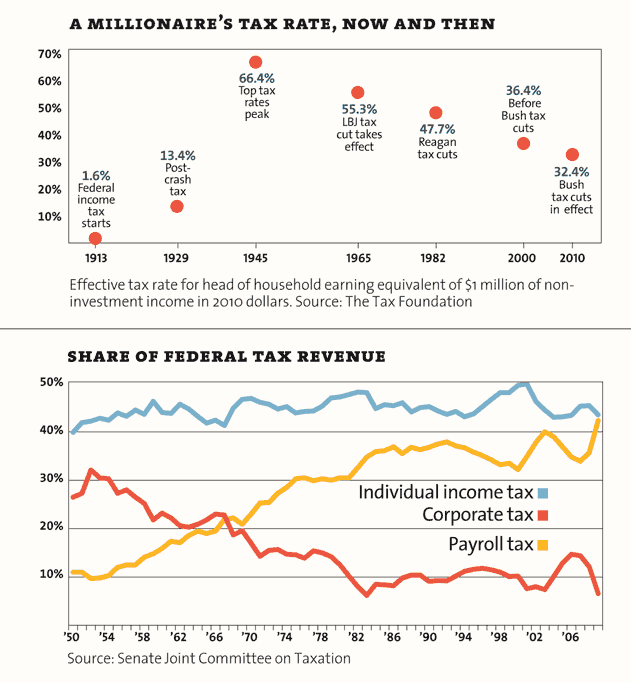
The fact is that the mega-rich have been gobbling up a greater and greater share of the national wealth for several decades now: in 1976 the top 1 per cent of households received 8.9 per cent of all pre-tax income - by 2008, its share had more than doubled to 21.0 per cent. Between 1979 and 2009, the top 5 per cent of American families saw their real incomes increase 72.7 per cent, according to Census data. Over the same period, the lowest-income fifth saw a decrease in real income of 7.4 per cent (by contrast, the 1947-79 period all income groups saw similar income gains, with the lowest income group actually seeing the largest gains). And perhaps most astonishingly, the tax rate for the highest earners was 91 per cent in 1960, 70 per cent in 1980 and only 35 per cent today, the lowest ever with the exception of a couple of years in the late 80s and early 90s.

And it's not as if these people have been suffering during this recession. Unlike the bottom 99 per cent, they've quite smartly recovered from the 2008 unpleasantness. For instance, according to a recent New York Times report, executive pay at 200 big US companies last year went up by an average 23 per cent over 2009 - the median executive salary was 10.8m USD. Meanwhile, the average American family's household net worth declined 23 per cent between 2007 and 2009.

Considering this somewhat ostentatious disparity, one would think that those who are doing well would decide to lay low and quietly count their money so as not to draw undue attention to their good fortune. One might even have expected them to take up good works and be especially generous in order to deflect the anger and resentment that any sentient being could see might result from such blatant unfairness. But no. They have instead waged a public campaign of extravagant whining, complaining incessantly that they are being scapegoated for the nation's economic ills and throwing tantrums at the mere suggestion that they might need to contribute a little bit more in taxes to make up for the carnage their bad bets left in their wake.

Wednesday, October 5, 2011

Executive Pay Spiraling Upward As Corporations Race To Pay Their Bosses The Most

("Why are people protesting..? I don't understand..." Oh, are these the jobs being created by the job creators? Well, no wonder there are so few of them! Look what they pay.--jef)


+++++


The American economy may be faltering, but corporate executives needn't worry: Regardless of how well they perform, each one of them stands a good chance of getting paid as much as all the others -- if not more.

That's because of a practice known as "peer benchmarking" -- a widely used method wherein corporations set pay for their executives at or above the median level of, well, other executives. No company wants their top brass leaving for another job with better pay, so executives are often compensated not based on how well they do, but on how much their competitors in the industry make.

The result? Salaries at the top are inching higher all the time, according to research cited by the Washington Post.

The financial crisis and subsequent worldwide economic slowdown haven't stopped executives from taking home bigger paychecks, both in salaries and bonuses. In 2010, JPMorgan CEO Jamie Dimon received a pay raise of more than $19 million, while Lloyd Blankfen, CEO of Goldman Sachs, collected an additional $3.6 million in bonuses and saw his salary more than triple.

In general, executive salaries have grown far faster than the incomes of average workers in the years since the crisis. Median CEO compensation pay rose by 27 percent in 2010, compared with an increase of just 2.1 percent for workers.

Such figures suggest that the prevalence of peer benchmarking, as outlined in a recent Washington Post article, may play an important role in the United States' ever-widening wealth gap.

Recent studies have shown that the richest 1 percent of Americans control about 24 percent of the country's wealth -- an imbalance that has grown especially pronounced in recent decades, as the salaries of the affluent climbed higher and higher while middle- and lower-class incomes became more or less stagnant.

The growing distance between America's wealthiest citizens and its poorest -- of whom there are more than ever before, with a record 46.2 million people counted in poverty last year -- may be contributing to the frustrating slowness of the economic recovery.

Even though the recession officially ended two years ago, the U.S. has added few new jobs and growth has slowed to a near-standstill.

The high levels of income inequality may have something to do with that. A recent study shows that countries with a more equitable income distribution tend to have longer periods of economic growth -- and that "more inequality lowers growth," in the words of one of the study's authors.

The wealth discrepancy has been cited as one of the principal grievances of the Occupy Wall Street movement, a grassroots protest that began in lower Manhattan's Financial District last month and has since spread to more than 100 cities.

The participants of Occupy Wall Street, more than 700 of whom were arrested during a march over the Brooklyn Bridge this weekend, have called for a more fair distribution of wealth, as well as greater repercussions for the banks at the center of the financial crisis and the end of corporate influence in the political process.

Nor are concerns over income inequality limited to the Wall Street protesters. A recent poll found that the number of Americans who see the country as divided between affluent "haves" and struggling "have-nots" rose in 2011 for the second year in a row.

Friday, September 2, 2011

Executive Pay and the Great Tax Dodge


Before the deficit reduction “super-committee” embarks on a $1–2 trillion course of human slashonomics, it should take a hard look at the Institute for Policy Studies’ (IPS) eighteenth annual executive compensation report, which details how corporations are rewarding CEOs for aggressive tax avoidance—to the tune of at least $100 billion in lost tax revenues every year.

Executive Excess 2011: The Massive CEO Rewards for Tax Dodging reveals that last year twenty-five of the 100 most highly paid CEOs took home salaries greater than the amount their companies paid in 2010 federal income taxes. And it wasn’t because the corporations weren’t making dough—they averaged global profits of $1.9 billion, and only seven reported losses in US pre-tax income.

But these twenty-five companies shielded their profits in 556 tax haven subsidiaries in places like the Cayman Islands, Isle of Man, and Singapore, which proved to be a lucrative tax dodging strategy for the CEOs themselves: the twenty-five CEOs averaged $16.7 million in compensation, compared to $10.8 million for their peers in the S&P 500.

“What we’re seeing here is tax dodging, pure and simple,” says Sarah Anderson, who directs the global economy project at IPS and has coauthored the Executive Excess report for eighteen years running. “And tax dodging that’s benefiting the CEOs of these companies personally.”

It’s not that the corporations are breaking the law. Indeed, the report co-authors emphasize that tax dodging isn’t illegal. But Anderson points out that the laws are “the result of a corrupt system where hundreds of millions of dollars spent lobbying can result in these kinds of crazy, corporate tax loopholes.

That’s why twenty of the twenty-five companies who paid their CEOs more than they paid in federal income taxes also spent more on lobbying lawmakers, and eighteen contributed more to the political campaigns of their preferred candidates than they paid to the IRS.

“GE is sort of our world champion when it comes to tax dodging," says Anderson. “They were also number one in lobbying and political campaign spending, with about $42 million spent on that last year.”

GE paid CEO Jeff Immelt—who also is chairman of President Obama’s Council on Jobs and Competitiveness—$15.2 million. The company had more than $5 billion in US profits, yet reaped $3.3 billion in federal income tax refunds. (You should be receiving your thank-you note in the mail any day now.)

Report co-author Chuck Collins, who directs the IPS program on inequality and the common good, notes that the offshore tax havens have created a “two-tier” corporate system in which domestic businesses that pay closer to the 35 percent statutory rate are competing against global businesses that game the system.
“This is really bad for business and bad for local domestic businesses in particular,” says Collins.

IPS is working with business allies to close loopholes, broaden the tax base  and reduce rates, creating a fairer system. Collins also points out that the common conservative argument that US companies pay one of the highest tax rates in the world at 35 percent is a canard. In fact, thanks to all the gimmicks courtesy of corporate lobbyists and an obliging Congress, the effective rate was 25 percent in 1988 and has plummeted to 10.5 percent today—among the lowest in the world.

“Two generations ago some of the CEOs of these very same companies would have been embarrassed to be so lavishly compensated while at the same time reneging on their responsibility to pay their fair share in taxes,” says Collins. “It’s not just a trend in terms of compensation and tax avoidance. We’re looking at a multigenerational ethical shift away from a civic and corporate leadership.”

The Stop Tax Haven Abuse Act sponsored by Senator Carl Levin and Congressman Lloyd Doggett would plug up some of the corporate-preferred offshore mechanisms and secrecy jurisdictions. IPS has a petition in support of the legislation, and members of Congress should also be contacted and urged to cosponsor. The voices of small-business owners in particular are an important counter to corporations that claim they need these tax havens to create jobs.

The report also illustrates that exorbitant CEO salaries—fueled in part by these tax avoidance schemes—have led to a dramatic increase in the gap between CEO and average worker pay: it was 263:1 in 2009, and shot up to 325:1 last year. Anderson notes that the ratio was just around 40:1 in the 1980s.

“It’s clearly not due to some huge increase of talent at the top—some kind of managerial brilliance,” she says. “Instead it’s the result of a perverse system where CEOs are outrageously rewarded for short-term thinking: tax dodging, reckless investments, slashing jobs, cooking the books or using accounting tricks. Meanwhile, board members approving the pay packages are often executives at other companies who don’t want to rock the boat, or who find the rising compensation mutually beneficial.”

Fortunately, as a result of the Dodd-Frank bill, shareholders now have a right to an annual (though non-binding) “say-on-pay” vote on executive compensation packages, and Anderson says about forty have been rejected.

“This is a growing area of activism,” says Anderson. “But we can’t just leave it to shareholders to solve all the problems.”

Other key proposals that need citizen-activists’ support include California Congresswoman Barbara Lee’s Income Equity Act that would deny corporate tax deductions on any executive pay that runs over twenty-five times the lowest-paid employee, or $500,000, whichever is higher.

There is also a need for citizens to get involved in an underreported fight over the Dodd-Frank requirement that corporations disclose the gap between its CEO and median worker’s pay. The potential for public backlash has led corporate lobbyists to make repeal a priority before the disclosure takes effect. The House will likely vote to repeal, and there is concern that conservative Democrats in the Senate will see it as a bone to throw to Big Business contributors heading into the 2012 elections.

Already, this report has had a positive impact: it led Maryland Democratic Congressman Elijah Cummings to call for hearings “to examine the extent to which the problems in CEO compensation that led to the economic crisis continue to exist today” and “the extent to which our tax code may be encouraging these growing disparities.”

Executive Excess has also received coverage from the Washington Post, the New York Times, Reuters, MSNBC, the Atlanta Journal Constitution and Bloomberg, among others—and that’s just on the first day of its release.

IPS has done a real service in drawing these connections between CEO pay and an absurdly unfair tax system. It’s time for street heat, letters to the editor, calls to Congress, and driving this issue into 2012. It’s time to restore some sanity to pay equity and corporate taxes.

Thursday, September 1, 2011

Some US Firms Paid More to CEOs and/or Lobbyists Than Taxes


by Nanette Byrnes 
 
WASHINGTON - Twenty-five of the 100 highest paid U.S. CEOs earned more last year than their companies paid in federal income tax, a pay study said on Wednesday.

It also found many of the companies spent more on lobbying than they did on taxes.

At a time when lawmakers are facing tough choices in a quest to slash the national debt, the report from the Institute for Policy Studies (IPS), a left-leaning Washington think tank, quickly hit a nerve.

After reading it, Democratic Representative Elijah Cummings, ranking member of the Committee on Oversight and Government Reform, called for hearings on executive compensation.

In a letter to that committee's chairman, Republican Darrell Issa, Cummings asked "to examine the extent to which the problems in CEO compensation that led to the economic crisis continue to exist today."

He also asked "why CEO pay and corporate profits are skyrocketing while worker pay stagnates and unemployment remains unacceptably high," and "the extent to which our tax code may be encouraging these growing disparities."

In putting together its study, IPS chose to compare CEO pay to current U.S. taxes paid, excluding foreign and state and local taxes that may have been paid, as well as deferred taxes which can often be far larger than current taxes paid.

The group's rationale was that deferred taxes may or may not be paid, and that current U.S. taxes paid are the closest approximation in public documents to what companies may have actually written a check for last year.

$16.7 MILLION AVERAGE

Compensation for the 25 CEOs with pay surpassing corporate taxes averaged $16.7 million, according to the study, compared to a $10.8 million average for S&P 500 CEOs. Among the companies topping the IPS list:
  • eBay whose CEO John Donahoe made $12.4 million, but which reported a $131 million refund on its 2010 current U.S. taxes.
  • Boeing, which paid CEO Jim McNerney $13.8 billion, sent in $13 million in federal income taxes, and spent $20.8 million on lobbying and campaign spending
  • General Electric where CEO Jeff Immelt earned $15.2 million in 2010, while the company got a $3.3 billion federal refund and invested $41.8 million in its own lobbying and political campaigns.

Though the companies come from different industries, their tax breaks fall into two primary areas.

Two-thirds of the firms studied kept their taxes low by utilizing offshore subsidiaries in tax havens such as Bermuda, Singapore and Luxembourg. The remaining companies benefited from accelerated depreciation.

Shareholders have responded favorably when companies in which they invest keep a tax bill low through legal methods, thereby benefiting earnings. But Chuck Collins, an IPS senior scholar and co-author of the report, said that is a mistake.

"I think it's an exposure of weakness in a company if their profitability is dependent on their accounting department and not on making better widgets," he said.

In prior reports, Collins said, out-sized CEO pay was often a red flag of bigger problems to come. The IPS has been putting a pay report together for 18 years. Among those whose leaders have made the high pay list in years past, only to have their businesses falter: Tyco, Enron and WorldCom.

Monday, May 30, 2011

We're in Dire Straits When the Only Employment Sector Catching Fire Is in Unpaid Internships

The United States still counts a depressing 24 million unemployed, while the number of exploited unpaid workers keeps growing
By Scott Thill, AlterNet
Posted on May 30, 2011
Here's a particularly nasty sign that the economy is still weaker than Donald Trump's presidential run was: The United States still counts a depressing 24 million unemployed currently hunting for a full-time job, and the only employment sector really catching fire is unpaid jobs and internships, which have steadily increased to fill the undignified void. Whether you're a new college graduate or an unemployed veteran of the pre-recession employment landscape, you're now either fighting for a shrinking pool of new low-paying positions or plenty of gratis gigs where you won't ever see a dime for your earnest blood, sweat and tears.
Last week, the Department of Labor announced a minuscule drop in unemployment insurance claims to 409,000, barely below the annual average's wheelhouse of 412,000 but well above 2011's low of 375,000. For those who graduated college long ago, peak oil and climate change have continued to initiate obvious yet still destabilizing price increases in commodities like food and oil. Health insurance hikes continue unabated and unjustified, and over half of Americans think the housing market is moribund
Meanwhile on campus, corporations are still avoiding college job fairsEscalating tuition costs are said to be inevitable. Perhaps that's just what happens when the University of Chicago decides to host an academic conference on Jersey Shore. Or perhaps Americans who bought into the dream of hard work, ATM housing and paid health care have now devolved to the point that they're indistinguishable from college graduates just entering an anemic job market that shows zero signs of progressing. At this point, the only difference between the two is who eventually moves beyond the increasingly fashionable unpaid job or internship to a paid position.
If the predictable rise in unpaid jobs and internships isn't a sign that the American worker is being undervalued, the Department of Labor's recent decision to hire 250 additional regulators to enforce the Fair Labor Standards Act probably is. Passed in 1938, the FLSA mandated a national minimum wage, overtime for certain jobs and prohibited oppressive child labor. It also formed a cornerstone of Franklin Delano Roosevelt's New Deal social safety net, which is why Republicans in Maine and Missouri are predictably trying to repeal it as you read this. According to these greedy bastards, nothing says true American grit like 14-year-olds working overtime in dead-end jobs during school hours. 
When it comes to paid and unpaid labor, how the FLSA fluctuates between varying state regulations and federal mandates is a mystery to almost anyone unschooled in government or occupational bureaucracy. But one thing seems clear: The U.S. Department of Labor hired its regulators because the system obviously needs regulation.
"Our top priority is protecting the rights of all workers in the American workforce," a spokesperson for the U.S. Department of Labor's Wage and Labor Division told AlterNet. "Clearly, participating in internships, externships and training opportunities are positive and career-building experiences for individuals. But it also means ensuring that employers act responsibly -- and are held accountable when they treat their workers unfairly."
To do that, Labor has encouraged unpaid employees and interns to call 1-866-4US-WAGE if they feel their employers aren't operating in good faith or compliance with national guidelines. The helpful but still ironic recent hiring of additional federal regulators has allowed the Wage and Hour Division to open new district offices across the country, enabling especially younger workers to better report violations "so that they know their rights."
"That's absolutely a priority," the spokesperson added. "The investigators conduct extensive outreach at college campuses and at career centers all over the country. If we were to receive a complaint, we would investigate that complaint. But the fact of the matter is that Wage and Hour Division has not received a single complaint regarding an unpaid internship."
While alarming, that factoid makes sense. As Fortune recently explained in a scary article titled "Unpaid Jobs: The New Normal?" unpaid employment necessarily breeds strange relationships in which employees and employers understand that the former are "going to give their all for nothing." Because of that inequitable arrangement, employees often shirk their uneven responsibilities or give less than their all, especially if the promise of a paid position recedes with every week.
"It's better to have one decently paid person than nine unpaid people who are making it so difficult because they're slacking off or they're difficult to manage," the article quotes one frustrated employer. If unpaid labor truly is the new normal, one wonders how long it will be before the phones at Labor's Wage and Hour Division, which only recently stepped up its workplace regulation, starts ringing off the hook.
"Unpaid internships have a number of problems," Rosy Rickett, cofounder of the UK's Interns Anonymous, explained to AlterNet. "They're elitist, because only the richer can afford to work for free. They devalue labor; having unpaid journalists or architects means that newspapers or architecture firms can undercut competitors. And they are often seen -- by the British government at least -- as a cure-all for youth unemployment figures. Clearly, paid jobs, not unpaid internships, solve unemployment. I'm not sure whether 250 regulators can do the job for the whole of the U.S., but maybe I underestimate them."
Rickett's point is well-taken. While American employees have been mired in a nowhere land pockmarked by a few low-paying jobs and lots of unpaid jobs, American corporate profits have reached an all-time high. Exorbitant executive bonuses are making a comeback. Not a single major bankster responsible for the so-called Great Recession has seen the inside of a jail cell, even though the price tag on bank failures in 2010 alone hit $2 billion and the remaining banks are bigger and more failure-prone than ever. In what world will 250 additional regulators at the Department of Labor be able to adequately regulate workplace injustice or exploitation? Probably the best news to come of this development is that the Department of Labor is hiring at all.
"Not investing time or money in an intern means that we often hear reports of interns not adding value to a company," added Rickett. "Paying a worker means that you invest in them, and are therefore more likely to train them effectively and build up a good working relationship."
According to Amy Potthast, director of Service and Graduate Programs at social and environmental justice employment clearinghouse Idealist.org, that persistent problem is more uncommon to nonprofit organizations that marry their employees and interns' personal goals to their professional ones.
"In the nonprofit sector, where volunteers are usually essential to an organization's human resources capacity, unpaid internships make sense," Potthast explained. "Unpaid nonprofit internships differ from corporate internships in that they take place in a context of positive social and environmental impact. Very often, nonprofit interns pursue opportunities that allow them to build skills while working toward a mission they believe in. Their goals are not simply to learn, to network or to add to their resume, but to also significantly strengthen the community."
The corporate sector has shown that it is mostly uninterested in fortifying such communal bonds. Sitting on record profits, dishing out offensive bonuses and cheaply restricting its hiring, it has illustrated a callous disinterest in the workers who have bailed out its recently failed stratagems. In fact, corporate inaction has become so obvious that even President Obama decided to publicly call bullshit on it.
"It is time for companies to step up," Obama complained on national television in May. "American taxpayers contributed to that process of stabilizing the economy. Companies have benefited from that, and they're making a lot of money, and now's the time for them to start betting on American workers and American products."
But it's going to take more than Obama using the bully pulpit to chastise American corporations or hiring more regulators to force their compliance with employment guidelines to create the sea change he campaigned on. It's going to take fundamental shifts in priorities and policies to awaken the government and public alike to the bleaker, newer normal. It's going to take painful realizations that the American economy, currency and consumption we've enjoyed (and abused) for the last several decades is likely gone for good. Our increasing climate and economic catastrophes demand adaptation.
So the only significant way unpaid labor will be equitable in what's left of late capitalism is if it's accompanied by a secure social safety net that can aid an ailing populace's basic needs. After all, there's a reason the godfather of labor theory Karl Marx regarded surplus labor -- usually, unpaid labor -- as the ultimate source of capitalist profit.
"What would Karl Marx make of this?" Interns Anonymous asked in an insightful analysis called "WWMD: What Would Marx Do?"
"He would laugh in disbelief that the capitalist system has created slaves within its own class. Disbelief that these slaves have been 'culturally enlightened' and supposedly see the flaws in the system, yet continue to submit themselves to exploitation. They are a sub-culture existing within the middle class itself, and they are full of contradictions: Impoverished yet decadent; desperate but unwilling; culturally enlightened yet utterly naive. They are magnets for exploitation."

Tuesday, February 22, 2011

Capitalism for the Long Term

 (As anti-corporate as I am, I have to say this is the most sensible pro-corporate piece I've read in over a decade. I don't like a lot of it, but it takes a sensible approach to some of the crucial issues that divide corporations and the US citizenry. What I would add, though, is give up your corporate personhood, or it will be taken away, anyway. And get the hell out of government. Your corruption will take decades to undo!--jef)
 
++++
 
The near meltdown of the financial system and the ensuing Great Recession have been, and will remain, the defining issue for the current generation of executives. Now that the worst seems to be behind us, it’s tempting to feel deep relief—and a strong desire to return to the comfort of business as usual. But that is simply not an option. In the past three years we’ve already seen a dramatic acceleration in the shifting balance of power between the developed West and the emerging East, a rise in populist politics and social stresses in a number of countries, and significant strains on global governance systems. As the fallout from the crisis continues, we’re likely to see increased geopolitical rivalries, new international security challenges, and rising tensions from trade, migration, and resource competition. For business leaders, however, the most consequential outcome of the crisis is the challenge to capitalism itself.

That challenge did not just arise in the wake of the Great Recession. Recall that trust in business hit historically low levels more than a decade ago. But the crisis and the surge in public antagonism it unleashed have exacerbated the friction between business and society. On top of anxiety about persistent problems such as rising income inequality, we now confront understandable anger over high unemployment, spiraling budget deficits, and a host of other issues. Governments feel pressure to reach ever deeper inside businesses to exert control and prevent another system-shattering event.

My goal here is not to offer yet another assessment of the actions policymakers have taken or will take as they try to help restart global growth. The audience I want to engage is my fellow business leaders. After all, much of what went awry before and after the crisis stemmed from failures of governance, decision making, and leadership within companies. These are failures we can and should address ourselves.

In an ongoing effort that started 18 months ago, I’ve met with more than 400 business and government leaders across the globe. Those conversations have reinforced my strong sense that, despite a certain amount of frustration on each side, the two groups share the belief that capitalism has been and can continue to be the greatest engine of prosperity ever devised—and that we will need it to be at the top of its job-creating, wealth-generating game in the years to come. At the same time, there is growing concern that if the fundamental issues revealed in the crisis remain unaddressed and the system fails again, the social contract between the capitalist system and the citizenry may truly rupture, with unpredictable but severely damaging results.

Most important, the dialogue has clarified for me the nature of the deep reform that I believe business must lead—nothing less than a shift from what I call quarterly capitalism to what might be referred to as long-term capitalism. (For a rough definition of “long term,” think of the time required to invest in and build a profitable new business, which McKinsey research suggests is at least five to seven years.) This shift is not just about persistently thinking and acting with a next-generation view—although that’s a key part of it. It’s about rewiring the fundamental ways we govern, manage, and lead corporations. It’s also about changing how we view business’s value and its role in society.

There are three essential elements of the shift:
  • First, business and finance must jettison their short-term orientation and revamp incentives and structures in order to focus their organizations on the long term. 
  • Second, executives must infuse their organizations with the perspective that serving the interests of all major stakeholders—employees, suppliers, customers, creditors, communities, the environment—is not at odds with the goal of maximizing corporate value; on the contrary, it’s essential to achieving that goal. 
  • Third, public companies must cure the ills stemming from dispersed and disengaged ownership by bolstering boards’ ability to govern like owners.
None of these ideas, or the specific proposals that follow, are new. What is new is the urgency of the challenge. Business leaders today face a choice: We can reform capitalism, or we can let capitalism be reformed for us, through political measures and the pressures of an angry public. The good news is that the reforms will not only increase trust in the system; they will also strengthen the system itself. They will unleash the innovation needed to tackle the world’s grand challenges, pave the way for a new era of shared prosperity, and restore public faith in business.
1. Fight the Tyranny of Short-TermismAs a Canadian who for 25 years has counseled business, public sector, and nonprofit leaders across the globe (I’ve lived in Toronto, Sydney, Seoul, Shanghai, and now London), I’ve had a privileged glimpse into different societies’ values and how leaders in various cultures think. In my view, the most striking difference between East and West is the time frame leaders consider when making major decisions. Asians typically think in terms of at least 10 to 15 years. For example, in my discussions with the South Korean president Lee Myung-bak shortly after his election in 2008, he asked us to help come up with a 60-year view of his country’s future (though we settled for producing a study called National Vision 2020.) In the U.S. and Europe, nearsightedness is the norm. I believe that having a long-term perspective is the competitive advantage of many Asian economies and businesses today.
Myopia plagues Western institutions in every sector. In business, the mania over quarterly earnings consumes extraordinary amounts of senior time and attention. Average CEO tenure has dropped from 10 to six years since 1995, even as the complexity and scale of firms have grown. In politics, democracies lurch from election to election, with candidates proffering dubious short-term panaceas while letting long-term woes in areas such as economic competitiveness, health, and education fester. Even philanthropy often exhibits a fetish for the short term and the new, with grantees expected to become self-sustaining in just a few years.
Lost in the frenzy is the notion that long-term thinking is essential for long-term success. Consider Toyota, whose journey to world-class manufacturing excellence was years in the making. Throughout the 1950s and 1960s it endured low to nonexistent sales in the U.S.—and it even stopped exporting altogether for one bleak four-year period—before finally emerging in the following decades as a global leader. Think of Hyundai, which experienced quality problems in the late 1990s but made a comeback by reengineering its cars for long-term value—a strategy exemplified by its unprecedented introduction, in 1999, of a 10-year car warranty. That radical move, viewed by some observers as a formula for disaster, helped Hyundai quadruple U.S. sales in three years and paved the way for its surprising entry into the luxury market.
To be sure, long-term perspectives can be found in the West as well. For example, in 1985, in the face of fierce Japanese competition, Intel famously decided to abandon its core business, memory chips, and focus on the then-emerging business of microprocessors. This “wrenching” decision was “nearly inconceivable” at the time, says Andy Grove, who was then the company’s president. Yet by making it, Intel emerged in a few years on top of a new multi-billion-dollar industry. Apple represents another case in point. The iPod, released in 2001, sold just 400,000 units in its first year, during which Apple’s share price fell by roughly 25%. But the board took the long view. By late 2009 the company had sold 220 million iPods—and revolutionized the music business.
It’s fair to say, however, that such stories are countercultural. In the 1970s the average holding period for U.S. equities was about seven years; now it’s more like seven months. According to a recent paper by Andrew Haldane, of the Bank of England, such churning has made markets far more volatile and produced yawning gaps between corporations’ market price and their actual value. Then there are the “hyperspeed” traders (some of whom hold stocks for only a few seconds), who now account for 70% of all U.S. equities trading, by one estimate. In response to these trends, executives must do a better job of filtering input, and should give more weight to the views of investors with a longer-term, buy-and-hold orientation.
If they don’t, short-term capital will beget short-term management through a natural chain of incentives and influence. If CEOs miss their quarterly earnings targets, some big investors agitate for their removal. As a result, CEOs and their top teams work overtime to meet those targets. The unintended upshot is that they manage for only a small portion of their firm’s value. When McKinsey’s finance experts deconstruct the value expectations embedded in share prices, we typically find that 70% to 90% of a company’s value is related to cash flows expected three or more years out. If the vast majority of most firms’ value depends on results more than three years from now, but management is preoccupied with what’s reportable three months from now, then capitalism has a problem.
Some rightly resist playing this game. Unilever, Coca-Cola, and Ford, to name just a few, have stopped issuing earnings guidance altogether. Google never did. IBM has created five-year road maps to encourage investors to focus more on whether it will reach its long-term earnings targets than on whether it exceeds or misses this quarter’s target by a few pennies. “I can easily make my numbers by cutting SG&A or R&D, but then we wouldn’t get the innovations we need,” IBM’s CEO, Sam Palmisano, told us recently. Mark Wiseman, executive vice president at the Canada Pension Plan Investment Board, advocates investing “for the next quarter century,” not the next quarter. And Warren Buffett has quipped that his ideal holding period is “forever.” Still, these remain admirable exceptions.
To break free of the tyranny of short-termism, we must start with those who provide capital. Taken together, pension funds, insurance companies, mutual funds, and sovereign wealth funds hold $65 trillion, or roughly 35% of the world’s financial assets. If these players focus too much attention on the short term, capitalism as a whole will, too.
In theory they shouldn’t, because the beneficiaries of these funds have an obvious interest in long-term value creation. But although today’s standard practices arose from the desire to have a defensible, measurable approach to portfolio management, they have ended up encouraging shortsightedness. Fund trustees, often advised by investment consultants, assess their money managers’ performance relative to benchmark indices and offer only short-term contracts. Those managers’ compensation is linked to the amount of assets they manage, which typically rises when short-term performance is strong. Not surprisingly, then, money managers focus on such performance—and pass this emphasis along to the companies in which they invest. And so it goes, on down the line.
As the stewardship advocate Simon Wong points out, under the current system pension funds deem an asset manager who returns 10% to have underperformed if the relevant benchmark index rises by 12%. Would it be unthinkable for institutional investors instead to live with absolute gains on the (perfectly healthy) order of 10%—especially if they like the approach that delivered those gains—and review performance every three or five years, instead of dropping the 10-percenter? Might these big funds set targets for the number of holdings and rates of turnover, at least within the “fundamental investing” portion of their portfolios, and more aggressively monitor those targets? More radically, might they end the practice of holding thousands of stocks and achieve the benefits of diversification with fewer than a hundred—thereby increasing their capacity to effectively engage with the businesses they own and improve long-term performance? Finally, could institutional investors beef up their internal skills and staff to better execute such an agenda? These are the kinds of questions we need to address if we want to align capital’s interests more closely with capitalism’s.

2. Serve Stakeholders, Enrich Shareholders
The second imperative for renewing capitalism is disseminating the idea that serving stakeholders is essential to maximizing corporate value. Too often these aims are presented as being in tension: You’re either a champion of shareholder value or you’re a fan of the stakeholders. This is a false choice.
The inspiration for shareholder-value maximization, an idea that took hold in the 1970s and 1980s, was reasonable: Without some overarching financial goal with which to guide and gauge a firm’s performance, critics feared, managers could divert corporate resources to serve their own interests rather than the owners’. In fact, in the absence of concrete targets, management might become an exercise in politics and stakeholder engagement an excuse for inefficiency. Although this thinking was quickly caricatured in popular culture as the doctrine of “greed is good,” and was further tarnished by some companies’ destructive practices in its name, in truth there was never any inherent tension between creating value and serving the interests of employees, suppliers, customers, creditors, communities, and the environment. Indeed, thoughtful advocates of value maximization have always insisted that it is long-term value that has to be maximized.
Capitalism’s founding philosopher voiced an even bolder aspiration. “All the members of human society stand in need of each others assistance, and are likewise exposed to mutual injuries,” Adam Smith wrote in his 1759 work, The Theory of Moral Sentiments. “The wise and virtuous man,” he added, “is at all times willing that his own private interest should be sacrificed to the public interest,” should circumstances so demand.
Smith’s insight into the profound interdependence between business and society, and how that interdependence relates to long-term value creation, still reverberates. In 2008 and again in 2010, McKinsey surveyed nearly 2,000 executives and investors; more than 75% said that environmental, social, and governance (ESG) initiatives create corporate value in the long term. Companies that bring a real stakeholder perspective into corporate strategy can generate tangible value even sooner. (See the sidebar “Who’s Getting It Right?”)
Creating direct business value, however, is not the only or even the strongest argument for taking a societal perspective. Capitalism depends on public trust for its legitimacy and its very survival. According to the Edelman public relations agency’s just-released 2011 Trust Barometer, trust in business in the U.S. and the UK (although up from mid-crisis record lows) is only in the vicinity of 45%. This stands in stark contrast to developing countries: For example, the figure is 61% in China, 70% in India, and 81% in Brazil. The picture is equally bleak for individual corporations in the Anglo-American world, “which saw their trust rankings drop again last year to near-crisis lows,” says Richard Edelman.
How can business leaders restore the public’s trust? Many Western executives find that nothing in their careers has prepared them for this new challenge. Lee Scott, Walmart’s former CEO, has been refreshingly candid about arriving in the top job with a serious blind spot. He was plenty busy minding the store, he says, and had little feel for the need to engage as a statesman with groups that expected something more from the world’s largest company. Fortunately, Scott was a fast learner, and Walmart has become a leader in environmental and health care issues.
Tomorrow’s CEOs will have to be, in Joseph Nye’s apt phrase, “tri-sector athletes”: able and experienced in business, government, and the social sector. But the pervading mind-set gets in the way of building those leadership and management muscles. “Analysts and investors are focused on the short term,” one executive told me recently. “They believe social initiatives don’t create value in the near term.” In other words, although a large majority of executives believe that social initiatives create value in the long term, they don’t act on this belief, out of fear that financial markets might frown. Getting capital more aligned with capitalism should help businesses enrich shareholders by better serving stakeholders.

3. Act Like You Own the PlaceAs the financial sector’s troubles vividly exposed, when ownership is broadly fragmented, no one acts like he’s in charge. Boards, as they currently operate, don’t begin to serve as a sufficient proxy. All the Devils Are Here, by Bethany McLean and Joe Nocera, describes how little awareness Merrill Lynch’s board had of the firm’s soaring exposure to subprime mortgage instruments until it was too late. “I actually don’t think risk management failed,” Larry Fink, the CEO of the investment firm BlackRock, said during a 2009 debate about the future of capitalism, sponsored by the Financial Times. “I think corporate governance failed, because...the boards didn’t ask the right questions.”
What McKinsey has learned from studying successful family-owned companies suggests a way forward: The most effective ownership structure tends to combine some exposure in the public markets (for the discipline and capital access that exposure helps provide) with a significant, committed, long-term owner. Most large public companies, however, have extremely dispersed ownership, and boards rarely perform the single-owner-proxy role. As a result, CEOs too often listen to the investors (and members of the media) who make the most noise. Unfortunately, those parties tend to be the most nearsighted ones. And so the tyranny of the short term is reinforced.

The answer is to renew corporate governance by rooting it in committed owners and by giving those owners effective mechanisms with which to influence management. We call this ownership-based governance, and it requires three things:

More-effective boards.
In the absence of a dominant shareholder (and many times when there is one), the board must represent a firm’s owners and serve as the agent of long-term value creation. Even among family firms, the executives of the top-performing companies wield their influence through the board. But only 43% of the nonexecutive directors of public companies believe they significantly influence strategy. For this to change, board members must devote much more time to their roles. A government-commissioned review of the governance of British banks last year recommended an enormous increase in the time required of nonexecutive directors of banks—from the current average, between 12 and 20 days annually, to between 30 and 36 days annually. What’s especially needed is an increase in the informal time board members spend with investors and executives. The nonexecutive board directors of companies owned by private equity firms spend 54 days a year, on average, attending to the company’s business, and 70% of that time consists of informal meetings and conversations. Four to five days a month obviously give a board member much greater understanding and impact than the three days a quarter (of which two may be spent in transit) devoted by the typical board member of a public company.

Boards also need much more relevant experience. Industry knowledge—which four of five nonexecutive directors of big companies lack—helps boards identify immediate opportunities and reduce risk. Contextual knowledge about the development path of an industry—for example, whether the industry is facing consolidation, disruption from new technologies, or increased regulation—is highly valuable, too. Such insight is often obtained from experience with other industries that have undergone a similar evolution.

In addition, boards need more-effective committee structures—obtainable through, for example, the establishment of a strategy committee or of dedicated committees for large business units. Directors also need the resources to allow them to form independent views on strategy, risk, and performance (perhaps by having a small analytical staff that reports only to them). This agenda implies a certain professionalization of nonexecutive directorships and a more meaningful strategic partnership between boards and top management. It may not please some executive teams accustomed to boards they can easily “manage.” But given the failures of governance to date, it is a necessary change.

More-sensible CEO pay.
An important task of governance is setting executive compensation. Although 70% of board directors say that pay should be tied more closely to performance, CEO pay is too often structured to reward a leader simply for having made it to the top, not for what he or she does once there. Meanwhile, polls show that the disconnect between pay and performance is contributing to the decline in public esteem for business.

CEOs and other executives should be paid to act like owners. Once upon a time we thought that stock options would achieve this result, but stock-option- based compensation schemes have largely incentivized the wrong behavior. When short-dated, options lead to a focus on meeting quarterly earnings estimates; even when long-dated (those that vest after three years or more), they can reward managers for simply surfing industry- or economy-wide trends (although reviewing performance against an appropriate peer index can help minimize free rides).

Moreover, few compensation schemes carry consequences for failure—something that became clear during the financial crisis, when many of the leaders of failed institutions retired as wealthy people.

There will never be a one-size-fits-all solution to this complex issue, but companies should push for change in three key areas:
  • They should link compensation to the fundamental drivers of long-term value, such as innovation and efficiency, not just to share price.
  • They should extend the time frame for executive evaluations—for example, using rolling three-year performance evaluations, or requiring five-year plans and tracking performance relative to plan. This would, of course, require an effective board that is engaged in strategy formation.
  • They should create real downside risk for executives, perhaps by requiring them to put some skin in the game. Some experts we’ve surveyed have privately suggested mandating that new executives invest a year’s salary in the company.

Redefined shareholder “democracy.”
The huge increase in equity churn in recent decades has spawned an anomaly of governance: At any annual meeting, a large number of those voting may soon no longer be shareholders. The advent of high-frequency trading will only worsen this trend. High churn rates, short holding periods, and vote-buying practices may mean the demise of the “one share, one vote” principle of governance, at least in some circumstances. Indeed, many large, top-performing companies, such as Google, have never adhered to it. Maybe it’s time for new rules that would give greater weight to long-term owners, like the rule in some French companies that gives two votes to shares held longer than a year. Or maybe it would make sense to assign voting rights based on the average turnover of an investor’s portfolio. If we want capitalism to focus on the long term, updating our notions of shareholder democracy in such ways will soon seem less like heresy and more like common sense.

While I remain convinced that capitalism is the economic system best suited to advancing the human condition, I’m equally persuaded that it must be renewed, both to deal with the stresses and volatility ahead and to restore business’s standing as a force for good, worthy of the public’s trust. The deficiencies of the quarterly capitalism of the past few decades were not deficiencies in capitalism itself—just in that particular variant. By rebuilding capitalism for the long term, we can make it stronger, more resilient, more equitable, and better able to deliver the sustainable growth the world needs. The three imperatives outlined above can be a start along this path and, I hope, a way to launch the conversation; others will have their own ideas to add.

The kind of deep-seated, systemic changes I’m calling for can be achieved only if boards, business executives, and investors around the world take responsibility for bettering the system they lead. Such changes will not be easy; they are bound to encounter resistance, and business leaders today have more than enough to do just to keep their companies running well. We must make the effort regardless. If capitalism emerges from the crisis vibrant and renewed, future generations will thank us. But if we merely paper over the cracks and return to our precrisis views, we will not want to read what the historians of the future will write. The time to reflect—and to act—is now.

Who’s Getting It Right?
Environmental, social, and governance initiatives can serve a wide range of stakeholders and benefit shareholders. Companies can:

Create new products and markets
Three years ago Verizon developed a phone and a calling plan to address the needs of seniors and the disabled. It sold 400,000 of the new phones and doubled senior customers’ wireless spending.

Drive operational efficiency
During the past several years Walmart has been working to establish tough new targets for reducing suppliers’ packaging waste. Its goal—to trim packaging by 5% between 2008 and 2013—should generate $12 billion in savings across its global supply chain.

Motivate and retain employees
Novo Nordisk’s mission to end diabetes would, if accomplished, put the company out of business. Yet the firm has an enormously committed workforce, not least in developing countries and especially in China, where its initiatives (such as the first Chinese-language website for people with diabetes) have helped it gain a 70% market share.

Spur innovation
GE’s “bottom of the pyramid” development of low-cost medical imaging for the Indian and Chinese markets led to efficiency breakthroughs in design and engineering and to new products that now account for growing sales in advanced nations as well. (See “How GE Is Disrupting Itself,” HBR October 2009.)

Retain access to inputs
Coca-Cola has devised a sophisticated global water strategy that ensures that local concerns as well as local supply and demand issues are integrated into the long-range plans for each plant. This approach helps avoid both public backlashes over water use and operational problems due to water shortages.