Showing posts with label Internet piracy. Show all posts

Friday, October 11, 2013

New study says online piracy isn’t hurting entertainment industry

By Eric Pfeiffer, Yahoo News October 3, 2013

For years, the entertainment industry has argued that online piracy has devastated business for movies, music and gaming.

But a new policy brief from the London School of Economics and Political Science (LSE) says that not only does piracy not hurt the creative industry but it is actually helping.

Millions of people across the globe illegally access copyrighted material on a daily basis. The most common method of digital pirating is through torrent sites, which let an individual download and upload content through a peer-to-peer file-sharing system.

Individuals in the U.S. who are found guilty of violating digital piracy laws can face severe legal penalties, including a felony record, five years in prison and $250,000 in penalties.

In the briefing, authors Bart Cammaerts, Robin Mansell and Bingchun Meng call on governments to re-evaluate their antipiracy laws to include data from studies beyond those directly sponsored by the entertainment industry itself.

“Contrary to the industry claims, the music industry is not in terminal decline, but still holding ground and showing healthy profits. Revenues from digital sales, subscription services, streaming and live performances compensate for the decline in revenues from the sale of CDs or records,” Cammaerts said in report carried by the site TorrrentFreak.

In a separate story, TorrentFreak says that independent data actually suggests that those who pirate content are also more likely to spend their money on film, music and gaming content.

A June 2013 study found that roughly 45 percent of all Americans pirate copyrighted content on a regular basis, including 70 percent of those under 30.

In the LSE report’s key messages, the authors say that evidence does not back up claims that individual cases of copyright infringement are affecting entertainment industry revenues, that antipiracy laws around the world are not achieving their desired impacts and that governments should update their policies to include more evidence from a diverse set of sources.

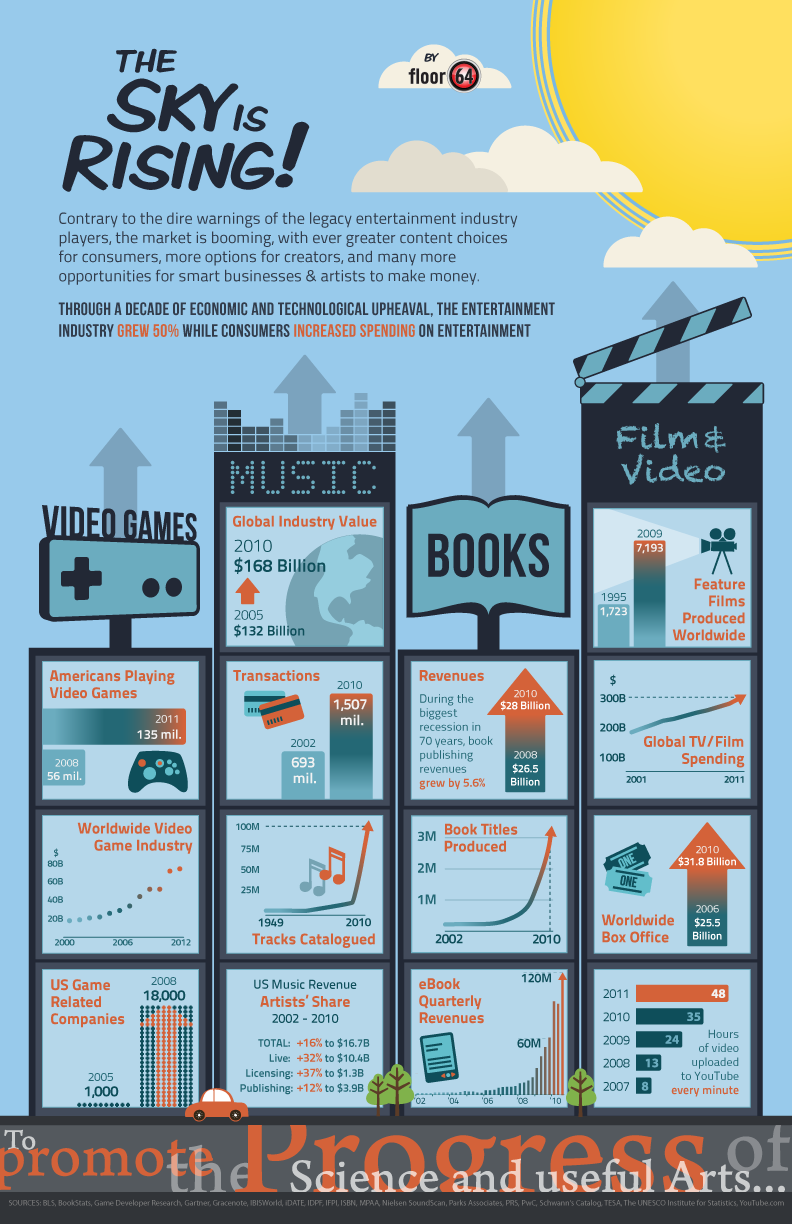
“Despite the Motion Picture Association of America’s (MPAA) claim that online piracy is devastating the movie industry, Hollywood achieved record-breaking global box office revenues of $35 billion in 2012, a 6% increase over 2011,” the report states.

And while music sales have faced steeper declines in recent years, the authors say those numbers have largely been balanced out by increased sales in live performance and other outlets.

“The music industry may be stagnating, but the drastic decline in revenues warned of by the lobby associations of record labels is not in evidence,” the authors write.

Interestingly, in the same Columbia University study, which found that nearly half of all U.S. Internet users pirate copyrighted material, nearly half of those individuals say they would willingly pay a monthly fee for unlimited access to multimedia content.

And the LSE study authors say that is one possible solution for the entertainment industry going forward as a way to bridge the gap between content providers and consumers.

“Within the creative industries there is a variety of views on the best way to benefit from online sharing practices, and how to innovate to generate revenue streams in ways that do not fit within the existing copyright enforcement regime,” the authors conclude.

“When both [the creative industries and citizens] can exploit the full potential of the Internet, this will maximize innovative content creation for the benefit of all stakeholders.”

Friday, May 18, 2012

Research paper finds music piracy ‘benefits’ album sales

By Stephen C. Webster - RAW Story
Friday, May 18, 2012

 
Illegally downloading pre-release leaks of major artists’ albums actually “benefits” first week sales, and if used properly these types of leaks could even work as an effective promotional tool for the largest record labels going forward, according to findings in the first draft of a working paper put out this month by an assistant professor at North Carolina State University.

However, the study (PDF) is not necessarily the godsent revelation advocates of file sharing and copyright reform may have been hoping for. Speaking to Raw Story on Friday, Asst. Prof. Robert Hammond, a Ph.D. graduate of Vanderbilt, cautioned that his results should not be construed to contradict the economic analyses put forward by music industry lobbyists in discussions with lawmakers.

Nevertheless, his study does pack a punch: “The findings suggest that file sharing of an album benefits it’s sales. I don’t find any evidence of a negative effect [from piracy] in any specification, using any instrument,” he wrote.

In fact, his study found that effect goes in the opposite direction: Hammond noted that the sales-boosting effect of piracy was most pronounced in cases where a major band’s album had been leaked online ahead of the official release. However, the overall amplification effect was relatively small, producing about 60 additional purchases in cases where an album was leaked to pirates up to 30 days before its official release.

“My results suggest that it’s possible to think of leaks as promotional activity, but more work needs to be done to understand how general that result is,” he told Raw Story.

He also noted that download data he used came from a “very small” BitTorrent tracker, and that the sales boosting effects could be more pronounced if data from some of the larger trackers were examined. Despite the size of his download tracker, Hammond told Raw Story that it actually offered him more detailed data than any other prior studies on the subject, revealing a previously unidentified correlation between downloads and sales.

Cross referencing that download data with music industry sales figures, Hammond was able to pinpoint key similarities. Namely, major bands are always downloaded the most, and they almost always see the biggest sales. Hammond found that these artists also saw the greatest benefit from pre-release file sharing. While that benefit may be relatively small, the popularity trend carried over to the genre level, with with pop albums seeing the greatest benefit, whereas independent artists or newly released groups saw none.

But that’s where the good news for copyright reform advocates ends: “What I find are individual downloads of an individual album are not harmful to individual sales,” he said. “That does not imply that if we aggregate all the downloading and all the sales, that more downloading, for the industry, means more sales for the industry.”

Hammond continued: “So much of the [recent] failed [Internet] legislation was driven by lobbying activities at the industry level. Nothing in my paper says those lobbyists and those industry level organizations are wrong in their claims. There has certainly been a steep drop in profitability in that industry. My results are on a very different question and so my ability to inform policy in that regard is somewhat limited.”

That steep drop-off in profitability remains a prescient reality for record companies even despite the emergence of online services like iTunes and Spotify, which have seen subscription numbers soar in recent years. Even in countries like France, where U.S.-supported Internet restrictions have significantly cut down on piracy, the music industry’s profits have continued to shrink year to year.

Explaining that the “appropriate” role of copyright is not a topic he’d care to address, Hammond added that his study simply does not address the “industry-level question” of the potential for harm posed by piracy.

Some of those industry analyses, however, seem to inflate the overall damages of piracy by attributing direct losses per download, as if to assume that the downloader would have otherwise purchased the item that is being shared with them. Rob Reid, creator of the online music service Rhapsody, explained in March during a speech to TED Talks why this is actually rather absurd.

“These days, an iPod classic can hold 40,000 songs… Which is to say, eight billion dollars worth of stolen media, or about 75,000 jobs,” Reid said. “Now you might find copyright math strange, but that’s because it’s a field that’s best left to experts.”

“So, putting my work in that context says that what’s good for an individual artist seems to be very different than what’s good for the industry,” Hammond concluded. “I imagine policy makers are more concerned with the industry than the individual artists.”

Friday, April 27, 2012

Facebook Lobbies Washington to “Like” Spying on Users

Friday, April 27, 2012 by CorpWatchby Pratap Chatterjee


Facebook, the social network behemoth that is about to become a multi-billion dollar company, has been lobbying for a proposed new U.S. law called the Cyber Intelligence Sharing and Protection Act (CISPA) that would allow companies to share information with government agencies. Zaid Jilani at the Republic Report has been digging up details on the Washington lobbyists who are helping Facebook.

“Under CISPA, private companies may spy on user communications, whether stored or in transit, and freely pass personal information to the government as long as they claim a vague "cybersecurity" exception,” write Mark M. Jaycox and Lee Tien at the Electronic Frontier Foundation. “The bill also creates expansive legal immunity that makes companies and the government largely unaccountable to users. Companies ‘acting in good faith’ are also excused from all liability for engaging in potential countermeasures, even if they hurt innocent parties.”

This is not the first time that the U.S. Congress has tried to pass a dubious law on computer security in the name of stopping piracy. Last year, the Stop Online Piracy Act and the Protect IP Act – backed by Hollywood and opposed by Facebook, Google and Wikipedia – was defeated after a huge backlash. Opponents noted that the law – as drafted - would threaten freedom of speech and support Internet censorship.

Mike Rogers, a Republican from Michigan, and Dutch Ruppersberger, a Democrat from Maryland, are the sponsors of the new bill. Unusually for Washington, the two men work together well, according to the Washington Post. Rogers is a former Federal Bureau of Investigations agent who has been promoting the drone war, notes the Post, and the two men have the backing of people like Michael Hayden, former director of the Central Intelligence Agency and the National Security Agency. So it is small wonder that CISPA will help out the intelligence agencies by expanding their powers of surveillance.

Not surprisingly, activists like Avaaz are campaigning against CISPA and so is (surprisingly) the Obama White House, which has threatened to veto the bill if it makes it to the president’s desk.

But Facebook – which opposed the cyber-security bills last year – has decided to support CISPA. The proposed law “would make it easier for Facebook and other companies to receive critical threat data from the U.S. government,” Facebook’s Washington DC office posted on its blog. It would “impose no new obligations on us to share data with anyone –- and ensures that if we do share data about specific cyber threats, we are able to continue to safeguard our users’ private information, just as we do today.”

Well, many Facebook users would testify that the company actually does a very poor job of protecting user’s private information.

Zaid Jilani at the Republic Report points out that Facebook is actively paying a Washington lobby firm to lobby for CISPA. In his article titled “Dislike: Meet The Lobbyists Facebook Hired To Help The Government Spy On You” he reports on the people at Fierce, Isakowitz & Blalock that are working the halls of Congress to get the bill passed.

“What’s particularly interesting about all of these individuals is that every single one previously worked somewhere in the executive or legislative branches of the Federal government. They were paid by taxpayers to get the training and connections that now allow them to have high-paid lobbying jobs representing corporations,” writes Jilani.

After all, Facebook has a lot to gain from this such as the ability to “freely pass personal information to the government” and to be “excused from all liability even if they hurt innocent parties.”

On Friday, when Congress gets to vote, we will find out which members “like” Facebooks plans.

Sunday, February 26, 2012

EU suspends ACTA ratification, refers treaty to court

RT | 22 February, 2012

The EU has suspended the ratification of the Anti-Counterfeiting Trade Agreement (ACTA) and referred the text to the European Court of Justice to investigate possible rights breaches.

The European Commission decided on Wednesday to ask the EU's top court "to clarify that the ACTA agreement and its implementation must be fully compatible with freedom of expression and freedom of the internet."

The ACTA debate "must be based upon facts and not upon the misinformation or rumor that has dominated social media sites and blogs," says EU Trade Commissioner Karel De Guch. The EU will not ratify the international treaty until the court delivers its ruling, he added.

De Guch insists the treaty will change nothing in the bloc, but help protect the creative economy.

European countries were quick to sign US- and Japan-lobbied ACTA agreement in Tokyo just a month ago. Ratification of the controversial agreement, however, is not going so smoothly.

ACTA faced fierce opposition by the Europeans, who saw it as an anti-democratic move. People took their anger to the streets in a synchronized protest, saying it violates their rights. About 200 cities participated in an anti-ACTA march on February 11.

The initial goal authorities pursued was to protect intellectual property and copyright, but human rights activists fought to prove its bias in favor of those in power. They argue it violates freedom of expression on the internet and allows unprecedented control of people’s personal information and privacy.

Some critics have been saying ACTA is a somewhat-disguised  SOPA (Stop Online Piracy Act).

ACTA has so far been signed by the EU as a bloc, 22 EU members as individual states, and also by the USA, Canada, Japan, Australia, South Korea and some other countries. The total number of signatories to the treaty is 31.

The European Parliament is set to vote on ACTA in June. In parallel, the accord has to be ratified by all the 27 EU member states. Germany, the Netherlands, Cyprus, Estonia and Slovakia have not put individual signatures under the treaty as such and, in the wake of the mass anti-ACTA protests in Europe, are not eager to proceed with it.Bulgaria, the Czech Republic and Latvia suspended the ratification process, while Poland on the second thought refused to ratify the accord all together.

Wednesday's decision means ACTA's ratification in the EU could be delayed for months.

Rob Beschizza, the managing director of online magazine and group blog Boing Boing, says nothing can stop Internet file swapping.

“What the industry needs to do when it considers how it makes entertainment products – music, movies and so on – available, is make it so that people can easily buy them. People don’t want to be thieves. They don’t want to take things they are not entitled to,” he told RT.

Beschizza believes that legislative initiatives like ACTA never do anything to stop piracy.

“The way the Internet works [is], as long as two computers can connect to each other, people are going to find a way to share files. The Internet works by copying data,” he said. “So what we foresee is when these laws are passed, there’ll be all this social harm and there’ll be no actual prevention of piracy.”

Thursday, January 26, 2012

ACTA: The Seldom Heard of International Treaty That Could Affect Internet Freedom

Wednesday, January 25, 2012 by Common Dreams
US among countries that have already signed ACTA


While there was  to online anti-piracy bills -- SOPA in the House and the PIPA in the Senate -- ACTA, the Anti-Counterfeiting Trade Agreement, has received scant media attention yet poses a tremendous threat to online freedom.

RT reports on how the ACTA treaty will work:

Under this new treaty, Internet Service Providers will police all data passing through them, making them legally responsible for what their users do online. And should you do something considered "breach of copyright" like, for instance, getting a tattoo of a brand logo, taking a photo and posting it somewhere, you may be disconnected from the Internet, fined or even jailed.
This, of course, threatens the entire founding idea of the Internet – the free sharing of information. But ACTA doesn't stop there. It goes beyond the Internet, bearing down on generic drugs and food patents. If passed, ACTA will enforce a global standard for seed patenting, which would wipe out independent, local farmers and make the world completely dependent on the patent owners (read "big corporations") for supplies.
TheRevolutionIsNow offers this video analysis of the treaty:

While protests were able to pressure officials from moving forward with the SOPA and PIPA bills, President Obama already signed ACTA months ago. The International Business Times reports:
ACTA, on the other hand, was already signed by the United States on Oct. 11, 2011, and Obama was not required to attain the approval of any outside authority to do so: not the Congress, not the Supreme Court, and not the American public.
Now that it has been signed, the legislative and judicial branches of the U.S. government also have little ability to challenge or amend the treaty, and Americans will be subject to a whole new scheme of laws, restrictions and regulations that could have them facing fines or jail through a process that would likely exist entirely outside the scope of the American justice system.
And Wired.co.uk reports:
It has been negotiated, mostly in secret, between various countries and the EU over the last four years. Many states have already signed up for Acta, well before the widespread web furore over Sopa. So far, Canada, Japan, Korea, Morocco, New Zealand, Singapore and the US have all signed up to Acta. The European Union, Mexico and Switzerland have supported the treaty and shown a commitment to signing it in the future. Acta was slipped through the European Council in an agriculture and fisheries meeting in December. Some of its more aggressive language has been removed from more recent iterations of the treaty, particularly concerning "disconnection of internet access". It is expected to be signed by the EU on Thursday, before the European Parliament has a chance to vote on it.
Echoing protests last week when many sites "went black" in protest of SOPA and PIPA,Agence France-Presse reports that close to 100 websites in Poland went black Tuesday in protest of their country's plan to sign ACTA.
So who supports this far-reaching treaty? Wired.co.uk reports:
Acta is supported by major copyright holders including pharmaceutical companies, movies studios and record labels. Lobbying organisations include GlaxoSmithKline, Pfizer, Sanofi-Aventis, Monsanto Company, Time Warner, Sony, Verizon, The Walt Disney Company, the Motion Picture Association of America, News Corporation, and Viacom. It looks like the European Commission supports it but the European Parliament are unanimously against it.

How Hollywood’s Own Reality Undermines Its Position on Internet Policy

Credibility Lost

by RICHARD FORNO

The furor over the latest legislative proposals to address online copyright infringement in the United States have cast the major American intellectual property companies – most notably, the entertainment industry — in a very negative light within the global Internet user community.  I join with technologists, scholars, and industry observers who are amazed at the level of concentrated outcry over a single technology policy issue and hope it represents a more civic-minded Internet population when it comes to matters affecting Internet users both in the United States and around the world.
Much of the controversy surrounding The Stop Online Piracy Act (SOPA) [1] and the Protect IP Act (PIPA) [2] pertains to how they were drafted and their potential adverse consequences to the Internet itself, if not society generally. While a prolonged analysis or description of these proposals are beyond the scope of this article – but can be found quite easily online – they represent the latest attempts by the intellectual property (IP) industry (although ‘cartel’ might be a  more appropriate term) to further extend its reach into cyberspace to enact what it believes are necessary measures to protect its copyrighted property such as movies, music, and software.  Unfortunately, these legislative proposals were conceived and developed primarily by industry lobbyists with little input from Internet engineers, cybersecurity practitioners, or other subject matter experts who understand the technical, legal, and social consequences should these proposals, as written, become law.  The secrecy surrounding the drafting of SOPA and PIPA are reminiscent of how these same industry organisations were adamant that the international  development of 2011′s controversial Anti-Counterfeiting Trade Agreement (ACTA) occur in secret with little if any public consultation, comment, or discussion.[3]
Apparently, developing laws to protect intellectual property on the Internet are exempt from Washington’s alleged desire for greater transparency in the policymaking process. It also represents a shift in how technology issues previously were dealt with in the earlier days of the Internet — i.e., involving all stakeholders in a public forum to reach a mutual consensus on a given matter.  Such one-sided practices can lead to proposals like SOPA and PIPA, which indeed may endanger the effective and secure operation of the Internet, harm innocent Internet users, establish a “shoot first” policy based on accusation not proof, and potentially present assorted constitutional concerns over due process and online freedom of expression.  [4]
Concerns over the technical and legal ramifications of SOPA and PIPA were voiced publicly by companies like Google and Facebook and a veritable Who’s Who of Internet Engineering[5]. These concerns subsequently were marginalised or ignored[6] by American legislators wanting to enact them into law quickly while minimising public discussion about their potential consequences.  In response, the Great SOPA Blackout of January 18th, 2012 was launched by major Internet companies, prominent Web sites, and individual luminaries to protest and raise public awareness of these proposals, building upon the successful online protest the prior month against Internet company GoDaddy.Com, a longtime SOPA supporter.[7]  The significant public attention brought to these proposals during the January 18th Blackout forced legislators to realise these proposals might be a political problem for them; even before the one-day protest ended, politicians began scrambling to distance themselves from these proposals, including several of their original sponsors.[8][9][10]  Political support turned so quickly against SOPA and PIPA that the president of the Motion Pictures Association of America (MPAA) publicly threatened to cut off campaign support for politicians who didn’t support its legislative desires once it was known that Congressional leaders and the Obama Administration had removed those proposals from active consideration in their current form.[11]
That said, the enforcement of copyright on the Net is an ongoing concern for Hollywood and represents an significant, if not apocalyptic, problem to the entertainment industry, as evidenced in recent years:
  • 2005: MPAA claims $6.1 billion in losses due to “continued camcordering” of movies in theaters. [12]
  • 2005: US Chamber of Commerce reports 750,000 jobs lost due to online ‘piracy.’[13]
  • 2006:  A study based on Motion Pictures Association of America (MPAA) data from the Institute for Policy Innovation claims the US economy loses $20.5 billon a year from movie ‘piracy.’[14]
  • 2011: In a letter to the New York Times, the US Chamber of Commerce’s Mark Elliot says online ‘piracy’ threatens more than 19 million American jobs.[15]
Clearly, the entertainment industry is suffering tremendous financial losses due to online theft.  More frightening, the potential job losses have increased from 750,000 in 2005 to more than 19 million in 2011. This stark news suggests there must be severe financial and employment losses for the entertainment industry resulting from the online ‘piracy’ of its products. These statistics and predictions must be true — after all, these are ‘industry numbers’ being reported!
Interestingly, despite this gloomy news, the MPAA reported that “global box office receipts reached an all time high” of $29.9 billion in 2010 — and soon after announced new statistics showing how movie ‘piracy’ is killing its industry and destroying jobs. [16]
MPAA can’t have it both ways. Either it is losing money and laying people off due to ‘piracy’ or it’s making profits hand-over-fist and keeping its industry very much alive and profitable. Either way, it’s offered up some very misleading statements about its profitability and well-being in the face of an alleged epidemic of online theft that only draconian measures like SOPA or PIPA can address.
Similar antics were used by the MPAA’s musical counterpart, the Recording Industry Association of America (RIAA) over the years to describe its alleged financial woes due to online theft.  In the case of music, iTunes destroyed the decades-old concept of “album sales” — yet recording industry statements and news articles continued to suggest that “declining album sales” was a direct consequence of the online ‘piracy’ problem rather than acknowledging that increasing number of customers now purchased individual tracks from iTunes instead of full albums. [17][18]
Nevertheless, these manipulated statistics are invoked by the entertainment industry at every opportunity to justify and perpetuate attacks on technology, customers, and the Internet itself while ignoring societal evolution and the evolving expectations of its customers.  I do not dispute that the theft of copyrighted materials on the Internet is a problem and needs to be addressed, but we must be mindful of the statistics presented by the entertainment industry on this issue and not blindly accept their view as reflective of reality. Unfortunately, like all pieces of propaganda, repeat it often enough and the audience will believe it’s true.
The late Senator Daniel Patrick Moynihan once said, “you are entitled to your own opinion, but not your own facts.”  So let’s dig a bit deeper into the statistics routinely cited by the entertainment industry as it plays the victim of ‘piracy’ in the eyes of legislators and the media to determine if these indeed are facts or merely fantasy:
  • 2010: The US Government Accountability Office (GAO) releases a study that, while confirming online copyright infringement indeed is a problem, cast serious doubts on the intellectual property industry’s ‘piracy’ statistics. It also concludes that measuring the impact of ‘piracy’ with any degree of meaningful accuracy may be impossible.[19]
  • 2011: A ‘piracy investigator’ working for the entertainment industry describes how the entertainment industry worked to boost its piracy statistics to gain stronger media and political interest in its efforts.[20]
  • 2012: Julian Sanchez of the Cato Institute notes that the statistics associated with online ‘piracy’ are flawed if not something purely in the fantasies of lobbyists and their paid-for legislators.[21]
In short, great doubts are, and should be, cast upon the statistics used by the entertainment industry regarding ‘piracy’ and the theft of its products.  Therefore, in negotiating with the entertainment industry, lawmakers must be prudently critical in their analysis and due diligence of the facts presented — or, as the late Ronald Reagan famously said, “trust, but verify.”
Sadly, these very metrics, flawed or fixed as they are, continue to define the entertainment industry’s vision of reality and are used by its Congressional lobbyists to garner support for more far-reaching mechanisms to control the flow of information — theirs or anyone else’s — on the Internet in the name of countering ‘piracy.’  After all, the flurry of widespread public criticism of SOPA was dismissed by lead SOPA sponsor Lamar Smith as “not based in reality”; in other words, the reality conveniently contrived by the entertainment industry lobbyists and subsequently believed as absolute truth by Congress.[22]  Such sentiment, if not simply an excessive sense of self-entitlement, also helps explain why members of the entertainment industry have sued foreign governments that do not enact legislation favourable to them immediately upon request.[23]
Therefore, how can anyone take seriously the claims of Hollywood over its declared losses to ‘piracy’?  Not only do the entertainment industry’s statements about ‘piracy’s’ debilitating effects on its profitability conflict with its proclamations about strong annual sales, but it’s been caught basing its actions on a misconstrued sense of reality and groupthink reinforced by an ongoing inability to work with those whose views differ or raise concerns about its agenda. But Congressional lawmakers routinely believe the entertainment industry’s claims and cater to its needs, because they appreciate the flow of money received by enacting legislation favourable to those supporting their political campaigns. [24]
Interestingly, either through a superb act of irony or willful ignorance, the entertainment industry (and Congress) fails to note that the very technologies it lobbies (or votes) against are the ones that continue to make it so profitable over time.  Technological innovations such as the VCR, DVR, iTunes, NetFlix, and yet-to-be-discovered (or invented) services all contribute to the long-term success of the entertainment industry by allowing customers to enjoy entertainment products in a manner conducive to and consistent with the modern age and societal expectations.  For example, the launch of iTunes as the de facto Internet site to purchase music was a direct response to the rampant theft of music over the Internet in the late 1990s when Napster, GnuTella, Limewire, and other services met an emerging customer need (portabilityof a purchased music to multiple devices and over the Internet) that the recording industry chose to ignore. iTunes transformed that mostly criminal venture – obtaining and sharing music over the Internet – into the recording industry’s standard, if not preferred, method of distributing commercial music to customers.
Unfortunately. any new technology in the hands of average customers absolutely terrifies the entertainment industry. An insane fear of ‘piracy’ and zealous desire to protect its digital products at all costs have contributed to the imposition of restrictive technology controls, laws, and legislative proposals that created the uproar we see currently over SOPA and PIPA. Similar efforts over time explain why customers couldn’t easily duplicate VHS tapes in the 1980s, or DVDs in the 1990s, and are forced to watch un-skippable FBI “Anti Piracy Warnings” on DVDs and Blu-Rays in the 2000s.  It’s why you hear terms like ‘safe harbour’, ‘circumvention’, HDMI, HDCP, DRM, TCP, CSS, TPM, ‘analog holes’, ‘broadcast flags’, and things called ‘content protection’ inflicted upon our computers, monitors, video cards, iPods, cell phones, home theater systems, movies, music, and other digital products we might place on our various ‘authorised devices.’ It’s why since 2005 you risk arrest on federal felony charges if you take a photos or quick movie clips of a relative in a movie theater and happen to also catch a film playing in the background.[25] Why? Because you might be a criminal looking to steal digital content.  Even if you’re not, you might be. But that chance that you might be a criminal means everyone must be considered and treated as one, too — and why every new piece of consumer technology is considered by the entertainment industry as a potential Weapon of Mass Infringement. [26]   Remember that in 1982 the former MPAA president famously equated the VCR to the Boston Strangler [27] in terms of endangering the future success of the film industry; yet despite the proliferation of VCRs, DVRs, and streaming video services in the years since, that same industry reported record profits in 2010!
Effectively working together to counter online copyright infringement requires trust — trust in the data presented, and trust in the trustworthiness of those you are working with. Sadly, the entertainment industry repeatedly demonstrates it is not to be trusted — and the flawed statistics endlessly cited to further its agenda confirms this belief, as does its repeated inability to work with people and groups whose views differ from their own.  Those working to develop lasting solutions to the very real problem of contemporary copyright infringement must strive towards a mutually acceptable resolution to this problem and realise that a winner-take-all scorched-earth outcome may not be an appropriate solution. Legislation and treaties regarding copyright enforcement that raise serious concerns about Internet security, stability, and constitutionality (i.e., SOPA, PIPA, ACTA) must not be developed in secret by a committee of selected lobbyists but rather in full view of the public and with input from qualified external subject matter experts representing all sides of the issue.  Finally, to reach such a solution, the entertainment industry must abolish its practice of treating its paying customers as potential criminals and overcome its paranoia about technologies that it doesn’t yet control or influence heavily[28][29].
Unlike Silicon Valley, Hollywood considers ‘innovation’ as the process of lobbying for newer and more stringent controls over information and the flow of information in modern society. By clinging to its own version of reality, the entertainment industry demonstrates that it prefers to inflict lasting damage on the rest of the world to protect its antiquated Industrial Age business models rather than evolve with the modern world and so-called Information Age. Moreover, I posit that the entertainment industry’s ongoing and frequently controversial efforts to deal with what it purports to be an apocalyptic threat of ‘piracy’ merely are attempts to justify its legitimacy and self-perceived relevance in a world where the capabilities of quality production, marketing, and distribution of entertainment and other digital products now exist in the hands of Every Man[30][31] and not exclusively One Man[32][33].
Sources.[1] http://thomas.loc.gov/cgi-bin/query/z?c112:H.R.3261[2] http://www.opencongress.org/bill/112-s968/text[3] http://arstechnica.com/tech-policy/news/2010/09/report-acta-secrecy-is-all-the-united-states-fault.ars[4] https://www.eff.org/document/law-professors-letter-sopa[5] https://www.eff.org/deeplinks/2011/12/internet-inventors-warn-against-sopa-and-pipa[6] http://www.gamepolitics.com/2012/01/04/smith-says-reddit-sopa-protestors-are-039not-legitimate-or-large-number039 [7] http://news.cnet.com/8301-31921_3-57349913-281/godaddy-bows-to-boycott-now-opposes-sopa-copyright-bill/[8] http://www.politico.com/news/stories/0112/71697.html[9] http://www.cbsnews.com/8301-501465_162-57362990-501465/sopa-is-dead-smith-pulls-bill/[10]  http://www.hollywoodreporter.com/news/harry-reid-pipa-sopa-mpaa-blackout-283549[11] http://www.techdirt.com/articles/20120120/14472117492/mpaa-directly-publicly-threatens-politicians-who-arent-corrupt-enough-to-stay-bought.shtml[12] http://www.theglobeandmail.com/news/arts/pirates-of-the-canadians/article735563/singlepage/#articlecontent[13] http://news.cnet.com/8301-13578_3-10213367-38.html[14] http://news.bbc.co.uk/2/hi/entertainment/5395218.stm[15] http://www.nytimes.com/2011/11/19/opinion/rogue-web-sites.html[16]http://voices.washingtonpost.com/fasterforward/2010/03/mpaa_box_office_bragging.html[17] http://blogs.hbr.org/research/2010/01/the-itunes-effect-and-the-futu.html[18]http://money.cnn.com/2010/02/02/news/companies/napster_music_industry/[19] http://arstechnica.com/tech-policy/news/2010/04/us-government-finally-admits-most-piracy-estimates-are-bogus.ars(The GAO Report is @ http://www.gao.gov/products/GAO-10-423)[20] http://torrentfreak.com/private-anti-piracy-investigator-spills-the-beans-111003/[21] http://www.itworld.com/security/242587/best-evidence-showing-we-need-sopa-based-govt-studies-never-existed[22] http://www.techdirt.com/articles/20120105/04462117287/rep-lamar-smith-decides-lying-about-insulting-dismissing-opposition-to-sopa-is-winning-strategy.shtml[23]http://www.techdirt.com/articles/20120112/09203917388/insane-entitlement-emi-sues-irish-govt-not-passing-sopa-like-censorship-law.shtml[24] http://thehill.com/blogs/hillicon-valley/technology/205491-consumer-group-accuses-hollywood-of-threatening-politicians[25] http://consumerist.com/2009/12/charged-with-felony-after-taping-4-minutes-of-new-moon.html[26] http://www.mpaa.org/contentprotection/camcorder-laws[27] http://cryptome.org/hrcw-hear.htm[28] http://www.dvdforum.org/about-mission.htm[29] http://www.digital-cp.com/about_dcp[30] http://www.apple.com/[31] http://www.youtube.com/[32] http://www.riaa.com/[33] http://www.mpaa.org/

Wednesday, December 21, 2011

RIAA & Movie Studios Caught Pirating TV Shows & Movies

By Sam Biddle - Gizmodo

The same copyright barons pushing SOPA, the awful internet act, are enormous hypocrites, TorrentFreak reports. They want the law as a means of stopping online piracy—but maybe they should start with their own employees.

A Russian BitTorrent tracking firm traced pirated movies and television show downloads back to IP addresses from Sony, Fox, and NBC—as TF points out, "these are the same companies who want to disconnect people from the Internet after they've been caught sharing copyrighted material."

This shouldn't surprise anyone. When studios push fascist copyright law, they're speaking on behalf of their shareholders, not the thousands of people they employ. Those people are ordinary people, who, yes, sometimes pirate albums, movies, shows, and games, like millions of other ordinary people around the world. But the hypocrisy is more than superficial. We shouldn't ever let companies that can't control their own miscreant employees shape federal legislation for all of us.

...and...


The RIAA Pirated $9 Million Worth of TV Shows

By Mario Aguilar - Gizmodo
 
The same RIAA that makes examples out of ordinary folks by suing them for millions of dollars for file sharing? Turns out someone there's been pirating full seasons of Dexter. Nine million dollars worth. Whoops!

That number—$150,000 for each of the 60 episodes illegally downloaded on the RIAA HQ ISP (OK?)—comes compliments of YouHaveDownloaded which logged the BitTorrent activity of some 50 million users and revealed that not only are the major movie studios pirating their own movies, but the RIAA is downloading pirated TV shows. Lots of 'em.

Again, this is the same RIAA that has been shaking down a Minnesota mother of four for $1.5 million over 24 songs she shared on Kazaa. And it turns out, they're being generous in that case! Since the statutory damages cited by its own guidelines are much higher:
… copyright holders can sue you for up to $150,000 in statutory damages for each of their copyrighted works that you illegally copy or distribute.
So let's see, $150k per episode times 60 episodes comes out to roughly... $9,000,000, checks payable to CBS.

Look, the RIAA's method of "enforcing" copyright law by suing people to oblivion is unfair. But to layer hypocrisy on top of that unfairness is just gross. How about you get your own house in order before you target your next Minnesota mom?

Saturday, October 29, 2011

Congress has declared war on the internet


Many internet users in the United States have watched with horror as countries like France and Britain have proposed or instituted so-called “three strikes” laws, which cut off internet access to those accused of repeated acts of copyright infringement. Now the U.S. has its own version of this kind of law, and it is arguably much worse: the Stop Online Piracy Act, introduced in the House this week, would give governments and private corporations unprecedented powers to remove websites from the internet on the flimsiest of grounds, and would force internet service providers to play the role of copyright police.

To recap a bit of history, the Stop Online Piracy Act or SOPA is the House version of a previous bill proposed by the Senate, which was known as the PROTECT-IP Act (a name that was an abbreviation for “Preventing Real Online Threats to Economic Creativity and Theft of Intellectual Property”). That in turn was a rewritten version of a previous proposed bill that was introduced in the Senate last year. Not wanting to be outdone by their Senate colleagues when it comes to really long acronyms, the House version is also known as the E-PARASITE Act, which is short for “Enforcing and Protecting American Rights Against Sites Intent on Theft and Exploitation.”

Copyright holders win, free speech and an open Internet lose
What it really is, however, is a disaster for the internet. As the Electronic Frontier Foundation notes in a post on the proposed legislation, the law would not only require ISPs to remove websites from the global network at the request of the government or the courts (by blocking any requests to the central domain-name system that directs internet traffic), but would also be forced to monitor their users’ behavior in order to police acts of copyright infringement. Providers who do not comply with these requests and requirements would be subject to sanctions. And in many cases, legal hearings would not be required. As Senator Ron Wyden (D-Oregon) said of the PROTECT-IP Act:
At the expense of legitimate commerce, PIPA’s prescription takes an overreaching approach to policing the Internet when a more balanced and targeted approach would be more effective. The collateral damage of this approach is speech, innovation and the very integrity of the Internet.
In effect, the new law would route around many of the protections in the Digital Millennium Copyright Act, including the “safe harbor” provisions (a number of law professors have said that they believe the proposed legislation would be unconstitutional because it is a restraint on freedom of speech). The idea that ISPs and internet users can avoid penalties if they remove content once they have been notified that it is infringing, for example, wouldn’t apply under the new legislation — and anyone who provides tools that allow users to access blacklisted sites would also be subject to penalties.


In addition to using what some are calling the “internet death penalty” of removing infringing websites from the DNS system so they can’t be found, the proposed bill would also allow copyright holders to push for websites and services to be removed from search engine results and to have their supply of advertising cut off — and would require that payment companies like PayPal and ad networks comply with these orders. If you liked what PayPal and others did when they shut off donations to WikiLeaks, you’re going to love the new Stop Online Piracy Act.

Creating a firewall around the internet, just like China
According to Techdirt, which has been a vocal critic of the bill and its predecessors, the new legislation would create a “Great Firewall of America,” similar to the firewall that the Chinese government uses to keep its citizens from accessing certain websites and servers that it deems to be illegal. Techdirt’s Mike Masnick notes that the new bill actually expands the range of websites that could be targeted by the bill: the previous version referred to sites that were “dedicated to infringing activities” with no other obvious purpose, but the new law would allow the government to target any site that has “only limited purpose or use” other than infringement (by the government’s definition).

The bottom line is that if it passes and becomes law, the new act would give the government and copyright holders a giant stick — if not an automatic weapon — with which to pursue websites and services they believe are infringing on their content. With little or no requirement for a court hearing, they could remove websites from the internet and shut down their ability to be found by search engines or to process payments from users. DMCA takedown notices would effectively be replaced by this nuclear option, and innocent websites would have to fight to prove that they deserved to be restored to the internet — a reversal of the traditional American judicial approach of being assumed innocent until proven guilty — at which point any business they had would be destroyed.

That might make for the kind of internet that media and entertainment conglomerates would prefer, but it would clearly be a much diminished version of the internet we take for granted. Opponents of the bill have set up a website to try and convince voters to reject the legislation and tell their congressman not to support it.

Thursday, July 28, 2011

GB Court orders BT to block pirate links website

(It will happen here in the US soon, too. --jef)

+++++

28th July, 2011 by Henna Butt

A High Court judge has ruled that BT, Britain’s largest ISP must block access to Newzbin 2, a website, which like many others provides links to pirated movies.

This is a landmark case in that an ISP has not previously been asked to block a website of this nature. This ruling will provide precedent for further action to be taken with different ISPs in order to block the vast numbers of similar websites that provide links to pirated material.

Justice Arnold stated: “In my judgment it follows that BT has actual knowledge of other persons using its service to infringe copyright: it knows that the users and operators of Newzbin 2 infringe copyright on a large scale, and in particular infringe the copyrights of the studios in large numbers of their films and television programmes.”

The legal action was launched by the Motion Picture Association (MPA) who celebrated the ruling as a victory for people working in creative industries.

The digital rights organisation the Open Rights Group argued that the ruling could set a “dangerous” precedent, challenging the freedom and openness upon which the Internet has been built.

“There are serious risks of legitimate content being blocked and service slowdown. If the goal is boosting creators’ ability to make money from their work then we need to abandon these technologically naive measures, focus on genuine market reforms, and satisfy unmet consumer demand,” said ORG campaigner Peter Bradwell.

Once a ruling allows the blocking of a website then questions in future will arise over the conditions which make a site worthy of being blocked and it is this potential for ‘gagging’ that we must be wary of.

Thursday, June 23, 2011

U.S. anti-Internet piracy campaign violates First Amendment


By Eric W. Dolan  Thursday, June 23rd, 2011
 
 
The Electronic Frontier Foundation (EFF) urged a federal court to return two domain names seized as part of the U.S. government's "Operation in Our Sites," an ongoing campaign against websites that illegally provide access to copyrighted material.

"This misguided intellectual property enforcement effort is causing serious collateral damage to free speech rights," said EFF Intellectual Property Director Corynne McSherry. "These domain seizures should cease unless and until the government can fix the First Amendment flaws inherent in the program."

The U.S. Immigration and Customs Enforcement's (ICE) Homeland Security Investigations (HSI) announced in February that the domain names of ten "linking" websites had been seized for allegedly providing access to illegal, pirated telecasts of the National Football League, the National Basketball Association, the National Hockey League, World Wrestling Entertainment, and the Ultimate Fighting Championship.

Visitors to these websites now only see a banner that says the domain name was seized by the New York office of ICE HSI because of criminal copyright violations.

The websites did not themselves host any illegal content, but allowed users to easily browse for links to third party websites that were hosting pirated videos, according to ICE.

EFF's amicus brief (PDF) was filed in support of a petition from Puerto 80, the Spanish company that owns the streaming sites Rojadirecta.com and Rojadirecta.org, which were both seized by ICE.

A Spanish court found the sites did not violate copyright law.

"Neither the government nor rightsholders should fear a copyright enforcement process that complies with the rule of law," said EFF Senior Staff Attorney Matt Zimmerman. "Valid claims of copyright infringement can be pursued in a manner that allows the accused parties to defend themselves. The unilateral seizure of domain names without a court ruling -- which obstructs access to all of a website's content -- is improper and should be strongly opposed by free speech advocates everywhere."

ICE has seized a total of 125 domain names as part of their ongoing anti-infringement campaign.

The domain seizures have been carried out under a procedure that allows the government to seize physical property that has been used in the commission of a crime, a strategy questioned by Members of Congress. The Supreme Court has ruled that seizures without prior notice must be limited to "extraordinary situations where some valid government interest is at stake" -- a narrowly-drawn exception that would not appear to apply to cases of copyright violation.

+++++++++++++++++++


Four of the largest ISPs in the USA are on the verge of approving a deal with the RIAA and MPAA that'll require ISPs to limit people who repeatedly infringe copyright to visiting only 200 websites, throttled bandwidth, and/or sending them to copyright re-education school.

These are characterized as an alternative to outright disconnection, but as the entertainment execs behind it know that heavily throttled connections or limited access to a small collection of websites are tantamount to disconnection when it comes to the diverse benefits accrue to Internet users. And being sent to a copyright school designed by the entertainment industry isn't likely to deliver a decent understanding of education.
After years of negotiations, a group of bandwidth providers that includes AT&T, Comcast, and Verizon are closer than ever to striking a deal with media and entertainment companies that would call for them to establish new and tougher punishments for customers who refuse to stop using their networks to pirate films, music and other intellectual property, multiple sources told CNET
The sources cautioned that a final agreement has yet to be signed and that the partnership could still unravel but added that at this point a deal is within reach and is on track to be unveiled sometime next month...
Participating ISPs are given plenty of choices on how to respond to the toughest cases. They can select from a "menu" of responses outlined in the plan, such as throttling down an accused customer's bandwidth speed or limit their access to the Web. For example, a suspected pirate may be allowed to visit only the top 200 Web sites until the illegal file sharing stops. The subscriber may also be required to participate in a program that educates them on copyright law and the rights of content creators. In the past, a graduated response was also supposed to lead to a complete termination of service for chronic file sharers. Kicking someone off a network is not required under the proposed agreement, the sources said. As for who pays for all this, the ISPs and copyright owners will share the costs of operating the program, sources said.