Showing posts with label plutocracy. Show all posts

Tuesday, March 31, 2015

Why America’s inequality conversation is such a farce

Tuesday, Mar 31, 2015
“It’s your own damn fault!” The upcoming campaign is supposedly going to be about inequality. Here's why it's just another plutocratic charade
Elias Isquith

As I’ve noted previously, one of the stranger recent developments in American politics has been the swift arrival of a bipartisan consensus over economic inequality. For years and years — decades, even — the left and the right have quarreled over inequality’s very existence. But now, worrying about the maldistribution of income and wealth in the U.S. is utterly mainstream. Noting the widening chasm between the 1 percent and everyone else has become so anodyne, in fact, that even would-be presidents like Hillary Clinton, Jeb Bush, Ted Cruz, Rand Paul and Marco Rubio are doing it. It’s enough to make a longtime class-warrior think she’s winning.

That would be a mistake. Because although the political value of inequality is different today than was the case before the Great Recession, it’s mainly been rhetoric — and not policy — that has changed. We may talk more than we once did about the rich are, as Fitzgerald wrote, “not like you and me.” So far, very little’s been done on the national level to explicitly confront the problem. On the contrary, the economic recovery has been so full of McJobs that there’s reason to suspect the issue may only get worse in years to come.

But if the U.S. economy is just as iniquitous as ever, and if the near-total gutting of campaign finance regulation has made the U.S. political economy almost as plutocratic as ever, then how do we explain the rise of inequality as a mainstream topic of conversation? If the 1 and .01 percent still wields such a massively disproportionate degree of influence over our culture as well as our politics, wouldn’t talk of class remain verboten? Shouldn’t the super-rich be telling voters and the public in general to pay no attention to the moneybags behind the curtain?

You might think so; but that would only be true if the wealthy’s control of American politics was more direct (and ham-handed) than it actually is. As Noam Chomsky has argued, the way the wealthy and the powerful operate in a formal democracy is significantly different from how they act in an illiberal society. The discourse has its regulators and gate-keepers, of course. But rather than outright censorship, the powers-that-be in the U.S. tend to head-off opposition by setting the parameters of the debate — and doing so in such a way as to ensure their interests are never really threatened.

Noam Scheiber’s New York Times piece on Monday shows us what that process looks like in the real world. What we see in his report is a donor class that’s acquiesced to inequality being a major 2016 issue, partially because they’ve succeeded so far in rendering any serious responses to the problem out of the question. As Scheiber notes, strong majorities of Americans — including Republicans— are in favor of the government taking action to address the crisis, with redistribution from the 1 percent to the rest being an especially popular response. Yet for all their talk of inequality and opportunity, none of the declared or soon-to-declare presidential candidates of consequence have provided even a general endorsement of such a plan.

Unsurprisingly, their hesitation is shared by one significant group — donors. Citing the invaluable work of Benjamin Page, Jason Seawright and Larry Bartels, Scheiber notes that although a majority of the wealthy Chicago-area persons these researchers interviewed professed concern over inequality, too, they were dramatically less interested in any public policy solutions. “Only 13 percent of wealthy interview subjects” want to see government work to address the problem, Scheiber writes. And only 17 percent are supportive of policies that involve raising taxes on the rich.

And it’s not just tax hikes that the wealthy are keeping off the table. While two-out-of-three Americans think the government should help citizens find a job, provided they’re willing and able, fewer than one-out-of-five of wealthy respondents agree. “Forty percent of the wealthy,” Scheiber writes, want the minimum wage to be high enough to support a family; among the general public, support for that idea nearly doubles, coming out at 78 percent. Perhaps even more telling, though, is the way the overall philosophy of the very rich permeates the public discourse at large.

For example: According to interviews with the wealthy conducted by Fiona Chin, a Northwestern graduate student whom Scheiber describes as a Page “protégé,” the 1 percent is much more likely to believe that inequality is a byproduct of virtue and hard work, rather than any flaws in the U.S.’s economic system. The wealthy, Chin says, think inequality is “a story about individual hard work, effort and character.” Sure, the rich have some built-in advantages, they say. But they’re disadvantaged too; being born with means, after all, can make you less inclined to work.

If you didn’t strike it rich in America, these 1 percenters told Chin, it’s most likely because you “didn’t take advantage of the education system.” That, of course, is a euphemistic way of saying it’s your own damn fault. And while Scheiber’s report doesn’t bring up this angle directly, it’s not hard to see how there might be a connection between the 1 percent’s focus on education and the burgeoning movement to “reform” public schooling. A grand experiment in charter schools is fine. But reducing inequality by giving money to the people who need it? Not okay.

So we may now hear Bush — or Cruz, or Rubio, or Paul — talk about “opportunity” gaps; and we may soon listen as Clinton rails against cutting hedge fund managers’ taxes. But given the constraints the 1 percent establishes upfront, you can expect that most of the ideas to come from Bush, Rubio and, eventually, Clinton will differ little from what they would’ve proposed in the years before the Great Recession. And until they stop trying to sell the same-old policies under an inequality-themed banner, the politics of the issue will not be appreciably different. We’ll merely have transitioned from denial to a charade.

Sunday, May 4, 2014

Plutocrats v. Oligarchs

America’s Superrich & the Influence They Wield
by DAVID ROSEN


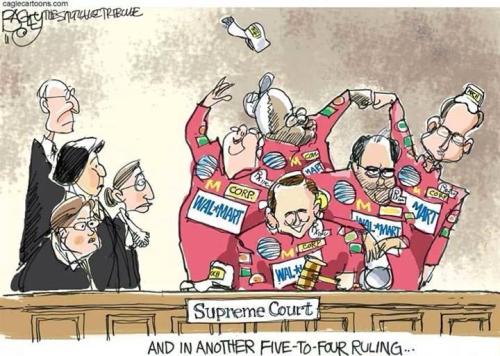
The Supreme Court’s recent decision, McCutcheon v FEC, granted further political influence to the 1 percent, enabling them to spend as much as they wish influencing political campaigns. It followed the Court’s 2010 ruling, Citizens United v. FEC, allowing the rich to spend unlimited sums on political advertising. Some wonder if this is not a 21st century form of buying an election?

Senator Bernie Sanders (I-VT) lamented the toll these decisions will likely have on American popular democracy. “If present trends continue, elections will not be decided by one-person, one-vote,” he warned. He added, “this process — a handful of the wealthiest people in our country controlling the political process — is called ‘oligarchy.’”

Sanders acknowledged the potential consequences of the Court’s decisions: “The great political struggle we now face is whether the United States retains its democratic heritage or whether we move toward an oligarchic form of society where the real political power rests with a handful of billionaires, not ordinary Americans.”

The contemporary concept of oligarchy was popularized by the Russian experience. Following the collapse of the Soviet Union, innumerable state companies were privatized. The country was in disarray and, in an effort to stabilize the economy, the Yeltsin government “redistributed” state-owned enterprises to trusted cronies. They came to wield unprecedented power over the economy, the state apparatus and the mass media.

The term “oligarchs” is gaining currency in the U.S. Sanders defined them as “a small number of very wealthy families who spend huge amounts of money supporting right-wing candidates who protect their interests.” He means to differentiate this “small number” from the larger world of the rich and superrich, the plutocrats, who – as a class – have long exercised considerable influence on the U.S. political system. Who are these oligarchs and how do they different from today’s plutocrats? And how does this generation of oligarchs differ from previous generations of the superrich who, over the last century, have dominated American politics?

* * *

Oligarchy is defined as “government by the few” and came into English use around 1570. The term derives from two Greek words: oligos meaning “few” and arch for “rule”; similar English-language terms include monarch or hierarchy. Plutocracy is derived from the Greek ploutos meaning “wealth” and kratos for “govern.”

Today, both concepts — plutocrats and oligarchs — refer to the growing influence the rich – and especially the superrich – have on the national (and international) political economy. Oligarchs are plutocrats who use their enormous wealth to further a particularly conservative, if not rightwing, agenda.

Thomas Piketty’s study, Capital in the Twenty-First Century, reveals that the U.S. – along with much of the advanced capitalist world — is returning to what economist Paul Krugman calls the “new Gilded Age.” Piketty finds that that in 2010, the top 1 percent controlled 20 percent of U.S. income and, together with the next 9 percent, the superrich controlled 50 percent of all income. The IRS recently noted that in 2011, 11,445 U.S. taxpayers declared incomes of more than $10 million.

According to Forbes, the three richest Americans in 2013 were: Bill Gates ($72 bil net worth), Warren Buffet ($58.5 bil) and Larry Ellison ($41 bil). They may well be plutocrats in the old-fashioned sense of Vanderbilt, Rockefeller, Carnegie and Ford. But are they oligarchs?

Michael Bloomberg was New York’s mayor for 12 long years and is ranked 10th on Fortune’s list of wealthiest Americans with a net worth of $31 billion. He leveraged his public position and private wealth vigorously promoting two pet projects, gun control and obesity? Both initiatives stalled in the political marketplace. Is he an oligarch?

Today’s grand plutocrats include the Walton family, the Koch brothers and Sheldon Adelson. They makeup seven of the top 11 wealthiest Americans: Charles Koch ($36 bil), David Koch ($36 bil), Christy Walton ($35.4 bil), Jim Walton ($33.8 bil), Alice Walton ($33.5 bil), Samuel Robson Walton ($33.3 bil) and Adelson ($28.5 bil). This is real money.

These plutocrats become oligarchs by employing their vast wealth in an apparently more aggressive – and conservative – way then, for example, Gates, Buffet or Bloomberg. The Koch brothers are major backers of the Tea Party and Americans for Prosperity; they are reported to have donated an estimated $196 millions to fight the Affordable Care Act (Obamacare). The Waltons have led the charge against public education, committing an estimated $1 billion promoting privatization – no teachers’ union or community accountability — through charter schools. Adelson famously holds court for Republican presidential hopefuls who visit his Las Vegas castle to kiss his ring and proclaim their undying support for Israel.

* * *

America is stuck. The “American Century” is over and globalization is restructuring capitalism. The rich are getting phenomenally richer while the income of the rest of Americans stagnates or falls. Both American plutocrats and oligarchs are fighting to hold on to — and increase! — their wealth and influence during this restructuring. And they are succeeding.

Over the last quarter-century, globalization has spawned a new class of superrich who wield historically unprecedented power. This elite truly enjoys the privileges of its social status, operating on its own economic, political and moral terms. It’s a value system shared by plutocrats around the globe. They endow cultural institutions, their names shameful promoted; they are delivered anywhere on the globe via private jets; they are escorted in chauffeured limousines through busy city streets; and they are celebrated at exclusive get-togethers like the Davos World Economic Forum. Like nobility of old, the obsequies media present them – like other celebrities – in the most favorable light.

In the U.S., pay-to-play payoffs — whether in cash or kind — define everyday politics. Local Chambers of Commerce, real-estate interests, financial players, large retailers, trade associations, unions and other special interests lubricate the wheels of government. Lobbyists facilitate, legislators dutifully legislate, deals are cut, someone wins and – in most cases – the vast majority of ordinary Americans loose. It’s the way the game is played.

However, the U.S. is not Russia, let alone Greece or Afghanistan or almost anywhere else around the globe. Most U.S. officials don’t take cheap bribes. Corruption takes place, but low-level scammers, whether from the private or public sector, are regularly busted. However, when it comes to real money, that’s another story.

American plutocrats are at the top of the political foodchain. Their wealth buys influence. They use their financial power to determine public policy, involving laws, court decisions, tax codes, zoning ordinances, corporate subsidies, outsourcing and purchasing contracts. Their wealth enables them to promulgate their self-serving vision at the local, state and federal levels, benefiting every step of the way. They link economic policy to social programs, seeking to dictate civic values — public morality — with regard to abortion rights, teen sex and gay rights.

This is nothing new. For more then a century, plutocrats have used their wealth to influence public policy. In the fin de siècle era, modern, industrial capitalists like Rockefeller and Carnegie remade America, promoting not only free-market capitalism but eugenics as well. These grand oligarchs garnered their wealth the old-fashioned way, by brutally exploiting their wage-labor workers. And in those good-old-days, politicians were really for sale, no questions asked. And then came the Progressives.

Ford — and the Fordist manufacturing process — defined the modern era. He introduced the assembly line and the $5-per-day salary – ostensibly so his workers could buy the cars they made. The collapse of the Great Depression stalled economic growth. The enormous expansion of the national economy during World War II and the post-war recovery made Ford # 1. Ford symbolizes the highpoint of consumer capitalism. And then came globalizations and a new generation of plutocrats and oligarchs.

In 1937, amidst the Great Depression, Ferdinand Lundberg published an influential book, America’s 60 Families. It revealed the financial and political power of the nation’s great fortunes. Nearly three-quarters of a century ago he warned:


The United States is owned and dominated today by a hierarchy of its sixty richest families, buttressed by no more than ninety families of lesser wealth… These families are the living center of the modern industrial oligarchy which dominates the United States, functioning discreetly under a de jure democratic form of government behind which a de facto government, absolutist and plutocratic in its lineaments …. It is the government of money in a dollar democracy.

Its more important then every to wonder just how much has changed.

A century ago the Progressive movement, led by Lincoln Steffens, Ida Tarbell, W.E.B. DuBois and Teddy Roosevelt, focused national attention on the robber barons. The Occupy Movement focused popular attention on the 1 percent. Inequality – and the growing power of the oligarchs – is becoming a national political issue, most evident in the election of Bill de Blasio as New York’s mayor.

Today’s plutocrats and oligarchs, backing both Democrats and Republicans, have failed to deliver. They’ve backed two expensive — in dollars and blood – failed foreign military interventions. They championed financial and economic policies contributing to the great recession of 2008-2010 from which the nation has yet to fully recover. And they’ve made the lives of ordinary Americans harder, materially worse. Their policies have failed, yet they remain in power.

For many Americans, Obama was the great black hope who realized far less then hoped for. He did move (however slowly) to end the military misadventures in Afghanistan and Iraq. And he did secure the passage of Obamacare, a possible stepping-stone to a national, single-payer program. Yet, he dutifully bailed out the banks and let walk the perpetrators of the financial crisis. And he’s backed the most reactionary immigration and intelligence policies as well as promoted the worst trade pact (the Trans-Pacific Partnership) since Nafta.

In the U.S. ready for four, if not eight, more years of another centrist Democrat? Hilary Clinton will likely only be Obama-heavy. If elected, Clinton will have much to prove, especially that she’s tough. The plutocratic ruling class has no national answer, a workable program, to address the changes the nation faces amidst capitalism’s global restructuring. Their goal is to maximize private gain at the expense of the vast majority of ordinary Americans. And Clinton, like her husband before her, will help facilitate the further distribution of wealth to the top 1 percent.

Given this possibility, could a Republican victory in the 2016 presidential election be a good thing for “progressives”? If both the presidency and the Congress fell under Republican control, life in the U.S. for middle-income, working-class and poor would get really worse. But at least no one will have any illusions that it could be different.

Thursday, April 3, 2014

SCOTUS Strikes Down Political Spending Limits for Rich Donors

The US govt is corrupt in every branch, every level. Wealth owns everyone and everything. Democracy--game over....


The New Citizens United
 Wednesday, 02 April 2014
By Mike Ludwig, Truthout


Demonstrations were held across the country Wednesday as the Supreme Court continued chipping away at federal campaign finance reforms with a 5-4 ruling striking down the federal cap on the total amount of money an individual donor can spend supporting candidates and political parties during a two-year election cycle.

The ruling, which split the high court along ideological lines, eliminates the aggregate the cap on the total amount of money an individual can donate to candidates and party fundraising committees during an election season, which was set at $123,200 for 2013 and 2014. That cap was so high that only a several hundred mega-rich donors reached it during the last election cycle.

Campaign finance watchdogs now estimate that a single wealthy donor could spread up to $3.6 million among candidates, party committees and some political action groups affiliated with a single party during a single election cycle. A single donor could theoretically spend twice that amount by supporting candidates and committees from both parties, according to the Sunlight Foundation.

Conservatives are hailing the ruling as a victory for free speech. Liberals and progressives say the ruling will only increase the corrupting influence that ultra-rich donors can have on politicians, dealing yet another fundamental blow to the legitimacy of American democracy. Activists organized about 140 demonstrations and events in 38 states to protest the ruling and call for legislative action.

The ruling is not as sweeping as the Supreme Court's infamous 2010 Citizens United decision, which removed caps on the amount of money that corporations and unions can spend influencing federal elections and unleashed a tidal wave of corporate campaign cash that made the 2012 elections by far the most expensive in history.

But the ruling - one of several rulings under Chief Justice John Roberts that have eroded federal and state campaign finance laws in recent years - surely will increase the ability of rich Americans to impact elections.

The ruling also could inflate the power of joint fundraising committees, which take large donations from donors and funnel the cash to candidates and party committees with full knowledge of who signed the original check.

"Eliminating these limits will now allow a single politician to solicit, and a single donor to give, up to $3.6 million through the use of joint fundraising committees," said Michael Walden, president of the Brennan Center for Justice. "Following the Citizens United decision, this will further inundate a political system already flush with cash, marginalize average voters, and elevate those who can afford to buy political access."

Wednesday's ruling in McCutcheon vs. Federal Election Commission does not touch limits on the amount of money an individual can give to a single federal candidate, which currently is set at $2,600.

Free Speech or Plutocracy?

The majority opinion, delivered by Roberts, claims these limits on individual donations will keep political corruption in check. The Roberts opinion, which was supported by the court's conservative justices, argues that the cap on the total amount and individual can spend during an election cycle can prevent a donor from giving to as many candidates as he or she chooses, which violates free speech rights under the First Amendment.

Like the Citizens United ruling, the majority opinion views political speech and the money spent by wealthy donors to support candidates and influence elections as one and the same.

"Contributing money to a candidate is an exercise of an individual’s right to participate in the electoral process through both political expression and political association," Roberts wrote for the majority. " ... The Government may no more restrict how many candidates or causes a donor may support than it may tell a newspaper how many candidates it may endorse."

Writing for the four dissenting justices on the liberal side of the bench, Justice Stephen Breyer argued that the ruling created a "loophole" allowing rich donors to donate millions to candidates and parties, and, coupled with the Citizens United ruling, "eviscerates our Nation’s campaign finance laws, leaving a remnant incapable of dealing with the grave problems of democratic legitimacy that those laws were intended to resolve."

The case was brought before the court by the national Republican Party and Shaun McCutcheon; a wealthy businessman from Alabama who argued the cap on aggregate donations violated his First Amendment rights by prevented him from donating to Republican candidates he wanted to support in recent elections.

"Today, the court made clear that restraints on the political speech of those whose views you don't like must fail; free speech is the right of all Americans and not a revocable grant from the government of the day," said Dan Backer, the lead political counsel for McCutcheon and the Republican Party.

Campaign finance reformers, however, said the ruling is not a victory for free speech. It's a victory for the plutocracy.

"No matter what five Supreme Court justices say, the First Amendment was never intended to provide a giant megaphone for the wealthiest to use to shout down the rest of us," said Robert Weissman, president of Public Citizen, a progressive watchdog group that supports campaign finance reforms. "Our only hope of overturning this McCutcheon travesty - along with Citizens United - is if millions of Americans band together in saying 'Enough!' to plutocracy."

Growing Grass-Roots Momentum

For several years, a broad grass-roots movement has pushed to overturn Citizens United, either through legislation or amending the Constitution to declare that money spent influencing elections is not the same as free speech. Activists also are pushing for federal legislation that would amplify the impact of small political donations made by average Americans.

Jonah Minkoff-Zern, an activist with Public Citizen who helped organize protests in response to the McCutcheon decision, said the ruling would only spark more grassroots momentum.

"The rallies are a way for us to say, this is not going to be a dark day in history but a day of organizing hope and a call for change," Minkoff-Zern told Truthout.

In recent years, lawmakers in at least 16 states have passed resolutions calling for a constitutional amendment to overturn Citizens United. Minkhoff-Zern said at least 150 members of Congress have signed on in support of similar resolutions.

Monday, April 1, 2013

Plutocracy in America

Runaway Exploitation
by MICHAEL BRENNER


Plutocracy literally means rule by the rich. “Rule” can have various shades of meaning: those who exercise the authority of public office are wealthy; their wealth explains why they hold that office; they exercise that authority in the interests of the rich; they have the primary influence over who holds those offices and the actions they take. These aspects of “plutocracy” are not exclusive. Government of the rich and for the rich need not be run directly by the rich. Also, in some exceptional circumstances rich individuals who hold powerful positions may govern in the interests of the many, e.g. Franklin Roosevelt.

The United States today qualifies as a plutocracy – on a number of grounds. Let’s look at some striking bits of evidence. Gross income redistribution upwards in the hierarchy has been a feature of American society for the past decades. The familiar statistics tell us that nearly 80% of the national wealth generated since 1973 has gone to the upper 2%, 65% to the upper 1 per cent. Estimates as to the rise in real income for salaried workers over the past 40 years range from 20% to 28 %. In that period, real GDP has risen by 110% – it has more than doubled. To put it somewhat differently, according to the Congressional Budget Office, the top earning 1 percent of households gained about 8X more than those in the 60 percentile after federal taxes and income transfers over a period between 1979 and 2007; 10X those in lower percentiles. In short, the overwhelming fraction of all the wealth created over two generations has gone to those at the very top of the income pyramid. That pattern has been markedly accelerated since the financial crisis hit in 2008. Between 2000 and 1012, the real net worth of 90% of Americans has declined by 25%. Theoretically, there is the possibility that this change is due to structural economic features operating nationally and internationally. That argument won’t wash, though, for three reasons. First, there is no reason to think that such a process has accelerated over the past five years during which disparities have widened at a faster rate. Second, other countries (many even more enmeshed in the world economy) have seen nothing like the drastic phenomenon occurring in the United States. Third, the readiness of the country’s political class to ignore what has been happening, and the absence of remedial action that could have been taken, in themselves are clear indicators of who shapes thinking and determines public policy. In addition, several significant governmental actions have been taken that directly favor the moneyed interests.

The latter include the dismantling of the apparatus to regulate financial activities specifically and big business generally. Runaway exploitation of the system by predatory banks was made possible by the Clinton “reforms” of the 1990s and the lax application of those rules that still prevailed. Attorney General Eric Holder just a few weeks ago went so far as to admit that the Department of Justice’s decisions on when to bring criminal charges against the biggest financial institutions will depend not on the question of legal violations alone but would include the hypothetical effects on economic stability of their prosecution. Earlier, Holder had extended blanket immunity to Bank of America and other mortgage lenders for their apparent criminality in forging, robo-signing, foreclosure documents on millions of home owners. In brief, equal protection and application of the law has been suspended. That is plutocracy.

Moreover, the extreme of a regulatory culture that, in effect, turns public officials into tame accessories to financial abuse emerged in stark relief at the Levin Committee hearings on J P Morgan Chase’s ‘London Whale” scandal. Morgan officials stated baldly that they chose not to inform the Controller of the Currency about discrepancies in trading accounts, without the slightest regard that they might be breaking the law, in the conviction that it was Morgan’s privilege not to do so. Senior regulators explained that they did not see it as their job to monitor compliance or to check whether claims made by their Morgan counterparts were correct. They also accepted abusive treatment, e.g. being called “stupid” to their face by senior Morgan executives. That’s plutocracy at work. The Senate Finance Committee hearing drew only 3 senators – yet another sign of plutocracy at work. When mega-banks make illicit profits by money laundering for drug cartels and get off with a slap on the wrist, as has HSBC and others, that too is plutocracy.

When the system of law that is meant to order the workings of society without reference to ascriptive persons is made malleable in the hands of officials to serve the preferred interests of some, it ceases to be a neutral instrument for the common good. In today’s society, it is becoming the instrument of a plutocracy.

There are myriad other examples of complicity between legislators or regulators, on the one hand, and special business interests on the other. EPA judgments that are reversed under the combined pressure of the commercial interests affected and beholden politicians is one. The government’s decision not to seek the power to bargain with pharmaceutical companies over the price of drugs paid for with public funds is another. Tolerance for the concealment of offshore profits in the tens of billions is a third. Relaxed interpretations of the tax laws by the IRS to the advantage of high income persons can be added to the list. So, too, can the give-away to sole source contractors of the tens of billions squandered in Iraq and Afghanistan. The number of such direct assists to big business and the wealthy is endless. The point is that government, at all levels, serves particular selfish interests no matter who holds high positions. While there is some difference between Republicans and Democrats on this score, it has narrowed on most major items to the point that the fundamental properties of the biased system are so entrenched as to be impervious to electoral outcomes. The most revealing experience that we have of that harsh reality is the Obama administration’s strategic decision to allow Wall Street to determine how and by whom the financial crisis would be handled.

Systemic biases are the most crucial factor is creating and maintaining plutocratic orientations of government. They are confirmed, and reinforced, by the identities and identifications of the persons who actually hold high elected office. Our leaders are nearly all rich by any reasonable standard. Most are very rich. Those who weren’t have aspired to become so and have succeeded. The Clintons are the striking case in point. That aspiration is evinced in how they conduct themselves in office. Congress, for its part, is composed of two rich men/women’s clubs. In many cases, personal wealth helped win them their offices. In many others, they knit ties with lobbies that provided the necessary funds. Whether they are “bought off” in some sense or other, they surely are often coopted. The most insidious aspect of cooptation is to see the world from the vantage point of the advantaged and special economic interests.

The devolution of the Democratic Party from being the representative of ordinary people to being just “another bunch of guys” is a telling commentary on how American politics has degenerated into a plutocracy. The party’s rolling over to accommodate the interests of the wealthy has been a theme of the past four years. From the Obama White House to the halls of Congress, party leaders (and most followers) have conceded the dominance of conservative ideas about macro-economic strategy (the austerity dogma), about retaining largely untouched the for-profit health care “non-system,” about bailing out the big financial players as the expense of everyone else and the economy’s stability, about degrading Social Security and Medicare. The last item is the most egregious – and revealing – of our plutocratic ways and means. For it entails a combination of intellectual deceit, blatant massaging of the numbers, and disregard for the human consequences in a time of growing distress for tens of millions. In other words, there is no way to conceal or spin the trade-offs made, who was being hurt and who would continue to enjoy the advantages of skewed fiscal policies.

There is another, absolutely crucial dimension to the consolidation of America’s plutocracy. It is controlling the means to shape how the populace understands public matters and, thereby, to channel thought and behavior in the desired direction. Our plutocratic guides, prophets and trainers have been enormously successful in accomplishing this. One object of their efforts has been to render the media into either conscious allies or to denature them as critics or skeptics. Their success is readily visible. Who has challenged the plutocracy serving falsehood that Social Security and Medicare are the main cause of our deficits whose imminent bankruptcy puts in jeopardy the American economy? Who even bothers to inform the public that those two programs’ trust funds draw on a separate revenue source from the rest of the budget? Answer: no one in or near the mainstream media. Who has performed the most elementary service in pointing out that of all the jobs created since 2009, small as the number has been, 60% at least have been either part-time or temporary? Answer: again, no one. Who has bothered to highlight the logical flaws in the market fundamentalist view of the world that has so deformed perceptions of what works and doesn’t work in macro-economic management? Yes, Paul Krugman, Joseph Stiglitz and a handful of others – although even Krugman’s colleagues writing on business and economics at the NYT seem not to have the time to read him or else lack the wit to comprehend what he is saying.

A second objective in a similar vein has been to dominate the think tank/foundation world. Today, nearly every major Washington think tank depends on corporate money. Businessmen sit on the boards and shape research programs. Peter G. Peterson, the hedge fund billionaire, took the more direct route of acquiring the International Institute of Economics, renaming it after himself. He then set about using it as in instrument to carry on the campaign against Social Security which has become his life’s work. Then there is Robert Rubin. Rubin is the distilled essence of financial malpractice, and the embodiment of the government-Wall Street nexus that brought the country to wrack and ruin. Author of Clinton’s deregulation program while Secretary of the Treasury: later super lobbyist and Chairman of CITI bank in the years before it was pulled from the brink of bankruptcy by Ben Bernanke, Paulson and Tim Geithner; and adviser to Barack Obama who stocked the new administration with Rubin protégés. He since has ensconced himself as Chairman of the Council on Foreign Relations and Director of the highly prestigious, lavishly funded Hamilton Project at Brookings. By happenstance, both organizations late last year featured presentations by Jaime Dimon. The one billed as a forum for a leading global CEO to share priorities and insights before a high-level audience of CFR members. That is plutocracy in action.

The third objective has been to weaken public education. We have witnessed the assault on our public elementary school system in the name of effectiveness, efficiency and innovation. Charter schools are the watchword. Teachers are the heart of the problem. So privatization, highly profitable privitization, is sold as the solution to save America’s youth in the face of ample evidence to the contrary. Cast aside is the historical truth that our public school system is the one institution, above all others, that made American democracy. It also is a bastion of enlightened social thinking. It thereby qualifies as a target. The same for the country’s proud network of public universities. From state to state, they are starved for funding and made sacrificial lambs on the altar of the austerity cult. They, too, are stigmatized as “behind the times,” as no longer doing the job of supplying the business world with the obedient, practical skilled workers it wants. Business schools, long a dependency of the corporate world, as held up as the model for private-public partnership in higher education. Distance learning, often managed by for-profit ‘expert” consultants or “entrepreneurs”, is advertised as the wave a bright future – a future with fewer liberal-leaning professors with fuzzy ideas about the good society. Distance learning is the higher education companion to the charter school fad. Lots of promises, little delivery but well conceived to advance a plutocracy friendly agenda.

Here, too, boards of regents are led by business men or women. The abortive coup at the University of Virginia was instigated by the Rector who is a real estate developer in Virginia Beach. The Chairman of the Board of Regents at the University of Texas system where tensions are at a combustible level is a real estate developer. The Chairman at the University of California is CEO of two private equity firms – and the husband of Senator Diane Feinstein. His pet project was to have the moneys of the California teacher’s pension fund placed in the custody of private financial houses. Two former directors of the fund currently are under criminal investigation for taking very large kick-backs from other private equity firms to whom they directed monies – and which later employed them as ‘placers.’ That’s plutocracy at work.

The ultimate achievement of a plutocracy is to legitimize itself by fixing in the minds of society the idea that money is the measure of all things. It represents achievement, it is the sine qua non for giving people the material things they want. It is the gauge of an individual’s worth. It is the mark of status in a status anxious culture. That way of seeing the world describes the outlook of Bill Clinton and Barack Obama. It is Obama who, at the height of the financial meltdown, lauded Jaime Dimon and Lloyd Blankfein as “savvy and successful businessmen.” It is Obama who eagerly became Dimon’s golfing buddy – an Obama who twice in his career took jobs with corporate law firms. It was Bill Clinton who has been flying the world in corporate jets for the past twelve years. It is the two of them who promoted Alan Simpson and Erskine Bowles to press for the crippling of Social Security. That’s plutocracy pervading the leadership ranks in both parties of what used to be the American republic.

Perhaps the most extraordinary achievement of the plutocracy’s financial wing has been to win acceptance from the country’s entire political class that its largely speculative activities are normal. Indeed, they are credited with being the economy’s principal engine of growth. It follows that their well-being is crucial to the well-being of the national economy and, therefore, they should be given privileged treatment.

*******

The American version of plutocracy is noteworthy for its crassness. Subtlety, discretion and restraint are foreign to it. It has a buccaneering quality. That style has roots in the country’s history and culture. Much of the behavior is impulsive grasping. Individuals are greedy for vivid displays that they are top dog, of what they can get away with, as well as the riches themselves. There is little interest in building anything that might endure – no ‘new order,’ no new party, no new institutions. Not even physical monuments to themselves. Why bother when the existing set-up works so well to your advantage, to that of your like-minded and like-interested associates – when you can turn ideas, policies and money in your direction with ease. And while the public is blind to how they are being deluded and abused. After all, the more things appear to stay the same, the more they can change in a country whose civic ideology imbues everyone with the firm belief that its principles and institutions embody a unique virtue. To challenge any of that would be to run the risk of raising consciousness – which is the last thing that the plutocrats want.

There are exceptions. The most stunning is Wall Street’s biggest players’ audacity in coopting a part of the NYC Police Department in setting up a semi-autonomous unit to monitor the financial district. Funded by Goldman Sachs et al, managed by private ban employees in key administrative positions, and with an explicit mandate to prevent, as well as to deal with any activity that threatens them, it operates with the latest high tech equipment out of a dedicated facility provided by its sponsors. The facility for years was kept “under the counter” so as not to tempt inquisitive parties to expose it. This is the unit that coordinated the squelching of the Occupy movement’s Manhattan demonstrations. It represents the appropriation of a public agency to serve and to serve under private interests. The post-9/11 hyper-anxiety provided political and ideological cover for a deal devised by Mayor Mike Bloomberg (himself a Wall Street billionaire who has gone down the line to defend it against all charges of financial abuse) in collusion with his former associates. Is this simply Bloomberg registering NYC’s fiscal dependency on financial sector jobs? Well, this is the same Bloomberg who killed a widely supported initiative to set a minimum decent wage of $10 an hour with health insurance ($11.50 without) on development projects that receive more than $1 million in taxpayer subsidies. He stigmatized the measure as “a throwback to the era when government viewed the private sector as a cash cow to be milked…. The last time we really had a big managed economy was the USSR and that didn’t work out so well.” That’s as plutocratic as it gets – and in liberal New York.

Furthermore, the moving forces of the plutocracy are not very organized. There is no conspiracy as such. It is the convergence of outlook among disparate persons in different parts of the system that has accomplished the revolution in American public life, public discourse, and public philosophy. Nobody had to indoctrinate Barack Obama in 2008-2009 or intimidate him or bribe him. He came to the plutocrats on his own volition with his mind-set and values already in conformity with the plutocracy’s view of itself and of America. This is the man who, for the first two years of his presidency, repeatedly misstated the coverage of the Social Security Act of 1935 – ignorant and not bothering to find out or willfully ignorant so as to create a convenient comparison with his fatally flawed health care pseudo-plan. This was the man, after all, who cited Ronald Reagan as model for what sort of presidency American needed. He has been living proof of how effectively Americans had been brought into line with the plutocratic vision.

This is not to say that the plutocrats’ success was inevitable – or that they were diabolically clever in manipulating everything and everyone to their advantage. There has been a strong element of good fortune in their victory. Their most notable piece of luck has been the ineptitude and shortsightedness of their potential opposition – liberal Democrats, intellectuals, and their like. The plutocrats pursued their goals in a disorganized, diffused way. However, the absence of an opponent on the contested terrain assured success.

As to cleverness, the American plutocracy is actually a stupid plutocracy. First, it is overreaching. Far better to leave a few goodies on the table for the 99% and even a few crumbs for the 47% than to risk generating resentment and retaliation. Since the financial meltdown, financial and business interests have been unable to resist picking the pockets of the weak. Fishing out the small change in the wake of grand larceny is rubbing salt into wounds. Why fight a small rise in the minimum wage? Why ruthlessly exploit all those temps and part-timers who have so little in the way of economic power anyway? Why squeeze every last buck from the small depositors and credit card holders whom you already systematically fleece? In the broad perspective, that sort of behavior is stupid.

To explain it, we must look to the status compulsions of America’s audacious corporate freebooters. These peculiar traits grow more intense the higher one goes in the hierarchy of riches. One is the impulse to show to everybody your superiority by displaying what you can get away with. “Sharp dealing” always has been prized by segments of American society. It’s the striving, insecure man who has to prove to the world – and to himself – that he can act with impunity. He is little different from the hoodlum showing off to his pals and to his moll. These people at heart are hustlers – they crave the thrill of pulling off a scam, not constructing something. Hence, Lloyd Blankfein not showing up for White House meetings yet having Obama thank him for letting the president know, albeit after the meeting already had begun, that Blankfein can’t make it. Hence, Jaime Dimon indignantly protesting his verbal mistreatment by the press, by the White House, by whomever. Then there is Jack Welch, the titan of American industry who struts sitting down, who holds the Guinness record for the most manufacturing jobs outsourced by one company – and yet impudently calls Barack Obama “anti-business” after the president appoints his hand-picked successor, Jeffrey Immelt, to head the White House’s Job Council. Or Bank of America’s faking compliance with the sweetheart deal it got from Obama on the felonious foreclosure scam. The ultimate episode of egregious lawlessness is the MF Holdings affair – whereby under its chief, former Senator and Governor Jon Corzine, this hedge fund took the illegal action of looting a few billion from custodial accounts to cover losses incurred in its proprietary trading. JP Morgan, which held MF Global funds in several accounts and also processed the firm’s securities trades, resisted transferring the funds to MF’s customers until forced to by legal action. Punitive action: none. Why? The Justice Department and regulatory bodies came up with the lame excuse that the MF group’s decision-making was so opaque that they could not determine whose finger clicked the mouse. To pull capers like these and get off scot free, without chastisement, is the ultimate ego trip.

Willie Sutton, the notorious bank robber of the 1940s, explained his targeting banks this way: “that’s where the money is.” Today’s financial swindlers go after the high risk gambles because that’s where the biggest kicks are. That is more important than the biggest bucks – although they add to the thrill. For the ever status striving, identity insecure financial baron is a compulsive gambler. He needs his fixes. Of winning, of celebrity, of respect. Of deference. All are transitory, though. For American culture provides few insignia of rank. No ‘Sirs,’ no seats in the House of Lords, no rites of passage that separate the heralded elite from all the rest. Oblivion shadows the most famous and acclaimed. Thus, the grasping for whatever badges of regard are within reach – however ludicrous they might be. When IR Magazine awarded JPMorgan the prize for “best crisis management” of 2012 for its handling of the London Whale trading debacle, at a black-tie awards ceremony in Manhattan, Morgan executives were there to express their appreciation, rather than bow out gracefully. The only Wall Street personage who has played the celebrity game without being marginalized in the public mind is Robert Rubin. Through nimbleness and political connection he has semi-institutionalized his celebrity status. Yes, there is Paul Volcker – but that is another world all together. His stature is built on an unmatched record of service to the commonweal and unchallenged integrity. The Blankfeins and Dimons and Welchs not only lack the critical attributes – they also lack the sense of what it means to serve the public from which they habitually distance themselves.

The plutocrats’ compulsive denigration of the poor, the ill and the dispossessed is perhaps the most telling evidence of status obsession linked to insecurity that is at the core of their social personality. They find it necessary to stigmatize the latter as at best failures, at worst as moral degenerates – drug addicts, lazy, parasites, in part to highlight their superiority and in part to blur the human consequences of their rapacity. Behavior of this kind is the antithesis of what could be the cultivated image of the statesman of commerce – even though they pay a price in public esteem. They also pay in price in terms of the other aspect of their own self-image.

Second, Americans have a craving to believe in their own virtue – as well as to have others recognize it. The perverse pride in beating the system cannot in and of itself compensate for the feeling that you’re a bad guy. Blankfein again: “I have been doing the Lord’s work.” No one laughs in public – so I’m right about that. Dimon swaggering through the Council On Foreign Relations or Brookings with the huddled masses in his audience – and on the dais – beaming their adulation as they bask in his fame and thirst for his wisdom on the great affairs of the world. Perhaps, his views on whether the BRICS can rig the LIBOR rate with the connivance of the Bank of England and the Federal Reserve – or ignore regulatory reporting rules when they threaten to reveal a madcap scheme that loses $6 billion?

*******

Plutocracy in the current American style is having pernicious effects that go beyond the dominant influence of the rich on the nation’s economy and government. It is setting precedents and modeling the unaccountability and irresponsibility that is pervading executive power throughout the society. Two successive presidential administrations and two decades of rogue behavior by corporate elites have set norms now evident in institutions as diverse as universities and think tanks, the military and professional associations. The cumulative result is a widespread degrading of standards in the uses and abuses of power.

Plutocracy also raises social tensions in society. Logically, the main line of tension should be between the plutocrats and the rest – or, at least, between them and all those with modest means. But that is not the case in the United States. While it is true that there were bitter words about the Wall Street moguls and their bailouts during the first year or so after the financial collapse, it never became the main line of political division. Today, outrage has abated and politics is all about austerity and debts rather than the distribution of wealth and the power that goes along with it.The deep-seated sense of anxiety and grievance that pervades the populace manifests in outbreaks of hostile competition among groups who are in fact themselves all victims of the plutocrats’ success in grabbing for themselves most of the country’s wealth – thereby leaving the rest of us to fight for the leftovers. So, it is private sector employees pitted against government employees because the latter have (some) health insurance, some pension and some security relative to the former who have been shorn of all three. It’s parents worried about their kids’ education against teachers. Both against cash strapped local authorities. Municipalities vs states. It’s the small businessman against unions and health insurance requirements. It’s doctors against patients against administrators. It’s university administrators against faculty and against students, faculty against students in competing for a much reduced appropriations. It’s all of those against boards of regents and state governors.

It’s everyone frustrated by the ever sharpening contrast between hopes and aspirations and darkening realities of what they might expect for themselves and their children. Meanwhile, the folks at the top wait confidently and expectantly above the fray they have engineered – ever ready to swoop down to strip the remains of combat by way of privatized public assets, no-bid contracts, tax and regulatory havens, commercially owned toll roads, student loan monopolies, rapacious buying up of foreclosed properties with federal incentives, and myriad tax breaks.

President Obama used his State of the Union Address to send the message loud and clear. “Let me put colleges and universities on notice” he warned, “If you can’t stop tuition from going up, the funding you get from taxpayers will go down.” He thereby set forth a line of reasoning that put him on the same wavelength as Rick Perry. For the reality is the exact opposite. It is because funding has gone down by 2/3 over the past few decades that colleges and universities are obliged to raise tuition – despite flat-lining faculty and staff salaries. This is the essence of intellectual conditioning to the plutocracy’s self-serving dogma and the suborning of public authorities by the plutocracy. Beyond capture, it is assimilation.

Does this sort of perverse pride go before the fall? No sign of that happening yet. Plutocracy in America is more likely to be our destiny. The growing dynastic factor operating within the financial plutocracy militates in that direction. Wealth itself has always been transferred from one generation to another, of course; reduced inheritance taxes along with lower rates at upper income brackets generally accentuate that tendency. With socio-economic mobility in American society slipping, it gains further momentum. Something approaching a caste identity is forming among the financial elites – as personified by Jaime Dimon who is the third generation of Wall Street stockbrokers/financial managers in his family – his father an Executive Director at American Express where the young Dimon joined forces with Sandy Weill. As a revealing coda to this generational tale, Dimon, last year, hired his 81 year old father to work for JP Morgan Chase. His father’s first-year salary was $447,000; slated to rise to $1.6 million – now that he has some work experience under his belt, presumably. A sense of limits is not part of the financial plutocracy’s persona.

*******

All that has been recounted here is on the public record. Facts are facts; the inferred attitudes of the plutocracy are confirmed by an abundance of data – including the players’ own statements. The consequences analyzed are also a matter of public record. The tepid reaction should be no surprise; that is exactly what is to be expected in a plutocracy.

So what is to be done? Rectify the sins of commission by rescinding them and those of omission by restoring responsible, enlightened policies. A model? How about 1974? Inglorious year, but….Richard Nixon was well to the ‘Left’ of Barack Obama civil liberties included; corporate power, especially that of big finance, was kept in check by effective regulation; and the integrity of American institutions was a paramount concern of most elected officials and the political elite in general.

The Word awaits…but

The script is small

The preacher is blind

The audience is deaf

And the echoes ricochet off bare walls soundlessly

Wednesday, October 31, 2012

When Corporations Bankroll Politics, We All Pay the Price


Letting taxpayers fund parties directly could revive our rotten system – and at $1 per elector, it would be cheaper too

by George Monbiot


‘Despite attempts to reform it, US campaign finance is more corrupt and corrupting than it has been for decades.' It's a revolting spectacle: the two presidential candidates engaged in a frantic and demeaning scramble for money. By 6 November, Barack Obama and Mitt Romney will each have raised more than $1bn. Other groups have already spent a further billion. Every election costs more than the one before; every election, as a result, drags the United States deeper into cronyism and corruption. Whichever candidate takes the most votes, it's the money that wins.

Is it conceivable, for instance, that Romney, whose top five donors are all Wall Street banks, would put the financial sector back in its cage? Or that Obama, who has received $700,000 from both Microsoft and Google, would challenge their monopolistic powers? Or, in the Senate, that the leading climate change denier James Inhofe, whose biggest donors are fossil fuel companies, could change his views, even when confronted by an overwhelming weight of evidence? The US feeding frenzy shows how the safeguards and structures of a nominal democracy can remain in place while the system they define mutates into plutocracy.

Despite perpetual attempts to reform it, US campaign finance is now more corrupt and corrupting than it has been for decades. It is hard to see how it can be redeemed. If the corporate cronies and billionaires' bootlickers who currently hold office were to vote to change the system, they'd commit political suicide. What else, apart from the money they spend, would recommend them to the American people?

But we should see this system as a ghastly warning of what happens if a nation fails to purge the big money from politics. The British system, by comparison to the US one, looks almost cute. Total campaign spending in the last general election – by the parties, the candidates and independent groups – was £58m: about one sixtieth of the cost of the current presidential race. There's a cap on overall spending and tough restrictions on political advertising.

But it's still rotten. There is no limit on individual donations. In a system with low total budgets, this grants tremendous leverage to the richest donors. The political parties know that if they do anything that offends the interests of corporate power they jeopardise their prospects.

The solutions proposed by parliament would make our system a little less rotten. At the end of last year, the committee on standards in public life proposed that donations should be capped at an annual £10,000, the limits on campaign spending should be reduced, and public funding for political parties should be raised. Parties, it says, should receive a state subsidy based on the size of their vote at the last election.

The political process would still be dominated by people with plenty of disposable income. In the course of a five-year election cycle, a husband and wife would be allowed to donate, from the same bank account, £100,000. State funding pegged to votes at the last election favours the incumbent parties. It means that even when public support for a party has collapsed (think of the Liberal Democrats), it still receives a popularity bonus.

Even so, and despite their manifesto pledges, the three major parties have refused to accept the committee's findings. The excuse all of them use is that the state cannot afford more funding for political parties. This is a ridiculous objection. The money required is scarcely a rounding error in national accounts. It probably represents less than we pay every day for the crony capitalism the present system encourages: the unnecessary spending on private finance initiative projects, on roads to nowhere, on the Trident programme and all the rest, whose primary purpose is to keep the 1% sweet. The overall cost of our suborned political process is incalculable: a corrupt and inefficient economy, and a political system engineered to meet not the needs of the electorate, but the demands of big business and billionaires.

I would go much further than the parliamentary committee. This, I think, is what a democratic funding system would look like: each party would be able to charge the same, modest fee for membership (perhaps £50). It would then receive matching funding from the state, as a multiple of its membership receipts. There would be no other sources of income. (This formula would make brokerage by trade unions redundant.)

This system, I believe, would not only clean up politics, it would also force parties to re-engage with the public. It would oblige them to be more entrepreneurial in raising their membership, and therefore their democratic legitimacy. It creates an incentive for voters to join a party and to begin, once more, to participate in politics.

The cost to the public would be perhaps £50m a year, or a little more than £1 per elector: three times the price of a telephone vote on The X Factor. This, on the scale of state expenditure, is microscopic.

Politicians and the tabloid press would complain bitterly about this system, claiming, as they already do, that taxpayers cannot afford to fund politics. But when you look at how the appeasement of the banking sector has ruined the economy, at how corporate muscle prevents action from being taken on climate change, at the economic and political distortions caused by the system of crony capitalism, and at the hideous example on the other side of the Atlantic, you discover that we can't afford not to.

Friday, October 26, 2012

Obama Uncensored: Rightwing Centrist Tax Cut Plan?


I get a right chuckle whenever I hear someone say Obama is a socialist. He's barely a democrat, more conservative than Saint Ronny ever was, and the real truth about this election? Obama and Romney are the same.  They play up their supposed differences in these "debates" but when it comes down to policy and which group they'll fuck the hardest, it will always be the group that has historically been fucked the hardest: the poor. Both parties do the bidding of their corporate masters, neither is progressive, it's all about the great big sellout. You'll be ok as long as you remain silent...or until you have something or do something that calls their attention to you. Regardless, you don't get a say in your future. You are a statistical subroutine.

Thursday, September 13, 2012

Profiles in Decadent Cowardliness

September 13, 2012
Two Conventions
by RALPH NADER

The Republican and Democratic Conventions are mercifully over but their corrosive impacts on our democracy persist.

First, did you know that taxpayers helped fund these conventions at a level of $100 million for logistics and police sequestrations of demonstrators in Tampa and Charlotte and an additional $18.2 million each for general convention expenses?

The two party duopoly obviously controls the honey pot in Congress. That corporate welfare is what they enacted in spite of the fact that the party’s convention committees are private corporations that should pay for their own big political party and their many smaller social parties with plentiful food and drink. No third party – Green, Libertarian or others – received any taxpayer money for their conventions this year.

Second, the Republican and Democratic Conventions have jettisoned their original purposes which were to resolve the contest for the presidential nomination and work up a platform. Both functions are now decided beforehand, setting the stage for a choreographed theatrical event of political pomposity and braggadocio. On the periphery are the omnipresent corporate lobbyists and their parties of free food and drink.

Did they ask you the taxpayers to foot so much of this bill? Silly question for an oligarchy greased by a plutocracy.

Taking these conventions at face value, one is shocked by how they are scripted right down to every line of every speech vetted by the politicos. Clint Eastwood’s spontaneity that so angered the GOP operatives was the exception.

The Republicans put three themes in just about every speech. Tell your personal story, recount your humble beginnings, and describe how you pulled yourself up by your own bootstraps. Show the people you’re human or at least humanoid, not corporatist. Keep heralding small business so you don’t have to talk about Big Business which has bad vibrations these days around the country. Also, praise, praise, praise Mitt Romney and Paul Ryan as family men with family values. Imagine Republicans telling the press that the convention was to “humanize” Romney and give the voters a warm, fuzzy feeling about their candidate so as to forget that his campaign is a clenched-teeth mouthpiece for Big Business.

The Democratic Convention evokes pity. They too had similar scripts at the podium – narrate your humble, hardworking family lines, talk incessantly about jobs so you won’t have to talk about wages. Especially muzzled was the willing Richard Trumka, head of the AFL-CIO, who, since 2009, has been given the back of Obama’s hand on “card check organizing rights” and on an inflation-adjusted minimum wage. His staged remarks even withheld any mention of a $10 minimum wage (See H.R. 5901 bill “Catching up with 1968”) and the raiding of worker pensions by corporate raptors.

The repetitive over-wrought praise of “el Presidente” in every speech became mawkish, reminding one of the “politics of personalism,” present in many countries with underdeveloped political institutions. Michelle Obama found no time for mentioning the Obama family and America’s mission to grow and consume nutritious food and keep fit to avoid the ravages of obesity. She was too occupied gushing over her aggressive drone commander’s touching nightly reading of letters from Americans about their problems.

The mass obeisance ended when the commander-in-chief himself sprung onto the stage to speak the language of hope, meanwhile avoiding addressing the number of undesirable conditions that need his attention at this singular opportunity.

Conservative New York Times columnist David Brooks, trying to be sympathetic, was looking for some significant specificity:
“What I was mostly looking for were big proposals, big as health care was four years ago. I had spent the three previous days watching more than 80 convention speeches without hearing a single major policy proposal in any of them. I asked governors, mayors and legislators to name a significant law that they’d like to see Obama pass in a second term. Not one could. At its base, this is a party with a protective agenda, not a change agenda…”

Fortifying Brooks’ observation was Obama’s recounting of the differences between the Democrats and Republicans. They are almost all defensive in nature. Defend social security, Medicare, and abortion from the Republican offensive. The Democrats are not on the offensive – getting tough on: corporate crime, consumer gouging, bank abuses, corporate tax avoidance and evasions. They are not on the offensive fighting for worker’s safety and labor rights or minimum wage increases or helping the poor earn more and pay less.

Even when Obama mentioned climate change – a recent no-no in the Democrat’s lexicon – his words were defensive, namely “climate change is not a hoax” he did not elaborate.

This defensive attitude against the cruelest, most ignorant corporate-indentured, anti-worker, war mongering Republican Party in history is also seen in the debates and programs of Democratic Congressional and state candidates.

Being on the offense with an agenda standing for and with the people who economically are being driven, along with their country, into the ground by unpatriotic global corporations and their political minions, should be easy. Unless, that is, the Democrats want to continue dialing for the same corporate campaign dollars.

Playing defense explains why veteran Democrat members of the House of Representatives tell me that the party is going to lose the House again to the likes of John Boehner and Eric Cantor. The Democrats cannot even defend the country from Republicans who think Ronald Reagan was too moderate and unelectable today.

Thursday, August 30, 2012

Payoff in the Pit of the Plutocracy

by RUSSELL MOKHIBER
 
Jeff Connaughton was a lobbyist, a Senate aide and a White House lawyer. He says he came to Washington, D.C. as a Democrat and left as a Plutocrat.

Now he’s written a book – The Payoff: Why Wall Street Always Wins (Prospecta Press, August 20, 2012.)

This book is about corporate crime – although that phrase doesn’t appear anywhere in its 288 pages.

It is in fact one of the best books on how corporate criminals manipulate the system to get away with their crimes.

One way is to enforce silence among the elites who know how the system works.

“Party cohesion and the desire to make a munificent living in DC go a long way to enforce silence,” Connaughton writes.

But Connaughton is silent no more.

“I’m willing to burn every bridge,” he writes. “Now that I’ve mutinied and fled to a remote place, I want to set flame to the ship that would take me back there.”

Connaughton says there have been no Wall Street prosecutions because the Obama Justice Department failed “to take a timely, targeted, all-in approach to the problem.”

“The truth is, the Justice Department never made investigating these actions a high priority,” he writes. “It never formed strike forces of investigators and lawyers that had sufficient resources and backing to doggedly pursue the obvious potential wrongdoers as long as it took to bring a fraud case.”

Prosecutors never used provisions in the Sarbanes-Oxley Act, which put in place tough criminal sanctions in the wake of Enron and other cases of massive corporate frauds, to indict those executives responsible for misleading financial reports.

“If Obama had appointed aggressive trial lawyers – and (Vice President Joe) Biden knew plenty of them – to these Justice Department positions and backed their efforts, there’s a good chance they would’ve hunted the worst Wall Street fraudsters relentlessly.”

“If the explanation for the inadequate effort is corruption (the administration could not afford to anger Wall Street contributors), the revolving door, or a belief that the health of the financial industry is more important than legal accountability, then we have an actual double standard. I don’t know the explanation, but in terms of faith in our institutions, it may not matter whether the double standard is real or apparent. That double standard has torn the social and moral fabric of our country in a way I find to be unforgivable.”

Connaughton says that two sources were telling him that Christine Varney, the assistant attorney general for the Antitrust Division, “was complaining to friends that Rahm Emanuel, then White House chief of staff, had sent her a message – in effect, throttle back on antitrust enforcement, because the top priority is economic recovery.”

“I was concerned that Attorney General Holder had gotten the same message about investigating Wall Street crime,” he writes.

Connaughton quotes Secretary of the Treasury Timothy Geithner as saying – “The stuff that seemed appealing in terms of…Old Testament justice…penalize the venal, would have been dramatically damaging to the basic strategy of putting out the panic, getting growth back, making people feel more confident in the future.”

“Geithner’s statement would seem to indicate that he believes utilitarian outcomes justify overlooking potentially criminal behavior by banks,” Connaughton writes.

Connaughton worked as chief of staff for Senator Ted Kaufman (D-Delaware.) Kaufman was appointed as Biden’s replacement and dedicated his two years in office to demanding accountability for Wall Street’s crimes.

During one meeting with Justice Department Criminal Division Chief Lanny Breuer, Breuer said the department was dependent on the “pipeline” to bring forward cases against Wall Street banks and their executives.

“That’s when I lost my temper,” Connaughton writes. “‘Lanny, you need to go down into your pipeline and make sure the FBI and U.S. attorney’s offices are making this a top priority.

Organize and shake your pipeline hard and get it to bring you cases. Don’t just sit back and wait.’”

“I also couldn’t resist invoking our mutual history in the White House Counsel’s office and even exhorting him to emulate the tactics of our former antagonist,” he writes. “‘You need to be like Ken Starr. You need to target some of these guys like they were drug kingpins, just like Starr targeted Clinton, and squeeze every junior person around them until you can get one to flip and give evidence against the senior people.”

The scene at the Securities and Exchange Commission (SEC) was not much better.

SEC Enforcement Division Director Robert Khuzami, when asked about federal judges rebuking the SEC for paltry fines, said to Kaufman: “I’m not losing any sleep over them.”

And SEC chair Mary Schapiro wasn’t much more responsive.

“Near the end of the [October 2009] meeting [Kaufman] told [SEC Chairman Mary] Schapiro, ‘I don’t believe you’re going to do anything about high-frequency trading.’ Looking him straight in the eye, she replied, ‘You just watch.’”

“We watched for nearly three years,” Connaughton writes. “It wasn’t until July 2011 and June 2012 that the SEC approved minimalist rules that would force market participates to collect the data that would enable the SEC to begin – begin – the process of understanding HFT’s impact on markets. In effect, Ted and I and America are still watching and waiting for the SEC to take meaningful action.”

“If my tenure as Ted’s chief of staff taught me anything, it’s that the C in SEC doesn’t stand for the speed of light.”

Kaufman introduced legislation with Senator Sherrod Brown (D-Ohio) to break up the big banks.

But Brown-Kaufman could muster only 33 votes in the Senate.

“Senator Diane Feinstein – one of the most liberal members of the Senate – asked [Senator Dick] Durbin, the majority whip, ‘What’s this amendment?’ [referring to the Brown-Kaufman amendment to break up the mega-banks]. According to Durbin, he replied: ‘To break up the banks.’ Giving the thumbs-down sign, Feinstein said bemusedly: ‘This is still America, isn’t it?’
Connaughton and Senator Kaufman tried to get enforcement authorities to move aggressively against Wall Street criminality. They tried to break up the big banks. To no avail.
They were up against The Blob.

And The Blob won.

“The Blob – its really called that – refers to the government entities that regulate the finance industry – like the Banking Committee, Treasury Department, and SEC – and the army of Wall Street representatives and lobbyists that continuously surrounds and permeates them,” Connaughton writes. “The Blob moves together. Its members are in constant contact by e-mail and phone. They dine, drink, and take vacations together. Not surprisingly, they frequently intermarry. No lobbying restrictions yet promulgated can prevent pillow talk between Blob spouses.”

Connaughton holds out hope for reform – but not until there is another Wall Street crisis.
In the meantime, he says it’s time to “stop voting for the lesser of two evils” – and stand on principle.

He has burned his bridges.

And he wants you to burn yours, too.

Wednesday, June 27, 2012

A Free Pass for Financial Predators

by ROBERT HUNZIKER
 
The American plutocratic revolution is now complete. The proof is: There are no criminal charges for the housing bust and financial meltdown of 2008. Starting with Reagan in the 1980s, as of today the Right has won their decades-long overthrow for complete control of America. An elite corps of wealthy now runs the country. Their bloodless rebellion, a coup d’etat whereby the Left was nullified by a tripartite (bankers, academia, and politicians) cabal’s tour de force, is a sharp contrast to the old-fashioned traditional bloody coup d’etats were accustomed to in South America, e.g., the Chilean September 1973 military coup against President Allende conducted by ultra right wing General Pinochet, who, after bombing the presidential palace, massacred the Left (See: the film Missing, by Costa-Gavras, Universal Pictures, 1982.). Of course, Pinochet’s old-fashioned coup had the advantage of speed and efficiency, completed within hours, whereas America’s bloodless coup took decades to accomplish, but on the other hand, America has not yet condoned military occupation on domestic soil.

The proof of a successful coup by the plutocratic elite is everywhere on display because it is absolutely remarkable how much we know about their unethical and/or criminal behavior behind America’s 2007-08 financial meltdown without knowing what to do about it!

As Charles H. Ferguson, winner of the 2010 Academy Award for Best Documentary Feature, Inside Job, says, “There is overwhelming evidence of massive criminal behavior” in the 2007-08 real estate bust and financial meltdown, but nobody has been charged with a crime. This, in part, is why he recently published Predator Nation, Corporate Criminals, Political Corruption, and the Hijacking of America, Random House, 2012, which book footnotes/documents the virulent combination of unchecked greed and criminal behavior behind the financial collapse of 2008. Ferguson identifies leading bankers, academics, and politicians who collaborated to pillage the American public. The book has been called a “roadmap for prosecution,” naming the culpable, stating the crimes, referencing laws that were broken.

How this tragedy occurred right under the country’s collective noses is a lengthy and nefarious story. Charles Ferguson’s new book covers this story with remarkable detail. Ferguson’s diatribe is laced by a book cover depicting a one hundred dollar bill folded into the image of a hand, flipping the bird, an obvious reference to the perpetrating financial, political, and academic elite’s haughty attitude towards the general public, emphasizing the dauntless, depraved lawlessness behind their theft committed in broad daylight. And, part of Ferguson’s thesis is exactly that, i.e., criminal acts led to, and were the cause of, one of history’s worst financial meltdowns. He also paints the picture of how America has been hijacked by a financial elite, an oligarchy that operates at the expense of the entire American population: “The financial sector is the core of a new oligarchy that has risen to power over the past thirty years, and that has profoundly changed American life.”

Ferguson’s ingenious work is, without a doubt, on target because we, as a nation, know it is true. Not only have oodles of articles and books already flushed out this repugnant story but intuitively, the citizens of the country know it is true because of how the disaster came down, namely: Governmental policy and Wall Street chicanery turned the housing industry into a gigantic Las Vegas craps table and dispensed free playing chips to beginners. Millions of unsuspecting Americans bought into this deal-of-a-lifetime, and when the house of cards tumbled, unsuspecting American taxpayers rescued the culprits, but the bankers already tucked away gargantuan fees.

We also know it is true because it happened in broad daylight, right before our eyes, caught on camera was the U.S. Treasury Secretary Henry Paulson, former CEO of Goldman Sachs, on one knee before a stern-faced, but dismayed, House Speaker Nancy Pelosi, pleading congressional approval for $700 billion (taxpayer funds) to bail out his buddies (so sorry Richard S. Fuld, Jr., CEO, Lehman Brothers, no jerks allowed.) Meanwhile, the Federal Reserve turned the SWIFT international wire system white hot, spreading trillions of US Dollars around the globe to foreign banks and multinational corporate interests in order to keep the worldwide ship of state afloat, and surrounding these horrifying events, the housing market crumbled apart like broken tinker toys, credit dissipated, and Wall Street crashed with the durable S& P Index registering a nasty, and ominously devilish, 666 low print early in March 2009.

As of today, people who are not normally schooled in the language of the Wall Street know names of people and of programs, like Goldman Sachs, Bear Stearns, Lehman, Freddie Mac, credit default swaps, and derivatives. Wall Street and big banks are the butt ends of crass jokes on late night TV, and inequality of income/wealth has never been so obvious. According to a recent Survey of Consumer Finance by the Federal Reserve, median family net worth fell 40% from 2007 to 2010. Meanwhile, according to Forbes magazine, billionaires and multi-millionaires set all-time records. The discrepancy between Middle America and Wall Street has never been so radiantly exposed, and the general public has finally learned how Wall Street makes a killing off their backs. Most likely, Goldman Sachs’ CEO Lloyd Blankfein, whose firm bet against (short sales) toxic securities they sold to other institutions, would not survive a stroll down Main Street in certain parts of the country.

The American public is overly informed about how and why one of the most corrupt and stupidest-ever financial schemes body-slammed the world economy, but as Charles Ferguson astutely declares, “Nobody has gone to jail” (poor ole Bernie Madoff must feel like he’s carrying the burden for everybody.)  Mortgage brokers, Wall Street investment bankers, commercial bankers, credit rating agencies, accountants, and politicians are complicit in the world’s biggest-ever ponzi scheme, taking advantage of the entire population of the country and sticking it to foreign banks/institutions by selling them toxic housing securities. The pure ugliness, brazenness, and gall of the perpetrators is enough to turn one’s stomach. As for CEO Fuld, he was attacked shortly after it was announced Lehman was bankrupt: “He was on a treadmill with a heart monitor on. Someone was in the corner, pumping iron and he walked over and he knocked him out cold.” (The Telegraph, October 7, 2008.)

According to Ferguson, there is overwhelming public evidence in (1) lawsuits, (2) depositions, (3) government investigations, and (4) whistleblowers of highly illegal conduct in the housing bubble and financial crisis. There is a staggering amount of evidence that CEOs of Wall Street firms, like Lehman Brothers, were warned that their financial controls were inadequate and their accounting was wrong, or to put in it in plain English: ‘their books were cooked’. A prime example is a memo warning to top Lehman executives by Senior Vice President Matthew Lee, “I feel it is my ethical and legal responsibility to point out to you that there are billions of dollars of unjustified assets on our balance sheet.” (To see the memo, Google: “Matthew Lee and Lehman.”) A month later Lee was dismissed from the firm and the CEO of Lehman continued to stand by the firm’s financial statements even though warned of extreme problems, inaccuracies, and overstatements, e.g., ‘Repo 105’ transactions artificially boosted the firm’s balance sheet by $50 billion! This is illegal corporate behavior of the first order, but where are the criminal charges?

Furthermore, according to Ferguson, “Over the last thirty years, in parallel with deregulation and the rising power of money in American politics, significant portions of American academia have deteriorated into ‘pay to play’ activities. The sale of academic expertise for the purpose of influencing government policy, the courts, and public opinion is now a multibillion-dollar business,” academia has become embedded within the finance industry and its greatest apologist, Exhibit A, is Lawrence Summers, former Treasury Secretary, former President of Harvard, former Head of the Council of Economic Advisors, former Mister Everything Economics, a proponent of the deregulation of financial services, i.e., elimination of the Glass-Steagall Act, which kept commercial bankers out of the risky securities business ever since 1933, stating, when significant parts of Glass-Steagall were overturned: “With this bill, the American financial system takes a major step forward towards the 21st Century.”  Thus, Summers was directly behind the entire meltdown, but as a highly endorsed hedge fund/banking consultant raking in millions, before and after his stint with Clinton, he had to follow his true conscience, i.e., benefactors, and push to kill the 1933 Act, which successfully, and responsively, protected bank depositors from risky commercial bank shenanigans for over 60 years.

Summers is the one who dressed down Raghuram Rajan (Finance Professor, University of Chicago; Chief Economist IMF), who presented a paper about credit default swaps at the Federal Reserve Jackson Hole 2005 Conference titled Has Financial Development Made the World Riskier? accusing firms of “goosing up returns” with latent risk, which proved to be precisely what cratered A.I.G., asking the prescient question: “If firms today implicitly are selling various kinds of default insurance to goose up returns, what happens if catastrophe strikes?” Rajan’s critique was thoughtful, balanced, and very obviously on point; it is indeed a sad commentary that Summers immediately stood up, lambasting Rajan and calling him a “Luddite,” but on the other hand, since Summers planned to be or was/is in the pockets of hedge funds and Wall Street, he flippantly overlooked the most obvious of dangers to the entire financial system in concert with the “profits now” mentality that bends to Wall Street’s every wish.

The real mystery is how and why they get away with it when their crimes and/or despicable ethical behavior prove so hideous… and so obvious, and thus, many astute progressive mouths dropped wide open with dismay when President Obama insanely appointed Summers as the Director of the National Economic Council, which only goes to prove what a tight clique exist amongst academia, politicians, and Wall Street whereby bad judgment and/or unethical practices are overlooked in favor of companionship-to-profits.

Nobody has gone to jail and as Ferguson explained in an interview with Amy Goodman on Democracy Now, “There is overwhelming evidence of massive criminal behavior.” Ferguson says: “the American people need to take their country back.” He suggests some kind of nationwide movement but without stating specifics. Indeed, the stench of the entire cabal, including academia, politicians, Wall Street, and rating agencies is so loathsomely squalid, and rotten to the core, it would not surprise if perpetrators are dragged into the streets in the middle of the night, stripped naked, tarred, feathered and run out of town on a rail, assuming some daring citizens become so fed up with the ‘system’ they take matters into their own hands.

Otherwise, and because nobody has been criminally charged, one can bitterly assume the country is now firmly in the hands of a wealthy elite, including academicians who, similar to guns for hire, will say or publish anything for a buck. With 20/20 hindsight, it is now clear the citizenry of the country cannot trust, but also cannot do anything about (other than revolt in the streets), the tripartite cabal that stole their country in broad daylight right under their noses. And, really…  isn’t it a crying shame the intelligentsia, who we trust to educate our society, is so deeply involved… but… come to think about it, they probably saw what happened to their colleagues in Chile under Pinochet, concluding life is much better, and easier, when one is part of the Inside Job.

By definition … if no criminal charges are filed, the coup is complete.

Friday, May 4, 2012

The Power of Plutocracy

May Day! May Day!!
by ROB URIE


Last Tuesday, Mayday, 2012, tens of thousands from Occupy Wall Street and a coalition of unions and immigrant rights groups marched in New York, Oakland, San Francisco, Los Angeles, Chicago and other major cities to protest economic inequality and to celebrate other possibilities. The dominant theme of these marches and rallies was economic justice, with a significant proportion of marchers expressing their desire for an alternative to capitalism.

Despite being four years into the worst economic downturn since the Great Depression, America, by aggregate measures, is about as rich as it has ever been. Per capita GDP has declined, but not nearly in proportion to the degree of economic misery being experienced by a large number of us. Our problem is that a small group of corporate executives and bankers have taken a wildly disproportionate share of what America produces and left only crumbs for the rest of us.

This epic of financial capitalism has produced little real wealth but it has been an effective tool for shifting existing wealth from those who produced it to a small group of plutocrats via a state / financial nexus. The only proposed solutions emanating from the plutocrat / state are for more of the same policies that have destroyed the American economy, polity and culture. The sad truth is that the economic elite benefit from our declining wages and the looting of our social resources in direct proportion to what we lose. The economic elite has launched a class war against us and they have indicated every intention of seeing it continue.

Current circumstances are understood in a general sense by most of us and in some great detail by a significant number. Legal scholars and current and former criminal prosecutors have identified a large number of actionable financial, war and environmental crimes committed by the financial and political elite that have gone un-prosecuted and unpunished. A social division exists where the rich and the politically connected have impunity for theirs crimes while the police and the surveillance state are used as tools of social control and political repression against the rest of us. Were redress available through the established order, criminal prosecutions of culpable elites would already have taken place.

Meanwhile, a set of concrete economic proposals that would immediately improve the lives of those most affected by the current economic crisis, as well those of the long-term dispossessed, exists without being enacted and with no impetus for enacting them from either major political party. These include:
(1) A government works program that would guarantee a job to every person who can work and who wants a job
(2) Medicare for all that would guarantee access to healthcare for all citizens regardless of their ability to pay
(3) Expanded programs of food security that would guarantee healthy, adequate and nutritious food for everyone in America
(4) Free access to public education for every American from pre-school through graduate school including trade school education that would feed the trades and the government works program
(5) Increased funding for the arts that would revive American culture and shift the cultural focus from joyless striving to facilitating a creative, peaceful and nurturing world.

These programs would immediately put America back to work in socially useful and productive endeavors. These programs would stop the downward economic spiral that capitalist policies have produced and the newly employed would pay into social programs creating a new virtuous set of economic relationships.

Enacting these programs would require undoing the existing economic / political order that has created current conditions and that is determined to continue on the path that has led most of us to economic ruin. The political capture the existing plutocracy has achieved must be ended for meaningful change to occur. The power of the plutocracy lies in income inequality—political capture has been purchased with economic capture. Economic disparity is at the root of current conditions. This economic disparity derives from specific economic policies designed to bring it about and not from any process of nature. Economic disparity can begin to be rectified through a set of polices that include:
(1) Set maximum total compensation for corporate executives at 3X the total compensation of the lowest paid workers.
(2) Restore progressive taxation to 90+% of income that includes a wealth tax charged for the provision of programs to maintain social well being and stability (e.g. those listed above).
(3) Fund political campaigns with public money alone and enact laws against private funding of political campaigns
(4) Open the political process by including any candidate who can get 5,000 signatures of support in any campaign for national political office
(5) Require that equal time be given to each of these candidates and require that media companies provide extensive platforms for political debate in exchange for the licensing privileges that they already enjoy
(6) Review all government contracts to private industry and redirect contracts according to principles of maximizing social well-being, international peace and the nurturing of a peaceful, creative culture. Find new employment for those displaced in this process in the government works program if private jobs don’t exist for them.
(7) Immediately end all military aggression overseas, bring the troops home to guaranteed jobs and redirect all military resources to productive use while maintaining the minimal structure necessary for mutual defense.
(8) Immediately limit permissible banking activities to the straightforward provisioning of credit to unaffiliated creditworthy borrowers and place displaced bankers in government works programs if private employment is not available

These proposals are designed to provide a starting point for political dialogue. They are not the collective views of Occupy Wall Street or any group mentioned in this piece. With this understood, there already is a set of concrete proposals on the table from the plutocracy and their political servants. It includes the continued consolidation of wealth, endless war, increasing environmental destruction, increasing surveillance, control and political repression of the populace and the continued promotion of joyless consumption as the purpose of life. That is their vision. What then is ours?