Showing posts with label growth. Show all posts

Tuesday, March 19, 2013

The Folly of Endless Growth on a Finite Planet

Tuesday, March 19, 2013 by Common Dreams
by John Atcheson


Ask any policy wonk, politician or pundit – Republican, Independent or Democrat – about the sine qua non of economic policy, and the chances are pretty good their answer will boil down to one word: growth.

No matter what their stripe, a growing economy is practically synonymous with a good economy.

Yet this flies in the face of reality. It is a disconnect, a non sequitur, an impossibility, a folly of immense proportions. Because the plain fact is, the economy can’t continuously grow in a finite world, and we are already bumping up against limits.

Right now, it takes 1.5 Earths worth of resources to maintain our current economy. By 2050, assuming only moderate growth, we’ll consume nearly 3 Earths worth.

But of course, we only have one planet.

Those extra worlds we consume represents debt – assets taken from our children. In ecologic terms, it is called “overshoot.” And living systems cannot long survive in overshoot mode.

The term overshoot comes from ecology, and a classic example of an ecological overshoot might serve to make this concept more real.

So here you go. In 1944, the US Coast Guard released 29 reindeer onto St. Mathew Island. By the summer of 1963, the population had exploded to over 6,000 animals.

Quite a success, eh?

Not really. By the end of 1963, the population plummeted to fewer than 50 scrawny, starving animals. They’d experienced an ecological overshoot.

And notwithstanding the economists and politicians advocating more and more growth, we humans are pretty close to the reindeer’s plight in 1963, and we’re taking the rest of the species with us. Fueled by increasing population and increased per capita consumption, we are perched on the edge of a global ecological abyss.

Exhibit A has to be climate change. Exhibit B has to be commodity reserves. They are two sides of why economic growth can’t be our economic polestar. Nearly four decades ago, economist Herman Daly pointed out that our macroeconomic models were all circular and self-contained, while in reality, the economy was a subset of the environment, taking resources from the natural world, using them to provide goods or services, and discarding the wastes.

Resource depletion and waste such as carbon emissions are not priced in our growth oriented market. Indeed, as Robert Repetto demonstrated, we treat resource depletion as wealth generation in national accounts such as GDP.

Commodity supplies are finite, and as Chris Martenson points out in his excellent book The Crash Course, we are rapidly depleting non-renewable resources.

On the other end of our economic growth model, wastes are accumulating at an alarming rate. Whale carcasses contain enough persistent organic chemicals that they could be considered hazardous waste. Carbon dioxide has gone from about 285 ppm atmospheric concentration at the turn of the 19th Century to 395 today, and on our current trajectory, we will reach nearly 1000 ppm by 2100.

Water is becoming increasingly scarce and increasingly privatized.

Desertification, fueled by global warming, is expanding throughout the world.

So yes, we are very much like the reindeer on St. Mathew island in the early 1960’s – growing rapidly and in imminent danger of overshoot. In fact, when it comes to climate change we’re already locked into eons of rising seas and melting ice caps.

But if growth cannot be our goal, what should it be?

There is an alternative. We can develop.

Developing means investing in reducing the throughput of resources and output of pollutants, while preserving prosperity. For example, according to the National Renewable Energy Laboratory, the US could get 80% of its energy from renewables by 2050, using technology available today. This would mean zero depletion of resources and near zero emissions for most of our energy supply.

Similarly, designing for disassembly and reuse could drastically reduce resource use and waste generation.

And retooling our economy to accomplish this would create high paying jobs. In fact, clean energy investments generate 3 times as many jobs per dollar invested than fossil fuels do.
We can avoid overshoot by 1) being poorer, 2) reducing the ecological throughput of our economy by using more efficient and cleaner technologies, or 3) by reducing population. Another way to look at this is that the better our technologies and the lower our population, the more prosperity we can sustain.

But this demands a government with strong regulatory authority and that demands an educated populace capable of critical thinking skills. Don’t hold your breath.

Friday, September 2, 2011

Bleak Jobs Report: Zero Job Growth in August

Unemployment Rate Remains Stable
By Dean Baker, CEPR
Posted on September 2, 2011
The Labor Department reported that there was no growth in jobs in August, while it revised down its job growth numbers for the prior two months by 58,000. Job growth over the last three months has now averaged 35,000, well below the 90,000 needed to keep pace with the growth of the labor force. The Verizon strike reduced the number of jobs reported in August by 45,000. Adjusting for this factor, job growth would have averaged 50,000 over the last three months.

The household measure (U3) showed that the unemployment rate remained unchanged at 9.1 percent; although, the employment-to-population ratio (EPOP) did edge up from its recession low to 58.2 percent. The number of people involuntarily working part-time jumped up by 430,000, to 8.8 million.

A disproportionate share of the increase in employment in the household survey was among blacks, who saw a rise in employment of 155,000. However, this went along with a jump in the African American unemployment rate of 0.8 percentage points to 16.7 percent. The unemployment rate for black men rose by 1.0 percentage point to 18.0 percent and for black teens by 7.3 percentage points to 46.5 percent. The EPOP for black teens was just 13.0 percent, a new low for the downturn.


The big job gainers continue to be older workers. Workers over age 55 accounted for 203,000 of the 311,000 increase in jobs reported in the household survey. Over the last year employment of men over age 55 increased by 641,000, or 4.5 percent. By contrast, employment among men between the ages of 34 and 44 fell by 377,000, a drop of 2.3 percent.


The weak job growth picture on the establishment side is across the board with no sector showing robust growth in August. Still, there were some one-time factors that likely exaggerated the weakness for the month. Manufacturing, which reportedly lost 3,000 jobs in August, had shown a gain of 36,000 jobs in July. This was driven by the fact that the auto industry no longer had large-scale shutdowns for retooling in July. Autos and fabricated metals added 16,500 jobs in July; they lost 8,200 in August. There is a similar story in retail, where earlier-than-usual back-to-school sales led to 26,400 new jobs in July. There was a 7,800 drop in jobs in the sector in August. 


The three-cent decline in wages reported in August also was an anomaly. The average hourly wage rose by 11 cents in July. The big factor in this rise and reversal was a reported jump of 0.9 percent in the wage in the retail sector in July, which was almost completely reversed in August. Over the last three months, wages have been rising at a 2.2 percent annual rate, up slightly from the 1.9 percent rate over the last year.


However, even correcting for these peculiarities, there can be little doubt that the picture in the August data is bleak. Health care, which added 29,700 in August, is the only sector adding jobs at a respectable pace. Restaurants added 9,300 jobs last month and an average of just 2,300 jobs over the last four months. The temp sector added 4,700 jobs in August. Temp employment is still 7,500 below the March level. And average weekly hours edged down by 0.1 percent. The government sector lost 17,000 jobs in August, bringing its average rate of job loss to 37,700 over the last three months.

Unemployment Rate for All, Construction, and Manufacturing Workers, 2004-2011


One item worth noting is the continuing decline in the unemployment rate for workers in the construction and manufacturing industries. The former is down to 13.5 percent from 17.0 percent a year ago, and the latter is now 8.9 percent, slightly below the overall unemployment rate. This trend undermines the argument that any substantial portion of the rise in unemployment is structural. Together these sectors increase overall unemployment by less than 0.2 percentage points.

Adjusting for the Verizon strike and seasonal peculiarities, this report shows an economy that is growing, but at a very slow pace. It is not even creating sufficient jobs to keep pace with the growth of the labor force. It is difficult to see how this will change absent a boost from the government.

Monday, May 2, 2011

The Budget Mess: A Crisis in Legitimacy

by Sheldon Richman, April 26, 2011 - The Future of Freedom Foundation

Reality has finally caught up with the ruling elite, and its members inside and outside government are in a panic. They have freely spent the taxpayers’ money for generations building a corporatist warfare-welfare state, and when that wasn’t enough to finance their projects, they borrowed just as freely. For a long while it paid off handsomely in power and wealth, but now even they realize things can’t go on as they have for so long.

This fiscal year the government will spend $3.8 trillion, more than 40 percent of which will be borrowed. In the last full year before the current administration came to power, outlays were just under $3 trillion. Earlier this year, the Office of Management and Budget estimated that under President Obama’s budget, spending in 2016 will rise to $4.5 trillion. The FY 2008 deficit stood at less than half a trillion dollars — an astounding amount in its day. It hit a record $1.88 trillion in 2009. According to administration estimates, the deficit won’t fall below a trillion dollars until 2013, then will begin rising again 2016.

Deficit projections of course depend on assumptions about economic growth. When the public is clamoring for action on the deficit, officials have an incentive be unrealistically optimistic.

Also, budget discussions overflow with opportunities for deceit. As we saw with the recent compromise over the 2011 continuing resolution, in Orwellian Washington a spending cut is really an increase.

Deficit spending has had a deep structural effect on America’s political economy. In mid April the national debt was $14.3 trillion, about 98 percent of GDP. Last year the administration’s Mid-Session Budget Review projected the debt would hit 100 percent of GDP by 2012, and would double by 2020, exceeding 100 percent of GDP for the rest of the decade.

To see the yearly budget impact of that, in 2010 the U.S. government paid more than $400 billion in interest, a little less than the Medicare budget — the fourth largest budget item. This year the government is on track to exceed that amount. It is estimated that in 2019 the government will pay $700 billion in interest.

Obama’s profligate spending should not lead us to think he succeeded a budget hawk in office. On the contrary, the eight years of George W. Bush saw outlays go from $1.9 trillion to nearly $3 trillion and the debt go from $5.7 trillion to $10.7 trillion.

Virtually everyone agrees that the current situation is unsustainable. It’s easy to see why the ruling elite think so. They are concerned that if some control is not achieved over spending, by 2025 all revenues collected by the national government will be swallowed up by Medicare, Medicaid, Social Security, and interest on the debt. But then how will the politicians do all the other things they do: subsidizing pet projects (many of which are carried on by well-connected businesses); policing the globe for political and economic reasons (fighting overt and covert wars and channeling billions to the military-industrial complex); and generally centralizing power in Washington, D.C.?


The regime faces a double crisis. The first is fiscal: Unless it does something, it won’t have the money to maintain the gravy train. The other is a crisis in legitimacy. People are catching on that the borrowing power hides the cost of government, imposing burdens on future generations. If politicians don’t appear to fix things their careers are in jeopardy.

Hence, Budget Chairman Paul Ryan’s House-backed meager “Path to Prosperity” and Obama’s expression of support for modest budget cuts (plus tax increases on the wealthy). But both approaches, whatever their differences in detail and style, have one overriding feature in common: Both aim to preserve the corporatist warfare-welfare state. Neither represents a serious rethinking of the role of government. In the end, there will be little change, no matter who prevails.

Wednesday, July 28, 2010

Corporate Profits Return, But There's Nearly Zero Hiring

Big American companies may never rehire large numbers of workers, even as their bottom lines keep growing.
By Robert Reich, Robert Reich's Blog
July 28, 2010

Second-quarter earnings reports are coming in, and they’re making Wall Street smile. Corporate profits are up. And big American companies are sitting on a gigantic pile of money. The 500 largest non-financial firms held almost a trillion dollars in the second quarter, and that money pile is growing larger this quarter. Profits that plummeted in the recession have bounced back. Big businesses have recovered almost 90 percent of what they lost.

So with all this money and profit, they’ll start hiring again, right? Wrong – for three reasons.

First, lots of their profits are coming from their overseas operations. So that’s where they’re investing and expanding production.

GM now sells more cars in China than it does in the US, but makes most of them there. The company now employs 32,000 hourly workers in China. But only 52,000 GM hourly workers remain in the United States – down from 468,000 in 1970.

GM isn’t just hiring low-tech assembly workers in China. Last week the firm broke ground there on a $250 million advanced technology center to develop batteries and other alternative energy sources.

You and I and other American taxpayers still own over 60 percent of GM. We bought GM to save GM jobs, remember?

GM officials say no American taxpayer money is being used to expand in China. But money is fungible. Because of our generosity, GM can now use the dollars it doesn’t have to spend in the United States meeting its American payrolls and repaying its creditors, for new investments in China.

Second, big U.S. businesses are investing their cash in labor-saving technologies. This boosts their productivity, but not their payrolls.

Last Friday, for example, Ford reported a $2.6 billion second-quarter profit. The firm is already more than two-thirds the way to equaling its record 1999 profits. But due to labor-saving technologies, Ford now has half as many employees as it did a decade ago.

Wall Street analysts are happy with Ford’s “commitment to keeping capacity in check,” according to the Wall Street Journal. Ford shares rose 5.2 percent Friday. “Keeping capacity in check” is the Street’s way of saying “no new hiring.” In fact, the Street is advising investors to sell the stocks of companies that talk openly of expanding capacity.

Finally, corporations are using their pile of money to pay dividends to their shareholders and buy back their own stock – thereby pushing up share prices.

Last Friday, GE announced it would raise its dividend by 20 percent and reinstate its share-buyback plan. It’s GE’s first dividend increase since the company cut its dividend in early 2009. As a result, GE shares are up more than 5% in the past few days.

Bottom line: Higher corporate profits no longer lead to higher employment. We’re witnessing a great decoupling of company profits from jobs.

The next supply-side economist who tells you companies need more incentive (i.e. lower taxes) before they’ll hire is living on another planet.

The reality is this: Big American companies may never rehire large numbers of workers. And they won’t even begin to think about hiring until they know American consumers will buy their products. The problem is, American consumers won’t start buying against until they know they have reliable paychecks.

Monday, July 12, 2010

Dear Candidate: What Will You Do if Growth Is Over?

Posted by Nate Hagens on July 11, 2010 

What if there were the possibility that economic growth did not return? What might that imply? There is such a vast dissonance, that such a possibility is not even remotely discussed in political circles. The essay below the fold was adapted from the Institute for Integrated Economic Research website (under construction)- on what possible benign trajectories exist in a world after growth.


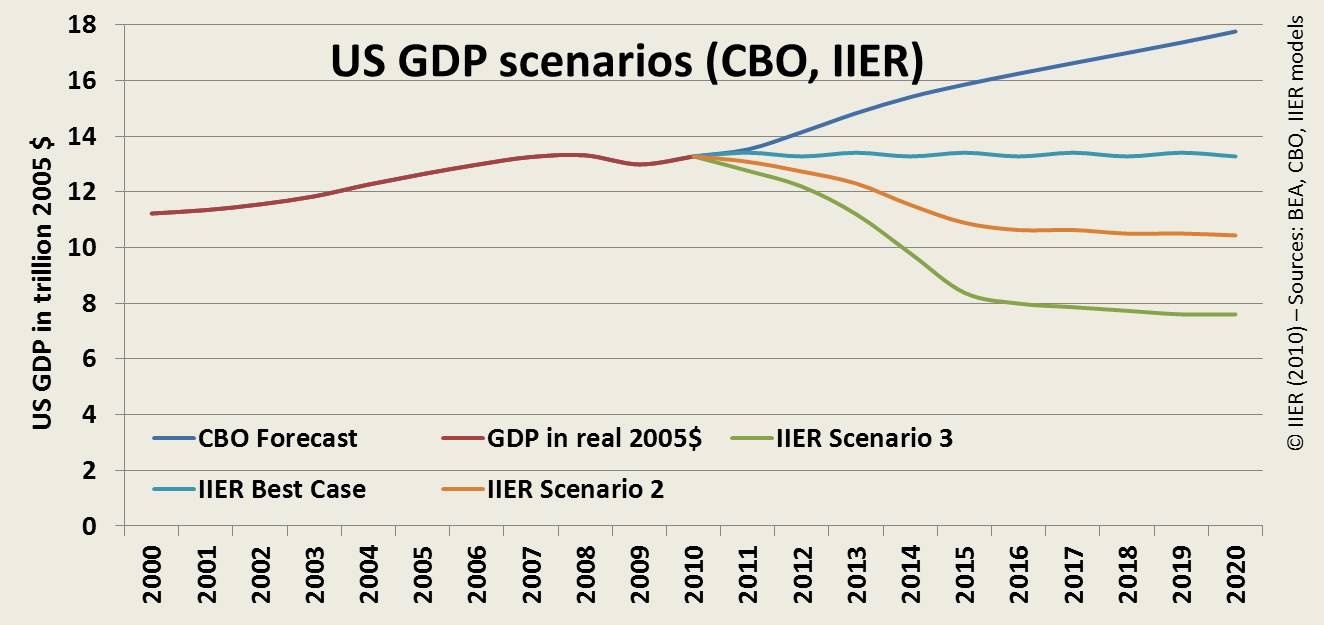
Fig 1: Official and alternative scenarios for U.S. GDP growth

One of the most surreal phenomena one encounters these days is that no country, no established economic research institute (aware of as of this posting), and no international organization (such as the IMF) publicly discusses scenarios that don't plan for a return to stable economic (GDP) growth. Even Greece's government, after 2012, expects growth, which would allow the country to slowly reduce its monster debt load. Similarly, the U.S. government forecasts annual average (real) growth rates of 4.4% for the years 2012-2014, and 2.4% thereafter until 2020. This theme is globally ubiquitous. (ADDENDUM: Today Lloyds of London said global institutions are underestimating impacts of peak oil).


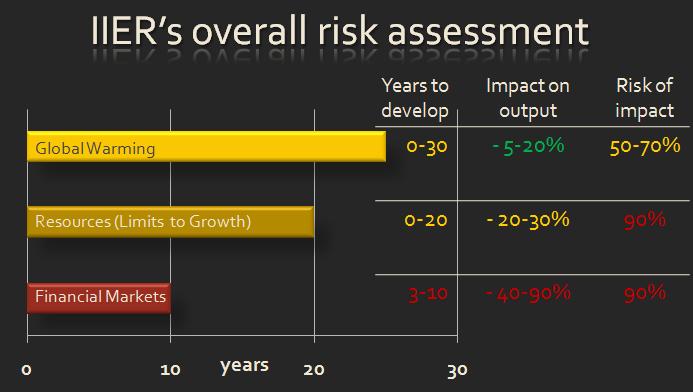
The above graph is one organization's view of the general magnitude of risks facing societies. Whether or not you agree with their projections is secondary to their ranking in mainstream discussions. On a long term horizon, clearly the health of our environment is of upmost importance. And, along with climate change and other potential externalities, resource depletion issues of various stripes pose large risks to the system as we know it. But before we face the long term we have to go through the short term, which will have to navigate the energy/debt/growth gauntlet. For all the effort being undertaken internationally to address climate, little if any is being made towards building bridges through and past a period of declining growth and wealth. Cognitive dissonance meet group think...

Given the stakes, it is quite worrying that in all the institutionalized economic projections of late, decline or zero growth aren't even mentioned as a possibility. One can speculate why this is the case, but there is significant evidence that only limited efforts- if any - are being allocated to understanding the possible consequences and required mitigation strategies of such a trajectory.

We have no insurance for "no-growth" scenarios

Given the constraints in natural resources, our currently unprecedented levels of debt on a global scale, and the absence of ideas for the next grand "leap forward" for mankind, it seems plausible that we might have to bid adieu to economic growth, and not just for a year or two, but for a long time. Some models at IIER (and other whisper numbers at boutique firms and the blogosphere) suggest the chances for steady economic growth after 2010 are below 10-20%. Even if you disagree with such low odds and put the probability for "more growth" to, say, 80%, doesn't it seem a bit irresponsible to not at least consider the other 20%? Not buying insurance for a risk that might hit you with some pretty negative consequences with a one in five chance strikes me as not the best strategy for a resilient and forward thinking society.

Consequences of "no growth" are quite unpleasant

Our current world is about as prepared for "no growth" as is a fish to walk on land. All our current claims systems, the credit outstanding, including government debt, our pension expectations, our savings, our hopes and dreams, are mostly focused on a "there will be more tomorrow" mentality. Should this "more" disappear as a possibility, we will likely not just see small implications, but rather a disruptive destruction of both perceived wealth and security, accompanied by the shattering of hopes and dreams, the perception alone which might cause further trouble in our highly complex societies. Choosing to go forward to a world with different aspirations than growth might have some unexpected positive surprises. But one could argue the worst will happen if we run into such a world completely unprepared. This is why we urgently need policymakers to face the risk of "no-growth," to understand possible implications and to work on transition approaches.

Why not use upcoming elections to ask a few questions?

So with elections coming up in a number of places, particularly for mid-term this fall, why not ask some questions to those people who want our vote? Why not at least instill awareness, concern and caution into the candidates who wish to represent us in the future? Why not have them ask themselves how they'd deal with a situation where they can no longer promise "more" to their constituents, but instead have to think about how to make "less" more appealing to everyone...?