Showing posts with label Corrections Corporation of America (CCA). Show all posts

Friday, November 2, 2012

The Prison System Expands at Frightening Pace Following Declaration of War on Drugs

Tuesday, October 30, 2012
Sean Kerrigan, Contributor
Activist Post

In the early 1970s, the prison population in the United States was small and was steadily falling relative to the size of the population. Experts imagined that in a few decades, the prison system as we know it could be successfully dismantled, but that began to change after President Nixon began the War on Drugs in 1971, resulting in a huge influx of convicts.
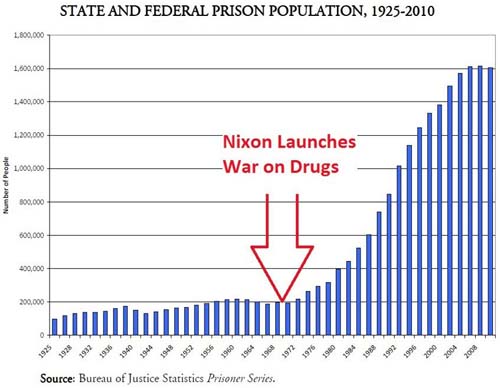
CLICK IMAGE TO ENLARGE
The massive increase in prisoners has given rise to what some call the Prison Industrial Complex. Like its cousin, the Corporate Military Industrial Complex, government policy and spending continues to make private involvement in the prison system very lucrative. Taxpayer money is transferred to corporations to satisfy the increasing number of prisoners as a result of the drug war.

As these corporations become bigger and more powerful, they can lobby for policies that will increase their business. Their business is to see you behind bars. More prisoners means more profit, which means more influence. It’s a continuing cycle that has reached a tipping point.

Like all big businesses, private prisons invest heavily in government lobbying to ensure an ever increasing supply of new customers, in this case prisoners. Currently, private prison companies are negotiating with states to buy and manage public prisons, if in exchange the state can promise occupancy rates remain above 90 percent for at least 20 years. This of course only adds to incentivize the states to prosecute more citizens for more crimes.

The Corrections Corporation of America’s annual filing even admits this is their goal:
The demand for our facilities and services could be adversely affected by the relaxation of enforcement efforts, leniency in conviction or parole standards and sentencing practices or through the decriminalization of certain activities that are currently proscribed by our criminal laws…For instance, any changes with respect to drugs and controlled substances or illegal immigration could affect the number of persons arrested, convicted, and sentenced, thereby potentially reducing demand for correctional facilities to house them. (and this is why marijuana will never be totally decriminalized--jef)
In some cases, the private prison industry has even assisted in writing the laws designed to increase the prison population, as was the case with the controversial Arizona law SB 1070, which would inevitably jail foreign nationals suspected of being in the country illegally.

The US has 25 percent of the world’s prisoners. It’s incarceration rate is the highest in the world and has increased by 10 percent since 2000. The US incarceration rate is only slightly lower than in the Soviet Union at the height of the gulag system just before World War II. At current rates, the US will surpass the gulag system by 2018!

Financial writer Jeff Neilson has recently noted that while US new home inventory has been “plummeting straight down,” other reports indicate that construction of homes are up significantly, producing “50 to 100 percent more units than they sell.” Neilson’s conclusion?
Either the official U.S. housing numbers were total fabrications; or, more than half of these ‘housing starts’ were units which did not require a ‘sale’ to an individual owner in order for the builder to be paid (since no builder can stay in business building twice as many units as they sell).
In attempting to come up with an answer to the question ‘how could millions of new U.S. housing units not require sale to an owner?,’ I could only formulate one possibility. All of these phantom housing starts were in fact prison cells.
Slave Labor

The 13th Amendment to the Constitution specifically outlaws slavery “except as a punishment for crime,” meaning that convicted prisoners can be used as a source of forced servitude. During times of economic stress, demand for cheap prison labor increases.

With the expansion of the private prison system, we’re seeing new interest in the practice that goes way beyond making license plates.

While cheap sweatshop labor is becoming increasingly common across the country, no one takes better advantage of the system than prisons.

Alternet reports that almost 1 million prisoners are doing simple unskilled labor including “making office furniture, working in call centers, fabricating body armor, taking hotel reservations, working in slaughterhouses, or manufacturing textiles, shoes, and clothing, while getting paid somewhere between 93 cents and $4.73 per day.” They continue:
Rarely can you find workers so pliable, easy to control, stripped of political rights, and subject to martial discipline at the first sign of recalcitrance — unless, that is, you traveled back to the nineteenth century when convict labor was commonplace nationwide…It was one vital way the United States became a modern industrial capitalist economy — at a moment, eerily like our own, when the mechanisms of capital accumulation were in crisis.
Compare the cost of less than $5 a day with the cost of a minimum wage worker at $58 a day and you begin to see the perverse influence on the entire labor market.

CNN Money reports that prison inmates are now directly competing for jobs in the rest of the economy, and employers are finding it increasingly difficult to keep up. Lost jobs are the result. They cite one company, American Apparel Inc., which makes military uniforms. They write:
‘We pay employees $9 on average,’ [a company executive] said. ‘They get full medical insurance, 401(k) plans and paid vacation. Yet we’re competing against a federal program that doesn’t pay any of that.’
[The private prison] is not required to pay its workers minimum wage and instead pays inmates 23 cents to $1.15 an hour. It doesn’t have health insurance costs. It also doesn’t shell out federal, state or local taxes.
The new influx of cheap, domestic labor will inevitably drive down wages for both skilled and unskilled jobs.

Perverse Incentives

The profitability of privately run prison system has led to an increase in abuse within government positions. In 2009, two judges were convicted of fraud for accepting kickbacks from private prisons for sending juveniles to prison, even for minor offenses. In one instance, a 17-year-old student was sentenced to three months in prison for creating a fake MySpace page mocking an assistant principal.

The expansion of the American-style gulag will require the subversion of the jury trial (and jury nullification) or replaced all together with a system that provides fewer checks to protect the innocent. Misdemeanors will be reclassified as felonious. Decriminalization efforts that have succeeded will be reversed. People will be imprisoned for offenses not even considered crimes, or held without trial.

The financial justification for private prisons is in question as well. The New York Times, The Arizona Republic, and the Associated Press, have noted that governments save little if any money by privatizing the prison system. The Times notes that statistics are often manipulated since private prisons are more than willing to take healthy inmates, but tend to reject inmates with expensive health conditions, making the operation appear more cost effective than it is.

Wednesday, July 25, 2012

Prisons as Growth Industry

by RALPH NADER
Ever visit a major prison? The vast majority of Americans have not, despite our country having by far a higher incarceration rate per capita than China or Iran. Out of sight is out of mind.

Imagine the benefits of the average taxpayer touring a prison. The lucrative prison-industrial complex would definitely not like public exposure of their daily operations.

Prison CEOs have no problem with a full house of non-violent inmates caught with possession of some street drugs (not alcohol or tobacco). Our horrendous confinement system cannot change when it clings to perverse practices such as cruel, costly, arbitrary, mentally destructive solitary confinement (again, the highest in the world, see: http://solitarywatch.com/). Corporate profits drive the prison system’s insanity.

Indeed, for the giant Corrections Corporation of America (CCA), times are booming. CCA builds their prisons or buys or leases public prisons from financially strapped governments. Barron’s financial weekly can always be expected to give us the Wall Street perspective. In a recent article titled “Ready to Bust Out,” writer Jonathan R. Laing is bullish on CCA stock. He thinks it could double to more than $50 a share if the company were to convert to a real estate investment trust (REIT).

Mr. Laing writes that CCA has cost advantages over the public-prison sector, paying lower non-union wages and using more automated technology. Besides, the company is a tough bargainer when it buys or operates public prisons. One CCA condition is that the facility must have 1,000 beds, can’t be more than 25 years old, and get this, “the contract must guarantee a 90 percent occupancy rate.” A guarantee backed by taxpayers no less, unless, that is, the clause works to put more prisoners in jail for longer sentences.

The Barron’s article adds that CCA is counting on “the old standby of recidivism to keep prison head counts growing, filling its empty beds.” To the impoverished rural communities where these prisons are located, it’s about needed jobs.

The criminal injustice system has many faults, other than an inadequate number of beds filled with convicted corporate crooks. As the Justice Roundtable (http://justiceroundtable.com/), composed of a collation of over 50 national organizations, declares, “The current punitive system depletes budgets without making society safer…The Archaic system must be reformed to be rehabilitative, just and accountable.”

How naïve! Don’t these experienced people know that first they have to change the purposes of this system? Instead of wanting more prisoners and treating them in such ways that when they get out they are too unskilled and damaged to overcome the society’s exclusionary pressures that half of them end up back in jail, they should be training these prisoners to be contributing members of society. But that’s the problem of the gigantic prison machine that thrives on returning prisoners.

The same perverse incentives apply to the self-defeating trillion-dollar war on drugs (see http://www.drugpolicy.org/). History has demonstrated that driving addictions into illegal undergrounds creates vicious underworld crimes. In Mexico, the so-called drug cartel is getting close to destroying local governments in many regions.

In the U.S., half a million people are behind bars for nonviolent drug offenses, the vast majority arrested for mere possession, not production or sale. That is nearly one in four of all prisoners. There are twenty million marijuana arrests every year in the U.S.!

Drug addictions are treated as crimes instead of as health problems, which we do with tobacco and alcohol addictions. Gross racial disparities persists, starting with black teenagers having to go to jail for a drug offense six times more often than a comparable white youth, both with prior clean records (http://www.nyclu.org/content/commission-must-reform-inhumane-drug-laws).

Without rehabilitation changes in prisons and changes in societal attitudes toward those who have done time, ex-prisoners will continue to have trouble getting jobs having food stamp eligibility, financial aid for college or vocational schools and even the right to vote.

In the first ever congressional hearing on solitary confinement, led by Senator Richard Durbin (D-Ill.) last month, the Senate Judiciary Committee’s Subcommittee on the Constitution, Civil Rights and Human Rights received testimony about and directly from wrongfully convicted prisoners put away in “the hole,” as solitary has been called for years. They also heard from Christopher Epps, the boss of the Mississippi prison system, one of a few states that, in the words of The New York Times, “ha(s) reduced prison violence and reaped millions in budgetary savings by steeply cutting back on solitary confinement.”

From the lethal drug wars on our city streets to the crowding out of civil cases from the federal and state dockets clogged by these drug cases, to the blocking of proven, superior ways to deal with the entire problem by innovative judges, thoughtful scholars and prominent advocacy groups, the time is ripe for change.

Right/Left convergence is emerging. Last April, for instance, David Keene, former Chair of the American Conservative Union and Grover Norquist, president of Americans for Tax Reform, joined with the NAACP and other liberals to highlight escalating levels of prison spending and its impact on our nation’s children and poorly performing schools. Connecticut spends $40,000 a year to imprison a juvenile offender compared to less than $12,000 a year to educate a young person. Other similar convergences over hugely disparate sentencing as with crack and cocaine are forming, making both economic and humane arguments. More young black men are locked up than are in college, according to the Justice Roundtable.

Still, there hasn’t been enough reform pressure even to pass outgoing U.S. Senator Jim Webb’s legislation simply to create a National Criminal Justice Commission Act. This legislation is now stuck in Senatorial limbo.

Start up the prison tours. Have some led by articulate, former convicts who are pushing to reform our cruel, costly and ineffective prison system. It is so easy to do much better, if we want to.

Wednesday, April 25, 2012

Private Prison Corporations Are Modern Day Slave Traders

Wednesday, April 25, 2012 by Black Agenda Reportby Glen Ford


The nation’s largest private prison company, the Corrections Corporation of America, is on a buying spree. With a war chest of $250 million, the corporation, which is listed on the New York Stock Exchange, earlier this year sent letters to 48 states, offering to buy their prisons outright. 

To ensure their profitability, the corporation insists that it be guaranteed that the prisons be kept at least 90 percent full. Plus, the corporate jailers demand a 20-year management contract, on top of the profits they expect to extract by spending less money per prisoner.For the last two years, the number of inmates held in state prisons has declined slightly, largely because the states are short on money. 

Crime, of course, has declined dramatically in the last 20 years, but that has never dampened the states’ appetites for warehousing ever more Black and brown bodies, and the federal prison system is still growing. However, the Corrections Corporation of America believes the economic crisis has created an historic opportunity to become the landlord, as well as the manager, of a big chunk of the American prison gulag.

The attempted prison grab is also defensive in nature. If private companies can gain both ownership and management of enough prisons, they can set the prices without open-bid competition for prison services, creating a guaranteed cost-plus monopoly like that which exists between the Pentagon and the military-industrial complex.

But, for a better analogy, we must go back to the American slave system, a thoroughly capitalist enterprise that reduced human beings to units of labor and sale. The Corrections Corporation of America’s filings with the U.S. Securities and Exchange Commission read very much like the documents of a slave-trader. Investors are warned that profits would go down if the demand for prisoners declines. That is, if the world’s largest police state shrinks, so does the corporate bottom line. 

Dangers to profitability include “relaxation of enforcement efforts, leniency in conviction or parole standards and sentencing practices or through the decriminalization of certain activities that are currently proscribed by our criminal laws." 

The corporation spells it out: “any changes with respect to drugs and controlled substances or illegal immigration could affect the number of persons arrested, convicted, and sentenced, thereby potentially reducing demand for correctional facilities to house them." At the Corrections Corporation of America, human freedom is a dirty word.

But, there is something even more horrifying than the moral turpitude of the prison capitalists. If private companies are allowed to own the deeds to prisons, they are a big step closer to owning the people inside them. Many of the same politicians that created the system of mass Black incarceration over the past 40 years, would gladly hand over to private parties all responsibility for the human rights of inmates. 

The question of inmates' rights is hardly raised in the debate over prison privatization. This is a dialogue steeped in slavery and racial oppression. Just as the old slave markets were abolished, so must the Black American Gulag be dismantled – with no compensation to those who traffic in human beings.

Thursday, April 19, 2012

The Prison Labor Complex

A reason why for the corporate rulers, the economy doesn't have to improve--not when they have a captive workforce.--jef

+++

by STEVE FRASER and JOSHUA B. FREEMAN


Sweatshop labor is back with a vengeance. It can be found across broad stretches of the American economy and around the world. Penitentiaries have become a niche market for such work. The privatization of prisons in recent years has meant the creation of a small army of workers too coerced and right-less to complain.

Prisoners, whose ranks increasingly consist of those for whom the legitimate economy has found no use, now make up a virtual brigade within the reserve army of the unemployed whose ranks have ballooned along with the U.S. incarceration rate. The Corrections Corporation of America and G4S (formerly Wackenhut), two prison privatizers, sell inmate labor at subminimum wages to Fortune 500 corporations like Chevron, Bank of America, AT&T, and IBM.

These companies can, in most states, lease factories in prisons or prisoners to work on the outside. All told, nearly a million prisoners are now making office furniture, working in call centers, fabricating body armor, taking hotel reservations, working in slaughterhouses, or manufacturing textiles, shoes, and clothing, while getting paid somewhere between 93 cents and $4.73 per day.

Rarely can you find workers so pliable, easy to control, stripped of political rights, and subject to martial discipline at the first sign of recalcitrance — unless, that is, you traveled back to the nineteenth century when convict labor was commonplace nationwide. Indeed, a sentence of “confinement at hard labor” was then the essence of the American penal system. More than that, it was one vital way the United States became a modern industrial capitalist economy — at a moment, eerily like our own, when the mechanisms of capital accumulation were in crisis.

A Yankee Invention
What some historians call “the long Depression” of the nineteenth century, which lasted from the mid-1870s through the mid-1890s, was marked by frequent panics and slumps, mass bankruptcies, deflation, and self-destructive competition among businesses designed to depress costs, especially labor costs. So, too, we are living through a twenty-first century age of panics and austerity with similar pressures to shrink the social wage.

Convict labor has been and once again is an appealing way for business to address these dilemmas. Penal servitude now strikes us as a barbaric throwback to some long-lost moment that preceded the industrial revolution, but in that we’re wrong. From its first appearance in this country, it has been associated with modern capitalist industry and large-scale agriculture.

And that is only the first of many misconceptions about this peculiar institution. Infamous for the brutality with which prison laborers were once treated, indelibly linked in popular memory (and popular culture) with images of the black chain gang in the American South, it is usually assumed to be a Southern invention. So apparently atavistic, it seems to fit naturally with the retrograde nature of Southern life and labor, its economic and cultural underdevelopment, its racial caste system, and its desperate attachment to the “lost cause.”

As it happens, penal servitude — the leasing out of prisoners to private enterprise, either within prison walls or in outside workshops, factories, and fields — was originally known as a “Yankee invention.”

First used at Auburn prison in New York State in the 1820s, the system spread widely and quickly throughout the North, the Midwest, and later the West. It developed alongside state-run prison workshops that produced goods for the public sector and sometimes the open market.

A few Southern states also used it. Prisoners there, as elsewhere, however, were mainly white men, since slave masters, with a free hand to deal with the “infractions” of their chattel, had little need for prison. The Thirteenth Amendment abolishing slavery would, in fact, make an exception for penal servitude precisely because it had become the dominant form of punishment throughout the free states.

Nor were those sentenced to “confinement at hard labor” restricted to digging ditches or other unskilled work; nor were they only men. Prisoners were employed at an enormous range of tasks from rope- and wagon-making to carpet, hat, and clothing manufacturing (where women prisoners were sometimes put to work), as well coal mining, carpentry, barrel-making, shoe production, house-building, and even the manufacture of rifles. The range of petty and larger workshops into which the felons were integrated made up the heart of the new American economy.

Observing a free-labor textile mill and a convict-labor one on a visit to the United States, novelist Charles Dickens couldn’t tell the difference. State governments used the rental revenue garnered from their prisoners to meet budget needs, while entrepreneurs made outsized profits either by working the prisoners themselves or subleasing them to other businessmen.

Convict Labor in the ‘New South’

After the Civil War, the convict-lease system metamorphosed. In the South, it became ubiquitous, one of several grim methods — including the black codes, debt peonage, the crop-lien system, lifetime labor contracts, and vigilante terror — used to control and fix in place the newly emancipated slave. Those “freedmen” were eager to pursue their new liberty either by setting up as small farmers or by exercising the right to move out of the region at will or from job to job as “free wage labor” was supposed to be able to do.

If you assumed, however, that the convict-lease system was solely the brainchild of the apartheid all-white “Redeemer” governments that overthrew the Radical Republican regimes (which first ran the defeated Confederacy during Reconstruction) and used their power to introduce Jim Crow to Dixie, you would be wrong again. In Georgia, for instance, the Radical Republican state government took the initiative soon after the war ended. And this was because the convict-lease system was tied to the modernizing sectors of the post-war economy, no matter where in Dixie it was introduced or by whom.

So convicts were leased to coal-mining, iron-forging, steel-making, and railroad companies, including Tennessee Coal and Iron (TC&I), a major producer across the South, especially in the booming region around Birmingham, Alabama. More than a quarter of the coal coming out of Birmingham’s pits was then mined by prisoners. By the turn of the century, TC&I had been folded into J.P. Morgan’s United States Steel complex, which also relied heavily on prison laborers.

All the main extractive industries of the South were, in fact, wedded to the system. Turpentine and lumber camps deep in the fetid swamps and forest vastnesses of Georgia, Florida, and Louisiana commonly worked their convicts until they dropped dead from overwork or disease. The region’s plantation monocultures in cotton and sugar made regular use of imprisoned former slaves, including women. Among the leading families of Atlanta, Birmingham, and other “New South” metropolises were businessmen whose fortunes originated in the dank coal pits, malarial marshes, isolated forests, and squalid barracks in which their unfree peons worked, lived, and died.

Because it tended to grant absolute authority to private commercial interests and because its racial make-up in the post-slavery era was overwhelmingly African-American, the South’s convict-lease system was distinctive. Its caste nature is not only impossible to forget, but should remind us of the unbalancedracial profile of America’s bloated prison population today.

Moreover, this totalitarian-style control invited appalling brutalities in response to any sign of resistance: whippings, water torture, isolation in “dark cells,” dehydration, starvation, ice-baths, shackling with metal spurs riveted to the feet, and “tricing” (an excruciatingly painful process in which recalcitrant prisoners were strung up by the thumbs with fishing line attached to overhead pulleys). Even women in a hosiery mill in Tennessee were flogged, hung by the wrists, and placed in solitary confinement.

Living quarters for prisoner-workers were usually rat-infested and disease-ridden. Work lasted at least from sunup to sundown and well past the point of exhaustion. Death came often enough and bodies were cast off in unmarked graves by the side of the road or by incineration in coke ovens. Injury rates averaged one per worker per month, including respiratory failure, burnings, disfigurement, and the loss of limbs. Prison mines were called “nurseries of death.” Among Southern convict laborers, the mortality rate (not even including high levels of suicides) was eight times that among similar workers in the North — and it was extraordinarily high there.

The Southern system also stood out for the intimate collusion among industrial, commercial, and agricultural enterprises and every level of Southern law enforcement as well as the judicial system. Sheriffs, local justices of the peace, state police, judges, and state governments conspired to keep the convict-lease business humming. Indeed, local law officers depended on the leasing system for a substantial part of their income. (They pocketed the fines and fees associated with the “convictions,” a repayable sum that would be added on to the amount of time at “hard labor” demanded of the prisoner.)

The arrest cycle was synchronized with the business cycle, timed to the rise and fall of the demand for fresh labor. County and state treasuries similarly counted on such revenues, since the post-war South was so capital-starved that only renting out convicts assured that prisons could be built and maintained.

There was, then, every incentive to concoct charges or send people to jail for the most trivial offenses: vagrancy, gambling, drinking, partying, hopping a freight car, tarrying too long in town. A “pig law” in Mississippi assured you of five years as a prison laborer if you stole a farm animal worth more than $10. Theft of a fence rail could result in the same.

Penal Servitude in the Gilded Age North

All of this was only different in degree from prevailing practices everywhere else: the sale of prison labor power to private interests, corporal punishment, and the absence of all rights including civil liberties, the vote, and the right to protest or organize against terrible conditions.

In the North, where 80% of all U.S. prison labor was employed after the Civil War and which accounted for over $35 billion in output (in current dollars), the system was reconfigured to meet the needs of modern industry and the pressures of “the long Depression.” Convict labor was increasingly leased out only to a handful of major manufacturers in each state. These textile mills, oven makers, mining operations, hat and shoe factories — one in Wisconsin leased that state’s entire population of convicted felons — were then installing the kind of mass production methods becoming standard in much of American industry. As organized markets for prison labor grew increasingly oligopolistic (like the rest of the economy), the Depression of 1873 and subsequent depressions in the following decades wiped out many smaller businesses that had once gone trawling for convicts.

Today, we talk about a newly “flexible economy,” often a euphemism for the geometric growth of a precariously positioned, insecure workforce. The convict labor system of the nineteenth century offered an original specimen of perfect flexibility.

Companies leasing convicts enjoyed authority to dispose of their rented labor power as they saw fit. Workers were compelled to labor in total silence. Even hand gestures and eye contact were prohibited for the purpose of creating “silent and insulated working machines.”

Supervision of prison labor was ostensibly shared by employers and the prison authorities. In fact, many businesses did continue to conduct their operations within prison walls where they supplied the materials, power, and machinery, while the state provided guards, workshops, food, clothing, and what passed for medical care. As a matter of practice though, the foremen of the businesses called the shots. And there were certain states, including Nebraska, Washington, and New Mexico, that, like their Southern counterparts, ceded complete control to the lessee. As one observer put it, “Felons are mere machines held to labor by the dark cell and the scourge.”

Free market industrial capitalism, then and now, invariably draws on the aid of the state. In that system’s formative phases, the state has regularly used its coercive powers of taxation, expropriation, and in this case incarceration to free up natural and human resources lying outside the orbit of capitalism proper.

In both the North and the South, the contracting out of convict labor was one way in which that state-assisted mechanism of capital accumulation arose. Contracts with the government assured employers that their labor force would be replenished anytime a worker got sick, was disabled, died, or simply became too worn out to continue.

The Kansas Wagon Company, for example, signed a five-year contract in 1877 that prevented the state from raising the rental price of labor or renting to other employers. The company also got an option to renew the lease for 10 more years, while the government was obliged to pay for new machinery, larger workshops, a power supply, and even the building of a switching track that connected to the trunk line of the Pacific Railway and so ensured that the product could be moved effectively to market.

Penal institutions all over the country became auxiliary arms of capitalist industry and commerce. Two-thirds of all prisoners worked for private enterprise.

Today, strikingly enough, government is again providing subsidies and tax incentives as well as facilities, utilities, and free space for corporations making use of this same category of abjectly dependent labor.

The New Abolitionism

Dependency and flexibility naturally assumed no resistance, but there was plenty of that all through the nineteenth century from workers, farmers, and even prisoners. Indeed, a principal objective in using prison labor was to undermine efforts to unionize, but from the standpoint of mobilized working people far more was at stake.

Opposition to convict labor arose from workingmen’s associations, labor-oriented political parties, journeymen unions, and other groups which considered the system an insult to the moral codes of egalitarian republicanism nurtured by the American Revolution. The specter of proletarian dependency haunted the lives of the country’s self-reliant handicraftsmen who watched apprehensively as shops employing wage labor began popping up across the country. Much of the earliest of this agitation was aimed at the use of prisoners to replace skilled workers (while unskilled prison labor was initially largely ignored).

It was bad enough for craftsmen to see their own livelihoods and standards of living put in jeopardy by “free” wage labor. Worse still was to watch unfree labor do the same thing. At the time, employers were turning to that captive prison population to combat attempts by aggrieved workers to organize and defend themselves. On the eve of the Civil War, for example, an iron-molding contractor in Spuyten Duyvil, north of Manhattan in the Bronx, locked out his unionized workers and then moved his operation to Sing Sing penitentiary, where a laborer cost 40 cents, $2.60 less than the going day rate. It worked, and Local 11 of the Union of Iron Workers quickly died away.

Worst of all was to imagine this debased form of work as a model for the proletarian future to come. The workingman’s movement of the Jacksonian era was deeply alarmed by the prospect of “wage slavery,” a condition inimical to their sense of themselves as citizens of a republic of independent producers. Prison labor was a sub-species of that dreaded “slavery,” a caricature of it perhaps, and intolerable to a movement often as much about emancipation as unionization.

All the way through the Gilded Age of the 1890s, convict labor continued to serve as a magnet for emancipatory desires. In addition, prisoners’ rebellions became ever more common — in the North particularly, where many prisoners turned out to be Civil War veterans and dispossessed working people who already knew something about fighting for freedom and fighting back. Major penitentiaries like Sing Sing became sites of repeated strikes and riots; a strike in 1877 even took on the transplanted Spuyten Duyvil iron-molding company.

Above and below the Mason Dixon line, political platforms, protest rallies, petition campaigns, legislative investigations, union strikes, and boycotts by farm organizations like the Farmers Alliance and Grange cried out for the abolition of the convict-lease system, or at least for its rigorous regulation. Over the century’s last two decades, more than 20 coal-mine strikes broke out because of the use of convict miners.

The Knights of Labor, that era’s most audacious labor movement, was particularly exercised. During the Coal Creek Wars in eastern Tennessee in the early 1890s, for instance, TC&I tried to use prisoners to break a miners’ strike. The company’s vice president noted that it was “an effective club to hold over the heads of free laborers.”

Strikers and their allies affiliated with the Knights, the United Mine Workers, and the Farmers Alliance launched guerilla attacks on the prisoner stockade, sending the convicts they freed to Knoxville. When the governor insisted on shipping them back, the workers released them into the surrounding hills and countryside. Gun battles followed.

The Death of Convict Leasing

In the North, the prison abolition movement went viral, embracing not only workers’ organizations, sympathetic rural insurgents, and prisoners, but also widening circles of middle-class reformers. The newly created American Federation of Labor denounced the system as “contract slavery.” It also demanded the banning of any imports from abroad made with convict labor and the exclusion from the open market of goods produced domestically by prisoners, whether in state-run or private workshops. In Chicago, the construction unions refused to work with materials made by prisoners.

By the latter part of the century, in state after state penal servitude was on its way to extinction. New York, where the “industry” was born and was largest, killed it by the late 1880s. The tariff of 1890 prohibited the sale of convict-made wares from abroad. Private leasing continued in the North, but under increasingly restrictive conditions, including Federal legislation passed during the New Deal. By World War II, it was virtually extinct (althoughgovernment-run prison workshops continued as they always had).

At least officially, even in the South it was at an end by the turn of the century in Tennessee, Louisiana, Georgia, and Mississippi. Higher political calculations were at work in these states. Established elites were eager to break the inter-racial alliances that had formed over abolishing convict leasing by abolishing the hated system itself. Often enough, however, it ended in name only.

What replaced it was the state-run chain gang (although some Southern states like Alabama and Florida continued private leasing well into the 1920s). Inmates were set to work building roads and other infrastructure projects vital to the flourishing of a mature market economy and so to the continuing process of capital accumulation. In the North, the system of “hard labor” was replaced by a system of “hard time,” that numbing, brutalizing idleness where masses of people extruded from the mainstream economy are pooled into mass penal colonies. The historic link between labor, punishment, and economic development was severed, and remained so… until now.

Convict Leasing Rises Again

“Now,” means our second Gilded Age and its aftermath. In these years, the system of leasing out convicts to private enterprise was reborn. This was a perverse triumph for the law of supply and demand in an era infatuated with the charms of the free market. On the supply side, the U.S. holds captive 25% of all the prisoners on the planet: 2.3 million people. It has the highest incarceration rate in the world as well, a figure that began skyrocketing in 1980 as Ronald Reagan became president. As for the demand for labor, since the 1970s American industrial corporations have found it increasingly unprofitable to invest in domestic production. Instead, they have sought out the hundreds of millions of people abroad who are willing to, or can be pressed into, working for far less than American workers.

As a consequence, those back home — disproportionately African-American workers — who found themselves living in economic exile, scrabbling to get by, began showing up in similarly disproportionate numbers in the country’s rapidly expanding prison archipelago. It didn’t take long for corporate America to come to view this as another potential foreign country, full of cheap and subservient labor — and better yet, close by.

What began in the 1970s as an end run around the laws prohibiting convict leasing by private interests has now become an industrial sector in its own right, employing more people than any Fortune 500 corporation and operating in 37 states. And here’s the ultimate irony: our ancestors found convict labor obnoxious in part because it seemed to prefigure a new and more universal form of enslavement. Could its rebirth foreshadow a future ever more unnervingly like those past nightmares?

Today, we are being reassured by the president, the mainstream media, and economic experts that the Great Recession is over, that we are in “recovery” even though most of the recovering patients haven’t actually noticed significant improvement in their condition. For those announcing its arrival, “recovery” means that the mega-banks are no longer on the brink of bankruptcy, the stock market has made up lost ground, corporate profits are improving, and notoriously unreliable employment numbers have improved by several tenths of a percent.

What accounts for that peculiarly narrow view of recovery, however, is that the general costs of doing business are falling off a cliff as the economy eats itself alive. The recovery being celebrated owes thanks to local, state, and Federal austerity budgets, the starving of the social welfare system and public services, rampant anti-union campaigns in the public and private sector, the spread of sweatshop labor, the coercion of desperate unemployed or underemployed workers to accept lower wages, part-time work, and temporary work, as well as the relinquishing of healthcare benefits and a financially secure retirement — in short, to surrender the hope that is supposed to come with the American franchise.

Such a recovery, resting on the stripping away of the hard won material and cultural achievements of the past century, suggests a new world in which the prison-labor archipelago could indeed become a vast gulag of the downwardly mobile.