Showing posts with label copyright laws. Show all posts
Showing posts with label copyright laws. Show all posts
Tuesday, December 31, 2013


Friday, October 11, 2013
New study says online piracy isn’t hurting entertainment industry
By Eric Pfeiffer, Yahoo News October 3, 2013
For years, the entertainment industry has argued that online piracy has devastated business for movies, music and gaming.
But a new policy brief from the London School of Economics and Political Science (LSE) says that not only does piracy not hurt the creative industry but it is actually helping.
Millions of people across the globe illegally access copyrighted material on a daily basis. The most common method of digital pirating is through torrent sites, which let an individual download and upload content through a peer-to-peer file-sharing system.
Individuals in the U.S. who are found guilty of violating digital piracy laws can face severe legal penalties, including a felony record, five years in prison and $250,000 in penalties.
In the briefing, authors Bart Cammaerts, Robin Mansell and Bingchun Meng call on governments to re-evaluate their antipiracy laws to include data from studies beyond those directly sponsored by the entertainment industry itself.
“Contrary to the industry claims, the music industry is not in terminal decline, but still holding ground and showing healthy profits. Revenues from digital sales, subscription services, streaming and live performances compensate for the decline in revenues from the sale of CDs or records,” Cammaerts said in report carried by the site TorrrentFreak.
In a separate story, TorrentFreak says that independent data actually suggests that those who pirate content are also more likely to spend their money on film, music and gaming content.
A June 2013 study found that roughly 45 percent of all Americans pirate copyrighted content on a regular basis, including 70 percent of those under 30.
In the LSE report’s key messages, the authors say that evidence does not back up claims that individual cases of copyright infringement are affecting entertainment industry revenues, that antipiracy laws around the world are not achieving their desired impacts and that governments should update their policies to include more evidence from a diverse set of sources.
“Despite the Motion Picture Association of America’s (MPAA) claim that online piracy is devastating the movie industry, Hollywood achieved record-breaking global box office revenues of $35 billion in 2012, a 6% increase over 2011,” the report states.
And while music sales have faced steeper declines in recent years, the authors say those numbers have largely been balanced out by increased sales in live performance and other outlets.
“The music industry may be stagnating, but the drastic decline in revenues warned of by the lobby associations of record labels is not in evidence,” the authors write.
Interestingly, in the same Columbia University study, which found that nearly half of all U.S. Internet users pirate copyrighted material, nearly half of those individuals say they would willingly pay a monthly fee for unlimited access to multimedia content.
And the LSE study authors say that is one possible solution for the entertainment industry going forward as a way to bridge the gap between content providers and consumers.
“Within the creative industries there is a variety of views on the best way to benefit from online sharing practices, and how to innovate to generate revenue streams in ways that do not fit within the existing copyright enforcement regime,” the authors conclude.
“When both [the creative industries and citizens] can exploit the full potential of the Internet, this will maximize innovative content creation for the benefit of all stakeholders.”
For years, the entertainment industry has argued that online piracy has devastated business for movies, music and gaming.
But a new policy brief from the London School of Economics and Political Science (LSE) says that not only does piracy not hurt the creative industry but it is actually helping.
Millions of people across the globe illegally access copyrighted material on a daily basis. The most common method of digital pirating is through torrent sites, which let an individual download and upload content through a peer-to-peer file-sharing system.
Individuals in the U.S. who are found guilty of violating digital piracy laws can face severe legal penalties, including a felony record, five years in prison and $250,000 in penalties.
In the briefing, authors Bart Cammaerts, Robin Mansell and Bingchun Meng call on governments to re-evaluate their antipiracy laws to include data from studies beyond those directly sponsored by the entertainment industry itself.
“Contrary to the industry claims, the music industry is not in terminal decline, but still holding ground and showing healthy profits. Revenues from digital sales, subscription services, streaming and live performances compensate for the decline in revenues from the sale of CDs or records,” Cammaerts said in report carried by the site TorrrentFreak.
In a separate story, TorrentFreak says that independent data actually suggests that those who pirate content are also more likely to spend their money on film, music and gaming content.
A June 2013 study found that roughly 45 percent of all Americans pirate copyrighted content on a regular basis, including 70 percent of those under 30.
In the LSE report’s key messages, the authors say that evidence does not back up claims that individual cases of copyright infringement are affecting entertainment industry revenues, that antipiracy laws around the world are not achieving their desired impacts and that governments should update their policies to include more evidence from a diverse set of sources.
“Despite the Motion Picture Association of America’s (MPAA) claim that online piracy is devastating the movie industry, Hollywood achieved record-breaking global box office revenues of $35 billion in 2012, a 6% increase over 2011,” the report states.
And while music sales have faced steeper declines in recent years, the authors say those numbers have largely been balanced out by increased sales in live performance and other outlets.
“The music industry may be stagnating, but the drastic decline in revenues warned of by the lobby associations of record labels is not in evidence,” the authors write.
Interestingly, in the same Columbia University study, which found that nearly half of all U.S. Internet users pirate copyrighted material, nearly half of those individuals say they would willingly pay a monthly fee for unlimited access to multimedia content.
And the LSE study authors say that is one possible solution for the entertainment industry going forward as a way to bridge the gap between content providers and consumers.
“Within the creative industries there is a variety of views on the best way to benefit from online sharing practices, and how to innovate to generate revenue streams in ways that do not fit within the existing copyright enforcement regime,” the authors conclude.
“When both [the creative industries and citizens] can exploit the full potential of the Internet, this will maximize innovative content creation for the benefit of all stakeholders.”
Tuesday, June 26, 2012
ACTA: An International SOPA
By Sandra Fulton, ACLU Washington Legislative Office
While the Internet community came out in force to protest the free speech and privacy threats posed by the PROTECT IP Act (PIPA) and the Stop Online Piracy Act (SOPA), an international trade agreement with the same stated goals—and potentially greater threats—was being negotiated behind closed doors. While the First Amendment can be served by intellectual property protections that incentivize content creation, IP laws can easily be misused. Like PIPA and SOPA, the Anti-Counterfeiting Trade Agreement (“ACTA”) is another misguided and overbroad attempt to crack down on counterfeiting and piracy over the Internet. There has been excellent analysis of the issue by sources including EFF, Tech Dirt and Ars Technica, but we have also been watching this issue and wanted to summarize what’s at stake.
While many of the worst provisions of ACTA were ultimately watered down (mainly due to pressure from outside groups reacting to leaked drafts), many issues remain, both procedural and substantive. There are four primary problems with ACTA.
To date the United States, the European Union (and 22 of its member states), Australia, Canada, Japan, Morocco, New Zealand, Singapore, and South Korea have all signed ACTA but none have formally ratified the agreement yet.
At the grassroots and at the highest levels of government, ACTA has sparked protests. In Poland, tens of thousands of people protested across the nation and activists attacked government websites when that country signed the agreement in January. Members of the Polish Parliament wore Guy Fawkes masks to demonstrate their disapproval. Since then, protests have been organized throughout Europe including in Sweden, Germany, Bulgaria, Greece, and the United Kingdom. Notably, Kader Arif, the first "rapporteur" for ACTA in the EU parliament (the member who prepares the official recommendation to the parliament on a legislative proposal), quit his role in disgust, stating,
This agreement might have major consequences on citizens' lives, and still, everything is being done to prevent the European Parliament from having its say in this matter. That is why today, as I release this report for which I was in charge, I want to send a strong signal and alert the public opinion about this unacceptable situation. I will not take part in this masquerade.
Arif’s successor, David Martin, recommended against adoption of the agreement, fearing unintended consequences and overbroad enforcement (though he also asked the parliament to consider a replacement).
Post-ACTA: The Trans-Pacific Partnership
Since ACTA’s completion we have learned that part of a new massive trade agreement, the Trans-Pacific Partnership (TPP), aims "to ensure an effective and balanced approach to intellectual property rights among the TPP countries.” Talks on the TPP are currently being held between nine Pacific Rim countries: Australia, Brunei, Canada, Chile, Malaysia, New Zealand, Peru, Singapore, Vietnam, and the United States. Like ACTA all negotiations are being conducted behind closed doors with details shared only with Industry Trade Advisory Committees (ITAC). The U.S. ITAC is called ITAC 15 and includes top executives from AT&T, Verizon, the RIAA, the pharmaceutical lobby, and Cisco. All anyone else knows about the agreement comes from a leak of the "intellectual property chapter" that surfaced about a year ago. EFF’s international IP director, Gwen Hinze, told Ars Technica, “I would say it’s ACTA-plus, not ACTA redux,” Secret international trade agreements negotiated between only government and industry is not a trend we want to see catch on.
Healthy democracies depend on transparency and public debate. Good policies are created through the input of experts, advocates, industry, policy makers, and citizens. Circumventing basic checks and balances to fast-track policies that have already been defeated by the public—often called “policy laundering”— is not how representative democracy is supposed to work. Many fear that agreements made in ACTA and TPP will put our civil liberties at risk. At the very least, the president should allow a free and open debate on the measures.
While many of the worst provisions of ACTA were ultimately watered down (mainly due to pressure from outside groups reacting to leaked drafts), many issues remain, both procedural and substantive. There are four primary problems with ACTA.
- Tying Congress’s Hands on Copyright Law
While supporters of ACTA insist it does not change U.S. law (were it technically to change existing law, it would require Senate ratification) opponents have different concerns—namely, that it will reinforce current copyright laws in an area that is changing rapidly and many believe should be updated. Opponents fear that signing the agreement will make it unnecessarily more difficult for Congress to update copyright laws while staying compliant with our new “international obligations.”
- Lack of accountability
Unlike PIPA and SOPA, ACTA would establish a new international body to enforce certain IP rules. This body would be made up of unelected members acting outside the purview of any current international institution. So, while SOPA and PIPA at least would have been enforced by U.S. agencies and subject to constitutional checks and balances, ACTA could be used for worldwide crackdowns on Internet activity by a coordinated authority that could work at cross-purposes with the laws and policies of the participating countries.
- Negotiated in secret
Despite the fact that such world-wide e-regulation has the potential to impact everyone with a computer, ACTA was negotiated in secret by a small, exclusive group of countries and a few private companies. The first the public heard about the talks was when WikiLeaks released a discussion document in May 2008. Both Presidents Bush and Obama rejected calls from advocates and members of Congress to make ACTA negotiations public, claiming that such disclosure would cause “damage to the national security.” However, a 2009 FOIA request found that the draft had been shared with Google, eBay, Dell, Intel, the Business Software Alliance, News Corporation, Sony Pictures, Time Warner, the Motion Picture Association of America, and Verizon under a nondisclosure agreement. Once the agreement was finalized it was posted to the United States Trade Representative’s website here.
- Evading Senate approval
To keep the negotiations secret and avoid having to obtain the Senate’s approval, the president is claiming that ACTA was negotiated within his presidential powers as a “sole executive agreement.” A sole executive agreement is one that the president may enter if the terms will not change U.S. law. However, the extent of the president’s authority to completely bypass Congressional approval and enter into a sole executive agreement is controversial. Earlier this month 50 leading U.S. legal scholars sent a letter to members of the Senate Finance Committee stating,
the Administration currently lacks a means to constitutionally enter ACTA without ex post Congressional approval. The present issue reaches far beyond the topical matters covered by ACTA, into the fundamental Constitutional issue of separation of powers. If Congress allows the executive to claim that ACTA was authorized by language that clearly does not authorize the agreement, it will be ceding unprecedented power to the executive."Senator Wyden (D-OR) has also questioned the president’s authority to treat ACTA as a sole agreement. “There are questions of constitutional authority surrounding whether the administration can enter into this agreement without Congress’s approval,” he said. “Either way, when international accords, like ACTA, are conceived and constructed under a cloak of secrecy it is hard to argue that they represent the broad interests of the general public. The controversy over ACTA should surprise no one.”
International oppositionRep. Darrell Issa (R-CA) warned participants at the World Economic Forum that ACTA was more dangerous than SOPA and PIPA and.then called into question the president’s authority to negotiate the agreement. He said, “It’s not coming to me for a vote. It purports that it does not change existing laws. But once implemented, it creates a whole new enforcement system and will virtually tie the hands of Congress to undo it.”
To date the United States, the European Union (and 22 of its member states), Australia, Canada, Japan, Morocco, New Zealand, Singapore, and South Korea have all signed ACTA but none have formally ratified the agreement yet.
At the grassroots and at the highest levels of government, ACTA has sparked protests. In Poland, tens of thousands of people protested across the nation and activists attacked government websites when that country signed the agreement in January. Members of the Polish Parliament wore Guy Fawkes masks to demonstrate their disapproval. Since then, protests have been organized throughout Europe including in Sweden, Germany, Bulgaria, Greece, and the United Kingdom. Notably, Kader Arif, the first "rapporteur" for ACTA in the EU parliament (the member who prepares the official recommendation to the parliament on a legislative proposal), quit his role in disgust, stating,
I want to denounce in the strongest possible manner the entire process that led to the signature of this agreement: no inclusion of civil society organizations, a lack of transparency from the start of the negotiations, repeated postponing of the signature of the text without an explanation being ever given, exclusion of the EU Parliament's demands that were expressed on several occasions in our assembly.
This agreement might have major consequences on citizens' lives, and still, everything is being done to prevent the European Parliament from having its say in this matter. That is why today, as I release this report for which I was in charge, I want to send a strong signal and alert the public opinion about this unacceptable situation. I will not take part in this masquerade.
Arif’s successor, David Martin, recommended against adoption of the agreement, fearing unintended consequences and overbroad enforcement (though he also asked the parliament to consider a replacement).
Post-ACTA: The Trans-Pacific Partnership
Since ACTA’s completion we have learned that part of a new massive trade agreement, the Trans-Pacific Partnership (TPP), aims "to ensure an effective and balanced approach to intellectual property rights among the TPP countries.” Talks on the TPP are currently being held between nine Pacific Rim countries: Australia, Brunei, Canada, Chile, Malaysia, New Zealand, Peru, Singapore, Vietnam, and the United States. Like ACTA all negotiations are being conducted behind closed doors with details shared only with Industry Trade Advisory Committees (ITAC). The U.S. ITAC is called ITAC 15 and includes top executives from AT&T, Verizon, the RIAA, the pharmaceutical lobby, and Cisco. All anyone else knows about the agreement comes from a leak of the "intellectual property chapter" that surfaced about a year ago. EFF’s international IP director, Gwen Hinze, told Ars Technica, “I would say it’s ACTA-plus, not ACTA redux,” Secret international trade agreements negotiated between only government and industry is not a trend we want to see catch on.
Healthy democracies depend on transparency and public debate. Good policies are created through the input of experts, advocates, industry, policy makers, and citizens. Circumventing basic checks and balances to fast-track policies that have already been defeated by the public—often called “policy laundering”— is not how representative democracy is supposed to work. Many fear that agreements made in ACTA and TPP will put our civil liberties at risk. At the very least, the president should allow a free and open debate on the measures.
Friday, March 16, 2012
Author illustrates why copyright math is bogus
By Stephen C. Webster - RAW Story
Friday, March 16, 2012
Giving a recent TED Talk, author Rob Reid, creator of the online music subscription service Rhapsody, illustrated for the audience exactly why so-called “copyright math” is almost completely bogus.
“Copyright math” is a term used for the extrapolations published by groups like the Motion Picture Association of America (MPAA), or the Recording Industry Association of America (RIAA), which lobby Washington for tougher laws on copyright infringement by claiming exorbitant financial and job losses due to online piracy.
Of course, it’s hard to claim those losses when so many executives are seeing their largest salaries ever, with box office profits continually spiraling higher.
Yet in 1999, the content industries got together to lobby for an “improvement” to copyright law that put a $150,000 price tag on every single act of infringement, and Washington granted their wish.
“Now when this law first passed, the world’s hottest MP3 player could hold just 10 songs, and it was a big Christmas hit — because what little hoodlum wouldn’t want a million and a half bucks-worth of stolen goods in his pocket?” Reid asked, using copyright math to illustrate the absurdity of their claims.
“These days, an iPod classic can hold 40,000 songs… Which is to say, eight billion dollars worth of stolen media, or about 75,000 jobs,” he deadpanned. “Now you might find copyright math strange, but that’s because it’s a field that’s best left to experts.”
Both the MPAA and the RIAA have weighed in heavily on other nations’ copyright laws in recent years, facilitated by the Obama Administration. They also recently brokered a deal with all the major Internet providers to set up network operators as the de facto copyright police, who will begin spying on customers to detect piracy later this year.
This video is from TED Talks, published Thursday, March 15, 2012.
Friday, March 16, 2012
Giving a recent TED Talk, author Rob Reid, creator of the online music subscription service Rhapsody, illustrated for the audience exactly why so-called “copyright math” is almost completely bogus.
“Copyright math” is a term used for the extrapolations published by groups like the Motion Picture Association of America (MPAA), or the Recording Industry Association of America (RIAA), which lobby Washington for tougher laws on copyright infringement by claiming exorbitant financial and job losses due to online piracy.
Of course, it’s hard to claim those losses when so many executives are seeing their largest salaries ever, with box office profits continually spiraling higher.
Yet in 1999, the content industries got together to lobby for an “improvement” to copyright law that put a $150,000 price tag on every single act of infringement, and Washington granted their wish.
“Now when this law first passed, the world’s hottest MP3 player could hold just 10 songs, and it was a big Christmas hit — because what little hoodlum wouldn’t want a million and a half bucks-worth of stolen goods in his pocket?” Reid asked, using copyright math to illustrate the absurdity of their claims.
“These days, an iPod classic can hold 40,000 songs… Which is to say, eight billion dollars worth of stolen media, or about 75,000 jobs,” he deadpanned. “Now you might find copyright math strange, but that’s because it’s a field that’s best left to experts.”
Both the MPAA and the RIAA have weighed in heavily on other nations’ copyright laws in recent years, facilitated by the Obama Administration. They also recently brokered a deal with all the major Internet providers to set up network operators as the de facto copyright police, who will begin spying on customers to detect piracy later this year.
This video is from TED Talks, published Thursday, March 15, 2012.
Friday, February 17, 2012
List of countries willing to ratify ACTA shrinks daily
'I Don’t Know Why I Signed': ACTA Support Tanks
Support for the controversial Anti-Counterfeiting Trade Agreement (ACTA) continues to wane this week as the Netherlands have imposed delays on ratification, joining the list of countries that have begun to back down on the agreement.
Last weekend saw tens of thousands of protesters across Europe in opposition to the agreement. In response to these protests, now the Netherlands have joined a growing list of countries including Germany, Poland, and Bulgaria who have recently taken steps to delay or reject ACTA.
UPI reports:
RT reports:
Support for the controversial Anti-Counterfeiting Trade Agreement (ACTA) continues to wane this week as the Netherlands have imposed delays on ratification, joining the list of countries that have begun to back down on the agreement.
Last weekend saw tens of thousands of protesters across Europe in opposition to the agreement. In response to these protests, now the Netherlands have joined a growing list of countries including Germany, Poland, and Bulgaria who have recently taken steps to delay or reject ACTA.
UPI reports:
The Netherlands this week imposed delays on the ratification of the ACTA international anti-piracy agreement, which critics claim threatens Internet freedoms.
Opponents say the draft Anti-Counterfeiting Trade Agreement puts users' privacy at risk while the European Commission contends the measure doesn't change existing data protection laws and is needed to mount a long-term global fight against copyright theft.
Germany, Poland, the Czech Republic and Slovakia have already delayed the international trade agreement's ratification process, citing the same privacy concerns highlighted during a wave of anti-ACTA protests throughout Europe last week.
The Netherlands joined that group Tuesday, when the Dutch lower house of Parliament backed a motion from the Green Left party calling on the Netherlands to refrain from signing onto ACTA, Radio Netherlands reported. [...]
Dunja Mijatovic, media freedom representative for the Organization for Security and Cooperation in Europe, Tuesday urged the European Parliament to reject ACTA, which it is considering for ratification.
"In my role as the OSCE representative on Freedom of the Media, I am mandated to observe media freedom developments in the OSCE participating states and am concerned that the present agreement on ACTA might have a detrimental effect on freedom of expression and a free flow of information in the digital age," Mijatovic said in Vienna.
RT reports:
As European parliaments reject the Anti-Counterfeiting trade Agreement on human rights grounds, some are asking why it was signed in the first place.
It looks like some of the countries who signed ACTA in Tokyo on January 26 are already having second thoughts.
“I don’t know why I signed ACTA”, former Romanian prime minister Emil Boc said on February 6.
“We made insufficient consultations before signing the agreement in late January," said Polish PM Donald Tusk on February 3, implying that his government had not taken steps to fully "ensure it was entirely safe for Polish citizens.”
A few days later Slovenia's foreign minister, who signed the agreement on behalf of her country, apologized for doing so: "Quite simply, I did not clearly connect the agreement I had been instructed to sign with the agreement that, according to my own civic conviction, limits and withholds freedom of engagement on the largest and most significant network in human history, and thus limits particularly the future of our children."
Wednesday, February 1, 2012
International agreement cements frequently-abused U.S. copyright law
By Stephen C. Webster - RAW Story
“The theory is that ‘foreign affairs’ is, in Article II of the Constitution, a power specifically allocated to the President — and, therefore, since ACTA is an issue under ‘foreign affairs’ it should be viewed as a Sole Executive Agreement that does not need Congressional approval,” Michael Burke, a Washington, D.C. attorney who specializes in international law, explained to Raw Story. “Both the Constitution and relevant Supreme Court cases are clear that the President, sometimes, has ‘sole’ and ‘plenary’ authority on foreign relations/foreign affairs.”
“However,” Burke added, “others feel that Article I, Section 8 of the Constitution — that allocates to Congress the power to regulate trade among nations-means that ACTA should not be considered a Sole Executive Agreement but a treaty subject to review and vote by the Senate.” That’s led the president’s critics to latch on to claims that he’s superseded his constitutional authority.
In its earliest forms, anti-ACTA activists wouldn’t have been wrong in their assertions: ACTA previously contained SOPA-like provisions that would disconnect repeat copyright offenders from the Internet, DNS blockades for rogue websites and liability provisions that would make network administrators and website owners responsible for the actions of their users. Sources say, and cables show, those provisions were fought tooth-and-nail behind the scenes and ultimately dropped from the final version, though they’ve already reappeared in the Trans-Pacific Partnership, a potential treaty which enters its 11th round of negotiations in March.
While ACTA is not a backdoor to imposing SOPA/PIPA on an unwilling populace, as some have claimed, it is broadly representative of the American entertainment industry’s long-term investment in using the American government to help it impost new copyright regimes abroad. Further evidence of that long-term goal can be found in U.S. diplomatic cables leaked last year.
ACTA is not likely to have immediate effects in the States, as part of the U.S.’s overall international copyright enforcement strategy, but it does give the Administration yet another tool in its arsenal to pursue sanctions against nations it deems insufficiently committed to protecting the U.S. entertainment industry’s profits.
For example, the U.S. keeps a list of countries that skirt these requirements, targeting them with economic pressure to force compliance. Already, Spain was the most recent to face such pressure, which was revealed in December after a U.S. diplomat’s letter was leaked to the media. Because of U.S. pressure, Spain’s new administration adopted intellectual property laws similar to SOPA, even after the previous administration refused.
Under ACTA, U.S. power to force compliance onto countries with more liberal fair use and less onerous enforcement policies will simply grow.
Wednesday, February 1, 2012
With the latest round of anti-piracy bills now soundly defeated, many activists and lawmakers have begun thinking about ways that the Digital Millennium Copyright Act (DMCA) may be changed to remediate portions that have been abused by copyright holders.
Only, they’ve discovered that it may be too late.
The Obama administration signed off on an international agreement late last year called the Anti-Counterfeiting Trade Act (ACTA) that effectively exports much of the DMCA to Europe, Japan, Australia and other developed nations, and most likely cements those laws in place as-is here at home. Though negotiated in out of public view, as all U.S. Trade Representative (USTR) agreements are, portions of ACTA’s early form became public after anti-secrecy website WikiLeaks released a trove of U.S. diplomatic cables referring to the talks.
Those cables showed a vastly different — and much more objectionable — agreement than what President Barack Obama eventually signed in 2011. Nonetheless, anti-ACTA activists have tried to generate mass opposition to the treaty by comparing it to the Stop Online Piracy Act (SOPA) and the Protect Intellectual Property Act (PIPA), in an apparent effort to energize the same Internet users that were so successful in defeating those bills last month. But their arguments, largely based on conjecture and hyperbole, may ultimately hurt opponents of ACTA more than they help, allowing the Obama administration to reject lawmakers who call for reforms, like Sen. Ron Wyden (D-OR) and Rep. Darrell Issa (R-CA).
As ACTA exists today, the administration insists that it does not make any alterations to U.S. law and does not introduce any new concepts for countries that have signed on, which is why the USTR and the Obama administration treated it as an “executive agreement” and did not send it to the U.S. Senate for ratification. Such executive agreements, though controversial, are not unheard of. The president does have the authority to enter into international agreements if it does not alter U.S. law, because such an agreement does not meet the technical definition of a treaty.
Instead of mirroring SOPA/PIPA, ACTA appears to primarilly formalize language from a number of existing bilateral free trade agreements, all of which have included intellectual property enforcement requirements.
The current copyright enforcement regime, codified under the DMCA, has been greatly abused in the U.S. because of the number of pitfalls that were not foreseen by lawmakers who crafted the legislation in the mid-90s. The Electronic Frontier Foundation (EFF), a technology policy group, has a list of DMCA abuses where copyright holders have been empowered by the law to prevent the publication of damaging information, bully competition out of the market, limit consumer choices, hinder scientific research, censor media outlets, modify or delete user-submitted multimedia on the Internet and discourage technological innovation.
“Years of experience with the ‘anti-circumvention’ provisions of the DMCA demonstrate that the statute reaches too far, chilling a wide variety of legitimate activities in ways Congress did not intend,” the EFF explained. “As an increasing number of copyright works are wrapped in technological protection measures, it is likely that the DMCA’s anti-circumvention provisions will be applied in further unforeseen contexts, hindering the legitimate activities of innovators, researchers, the press, and the public at large.”
Although it’s not technically a treaty in the strictest sense because it doesn’t require changes to current law, any future legislative changes to the DCMA that counter provisions in ACTA could run into roadblocks. Once ACTA enters into force, any changes to U.S. copyright enforcement law could well run afoul of ACTA, forcing a future Administration to either withdraw from ACTA, renegotiate parts of the treaty to remain in compliance or risk sanctions from the other parties to the agreement. For its part, the Obama administration has insisted that ACTA does not tie the hands of Congress, but a future administration may read the text differently.
With the latest round of anti-piracy bills now soundly defeated, many activists and lawmakers have begun thinking about ways that the Digital Millennium Copyright Act (DMCA) may be changed to remediate portions that have been abused by copyright holders.
Only, they’ve discovered that it may be too late.
The Obama administration signed off on an international agreement late last year called the Anti-Counterfeiting Trade Act (ACTA) that effectively exports much of the DMCA to Europe, Japan, Australia and other developed nations, and most likely cements those laws in place as-is here at home. Though negotiated in out of public view, as all U.S. Trade Representative (USTR) agreements are, portions of ACTA’s early form became public after anti-secrecy website WikiLeaks released a trove of U.S. diplomatic cables referring to the talks.
Those cables showed a vastly different — and much more objectionable — agreement than what President Barack Obama eventually signed in 2011. Nonetheless, anti-ACTA activists have tried to generate mass opposition to the treaty by comparing it to the Stop Online Piracy Act (SOPA) and the Protect Intellectual Property Act (PIPA), in an apparent effort to energize the same Internet users that were so successful in defeating those bills last month. But their arguments, largely based on conjecture and hyperbole, may ultimately hurt opponents of ACTA more than they help, allowing the Obama administration to reject lawmakers who call for reforms, like Sen. Ron Wyden (D-OR) and Rep. Darrell Issa (R-CA).
As ACTA exists today, the administration insists that it does not make any alterations to U.S. law and does not introduce any new concepts for countries that have signed on, which is why the USTR and the Obama administration treated it as an “executive agreement” and did not send it to the U.S. Senate for ratification. Such executive agreements, though controversial, are not unheard of. The president does have the authority to enter into international agreements if it does not alter U.S. law, because such an agreement does not meet the technical definition of a treaty.
Instead of mirroring SOPA/PIPA, ACTA appears to primarilly formalize language from a number of existing bilateral free trade agreements, all of which have included intellectual property enforcement requirements.
The current copyright enforcement regime, codified under the DMCA, has been greatly abused in the U.S. because of the number of pitfalls that were not foreseen by lawmakers who crafted the legislation in the mid-90s. The Electronic Frontier Foundation (EFF), a technology policy group, has a list of DMCA abuses where copyright holders have been empowered by the law to prevent the publication of damaging information, bully competition out of the market, limit consumer choices, hinder scientific research, censor media outlets, modify or delete user-submitted multimedia on the Internet and discourage technological innovation.
“Years of experience with the ‘anti-circumvention’ provisions of the DMCA demonstrate that the statute reaches too far, chilling a wide variety of legitimate activities in ways Congress did not intend,” the EFF explained. “As an increasing number of copyright works are wrapped in technological protection measures, it is likely that the DMCA’s anti-circumvention provisions will be applied in further unforeseen contexts, hindering the legitimate activities of innovators, researchers, the press, and the public at large.”
Although it’s not technically a treaty in the strictest sense because it doesn’t require changes to current law, any future legislative changes to the DCMA that counter provisions in ACTA could run into roadblocks. Once ACTA enters into force, any changes to U.S. copyright enforcement law could well run afoul of ACTA, forcing a future Administration to either withdraw from ACTA, renegotiate parts of the treaty to remain in compliance or risk sanctions from the other parties to the agreement. For its part, the Obama administration has insisted that ACTA does not tie the hands of Congress, but a future administration may read the text differently.
“The theory is that ‘foreign affairs’ is, in Article II of the Constitution, a power specifically allocated to the President — and, therefore, since ACTA is an issue under ‘foreign affairs’ it should be viewed as a Sole Executive Agreement that does not need Congressional approval,” Michael Burke, a Washington, D.C. attorney who specializes in international law, explained to Raw Story. “Both the Constitution and relevant Supreme Court cases are clear that the President, sometimes, has ‘sole’ and ‘plenary’ authority on foreign relations/foreign affairs.”
“However,” Burke added, “others feel that Article I, Section 8 of the Constitution — that allocates to Congress the power to regulate trade among nations-means that ACTA should not be considered a Sole Executive Agreement but a treaty subject to review and vote by the Senate.” That’s led the president’s critics to latch on to claims that he’s superseded his constitutional authority.
In its earliest forms, anti-ACTA activists wouldn’t have been wrong in their assertions: ACTA previously contained SOPA-like provisions that would disconnect repeat copyright offenders from the Internet, DNS blockades for rogue websites and liability provisions that would make network administrators and website owners responsible for the actions of their users. Sources say, and cables show, those provisions were fought tooth-and-nail behind the scenes and ultimately dropped from the final version, though they’ve already reappeared in the Trans-Pacific Partnership, a potential treaty which enters its 11th round of negotiations in March.
While ACTA is not a backdoor to imposing SOPA/PIPA on an unwilling populace, as some have claimed, it is broadly representative of the American entertainment industry’s long-term investment in using the American government to help it impost new copyright regimes abroad. Further evidence of that long-term goal can be found in U.S. diplomatic cables leaked last year.
ACTA is not likely to have immediate effects in the States, as part of the U.S.’s overall international copyright enforcement strategy, but it does give the Administration yet another tool in its arsenal to pursue sanctions against nations it deems insufficiently committed to protecting the U.S. entertainment industry’s profits.
For example, the U.S. keeps a list of countries that skirt these requirements, targeting them with economic pressure to force compliance. Already, Spain was the most recent to face such pressure, which was revealed in December after a U.S. diplomat’s letter was leaked to the media. Because of U.S. pressure, Spain’s new administration adopted intellectual property laws similar to SOPA, even after the previous administration refused.
Under ACTA, U.S. power to force compliance onto countries with more liberal fair use and less onerous enforcement policies will simply grow.
Wednesday, December 21, 2011
RIAA & Movie Studios Caught Pirating TV Shows & Movies
By Sam Biddle - Gizmodo
The RIAA Pirated $9 Million Worth of TV Shows
By
The same RIAA that makes examples out of ordinary folks by suing them for millions of dollars for file sharing? Turns out someone there's been pirating full seasons of Dexter. Nine million dollars worth. Whoops!
That number—$150,000 for each of the 60 episodes illegally downloaded on the RIAA HQ ISP (OK?)—comes compliments of YouHaveDownloaded which logged the BitTorrent activity of some 50 million users and revealed that not only are the major movie studios pirating their own movies, but the RIAA is downloading pirated TV shows. Lots of 'em.
Again, this is the same RIAA that has been shaking down a Minnesota mother of four for $1.5 million over 24 songs she shared on Kazaa. And it turns out, they're being generous in that case! Since the statutory damages cited by its own guidelines are much higher:
Look, the RIAA's method of "enforcing" copyright law by suing people to oblivion is unfair. But to layer hypocrisy on top of that unfairness is just gross. How about you get your own house in order before you target your next Minnesota mom?
The same copyright barons pushing SOPA, the awful
internet act, are enormous hypocrites, TorrentFreak reports. They want the
law as a means of stopping online piracy—but maybe they should start with their own employees.
A Russian BitTorrent tracking firm traced pirated movies and television show downloads back to IP addresses from Sony, Fox, and NBC—as TF points out, "these are the same companies who want to disconnect people from the Internet after they've been caught sharing copyrighted material."
This shouldn't surprise anyone. When studios push fascist copyright law, they're speaking on behalf of their shareholders, not the thousands of people they employ. Those people are ordinary people, who, yes, sometimes pirate albums, movies, shows, and games, like millions of other ordinary people around the world. But the hypocrisy is more than superficial. We shouldn't ever let companies that can't control their own miscreant employees shape federal legislation for all of us.
A Russian BitTorrent tracking firm traced pirated movies and television show downloads back to IP addresses from Sony, Fox, and NBC—as TF points out, "these are the same companies who want to disconnect people from the Internet after they've been caught sharing copyrighted material."
This shouldn't surprise anyone. When studios push fascist copyright law, they're speaking on behalf of their shareholders, not the thousands of people they employ. Those people are ordinary people, who, yes, sometimes pirate albums, movies, shows, and games, like millions of other ordinary people around the world. But the hypocrisy is more than superficial. We shouldn't ever let companies that can't control their own miscreant employees shape federal legislation for all of us.
...and...
The RIAA Pirated $9 Million Worth of TV Shows
By
The same RIAA that makes examples out of ordinary folks by suing them for millions of dollars for file sharing? Turns out someone there's been pirating full seasons of Dexter. Nine million dollars worth. Whoops!
That number—$150,000 for each of the 60 episodes illegally downloaded on the RIAA HQ ISP (OK?)—comes compliments of YouHaveDownloaded which logged the BitTorrent activity of some 50 million users and revealed that not only are the major movie studios pirating their own movies, but the RIAA is downloading pirated TV shows. Lots of 'em.
Again, this is the same RIAA that has been shaking down a Minnesota mother of four for $1.5 million over 24 songs she shared on Kazaa. And it turns out, they're being generous in that case! Since the statutory damages cited by its own guidelines are much higher:
… copyright holders can sue you for up to $150,000 in statutory damages for each of their copyrighted works that you illegally copy or distribute.So let's see, $150k per episode times 60 episodes comes out to roughly... $9,000,000, checks payable to CBS.
Look, the RIAA's method of "enforcing" copyright law by suing people to oblivion is unfair. But to layer hypocrisy on top of that unfairness is just gross. How about you get your own house in order before you target your next Minnesota mom?
Wednesday, October 5, 2011
Supreme Court legalizes downloading music
Published: 04 October, 2011
The United State Supreme Court has refused an appeal that would
have made downloading music an infringement of federal copyright law.
Take that, Metallica!
The American Society of Composers, Authors and Publishers, or ASCAP, had been attempting to appeal to the Supreme Court an early ruling by an appeals court in New York that said that a downloaded song constituted a public performance of the song under federal copyright law. Attorneys for ASCAP were fighting to reverse that decision in hopes that they’d be able to collect additional royalties off of songs downloaded from the Web.
ASCAP had insisted that digital downloads were on par with public performances, which would thus allow copyright owners to receive compensation for each download. A federal judge and an appeals court had rejected that argument, however, and now the Supreme Court is also refusing to hear it.
According to the appeals court, “Music is neither recited, rendered, nor played when a recording (electronic or otherwise) is simply delivered to a potential listener.” US Solicitor General Donald Verrilli agreed with the appeals ruling and that just because a song was transferred over the Internet did not mean that it was being performed, reports Reuters.
Theodore Olson, a Bush administration-appointed solicitor general representing ASCAP in the matter believes otherwise. He argues that the earlier ruling placed the United States in violation of intellectual property treaties and other international agreements, says Reuters, but the Supreme Court said they wouldn’t bother to go over the appeal and issued no comment.
ASCAP, who has nearly 300,000 members, first lost the case back in September of 2010. In the last year, however, they have taken several routes in hopes of getting additional revenues for their clients that they say lose profits through digital downloads.
In the meantime, ASCAP members do indeed still receive revenue from downloads, just not the additional compensation that the group was hoping to get them. A mechanical royalty is offered to copyright owners through a separate body than that that handles performance royalties, which ASCAP was hoping to have applied to digital downloads.
The American Society of Composers, Authors and Publishers, or ASCAP, had been attempting to appeal to the Supreme Court an early ruling by an appeals court in New York that said that a downloaded song constituted a public performance of the song under federal copyright law. Attorneys for ASCAP were fighting to reverse that decision in hopes that they’d be able to collect additional royalties off of songs downloaded from the Web.
ASCAP had insisted that digital downloads were on par with public performances, which would thus allow copyright owners to receive compensation for each download. A federal judge and an appeals court had rejected that argument, however, and now the Supreme Court is also refusing to hear it.
According to the appeals court, “Music is neither recited, rendered, nor played when a recording (electronic or otherwise) is simply delivered to a potential listener.” US Solicitor General Donald Verrilli agreed with the appeals ruling and that just because a song was transferred over the Internet did not mean that it was being performed, reports Reuters.
Theodore Olson, a Bush administration-appointed solicitor general representing ASCAP in the matter believes otherwise. He argues that the earlier ruling placed the United States in violation of intellectual property treaties and other international agreements, says Reuters, but the Supreme Court said they wouldn’t bother to go over the appeal and issued no comment.
ASCAP, who has nearly 300,000 members, first lost the case back in September of 2010. In the last year, however, they have taken several routes in hopes of getting additional revenues for their clients that they say lose profits through digital downloads.
In the meantime, ASCAP members do indeed still receive revenue from downloads, just not the additional compensation that the group was hoping to get them. A mechanical royalty is offered to copyright owners through a separate body than that that handles performance royalties, which ASCAP was hoping to have applied to digital downloads.
Tuesday, August 23, 2011
Criminalizing Competition

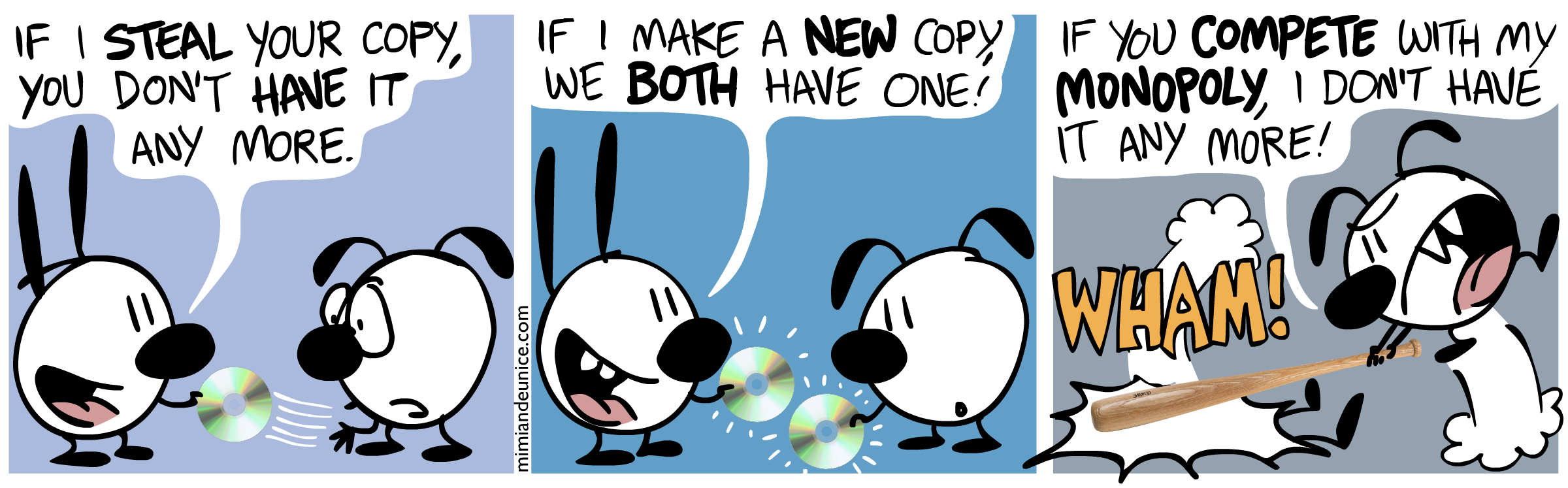
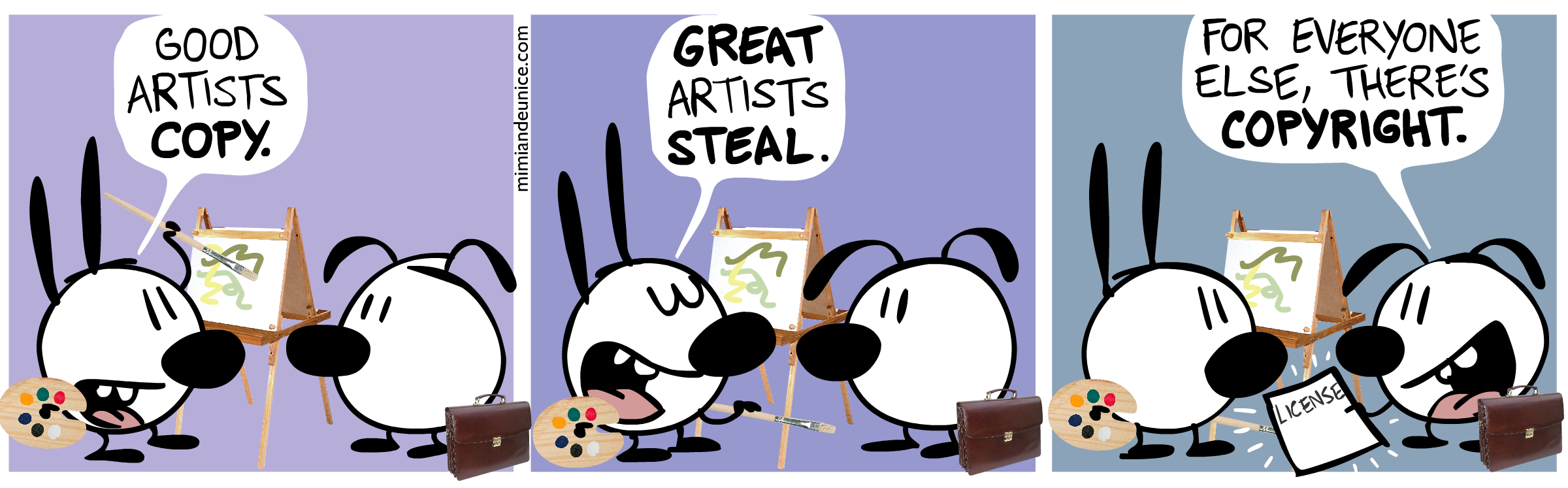
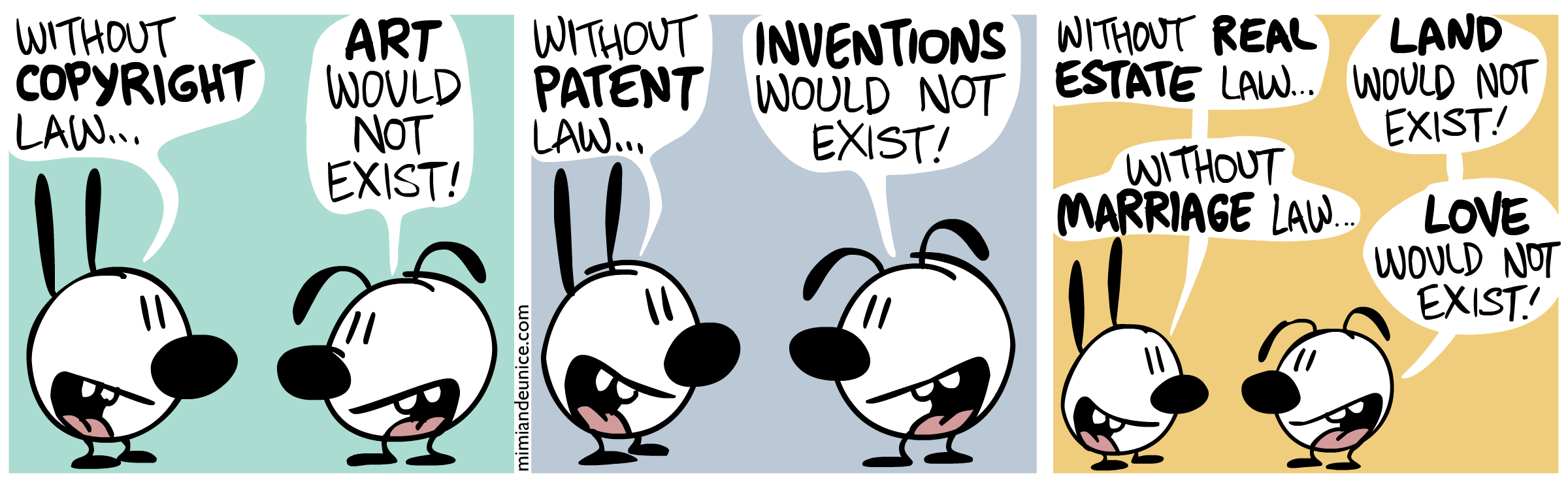
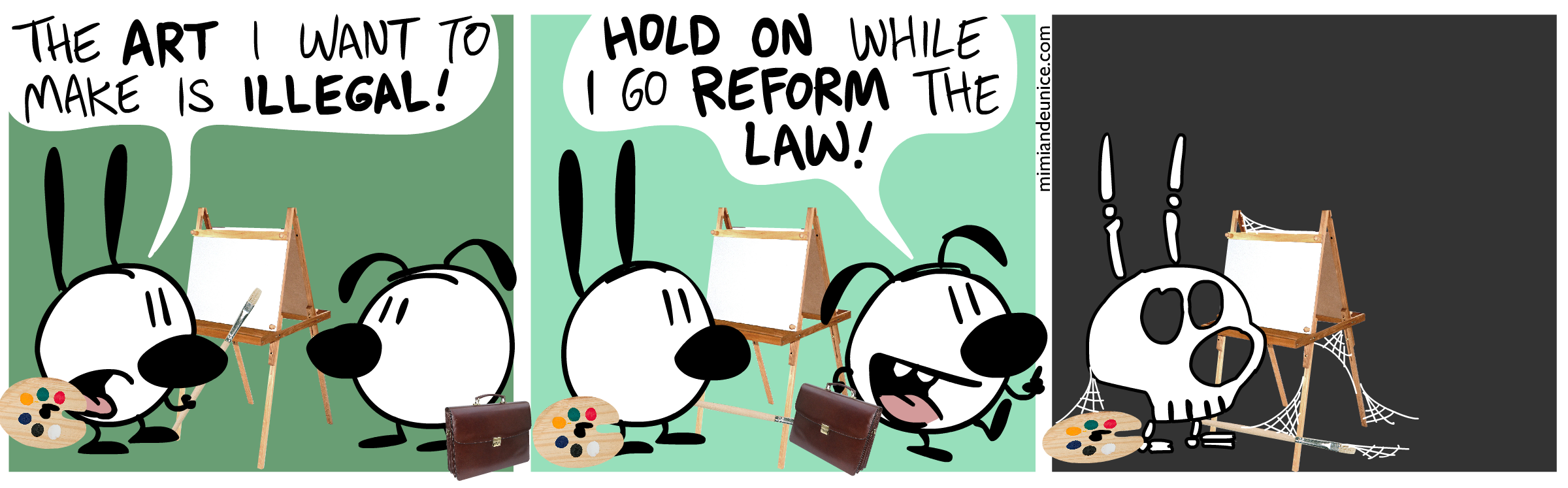
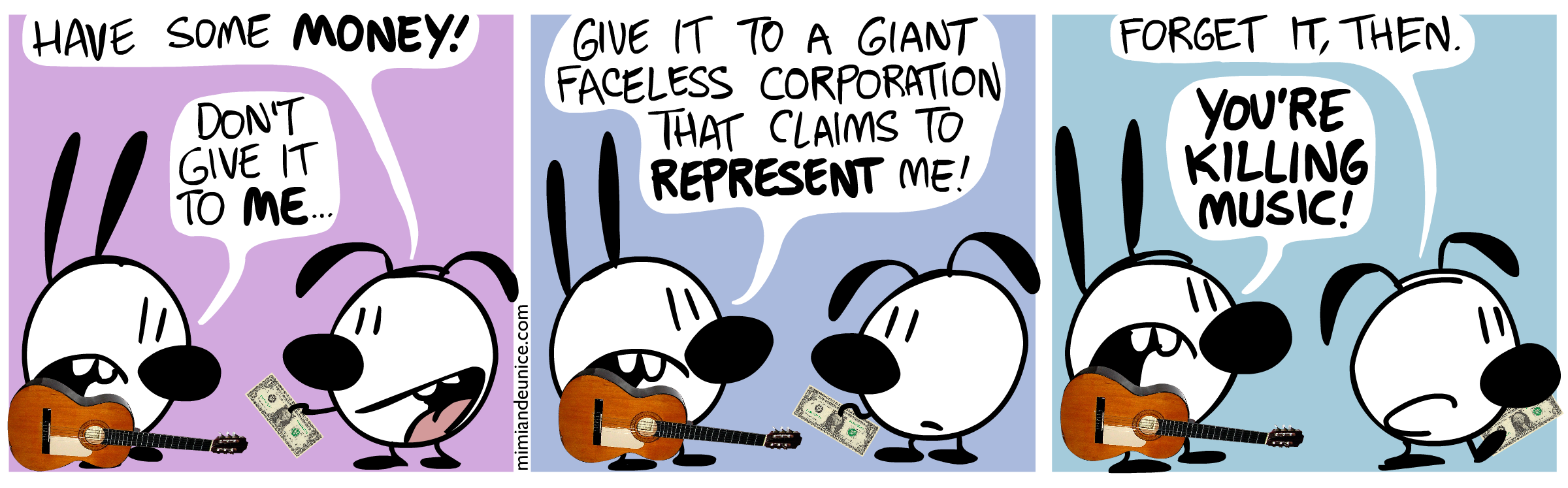
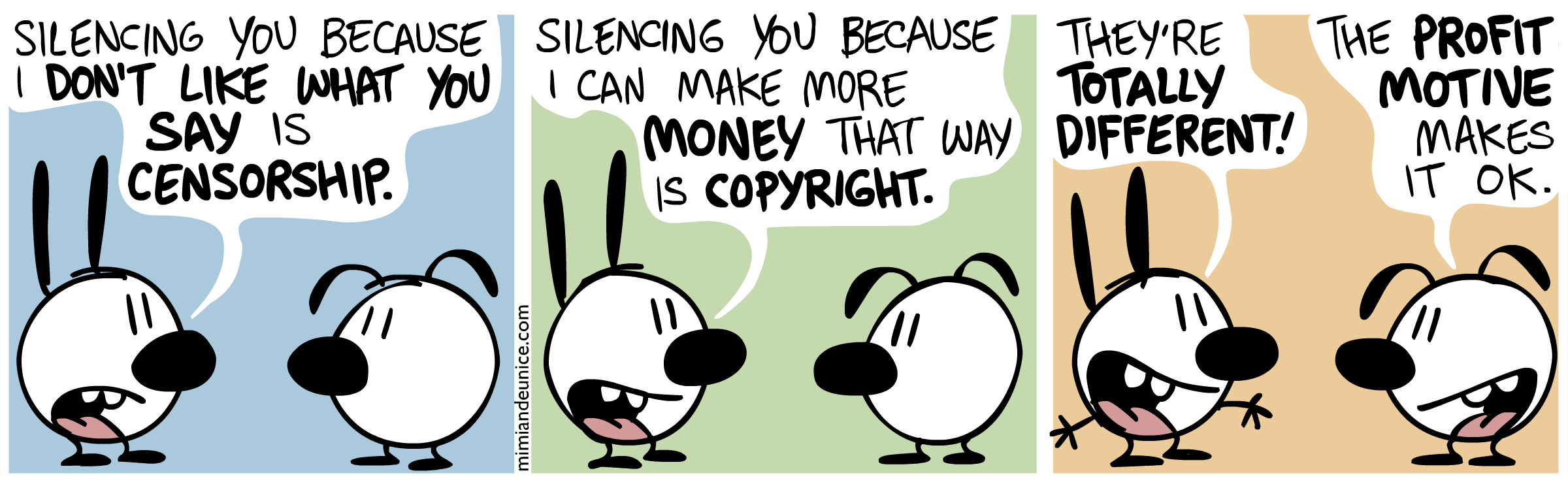
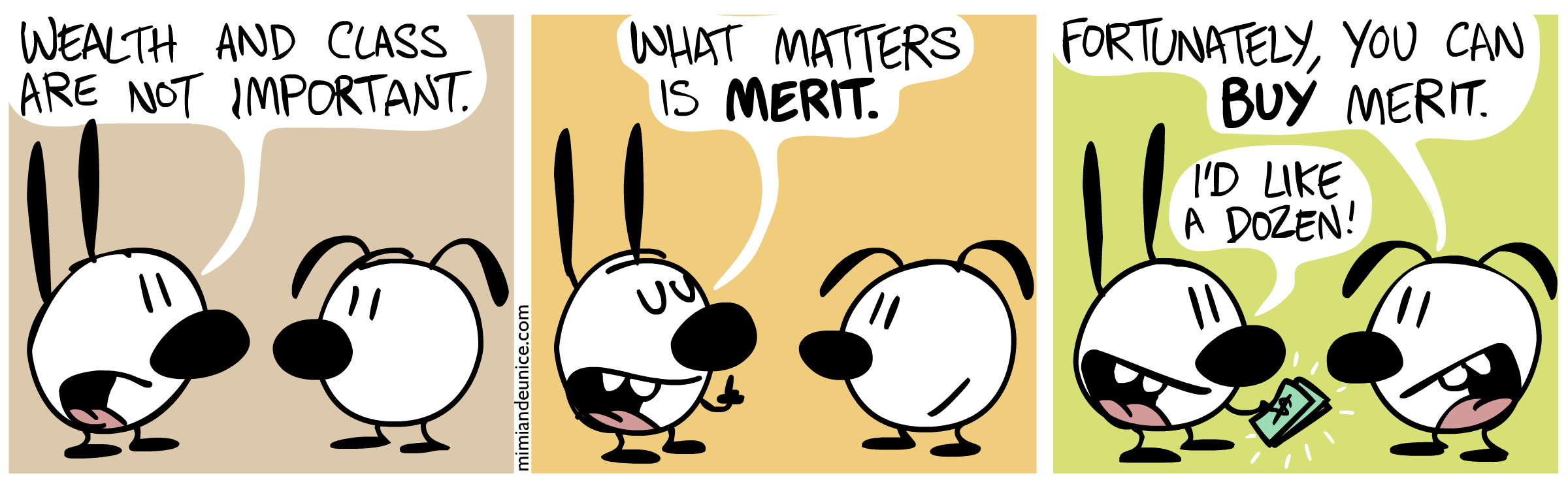

Posted by Kevin Carson on Aug 17, 2011 - C4SS
EUNICE: “Copying a song instead of buying a copy is stealing!”
MIMI: “Doing for yourself what you could pay someone else to do is stealing!”
BOTH: “Competition is theft!”
Unfortunately, Nina was preempted by reductio creep: The tendency of real world irrationality to outpace our ability to make fun of it.
In 2005, the French bus company TSE sued a group of cleaning women who’d previously taken the bus to work, arguing that carpooling was unregulated competition that deprived the bus company of revenue. Although that that specific case was thrown out, the principle it illustrates — a legal guarantee of rents from a monopoly on the right to do something — is at the heart of capitalism (as opposed to the free market).
Throughout history, propertied classes have relied primarily on artificial scarcities of material resources to extract a surplus from labor. With the help of state-enforced artificial property rights, a ruling class can control great concentrations of land and capital. These monopolies prevent competition from driving down the price of capital and land to their natural values. Thus the means of production are artificially scarce and expensive, and labor is forced to pay tribute for access to them.
Today, however, the imploding cost of production means that concentrated ownership of land and capital is becoming less and less effective as a means of rent extraction. The desktop revolution has reduced the cost of setting up a “publishing house” or “music studio” a hundredfold. Micromanufacturing with open source desktop CNC tools will soon do likewise to the cost of a factory. Intensive raised-bed horticulture grows many times more food per acre than mechanized agribusiness. In fact most “farming” is a real estate investment in which the government pays rent for the “farmer” to hold land out of use!
In this age of abundance, when the falling cost of machinery and exploding efficiencies of extracting value from inputs threaten to make control of physical resources worthless as a source of rent, rents accrue mainly to “property rights” like the right to do certain things, or criminalizing competition from more efficient ways of doing things.
Under old-style capitalism, rents were extracted by using artificial property rights to restrict access to physical opportunities for production. Now that the cheapening of physical means of production has made this strategy untenable, the ruling classes must instead charge rents on the right to produce with one’s own physical resources.
In today’s global economy, profits from old-style subsidies and artificial scarcities of physical resources haven’t exactly disappeared. Foreign aid and World Bank loans still provide subsidized infrastructure for offshored production. Third World landed oligarchies still nullify traditional peasant property rights and steal land for cash crop production in collusion with subsidized Western agribusiness interests. Thanks to compliant local governments, and the use of World Bank debt slavery to pressure the noncompliant — not to mention legacy titles from outright theft in colonial days — extractive industries make enormous profits mining and logging on ill-gotten land. Half of Big Pharma’s R&D is taxpayer funded, and billions of dollars of high-tech R&D is subsidized with refundable tax credits.
But most profits come from immaterial property in the right to make or do a certain thing. Because of patents it’s illegal to make a physically identical knockoff of an iPhone and sell it for a fraction of the price without all the embedded rents on artificial property. Copyright makes a CD of Word cost $200 instead of ten bucks like an Open Office CD. ”Intellectual property,” exactly like your grandfather’s tariff, is just a restriction on who has the right to sell a thing in a particular market. IP performs the same protectionist role for transnational corporations that tariffs once performed for national industrial corporations.
The majority of TNCs’ profits are from royalties or licensing fees. The most profitable industries in the global economy are those with business models based on IP: Pharma, biotech, entertainment, software. Patents give Western corporations a lockdown on the latest generation of production technology, effectively relegating Third World countries to supplying cheap raw materials and sweatshop labor. Trademark and patent laws enable corporate headquarters to outsource actual production to job shops in China or Vietnam, while charging a 1000% markup in retail outlets.
Intellectual protectionism apologists tell us ignoring patent and copyright monopolies is theft. It’s not. It’s legitimate free market competition. “Intellectual property” is theft.
Monday, June 6, 2011
New media laws could mean jail for ordinary users
Jacob Aron, technology reporter
16:30 3 June 2011
Regulating the internet is no easy task, as a recent string of technology-related bills proposed by US legislators shows. Poor wording and a lack of understanding of the underlying technology could put ordinary internet users at risk of breaking the law - even though supporters of the new bills say they wouldn't be targeted.
One bill, put forward by Senators Amy Klobuchar, John Cornyn and Christopher Coons, aims to make it a crime to stream copyrighted material, but as Techdirt points out, the wording of the bill as it currently stands could make simply embedding a YouTube video an illegal act.
The bill is intended to target streaming websites that provide entire movies for free, but uses the phrase "public performance by electronic means" without clearly defining it. Is embedding a video a performance? It's an important question, because the bill also imposes a jail term of up to five years for ten such "performances".
Another bill, recently signed into law by the governor of Tennessee, makes it illegal to share your password for media streaming services such as Netflix or Hulu. Anyone who allows friends or families to use their login details to access these services could potentially face a one-year jail sentence and a $2500 fine for stealing media worth $500 or less.
The new law updates existing legislation that makes it illegal to use services such as cable television or restaurants without paying, updating the wording to include "entertainment subscription services", but it seems Netflix doesn't see the need for such an update. The compoany told MediaBeat:
Google's chaiman, Eric Schmidt, has spoken out against the bill, saying it "sets a very bad precedent".
16:30 3 June 2011
Regulating the internet is no easy task, as a recent string of technology-related bills proposed by US legislators shows. Poor wording and a lack of understanding of the underlying technology could put ordinary internet users at risk of breaking the law - even though supporters of the new bills say they wouldn't be targeted.
One bill, put forward by Senators Amy Klobuchar, John Cornyn and Christopher Coons, aims to make it a crime to stream copyrighted material, but as Techdirt points out, the wording of the bill as it currently stands could make simply embedding a YouTube video an illegal act.
The bill is intended to target streaming websites that provide entire movies for free, but uses the phrase "public performance by electronic means" without clearly defining it. Is embedding a video a performance? It's an important question, because the bill also imposes a jail term of up to five years for ten such "performances".
Another bill, recently signed into law by the governor of Tennessee, makes it illegal to share your password for media streaming services such as Netflix or Hulu. Anyone who allows friends or families to use their login details to access these services could potentially face a one-year jail sentence and a $2500 fine for stealing media worth $500 or less.
The new law updates existing legislation that makes it illegal to use services such as cable television or restaurants without paying, updating the wording to include "entertainment subscription services", but it seems Netflix doesn't see the need for such an update. The compoany told MediaBeat:
Netflix applauds any efforts to stave off video piracy... However, Netflix already has provisions in its Terms of Use that restrict passwords to the member's household.These flawed bills come shortly after the proposal of the controversial Protect IP Act, which would give the US Department of Justice the power to block non-US websites hosting copyright-infringing material. The Act would also require search engines to remove links to such sites.
Google's chaiman, Eric Schmidt, has spoken out against the bill, saying it "sets a very bad precedent".
Tuesday, February 8, 2011
DHS Seizes Websites for Merely LINKING to Copyrighted Material
(I guess my blog days are numbered--jef)
***
Monday, February 7, 2011

Eric Blair
Activist Post
Apparently the Department of Homeland Security is now authorized to rewrite and enforce copyright infringement laws. In a stunning precedent, the recent round of domain seizures to shut down websites that allowed illegal streaming of the Super Bowl also included a few other websites that were seized simply for linking to infringing content.
Mike Masnick of TechDirt, who received and published a DHS seizure affidavit, had this to say in a must-read article:
Until these unprecedented seizures, online copyright infringement was dealt with by simply asking infringing websites to remove the material and replace it with a link to the source. Previous cases have normally been battled out in civil court. Alternative news giant, Matt Drudge, is currently fighting a seemingly ridiculous civil lawsuit over linking to news stories....the affidavit itself is chock full of legal and technical errors, compounded by assertions-as-facts that seem to have little basis in reality. This is immensely troubling, especially given that the specific legal issues here are hardly settled law, and Homeland Security seems to be acting as if these cases are no brainers, allowing them to flat out seize domains, even when those websites have been declared perfectly legal in their home countries.The biggest problem is that Homeland Security seems to suggest -- without a hint of doubt -- that merely linking to infringing content is criminal copyright infringement. That is a huge stretch. The affidavit appears to make it clear that it believes that these sites are guilty of direct criminal copyright infringement, rather than any sort of contributory copyright infringement. As we've discussed in the past, the courts have tended to say that embedding and linking can be contributory infringement, but not direct infringement. Homeland Security and ICE may be in for a bit of legal trouble trying to prove that embedding is direct infringement.
Additionally, this type of precedent would seem to massively change the Internet as we know it. What's next, seizing websites that link to those affiliate sites, like Facebook, Google, or Twitter? Well, that's the exact question Masnick investigated in his follow-up article, "Homeland Security Tries And Fails To Explain Why Seized Domains Are Different From Google." Masnick reports on an interview with a DHS agent in charge of the domain seizures, James Hayes:
In the interview, John Moe asked Agent Hayes a very simple question: given that these domains were all seized based solely on the fact that they link to infringing content hosted elsewhere, and all of the same content is also linked from Google, will the Feds seize Google's domain name? Well, more specifically, Moe asks if ICE could seize Google's domain name. Amusingly, right after being asked, Hayes conveniently gets cut off, but he does call back and the question is asked again.
However, once he gets back, he tries to tap dance around this issue. Hayes says "no" that ICE will not seize Google's domain name and that's because it's only targeting sites that "don't do due diligence" to make sure that the content they're linking to isn't infringing. There's a pretty serious problem with this claim in that it's wrong on both sides of the equation. First off, Google, as a search engine, does no due diligence to check that links only go to non-infringing content. Second, in at least some of the cases (specifically in the case of dajaz1), we know that it was actually Homeland Security and folks like Special Agent Hayes who "failed to do their due diligence," so the songs named in the ICE affidavit were, in fact, provided by the labels or representatives of the musicians. In other words, according to Special Agent Hayes' own criteria, Google is more of a criminal operation that Dajaz1.Despite the DHS's obvious distortion of the law, we are rapidly approaching a day where information can no longer flow freely on the Internet. We better wake up and share these stories with everyone we know, because tyranny is fast approaching. These words written above belong to nobody but the open-source, free Internet. Share and re-post at will.
For additional information about online copyright laws and guidelines, please visit the Citizen Media Law Project.
Tuesday, July 27, 2010
Did you hear the joke about the comedian and copyright law?
By Nate Anderson | Monday, July 26, 2010 | Ars Technica
Ponder the difference between the comedian and the musician. Both create and perform works to entertain audiences, but they go about protecting that work in different ways. The notoriously litigious music industry often resorts to the legal system to protect itself from pirates and samplers. But comedians don't. So why hasn't the joke well gone dry?
That's the question asked by a forthcoming book chapter from the University of Chicago Press called "Intellectual Property Norms in Stand-Up Comedy." Written by two professors from the University of Virginia School of Law, the chapter offers a case study in the axiom that more IP rights aren't always better IP rights.
For comedians, ripping off a joke is a major sin, but such cases almost never end up in court. Federal court, where copyright cases are heard, is too expensive to be worth it. Besides, copyright law only protects the exact expression, not the idea, so rip-off artists who add some different details are free to do so.
This hasn't led to a dearth of jokes. Instead, comedians use social norms rather than law to enforce their joke rights, and these social IP norms have actually been part of the process that shifted comedy away from one-liners and "rim shot" jokes to today's long-form observational comedy.
The authors interviewed 19 working comedians in detail, and they came away with an understanding that creators don't necessarily need formal legal protection to encourage them to create. But when they get protection, even an informal kind, creativity changes in interesting ways.
For instance, early twentieth century vaudeville featured plenty of joke and "bit" theft. Comedic ideas were common property; it was the performance that mattered. But as joke stealing became taboo in the 1950s and '60s, thieves would find themselves blackballed from clubs or ostracized by their fellow comics.
As this protection proved itself to be effective in practice, it encouraged comics to spend more effort on their "text." Jokes were no longer common property, so comics invested both time and money writing (and hiring others to write) new material in a way they rarely did before.
The result was more original comic material—but there was a side effect. "Comedians today invest less in developing the performative aspects of their work," says the chapter. "Indeed, many stand-ups today stand at a microphone, dress simply, and move around very little compared with the more elaborate costuming, mimicry, musicianship, and playacting that characterized the post-Vaudeville comics."
When IP norms did not exist, the hard-to-replicate live performance was the key differentiator. Once the informal community norms offered some protection for jokes, much of the creativity shifted back to the "text" and away from the performance.
In both cases, though, comedy flourished, and neither required official IP laws. "Conventional wisdom would have us believe that this [lack of official protection] entails a tragedy of the commons and suboptimal supply of jokes," write the chapter's authors. "Our research makes us pause. We see an operating market."
Their takeaway is not that we don't need rules, but that we should be doubly vigilant against the "careless expansion of legal protections." Informal norms might work well enough within different communities (and the smaller the community, the easier social norms are to enforce), and changing the official rules could produce unintended changes in the type of creativity that people engage in.
IP rules are needed, but they aren't "necessarily right for stand-up or for every creative practice." And that's no joke.
Ponder the difference between the comedian and the musician. Both create and perform works to entertain audiences, but they go about protecting that work in different ways. The notoriously litigious music industry often resorts to the legal system to protect itself from pirates and samplers. But comedians don't. So why hasn't the joke well gone dry?
That's the question asked by a forthcoming book chapter from the University of Chicago Press called "Intellectual Property Norms in Stand-Up Comedy." Written by two professors from the University of Virginia School of Law, the chapter offers a case study in the axiom that more IP rights aren't always better IP rights.
For comedians, ripping off a joke is a major sin, but such cases almost never end up in court. Federal court, where copyright cases are heard, is too expensive to be worth it. Besides, copyright law only protects the exact expression, not the idea, so rip-off artists who add some different details are free to do so.
This hasn't led to a dearth of jokes. Instead, comedians use social norms rather than law to enforce their joke rights, and these social IP norms have actually been part of the process that shifted comedy away from one-liners and "rim shot" jokes to today's long-form observational comedy.
The authors interviewed 19 working comedians in detail, and they came away with an understanding that creators don't necessarily need formal legal protection to encourage them to create. But when they get protection, even an informal kind, creativity changes in interesting ways.
For instance, early twentieth century vaudeville featured plenty of joke and "bit" theft. Comedic ideas were common property; it was the performance that mattered. But as joke stealing became taboo in the 1950s and '60s, thieves would find themselves blackballed from clubs or ostracized by their fellow comics.
As this protection proved itself to be effective in practice, it encouraged comics to spend more effort on their "text." Jokes were no longer common property, so comics invested both time and money writing (and hiring others to write) new material in a way they rarely did before.
The result was more original comic material—but there was a side effect. "Comedians today invest less in developing the performative aspects of their work," says the chapter. "Indeed, many stand-ups today stand at a microphone, dress simply, and move around very little compared with the more elaborate costuming, mimicry, musicianship, and playacting that characterized the post-Vaudeville comics."
When IP norms did not exist, the hard-to-replicate live performance was the key differentiator. Once the informal community norms offered some protection for jokes, much of the creativity shifted back to the "text" and away from the performance.
In both cases, though, comedy flourished, and neither required official IP laws. "Conventional wisdom would have us believe that this [lack of official protection] entails a tragedy of the commons and suboptimal supply of jokes," write the chapter's authors. "Our research makes us pause. We see an operating market."
Their takeaway is not that we don't need rules, but that we should be doubly vigilant against the "careless expansion of legal protections." Informal norms might work well enough within different communities (and the smaller the community, the easier social norms are to enforce), and changing the official rules could produce unintended changes in the type of creativity that people engage in.
IP rules are needed, but they aren't "necessarily right for stand-up or for every creative practice." And that's no joke.
Monday, April 5, 2010

Subscribe to:
Posts (Atom)