Showing posts with label mortgages. Show all posts

Monday, March 11, 2013

US Housing: Is the Recovery Real?

Speculators Chasing Yield
by MIKE WHITNEY

“If it weren’t for the activity of investors, including large hedge funds, there would be no market recovery.”

– Larry Roberts, O.C. Housing News

There’s no doubt that housing prices are going up. According to Corelogic, home prices have risen nearly 10 percent in the last year. And sales have been improving, too. In fact, in the last year alone, sales for new “single-family” homes are up 28.9 percent (437,000 homes) while sales for existing homes have increased by 9.1 percent year-over-year. (4.92 million units)

At the same time, inventory is at a 13-year low, which is pushing prices even higher. Across the country, inventory is down 25.3 percent, but it’s much worse in some of the nation’s hotter markets. According to CNBC:
“Listings are down 31 percent in Seattle from a year ago, down 32 percent in Denver, down 20 percent in Houston, down 37 percent in Boston, according to local Realtor associations….

“At the moment it’s a seller’s market again,” said David Fogg, a real estate agent in Burbank, CA. “Very low inventory, very low interest rates, almost no bank inventory of homes, it’s crazy out there. Every good property I’ve listed this year has brought 10-50 offers and sales prices 10-20 percent over comps. Cash is King.” (CNBC)

So, if sales and prices are going up, and inventory is shrinking, then how can anyone dispute that housing is finally recovering?

While it’s true that the data don’t lie, it’s also true that there’s more in the data than meets the eye. For example, did you know that there are currently 9.8 million vacant housing units in the US, but only 1.74 million of those homes are listed for sale on the MLS? That’s less than 20 percent of the total. So where did the rest of the homes go? Did they just vanish into the ether or are they being kept off the market for some other reason, like to keep prices artificially high?

And as we said earlier, inventories are down 25.3 percent from 2012. There are two reasons for this. First, the banks are holding most of their distressed properties off the market to keep prices high. Second, the banks are controlling the number of underwater homeowners who are allowed to sell via short sales, that is, to sell their home for less than the current price of the mortgage. In other words, the banks control the whole shooting match. If the banks want prices to go up, they simply reduce the supply and prices edge higher. So far, the plan appears to be working.
Housing experts figure that roughly 40 percent of the people who would normally put their houses up for sale, are unable to do so because they are still underwater on their mortgage and the amount they’d get from the sale would require them to borrow money to pay the balance. Who wants to do that? It’s cheaper to just stay in the house and stop making the mortgage payment, which is what millions of people have done. Now they’re waiting for the bank to foreclose, but the banks are in no hurry because foreclosing would just add to their mountain of distressed inventory which would push prices down further. So millions of delinquent borrowers are presently living in their homes for free as they have been for the last two or three years. The “housing recovery” cheerleaders rarely mention this part of the story.

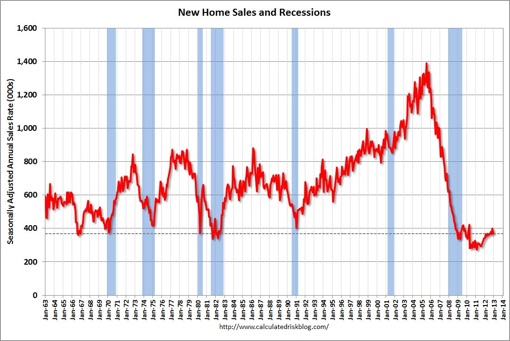
And another thing; while it may sound like houses are selling like hotcakes, the truth is far different. New home sales are less than one-third of what they were at their peak (1.4 million), while existing home sales are merely back to what they were in January 2002 before housing ballooned into a humongous bubble. In other words, the Fed’s record low rates, Obama’s mortgage modification programs, and FHA’s meager 3.5% down payment policy, have barely pushed sales back up to their historic trend. Does that sound like a strong recovery to you?

When you read about the great housing recovery, you should take it with a grain of salt. Take a look at this chart and you’ll see why.


New Home Sales


See that little squiggle at the end of the red line? That’s the housing recovery. That’s what $1.5 trillion dollars worth of mortgage backed securities (MBS) will buy you these days. Such a deal!

Now check out this excerpt from The Burning Platform:
“The contrived elevation of home sales and home prices has been engineered by the very same culprits who crashed our financial system in the first place. This has been planned, coordinated and implemented by a conspiracy of the ruling oligarchythe Federal Reserve, Wall Street, U.S. Treasury, NAR, and the corporate media conglomerates. Ben’s job was to screw senior citizens and drive interest rates low enough that everyone in the country could refinance, attract investors and flippers into the market, and propel home prices higher. Wall Street has been the linchpin to the whole sordid plan. They were tasked with drastically limiting the foreclosure pipeline, therefore creating a fake shortage of inventory. Next, JP Morgan, Blackrock, Citi, Bank of America, and dozens of other private equity firms have partnered with Fannie Mae and Freddie Mac, using free money provided by Ben Bernanke, to create investment funds to buy up millions of distressed properties and convert them into rental properties, further reducing the inventory of homes for sale and driving prices higher. Only the connected crony capitalists on Wall Street are getting a piece of this action. The Wall Street big hanging dicks have screwed the American middle class coming and going. The NAR and media are tasked with what they do best – spew propaganda, misinform, lie, cheerlead and attempt to create a buying frenzy among the willfully ignorant masses. ….. Mortgage applications by real people who want to live in a home are no higher than they were in 2010 when home sales were 33% lower than today. Mortgage applications are lower than they were in 1997 when 4 million existing homes were sold versus the 5 million pace today. The housing recovery is just another Wall Street scam designed to bilk the American middle class of what remains of their net worth.” (“It’s always the best time to buy”, The Burning Platform)

The whole article is a must read for anyone who’s at all interested in housing or government-Wall Street collusion. The author points to another disturbing trend too, the fact that firsttime homebuyers have vanished from the marketplace. Firsttime homebuyers and “move up” buyers used to make up the majority of all housing sales. Now they’ve been replaced by over-extended FHA borrowers (leveraged at 30 to 1) and private equity speculators who represent a full 30% of the market. This new dynamic won’t last, mainly because rising prices reduce profit margins causing speculators to shift to other forms of investment.

Case in point: Just look at Las Vegas where the big Wall Street investors have been buying everyhing that’s not nailed to the floor. This is from Realty Check:
“The Las Vegas market is being fueled by investors, but even the investors can’t find the great bargains anymore….(Mike Brunson, a local appraiser) called Las Vegas the Titanic of the real estate market. It was once thought unsinkable, and even now that the worst is over, he still thinks the market is on a well-provisioned life raft, not on solid ground.

“The only thing that concerns me is that we have been here before and the market itself is not what is driving the price increases. It’s not that we have new employers coming in and creating tens of thousands of new jobs that are leading to people buying new houses. It’s ‘Las Vegas is on sale,’ and investors are buying up everything they can in the used market…..

Brunson… still worries about the fundamentals, such as the slow economic growth and the fact that so much of the funding for new home sales is coming from low down payment, government-backed mortgages.” (“What’s Fueling the Housing Boom in Vegas?” Realty Check)

Brunson crystalizes the views of the housing skeptics (like me), that is, that a recovery that depends on speculators “chasing yield” instead of “organic growth” from working people looking for a place to live, is bound to fail. It’s only a matter of time. Any tightening of rates by the Fed or stock market correction will send the speculators racing for the exits.

Here’s more from Dave Dayen at The New Republic:
Analysts insist that REO-to-rental does not represent a bubble, that the rental revenue streams will satisfy investors and prevent a mass sell-off. But any disruption in the economy would affect the market for rental housing, leading to longer vacancies and lower returns on investment. And the textbook definition of a bubble consists of speculation chasing an appreciating asset. This is precisely what we have in REO-to-rental. In the words of analyst Josh Rosner of Graham Fisher, “the speculative boom has returned.”Investors have begun to pull out of one of the leading edge markets, Phoenix, as most of the foreclosed properties worth purchasing have been snapped up. The big run-up in prices there could collapse as demand collapses, depressing prices and putting the recovery in jeopardy. And any economic downturn would increase rental vacancies and send this entire market reeling. We may not only have a bubble, but already the beginnings of a bust….” (“Your new landlord lives on Wall Street“, Dave Dayen, The New Republic)

Once the PE parasites have stripped the carcas to the bone; they’ll move on to other prey. It’s the nature of the beast. That means that all the markets that rallied in the last 9 months, will see a sharp drop off in demand in 2013 as investment dries up and prices flatten out or retreat. The investment craze is on a very fixed time-line. If lending standards don’t ease, prices will fall. It’s a sure-thing. Low interest rates alone will not keep prices high.

Even so, Fed chairman Ben Bernanke’s zero rate policy (zirp) has helped to fuel another destructive bubble that is setting up borrowers for more excruciating losses. Take a look at the bubble that is developing in California. This is from an article titled More Bubble Trouble in California?:
“In Southern California, home sales have jumped 14 percent over last year and the median price is up 16 percent, some 25 percent in Orange County. We may not quite be at 2007 super-bubble levels but we’re getting there, particularly in the more desirable areas.

Yet, before opening the champagne, we need to look at some of the downsides of this asset recovery. We are not seeing much new construction, particularly of single-family homes, so the supply is not being replenished as inventory sinks. Meanwhile, many of the homebuyers are not families seeking residences, but flippers, Wall Street types and foreign investors. A remarkable one-in-three Southern California home purchasers paid with cash, up from 27 percent from last year.

It’s clear that this increase is not being fueled primarily by income growth among middle-class Californians; these “prices are rising disconnected from household incomes,” notes one analyst….

This leads to what is becoming the biggest problem facing the state – a decline in the rates of affordability. The previous bubble left us a legacy of more-affordable housing, an advantage we may now be losing….The groups hit hardest by this scenario will be middle- and working-class Californians, particularly above the age of 30-35, most of whom desire to own their own home. Unable to qualify, or unwilling to overleverage, many will be forced either to give up their dreams or look elsewhere, taking their talents and, eventually, their offspring, with them.” (“More Bubble Trouble in California?”, Joel Kotkin, New Geography)

As always, the Fed’s meddling creates clear winners and clear losers. In this case, working people are getting shafted while Ben’s facebook friends make off with the lion’s share of the loot. Some things never change.

There’s no way to dispute that prices and sales have been improving. Interest rate stimulus, inventory suppression, and unprecedented speculation have reversed the downward trend and lifted housing off the canvas. But it’s going to take more than that to produce a sustainable housing recovery. It’s going to take a strong economy where unemployment is low and wages are growing.

Don’t hold your breath.

Total Housing Activity Chart: http://advisorperspectives.com/dshort/charts/index.html?guest/2012/LR-Home-TotalActivityIndex-112812.PNG

Wednesday, October 31, 2012

Is Housing About to Tank?

You Call It Recovery, I Call It Bollocks
by MIKE WHITNEY
 
Well, what do you know; mortgage applications have fallen off a cliff.

According to the Mortgage Bankers Association (MBA) loan applications decreased by 12 percent on a seasonally adjusted basis from one week earlier “registering the biggest percentage decline in a year as demand for both purchase loans and refinancings tumbled.”
But how can that be, after all,  the experts assured us that the Great Housing Rebound of 2012 was underway? They couldn’t be wrong, could they?

Uh huh. Just look at the data. Housing is still stuck in a long-term slump despite the cheerleading of “bottom callers” and oily TV pundits. The fact is, if the banks continue to keep their distressed inventory “off market”, (as they have been) sales are going to go down, way down, because the availability of affordable, low-end homes is drying up. That’s why mortgage applications are taking a hit, because the higher prices are crimping demand.

For the last few months there have been a number of factors that have helped to nudge prices higher than they should be. First, there’s the deluge of industry propaganda about prices ”hitting bottom”. What a crock. The reason prices have been going up is because the banks have slashed the number of repo properties they’re putting up for auction. Forget the fundamentals, the banks are playing a big shell game to hoodwink the sheeple into believing its safe to come out of their bunkers and start perusing the MLS again. If they’re smart, they’ll crawl back into their spiderholes and wait ’til the coast is clear.

Another reason why prices have recovered is because Uncle Sugar has been dishing out more perks to private equity and other fatcat investors through the Foreclosure-to-Rental scam. Many of these distressed properties have never even been listed on the MLS, so if you’ve been hanging around waiting for prices to correct, you can forget about it. That 2-story Tudor with the stone turret and the copper gargoyles just got offloaded to some moneybags shyster from Brooklyn who’s filling out his portfolio with budget real estate.

Here’s the scoop from Dr Housing Bubble:
“Renting out foreclosed homes has increasingly emerged as an investment opportunity for Wall Street. Financiers are busily studying ways to take the single-family home rental business, for years mostly a mom-and-pop affair, and make it a bigger industry. That has made it difficult for first-time shoppers to compete.”
So now you have to compete with Wall Street that receives favorable treatment from the government and Fed just to purchase an entry level home. This is becoming a closed loop system. The same financiers that made billions upon billions of dollars shelling out fraudulent loans and toxic waste are now gaining favorable treatment in locking up blocks of properties to jack up prices. The California median price is up 12.9 percent year over year while incomes remain stagnant. In Phoenix it is up a stunning 30 percent. Las Vegas? Up 18 percent year over year. These gains are on par with the peak years of the bubble.” (“A modern day feudal system for real estate”, Dr Housing Bubble)
A “closed loop system”. I love that. It really sums up what’s going on behind the scenes and how all the gravy keeps flowing to the chiselers on top.

And did you catch that part about Phoenix being up 30 percent in a year? That’s what happens when the big boys come to town and start snapping up all the cheapo homes so they can make a killing in the rental biz. It’s like buzzards flocking to roadkill.

Did you know that private equity firms have already raised “$8 billion to buy as many as 80,000 single-family homes” they plan to manage as rentals? That ought to keep prices going in the right direction, right?

Wrong. The truth is, rental management is tougher than it looks. It eats up a lot of time and money, which is why some of these investor groups are bailing already. It’s not the golden goose they thought it was going to be, so they’re pulling up stakes.

But if the private equity boys move on, then what’s going to happen to prices? That’s what everyone wants to know, including the Atlanta Fed who just wrote an analysis of the topic in a paper titled “Investor Participation in the Home-Buying Market”. Here’s what they found:
“When asked to describe the distribution of home buyers in their market, our business contacts from the Southeast (excluding Florida) noted that one-fifth of home sales, on average, were to investors. Once we added Florida into our tally of Southeast contacts, just over one-fourth of sales, on average, were to investors.” (“Investor Participation in the Home-Buying Market”, Federal Reserve Bank of Atlanta)
Whoa. So 25% of sales are going to investors? That’s a lot of real estate. So what happens if these heavyweights decide their investment strategy is a dud and pack-it-in before their shareholders figure out what’s going on? Then the market is in for another big price shock, right?

Here’s more from the Atlanta Fed:
“…institutional investors ramped up activity earlier this year and have indeed concentrated their investment activity within a handful of markets that were hit hard by the housing downturn. Acquisition strategies for these larger investors focus on mostly low-priced, distressed properties.
This makes sense. The markets hit hardest by the housing downturn are also the markets where distressed properties make up a significant portion of the available homes for sale. However, data from CoreLogic indicates that the share of distressed sales is steadily declining over time. As the distressed sales share continues to shrink and home prices continue to rise, it stands to reason that investment activity will shrink (or continue to shrink).
It was recently noted that Och-Ziff Capital Management Group LLC, a large institutional investor (not outlined in the table above), announced that it intends to exit this line of business. Perhaps it is just a matter of time before other large investors follow suit.” (“Investor Participation in the Home-Buying Market”, Federal Reserve Bank of Atlanta)
Well now, that doesn’t sound very encouraging. It sounds like the Fed has already figured out that the investment craze is a short-term phenom that will burn out and leave a big hole in the market. How does that square with all the cheerleading hoopla we’ve been hearing in the media lately? Not very well. In fact, it makes the “housing has bottomed” trope sound like your typical, lying Madison Avenue hype designed to dupe the public. Check this out from the MBA:
“The MBA is warning it expects to see $1.3 trillion in mortgage originations during 2013. This is down more than 25% from its revised estimation of $1.7 trillion in 2012.”
So they were off by $400 billion in their estimate? How the heck does that happen? Have they been making their calculations on an abacus?

Then there’s this from CNBC where expert Diana Olick wants to know “Where is all this distressed supply”:
“So where is all this distressed supply, given that there are still 5.45 million homes with mortgages that are either delinquent or in the foreclosure process (per LPS Applied Analytics)?”
Good question. How do you sweep 5 and a half million homes under the rug, that’s what I’d like to know? Here’s more from Olick:
“The biggest problem is that regular home sellers are not putting their homes on the market at a high enough rate to offset the drop in distressed volumes. Why? Part of it is still a lack of confidence in the market, but most of it that, as of August, about 15 million homeowners still owed more on their mortgages than their homes were worth, according to Zillow. That’s 31 percent of homes with a mortgage. Negative equity and near negative equity is largely what is holding the market back now, even as distressed homes slowly move out of the system.” (“Where is all this distressed supply?”, CNBC)
So there’s two things going on here. First, lenders are withholding their supply of distressed bank-owned homes in order to keep prices high. And, second, millions of people can’t sell because they’re underwater and selling would mean they’d have to come up with tens of thousands of dollars to close the deal. So it’s cheaper for them to “stay put.” The point is, neither of these are a sign of a strong market. Instead, they’re an indication of how discombobulated and utterly out-of-whack housing really is. Six years after the bubble burst, and policymakers are still holding the market together with bubble gum and duct tape. What a joke.

The strained inventory situation could get a lot worse too, mainly because private equity is wiping out the stockpile of low-end homes which make up 65% of the market. For example, sales of homes under 100 thousand dollars are down 47% out West year-over-year. As the cheap homes vanish, prices will rise, but sales will plunge. You can take that to the bank.

Now take a look at this from the National Association of Realtors (NAR) September report on existing home sales:
“Total existing-home sales, which are completed transactions that include single-family homes, townhomes, condominiums and co-ops, fell 1.7 percent to a seasonally adjusted annual rate of 4.75 million in September from an upwardly revised 4.83 million in August, but are 11.0 percent above the 4.28 million-unit pace in September 2011.”
Same old, same old, right? Prices up, sales down. Of course, Ben Bernanke thinks he can turn things around by lowering rates, flooding the system with liquidity, and reflating property values to the point where people start spending like crazy again. But that hasn’t happened yet, has it, mainly because Bernanke’s crackpot QEternity has turned out to be a big, fat bust. Did you know that in the six weeks since Ben Bernanke launched QE3, the 30-year fixed mortgage rate has dropped just 10 lousy basis points, which is virtually no difference at all. At the same time, the S&P 500 has slipped 2 percent, while mortgage applications have gone into a deep swan dive. In other words, Bernanke’s “accommodative policy” has had no meaningful effect on housing at all. The market is still mired in a depression with just modest improvements in new homes sales. And even that’s looking a bit sketchy. Take a look at this from CNBC:
“New U.S. single-family home sales surged in September to their highest level in nearly 2-1/2 years, further evidence the housing market recovery is gaining steam. The Commerce Department said on Wednesday sales increased 5.7 percent to a seasonally adjusted 389,000-unit annual rate — the highest level since April 2010, when sales were boosted by a tax credit for first-time homebuyers.”
Yippee. Housing is back. The recovery is real. Maestro Bernanke has triumphed.
Er, not exactly. Here’s a little background analysis you’re not going to find on propaganda channels. This is from Lance Roberts at Street Talk Live:”The headline number that is released is a seasonally adjusted and annualized number based on the actual month to month data. The Commerce Department reported that sales of new homes increased 5.7% to 389,000 in September. This increase against August’s downwardly revised pace of 368,000-units.

However, in reality there were only 31,000 ACTUAL new homes sold across the entire United States in September. This is the same number that was sold in August and down from the 35,000 units sold in May. In other words, the entire 5.7% increase in new home sales in September was strictly seasonal adjustments…..”Okay, so it’s a bit technical, but you get the gist of what Robert’s is saying. He’s saying, It’s all bollocks.

The only part of the market that’s busy is the low end where speculators are fighting over a few measly crumbs. The rest of the market is kaput.
You can call that a recovery. I call it bollocks.

Sunday, January 1, 2012

Companies getting very creative with data about you

By Candice Choi, Associated Press

NEW YORK – Companies are getting smarter at predicting your next move
As it becomes easier to gather information on consumers, businesses are crunching personal data in new ways to forecast a wide variety of behavior. In much the same way that credit scores predict how likely you are to pay your bills, a new generation of scores now rate the likelihood that you'll take your medications or redeem a specific coupon.

In some cases, transactions that were traditionally considered off the books — such as rent payments and payday loans — are being incorporated into the growing body of information used to size up customers.

The new uses of personal data raise a host of concerns for consumer advocates, who question the reliability of the scoring models and the accuracy of the information on which they rely. Also troubling is that many consumers are oblivious that they've been tagged with these numbers, notes Chi Chi Wu, an attorney with the National Consumer Law Center. In many cases, consumers have no way to learn what their so-called consumer scores are.

"If this score is about me, I should be entitled to it," Wu said.

With credit scores, for example, lenders are required to disclose a score if it was used to deny a loan or assign a higher interest rate. Those who aren't actively seeking a loan can also pay to learn their credit scores from Fair Isaac Corp., which also goes by the name of its widely used FICO score.

If you're wondering how else businesses are rating you, here's a look at four recently introduced scores you may not know about:

Mortgage scores
Anyone who has applied for a mortgage understands the importance of credit scores. The three-digit figures not only help determine whether a bank will approve a loan, but its interest rate as well.

Now a company called CoreLogic is developing a score it says will zero in on predicting a borrower's likelihood of repaying a mortgage. The score will be based on a new breed of credit reports the company released last month.

These reports gather information that isn't typically listed on credit reports, including information from CoreLogic's in-house databases of rental records and payday loan applications. Also included are public court records, such as property liens, evictions and child support judgments.

The new score is intended to give lenders a more "complete picture" of mortgage applicants, said Tim Grace, a CoreLogic executive. He said that should lead to better lending decisions and reduced delinquencies for banks.

The exact formula for the score is still being developed with FICO. But once they're available in March, Grace said consumers will be able to purchase their scores for a price yet to be determined. For now, CoreLogic is required by law to provide customers with a free annual copy of the more detailed credit reports the company introduced last month. Consumers can request their reports by calling 877-532-8778.

Medication scores
The business of scoring consumers isn't limited to financial matters. A score that was introduced this summer seeks to predict the likelihood that patients will take their medications. An individual's score can even vary depending on the condition; the score is available for hypertension, diabetes, high cholesterol, depression and asthma.

FICO says its Medication Adherence Score is intended to help health care providers flag patients at risk of ignoring doctor's orders. The idea is to improve overall patient outcomes and reduce health care costs. The score is not available to individuals.

Interestingly, a patient's health and credit data are not used to determine the score. Instead, FICO says it can predict compliance based on demographic information such as household size; those who live alone are more at risk of skipping their medications. Owning a car, by contrast, is a good indicator for health care providers, as is being neither very young nor very old.

And as it turns out, FICO says men are more likely to take their medications than women. Other information thrown into the formula includes the rate of bankruptcies in a patient's region and purchase histories culled from the same databases retailers use to target households for catalogs.

FICO, which notes that the scores can't be used for insurance underwriting purposes, declined to say whether the score is being used by any clients yet. But the company has estimated that 2 million to 3 million Americans would be scored by this year, with that number set to rise to around 10 million by the end of next summer.

Income scores
Asking a person how much he or she earns for a living is off limits in most circles. But credit card issuers and other companies can get a good idea of how much you make through an outside source.

Experian, one of the three national credit reporting agencies, in March introduced a product that predicts an individual's annual wages rounded to the nearest thousand dollars. The Income Insight W2 is based on the borrower's credit report.

"The intuitive explanation is that if you can maintain a mortgage or credit card payment at a certain level each month, you're earning a minimum amount," said Brannan Johnston, vice president of income and assets at Experian.

The W2 is a variation of an income forecaster the company rolled out in 2009, which predicted total household income, including investment income and spousal income. The singling out of the individual's wages was a response to new credit card regulations last year that require card issuers to assess card applicants' ability to afford their credit lines.
Although credit card issuers are the most common users of the Income Insight W2, Johnston notes that many other companies — including debt collectors — also use it to gauge how much individuals are earning.

Shopping scores
The items you put in your shopping cart aren't free from scrutiny either. FICO says it has helped a third of the top 100 largest U.S. retailers target their marketing based on customer buying patterns.

FICO declined to detail its roster of retail clients. But the warehouse discount club Sam's Club says it worked with the company to develop its eValues program introduced about two years ago that offers premium members personalized discounts.

Sam's Club uses its vast database of member transactions to determine "propensity scores," which gauge the likelihood that a customer would act on a particular discount. The scores even factor in the best time to offer that discount. For example, a customer who just bought three boxes of bulk cereal wouldn't be offered a discount on the same items right away.

So far, the program seems to be working. The company says that premium membership — which costs $100 a year, compared with $40 a year for standard membership — has more than doubled since eValues was launched. Customers who redeem an eValue discount also make more than twice as many trips to the store and tend to buy far more items during each visit, according to the company.

Although the scores aren't available to members, the company notes that shoppers are clearly benefiting from them.

"It's kind of like the eHarmony of couponing — we find the very best offers for the customer," said Catherine Corley, vice president of member program development at the company.

Friday, April 15, 2011

US banks to settle on financial crisis penalties

(Bastards!--jef)


US banks to settle on financial crisis penalties: report
By Agence France-Presse
Friday, April 15th, 2011

NEW YORK (AFP) – Several major US banks are close to an agreement with the Wall Street regulator to settle fraud allegations related to the "toxic" mortgages behind the 2008 financial crisis, a report said Friday.

An initial agreement with the Securities and Exchange Commission (SEC) could be settled next week, the Wall Street Journal said, citing sources close to the case, noting penalties would likely vary for different institutions.

Among the banks in negotiations with the SEC are JPMorgan Chase, Citigroup, Morgan Stanley, Merrill Lynch, Bank of America and UBS.

Few of the settlements are likely to top the $550-million penalty imposed on the Goldman Sachs Group in 2010 over allegations it misled investors over a mortgage investment program, the Journal said.

The financial crisis that stemmed from trillions of dollars in risky mortgages promoted by the top Wall Street firms has engulfed the globe and cost millions of jobs in the years since.

That mortgage bubble grew, burst and infected banks' balance sheets thanks to the magnifying effect of complex financial derivatives, noted an official US report issued earlier this year.

The Financial Crisis Inquiry Commission, after reviewing millions of pages of documents and interviewing around 700 witnesses, concluded in January that bankers, lawmakers, regulators and irresponsible borrowers all helped plunge the world into financial panic.

"This financial crisis was avoidable. The crisis was the result of human action and inaction, not Mother Nature or computer models gone haywire," the report said.

Tuesday, March 15, 2011

Bank Of America Anonymous Leak Alleges 'Corruption And Fraud'

Monday, March 14, 2011 by The Huffington Post
A group called Anonymous has released material relating to mortgages issued by a major US bank.
by Ryan McCarthy
 
The WikiLeaks-allied hacker group Anonymous has posted a series of emails purported to be from a former Bank of America employee, which the organization says prove "corruption and fraud" at the nation's largest bank.

In a release announced with the Twitter hashtag #BlackMonday, Anoymous posted the emails on the site BankofAmericasuck.com, where an emailer who identifies himself as an ex-Bank Of America employee airs a number of grievances against his former employer. The website's availability was up and down early Monday morning, potentially due to high traffic. The e-mails could not be independently verified.

In a statement to Reuters on Sunday, a Bank of America spokesman said the emails are simply clerical and administrative errors. ""We are confident that his extravagant assertions are untrue," the spokesman told Reuters.

Bank of America did not immediately return multiple calls on Monday.

The claims of the person purporting to be a former employee appear to begin with so-called "forced-place insurance," in which a mortgage borrower who doesn't maintain an insurance policy on their home has a policy "placed" for them by their insurer. The problem with forced-place insurance, as Felix Salmon noted in November, comes when a mortgage servicer owns an insurer. This can allow for highly inflated premiums and inadequate policies forced upon borrowers without their knowledge.

The emailer's accusations involve Balboa Insurance, a company that Bank of America acquired in its purchase of Countrywide Financial in 2008 and recently sold to the QBE Group, an Australian insurer. Balboa is a market leader in forced-place insurance.

The following section appears to be the main thrust of the emails:
"My name is (Anonymous). For the last 7 years, I worked in the Insurance/Mortgage industry for a company called Balboa Insurance. Many of you do not know who Balboa Insurance Group (soon to be rebranded as QBE First by Australian Reinsurance Company QBE according to internal communication sent to all Balboa associates) is, but if you’ve ever had a loan for an automobile, farm equipment, mobile home, or residential or commercial property, we knew you. In fact, we probably charged you money…a lot of money…for insurance you didn’t even need. 
Balboa Insurance Group, and it’s largest competitor, the market leader Assurant, is in the business of insurance tracking and Force Placed Insurance (aka Lender Placed Insurance, FOH, LPI, etc). What this means is that when you sign your name on the dotted line for your loan, the lienholder has certain insurance requirements that must be met for the life of the lien. Your lender (including, amongst others, GMAC, Aurora Loan Services [a subsidiary of Lehman Bros Holdings], IndyMac Federal Bank [a subsidiary of OneWest Bank], Saxon, HSBC, PennyMac [a collection agency started by former Countrywide Home Loans executive Stan Kurland after CHL and Balboa were sold to BAC], Downey Savings and Loans, Financial Freedom, Select Portfolio Services, Wells Fargo/Wachovia, and the now former owners of Balboa Insurance themselves…Bank of America) then outsources the tracking of your loan with them to a company like Balboa Insurance.
Balboa makes some money by charging these companies to track your insurance (the payment of which is factored into your loan). If you do not meet the minimum insurance requirements set by your lienholder, Balboa Insurance places a force placed insurance policy on your loan. You are sent a letter telling you that you do not have insurance, and your escrow account is then adjusted for the inflated premium of a full coverage policy placed by Balboa’s insurance tracking group, run by Steven Ramsthel, Sr Vice President of Loan Tracking Operations & Customer Care at Balboa Insurance Group, as seen on his LinkedIn profile below..
How is Balboa able to charge such inflated premiums and get away with it?
It’s all very simple.
First, when you call in to customer service, for say, GMAC, you’re not actually speaking to a GMAC employee. You’re actually speaking to a Bank of America associate working for Balboa Insurance who is required by their business to business contract with GMAC to state that they are, in fact, an employee of GMAC. The reasoning is that if you do not realize you’re speaking to a Bank of America/Balboa Insurance employee, you have no reason to question the validity of the information you are receiving from them. If you call your insurance agent and ask them for the lienholder information for your GMAC/Wells Fargo/etc lien (home or auto) you will be provided with their name, but the mailing address will be a PO Box at one of Balboa’s 3 main tracking locations (Moon Township/Coreaopolis, PA, Dallas/Ft Worth, TX, or Phoenix/Chandler, AZ)
The scope of these emails, according to their author, reaches far beyond poor customer service. In the email below, the author claims the bank's actions go much further, extending to what would seem to be extreme disorganization, or an allegedly willful intent to obscure Balboa's management of customer insurance policies.


The post includes what appear to be internal Balboa emails containing communications about mismatched -- and possibly deleted -- loan file numbers in Balboa's system.
In one email, a Balboa employee wonders about creating "huge red flags" for auditors over a change in record keeping, adding that it "just doesn't seem right to me."

When asked by Anonymous about his motivation for revealing this information, the author writes: "The only reason I'm doing this is because they already took everything from me…these people are still employees and have bills to pay and think it's illegal to expose fraud at this bank… Nobody wants to end up like me hiding out in my house having to talk to police officers and lawyers. Nobody will stand up until they see me in the traditional news. That's my short term goals right now."

You can read the emails here.

Sunday, February 20, 2011

U.S. drops criminal probe of former Countrywide chief Angelo Mozilo

 (Boy, nothing says the fix is in like having a criminal case dropped even though they had you dead to rights.--jef)

+++++

Mozilo's actions in the mortgage meltdown — which led to $67.5-million settlement against him — did not amount to criminal wrongdoing, federal prosecutors have concluded.

By E. Scott Reckard, Los Angeles Times

February 18, 2011

Federal prosecutors have shelved a criminal investigation of Angelo R. Mozilo after determining that his actions in the mortgage meltdown — which led to $67.5-million settlement against him — did not amount to criminal wrongdoing.

As the former chairman of Countrywide Financial Corp., Mozilo helped fuel the boom in risky subprime loans that led to the crippling of the banking industry and the near-collapse of the financial system.

A federal grand jury in Los Angeles began probing Mozilo in 2008, and four months ago he agreed to pay a $22.5-million fine and to repay $45 million in what the government said were ill-gotten gains to former Countrywide shareholders. The payments settled a civil action by the Securities and Exchange Commission.

But the criminal investigation has wound down without indictments of Mozilo or others at his Calabasas company, according to people familiar with both the prosecution and the defense teams, all of whom spoke on condition of anonymity because they were not authorized to discuss the matter.

"Sometimes the public thinks all you have to do is to indict someone and that's it," one of the federal sources said. "But you have to be able to prove your case, and it can be worse losing a case than not bringing one at all."

The 72-year-old Mozilo hung up the phone when contacted for comment at his home in the Lake Sherwood golf community of Ventura County.

The criminal investigation into Mozilo was never announced publicly, and as a rule federal prosecutors make no formal announcement when such cases are closed.

One defense attorney, however, said the government would probably keep a close watch on civil litigation by Countrywide shareholders against Mozilo and could still decide to bring charges depending on what develops in those cases.

"He may have to testify, and you never know what may come up," the attorney said.

Asst. U.S. Atty. Stephen A. Cazares, who spearheaded the Countrywide criminal probe, could not be reached for comment. A spokesman for U.S. Atty. Andre Birotte Jr. said the office would have no comment "at this time."

Countrywide, at one time the nation's top mortgage company, collapsed under the weight of soured loans and was acquired by Bank of America Corp. — which also has suffered heavy financial damage from Countrywide loans.

Mozilo and others involved in the mortgage boom "should go to jail," said Bruce Marks, founder of the nonprofit Neighborhood Assistance Corp. of America, which provides counseling to homeowners facing foreclosure.

"And they should throw away the keys," Marks added. "By not prosecuting them you have blessed their activities and allowed them to continue," he said, contending that many former originators of abusive loans are now buying up foreclosed properties for cash.

Along with avoiding criminal charges, Mozilo also escaped paying two-thirds of the SEC settlement. Though he was required to come up with the $22.5-million fine himself, Bank of America and insurance companies covered the $45 million in restitution to shareholders.

The SEC accused Mozilo and former Countrywide executives David Sambol and Eric P. Sieracki of downplaying the risks of subprime and other high-risk mortgages they were writing to homeowners and selling to investors.

E-mails released by the SEC quoted Mozilo denigrating various risky loans that Countrywide and other lenders provided, especially subprime mortgages that didn't require down payments from borrowers who had abysmal credit.

"In all my years in the business, I have never seen a more toxic product," Mozilo said in one message.

Defense attorneys said the comments were part of an internal corporate debate and had been taken out of context. They said the financial markets were well aware of Countrywide's products and their risks.

Columbia University law professor John Coffee said mortgage cases like Mozilo's were muddied by the numerous parties involved, unlike Enron and other "cook the books" cases in which executives were convicted.

Countrywide's model was to make or buy mortgages only to sell them off immediately to Fannie Mae or Wall Street as fodder for securities.

Given that model, Coffee said, blame could be assigned to an entire chain of players: mortgage brokers who falsified applications; investment bankers who concocted complex and "opaque" mortgage bonds; rating firms that provided high ratings on the bonds but said they were lied to; and institutional investors that relied on dubious ratings because the securities carried above-market interest while promising to be risk-free.

"All share responsibility, but none are culpable enough by themselves to compare with [Enron's] Ken Lay, Jeff Skilling or the WorldCom CEO," Coffee said.

Los Angeles defense lawyer Jan Handzlik agreed, saying it was easier to prove greed and negligence against mortgage and Wall Street executives than criminal intent. He noted that federal prosecutors have convicted "some of the low-hanging fruit," such as mortgage brokers, appraisers, lending officers and individual borrowers — people who "directly defrauded a bank for personal gain."

Civil cases, such as those brought by the SEC, carry a lower burden of proof, noted Jacob S. Frenkel, a former SEC enforcement lawyer and white-collar fraud prosecutor. Criminal cases require a much higher burden — beyond a reasonable doubt — to win convictions, he said.

"It exposes the tension between the public clamoring for punishment after a major economic calamity and the reality that criminal cases are based on evidence, of which criminal intent is the fundamental piece," he said.

The criminal investigation came to light in mid-2008 as grand jury subpoenas were served to executives with Countrywide and two other failed lenders, New Century Financial Corp. of Irvine and IndyMac Bank of Pasadena. No criminal charges have been filed in any of those cases, and it was not known whether they are still active, although defense attorneys described New Century's as dormant.

Prosecutors were trying to determine whether fraud or other crimes contributed to the mortgage debacle. But they pointed out even then that such cases were complex, difficult to prove and likely to take years to develop.

In recent testimony before the Financial Crisis Inquiry Commission and in a civil lawsuit in Los Angeles County Superior Court, Mozilo defended Countrywide as an all-American success story.

In the court case, a wrongful-dismissal suit brought by a former executive, Mozilo said the goal for him and Countrywide's co-founder, the late David Loeb, was "changing the lives of the American people" by making home loans to customers who could not have qualified for them through other lenders.

"It was founded by two people driven ... to make a difference," Mozilo said.

Mozilo and Loeb founded Countrywide in 1969 as a Federal Housing Administration and Veterans Administration lender. The company became the largest supplier of loans to government-sponsored mortgage financing company Fannie Mae.

Cocky, flashy and always tan, Mozilo was the face of the mortgage industry to many Americans, chatting with CNBC anchor Maria Bartiromo even as competitors collapsed and reassuring analysts that his company would weather the storm and emerge stronger.

Mozilo still faces several civil suits, including actions filed by investors in Countrywide mortgage-backed securities.

On another front, a congressional committee has reopened an investigation of whether Countrywide's VIP lending program, nicknamed "Friends of Angelo," provided improper favors to legislators and their staffs, other public officials and business associates.

Rep. Darrell Issa (R-Vista), chairman of the House Oversight Committee, issued a subpoena to Bank of America for all materials related to the VIP program, saying he believed Countrywide "orchestrated a deliberate and calculated effort to use relationships with people in high places in order to manipulate public policy and further their bottom line."

Wednesday, February 9, 2011

Why Another Financial Crash is Certain

How to Make $4 Trillion Vanish in a Flash
By MIKE WHITNEY

On August 9, 2007, an incident took place at a bank in France that touched-off a financial crisis that that would eventually wipe out more than $30 trillion in capital and thrust the world into the deepest slump since the Great Depression. The event was recounted in a speech by Pimco's managing director Paul McCulley, at the 19th Annual Hyman Minsky Conference on the State of the U.S. and World Economies. Here's an excerpt from McCulley's speech:
"If you have to pick a day for the Minsky Moment, it was August 9. And, actually, it didn’t happen here in the United States. It happened in France, when Paribas Bank (BNP) said that it could not value the toxic mortgage assets in three of its off-balance sheet vehicles, and that, therefore, the liability holders, who thought they could get out at any time, were frozen. I remember the day like my son’s birthday. And that happens every year. Because the unraveling started on that day. In fact, it was later that month that I actually coined the term “Shadow Banking System” at the Fed’s annual symposium in Jackson Hole.

“It was only my second year there. And I was in awe, and mainly listened for most of the three days. At the end....I stood up and (paraphrasing) said, ‘What’s going on is really simple. We’re having a run on the Shadow Banking System and the only question is how intensely it will self-feed as its assets and liabilities are put back onto the balance sheet of the conventional banking system.’”
BNP had been involved in credit intermediation, that is, it was exchanging bonds made up of mortgage-backed securities (MBS) for short-term loans in the repo market. It all sounds very complex, but it's no different than what banks do when they take deposits from customers and then invest the money in long-term assets. (aka--"maturity transformation") The only difference here was that these activities were not regulated, so no government agency was involved in determining the quality of the loans or making sure that the various financial institutions were sufficiently capitalized to cover potential losses. This lack of regulation turned out to have dire consequences for the global economy.

It took nearly a year from the time that subprime mortgages began to default en masse, until the secondary market (where these "toxic" bonds were traded) went into a nosedive. The problem was simple: No one knew whether the underlying mortgages were any good or not, so it became impossible to price the assets (MBS). This created, what Yale Professor Gary Gorton calls, the e coli problem. In other words, if even a small amount of meat is contaminated, millions of pounds of hamburger has to be recalled. That same rule applies to mortgage-backed securities. No one knew which MBS contained the bad loans, so the entire market froze and trillions of dollars in collateral began to fall in value.

Subprime was the spark that lit the fuse, but subprime wasn't big enough to bring down the whole financial system. That would take bigger ructions in the shadow banking system. Here's an excerpt from an article by Nomi Prins which explains how much money was involved:
"Between 2002 and early 2008, roughly $1.4 trillion worth of sub-prime loans were originated by now-fallen lenders like New Century Financial. If such loans were our only problem, the theoretical solution would have involved the government subsidizing these mortgages for the maximum cost of $1.4 trillion. However, according to Thomson Reuters, nearly $14 trillion worth of complex-securitized products were created, predominantly on top of them, precisely because leveraged funds abetted every step of their production and dispersion. Thus, at the height of federal payouts in July 2009, the government had put up $17.5 trillion to support Wall Street's pyramid Ponzi system, not $1.4 trillion." ("Shadow Banking", Nomi Prins, The American Prospect)
Shadow banking emerged so that large cash-heavy financial institutions would have a place to park their money short-term and get the best possible return. For example, let's say Intel is sitting on $25 billion in cash. It can deposit the money with a financial intermediary, such as Morgan Stanley, in exchange for collateral (aka MBS or ABS), and earn a decent return on its money. But if a problem arises and the quality of the collateral is called into question, then the banks (Morgan Stanley, in this case) are forced to take bigger and bigger haircuts which can send the system into a nosedive. That's what happened in the summer of 2007. Investors discovered that many of the subprimes were based on fraud, so billions of dollars were quickly withdrawn from money markets and commercial paper, and the Fed had to step in to keep the system from collapsing.

Regulations are put in place to see that the system runs smoothly and to protect the public from fraud. But banking without rules is more profitable, so industry leaders and lobbyists have tried to block the efforts at reform. And, they have largely succeeded. Dodd-Frank – the financial reform act -- is riddled with loopholes and doesn't really resolve the central issues of loan quality, additional capital, or risk retention. Banks are still free to issue bogus mortgages to unemployed applicants with bad credit, just as they were before the meltdown. And, they can still produce securitized debt instruments without retaining even a meager 5 per cent of the loan's value. (This issue is still being contested) Also, government agencies cannot force financial institutions to increase their capital even though a slight downturn in the market could wipe them out and cause severe damage to the rest of the system. Wall Street has prevailed on all counts and now the window for re-regulating the system has passed.

President Barack Obama understands the basic problem, but he also knows that he won't be reelected without Wall Street's help. That's why he promised to further reduce "burdensome" regulations in the Wall Street Journal just two weeks ago. His op-ed was intended to preempt the release of the Financial Crisis Inquiry Commission's (FCIC) report, which was expected to make recommendations for strengthening existing regulations. Obama torpedoed that effort by coming down on the side of big finance. Now, it's only a matter of time before another crash.

Here's an excerpt from a special report on shadow banking by the Federal Reserve Bank of New York:
"At the eve of the financial crisis, the volume of credit intermediated by the shadow banking system was close to $20 trillion, or nearly twice as large as the volume of credit intermediated by the traditional banking system at roughly $11 trillion. Today, the comparable figures are $16 and $13 trillion, respectively.....The weak-link nature of wholesale funding providers is not surprising when little capital is held against their asset portfolios and investors have zero tolerance for credit losses." ("Shadow Banking", Federal Reserve Bank of New York Staff Report)
So, between $4 to $7 trillion vanished in a flash after Lehman Brothers blew up. How many millions of jobs were lost because of inadequate regulation? How much was trimmed from output, productivity, and GDP? How many people are on now food stamps or living in homeless shelters or struggling through foreclosure because unregulated financial institutions were allowed to carry out credit intermediation without government supervision or oversight?

Ironically, the New York Fed doesn't even try to deny the source of the problem; deregulation. Here's what they say in the report: "Regulatory arbitrage was the root motivation for many shadow banks to exist."

What does that mean? It means that Wall Street knows that it's easier to make money by eliminating the rules....the very rules that protect the public from the predation of avaricious speculators.

The only way to fix the system is to regulate all financial institutions that act like banks. No exceptions.

Tuesday, January 18, 2011

No. 2 bank— JP Morgan Chase —overcharged troops on mortgages

(despicable!--jef)
***

JPMorgan Chase also improperly foreclosed on homes
By Lisa Myers and Sarah Heidarpour
NBC News
updated 1/17/2011

One of the nation's biggest banks — JP Morgan Chase — admits it has overcharged several thousand military families for their mortgages, including families of troops fighting in Afghanistan. The bank also tells NBC News that it improperly foreclosed on more than a dozen military families.

The admissions are an outgrowth of a lawsuit filed by Marine Capt. Jonathan Rowles. Rowles is the backseat pilot of an F/A 18 Delta fighter jet and has served the nation as a Marine for five years. He and his wife, Julia, say they’ve been battling Chase almost that long.

The dispute apparently caused the bank to review its handling of all mortgages involving active-duty military personnel. Under a law known as the Servicemembers Civil Relief Act (SCRA), active-duty troops generally get their mortgage interest rates lowered to 6 percent and are protected from foreclosure. Chase now appears to have repeatedly violated that law, which is designed to protect troops and their families from financial stress while they’re in harm's way.

A Chase official told NBC News that some 4,000 troops may have been overcharged. What’s more, the bank discovered it improperly foreclosed on the homes of 14 military families.

“We are deeply appreciative of those who fight to protect our country and Chase funds a number of programs that provide benefits to military personnel and veterans, and while any customer mistake is regrettable, we feel particularly badly about the mistakes we made here,” Chase chief communications officer Kristin Lemkau said in a statement to NBC News.

She said that beginning this week Chase will be mailing a total of about $2 million in refunds to families that may have been overcharged. She says most of the families improperly foreclosed on have gotten or will get their homes back. A bank official described what happened here as “grim,” but emphasized the mistakes were inadvertent, not malicious.

The news comes as millions of Americans are struggling to keep their homes. Banks have come under fire for allegedly improperly foreclosing on homes across the country.

JP Morgan Chase had over $2.14 trillion in total assets as of September, second only to Bank of America Corp., which had $2.34 trillion.

The overcharges may never have come to light but for Rowles, 31, and his wife, Julia.

“It’s been a nightmare. It’s been my living nightmare,” Julia Rowles said of her experience with Chase, in an interview with NBC News in Beaufort, S.C.

The saga began in 2006 when Rowles went on active duty. Under the SCRA, he could get his mortgage interest rate, which was adjustable and rising, lowered to 6 percent.

But Chase took a few months to lower Rowles' rate, overcharging the family, Rowles says, by as much as $900 a month. In the fall of 2006, Chase finally began charging Rowles the correct 6 percent rate. For the next year or so, everything went relatively smoothly.

Then, two years ago, the Rowles family says, Chase began hitting them with collection calls that escalated to sometimes three a day, claiming they owed as much as $15,000.

"Saturday, Sundays, middle of the night. It did not matter if it was a holiday," Julia said. “Collection calls at 3 in the morning. He would state, "I'm in California. I'm stationed here in Miramar. It's 3 in the morning. What are you doing calling me?" "Well, sir, this is an attempt to collect a debt."

She said they threatened to take the house and report the family to a credit agency, even though the Rowles family didn't owe the bank anything and never missed a payment.

The Rowles' records show that while they kept making payments on their mortgage at 6 percent, the bank wrongly had been charging them at rates above 9 or 10 percent. They kept calling the bank to explain there had been a huge mistake but say no one would listen. They say they kept being harassed for money they did not owe.

Fed up, Capt. Rowles got a lawyer and sued Chase, for himself and other members of the military.

"They ought to only have to worry about fighting the fight and keeping alive, not about whether their wives and children and going to be put out on the street," said Dick Harpootlian, an attorney for the Rowles family.

The lawsuit is still pending. But a Chase official now tells NBC that Rowles did everything right, and the bank did a lot wrong. (The bank maintains, however, that it previously refunded the initial overcharges of the Rowles family. The couple disputes that.)

"We made mistakes here and we are fixing them," said Chase spokeswoman Lemkau.

"We now have a dedicated team in place devoted to servicing home loans for military personnel —the members of our military deserve nothing less. We welcome the opportunity to talk to Captain Rowles and others who would like to discuss their accounts," she added.

“JP Morgan's treatment of our military personnel is inexcusable," said Sen. Richard Shelby (R-Ala.), the senior Republican on the Senate Banking committee. "I expect them to make this right without any further delays.”

Thursday, January 6, 2011

There Are No More Criminal Laws

 
You think I'm kidding, right?
The 50 state attorneys general probing U.S. foreclosure practices will first settle with the five largest loan servicers, including Bank of America Corp. and JPMorgan Chase & Co., Iowa Attorney General Tom Miller said.
Oh, so 150,000+ bogus affidavits - each an alleged count of perjury (and perhaps forgery) will lead to a felony criminal charge, right?
The group isn’t pursuing a criminal investigation, Miller said. “Our focus is to reform the servicing process and that’s inherently civil, not criminal,” he said.
I see. So the standard is that if you're a bank, you can break the law.  
Any law - and it's not criminal.  At worst it's a civil matter.  Maybe.
It's not criminal to break into someone's home when you have no right to be there (as has been documented in multiple cases) - if you're a bank, or employed by one.  And it's not criminal to falsely swear before a court - if you're a bank, or employed by one.
This is sorta like how it wasn't criminal to launder drug money - if you're a bank, or wire money to a prohibited nation (for alleged terrorist uses) - if you're a bank, or to be involved in a massive bribery and other associated events scheme over a sewer system - if you're a bank, or to rig bids in the municipal debt markets - again, if you're a bank.
Well, it seems to me that if this is the standard for a bank, then the people are well within their rights to decide that the precise same standard shall apply to conduct directed at a bank. 
That would be fair and just, right?
One would hope not.  But hope is not a strategy, nor is it a reasonably expectation.  Instead, we have the mealy-mouthed so-called "law enforcement" folks from our states who cannot in fact be bothered to..... enforce the law.
And here I thought our State AGs would actually perform their jobs and prosecute.
I guess not - after all, nobody has when it was drug money laundering, terrorist funding or ripping off state and local governments.
Why change the record now?

How Many Economists Does It Take to See an $8 Trillion Housing Bubble?

Sticking the Taxpayer (Not the Banks) With the Tab
By DEAN BAKER

The answer to that question has to be many more economists than we have in the United States. Very few economists saw or understood the growth of the $8 trillion housing bubble whose collapse wrecked the economy. This involved a degree of inexcusable incompetence from the economists at the Treasury, the Fed and other regulatory institutions who had the responsibility for managing the economy and the financial system.

There really was nothing mysterious about the bubble. Nationwide house prices in the United States had just kept even with the overall rate of inflation for 100 years from the mid 1890s to the mid 1990s. Suddenly house prices began to hugely outpace the overall rate of inflation. By their peak in 2006 house prices had risen by more than 70 percent after adjusting for inflation. Remarkably, virtually no U.S. economists paid any attention to this extraordinary movement in the largest market in the world.

Had they bothered, they would have quickly seen that there was no plausible explanation for this jump in prices in either the supply or demand side of the market. There were no major new restrictions on supply, with the builders putting up homes at near-record rates. Nothing on the demand side suggested that prices should rise. The healthy income growth of the late 90s was followed by stagnation in the last decade and population growth was relatively subdued. Finally, there was no unusual rise in rents, which just slightly outpaced inflation over this period.

Therefore it should have been easy for any competent economist to recognize the housing bubble. Moreover, the dangers for the economy should also have been apparent. The boom in construction (both residential and non-residential) had raised its share of GDP by more than 3 percentage points above its long-term average. In addition, the creation of $8 trillion in housing bubble wealth predictably led to a consumption boom, as households spend based on the new equity created by the bubble.

All of this presaged disaster for the time after the bubble burst. Construction spending was sure to plummet to below normal levels as the market recovered from the long period of overbuilding. Consumption would also fall back as households adjusted to the disappearance of the housing wealth that they expected to be available to them in future years.

Yet, almost no economists saw what was clearly in front of their eyes. They thought everything was just fine until the house of cards eventually collapsed in 2007-2008.

Unfortunately, the reign of error is not over. House prices in the United States are again declining and most of the economics profession remains clueless. The Case-Shiller 20-city house price index for October (the data is released with a two-month lag) showed a decline of 1.3 percent from September. This implied an acceleration from the prior month's decline, which is now reported as 1.0 percent. In other words, house prices are again declining at double-digit rates.

A more careful examination of the data reveals the underlying logic. Prices are declining most rapidly in the bottom third of the market. Prices for this bottom tier of the market were in a literal free fall in recent months in several cities.

The reason is that a first-time buyers tax credit ended in June. This credit caused many buyers to move their purchase forward. People who might have otherwise bought in the second half of 2010 or in 2011 instead bought in the first half of 2010.

This tax credit had the effect of ending the plunge in house prices in 2009 and even leading to small rise in the second half of the year. But with the credit now expired, the price decline is resuming. It will likely spread from the bottom tier of the market to the middle and higher end, since the sellers of bottom-tier homes are the buyers of higher-end homes. If they must sell for much lower prices than they had anticipated, then they will have less money to buy these higher-end homes.

The further decline in house prices will have predictable consequences for the economy. If house prices drop by another 15 percent, completing the deflation of the housing bubble, this would imply a loss of $2.5 trillion in housing wealth. If consumers spend 6 cents for every dollar of housing wealth (near the middle of the range of estimates), this would mean a fall in consumption of roughly $150 billion or 1 percent of GDP. This will be a substantial drag on growth over the next two years that will no doubt surprise most economists.

The other important part of this story is that many more homes will fall underwater and there will be new losses for banks. However one result of the delay in this second round of price adjustments is that trillions of dollars of mortgages were taken out of private hands and shifted over to Fannie Mae and Freddie Mac, the mortgage giants that are currently owned by the government. This means that the losses on these mortgages will be the problem of the taxpayers, not the banks. Why is no one surprised?

Wednesday, December 29, 2010

The Year in Wall Street Investigations

by Karen Weise
Tuesday, December 28, 2010 by Pro Publica

It's been over three years since credit markets started shaking with the early tremors of the subprime crisis, and two years since that spread into a marketwide collapse. Prosecutors, regulators, Congress and journalists have spent the year uncovering the financial shenanigans that brought the market to its knees. It's been marked by a few blockbuster settlements and more revealing investigations -- as well as by some noticeable inaction in the reckoning.

Let's start at the ground level, with selling risky mortgages to homeowners. Nobody symbolized the subprime market -- from its growth to its downfall -- better than former Countrywide CEO Angelo Mozilo. This fall, the Securities and Exchange Commission reached a $67.5 million settlement [1] with Mozilo in its only major case against a financial executive. The SEC charged Mozilo with praising Countrywide to investors while internally doubting its lending standards. As part of the settlement, Mozilo admitted no wrongdoing.

Moving up the finance chain, we come to the banks that sold mortgage deals to investors. Much of the scrutiny focuses on a type of mortgage deal called collateralized debt obligations, or CDOs, which are essentially bundles of other mortgage bonds that were sold off to investors.

Though nearly every bank [2] is rumored to be under investigation, the year was marked by one major case looking at the CDO business. In April, the SEC accused Goldman Sachs of creating a mortgage deal [3] that was designed to fail. The SEC's argument was that Goldman's hedge-fund client helped design the deal specifically to bet against it -- without Goldman explaining the relationship to investors. In July, Goldman settled for $550 million (or about two weeks' worth of profit [4]), admitting a "mistake" but no wrongdoing.

The idea of betting against deals lies at the center of a number of other investigations as well. The SEC is looking into [5] whether JPMorgan Chase allowed a hedge fund named Magnetar to choose assets for a mortgage deal without disclosing Magnetar's role in selecting what went into the deal. As ProPublica reported in April with the radio programs This American Life and NPR's Planet Money, Magnetar encouraged banks to put together riskier deals [6] and bought the riskiest bond slices that otherwise may have been unsold. Magnetar then bet against some of those deals [7], standing to make far more by shorting its losses on those risky slices if the housing market went south.

U.S. prosecutors are also looking into whether Morgan Stanley created a series of CDOs that its own trading desks bet against [8], the Wall Street Journal reported in May. A few months later it reported on how Deutsche Bank also bet against the souring housing market at the same time [9] it was marketing new mortgage deals.

The SEC is also looking into whether Citigroup improperly encouraged an independent manager to stuff a deal with leftover pieces [10] of other deals that it couldn't sell in the market. In September, ProPublica and NPR's Planet Money reported on self-dealing [11] among CDOs, showing how banks structured deals to buy portions of each others' [12] often leftover inventory of hard-to-sell pieces. This created a daisy-chain of investments [13] that manufactured demand, thereby prolonging the housing bubble. The SEC has said it is investigating [14] one independent management firm and looking into about 50 others.

The year ended with rumors of mass settlements [15], where banks and the SEC settle broadly over their CDO practices rather than battling over individual deals, according to the Wall Street Journal.

Deal-by-deal fights may flame up in courts, however, with investors pushing banks to buy back sour deals, egged on by new evidence [16] that banks may have known the mortgages underlying the deals were flawed. With such complicated shenanigans going on behind the scenes, investigators also want to know how banks hid their exposure to these risky securities from investors. The investigations are looking into various tactics, from general misstatements, like the Citigroup's $75 million settlement [17] with the SEC for not disclosing $40 billion in subprime risk, to accounting maneuvers that moved certain deals off bank balance sheets.

In the spring, a court-appointed examiner in the bankruptcy of failed investment bank Lehman Brothers shined a light on a practice known as "Repo 105," where Lehman moved $50 billion in assets off its books right before it had to submit investor reports. Last week, the New York attorney general filed civil charges against the accounting firm Ernst & Young [18], saying it had "substantially assisted" Lehman's "house-of-cards business model" that misled investors. Executives from the now-bankrupt Lehman have not been charged.

Despite revelations coming up and down the financial spectrum, there have been no major criminal charges and almost no civil charges against executives. And while the SEC and some government prosecutors have been active, federal bank regulators have so far been quiet [19].

This all comes as Congress passed the Dodd-Frank financial reform bill this summer, seeking to overhaul the oversight of everything from mortgage securities to how banks make bets with their own money. As regulators hammer out the rules of the reforms, the devil may lie in the hotly contested [20] details.

Wednesday, December 22, 2010

Two States Sue Bank of America Over Mortgages

Arizona and Nevada sue BoA for "Widespread Fraud"
By ANDREW MARTIN and MICHAEL POWELL

The attorneys general of Arizona and Nevada on Friday filed a lawsuit against Bank of America, accusing it of engaging in “widespread fraud” by misleading customers with “false promises” about their eligibility for modifications on their home mortgages.

In withering complaints filed in state courts in both states, the attorneys general accused Bank of America of assuring customers that they would not be foreclosed upon while they were seeking loan modifications, only to proceed with foreclosures anyway; of falsely telling customers that they must be in default to obtain a modification; of promising that the modifications would be made permanent if they completed a trial period, only to renege on the deal; and of conjuring up bogus reasons for denying modifications.

“Bank of America’s callous disregard for providing timely, correct information to people in their time of need is truly egregious,” Catherine Cortez Masto, the attorney general of Nevada said in a statement.

Many Nevada homeowners continued “to make mortgage payments they could not afford, running through their savings, their retirement funds or their children’s education funds.”

The lawsuit comes as top prosecutors nationwide are investigating whether the paperwork that banks used to support foreclosure cases often was egregiously sloppy, sometimes relying on robo-signers — employees who signed hundreds of documents a day — to sign sworn court documents.

Tom Miller, Iowa’s attorney general who is heading the multistate investigation into foreclosure fraud allegations, said the two states’ lawsuits would not dilute his inquiry. “It is clear that attorneys general in Arizona and Nevada believe that it is in their two states’ best interests to pursue coordinated civil cases against Bank of America,” he said in a statement.

A Bank of America spokesman, Dan Frahm, said bank officials were disappointed that the lawsuits were filed “at this time,” given the bank’s cooperation with the multistate investigation.

Mr. Frahm disputed the allegations in the lawsuit, saying the bank was committed to making sure no property was foreclosed until the customer had a chance to modify the loan or, if ineligible for a modification, to pursue another solution.

He said the attorneys general didn’t acknowledge the many improvements the bank had made, like providing a single point of contact for customers who have started the modification process and increasing staff to support “homeownership retention initiatives.”

Arizona and Nevada are among the states hardest hit by the housing downturn, and the state attorneys general said their lawsuits were prompted by hundreds of complaints by consumers who sought modifications of their mortgages.

The complaints in the lawsuit in many ways echoed problems encountered by homeowners nationwide who have tried with little luck to obtain mortgage modifications from banks, often through a federal program set up for that purpose. Thousands of homeowners complain that banks repeatedly lose their documents, fail to return calls or foreclose when a homeowner believes he or she is still negotiating a modification.

Indeed, according to the lawsuits, Bank of America’s efforts were the most anemic of the big banks and were not confined to the Western states but rather “reflect a pervasive nationwide pattern and practice of conduct.” The lawsuit noted that Bank of America ranked last in “virtually every homeowner experience metric” monitored in a monthly report on the federal home loan modification program.

Ms. Masto of Nevada said her office’s findings were confirmed by interviews with consumers, former employees, third parties and documents. Former employees said that Bank of America’s modification staff was “chaotic, understaffed and not oriented to customers,” according to a news release. One former employee said, “The main purpose of the training is to teach us how to get customers off the phone in less than 10 minutes.”

Another employee said, “When checking on a borrower’s status, I often found that the modification request had not been dealt with or was so old that the request had become inactive. Yet, I was instructed to inform borrowers that they were ‘active and in status.’ One time I complained to a supervisor that I felt I always was lying to borrowers.”

The Arizona complaint cites the case of an Apache Junction couple who faced foreclosure. When the wife called the bank, a representative told her ‘not to worry,’ there was a stop order on the foreclosure and the couple’s loan modification package would arrive the next day. The next day the homeowner learned that her house had already been sold, the suit says.

Terry Goddard, attorney general of Arizona, said the lawsuit was filed in part because the bank had violated the terms of a 2009 consent decree that Countrywide Home Loans — which Bank of America purchased in 2008 — had engaged in “widespread consumer fraud” in originating and marketing mortgages. As part of the judgment, Countrywide had agreed to create a loan modification program for some Arizona homeowners.

Mr. Goddard, a Democrat who lost a bid for governor, will leave office in January.

Wednesday, December 15, 2010

Us Versus Them, We Don’t Count

by ecthompson md on I’ve been reading all this information on Julian Assange and WikiLeaks. I’ve tried to generate some interest. Glenn Greenwald has devoted not just one or two posts but a whole week to this gentleman and his plight. Wrongful prosecution, freedom of the press -  the posts go on and on. I’m sorry, maybe I’m missing the bigger picture, but can Julian Assange put food on my table? Fixing this one man’s plight does little for me.

Now fixing the plight of Christopher Marconi, Tom Williams, Warren Nyerges or Rachel Keyser, this is what I’m talking about. Each one of these people are facing foreclosure. Each for a different reasons. Each one is wrongfully being thrown out of their house. Each one tells a story about America and what we have become. Either you or I could be one of these good Americans but for the grace of God. There was a time, at least I think there was, when the little man mattered. I don’t think we matter today. Our job is simply to pay the bills so that others can reap the benefits of our society and our economy.
Rachel Keyser bought a home in 2004. She did not go for one of those adjustable-rate mortgages that were being pawned off on America during this timeframe. Instead, she had saved money as Americans are supposed to. She put down $100,000 on this house and her payments were within our budget. Then Countrywide, with whom she bought her original mortgage, asked her to refinance. It turned out to be a con artist who worked for Countrywide. He convinced her to refinance her house and the payments went to him and not to Countrywide. She lost over $65,000. Countrywide was bailed out by Bank of America. In the old days, banks would stand up for their customers. Bank of America would’ve reviewed her paperwork and apologized profusely. They would’ve figured out a way to refinance her house back to her old mortgage. Unfortunately that was not done in this case. The state of New Hampshire has recognized this scam and Rachel has hired a lawyer. In telephone recordings and in documents, Bank of America has promised to work with her, yet they also tried to foreclose on her. Why? She doesn’t matter.
Christopher Marconi is a hard-working American. He pays his bills, including his mortgage. One day there was a foreclosure notice nailed to his front door, a foreclosure notice for a house he’d never owned and never seen. The foreclosure was on a mortgage he never had. Why do these mistakes happen? Christopher doesn’t matter. Making money to feed the machine is all that matters.

Tom Williams also got a foreclosure notice. This time, GMAC, at least did some of their homework. They were actually foreclosing on a house that he owned and had paid the mortgage on. GMAC was asking for $276,000 immediately, in spite of the fact that Tom Williams had never missed a mortgage payment. His loan wasn’t do until 2032. Tom doesn’t matter.

The most egregious case which has received some national attention is that of Warren Nyerges. Bank of America was foreclosing on him, which in itself is is not unusual. Bank of America forecloses on thousands of Americans every month. Yet Warren was different. He is one of those rare Americans who actually pays for things in cash. He bought his house in cash. He doesn’t have a checking account. He has never had a mortgage on this house. After multiple calls to the bank and numerous trips to a local branch, Warren finally had to file a lawsuit.

Warren’s problem is he just wants things to be fair. He’s filed a second motion seeking $2500 from Bank of America for his time and expenses. He does not understand the game. The game is about money, large sums of money. The game is about pools of mortgages and not about individuals. If Warren wants to get the attention of Bank of America, he needs to sue them for $200 million. Bank of America did release a nauseating statement which stated, “Bank of America sincerely apologizes to Mr. Nyerges for this inconvenience. We are currently researching the matter and are stopping the foreclosure. We are still in the process of identifying the root cause that created this issue.”

Rick Santelli really crystallized this feeling more than anyone has before or since. These folks on Wall Street in these huge financial behemoths believe that they are the water carriers, that they are important and we are not. Just look at these four cases. Yes, I will admit that these are highly selected cases which have received some national press; nonetheless, you don’t see any of these individuals being treated as Americans. They are commodities to be bought and sold.

Even worse, these Americans are standing in the way of commodities – home mortgages. Until we can get back to treating each other with dignity and respect and understand that money isn’t everything, these kinds of atrocities will continue. The Rick Santelli’s of the world are wrong. The world doesn’t revolve around you. You aren’t more important or better than the rest of us. You are simply more arrogant. That’s it.

Saturday, November 20, 2010

Let's Build the New Economy


by Joe Brewer

We need to build a new economy, one that promotes widespread prosperity while protecting us against ecological disaster.  The problem is that the current economy has been structured explicitly to extract wealth from the global commons and accumulate it in the coffers of an extremely powerful elite.  And it is standing in our way.

I say let the U.S. economy collapse.  It’s not serving us anyway.  Now before you go off and think I’m just a heretic who hates this country, please hear me out.

The current economy is designed to:
  • Encourage widespread home ownership, which straps people to a lifetime of mortgage debt;
  • Mandate that health care only be provided through employers, which enslaves people to meaningless jobs they don’t like;
  • Grow perpetually, which means that natural resources must be depleted to keep the gears turning;
  • Accumulate wealth in the hands of those who control capital, which drives a wedge between the haves and the have-nots;
  • Drive the creation of sweat shops all over the world that enslave billions in a cycle of perpetual poverty;
  • Allow corporations to co-opt our democracy, by granting them the rights of legal personhood and defining money as speech;
  • Ultimately destroy the foundations of human well-being, thus spiraling deregulated markets out of control.
As a result, we are seeing massive growth of public debt while a small portion of the population becomes more wealthy than the monarchs of past ages.  These billionaires then build incredibly sophisticated propaganda machines to convince everyday citizens to support their exploitative system.

I would be perfectly happy to let this economy collapse if a better one were to replace it.  Luckily, the collapse is about to be accelerated.  We’re about to see the federal political system become even more dysfunctional.  And the life supports for our economy — the vital infrastructure funded by public dollars — is about to be cut even further to extract wealth for the super rich.  Tea Party supporters have ensured that the next few years will further corrode the existing economy through the attack of a thousand cuts.

We can take comfort in the knowledge that the global economy of the late 20th Century is in the process of collapsing.  It wasn’t serving us anyway.

Now is the time for social entrepreneurs to mobilize and begin the creative process of building the foundational institutions of the 21st Century economy.  Look around and you will see that this effort is already underway.  Micro-credit lending institutions are revolutionizing the world of finance (see Kiva and Grameen Bank).  Social media platforms are replacing the elite communication systems set up to broadcast information from a central source to the masses.  Legal hackers are creating benefit corporations that merge the social missions of non-profits with the economic power of publicly traded corporations.  And urban designers are creating cityscapes that mimic natural ecosystems.

So let’s begin the work of building 21st Century political and economic systems.  The need is clear and the time is right.  Many bottlenecks to progress are about to be removed de facto as state governments grapple with bankruptcy and corporations expand their stranglehold on our judicial and legislative systems.  The weakening of our economic foundations will bring with it a loosening of control that these powerhouses have on economic development.

Rough times lie ahead, no doubt about it.  But we can take heart in the entrepreneurial spirit of the American people and the considerable economic power of our major cities.  A truism that we must all take to heart is that, while the 20th Century was dominated by nations, the 21st Century will be shaped primarily by cities.  If you don’t believe me, look at the rapid urbanization of China and India and ask yourself how many of the remaining resources will be sucked up by the unprecedented growth of buildings, regional transit systems, and commerce in the developing world.

Many Americans are going to be caught off guard when the carpet is pulled out from under their feet.  Others will be relieved that we can finally begin to catch up with the rest of the world, presuming of course that our own cities aren’t entirely decimated by the hording of wealth by short-sighted elites.  We currently house most of the world’s best research labs and continue to attract global intellectual talent to our shores.  (Of course, this may change if the xenophobic tenor of our immigration debate doesn’t catch up with the times.)  And we have several awe-inspiring regional economies like the San Francisco Bay Area, Puget Sound in the Pacific Northwest, and a number of hubs in New England.

So all you social innovators out there, now is the time to heed the call.  Focus your efforts on the new business models, disruptive technologies, collaborative finance systems, and politic organizing platforms.  We’re going to need you.

The time to build the new economy is upon us.