Showing posts with label Corporate control. Show all posts

Monday, March 16, 2015

Robert Reich: Why Americans Are Fucked and Europeans Are Not

The U.S. economy is picking up steam but most Americans aren’t feeling it.
The U.S. economy is picking up steam but most Americans aren’t feeling it. By contrast, most European economies are still in bad shape, but most Europeans are doing relatively well.

What’s behind this? Two big facts.

First, American corporations exert far more political influence in the United States than their counterparts exert in their own countries.

In fact, most Americans have no influence at all. That’s the conclusion of Professors Martin Gilens of Princeton and Benjamin Page of Northwestern University, who analyzed 1,799 policy issues — and found that “the preferences of the average American appear to have only a miniscule, near-zero, statistically non-significant impact upon public policy.”

Instead, American lawmakers respond to the demands of wealthy individuals (typically corporate executives and Wall Street moguls) and of big corporations – those with the most lobbying prowess and deepest pockets to bankroll campaigns.

The second fact is most big American corporations have no particular allegiance to America. They don’t want Americans to have better wages. Their only allegiance and responsibility to their shareholders — which often requires lower wages  to fuel larger profits and higher share prices.

When GM went public again in 2010, it boasted of making 43 percent of its cars in place where labor is less than $15 an hour, while in North America it could now pay “lower-tiered” wages and benefits for new employees.

American corporations shift their profits around the world wherever they pay the lowest taxes. Some are even morphing into foreign corporations.

As an Apple executive told The New York Times, “We don’t have an obligation to solve America’s problems.”

I’m not blaming American corporations. They’re in business to make profits and maximize their share prices, not to serve America.

But because of these two basic facts – their dominance on American politics, and their interest in share prices instead of the wellbeing of Americans – it’s folly to count on them to create good American jobs or improve American competitiveness, or represent the interests of the United States in global commerce.

By contrast, big corporations headquartered in other rich nations are more responsible for the wellbeing of the people who live in those nations.

That’s because labor unions there are typically stronger than they are here — able to exert pressure both at the company level and nationally.

VW’s labor unions, for example, have a voice in governing the company, as they do in other big German corporations. Not long ago, VW even welcomed the UAW to its auto plant in Chattanooga, Tennessee. (Tennessee’s own politicians nixed it.)

Governments in other rich nations often devise laws through tri-partite bargains involving big corporations and organized labor. This process further binds their corporations to their nations.

Meanwhile, American corporations distribute a smaller share of their earnings to their workers than do European or Canadian-based corporations. 

And top U.S. corporate executives make far more money than their counterparts in other wealthy countries.
The typical American worker puts in more hours than Canadians and Europeans, and gets little or no paid vacation or paid family leave. In Europe, the norm is five weeks paid vacation per year and more than three months paid family leave.

And because of the overwhelming clout of American firms on U.S. politics, Americans don’t get nearly as good a deal from their governments as do Canadians and Europeans.

Governments there impose higher taxes on the wealthy and redistribute more of it to middle and lower income households. Most of their citizens receive essentially free health care and more generous unemployment benefits than do Americans.

So it shouldn’t be surprising that even though U.S. economy is "doing better," most Americans are not.

The U.S. middle class is no longer the world’s richest. After considering taxes and transfer payments, middle-class incomes in Canada and much of Western Europe are higher than in U.S. The poor in Western Europe earn more than do poor Americans.

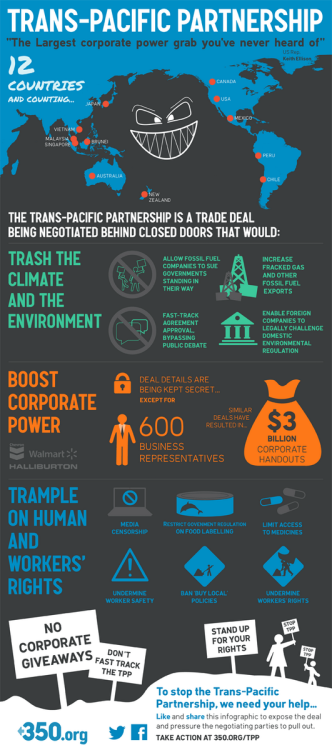
Finally, when at global negotiating tables – such as the secretive process devising the “Trans Pacific Partnership” trade deal — American corporations don’t represent the interests of Americans. They represent the interests of their executives and shareholders, who are not only wealthier than most Americans but also reside all over the world.

Which is why the pending Partnership protects the intellectual property of American corporations — but not American workers’ health, safety, or wages, and not the environment.

The Obama administration is casting the Partnership as way to contain Chinese influence in the Pacific region. The agents of America’s interests in the area are assumed to be American corporations.

But that assumption is incorrect. American corporations aren’t set up to represent America’s interests in the Pacific region or anywhere else.
Either we lessen the dominance of big American corporations over American politics. Or we increase their allegiance and responsibility to America.

What’s the answer to this basic conundrum? Either we lessen the dominance of big American corporations over American politics. Or we increase their allegiance and responsibility to America.

It has to be one or the other. Americans can’t thrive within a political system run largely by big American corporations — organized to boost their share prices but not boost America.

Wednesday, October 1, 2014

Corporations ‘the cancer’ that are slowly killing American middle-class, ‘Wire’ creator David Simon

John Mulholland, The Observer
28 Sep 2014

The writer’s next show, Show Me a Hero, is the true story of a battle over public housing that convulsed New York in the 80s. Here, on location in Manhattan, he talks about how money corrupts US politics, the erosion of the working class, why it’s a crime to be poor in America – and why he likes to argue

At the end of a long day scouting locations for his new TV miniseries, David Simon is sitting in his Upper West Side office in New York describing the type of person who needn’t bother tuning in to his new show. He’s speaking as a TV writer but also as a citizen angered by a political system that he thinks fails many of his fellow countrymen.

“People who think we’re being well governed at the moment… well, there’s no reason for them to watch. People who look at the inertia of Washington, at the partisanship, at the divisive and polarised discourse… people who think that’s the way to build a just society, well, don’t watch the show, because I got nothin’ for you.”

If, on the other hand, “You’re starting to believe that even the vernacular we’re using to argue about solutions to problems is dysfunctional, watch this show because I think it’s a perfect metaphor for what the American government is no longer capable of doing – addressing problems in a utilitarian fashion for the good of most people. American politics has left the room when it comes to finding solutions for our problems.”

Show Me a Hero, which will appear on screens late next year or in spring 2016, is based on a non-fiction book of the same name by former New York Times writer Lisa Belkin. It marks the time, says Simon, when American politics left the room.

The 1999 book’s subtitle, “a tale of murder, suicide, race and redemption” hints at the drama involved. Belkin documents the story through a series of interviews with many of the principals involved. It’s a tale of political and personal destruction that convulsed Yonkers, a city of 200,000 people just 40 minutes’ drive north of Manhattan. At its heart was a row about public housing for low-income residents being built in a part of Yonkers almost exclusively reserved for the wealthy.

Show Me a Hero shows how the fallout engulfed the New York body politic and ultimately brought unwanted national attention to Yonkers. When the dispute was finally settled the New York Times noted how the bitter row “had opened an ugly chapter in the city’s history, tearing apart neighbourhoods, building and destroying political careers and unleashing a heated court battle that nearly drove Yonkers to bankruptcy”.

On a bright, sunny morning last week the Schlobohm housing project, in west Yonkers, the largest low-income public housing site in the city and one of the principal locations for Show Me a Hero, is quiet. Except, that is, for Simon, his director Paul Haggis and other crew members who are here to scrutinise backgrounds, visualise scenes and figure out what angle offers the best view of the Hudson river in the near distance. Schlobohm is one of half a dozen stops they will make as they crisscross the city to finalise locations before four months of filming, which starts this week.

As the crew sweeps through a communal space that doubles as a car park, they pass by a mural. Painted on the side of a low wall that circles the area are five words in large, childlike lettering. They add colour to an urban landscape dominated by the red brick of the low- and high-rises. Spaced about a metre apart, they read “Unity”, “Harmony”, “Peace”, “Pride”, “Safe”.

But when the FBI’s New York field office writes about Schlobohm, it uses a different set of words. One of the most recent entries on its website is headed: “Three charged in connection with December 2013 homicide”. It lays bare the cycle of violence that is visited on places such as this when it notes that the arrest of two dozen gang members two years before had paved the way for a rival to thrive in their absence.

“In late June and early July 2012, federal authorities arrested 20 members of the Strip Boyz on charges of narcotics distribution and/or firearm offences… the arrests of the Strip Boyz left GMF [rival gang the Grimy Motherfuckers] dominant in the Schlobohm housing project.”

If the FBI’s reports were reduced to five words they might read “Narcotics”, “Gangs”, “Murder”, “Shooting”, and “Trafficking”.

The story of Schlobohm to be told by David Simonstarts in 1980, when the local Yonkers branch of the National Association for the Advancement of Coloured People (NAACP), backed by the US justice department, sued the city of Yonkers. The lawsuit alleged that the city’s housing and school policies had, over a period of 40 years, purposely segregated black and Hispanic residents from its more affluent white neighbours. It claimed that Yonkers deliberately placed its poorer (non-white) residents in the west of the city, while the east side remained predominantly white.

In 1985, US federal court judge Leonard Sand ruled in favour of the NAACP and instructed Yonkers to build 200 units of public housing on the east side. That’s when the trouble started.

The six-part miniseries will follow what happened from 1987 to 1994 as local residents and politicians defied the court order in a series of increasingly vocal and public demonstrations that brought the issues of race, housing and deprivation in Yonkers on to the national agenda.

An ABC news report broadcast at the time gives a glimpse of how divisive the dispute was. It features one of the residents at a Save Yonkers meeting (a man named Jack Tracy) making his position clear: “I lived with blacks, I delivered newspapers to blacks, but I can’t live next to what the government has in these projects. If the government wants to put criminals and dope-pushers in the projects I can’t live next to them. The federal judge can find me guilty, the supreme court can find me guilty… but if they think they’re going to integrate with Jack Tracy and his family, they’re going to have to build projects 60 miles north, 80 miles north, they can build them in Maine or wherever they want but I will not live next to a project. And if it means going to Canada, or back to Ireland that is what I will do. That ain’t why I am living in this country.”

In the fury and noise that engulfed Yonkers’s east side, what Jack Tracy and others failed to hear was that the judge’s proposal was not for old style “projects” (ie large-scale, densely populated, high-rise public housing) but for 200 two-storey houses to be distributed in small groups across the east side.

Later in the morning, after we have left Schlobohm and passed on to the noticeably more affluent (and white) east side of Yonkers, Simon and his crew stop at another location. Simon points to a small row of innocuous two-storey houses on this pleasant, leafy street. He says: “Look. That’s them, those are some of the houses. That’s what Yonkers tore itself apart over. And you wouldn’t even know they were public housing.”

What attracted Simon to this story was not the issues of housing or race or deprivation but something more fundamental – the dysfunction of the American political system. The story, Simon says, is tailor-made for showing how US politics now runs on fear and money, two forces that are slowly corroding American society.

“What intrigued me about the story was that it’s an almost perfectly allegorical argument about how our political processes are no longer equipped to recognise or solve problems. You have this mid-size American city, Yonkers, that didn’t have terrifying racial dynamics before the controversy. It had problems like any city but there was no reason that fear should be such an effective currency in the political process. And yet fear and money are the only currencies in the American political process that get their due any more. Nothing makes people more stupid and foolish than money and fear.”

The effect was to split the city in half. The east side set about protecting the value of its homes, livelihoods, children and way of life from the perceived threat from the west side. Looking now at the small clusters of neat, low-rise homes that were eventually built on the east side, its difficult to understand why the fury reached such a pitch.

For Simon, the answer is clear. “Politicians can gain so much by invoking fear and because money is at the core of that fear and the people who are the most frightened were looking towards their real-estate values, the values of their neighbourhoods and what they might personally lose if the neighbourhood went south. Money and fear paralysed Yonkers politically, and caused untold damage to the city’s reputation.”

For Simon, the story of Yonkers is telling for another reason – its timing marks the period in American history when a consensus fractured. The social compact between capital and labour was starting to break. From the 1980s onwards capital won virtually all of its battles with the labour unions in America.

This is a point forcefully made by ex-Clinton labour secretary Robert Reich in his recent film, Inequality for All. He dates the busting of the labour unions and the rupture of the social compact to Ronald Reagan’s firing of 11,000 air traffic controllers in 1981. From then on, the idea that a market-driven society would mutually benefit those who held the capital and those who provided the labour was no longer in place, he says. For Simon, this is the point at which the shared community of interests that walked side by side as the American economy surged after the second world war came apart. The collective will that bound together communities, cities and, ultimately, America started to erode.

“What was required in Yonkers was to ask: ‘Are we all in this together or are we not all in this together?’ Is there a society or is there no society, because if there is no society, well, that’s the approach that says ‘Fuck ’em, I got mine’. And Yonkers coincides with the rise of ‘Fuck ’em I got mine’ in America.

“That’s the notion that the markets will solve everything. Leave me alone. I want maximum liberty, I want maximum freedom. Those words have such power in America. On the other hand ‘responsibility’ or ‘society’ or ‘community’ are words that are increasingly held in disfavour in the United States. And that’s a recipe for cooking up a second-rate society, one that does not engage with the notion of collective responsibility. We’re only as good a society as how we treat those who are most vulnerable and nobody’s more vulnerable than our poor. To be poor is not a crime, except in America.”

These are not new themes in Simon’s work. The Wire was a grand tour of the institutions that were failing Americans, from politics to journalism, and from education to the criminal justice system. It was also an indictment of how capital had decisively won its war against American labour, with enduring consequences for America’s working class. This is the issue that most exercises Simon.

In his long and brilliant introductory essay to the 2009 book The Wire: Truth Be Told (a collection of essays by people involved in the making of the series), Simon wrote: “The Wire depicts a world in which capital has triumphed completely, labour has been marginalised and moneyed interests have purchased enough political infrastructure to prevent reform. It is a world in which the rules and values of the free market and maximised profit have been mistaken for a social framework, a world where institutions themselves are paramount and everyday human beings matter less.

“Unemployed and under-employed, idle at a west Baltimore soup kitchen or dead-ended at some strip-mall cash register – these are the excess Americans. The economy staggers along without them, and without anyone in this society truly or sincerely regarding their desperation. Ex-steelworkers and ex-longshoremen, street dealers and street addicts, and an army of young men hired to chase and jail the dealers and addicts, whores and johns and men to run the whores and coerce the johns – and all of them unnecessary and apart from the new millennium economic model that long ago declared them irrelevant.

“This is the world of The Wire, the America left behind.”

But Simon acknowledges that this wider message may have been lost on some of those who watched the highly acclaimed series, set among the politicians, police, press and drug dealers of Baltimore.

“Sure, there’s people who watch The Wire and go ‘Man I love all these fuckin’ characters but I hate it when the politics comes on… I just want to see the badasses shoot each other.’ And it’s like yeah, well, OK, I get it, you know, I get it, but I didn’t leave journalism to write fuckin’ television for you because that’s just horrific.”

He expresses relief, and some amusement, that the cable channel HBO continues to commission his work in spite of the relatively low ratings his TV work attracts (The Wire, belatedly through word of mouth, drew in a healthy audience. Subsequent series, though highly acclaimed, including Generation Kill and Treme, fared less well).

He jokes about “getting a 2% share” of audience, but appears untroubled about how long his shelf life as a TV writer might be. “You got to commit to something. If you’re a writer you got to write something. You might as well believe in it.”

HBO seems to believe in it too. That much is clear the next day when Simon and co-writer Bill Zorzi (who has been working on Show Me a Hero, on and off, for 10 years) are the star attractions at a start of production meeting in HBO’s Manhattan headquarters. There are close to 50 people here, and another 10 are looped in on a screen from LA. Haggis jokes that “he’s never seen this many people in a room before”.

Before Simon addresses the room, senior HBO executive Kary Antholis steps forward to speak. One of the executives closest to Simon’s projects, he is wholehearted in his praise. “This project is among the most meaningful that David has ever done. In its reflections on race, politics and community, I think it will be a powerful story and will make an important contribution to this country’s social dialogue. It’s one of the great legacies of HBO that we make these contributions to our social dialogue… I believe that Treme lives in that legacy, so does Generation Kill, and The Wire. I am very proud and grateful that David is doing these series for HBO.”

When Simon speaks he emphasises why Show Me a Hero is so prescient. But he goes further too, in pointing out precisely what it is that has gummed up the US political machine. “The most dysfunctional part of the government is Congress, the most loathed institution in America (with approval ratings of 7%), but they are unrepentant about that. The reason to do this project is that it speaks exactly to what is wrong with our country. It happens that this story is about 200 houses that needed to be built, but substitute any other issue… immigration, budgetary issues, almost any foreign policy or environmental issue that requires any systematic action, or thought, and you see it. This is a country that can get nothing done.”

Simon argues forcefully that it’s the US Congress which smothers the body politic and destroys its capacity for action. Money has tilted the balance of power by inserting itself into the political system and now has the power to influence Congress – and the legislation that governs how society organises itself.

“You can buy congressmen so fast. Ideas have nothing to do with it. And that’s the part that’s broken. And that was the part that was broken in Yonkers.

“It has to change. When capital also is entitled to buy the government, that same government that might in some way create the basic standards of behaviour, everything from child labour to environmental protection, to workplace safety, to minimum wages that are consistent with the cost of living… Well eventually it’s going to get to the point where it’s so fuckin’ bad that people are going to throw a brick.”

Simon, at 54, is driven. Driven to write about the issues that exercise him. And driven to engage in intellectual combat. He relishes argument, and thrives on the mental exercise that debate provides. You get a strong sense that, left to his own devices and left all alone, it wouldn’t be long before he was picking a fight with himself. It’s a thirst for intellectual friction, and appetite for a dialectic, that drives all of his work. Plots, characters and narrative are all very well, but only in that they are part of a toolkit needed to construct an argument. Simon is never going to sit down and write a TV drama about people per se: his work will always be about something more elemental, more structural.

Writing in 2009 about the impulses that drove The Wire, he said: “The Wire had ambitions elsewhere. Character is essential for all good drama, and plotting is just as fundamental. But ultimately, the storytelling that speaks to our current condition, that grapples with the basic realities and contradictions of our immediate world – these are stories that, in the end, have some chance of presenting a social, and even political, argument. And to be honest, The Wire was not merely trying to tell a good story or two. We were very much trying to pick a fight.”

Simon has been picking fights since he was a young kid growing up in Washington. He learned his way around an argument at an early age while sitting at his family dinner table. It was how you gained your spurs (your “moxie”) in the Simon family: by holding your own in intellectual fisticuffs. “I lived in a house where argument was sport. Dinner discussions were about what was going on in the world. Not everybody was expected to agree, because then you couldn’t have a good argument, but if people didn’t agree, then you could have a good argument.”

Simon remembers the day he came of age intellectually. In his telling, it sounds like a duel, a rite-of-passage moment. “I was having an argument in my uncle Hank’s house in New York, and I would stake myself out against my father and two of my uncles. I must have been 17 and I just knew they were wrong. And I held them off to a draw for about an hour and a half in my uncle’s den. And I remember my uncle Hank turning to my father and saying, “Who knew he had a brain?” It was the biggest thing for my uncle Hank; it was how you earned moxie in my house.”

The web has given Simon another place to pick fights. Having lain dormant and then only been used for professional announcements, davidsimon.com has now become a place where Simon has, over the last few years, written occasional often coruscating posts on anything from the NSA to the policing of the Ferguson riots. Given time he will engage at length with some of those who post comments. The engagement is robust. He pushes, and is willing to be pushed, if he thinks contributors (and he himself) will learn, develop and mature their argument. It’s the family dinner table again.

When he was setting out what davidsimon.com would become, he wrote, with unerring honesty: “Those who know me understand that while it’s refreshing to meet people with no opinions, I’m not that fellow – I like to argue. I don’t like to argue personally, but rather I like pursuing a good ranging argument.”

Although limited by time and a work schedule that, alongside Show Me a Hero, sees Simon wrestling with three other development projects for HBO, including one about the New York sex industry in the 70s (not to mention a theatre project involving the songs of the Pogues), he still finds time for occasional posts. What he relishes is the opportunity to write in long-form and to develop an argument, see a thought grow, mature and ripen. “I guess what you’re hoping, the equivalent of what often resulted at my family’s dinner table, was that the argument goes somewhere, that it has legs. This is why you engage with people on ideas. At its best ideas can build, arguments can develop.”

The fight that David Simon has most often picked in recent years – and one he will address when he delivers the keynote talk at the Observer Ideas festival next month – is how the power of the market has trumped all other priorities in his country, and destroyed the values that brought America together.

“My conviction is that what made us great as an economic power was transforming our working class into a middle class and making them this economic engine that not only bought all the shit that they needed, but a lot of stuff they didn’t. By the middle of the century, or a little later, the American workforce had been launched into middle-class status and had discretionary income and the ability to construct a future that allowed the next generation to maintain that upward mobility and even advance further on it. That’s a pretty good dream. That’s more than a dream. But it’s no longer true. We’ve been disassembling that middle class slowly by degrees.”

For typical middle-class Americans, the squeeze is on. The certainties they had come to expect no longer exist. Late capitalism is unable to provide the generation-on-generation wealth advances that many had come to assume was normal. The new normal is something very different.

“Now you have an existing upper middle class or upper class that is politically powerful, quite moneyed and is larger than at any time. It’s not just the 1%, it’s the 10%, the 20% that have been carried higher up on the pyramid and who are in those industries that have caught the wave of the information age and for them the American dream seems uninterrupted. What they’re not noticing is that the people who used to be able to send their kids to college and hold down a mortgage on a factory wage or on a mid-level administrative [job] or on a civil servant’s salary, that they’re being crushed.”

Simon is not an outlier in his criticism of the American body politic or in his reflections on unfettered capitalism and the rise of inequality. What is marked is how many voices have joined this debate in the US.

For the last two years the New York Times has been running a series on inequality, curated by the venerable economist Joseph Stiglitz, entitled The Great Divide. It has featured contributions from academics, business people and politicians.

Stiglitz recently wrote about the fracturing of the same postwar consensus, and how it came about. “Corporate interests argued for getting rid of regulations, even when those regulations had done so much to protect and improve our environment, our safety, our health and the economy itself.

“But this ideology was hypocritical. The bankers, among the strongest advocates of laissez-faire economics, were only too willing to accept hundreds of billions of dollars from the government in the bailouts that have been a recurring feature of the global economy since the beginning of the Thatcher-Reagan era of ‘free’ markets and deregulation.

“The American political system is overrun by money. Economic inequality translates into political inequality, and political inequality yields increasing economic inequality.”

More recently, Robert Reich contributed an essay to Salon.com entitled “American democracy is diseased – how we can wrest back power from our corporate overlords”, in which he addresses the same issue. “We entered a vicious cycle in which political power became more concentrated in moneyed interests that used the power to their advantage – getting tax cuts, expanding tax loopholes, benefiting from corporate welfare and free-trade agreements, slicing safety nets, enacting anti-union legislation, and reducing public investments. These moves further concentrated economic gains at the top, while leaving out most of the rest of America.”

Simon is not sanguine about what it will take for corporate and political America (increasingly one and the same) to recognise that if the story continues in this vein it will not end well.

“I think in some ways the cancer is going to have to go a little higher. It’s going to start crawling up above the knee and people are going to have to start looking around and thinking ‘I thought I was exempt. I didn’t know they were coming for me’.

“It’s happened to the manufacturing class, it’s happened to the poor. Now it’s happening to reporters and schoolteachers and firefighters and cops and social workers and state employees and even certain levels of academics. And that’s new. That’s not the American dream.”

Simon reserves particular contempt for the forces in America that have helped strip labour of its dignity, who refuse to see the benefits, or necessity, of people collectively organising in order to protect their interest.

“Unions are part of the equation. They’re not the whole equation – the unions needed to lose as many battles as they won, but they needed to win some. And the demonisation of them has been an astonishing achievement of political disrepute in the west, and particularly in my country.”

Back in his Upper West Side office, Simon is now starting to seem fatigued by a long day of scouting locations, of being photographed, of being interviewed and, frankly, of being angry. It’s time to bring a close to the interview. But Simon’s sense of humour and self-deprecation is still very much intact.

When, at the very close of the conversation, he is asked how, or when, this TV career ends, he replies: “Well, I have enough to keep writing these miniseries nobody will watch for as long as HBO will allow nobody to watch them.” When it’s put to him that the story in development about New York’s sex industry is a sure winner, he retorts: “Just watch that one not get made either.”

In his 2009 introduction to The Wire: Truth Be Told, Simon concluded his essay by referring to The Wire as “an angry show, but that anger comes honestly”.

It’s difficult to think of a more fitting way to describe David Simon.


Thursday, September 4, 2014

30 Million Americans On Antidepressants And 21 Other Facts About America's Endless Pharmaceutical Nightmare

Submitted by Tyler Durden on 09/03/2014
New York Times
Reality


Submitted by Michael Snyder of End of The American Dream blog,

Has there ever been a nation more hooked on drugs than the United States?  And I am not just talking about illegal drugs – the truth is that the number of Americans addicted to legal drugs is far greater than the number of Americans addicted to illegal drugs.  As you will read about below, more than 30 million Americans are currently on antidepressants and doctors in the U.S. wrote more than 250 million prescriptions for painkillers last year.  Sadly, most people got hooked on these drugs very innocently.  They trusted that their doctors would never prescribe something for them that would be harmful, and they trusted that the federal government would never approve any drugs that were not safe.  And once the drug companies get you hooked, they often have you for life.  

You see, the reality of the matter is that some of these “legal drugs” are actually some of the most addictive substances on the entire planet.  And when they start raising the prices on those drugs, there isn’t much that the addicts can do about it.  It is a brutally efficient business model, and the pharmaceutical industry guards their territory fiercely.  Very powerful people will often do some really crazy things when there are hundreds of billions of dollars at stake.  The following are 22 facts about America’s endless pharmaceutical nightmare that everyone should know…

#1 According to the New York Times, more than 30 million Americans are currently taking antidepressants.
#2 The rate of antidepressant use among middle aged women is far higher than for the population as a whole.  At this point, one out of every four women in their 40s and 50s is taking an antidepressant medication.
#3 Americans account for about five percent of the global population, but we buy more than 50 percent of the pharmaceutical drugs.
#4 Americans also consume a whopping 80 percent of all prescription painkillers.
#5 It is hard to believe, but doctors in the United States write 259 million prescriptions for painkillers each year.  Prescription painkillers are some of the most addictive legal drugs, and our doctors are serving as enablers for millions up0n millions of Americans that find themselves hooked on drugs that they cannot kick.
#6 Overall, pharmaceutical drug use in America is at an all-time high.  According to a study conducted by the Mayo Clinic, nearly 70 percent of all Americans are on at least one prescription drug, and 20 percent of all Americans are on at least five prescription drugs.
#7 According to the CDC, approximately 9 out of every 10 Americans that are at least 60 years old say that they have taken at least one prescription drug within the last month.
#8 In 2010, the average teen in the United States was taking 1.2 central nervous system drugs.  Those are the kinds of drugs which treat conditions such as ADHD and depression.
#9 A very disturbing Government Accountability Office report found that approximately one-third of all foster children in the United States are on at least one psychiatric drug.
#10 An astounding 95 percent of the “experimental medicines” that the pharmaceutical industry produces are found not to be safe and are never approved.  Of the remaining 5 percent that are approved, we often do not find out that they are deadly to us until decades later.
#11 One study discovered that mothers that took antidepressants during pregnancy were four times more likely to have a baby that developed an autism spectrum disorder.
#12 It has been estimated that prescription drugs kill approximately 200,000 people in the United States every single year.
#13 An American dies from an unintentional prescription drug overdose every 19 minutes.  According to Dr. Sanjay Gupta, accidental prescription drug overdose is “the leading cause of acute preventable death for Americans”.
#14 In the United States today, prescription painkillers kill more Americans than heroin and cocaine combined.
#15 According to the CDC, approximately three quarters of a million people a year are rushed to emergency rooms in the United States because of adverse reactions to pharmaceutical drugs.
#16 The number of prescription drug overdose deaths in the United States is five times higher than it was back in 1980.
#17 A survey conducted for the National Institute on Drug Abuse found that more than 15 percent of all U.S. high school seniors abuse prescription drugs.
#18 More than 26 million women over the age of 25 say that they are “using prescription medications for unintended uses“.
#19 If all of these antidepressants are helping, then why are more Americans killing themselves?  The suicide rate for Americans between the ages of 35 and 64 increased by nearly 30 percent between 1999 and 2010.  The number of Americans that die by suicide is now greater than the number of Americans that die as a result of car accidents every year.
#20 Antidepressant use has been linked to mass shootings in America over and over and over again, and yet the mainstream media is eerily quiet about this. Is it because they don’t want to threaten one of their greatest sources of advertising revenue?
#21 The amount of money that the pharmaceutical industry is raking in is astronomical.  It has been reported that Americans spent more than 280 billion dollars on prescription drugs during 2013.
If many of these drugs were not so addictive, the pharmaceutical companies would make a lot less money.  And pharmaceutical drug addicts often don’t fit the profile of what we think a “drug addict” would look like.  For example, CNN shared the story of a 55-year-old grandmother named Cynthia Scudo that become addicted to prescription painkillers…
For Scudo, her addiction began — as they all do — innocently enough.

She sought relief from hip pain, possibly caused by scarring from cesarean sections she had delivering several of her children.

Her then-husband recommended a physician.

“There was no physical therapy offered,” she said of the doctor’s visit. “The first reaction was, let’s give you some drugs.”

He put her on OxyContin.

By the second week, she was physically addicted.

She was popping so much of the painkiller and other drugs such as anti-anxiety Valium that they equated to a dosage for three men.
There is lots and lots of money to be made from addiction.  In fact, if the U.S. health care system was a totally separate nation it would actually be the 6th largest economy on the entire globe.  We are talking about piles of money larger than most people would ever dare to imagine.

And with so much money floating around, it is quite easy for the pharmaceutical industry to buy the cooperation of our politicians and of the media.

Some time when you are watching television in the evening, consciously take note of how often a pharmaceutical commercial comes on.

It has gotten to the point where we are literally being inundated with these ads.

They are already making hundreds of billions of dollars, and they think that there is room for even more growth.

Friday, May 16, 2014

Obama Is Negotiating the Biggest Trade Deal in Human History - It Would Gouge the American Economy

AlterNet/ By Thom Hartmann
May 12, 2014 |

Right now - the Obama administration is negotiating the biggest trade deal in human history.

If approved - The Trans-Pacific Partnership - or TPP for short - would create a whole new set of rules regulating the economies of twelve countries on four different continents bordering the Pacific Ocean. While TPP is its official acronym, because it's a deal that involves Southern Hemisphere Asian countries as well as us and others, I prefer, instead of TPP, to call it the "Southern Hemisphere Asian Free Trade Agreement" or SHAFTA.

Because SHAFTA or the TPP is being negotiated almost entirely in secret - we don’t know a lot about it - and what we do know comes almost entirely from leaks. And according to those leaks - the TPP/SHAFTA would give big pharmaceutical companies virtual monopoly patent power - it would let corporations sue countries in international courts over regulations that those corporations don’t like - and and it would gut American environmental and financial rules. The TPP/SHAFTA is a huge deal - the type of story about which the media should be informing the American people. But here’s the problem: almost no one in the mainstream media is talking about it.

According to Media Matters for America - during one six month period between August 2013 and February 2014 - only one nightly network news show - The PBS Newshour - mentioned the trade deal - and they only mentioned it once.

And that one mention occurred essentially as a plug for the TPP/SHAFTA, when a scholar from a right-wing DC think tank said that signing on to the TPP was essential for “improving relations with Asian nations."

Cable news did a little better when it comes to TPP coverage. While Fox So-Called News had no mentions - CNN talked about it once and MSNBC talked about it thirty-two times. But those thirty-two mentions were mostly on one show - “The Ed Show” - and because MSNBC is only available by premium subscription - there’s a very good chance most Americans never watched Ed talk about the TPP/SHAFTA.

Of course - the only thing worse than not talking about the TPP/SHAFTA - like TV news networks have been doing - is talking about it in a misleading way.

And that’s exactly what most mainstream newspapers have been doing. Fairness and Accuracy in Reporting recently looked into TPP/SHAFTA coverage at two of the country’s most influential newspapers - the New York Times and the Washington Post - and found that “…on the rare occasions the papers covered TPP/SHAFTA over the last year, the sources they quoted tilted heavily in favor of the treaty.”

The total media blackout on actually critical coverage of the TPP/SHAFTA is a story in and of itself. Here we are, about to enter an once-in-a-generation economy-changing free trade deal, and the people who are supposed to be telling us the truth are either silent or on the side of giant multinational corporations.

Americans deserve to know what their government and big business are doing together behind closed doors.

And it’s outrageous that the mainstream media doesn’t seem think this is true when it comes to the TPP.

Tuesday, April 29, 2014

FCC Wants to Give Corporations Their Own Internet

And now the rights of corporate ownership officially supercede those of individual citizens. this isn't new, but the courts and the bureaucracy are going ahead and getting the big govt sellout locked in so we won't be able to repeal these inane conflicts of interest for a very long time or without extreme difficulty. Fuck corporate rule! Corporations aren't people. They should be dismantled every 20 years with the remaining holdings distributed among their workers, who may then apply for a brand new corporate charter, starting over from scratch every 20 years. It would help to prohibit the ridiculous amount of control a few corporate CEOs  and their executive boards have over our joke of a political process. Lobbying needs to be redefined with stricter limits, as well. And when you are interviewing for jobs in the public and private sector, you need to choose which one you'll stay in for 7 years. No more of this revolving door between regulating agencies and the industries/companies they regulate. It's all a huge shitsoaked conflict of interest that has destroyed a whole generation of workers, at least, and cannot provide any kind of future for the next generations of US citizens. The oligarchy must be destroyed by any means possible. Corporate leadership is far from patriotic: they hold the bulk of their fortunes in tax haven banks overseas to keep from paying taxes, drastically undercutting the federal budget during a crucial period in a failing economy 6 years deep in a "small d" depression, AND these traitors get to dictate policy and handpick their own candidates to do their bidding while holding office? Bullshit! Hang them all high! They betray everything sacred about this country and her consitution, all to make themselves richer at the expense of the nation and her people.

EAT THE RICH! and pile their bones up so high they reach the moon.--jef


++++++++++++++


The New Proposal Mocks Net Neutrality
by ALFREDO LOPEZ


When a federal court trashed its “net neutrality” compromise policy in January, the Federal Communications Commission assured us that the Internet we knew and depended on was safe. Most activists didn’t believe federal officials and this past week the FCC demonstrated how realistic our cynicism was.

The Commission announced last week that among its proposals on the Internet, due for full discussion on May 15, was one which would give access providers the right to sign special deals with content producers for connections that are faster and cleaner than the connections most websites use. It’s precisely the nightmare that court decision threatened.

In the predictable outcry and immediate debate over the FCC’s announcement, however, two major issues seemed to be lost.

To deliver this faster connection, the Internet giants will have to change the Net’s protocols, establishing a fast lane that completely destroys the technological basis of Internet neutrality. They will, effectively, be allowed to set up an alternate Internet.
At the same time, the announcements raise a question about the FCC’s role. To develop this proposal, it has obviously been talking to the very companies it is supposed to regulate and has written regulations based primarily on a concern about their ability to make lots of money.

Isn’t this the opposite of what federal regulation is supposed to do?

When the debate dust settles, it appears that not only may we lose the Internet as we know but we have no agency in government looking out for our interests.

The background has been covered on this website but, to recap:

Access (or service) providers offer connections to put you on the Internet and give you several speeds to choose from. They are mainly cable companies like Comcast and telecommunications companies like Verizon. Content providers use those connections to deliver what you want to see and read. Every website owner is a content provider, including biggies like Netflix.

Net Neutrality is the principle that service providers — like Verizon and Comcast — can’t discriminate in the delivery of content or provision of access based on user, content, site, platform, application, type of attached equipment, and modes of communication. If you go on-line, you can reach everything anyone else can. It was the law until this past January.

That was when a federal court struck down the provision finding that cable companies like Comcast weren’t subject to the neutrality rules that govern telephone companies and so net neutrality, based on the telecom industry’s practices, didn’t apply to high-speed providers. They are, after all, cable companies and anyone who subscribes to cable television with its multiple “programming packages” that give you a monthly dose of sticker shock knows there’s nothing “neutral” about cable.

In short, service provider companies can now charge content providers money to speed up their content delivery and the content providers can limit access to that faster content to people paying a higher price for it
.

While the decision was based on cable company practice, it obviously benefits telecoms like Verizon who also offer high-speed service.

Apparently, the FCC wasn’t too unhappy either. Chairman Tom Wheeler (a former telecom industry lobbyist) reacted in stunningly triumphant terms, assuring us all that our access to the Internet will be completely protected. In fact, he said the ruling actually gives the FCC more regulatory power. This new proposal, carving out a slice of the Internet for rich corporations to operate more quickly and cleanly, was apparently what he meant.

In his defense of the current FCC plan, Wheeler explains that we would all still have access to everything on the Internet. The proposal, he explains, “will restore the concepts of net neutrality consistent with the court’s ruling in January.” But that January ruling threw Net Neutrality out the window and it’s clear that with this new proposal our access to certain content will be slower, more prone to start and stop “buffering” and less crisp than the faster connection unless we pay more for it.

It’s like the locksmith assuring us that our broken door lock will remain broken.

If that spasm of regulatory double-speak doesn’t provoke a groan, the argument by decision defenders will: they say that, while the companies will pay for the faster connection, no access provider will charge the consumer more for it.

But the content provider will. Obviously an outfit like Netflix is not going to offer this higher speed service that it is paying the access providers handsomely for to customers without charging them more for it. In fact, if past practice is any indication, even those of us who don’t or can’t pay for faster internet service we will all see our fees for watching this kind of on-line content rise, whether we’re watching it on the faster connection or not. Netflix pays Comcast more and charges the pass-along costs (with some profit mixed in): just the kind of hustle Net Neutrality was invented to prevent.

If the proposal is approved, as is expected, Net Neutrality will be buried. But the true threat to the Internet’s existence isn’t only the “pay for speed” proposal. To make this happen, providing companies will have to restructure their technology to allow for a faster “lane” on the Internet. There already are, of course, various speeds of “high-speed” service and that is maintained by the company’s determining which connecting server the customer is going to access. When you enter the Internet you are immediately connected to a server that handles outgoing and incoming traffic at a specific speed. If you pay for higher speeds, you get the higher-speed systems with their servers.

All of this, however, has up to now been handled at the user or customer level. The Internet itself remains the same. What the FCC is proposing is a new way of regulating speed. Now it is the content provider who is assigned a specific speed lane and any user who pays can access that high-speed content. To make this possible, the access provider will have to establish not a higher speed connection server but a completely separate connection to the Internet. This isn’t a faster lane on the highway; it’s a completely separate highway.

With that “alternate Internet” established, and with a small empire of developers continuously improving it, the power of providers to control all Internet content is now in place. They can start with Netflix, but they legally have power to channel any Internet content over that super-highway, leaving most content providers in the dust. That will certain include most websites your visit, including this one. As speed over the Internet improves with new technological development, guess where most of the development investment is going? As new streaming technology improves, content developers will have to pay to take advantage of it and most of us just don’t have that kind of money.

The impact is also international because the Internet has no national boundaries and the rules governing any U.S. based company apply to all its activities world-wide unless the government of a specific country objects. That objection will rarely happen because most governments won’t care or will take a pay-off (in the form of a tax payment or licensing fee) to shut up. In fact, governments all over the world can now treat this as another form of revenue.

This kind of corporate control over the Internet and our communications is frightening and control is what the corporations are seeking. It’s been the goal of every major company to control as much access as they can, growing their “user-base” and profits in the process. In fact, the prospect of a wide open internet has now attracted a couple of “data giants”: Google and Facebook. Each company is now developing technology to provide access to everyone on earth using signal bouncing balloons (in Google’s case) and drones and satellites (in Facebook’s). While both companies protest that their intentions are altruistic (providing Internet to all humans), the timing of their plans in light of this decision seem like the good old pursuit of profit.

Rhe main question isn’t whether these people will try to do this because that’s answered by their history: Of course they will. The question then is: What is the FCC doing about it?

This week, coalitions of Internet freedom activists were making plans to make their presentations before the FCC and to lobby Congress and to do letter-writing campaigns to just about any concerned person in government. All of this has proven to be important and useful work and it has ended in some successes in the past.

But why should any of us have to do this? Isn’t the very role of the FCC to protect and represent the public? While neo-con steroids that have been driving it for the last two decades, the FCC’s legal responsibilities remain the same: not to protect the interests of corporations but to protect our interests against corporations.

Clearly, with a proposal that represents corporate interests, the FCC isn’t doing any such thing. Some of us aren’t surprised; none of us should be.

Monday, April 7, 2014

How We Can Fight Back Against the Supreme Court


Let me start by quoting two great men and a crook that died the other day.

"The issue today is the same as it has been throughout all history, whether man shall be allowed to govern himself or be ruled by a small elite." -- Thomas Jefferson

When asked if his payments to politicians had worked,  


Charles Keating replied, "I want to say in the most forceful way I can: I certainly hope so."

When asked outside of Independence Hall if we have a republic or a monarchy, Benjamin Franklin replied, "A republic, if you can keep it."

Well, here we are, aren't we? Right at the point where we are about to find out whether we can keep it or not. The Supreme Court has decided that a small amount of people will get to control our entire political system. Which politician or political party can resist hundreds of millions of dollars put in at once? Maybe one person can resist, maybe one party can resist for a small period of time, but eventually they will succumb.

In Congressional races, 95 percent of the time the person with more money wins. It doesn't matter if they are a Republican or Democrat, conservative or liberal. It doesn't matter what their ideas are or what their ideology is. It doesn't matter what they think at all. You have more money and you will win 19 out of 20 times.

Justice Anthony Kennedy destroyed our republic. We knew Alito, Scalia, Roberts and Thomas were corporate robots. We knew they were going to say disingenuously that corporations or billionaires pouring in millions into our politicians' pockets wouldn't lead to corruption. What an unbelievable joke. But it turns out that Kennedy was the biggest joke of all. He claims that millions in campaign donations won't even result in the appearance of corruption. Can anyone with a shred of intelligence honestly believe that?

So, it was nice while it lasted. Democracy at the national level is dead now. We have replaced it with an open auction. This will not at some future date lead to a worst case scenario. We're already living in that scenario.

You don't have to worry about the top 1 percent. Now, the 0.00024 percent of the country who donate over a $100,000 to politicians will rule us all. Because even the federal limit of $123,200 per election cycle has now been eliminated by the McCutcheon decision. They can now spend unlimited money "contributing" to our politicians.

So, how do we escape this worst case scenario? Congress is corrupt and the Supreme Court is even worse. Luckily, there is one thing above them -- the constitution. Every generation of Americans has amended the constitution so that we may have a more perfect union. Except one. Us.

We must get money out of politics. We must amend.

At The Young Turks, we already knew how bad the situation was because every political story we covered had the same exact answer -- find which side has more money and you'll know who is going to win. So, I founded Wolf PAC, which has only one, unstoppable mission -- amend the constitution to get the corrupting influence of money out of politics. We're not interested in awareness -- we're already quite aware of how screwed we are. We're not interested in consciousness raising or being a respected institution inside Washington, DC. We're interested in results!

I didn't pick the name Wolf PAC by accident. I picked it so we could be super aggressive. I don't want to negotiate with the power brokers in Washington; I want to tear them down. The lobbyists, the special interests, the donors and the politicians who cater to them are what's wrong with our country. They robbed us of our representative government. It's time we stood up and took it back. Let's over turn their apple cart.

Our founding fathers were geniuses. They put a certain provision in the constitution because they knew that a day like this would come. We have never had to use it yet. But we have threatened it many times and that threat has been incredibly effective just as many times. The clause is Article V of the constitution and it says that you don't necessarily need 2/3 of Congress to propose an amendment. You can have 2/3 of the states circumvent a corrupted Washington and propose a convention to get the same amendment. You don't need Washington at all. 34 states propose a convention for this specific issue. 38 states ratify that amendment. And we have our democracy back.

Now, this is the point in the movie when you say -- but that's impossible. The suffragist movement got women the right to vote when they couldn't vote in the first place. Now, that was impossible. And they still got it done.

In fact, four out of the last ten amendments were proposed by Congress because of the threat of an imminent convention. We can make these guys bend to our will. They're not supposed to be the boss of us. We are supposed to live in a democracy where we control our own fate. We are supposed to be the home of liberty. And we can be that again.

Let me tell you what we've done so far without anyone noticing. We have introduced a resolution calling for this convention in ten states and have over 100 state legislators sponsoring and supporting these resolutions all across the country. We have an army of 13,000 volunteers. We are legion and we are coming.

Tell me again what isn't possible.

We were told in Vermont that we had a zero percent chance of getting this resolution passed in the state Senate. That was a week before we got it passed 28-2. How did we turn the impossible into the inevitable? How did we get true bipartisanship on this issue? Well, we have over 90 percent of the American people on our side. Republicans, Democrats, libertarians and independents all agree on only one thing -- our national politicians are bought. When the bills are introduced we get a natural avalanche of support. At the state level, an army of citizens turn out to be hard to resist.

In one of the states where we had success, our volunteers got a politician to do something he didn't want to do. The pressure of angry, concerned citizens clearly switched his position. One of those volunteers wrote me an email afterward and said, "It feels so good to get the power back."

We have gone for so long without being able to affect the course of our government, we have gone so long feeling powerless that we have forgotten what our birthright is. We are born free men and women in this country. If we rise up together, we can be that again.

Join us. Join the fight. Get up, let's get them back!

Tuesday, January 21, 2014

The Global Fight Against Corporate Rule

- The Nation
by Robin Broad and John Cavanagh

Over the past several decades, multinational corporate Goliaths have helped to write and rewrite hundreds of rules skewing tax, trade, investment and other policies in their favor. The extraordinary damage these policies have caused has become increasingly apparent to the communities and governments most directly affected by them. This, in turn, has strengthened the potential of a movement that’s emerging to try to reverse the momentum. But just like David with his slingshot, the local, environmental and government leaders seeking to revise rules to favor communities and the planet must pick their battles carefully.

One of the most promising of these battles takes aim at an egregious set of agreements that allow corporations to sue national governments. Until three decades ago, governments could pass laws to protect consumers, workers, health, the environment and domestic firms with little threat of outside legal challenge from corporations. All that changed when corporations started acquiring the “right” to sue governments over actions—including public interest regulations—that reduce the value of their investments. These rights first appeared in little-known bilateral investment treaties. Twenty years ago, corporate lawyers embedded them in the North American Free Trade Agreement (NAFTA). Today, more than 3,000 trade and investment agreements and even some national investment laws grant foreign investors these powers.

The Obama administration is attempting to insert similar anti-democratic investor protections in new trade and investment agreements with countries that border the Pacific and with the European Union. Hoping to expedite the so-called Trans-Pacific Partnership (TPP) and the Transatlantic Trade and Investment Partnership (TTIP), congressional leaders introduced fast- track trade promotion legislation on January 9 that would severely limit Congress’s ability to amend such agreements. The widely anticipated move set off a storm of protest from unions, environmentalists, liberal members of Congress and others, and will likely remain a high-profile fight in the coming weeks.

The forces aligned against these proposed agreements are not alone. Activists across the globe are developing creative and increasingly effective strategies to push back against investor assaults on their communities, environment and national sovereignty. An important front has opened up in El Salvador, where a multinational firm is using investor powers to sue the government over the “right” to mine gold. This case represents an extreme assault on democracy, as local communities, the majority of the Salvadoran public and the Salvadoran government all oppose the gold mining. But what’s happening in El Salvador is not an anomaly. There are crucial battles brewing in several other Latin American countries—including Argentina, Venezuela, Bolivia and Ecuador—as well as in other parts of the developing world.

At the very least, these struggles should give the Obama administration pause as it considers the next round of trade agreements. But what makes them so strategic—and promising—is that powerful citizen groups are persuading governments to take up the challenge. As they do, they are building momentum in a broad global fight against investor rights.

* * *

Salvadoran land sits atop a wide belt of gold running down the middle of Central America, a vein that has enticed profiteers for more than a century. In the early 1900s, the US miner Charles Butters began plundering the region using a lucrative process that employed cyanide to separate gold from rock. Within years, Butters was making millions. But what he seems not to have contemplated—and what the farmers in these parts know well—is that the area is vulnerable to earthquakes and tropical storms, both of which make it difficult to contain the toxic chemicals used to mine gold. And no one appears to have known that the heavily concentrated sulfides found in the rock that often surrounds gold become sulfuric acid when they are exposed to the elements during the extraction process. The acid leaches other toxic materials into the soil and water. In July 2012, at the San Sebastián site of the mine that Butters opened more than a century ago, the Salvadoran environment ministry found levels of cyanide and iron that were through the roof.

The areas affected by gold mining will remain contaminated for centuries unless the companies are kept out and forced to pay for costly cleanup. Yet El Salvador is not suing the mining firms for such destruction. Instead, in 2009, at a tribunal housed in an imposing World Bank building just a few blocks from the White House, firms sued the Salvadoran government for not letting them mine. One of them, Canada’s Pacific Rim Mining Corporation, is demanding either that it be allowed to mine in northern El Salvador or that the government pay it over $300 million in damages, an amount equivalent to more than 1 percent of the Salvadoran economy.

Over the course of several trips we have taken in recent years to learn about the local movement against mining, corn and bean farmers have led us up and down the hills of northern El Salvador, guiding us through the streams that feed the Lempa River. This river, which flows from Guatemala through El Salvador and then along the border with Honduras before it plunges south into the Pacific Ocean, provides water to more than half the country’s people. One of our guides was Miguel Rivera, a local “pro-water” activist whose older brother Marcelo, a popular educator, was brutally assassinated in 2009 after organizing many in his community against gold mining.

Miguel and his colleagues brought us through different parts of the Lempa watershed to show us pollution from agribusiness, factories, hog farms and gold mining. Along the way, Miguel, who has become a trained water expert, often paused to test it for toxins and other substances. We visited the site of Butters’s San Sebastián mine, which has been closed for years but continues to leach toxic substances into the streams. Some days, the water was Kool-Aid orange; on others, it was Ocean Spray cranberry.

As the prices of gold and other metals skyrocketed after 2000, multinational firms like Pacific Rim rushed to apply for permits to mine in resource-rich regions like the Salvadoran province of Cabañas, where Miguel lives. Initially, the farmers of this poor region were intrigued by the prospect of good jobs, but a number of them visited the mines in neighboring Honduras and returned with horror stories of disease, polluted rivers and few actual jobs. A community activist told us, “We learned how much water the mining companies would use to mine, and water became a big issue. Mining uses a lot of it, and we had little.” Some visited the old Butters site in San Sebastián, where the orange and cranberry waters sealed their opposition.

Local activism on the proposed Pacific Rim mine—including cultural work led by Marcelo Rivera and a radio station run by local youth—spread in Cabañas and across El Salvador. Farmers, students, people of faith, lawyers and human-rights activists formed the National Roundtable Against Metallic Mining, and won over politicians and even the mainstream Catholic church. By 2007, a national poll showed that more than 62 percent of Salvadorans opposed metals mining. As Miguel Rivera and others continually stressed to us, the slogan of the Roundtable was “We can live without gold, but we can’t live without water.”

When the progressive FMLN party won the presidency in 2009, the newly elected president, Mauricio Funes, pledged not to issue mining permits during his five-year term, a promise he has kept. In other words, El Salvador has quietly become the first nation on earth to stop destructive gold mining.

But the victory has come at a cost. Pro-mining forces, including conservative local politicians in Cabañas, have fought back. At least four anti-mining activists have been assassinated since 2009. Marcelo Rivera’s mangled body was found at the bottom of a well; he had been tortured.

Pacific Rim acted quickly once it became clear that it would not be granted a mining “exploitation” license. The firm filed suit at the World Bank–based International Centre for the Settlement of Investment Disputes, charging that the Salvadoran government had violated the investor-rights provisions of its domestic investment law and a regional trade agreement, both modeled on NAFTA. (According to a study by Sarah Anderson and Manuel Perez-Rocha of the Institute for Policy Studies, cases related to oil, mining and gas make up more than a third of the docket at the ICSID, the most frequently used tribunal for such investor lawsuits. More than half of these are directed at Latin American countries, a region where several governments have asserted national interests over those of their corporate interlopers.)

The Salvadoran government and the Roundtable have had to put significant time and resources into fighting the suit. Joining them has been International Allies Against Metallic Mining in El Salvador, a coalition of US and Canadian groups that held weekly protests outside the World Bank in 2012 and coordinated with the Roundtable protests in San Salvador. Many legal experts are aghast at the suit, but the ICSID has allowed the case to proceed. A decision is not likely before 2015.

* * *

By late 2012, Pacific Rim seemed to be running out of money for its ICSID suit. To its rescue came a Canadian-Australian mining firm, OceanaGold. The firm’s infusion of cash granted it a one-fifth stake in Pacific Rim, and in November 2013 shareholders approved an outright purchase of the company. As a result, Pacific Rim has become a wholly owned subsidiary of OceanaGold, with more money to pursue the case at the tribunal.

Like Pacific Rim, OceanaGold claims to mine “responsibly,” using the latest environmentally sustainable techniques. To see if OceanaGold’s record matched its claims, we traveled to the firm’s Philippine gold and copper mine this past August. During the twelve-hour drive into the remote gold-laced mountains northeast of Manila, leaders of the Philippine Rural Reconstruction Movement told us about the long community struggle against OceanaGold’s pursuit of a mother lode of gold and copper that sits under a mountain where hundreds of farming families lived. They showed us before and after photos in which the green mountainside turned into an open-pit mine.

But nothing prepared us for the destruction and the noise and the anguish. In the community of Didipio, we spent time with farmers who had formed an organization to oppose OceanaGold as it moved in. With great emotion, they described the barricades they set up in 2008 and 2009 after the company demolished the homes of those who refused to sell out. But the Didipio Mine became operational in December 2012. Our hosts told us of “dirty water” downstream from the mine, dead fish washing up on the shores and other environmental problems the mine had caused.

We met with Carmen Ananayo, a leader of the efforts to close the mine. Her voice breaking and eyes tearing, she quietly shared the story of the 2012 murder of her daughter, Cheryl. Killed along with another community member, Cheryl was the mother of two very young children. It is an eerie parallel to El Salvador, where one of the assassinated was a pregnant woman who had been holding her toddler in her arms. No one suggested that the mining company shot Cheryl. But, as in El Salvador, the key variable is the mining company’s presence, which brought conflict and death to this previously peaceful municipality.

Carmen also told us that many of the mine’s workers—often hired as irregulars to avoid giving them the minimum wage and benefits—put in a grueling twelve-hour shift while earning less than $1.20 an hour. It would take these workers many lifetimes to approach the $1.3 million compensation package that OceanaGold CEO Michael Wilkes received in 2012.

What we witnessed in this remote community in the Philippines is plunder, pure and simple. OceanaGold’s bailout of Pacific Rim reminds us that the global brotherhood of mining companies can ensure that corporate lawsuits against recalcitrant governments will be well funded for years to come. Farmers in Didipio told us that they want to end the mining, to have their community and clean rivers back, to be able to farm in peace and build a better tomorrow for their children. They are proud to be producers in the northern Philippines’ “fruit and vegetable bowl,” and they want to keep it that way. The community has support in the Philippine Commission on Human Rights, which filed a motion in 2011 against OceanaGold for this mine. The motion recommended the revocation of the company’s mining license, citing forcible and illegal demolitions, the harassment of residents, and the indigenous community’s right to preserve its own culture. In August, the head of the commission told us unequivocally that it continues to be concerned about these violations at OceanaGold’s mine.

As the strategies for asserting investor rights proliferate across the globe, new alternatives are sprouting up, as communities, activists and governments confront the challenge with increasing urgency.

In the 1990s, a conservative Bolivian government that was privatizing its municipal water systems granted the concession for the water system of its fourth-largest city to the US corporation Bechtel. When Bechtel hiked the rates for consumers, tens of thousands rose up in what became known as the “water war.” After Bechtel abandoned the contract as a result of the opposition, it sued Bolivia under a bilateral investment agreement. Following a creative global campaign that included protests outside the company’s San Francisco headquarters and a shaming strategy, Bechtel finally caved, settling the case for a mere $1.

Groups as diverse as the Council of Canadians, MiningWatch Canada, US and Australian unions, Oxfam and the Institute for Policy Studies are attempting to do with Pacific Rim what those activists did with Bechtel. They’ve started a petition drive to pressure Pacific Rim and its parent company, OceanaGold, to “drop the suit,” and they’ve organized several hundred labor and other citizen groups to push the World Bank to sever its ties with the ICSID tribunal.

Meanwhile, Miguel Rivera and his colleagues are trying to build an alternative economy rooted in local enterprises and sustainable farming, as are other groups across El Salvador. One town we visited in the province of Chalatenango had set up a system to deliver clean water to households and had also established a cooperative to process sugar cane, manage a fish hatchery and maintain beehives for honey. The women of this town have organized to plant organic corn and beans collectively, and they are producing shampoo, soap and alternative medicines—they’re even running a small massage business.

Several Latin American governments are challenging corporations’ rights to sue them in international tribunals. Brazil has never accepted such rights in any international agreement. Bolivia, Venezuela and Ecuador have withdrawn from the ICSID tribunal and are rethinking their bilateral and multilateral investment deals. In an important development, Ecuador hosted these governments and several others last April to discuss an alternative to such agreements. Twelve governments are now on record supporting the creation of a regional mechanism “to ensure fair and balanced rules when settling disputes between corporations and States,” while laying out a framework for continuing the negotiations and bringing in other governments.

South Africa is terminating its bilateral investment agreements and establishing a new investment law that allows foreign corporations to bring such claims only to domestic courts rather than international tribunals. India is conducting a review of its treaties in the face of several corporate lawsuits. Australia refused to include these corporate rights in the 2005 Australia-US Free Trade Agreement, and so far it has not agreed to subject itself to them in the secretive negotiations surrounding the Trans-Pacific Partnership agreement. Recently leaked documents suggest that several of these governments are attempting to at least scale back investors’ rights in the TPP trade deal

The diverse set of groups that fought NAFTA two decades ago have remained united through the Citizens Trade Campaign, which is trying to stop the fast-track legislation for the TPP and the TTIP. Opponents have gained significant traction by raising questions about the corporate interests behind the proposed agreements. So too on the question of secrecy: in The Washington Post and elsewhere, Public Citizen, Friends of the Earth and others have stressed that 600 corporate advisers have had access to the text of the TPP agreement, while the public and members of Congress do not.

These fights are critical. If the momentum of corporate investment rules can be slowed or halted, the power of global corporations would be significantly curtailed. No one should expect that the hundreds of corporate rules written and strengthened over the course of decades can be dismantled overnight. But rules protecting investors’ rights are a key strategic front where progress is possible. A victory in the David versus Goliath battle between El Salvador and Pacific Rim would be huge—both symbolically and substantively. It would help shift the momentum back toward the rights of people and the environment they inhabit. It would also, we hope, lift some of the sadness that appears every day in the eyes of people like Miguel Rivera and Carmen Ananayo.

Thursday, January 16, 2014

Is This the End of Net Neutrality?

Privatizing the Public Good
by DAVID ROSEN


On Tuesday, Jan. 14th, the D.C. Circuit Court of Appeals struck down the Federal Communications Commission’s (FCC) Open Internet Order. In its decision, the Court found that the FCC lacked the authority to implement and enforce the order it put forth in 2011.

The FCC’s order was intended to prevent broadband Internet service providers (ISPs) from blocking or interfering with data traffic on the web. This policy – if significantly watered down — is in keeping with the both the open access traditional of U.S. communications services since the 1930s and the spirit of the Internet since its inception three decades ago.

Verizon challenged the FCC’s authority to regulate digital communications. Historically, ISPs must treat all data equally and are barred from slowing down or blocking websites. Verizon claimed that FCC regulatory practice violates its 1st Amendment right to edit, prioritize or block its customers’ access to the Internet. Ironically, the Court’s decision comes after a 2010 ruling that the FCC could not stop Comcast from blocking BitTorrent’s video sharing program.

The Court found that the FCC, having deceptively reclassified the Internet as a “information” services, could not impose the same obligations as traditional “common carrier” telecom services like old-fashion “pots” (plain-old-telephone). Judge David Tatel wrote, “Given that the Commission has chosen to classify broadband providers in a manner that exempts them from treatment as common carriers, the Communications Act expressly prohibits the commission from nonetheless regulating them as such.”

The FCC’s effort to reclassify the Internet as an “information” services was part of Bush-era policy to privatize online services. Pres. Obama’s former FCC Chairman Julius Genachowski — in the face of considerable public, activists and high-tech corporate pressure — tried to “square the circle” and maintain net neutrality while classifying the Internet as an information service. The Court’s decision is a rejection this legal fiction.

Over the last decade-plus, there’s been an increasingly close relationship between the FCC and its corporate clients – to the detriment of the public good. This was most graphically displayed in 2011 when Commissioner Meredith Attwell Baker, shortly following her approval of Comcast’s acquisition of NBC Universal, took a well-paying position with the cable giant.

Similar revolving doors are evident in the career paths of some recent chairmen. Kevin Martin, a Bush-II appointee, is now with Patton Boggs, a leading Washington, DC, law firm and lobbyist. Michael Powell, Gen. Powell’s son and appointed by Clinton, now heads the cable industry trade association, NCTA. William Kennard, also appointed by Clinton, previously an executive with the banking firm, Carlyle Group, where he specialized telecommunications and media in investments; he now serves as the U.S. Ambassador to the European Union. And Genachowski took a position at the Carlyle Group.

In November 2013, Obama replaced Genachowski with Tom Wheeler, a true industry insider, long a water carrier for corporate interests. He served as head of the NCTA from 1979 and 1984, and ran the Cellular Telecom and Internet Association (CTIA) from 1992 through 2004. Most recently, was a managing director at Core Capital Partners, a venture-capital firm, and a longtime Obama fundraiser.

Wheeler is likely to continue the FCC’s pro big-telecom policies. Nevertheless, a few days before the Court’s ruling, he came out with a strong endorsement of net neutrality. “Public policy should protect the great driving force of the open Internet: how it allows innovation without permission,” he said. “This is why it is essential that the FCC continue to maintain an open Internet and maintain the legal ability to intervene promptly and effectively in the event of aggravated circumstances.”

However, in 2009, he took a more compromised position:
Rules that recognize the unique characteristics of a spectrum-based service and allow for reasonable network management would seem to be more important than the philosophical debate over whether there should be rules at all. … The wireless industry’s initial reaction to net neutrality was to question its need and warn of “unintended consequences.” Accepting the inevitability of the concept, however, and working to maximize its positive effects – from appropriate network management, to flexible pricing and even new spectrum – could be the opportunity for a big win.

Say goodbye to net neutrality.

Verizon’s challenge to the FCC’s Internet order is only one element of a multi-faceted campaign to further privatize U.S. telecommunication services. A second front is being pushed by AT&T and involves proposed Congressional legislation that would essentially end all regulatory obligations. It insisted, “AT&T believes that this [traditional] regulatory experiment will show that conventional public-utility-style regulation is no longer necessary or appropriate in the emerging all-IP ecosystem.”

A third front is taking place outside the Washington beltway. The American Legislative Exchange Council (ALEC) has been effectively promoting “model legislation” ending traditional telephone company accountability requirements. Such legislation has been adopted by at least 23 states. This legislation removed ”carrier of last resort” requirements, thus telecoms no longer have to serve small rural communities.

Two decades ago, the telecom companies – phone and cable — promised to build Al Gore’s “Information Superhighway.” To incentivize these private conglomerates, the industry were deregulated, permitting increased pricing, decreased service requirements and nearly no public accountability. Since then, they’ve pocketed an estimated $350 billion to build a post-modern digital telecom system. What do we have today? A 2nd-rate communications system! Further deregulations – especially the killing of net neutrality – will only make things worse.

Last year, many within the broad tech, Internet and media communities organized to halt the Hollywood studios and record companies from pushing new “anti-piracy” laws through Congress. The battle against SOPA-PIPA is a model campaign for the next battle against Verizon, AT&T and ALEC to preserve net neutrality and an open Internet.