Showing posts with label Economic Collapse. Show all posts

Tuesday, October 8, 2013

Is Homeland Security Preparing for the Next Wall Street Collapse?

Ellen Brown

Activist Post

Reports are that the Department of Homeland Security (DHS) is engaged in a massive, covert military buildup. An article in the Associated Press in February confirmed an open purchase order by DHS for 1.6 billion rounds of ammunitionAccording to an op-ed in Forbes, that’s enough to sustain an Iraq-sized war for over twenty years. DHS has also acquired heavily armored tanks, which have been seen roaming the streets. Evidently somebody in government is expecting some serious civil unrest. The question is, why?

Recently revealed statements by former UK Prime Minister Gordon Brown at the height of the banking crisis in October 2008 could give some insights into that question. An article on BBC News on September 21, 2013, drew from an explosive autobiography called Power Trip by Brown’s spin doctor Damian McBride, who said the prime minister was worried that law and order could collapse during the financial crisis. McBride quoted Brown as saying:
If the banks are shutting their doors, and the cash points aren’t working, and people go to Tesco [a grocery chain] and their cards aren’t being accepted, the whole thing will just explode.
If you can’t buy food or petrol or medicine for your kids, people will just start breaking the windows and helping themselves. 
And as soon as people see that on TV, that’s the end, because everyone will think that’s OK now, that’s just what we all have to do. It’ll be anarchy. That’s what could happen tomorrow.

How to deal with that threat? Brown said, “We’d have to think: do we have curfews, do we put the Army on the streets, how do we get order back?”

McBride wrote in his book Power Trip, “It was extraordinary to see Gordon so totally gripped by the danger of what he was about to do, but equally convinced that decisive action had to be taken immediately.” He compared the threat to the Cuban Missile Crisis.

Fear of this threat was echoed in September 2008 by US Treasury Secretary Hank Paulson, who reportedly warned that the US government might have to resort to martial law if Wall Street were not bailed out from the credit collapse.

In both countries, martial law was avoided when their legislatures succumbed to pressure and bailed out the banks. But many pundits are saying that another collapse is imminent; and this time, governments may not be so willing to step up to the plate.

The Next Time WILL Be Different

What triggered the 2008 crisis was a run, not in the conventional banking system, but in the “shadow” banking system, a collection of non-bank financial intermediaries that provide services similar to traditional commercial banks but are unregulated. They include hedge funds, money market funds, credit investment funds, exchange-traded funds, private equity funds, securities broker dealers, securitization and finance companies. Investment banks and commercial banks may also conduct much of their business in the shadows of this unregulated system.

The shadow financial casino has only grown larger since 2008; and in the next Lehman-style collapse, government bailouts may not be available. According to President Obama in his remarks on the Dodd-Frank Act on July 15, 2010, “Because of this reform, . . . there will be no more taxpayer funded bailouts – period.”

Governments in Europe are also shying away from further bailouts. The Financial Stability Board (FSB) in Switzerland has therefore required the systemically risky banks to devise “living wills” setting forth what they will do in the event of insolvency. The template established by the FSB requires them to “bail in” their creditors; and depositors, it turns out, are the largest class of bank creditor. (For fuller discussion, see my earlier article here.)

When depositors cannot access their bank accounts to get money for food for the kids, they could well start breaking store windows and helping themselves. Worse, they might plot to overthrow the financier-controlled government. Witness Greece, where increasing disillusionment with the ability of the government to rescue the citizens from the worst depression since 1929 has precipitated riots and threats of violent overthrow.

Fear of that result could explain the massive, government-authorized spying on American citizens, the domestic use of drones, and the elimination of due process and of “posse comitatus” (the federal law prohibiting the military from enforcing “law and order” on non-federal property). Constitutional protections are being thrown out the window in favor of protecting the elite class in power.

The Looming Debt Ceiling Crisis

The next crisis on the agenda appears to be the October 17th deadline for agreeing on a federal budget or risking default on the government’s loans. It may only be a coincidence, but two large-scale drills are scheduled to take place the same day, the “Great ShakeOut Earthquake Drill” and the “Quantum Dawn 2 Cyber Attack Bank Drill.” According to a Bloomberg news clip on the bank drill, the attacks being prepared for are from hackers, state-sponsored espionage, and organized crime (financial fraud). One interviewee stated, “You might experience that your online banking is down . . . . You might experience that you can’t log in.” It sounds like a dress rehearsal for the Great American Bail-in.

Ominous as all this is, it has a bright side. Bail-ins and martial law can be seen as the last desperate thrashings of a dinosaur. The exploitative financial scheme responsible for turning millions out of their jobs and their homes has reached the end of the line. Crisis in the current scheme means opportunity for those more sustainable solutions waiting in the wings.

Other countries faced with a collapse in their debt-based borrowed currencies have survived and thrived by issuing their own. When the dollar-pegged currency collapsed in Argentina in 2001, the national government returned to issuing its own pesos; municipal governments paid with “debt-canceling bonds” that circulated as currency; and neighborhoods traded with community currencies. After the German currency collapsed in the 1920s, the government turned the economy around in the 1930s by issuing “MEFO” bills that circulated as currency. When England ran out of gold in 1914, the government issued “Bradbury pounds” similar to the Greenbacks issued by Abraham Lincoln during the US Civil War.

Today our government could avoid the debt ceiling crisis by doing something similar: it could simply mint some trillion dollar coins and deposit them in an account. That alternative could be pursued by the Administration immediately, without going to Congress or changing the law, as discussed in my earlier article here. It need not be inflationary, since Congress could still spend only what it passed in its budget. And if Congress did expand its budget for infrastructure and job creation, that would actually be good for the economy, since hoarding cash and paying down loans have significantly shrunk the circulating money supply.

Peer-to-peer Trading and Public Banks

At the local level, we need to set up an alternative system that provides safety for depositors, funds small and medium-sized businesses, and serves the needs of the community.

Much progress has already been made on that front in the peer-to-peer economy. In a September 27th article titled “Peer-to-Peer Economy Thrives as Activists Vacate the System,” Eric Blair reports that the Occupy Movement is engaged in a peaceful revolution in which people are abandoning the established system in favor of a “sharing economy.” Trading occurs between individuals, without taxes, regulations or licenses, and in some cases without government-issued currency.

Peer-to-peer trading happens largely on the Internet, where customer reviews rather than regulation keep sellers honest. It started with eBay and Craigslist and has grown exponentially since. Bitcoin is a private currency outside the prying eyes of regulators. Software is being devised that circumvents NSA spying. Bank loans are being shunned in favor of crowdfunding. Local food co-ops are also a form of opting out of the corporate-government system.

Peer-to-peer trading works for local exchange, but we also need a way to protect our dollars, both public and private. We need dollars to pay at least some of our bills, and businesses need them to acquire raw materials. We also need a way to protect our public revenues, which are currently deposited and invested in Wall Street banks that have heavy derivatives exposure.

To meet those needs, we can set up publicly-owned banks on the model of the Bank of North Dakota, currently our only state-owned depository bank. The BND is mandated by law to receive all the state’s deposits and to serve the public interest. Ideally, every state would have one of these “mini-Feds.” Counties and cities could have them as well. For more information, see http://PublicBankingInstitute.org.

Preparations for martial law have been reported for decades, and it hasn’t happened yet. Hopefully, we can sidestep that danger by moving into a saner, more sustainable system that makes military action against American citizens unnecessary.

Saturday, August 31, 2013

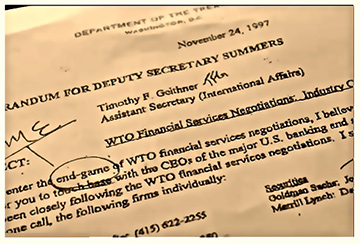
Larry Summers and the Secret “End-Game” Memo

August 26, 2013


palast1When a little birdie dropped the End Game memo through my window, its content was so explosive, so sick and plain evil, I just couldn’t believe it.

The Memo confirmed every conspiracy freak’s fantasy: that in the late 1990s, the top US Treasury officials secretly conspired with a small cabal of banker big-shots to rip apart financial regulation across the planet. When you see 26.3% unemployment in Spain, desperation and hunger in Greece, riots in Indonesia and Detroit in bankruptcy, go back to this End Game memo, the genesis of the blood and tears. The Treasury official playing the bankers’ secret End Game was Larry Summers. Today, Summers is Barack Obama’s leading choice for Chairman of the US Federal Reserve, the world’s central bank. If the confidential memo is authentic, then Summers shouldn’t be serving on the Fed, he should be serving hard time in some dungeon reserved for the criminally insane of the finance world.

The memo is authentic.

To get that confirmation, I would have to fly to Geneva and wangle a meeting with the Secretary General of the World Trade Organization, Pascal Lamy. I did. Lamy, the Generalissimo of Globalization, told me,
“The WTO was not created as some dark cabal of multinationals secretly cooking plots against the people…. We don’t have cigar-smoking, rich, crazy bankers negotiating.”

Then I showed him the memo.

It begins with Summers’ flunky, Timothy Geithner, reminding his boss to call the then most powerful CEOs on the planet and get them to order their lobbyist armies to march:
“As we enter the end-game of the WTO financial services negotiations, I believe it would be a good idea for you to touch base with the CEOs….”
To avoid Summers having to call his office to get the phone numbers (which, under US law, would have to appear on public logs), Geithner listed their private lines. And here they are:
Goldman Sachs: John Corzine (212)902-8281

Merrill Lynch: David Kamanski (212)449-6868

Bank of America, David Coulter (415)622-2255

Citibank: John Reed (212)559-2732

Chase Manhattan: Walter Shipley (212)270-1380

Lamy was right: They don’t smoke cigars. Go ahead and dial them. I did, and sure enough, got a cheery personal hello from Reed–cheery until I revealed I wasn’t Larry Summers. (Note: The other numbers were swiftly disconnected. And Corzine can’t be reached while he faces criminal charges.)

It’s not the little cabal of confabs held by Summers and the banksters that’s so troubling. The horror is in the purpose of the “end game” itself.

Let me explain:

The year was 1997. US Treasury Secretary Robert Rubin was pushing hard to de-regulate banks. That required, first, repeal of the Glass-Steagall Act to dismantle the barrier between commercial banks and investment banks. It was like replacing bank vaults with roulette wheels.

Second, the banks wanted the right to play a new high-risk game: “derivatives trading.” JP Morgan alone would soon carry $88 trillion of these pseudo-securities on its books as “assets.”

Deputy Treasury Secretary Summers (soon to replace Rubin as Secretary) body-blocked any attempt to control derivatives.

But what was the use of turning US banks into derivatives casinos if money would flee to nations with safer banking laws?

The answer conceived by the Big Bank Five: eliminate controls on banks in every nation on the planet – in one single move. It was as brilliant as it was insanely dangerous.

How could they pull off this mad caper? The bankers’ and Summers’ game was to use the Financial Services Agreement, an abstruse and benign addendum to the international trade agreements policed by the World Trade Organization.

Until the bankers began their play, the WTO agreements dealt simply with trade in goods–that is, my cars for your bananas. The new rules ginned-up by Summers and the banks would force all nations to accept trade in “bads” – toxic assets like financial derivatives.

Until the bankers’ re-draft of the FSA, each nation controlled and chartered the banks within their own borders. The new rules of the game would force every nation to open their markets to Citibank, JP Morgan and their derivatives “products.”

And all 156 nations in the WTO would have to smash down their own Glass-Steagall divisions between commercial savings banks and the investment banks that gamble with derivatives.

The job of turning the FSA into the bankers’ battering ram was given to Geithner, who was named Ambassador to the World Trade Organization.

Bankers Go Bananas

Why in the world would any nation agree to let its banking system be boarded and seized by financial pirates like JP Morgan?

The answer, in the case of Ecuador, was bananas. Ecuador was truly a banana republic. The yellow fruit was that nation’s life-and-death source of hard currency. If it refused to sign the new FSA, Ecuador could feed its bananas to the monkeys and go back into bankruptcy. Ecuador signed.

And so on–with every single nation bullied into signing.

Every nation but one, I should say. Brazil’s new President, Inacio Lula da Silva, refused. In retaliation, Brazil was threatened with a virtual embargo of its products by the European Union’s Trade Commissioner, one Peter Mandelson, according to another confidential memo I got my hands on. But Lula’s refusenik stance paid off for Brazil which, alone among Western nations, survived and thrived during the 2007-9 bank crisis.

China signed–but got its pound of flesh in return. It opened its banking sector a crack in return for access and control of the US auto parts and other markets. (Swiftly, two million US jobs shifted to China.)

The new FSA pulled the lid off the Pandora’s box of worldwide derivatives trade. Among the notorious transactions legalized: Goldman Sachs (where Treasury Secretary Rubin had been Co-Chairman) worked a secret euro-derivatives swap with Greece which, ultimately, destroyed that nation. Ecuador, its own banking sector de-regulated and demolished, exploded into riots. Argentina had to sell off its oil companies (to the Spanish) and water systems (to Enron) while its teachers hunted for food in garbage cans. Then, Bankers Gone Wild in the Eurozone dove head-first into derivatives pools without knowing how to swim–and the continent is now being sold off in tiny, cheap pieces to Germany.

Of course, it was not just threats that sold the FSA, but temptation as well. After all, every evil starts with one bite of an apple offered by a snake. The apple: The gleaming piles of lucre hidden in the FSA for local elites. The snake was named Larry.

Does all this evil and pain flow from a single memo? Of course not: the evil was The Game itself, as played by the banker clique. The memo only revealed their game-plan for checkmate.

And the memo reveals a lot about Summers and Obama.

While billions of sorry souls are still hurting from worldwide banker-made disaster, Rubin and Summers didn’t do too badly. Rubin’s deregulation of banks had permitted the creation of a financial monstrosity called “Citigroup.” Within weeks of leaving office, Rubin was named director, then Chairman of Citigroup—which went bankrupt while managing to pay Rubin a total of $126 million.

Then Rubin took on another post: as key campaign benefactor to a young State Senator, Barack Obama. Only days after his election as President, Obama, at Rubin’s insistence, gave Summers the odd post of US “Economics Tsar” and made Geithner his Tsarina (that is, Secretary of Treasury). In 2010, Summers gave up his royalist robes to return to “consulting” for Citibank and other creatures of bank deregulation whose payments have raised Summers’ net worth by $31 million since the “end-game” memo.

That Obama would, at Robert Rubin’s demand, now choose Summers to run the Federal Reserve Board means that, unfortunately, we are far from the end of the game.

Saturday, November 17, 2012

God May Have to Cause "A Complete Economic Collapse" to Save Nation From Obama~Franklin Graham

OK, Republicans...for the real reason you've lost two presidential elections in a row, look no further than this guy and those like him who say similar bullshit. Who votes for obvious insanity? We like our insanity safely suppressed so that when it forces its way out later, the damage will be more extensive. --jef


franklin graham 
 
Some conservatives are having a tough time with President Barack Obama's reelection. Take social conservative leader Franklin Graham. In an interview with Newsmax.com, the Rev. Graham, a prominent evangelist and son of top-dog evangelist Billy Graham, maintained that Obama's victory will put the country further along a "path of destruction." And he suggested it would take a "complete economic collapse" to place the United States on a better course and return it to godliness.

Graham equated the Obama years with a national rejection of God. "In the last four years, we have begun to turn our backs on God," he said. "We have taken God out of our education system. We have taken him out of government. You have lawyers that sue you every time you mention the name of Jesus Christ in any kind of a public forum." Oddly, Graham ignored the fact that he and other shepherds of the Christian right have griped about such matters for much longer than four years. It didn't start with Obama.
As Graham denounced the Obama years, Newsmax's Kathleen Walter asked, "So we've become too secular a nation? How do we bring God back into government?" Graham replied:
Maybe God will have to bring our nation down to our knees—to where you just have a complete economic collapse. And maybe at that point, maybe people will again begin to call upon the name of almighty God.
Economic calamity was the one option Graham mentioned—as if only such a disaster could move the United States in the right direction.

Graham has been no stranger to controversy. Earlier this year, he had to apologize after questioning Obama's faith and saying on MSNBC that the president "seems more concerned about [Muslims] than the Christians that are being murdered in the Muslim countries." He has often decried the entire religion of Islam, at one point calling it "a very evil and wicked religion." Two years ago, he was disinvited from the Pentagon's National Day of Prayer event when a fuss developed over his anti-Muslim comments.

In his Newsmax interview, Graham wasn't quite advocating that God wreak total economic havoc upon the United States. But he did come close. He also noted that his father "likes the president personally." The problem, Graham explained, is that "the radical left" has "taken over the White House."

Despite his harsh feelings concerning Obama's leadership, Graham said God commands him and Christians to "pray for those in authority." Consequently, he said, "I would encourage everyone to pray for the president…We need to bathe him prayer"—presumably, before the final (economic) days come.

Friday, October 12, 2012

Triumph of the Wrong: The GOP's Austerity Plan for America

Friday, October 12, 2012 by The New York Times
by Paul Krugman

In these closing weeks of the campaign, each side wants you to believe that it has the right ideas to fix a still-ailing economy. So here’s what you need to know: If you look at the track record, the Obama administration has been wrong about some things, mainly because it was too optimistic about the prospects for a quick recovery. But Republicans have been wrong about everything.

About that misplaced optimism: In a now-notorious January 2009 forecast, economists working for the incoming administration predicted that by now most of the effects of the 2008 financial crisis would be behind us, and the unemployment rate would be below 6 percent. Obviously, that didn’t happen.

Why did the administration get it wrong? It wasn’t exaggerated faith in the power of its stimulus plan; the report predicted a fairly rapid recovery even without stimulus. Instead, President Obama’s people failed to appreciate something that is now common wisdom among economic analysts: severe financial crises inflict sustained economic damage, and it takes a long time to recover.

This same observation, of course, offers a partial excuse for the economy’s lingering weakness. And the question we should ask given this unpleasant reality is what policies would offer the best prospects for healing the damage. Mr. Obama’s camp argues for an active government role; his last major economic proposal, the American Jobs Act, would have tried to accelerate recovery by sustaining public spending and putting money in the hands of people likely to use it. Republicans, on the other hand, insist that the path to prosperity involves sharp cuts in government spending.

And Republicans are dead wrong.

The latest devastating demonstration of that wrongness comes from the International Monetary Fund, which has just released its World Economic Outlook, a report combining short-term prediction with insightful economic analysis. This report is a grim and disturbing document, telling us that the world economy is doing significantly worse than expected, with rising risks of global recession. But the report isn’t just downbeat; it contains a careful analysis of the reasons things are going so badly. And what this analysis concludes is that a disproportionate share of the bad news is coming from countries pursuing the kind of austerity policies Republicans want to impose on America.

O.K., it doesn’t say that in so many words. What the report actually says is: “Activity over the past few years has disappointed more in economies with more aggressive fiscal consolidation plans.” But that amounts to the same thing.

For leading Republicans have very much tied themselves to the view that slashing spending in a depressed economy — “fiscal consolidation,” in I.M.F.-speak — is good, not bad, for job creation. Soon after the midterm elections, the new Republican majority in the House of Representatives issued a manifesto on economic policy — titled, “Spend less, owe less, grow the economy” — that called for deep spending cuts right away and pooh-poohed the whole notion that fiscal consolidation (yes, it used the same term) might deepen the economy’s slump. “Non-Keynesian effects,” the manifesto declared, would make everything all right.

Well, that turns out not to be remotely true. What the monetary fund shows is that the countries pursing the biggest spending cuts are also the countries that have experienced the deepest economic slumps. Indeed, the evidence suggests that in brushing aside the standard view that spending cuts hurt the economy in the short run, the G.O.P. got it exactly wrong. Recent spending cuts appear to have done even more harm than most analysts — including those at the I.M.F. itself — expected.

Which brings us to the question of what form economic policies will take after the election.

If Mr. Obama wins, he’ll presumably go back to pushing for modest stimulus, aiming to convert the gradual recovery that seems to be under way into a more rapid return to full employment.

Republicans, however, are committed to an economic doctrine that has proved false, indeed disastrous, in other countries. Nor are they likely to change their views in the light of experience. After all, facts haven’t gotten in the way of Republican orthodoxy on any other aspect of economic policy. The party remains opposed to effective financial regulation despite the catastrophe of 2008; it remains obsessed with the dangers of inflation despite years of false alarms. So it’s not likely to give up its politically convenient views about job creation.

And here’s the thing: if Mitt Romney wins the election, the G.O.P. will surely consider its economic ideas vindicated. In other words, politically good things may be about to happen to very bad ideas. And if that’s how it plays out, the American people will pay the price.

Thursday, June 14, 2012

The Meaning of Occupy

Revealing the Failure of 21st Century U.S. Capitalism
by PETER BOHMER

The Occupy movement in the United States is part of a global upsurge that began in Tunisia in late 2010, spread to Egypt and the Middle East, Wisconsin, Chile, Spain, Greece, Wall Street and the rest of the United States and now Quebec. I focus on the United States, particularly the Pacific Northwest where I have been an active participant.

I would like to acknowledge the moment. So often, we are alienated, or apathetic to the economic and social injustices taking place. This is a hopeful period when resistance and uprising in one place have resonated and spread. In the United States, we are living in a period of obscene inequality of income and wealth, a broken economic and political system that needs to be transformed not patched up. The income of the top 1% today is 42 times the bottom 90%, three times greater than the already high income inequality of 1979. 50 million people do not have health insurance, 1 in 3 are poor or near poor. Millions have lost their homes. Over 2 million people are in prison, disproportionately Black and Latino.

Over 20 million are unemployed; the rate for Blacks is twice that of whites. According to the New York Times of June 6th, 2012, of those who graduated from high school between 2009 and the present and who are not in college full time, one in six have full time jobs. For recent college graduates it’s not as bad but there is an ongoing crisis of unemployment and underemployment. The unemployment rate for young adults in Egypt, Spain, Greece and Portugal is even worse and has been an important factor in their uprisings. Whether we are living in a full-fledged global economic crisis is debatable, but the much higher than normal rates of unemployment is striking. The ongoing high unemployment rates and poor job prospects with high levels of student debt are an important factor in the participation and support for the Occupy Movement.

There was significant participation of veterans from Iraq and Afghanistan in the physical occupation of public space, Occupy, Olympia, Seattle and Portland, which peaked in October and early November 2011 and were closed down by various police forces over the next month. Most of the vets participating couldn’t find jobs and many were suffering from PTSD, often undiagnosed —another symptom of our imperialist system and poorly functioning health-care system.

The majority of the people who lived in tents at the Occupy Olympia site lacked access to health care, regular jobs and housing. Many had felony convictions, a testament to the U.S. having the highest prison rate in the world. Felons are openly discriminated against in getting jobs, housing, and higher education (see Michelle Alexander, The New Jim Crow.)

Those active in the Occupy Movement were motivated by unemployment and housing foreclosures, by the growing inequality of income and wealth, by the corporate domination of our daily lives, and corporate control of the government. There is a lot of anger at the decline in the social safety net, the bailout of banks and not people, and the “Citizens United” Supreme Court decision.

The Occupy Movement has forced public discussion and debate of these issues. Growing numbers, particularly young people, have begun to feel that they can and should act, that their actions matter. Through actions and media attention and by resonating with the lived experiences of the “99%”, the Occupy Movement has brought the economic and political crisis out of the closet.

By economic crisis, I do not necessarily mean a full-blown economic crisis in the Marxist sense. Even if profits are up; the economy is not working for working people and the unemployed. By political crisis I do not mean we are in a possible revolutionary situation, such as Greece, but rather there is a rapid loss of legitimacy of the Democrats and Republicans, of the Supreme Court and a growing awareness of the ongoing destruction of democracy and the growing surveillance state.

Prefigurative Movements

Among activists in the Occupy Movement, a very popular ideology is anarchist, although increasingly an anarchism not hostile to Marxism. I agree with Grubajic and Lynd in Wobblies and Zapatistas, that we need to end the sectarianism and division between anarchists, Marxists and participatory socialists. Although, I would not call the Occupy Movement as a whole, anti-capitalist, many of the participants identify that way. In Seattle, on May Day, 2012, there was an overtly anti-capitalist march, organized by Occupy Seattle, of 800 people.

A priority in the occupations has been meeting the needs of poor people for medical care, housing, food, security and safety, and community and political discussion and education. There was a serious effort by activists to provide these services on-site and to encourage the active participation of the residents of the occupation. These actions show the failure of the current capitalist system to provide for human needs; its discarding of poor people. We made visible the human costs of the U.S. political economy.

A community and democratic structure, although somewhat chaotic and imperfect and with few resources, provided a place for people to live, to learn, and be secure. There has been the development of community in the Occupy Movement; meaningful discussions between people who usually don’t talk to each other, of people looking out for each other. There were problems of limited and difficult communication between activists, mainly students or college educated, with the homeless, but it’s a beginning.

There were fights and drug problems, and problems of male dominance and sexual violence. Nonetheless, I disagree with the commonly held point of view that the Occupy Movement has been weakened by the large participation of homeless people. They are “the canary in the coal mine”. Over time, many identified as protesters.

Although imperfect, this is a concrete demonstration on a small scale of key values of a participatory socialist system. The meeting of basic human needs was a priority of the occupations and was universally understood as a human right. There was discussion of how to move from a makeshift medical tent on-site to the development of a fully functioning and accessible free health clinic. There was sharing of tents and clothing and resources.

There has been an emphasis on direct democracy, encouraging all voices to be heard with consensus decision-making. While this sometimes led to the general assembly being unable to reach decisions, it reflected a key value of the occupiers, of participatory democracy, and horizontal and non-hierarchical decision making. There was a rotation of tasks and facilitators at meetings. There was an emphasis on building an alternative community, ourselves. There was less emphasis on demanding resources from the state. Many participants believe in building a new society with a different economy, politics, culture, and interpersonal relationships–by having these alternative small communities spread until they became a new society.

Limitations

By the time of the December, 2011 police raid, participation at Olympia, Occupy had declined. The wet and cold weather was a major cause as was the large time commitment. Since then the Occupy Movement has not been able to regain its momentum. The lack of structure is a factor as is the lack of a clear strategic way to move forward. Should there be physical occupations of public or private space; or campaigns around specific demands, e.g., stopping housing foreclosures; or direct action and/or demonstration, such as mobilizations against the G-8 in Chicago in May, 2012, or at the upcoming Democratic and Republican Convention? None of these tactics have garnered much enthusiasm or active participation. The anger and awareness about the systemic failures of our system continue as does a growing anti-capitalist consciousness, but there is a lull in activism.

A major problem has been how to build a movement that unites the 99% while simultaneously making central the concerns of the most oppressed–by not having our only talking point be the excess wealth and power of the 1%. How do we build a movement that includes immigrant rights, environmental justice, racial justice, LGBT and reproductive/women rights, anti-war and global justice? Most participants in Occupy are sympathetic to amnesty for undocumented immigrants and against U.S. wars; but these have not been principles nor put forth as demands. A major challenge of Occupy is how to be simultaneously broad, inclusive and principled.

A common criticism has been there have been no demands, especially at a national level. Given the divergence of ideologies– many flavors of reformism and of left radicalism– making demands has been difficult and not desirable at this early stage of the movement. There is a need as this movement develops for demands for non-reformist reforms (see Gorz, Strategy for Labor) to emerge, that campaigns can be built around, where there is national coordination and excitement and passion Full employment with living wage jobs is a possible demand.

In fall, 2011, the Occupy Movement in the U.S. broke through feelings of powerlessness. Six months later, this movement is weaker although the movement against neoliberalism and austerity in Greece and Quebec is growing and powerful. New activists have learned organizing skills and have deepened their political understanding. Stay tuned for the next chapter.

Thursday, May 24, 2012

Bet on Collapse

Recovery or Collapse? 
by PAUL CRAIG ROBERTS

The US financial system and, probably, the financial system of Europe, like the police, no longer serves a useful social purpose.

In the US the police have proven themselves to be a greater threat to public safety than private sector criminals. I just googled “police brutality” and up came 183,000,000 results.

The cost to society of the private financial system is even higher. Writing in CounterPunch (May 18), Rob Urie reports that two years ago Andrew Haldane, executive Director for Financial Stability at the Bank of England (the UK’s version of the Federal Reserve) said that the financial crisis, now four years old, will in the end cost the world economy between $60 trillion and $200 trillion in lost GDP. If Urie’s report is correct, this is an astonishing admission from a member of the ruling elite. Try to get your mind around these figures. The US GDP, the largest in the world, is about 15 trillion. What Haldane is telling us is that the financial crisis will end up costing the world lost real income between 4 and 13 times the size of the current Gross Domestic Product of the United States. This could turn out to be an optimistic forecast.

In the end, the financial crisis could destroy Western civilization.

Even if Urie’s report, or Haldane’s calculation, is incorrect, the obvious large economic loss from the financial crisis is still unprecedented. The enormous cost of the financial crisis has one single source–financial deregulation. Financial deregulation is likely to prove to be the mistake that destroys Western civilization. While we quake in our boots from fear of “Muslim terrorists,” it is financial deregulation that is destroying us, with help from jobs offshoring. Keep in mind that Haldane is a member of the ruling elite, not a critic of the system like myself, Michael Hudson, or Pam Martens, to mention some CounterPunch contributors.)

Financial deregulation has had dangerous and adverse consequences. Deregulation permitted financial concentration that produced “banks too big to fail,” thus requiring the general public to absorb the costs of the banks’ mistakes and reckless gambling.

Deregulation permitted banks to leverage a small amount of capital with enormous debt in order to maximize return on equity, thereby maximizing the instability of the financial system and the cost to society of the banks’ bad bets.

Deregulation allowed financial institutions to sweep aside the position limits on speculators and to dominate commodity markets, turning them into a gambling casino and driving up the prices of energy and food.

Deregulation permits financial institutions to sell naked shorts, which means to sell a company’s stock or gold and silver bullion that the seller does not possess into the market in order to drive down the price.

The informed reader can add more items to this list.

The dollar in its role as world reserve currency is the source of Washington’s power. It allows Washington to control the international payments system and to exclude from the financial system those countries that do not do Washington’s bidding. It allows Washington to print money with which to pay its bills and to purchase the cooperation of foreign governments or to fund opposition within those countries whose governments Washington is unable to purchase, such as Iran, Russia, and China. If the dollar was not the world reserve currency and actually reflected its true depreciated value from the mounting US debt and running of the printing press, Washington’s power would be dramatically curtailed.

The US dollar has come close to its demise several times recently. In 2011 the dollar’s value fall as low as 72 Swiss cents. Investors seeking safety for the value of their money flooded into Swiss francs, pushing the value of the franc so high that Switzerland’s exports began to suffer. The Swiss government responded to the inflow of dollars and euros seeking refuge in the franc by declaring that it would in the future print new francs to offset the inflows of foreign currency in order to prevent the rise in the value of the franc. In other words, currency flight from the US and Europe forced the Swiss to inflate in order to prevent the continuous rise in the exchange value of the Swiss currency.

Prior to the sovereign debt crisis in Europe, the dollar was also faced with a run-up in the value of the euro as foreign central banks and OPEC members shifted their reserves into euros from dollars. The euro was on its way to becoming an alternative reserve currency. However, Goldman Sachs, whose former employees dominate the US Treasury and financial regulatory agencies and also the European Central Bank and governments of Italy and, indirectly, Greece, helped the Greek government to disguise its true deficit, thus deceiving the private European banks who were purchasing the bonds of the Greek government. Once the European sovereign debt crisis was launched, Washington had an interest in keeping it going, as it sends holders of euros fleeing into “safe” dollars, thus boosting the exchange value of the dollar, despite the enormous rise in Washington’s own debt and the doubling of the US money supply.

Last year gold and silver were rapidly rising in price (measured in US dollars), with gold hitting $1,900 an ounce and on its way to $2,000 when suddenly short sales began dominating the bullion markets. The naked shorts of gold and silver bullion succeeded in driving the price of gold down $350 per ounce from its peak. Many informed observers believe that the reason Washington has not prosecuted the banksters for their known financial crimes is that the banksters serve as an auxiliary to Washington by protecting the value of the dollar by shorting bullion and rival currencies.

What happens if Greece exits the EU on its own or by the German boot? What happens if the other EU members reject German Chancellor Merkel’s austerity, as the new president of France promised to do? If Europe breaks apart, do more investors flee to the doomed US dollar?

Will a dollar bubble become the largest bubble in economic history?

When the dollar goes, interest rates will escalate, and bond prices will collapse. Everyone who sought safety in US Treasuries will be wiped out.

We should all be aware that such outcomes are not part of the public debate.

Recently Bill Moyers interviewed Simon Johnson, formerly chief economist of the International Monetary Fund and currently professor at MIT. It turns out that deregulation, which abolished the separation of investment banks from commercial banks, permitted Jamie Dimon’s JPMorganChase to gamble with federally insured deposits. Despite this, Moyers reports that Republicans remain determined to kill the weak Dodd-Frank law and restore full deregulation.

Simon Johnson says: “I think it [deregulation] is a recipe for disaster.” The problem is, Johnson says, that correct economic policy is blocked by the enormous donations banks make to political campaigns. This means Wall Street’s attitudes and faulty risk models will result in an even bigger financial crisis than the one from which we are still suffering. And it will happen prior to recovery from the current crisis.

Johnson warns that the Republicans will distract everyone from the real crisis by concocting another “crisis” over the debt ceiling.

Johnson says that “a few people, particularly in and around the financial system, have become too powerful. They were allowed to take a lot of risk, and they did massive damage to the economy — more than eight million jobs lost. We’re still struggling to get back anywhere close to employment levels where we were before 2008. And they’ve done massive damage to the budget. This damage to the budget is long lasting; it undermines the budget when we need it to be stronger because the society is aging. We need to support Social Security and support Medicare on a fair basis. We need to restore and rebuild revenue, revenue that was absolutely devastated by the financial crisis. People need to understand the link between what the banks did and the budget. And too many people fail to do that.”

Consequently, Johnson says, the banksters continue to receive mega-benefits while imposing enormous social costs on society.

Few Americans and no Washington policymakers understand the dire situation. They are too busy hyping a non-existent recovery and the next war. Statistician John Williams reports that when correctly measured as a cost of living indicator, which the CPI no longer is, the current inflation rate in the US is 5 to 7 percentage points higher than the officially reported rate, as every consumer knows. The unemployment rate falls because, and only because, people unable to find jobs drop out of the labor force and are no longer counted as unemployed. Every informed person knows that the official inflation and unemployment rates are fictions; yet, the presstitute media continue to report the rates with a straight face as fact.

The way the government has rigged the measure of unemployment, it is possible for the US to have a zero rate of unemployment and not a single person employed or in the work force.

The way the government has the measure of inflation rigged, it is possible for your living standing to fall while the government reports that you are better off.

Financial deregulation raises the returns from speculative schemes above the returns from productive activity. The highly leveraged debt and derivatives that gave us the financial crisis have nothing to do with financing businesses. The banks are not only risking their customers’ deposits on gambling bets but also jeopardizing the country’s financial stability and economic future.

With an eye on the approaching dollar crisis, which will wreck the international financial system, the presidents of China, Russia, Brazil, South Africa, and the prime minister of India met last month to discuss forming a new bank that would shield their economies and commerce from mistakes made by Washington and the European Union. The five countries, known as the BRICS, intend to settle their trade with one another in their own currencies and cease relying on the dollar. The fact that Russia, the two Asian giants, and the largest economies in Africa and South America are leaving the dollar’s orbit sends a powerful message of lack of confidence in Washington’s handling of financial matters.

It is ironic that the outcome of financial deregulation in the US is the opposite of what its free market advocates promised. In place of highly competitive financial firms that live or die by their wits alone without government intervention, we have unprecedented financial concentration. Massive banks, “too big to fail,” now send their multi-trillion dollar losses to Washington to be paid by heavily indebted US taxpayers whose real incomes have not risen in 20 years. The banksters take home fortunes in annual bonuses for their success in socializing the “free market” banks’ losses and privatizing profits to the point of not even paying income taxes.

In the US free market economists unleashed avarice and permitted it to run amuck. Will the disastrous consequences discredit capitalism to the extent that the Soviet collapse discredited socialism?

Will Western civilization itself survive the financial tsunami that deregulated Wall Street has produced?

Ironic, isn’t it, that the United States, the home of the “indispensable people,” stands before us as the likely candidate whose government will be responsible for the collapse of the West.

Sunday, May 6, 2012

The Coming Economic Collapse Is More Real Than You Think


 David Seaman/Business Insider/5-5-2012

"Governments worldwide have borrowed 100 trillion last ten years. Defaults inevitable sometime soon. Means crash, hurting rich and poor," News Corporation CEO and Chairman Rupert Murdoch recently tweeted.

"Of course markets stay high with central banks printing huge sums, inflating everything except jobs," he had pointed out in a prior tweet.

And Rupert Murdoch isn't the only "elite" "insider" hinting at something unpleasant down the road if governments continue their spending (which they are doing, unabashedly).

Hedge funder David Einhorn recently opined over at Huffington Post: "I believe that stocks are depressed because there is a pervasive feeling that something awful is going to happen. What is this enormous tail-risk? It's the intersection of reckless fiscal policy with Jelly Donut monetary policy. There is a fear that our Fed Chairman is an academic willing to take great systemic risks in an experiment to prove out his thesis as to how we should have fought the last Great Depression."

And yes, the federal government really has been spending a LOT lately.

CBS News last year reported that the Obama administration has effected "the most rapid increase in the debt under any U.S. president," bringing us more than $4 trillion in fresh public debt since he took office. Is there some top-secret war being waged against an alien species on Mars?

No, the truth is far more mundane: hapless military excursions in the Middle East, declining revenues (due to declining economic growth), and outlandish police state expenses like a $2 billion data center in the Utah desert to spy on American citizens' online communications -- sadly this list explains much of our debt.

Automated data centers aren't exactly the best way to boost [human] employment, by the way.

Other debt icebergs, perhaps far more pernicious, lurk just below the surface: student loan debts have reportedly surpassed the $1 trillion mark, and with more than 1 in 2 new graduates unable to find gainful employment, this is a huge class of borrowers that appear less capable than ever of repaying their debts.

2012 should be interesting after the summer malaise subsides, giving way to real fear.

Friday, March 16, 2012

Goldman Sachs Takeaway: Fix Our Financial System or Get Ready for the Next Horrific Collapse

Only an overhaul in our broken banking and financial system will prevent the next collapse. Goldman Sachs' misdeeds are merely a symptom of a much bigger problem.
By Marshall Auerback, AlterNet
Posted on March 15, 2012

Greg Smith's mea culpa about Goldman Sachs should not come as a surprise to anybody who has a remote connection with the financial services industry. But to suggest that the allegations made by Mr. Smith are unique to  Goldman Sachs' culture is ludicrous. They are symptomatic of a much broader problem embedded in Wall Street culture as a whole.  Goldman Sachs' major sin was being more astute at exploiting this system than most of its competitors.

The toxic derivatives sold to what employees of  Goldman Sachs derisively referred to as "muppet" clients (since when was being a "muppet" such a bad thing?) were certainly neither a trend unique to GS, nor was it a recent phenomenon. The truth is that this activity has been embedded in Goldman' Sachs' culture since the days when Robert Rubin was co-CEO of the company and advocated GS taking proprietary positions (trading for its own account), even if it meant betting against their clients.

Goldman Sachs was a successful company and success tends to breed imitation. Eventually, everybody on Wall Street was doing the same shitty business.  Goldman Sachs, for example, wasn't the only one selling these toxic mortgage products, which helped to blow up the world's global economy in 2008, but they were smart enough to hedge them.

Why is all this so dangerous? Think of the recently deceased James Q. Wilson's Broken Windows thesis, which he largely used as his model for "blue collar" crime. Wilson thought that it was necessary to tackle even small signs of crime and decay in a community in order to prevent larger, more system criminal activity from emerging. You see a broken window, you go after the culprit. In the elite white collar crime context we have been following the opposite strategy of that recommended under the theory.

As the economist/criminologist Bill Black recently noted in a piece discussing Wilson's theory, the whole story of the past two decades has been that we have persistently excused those in finance who persistently break the windows. Indeed, we have praised them and their misconduct.

But as Black has noted, "The problem with allowing broken windows is far greater in the elite white collar crime context than the blue collar crime context. The squeegee guys make tiny amounts of money and are hated and politically powerless. The mediocre financial CEO who engages in accounting control fraud because it is a 'sure thing' causes the bank to report record (albeit fictional) profits and becomes wealthy and politically powerful. He uses his wealth to make charitable and political contributions that make him far harder to sanction. He claims that any crackdown on him is 'class warfare' by 'neo-Bolsheviks'."

Incredibly, the Department of Justice, the press, and the economic profession persistently ignore those who become wealthy by breaking windows, communities, and economies. In fact, they are lionised by no less than our President, who once termed both Lloyd Blankfein and Jamie Dimon "pretty savvy businessmen." Yes, and Al Capone was a pretty savvy businessman -- who just happened to be sloppy on his tax returns.

Realistically, what is required is a wholesale shift in our banking culture. In the old days, a banker “hedged” his credit risk by doing (shock!) CREDIT ANALYSIS. If the customer was deemed to be a poor credit risk, no loan was made. But if the loan was made, and turned out to be profitable, both lender and borrower made money, which is how banking should work.

It goes back to a point I have made many times: Creditworthiness precedes credit. You need policies designed to promote job growth, higher incomes and a corresponding ability to service debt before you can expect a borrower take on a loan or a banker to extend one. And, as the economist Hyman Minsky used to point out, in the old days, banking was a fundamentally optimistic activity, because the success of the lender was tied up with the success of the borrower; in other words, we didn’t have the spectacle of vampire-like squids betting against the success of their clients via instruments such as credit default swaps.

The main problem is that “finance” simply became too big. At the peak it captured 40 percent of all corporate profits (it recovered that share by the beginning of 2010 thanks to the bail-out and “creative” or even fraudulent accounting), and about a fifth of value-added to GDP. Interestingly, we find the same phenomenon in 1929, when finance received 40 percent of the nation’s profits. Apparently that represents a practical maximum and thus a turning point at which the economy collapses.

Perhaps of equal importance, finance virtually captured government, with Wall Street alumni grabbing an unprecedented proportion of federal government positions that have anything to do with the financial sector—including Treasury—under three consecutive presidents (from Clinton through Obama). It is not surprising that Wall Street gets deregulation when it wants, and that in spite of the scale of the current financial crisis—which has wiped out an estimated $50 trillion in global wealth—there has been no significant reform to date.

Real reform will likely have to wait for another collapse. When it comes, it will wipe out even more wealth, and will bring on even more intolerable suffering. Looking at today's situation that context, Greg Smith's letter is interesting, but ultimately it will be a sideshow unless it wakes us up to the bigger picture. The entire system demands overhaul.

Thursday, December 29, 2011

Failure to Reflate

by MIKE WHITNEY
 
 
For the second time in three years, the banking system has collapsed, which means that the banks are no longer able to fund themselves through the normal means, the wholesale markets. This same thing happened in July 2007 when two Bear Stearns hedge funds defaulted and trillions of dollars of mortgage-backed securities–which US banks had been holding–began to sharply decline in value. In a matter of months, most of America’s big-name banks were technically insolvent although the charade continued for a full year before Lehman Brothers blew up and the rot within the system became apparent to everyone. Now the same thing is taking place in Europe.

The banks do not get the bulk of their funding through their regulated activities of taking deposits and issuing loans, but by exchanging assets for short-term loans. Naturally, when doubts arise about the quality of these assets, then trading slows to a crawl and the banks are left high-and-dry. In other words, banking has transformed itself into an unregulated multi-trillion dollar pawn shop that can shut down at a moment’s notice leaving the entire industry dead-in-the-water.

When crisis strikes, alarms go off at the central banks who then ride to the rescue with lavish taxpayer-funded bailouts. We’ve seen this play many times before, the script never changes. The central bank chiefs claim that they are just offering liquidity assistance for “temporarily” impaired assets, but, of course, that’s not true. Two years after the Fed began its purchases of toxic MBS from US banks, all of those same assets are still on the Fed’s balance sheet. The Fed’s has become a “bad bank” where the stinkpile of unmarketable dreck the banks created via financial alchemy is housed. Eventually, the losses will be passed on to the taxpayers.

Imagine if the $350,000 home that you bought at the peak of the bubble in 2005 was suddenly “unsellable” at any price. This is the situation EU banks are in. No one wants to do business with them because there are doubts about their solvency as well as questions about the value of their assets. So, the system has shut down forcing the banks have to depend more and more on funding from the ECB. Of course, it doesn’t work this way for the average working guy. When the value of his house falls or his credit score gets slashed, he just has to suck-it-up and live on less because no one will give him a loan. It’s different for bankers.

EU Banking System: How bad is it?
Last week, the ECB lent 523 banks a total of 489 billion euros for three years at 1 percent. On Wednesday, those same banks parked all of the money they borrowed (except 37 billion euros) back at the ECB in overnight deposits. (That’s 452 euros, a new record) Think about that for a minute. In other words, the system is not just broken; it is completely broken.

There’s no lending,  no exchange of assets for short-term loans,  no credit expansion, no nothing. Zilch. All there is is hoarding and a lot of PR gibberish about “emergency liquidity”, “long-term refinancing”, blah, blah, blah. The average Joe doesn’t want a bunch of excuses; they want the facts. And the fact is, this unregulated, volatile, crisis-prone system has collapsed for a second time in three years which is why the central banks are committing trillions (just look at the ECB’s exploding balance sheet) in public money to bailout speculators who’ve gamed the system. That’s all people want to know.

So what is the ECB trying to achieve by pumping all this money into the banking system?
First of all, ECB chief Mario Draghi is trying to reflate the bubble in the bond market. You see, during the boom years, capital flows into Greece, Portugal, Spain etc, boosted the value of the sovereign debt by many orders of magnitude. The main buyers of these bonds were EU banks, so they are loaded to the gills with this junk-paper. Since Greece started teetering, the value of these bonds has plunged leaving many of these banks in the red.

And the situation is even worse than it sounds, because the banks have borrowed more money than the original value of the bonds themselves. In other words, they have posted this same collateral many times over greatly increasing their leverage and their exposure. It would be like if you or I took our prize racing bike down to the pawn shop and exchanged it for a short-term loan of $3,500. Only–in this case–the pawn shop owner allowed us to hold on to the bike. Then we went to another pawn shop, and a third and a forth; posting the same bike for the same short-term loan over and over again. Pretty soon, the debt is so huge, that any disruption in the flow of business, and the whole Ponzi-debt pyramid comes tumbling down. Presently, the ECB is trying to keep that pyramid in place by inflating the value of the dodgy bonds with injections of 3-year liquidity. These loans will never be repaid.

Now take a look at this from the Wall Street Journal:
“Even after the European Central Bank doled out nearly half a trillion euros of loans to cash-strapped banks last week, fears about potential financial problems are still stalking the sector. One big reason: concerns about collateral.
The only way European banks can now convince anyone—institutional investors, fellow banks or the ECB—to lend them money is if they pledge high-quality assets as collateral.
Now some regulators and bankers are becoming nervous that some lenders’ supplies of such assets, which include European government bonds and investment-grade non-government debt, are running low.
If banks exhaust their stockpiles of assets that are eligible to serve as collateral, they potentially could encounter liquidity problems. That is what happened this fall to Franco-Belgian lender Dexia SA, which ran out of money and required a government bailout.” (“European Bank Worry: Collateral”, Wall Street Journal)
So, the banks don’t have money and they don’t have good collateral. And the reason they don’t have good collateral is because they’ve been posting the same collateral over and over again to increase leverage. So, it’s all a sham; they’re upside down and headed for trouble. Here’s more from the same article:
“In addition to fears that the banks might simply run out of eligible collateral, some bankers and regulators worry that the banks’ growing reliance on “secured lending” will make it harder for the industry to return to its past practice of funding itself by issuing unsecured bonds. That could result in a permanent funding scarcity…..
Since this summer, it has been virtually impossible for banks to issue unsecured bonds, because investors view European banks as risky investments.
In the second half of 2011, European banks issued a total of about $80 billion of senior unsecured bonds, according to data provider Dealogic. That compares to $240 billion in the same period last year and $257 billion in 2009.” (“European Bank Worry: Collateral”, Wall Street Journal)
Financial journalists love to make this stuff sound harder than it really is. Look, this is simple. No one is trading with the banks because everyone knows they’re broke. When the author says that the banks’ “growing reliance on “secured lending” will make it harder for the industry to return to its past practice of funding itself by issuing unsecured bonds”; what he means is that the banks funding-model is kaput, because the bonds the banks own are losing value and no sane person will accept them in exchange for cash-money. So, the banksters are out of luck; they have to take their begging bowl to the ECB for handouts. And that’s where we are right now.

So, what’s the bottom line? What do these new developments (Draghi’s $600B Long-Term Refinancing Operation) tell us about the condition of the EU banking system and the probability of another financial crisis?

That’s the question I asked a friend of mine who works in the credit markets. Here’s what he said:
“Ask yourself one question, what has materially changed relating to solvency issues for banks in Europe in general and solvency issues for European countries in particular?
Nothing.
A credit crunch is unavoidable, and a meltdown is a possibility.”
You can’t sum it up any better than that.

Monday, September 26, 2011

(Obviously, this is a worst-case scenario, but not only is it possible, it is the probable result if things keep going the way they've gone since the late 1970s. I'm holding out a tiny bit of hope that sane minds will prevail over the religious nuts, the corrupt greedy wealthy and their servant politicians, and those who either are so apathetic they don't care or so falsely optimistic, they think it can't get that bad. I'm hopeful, but I'm a realist and I believe it will get much worse before it gets any better. And any talk of a recovery is bullshit. We are in for a decade or more of darkness. I believe the forces of sanity and peace can prevail, but the path to propserity for all of us, winds through bitter darkness and despair. All of us won't make it to the other side, either, sadly. So, we shiver in expectation for what we must endure.--jef)

How will America look after the Collapse?
~ Gerald Celente

How will America look after the Collapse? America is going to collapse, not just financially, but also politically and societally. This is a mathematical certainty. In this video I outline the basic facts that make the utter collapse of the dollar inevitable. My purpose is not to scare you, but to motivate you to prepare. Are you prepared for the economic collapse of America? The unprecedented economic prosperity that we have enjoyed for decades is coming to an end. The world is becoming a very unstable place. The greatest debt bubble in the history of the world is about to burst. I hope that you are getting prepared for what is ahead.


Five Banks Account For 96% Of The $250 Trillion In Outstanding US Derivative Exposure

Is Morgan Stanley Sitting On An FX Derivative Time Bomb?


The latest quarterly report from the Office Of the Currency Comptroller is out and as usual it presents in a crisp, clear and very much glaring format the fact that the top 4 banks in the US now account for a massively disproportionate amount of the derivative risk in the financial system. Specifically, of the $250 trillion in gross notional amount of derivative contracts outstanding (consisting of Interest Rate, FX, Equity Contracts, Commodity and CDS) among the Top 25 commercial banks (a number that swells to $333 trillion when looking at the Top 25 Bank Holding Companies), a mere 5 banks (and really 4) account for 95.9% of all derivative exposure (HSBC replaced Wells as the Top 5th bank, which at $3.9 trillion in derivative exposure is a distant place from #4 Goldman with $47.7 trillion). The top 4 banks: JPM with $78.1 trillion in exposure, Citi with $56 trillion, Bank of America with $53 trillion and Goldman with $48 trillion, account for 94.4% of total exposure. As historically has been the case, the bulk of consolidated exposure is in Interest Rate swaps ($204.6 trillion), followed by FX ($26.5TR), CDS ($15.2 trillion), and Equity and Commodity with $1.6 and $1.4 trillion, respectively. And that's your definition of Too Big To Fail right there: the biggest banks are not only getting bigger, but their risk exposure is now at a new all time high and up $5.3 trillion from Q1 as they have to risk ever more in the derivatives market to generate that incremental penny of return.


At this point the economist PhD readers will scream: "this is total BS - after all you have bilateral netting which eliminates net bank exposure almost entirely." True: that is precisely what the OCC will say too. As the chart below shows, according to the chief regulator of the derivative space in Q2 netting benefits amounted to an almost record 90.8% of gross exposure, so while seemingly massive, those XXX trillion numbers are really quite, quite small... Right?


...Wrong. The problem with bilateral netting is that it is based on one massively flawed assumption, namely that in an orderly collapse all derivative contracts will be honored by the issuing bank (in this case the company that has sold the protection, and which the buyer of protection hopes will offset the protection it in turn has sold). The best example of how the flaw behind bilateral netting almost destroyed the system is AIG: the insurance company was hours away from making trillions of derivative contracts worthless if it were to implode, leaving all those who had bought protection from the firm worthless, a contingency only Goldman hedged by buying protection on AIG. And while the argument can further be extended that in bankruptcy a perfectly netted bankrupt entity would make someone else whole on claims they have written, this is not true, as the bankrupt estate will pursue 100 cent recovery on its claims even under Chapter 11, while claims the estate had written end up as General Unsecured Claims which as Lehman has demonstrated will collect 20 cents on the dollar if they are lucky.

The point of this detour being that if any of these four banks fails, the repercussions would be disastrous. And no, Frank Dodd's bank "resolution" provision would do absolutely nothing to prevent an epic systemic collapse.
...
Lastly, and tangentially on a topic that recently has gotten much prominent attention in the media, we present the exposure by product for the biggest commercial banks. Of particular note is that while virtually every single bank has a preponderance of its derivative exposure in the form of plain vanilla IR swaps (on average accounting for more than 80% of total), Morgan Stanley, and specifically its Utah-based commercial bank Morgan Stanley Bank NA, has almost exclusively all of its exposure tied in with the far riskier FX contracts, or 98.3% of the total $1.793 trillion. For a bank with no deposit buffer, and which has massive exposure to European banks regardless of how hard management and various other banks scramble to defend Morgan Stanley, the fact that it has such an abnormal amount of exposure (but, but, it is "bilaterally netted" we can just hear Dick Bove screaming on Monday) to the ridiculously volatile FX space should perhaps raise some further eyebrows...

Monday, September 5, 2011

Labor Day 2011: What Are We Celebrating? The Lack Of Jobs In America?

The Economic Collapse
Monday, September 5, 2011

If you still have a good job, you certainly have something to celebrate on Labor Day 2011.

So far you have survived the decline of the U.S. economy.  But your day may be coming soon.  This weekend, there will be millions of Americans that will not be doing any celebrating.

They are not enjoying a break from their jobs because they don’t have any jobs.  In fact, it seems kind of heartless for the rest of us to be celebrating while so many of our countrymen are destitute.  What are we celebrating on Labor Day 2011?  The lack of jobs in America?

At this point, the U.S. economy closely resembles a gigantic game of musical chairs.  Every time the music stops, even more good jobs are pulled out of the game and even more workers are added.  Once upon a time, if you really wanted a job in America you could get one.  But now the competition for even the most basic jobs is absolutely brutal.  If you gathered together all of the unemployed people in the United States, they would constitute the 68th largest country in the world.  It would be a nation larger than Greece.  All of those unemployed people are not going to be taking trips with their families this holiday weekend.  Instead, most of them are going to be trying to figure out what to do with their shattered lives.

With the economy in such a mess, you would think that someone out there would be suggesting that Labor Day 2011 should really be a day of mourning.  This economic downturn has shredded the lives of millions of American families.

Is there any other crisis in recent years that has had more of an impact on a national level?

On Friday, the U.S. Bureau of Labor Statistics reported that no new jobs were created during the month of August and that the official unemployment rate remained steady at 9.1 percent.

Wait, aren’t we supposed to be in the middle of an economic recovery?

Actually, we need at least 150,000 new jobs or so each month just to keep up with the growth of the U.S. population.  So it seems odd that the economy would add zero jobs but the unemployment rate would not increase.

But that is what the government is saying.

In any event, things don’t look good.  According to the U.S. Bureau of Labor Statistics, the civilian employment-population ratio was at 58.2 percent last month.  This is an incredibly low figure.

In a recent article, John Mauldin explained what would have to happen to return the employment-population ratio to where it was in the year 2000….
The US has roughly the same number of jobs today as it had in 2000, but the population is well over 30,000,000 larger. To get to a civilian employment-to-population ratio equal to that in 2000, we would have to gain some 18 MILLION jobs.
Does anyone have an extra 18 million jobs laying around somewhere?  The following is a chart showing what has happened to the employment-population ratio over the last several decades….


What makes this chart even more startling is that the number of women in the workforce was constantly rising for most of the time period reflected in this chart.  So when you take that into account our current situation is far worse.

For example, back in 1969 95 percent of all men between the ages of 25 and 54 had a job.

Pretty much any man in his prime working years that wanted a job could get a job.
In July, only 81.2 percent of men in that age group had a job.

But that is only part of the story.  Another significant trend has been how flat wages have been.  Average hourly earnings fell 0.1% in August.  Meanwhile, the prices in the stores continue to go up.

In this column, I write a lot about how the middle class is being destroyedin this country.

When you look at the ratio of employee compensation to GDP, it is now the lowest that is has been in about 50 years.  In other words, U.S. workers are taking home a smaller share of the pie than at any other time in modern U.S. history.


But at this point those that still actually do have jobs consider themselves to be the lucky ones.

Tonight, there will be millions of desperate unemployed Americans that will blankly stare at their televisions as they try to figure out how their dreams got flushed down the toilet.

Remember how I mentioned at the beginning of the article that unemployed Americans would constitute a country larger than Greece?  Well, 42 percent of all of those unemployed

Americans have been out of a job for 27 weeks or longer.

What would you do if you lost your job and you were unemployed for half a year?
Would you be able to survive?

In America today, the longer that you are unemployed, the harder it is for you to get another job.  If you have been unemployed for at least one year, there is a 91 percent chance that you will not find a new job within the next month.

Out of sheer desperation, many Americans have taken jobs that they never even dreamed that they would take.

Only 47 percent of the U.S. workforce is “fully employed” at this point.  Right now there are hordes of Americans that are waiting tables, flipping burgers or stocking shelves at Wal-Mart because that is all that they can find right now.

Sadly, this is all part of a long-term trend.

Back in 1980, less than 30% of all jobs in the United States were low income jobs.

Today, more than 40% of all jobs in the United States are low income jobs.

This middle class is being pummeled out of existence, and most Americans don’t even understand what is happening.

It certainly does not help that both the Republicans and the Democrats have stood by as millions upon millions of our jobs have been shipped out of the country.

It also certainly does not help that both the Republicans and the Democrats have stood by as millions upon millions of illegal immigrants have taken jobs away from American citizens.

It also certainly does not help that both the Republicans and the Democrats have stood by as U.S. businesses have been absolutely crushed by mountains of nightmarish regulations and have been taxed into oblivion.

The decade that just ended was the worst decade for job growth in America since the Great Depression.  In fact, even though thirty million people were added to the U.S. population during the decade, there was essentially zero job growth.

Sadly, things look like they are going to continue to get even worse.  For example, the United States Postal Service is in such trouble that it is asking Congress to allow it to lay off 120,000 workers. Overall, the Postal Service wants to eliminate 220,000 positions by 2015.

So is this big speech that Obama is going to give on Thursday going to solve anything?
Of course not.

The reality is that if Obama or any of his advisors had any grand ideas for fixing our situation they would have implemented them by now.

And what is the big deal in making us wait until Thursday to hear these “new ideas”?  Why not just tell us now?

Sadly, the truth is that everything that our politicians do now is about setting themselves up for the 2012 election.

Most likely, Obama is just going to take a bunch of tired ideas that do not work and “spin” them into a grand new plan.

Millions of Americans will actually buy into it.

But it is not as if establishment Republican candidates have anything to offer either.

You know, if Obama wanted to do something substantial, one place to start would be to order the Federal Reserve to stop paying banks not to make loans to individual and small businesses.

But just like all of our other weak-minded recent presidents, Barack Obama is not going to confront the Federal Reserve.

In fact, everything that Obama actually does “for the economy” only seems to make things worse.

As I have outlined before, we know exactly why our economy is losing jobs and we know things that we could start doing right now to reverse the long-term trends that are absolutely killing us.

But Barack Obama is not talking about real solutions and neither are the establishment Republican candidates.

So things are going to continue to get worse.  The number of Americans on food stamps has increased 74% since 2007.  Every month we have been setting a new record.  The middle class is going to continue to disappear as the number of good jobs continues to decrease.

So, no, there are not too many reasons to celebrate on Labor Day 2011.  Our economy is dying and millions upon millions of our fellow citizens are deeply suffering.

Urgent action is required in order to prevent our situation from rapidly getting worse, but right now the vast majority of our politicians are asleep at the switch.

So instead of celebrating this Labor Day, why don’t you say a prayer for America instead?

We really could use it.

Wednesday, August 17, 2011

Is Democracy as We Know It on Its Way Out?

A decade ago, only paranoid alarmists would have posed that question.

 Today, it may be an expression of cold, brutal realism. 


By Frank Viviano, New America Media
Posted on August 17, 2011

Is Western democracy coming apart at the seams? A decade ago, only paranoid alarmists would have posed that question.


Today, it may be an expression of cold, brutal realism. 


On both sides of the Atlantic -- from the fires that raged in large stretches of London, to the political chicanery that brought the U.S. economy to its knees in early August -- the institutional framework that came to define modern democracy in the 19th century is in deep trouble. 


The principal organs of financial oversight and management are in tatters. Ferociously xenophobic political movements, an entire constellation of Tea Parties, now play important roles in nearly every European nation, as well as the United States. 


Faith in elected leaders and legislatures, the central and defining institutions of democracy, has never been lower.


According to the Pew Research Center, the proportion of the U.S. public expressing trust in the federal government has fallen from just under 80 per cent in the late 1960s to barely 20 per cent today. 


A European Union poll last September found that only 29 per cent of voters in its 27 member-states trust their own national government. Less than 20 per cent believe that their elected representatives are capable of successful action "against the effects of the financial and economic crisis." 


A meagre seven per cent trust the United States, the West's political and economic giant, to address the crisis -- a resounding vote of no confidence a year before the disastrous U.S. Congressional budget struggle. 


These numbers, put bluntly, are staggering. 


Angry, violent civil disturbances, first in Paris and now in London, have revealed enormous tinderboxes of alienation. With the gap between rich and poor -- between philosophical democracy's matchless promise and contemporary democracies' transparent inequities -- expanding at a dizzying pace, more explosions are likely and perhaps inevitable. 


Abroad in the Middle East and Central Asia, and at home in its urban streets, the Western Alliance is increasingly unable to maintain its values or defend them. 


Murdoch affair -- another betrayal of trust


Two factors separate these developments from the periodic lapses that marred democracy's evolution in the past. The first is that they are intimately connected, a systemic malady. The second is that their strains are being felt not in one Western nation or even half a dozen, but in all of them simultaneously. 


The links were strikingly evident in the scandal that erupted over the operations of Rupert Murdoch's News of the World, the United Kingdom's largest-circulation newspaper. 


The story opened with what appeared to be narrow abuses of individual privacy, the hacking by News of the World reporters into the cell phone of Milly Dowler, a 13-year-old British girl who vanished on the way home from school and was later found dead. 


Within days, the scandal grew into an expose of byzantine collaborations at the commanding heights of business and politics, leading not only to the firings and eventual arrests of Murdoch editors, but bringing down powerful figures in the British government and the nation's top law enforcement official. 


Then the storm crossed the Atlantic, setting off an FBI investigation and prompting the resignation of Les Hinton, chairman of Dow Jones and publisher of the Wall Street Journal. Both companies are also owned by Murdoch, as is the Fox News Channel, the chief broadcast voice of the populist American right.


A limited story about the callous treatment of a family tragedy had morphed into a full-fledged allegory on the cynical corruptions of business and politics, all in the name of "the people" -- the mostly lower-middle-class voters who are the principal audience of Murdoch's publications and broadcasts in Britain and America alike.


The tragedy is that their betrayal, which is precisely what it amounts to, is also a betrayal of their waning faith in democracy. 


A private survey released by the Brussels-based polling firm Burson-Marsteller in June, even before the Murdoch scandal broke, found that Britons' trust in their government had dropped by 51 per cent in just two years. 


Decline of the fourth estate


In the end, another of democracy's critical institutions, a reliable and vigilant press, blew the whistle on the Murdoch empire's shenanigans. The most damning evidence was hunted down by the investigative team at the Guardian, a British newspaper that stands at the opposite end of the professional spectrum from the tabloid sensationalism of News of the World (which Murdoch eventually shut down in an effort at damage control).


Voters need a dependable flow of facts, the kind the Guardian team chased down, to interpret events whose complexities are all too often lost in the braying of extremists. Without a well-informed electorate, democracy is a sham.


But like public trust in government, the mainstream press is caught in a precipitous downward spiral. In the brief span of four years since 2007, more than 25 per cent of all full-time reporters at U.S. newspapers have lost their jobs. In 2009 alone, the toll exceeded 6,000, the largest single year's cutback every recorded. 


The United Kingdom, Spain, Germany and Italy, with a combined population roughly 50 million less than that of the United States, laid off 6,500 reporters that same year.


Meanwhile, the sensationalist tabloids and their broadcast equivalents prosper, scandals notwithstanding, with the nihilistic right as prime beneficiaries.


There is no mistaking its impact. 


The European Union, an extraordinarily ambitious experiment in establishing democratic institutions across national boundaries, has brought six decades of continuous peace to a continent where history was defined by ceaseless wars among the French, British, Germans, Spaniards and their neighbors for two millennia.


Amidst a chorus of vapid nationalistic slogans on every side, the EU now stands perilously close to outright collapse.


In the once-solid heartland of western tolerance, the Nordic countries and the Netherlands, extremist anti-immigrant parties have been voted into every national parliament and exercise decisive power in many. The rhetoric that seized the imagination of Anders Behring Breivik, and sent him on a bloody one-day rampage in Norway that took 77 lives, is heard daily in the very legislatures where social democracy was polished into the globe's most comprehensive health, job-creation and pension structure. 


In Italy, where I live, the most important coalition partner in the government of Prime Minister Silvio Berlusconi is the Northern League, a party openly dedicated to the dismantling of the Italian state. The League's close American cousins, in spirit as well as in principle, are the Tea Party legislators of the U.S. Congress. 


It also demands the forced repatriation of immigrants, from a country that saw 25 million of its own people leave for abroad in the lifetime of my four grandparents, who were among them.