Showing posts with label income. Show all posts

Sunday, January 1, 2012

Companies getting very creative with data about you

By Candice Choi, Associated Press

NEW YORK – Companies are getting smarter at predicting your next move
As it becomes easier to gather information on consumers, businesses are crunching personal data in new ways to forecast a wide variety of behavior. In much the same way that credit scores predict how likely you are to pay your bills, a new generation of scores now rate the likelihood that you'll take your medications or redeem a specific coupon.

In some cases, transactions that were traditionally considered off the books — such as rent payments and payday loans — are being incorporated into the growing body of information used to size up customers.

The new uses of personal data raise a host of concerns for consumer advocates, who question the reliability of the scoring models and the accuracy of the information on which they rely. Also troubling is that many consumers are oblivious that they've been tagged with these numbers, notes Chi Chi Wu, an attorney with the National Consumer Law Center. In many cases, consumers have no way to learn what their so-called consumer scores are.

"If this score is about me, I should be entitled to it," Wu said.

With credit scores, for example, lenders are required to disclose a score if it was used to deny a loan or assign a higher interest rate. Those who aren't actively seeking a loan can also pay to learn their credit scores from Fair Isaac Corp., which also goes by the name of its widely used FICO score.

If you're wondering how else businesses are rating you, here's a look at four recently introduced scores you may not know about:

Mortgage scores
Anyone who has applied for a mortgage understands the importance of credit scores. The three-digit figures not only help determine whether a bank will approve a loan, but its interest rate as well.

Now a company called CoreLogic is developing a score it says will zero in on predicting a borrower's likelihood of repaying a mortgage. The score will be based on a new breed of credit reports the company released last month.

These reports gather information that isn't typically listed on credit reports, including information from CoreLogic's in-house databases of rental records and payday loan applications. Also included are public court records, such as property liens, evictions and child support judgments.

The new score is intended to give lenders a more "complete picture" of mortgage applicants, said Tim Grace, a CoreLogic executive. He said that should lead to better lending decisions and reduced delinquencies for banks.

The exact formula for the score is still being developed with FICO. But once they're available in March, Grace said consumers will be able to purchase their scores for a price yet to be determined. For now, CoreLogic is required by law to provide customers with a free annual copy of the more detailed credit reports the company introduced last month. Consumers can request their reports by calling 877-532-8778.

Medication scores
The business of scoring consumers isn't limited to financial matters. A score that was introduced this summer seeks to predict the likelihood that patients will take their medications. An individual's score can even vary depending on the condition; the score is available for hypertension, diabetes, high cholesterol, depression and asthma.

FICO says its Medication Adherence Score is intended to help health care providers flag patients at risk of ignoring doctor's orders. The idea is to improve overall patient outcomes and reduce health care costs. The score is not available to individuals.

Interestingly, a patient's health and credit data are not used to determine the score. Instead, FICO says it can predict compliance based on demographic information such as household size; those who live alone are more at risk of skipping their medications. Owning a car, by contrast, is a good indicator for health care providers, as is being neither very young nor very old.

And as it turns out, FICO says men are more likely to take their medications than women. Other information thrown into the formula includes the rate of bankruptcies in a patient's region and purchase histories culled from the same databases retailers use to target households for catalogs.

FICO, which notes that the scores can't be used for insurance underwriting purposes, declined to say whether the score is being used by any clients yet. But the company has estimated that 2 million to 3 million Americans would be scored by this year, with that number set to rise to around 10 million by the end of next summer.

Income scores
Asking a person how much he or she earns for a living is off limits in most circles. But credit card issuers and other companies can get a good idea of how much you make through an outside source.

Experian, one of the three national credit reporting agencies, in March introduced a product that predicts an individual's annual wages rounded to the nearest thousand dollars. The Income Insight W2 is based on the borrower's credit report.

"The intuitive explanation is that if you can maintain a mortgage or credit card payment at a certain level each month, you're earning a minimum amount," said Brannan Johnston, vice president of income and assets at Experian.

The W2 is a variation of an income forecaster the company rolled out in 2009, which predicted total household income, including investment income and spousal income. The singling out of the individual's wages was a response to new credit card regulations last year that require card issuers to assess card applicants' ability to afford their credit lines.
Although credit card issuers are the most common users of the Income Insight W2, Johnston notes that many other companies — including debt collectors — also use it to gauge how much individuals are earning.

Shopping scores
The items you put in your shopping cart aren't free from scrutiny either. FICO says it has helped a third of the top 100 largest U.S. retailers target their marketing based on customer buying patterns.

FICO declined to detail its roster of retail clients. But the warehouse discount club Sam's Club says it worked with the company to develop its eValues program introduced about two years ago that offers premium members personalized discounts.

Sam's Club uses its vast database of member transactions to determine "propensity scores," which gauge the likelihood that a customer would act on a particular discount. The scores even factor in the best time to offer that discount. For example, a customer who just bought three boxes of bulk cereal wouldn't be offered a discount on the same items right away.

So far, the program seems to be working. The company says that premium membership — which costs $100 a year, compared with $40 a year for standard membership — has more than doubled since eValues was launched. Customers who redeem an eValue discount also make more than twice as many trips to the store and tend to buy far more items during each visit, according to the company.

Although the scores aren't available to members, the company notes that shoppers are clearly benefiting from them.

"It's kind of like the eHarmony of couponing — we find the very best offers for the customer," said Catherine Corley, vice president of member program development at the company.

Friday, September 2, 2011

Executive Pay and the Great Tax Dodge


Before the deficit reduction “super-committee” embarks on a $1–2 trillion course of human slashonomics, it should take a hard look at the Institute for Policy Studies’ (IPS) eighteenth annual executive compensation report, which details how corporations are rewarding CEOs for aggressive tax avoidance—to the tune of at least $100 billion in lost tax revenues every year.

Executive Excess 2011: The Massive CEO Rewards for Tax Dodging reveals that last year twenty-five of the 100 most highly paid CEOs took home salaries greater than the amount their companies paid in 2010 federal income taxes. And it wasn’t because the corporations weren’t making dough—they averaged global profits of $1.9 billion, and only seven reported losses in US pre-tax income.

But these twenty-five companies shielded their profits in 556 tax haven subsidiaries in places like the Cayman Islands, Isle of Man, and Singapore, which proved to be a lucrative tax dodging strategy for the CEOs themselves: the twenty-five CEOs averaged $16.7 million in compensation, compared to $10.8 million for their peers in the S&P 500.

“What we’re seeing here is tax dodging, pure and simple,” says Sarah Anderson, who directs the global economy project at IPS and has coauthored the Executive Excess report for eighteen years running. “And tax dodging that’s benefiting the CEOs of these companies personally.”

It’s not that the corporations are breaking the law. Indeed, the report co-authors emphasize that tax dodging isn’t illegal. But Anderson points out that the laws are “the result of a corrupt system where hundreds of millions of dollars spent lobbying can result in these kinds of crazy, corporate tax loopholes.

That’s why twenty of the twenty-five companies who paid their CEOs more than they paid in federal income taxes also spent more on lobbying lawmakers, and eighteen contributed more to the political campaigns of their preferred candidates than they paid to the IRS.

“GE is sort of our world champion when it comes to tax dodging," says Anderson. “They were also number one in lobbying and political campaign spending, with about $42 million spent on that last year.”

GE paid CEO Jeff Immelt—who also is chairman of President Obama’s Council on Jobs and Competitiveness—$15.2 million. The company had more than $5 billion in US profits, yet reaped $3.3 billion in federal income tax refunds. (You should be receiving your thank-you note in the mail any day now.)

Report co-author Chuck Collins, who directs the IPS program on inequality and the common good, notes that the offshore tax havens have created a “two-tier” corporate system in which domestic businesses that pay closer to the 35 percent statutory rate are competing against global businesses that game the system.
“This is really bad for business and bad for local domestic businesses in particular,” says Collins.

IPS is working with business allies to close loopholes, broaden the tax base  and reduce rates, creating a fairer system. Collins also points out that the common conservative argument that US companies pay one of the highest tax rates in the world at 35 percent is a canard. In fact, thanks to all the gimmicks courtesy of corporate lobbyists and an obliging Congress, the effective rate was 25 percent in 1988 and has plummeted to 10.5 percent today—among the lowest in the world.

“Two generations ago some of the CEOs of these very same companies would have been embarrassed to be so lavishly compensated while at the same time reneging on their responsibility to pay their fair share in taxes,” says Collins. “It’s not just a trend in terms of compensation and tax avoidance. We’re looking at a multigenerational ethical shift away from a civic and corporate leadership.”

The Stop Tax Haven Abuse Act sponsored by Senator Carl Levin and Congressman Lloyd Doggett would plug up some of the corporate-preferred offshore mechanisms and secrecy jurisdictions. IPS has a petition in support of the legislation, and members of Congress should also be contacted and urged to cosponsor. The voices of small-business owners in particular are an important counter to corporations that claim they need these tax havens to create jobs.

The report also illustrates that exorbitant CEO salaries—fueled in part by these tax avoidance schemes—have led to a dramatic increase in the gap between CEO and average worker pay: it was 263:1 in 2009, and shot up to 325:1 last year. Anderson notes that the ratio was just around 40:1 in the 1980s.

“It’s clearly not due to some huge increase of talent at the top—some kind of managerial brilliance,” she says. “Instead it’s the result of a perverse system where CEOs are outrageously rewarded for short-term thinking: tax dodging, reckless investments, slashing jobs, cooking the books or using accounting tricks. Meanwhile, board members approving the pay packages are often executives at other companies who don’t want to rock the boat, or who find the rising compensation mutually beneficial.”

Fortunately, as a result of the Dodd-Frank bill, shareholders now have a right to an annual (though non-binding) “say-on-pay” vote on executive compensation packages, and Anderson says about forty have been rejected.

“This is a growing area of activism,” says Anderson. “But we can’t just leave it to shareholders to solve all the problems.”

Other key proposals that need citizen-activists’ support include California Congresswoman Barbara Lee’s Income Equity Act that would deny corporate tax deductions on any executive pay that runs over twenty-five times the lowest-paid employee, or $500,000, whichever is higher.

There is also a need for citizens to get involved in an underreported fight over the Dodd-Frank requirement that corporations disclose the gap between its CEO and median worker’s pay. The potential for public backlash has led corporate lobbyists to make repeal a priority before the disclosure takes effect. The House will likely vote to repeal, and there is concern that conservative Democrats in the Senate will see it as a bone to throw to Big Business contributors heading into the 2012 elections.

Already, this report has had a positive impact: it led Maryland Democratic Congressman Elijah Cummings to call for hearings “to examine the extent to which the problems in CEO compensation that led to the economic crisis continue to exist today” and “the extent to which our tax code may be encouraging these growing disparities.”

Executive Excess has also received coverage from the Washington Post, the New York Times, Reuters, MSNBC, the Atlanta Journal Constitution and Bloomberg, among others—and that’s just on the first day of its release.

IPS has done a real service in drawing these connections between CEO pay and an absurdly unfair tax system. It’s time for street heat, letters to the editor, calls to Congress, and driving this issue into 2012. It’s time to restore some sanity to pay equity and corporate taxes.

Thursday, September 1, 2011

Pouring the Red Ink Down the Sink


by MIKE WHITNEY
The US consumer’s decade-long spending spree has ended, but there’s still an ocean of red ink left to mop up. And with housing prices falling and unemployment tipping 9 per cent, it will take longer to clear the family balance sheet than many had anticipated.


Traditionally, the government has helped to ease the pain of deleveraging by providing fiscal stimulus to boost economic activity and lower the real cost of debt. But Capitol Hill is now in the grips of deficit hawks who frown on such Keynesian remedies, so households and consumers will have to fend for themselves and pay-down debts as best as they can or default when repayment is no longer possible . That’s bad news for the economy that depends on consumers for 71 percent of GDP. Without a healthy consumer, the economy will face years of sluggishness and stagnation.


U.S. household debt as a share of annual disposable income is currently 115 percent, down from the peak of 135 percent in 2008. But, while consumers are making headway in paring down their debts, there’s still a lot of work to do. Economists believe that the figure will eventually return to its historic range of 75 percent, which means slower growth for years to come unless someone else makes up the difference in spending.


But what sector is big enough to make up for the loss in consumer spending? Business? Government?


Business spending is still significantly below pre-crisis levels of investment. Naturally, businesses aren’t going hire more workers and produce more products if demand is weak. And, demand is bound to stay weak if there’s no rebound in consumption.  But how can the consumer rebound when he’s buried under a mountain of debt and making every effort to increase his savings? Surely, if wages were growing, then it would be easier to pay down debts while increasing spending at the same time. But wages aren’t growing, in fact, they are falling in inflation-adjusted terms. So personal consumption–which typically leads the way out of recession–will continue to disappoint. This is from an article by Stephen Roach titled “One Number Says it All”:
“There are two distinct phases to this period of unprecedented US consumer weakness. From the first quarter of 2008 through the second period of 2009, consumer demand fell for six consecutive quarters at a 2.2 per cent annual rate. Not surprisingly, the contraction was most acute during the depths of the Great Crisis, when consumption plunged at a 4.5 per cent rate in the third and fourth quarters of 2008.
As the US economy bottomed out in mid-2009, consumers entered a second phase – a very subdued recovery. Annualized real consumption growth over the subsequent eight-quarter period from the third quarter of 2009 through the second quarter of 2011 averaged 2.1 per cent. That is the most anemic consumer recovery on record – fully 1.5 percentage points slower than the 12-year pre-crisis trend of 3.6 per cent that prevailed between 1996 and 2007.
These figures are a good deal weaker than originally stated. As part of the annual reworking of the US National Income and Product Accounts that was released in July 2011, Commerce Department statisticians slashed their earlier estimates of consumer spending. The 14-quarter growth trend from early 2008 to mid-2011 was cut from 0.5 per cent to 0.2 per cent; the bulk of the downward revision was concentrated in the first six quarters of this period – for which the estimate of the annualized consumption decline was doubled, from 1.1 per cent to 2.2 per cent.
I have been tracking these so-called benchmark revisions for about 40 years. This is, by far, one of the most significant I have ever seen. We all knew it was tough for the American consumer – but this revision portrays the crisis-induced cutbacks and subsequent anemic recovery in a much dimmer light.” (“One Number Says it All”, Stephen S. Roach, Project Syndicate)
Roach’s timeline is key to understanding what’s going on. He says: “the subsequent eight-quarter period from the third quarter of 2009 through the second quarter of 2011 averaged 2.1 per cent.” The period that Roach calls a “very subdued recovery” coincides with the implementation of the $787 billion fiscal stimulus (ARRA).


Absent the Obama administration’s fiscal intervention, there would have been no recovery. This is worth considering in view of the fact that households continue to pay-down debts and will do so for the forseeable future. If the government doesn’t provide additional stimulus, then the economy will slip back into negative territory. And that’s precisely what’s happening now. Here’s an excerpt from an article by John P. Hussman, Ph.D, Hussman Funds who connects the dots drawing from recent data:
“It is now urgent for investors to recognize that the set of economic evidence we observe reflects a unique signature of recessions comprising deterioration in financial and economic measures that is always and only observed during or immediately prior to U.S. recessions. These include a widening of credit spreads on corporate debt versus 6 months prior, the S&P 500 below its level of 6 months prior, the Treasury yield curve flatter than 2.5 per cent…, year-over-year GDP growth below 2 per cent, ISM Purchasing Managers Index below 54, year-over-year growth in total nonfarm payrolls below 1 per cent, as well as important corroborating indicators such as plunging consumer confidence. There are certainly a great number of opinions about the prospect of recession, but the evidence we observe at present has 100 per cent sensitivity (these conditions have always been observed during or just prior to each U.S. recession) and 100 per cent specificity (the only time we observe the full set of these conditions is during or just prior to U.S. recessions). This doesn’t mean that the U.S. economy cannot possibly avoid a recession, but to expect that outcome relies on the hope that “this time is different.” (“A Reprieve from Misguided Recklessness”, John P. Hussman, Ph.D, Hussman Funds)
Policy should be based on more than hope. It should be grounded in a firm grasp of macroeconomics and a commitment to the common good.


Keep in mind, that during the peak bubble years of 2000 to 2007 households nearly doubled their “outstanding debt to $13.8 trillion” and “personal consumption grew by 44 per cent from $6.9 trillion to $9.9 trillion”. Also, from 2003 to the third quarter 2008 US households extracted $2.3 trillion of equity from their homes in the form of home equity loans and cash-out refinancings” (figures from “Will US Consumer Debt Cripple the Recovery”, McKinsey Global Institute)


$2.3 trillion! Think about that. That’s nearly $500 billion that was being pumped into the economy every year, which is more than Obama’s $787 stimulus distributed over a two-year period. That’s why unemployment stayed low while housing prices ballooned, because loose lending standards and easy money inflated the biggest credit bubble of all time. But now the trend has reversed itself and debt-deflation dynamics are in play forcing consumers to cut spending, increase saving, and pay down their debts. Only the federal government has the ability and the wherewithal to support the flagging economy while the process continues. The government must boost its spending, increase the deficits, and assist in the deleveraging process. This is from an article by economist Laura Tyson titled “Recovering from a Balance-Sheet Recession”:
“In other recoveries during the last 50 years, public-sector employment increased. This time it is falling: during the last year the private sector added 1.8 million jobs while the public sector cut 550,000.
What should policy makers do to combat the large and lingering job losses that result from a financial crisis and balance-sheet recession? Mr. Koo, whose book on Japan’s experience should be required reading for members of Congress, showed that when the private sector is curtailing spending, fiscal stimulus to increase growth and reduce unemployment is the most effective way to reduce the private-sector debt overhang choking private spending.
When the Japanese government tried fiscal consolidation to slow the growth of government debt in response to International Monetary Fund advice in 1997, the results were economic contraction and an increase in the government deficit. In contrast, when the Japanese government increased government spending, the pace of recovery strengthened and the deficit as a share of gross domestic product declined….” (“Recovering from a Balance-Sheet Recession”, Laura D’Andrea Tyson, New York Times)
Did you catch that? When the Japanese government tried to decrease the deficits by slashing spending, they increased the deficits. This is the lesson that every country in the EU –which has applied the ECB-IMF austerity measures—has learned. Cutting spending when the economy is weak is bad policy and bad economics. Struggling economies must "growth" their way out off of recession by spending liberally and putting people back to work, thus adding to government revenues. Here’s Tyson again explaining why this is so:
“The market understands that the most important driver of the fiscal deficit in the short to medium run is weak tax revenues, reflecting slow growth and high unemployment, and that additional fiscal measures to put people back to work are the most effective way to reduce the deficit.
“Every one percentage point of growth adds about $2.5 trillion in government revenue. An extra percentage point of growth over the next five years would do more to reduce the deficit during that period than any of the spending cuts currently under discussion. And faster growth would make it easier for the private sector to reduce its debt burden….Under these conditions, slow growth leads to a higher debt ratio, not vice versa…” (“Recovering from a Balance-Sheet Recession”, Laura D’Andrea Tyson, New York Times)
So, how do we speed up the deleveraging process so the economy can get back on track?


First, the government must be committed to long-term “sustained” fiscal stimulus until the share of household debt to disposable income returns to normal. Second, there should be a restructuring of household and personal debts “including”,– as economist Carmen Reinhart says– “debt forgiveness for low-income Americans”….


“Until we deal head-on with the fact that some of those debts are not ever going to be repaid, we will continue to have this shadow over growth”, Reinhart told Bloomberg News last weekend.


Debt repudiation, principle write-downs on underwater mortgages and amnesty on delinquent student loans should all be added to the mix of stimulants to future growth.


Finally–along with federally-funded government jobs programs (a revised WPA, etc)–Congress needs to address the chronic supply-demand imbalance that has emerged from Labor’s dwindling share in corporate profits. The imbalance has now reached historic levels which has widened gross inequality and threatens to keep the economy in a semi-permanent state of Depression. Here’s a quick summary from Barry Ritholtz’s “The Big Picture”:
“Labor share averaged 64.3 percent from 1947 to 2000. Labor share has declined over the past decade, falling to its lowest point in the third quarter of 2010, 57.8 percent. The change in labor share from one period to the next has become a major factor contributing to the compensation–productivity gap in the nonfarm business sector….
While Labor Share has recently plummeted to all-time lows since record keeping began, Median Household Income has stagnated for the past 12 years. In the last recession (2001), incomes had only begun to decline…. One decade later, Labor Share has collapsed, incomes have gone nowhere, and credit availability… has all but vanished except for the most creditworthy…” (“The Heart of the Matter”, The Big Picture)
Not only is labor getting a smaller and smaller piece of the pie, but, also, financial engineering–spurred-on by low interest rates and deregulation–has given rise to consecutive credit bubbles which have transferred a larger share of pension and retirement fund-wealth to Wall Street speculators. So, working people are not just getting screwed on their labor, the government and central bank are actually helping to facilitate the pilfering of their savings.


At the same time, corporate profits have continued to skyrocket. As the Wall Street Journal’s Kelly Evans notes, “Since the recession ended in mid-2009, U.S. corporate profits have jumped by about 43 per cent to a record $1.45 trillion as of the first quarter, after taxes, inventory and accounting adjustments, according to the Commerce Department.” (“More Liquidity Only Douses Growth Sparks”, Wall Street Journal)


So, despite sky-high unemployment, household deleveraging, historic inequality and slow growth; profits keep rising. Is there any doubt about whose interests are being served.


The only way out of the mess that workers find themselves in, is through politics. And–on that score–FDR said it best:
“We cannot allow our economic life to be controlled by that small group of men whose chief outlook upon the social welfare is tinctured by the fact that they can make huge profits from the lending of money and the marketing of securities–an outlook which deserves the adjectives ‘selfish’ and ‘opportunist.’” –Franklin Delano Roosevelt, “FDR Explains the Crisis: Why it feels like 1932″, Pam Martens, CounterPunch.

Wednesday, June 29, 2011

How Greed Destroys America


America’s corporate chieftains are living like kings while the middle class stagnates and shrivels
 
If the “free-market” theories of Ayn Rand and Milton Friedman were correct, the United States of the last three decades should have experienced a golden age in which the lavish rewards flowing to the titans of industry would have transformed the society into a vibrant force for beneficial progress.

Direct Action for Single-Payer Direct Action for Single-PayerAfter all, it has been faith in “free-market economics” as a kind of secular religion that has driven U.S. government policies – from the emergence of Ronald Reagan through the neo-liberalism of Bill Clinton into the brave new world of House Republican budget chairman Paul Ryan.

By slashing income tax rates to historically low levels – and only slightly boosting them under President Clinton before dropping them again under George W. Bush – the U.S. government essentially incentivized greed or what Ayn Rand liked to call “the virtue of selfishness.”

Further, by encouraging global “free trade” and removing regulations like the New Deal’s Glass-Steagall separation of commercial and investment banks, the government also got out of the way of “progress,” even if that “progress” has had crushing results for many middle-class Americans.

True, not all the extreme concepts of author/philosopher Ayn Rand and economist Milton Friedman have been implemented – there are still programs like Social Security and Medicare to get rid of – but their “magic of the market” should be glowing by now.

We should be able to assess whether laissez-faire capitalism is superior to the mixed public-private economy that dominated much of the 20th Century.

The old notion was that a relatively affluent middle class would contribute to the creation of profitable businesses because average people could afford to buy consumer goods, own their own homes and take an annual vacation with the kids. That “middle-class system,” however, required intervention by the government as the representative of the everyman.

Beyond building a strong infrastructure for growth – highways, airports, schools, research programs, a safe banking system, a common defense, etc. – the government imposed a progressive tax structure that helped pay for these priorities and also discouraged the accumulation of massive wealth.

After all, the threat to a healthy democracy from concentrated wealth had been known to American leaders for generations.

A century ago, it was Republican President Theodore Roosevelt who advocated for a progressive income tax and an estate tax. In the 1930s, it was Democratic President Franklin Roosevelt, who dealt with the economic and societal carnage that under-regulated financial markets inflicted on the nation during the Great Depression.

With those hard lessons learned, the federal government acted on behalf of the common citizen to limit Wall Street’s freewheeling ways and to impose high tax rates on excessive wealth.

So, during Dwight Eisenhower’s presidency of the 1950s, the marginal tax rate on the top tranche of earnings for the richest Americans was about 90 percent. When Ronald Reagan took office in 1981, the top rate was still around 70 percent.

Discouraging Greed

Greed was not simply frowned upon; it was discouraged.

Put differently, government policy was to maintain some degree of egalitarianism within the U.S. political-economic system. And to a remarkable degree, the strategy worked.

The American middle class became the envy of the world, with otherwise average folk earning enough money to support their families comfortably and enjoy some pleasures of life that historically had been reserved only for the rich.

Without doubt, there were serious flaws in the U.S. system, especially due to the legacies of racism and sexism. And it was when the federal government responded to powerful social movements that demanded those injustices be addressed in the 1960s and 1970s, that an opening was created for right-wing politicians to exploit resentments among white men, particularly in the South.

By posing as populists hostile to “government social engineering,” the Right succeeded in duping large numbers of middle-class Americans into seeing their own interests – and their “freedom” – as in line with corporate titans who also decried federal regulations, including those meant to protect average citizens, like requiring seat belts in cars and discouraging cigarette smoking.

Amid the sluggish economy of the 1970s, the door swung open wider for the transformation of American society that had been favored by the likes of Ayn Rand and Milton Friedman, putting the supermen of industry over the everyman of democracy.

Friedman tested out his “free-market” theories in the socio-economic laboratories of brutal military dictatorships in Latin America, most famously collaborating with Chile’s Gen. Augusto Pinochet who crushed political opponents with torture and assassinations.

Ayn Rand became the darling of the American Right with her books, such as Atlas Shrugged, promoting the elitist notion that brilliant individuals represented the engine of society and that government efforts to lessen social inequality or help the average citizen were unjust and unwise.

The Pied Piper

Yet, while Rand and Friedman gave some intellectual heft to “free-market” theories, Ronald Reagan proved to be the perfect pied piper for guiding millions of working Americans in a happy dance toward their own serfdom.

In his first inaugural address, Reagan declared that “government is the problem” – and many middle-class whites cheered.

However, what Reagan’s policies meant in practice was a sustained assault on the middle class: the busting of unions, the export of millions of decent-paying jobs, and the transfer of enormous wealth to the already rich. The tax rates for the wealthiest were slashed about in half. Greed was incentivized.

Ironically, the Reagan era came just as technology – much of it created by government-funded research – was on the cusp of creating extraordinary wealth that could have been shared with average Americans. Those benefits instead accrued to the top one or two percent.

The rich also benefited from the off-shoring of jobs, exploiting cheap foreign labor and maximizing profits. The only viable way for the super-profits of “free trade” to be shared with the broader U.S. population was through taxes on the rich. However, Reagan and his anti-government true-believers made sure that those taxes were kept at historically low levels.

The Ayn Rand/Milton Friedman theories may have purported to believe that the “free market” would somehow generate benefits for the society as a whole, but their ideas really represented a moralistic frame which held that it was somehow right that the wealth of the society should go to its “most productive” members and that the rest of us were essentially “parasites.”

Apparently, special people like Rand also didn’t need to be encumbered by philosophical consistency. Though a fierce opponent of the welfare state, Rand secretly accepted the benefits of Medicare after she was diagnosed with lung cancer, according to one of her assistants.

She connived to have Evva Pryor, an employee of Rand’s law firm, arrange Social Security and Medicare benefits for Ann O’Connor, Ayn Rand using an altered spelling of her first name and her husband’s last name.
In 100 Voices: An Oral History of Ayn Rand, Scott McConnell, founder of the Ayn Rand Institute’s media department, quoted Pryor as justifying Rand’s move by saying: “Doctors cost a lot more money than books earn and she could be totally wiped out.” Yet, it didn’t seem to matter much if “average” Americans were wiped out.

Essentially, the Right was promoting the Social Darwinism of the 19th Century, albeit in chic new clothes. The Gilded Age from a century ago was being recreated behind Reagan’s crooked smile, Clinton’s good-ole-boy charm and George W. Bush’s Texas twang.

Whenever the political descendants of Theodore and Franklin Roosevelt tried to steer the nation back toward programs that would benefit the middle class and demand greater sacrifice from the super-rich, the wheel was grabbed again by politicians and pundits shouting the epithet, “tax-and-spend.”

Many average Americans were pacified by reminders of how Reagan made them feel good with his rhetoric about “the shining city on the hill.”

The Rand/Friedman elitism also remains alive with today’s arguments from Republicans who protest the idea of raising taxes on businessmen and entrepreneurs because they are the ones who “create the jobs,” even if there is little evidence that they are actually creating American jobs.

Rep. Paul Ryan, R-Wisconsin, who is leading the fight to replace Medicare with a voucher system that envisions senior citizens buying health insurance from profit-making companies, cites Ayn Rand as his political inspiration.

A Land for Billionaires

The consequences of several decades of Reaganism and its related ideas are now apparent. Wealth has been concentrated at the top with billionaires living extravagant lives that not even monarchs could have envisioned, while the middle class shrinks and struggles, with one everyman after another being shoved down into the lower classes and into poverty.

Millions of Americans forego needed medical care because they can’t afford health insurance; millions of young people, burdened by college loans, crowd back in with their parents; millions of trained workers settle for low-paying jobs; millions of families skip vacations and other simple pleasures of life.

Beyond the unfairness, there is the macro-economic problem which comes from massive income disparity. A healthy economy is one where the vast majority people can buy products, which can then be manufactured more cheaply, creating a positive cycle of profits and prosperity.

With Americans unable to afford the new car or the new refrigerator, American corporations see their domestic profit margins squeezed. So they are compensating for the struggling U.S. economy by expanding their businesses abroad in developing markets, but they also keep their profits there.

There are now economic studies that confirm what Americans have been sensing in their own lives, though the mainstream U.S. news media tends to attribute these trends to cultural changes, rather than political choices.

For instance, the Washington Post published a lengthy front-page article on June 19, describing the findings of researchers who gained access to economic data from the Internal Revenue Service which revealed which categories of taxpayers were making the high incomes.

To the surprise of some observers, the big bucks were not flowing primarily to athletes or actors or even stock market speculators. America’s new super-rich were mostly corporate chieftains.

As the Post’s Peter Whoriskey framed the story, U.S. business underwent a cultural transformation from the 1970s when chief executives believed more in sharing the wealth than they do today.

The article cites a U.S. dairy company CEO from the 1970s, Kenneth J. Douglas, who earned the equivalent of about $1 million a year. He lived comfortably but not ostentatiously. Douglas had an office on the second floor of a milk distribution center, and he turned down raises because he felt it would hurt morale at the plant, Whoriskey reported.

However, just a few decades later, Gregg L. Engles, the current CEO of the same company, Dean Foods, averages about 10 times what Douglas made. Engles works in a glittering high-rise office building in Dallas; owns a vacation estate in Vail, Colorado; belongs to four golf clubs; and travels in a $10 million corporate jet. He apparently has little concern about what his workers think.
“The evolution of executive grandeur – from very comfortable to jet-setting – reflects one of the primary reasons that the gap between those with the highest incomes and everyone else is widening,” Whoriskey reported.

“For years, statistics have depicted growing income disparity in the United States, and it has reached levels not seen since the Great Depression. In 2008, the last year for which data are available, for example, the top 0.1 percent of earners took in more than 10 percent of the personal income in the United States, including capital gains, and the top 1 percent took in more than 20 percent.

“But economists had little idea who these people were. How many were Wall Street financiers? Sports stars? Entrepreneurs? Economists could only speculate, and debates over what is fair stalled. Now a mounting body of economic research indicates that the rise in pay for company executives is a critical feature in the widening income gap.”

Jet-Setting Execs

The Post article continued:

“The largest single chunk of the highest-income earners, it turns out, are executives and other managers in firms, according to a landmark analysis of tax returns by economists Jon Bakija, Adam Cole and Bradley T. Heim. These are not just executives from Wall Street, either, but from companies in even relatively mundane fields such as the milk business.
“The top 0.1 percent of earners make about $1.7 million or more, including capital gains. Of those, 41 percent were executives, managers and supervisors at non-financial companies, according to the analysis, with nearly half of them deriving most of their income from their ownership in privately-held firms.

“An additional 18 percent were managers at financial firms or financial professionals at any sort of firm. In all, nearly 60 percent fell into one of those two categories. Other recent research, moreover, indicates that executive compensation at the nation’s largest firms has roughly quadrupled in real terms since the 1970s, even as pay for 90 percent of America has stalled.”
While these new statistics are striking – suggesting a broader problem with high-level greed than might have been believed – the Post ducked any political analysis that would have laid blame on Ronald Reagan and various right-wing economic theories.

In a follow-up editorial on June 26, the Post lamented the nation’s growing income inequality but shied away from proposing higher marginal tax rates on the rich or faulting the past several decades of low tax rates. Instead, the Post suggested perhaps going after deductions on employer-provided health insurance and mortgage interest, tax breaks that also help middle-class families.

It appears that in Official Washington and inside the major U.S. news media the idea of learning from past presidents, including the Roosevelts and Dwight Eisenhower, is a non-starter. Instead there’s an unapologetic embrace of the theories of Ayn Rand and Milton Friedman, an affection that can pop out at unusual moments.

Addressing a CNBC “Fast Money” panel last year, movie director Oliver Stone was taken aback when one CNBC talking head gushed how Stone’s “Wall Street” character Gordon Gecko had been an inspiration, known for his famous comment, “Greed is good.” A perplexed Stone responded that Gecko, who made money by breaking up companies and eliminating jobs, was meant to be a villain.

However, the smug attitude of the CNBC stock picker represented a typical tribute to Ronald Reagan’s legacy. After all, greed did not simply evolve from some vague shift in societal attitudes, as the Post suggests. Rather, it was stimulated – and rewarded – by Reagan’s tax policies.

Reagan’s continued popularity also makes it easier for today’s “no-tax-increase” crowd to demand only spending cuts as a route to reducing the federal debt, an ocean of red ink largely created by the tax cuts of Ronald Reagan and George W. Bush.

Tea Partiers, in demanding even more cuts in government help for average citizens and even more tax cuts for the rich, represent only the most deluded part of middle-class America. A recent poll of Americans rated Reagan the greatest U.S. president ever, further enshrining his anti-government message in the minds of many Americans, even those in the battered middle class.

When a majority of Americans voted for Republicans in Election 2010 – and with early polls pointing toward a likely GOP victory in the presidential race of 2012 – it’s obvious that large swaths of the population have no sense of what’s in store for them as they position their own necks under the boots of corporate masters.

The only answer to this American crisis would seem to be a reenergized and democratized federal government fighting for average citizens and against the greedy elites. But – after several decades of Reaganism, with the “free market” religion the new gospel of the political/media classes – that seems a difficult outcome to achieve.

Monday, May 30, 2011

Income Inequality Ignorance

Sunday, May 29, 2011 by RT America

Despite the gap between rich and poor in the United States growing steadily since the 1970's most Americans are not getting angry or protesting in the streets. This could be because most of them are unaware of it, with both lower and upper class people considering themselves to be middle class.

Tuesday, July 13, 2010

Controlling the wealth of America

Top 1 percent control 83 percent of U.S. stocks. As a share of personal income mortgage debt ate up 19 percent in 1949. In 2003 it went up to 85 percent. 80 percent of Americans 65 years and older depend on Social Security for half of their income.

Mayer Rothschild was quoted as saying “give me the power of the money and it will not matter any more who is commanding.”  Today Wall Street is in full command of our government.  The impact of massive lobbying has guaranteed that many of our politicians are bought off and are serving as serfs to their feudal lords on Wall Street.  How else can we explain the lack of reform in the financial industry after the biggest economic crisis since the Great Depression?  Wealth is massively concentrated in a few hands in America.  Just because you have access to debt does not make you wealthy.  83 percent of all U.S. stocks are in the hands of the top 1 percent.

Let us look at the data:

Source:  ACS, Lending Tree Report

The above is a clear example of why the recent Bull Run in the stock market made very little impact in the real economy.  Unemployment is still extremely high and most Americans still live with the effects of a recession.  The housing market is still in disarray yet the boom in stock values has benefitted those that least need it in the market.  The notion that stock wealth is evenly disbursed is nothing more than Wall Street propaganda.  Look at the above data and you can see why.

Many Americans have been under a spell thinking that they have been getting richer merely because they have more access to debt. Wealth is measured by net worth, not how much debt you have. And Americans are drowning in mountains of debt. The share of debt that now goes to housing and consumer credit is off the charts:


The above chart highlights a clear reflection of the decade long housing bubble.  Even though the housing bubble only ramped up in the last decade, the pattern was already taking place for well over 50 years.  Back in 1949 the mortgage as a share of personal income only ate at 19.6 percent of income.  In 2003 it had shot up to 85 percent.  Is it any wonder why so many people were taking on massive amounts of mortgage debt in the last decade?  Someone during the housing boom was quoted as saying:
“[It is] weird to be a young person living in Washington, [D.C.] with this sort of housing bonanza, a psycho-frenzy thing going on. It’s just so very tiring. Sometimes I feel like for me, yeah, having a house would be great but it’s almost become something that I feel like we’re being programmed to do, that it is [an unquestioned] part of the American Dream.”
Most bought into this programming and went ahead and took on massive amounts of debt from the banking giants that turned many into debt slaves.  No one forced these people to sign but neither did anyone force the banks to make these toxic loans.  Yet today, the only group actually getting a bailout is the banking sector.  Those that took on those massively bad loans are destined to lose their homes through foreclosure and have ruined credit.  What consequence do banks face?  They serve the needs of a very small cohort in our population and our government is at their service.

Just look above one more time and look at how much money now goes to home equity debt.  This was unheard up until the 1990s.  In the last decade mortgage equity withdrawals financed a large part of our economy from vacations, to upgrades, to new automobiles.  It was largely one giant façade.  The only group that saw their status increase was the top 1 percent.  Everyone else saw their quality of financial stability decline:


I’m sure when data is released in September by the Census, the numbers will look even worse.  Income on an inflation adjusted level has been falling for well over a decade.  Most Americans were deluded into thinking that debt was equal to wealth.  Or to be more specific, what they were able to finance with debt.  Just because you have a leased foreign car and a large McMansion does not make you wealthy.  All it does is makes you a slave to the objects but also the banks that finance the deal.  Unlike the banks, you do not have a lobbyist looking out for your interest.

The way out for many is through getting an education but the banking system has now inflated the cost of education.  We have for profit schools that provide very little benefit as shown through data but their costs keep going up because they have mastered the ability to take taxpayer loans and push people into their system like a paper mill.  The cost of college keeps going up as income keeps going down:


The only way to understand finance is to get educated but the cost of that is going up.  So you have an enormous serfdom of those who have very little understanding of finance being subjected to the whims of the banking sector.  In the end, the banks have managed to calm the masses and numb their ability to reason because what has occurred over the last few years is the greatest wealth transfer in the history of our nation.  It didn’t take a war or coup but simply happened by pure momentum and sheer inactivity.  They system is in a deep capture.

Even being in the industry does not keep you from buying into the delusional propaganda of Wall Street:
“I studied finance… I learned about stock investments when I was 18 or 19. I took money that I saved since I was a kid and invested in stocks. It was $10,000. I made it into $80,000 in 2 years in stocks. But I had $150,000 invested because of margin and I lost all of it. Now I’m looking at the real estate market. I’m like, huh. I learned my lesson in the stock market. Should I sell my real estate that has gone up in value by 80 percent?”
This quote was taken at the height of the housing bubble.  How many people do you think lost money in the stock market and the real estate bubble?  Trillions of dollars were lost yet somehow, the top 1 percent came out ahead.  They will argue that they are not as wealthy as before but keep in mind even if you lost money, the cost of other items has also fallen.  Money is only as valuable as what you can buy with it.  And this tiny group has become all the richer in this crisis.  You can now by the yacht for half off while your stock portfolio fell by 15 percent.

For all the back and forth with Social Security, an enormous part of our country depends on it for its income:


A stunning 40 percent of those 65 and older depend on Social Security for over 80 percent of their income.  60 percent of this group depends on it for at least 65 percent of their income.  If we look at 8 out of 10 in this group, at the very low end they depend on Social Security for 45 percent of their income!  And this makes total sense because stock wealth is concentrated so heavily in the hands of a few.  And they want people to put money into the stock market casino?  Wall Street is simply looking at eliminating another line item here.  Controlling wealth is more important than who controls the government. Rothschild had it right.

Saturday, June 12, 2010

The new two income trap.

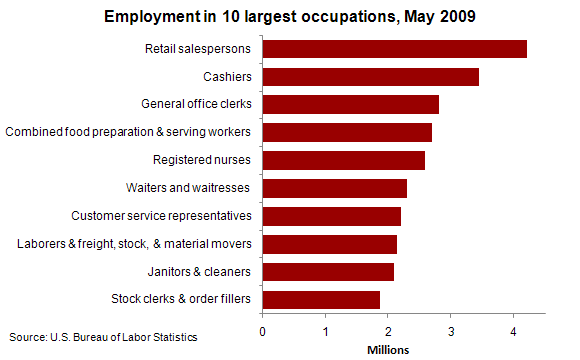
The financial raid against the middle class – 9 of the 10 largest occupations in the U.S. have median wages between $8 per hour and $14per hour. The middle class is inheriting a new serfdom drowning in mountains of debt.

The war against the  middle class is silent and has grown since the recession started.  We don’t hear much about this because in large part, those falling out of the middle class don’t have the funds to purchase airtime with the media who is wedded to Wall Street.  40 million Americans now receive food assistance.  How often do we hear about this?  Each month we add tens of thousands to this number yet we are somehow in a recovery?  A recovery for which group of people is the question we should be asking.  Clearly the middle class isn’t feeling this recovery.  Nearly 17 percent of our population is underemployed.  But then we add 20 percent of those who are employed who are part of the working poor.  If we look at the top 10 occupational sectors in the U.S. we start to realize that many in the middle class are giving up higher paying jobs to service the needs of a tiny elite class.


Take a look at the top 10 occupational sectors in the U.S.:

Source:  BLS

Keep in mind this group is part of the “fully employed” class.  When we think of those who are employed we tend to think that most work in sectors that offer them a decent wage.  That is not the case at all.  In fact, when we look at the median household income of $52,000 we realize that most people are working in the service sector with lower wages and only boost the stat higher because of the two income trap.  9 out of 10 of the above jobs from cashiers to janitors make median wages from $8 to $14.
“To even reach the middle class median income, someone would need to make $25 an hour.  So even looking at the higher end of the above pay scale for these jobs, you would need to have two people making the top $14 to squeak out the necessary $25 per hour to make the $52,000 median income figure.  Keep in mind the above is the top employment sectors in our economy.  In the past where we had a bulk of our population working in manufacturing making the median income wage with one job, now we have given that up for two jobs in service sector work.  I’m not sure many in the middle class wanted to make that trade off.”
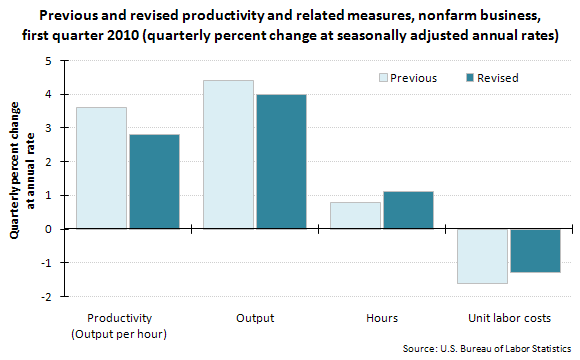
Wall Street wouldn’t mind if most Americans were part of the working poor so long as they can keep their exploiting ways going.  In fact, these banks want to sink these people even further by creating this large class of middle class debt serfdom.  Enormous mortgages, student loan debt, and credit cards are the new chains to keep the working and middle class stuck in financial purgatory.  Keep in mind the money the banking industry funnels out is largely taxpayer dollars so the prison we are creating is largely with our own money.  Wall Street investment banks and the too big to fail financial sector is broke.  They would be nonexistent if it weren’t for the complete and generous handout from the U.S. Treasury and Federal Reserve.  How do they repay the people for this?  They begin by squeezing every ounce of productivity of those still working:
Now this is a fascinating chart.  Even in the worst economic crisis since the Great Depression somehow, we are able to become more productive.  Interestingly enough labor costs have fallen at the same time.  Of course the above translates to middle class workers having to put up with stagnant or falling wages while the bottom line keeps getting better.  But better for who?  The banking industry is juicing this game by gambling on Wall Street and not lending money out to the public.  This money was given to them under the pretense of keeping the loan channels alive for American workers.  So we have record foreclosures and bankruptcies while banks keep making billion dollar profits.  The raid on the middle class is like pirates taking the loot in broad daylight.
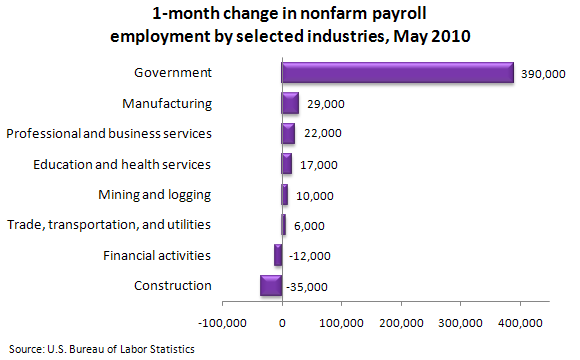
Yet the spin is out in full force.  Last month the rise in employment was largely from the government sector:
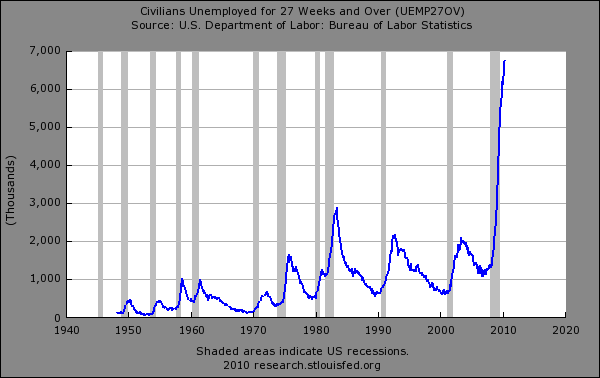
In fact, we can say that the entire rise in employment last month came because of temporary government work.  These Census jobs fall into the trend that we are seeing.  The middle class has to deal with transient work with no security and in order to have access to any semblance of a middle class lifestyle, must enter into a deal of debt serfdom with the banking elite.  We can see that we have hit an absolute structural tipping point in our society with the amount of long-term unemployed:
This is the largest percent of long-term unemployed in modern record keeping history.  What has happened is essentially the last hit against the middle class.  Without any security whatsoever, many are now unable to find work in a highly service oriented world.  The playing field is not level.  The banking sector fills the air with propaganda of the “free market” yet received trillions of dollars in handouts.  The hypocrisy is incredible and many Americans realize this.  This is why satisfaction with both Democrats and Republicans are at all time lows.  Both parties are beholden to the banking and Wall Street elite that work as a leech and are siphoning off every ounce of productivity from the American working and middle class.
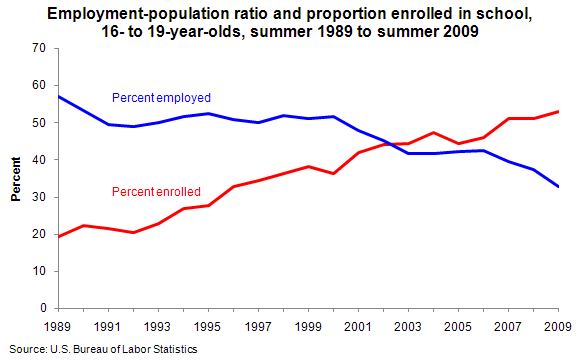
The youth of our country are feeling this deeply:
The above chart would seem positive.  More students are taking summer school as opposed to working.  Yet this trend isn’t happening by choice.  It is happening by force.  There are little jobs for teens since they are competing with adults for low pay service sector jobs!  This is the idea of recovery in the new America.  A banking sector that is swimming in gold coins like Scrooge McDuck while middle class Americans find themselves competing with their own children for lower paying service sector jobs.
So what is the solution then?  How the argument is framed is completely false and the Federal Reserve is merely a protector of the banks.  They want to force austerity on the majority of Americans while banks and their predator executives still manage to keep their taxpayer subsidized yachts.  There is money but it went to the banking sector.  The game is fixed for most in the  middle class.  Until we break up the too big to fail banks and have a government that truly represents the people’s best interest, there is little reason to believe that the overall trend will reverse.  The fact that 9 out of our top 10 job sectors are from the low paying service sector is not good news.