Showing posts with label private property ownership. Show all posts

Tuesday, August 23, 2011

Criminalizing Competition


Posted by Kevin Carson on Aug 17, 2011 - C4SS

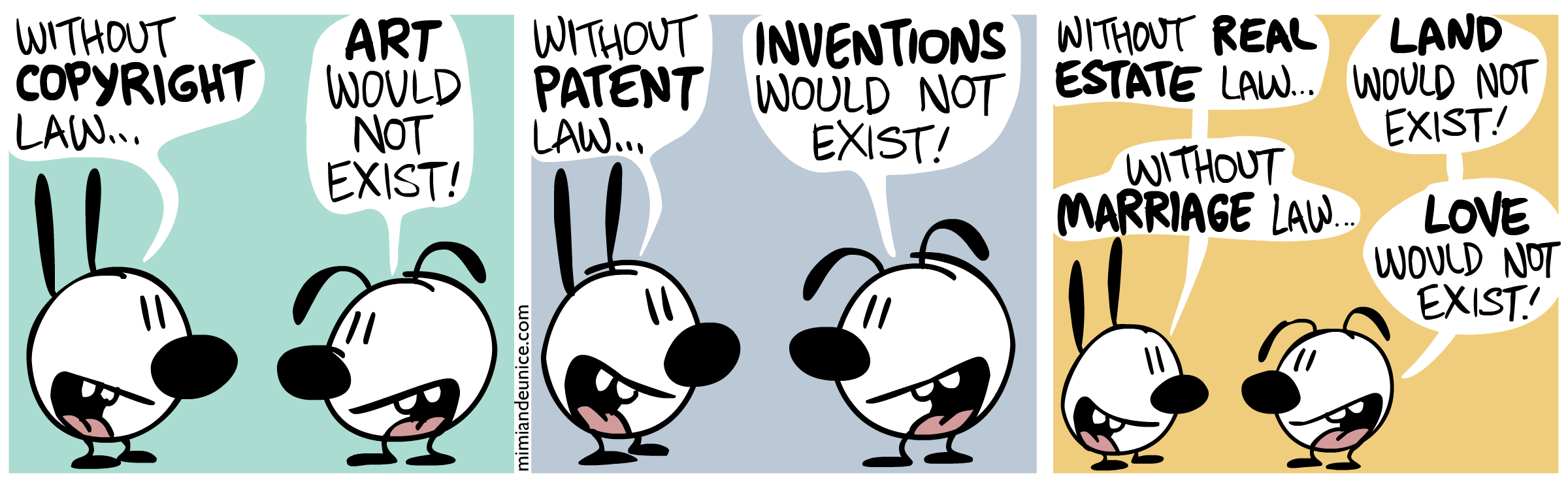
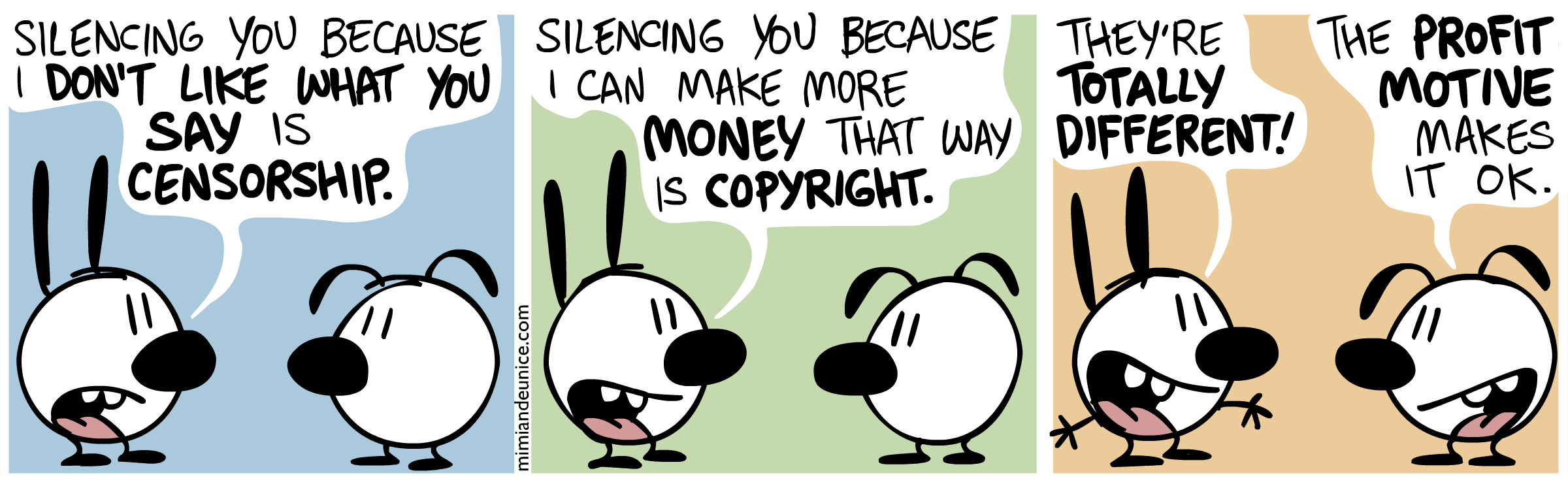
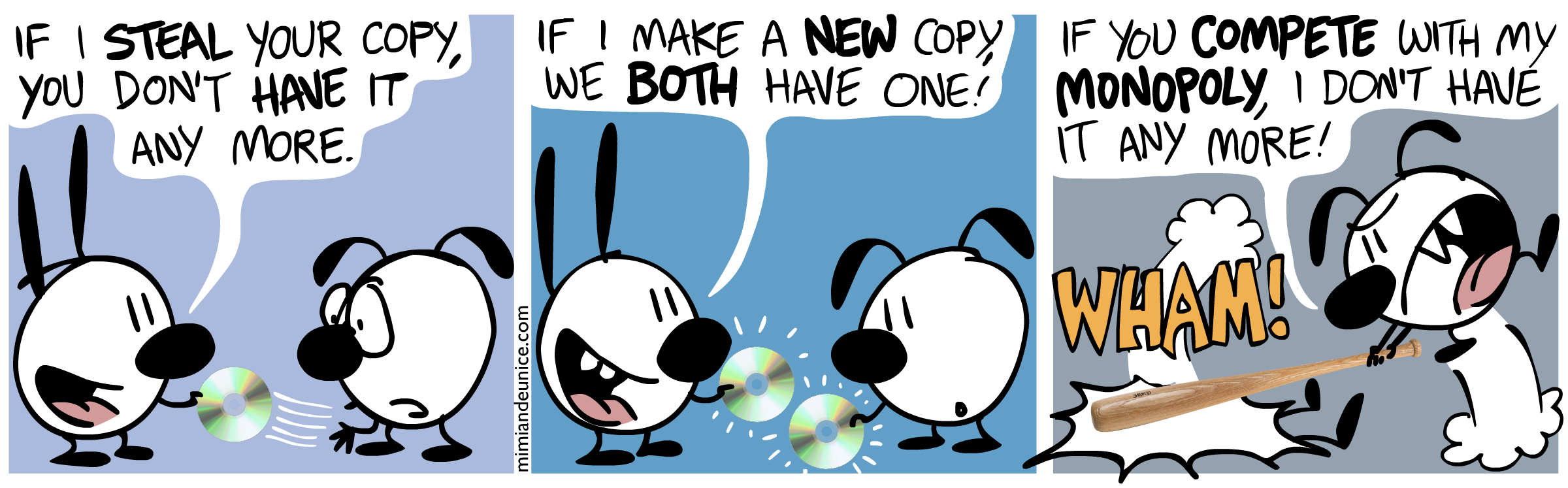
Free culture activist Nina Paley, in a recent cartoon, parodies the philosophy behind “intellectual property.”

EUNICE:  “Copying a song instead of buying a copy is stealing!”
MIMI: “Doing  for yourself what you could pay someone else to do is stealing!”
BOTH:  “Competition is theft!”

Unfortunately, Nina was preempted by reductio creep: The tendency of real world irrationality to outpace our ability to make fun of it.

In 2005, the French bus company TSE sued a group of cleaning women who’d previously taken the bus to work, arguing that carpooling was unregulated competition that deprived the bus company of revenue. Although that that specific case was thrown out, the principle it illustrates — a legal guarantee of rents from a monopoly on the right to do something — is at the heart of capitalism (as opposed to the free market).

Throughout history, propertied classes have relied primarily on artificial scarcities of material resources to extract a surplus from labor.  With the help of state-enforced artificial property rights, a ruling class can control great concentrations of land and capital. These monopolies prevent competition from driving down the price of capital and land to their natural values. Thus the means of production are artificially scarce and expensive, and labor is forced to pay tribute for access to them.

Today, however, the imploding cost of production means that concentrated ownership of land and capital is becoming less and less effective as a means of rent extraction. The desktop revolution has reduced the cost of setting up a “publishing house” or “music studio” a hundredfold. Micromanufacturing with open source desktop CNC tools will soon do likewise to the cost of a factory. Intensive raised-bed horticulture grows many times more food per acre than mechanized agribusiness. In fact most “farming” is a real estate investment in which the government pays rent for the “farmer” to hold land out of use!

In this age of abundance, when the falling cost of machinery and exploding efficiencies of extracting value from inputs threaten to make control of physical resources worthless as a source of rent, rents accrue mainly to “property rights” like the right to do certain things, or criminalizing competition from more efficient ways of doing things.

Under old-style capitalism, rents were extracted by using artificial property rights to restrict access to physical opportunities for production. Now that the cheapening of physical means of production has made this strategy untenable, the ruling classes must instead charge rents on the right to produce with one’s own physical resources.

In today’s global economy, profits from old-style subsidies and artificial scarcities of physical resources haven’t exactly disappeared. Foreign aid and World Bank loans still provide subsidized infrastructure for offshored production. Third World landed oligarchies still nullify traditional peasant property rights and steal land for cash crop production in collusion with subsidized Western agribusiness interests. Thanks to compliant local governments, and the use of World Bank debt slavery to pressure the noncompliant — not to mention legacy titles from outright theft in colonial days — extractive industries make enormous profits mining and logging on ill-gotten land. Half of Big Pharma’s R&D is taxpayer funded, and billions of dollars of high-tech R&D is subsidized with refundable tax credits.

But most profits come from immaterial property in the right to make or do a certain thing. Because of patents it’s illegal to make a physically identical knockoff of an iPhone and sell it for a fraction of the price without all the embedded rents on artificial property. Copyright makes a CD of Word cost $200 instead of ten bucks like an Open Office CD. ”Intellectual property,” exactly like your grandfather’s tariff, is just a restriction on who has the right to sell a thing in a particular market. IP performs the same protectionist role for transnational corporations that tariffs once performed for national industrial corporations.

The majority of TNCs’ profits are from royalties or licensing fees. The most profitable industries in the global economy are those with business models based on IP: Pharma, biotech, entertainment, software. Patents give Western corporations a lockdown on the latest generation of production technology, effectively relegating Third World countries to supplying cheap raw materials and sweatshop labor. Trademark and patent laws enable corporate headquarters to outsource actual production to job shops in China or Vietnam, while charging a 1000% markup in retail outlets.

Intellectual protectionism apologists tell us ignoring patent and copyright monopolies is theft.  It’s not. It’s legitimate free market competition. “Intellectual property” is theft.

Monday, April 18, 2011

Economic Entropy as Revolutionary Redistribution

Let the Free Market Eat the Rich!
by Jeremy Weiland
Anarchy and Distribution

Civil society has become so confused with the institution of the State that anarchists often find it difficult to extricate one from the other when positing a voluntary society. The effects of privilege permeate our culture, our infrastructure, our economic relationships, and our thinking. Therefore, the ability to describe a coherent and distinctive picture of a post-state, post-privilege world is crucial in that it throws contemporary constructs of privilege into stark relief. While disputes about proper means towards a stateless society abound in the anarchist milieu, the most striking distinctions can be discovered by examining the varied predictions of the likely ends of anarchism. Perhaps nothing sets these approaches apart and divides efforts more than competing visions of just property distribution.

A long running debate among anarchists, especially between the individualist and collectivist schools, centers around the justice of wealth disparities. Certainly the existence of the State serves to enrich particular interests at the expense of others, but in anarchy would the rich dominate society - just as they do with the State? Should private property be abolished altogether to force an egalitarian society into existence? Or will private property be the basis for a new, voluntary order where the wealth gap will no longer matter? Even if we could immediately switch off the institutions that forcibly manipulate society, many fear that the legacy of privilege and accumulated wealth could persist for some time, distorting markets and continuing the frustrate the balance of power between individuals.

Individualist anarchists have had a variety of responses to the problems of historical property and wealth maldistribution. Even anarcho-capitalists who see large scale social coordination as the natural direction of society have different views, such as Hans Hermann Hoppe's theory of a natural elite and Murray Rothbard's support of syndicalist takeover of State-supported corporations. On the other side of the coin, left-leaning individualists also entertain a variety of approaches: from agorist advocacy of revolutionary entrepreneurship as a leveling force to mutualists such as Benjamin Tucker and Kevin Carson speculating about the possible need for short term State sponsored redistribution and reform.

At the root of all these competing theories, the key question for anarchists remains: what does a stateless society look like? What exactly are we working towards? It is this difference of vision that divides the efforts of anarchists much more than purely strategic differences. Is a more ecumenical anarchism possible - one that can bring the schools together, at least for activist purposes, not by fighting over predictions and visions but by agreeing on the means by which a voluntary society is achieved?

In the midst of all this theorizing, it is easy to forget that anarchy is - anarchy becomes defined by - however humans naturally interact, not how we wish they would interact. In other words, true anarchy is an empirical reality, and we have only to discover it by removing privilege. Arguing over what it shall be and shall not be presumes we can dictate how humans interact, a positively authoritarian concept. Whatever human nature might be, any anarchism worth pursuing starts there, and the kernel of proportionality and balance that could inform this matter may be sought there as well. Given this approach to anarchism, what can human nature tell us about distributive justice?

In any statist society, those who benefit from the status quo rely first and foremost on the stability and security of the social order. How they achieve this defines politics as we experience it. The purpose of this essay is to demonstrate how large scale aggregations of wealth require an outside stabilizing force and defensive agency to maintain, and how in a free, dynamic market there are entropies that move imbalances back to equilibrium. There is also a proposed basis for a relative equilibrium among people once privileges are abolished. This investigation will identify two main institutions that arise from state intervention in capitalist society: corporations and personal estates.

The Modern Corporation

The modern corporation is a legal entity chartered by the State. Corporations benefit from an arsenal of privileges, such as fiat entity status, personhood and limited liability, which serve to set the rules of the market on terms favorable to corporate investors and managers. The trend has always been to correct any perceived problems with big business by large, top-down regulation, rather than to reexamine the legal constructs that give these institutions such outsized power in our society.

For instance, it is conceivable that a firm could argue effectively in front of a judge for certain of the rights of being a human citizen on a case by case basis, but current established law mandates a clumsy legal equivalence between living human beings and abstract organizations of people and assets (which is historically dubious). The benefit to big business, of course, is to regularize and simplify business legal proceedings, setting aside the legal advantages this gives corporations over individual humans. In the United States, for instance, the ability to exercise first and fourth amendment rights as if the firm were a human being results in corporate campaign contributions and protection from random inspections. It is interesting to see the framers' document limiting government prerogative used to defend not merely the rights of human beings but those of the government's own abstract inventions.

Yet while human rights are invoked, privileges granted by the State to corporations that no human can claim, such as limited liability, represent a fiat subsidy. Imagine the cost of privately insuring the value of the total market capitalization of the world's corporations! But the utility of the subsidy goes even further, because it allows investors to hire managers who have a legal mandate to pursue profits while maintaining a distance from the way the profits are pursued. Highly capitalized firms, who by their sheer size wield far more potential for harm than any single individual, essentially obfuscate the way decisions are made so that if third parties to the stockholder-manager relationship are harmed, stockholders cannot lose more than their investment.

The imbalance of responsibility this enables cannot be underestimated, for it goes to the very heart of corporate economic behavior. What would be different about business, socioeconomics, and politics if stockholders knew that their managers' activities would leave them fully liable for the actions of the corporation and could lose their savings, their car, their house? Limited liability and corporate personhood make possible a way of doing business in a far riskier way than normal people would. How do we know this? Because few people, anarchist or not, would limit the liability of regular human beings, knowing that it is the consequences of undesirable behavior such as violence or theft that helps prevent it.

In a free market, corporations would not be able to rely on the State for their very existence. Any ability to do business as an entity would come from the consent and cooperation of the market - customers, suppliers, contractors, service providers, banks, but most importantly management. Without a Securities and Exchange Commission and intrusive reporting requirements, oversight, and regulatory enforcement, it would be very hard to protect the shareholders at firms of any appreciable size and organizational complexity from outright fraud in a variety of ways. The well-understood legal relationships that govern so much capital finance and business activity would become much more ad hoc and peculiar. Shares in corporations would become even less uniform constructs from business to business, since their terms could vary wildly and they couldn't simply be traded as almost fungible commodities. Unpredictability and risk would skyrocket, which is a much more favorable environment for the small-time entrepreneur than the big, clumsy, bureaucratic corporation.

Think about the huge stabilizing effect of the federal government for making big business anything less than a total ripoff for investors right from the start. Think about the ways government regulation rationalizes markets to make them safe for large industries to exploit and oligopolize. Think about how much leeway the modern CEO is afforded to run the business in pursuit of short term gain, with stockholders often supporting them even as they engage in questionable activities. Enron's reckless destruction of shareholder value is hardly remarkable, when you think about the level of complexity in which they schemed and strategized - the fact that it doesn't happen more often is (until you check your tax bill and realize you're subsidizing the stability and security of others' investments!).

The Personal Estate

Obviously the most direct way in which people benefit from the institutional character of our statist society is through direct ownership. While there are few (if any) rich people who aren't heavily and diversely invested in corporate capitalism and share in its redistribution of wealth and special favors from the government, there are additional State provisions to benefit individuals. Unlike corporate privileges, those which govern the stability of personal estates arguably serve the interests of more modest individuals, especially the middle class. However, I intend to show that the rich benefit far more from fiat stability and socialized security than the rest of us.

The biggest subsidy enjoyed by the wealthy lies in government regulation of finance. By regulating banking through inspections, audits, and the centralized monetary maintenance practiced by the Federal Reserve System, depositors enjoy a level of stability in the system that is quite unrivaled in history. Of course, regular joes like you and I prefer our current experience to frequent crashes and bank runs, but there's a catch: we don't pay for this "service" in proportion to our deposits (or the interest we earn!). Instead, we help subsidize the regulation and maintenance of the financial system from which the elite depositors benefit disproportionately.

Rich depositors are more likely to invest in instruments and accounts which yield higher interests rates. Plus, they're more likely to earn a greater amount of their income directly from the interest on their deposits. The barriers to entry in banking prevent individuals from forming their own mutual banks and force them to rely on the aggregated wealth of big depositors at some level of the hierarchical financial establishment. And because the rich can afford to pay for maintenance of their wealth by managers, accountants, and brokers, they are more likely to anticipate and capitalize upon market shifts than us.

Keep in mind that central regulation and maintenance of markets, groomed and rationalized by the Federal Reserve System, the Federal Deposit Insurance Corporation, and other departments encourages the sort of investment patterns that count on steady profits and interest - phenomena much more likely to benefit the wealthy than those of us investing in 401-Ks and IRAs. By lowering risks, any entrepreneurial profit opportunities for the little guy that regulation kills translate into the stability of markets and the steadiness of investment income. Of course, that benefits those who've already accumulated capital much more than those of us who've yet to achieve our fortune.

However, the extent of State intervention to benefit the rich extends beyond finance into the very real area of asset security. The rich depend on the stability and predictability of systems that ensure and protect their title to their property, but again their benefit from these phenomena dwarfs ours. For example, they count on the government keeping a central repository of property titles to justify excluding others. This takes property off the market and thus raises the value of their property. While it is true that middle class homeowners benefit from these systems, it does not benefit them to nearly the degree it does the rich. Socializing the costs of kicking people off one's land necessarily favors those who have more land to guard.

Police patrols of moneyed neighborhoods provide an example of socialized security, where defense and sentry costs are not paid directly by the beneficiaries. Sure, many wealthy types hire security guards, but they would have to hire many more - and pay much higher insurance premiums - if it were not for public law enforcement at least helping to defend their property, nor the extensive, expensive system of socialized criminal investigation that makes it less likely property will stay stolen and criminals remain at large.

The Entropy of Aggregated Wealth

As I stated earlier, we may find the answer to the problem of persistent wealth imbalances in human nature. Two aspects of that nature are greed and envy. In a market without socialized regulation, stockholders are in constant danger of management and employees siphoning off profits and imperiling the long term viability of the business. Rich individuals face similar uncertainties of theft and fraud by those they employ to maintain and protect their assets. Because the lack of a State would force these costs to be internalized within the entity rather than externalized onto the public, it is highly likely that the costs of maintaining these outsized aggregations of wealth would begin to deplete it.

The balance of power between the rich and non-rich is key here. Direct plundering of wealth, though fraud or theft, threatens the rich in a crippling way. It raises their costs directly in proportion to their wealth, either through insurance costs, defense costs, or losses. They have to worry not just about outside threats, but also the threats posed by their servants, employees, and even their family members. Because the wealth is centralized around one individual or one management team, it is near impossible to find any fair way to distribute the responsibilities of stewardship without distributing the wealth itself. Having a lot of stuff becomes more trouble than it's worth.

Meanwhile, less rich people economize on these costs by banding together with other modest individuals to either hire outside defense (socializing protection on their own, voluntary terms) or by personally organizing to defend property (via institutions such as militias). Because the ratio of person to wealth is relatively greater, there are more interested individuals wiling to play a role in defense and maintenance of property. The distribution of the wealth over more people necessarily eases its protection. And since everybody has basically the same amount of stuff, nobody has an interest in taking advantage of, nor stealing from, others.

In fact, normal human greed suggests that there will always be an element of society that wishes to steal and cheat others. In anarchy, the wealthy offer themselves as easy targets to such criminals, because big estates are harder to defend and so invite more opportunities for plunder. Additionally, it is far more likely that wealthy estates will be targeted because, for instance, it is easier to steal a million dollars worth of cash or property from one location such as a bank or mansion than it is to rob a thousand or so common people. The larger the disparity in wealth, the more intensively the wealthy will be targeted by criminals.

On the other hand, normal people would necessarily be less likely to be targeted by the criminal, for a few reasons. First, since the ratio of human bodies to wealth in a modest community would be much greater, the deterrent effect would be insurmountable to all but the most stupid crooks. Second, once statist regulations and privileges stop making an honest living less of a bad deal, the criminal elements in a modest community are more likely to share in the legitimate wealth of the economy, easing their need to prey on their neighbors. Markets freed from dehumanizing, deracinated centralization imposed for corporate convenience would be fathomable, with plenty of opportunities for entrepreneurship. While by no means a utopia, a genuinely free market would ease the pressures on the lower and middle classes.

The Free Market as Egalitarian Equalizer

This phenomenon of disadvantaged rich and advantaged poor, brought about by the costs of estate and business management, suggests an interesting dynamic. It may be that in a free market there will exist a natural, mean personal wealth value, beyond which diminishing returns enter quickly, and below which one is extremely disposed towards enrichment. If this is true, then that means that normal, productive, and non-privileged people will tend to have similar estate values. This wide distribution of wealth will tend to reinforce bottom-up society and a balance of power unrivaled in history (except maybe in frontier experiences).

In a stateless society, institutions for business and personal organization must derive their permanence from their usefulness not just to an elite few, but from the respect of the entire community - customers, suppliers, neighbors, etc. An entity that can operate efficiently and deliver a steady stream of income, whether an estate or a corporate business, becomes less viable the larger it grows because internal transaction and maintenance costs start to skyrocket. This is a function not of wealth itself, but rather of the inherent difficulty in convincing those with less to honor and defend the property of those with more. The more people benefit from a body of wealth, the more people will support it.

Indeed, the State can be seen as a mechanism for acquiring the consent of the governed to sign onto a program of stabilization that is inherently artificial, precisely due to its disproportionate dividends to established elites. The State co-opts authentic community support or opposition and channels it into modes that are predictable and stable, establishing its institutional identity as indispensable mediator between the very interests in which it promotes opposition. But authentic community stability is no harder to realize in a genuine, stateless society where people participate only in voluntary organizations. Similarly, inauthentic, imposed stability usually benefits those who cannot maintain their position without outside help. Wealthy interests use the State as a way to marshal public support without yielding control or spreading the wealth, as it were.

A truly free market without subsidized security, regulation, and arbitration imposes costs on large scale aggregations of assets that quickly deplete them. I do not think they would be able to survive for very long without the State, even if "natural elites" exist or some form of social darwinism is proven correct, because natural hierarchies such as those would not need State intervention to maintain their cohesion. One can chalk this up to the fickle and often dark side of human nature, but it's a phenomenon that we cannot just wish away - indeed, we should see a place for these dynamics in the legitimate, bottom-up society.

This theory is not an ironclad prescription of how anarchy must emerge. It is merely a demonstration of how individualist and collectivist visions can both be served without compromising either's interests. Markets and egalitarian distribution of property and wealth are not necessarily mutually exclusive. Perhaps authentic libertarian means of genuinely free markets, taken to their logical conclusion, can effect far more egalitarian and redistributionist ends than we ever dreamed - not as a function of any central State, but rather as a result of its absence.

Thursday, December 16, 2010

How an Obscure Outfit Called MERS Is Subverting Our Entire System of Property Rights

Banks have scrambled America's system of private property ownership to the point that no one knows who owns what. 
By Yasha Levine, AlterNet
Posted on December 16, 2010

"For the first time in the nation's history, there is no longer an authoritative, public record of who owns land in each county." -- University of Utah law professor Christopher Peterson 
There is an unbelievable scandal in the making that threatens to subvert our four-century-old method for guaranteeing a fundamental building block of the American republic—property ownership. The biggest reason why you probably haven’t heard much about it is that it involves one of the most generic and boring company names imaginable: Mortgage Electronic Registration Systems, Inc., or MERS. It is a story of deception engineered at the highest level of power for short-term gain, and another epic failure of the private sector to uphold the laws and traditions of American society, even something as fundamental as property rights.

Created in 1995 by the country's biggest banks, MERS quietly took control of and privatized mortgage record-keeping across the country and, in the span of a few years, scrambled America's private property ownership records to the point where no one could figure out who owns what. This was no accident, and was done by design: MERS was a tool used by America's top financial institutions to pump up the real estate market. Mortgage-backed securities, robo-signers, lightning quick foreclosures, subprime mortgages and just about everything else that went into feeding the biggest real estate bubble in U.S. history could not function without help from MERS. But unlike many of the Wall Street scandals, this one could blow up in the banks’ faces, with the little guy laughing all the way back to his free McMansion, and local governments seeing their empty coffers fill back up with the billions of dollars in unpaid fees that MERS circumvented.

The story begins in mid-'90s with the founding of MERS, Inc. by the nation's most powerful banks, ostensibly with the aim of streamlining and modernizing the process of registering and tracking mortgages. Traditionally, there has been no centralized registry of real estate ownership information, with counties maintaining their own records for properties within their borders—a system that has remained virtually unchanged since colonial times.

The MERS database went live in the middle of the dot-com bubble, and was supposed take inefficient government bureaucracies kicking and screaming into the future by providing a centralized, national registry of mortgage ownership information. "MERS addresses a problem that was costing the industry a significant amount of money," Rick Amatucci, a Fannie Mae vice president and the agency's liaison with MERS, told Mortgage Banking magazine, just as the new registry went online in 1997. The database would give lenders across the country instant access to real-time mortgage information, diminish potential for fraud, and lower costs for servicers and borrowers, according to Mortgage Banking Association, which was tasked with overseeing the project.

But that kind of talk was just for the press release. The banking industry wasn't concerned with efficiency or transparency or the greater good. It was all about making money, as quickly and cheaply as possible. And that is what MERS was for. It was created to help the industry push its latest money-maker: mortgage-backed securities, a Wall Street financial scam that dressed up the most toxic, guaranteed-to-fail loans as Grade A investment vehicles that could be sold to suckers looking for an easy gain.

But before mortgage-backed securities could be unleashed on the residential housing market on a massive scale, bankers needed to get rid of America's long-standing real estate recording laws, which required lenders to file all mortgage transactions—the origination of a new loan, for instance, or the transfer or sale of a mortgage between banks—with the county in which the property is located. While this recording requirement was not a problem in the sleepy pre-securitization days of the home loan business, when mortgage transactions were kept to a minimum, it was going to be much more difficult—if not impossible—with widespread use of securitization, which jacked up the industry like high-grade meth. Mortgages would be changing hands dozens of times, going from loan originators to banks to Wall Street investment houses, which would collect them by the thousands and package them into complex debt instruments that would be chopped up into shares and sold off to multiple investors all over the world.

Bankers needed a quick, clean way of reassigning mortgages without having to go through the "cumbersome" process of recording them with county courts and recorder offices. But instead of working with municipalities to modernize title registration by a creating a national database that was aboveboard and that everyone could use, the banking industry did what it does best: hid the information with sly accounting tricks.

And it succeeded. In just a few short years, MERS took over the bulk of residential mortgage registration. There are about 80 million residential mortgages in America today, and MERS tracks 60 percent of them.

"[M]ortgage bankers formed a plan to create one shell company that would pretend to own all the mortgages in the country—that way, the mortgage bankers would never have to record assignments since the same company would always 'own' all the mortgages," wrote University of Utah law professor Christopher Peterson, who wrote a key paper on MERS and the mortgage industry.

Here is how the plaintiffs in a class action suit filed in Florida in July 2010 against MERS and a legal firm described the MERS registration system:
The whole purpose of MERS is to allow "servicers" to pretend as if they are someone else: the "owners" of the mortgage, or the real parties in interest. In fact they are not. … With the oversight of Defendant Merscorp and its unknown principals, the MERS artifice and enterprise evolved into an "ultra-fictitious" entity, which can also be understood as a "meta-corporation." To perpetuate the scheme, MERS was and is used in such a way that the average consumer, or even legal professional, can never determine who or what was or is ultimately receiving the benefits of any mortgage payments. The conspirators set about to confuse everyone as to who owned what. They created a truly effective smokescreen which has left the public and most of the judiciary operating "in the dark" through the present time.
The use of MERS as a generic placeholder for the real owner of a mortgage was a crucial component of the entire securitization machine."[T]he entire scheme was predicated upon the fraudulent designation of MERS as the 'beneficiary' under millions of deeds of trust," according to a class action suit filed in Nevada in 2009 against MERS and all the big, crooked banks we’ve learned to fear and hate. "Before MERS, it would not have been possible for mortgages with no market value . . . to be sold at a profit or collateralized and sold as mortgage-backed securities. Before MERS, it would not have been possible for the Defendant banks and AIG to conceal from government regulators the extent of risk of financial losses those entities faced from the predatory origination of residential loans and the fraudulent re-sale and securitization of those otherwise non-marketable loans."

How efficient was MERS at perpetuating trickery in the real estate market? Well, according to statistics published by the U.S. Treasury’s Financial Crime Enforcement Network, from 1997—the year MERS went online—to 2005, mortgage fraud reports increased by 1,411 percent.

The MERS hustle had another benefit: it saved the banking industry—and cost municipal governments—tens of billions of dollars by allowing lenders to avoid paying county filing fees, which cost an average of $30 a pop. According to the AP, if every mortgage tracked by MERS had been resold and re-recorded with a county just one time, the system would have saved the banking industry $2.4 billion in filing fees. In reality, most mortgages are sold and resold a dozen times—sometimes more, which means that MERS extracted at minimum around $30 billion from cash-strapped local governments. "Some counties also use recording fees to fund their court systems, legal aid organizations, low-income housing programs, or schools. In this respect, MERS's role in acting as a mortgagee of record in nominee capacity is simply a tax evasion tool," says Professor Peterson.

But there was one major downside to the scam: because MERS departed from established real estate recording requirements, there was no guarantee that its claim to ownership, if challenged, would be honored by the courts.

Transparent real property registration was one of the earliest—and most important—functions of the American government, a practice that has changed amazingly little since the colonial times. According to "Foreclosure, Subprime Mortgage Lending, and the Mortgage Registration System," American colonists began to enact laws requiring land sales, transfers and mortgages to be entered into the public record with a government agency going back almost 400 years. The Massachusetts Plymouth Bay Colony adopted its first such "recording law" in 1636, which stated that "all sales exchanges giftes mortgages leases or other Conveyances of howses and landes the sale to be acknowledged before the Governor or anyone of the Assistants and committed to publick Record."

By the time the Boston Tea Party rolled around, every English colony had passed laws that required lenders and landowners to enter their names and property and mortgage information into the public record. The reasons for the popularity of the laws are simple and utilitarian: transparent public records of property ownership prevented disputes over who owned what and allowed people to use land as collateral on loans. "The necessity and usefulness of these early public title records is attested to by their nearly universal and uninterrupted force in subsequent American law. Indeed, Pennsylvania's first recording act, first adopted in 1717, remains in force to this day," wrote Peterson. Banks that failed to register mortgage transactions risked losing their ability to enforce the contract. And that is exactly what is on the verge of happening with mortgages registered with MERS.

Dozens of lawsuits all across the country have been filed against MERS and its partners to put this very issue to the test. And while most of them are still ongoing, it's clear that MERS is fighting for its life.

The Wall Street Journal:
Now, critics and homeowners facing foreclosure are increasingly challenging, among other things, MERS' role and legal standing in home foreclosures where it acts as legal representative of the mortgage holder. MERS has fought and won legal challenges in the past. But the nationwide epidemic of foreclosures in the wake of the housing collapse will present it with a wave of challenges unlike any it has seen previously.
Trouble for MERS could add risk to banks by slowing down the securitization process, and creating uncertainty during a time when banks are struggling to reassure shareholders and customers. One hedge fund investor said Friday that questions around MERS are adding to his concerns about banks in the mortgage business and are keeping him from investing in the sector.
While MERS officials say they are confident about their business model, it has become clear that their scheme might very well be on the verge of toppling. On November 17, Congress quietly rammed through a sneaky, vaguely worded bill that would have legalized MERS’ dealings retroactively. And while the bill didn't pass, we can expect Wall Street's lackeys in Congress to continue their efforts. After all, if courts continue to rule against MERS's business model—and it looks like they will—many homes may become foreclosure proof. As Reuters put it: “If court rulings against MERS' authority to foreclose proliferate, many foreclosure cases may be halted indefinitely, and some homeowners in default may end up with clear title to their homes.” Owners will still owe money to banks, but their homes would no longer be counted as collateral on the loan. In short, banks would not be able to kick people out of their homes. And clearly, that is something that America's plutocracy just cannot abide.

***

So who or what is MERS? How was this little-known corporation able to change nearly 400 years of legal practice in the span of a decade, and do so much damage so quickly? And why did no one blow the whistle?

As a result of the lawsuits being filed against MERS, a lot of previously unknown information about the inner workings of MERS is coming to light.

The people who developed the concept of MERS were connected with Fannie Mae and Freddie Mac, as well as the most corrupt lending institutions in America. People like Brian Hershkowitz, former director of the Mortgage Bankers Association and founder of the association’s technology committee that oversaw the early development of MERS in the early '90s, according to a homeowner-turned-activist-blogger, who is involved in a class action lawsuit against MERS (In 1993, Mortgage Banking magazine referred to this new mortgage resignation system as “New Age Delivery.”)

Hershkowitz was an early tech-booster in the banking industry, heralding a new age where efficiency and profitability would reign supreme. In the early 90s he attributed the success of Countrywide Financial to the fact that it embraced emerging computer technology. "They use technology in ways that give them a competitive advantage and set them apart. They were operating with excess capacity, and now they are putting it to use," Hershkowitz, then-associate director of the Mortgage Bankers Association, told the New York Times in 1991. A few years later he went to work for Countrywide as an executive involved in "areas of strategic planning and executive management." From 1982 to 2003, Countrywide performed like a Ponzi scheme, with shareholders gleefully getting a 23,000.0 percent return on their investment, until the bank collapsed under the weight of its own fraud schemes in 2007.

It seems that MERS has operated along similar lines. According to sworn testimony by various MERS executives, the organization has cycled through four different corporate entities in its brief lifespan. MERS also has almost no paid employees and does not seem to keeps any records or minutes of corporate meetings. When pressed to explain the inner workings of the organization, its executives evaded questions, feigned ignorance and generally acted like provincial mafia bosses on trial—exactly the kind of professionalism one would expect for a company responsible for tracking the ownership information of 50 million mortgages. It was just a couple of guys sitting around, chatting, smoking…and making sure not to leave any evidence behind. No wonder county officials who blew the whistle on MERS early on were squashed.

Edward Romaine, a Republican recorder of deeds for New York's Suffolk County, was one of the few officials who tried to refuse to take filings from MERS. "He argued that not only would the county lose out on fees—$1 million in one year alone—but that MERS failed to even maintain a clear chain of title on a property. He got backing from New York's attorney general," reported the Associated Press. MERS sued Suffolk County and took the case all the way up to the state's highest court, where it won on appeal in 2007. The court forced the county to accept MERS filings because the county lacked the statutory authority. Put another way, the court forced a municipal government to do business with a criminal organization, despite objections from county officials.

MERS cost local governments billions of dollars in lost revenue, but there is a chance that the cash-strapped counties will be able to claw some of that money back. Lawsuits have been filed against MERS in California, Nevada, Tennessee and 14 other states that accuse the company of functioning as a tax evasion vehicle designed to help banks circumvent filing fee requirements. “In California, the suit against MERS could cost the company somewhere between $60 to $120 billion in damages and penalties. With so much money extracted from California's municipalities, no wonder the Golden State is facing a $25 billion budget gap,” reported the Associated Press.

We're constantly being told that liberalization, deregulation and privatization automatically equal greater freedom and increased efficiency. But MERS provides us with a different narrative, one in which the government works perfectly well, when not corrupted by corporations who want to use it to loot public wealth.