Showing posts with label permanent unemployment. Show all posts

Monday, July 22, 2013

Fewer Americans Will Work: What That Means for the Economy

By Christopher Matthews, TIME Magazine
July 22, 20130

With last year’s presidential election so focused on jobs and the economy, the American public probably knows more about the nuances of the unemployment rate than they ever have before. One particular of the official unemployment rate that received attention last year is that the Labor Department counts someone as unemployed only if he or she is actively looking for employment. Other folks who, for whatever reason, aren’t searching for work are considered not in the labor force.

The ratio between those considered in the labor force and the total working-age population is known as the “labor-force-participation rate.” And the reason why the unemployment rate has been able to fall from more than 10% in 2009 to 7.6% today despite middling job growth is that more and more Americans are dropping out of the labor force altogether.

As you can see from the chart below, this decline in the labor-force-participation rate is a trend that’s been going on for many years now. The primary driver of the overall trend is the aging workforce — many of those dropping out are simply retiring at around the normal age. But the trend accelerated during the recession, suggesting that many more people dropped out of the workforce than otherwise would have if the economy were in better shape.


As the economy improves, however, should we expect to see the participation rate bounce back? According to new analysis from Macroeconomic Advisers, it’s not likely. They estimate that roughly 45% of the recent decline in labor-force participation is a result of a weak economy, and the rest because of demographic factors. But as the economy improves, the workforce is going to continue to age, meaning that by 2015, when the Federal Reserve expects the economy to be back near full employment, the participation rate will remain where it is today.

In one sense this is good news because the economy doesn’t need to produce as many jobs per month to see reductions in the unemployment rate. But on a deeper level, it’s evidence that the high labor-participation rates that helped spur economic growth from the 1970s through the 1990s is a thing of the past. To put it another way, our economy is going to have to produce more with fewer people going forward, which — all else being equal — will slow economic growth.

So just how big of an effect will a smaller workforce have on the economy? In 2011, Harvard University’s Program on the Global Demography of Aging published a paper that tried to understand this question. Logic suggests that a workforce that has to support fewer nonworking individuals will be wealthier overall, and the study bears out that hypothesis. In the paper, economists David E. Bloom, David Canning and Günther Fink estimated how high-income countries (most of which have aging populations) would have grown from the 1960 to 2005 period if they had experienced population growth similar to the projections for 2005 to 2050. According to the report, if a high-income country like the U.S. had a per-person income of $10,000 in 1960, that income grew to $34,600 under the population growth we actually experienced. On the other hand, if the 1960 to 2005 period experienced the sort of population growth that we’re expected to see through 2050, that income would have grown only to $25,500.

This huge difference underscores how important population growth and workforce participation is to a country’s economy. If there are more people working in a country, and if a higher percentage of those people are productive, the whole country will be richer. (This is one reason why economists tend to support policies that increase immigration.)

Friday, October 5, 2012

Another Phony Employment Report--2.5 million unemployed Americans were not counted as unemployed by the U3 Household Survey

 It's not a conspiracy theory, it's math. I think I've established that I am even more to the left than most mainstream Democrats, and I don't believe the job numbers, either. Based on the math alone, they don't work out the way the BLS is claiming.--jef

October 5, 2012 | Paul Craig Roberts

October 5. Today’s employment report from the Bureau of Labor Statistics shows 114,000 new jobs in September and a drop in the U3 rate of unemployment from 8.1% to 7.8%. As 114,000 new jobs are not sufficient to stay even with population growth (150,000 per month--so a net job loss of -36,000 jobs), the drop in the unemployment rate is the result of not counting discouraged workers who are defined away as “not in the labor force.”

According to the BLS, “In September, 2.5 million persons were marginally attached to the labor force.” These individuals “wanted and were available for work,” but “they were not counted as unemployed because they had not searched for work in the 4 weeks preceding the survey.”

In other words, 2.5 million unemployed Americans were not counted as unemployed.

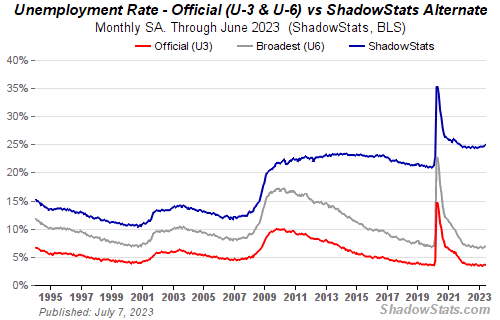
The blue line is the true measure of unemployment.


The stock market rose on the phony good news. Bloomberg’s headline: “U.S. Stocks Rise as Unemployment Rate Unexpectedly Drops.”  .

A truer picture of the dire employment situation is provided by the 600,000 rise over the previous month in involuntary part-time workers. According to the BLS, “These individuals were working part time because their hours had been cut back or because they were unable to find a full-time job.”

Turning to the 114,000 new jobs, once again the jobs are concentrated in lowly paid domestic service jobs that cannot be offshored. Manufacturing jobs declined by 16,000.

As has been the case for a decade, two categories–health care and social assistance (primarily ambulatory health care services) and waitresses and bartenders account for 53% of the new jobs. The BLS never ceases to find ever growing employment of people in restaurants and bars despite the rising dependence of the US population on food stamps. The elderly are rising as a percentage of the American population, but I sometimes wonder if employment in ambulatory health care services is rising faster than the elderly population. Whether these reported jobs are real, I do not know.

The rest of the new jobs were accounted for by retail trade, transportation and warehousing, financial activities (primarily credit intermediation), professional and business services (primarily administrative and waste services), and state government education, where the 13,600 reported new jobs seem odd in light of the teacher layoffs and rise in classroom size.

The high-tech jobs that economists promised would be our reward for offshoring American manufacturing jobs and tradeable professional services, such as software engineering and IT, have never materialized. “The New Economy” was just another hoax, like “Iraqi weapons of mass destruction” and “Iranian nukes.”

While employment falters, the consumer price index (CPI-U) in August increased 0.6 percent, the largest since June 2009. If the August rate is annualized, it means bad news on the inflation front. Instead of bringing us high tech jobs, is “the New Economy” bringing back the stagflation of the late 1970s? Time will tell.

Saturday, September 29, 2012

The Real Unemployment Numbers Are Worse Than You Are Being Told

The Economic Collapse

According to the Obama administration, the unemployment rate in the United States has been slowly coming down over the past couple of years.  But is that actually true?  When you take a closer look at the data you quickly realize that the real unemployment numbers are much worse than we are being told.  For example, if the labor force participation rate was the same today as it was back when Barack Obama first took office, the unemployment rate in the United States would be a whopping 11.2 percent.  But every month the Obama administration has been able to show "progress" because of the fiction that hundreds of thousands of Americans are "disappearing" from the labor force each month.  Frankly, the way that they come up with these numbers is an insult to our intelligence.

Personally, I much prefer the employment-population ratio.  It is a measure of the percentage of working age Americans that actually have jobs.  I like to call it "the employment rate".  So what happened to the "employment rate" in August?  It fell slightly to 58.3 percent.  It is lower than it was when the last recession supposedly ended, and it is almost as low as it has been at any point since the very beginning of this crisis.  A few times during this economic downturn it has actually hit 58.2 percent.  Needless to say, things are not getting any better.  So why aren't the American people being told the truth?

After every other recession in the post-World War II era, the employment rate has always rebounded.

But not this time.

Does this look like a recovery to you?....


So how in the world can Barack Obama claim that we are better off now?

In August 2010, 58.5 percent of working age Americans had jobs.

In August 2012, 58.3 percent of working age Americans had jobs.

So where is the recovery?

It is two years later and a smaller percentage of Americans are employed.

It is very frustrating to me that we are not being told the truth about the unemployment numbers.

The following are some more indications that the real unemployment numbers are much worse than we are being told....

  • In July, 142,220,000 Americans were working.  In August, only 142,101,000 Americans were working.  So the number of Americans working fell by 119,000 and yet the government would have us believe that the unemployment rate actually declined from 8.3 percent to 8.1 percent.
  • According to the federal government, 96,000 jobs were added to the economy in August and the U.S. labor force shrank by 368,000 even though our population is continually growing. If the size of the U.S. labor force had stayed the same, the official unemployment rate would have actually gone up to 8.4 percent.
  • Almost all of the new jobs added in August were the result of the "birth-death" model used by the Labor Department to estimate jobs added by new businesses.  That model has been heavily criticized for being inaccurate.  If you take the 87,000 jobs added by that model out of the equation, then the U.S. economy only added 9,000 jobs in August.  But it takes somewhere around 125,000 new jobs each month just to keep up with the growth of the population.
  • If the labor participation rate was sitting where it was when Barack Obama first took office, the unemployment rate in the United States would actually be 11.2 percent.
  • If the labor participation rate was sitting at the 30 year average of 65.8 percent, the unemployment rate in the United States would actually be 11.7 percent.
  • John Williams of Shadow Government Statistics would put the "real" rate of unemployment up around 23 percent after adding in all workers that have given up looking for work and all underemployed workers.
  • The labor participation rate for men has fallen to 69.9 percent.  This is the lowest level that it has been since the U.S. government began tracking this statistic back in 1948.
  • There was more bad news for manufacturing in this latest report.  During the month of August the U.S. manufacturing sector lost approximately 15,000 jobs.
  • The employment numbers for both June and July were revised downward significantly.  For June, it turns out that only 45,000 jobs were added to the economy as opposed to the 64,000 that were originally reported.  For July, it turns out that only 141,000 jobs were added to the economy as opposed to the 163,000 that were originally reported.
  • Incredibly, 58 percent of the jobs created since the end of the last recession have been low income jobs.
  • The U.S. economy currently has 4.7 million less jobs than it did when the last recession started.

So what is the solution to these problems?

The media is breathlessly proclaiming that more quantitative easing is on the way and that the Federal Reserve will save the economy and send the stock market soaring to new heights.

A headline on CNBC on Friday boldly declared the following: "Market Sees 'Helicopter Ben' Coming to the Rescue".

You can almost hear the chopper blades whirling now.

Apparently Bernanke has had a love of showering the economy with money for a very long time.  For example, you can see a picture of a young Ben Bernanke in action right here.

Of course that is a joke, but you get the point.

In recent years Federal Reserve Chairman Ben Bernanke and the rest of his cohorts have printed money like there is no tomorrow.

So have the previous rounds of quantitative easing solved our problems?

Of course not.

The employment rate is even lower today than it was two years ago.

But all of that money printing has sent the stock market soaring and it has enabled the big Wall Street banks to make an obscene amount of money.

The truth is that the Federal Reserve, the Obama administration and the big Wall Street banks don't really care about you.

They don't really care that the middle class is rapidly shrinking and that the number of Americans on food stamps has risen by more than 14 million since Barack Obama became president.

What they care about is what is good for them.

As I have written about previously, if we continue on the same path that we have been on for the past several decades, there will never be enough jobs in America ever again.

On our current trajectory, we will end up just like Greece where the unemployment rate is now up to 24.4 percent.

Once upon a time the economy of Greece was thriving.

But today, many formerly middle class Greek citizens are leaving Greece and are picking up whatever work they can find....
As a pharmaceutical salesman in Greece for 17 years, Tilemachos Karachalios wore a suit, drove a company car and had an expense account. He now mops schools in Sweden, forced from his home by Greece’s economic crisis.
“It was a very good job,” said Karachalios, 40, of his former life. “Now I clean Swedish s---.”
Karachalios, who left behind his 6-year-old daughter to be raised by his parents, is one of thousands fleeing Greece’s record 24 percent unemployment and austerity measures that threaten to undermine growth.
Would you be willing to do that?

Don't laugh.

Someday when the unemployment rate in the United States gets that high we will see large numbers of desperate Americans leaving this country in search of work somewhere else.

Already, an increasing number of Americans are buying expired food at auctions.

Times are hard and people are trying to get by any way that they can.

More than 100 million Americans are already on welfare and things have not even gotten that bad yet.

This is nothing compared to what is coming.

As you can see from the chart posted near the top of this article, the last economic downturn appears to have permanently weakened the U.S. economy.

Now the next wave of the economic collapse is rapidly approaching.

How much worse will things get when it finally hits us?

That is something to think about.

Why Does Our Society Look Down On Unemployed Men So Much?

 September 28th, 2012/TheEconomicCollapseBlog.com

If you are unemployed for an extended period of time, people are going to look at you differently.  Unfortunately, this is especially true if you are a man.  In our society, men are primarily defined by "what they do".  If you have been unemployed for a long period of time, that can make social interactions even more awkward than normal.  Most people will instantly become more uncomfortable around you when they find out that you are unemployed.  Many will look at you with pity, and others will actually look at you with disdain.  Women will not want to date you, and if you are in a relationship unemployment will put a tremendous amount of strain on it.  Once you "don't have a job", you will not get the same level of respect from former co-workers, friends, members of your own family and possibly even your own wife. 

So why does our society look down on unemployed men so much?  Well, it is generally expected that men are supposed to be the "breadwinners" for their families.  If a woman stays home with the kids nobody has any problems with that, but if men do the same thing it tends to raise eyebrows.  But there is a big problem.  Our economy is not producing enough jobs for everyone.  In fact, there are millions upon millions more workers than there are jobs.  It would be great if this was just a temporary situation, but as I have written about previously, there will never be enough jobs in America ever again.  So there will continually be millions upon millions of men that are looked down upon by society because they can't get jobs, and as a result we are going to have millions upon millions of men that are constantly battling against soul-crushing despair.

It can be really hard to "feel like a man" when you aren't making any money.

And most women simply are not interested in becoming romantically involved with an unemployed man.  Just check out what one recent survey found....
Of the 925 single women surveyed, 75 percent said they'd have a problem with dating someone without a job. Only 4 percent of respondents asked whether they would go out with an unemployed man answered "of course."
"Not having a job will definitely make it harder for men to date someone they don't already know," Irene LaCota, a spokesperson for It's Just Lunch, said in a press release. "This is the rare area, compared to other topics we've done surveys on, where women's old-fashioned beliefs about sex roles seem to apply."


Those are some pretty overwhelming numbers.

So is it the same way when the roles are reversed?

Not even close.

When men were asked the same question, the difference was absolutely shocking....
On the other hand, the prospect of dating an unemployed woman was not a problem for nearly two-thirds of men. In fact, 19 percent of men said they had no reservations and 46 percent of men said they were positive they would date an unemployed woman.
Admittedly, men are often thinking about other things when they are evaluating whether they want to date a women or not.  Yes, there are some men these days that are concerned about how much money a woman makes, but the truth is that men tend to be much less concerned about income levels than women are.

In fact, a UK study that was released last year discovered that British women are even more concerned about the education and income of a potential mate than they were back in the 1940s.

So if you are unemployed you are probably not going to find much success in the romance department either.

If you are married, being unemployed is likely to put a huge strain on your marriage.  The following is a short excerpt from a recent Business Insider article entitled "TRUE CONFESSION: I'm Sick Of My Unemployed Husband"....
I can’t even remember when my husband stopped working.
And frankly, I don’t have time to think about it, between my full-time job and my fledgling business, volunteering at an after-school program to help teenagers prepare for the professional world and mothering two children.
But when I do think about it–when I think about all the times I come home to see evidence of his entire day’s activities cluttering the coffee table, or when I have to take our shared car to work and strand him at home because he doesn’t feel like getting up to drive me–I’m angry.
If a husband is unemployed for an extended period of time, there is a very good chance that the wife is going to start feeling very resentful.

If things get bad enough, many women will pull the plug on their marriages and will get rid of their "unproductive" husbands.

Last year, Time Magazine reported on a study that indicated that unemployed men were significantly more likely to get divorced than employed men were.

My goal in writing this is not to "bash women".  I am just pointing out how hard things are for unemployed men in our society.  Many wives (and their extended families) simply do not understand that our economy has fundamentally changed.  In the old days just about any hard working man that wanted a job could go out and get one.  That is most definitely NOT the case today.

Hopefully we can get more women to understand this.  I know that it can be hard to be patient when your husband is unemployed for month after month after month.

But at a time when husbands need their support the most, many wives withdraw emotionally and become very angry.

For example, how many women have you ever heard declare how proud they are of their unemployed husbands?

Of course there are definitely situations where these roles are reversed and employed husbands are badgering their unemployed wives about getting a job, but in general our society tends to have a greater degree of tolerance for unemployed women than it does for unemployed men.

Sadly, most people simply do not understand how dramatically things have changed in our economy.

The following chart shows the stunning decline in the percentage of working age men with a job over the past 60 years....


Back in the 1950s, there were times when nearly 85 percent of all working age men had jobs.

We will never get back to anything close to that ever again.

Prior to the last recession, about 70 percent of all working age men were employed.

Since the end of the recession, that number has not gotten back to 65 percent at any point.

That means somewhere around 5 percent of all working age American men have been displaced from the workforce permanently.

The mainstream media would have us believe that we are experiencing an "economic recovery" but that is a massive lie.  The real unemployment numbers are much worse than we have been told.

If you take a look at all working age Americans (men and women), there are actually more than 100 million of them that do not have jobs right now.

I know that statistic can be hard to believe.  I had a hard time believing it at first.  But it is actually true.

Meanwhile, the incomes of those who are working continue to fall.  According to the U.S. Census Bureau, median household income in the United States has fallen for four years in a row.

But this is not a trend that just started recently.  According to one study, between 1969 and 2009 the median wages earned by American men between the ages of 30 and 50 dropped by 27 percent after you account for inflation.

We are in the midst of a long-term economic decline and it is time for all of us to admit how bad things have really gotten.

So what are all of the men who are not working doing these days?

Well, there are some that have chosen to stay at home with the kids.  In a previous article, I discussed how the number of "stay at home dads" has doubled over the past decade.

But the overall percentage of "Mr. Moms" is still very, very low according to Fox News....
There were only about 81,000 Mr. Moms in 2001, or about 1.6 percent of all stay-at-home parents. By last year, the number had climbed to 176,000, or 3.4 percent of stay-at-home parents, according to U.S. Census data.
The vast majority of working age men still want to work outside of the home and earn a living for their families.

Unfortunately, most families need more than one income to make it these days.  In fact, in many cases both parents are working multiple jobs in an attempt to make ends meet.

Meanwhile, the number of good jobs continues to decline and the middle class in America continues to shrink.

This is hitting our young people that are just starting out particularly hard.  For example, during 2011 53 percent of all Americans with a bachelor's degree under the age of 25 were either unemployed or underemployed.

And as I have written about previously, this is resulting in huge numbers of our young people moving back home with Mom and Dad.

This is particularly true when it comes to young men.  According to CNN, American men in the 25 to 34 age bracket are nearly twice as likely to live with their parents as women the same age are....
The number of adult children who live with their parents, especially young males, has soared since the economy started heading south. Among males age 25 to 34, 19% live with their parents today, a 5 percentage point increase from 2005, according to Census data released Thursday. Meanwhile, 10% of women in that age group live at home, up from 8% six years ago.
How are our young men going to be able to get married and start families if they can't find jobs and they are living in our basements?

Sadly, things are really hard for everyone right now.  Since June 2009, we have supposedly been in "the Obama recovery", but median household income in America has fallen during that time period by $3040.

People keep waiting for things to "get better", but it just isn't happening.  This was beautifully illustrated the other night during a Saturday Night Live skit that had "Barack Obama" speaking in front of a rally of unemployed and underemployed workers.  You can find video of that skit right here.

There are millions upon millions of men (and women) all over America that are ready and willing to go back to work.

Sadly, there will never be enough jobs for all of them ever again, and that is not going to change no matter who wins the election.

In fact, when the next wave of the economic collapse hits the United States it is likely that unemployment is going to get a whole lot worse.

What will our society look like when that happens?

Tuesday, September 18, 2012

The Jobs Crisis, the “Unemployable,” and the Fiscal Cliff

by SHAMUS COOKE
 
With the November elections right around the corner, the millions of unemployed and under-employed have little reason to care. Aside from some sparse rhetoric, neither Democrats nor Republicans have offered a solution to job creation. Most politicians seem purposefully myopic about the jobs crisis, as if a healthy dose of denial might get them through the electoral season unscathed.

In reality, the jobs crisis continues unaddressed, and threatens to get worse after the election. The post-election “fiscal cliff” of social cuts — “triggered” by Obama’s debt commission —will pull the economy below the current treading-water phase, drowning millions more workers in America in unemployment and hopelessness. In addition, two million more long-term unemployed — those lucky enough to still receive benefits — face the very likely possibility of having their benefits ended due to the trigger cuts.

But this is all part of the plan. The current jobs crisis is not accidental; there are public policies that could be implemented — such as a federal jobs program — that would stop unemployment in its tracks. Both parties agree that this cannot  be done for the same reason: high unemployment is desirable since it acts as a sledgehammer against wages, lowering them with the intent of boosting profitability for corporations.  Creating this nationwide “new normal” takes time.

Until corporations have an ideal environment to make super profits — aside from the short-term money printing of the Federal Reserve — unemployment will remain purposefully high. The Feds massive money-printing program — called Quantitative Easing (QE) — is a desperate move that risks super inflation, yet is deemed necessary until politicians implement the economic new normal for workers in America.

This policy is referred to as an “adjustment” period by some economists. Corporations and their puppet politicians have used the recession to start implementing the new normal of lower wages, reduced benefits, and fewer social programs on a city, state, and federal basis. In order to complete this national adjustment, expectations for working people must be drastically lowered, so that they’ll be less likely to be angry and fight against this onslaught.

This was Bill Clinton’s intention when he told the Democratic National Convention, “The old economy isn’t coming back.”  Most people in America have yet to realize this, but the economic policies of the Democrats and Republicans reflect a conscious plan to push wages down and shred the safety net to fit the “new economy” standards sought by corporate America.

Because corporations only hire workers in order to make profit, businesses today are sitting on trillions of cash, waiting for a sunnier day to invest in labor. The lower the wages of workers in America, the brighter the skies for corporations’ bottom line. It is this basic economic interest driving the jobs crisis, as politicians only offer solutions that “encourage businesses to invest” rather than creating immediate solutions for working people.

But millions of people are waiting for sunnier days too. A large number are seeking to wait out the recession by returning to school and are now graduating; a record 30 percent have bachelor degrees, a number that is expected to rise. The increasing number of graduates will drive up unemployment, while those lucky enough to find jobs aren’t finding one capable of paying off their massive student loans. The trillion-dollar student loan business is yet another example of wealth transference from bottom to top: students borrow money from the wealthy, and pay them back with interest, sometimes exorbitant interest.

The Bureau of Labor Statistics indicates that there are 12.5 million people who are officially unemployed but an additional 9.5 million who are “unofficially” unemployed — those who are not actively looking for work, “discouraged workers,” part-time workers who want full-time work, etc. The number is certainly higher. These workers are not counted in the “official” unemployment numbers, and this unofficial number is getting worse. In August 2012, 368,000 more workers joined this illustrious group by dropping out of the labor force, i.e., they gave up looking for a job and thus are no longer counted as unemployed, in this way giving Obama “positive news” since the unemployment numbers actually improved!

These workers are often referred to as “unemployable,” meaning that they are usually over forty-five years of age or under 30 and are tarnished with a lack of job experience or an excess of it. Corporations can now have an abundance of workers to choose from, and are being extra picky on whom they hire, if anybody.

The new “private sector” jobs that Obama constantly brags about are much lower paying than the jobs they are replacing.   According to a study performed by the National Employment Law Project,  
58 percent of all new post-recession jobs come with wages below $14.00 an hour, i.e. a not a living wage.

For those millions unable to find jobs, their future lies in either dependence on family or the state, or a risky life in the informal economy, which implies the possibility of imprisonment.

The reason that many labor and community groups have not fully explained the above facts — nor protested against them — is because they are “embarrassing” to the Democrats.  Labor unions have gone into pre-election hibernation, ignoring reality as they push their members to campaign for the president who is overseeing this economic “new normal.”

The still-sputtering economy is expected to grind to a halt post-election, with average working people again footing the bill. But millions of Americans are experiencing the politics of the 1%, and drawing conclusions; ever since the recession government policy has been aimed at benefiting the wealthy and corporations, while working people have only experienced layoffs, lower wages and benefits, and slashed public services.  To stop this dynamic of austerity working people must unite and protest in massive numbers, like the working people of Europe.

In Portland, Oregon, such a demonstration is being planned, pre-election, by a coalition of community groups to “stop the cuts,” for debt relief, and against the above national policy of austerity for working people. By highlighting the bi-partisan nature of the attack against working people, the community organizers in Portland hope to educate the community to take action, so that working people are prioritized.

Let the wealthy pay for their crisis.

Thursday, September 13, 2012

Myths About Job Creation and the Private Sector

by MARK VORPAHL
 
The issue of unemployment and underemployment loomed above the hype of both the Republican and Democratic Party conventions with the cold stare of a harsh judge. Many promises and dubious claims were made from the respective party podiums, but no real solutions were put forward.

Despite the antagonistic posturing between Obama and Romney, both stand by the “free market” commandment that it is the business of the private sector to create jobs, not the government. That is, the effects of the Great Recession will not be reversed until the big business owners invest in job creating ventures that they can make a profit from. In order to encourage them to make these investments it is necessary to fatten their financial reserves with bail outs, low interest loans, minuscule tax rates, and so on.

In short, the policies emanating from the belief that the private sector will rescue workers from the jobs crisis are variations of the discredited trickle down theory where the wealth built up at the top through government funded corporate welfare will somehow find its way into the pockets of working Americans.

Romney is an unapologetic supporter of this discredited scheme. While candidate Obama criticizes such an approach in order to get votes, nevertheless, as President, this has been the guiding philosophy of his actions. He has provided trillions of dollars in bailouts and loans to Wall Street, declared himself open to cuts to Social Security, Medicare, and Medicaid, supported the privatization of public schools through the “Race to the Top” program of charter schools, extended the Bush tax cuts for the rich, and the list goes on.

What have been the results? Ninety three percent of the economic growth that has occurred since the economic crisis went into the pockets of the top 1%.[i] Big business is sitting on $2 trillion in profits without reinvesting them.[ii] Side by side with this enrichment, high unemployment and underemployment persist and 58 percent of new jobs pay under $13.83 per hour.[iii]

The private sector is not coming to the economy’s rescue. Rather, those in the private sector are taking advantage of the crisis to enrich themselves at the expense of workers. Neither Romney or Obama are proposing an alternative course, only variations of the same failed approach.

The private sector did eventually help to lead the nation out of the deep recessions of the 1970s and 1980s. However, the Great Recession is much more profoundly structural in its nature. Conditions are worse today, and policies that depend on the private sector to create good jobs will only exacerbate the fundamental problems that led to the Great Recession and allow its results to continue to devastate the lives of tens of millions.

One difference is that today wealth is vastly more concentrated into fewer hands. The top richest 400 individuals have more net worth than the bottom 60 percent of all Americans.[iv] Six members of the Walton family behind Walmart have, by themselves, as much wealth as the bottom 150 million.[v]

These few are the most powerful owners of the private sector. This elite’s outlook is far removed from that of the majority. Because they are so powerful, they own a good part of both political parties. And because they are sitting on such vast financial reserves, they are less inclined to risk it on investments that provide jobs.

Their top goal is to generate as much short-term profit as possible for themselves. The long-term effects of how they do this are of no concern to them. If they can make more through destructive trickery rather than putting people to work making commodities, all the better.

The opportunities for such trickery have grown in parallel with the rapid expansion of the financial sector over the last thirty years. This is indicated by the fact that trade in U.S. equity (stock) markets grew from $1.671 trillion, or 13.1 percent of the US GDP in 1970, to $14.222 trillion, or 144.9 percent of the US GDP in 2000.[vi]

Profit has increasingly been made through financial schemes rather than production and trade. The problem developing out of this is not only a minimalization of job creating investment, it turns the economic system into a giant casino for the mega rich at the cost to society as a whole.

It was the growth of financial speculation that led to economic bubbles, particularly in housing, which helped make the collapse of 2008 so deep and lasting. The destructive possibilities of the financial sector’s activities continue unchecked. The banks have lobbied tenaciously to prevent any restrictive regulation. In fact, just last month the Securities and Exchange Commission abandoned efforts to tighten regulations on money market funds. All those who follow the financial sector agree that nothing substantial has been done to prevent a monumental financial disaster that will require an even bigger bailout than before.

Even more alarming has been the growth in derivatives trading. Paul Wilmott, an economic quantitative analyst, has estimated that the total amount of derivatives being played in the markets is $1.2 trillion — 20 times the amount of money currently in the global economy. Despite the enormous risk the exposure to such debt puts the economy in, financiers continue to realize more short-term profit through these investments than job creating production in manufacturing.

The main players in the private sector are not interested in job creating investment. The reality is that workers are too broke to buy much, therefore demand is too weak for big business to realize profits by making more goods. Better from the big business elite’s perspective to hoard trillions and invest in financial speculation, though it puts the world economy in peril.

In contrast to the claims of both Obama and Romney — and both of them know better — the private sector will not create the jobs necessary to lift workers out of the Great Recession. No matter how many incentives big business is showered with, there will not be enough to overcome the limits the profit motive places on investment, given the concentration of wealth, growth in financial speculation, and the lack of demand resulting from workers’ impoverishment.

The private sector is the problem, not the solution for the jobs crisis. It will take investment in the public sector to create full employment and lift up the economy. This investment can be funded by taxing corporations to the point where our nation is facing surpluses rather than deficits. Owners of immense wealth have for too long been let off the hook from paying their fair share.

There is no shortage of work that desperately needs to be done. Industries need to be retooled to reverse climate change. Our infrastructure needs to be maintained and, in many cases, rebuilt. Public education needs to be improved and expanded rather than privatized. Social services and health care need to be made available for everyone who needs them.

Unfortunately, this is exactly the opposite of the approach of both presidential candidates and their corporate funded parties. Workers need to wrest control of the economy from the 1% by building a politically independent mass social movement to place our needs, such as a federal jobs program to create full employment, on the front stage.

All progressive changes that have benefited the vast majority have been the result of such struggles. Our salvation from the Great Recession lies in forging the necessary grass roots/workers unity to rediscover our power to set the political agenda.
Notes. 
[i] “The Rich Get Richer” by Steven Rattner http://www.nytimes.com/2012/03/26/opinion/the-rich-get-even-richer.html?_r=1
[ii] “US firms hoarding $2 trillion” by John Aidan Byrnehttp://www.nypost.com/p/news/business/hoarding_cash_Yzfk2c8aK1wAPrZCRdEVnJ
[iii] “The low-wage jobs explosion” by Tami Luhby http://money.cnn.com/2012/08/31/news/economy/low-wage-jobs/index.html
[iv] “Michael Moore says 400 Americans have more wealth than half of all Americans” by Politifacthttp://www.politifact.com/wisconsin/statements/2011/mar/10/michael-moore/michael-moore-says-400-americans-have-more-wealth-/
[v] “Wal-Mart Heiress’s Art Museum a Moral Blight” by Jeffery Goldberg http://www.businessweek.com/news/2011-12-19/wal-mart-heiress-s-art-museum-a-moral-blight-jeffrey-goldberg.html
[vi] “Financialization” Wikipedia http://en.wikipedia.org/wiki/Financialization

Monday, September 10, 2012

Obama vs. Economic Reality (the Democrats suck, too)

(Until we stop electing Democrats and Republicans, this depression will be endless. They are both in it for themselves and their controllers, and the middle class is in the way of them maximizing profits. If you don't see this plainly, I'm sorry, but you are a willfully ignorant dumb-ass, there's just no way to sugarcoat that.--jef)

 
by SHAMUS COOKE
 
It took less than 24 hours for Obama’s “inspiring” convention speech to be smothered by the reality of the job crisis. The August national jobs report showed that the U.S. economy failed to create enough new jobs to keep up with population growth. More importantly, in August 368,000 Americans completely dropped out of the labor force, meaning that they’ve given up looking for a job (this ironically “lowered” the unemployment numbers, since demoralized workers aren’t counted in the official rate).

Most of the jobs created in August were low paying, such as retail, hotel, and restaurant jobs. Higher paying manufacturing and government jobs were once again cut by the thousands. These statistics are in line with Obama’s tenure as president and will continue if he is re-elected. In fact, they are the result of a conscious policy that he is pursuing in the interests of the profits of big business, who are demanding lower wages from workers. As Obama has repeatedly said, the government is not in the job-creating business.

According to a study performed by the National Employment Law Project, 58 percent of all new post-recession jobs come with hourly wages between $7.69 to $13.83. A worker would need two of these jobs just to afford rent, food, and other basics.

The New York Times commented on the “new normal” of low wage jobs:
“The disappearance of midwage [living wage], midskill jobs is part of a longer-term trend that some refer to as a hollowing out of the work force, though it has probably been accelerated by government layoffs.”
This “hollowing out” of the workforce is — along with high unemployment — the most striking feature of the “new normal” of the American workforce. A new generation of youth entering the labor market is not finding secure jobs and decent wages but unemployment and wage slavery.

Republicans and Democrats are completely silent on this all important subject because they agree that it is necessary.

The Democrats’ attack on public employees confirms that this dynamic is being purposely done: over 600,000 public employees have lost their jobs since 2009. Most of these workers were paid a living wage and had health care and pension plans. Their private sector replacement jobs that Obama boasts about pay peanuts and more often than not have no additional health or retirement benefits. The Obama administration understands perfectly well that these public sector layoffs could have been prevented by government action, but undermining employment and the wages of public employees is one way to drive down wages for everyone else. Together these trends lower the need for taxes and raise corporate profits.

The attack on unions is yet more proof that the low wage syndrome is a self-induced illness: Democratic Party governors across the country have demanded major wage and benefit concessions from public employees. And while the Democrats blame the Republicans for being “anti-union,” the concessions demanded by the Democrats drastically weaken unions to the point that Republicans can finish them off. For example, the Democrats in Chicago are presently preparing to smash the Chicago Teachers Union, if they can, by demanding massive concessions. The teachers will have to fight, not only for their standard of living, but for the survival of their union.

One of Obama’s proudest achievements — “saving” General Motors — is yet more proof that the Democrats have a conscious plan to lower wages. The administration’s Auto Task Force helped in the layoffs of 35,000 autoworkers while slashing the wages of the new hires by half as well as deepening the cuts in health care and pension benefits. This action created a precedent that other corporations were eager to copy in order to remain “competitive.”

Another example of Obama’s push to lower wages is his purposeful lack of action to solve the unemployment crisis. Obama is perfectly aware that he could — like FDR before him — massively invest in a national jobs program rebuilding U.S. infrastructure, putting teachers back to work, and ideally transitioning to green energy sources. President Obama hasn’t done this, in part, because doing so would raise the wages of all workers, and it would need to be funded by the people who fund his campaign the most, the rich, since they are the only ones with money to spare.

The labor market works like every other market, according to the rules of supply and demand. When there is high unemployment the supply of workers outstrips the demand, and thus workers’ wages drop. The administration is using unemployment as a hammer against the wages of U.S. workers. Lowering the wages of public sector employees works the same way: if public employees have higher wages, the private sector must compete with the public sector by attracting workers with similar wages.

When unions are strong and demand higher wages, they are able to alter the national labor market so that it acts more favorably towards workers: non-union companies must compete for workers by raising wages. When the labor movement is weak — as it is now — the exact opposite dynamic takes hold.

Why is President Obama hell-bent on lowering wages for the U.S. workers? He was very clear about this in his acceptance speech, with his repeated reference to increasing U.S. exports for the world market. The rub, however, is that China, India, and other low wage countries also compete on this same world market, and the workers in those countries make horribly low wages. But in the last four years the U.S. corporations that aim to compete with these low wage nations have made spectacular “progress” in driving down the wages of their workers. Thus Obama can brag about his “achievement” of increasing U.S. exports.

Democrats and Republicans agree that no national jobs program should be implemented, that unions should be weakened or destroyed, that the public sector should be slashed and its workers’ wages cut. Both parties want U.S. corporations to compete better on the world market, requiring that U.S. workers make lower and lower wages. This is the fundamental economic issue being ignored in the mainstream media.

Workers must fight back in massive demonstrations to demand a federal jobs program and a consequent strengthening of the public sector, lest their issues be completely ignored in a national election that is promising them nothing. They should insist that taxes on the rich be raised, given that the rich are continually becoming richer while the rest of us are losing ground. They should demand no cuts to Social Security and Medicare and that the attack on public workers and their unions stop immediately. Workers can accomplish all this and more if they stop waiting and hoping for help from the Democrats and begin to build their own independent movement to fight for the interests of the majority.

Saturday, September 8, 2012

Spinning Bad Financial News Into Good

September 8, 2012 | ~ Paul Craig Roberts

Friday’s payroll jobs report says that 96,000 new jobs were created in August and that the unemployment rate (U.3) fell from 8.3% to 8.1%. As 96,000 new jobs are not enough to keep up with population growth (150,000 jobs per month), the decline in the U.3 unemployment rate was caused by 368,000 discouraged job seekers giving up on finding employment and dropping out of the work force as measured by U.3.

Discouraged workers are not included in the U.3 measure of unemployment, which makes the measure useless. The only purpose of U.3 is to keep bad news out of the news. the U.3 unemployment rate only measures those who have not been discouraged by the inability to find a job and are still actively seeking employment.

The government produces another unemployment measure, U.6, which includes people who have been discouraged by the inability to find a job and have been out of the work force for less than a year. This measure of unemployment is 14.7%, a number that would get attention if reported.

When the long-term (more than one year) discouraged workers are included, the US unemployment rate is about 22%. In other words, the real US rate of unemployment is almost three times higher than the reported headline rate of 8.1%, about 23%.

What is the purpose of reporting an unemployment rate that is about one-third the real unemployment rate? The only answer is deception through Happy News.

Let’s have a look at those 96,000 jobs. What kind of high-tech, high-income super jobs is “the world’s only superpower, the indispensable nation, the world’s greatest economy and capitalist heaven” creating? The answer is lowly paid third world jobs, which is why there is not and cannot be an economic recovery. All the good jobs have been moved offshore in order to maximize the incomes of the rich.

According to the US Bureau of Labor Statistics (BLS), 28,300 of the 96,000 jobs or 29% are waitresses and bartenders. http://www.bls.gov/news.release/empsit.t17.htm

Health care and social services, primarily ambulatory health care services and home health care services, provided 21,700 jobs or 22.6% of the jobs.

So, 52% of the new jobs created by the American superpower are lowly paid waitresses, bartenders, practical nurses, and hospital orderlies.

Highly paid manufacturing jobs declined by 15,000. The incomes lost by these jobs most likely exceed the income gains from the waitresses, bartenders, and hospital orderlies jobs.

Where did the other 46,000 jobs come from?

Formerly, in hard times government employment would expand, but, despite Republican propaganda, not today in today’s mean times. Government (federal, state and local) lost 7,000 jobs.

Professional and business services gained 28,000 jobs, primarily in computer systems design and related services (mainly Indians on H-1B work visas) and management and technical consulting services (mainly former corporate professional employees who now eke out a living by consulting, without pension or health benefits, with their former employers; in other words, they are working the same for less).

These three categories account for 81% of the new jobs.

Where are the remainder?

A few thousand jobs in finance and insurance, jobs that absorb consumer incomes but produce no product. Telephone, cable, water, electricity, and heating produced 8,800 jobs. Transportation and warehousing to store unsold goods produced 5,700 jobs. Retail trade, primarily food and beverage stores (alcohol), produced 6,100 jobs.

And there you have it. The “powerful American economy” is an economy that cannot produce its own clothes and shoes, or the manufactured products, including high technology products, that it consumes, or its own energy, all of which it imports by issuing more debt.

The “great hegemonic American economy” is on the verge of total collapse, because the only way it can pay for the imports that sustain it is by issuing more debt and printing more money. Once the debt and money creation undermine the dollar as world reserve currency, the US will become overnight a third world country, much to the relief of the rest of the world.

Last week Mr. Draghi, the head of the European Central Bank, announced for propaganda purposes that the ECB would buy up the sovereign debt of the troubled EU member governments if, and only if, the assisted member governments agreed to the conditionality that would be imposed.

In other words, Draghi told Greece, Spain, and italy that the ECB will buy your bonds if you do what we tell you. Draghi’s conditions are a combination of austerity on the countries’ populations and the surrender of the countries’ financial sovereignty. Since the troubled debtor countries already had that option, Draghi’s scheme doesn’t change anything. However, the NY StockExchange used Draghi’s announcement to gin up day-trading profits.

Draghi says that the money that the ECB will pour into purchasing Greek, Italian and Spanish bonds will be offset by draining reserves from the European banking system, hardly a helpful operation to stressed banks and European recession.

It is difficult to image worse news than Draghi’s. Yet, stock markets rose. This result is more evidence that financial markets are not to be trusted.

But you will never, ever, hear this fact from the financial press.

A financial system based on lies and deceptions cannot forever last.

Friday, September 7, 2012

Hostility Toward the Health of the People

by ELLIOT SPERBER
Bill Clinton raised a good deal of applause the other night in his speech at the Democratic National Convention, pointing out that the Republicans made a huge mess out of the economy. And while what Clinton said was to some degree the case, it was only the case insofar as it omits a great deal of what we see in the world around us from consideration. To be sure, he neglected to mention the far larger issue that it is not only the Republicans’ economic plan, but that of the Democrats as well that makes not only a mess, but an extremely toxic, and – it should be stressed – completely unnecessary “mess” out of the entire biosphere.

It is telling that when it comes time to discuss the subject of cleaning up the big mess of the economy, no mention is made at all about the deep, structural mess that includes, among other things, a prison population in this country that is at present in excess of 2,200,000 people – a figure, by the way, that excludes minors. Indeed, the long-term economic policy in this country has involved incarceration, in one way or another, for over a century. Since the end of the Civil War – especially, but not exclusively, in the south – a sizable amount of economic growth has been attributable to prison labor. Let us not forget, the 13th Amendment to the Constitution, which outlaws slavery, has a prison labor exception. And, as soon as Reconstruction was prematurely terminated, the state, together with industry, lost little time in taking advantage of this exception. Through such programs as the convict lease system, newly freed slaves were put back to work in a manner that gives new meaning to the term free laborers.

As the US continues to trudge through this period of post-industrial permanent unemployment – one in which outsourcing and automation have bludgeoned the working class’s jobs along with their bargaining power – we are seeing permanently unemployed sectors of the population being permanently housed in corrections facilities. This model of social control, developed in the Jim Crow South, has for decades been applied to the entire country.

Not only do prisoners these days produce such consumer items as Victoria’s Secrets underwear, but the prisons themselves are an important sector of the economy, employing countless guards, cooks, contractors, sub-contractors, construction workers, etc. This outstanding social problem has, among other things, led to the situation where, although the US has only 5% of the world’s total population, it houses 25% of the world’s total prison population – a number unprecedented in both absolute as well as relative numbers. Moreover, through discriminatory policing, discriminatory convictions, and discriminatory sentencing – that is, by design – it is only increasing.

Clinton, and then Obama on the following night, spoke in grandiloquent terms of a new era of economic growth in sight for the United States. But even if, for the sake of argument, such growth could deflate the astronomically large prison population, it would still have no effect – at least not any salutary effect – when it comes to cleaning up the actual, concrete messes this economy systematically produces and reproduces.The ceaseless production of largely unnecessary junk food, junk clothes, junk medicine, junk toys, and their packaging, among other things, creates a literal mess, polluting our world, and spreading a cancer epidemic, not to mention climate change.

It is illustrative that in one sentence Obama mourns his mother’s death from cancer, raising the issue of health care (which his Affordable Care Act will do literally little to affordably provide to most people) and in the next he touts his salvaging of the automobile industry – an industry that leads the way not only in the production of cars, but in the production of carcinogens. Not only does pollution from automobile exhaust contribute to soaring rates of asthma, heart disease, and cancer, among other illnesses; in addition to polluting the air it pollutes the water and soil as well.

Beyond automobiles and junk, one of our most fundamental needs, the production of food, is subordinated not to the requirements of nutrition and health, but to profit. It is a well-documented fact that industrial agriculture employs fertilizers and pesticides that, in adddition to contributing to health problems through direct consumption, create monumental health problems from pollution. Vast deadzones now sprawl throughout our oceans and waterways. And where people are not harmed by these practices, they are often harmed by the intended product of these practices: food that contributes less to health than to obesity, heart disease, diabetes, and cancer. From the harms caused by nuclear waste, oil production, natural gas and coal extraction, to those caused by weapons manufacturing, and their attendant wars, this economy is not just a mess, but a tremendous source and cause of disease.

And even if, contrary to not only experience but its very own logic of metastatic growth, the  capitalistic economy could continue to develop without its highly toxic shadow, for most people work itself is an occupational disease. Obama and Biden’s assertion that a job is more than a paycheck is correct. However, for most people work is less a source of satisfaction and purpose than it is a necessary evil – one that doesn’t even pay the bills these days. There is just too much work. As countless studies demonstrate, there have been huge increases in worker productivity over the years accompanied by widening disparities in pay between entry-level workers and corporate executives. Virtually all of the profit from all of this work is going to the few owners. People are not only aware of this, but are literally sick of it.

Instead of demanding decreases in taxes, people should be demanding decreases in work. Indeed, a century ago, when machines were relatively new and were hailed as labor-saving technologies, there was an expectation that the workweek would be diminished to two or three days. As we all know, no such diminution occurred. For the sake of our health, however, it should. For the sake of our health the above-mentioned economic practices that are not only not improving at all but are instead diminishing our quality of life should be eliminated. And when people speak of the mess of our economy, we should not neglect to consider the entirety of this mess. A just political-economic system would not only not reproduce these injuries, it would supply those things that people actually need. And it is a just political-economic system that we should be striving toward, not – to use present-day political parlance – more of the same. For centuries the legal maxim salus populi suprema lex esto has affirmed that ‘the health of the people is the supreme law.’ Beyond other things, this maxim subtends the emancipatory ideals of the Declaration of Independence. While it has been used to pursue harmful practices as well, for centuries it has also been used to nullify laws and practices that in one way or another trespass on the health of the people, however problematically this notion may be defined.

Perhaps the time has come to not only critically reinterpret this maxim, but in the face of a world that is becoming more and more hostile to the health of the people of the planet, to apply it to the exigencies we all today together confront.