Showing posts with label rising healthcare costs. Show all posts

Wednesday, April 24, 2013

Beyond Obamacare: How a Single-Payer System Can Save US Health Care

Wednesday, April 24, 2013 by Common Dreams
by Dave Dvorak, MD

As physicians, health care leaders and legislators grapple with the complex changes brought by the Affordable Care Act (ACA), many are concerned that even after the law is fully implemented, hundreds of thousands of people will remain uninsured while health care costs continue to spiral.

What if there were a simple, streamlined solution that would guarantee health coverage while saving billions of dollars? A growing number of physicians are endorsing what they consider to be such a solution: single-payer health care. Weary of having to comply with hundreds of different insurance plans’ administrative requirements while their patients are denied needed tests and treatments, these physicians are drawn to the simplicity, cost-effectiveness and truly universal coverage offered by a single-payer system.

Their views were supported by an independent analysis last year demonstrating that with a state-based single-payer system, every person could have comprehensive coverage while the state would save billions annually.

A deeply flawed system

The desire for meaningful reform comes in the face of the U.S. health care system’s long-recognized dysfunction. Despite health care accounting for 18 percent of the nation’s economy—twice that of other wealthy democracies—48 million Americans lack health coverage. Another 29 million are underinsured, having poor coverage that exposes them to unaffordable out-of-pocket expenses. Health insurance premiums have doubled over the past decade, with the average annual cost for family coverage now exceeding $15,700; and health care costs now account for two-thirds of personal bankruptcy filings in the United States.

At the root of these problems is the fact that we have a fragmented, highly inefficient system. Employed Americans younger than 65 years of age have job- based insurance, if their employer chose to provide it; the elderly and disabled are covered through Medicare; the poor by Medicaid; military veterans through the Veterans Administration; and American Indians through the Indian Health Service. Persons who do not fall into any of those categories must try to purchase individual coverage in the private market, where it is often prohibitively expensive or unobtainable if they have a pre-existing health condition.

Owing largely to this fragmentation and inefficiency, a staggering 31 percent of U.S. health care spending goes toward administrative costs, rather than care itself. Inefficiency exists at both the provider and payer level. To care for their patients and get paid for their work, physicians and hospitals must contend with the intricacies of numerous insurance plans—which tests and procedures they cover, which drugs are on their formularies, which providers are in their network. Meanwhile, private health insurance companies divert a considerable share of the premiums they collect toward advertising and marketing, sales teams, underwriters, lobbyists, executive salaries and shareholder profits. The top five private insurers in the United States paid out $12.2 billion in profits to investors in 2009, a year when nearly 3 million Americans lost their health coverage.

The ACA of 2010, known widely as Obamacare, is expected to extend coverage to 32 million more Americans But it accomplishes this goal primarily by expanding the current fragmented, inefficient system and maintaining the central role of the private insurance industry in providing coverage. As a result, the ACA is expected to do little to rein in health care spending. Furthermore, it will fall far short of achieving universal coverage, as tens of millions of Americans will remain uninsured after its full implementation.

The solution

The central feature of a single-payer health care system would be one health plan that covers all citizens, regardless of their employment status, age, income or health status. Having a public fund that pays for care would slash administrative inefficiencies and eliminate profit-taking by the private insurance industry.

Under a single-payer system, the way society pays for health care would change, but the market-based health care delivery system would remain. Physicians and hospitals would continue to compete with one another based on service, quality of care and reputation. The chief difference is that they would bill a single entity for their services, rather than numerous insurers.

Individuals would benefit immensely by having continuous coverage that is decoupled from their employment. This would alleviate “job lock,” in which people remain in undesirable employment situations in order to maintain coverage. In a single-payer system, individuals could choose to see any provider, in contrast to the current system in which choice is restricted to those who are in-network. Deductibles and copays would be minimal or eliminated, removing cost as a barrier to obtaining needed care.

A single-payer system would be funded through savings on administrative costs, along with modest taxes that would replace the premiums and out-of-pocket expenses currently paid by individuals and businesses. The cost savings to individuals, businesses and government would be considerable. The nonpartisan U.S. General Accounting Office concluded that single- payer health care would save the United States nearly $400 billion per year, enough to cover all of the uninsured.

Physician support for a simplified, universal health care system is robust and growing. A 2008 survey published in Annals of Internal Medicine found that 59 percent of physicians supported a national health insurance system—up from 49 percent in 2002. Physicians for a National Health Program, a national organization advocating for single-payer reform, reports a membership of 18,000. In Minnesota, single payer has been formally endorsed by nearly 800 physicians, other providers and medical students.

Recognizing the implausibility of achieving single-payer reform at the national level in the current political climate, many single-payer advocates have turned their attention to state-level reform. The ACA provides for “state innovation waivers” to be granted beginning in 2017, allowing states to implement creative plans they believe would work best for them. With this in mind, organized single-payer movements have taken root in states as varied as Colorado, Hawaii, Illinois, New York, California, Oregon and Vermont. Vermont’s governor and Legislature passed a law in 2011 setting the path for the state to move toward single payer.

Conclusion

With nearly 50 million uninsured people in the United States and skyrocketing health costs, the need for profound reform of our health system could not be more clear. The ACA is a start, but it will fall far short of achieving universal coverage, and it allows unsustainable spending growth to continue. Single-payer health care would eliminate administrative waste and inefficiency, thereby creating an opportunity to achieve truly universal, cost-effective health care.

Tuesday, January 1, 2013

The Ongoing War: After the Battle Over the Cliff, the Battle Over the Debt Ceiling

 Robert Reich

“It’s not all I would have liked,” says Republican Senator Lindsey Graham of South Carolina, speaking of the deal on the fiscal cliff, “so on to the debt ceiling.”

For Republicans, the battle over the fiscal cliff is only a prelude to the coming battle over raising the debt ceiling – a battle that will likely continue through early March, when the Treasury runs out of tricks to avoid a default on the nation’s debt.

The White House’s and Democrats’ single biggest failure in the cliff negotiations was not getting Republicans’ agreement to raise the debt ceiling.

The last time the debt ceiling had to be raised, in 2011, Republicans demanded major cuts in programs for the poor as well as Medicare and Social Security.

They got some concessions from the White House but didn’t get what they wanted – which led us to the fiscal cliff.

So we’ve come full circle.

On it goes, battle after battle in what seems an unending war that began with the election of Tea-Party Republicans in November, 2010.

Don’t be fooled. This war was never over the federal budget deficit.

In fact, federal deficits are dropping as a percent of the total economy.

For the fiscal year ending in September 2009, the deficit was 10.1 percent of the gross domestic product, the value of all goods and services produced in America. In 2010, it was 9 percent. In 2011, 8.7 percent. In the 2012 fiscal year, it was down to 7 percent.

The deficit ballooned in 2009 because of the Great Recession. It knocked so many people out of work that tax revenues dropped to the lowest share of the economy in over sixty years. (The Bush tax cuts on the rich also reduced revenues.) The recession also boosted government spending on a stimulus program and on safety nets like unemployment insurance and food stamps.

But as the nation slowly emerges from recession, more people are employed — generating more tax revenues, and requiring less spending on safety nets and stimulus. That’s why the deficit is shrinking.

Yes, deficits are projected to rise again in coming years as a percent of GDP. But that’s mainly due to the rising costs of health care, along with aging baby boomers who are expected to need more medical treatment.

Health care already consumes 18 percent of the total economy and almost a quarter of the federal budget (mostly in Medicare and Medicaid).

So if the ongoing war between Republicans and Democrats was really over those future budget deficits, you might expect Republicans and Democrats to be focusing on ways to hold down future healthcare costs.

They might be debating how to make the cost controls in the Affordable Care Act more effective, for example, or the merits of moving to a more efficient single-payer system, as every other advanced country has done.

But they’re not debating this, because the federal deficit is not what this war is about.

It’s about the size of government. Tea-Party Republicans (and other congressional Republicans worried about a Tea-Party challenge in their next primary) want the government to be much smaller.

“My goal,” says conservative guru Grover Norquist, “is to cut government in half in twenty-five years, to get it down to the size where we can drown it in the bathtub.”

What’s behind this zeal to shrink government? It’s not that the U.S. government has suddenly become larger. In fact, non-military government spending relative to the size of the U.S. economy remains the smallest of any other rich nation.

Apart from the military, Medicare and Social Security account for almost everything else the federal government does – and these programs continue to be hugely popular, as Republicans learn every time they threaten them.

The animus toward government has more to do with the growing frustrations of many Americans that they’re not getting ahead no matter how hard they work. Government is an easy scapegoat, utilized by much of corporate America to convince average Americans to cut taxes, spending, and regulations.

The median wage continues to drop, adjusted for inflation, even though the economy is growing. And the share of the economy going to wages rather than to profits is the smallest on record.

Increasingly it’s looked like the game is rigged, especially when people see government bailing out Wall Street (the Tea Party movement grew out of the bailout, as did the Occupiers), and handing out corporate welfare to big agriculture, big pharma, oil companies, and insurance companies.

The outrage grows when average working people are told – wrongly — that a growing portion of Americans don’t pay taxes and live off government handouts.

The battle over the fiscal cliff is over but the trench warfare will continue.

Wednesday, December 26, 2012

Free Trade in Medicare

An Alternative to Austerity
by DEAN BAKER


Washington policy debates are chock full of rich people telling poor and middle-class people that they will have to tighten their belts. In fact, in the crazy upside down world of Washington this passes for “courage.”

Cutting back Medicare is one of the favorite forms of belt-tightening being pushed by the elites. Many of the advocates of deficit reduction argue for raising the age of eligibility for Medicare from 65 to 67. Another favorite among this group is to require larger premium payments for Medicare from middle-class beneficiaries. Of course many Republicans would simply privatize Medicare and replace it with a voucher, which almost certainly would not be sufficient to cover the cost of health care.

It is striking in this discussion that no one advocating Medicare cuts ever proposes taking advantage of the lower cost health care systems in other countries. As every policy analyst knows, the problem of Medicare costs stems almost entirely from the fact that our health care system is incredibly inefficient. We pay more than twice as much per person for our health care as people in other wealthy countries even though we have almost nothing to show for it in the way of better health outcomes.

This enormous gap in costs suggests an easy opportunity for massive gains from trade. If people in the United States can get their health care from other countries there would be huge savings.
While it may impractical for most of the population to go to another country for most of their health care needs, this is not true for Medicare beneficiaries, the vast majority of whom are retired. Many retirees have friends and/or family in other countries. If they opted to move to another country to get their health care, there could be enormous savings that they could share with the government.

To take a simple example, the Medicare trustees project that the cost to the program for an average beneficiary in 2020 will be close to $16,000. Suppose the cost of providing care in the United Kingdom is half as much or $8,000 a year.

If Medicare paid for a beneficiary to get care in the U.K. instead of the United States, the savings would be $8,000 a year. It could pay half of this money, or $4,000 a year, to the beneficiary and still save $4,000 for each beneficiary that opted to go to the U.K. to get care. If 1 million beneficiaries (at 2 percent of beneficiaries) opted to take advantage of this sort of deal, the savings would be $4 billion a year. If 5 million beneficiaries took advantage of this opportunity the savings would be $20 billion a year.

Over a longer horizon the gains would be projected to get much larger as U.S. health care costs are projected to hugely outstrip the increase in costs in other countries. As a result, the savings from going to the U.K. or elsewhere could easily exceed $16,000 a year by 2030. This would mean both that the government’s savings would be increasing for each person that took advantage of this deal and also that many more beneficiaries would likely opt to get their care from other countries.

Once we go out 20 years, for many beneficiaries their share of the projected savings would more than double their income. The projected gap in health care costs are so enormous than the U.S. government could even pay a premium of 10-20 percent above the cost of health care in other countries and still have enough money left over to allow large payments to beneficiaries and huge savings to the government.

The point is simple. The story of those incredibly scary long-term deficit projections is a story of exploding health care costs. If these projections of exploding health care costs prove accurate, then the country would enjoy enormous savings by having Medicare beneficiaries get their health care from the more efficient health care systems in other countries.

If we were having an honest policy debate this sort of proposal for free trade in health care services would be front and center on the national agenda. After all, which is a better way to save money on Medicare, making people wait until age 67 to qualify for benefits or giving beneficiaries the option to get health care in another country and to put some money in their pockets?

However you won’t hear about free trade in health care in the Washington policy debates. The Washington policy elites love trade when it can be used to beat down the wages of auto workers or truck drivers. However when trade might jeopardize the income of the pharmaceutical and the insurance industries, and highly paid medical specialists, they don’t even want it to be part of the discussion. And since the elites control the Washington policy debate, folks can expect to wait until age 67 for their Medicare and/or pay higher premiums.

Friday, September 28, 2012

Reflections on a Medical Career

The Impending Collapse of American Medicine
by Robert S. Dotson, M.D.


Just as is every issue in the US, Obamacare and the wider question of the state of American health care are obscured by propaganda and disinformation. In the article below, Dr. Robert S. Dobson looks back on a lifetime of medical practice and provides facts and insights that might help us to understand our situation.

The US medical system is the most expensive on earth without being the best and without providing full coverage. One-sixth of the American population has no medical coverage.

There are two main reasons that US medicine is so expensive. One is that profits are piled upon profits. In addition to wages and salaries for doctors, nurses, and medical personnel, the American health care system has to provide profits for private hospitals, diagnostic centers, insurance companies, and for the accountants, attorneys and management consultants made necessary by the enormous litigation and regulatory compliance cost. American medicine is the most regulated in the world and the most criminalized.

What “Obamacare” does is to divert Medicare and Medicaid monies to the profits of private insurance companies. Instead of providing medical care to those in need, the taxpayers’ money will provide bonuses for insurance executives and profits for their shareholders. It is the height of folly for Obama worshipers to defend a law written by the private insurance companies that uses public revenues to provide insurers with 50 million more customers and to add yet another layer of profits to the cost of American medicine. ~ Paul Craig Roberts
_________________________________________________________________________________________

Reflections on a Medical Career
Robert S. Dotson, M.D.

All lovely things will have an ending, All lovely things will fade and die; And youth, that’s now so bravely spending, Will beg a penny by and by.
~Conrad Aiken (“Disenchantment IV”- 1916)

Thirty years have passed since a much younger physician opened his ophthalmology practice in East Tennessee. A lifetime of hopes and expectations, intermingled with the usual collection of fears and uncertainties, has sped past at blinding speed. Children came, grew up, and moved on to their own lives. Parents and grandparents, aunts and uncles, many friends and colleagues have returned to dust in advance of their fading photos.

Patients and their parents and children and grandchildren have moved in and out of this world, too, inextricably woven into the fabric of my life. Sadly, a few may have been hurt by lapses in judgment or the arrogance of youthful physician pride and overconfidence. But, at the end of the day, most were helped. I was fortunate to be recognized as a “doctor’s doctor” early on and, though there was no attendant reward other than the respect of peers, that was a sufficiently gratifying laurel to carry.

As in any human story, joy and pain, love and sorrow, have marked these same years. The Millstone of Time has also worn away foolish aspirations and vainglorious pretensions. There is no one left to impress, no accolades to seek, no rank to which to aspire. Consequently, I feel freed to offer some end-of-life reflections on my profession and career.

Any thinking American knows that there is something terribly wrong with the health care system in this country. Throughout my career, the political ruling elite has been enacting piecemeal a version of “universal” healthcare coverage to satisfy the demands of an increasingly vocal, but also increasingly disenfranchised citizenry. Our overlords, of course, have been more motivated by enhancing corporate bottom lines and enriching themselves, than in genuinely helping the peasantry.

Every U.S. President since Kennedy in 1962 has dealt with the issue in one way or another – by policy statement or passage of legislation. LBJ oversaw the creation of Medicare and Medicaid in 1965. Nixon oversaw the passage of the HMO Act (Health Maintenance Organization) in 1973 and ERISA (Employee Retirement Income Security Act) in 1974. Amazingly, he also introduced CHIA (Comprehensive Health Insurance Act) in 1974. Even more incredible was the spectacle of Ted Kennedy working to ensure its defeat. Doubtless, Kennedy regretted that in future years. Following the untimely departure of the 37th President, Gerald Ford signed ERISA into law in 1974 on his behalf, thereby introducing some minimal regulations to ensure that separated employees could maintain benefits, such as health insurance, for a limited time.

Carter campaigned in favor of National Health Insurance, but failed to pass anything similar during his time in office. He cited Kennedy’s opposition to CHIA and to his own proposals as the main reason for failure. Reagan’s era witnessed the passage of EMTALA (Emergency Medical Treatment and Active Labor Act) and COBRA (Consolidated Omnibus Budget Reconciliation Act) in 1986 that, among other things, provided for emergency medical treatment coverage for anyone who could drag themselves into an emergency room (of course, such a visit might bankrupt them unless they were lucky enough to be an illegal alien). Medical labs and imaging centers (and, the providers staffing them) were given “special attention” under CLIA (1988).

The first President Bush had little time for national health care issues, as he was primarily focused on launching the NWO. Poppy’s “Thousand Points of Light” degenerated into in-coming tracers from the illuminated Angel of Death – simply more “peace, freedom and liberty” being delivered to millions of innocents across Battlefield Earth. It seems so trivial now, but Bush was unseated after reneging on his pledge of “no new taxes,” not for offshoring the US economy or taking the first step toward turning US foreign policy into the pursuit of world hegemony.

The Clinton administration tried to force through “Hillarycare” in 1993, but met with stiff opposition from their Republican opponents (of course, the opposition was due to perceived threats to corporate profit margins). Nonetheless, Team Clinton was able to push through HIPAA (1996) (Health Insurance Portability and Accountability Act) and SCHIP (1997) (State Children’s Health Insurance Program) which, contrary to the titles of the acts, neither improved health insurance portability or accountability nor improved the health of children.

The Clinton White House had more important fish to fry: war in the Balkans; the liberal distribution of depleted uranium and cruise missiles across the globe; test wars on Americans at places like Ruby Ridge, Waco, and Oklahoma City (OKC); the appearance of numerous “Arkan-cide” victims whose mortal remains seemed to be discovered at the most inconvenient times; and, a semen-stained blue dress. The first versions of the Patriot Act were trotted out in response to the false flag event of OKC, but Congress and even the Imperial Senate balked at moving so precipitously toward the New Amerikan Security State.

The ascension of son Bush and his neoconservative cabal turned the government to the drive toward world hegemony. The serendipitous events of 9/11 opened the door for passage of the neocon’s PATRIOT Act and for the still on-going implementation of their Project for the New American Century (PNAC). New alphabet agencies like DHS and TSA were created to augment existing departments and agencies (FDA, DHHS, IRS, FTC, FCC, EPA, FEMA, DEA, BATF, FBI, NSA, CIA, and DOD) charged with dominating the nation and the planet beyond. Orwell’s dystopia, 1984, became reality: “War is Peace. Freedom is Slavery, Ignorance is Strength.” President Bush modeled Big Brother’s third slogan for an admiring populace more concerned with Harry Potter and Janet Jackson’s nipple than with the deadly machinations of the psychopath in charge.

It seems likely that steps toward the Third World War were taken during Bush II’s reign with “war, war, WAR” being unconstitutionally declared against the nebulous (some might say, non-existent) terrorists lurking under every bed and in every closet, cave, and country on the planet. In spite of a premature proclamation of “Mission Accomplished” from a flag-festooned carrier in 2003 by the Decider-In-Chief, the killings have continued with little pause up to this day. The Great Decider used the opportunity of “victory” abroad, however, to turn his attention to the healthcare needs of his subjects.

What could be a better bone to throw to the peasants than the expansion of pharmaceutical coverage for those under Medicare? And, what could be a better pay-off for corporate buddies than massive new government wealth transfers of taxpayers’ dollars to Big Pharma via such a plan? It was a perfect “win-win” for the oligarchs at the top of the pyramid and a “lose-lose” for the peons at the bottom. To the great joy of Big Pharma, the Medicare Prescription Drug, Improvement and Modernization Act (Medicare, Part D) was launched in 2003 to insure unimaginable profits for its corporate members and more expense for the common people it was alleged to help. As in any casino, our healthcare croupiers are well trained to leave no dollar on the table.

President Obama, a corporate stooge par excellence, was able to ram through “universal healthcare” with the help of a Howdy Doody smile, his corporate sponsors, and the slavish devotion of an ever-delusional, pseudo-Left. It mattered not that the legislation was written by the insurance companies who had been profiting from the misery of patients for decades.

It is no accident – and would be comical, if it were not so serious – that there will be no true, equitable national health care system under the Patient Protection and Affordable Care Act of 2010 (aka, “Romneycare II” or “Obamacare” or, lately, “Robertscare” in homage to a Supreme Court judge) and its accompanying legislation, the Health Care and Education Reconciliation Act. No Single Payer. No mutual insurance system that provides a basic level of healthcare for the proles of this collapsing Security State. Instead, we are witnessing the imposition of a system that will further enslave and impoverish the peasants here in Gulag Amerika. How poetic that a self-identifying “black man” is the front for resurrecting a 21st century version of chattel slavery in the twilight years of Empire.

Obama was positively beaming in his many photo-ops with the sponsoring corporatist representatives of Corporate Medicine, Big Insurance, Big Pharma, and Big Government who enabled the Prince of Change to achieve this milestone deception of America. The very fact that this “wonderful” new system – lauded by supporters as “revolutionary” – is to be enforced by a projected army of 16,500 new IRS agents should give us pause.

Notwithstanding passage of the legislation, decades of bad healthcare policy and corporatist plunder are finally taking their toll. The collapse of the ill-conceived US health care system might be near.

Ever more intrusive regulations are driving up the cost of medical care, and the practice of medicine is being criminalized. Even with all of their flaws, Medicare and Medicaid have provided a safety net for the elderly and disadvantaged since their inception. Those systems’ days are numbered, however, as they are being gutted to turn health care into profits not for doctors and hospitals but for insurance companies and Big Pharma. For starters, large sums have been ear-marked to be taken from Medicare and Medicaid to help fund PPACA (Patient Protection and Affordable Care Act). Is looting Social Security and Medicare “change one can believe in”?

If this system is bad for patients, what does it mean for doctors? It means falling reimbursement rates and rising overhead costs for providers, onerous government mandates and regulations, and institutionalized, legalized larceny by Big Pharma, Big Insurance and Corporate Medicine. As an example of how time and circumstance have affected my own profession of ophthalmology, one need only look at Medicare approved reimbursement rates for cataract surgery.

In reflecting back over my many years in the field of ophthalmology (as of this writing, I am 63 years old and feeling pretty shop-worn), I am staggered by the changes that have occurred. When I opened my practice in 1982, Medicare approved surgical fees for cataract and implant surgery were near $1200. By 2012, that approved charge had dropped to about $570 in Tennessee. (There is some variance within states based on rural versus metro areas and between states where some are declared to have higher costs of doing business.)

Additionally, the US dollar has declined in value an average of almost 2.5% per year over the past 30 year period. Needless to say, overhead operating costs – salary, rent, insurance, personnel costs, taxes, and normal business expenses – have exploded during this same 30 year period. My office rent was raised 20% in the Fall of 2011, for instance.

To further illustrate the absurdity of the situation, it is worth recounting an anecdote. Several years ago, a patient excitedly told me of the vision restoring cataract surgery that her poodle had received at the local veterinary college. It “only cost $2600 for both eyes!” At the time, Medicare was paying about $1400 for two eyes in a human – including work up, surgical fee, post-op care for 90 days, and the very real liability associated with being a physician in a litigious society.

I do not begrudge my animal doctor friends their success, but surely the worth of human care should at least approximate that for a poodle. Although I know veterinarians who are struggling in their own practices due to the economic recession, at least they do not have to deal with government fee-setting and the liability and costs associated with treating humans. They are able to price their services sufficiently to keep their practices open and to provide for their own health care and retirement.

In my own practice, the amount of “write off” on charges for legitimate services rendered began to climb as we entered the 21st Century. For years, the “disallowed” charges by Medicare and private insurers resulted in “discounts” of 20-25%. As the economic upheaval of 2008 rolled around, those fee adjustments (actually theft of labor from providers) began to climb – 30%, 32%, 35%, and in my last year of practice over 60%! For years, I had been able to subsidize my Medicare (cataract) side of the practice by offering elective refractive surgery procedures (LASIK, PRK, etc.) to my patients. As these were private pay cases, they offset the draconian cuts in Medicare and insurance fee “adjustments.” The economic collapse of 2008, however, reduced that income stream for many ophthalmologists and, subsequently, led to the closing of many practices throughout the country.

Most general ophthalmologists are, by definition, primarily cataract surgeons. Many people – including Medicare recipients – do not realize that the fees paid to their physician are fixed by the U.S. Government after consultation with its many corporate sponsors within Big Insurance, Big Pharma, and Corporate Medicine. Patients also do not realize that those reimbursement levels are set by central planners at below-cost levels.

Medicare issues cut across all specialties, and ophthalmology has not been alone in experiencing cutbacks. Primary care physicians have increasingly become “piece good workers” – managed by corporate pencil pushers to see a patient every 6-8 minutes while being forced to carry all the liability and manage all the data and coding previously done by insurers.  

Who can diagnose, much less treat a patient in 6-8 minutes?

My own solo cardiologist was forced to close his practice last Fall and seek employment with an area hospital, due to declining reimbursement levels. More than 51% of cardiologists in the U.S. are now hospital employees. One of my medical school classmates, a successful internal medicine specialist, has recently given up the fight and has plans to enter some other line of work. Several friends in Radiology have seen their incomes decline as more and more work is “outsourced” to tele-docs in Asia. Still other long-time friends who are general surgeons are struggling to survive (a surgical fee for incisional cholecystectomy, for instance, is now under $400). Several have retired prematurely and others are looking for other work to do. As a final example, another of my friends is one of five physicians in a busy urology practice (2 offices and 26 employees) and they are now borrowing from the bank to make payroll. A recent article from CNN, “Doctors Going Broke,” confirms the growing problem. http://money.cnn.com/2012/01/05/smallbusiness/doctors_broke/index.htm

As income reductions are being imposed on private practice, costs are being driven up by exploding regulations. In addition, the plethora of new mandates and laws have increasingly criminalized every aspect of the practice of medicine and created vast new armies of armed bureaucrats whose sole aim is to impose civil and criminal penalties on any provider unlucky enough to be singled out for attention. The old Soviet dictum attributed to Lavrenti Beria (Stalin’s NKVD chief), “Show me the man and I’ll find you the crime,” is in full force in Amerika.

The present puppet in the White House has completed the work begun by his predecessors in moving the nation into a police state. The NDAA passed in the Fall of 2011 was the final nail in the coffin of personal freedoms guaranteed by the US Constitution. By suspending habeas corpus and even trial by judge or jury, the Act has made certain that no person is safe from being violated by a power-mad Security State. At the mere movement of the Unitary Executive’s pen, it is now permissible to “disappear” or even execute anyone on the planet – all on the whim of the unaccountable psychopath in charge. Judge Andrew P. Napolitano has reported that our present Unitary Exec spends every Tuesday morning reviewing and signing off on a kill list supplied by his loyal minions. Nobel Peace Prize worthy stuff, indeed!

One is presumed guilty now in Amerika until proven otherwise and nowhere has this been more demonstrated than in the policing of medicine. Heaven help the poor provider who is targeted by the Medicare Police – or now, one supposes, by the new IRS Medical Special Branch. If targeted, his or her practice will be shut down without due process. His or her assets will be seized without due process (assuring the inability to even defend oneself). Finally, the unlucky guilty-until-proved-innocent physician will be permanently discredited (libeled) in his or her community with the ready help of the Government’s countless propaganda organs – press, radio, and TV – all before any day in court is seen.

New restrictions, rules, and regulations on healthcare – on providers and patients alike – have imposed legal constraints with which full compliance is impossible. Medicare rules and regs alone fill tens of thousands of pages, and ignorance of any of them is no defense for the unlucky. The original HIPAA legislation has been amplified with many additions since its inception in 1996: FERPA, HITECH, ARRA (2009). Each additional act or regulation has further criminalized the practice of medicine.

Finally, the entire health care system is being forced to switch to electronic health records (EHRs) and, soon, to a completely new coding system (from ICD-9 to ICD-10). Failure to comply with these mandates will result in further reductions in provider payments with every year that they remain unimplemented. For a solo physician practice, it is estimated that each mandate will cost as much as $80,000 to implement initially and, then, $10-15,000 annually to maintain. For multi-physician practices, costs run as high as three times (or more) that of a single provider practice. Of course, the purpose behind all of this is to make each person’s most private and personal information available to government bureaucrats and regulators while also ensuring its accessibility to the Security State’s many law enforcement tentacles and to all the corporate members of the Medical-Industrial complex.

Unfettered access to this information will ensure that the Corporate State can maximize its profits, largely avoid all risk and liability, and eliminate any potential competition (such as, often cheaper and more effective alternative medicine providers and therapies, non-GMO whole foods, and nutritional supplements). It will also ensure that medicine is practiced/delivered within strict cookbook guidelines that are carefully written by non-physician bureaucrats to maintain corporate profits and government power. All of this is well along in implementation.

A recent article, “Efforts to implement Obamacare law raise concerns of massive government expansion” from Fox News, 5 July 2012, (http://www.foxnews.com/politics/2012/07/03/efforts-to-implement-obamacare-law-raise-concerns-massive-government-expansion/#ixzz1ziuZDCSV) informs us that lawyers have already “drafted more than 13,000 pages of Obamacare regulations and that this number will increase further over coming months. In addition, we are told that DHHS (Department of Health and Human Services) has been given more than one billion dollars to date in order to begin oversight of this mess and that more than 180 “commissions, boards, and bureaus” within the Agency are already hard at work implementing the final destruction of American medicine.

Widespread vaccination of the population with untested “stabs” will be mandated and enforced. As long predicted by Tin Hatters around the planet, this will permit biometric “nano-chipping” of the citizenry without the unpleasant need to ask their permission.

Vast sums will be committed to “preventive” medicine which will prevent nothing and will only expand the reach of the Medical-Industrial complex into every nook and cranny of a person’s life – and, into every wallet. Certain corporate profit-driven diets and treatment regimens will be mandated and enforced; access to nutritional supplements and alternative medicine practices will be limited or banned altogether; behavior patterns of all types will be monitored and carefully scripted and controlled (what we see, hear, read, do, eat, drink, and breathe – where and how we work, play, and live) under the guise of State Security concerns and its new companion, Public Health or Public Good; and, finally, the Corporate State will deploy “death panels” to decide when a person has outlived his or her economic usefulness to the State. In spite of Obama’s denials that such bodies exist and Palin’s diversionary, hysterical rantings at Tea Party rallies, there is clear provision in the Act for bureaucratic decision-making bodies which will make end-of-life decisions for us all. These entities are already being formed and deployed across the land. Our Anglo cousins in the UK are showing us the way by withholding food and fluids from as many as 29% of their hospital patients now who are judged to be living beyond their government-dictated “use-by” dates (pragmatically justified “to free up beds” – oh, those Brits and their refined sense of humor).

What can be done about the failing American health care system and the wider collapse of the economy and civil liberty? Frankly, very little. The system is rigged against the people as it has always been, only now one can be “black-bagged” and disappeared at any time. Protest too loudly and one is liable to literally see a grim Reaper overhead with one’s personal biometrics programmed into its fire control system. Like every other institution within the United States, the medical system is totally and completely broken. It can no longer be fixed by “voting” for the lesser of evils, by printing bales of fiat currency, or even by deploying fleets of obsolete aircraft carriers across the planet.

If as it seems we are arriving at the end of an age, if we can survive the end, something better might arise from the ashes. The prospect of collapse turns one’s thoughts to escape and survival. Can you do either? Volumes have been written about preparedness in a time of chaos, so I will spare readers a rehash. But, a few comments about healthcare, in particular, might be in order.

In a perfect world, it is my opinion that we should have some form of single payer healthcare system and divorce ourselves from corporate medicine. In my opinion, this will not happen without the complete collapse of the present system. Since that is unlikely to occur before more seasons of national election fraud are imposed on us, a few “in-the-meantime” suggestions follow:

Avoid contact with the existing health care system as far as possible. Yes, emergencies arise that require the help of physicians, but by and large one can learn to care for one’s own minor issues. Though it is flawed, the internet has been an information leveler for the masses and permits each person to be his or her own physician to a large degree. Take advantage of it! Educate yourself about your own body and learn to fuel and maintain it as you would an expensive auto or a pet poodle. One does not need a medical degree to:

  1. avoid excessive use of tobacco or alcohol or, for that matter, caffeine;
  2. avoid poisons like fluoride, aspartame, high fructose corn syrup, and addictive drugs (legal or illicit);
  3. avoid unnecessary and potentially lethal imaging studies (TSA’s radiation pornbooths, excessive mammography, repetitive CT scans – exposure to all significantly increases cancer risk);
  4. avoid excessive cell phone use and exposure to other forms of EMR pollution where possible (the NSA is recording everything you say and text anyway);
  5. avoid daily fast food use and abuse (remember: pink slime and silicone) ;
  6. avoid untested GMO foods (do you really want to become “Roundup Ready?”);
  7. avoid most vaccinations and pharmaceutical agents promoted by the establishment;
  8. avoid risky behaviors (and, we do not need a bunch of Nanny State bureaucrats to define and police these);
  9. exercise moderately;
  10. get plenty of sleep;
  11. drink plenty of good quality water (buy a decent water filter to remove fluoride, chloride, and heavy metals);
  12. wear protective gear at work and play where appropriate (helmets, eye-shields, knee and elbow pads, etc.);
  13. seek out locally-grown, whole, organic foods and support your local food producers;
  14. take appropriate nutritional supplements (multi-vitamins, Vitamin C, Vitamin D3);
  15. switch off the TV and the mainstream media it represents;
  16. educate yourself while you can;

And, lastly…

17. QUESTION AUTHORITY!

Doing these simple, common-sense things will add healthy years to a person’s life and help one avoid most medical encounters during his or her allotted time on earth.

Finally, we have a responsibility to our neighbors and our families. We need to reach out to those around us – talk to them, listen to them – sympathize and empathize. Take time especially to listen to those who are in pain and are suffering and to help them by being humane. If you do this, you will discover that we have more in common with each other than the ruling elite wants us to believe. Governments obtain power and control by taking advantage of divisions along religious, ethnic, class, economic, ideological, and nationalistic lines. We must awaken to this fact if the 99% are to prevail against the 1%.

As for me, I was finally forced to close my practice earlier this year. Nearly two years of consulting with multiple attorneys, accountants, practice management consultants, and bankers, and expending most of my resources in a vain effort to keep operating, were simply not enough. It seemed only poetic that April Fool’s Day 2012 should be chosen for turning out the lights and ringing down the curtain. Patients and employees and suppliers were notified of the end. Many had been with me for my entire career and leaving them was and remains painful. More than nine thousand active charts were transferred to the care of a younger ophthalmologist still trying to stay afloat.

I share the heartache of many physicians forced out of medicine by the high cost of practicing it. As the health system is stripped of medical care in behalf of corporate profits, its exploitative character will become clear to all. In the meantime, don’t give in or give up. Plan for something better on the other side of chaos.

I wanted a perfect ending. Now I’ve learned, the hard way, that some poems don’t rhyme, and some stories don’t have a clear beginning, middle and end.
~ Gilda Radner

Glossary of Terms:

ARRA American Recovery and Reinvestment Act of 2009
CHIA Comprehensive Health Insurance Act
CIA Central Intelligence Agency
CLIA Clinical Laboratory Improvement Amendments of 1988 – administered by CMS
CMS Centers for Medicare and Medicaid Services
COBRA Consolidated Omnibus Budget Reconciliation Act of 1985
DHHS Department of Health and Human Services
DHS Department of Homeland Security
DOD Department of Defense
EMR Electromagnetic radiation
EMTALA Emergency Medical Treatment and Active Labor Act – part of COBRA1986
EPA Environmental Protection Agency
ERISA Employee Retirement Income Security Act
FEMA Federal Emergency Management Agency
FBI Federal Bureau of Investigation
FDA Food and Drug Administration
FERPA Family Educational Rights and Privacy Act (1974 original legislation)
GMO Genetically Modified Organisms
HCERA Health Care and Education Reconciliation Act of 2010 – supplement to PPACA
HIPAA Health Insurance Portability and Accountability Act
HITECH Health Information Technology for Economic and Clinical Health Act (2009)
HMO Health Maintenance Organization
ICD-10 International Statistical Classification of Diseases and Related Health Problems 10th Revision
IRS Internal Revenue Service
NDAA National Defense Authorization Act
NSA National Security Agency
NWO New World Order
PPACA Patient Protection and Affordable Care Act
SCHIP State Children’s Health Insurance Program
TSA Transportation Security Administration
USAPA Unifying and Strengthening America by Providing Appropriate Tools Required to Intercept and Obstruct Terrorism – aka, The Patriot Act

****

Whether you agree or disagree with his points, you have to agree that it was a compelling read.--jef

Thursday, September 13, 2012

A Tale of Two Healthcare Plans


by David Cay Johnston
 
 
No issue affecting taxes so clearly divides the two parties in the U.S. election as healthcare. The two parties, in their platforms, describe very different approaches to healthcare economics. Both use political plastic surgery to cover up ugly truths.


The stakes are huge. Americans spend $2.64 per person for healthcare for each purchasing power equivalent dollar spent by the 33 other countries that make up the Organization for Economic Cooperation and Development. The OECD data shows the U.S. spends $8,233 per capita compared with an average of $3,118 in the other 33 countries.

A growing share of federal tax dollars, in direct spending and in tax breaks, is going to U.S. healthcare as the population ages, even though about one in six Americans lacks health insurance.

America‘s healthcare system, more accurately described as a non-system sick care system, totaled 17.6 percent of the economy in 2010, compared to an average of 9.2 percent in the other 33 countries, as the OECD data shows.

In the United States, total public and private cost of healthcare is significantly greater than the total of corporate and individual income taxes, as well as payroll taxes. For each dollar paid in all three of those taxes in 2010, healthcare came to $1.29.

If we just lowered our costs to those of France, which has universal care in what is widely regarded as one of the best systems if not the best, it would save almost as much money as Americans paid in individual income taxes in 2010. The French spend 6 percentage points less of their economy on healthcare. In the United States, the individual income tax in 2010 came to 6.3 percent of the U. S. economy, the lowest since Truman was president.

Take a look at your pay stub to get an idea of the kind of money being spent on a system that fosters bankruptcy, bedevils small business and ranks 31st among the 34 OECD countries in preventing premature death.

REPUBLICAN PLAN

The Republicans say the federal government is “structurally and financially broken” and that “three programs - Medicare, Medicaid, and Social Security – account for over 40 percent of total spending,” which is “harming job creation and growth, (while) projections of future spending growth are nothing short of catastrophic, both economically and socially.”

The Republicans promise to “empower millions of seniors to control their personal healthcare decisions,” a vow immediately followed by a promise to cut federal spending.

The clearest explanation of what that would mean comes from Representative Paul Ryan, the Republican vice presidential nominee. Before he started obfuscating, Ryan laid out his plans in detail. He boasted that by changing Medicare from a plan that provides treatment for every older American into one that gives seniors a fixed sum to buy their own health insurance, taxpayers would save through 2084 the present equivalent of $4.9 trillion.

What Ryan did not mention is that his plan would also mean $8 of increased private spending by seniors and the disabled for each tax dollar saved.

We know how Ryan’s plan would raise total costs because David Rosnick and Dean Baker, economists at the Center for Economic Policy and Research which promotes government policies that it says would benefit workers and the poor, used the same formula that Ryan (or his staff) applied to the same Congressional Budget Office data, but on private medical care spending. Ryan’s spokesman did not respond to requests for comment.

Beyond the fact that it makes no sense to spend $8 to save $1, older people do not have the money. A tenth of Americans age 75 and older live below the official poverty line. Another 24 percent have only saved a tad more.

Every indicator shows that Americans have not enough for their old age and that a shrinking number have pensions while the Republicans now in charge of the party want to cut Social Security benefits, if not kill the program.

So why would any Americans under age 55, whose healthcare benefits Ryan wants to cut when they reach 65, think they can afford to spend $8 to save $1? Recently Ryan has softened his plan to let those who wish stay in traditional Medicare. Since anyone not rich who can count would stick with Medicare, Ryan’s promised taxpayer savings would never materialize.

Alan Grayson, the combative one-term Democratic representative from Florida, got it right when he said on the House floor in 2009: “The Republican plan – don’t get sick and if you do get sick die quickly.”

DEMOCRATS FAVOR UNIVERSAL CARE
 The Democratic platform calls for universal healthcare. “We will end the outrage of unaffordable, unavailable healthcare,” they say, though after six decades that party promise remains unfulfilled.

President Barack Obama‘s Patient Protection and Affordable Care Act will enable those with pre-existing conditions and twenty-somethings without work to get health insurance. But the plan does nothing to address the larger economic problem. American healthcare costs too much and needs replacement, not a nip and tuck.

Portugal, with half the income per person as America, provides universal healthcare. Cuba, the CIA tells us, ranks 40th in infant mortality, while the United States is nine steps lower at 49th, an astonishing fact given U.S. spending compared to the poverty induced by Castro’s collectivist economic policies.

Doing worse than Portugal and Cuba is, in my view, not just costly but immoral.

Just as Republicans are trying to limit the franchise, so are they trying to limit who gets healthcare. The Democrats are better only because they recognize that universal care can be cheaper while removing an annoying and costly distraction from business.

Death and taxes will always be with us. What we need is to spend less on taxes while doing the best we can to stave off death.

Thursday, February 2, 2012

The Health Care Racket

Follow the Bills
by RALPH NADER

Looking at millions of individual bills that makeup the 2.7 trillion dollars of annual health care costs opens a gigantic window on the massive waste, redundancy, profiteering, fraud and sometimes criminal over-billing.

Here is a partial example of what I mean, in the words of Philip M. Boffey, the estimable science writer for the New York Times:

“Why does an appendectomy in Germany cost roughly a quarter what it costs in the United States? ($3,285 compared to $13,123). Or an MRI scan cost less than a third as much, on average, in Canada? ($304 compared to $1,009).
“Americans continue to spend more on health care than patients anywhere else. In 2009, we spent $7,960 per person, twice as much as France, which is known for providing very good health services. And for all that spending, we get very mixed results—some superb, some average, some inferior—compared with other advanced nations.”

Moreover, France and Germany, Italy, England, Canada, Belgium, Sweden and all other western countries plus Japan and Taiwan cover almost all their citizens, unlike the U.S. where 50,000,000 people are uninsured.

Boffey, who wrote a book on the National Academy of Sciences, (The Brain Bank of America: An Inquiry into the Politics of Science), under our sponsorship in 1975 goes on to cite the comparative price report of the International Federation of Health Plans in 2010. They are stunning! For Britain, Canada, France, Germany and the U.S. respectively, the average cost in dollars for bypass surgery is $13,998, $22,212, $16,325, $27,237 and in the U.S. $59,770. For cataract surgery the bill is $1,299, $927, $3,352, N.A. and in the U.S. $14,764.

Boffey adds other explanatory factors. These include higher administrative costs to deal with insurance paperwork, higher insurance company profits and executive compensation and less developed electronic health records leading to costly errors.

Except for Germany there are somewhat longer waiting times for some patients to see a specialist in these countries. But in the U.S. seeing specialists is often prohibitively expensive, and if you cannot afford such services, that is the longest waiting time of all.

A recent commentary in the Mayo Clinic Proceedings last August by Charles. W. Slack and Warner V. Slack, MD suggests another compelling comparison—between outcomes in different states in the U.S. They ask “why, for example, do Mississippi, Louisiana, and Georgia have such a high rate of mortality amenable to health care when compared with Idaho, Oregon and Washington.” Wide differences between states and counties have been documented regarding the cost of identical operations, frequency of operations such as cesarean sections or hysterectomies and other surgical disparities studied under controlled variables.

Health care bills come with hefty levels of fraud. From the historic study twenty years ago by the then General Accounting Office of the Congress to the present estimates by the nation’s leading expert in this field, Professor Malcolm Sparrow at Harvard University, fully ten percent of all health care expenditures are the result of computerized billing fraud and abuse. That will be $270 billion this year.

Dr. Sparrow, an applied mathematician, says it could be higher if the federal government would simply do a more detailed study. He adds that the enforcement budget should be one percent of the estimable volume of fraud. In actual practice, the enforcement budget is less than one/tenth of one percent, even though every dollar of enforcement brings in at least seventeen dollars back. (See Dr. Sparrow’s website: http://www.hks.harvard.edu/fs/msparrow/ )

Obviously the corporate fraud lobby is stronger than the taxpayer/consumer lobby in Washington, D.C. But why the health insurance companies, a formidable force in their own right when it comes to protecting its turf against single payer or full Medicare insurance (see singlepayeraction.org) do not do more to stop fraudulent billing practices, is a puzzle.

All in all, the health care industry is replete with rackets that neither honest practitioners or regulators find worrisome enough to effectively challenge. The perverse economic incentives in this industry range from third party payments to third party procedures. Add paid-off members of Congress who starve enforcement budgets and the enormous profits that comes from that tired triad “waste, fraud and abuse” and you have a massive problem needing a massive solution.

So, voters, why not start challenging all candidates for elective office to make this vast daily heist a front burner campaign issue.

Tuesday, August 31, 2010

Unemployed Are Seeing A Rise in Health Care Costs

Laura Bassett 08-30-10
While the national unemployment rate has been hovering at about 9.5 percent for the last year, the average cost of health care plans for jobless Americans is steadily on the rise.

Terminated workers are paying an average of $429 a month this year for individual HMO coverage, compared to $399 for the same coverage in 2009, according to a survey conducted by Aon Consulting. COBRA coverage for an entire family now costs an average of $1,251, up from $1,171 per month at this time last year. With COBRA costs on the rise and the average unemployment check totaling less than $300 a week, a growing number of jobless Americans are no longer able to afford their health insurance plans.

Dianna Walker, 41, of Clearwater, Florida, said she and her husband have been struggling to afford COBRA since she was laid off on June 3, three days after the COBRA subsidy expired.

"We are charged $884 per month for COBRA," Walker told HuffPost. "Try paying that with a $240 unemployment check."

Walker said her husband has a pre-existing health condition that requires up to $1,000 per month in medications, but he doesn't qualify for the government's new Pre-Existing Condition Insurance Plan because he hasn't been uninsured for more than six months. HuffPost's Arthur Delaney recently reported that only 1,200 people have been approved so far for the PCIP program, whose steep premiums ranging from $140 to $900 a month make it no more affordable than COBRA for many unemployed Americans.

Walker said COBRA is draining her savings, but she and her husband are out of options.

"We just missed our first mortgage payment ever," she said. "I have checked into all the new options from Obama's new health care reform and it is next to impossible to qualify. And if you do, it is very little coverage and costs more than COBRA without the subsidy.

John Zern, executive vice president and Health & Benefits Practice director with Aon Consulting, said the costs of COBRA are rising because so many people are using the system.

"The increased frequency and duration of COBRA use is creating a significant strain on the program, leading to higher costs," he said. "Those who are unemployed, and facing uncertainty about employment prospects and future COBRA availability, are utilizing the program more than we've traditionally seen to treat a variety of conditions prior to potentially losing coverage."

Current employees should also expect to see their plans become more expensive in the next couple of years as employers shift the costs over to them. The Aon survey found that 65 percent percent of employers plan to increase cost-sharing in 2011 for deductibles, co-pays and out-of-pocket maximums, and 57 percent of companies polled said they will ask employees to contribute more for the overall cost of health care next year.

Wednesday, August 25, 2010

How much does the Average American Make?

Breaking Down the U.S. Household Income Numbers.
How much does the typical American family make?  This question is probably one of the most central in figuring out how we can go about fixing our current economic malaise.  After all, we don’t hear many people saying in today’s world that they have too much money.

The median household income in the United States is $46,326.  Here in California people have a hard time understanding that yes, 50 percent of our population live on $46,000 or less a year.  Even today, all the elixirs and remedies being thrown around fail to focus on income and the big brother of income, solid employment.  Dual earner households have a higher median income at $67,348.

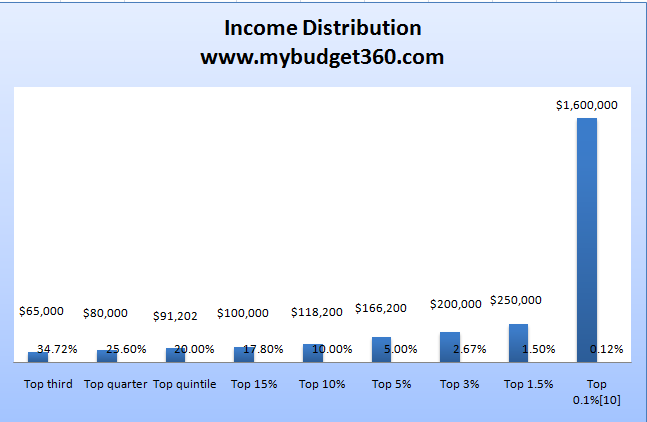
To highlight the massive discrepancy I’ve put together a chart showing the household income distribution:

U.S. Income Distribution

As you can see from the above chart, only 17.8% of all U.S. households make more than $118,200 a year.  Only 2.67% make more than $200,000.  The fact that only 34% make more than $65,000 is astounding given how expensive other cost of living items have gotten over the past decade.  That is why the middle class is feeling squeezed from all different sides.

When I put together a budget for a family making $100,000 I received a bit of feedback on both sides.  Even though I realized very few people had household incomes in the 6 figure range looking very closely at the data, I can understand why people took issue with a budget that was at that level.  I also put together a budget from someone living in California making $46,000 a year and received feedback as well.  I think when it comes to income, you can never have too much.

What is even more fascinating, is how even amongst the super wealthy income is not distributed evenly.  There are approximately 146,000 (0.1%) households with incomes exceeding $1,500,000 a year.  Even at that, the top 0.01% of households had incomes of $5,500,000 and accounted for 11,000 households.  The 400 highest tax payers in the nation brought in a stunning $87,000,000 a year.  Now that is wealth.

For us mere mortals, it is important again to focus on that chart.  $46,000 does not go a long way.  In a recent Census report there are 110,000,000 households in the United States.  What this data tells us is that 55,000,000 households are living on $46,000 or less a year.  Let us assume this is a married couple with 1 child.  Let us run the numbers:

Texas Income Household

I ran the numbers for a state with no state income taxes, Texas.  A family at this level is only bringing in $3,215 a month.  The national median home price peaked around $200,000.  So let us assume this family purchased the median home:

5% down payment:                    $10,000
Mortgage 30-year fixed (6.5%):   $1,200
Taxes and Insurance:                       $333
Mortgage Insurance:                        $???

PITI:  $1,533

Right off the bat, this family is spending 47% of their net pay on a median priced home.  We didn’t even account for any pre-tax retirement account investing.  Given the recent stock market performance and the loss of $50 trillion in global wealth, maybe that wasn’t such a bad idea.  The bottom line is the average American family is being squeezed from every angle.   What we need is a focus on jobs and our economy, not bailing out banks.  That defeats the entire purpose.  The average American family is struggling getting by and when they hear about these billion dollar handouts, they can’t help but to feel left out.