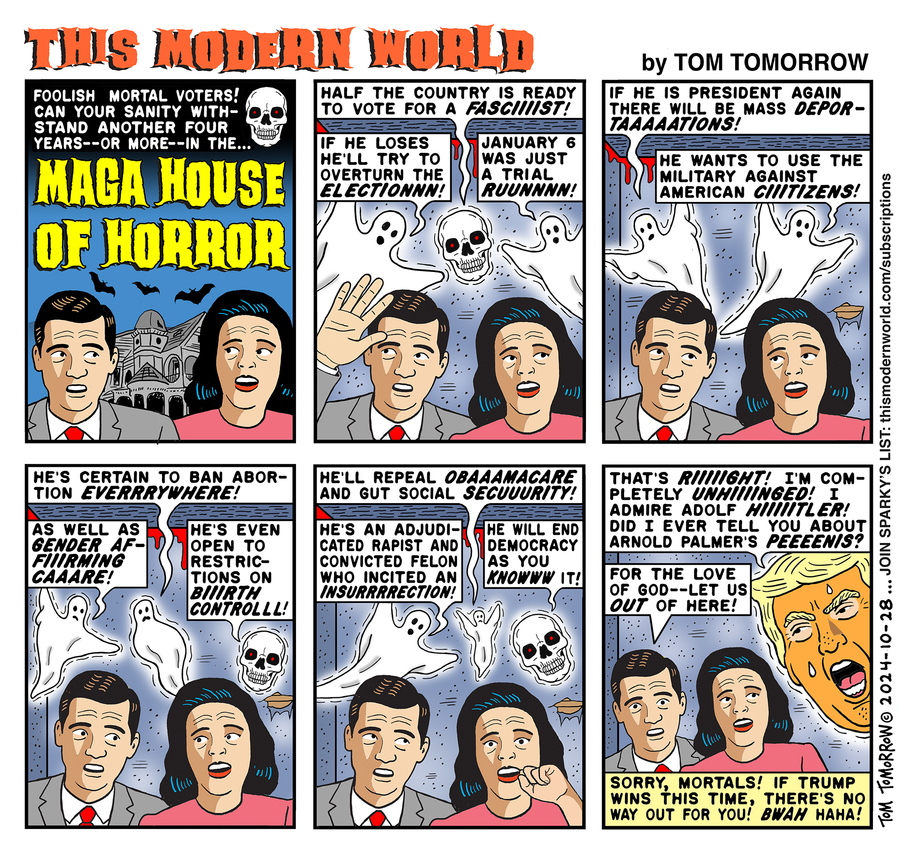
The parallel paths of Trump and Hitler can no longer be ignored
Story by Cormac Moore
Believing Barack Obama would comfortably win the 2008 US presidential election, some friends and I went to Chicago that November for the results.
We ended up being amongst the crowd of thousands in Grant Park as the president-elect gave his victory speech.
It was wonderful to witness what looked like such an important moment in American history, as the nation seemed to have turned a corner for the better by electing its first African-American president.
Eight years later, the hopes of 2008 had vanished. The most unqualified and unprincipled person imaginable succeeded Obama.
As with Hitler in 1920s Germany, many considered Trump’s foray into a politics a joke when he descended his golden escalator in 2015. He was not taken seriously by opponents in the Republican Party and elsewhere until it was too late.
Both Hitler and Trump ascended to power using outrageous and divisive language, deploying ‘them v us’ tactics, while claiming that they, as outsiders of the elites, were the only ones who could fix the real or imagined malaise that existed in their nations.
While the checks and balances of the American constitution somewhat curbed Trump’s authoritarian instincts during his first term, it laid the foundations for him to destroy the constitution in his second.
A case in point is his filling of the US Supreme Court with malleable judges, who, in one of the most shocking judgments in the court’s long history, ruled in 2024 that presidents had broad immunity from criminal prosecution for official acts taken in office.
Despite being a criminal like Hitler, Trump won a second term in 2024, even after the failed putsch on January 6 2021, when he and his supporters refused to accept the democratic decision of the American electorate to oust him the previous November.
Now the guard rails are off, and we are witnessing Trump’s America fully eschew democracy and embrace fascism.
As with Hitler’s Germany, the descent to authoritarianism in America has been a gradual process.
Before Hitler became Führer after the death of President Paul von Hindenberg in August 1934, 18 months after he had become German chancellor, the true barbarism of the Nazi regime was checked as he needed the help of conservatives, the military and businesses to attain and maintain power.
People like Hindenberg, Franz von Papen and a multitude of big business owners opportunistically paved the way for Hitler’s path to absolute power. Likewise, many former sworn political enemies of Trump within the Republican Party, as well as CEOs of firms, particularly technology companies, are legitimising and supporting his descent into fascism, all for their own selfish reasons.
In his 2025 book The Nazi Mind, historian Laurence Rees wrote: “Once they gain power, dictators seek to destroy the human rights of their population. A free press, the rule of law, fair elections – all of them need to be annihilated if a dictator is to feel secure.”
While Rees was referring to Hitler, he could just as easily be talking about Trump. He and his sycophants have taken a hammer to democracy in America.
His personal attacks on journalists and litigation and cutting of funding for media outlets have severely eroded the freedom of the press in the US. The instructions of the Department of “War” last year to only publish information that is officially sanctioned is eerily similar to Joseph Goebbels’s directives subordinating the German press to his Ministry of Propaganda.
It is apparent from recent events in Minneapolis involving ICE, which has become Trump’s Gestapo-like force, that the rule of law is breaking down before our eyes as he targets enemies from within, using paramilitary forces not only to break the law but to murder. He has also deployed the National Guard in Democrat-run cities.
Following the cue from their master, the liar-in-chief, his acolytes – people like Vance, Noem, Miller and Leavitt – brazenly lie about what we can easily see with our own eyes. They lie so effortlessly, as easily as breathing, another feature of this administration that bears the same hallmarks as the Nazi regime. Some don’t even hide their fascism anymore, with the Departments of Homeland Security and Labor posting several Nazi images and messages.
There was only one federal election in Germany while Hitler was in power, in March 1933. Held just days after the burning of the Reichstag, it was not free and fair, with the Communist Party essentially banned and Social Democratic Party severely restricted.
A big test comes this November in the US with the mid-terms. Efforts are already afoot by Republicans to strip millions of Americans of their right to vote.
The way the elections are run and the reaction to the outcomes will show how far the country has moved towards authoritarianism.
There was only one federal election in Germany while Hitler was in power and it was not 'free and fair'
Judging by Trump’s behaviour after one year of his second term, I do not hold out much hope. As the former chess grandmaster and activist Garry Kasparov warned: “These are not the acts of people who expect to lose power any time soon, or ever. They are racing to the point where they will not be able to afford to lose control of the mechanisms they are ripping up and remaking in their image.”
Despite Trump’s obvious abhorrence of democracy, many in the US and elsewhere continue to appease him. There was a sigh of relief after he appeared to back down over Greenland and even ICE.
But these are just temporary roadblocks as Trump and his administration continue a destructive path that bears too many similarities to Nazi Germany to keep on ignoring.
Scarily, I believe we are only at the end of the beginning of this destructive path.
#trump
#hitler
#trump Hitler
#nazis
#fascists