Showing posts with label slow growth. Show all posts

Monday, September 30, 2013

The Economy is Falling Further and Further Behind

by DEAN BAKER


Proponents of austerity both in the United States and Europe are eager to claim to success for their policies. In spite of economies that look awful by normal standards, austerity advocates are able to claim success for their policies by creating a new meaning for the word.

In Europe we have the bizarre story of both George Osborne, the UK’s chancellor of the exchequer, and Olli Rehn, the European Union’s commissioner for economic and monetary affairs, claiming success for their austerity policies based on one quarter of growth. Apparently, they are arguing that because their policies did not lead to a never-ending recession, they are a success. Remarkably, they seem very proud of this fact.

In the United States we were treated to the Wall Street Journal boasting of the success of the 2011 debt ceiling agreement on the eve of another standoff on the budget and the debt ceiling. The measure of success in this case appears to be that the sequester budget cuts put in place by the agreement are still in place and that the economy has not collapsed as a result. By this standard the WSJ has a case, but as with the austerity crew in Europe, this is a rather pathetic bar.

First, it is worth noting that many of the disaster warnings about the sequester from President Obama and the Democrats were grossly exaggerated. There was no plausible story in which cutting 5 percent of the discretionary portion of the federal budget would lead to imminent disaster. Most departments have some amount of reserves in various forms that they can tap into in order to minimize the impact of these cuts over a relatively short period. This meant nothing horrible happened when the sequester first began to bite on March 1.

However this doesn’t mean that the sequester is harmless. Suppose the 5 percent cutback rule was applied to any major corporation, even a highly profitable one such as Verizon or Apple. Surely these companies could find ways to reduce their operating expenses by 5 percent. They could put off hiring workers to fill vacancies. They may delay renovating office space. Perhaps they would freeze or cut some workers’ pay.

In the short-run there would probably be little change in the company’s ability to operate. After all, much of what they do is already baked into the cake. Verizon is going to be a huge and highly profitable wireless and phone company in 2013 and 2014 even if they cut back their marketing and don’t do proper maintenance and care for their network for six months or a year. In time of course the cutbacks will take a toll and likely lead to serious loss of market share and profits.

In the case of the federal government, we will see departments that are less able to do their jobs over time. This has been highlighted most clearly at the National Institutes of Health, where many promising lines of research were abandoned because of the sequester. But there will be similar stories in other departments.

Also, while kicking federal employees is apparently great sport for many, over time these people will look for other jobs and those who will replace them will likely be less qualified. Most people don’t want to work at a job where their pay and hours can be cut at any time for reasons that have nothing to do with their performance.

Employers in the private sector understand this fact even if it too complicated for members of Congress. This means that we can expect future government employees, like air traffic controllers, meat inspectors, and FBI agents, to be less qualified and committed than the current crew. The Wall Street Journal might think it some great victory that this deterioration has not been evident six months after the sequester, but people with more knowledge of the business world might be less impressed.

But the deterioration of government services might be the less important damage done by the sequester. The more visible and certain damage is the slower growth of the economy and higher unemployment.

Businesses hire people and undertake investment when they see demand for their product and/or have a new innovative idea. Outside of Wall Street Journal editorial page land, no business increases employment or undertakes investment because the government has laid off workers and cut back spending. This means that the government cutbacks directly reduce employment and curtail growth.

In the last two years, the government sector has shed 200,000 jobs. In a comparable period in the last recovery (August 2003 to August 2005) it added more than 300,000 jobs. This difference of 500,000 jobs would have a substantial impact on the labor market, especially when we consider that spending by these workers can be expected to increase the employment impact by at least 50 percent, bringing the total gain to 750,000 workers.

We can tell a similar story about growth, which has averaged just 2.2 percent over the last two years. This pace is less than most estimates of the economy’s potential growth rate, which means that rather than making up ground lost in the recession, we have been falling further behind the economy’s potential level of output. According to the Congressional Budget Office we are losing roughly $1 trillion in output a year because of the lack of demand in the economy.

So we know the sequester will give us deteriorating government services, higher unemployment, and slower economic growth. That’s the track record which prompts the Wall Street Journal’s boasts and advocacy of more austerity.

Monday, July 22, 2013

Fewer Americans Will Work: What That Means for the Economy

By Christopher Matthews, TIME Magazine
July 22, 20130

With last year’s presidential election so focused on jobs and the economy, the American public probably knows more about the nuances of the unemployment rate than they ever have before. One particular of the official unemployment rate that received attention last year is that the Labor Department counts someone as unemployed only if he or she is actively looking for employment. Other folks who, for whatever reason, aren’t searching for work are considered not in the labor force.

The ratio between those considered in the labor force and the total working-age population is known as the “labor-force-participation rate.” And the reason why the unemployment rate has been able to fall from more than 10% in 2009 to 7.6% today despite middling job growth is that more and more Americans are dropping out of the labor force altogether.

As you can see from the chart below, this decline in the labor-force-participation rate is a trend that’s been going on for many years now. The primary driver of the overall trend is the aging workforce — many of those dropping out are simply retiring at around the normal age. But the trend accelerated during the recession, suggesting that many more people dropped out of the workforce than otherwise would have if the economy were in better shape.


As the economy improves, however, should we expect to see the participation rate bounce back? According to new analysis from Macroeconomic Advisers, it’s not likely. They estimate that roughly 45% of the recent decline in labor-force participation is a result of a weak economy, and the rest because of demographic factors. But as the economy improves, the workforce is going to continue to age, meaning that by 2015, when the Federal Reserve expects the economy to be back near full employment, the participation rate will remain where it is today.

In one sense this is good news because the economy doesn’t need to produce as many jobs per month to see reductions in the unemployment rate. But on a deeper level, it’s evidence that the high labor-participation rates that helped spur economic growth from the 1970s through the 1990s is a thing of the past. To put it another way, our economy is going to have to produce more with fewer people going forward, which — all else being equal — will slow economic growth.

So just how big of an effect will a smaller workforce have on the economy? In 2011, Harvard University’s Program on the Global Demography of Aging published a paper that tried to understand this question. Logic suggests that a workforce that has to support fewer nonworking individuals will be wealthier overall, and the study bears out that hypothesis. In the paper, economists David E. Bloom, David Canning and Günther Fink estimated how high-income countries (most of which have aging populations) would have grown from the 1960 to 2005 period if they had experienced population growth similar to the projections for 2005 to 2050. According to the report, if a high-income country like the U.S. had a per-person income of $10,000 in 1960, that income grew to $34,600 under the population growth we actually experienced. On the other hand, if the 1960 to 2005 period experienced the sort of population growth that we’re expected to see through 2050, that income would have grown only to $25,500.

This huge difference underscores how important population growth and workforce participation is to a country’s economy. If there are more people working in a country, and if a higher percentage of those people are productive, the whole country will be richer. (This is one reason why economists tend to support policies that increase immigration.)

Wednesday, May 1, 2013

Obama’s Absurd Sequester Scheme

Making a Terrible Situation Worse
by DEAN BAKER


The big talk in Washington this month is the sequester cuts. These cuts are roughly 8 percent of most areas of discretionary spending, both military and domestic. While the cuts became effective at the start of March, many will first begin to pinch this month since government contracts generally require 30 day advance notice for leaves or furloughs. This means that cuts in areas such as airport security, food inspectors, and air traffic controllers are just now taking effect.

The Democrats have been yelling loudly about the damage that these cuts will inflict on specific programs and the economy as a whole. They do have a case. The cuts will whittle back spending in a wide variety of areas. Some of these, like the cuts to airport security and food inspections will have an immediate impact. We will see longer lines at airports and are more likely to find ourselves eating contaminated meat.

The impact of other cuts, like reductions in spending on infrastructure maintenance and medical research, will only be seen over the long-term. We will see a gradual worsening in the quality of the infrastructure and less medical progress.

In addition, the reduction in spending at a time when the economy is already weak will further slow growth and weaken job creation. The March jobs report helped to remind everyone of this problem. The economy created just 88,000 jobs in March, less the number needed just to keep pace with the growth of the labor force.
For some bizarre reason, prior to the release of the report many economists were making bold claims about how the economy had turned the corner and the recovery was picking up steam. It’s not clear what these folks had been smoking.

The economy was growing at just a 1.7 percent annual rate in the second half of last year. The most recent data on new orders for equipment showed that investment was just even with its year ago pace. And the rate of job creation over the prior five months was actually down by an average of 40,000 from the same months a year earlier.
None of this looked like a story of accelerating growth. Thankfully the March jobs report helped bring the discussion of the economy back to reality. The experts again recognized that we have a problem of a seriously depressed economy that is at best just growing rapidly enough to keep pace with its underlying potential, meaning that it is making up none of the lost ground from the downturn.

In this context, the hit from the sequester is clearly bad news. The Congressional Budget Office projects that it will reduce growth in 2013 by 0.5 percentage points costing as many as 700,000 jobs. With the sequester in place there is a high probability that the unemployment rate will be higher at the end of the year than it was at the beginning.

But there is a limit to how much President Obama and the Democrats can really complain about the sequester. The reason is that President Obama himself set a course for large cuts in discretionary spending. His budget for 2012, which was put out before the deal with the Republican Congress, called for discretionary spending to be 7 percent less in 2021 than it had been in 2010, in nominal dollars. This budget would have implied cuts in services of more than 40 percent since the economy was projected to be more than 60 percent larger in 2021 than in 2012. This means that most of the bad stories that we are hearing about from the sequester cuts likely would have been the result of the cuts that President Obama had laid out himself, even if they would have been phased in more slowly.

The furloughs and layoffs of public sector workers also have their roots with President Obama. After all, it was his idea to freeze the pay of federal employees back in 2011, implying that we have a problem with overpaid government workers. Is it a surprise that the Republicans want to push the attack one step further?

And President Obama basically accepted the Republicans’ framing of the story of the downturn which turned reality on its head with the line about out of control budget deficits. Fans of arithmetic know that the large budget deficits are the result of the economic collapse. In fact budget deficits were modest prior to the downturn and were projected to remain small even if the Bush tax cuts were no allowed to expire at the end of 2010 as originally scheduled.

In this context, it is a bit hard to get too excited about the sequester. Yes, it is very bad news, but we were looking at the prospect of large cuts to the budget even before the sequester. And yes, it will slow growth and increase unemployment, but we were already looking at a government that seemed content to allow the country to needlessly lumber through a prolonged period of high unemployment.

The sequester makes a terrible situation somewhat worse, but the idea that everything would be just fine if we just stopped the sequester is nuts. We should be talking about reversing the austerity agenda more generally. The Democrats’ hysterics about the sequester should be recognized as the theater it is.

Even worse the idea pushed by President Obama, that we should be prepared to accept large cuts to Social Security and Medicare to get back to the slow motion sequester is almost too absurd for words
. If he raised this plan anywhere other than Washington he would have been laughed out of town. Certainly those of us who do not work for hacks and hedge funds should treat this scheme with the derision it deserves.

Saturday, November 26, 2011

Failure of the Super Committee Might Be the US's Best Hope for Economic Recovery

"Drawing blood” from the economy by cutting government expenditures at a time of high unemployment and underused resources will only ensure the patient’s death, not recovery. 
By Marshall Auerback, AlterNet
Posted on November 26, 2011

The bipartisan super committee has failed to meet the self-imposed November 23rd deadline to enact $1.2trillion of cuts over the next ten years. That failure, as Paul Krugman notes in the New York Times, is a good thing:
“Any deal reached now would almost surely end up worsening the economic slump. Slashing spending while the economy is depressed destroys jobs, and it’s probably even counterproductive in terms of deficit reduction, since it leads to lower revenue both now and in the future.”

If the super committee failed to come up with an alternative plan by Thanksgiving, and the cuts will hit defense and domestic programs equally. But those cuts won’t begin to go into effect until January 2013, two months after next fall’s election, which also means that the programmed fiscal restriction planned for next year won't come into effect. The likelihood of failure is provoking a negative reaction in both the markets and the mainstream press. But in spite of that, failure might be the difference between sluggish, moderate growth in the U.S. and double dip recession.

The travails of the euro zone are perpetual front page news right now, but let's try to put them aside for a moment and focus solely on the U.S. The latest U.S. economic data suggests that the economy has continued to muddle along at a positive rate of growth somewhat below its trend rate of growth. This has happened even though an unwind of the 2009 $860 billion stimulus package is now leading to moderate reductions in government spending.

October core retail sales were up +0.6%. The three-month annualized change now stands at +6.6%. This is consistent with personal consumption expenditure growth of perhaps +3.0%. The increase is consistent with the above trend U.S. economic growth.

Dallas Fed President Richard Fisher thinks such growth is sustainable. He expects U.S. economic output to grow +2.5% to +3.0% in this quarter and expects it to improve next year.

But not if the super committee goes big and enacts huge budget cuts. In that kind of scenario, economic growth in the U.S. next year will be held back (or worse) by programmed fiscal restriction as even greater amounts of income are withdrawn from the economy, especially if cuts are implemented in programs such as Social Security. Lower incomes means lower sales, and sales are what ultimately drive economic activity. 

Remember: businesses lay people off when their customers stop buying, for any reason. So the reason we lost 8 million jobs almost all at once back in 2008 wasn't because all of a sudden all those people decided they'd rather collect unemployment than work. The reason all those jobs were lost was because sales collapsed.

I am also skeptical of the validity of the recent strong trend in consumer spending because it appears to be a product of consumers drawing down on savings, which began to be rebuilt in the aftermath of the 2008 crash. Unfortunately, consumers no longer have the credit availability to do that. Nor do they have the incomes to sustain taking on ever increasing burdens of private debt, as was the case in the 1990s.

And let’s be clear: Despite the distortions floated by many politicians and pundits in the mainstream press, most of the growth of the government’s deficit can be attributed to the rotten economy–which destroyed jobs and thus tax revenue. As the U.S. private sector retrenched to rebuild its balance sheet, the government’s balance moved toward deficit. This had very little to do with “excessive” and “unsustainable” entitlement programs. The positive contribution of the U.S. fiscal stimulus (with supporting monetary policy) cannot be overstated, even though many notable mainstream economists (such as Robert Barro, or Greg Mankiw) claim it made the recession worse. Without the two-pronged attack – first of shoring up the financial system to ensure the banks could lend and second, the substantial increase in government net spending (which was both the product of discretionary fiscal decisions and what economists call "automatic stabilizers" like unemployment benefits) – the world economy would have collapsed into Depression. That is not to say that the fiscal interventions were sound and well designed. I generally think they were unsound in the sense that they did not support job creation as much as they should have. But that is a separate issue.

The outlook for 2012 then depends very much on fiscal policy. Right now according to the Congressional Budge Office (CBO), we are programmed for fiscal restriction of perhaps 2.5% of GDP or more in 2012. That could overcome the natural tendency of economies to grow, especially with real interest rates at negative levels. The question then arises, will we really go through an election year with so much fiscal restriction? The answer, of course, is in the hands of the politicians. As it now stands, the President wants a $447 billion dollar jobs plan. That is equal to almost 3% of GDP. He wants most of it to be financed with borrowings in 2012, with offsetting tax increases in future years. Passage of all of this jobs plan would turn programmed fiscal restriction into marginal fiscal stimulus.

The Republican position has been that, even if they go along with parts of this job stimulus plan like an extension of the payroll tax cut, they demand offsetting greater expenditure cuts.

In other words, even if they concede to some of Obama’s demands, they insist on maintaining the overall fiscal restriction that is now programmed because they say that demonstrating a commitment to “budget discipline” will enhance business confidence and allow the private sector to create more jobs.

So let’s assume that the GOP is right: imagine a new government being elected on the promise of cutting national debt and in its first budget outlines a very clear plan to seriously cut the national budget deficit, reduce taxes (but definitely not put them up), cut public employment and free up the regulative environment. And let's say that such a government also pronounced its “pro-business” credentials (self-styled).

In that situation, if the Republican view was correct, we would expect to observe within a few months (certainly within a year) of the new government a reduction in private uncertainty, which, if the concept has any operational application, should influence discretionary behavior such as spending and employment.

It would be reasonable to expect business confidence to rise, which should mean that private investment would accelerate as business owners anticipate a consumer revival. It would be reasonable to expect firms to be keen to get staff in place to meet the renewed expectations of increased orders. It would be reasonable to expect consumers to become more confident and this confidence to translate into their consumption expenditure.

So... how does one explain the UK, which continues to deteriorate in spite of making very clear its plans and implementation for budget cutting? And how does one explain Australia, which has also been working toward reducing government spending, even as its unemployment rate has begun to tip up again?

The economics of the super committee, indeed that of virtually all of the mainstream Washington policy establishment, is still predicated on the economic equivalent of Medieval blood-letting. Continuing to “draw blood” from the US economy via ongoing cuts in government expenditure at a time of high unemployment and underused resources will ensure the patient’s death, not recovery.

Friday, June 17, 2011

The Bush Tax Cuts: A Decade of Economic Disaster

Friday, June 17, 2011 by The Providence Journal
by William Barclay

This month marks the 10th anniversary of the first of the two tax cuts sought by President George W. Bush. The Economic Growth and Tax Relief Reconciliation Act was enacted in 2001 to be followed, in 2003, by the Jobs and Growth Tax Relief Reconciliation Act.

Ten years later, it is time we assess the actual results of these tax cuts, looking at economic performance rather than political promises. The results have been a disaster for the U.S. economy and for almost all of the American people. We have had very slow income and employment growth for the vast majority of families, an extremely unequal distribution of the direct financial benefits from these measures and very slow growth in the economy as a whole.

As a high-income person who has received these tax cuts during the past 10 years, I feel that it is my responsibility to speak out.

Supporters of tax cuts for high-income households, such as House Speaker John Boehner (R.-Ohio), argue that rich people are the “job creators” and that tax cuts encourage them to create jobs and that these new jobs, in turn, increase employment opportunities and improve the wages of the rest of the population.

Did any of these benefits occur after the Bush tax cuts? The quick and accurate answer is, no, they did not. Adjusted for inflation, the median weekly earnings of working Americans actually fell 2.3 percent from the end of the 2000-01 recession to the onset of the Great Recession. This is unique in the post World War II period.

Further, the recovery from the 2000-01 recession was the slowest of any post World War II recession to date, requiring 39 months before the number of employed Americans reached the pre-recession level. Where is even a scintilla of evidence that tax cuts such as those passed in 2001 and 2003 generate income and employment growth for the vast majority of the population?

A significant part of the failure of the Bush tax cuts to generate jobs and income growth flows from the top-heavy distribution of the benefits conveyed by these measures. The vast bulk of the reduced taxes were reaped by a very small number of families. In 2011, the average tax reduction to families receiving an income of $1 million or more (about 321,000 families) will be $139,199.

For this less than 0.5 percent of all families this is a total reduction in taxes of $860 million/week. Compare these tax benefits with the yearly savings proposed by cutting the Women, Infants and Children (WIC) health and nutrition program: $833 million. An obvious question is, why can’t this very small group of very high-income families give up just one week of their tax cut to provide nutrition for the tens of thousands of women and children that benefit from the WIC program?

More significantly, in light of the deficit hysteria gripping Washington, D.C., the combined impact of the 2001 and 2003 Bush tax cuts has been the addition of more than $2.6 trillion to the federal debt. This included more than $400 billion in interest payments on the debt necessary to pay for the cuts.

Of course, one might forgive these policy failures if the promise of economic growth had been fulfilled. On this measure, however, the record is even worse.

The 2000-01 recession ended in the fourth quarter of 2001, just in time for the first Bush tax cut to take effect. From the end of the recession until the onset of the Great Recession, the economy grew at a slower rate than in any other post recession period since World War II. Thus, despite promises from the advocates of the tax cuts, the reality was slower growth rather than faster growth. The additional tax cut in 2003 did nothing to increase the pace of economic growth.

In sum, the Bush tax cuts were a bad idea at the time and are an even worse idea today. Ending these cuts for incomes over $250,000 would generate over $100 billion a year in additional revenue. If we also created additional tax rates for very high-income families (e.g., at $500,000, $1 million, $5 million and $10 million) we could increase federal revenue by more than double that amount and put ourselves on the road to reducing deficits and debts.

Wednesday, June 8, 2011

Austerity Measures Will Only Worsen Current Recession

There’s no chance consumers will soon rescue the economy. The only hope for a speedy recovery is for the government to increase spending in the right ways.
By Eileen Appelbaum, AlterNet
Posted on June 8, 2011


The administration and Congress made a terrible mistake switching their attention from jobs to deficit reduction -- and the country is already suffering the consequences. GDP growth fell from 3.1 percent in the last quarter of 2010 to just 1.8 percent in the first quarter of this year.

Consumer spending has slowed. The pace of business investment has weakened. Factory orders are down. In fact, the Institute for Supply Management’s May manufacturing figure fell to 53.5 from 60.4, the largest one-month decline since January 1984. Housing still hasn’t recovered from the bursting of the bubble and remains a disaster zone.

Friday’s job report for May -- showing an increase in the official unemployment rate to 9.1 percent from 8.8 percent in March -- should give the "Austerity Now!" crowd pause. Amid the assault on government spending, public sector employment fell by 29,000 in May, mostly at the local level. Local government jobs are down nearly half a million since they peaked in September 2008. Expect this to worsen in July, when the new budget year starts in most states. Teachers are getting pink slips.

There is no sign the private sector, which added a mere 83,000 jobs in May, is about to take up the slack. Companies are sitting on trillions in profits, but they won’t use this money to create jobs if they don’t see increasing demand for their products and services. With the economy slowing and the political class focused on deficit reduction, it’s hard to fault these big corporations -- not to mention still struggling small businesses -- for not taking on more workers. A "contractionary expansion" -- fancy economist talk for cutting government spending and unleashing the private sector to expand hiring and production -- is nowhere in sight.

Women are especially at risk. They hold the majority of the public sector jobs already lost or slated to be cut. While job creation during the recovery has been slow for both men and women since the labor market hit bottom in February 2010, men gained more than four-fifths of the new jobs, even capturing two-thirds of jobs added in private services where they are less than half the workforce. In the public sector nearly two-thirds of the jobs lost were held by women.


While everyone else is tightening their belts is not the right time for the government to tighten its belt as well. That way lays disaster. Unless demand picks up, the private sector is not going to hire enough workers to make a dent in unemployment. Where will increased demand for private sector products and services come from? Workers are unemployed or worried about their jobs, and households are strapped for cash. There’s no chance that consumers will soon rescue the economy. The only hope for a speedy recovery is for the government to increase spending in a way that averts layoffs, creates jobs and puts money in the pockets of ordinary people.

Austerity while the economy is weak hurts the economy. It makes the deficit worse, not better, as tax revenues again begin to shrink. What is needed right now -- dare we say it? -- is for government to spend more: provide block grants to the states to avert a crisis in public education and a decline in access to health care for poor kids; extend unemployment benefits to the rising number of long-term unemployed; and engage temporarily in direct job creation to put millions of unemployed workers back to work quickly.

Concern about the bond vigilantes, those feared bogeymen that deficit hawks maintain are ready to pounce and raise interest rates if the government takes steps to improve the job situation, is misplaced. It’s the weakening economy, not government spending to protect and create jobs, that investors fear. Yields on 10-year Treasury bonds are not rising -- they have fallen to 3 percent as investors seek safe harbor in US government guaranteed assets. Only the current foolishness over raising the debt limit can threaten that guarantee and cause investors to flee US government bonds and the interest rate to suddenly spike.

Absent government policies, it takes a long time for an economy to recover from a recession and financial crisis. The panic and depression of 1873, similar in many ways to the current economic situation, lasted six years before lifting in 1879. But unlike in 1873-'79, we now have the economic know-how to bring our current crisis to a speedy end. We lack only the political will.

Policy-makers must focus on creating jobs, not slashing the deficit. It’s unconscionable to allow nearly 25 million unemployed and underemployed Americans to continue to suffer the devastating economic and psychological consequences of unemployment.

Monday, June 6, 2011

Jobs Slump — It's The Policy, Stupid

IBD Editorials
Posted 06/03/2011

Recession: Two years into a "recovery," the unemployment rate leaps to 9.1% and just 54,000 new jobs are created. Is this just "bumps on the road to recovery," as the White House insists, or something more dangerous?

This has been the most miserable recovery in modern history. Not only are there not enough jobs being created, but also the economy itself looks to be stalling.

Gross domestic product grew a paltry 1.8% during the first quarter, and most economists expect something similar for the second quarter. Double dip? It's possible.

As we noted earlier last week before the new jobs data came out, the U.S. is already in a growth recession — defined as an economy that's growing too slowly to keep unemployment from rising.

Yet the Obama administration is crowing about its accomplishments as if slowing growth and rising joblessness have nothing to do with its bad policies.

"The initiatives put in place by this administration — such as the payroll tax cut and business incentives for investment — have contributed to solid employment growth overall this year, but this report is a reminder of the challenges that remain," said Austan Goolsbee, Obama's top economic adviser.

"Solid employment growth"? Since the end of last year, job growth has averaged 130,500 a month — about the number of people who enter the workforce each month. That's not "solid" enough.

By the way, the unemployment rate has been below 9% for just five months since Obama took office — and three of those months were in the first 12 weeks of his presidency, before his policies took effect.

Even so, President Obama on Friday visited Chrysler workers, lauding the government's bailout for the re-emergence of the auto industry, which has added 113,000 jobs over the last two years.

What he didn't say was that GM, the bailout's poster boy, lost taxpayers $14 billion, and the total cost of his stimulus and bailout plan has now risen to $830 billion.

Obama was unflappable. "This economy took a big hit — it's taking a while to mend," he told Chrysler workers, reciting high gas prices, Japan's earthquake and the Mideast as the "head winds" facing the economy.

How about the head wind of bad government policies that, based on Congressional Budget Office data, have cost the economy over $760 billion in lost economic output in the past two years — and millions of jobs?

This lost output is the Obamanomics growth tax. Too much tinkering, too much debt, too much spending.

"By failing to alleviate the uncertainty businesses are feeling, Washington continues to stifle hiring," said Chamber of Commerce economist Martin Regalia.

This "uncertainty," by the way, is why businesses, with their $2 trillion in cash, stay on the sidelines. At this point in a recovery, they should be adding hundreds of thousands of workers each month.

That they aren't is a damning indictment of Obama's big-spending, high-debt,  strategy that has emerged as one of the great failures of economic policy-making in modern times.

Another Recession Can't Happen, But It Is Happening

(I think, like the author of my previous post, we are in a depression--we are based on the same numbers they used prior to the 1990s--but even a double-dip recession is bad news. Whenever a media joker says "recovery," they are lying.--jef)
+++++++++++++++

The Big Double-Dip

By DAVE LINDORFF
It was just as recently as a year ago that the authorities in politics, business and academe were stating boldly and confidently that the nation's economy was on the mend, and that there was no chance of a backslide into recession again.

Take Lakshman Achuthan and Anirvan Banerji who are, respectively, co-founder and chief operating officer and co-founder and chief research officer of ECRI, the Economic Cycle Research Institute.

"The good news is that the much-feared double-dip recession is not going to happen," they said on CNN on Oct. 28, last year. "After completing an exhaustive review of key drivers of the business cycle, ranging from credit to inventories and measures of labor market conditions, we can forecast with confidence that the economy will avoid a double dip."

"We will not have a double-dip recession at all," said Warren Buffett, the multi-billionaire investor called, by his fans, the Oracle of Omaha, back on September 13, 2010. "I see business coming back almost across the board," he told an assembled group of bankers.

And of course, there was Ben Bernanke, the chairman of the Federal Reserve, who actually acts on his presumed wisdom, saying, on June 8, 2010, ""There seems to be a good bit of momentum in consumer spending and investment," he said at the time. "My best guess is we'll have a continued recovery [but] it won't feel terrific."

Even a Vistage Survey of CEOs, conducted release last Oct. 4, showed the confidence index respondents, all top executives at public companies, saying there was "no evidence" for a double dip back into recession in the nation's economic future.

So much for expert opinion.

This week we have seen new unemployment claims top 400,000 for the eighth week in a row. Manufacturing has fallen to where it was in 2009, the respected Case-Shiller Housing Index has declared that the housing price collapse has gone into a second dip, with home prices nationwide now back down to where they were in 1999 and still falling, and consumer confidence, according to the Conference Board, is down to 60.8 (in 1988 it was 100), a serious slump in a nation where 72 percent of the economy consists normally of consumer spending.

Okay, we're not in a second round of recession yet, but with economic "growth" slumping into to 1.8 percent for the first quarter of this year, and nothing up ahead to suggest it will get better, there's every reason to think we could move into negative territory before long.

Also, this stuff about recession is a bit nebulous anyhow. A recession is defined as two back-to-back quarters of negative growth, but when you go from 3% growth -- the bare minimum in theory to have jobs being created at a rate sufficient to employ all the new workers entering the job market -- to 1% or 2%, it might as well be called a recession. Some companies may still be making profits by operating at a lower than capacity level, but unemployment will be rising, people will be getting poorer, more homes will be going into foreclosure, schools will be laying off teachers, and the general level of misery in the nation will be rising.

Incumbent politicians might try to call that a "recovery," but that's really stretching the English language.

So how did all these supposedly smart people get things so wrong?

Any fool can see the problem. The Americans who own their own homes have seen what they thought was their major asset shrink in value by at least a third. Don't even talk about what meager savings they might have had. Back in July 2008, before the markets crashed, Americans had a total indebtedness of $2.5 trillion. The average American was reportedly saving less than $400 per year. We were living on credit, not saving. Those who did have some money saved and who had been investing it saw it lose 43% of its value almost overnight.

Sure, some of those people, who left their money sitting in the same equities they had been in before the crash got most of it back this year, but an awful lot of those people cashed out at the bottom, not wanting to risk losing any more. Their loses are permanent. Others cashed out because they lost their jobs and needed the money. Their losses are permanent.

This is what the too-smart economists, politicians and CEOs simply don't get. In their world--the one that just looks at P&L statements, shares words of "wisdom" over golf tees, and profits from illegal but routine insider tips on investment opportunities the rest of us don't learn about--things look pretty good. Companies are profitable, having laid off huge swaths of workers, bashed unions, won pay and benefit "give-backs" from employees and tax breaks from politicians, elected officials have been re-elected, thanks to friendly backing from the corporate media, and plenty of lucre from corporate PACs, and the tax breaks for the rich that were enacted under the prior Bush/Cheney administration have been extended by the Obama administration, so the well-heeled don't even have to pay much in taxes.

In our world, though, there are higher taxes, higher gas prices, higher food prices, increased bank charges, miniscule interest or no interest at all on any savings, higher tuition and less in financial aid for our kids, no jobs, pay cuts, and if we're laid off, there's no more health care.

So where do the happy-talk forecasters of "recovery" get the idea that we ordinary Americans are going to get out there and spend? Where do they get the idea that the great consumer "engine" that powered the economy for the last three or four decades is going to rev up again?

These idiots should go walk around a few shopping malls. What a dismal experience that is!

They should go stand in an unemployment office application line and talk to a few of the newly laid-off. Of better yet, volunteer at a food bank and talk to the people coming in for food assistance (at least that way these parasites would be doing something useful while they did their research).
 
If they did a little of that real research, they might not be so quick to make jackasses of themselves again, predicting confidently that there's no double-dip recession in the cards for the US economy.

I'm not holding my breath, but whether they take my advice or not, I'm ready to offer them a challenge: let's check back this time next year, and see who was right, them or me.

Sunday, May 22, 2011

Why March-April's Job Gains Will Collapse This Summer

by: Jack Rasmus, Truthout Sunday 22 May 2011

Every spring for the last three years, the business press and government policy makers declare with great fanfare that the job market in the US has finally turned the corner; sustained recovery in job creation has begun. But every summer following their pronouncements, the opposite occurs: employment and job creation retrenches from the spring and declines.

In recent months, the US Labor Department has reported that jobs for March and April 2011 grew by more than 200,000 each month. Apart from the fact that 130,000 new workers enter the labor force each month, and, therefore, the "net" gain is really only 70,000 (and a third to half of gains represent part time and temp workers), the 200,000 jobs represent an apparent relative improvement over the dismal job creation picture since last June 2010. But appearances are deceptive, and sometimes even false.

How real is the job growth in recent months? And will it continue for the remainder of 2011? Our answer to the first query is "not very" and to the second, "not likely." Here's why.

If the past three years, 2008-2010, are any indicator, employment gains that occur in the spring are not a true, reliable indicator of actual job creation. And the gains of this spring will once again likely disappear in the coming summer-fall of 2011.

The reason has to do with serious problems with the way the Department of Labor calculates employment gains every spring, and in particular, during the second quarter of April-June. When the economy is growing, the problems in calculation are minimal. But when the economy is in a deep downturn, or remains stagnant, the problems are exacerbated.

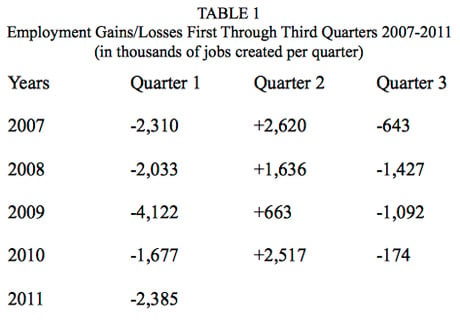
At the heart of the calculation of employment problem is a practice the US Labor Department employs called the "net new business formation" model, officially called the "Business Employment Dynamics" model (BDM). Every spring, the Labor Department "plugs in" a number of job gains from this model into the Current Establishment Survey (CES), which gathers the actual data on job totals in the economy from more than 400,000 establishments or businesses. The raw data on actual jobs created from the CES is relatively accurate. But the BDM is not. The BDM is not an actual tally of jobs. It is a convoluted "model" that estimates how many jobs are created from the formation of new businesses minus the number of companies going out of business. The numbers for the creation of new businesses, and corresponding new jobs associated with those new businesses, come from state unemployment insurance records that are a minimum of nine months old. And by the time the data is recorded, it is at least one year old. On the other hand, there is no accurate data on the "death" of old businesses. So, the Labor Department takes the number for new businesses, a year ago, and picks a number for "death" of old businesses (for which there are no records), and then plugs the "net" result into the actual number of jobs obtained from the regular CES survey of jobs for the month. But that's not all. The plug-in number is not only from data a year old. It is a historically averaged long run assumed number. So, new business formation from years ago, when the economy was doing well, further upward biases the jobs in the model when the economy is in a deep downturn. The Labor Department itself actually admits, "even in a year where total nonfarm employment declines, the residual net birth-death employment component is positive." We can have a major collapse of small businesses by the hundreds of thousands a month during a recession - which is what in fact happened and still continues to happen - but, nonetheless, the addition to jobs is "positive."

What this all results in is a falsely boosted number of jobs created from the BDM model that are added to the second quarter raw jobs numbers. The spring jobs numbers thus are always heavily inflated.

The Labor Department then takes the model's inflated numbers, adds them to the actual CES raw jobs numbers and then "seasonally adjusts" the combined numbers upward every spring-second quarter. Voila! We get a misrepresented improvement in job creation numbers every spring. But the false boost in job creation in the spring-second quarter declines just as quickly in the summer-fall third quarter when the BDM and seasonality adjustments level off.

Looking at just the actual, raw jobs data from the CES survey for the second quarter for the last several years, compared to the preceding first and subsequent third quarters, shows how the gains of the second quarter always "run-up" compared to the first and then collapse in the third. This data is from the US Labor Department's CES for the past four years.


When the above raw data from the CES combined with the BDM is subsequently adjusted for seasonality, the result is a rosy picture for job creation in the second quarter radically different from the raw data above for actual jobs created or lost. As Labor Department representatives admitted in a public online question-and-answer session on the BDM model, which this writer attended, "months with generally strong seasonal increases such as April, May, June generally have a larger positive birth-death factor." When that seasonal upward bias disappears in the remainder of the year, jobs then collapse once again.

The problem with the BDM is that it does not reflect any actual job creation data. It is a "model," not an actual survey or census of jobs. It is derived from a long-run historical average for new business creation (and, thus, jobs), which includes economic growth periods when creation is higher than in recessions, when creation may in fact be negative for many months. It does not pick up actual business "deaths" and therefore, job destruction. It is based on data that is lagged at least a full year. It results in a gross overestimation of net new jobs created, and particularly in the spring when seasonality adjustments are factored into the raw data.

What it all means is we can expect a retrenchment on job creation this coming summer once again. Nearly all economic indicators are pointing to a slowdown in the US economy. Housing is in a double dip, with record level collapses in prices, housing starts, sales, and just about everything else. Manufacturing has begun to level off as the global economy slows in turn, with Japan and UK and the Euro periphery in or entering new recessions, and China, Brazil and India taking action to slow their economies. Services growth in the US is also slowing, as the US consumer is hammered by increases in gas and food prices, as well as by continuing double-digit cost increases in health care, education and local taxes. State and local governments are on schedule to lay off at least 400,000 in the coming fiscal year, having sacked 300,000 last year. And the federal government, where jobs have been flat, will lay off hundreds of thousands more if current directions in budget cutting are any indicator.

So, don't get too excited about US government jobs reports in the second quarter. And hold onto your hat. The jobs crisis is far from over.

Sunday, May 8, 2011

Why Washington Should Pay Attention to the Economy Here and Now


After a week of non-stop Osama Bin Laden, Washington is now returning to the battle of the budget deficit and debt ceiling.Earth to Washington.

All over Capitol Hill Republicans and Democrats are debating spending caps and automatic triggers, and whether to begin them before or after Election Day.

But if you don’t mind my asking, what about the economy? I’m not talking about the economy five or ten years from now, when projections show the federal budget wildly out of control or when foreigners might start dumping dollars.

I’m talking about the here and now economy – the one Americans are living in day to day.
The Labor Department reported today that unemployment for April was 9 percent, up from 8.8 percent in March. And that doesn’t count people working part-time who’d rather have full-time jobs.

Yes, 244,000 jobs were added in March — but that’s chicken feed. We’d need 350,000 a month, every month for the next three years, simply to get back to where we were before the Great Recession.

And the percentage of working-age Americans actually working – 64.2 percent – hasn’t improved. It’s almost as low as it was in the depths of the recession. 13.7 million people remain out of work.

Hello Washington?

Even for Americans with jobs, wages are going nowhere. Basically, the only employers hiring are paying peanuts. McDonalds just announced it would start hiring big time.

In fact, there’s reason to worry we’re heading back toward recession. The Labor Department also reports new claims for unemployment insurance soared to 474,000 last week.

In the first quarter of this year the U.S. economy slowed to a crawl — a measly 1.8 percent annualized growth — down from over 3 percent last fall. Higher gas and food prices are putting even more squeeze on American households.

And housing prices continue to drop.

Washington is fighting over how much to cut spending over the next ten or twelve years.

But right now we need more public spending to get people back to work, stronger safety nets to help those who have lost their jobs or can’t find new ones, lower payroll taxes on average workers, and a requirement that Wall Street banks renegotiate mortgage loans so Americans can keep their homes.

Why isn’t Washington paying attention to what most Americans need in the here-and-now economy?

Because the White House and congressional Democrats don’t dare admit how bad the economy continues to be for so many people. They’re holding their breath, hoping the recovery catches fire next year before Election Day.

Republicans don’t dare admit how bad the economy is because they don’t want to increase public spending or strengthen safety nets. And their patrons on Wall Street don’t want to modify mortgages. Republicans would rather Americans believe their big lie that taming the deficit will create jobs and restore the economy.

So Washington would rather fight over the long-term budget, spending caps, taxes, and trigger mechanisms than do something about the pain most Americans are experiencing today.

But the here-and-now economy the most important thing on Americans’ minds.

Ironically, Washington’s disregard for what’s happening right now is also worsening the long-term budget problem. That problem is not the debt per se; it’s the ratio of debt to the overall economy. If the economy sputters or continues to grow at a snail’s pace, that ratio becomes worse and worse.

In other words, attending to the here-and-now economy is also good for the future.

Earth to Washington: Listen to America.

Wednesday, December 22, 2010

Obama's Tax Deal: Read the Small Print

It's been heralded by some as a 'second stimulus', but check the numbers: it's a recipe for slow growth and high unemployment
Tuesday, December 21, 2010 by The Guardian/UK
by Dean Baker

The enthusiasm of the US business press for the compromise tax package worked out by President Obama and Republicans in Congress led to a mini-euphoria of upbeat economic projections for 2011. While the economy will do better with this tax package than if no deal were forthcoming, much of the discussion has exaggerated the potential stimulus to the economy.

First, it is important to remember that although the total package is scored as costing almost $900bn over two years, almost everything in this package simply leaves in place current tax rates and spending. The biggest portion of the tax cut continues the tax rates put in place by President Bush in 2001. The continuation of these tax cuts, including a lower estate tax rate, accounts for almost $400bn of the $900bn.

Adding in the cost of a technical fix to the Alternative Minimum Tax, which is done every year, and the continuation of a series of smaller tax breaks, brings the total to $670bn. This portion of the package buys exactly zero stimulus, since it simply amounts to continuing tax policies already in place. Had these tax breaks not continued, it would have been a drag on growth, but their continuation does not provide any additional momentum to the economy. The $60bn cost of extending unemployment insurance for another year can also be put in this category.

The only net stimulus in this package comes from replacing the $60bn Making Work Pay tax credit in 2011 with a $110bn reduction in the payroll tax and the allowance full expensing of new investment. The latter is projected to cost $55bn a year for the next two years. The full expensing in this deal replaces a provision of the 2009 stimulus package that provided for 50% expensing, which means that the net boost to the economy is half this size.

In sum, the net stimulus for the economy from this package in 2011 will be in the range of $70bn, or about 0.5% of GDP. This is not likely to provide a substantial boost to growth.

While the tax deal will be a net positive to growth for 2011, there are many other factors that are pushing in the opposite direction. First, much of the spending in the original stimulus package will be coming to an end in the first two quarters of 2011. This includes both infrastructure spending for projects that will be nearing completion, and also assistance to state governments that allowed them to better weather difficult fiscal times.

State and local governments continue to face large budget shortfalls. They are finding it increasingly difficult to paper over their budgetary gaps (most state and local governments are required to run balanced budgets), and will have to resort to further cutbacks and tax increases in the year ahead.

House prices are once again falling, with the most recent data showing an 8.5% annual rate of decline. This pace is likely to accelerate in the months ahead. The housing market had been supported through the first half of 2010 by a first-time buyers' tax credit. This had the effect of pulling many purchases forward from the second half of the year or 2011. As a result, sales have fallen by almost one third. As inventories build up again, many homeowners will be forced to make substantial price cuts to sell their houses.

Declining house prices will be another blow to consumption as homeowners recognise that they have lost even more wealth than their had previously believed. The current pace of decline implies a loss of more than $1tn in wealth over the course of a year. The actual loss of wealth could easily be twice as large if the rate of price decline accelerates.

Another factor depressing consumption is the recent bump in interest rates. While interest rates are still extremely low in both real and nominal terms, the current 10-year Treasury rate is close to a full percentage point above the lows hit in the late summer. This rise in interest rates will bring to an end the wave of mortgage refinancing that had helped to free up tens of billions of dollars for consumption. Relatively few homeowners will see much gain in refinancing at current mortgage rates.

It is also important to recognize just how slow the underlying rate of growth in the economy actually is. Most analysts have highlighted the overall GDP growth figure. But this number has been inflated over the last year by a rapid build-up of inventories. Over the last four quarters, GDP growth averaged 3.2%. However, final demand growth averaged just 1.3% over this period. In the most recent quarter, inventories were accumulating at almost the fastest rate on record. It is unlikely that the rate of inventory accumulation will accelerate further. Rather, the rate is likely to slow – meaning that inventories will be a net drag on growth in coming quarters.

In sum, there is every reason to expect that 2011 will be another year of weak growth, with little, if any, decline in the unemployment rate. The economy will be somewhat stronger as a result of this tax package being put in place, compared to a scenario in which nothing was done, but this is very far from the fabled "second stimulus" that some are acclaiming.