Showing posts with label Afghan War. Show all posts

Tuesday, March 19, 2013

Iraq After Ten Years

March 18, 2013 | Paul Craig Roberts

Ten years ago today the Bush regime invaded Iraq. It is known that the justification for the invasion was a packet of lies orchestrated by the neoconservative Bush regime in order to deceive the United Nations and the American people.

The US Secretary of State at that time, General Colin Powell, has expressed his regrets that he was used by the Bush regime to deceive the United Nations with fake intelligence that the Bush and Blair regimes knew to be fake. But the despicable presstitute media has not apologized to the American people for serving the corrupt Bush regime as its Ministry of Propaganda and Lies.

It is difficult to discern which is the most despicable, the corrupt Bush regime, the presstitutes that enabled it, or the corrupt Obama regime that refuses to prosecute the Bush regime for its unambiguous war crimes, crimes against the US Constitution, crimes against US statutory law, and crimes against humanity.

In his book, Cultures Of War, the distinguished historian John W. Dower observes that the concrete acts of war unleashed by the Japanese in the 20th century and the Bush imperial presidency in the 21st century “invite comparative analysis of outright war crimes like torture and other transgressions. Imperial Japan’s black deeds have left an indelible stain on the nation’s honor and good name, and it remains to be seen how lasting the damage to America’s reputation will be. In this regard, the Bush administration’s war planners are fortunate in having been able to evade formal and serious investigation remotely comparable to what the Allied powers pursued vis-a-vis Japan and Germany after World War II.”

Dower quotes Arthur Schlesinger Jr.: “The president [Bush] has adopted a policy of ‘anticipatory self-defense’ that is alarmingly similar to the policy that imperial Japan employed at Pearl Harbor on a date which, as an earlier American president said it would, lives in infamy. Franklin D. Roosevelt was right, but today it is we Americans who live in infamy.”

Americans paid an enormous sum of money for the shame of living in infamy. Joseph Stiglitz and Linda Bilmes calculated that the Iraq war cost US taxpayers $3 trillion dollars. This estimate might turn out to be optimistic. The latest study concludes that the war could end up costing US taxpayers twice as much.

In order to pay for the profits that have flowed into the pockets of the US military-security complex and from there into political contributions, Americans are in danger of losing Social Security, Medicare, and the social cohesiveness that the social welfare system provides.

The human cost to Iraq of America’s infamy is extraordinary: 4.5 million displaced Iraqis, as many as 1 million dead civilians leaving widows and orphans, a professional class that has departed the country, an infrastructure in ruins, and social cohesion destroyed by the Sunni-Shia conflict that was ignited by Washington’s destruction of the Saddam Hussein government.

It is a sick joke that the United States government brought freedom and democracy to Iraq. What the Washington war criminals brought was the death and destruction of a country.

The US population, for the most part, seems quite at ease with the gratuitous destruction of Iraq and all that it entails: children without parents, wives without husbands, birth defects from “depleted” uranium, unsafe water, a country without hope mired in sectarian violence.

Washington’s puppet state governments in the UK, Europe, the Middle East and Japan seem equally pleased with the victory–over what? What threat did the victory defeat? There was no threat.

Weapons of mass destruction was a propaganda hoax. Mushroom clouds over American cities was fantasy propaganda. How ignorant do populations have to be to fall for such totally transparent propaganda? Is there no intelligence anywhere in the Western world?

At a recent conference the neoconservatives responsible for the deaths and ruined lives of millions and for the trillions of dollars that their wars piled on US national debt were unrepentant and full of self-justification. While Washington looks abroad for evil to slay, evil is concentrated in Washington itself.

The American war criminals walk about unmolested. They are paid large sums of money to make speeches about how Americans are bringing freedom and democracy to the world by invading, bombing and murdering people. The War Crimes Tribunal has not issued arrest warrants. The US Department of State, which is still hunting for Nazi war criminals, has not kidnapped the American ones and sent them to be tried at the Hague.

The Americans who suffered are the 4,801 troops who lost their lives, the thousands of troops who lost limbs and suffer from other permanent wounds, the tens of thousands who suffer from post-traumatic stress and from the remorse of killing innocent people, the families and friends of the American troops, and the broken marriages and single-parent children from the war stress.

Other Americans have suffered on the home front. Those whose moral conscience propelled them to protest the war were beaten and abused by police, investigated and harassed by the FBI, and put on no-fly lists. Some might actually be prosecuted. The Unites States has reached the point where any citizen who has a moral conscience is an enemy of the state. The persecution of Bradley Manning demonstrates this truth.

A case could be made that the historians’ comparison of the Bush regime with Japanese war criminals doesn’t go far enough. By this October 7, Washington will have been killing people, mainly women, children, and village elders, in Afghanistan for 12 years. No one knows why America has brought such destruction to the Afghan people. First the Soviets; then the Americans. What is the difference? When Obama came into the presidency, he admitted that no one knew what the US military mission was in Afghanistan. We still don’t know. The best guess is profits for the US armaments industry, power for the Homeland Security industry, and a police state for the insouciant US population.

Washington has left Libya in ruins and internal conflict. There is no government, but it is not libertarian nirvana.

The incessant illegal drone attacks on Pakistani civilians is radicalizing elements of Pakistan and provoking civil war against the Pakistani government, which is owned by Washington and permits Washington’s murder of its citizens in exchange for Washington’s money payments to the political elites who have sold out their country to Washington.

Washington has destabilized Syria and destroyed the peace that the Assad family had imposed on the Islamic sects. Syria seems fated to be reduced to ruins and permanent violence like Libya and Iraq.

Washington is at work killing people in Yemen.

As the video released to WikiLeaks by Bradley Manning shows, some US troops don’t care who they kill–journalists and civilians walking peacefully along a street, a father and his children who stop to help the wounded. As long as someone is killed, it doesn’t matter who.

Killing is winning.

The US invaded Somalia, has its French puppets militarily involved in Mali, and perhaps has Sudan in its crosshairs for drones and missiles.

Iran and Lebanon
are designated as the next victims of Washington’s aggression.

Washington protects Israeli aggression against the West Bank, Gaza, and Lebanon from UN censure and from embargoes. Washington has arrested and imprisoned people who have sent aid to the Palestinian children. "Gaza," declares Washington which regards itself as the only fount of truth, "is ruled by Hamas, a terrorist organization." according to Washington. Thus any aid to Gaza is aid to terrorism. Aide to starving and ill Palestinian children is support of terrorism. This is the logic of an inhumane war criminal state.

What is this aggression against Muslims about?

The Soviet Union collapsed and Washington needed a new enemy to keep the US military/security complex in power and profits. The neoconservatives, who totally dominated the Bush regime and might yet dominate the Obama regime declared Muslims in the Middle East to be the enemy. Against this make-believe “enemy,” the US launched wars of aggression that are war crimes under the US imposed Nuremberg standard that was applied to the defeated WWII Germans.

Although the British and French started World War II by declaring war on Germany, it was Germans, defeated by the Red Army, who were tried by Washington as war criminals for starting a war. A number of serious historians have reached the conclusion that America’s war crimes, with the fire-bombings of the civilian populations of Dresden and Tokyo and the gratuitous nuclear attacks on the civilian populations of Hiroshima and Nagasaki, are of the same cloth as the war crimes of Hitler and the Japanese.

The difference is that the winners paint the defeated in the blackest tones and themselves in high moral tones. Honest historians know that there is not much difference between US WWII war crimes and those of the Japanese and Germans. But the US was on the winning side.

By its gratuitous murder of Muslims in seven or eight countries, Washington has ignited a Muslim response: bitter hatred of the United States. This response is termed “terrorism” by Washington and the war against terrorism serves as a source of endless profits for the military complex and for a police state to “protect” Americans from terrorism, but not from the terrorism of their own government.

The bulk of the American population is too misinformed to catch on, and the few who do
understand and are attempting to warn others will be silenced. The 21st century will be one of the worst centuries in human history. All over the Western world, liberty is dying.

The legacy of “the war on terror” is the death of liberty.

Saturday, December 8, 2012

The US Military Approves Bombing Children

Robert Dreyfuss on December 4, 2012

In October, I blogged about an incident in Afghanistan in which three small children were killed in a US airstrike.

In that one small incident, which drew little attention at the time and since, three children aged 12, 10 and 8 were blown to smithereens in a NATO bombing while they were out gathering dung for fuel.

Now, in a despicable article in Military Times, the US military says that children are legitimate targets in the war in Afghanistan because sometimes the Taliban and other insurgents use kids.

In the original incident, which I cited in October, The New York Times reported it this way:
The…case of three children allegedly killed in a coalition strike was reported by local officials in Helmand Province’s Nawa district. The officials said that the children were killed in a NATO strike on Sunday afternoon as they were gathering dung to burn as fuel, a common practice in the desert reaches of southern Afghanistan where there are few trees.

“When we reached the area I saw the three bodies of children, two boys and one girl, ages 8 to 12 years old. They were from the same family,” said Haji Hayatullah, a member of the tribal council in the Nawa district. Their family is in the livestock business and raises goats and sheep on government land, he said.

Mr. Hayatullah added: “They had been collecting the animal dung and were heading home. I saw a sack of dung and another sack that was contaminated with their blood, and I saw three to four holes in the area. It seems the insurgents were digging them to plant mines, but I did not see any men’s bodies.”

The children were identified as Borjan, 12; Sardar Wali, 10; and Khan Bibi, 8, said Haji Abdul Manaf Khan, the governor of the neighboring Marja district. The deaths occurred near the border of the Marja and Nawa districts.

The Marja governor said that NATO forces watched as improvised explosive devices were being planted, and targeted the insurgents planting them. “As a result two I.E.D. planters were killed and the shrapnel killed the three children who were wandering nearby,” he said. Other reports said that three insurgents had been killed.

A spokesman for the international forces, Maj. Adam Wojack, said that the coalition forces were aware of the allegations and that the episode was being investigated. “I.S.A.F. did conduct a precision airstrike on three insurgents in Nawa district, and the strike killed all three insurgents,” he said.

“None of our reporting shows any civilian casualties or any children.”
But on December 3 Gannett, which owns Military Times, ran an article headlined: “Some Afghan Kids Aren’t Bystanders.” It said:
When Marines in Helmand province sized up shadowy figures that appeared to be emplacing an improvised explosive device, it looked like a straightforward mission. They got clearance for an airstrike, a Marine official said, and took out the targets.

It wasn’t that simple, however. Three individuals hit were 12, 10 and 8 years old, leading the International Security Assistance Force in Kabul to say it may have “accidentally killed three innocent Afghan civilians.”

But a Marine official here raised questions about whether the children were “innocent.” Before calling for the M142 High Mobility Artillery Rocket System mission in mid-October, Marines observed the children digging a hole in a dirt road in Nawa district, the official said, and the Taliban may have recruited the children to carry out the mission.
Shockingly, the article quotes a senior officer saying that the military isn’t just out to bomb “military age males,” anymore, but kids, too:
“It kind of opens our aperture,” said Army Lt. Col. Marion “Ced” Carrington, whose unit, 1st Battalion, 508th Parachute Infantry Regiment, was assisting the Afghan police. “In addition to looking for military-age males, it’s looking for children with potential hostile intent.”
“Opens our aperture,” indeed.

The article:

 Some Afghan kids aren’t bystanders
By Dan Lamothe and Joe Gould - Staff writers
Monday Dec 3, 2012

CAMP LEATHERNECK, Afghanistan — When Marines in Helmand province sized up shadowy figures that appeared to be emplacing an improvised explosive device, it looked like a straightforward mission. They got clearance for an airstrike, a Marine official said, and took out the targets.

It wasn’t that simple, however. Three individuals hit were 12, 10 and 8 years old, leading the International Security Assistance Force in Kabul to say it may have “accidentally killed three innocent Afghan civilians.”

But a Marine official here raised questions about whether the children were “innocent.” Before calling for the M142 High Mobility Artillery Rocket System mission in mid-October, Marines observed the children digging a hole in a dirt road in Nawa district, the official said, and the Taliban may have recruited the children to carry out the mission.

The incident underscores a continuing problem across Afghanistan. The use of children by the Taliban — through recruitment and as human shields — complicates coalition forces’ efforts to eliminate enemy fighters from the battlefield without angering civilians.

The New York Times reported that the dead children’s family members said they had been sent to gather dung, which farmers use for fuel. Taliban fighters were laying the bombs near the children, who were mistakenly killed, they said.

Regardless, it’s one of many times the children have been involved in the war. In a case this year, Afghan National Police in Kandahar province’s Zharay district found two boys, ages 9 and 11, with a male 18-year-old carrying 1-liter soda bottles full of enough potassium chlorate to kill coalition forces on a foot patrol.

“It kind of opens our aperture,” said Army Lt. Col. Marion “Ced” Carrington, whose unit, 1st Battalion, 508th Parachute Infantry Regiment, was assisting the Afghan police. “In addition to looking for military-age males, it’s looking for children with potential hostile intent.”

There were 316 documented cases of underage recruitment in the war last year, most of them attributed to the Taliban and other armed groups like the Haqqani network, according to a U.N. report released in April. Eleven children, including an 8-year-old girl, were killed in Afghanistan last year carrying out suicide attacks, the report said.

Marines in Helmand say the Taliban regularly recruit children to serve as spotters, letting armed insurgents know when U.S. or Afghan forces reach designated points on a patrol so they can prepare an ambush.

An ISAF spokesman, Lt. Col. Jimmie Cummings, said insurgents continue to use children as suicide bombers and IED emplacers, even though Taliban leader Mullah Omar has ordered them to stop harming civilians.
++++++++++++++++++++

But isn't the point to be less evil than the people we are fighting? If they use children to carry out their goals, does that mean we now have carte blanche in killing children? Does this not seem evil to anybody?

Thursday, July 12, 2012

American Freefall

Misery Rising
by PAUL CRAIG ROBERTS

Washington has been at war since October, 2001. This war took a back seat when Bush concocted another excuse to order the invasion of Iraq in 2003, a war that went on without significant success for 8 years and has left Iraq in chaos with dozens more killed and wounded every day, a new strong man in place of the illegally executed former strongman, and the likelihood of the ongoing violence becoming civil war.

Upon his election, President Obama foolishly sent more troops to Afghanistan and renewed the intensity of that war, now in its eleventh year, to no successful effect.

These two wars have been expensive. According to estimates by Joseph Stiglitz and Linda Bilmes, when all costs are counted, the Iraq invasion cost US taxpayers $3 trillion dollars. Ditto for the Afghan war. In other words, the two gratuitous wars doubled the US public debt. This is the reason there is no money for Social Security, Medicare, Medicaid, food stamps, the environment, and the social safety net.

Americans got nothing out of the wars, but as the war debt will never be paid off, US citizens and their descendants will have to pay interest on $6,000 billion of war debt in perpetuity.

Not content with these wars, the Bush/Obama regime is conducting military operations in violation of international law in Pakistan, Yemen, and Africa, organized the overthrow by armed conflict of the government in Libya, is currently working to overthrow the Syrian government, and continues to marshall military forces against Iran.

Finding the Muslim adversaries insufficient for its energies and budget, Washington has encircled Russia with military bases and has begun the encirclement of China. Washington has announced that the bulk of its naval forces will be shifted to the Pacific over the next few years, and Washington is working to reestablish its naval base in the Philippines, construct a new one on a South Korean island, acquire a naval base in Viet Nam, and air and troop bases elsewhere in Asia.

In Thailand Washington is attempting to purchase with the usual bribes an air base used in the Vietnam war. There is opposition as the country does not wish to be drawn into Washington’ s orchestrated conflict with China. Downplaying the real reason for the airbase, Washington, according to Thai newspapers, told the Thai government that the base was needed for “humanitarian missions.” This didn’t fly, so Washington had NASA ask for the air base in order to conduct “weather experiments.” Whether this ruse is sufficient cover remains to be seen.

US Marines have been sent to Australia and elsewhere in Asia. To corral China and Russia (and Iran) is a massive undertaking for a country that is financially busted. With wars and bankster bailouts, Bush and Obama have doubled the US national debt while failing to address the disintegration of the US economy and rising hardships of US citizens.

The annual US budget deficit is adding to the accumulated debt at about $1.5 trillion per year with no prospect of declining. The financial system is broken and requires ongoing bailouts. The economy is busted and has been unable to create high-paying jobs, indeed any jobs. Despite years of population growth, payroll employment as of mid-2012 is the same as in 2005 and substantially below 2008. Yet, the government and financial presstitute media tell us that we have a recovery.

According to the US Bureau of Labor Statistics, employment in 2011 was only 1 million more than in 2002. As it takes about 150,000 new jobs each month to stay even with population growth, that leaves a decade long job deficit of 15 million jobs.

The US unemployment and inflation rates are far higher than reported. In previous columns I have explained, based on statistician John Williams’ work (shadowstats.com), the reasons that the government’s headline numbers are serious understatements.
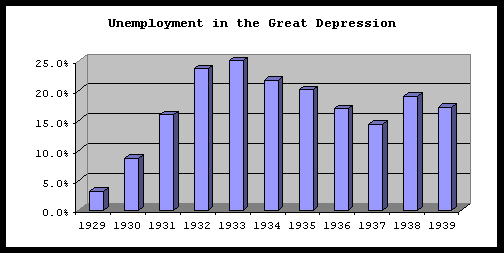
 The headline (U3) unemployment rate of 8.2% counts no discouraged workers who have given up on finding a job. The government has a second unemployment rate (U6), seldom reported, which includes short-term discouraged workers. That rate is 15%. When the long-term discouraged workers are added in, the current US unemployment rate is 22%, a number closer to the unemployment rate of the Great Depression than to the unemployment rates of postwar recessions. (in fact, it's higher than all but 2 or 3 years during the Great Depression...


Changes in the way inflation is measured have destroyed the Consumer Price Index (CPI) as a measure of the cost of living. The new methodology is substitution based. If the price of an item in the index rises, a lower priced alternative takes its place. In addition, some price rises are labeled quality improvements whether they are or not and thus do not show up in the CPI. People still have to pay the higher price, but it is not counted as inflation.

Currently, the substitution-based rate of inflation is about 2%. However, when inflation is measured as the actual cost of living, the rate of inflation is 5%.

The Misery Index is the sum of the inflation and unemployment rates. The level of the current Misery Index depends on whether the new rigged measures are used, which understate the misery, or the former methodology that accurately measures it. Prior to the November 1980 election, the Misery Index hit 22%, which was one reason for Reagan’s victory over President Carter. Today if we use previous methodology, the Misery Index stands at 27%. But if we use the new rigged methodology, the Misery Index is 10%.

The understatement of inflation serves to boost Gross Domestic Product (GDP). GDP is calculated in current dollars. To be able to determine whether GDP rose because of price rises or because of increases in real output, GDP is deflated by the CPI. The higher the inflation rate, the less the growth in real output and vice versa. When the substitution based methodology is used to measure inflation, the US economy experienced real growth in the 21st century except for the sharp dip during 2008-2010.

However, if the cost-of-living based methodology is used, except for a short period during 2004, the US economy has experienced no real growth since 2000. The lack of employment and real GDP growth go together with the decline in real household median income. The growth in consumer debt substituted for the lack of income growth and kept the economy going until consumers exhausted their ability to take on more debt. With the consumer dead in the water, the outlook for economic recovery is poor.

Politicians and the Federal Reserve are making the outlook even worse. At a time of high unemployment and debt-stressed households, politicians at local, state, and federal levels are cutting back on government provision of health care, pensions, food stamps, housing subsidies and every other element of the social safety net. These cutbacks, of course, further reduce aggregate demand and the ability of incomestressed Americans to survive.

The Federal Reserve has interest rates so low that retirees and others living on their savings can earn nothing on their money. The interest rates paid on bank CDs and government and corporate bonds are lower than the rate of inflation. To live on interest income, a person has to purchase Greek, Spanish, or Italian bonds and run the risk of capital loss. The Federal Reserve’s policy of negative interest rates forces retirees to spend down their capital in order to live. In other words, the Fed’s policy is destroying personal savings as people are forced to spend their capital in order to cover living expenses.

In June the Federal Reserve announced that it was going to continue its policy of driving nominal interest rates even lower, this time focusing on long-term Treasury bonds. The Fed said it would be purchasing $400 billion of the Treasury’s 30-year bonds. Driving interest rates down means driving bond prices up. With 5-year Treasury bonds paying only seven-tenths of one percent and 10-year Treasuries paying only 1.6%, below even the official rate of inflation, Americans desperate for yield move into 30-year bonds currently paying 2.7%. However, the the high bond prices mean that the risk of capital loss is very high.

The Fed’s debt monetization, or a drop in the exchange value of the dollar as other countries move away from its use to settle their balance of payments, could set off inflation that would take interest rates out of the Fed’s control. As interest rates rise, bond prices fall.

In other words, bonds are now the bubble that real estate, stocks, and derivatives were. When this bubble pops, Americans will take another big hit to their remaining wealth.

It makes no sense to invest in long-term bonds at negative interest rates when the federal government is piling up debt that the Federal Reserve is monetizing and when other countries are moving away from the flood of dollars. The potential for a rising rate of inflation is high from debt monetization and from a drop in the dollar’s exchange value. Yet, bond fund portfolio managers have to follow the herd into longer term maturities or see their performance relative to their peers drop to the bottom of the rankings.

Some individual investors and foreign central banks, anticipating the dollar’s loss of value, are accumulating gold and silver bullion. Realizing the danger to the dollar and its policy from the rapid rise in the price of bullion during 2011, the Federal Reserve has arranged offsetting action. When the demand for physical bullion drives up the price, short sales of bullion in the paper market are used to drive the price back down. Similarly, when investors begin to flee Treasuries, thus causing interest rates to rise, J.P. Morgan and other dependencies of the Federal Reserve sell interest-rate swaps, thus offsetting the effect on interest rates of the bond sales. (Keep in mind that interest rates rise when bond prices fall and vice versa.)

The point of all this information is to establish that except for the 1 percent, the incomes and wealth of Americans are being cut back across the board. From 2002 through 2011 the economy lost 3.5 million manufacturing jobs. These jobs were replaced with lowerpaying waitress and bartender jobs (1,189,000), ambulatory health care service jobs (1,512,000) and social assistance jobs (578,000).

These replacement jobs in domestic services mean that on a net basis US consumer income was moved out of the country. Potential aggregate demand in the US dropped by the differences in pay in the job categories. Clearly and unambiguously, jobs offshoring lowered US disposable income and US GDP and, thereby, employment.

Despite the lack of an economic base, Washington’s hegemonic aspirations continue unabated. Other countries are amused at Washington’s unawareness. Russia, China, India, Brazil, and South Africa are forming an agreement to abandon the US dollar as the currency for international settlement between themselves.

On July 4 the China Daily reported: “Japanese politicians and prominent academics from China and Japan urged Tokyo on Tuesday to abandon its outdated foreign policy of leaning on the West and accept China as a key partner as important as the United States. The Tokyo Consensus, a joint statement issued at the end of the Beijing-Tokyo Forum, also called on both countries to expand trade and promote a free-trade agreement for China, Japan and South Korea. “

This means that Japan is in play.

The Chinese government, more intelligent than Washington, is responding to Washington’s military threats by enticing away Washington’s two key Asian allies. As the Chinese economy is now as large as the US and on far firmer footing, and as Japan now has more trade with China than with the US, the enticement is appealing.

Moreover, China is next door, and Washington is distant and drowning in its hubris. Washington, which flicked its middle finger to international law and to its own law and Constitution with its arrogance and gratuitous and illegal wars and with its assertion of the right to murder its own citizens and those of its allies, such as Pakistan, has made the United States a pariah state.

Washington still controls its bought-and-paid-for NATO puppets, but these puppet states are overwhelmed with derivative debt problems brought to them by Wall Street and by sovereign debt problems, some of which were covered up by Wall Street’s Goldman Sachs.

Europe is on the ropes and has no money with which to subsidize Washington’s wars of hegemony.

Washington is becoming an isolated and despised element of the world community. Washington has purchased Europe, Canada, Australia, the former Soviet state of Georgia (and almost Ukraine), and Columbia, and continues its effort to purchase the entire world, but sentiment is turning against the rising Gestapo state that has shown itself to be lawless, ruthless, and indifferent, even hostile, to human life and human rights.

A government, whose military was unable with the help of the UK to occupy Iraq after eight years and was forced to end the conflict by putting the “insurgents” on the US military payroll and to pay them to stop killing American troops, and a government whose military has been unable to subdue a few thousand lightly armed Taliban after 11 years, is over the top when it organizes war against Iran, Russia, and China.

The only prospect Washington has of prevailing in such an undertaking is first use of nuclear weapons, of catching its demonized opponents off guard by nuking them out of the blue. In other words, by the elimination of life on earth.

Is this Washington’s program revealed by the neoconservative warmonger, Bill Kristol, who had no shame to ask publicly: “What’s the good of nuclear weapons if you can’t use them?

Friday, May 18, 2012

Congress Votes for More War in Afghanistan despite Public Majority Against It

Congresswoman Lee Discussing Her Amendment to End the War in Afghanistan:


Christian Science Moniter: House reauthorizes Afghan conflict in bipartisan vote
The vote came as the House considered a $642 billion defense budget for next year, debating more than 140 amendments to the far-reaching legislation. Final passage of the measure was expected Friday.
Rather than a speedy withdrawal from Afghanistan, the spending blueprint calls for keeping a sizable number of U.S. combat troops in the country. The bill cites significant uncertainty in Afghanistan about U.S. military support and says that to reduce the uncertainty and promote stability the president should "maintain a force of at least 68,000 troops through Dec. 31, 2014, unless fewer forces can achieve United States objectives."
The United States currently has 88,000 troops there. President Barack Obama envisions a final withdrawal of U.S. combat troops in 2014. Earlier this month, he signed an agreement with Afghan President Hamid Karzai on the role of America forces in counterterrorism and training of the Afghan military. The president insisted that the U.S. combat role was winding down.
*  *  *
The Hill: Three other amendments were rejected earlier in the day by voice vote
• Rep. Dennis Kucinich (D-Ohio), prohibits the Joint Special Operations Command from conducting drone strikes against targets whose identity is not known or is based solely on patterns of behavior the target (aka "signature" strikes).

• Rep. John Conyers (D-Mich.), terminates the F-35B aircraft program and would direct the funds authorized for such to procure an additional number of F/A-18E/F aircraft and to deficit reduction.

• Rep. Michael Quigley (D-Ill.), eliminates funds made available for the procurement of the V-22 Osprey aircraft and would direct the funds authorized for such to deficit reduction.

Wednesday, May 2, 2012

Obama's 'Midnight' Deal Will Stretch Afghan War to 2024

Wednesday, May 2, 2012 by Common Dreams
One thing crystal clear in secretive US-Afghan 'strategic partnership agreement': War not even close to ending

President Obama's secret trip to Afghanistan, shrouded in secrecy for security reasons, culminated in a midnight meeting with Afghan President Hamid Karzai and the signing of a 'strategic partnership agreement', the full details of which have not been made available to either the American or Afghan public.


"If ever there was an image to convey the limits of the UK-US success in Afghanistan, it was the way that Barack Obama, the Commander-in-Chief of the liberating, Taliban-scattering forces was forced to skulk into Kabul last night under the cover of darkness," writes the Telegraph's Peter Foster. "After landing at Bagram Airbase just after 10pm local time, there was a low-level, cover-of-darkness helicopter insertion to the Presidential Palace where the ten-page deal (which contains no specifics on funding or troop levels) was signed around midnight."

The agreement, broadly understood, codifies the ongoing conditions under which the US government agrees to operate in Afghanistan and will guide policies on the management of military bases, authority over detainees, the execution of night raids and other security operations, and will set conditions for troop levels and residual US forces that will remain in Afghanistan even after a 'withdrawal' commences in 2014.  The agreement also deals with ongoing financial support for the Afghan government and military into the future.

Though Obama spoke optimistically of 'light of a new day' in Afghanistan and many media reports heralded the agreement as a 'signal to the end of war', other analysts arrived at different conclusions.

"Interestingly," writes Jason Ditz at Anti-war.com, "with the ink now drying on the document and the US officially committed to the occupation of Afghanistan for another decade, officials are continuing to tout 2014 as the “end” of the war. This speaks to how the 2024 date, though openly discussed by the Karzai government in Afghanistan and privately acknowledged as part of the secret pact, has not been publicly presented to the American public. When they will officially spring it on us remains unclear."

“While the world may accept that the US and Afghan governments have some 'state’ or ‘noble’ considerations for not revealing the contents of the US/Afghan Strategic Partnership Agreement, how about the democratic consideration of involving Afghans in their own future?," asked Kathy Kelly, a co-coordinator of Voices for Creative Nonviolence, who is currently on a peace walk from Madison, Wisconsin to Chicago, where she will arrive in time for the upcoming NATO Summit.

“The SPA is likely to prolong fighting in the region," Kelly added, "because the Taliban and neighboring countries have clearly stated that they won’t accept US foreign troop presence. Also, many Afghans wonder if the US and NATO want to protect construction of the TAPI [Trans-Afghanistan] pipeline, which the 2010 NATO summit approved of and the New Silk Road which Hilary Clinton has promised the US will construct.”

US veteran Sgt. Jacob George, who served in Afghanistan but now speaks out against the war, argued the agreement speaks to the futility of US military efforts in Afghanistan that began with the US invasion in 2001. “The agreement actually allows for sustaining a ‘post-conflict’ force of 20,000 to 30,000 troops for a continued training of indigenous forces. They are pretending this is something new, but it’s not. That’s what I was doing in 2001 — and 2002, 2003 and 2004. This is just disastrous, for ten years, with the greatest military the world has ever seen, we’ve been unable to defeat people with RPGs. And a year after Bin Laden was killed, we’re still planning to keep tens of thousands of troops there.”

Andrey Avetisyan, Russian ambassador to Kabul, speaking to the Telegraph newspaper ahead of the agreement, revealed concern for the long-term impacts of a sustained US military presence. “Afghanistan needs many other things apart from the permanent military presence of some countries. It needs economic help and it needs peace. Military bases are not a tool for peace."

"Does anyone think our staying until 2024 is going to bring peace and stability to Afghanistan?" ask Kevin Martin and Michael Eisenscher in an op-ed today on Common Dreams. "We’ve already been there for eleven years – the longest war in our country’s history.  What do we really have to show for it?  We’ve spent almost $523 billion.  Almost 2000 Americans have been killed and another 15,300 wounded.  1000 NATO troops have lost their lives." Eisenscher is National Coordinator of U.S. Labor Against the War and Martin is the executive director of Peace Action. 

They continue: "Staying through 2024 will be a hard sell to the majority of Americans. According to last week’s Pew Research public opinion poll, only about a third of those polled think U.S. troops should stay in Afghanistan 'until the situation there is stabilized' (whatever that means). About two-thirds of Obama supporters, and almost as many swing voters (who make up nearly a quarter of the electorate), want a swift withdrawal of U.S. troops, while Mitt Romney supporters are split just about evenly."

Today also marks the one year anniversary of the US killing of Osama Bin Laden in Pakistan. Martin and Eisensche conclude: "It’s not clear what the year since the killing of Bin Laden has done to improve U.S. or Afghan security. It’s even less clear what staying for another dozen years will do for either country. The time to bring U.S. forces home is now, not 2014, and certainly not 2024."

And Robert Naiman, Policy Director at Just Foreign Policy, asks in his analysis at Common Dreams, 'What Did We Get for 381 US Dead Since the Death of bin Laden?' and writes:
In his speech, President Obama said, "As we move forward, some people will ask why we need a firm timeline." I'm delighted that President Obama supports the principle of a firm timeline. But it's far from obvious that we actually have a "firm timeline," and if we do, exactly what it is. Certainly there is no timeline for when all U.S. troops will be withdrawn. President Obama did seem to imply that we can be sure that there will be no U.S. troops involved in "combat" in Afghanistan after December 31, 2014. But they may be involved in "counterterrorism," which presumably is combat, and "training," and if you ask the military what "training" is, they will say it includes embedding with Afghanistan troops who are engaged in combat. So "training" is also combat. And therefore it is far from obvious that we actually have a "firm timeline" for anything. [...]
In his speech, President Obama said: "we are pursuing a negotiated peace. In coordination with the Afghan government, my Administration has been in direct discussions with the Taliban. We have made it clear that they can be a part of this future if they break with al Qaeda, renounce violence, and abide by Afghan laws. "
Isn't this essentially the same policy that Republican Senate Majority Leader Bill Frist was proposing in October 2006 when he said that the Afghan Taliban couldn't be defeated militarily and that the U.S. should bring "people who call themselves Taliban" into the Afghan government? Why have we waited almost six years to adopt this policy? Are we really going to get a much better deal now than we could have had six years ago? If so, will the difference be sufficient to justify the additional sacrifice of the last six years?
If we stopped the killing now, how sure are we that the political deal that would result would be much worse for us than the deal that will result if we keep killing? Shouldn't someone have to answer that? What if we tried having an offensive cease-fire for 30 days, just as an experiment, to see if it facilitated peace talks? What exactly would be the downside of giving that experiment a try?

Thursday, April 19, 2012

US Troops Posed with Body Parts in Afghanistan


Wednesday, April 18, 2012 by Common Dreams
US soldier says he released the photos to the LA Times to show breakdown in leadership and discipline

The Los Angeles Times this morning has released photographs, leaked by a member of the US Army, showing American soldiers posing with the dead and mutilated bodies of Afghan suicide bombers.

A soldier from the Army's 82nd Airborne Division with the body
of an Afghan insurgent killed while trying to plant a roadside bomb.
The photo is one of 18 provided to The Times of U.S.
soldiers posing with corpses.

The soldier who provided the photos did so on condition of anonymity. The Times did reveal that, "he served in Afghanistan with the 82nd Airborne's 4th Brigade Combat Team from Ft. Bragg, N.C." and said the soldier released the shocking images to "point to a breakdown in leadership and discipline that he believed compromised the safety of the troops."

The soldier who released the photos told The Times that at the time his fellow soldiers "felt a sense of triumph and satisfaction, especially after learning that the insurgents had been killed by their own explosives." He said, "They were frustrated, just pissed off — their buddies had been blown up by IEDs" — improvised explosive devices — "So they sort of just celebrated."

Recognizing this episode is not an isolated incident of US troops' disregard for Afghan life, the Times notes:
"In January, a video appeared on the Internet showing four U.S. Marines urinating on Afghan corpses. In February, the inadvertent burning of copies of the Koran at a U.S. base triggered riots that left 30 dead and led to the deaths of six Americans. In March, a U.S. Army sergeant went on a nighttime shooting rampage in two Afghan villages, killing 17."
The US Army asked the LA Times not to publish any of the 18 photos it received. Times Editor Davan Maharaj said, "After careful consideration, we decided that publishing a small but representative selection of the photos would fulfill our obligation to readers to report vigorously and impartially on all aspects of the American mission in Afghanistan, including the allegation that the images reflect a breakdown in unit discipline that was endangering U.S. troops."

An Army investigation into the incidents has been launched.

* * *

The Los Angeles Times: U.S. troops posed with body parts of Afghan bombers


The 82nd Airborne Division soldiers arrived at the police station in Afghanistan's Zabol province in February 2010. They inspected the body parts. Then the mission turned macabre: The paratroopers posed for photos next to Afghan police, grinning while some held — and others squatted beside — the corpse's severed legs. 
A few months later, the same platoon was dispatched to investigate the remains of three insurgents who Afghan police said had accidentally blown themselves up. After obtaining a few fingerprints, they posed next to the remains, again grinning and mugging for photographs. 
Two soldiers posed holding a dead man's hand with the middle finger raised. A soldier leaned over the bearded corpse while clutching the man's hand. Someone placed an unofficial platoon patch reading "Zombie Hunter" next to other remains and took a picture.

Thursday, September 29, 2011

Why Tax the Rich to Pay for More War?


Ordinarily, I think of myself as a card-carrying liberal. But lately, I'm getting the feeling that Liberal America had a meeting to decide on our current priorities and peace advocates weren't invited. I open my email and it's full of rallying cries about the urgency of taxing the rich. When was it decided that taxing the rich was the marquee demand of Liberal America at this juncture? Were peace advocates invited to this meeting? I see no evidence that we were.

In a different political juncture, I would be happy to march behind the banner of taxing the rich. But at this political juncture, when the war budget is half of federal discretionary spending, and when because of the Budget Control Act and the Supercommittee, we have a historic opportunity to cut the war budget - a much better prospect, at present, than our prospects for raising tax rates on rich people - I ain't marching for this dogwhistle anymore.

Suppose there were a massive government program to dump truckloads of dioxin in Lake Michigan. And suppose that - in addition to the direct effects of poisoning a major source of drinking water - this program were tremendously expensive in blood and treasure. Suppose that since October 7, 2001, more than five thousand American workers had been killed carrying out the Lake Michigan-poisoning project, with tens of thousands of American workers counted as wounded, and the real toll of wounded American workers many times higher. And suppose that the budgeted cost so far of the massive government program to dump poison in Lake Michigan were over a trillion dollars so far, with the real financial cost to society, when you count things like the future health costs of the poisoned American workers, much higher.

Would the marquee demand of Liberal America be to make Warren Buffett pay his fair share for the Lake Michigan-poisoning program? Or would the marquee demand of Liberal America be to stop dumping poison in Lake Michigan?

If we're going to use the money to kill, imprison, and otherwise oppress people in other countries who have done us no wrong, I would just as soon let Warren Buffett keep his money. Maybe he will donate some of it to a good cause. But even if he uses it to buy caviar, that would be better than continuing the war in Afghanistan, which is, on a routine basis, violating the basic human rights of the Afghan people, in addition to killing and maiming Americans for no good reason.

Item: in the November issue of the Atlantic, Matthieu Aikins makes a compelling case that the Pentagon is violating the Leahy Amendment by arming the forces of Afghan warlord Abdul Raziq, given that Raziq's forces have a history of gross human rights abuses as long as your arm. But this Pentagon activity has proceeded unmolested by the Leahy Law.
Why should we take money from Warren Buffett to pay for this? Shouldn't we just stop it?

Item: in a recent article in Truthout, Gareth Porter demolishes the claim that U.S. "night raids" in Afghanistan - that's when U.S. forces smash into people's homes in the middle of the night, shooting anyone who might appear to resist - are "precisely targeted," noting that a key target of the night raids is not insurgents, but civilians who might know insurgents, a blatant violation of the laws of war; and that moreover, people are targeted based not on their identity, but based on their phone records. So if somebody calls someone linked by the U.S. to the insurgency from your phone, U.S. forces can smash into your house, kill you and your relatives, and claim success: "Taliban killed."

Why should we take money from Warren Buffett to pay for this? Shouldn't we just stop it?
At this juncture in our history, why should we make common cause with the warmongers against the Tea Party? Wouldn't it be more righteous to make common cause with the Tea Party against the warmongers?

What's particularly striking at this juncture is this: House Democrats appear to be ahead of Liberal America on this issue right now. Seventy Representatives - mostly Democrats - have written to the debt-reduction Supercommittee, urging them to end the wars. Why isn't our email full of urgings to support the seventy Representatives in their demand that the Supercommittee end the wars?

On October 7, 2011, we'll have been at war for ten years. There will be protests around the country. Let us first end the wars. Then I will gladly march behind the banner of taxing the rich.

Saturday, September 17, 2011

All the Countries the US is at War with after 9/11

Friday, September 16, 2011 by Institute for Policy Studies
September 11 Remembered, US at War Against the World, and the Ongoing Campaign Against Israeli Occupation.
 
 
September 11 commemorations were everywhere this past weekend. My own view is that the devastating attacks of September 11 were, along with an enormous human tragedy, a huge crime, a crime against humanity. But they did not threaten our country’s existence, they did not threaten our democracy. It was the acts of September 12, when the Bush administration decided to take the world to war in response, that threatened and continue to threaten our country, our democracy, our security, and the security of much of the rest of the world. 

Many of you probably saw the piece in Sunday’s New York Times Magazine, by one of their top editors, Bill Keller, one of the “liberal hawks,” sort of apologizing for having supported the Iraq War. I sent a letter to the Times (we’ll see if it gets in!) to say that his “hard look” back is appropriate, but not nearly hard enough. He spoke of the “monster argument” being so potent in convincing him to call for war against Iraq, but where was he in the 1970s and 1980s when Saddam Hussein’s dictatorship was armed and financed by the United States?

He ignored the 1990s when the people of Iraq faced not only the continuing brutality of that dictatorship but the monster of U.S.-backed economic sanctions that killed over 500,000 children.

But most of all Keller ignored the fact that the “broad consensus” he invokes was not absolute. He names one skeptic who “joined the hawk club” after Powell’s speech to the UN Security Council — but ignores all those skeptics who watched that same speech and weren’t convinced. Some of us published articles with titles like “Powell’s Dubious Case for War” within hours of Powell’s speech on February 5, 2003. He ignores — as his newspaper so often ignored — the voices of consistent skeptics, those of us who opposed the Iraq war as a drive toward power and empire, who cheered the UN when it joined millions of people around the world who said no to war. We opposed the war then, and we were right. We still are.

Now the 9/11 commemorations have come and gone, and our country is still at war.  Sometimes it seems that one way or another the United States is at war against almost the whole world:
  • Official (though undeclared) wars in and against Afghanistan and Iraq
  • Official (but not really a war "because U.S. troops aren’t the ones at risk") war in Libya
  • Unofficial (though sort of acknowledged) war in Pakistan
  • Unacknowledged (because murder-by-drone doesn’t count as war) war in Yemen and Somalia
  • Indirect and diplomatic war (through $30 billion military aid enabling Israel’s occupation and by promising another UN veto) against Palestine
  • Unacknowledged and denied (through still-stealth drone campaigns) war in uncertain venues mainly in Africa, Asia and the Middle East
  • Untitled (though still accurately described as the Global War on Terror) war in the whole world
  • Then there’s the not-exactly-military war, like the war against the poor in the United States because of the hundreds of billions, now trillions, of tax dollars wasted on all those other wars.
It’s been a hell of an end to summer. The new census figures out this week are horrifying. Unemployment is staggeringly high, with more than 14 million people officially unemployed — which of course don’t include those who are under-employed, working two or three slave-wage jobs to survive, or who have simply given up looking. The current new jobs program is completely insufficient. What we need is a major federal jobs program, a real WPA, that we know works. Instead, we’re seeing billions diverted to continuing illegal, useless wars.

Poverty has surged to its highest levels in almost two decades, with one out of five children and one out of six people overall living below the poverty level, including lots of families where someone does have what passes for a job these days. And remember that the official “poverty line” is just over $22,000 for a family of four, no matter where they live! Imagine that for a family in New York or Washington or Chicago or Los Angeles…

And those devastating figures are far worse when we think about where our tax money is being spent. If President Obama ended the Iraq war “right away” — just the Iraq war, not even counting Afghanistan — he could bring home almost 50,000 troops and save almost $50 billion dollars. That’s enough for one million new green middle-class jobs — starting with those returning veterans.

If the president ended the war in Afghanistan “right away” — and we’re seeing every day how the U.S. occupation is causing more, not less violence in Afghanistan — he could bring home about 100,000 troops and $122 billion of our tax money. Keeping those troops in Afghanistan costs a million dollars a year each. For every soldier we bring home, saving that million dollars, we could hire that once-soldier-now-civilian plus 19 more people in good green jobs.

That’s what I wrote about in response to the celebrations about August — the first month without U.S. casualties in Iraq — but with too many Iraqi civilians still being killed, and too many billions of our tax dollars still wasted. (I also wrote a short op-ed version that went out on IPS’s OtherWords op-ed syndication service.)

THE UN IS COMING BACK TO TOWN
But the end of summer also means the UN General Assembly is coming back into session in the next couple of weeks. And Palestine is back on the agenda. After years (more than 20 years, actually) of a failed U.S.-controlled “peace process,” the question of Palestine is once again on the global agenda of the United Nations. And once again the United States is isolated with Israel, standing almost alone in the world in opposing a Palestinian initiative for UN recognition of Palestinian statehood that has long been the claimed, but never implemented, goal of U.S. policy. The fight is ostensibly over venue, not substance; the United States, we are told, supports a Palestinian state. But we don’t support them getting it in the UN. We only support it if it is created under our auspices and control. Otherwise we’ll call it “unhelpful.”

The United States has promised to veto a UN membership bid in the Security Council. But the Palestinians may avoid that by heading straight to the General Assembly where there is no veto, but where their state recognition will not include UN membership, though it would include the potentially powerful right to join the International Criminal Court. But there are a lot of negatives as well, primarily having to do with loss of representation at the UN for Palestinian refugees and support for their right of return, and many Palestinians are against this move. Developments are very uncertain, no one is sure yet what the Palestinian diplomats actually intend to do. What is clear is that we should not allow the United States to be the ones to say “no” to the Palestinian effort.

AND BACK IN THE REGION…Lots of other Middle East news. I had a letter published in the Washington Post targeting U.S.-NATO hypocrisy in Libya and objecting to their misrepresentation of the UN resolution supposedly justifying the Western military intervention there. With regional developments changing so fast, at the moment changing especially swiftly in terms of Israel’s increasing isolation and changing relationships with its one-time allies in the region, I discussed the role of Egypt’s changes in determining Israeli actions in Gaza, with The Real News Network editor Paul Jay. (This video, along with some great footage of the protests in Israel, ends rather abruptly when the east coast earthquake interrupted our interview… it’s pretty funny.)

And I collaborated with my friend Richard Falk, the great international law scholar and the UN Special Rapporteur on Human Rights in the Occupied Territories, on an analysis of the UN’s latest report on last year’s Israel attack on the Gaza Freedom Flotilla — in which they managed to claim Israel’s blockade of Gaza is somehow legal.

And last, as summer wanes, the U.S. Campaign to End the Israeli Occupation is holding our annual national conference, celebrating ten years of work changing discourse and challenging U.S. policy towards Palestine and Israel, and looking forward to a (hopefully) short time left before we can fold up shop and take a vacation, because we’ve succeeded.

Thursday, September 8, 2011

Jobs Plan? End the Wars, Save 400,000 Jobs


President Obama is preparing to deliver a major address to a joint session of Congress on Thursday, outlining his plans for spending and tax cuts to create jobs.

Here's a plan that would likely save at least 400,000 jobs over the next ten years, without increasing the deficit or raising a dollar of additional revenue: bring the troops home from Iraq and Afghanistan as previously scheduled, and use the savings to reduce the debt in place of proposed cuts to Social Security and Medicare benefits - or other cuts in domestic spending.

The total savings to the federal budget of using the chained CPI as a measure of inflation (including cuts in Social Security benefits) and raising the Medicare retirement age appear to be on the order of $200 billion over 2012-2021. This proposal was a key feature of the deal that President Obama and Speaker Boehner agreed to in the debt ceiling negotiations. The deal collapsed, because Speaker Boehner could not deliver the House on the deal, since it also included revenue increases. Judging from press reports, the President and others would like to revive this deal. So - unfortunately, from the point of view of the values and interests of the overwhelming majority of Americans - this proposal appears to still be on the table.

As good fortune would have it, $200 billion is a conservative estimate of the savings to the federal budget from 2012-2021 of withdrawing all U.S. troops from Iraq this December (as previously agreed) and withdrawing all U.S. troops from Afghanistan after 2014 (as previously announced.) It's a conservative estimate for at least three reasons: because it assumes that the Pentagon's plan is to keep 25,000 troops in Afghanistan after 2014, which is towards the low end of the estimates that have appeared in press reports; because it uses the current average cost of keeping troops in Afghanistan and Iraq, and the average cost is likely to be higher when troop levels are lower; and because it is only based on current appropriations, not future implied costs of current action, like veterans' health care.

In addition to the direct benefit to the overwhelming majority of Americans of protecting Social Security and Medicare benefits from any cuts, taking the money from the military rather than Social Security and Medicare would have the effect of protecting U.S. employment, since spending money in the domestic economy creates more U.S. employment than military spending in general, and war spending in particular.
Here is a rough estimate of the effect this proposal would have on saving jobs.

In a 2007 paper, Robert Pollin and Heidi Garrett-Peltier of the University of Massachusetts estimated the impact of an additional billion dollars in military spending on employment compared to other uses, using a standard input-output model of the U.S. economy.
They found that an additional billion dollars in military spending would create 8,555 jobs. In contrast, an additional billion in tax cuts for personal consumption would create 10,779 jobs. Other categories of federal spending examined - education, health, mass transit - created more jobs than tax cuts for personal consumption. [See table 1, page 6.]

Thus, the net effect of moving one billion dollars from the domestic economy to military spending would be to destroy at least 2,224 jobs; moving $200 billion from the domestic economy to military spending would destroy at least 444,800 jobs. Conversely, saving $200 billion by ending the wars as previously scheduled, rather than saving it from the federal budget by using the chained CPI and raising the Medicare retirement age, would save more than 400,000 jobs.

What does saving 444,800 jobs mean in the context of the U.S. economy? The U.S. labor force is about 150 million people, so 400,000 jobs represents about 0.3% of the labor force. If those jobs were added to the economy today, the measured unemployment rate, instead of being 9.1%, would be 8.8%. Not at all where we want to be, obviously, but still a significant improvement - for hundreds of thousands of people - from where we are now.
Of course, there are much more savings to be had by cutting the military budget. We could draw troops down in Afghanistan between now and 2015 faster than the Pentagon wants. Every year we have 25,000 fewer troops in Afghanistan, we more than $17 billion. As David Ignatius notes in the Washington Post, according to the analysts of the CIA, we're currently spending $100 billion a year in Afghanistan for "stalemate."

And then there is the question of cutting the "base," non-war, Pentagon budget. Under the automatic trigger, currently projected Pentagon spending would be cut by roughly $600 billion over ten years, in addition to the $350 billion reduction that the Administration and press reports say was implied by the previous debt reduction agreement. Pentagon chief Leon Panetta has said this additional reduction in projected Pentagon spending would be unacceptable, and the money should come from "entitlements" - the Social Security and Medicare benefits we have already paid for through our payroll taxes - instead.

But if taking $200 billion out of the military instead of domestic spending would save 444,800 jobs, then taking $600 billion out of the military instead of domestic spending would save 1,334,400 jobs. If you added 1,334,400 jobs to the economy today, the unemployment rate would be 8.2%, rather than 9.1%. If we end the wars as scheduled and cut projected Pentagon spending by an additional $600 billion, instead of taking money out of the domestic economy, that would save 1,779,200 jobs, an effect akin to reducing the unemployment rate today from 9.1% to 7.9%.

Ending the wars and cutting the base military budget by $600 billion will not by itself solve our unemployment problem. But failing to end the wars, and failing to cut the base military budget, and cutting domestic spending instead, will, so long as we have an unemployment problem, make our unemployment problem significantly worse; and ending the wars and cutting the base Pentagon budget will have the effect of significantly lowering unemployment relative to taking cuts from the domestic economy.

Here's another way of looking at the stimulus effects of moving money from the military to the domestic budget. If you find a billion dollars lying on the sidewalk, you can use that to create 10,779 jobs through tax cuts for personal consumption, the least efficient means of creating jobs besides military spending. If you move a billion dollars from military spending to domestic spending, you create 2,224 jobs. Thus, every time you move a billion dollars from the military budget to domestic spending, it's as if you found $206 million lying on the sidewalk to use for economic stimulus. If you move $800 billion to the domestic economy by ending the wars and cutting projected Pentagon spending, it's as if you found $165 billion lying on the sidewalk to use for economic stimulus.

You can urge Congress to end the wars as part of the deal to reduce the nation's debt here.

Thursday, August 18, 2011

George W. Obama? The Bush-Obama Presidency

The Saved and the Sacked
By DAVID BROMWICH

Is it too soon to speak of the Bush-Obama presidency?

The record shows impressive continuities between the two administrations, and nowhere more than in the policy of "force projection" in the Arab world. With one war half-ended in Iraq, but another doubled in size and stretching across borders in Afghanistan; with an expanded program of drone killings and black-ops assassinations, the latter glorified in special ceremonies of thanksgiving (as they never were under Bush); with the number of prisoners at Guantanamo having decreased, but some now slated for permanent detention; with the repeated invocation of "state secrets" to protect the government from charges of war crimes; with the Patriot Act renewed and its most dubious provisions left intact -- the Bush-Obama presidency has sufficient self-coherence to be considered a historical entity with a life of its own.

The significance of this development has been veiled in recent mainstream coverage of the national security state and our larger and smaller wars. Back in 2005-2006, when the Iraqi insurgency refused to die down and what had been presented as "sectarian feuding" began to look like a war of national liberation against an occupying power, the American press exhibited an uncommon critical acuteness. But Washington's embrace of "the surge" in Iraq in 2007 took that war off the front page, and it -- along with the Afghan War -- has returned only occasionally in the four years since.

This disappearance suited the purposes of the long double-presidency. Keep the wars going but normalize them; make them normal by not talking about them much; by not talking about them imply that, while "victory" is not in sight, there is something else, an achievement more realistic and perhaps more grown-up, still available to the United States in the Greater Middle East. This other thing is never defined but has lately been given a name. They call it "success."

Meanwhile, back at home...

The usual turn from unsatisfying wars abroad to happier domestic conditions, however, no longer seems tenable. In these August days, Americans are rubbing their eyes, still wondering what has befallen us with the president's "debt deal" -- a shifting of tectonic plates beneath the economy of a sort Dick Cheney might have dreamed of, but which Barack Obama and the House Republicans together brought to fruition. A redistribution of wealth and power more than three decades in the making has now been carved into the system and given the stamp of permanence.

Only a Democratic president, and only one associated in the public mind (however wrongly) with the fortunes of the poor, could have accomplished such a reversal with such sickening completeness.

One of the last good times that President Obama enjoyed before the frenzy of debt negotiations began was a chuckle he shared with Jeff Immelt, former CEO of General Electric and now head of the president's outside panel of economic advisers. At a June 13th meeting of the president's Council on Jobs and Competitiveness, a questioner said he assumed that President Obama knew about the difficulties caused by the drawn-out process of securing permits for construction jobs. Obama leaned into the microphone and offered a breezy ad-lib: "Shovel ready wasn't as, uh, shovel-ready as we expected" -- and Immelt got off a hearty laugh. An unguarded moment: the president of "hope and change" signifying his solidarity with the big managers whose worldly irony he had adopted.

A certain mystery surrounds Obama's perpetuation of Bush's economic policies, in the absence of the reactionary class loyalty that accompanied them, and his expansion of Bush's war policies in the absence of the crude idea of the enemy and the spirited love of war that drove Bush. But the puzzle has grown tiresome, and the effects of the continuity matter more than its sources.

We knew the meaning of Bush, and the need for resistance was clear. Obama makes resistance harder. During a deep crisis, such a nominal leader, by his contradictory words and conduct and the force of his example (or rather the lack of force in his example), becomes a subtle disaster for all those whose hopes once rested with him.

The philosopher William James took as a motto for practical morality: "By their fruits shall ye know them, not by their roots."

Suppose we test the last two and a half years by the same sensible criterion. Translated into the language of presidential power -- the power of a president whose method was to field a "team of rivals" and "lead from behind" -- the motto must mean: by their appointments shall ye know them.

Let us examine Obama, then, by the standard of his cabinet members, advisers, and favored influences, and group them by the answers to two questions: Whom has he wanted to stay on longest, in order to profit from their solidity and bask in their influence? Which of them has he discarded fastest or been most eager to shed his association with? Think of them as the saved and the sacked. Obama's taste in associates at these extremes may tell us something about the moral and political personality in the middle.

The Saved

Advisers whom the president entrusted with power beyond expectation, and sought to keep in his administration for as long as he could prevail on them to stay:

1. Lawrence Summers: Obama's chief economic adviser, 2009-2010. As Bill Clinton's secretary of the treasury, 1999-2001, Summers arranged the repeal of the New Deal-era Glass-Steagall Act, which had separated the commercial banks -- holders of the savings of ordinary people -- from the speculative action of the brokerage houses and money firms. The aim of Glass-Steagall was to protect citizens and the economy from a financial bubble and collapse. Demolition of that wall between savings and finance was a large cause of the 2008 meltdown. In the late 1990s, Summers had also pressed for the deregulation of complex derivatives -- a dream fully realized under Bush. In the first years of the Obama era, with the ear of the president, he commandeered the bank bailouts and advised against major programs for job creation. He won, and we are living with the results.

In 2009-2010, the critical accessory to Summers's power was Timothy Geithner, Obama's treasury secretary. Most likely, Geithner was picked for his position by the combined recommendations of Summers and Bush's Treasury Secretary Hank Paulson. The latter once described Geithner as "a very unusually talented young man," and worked with him closely in 2008 when he was still president of the New York Fed. At that time, he concurred with Paulson on the wisdom of bailing out the insurance giant AIG and not rescuing Lehman Brothers. Obama for his part initiated several phone consultations with Paulson during the 2008 campaign -- often holding his plane on the tarmac to talk and listen. This chain is unbroken. Any tremors in the president's closed world caused by Summers's early departure from the administration have undoubtedly been offset by Geithner's recent reassurance that he will stay at the Treasury beyond 2011.

Postscript: In 2011, Summers has become more reformist than Obama. On The Charlie Rose Show on July 13th, he criticized the president's dilatoriness in mounting a program to create jobs. Thus he urged the partial abandonment of his own policy, which Obama continues to defend.

2. Robert Gates: A member of the permanent establishment in Washington, Gates raised to the third power the distinction of massive continuity: First as CIA director under George H.W. Bush, second as secretary of defense under George W. Bush, and third as Obama's secretary of defense. He remained for 28 months and departed against the wishes of the president. Gates sided with General David Petraeus and Chairman of the Joint Chiefs of Staff Admiral Mike Mullen in 2009 to promote a massive (called "moderate") escalation of the Afghan War; yet he did so without rancor or posturing -- a style Obama trusted and in the company of which he did not mind losing. In the Bush years, Gates was certainly a moderate in relation to the extravagant war aims of Vice President Dick Cheney, Secretary of Defense Donald Rumsfeld, and their neoconservative circle. He worked to strengthen U.S. militarism through an ethic of bureaucratic normalization.

His approach has been endorsed and will be continued -- though probably with less canniness -- by his successor Leon Panetta. Without a career in security to fortify his confidence, Panetta is really a member of a different species: the adaptable choice for "running things" -- without regard to the nature of the thing or the competence required. Best known as the chief of staff who reduced to a semblance of order the confusion of the Clinton White House, he is associated in the public mind with no set of views or policies.

3. Rahm Emanuel: As Obama's White House chief of staff, Emanuel performed much of the hands-on work of legislative bargaining that President Obama himself preferred not to engage in. (Vice President Joe Biden also regularly took on this role.) He thereby incurred a cheerless gratitude, but he is a man willing to be disliked. Obama seems to have held Emanuel's ability in awe; and such was his power that nothing but the chance of becoming mayor of Chicago would have plucked him from the White House. Emanuel is credited, rightly or not, with the Democratic congressional victory of 2006, and one fact about that success, which was never hidden, has been too quickly forgotten. Rahm Emanuel took pains to weed out anti-war candidates.

Obama would have known this, and admired the man who carried it off. Whether Emanuel pursued a similar strategy in the 2010 midterm elections has never been seriously discussed. The fact that the category "anti-war Democrat" hardly exists in 2011 is, however, an achievement jointly creditable to Emanuel and the president.

4. Cass Sunstein: Widely thought to be the president's most powerful legal adviser. Sunstein defended and may have advised Obama on his breach of his 2008 promise (as senator) to filibuster any new law that awarded amnesty to the telecoms that illegally spied on Americans. This was Obama's first major reversal in the 2008 presidential campaign: he had previously defended the integrity of the Foreign Surveillance Intelligence Act against the secret encroachment of the National Security Agency (NSA).

At that moment, Obama changed from an accuser to a conditional apologist for the surveillance of Americans: the secret policy advocated by Dick Cheney, approved by President Bush, executed by NSA Director Michael Hayden, and supplied with a rationale by Cheney's legal counsel David Addington. In his awkward public defense of the switch, Obama suggested that scrutiny of telecom records and their uses by the inspectors general in the relevant agencies and departments should be enough to restore the rule of law.

When it comes to national security policy, Sunstein is a particularly strong example of Bush-Obama continuity. Though sometimes identified as a liberal, from early on he defended the expansion of the national security state under Cheney's Office of the Vice President, and he praised the firm restraint with which the Ashcroft Justice Department shouldered its responsibilities. "By historical standards," he wrote in the fall of 2004, "the Bush administration has acted with considerable restraint and with commendable respect for political liberty. It has not attempted to restrict speech or the democratic process in any way. The much-reviled and poorly understood Patriot Act, at least as administered, has done little to restrict civil liberty as it stood before its enactment." This seems to have become Obama's view.

Charity toward the framers of the Patriot Act has, in the Obama administration, been accompanied by a consistent refusal to initiate or support legal action against the "torture lawyers." Sunstein described the Bush Justice Department memos by John Yoo and Jay Bybee, which defended the use of the water torture and other extreme methods, in words that stopped short of legal condemnation: "It's egregiously bad. It's very low level, it's very weak, embarrassingly weak, just short of reckless." Bad lawyering: a professional fault but not an actionable offense.

The Obama policy of declining to hold any high official or even CIA interrogators accountable for violations of the law by the preceding administration would likely not have survived opposition by Sunstein. A promise not to prosecute, however, has been implicit in the findings by the Obama Justice Department -- a promise that was made explicit by Leon Panetta in February 2009 when he had just been named President Obama's new director of the CIA.

As head of the president's Office of Information and Regulatory Affairs, with an office in the White House, Sunstein adjudicates government policy on issues of worker and consumer safety; yet his title suggests a claim of authority on issues such as the data-mining of information about American citizens and the government's deployment of a state secrets privilege. He deserves wider attention, too, for his 2008 proposal that the government "cognitively infiltrate" discussion groups on-line and in neighborhoods, paying covert agents to monitor and, if possible, discredit lines of argument which the government judges to be extreme or misleading.

5. Eric Holder: Holder once said that the trial of suspected 9/11 "mastermind" Khalid Sheikh Mohammed in a New York City courtroom would be "the defining event of my time as attorney general." The decision to make KSM's a civilian trial was, however, scuttled, thanks to incompetent management at the White House: neither the first nor last failure of its kind. The policy of trying suspected terrorists in civilian courts seems to have suffered from never being wholeheartedly embraced by the administration's inside actors. Local resistance by the New York authorities was the ostensible reason for the failure and the change of venue back to a military tribunal at Guantanamo. No member of the administration besides Holder has been observed to show much regret.

During his 30-month tenure, in keeping with Obama's willingness to overlook the unpleasant history of CIA renditions and "extreme interrogations," Holder has made no move to prosecute any upper-level official of any of the big banks and money firms responsible for the financial collapse of 2008. His silence on the subject has been taken as a signal that such prosecutions will never occur. To judge by public statements, the energies of the attorney general, in an administration that arrived under the banner of bringing "sunshine" and "transparency" to Washington, have mainly been dedicated to the prosecution of government whistle-blowers through a uniquely rigorous application of the Espionage Act of 1917. More people have been accused under that law by this attorney general than in the entire preceding 93 years of the law's existence.

Again, this is a focus that Bush-era attorney generals John Ashcroft, Alberto Gonzales, and Michael Mukasey might have relished, but on which none would have dared to act on so boldly. Extraordinary delays in grand jury proceedings on Army Private Bradley Manning, suspected of providing government secrets to WikiLeaks, and Julian Assange, who ran that website, are said to have come from a protracted attempt to secure a legal hold against one or both potential defendants within the limits of a barbarous and almost dormant law.

6. Dennis Ross: Earlier in his career, Obama seems to have cherished an interest in the creation of an independent Palestinian state. In Chicago, he was a friend of the dissident Middle East scholar Rashid Khalidi; during his 2007 primary campaign, he sought and received advice from Robert Malley, former special assistant to President Clinton for Arab-Israeli affairs, and Zbigniew Brzezinski, former national security adviser to President Jimmy Carter. Both were "realist" opponents of the expansionist policy of Israel's right-wing coalition government, which subsidizes and affords military protection to Jewish settlements on the occupied West Bank.

Under pressure from the Israel lobby, however, Obama dissociated himself from all three chosen advisers.

Ross, as surely as Gates, is a member of Washington's permanent establishment. Recruited for the Carter Defense Department by Paul Wolfowitz, he started out as a Soviet specialist, but his expertise migrated with a commission to undertake a Limited Contingency Study on the need for American defense of the Persian Gulf. An American negotiator at the 2000 Camp David summit, Ross was accused of being an unfair broker, having always "started from the Israeli bottom line."

He entered the Obama administration as a special adviser to Hillary Clinton on the Persian Gulf, but was moved into the White House on June 25, 2009, and outfitted with an elaborate title and comprehensive duties: Special Assistant to the President and Senior Director for the Central Region, including all of the Middle East and the Persian Gulf, Afghanistan, Pakistan and South Asia. Ross has cautioned Obama to be "sensitive" to domestic Israeli concerns.

In retrospect, his installation in the White House looks like the first step in a pattern of concessions to Israeli Prime Minister Benjamin Netanyahu that undid Obama's hopes for an agreement in the region. Here, caution precluded all inventiveness. It could have been predicted that the ascendancy of Ross would render void the two-state solution Obama anticipated in his carefully prepared and broadly advertised speech to the Arab world from Cairo University in June 2009.

7. Peter Orzag: Director of the Office of Management and Budget from January 2009 to August 2010, Orzag was charged with bringing in the big health insurers to lay out what it would take for them to support the president's health-care law. In this way, Orzag -- along with the companies -- exerted a decisive influence on the final shape of the Patient Protection and Affordable Care Act of 2010. In January 2011, he left the administration to become vice chairman of global banking at Citigroup. A few days out of the White House, he published an op-ed in the New York Times advising the president to extend the Bush-era tax cuts for the top 2% of Americans -- adding that Obama should indicate that the cuts would continue in force only through 2012. Obama took the advice.

8. Thomas Donilon: National Security Adviser and (after the departure of Gates) Obama's closest consultant on foreign policy. Donilon supported the 34,000 troop-escalation order that followed the president's inconclusive 2009 Afghanistan War review. He encouraged and warmly applauded Obama's non-binding "final orders" on Afghanistan, which all the participants in the 2009 review were asked formally to approve. (The final orders speak of "a prioritized comprehensive approach" by which the U.S. will "work with [Afghan President Hamid] Karzai when we can" to set "the conditions for an accelerated transition," to bring about "effective sub-national governance," and to "transfer" the responsibility for fighting the war while continuing to "degrade" enemy forces.)

Donilon comes from the worlds of business, the law, and government in about equal measure: a versatile career spanning many orthodoxies. His open and unreserved admiration for President Obama seems to have counted more heavily in his appointment than the low opinion of his qualifications apparently held by several associates. As Assistant Secretary of State for Public Affairs during the Clinton administration, he helped arrange the eastward expansion of NATO after the Cold War: perhaps the most pointless and destructive bipartisan project of the epoch. He was Executive Vice President for Law and Policy at Fannie Mae, 1999-2005.

The Sacked

Advisers and nominees with views that were in line with Obama's 2008 election campaign or his professed goals in 2009, but who have since been fired, asked to resign or step down, or seen their nominations dropped:

1. General James Jones: Former Marine Corps Commandant and a skeptic of the Afghanistan escalation, Jones became the president's first National Security Adviser. He was, however, often denied meetings with Obama, who seems to have looked on Gates as a superior technocrat, Petraeus as a more prestigious officer, and Donilon as a more fervent believer in the split-the-difference war and diplomatic policies Obama elected to pursue. Jones resigned in October 2010, under pressure.

A curious point: Obama had spoken to Jones only twice before appointing him to so high a post and seems hardly to have come to know him by the time he resigned.

2. Karl Eikenberry: Commander of Combined Forces in Afghanistan before he was made ambassador, Eikenberry, a retired Lieutenant General, had seniority over both Petraeus and then war commander General Stanley McChrystal when it came to experience in that country and theater of war. He was the author of cables to the State Department in late 2009, which carried a stinging rebuke to the conduct of the war and unconcealed hostility toward any new policy of escalation. The Eikenberry cables were drafted in order to influence the White House review that fall; they advised that the Afghan war was in the process of being lost, that it could never be won, and that nothing good would come from an increased commitment of U.S. troops.

Petraeus, then Centcom commander, and McChrystal were both disturbed by the cables -- startled when they arrived unbidden and intimidated by their authority. Obama, astonishingly, chose to ignore them. This may be the single most baffling occasion of the many when fate dealt a winning card to the president and yet he folded. Among other such occasions: the 2008-2009 bank bailouts and the opening for financial regulation; the BP oil spill in the Gulf of Mexico and the opportunity for a revised environmental policy; the Fukushima nuclear plant meltdowns and a revised policy toward nuclear energy; the Goldstone Report and the chance for an end to the Gaza blockade. But of all these as well as other cases that might be mentioned, the Eikenberry cables offer the clearest instance of persisting in a discredited policy against the weight of impressive evidence.

Ambassador Eikenberry retired in 2011, and Obama replaced him with Ryan Crocker, the Foreign Service officer brought into Iraq by Bush to help General Petraeus manage the details and publicity around the Iraq surge of 2007-2008.

3. Paul Volcker: Head of the Federal Reserve under Presidents Carter and Reagan, Volker had a record (not necessarily common among upper-echelon workers in finance) entirely free of the reproach of venality. A steady adviser to the 2008 Obama campaign, he lent gravity to the young candidate's professions of competence in financial matters. He also counseled Obama against the one-sidedness of a recovery policy founded on repayment guarantees to financial outfits such as Citigroup and Bank of America: the policy, that is, favored by Summers and Geithner in preference to massive job creation and a major investment in infrastructure. "If you want to be a bank," he said, "follow the bank rules. If Goldman Sachs and the others want to do proprietary trading, then they shouldn't be banks." His advice -- to tighten regulation in order to curb speculative trading -- was adopted late and in diluted form. In January 2010, Jeff Immelt, CEO of General Electric, which paid no federal taxes that year, replaced him.

4. Dennis Blair: As Director of National Intelligence, Blair sought to limit the expansion of covert operations by the CIA. In this quest he was defeated by CIA Director Leon Panetta -- a seasoned infighter, though without any experience in intelligence, who successfully enlarged the Agency's prerogatives and limited oversight of its activities during his tenure. Blair refused to resign when Obama asked him to, and demanded to be fired. He finally stepped down on May 21, 2010.

Doubtless Blair hurt his prospects irreparably by making clear to the president his skepticism regarding the usefulness of drone warfare: a form of killing Obama favors as the most politic and antiseptic available to the U.S. Since being sacked, Blair has come out publicly against the broad use of drones in Pakistan and elsewhere.

On his way out, he was retrospectively made a scapegoat for the November 2009 Fort Hood, Texas, killing spree by Army psychiatrist Major Nidal Hasan; for the "underwear" bomber's attempt to blow up a plane on its way to Detroit on Christmas day 2009; and for the failed Times Square car bombing of May 2010 -- all attacks (it was implied) that Blair should have found the missing key to avert, even though the Army, the FBI, and the CIA were unable to do so.

5. James Cartwright: As vice-chairman of the Joint Chiefs of Staff, General Cartwright passed on to Obama, and interpreted for him, a good deal of information that proved useful in the Afghanistan War review. Their friendship outlasted the process and he came to be known as Obama's "favorite general," but Cartwright stirred the resentment from both Petraeus and Mullen for establishing a separate channel of influence with the president. Like Eikenberry, he had been a skeptic on the question of further escalation in Afghanistan. His name was floated by the White House as the front-runner to become chairman of the Joint Chiefs after the retirement of Mullen. Informed of the military opposition to the appointment, Obama reversed field and chose Army Chief of Staff General Martin Dempsey, a figure more agreeable to Petraeus and Mullen.

6. Dawn Johnsen: Obama's first choice to head the Office of Legal Council, a choice generally praised and closely watched by constitutional lawyers and civil libertarians. Her name was withdrawn after a 14-month wait, and she was denied a confirmation process. The cause: Republican objections to her writings and her public statements against the practice of torture and legal justifications for torture.

This reversal falls in with a larger pattern: the putting forward of candidates for government positions whose views are straightforward, publicly available, and consistent with the pre-2009 principles of Barack Obama -- followed by Obama's withdrawal of support for the same candidates. A more recent instance was the naming (after considerable delay) of Elizabeth Warren as a special advisor to organize the Consumer Financial Protection Bureau, followed by the decision in July not to nominate her as the first director of the bureau.

Avoidance of a drag-out fight in confirmation hearings repeatedly seems to be the recurrent motive here. Of course, the advantage of such a fight, given an articulate and willing nominee, is the education of public opinion. But in every possible instance, President Obama has been averse to any public engagement in the clash of ideas. "Bottom line is that it was going to be close," a Senate Democratic source told ABC's Jake Tapper when Johnsen's name was withdrawn. "If they wanted to, the White House could have pushed for a vote. But they didn't want to 'cause they didn't have the stomach for the debate."

Where the nomination of an "extreme" candidate might have hardened the impression of Obama as an extremist, might not a public hearing have helped eradicate the very preconception that a frightened withdrawal tends to confirm? This question is not asked.

7. Greg Craig: For two years special counsel in the Clinton White House, he led the team defending the president in the impeachment proceedings in Congress. Craig's declaration of support for Obama in March 2007 was vital to the insurgent candidate, because of his well-known loyalty to the Clintons. Obama made him White House Counsel, and his initial task was to draw up plans for the closing of Guantanamo, a promise made by the president on his first day in the Oval Office. But once the paper was signed, Obama showed little interest in the developing plans. Others were more passionate. Dick Cheney worked on a susceptible populace to resurrect old fears. The forces against closure rallied and spread panic, while the president said nothing. Craig was defeated inside the White House by the "realist" Rahm Emanuel, and sacked.

8. Carol Browner: A leading environmentalist in the Clinton administration, Browner was given a second shot by Obama as director of the White House Office of Energy and Climate Change Policy. She found her efforts thwarted within the administration as well as in Congress: in mid-2010 Obama decided that -- as a way to deal with global warming -- cap-and-trade legislation was a loser for the midterm elections. Pressure on Obama from the U.S. Chamber of Commerce to heed business interests served as a strong incitement in forcing Browner's resignation after the democratic "shellacking" in midterm elections, a result that his quiet abandonment of cap-and-trade had failed to prevent. The White House had no backup plan for addressing the disaster of global warming. After Browner's resignation in March 2011, her position was abolished. Since then, Obama has seldom spoken of global warming or climate change.

Moral and Political Limbo

The Obama presidency has been characterized by a refined sense of impossibility. A kind of suffocation sets in when a man of power floats carefully clear of all unorthodox stimuli and resorts to official comforters of the sort exemplified by Panetta. As the above partial list of the saved and the sacked shows, the president lives now in a world in which he is certain never to be told he is wrong when he happens to be on the wrong track. It is a world where the unconventionality of an opinion, or the existence of a possible majority against it somewhere, counts as prima facie evidence against its soundness.

So alternative ideas vanish -- along with the people who represent them. What, then, does President Obama imagine he is doing as he backs into one weak appointment after another, and purges all signs of thought and independence around him? We have a few dim clues.

A popular book on Abraham Lincoln, Team of Rivals, seems to have prompted Obama to suppose that Lincoln himself "led from behind" and was committed to bipartisanship not only as a tactic but as an always necessary means to the highest good of democracy. A more wishful conceit was never conceived; but Obama has talked of the book easily and often to support a "pragmatic" instinct for constant compromise that he believes himself to share with the American people and with Lincoln.

A larger hint may come from Obama's recently released National Strategy for Counterterrorism, where a sentence in the president's own voice asserts: "We face the world as it is, but we will also pursue a strategy for the world we seek." If the words "I face the world as it is" have a familiar sound, the reason is that they received a trial run in Obama's 2009 Nobel Prize speech. Those words were the bridge across which an ambivalent peacemaker walked to confront the heritage of Mahatma Gandhi and Martin Luther King with the realities of power as experienced by the leader of the only superpower in the world.

Indeed, Obama's understanding of international morality seems to be largely expressed by the proposition that "there's serious evil in the world" -- a truth he confided in 2007 to the New York Times conservative columnist David Brooks, and attributed to the theologian Reinhold Niebuhr -- combined with the assertion that he is ready to "face the world as it is." The world we seek is, of course, the better world of high morality. But morality, properly understood, is nothing but a framework for ideals. Once you have discharged your duty, by saying the right words for the right policies, you have to accommodate the world.


This has become the ethic of the Bush-Obama administration in a new phase. It explains, as nothing else does, Obama's enormous appetite for compromise, the growing conventionality of his choices of policy and person, and the legitimacy he has conferred on many radical innovations of the early Bush years by assenting to their logic and often widening their scope. They are, after all, the world as it is.

Obama's pragmatism comes down to a series of maxims that can be relied on to ratify the existing order -- any order, however recent its advent and however repulsive its effects. You must stay in power in order to go on "seeking." Therefore, in "the world as it is," you must requite evil with lesser evil. You do so to prevent your replacement by fanatics: people, for example, like those who invented the means you began by deploring but ended up adopting. Their difference from you is that they lack the vision of the seeker. Finally, in the world as it is, to retain your hold on power you must keep in place the sort of people who are normally found in places of power.