Showing posts with label earthquake. Show all posts

Wednesday, September 17, 2014

Scientists Find ‘Direct Link’ Between Earthquakes And Process Used For Oil And Gas Drilling


But like with everything controversial that makes people lots of money, the profiteers of this industry will deny it until the earth swallows them up. i'm sorry, folks--if anyone still reads this blog--but the only thing that can save humanity is something which will wipe out civilization. technology is wonderful, but we are too stupid and shortsighted to use it correctly. we destroy something permanently if we can profit from its destruction. THAT'S why UFOs and aliens don't come here any more. They put up a "quarantined" sign in the Kuiper Belt telling explorers that this solar system is off-limits. imagine if we were allowed to travel the galaxy--we would be hated instantly and cause our planet to be invaded and destroyed to keep us from expanding. like the great Bill Hicks said: "humanity is a virus with shoes."


by Emily Atkin, THINKPROGRESS
Posted on September 16, 2014

A team of scientists with the U.S. Geological Survey have found evidence “directly linking” the uptick in Colorado and New Mexico earthquakes since 2001 to wastewater injection, a process widely used in the controversial technique of hydraulic fracturing, or fracking, and conventional drilling.
In a study to be published in the Bulletin of the Seismological Society of America on Tuesday, the scientists presented “several lines of evidence [that] suggest the earthquakes in the area are directly related to the disposal of wastewater” deep underground, according to a BSSA press release. Fracking and conventional natural gas companies routinely dispose of large amounts of wastewater underground after drilling. During fracking, the water is mixed with chemicals and sand, to “fracture” underground shale rock formations and make gas easier to extract.

The USGS research is just the latest in a string of studies that have suggested the disposed water is migrating along dormant fault lines, changing their state of stress, and causing them to fail.

For their research, the four California-based USGS scientists monitored the 2,200 square mile Raton Basin, which goes from southern Colorado into New Mexico. They pointed out that the Basin had been “seismically quiet” until 1999, when companies began “major fluid injection” deep into the ground. Earthquakes began in 2001 when Colorado wastewater injection rates were under 600,000 barrels per month, and and since then there have been 16 earthquakes that could be considered large (above a magnitude of 3.8, including two over a 5.0 magnitude), compared with only one — a 4.0 magnitude quake — in the 30 years prior.


CREDIT: Rubenstein et. al.

“These earthquakes are limited to the area of fluid injection, they occur shortly after major fluid injection activities began, and the earthquake rates track the fluid injection rates in the
Raton Basin,” the paper said, noting the scientists’ comparisons of the timing and location of earthquakes with the timing and location of injected wastewater. By the mid-2000s, Colorado’s wastewater injection rates were up to 1.9 million barrels per month.

Taking that and the unexpected frequency of the earthquakes into consideration, the paper noted that it was “highly unlikely” that the quakes could have been due to any random fluctuations underground.

“Detailed investigations of two seismic sequences places them in proximity to high-volume, high-injection-rate wells, and both sequences occurred after a nearby increase in the rate of injection,” the study’s accompanying press release said. “A comparison between seismicity and wastewater injection in Colorado and New Mexico reveals similar patterns, suggesting seismicity is initiated shortly after an increase in injection rates.”

The study does note that despite the strong and direct link, the findings are not definitive, echoing language often used by climate scientists to describe why it’s nearly impossible to say that individual weather events are caused by climate change. “Although there are many lines of evidence showing that the seismicity in the Raton Basin has been induced by wastewater injection activities in the area, it is very difficult to say whether an individual earthquake was caused by injection because natural seismicity has also been recorded there,” the study says. “For future research, a longer-term study with dense network coverage on both sides of the border would be especially useful in understanding the inducing relationship between the earthquakes and fluid injection in the Raton Basin.”

The U.S. government announced back in May that it would begin to track the risks that so-called “frackquakes” pose, and start including them on official maps that help influence building codes. Before then, the USGS had never taken man-made earthquakes into account during its regular quake mapping activity. It made the decision to do so after finding that two strong earthquakes in heavily-drilled areas of Colorado and Oklahoma in 2011 might have been the result of wastewater injection. “For future research, a longer-term study with dense network coverage on both sides of the border would be especially useful in understanding the inducing relationship between the earthquakes and fluid injection in the Raton Basin.”

Since then, drilling for natural gas and fracking has proliferated across the country, as have earthquakes in the places where those booms are occurring. Oklahoma, a hotbed for fracking, is currently experiencing anywhere from 5 to 20 small earthquakes every day, according to the state’s Geology Survey. What’s more, Cornell University scientists have linked more than 2,500 small earthquakes that have hit Oklahoma in the past five years to the wastewater disposal process.

These quakes are usually too small to be felt, but scientists have warned that they stand to get stronger as more wastewater injection happens — a likelihood considering the growing expansion of fracking.

Monday, July 7, 2014

Just 4 fracking wastewater sites cause 20 percent of all central US earthquakes – study

RT
Published time: July 04, 2014

Just four wastewater wells in Oklahoma – where energy companies dump water after completing the hydraulic fracturing process – have caused scores of earthquakes this year, some 30 km from the site, according to a new study by top US universities.

The report, published in Science magazine, focused on the Midwestern state, which has produced 45 percent of the country’s magnitude 3 or bigger seismic shocks in the past five years – with the numbers rising rapidly to match the intensification of fracking activities in the area.

While hydraulic fracturing, or fracking, – which involves pressuring rock formations with liquid until they crack, and then extracting the oil and gas within – poses an inherent risk of earthquakes, according to the authors, the biggest culprits were the wastewater wells, where the liquids used for fracking are pumped, once a reservoir is opened.

“The disposed fluids are capable of contributing to the seismic activity,” Katie Keranen, a geophysics professor at Cornell, and the lead author of the study, told The Oklahoman newspaper.

“These wells are capable. That doesn’t exclude anything else from contributing, but we have no reason to think these are tectonic. They don’t match tectonic activity in other areas. It does seem these are just linked to wastewater. Our research focuses on wastewater and shows it is sufficient.”

Because of a paucity of real data from the thousands of sites in Oklahoma, the team, which included a member from the US Geological Survey, used a three-dimensional model of the underground formations in the area, and then combined that with real liquid injection rates in the area.

There are more than 4,500 active disposal wells in the state, but scientists found that of those, four large wells collectively responsible for pumping 5 million barrels – the equivalent of more than 200 Olympic swimming pools – of liquid into the ground each month, exceed a threshold beyond which disproportionately large earthquakes can happen.

“These really big wells have the biggest impacts on the system,” said Geoffrey Abers, one of the authors, and a professor at Columbia University's Lamont-Doherty Earth Observator.

“The earthquakes themselves seem to occur on small discrete faults. As the pressure builds up in the sedimentary formation that they are pumped into... They put that fault over the edge by jacking up the pore pressure.”

The researchers have not named the four sites, though they are located around Oklahoma City. This is particularly alarming, as the academics say that the impact of the earthquake in their model was as far as 22 miles away (the previous limit was thought to be about, and also could happen even after the disposal well was shut down.

This is a situation where the pumping starts months or a couple of years before the earthquakes are observed at all,” said Abers.

New Dominion, which operates the biggest wastewater wells in the state, has dismissed the simulation used to draw the conclusions.

"An initial review reflects it is premised on certain false assumptions," said company spokesman Jack Money. "At best these incorrect assumptions are irresponsible."

The oil and gas industry – which directly or indirectly employs 1 in 6 in the formerly lagging state – has also urged caution.

“As an industry, we’ve been saying we need more data and we need to work with regulators and others to help determine what is causing the significant increase in seismic activity,” said Chad Warmington, president of the Oklahoma Oil and Gas Association. “But to unequivocally link it to wastewater injections, I think there still needs to be more research.”

Between 1967 and 2000, there was an average of 21 earthquakes of a magnitude greater than 3.0 – considered strong enough to be noticed - in Oklahoma. Last year there were over a hundred, and this year there have been more than 200.

State industry regulator, the Oklahoma Corporation Commission, said it would not comment on the findings until it had a chance to examine them carefully.

Thursday, June 5, 2014

How Regulators Ignore Science and Cave to Oil & Gas Companies

Frack, Rattle and Roll
by JOSHUA FRANK


When one thinks of earthquakes, what comes to mind is usually the vast fault line straddled lands of southern California or the great subduction zones off the coasts of Chile and Japan. Surely, it isn’t the cattle fields of Texas or the rolling plains of Ohio and Oklahoma. Natural disasters in the central and southern United States typically blow in with the winds in the form of deadly tornadoes and storms. Yet, thanks to the insatiable rush to tap every last drop of oil and gas from the depths of the earth’s crust, earthquakes are fast becoming the new norm in “fly-over country”.

Fracking involves shooting a mix of sand, water and chemicals deep underground to force natural gas and oil to the surface. The practice is employed in geological areas where typical extraction methods can’t be utilized. Depending on the size of the operations, fracking produces millions of gallons of water waste, which ends up being stored undergound in so-called injection wells. In 2012 fracking in the U.S. produced nearly 280 billion gallons of this chemically-laden fluid and the EPA reports there are over 155,000 oil and gas wastewater wells active nationwide. Geologists have long associated these deep wells with earthquakes.

Back in the 1960s the U.S. military injected chemical waste northeast of Denver, Colorado at the Rocky Mountain Arsenal station. From March of 1962 to September 1963 an average of 21 million liters were injected 3,600 meters below the earth’s surface monthly. While injections ceased for nearly a year, the military again resumed the practice in April 1965 through February 1966, only to be halted once earthquakes were reported at local seismic stations. After observing this earthquake activity before, during and after the injection of chemical water waste, researchers were convinced the pressurized injection had caused numerous tremors that would have otherwise not occurred.

Since this recorded instance, dozens of other cases have been studied with reports being published in peer reviewed journals, where geologists have concluded there is indeed causality between deep-well injections and earthquakes. Yet, this stark research hasn’t stopped state governments from issuing thousands of permits to allow wastewater and other drilling to proceed, often in close proximity to homes and schools. In many such instances state resource departments blatantly ignore science that doesn’t favor the oil and gas industry.

Take the case of lonesome Youngstown, Ohio. Prior to 2011, Youngstown, population 65,405, had never experienced an earthquake, at least not since records were first kept by Europeans who settled the region in 1776. Nonetheless, this lack of seismic activity changed dramatically when the area recorded 100+ tremors over the course of 2011, including a 3.9 quake that shook the town on New Year’s Eve. Those earthquakes, according to a study by Won-Young Kim of Columbia University, published in the Journal of Geophysical Research, were the result of a pesky injection well known as Northstar 1.

“Earthquakes were triggered by fluid injection shortly after the injection initiated – less than two weeks,” Dr. Won-Young Kim told LiveScience.

After eight quakes occurred near Northstar 1, Ohio Department of Natural Resources’ (ODNR) spokesperson Heidi Hetzel-Evans stated, “ODNR has not seen any evidence that shows a correlation between localized seismic activity and deep injection well disposal.”

It’s important to note that it’s not the process of fracking itself that is causing quakes, but the practice of pumping wastewater back into the earth after it’s been used to help extract oil or natural gas. These wells, if located in and around fault lines, have a high likelihood to causing tremors.

Dr. Ray Beiersdorfer, a geology professor at Youngstown University, was mystified by ODNR’s response to the Youngstown quakes. “Based on what I witnessed in the 2011 incident, I believe ODNR is a captured agency,” argues Beiersdorfer. “The language used by industry and the regulatory agency was indistinguishable.”

Professor Beiersdorfer’s suspicion that ODNR is in bed with industry isn’t far-fetched. In a leaked internal document obtained by the Sierra Club, a 2012 draft communication plan outlined how agency staff ought to respond to criticism of the fracking operations ODNR was greenlighting.

“[Fracking] will be met with zealous resistance by environmental activist opponents, who are skilled propagandists,” the Communication Plan stated. “Neutral parties in particular – such as ordinary citizens concerned about families’ health – will be vulnerable to messaging by opponents that the initiative represents dangerous and radical state policy by Gov. Kasich.”

While the Northstar 1 injection well was shut down after the significant 3.9 magnitude earthquake on December 31, 2011, ODNR wasn’t about to admit it had ignored the science and allowed the operation to continue for far too long. It also didn’t stop ODNR from issuing other permits to allow injection well drilling in Ohio.

Consequentially, in March 2014 twelve new earthquakes hit south of Lowellville, Ohio where Hilcorp Energy was fracking. On March 10, ODNR stated it would force Hilcorp to “suspend all activity”, yet the agency allowed the company to continue gas production and flaring at the site.

Unsurprisingly, Beiersdorfer and others aren’t pleased with the state’s half-hearted response and have called on ODNR to deploy portable seismic stations closer to the Hilcorp operation to get better measurements of quakes, which will in turn provide scientists clearer information about size and location of the tremors.

“The request has been ignored,” Beiersdorfer frustratingly asserts in a piece in Columbus Free Press, “According to a telephone conversation I had with [ODNR Spokesperson] Mark Bruce they are not even discussing deploying portable seismic stations to the site. He said that the five seismometers located within 8 miles (the closest is 4 miles away) are sufficient. My reply that these stations are not close enough to precisely determine the depth of these small earthquakes was not addressed.”

Ohio state Representative Bob Hagen has repeatedly asked ODNR for more information on these quakes as well as drilling activity, yet Hagen has been stonewalled by the agency who would rather fight the “zealous resistance” by environmentalists than allow geologists and even elected representatives access to information about drilling activity. Without the data there can be no research and therefore no blame.

Currently citizens of Youngstown are rallying to ban fracking and injection wells through ballot measures, having failed twice before. Beirsdorfer and his wife, a fellow geologist, have joined the local fight against fracking despite having both worked for oil companies in the past.

“We suffered another set of earthquakes in [Ohio’s] Mahoning Valley and the ODNR claims to be getting to the bottom of this, yet the most important thing they could do, deploy the remote seismic stations, is not being done,” Professor Beiersdorfer contends. “Representative Hagan is being neglected. The press is being avoided. Somehow, we are expected to believe that ODNR has the technical expertise and social reasonability to decide where in our communities fracking and waste-injection can take place, whether you want them or not.”

* * *

Oklahoma is far worse than Ohio, and California for that matter, at least when it comes to earthquake activity. By early April of this year the state had already been dealt 109 earthquakes with a magnitude 3.0 or higher – that’s as many quakes as the Sooner state had in all of 2013. Still, Oklahoma regulatory and industry officials aren’t ready to admit outright the quakes are a result of injection wells.

Yet, all this shaking is not an entirely new phenomenon. In 2011 Oklahoma experienced a large 5.6 earthquake and a 4.7 aftershock near the sleepy town of Prague, which damaged over 200 buildings and injured two people. The Corporation Commission, which tracks injection wells in the state, says there are at least 10,000 active underground injection wells in Oklahoma.

The Oklahoma Geological Survey examined a cluster of quakes that hit near wells in August 2011 and found “that shortly after hydraulic fracturing began small earthquakes started occurring, and more than 50 were identified, of which 43 were large enough to be located. Most of these earthquakes occurred within a 24 hour period after hydraulic fracturing operations had ceased.”

“We’re trying to make sure we understand what data the state needs in order to start making some determinations on cause and effect,” Chad Warmington, president Oklahoma Oil and Gas Association told Bloomberg in response to the seismic activity. “We don’t want anybody to jump to conclusions.”

But conclusive links between deep wastewater injection wells and earthquakes is exactly what the scientific community has detected. The U.S. Interior Department has openly acknowledged the six-fold increase in quakes in the central U.S. from 2000-2011 are strongly correlated to wastewater injection, including those rolling through Oklahoma.

Even the few scientists that don’t oppose fracking see the dangers. Stanford University professor Mark Zoback, who moonlights as a senior adviser to Baker-Hughes, a multinational well services firm, wrote in a 2011 issue of Earth Magazine that man-made earthquakes can be managed, noting that “…it is important to avoid injection into active faults.” Zoback went on to admit that “a number of the small-to-moderate earthquakes that occurred in the U.S. interior in 2011 appear to be associated with the disposal of wastewater, at least in part related to natural gas production.”

Even so, state officials have not halted companies from continuing to inject millions of gallons of wastewater into underground wells in Oklahoma near known faults. Many of these wastewater dumping holes are located less than three miles from the epicenter of the large Prague quake of 2011.

Austin Holland, an Oklahoma Geological Survey seismologist, recently told E&E News that injections must continue despite the swarm of quake activity rattling Oklahoma. “We can actually learn what’s going on,” he claimed, “and perhaps mitigate these things in the future.”

Such brash sentiments are disconcerting to folks who are living in the midst of these ongoing earthquakes. For those residing in the tremor zones down in Arkansas, where numerous injection wells are active, daily anxiety caused by numerous quakes has many on edge.

“I remember days when the tremors were most active in the Greenbrier area, the rural town where I grew up [in Arkansas],” says Emily Lane, who now sits on the Board of Directors of Faulkner County Citizens Advisory Group in Arkansas. “Some days I’d feel 1-2 earthquakes an hour. The roar would approach quickly and roll through the house like a train passing through. Pictures rattled, the dog barked, and a fear grew inside me and many in the community about when the ‘big one’ would come.”

Arkansas officials shut down four disposal wells near Greenbrier and the quakes have stopped; yet tremors in other areas of the state near injection wells continue. “These quakes in outlying areas continue to compromise the integrity of well casings, increasing the likelihood of water contamination in the area,” attests Lane, who is deeply concerned about what lies ahead. “What is most discouraging, beyond the obvious dangers present from future earthquakes and fluid migration/contamination, is that most people in Arkansas still do not realize that a strong correlation was found between disposal wells and seismicity.”

Residents in Arkansas have filed a class action suit against the drillers who operate the disposal wells. Texas residents also lodged a similar case against Royal Dutch Shell, Sunoco and others, claiming their properties have been damaged by earthquakes near the companies’ injection wells.

The fight to end fracking, or at least relocate these earthquake-inducing disposal wells away from fault zones, is going to be an uphill battle. It will likely take thousands more earthquakes, severe property damage, injuries and perhaps death before regulatory agencies stop ignoring science and start protecting people instead of Oil & Gas industry profits.

Friday, March 29, 2013

Injection Well Linked to Destructive Earthquake in Oklahoma, Confirming New Fracking Fears

Friday, 29 March 2013
By Mike Ludwig, Truthout


A team of federal and university geologists have linked a series of unusual earthquakes, including a destructive 5.7-magnitude shocker, to oil-drilling wastewater-injection wells in Oklahoma.

The earthquakes occurred near Prague, Oklahoma, in 2010. The largest quake left two people injured, destroyed 14 homes, damaged a federal highway and was felt as far away as Milwaukee, according to a Columbia University release.

Columbia geologists partnered with the US Geological Survey to produce the report, which revealed a "potential" link between drilling wastewater injection and the massive earthquake.

The wells suspected of causing the earthquakes were in operation for at least 18 years, and the seismic events indicate that there can be decades-long lags between drilling wastewater injection and seismic events, according to the report.

The injection-well operations linked to the earthquakes were relatively small and involved filling oil wells with waste fluids, but over the years, pressure in the wells increased and eventually lubricated a known seismic fault.

"There's something important about getting unexpectedly large earthquakes out of small systems that we have discovered here," said Geoffrey Abers, a co-author of the study.

Abers said the team's observations indicate that the risk of humans inducing large earthquakes from even small injection activities is "probably higher" than previously thought.

The findings come at a time when geologists are reporting an uptick in minor earthquakes across the country linked to unconventional hydraulic fracturing, or "fracking." Fracking has facilitated an oil- and gas-drilling boom across the country, and the process produces large amounts of liquid waste that is most often injected into underground wells for disposal.

In the last four years, the number of earthquakes in the central United States spiked by 11 times compared with three decades prior, the authors of the Oklahoma study estimate.

The wells suspected of causing the massive quake in Oklahoma were not disposing of unconventional fracking waste, but the report raises new concerns about the long-term impacts of underground drilling-waste disposal.

Oklahoma state officials have not officially determined the source of the earthquakes. In response to the report, a state geologist said the findings could link the wells to earthquakes, but the Oklahoma Geological Survey still suspects that they were naturally occurring, according to the Columbia University release. Well operations continue at the site.

Every day, the oil and gas industry injects two billion gallons of liquid waste into any number of 144,000 underground wells, according to the US Environmental Protection Agency. Earthquakes related to wastewater injection are rare, but in recent years, fracking-waste-injection wells have been linked to earthquakes in several states, including Ohio, Alabama, Arkansas, Texas and California.

Between the spring of 2011 and early 2012, a fracking-waste-injection well caused more than a dozen minor earthquakes near Youngstown, Ohio, including one 4.0 magnitude earthquake that was felt for miles.

A Truthout investigation found that Ohio regulators permitted operators of the Ohio well to raise its maximum injection pressure twice, once shortly before and once again after the well-caused two initial earthquakes on March 17, 2011.

The Ohio well has been shut down and state regulators have worked to reform their injection-well policies.

Wednesday, March 13, 2013

Artists Against Fracking Present: "Don't Frack My Mother"

Tuesday, March 12, 2013 by Artists Against Fracking


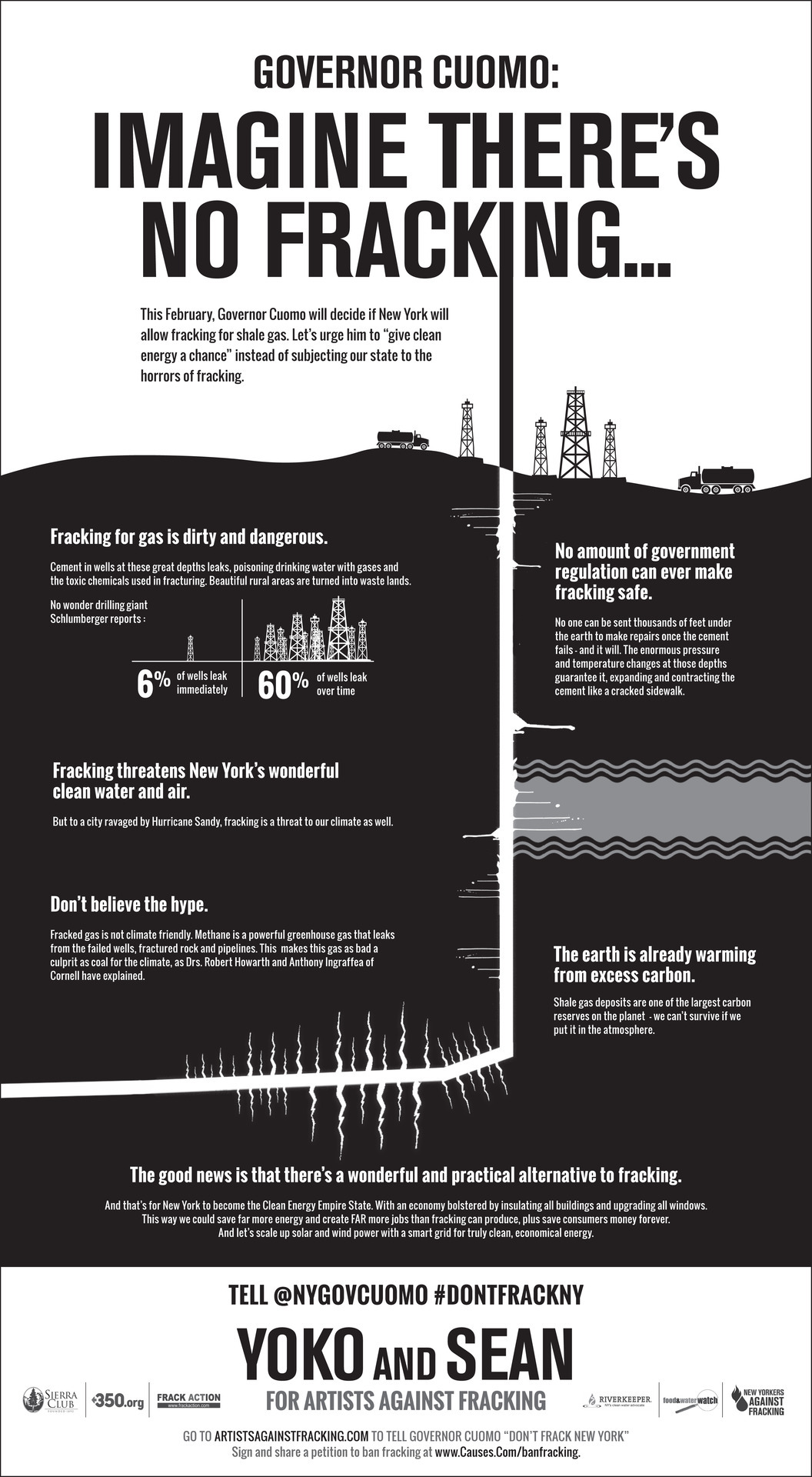
The artists of Artists Against Fracking worked together to create this music video for “Don’t Frack My Mother,” Sean Lennon’s very own anti-fracking anthem. This is the perfect time to celebrate our progress. In case you missed it, the New York State Assembly passed a two-year moratorium on fracking in New York. But this is also the perfect time to keep the pressure up! The bill’s not a done deal. It still has to pass the State Senate and then get signed into law by Governor Cuomo.

Directors: Sarah Sophie Flicker, Maximilla Lukacs and Tennessee Thomas
Producer: Rebecca Fernandez
Editor: Maximilla Lukacs

Adrian Grenier
Alexa Chung
Ben Lee
Carrie Fisher
Daniel Pinchbeck
Devendra Banhart
Fred Armisen
Ione Skye
Joseph Gordon-Levitt
Josh Fox
Liv Tyler
Lindsey Wixson
Maggie Gyllenhaal
Mark Ronson
Melissa Auf Der Maur
Michael Skolnik
Natasha Lyonne
Penn Badgley
Reggie Watts
Sean Lennon
Susan Sarandon
Yoko Ono
Zoë Kravitz


Also featuring band members from:

Au Revoir Simone
Black Lips
Cibo Matto
The Citizens Band
The Like
The Strokes
Wilco
Wild Belle


Monday, October 1, 2012

Dallas Suburb Rattled by 3.4-Magnitude Quake

Another fracking quake hits the Dallas area...


Irving September 30, 2012 (AP)

Damage from a small earthquake and a subsequent aftershock in a suburb west of Dallas was mostly limited to cracked walls and knocked-down pictures, authorities said.

The unscathed Dallas-Fort Worth airport, near the epicenter of Saturday's late-night temblor, kept up with normal flight operations. And emergency officials said there were no indications of any injuries.

The initial earthquake, measured at a preliminary magnitude of 3.4, struck at 11:05 p.m. CDT Saturday and was centered about 2 miles north of the Dallas suburb of Irving, the US Geological Survey's national earthquake monitoring center in Golden, Colo., reported.

USGS geophysicist Randy Baldwin told The Associated Press from Colorado that the initial quake lasted several seconds and appeared strong enough to be felt up to 15 or 20 miles away. He said the smaller aftershock with an estimated 3.1 magnitude occurred four minutes later and just a few miles away in another area west of Dallas.

Irving's emergency operators were flooded with more than 400 calls after the initial quake, with people reporting minor damage, such as cracks in some walls and a ceiling, pictures that had been knocked down and a report of a possible gas leak, according to emergency official Pat McMacken.

"We have had no infrastructure impact at all," McMacken said Sunday morning.

The Dallas-Fort Worth International Airport continued routine operations even though the shaking was felt at the airport, which is partly located in Irving's city limits, airport public affairs officer David Magana said. He told AP that the airport, which has 1,800 daily departures and arrivals, had little air traffic late Saturday night.

He said the quake caught the attention of those at the airport, but didn't prompt wider alarm.

"I wouldn't call it panic. I would call it surprise," Magana said by phone.

He said members of the airport operations team went out afterward and inspected landing strips, buildings and other airport installations and found no damage.

"There were no impacts or outages and no disruptions to flights," Magana said. "I felt it at my house. It shook it a little bit but it wasn't enough of a jolt to shake anything loose like you have in California. I've been in California and this was nothing like that."

Baldwin said more aftershocks are possible Sunday, noting the region has been periodically rattled by small quakes, including a cluster of minor ones in 2008.

"There are parts of Texas that certainly have more quakes than others," USGS geophysicist Don Blakeman said Sunday, specifically mentioning West Texas. But, he said, naturally occurring quakes can happen anywhere.

About 1,200 reports by people who felt the quake were recorded with the Colorado earthquake monitoring center soon after it hit.

Wednesday, September 19, 2012

A Moron's Guide to the Fracking of Dallas

By Anna Merlan
Dallas Observer

Important civic issues have a way of sneaking up on you. They do that, typically, by being so goddamned boring that you ignore them until it's impossible to do otherwise. Garbage, redistricting, municipal judge appointments: Those were just a few of the hotly debated topics that all of us did our best to avoid, right up until the point that "hotly debated" meant City Council members were yelling at each other about racism and staging dramatic walkouts. (Seriously, you should start watching the Wednesday council meetings on public access television. Better than a dozen telenovelas).

One of the longest-running debates you likely haven't been paying attention to is gas drilling within city limits. Since 2007 or so, it's been discussed in stultifying City Hall hearings, fulminated against on environmentalists' blogs and had its pros and cons weighed in newspaper articles you skipped right over in favor of reading about that teacher who had group sex with everybody.

Yes, it's unsexy. But it's here. In the coming weeks or months, Dallas City Council members will finally vote on new regulations for drilling inside the city limits. Those rules, if drilling companies and sympathetic-minded council members get their way, will allow for drilling in parkland, in the floodplains along the Trinity River and in some cases as near as 500 feet from places like houses and schools.

A growing body of scientific literature suggest that gas drilling, specifically the process of fracking (pouring millions of gallons of water and chemicals down a well to break up shale below ground and release the natural gas trapped in it) has negative effects on air quality, might contaminate groundwater, increases the numbers of small earthquakes around disposal well sites (where the waste water from fracking is deposited), and may allow you to increase the amount of tap water that you can set on fire by 100 percent.

Meanwhile, millions of dollars in city coffers suggest that drilling companies paid a lot of bucks for leases around here, and they will get mighty disgruntled and probably quite litigious if their drill bits don't end up in some soil soon. Five years ago, Dallas officials began soliciting gas drilling companies to buy leases on city-owned land; two companies, Trinity East and XTO, ended up paying around $33.7 million to purchase leases. The city also stands to receive 25 percent royalties on gas drawn by Trinity East. From XTO, they've been promised a 26 percent royalty as well as $50,000 per acre used for drilling. At the time the leases were bought, the city ordinances regulating drilling were either frighteningly lax or remarkably respectful of the power of the free market, depending on your point of view.


Game2update_opt.jpg
Click to embiggen and play The Game of Frack!  


After some pointed grumbling from local residents who didn't necessarily want to see a drilling operation in their kids' sandbox, City Council members decided more study might be needed. They auditioned members for a task force to issue new, nonbinding recommendations on what the city's updated drilling ordinance should look like.

"We thought we were going to talk about whether drilling was safe enough to happen in an urban area," says task force member Cherelle Blazer. She's a Yale-educated scientist who heads an environmental nonprofit, You Can't Live In the Woods. "By the time I was appointed and we were briefed on what our charge was, it changed into a foregone conclusion and we were just there to decide on an ordinance."

In June of last year, Blazer joined two other members meant to represent "neighborhood and environmental interests." Three people from the gas industry were also appointed, along with three supposedly neutral "subject matter experts." The group met for more than eight months, three months longer than they'd planned. From the start, Blazer says, pressure from community groups and energy companies alike was intense. "The frequency from the activists was more, but industry was very, very persistent," she says. "Before and after each meeting, they'd tell us what our decision should be or what the ramifications of our vote that day were and tell us how they wanted us to vote." Occasionally, she says, they'd send polite emails to let the task force members know that a proposed rule was overly restrictive and "The City probably would have to go to court about that."

In the end, in a true spirit of compromise, the task force ended up with recommended rules that made both sides very grumpy. Dallas Cothrum, a zoning consultant who represents a number of energy companies, griped to the Morning News that the new rules amounted to a "moratorium" on drilling, while environmental groups said the proposed setbacks and rules for floodplains and parkland weren't strict enough.

The proposed rules included a 1,000-foot setback from homes, churches, schools and retail structures. But it said the City Council should be able to grant a variance to that rule, allowing just a 500-foot setback if 12 of the 15 of them voted for it. They recommended some parkland be opened to drilling, if it's not currently being used as a public park or playground and if it's near an industrial area. And the company doing the drilling would be required to minimize "dust, vibrations and odor" from its drilling site and to prevent groundwater contamination. It would also have to bear the cost for various water sampling and monitoring equipment.

Guess what? None of it matters. The City Council is obligated to take exactly none of the task force's suggestions. They've met privately with the city attorney at least once, presumably to hash out who they'd like to be sued by the least.

As we await a final set of rules -- ones which we predict will allow drilling in parks, floodplains, playgrounds and any hairdo over a certain height -- we've put together this handy board game to explain this complicated history. Gather around it with your loved ones and use it to guide you through the drilling process. Or wait six months or so and just watch it from your window.

Fracking: A Glossary of Terms

RFP: Dallas' up-and-down love affair with drilling began in 2007, when the city put out a request for proposals (RFP) to more than 30 gas production companies across the state. City officials followed that up with phone calls and letters, making it clear that they'd really like someone to drill around here, and by the way, that a minimum bid of $4000 per acre would be required.

Representatives from the drilling companies who took the bait now say they would have never purchased the leases had they known Dallas was going to get all fuddy-duddy and start talking about safety and air quality. They seem to be worried that the city will actually make them comply with any new rules they create. Which is just adorable.

Setback: A setback is how far a drilling site can legally be from homes and businesses. Environmentalist types will tell you that 1,000 feet is the bare minimum for a setback. Drilling companies will tell you that patriotic homeowners should be allowed to climb right inside a well and start a family if they so choose. No one has done rigorous research on just how far air and water contamination can spread under different scenarios. But what we don't know can't give us cancer, right?


frackplayersnew_opt.jpg
Click to embiggen. 

Floodplain: In May, green group Texas Campaign for the Environment released a map, provided by City Hall, showing where drilling company Trinity East has bought city leases. Nearly all of it is located in the floodplains along the Trinity River. Scientists warn that drilling in a floodplain would likely allow fracking chemicals to make their way into the Trinity and wash downstream. To which we say: Suck it, Houston.

Park land: A 2008 briefing from City Hall promised there would be no drilling allowed (emphasis theirs) on the surface of city of Dallas park land. Underneath the surface, though, that would be fine. There's no joke here. That's what they wrote.

Education: The Barnett Shale Energy Education Council is collection of nice folks who only want you to have the best information about gas drilling, the kind that shows it's exceedingly, gloriously safe. The council is made up of eight energy companies who operate in the Barnett. Its ubiquitous executive director is Ed Ireland, a 20-year industry vet who's astoundingly quick with a quote or a press release and looks exactly like Lex Luthor. We expect an email from him expressing disappointment in our puerile, anti-gas humor in approximately five minutes.

Chip Groat: There are about as many dueling fracking studies as there are competing interpretations of the Bible (in ours, gay sex is actually mandatory). But the drilling industry was excited when a serious, reputable study from UT Austin concluded that fracking was unlikely to contaminate surrounding groundwater. The study was led by Charles "Chip" Groat; about five minutes after it was published, a Buffalo-based nonprofit, the Public Accountability Initiative, noted that Groat neglected to reveal his substantial financial ties to the drilling industry. Turns out he serves on the board of gas company Plains Exploration & Production. Groat subsequently told Bloomberg that he didn't alter any findings in the study, and that "disclosing my Plains board position would not have served any meaningful purpose."

Disposal Wells: The gas drilling process leaves behind several million gallons of chemical-filled water, which in turn must be disposed of somewhere. Efforts to turn it into a delicious cocktail have been unsuccessful (the name "Frack on the Beach," tragically, remains unused). Instead, the waste water is poured back into deep disposal wells, ingenious trash cans made from Mother Nature herself. According to the Barnett Shale Energy Education Council, there are around 50,000 saltwater disposal wells in Texas, and "none of these disposal wells have ever had a problem with groundwater contamination." Great. What's that rumbling? Why, those are...

Earthquakes: The BSEEC will tell you that there might be some "mild" relationship between disposal wells and increased earthquake activity. Nothing definitive. Science, however, will tell you that since the '60s, there's been an acknowledged link between gas drilling and increasing numbers of small earthquakes. Studies by the U.S. Geological Survey and the National Academy of Sciences found unprecedented levels of new small quakes across the country, especially in Texas, Arkansas and Ohio. However, they've never done any serious damage, and hey, haven't you always wanted to feel like you live next to the airport?

Disclosure: Under Texas state law, gas drilling companies are required to disclose all the chemicals they use in their fracking process. Unless they deem those chemicals to be a "trade secret," of course. Also, they're only required to let you know what they've been industriously pouring in all those holes after they finish drilling. The information is presented on a government-run website that the Texas Observer once called "about as clear as a Finnish edition of Finnegan's Wake."

Water: The fracking process takes anywhere from one to five million gallons of water, depending on the size of the project. In Dallas, that water would come directly out of the municipal water supply. We still can't afford for you to water your lawn, though. Or shower. Or flush the toilet more than once every couple weeks. Don't think too hard about that one.

Inflammable: A famous set-piece from the documentary Gasland shows homeowners putting matches near their running water taps and watching as the stuff they drink goes up in flames. The Barnett Shale Energy Education Council dismisses inflammable water as the result of "naturally occurring methane gas." Gas drilling seems to have a way of bringing out water's previously undiscovered and "naturally occurring" qualities: A Duke University study last year found that methane gas levels in water wells increased to dangerous levels when they were close to natural gas wells. The methane in the water was found to be the same kind being extracted through the gas wells.

Gas Prices: Gas drilling -- everybody's doing it. A glut of natural gas on the market has led to record low prices, meaning that all the time, effort and money energy drilling companies have poured into drilling in Dallas has been totally worth it. Bright side: gas prices started to rally slightly over the summer, as the hottest year on record in the United States spurred utility companies to use more natural gas to power the nation's air conditioners. Everybody cross your sweaty fingers and wish real hard for global warming to hurry up and deliver fabulous profit to all of us!

Saturday, April 7, 2012

Collateral Damage in the Marcellus Shale

Fracking is destruction. I've posted many articles and read countless more, and the only time I find positive stories about fracking are when they are written by right wing oriented, pro-corporate  organizations or are propaganda pieces by PR firms hired by the energy companies. There is nothing good about fracking. It is an environmental disaster, a fresh water destroyer, cancer and earthquake causer, climate change accelerator, and the biggest lie? That natural gas is the "clean burning fuel." Since fracking became widespread, greenhouse gasses have increased at a higher rate than before fracking became widespread. We have reached the crisis moment of climate change. In all probability, we are doomed and can't come back from it because there are no plans to deal with the issue; meanwhile, fracking operations keep increasing with little to no regulation, contaminating more and more underground water sources, and killing families, their pets and livestock. Oh, and causing earthquakes. End it. If we allow fracking to continue, we are good and truly fucking extinct.--jef


+++


Fracking Low-Income Residents
by WALTER M. BRASCH

There’s nothing to suggest that in his 51 years Kevin June should be a leader.

Not from his high school where he dropped out after his freshman year.

Not from his job, where he worked as an auto body technician for more than 35 years.

Both of his marriages ended in divorce, but did produce two children, a 31-year-old son and a 28-year-old daughter.

June readily admits that for most of his life, beginning about 14 when he began drinking heavily, he was a drunk. Always beer. Almost always to excess. But, he will quickly tell you how many weeks he has been sober. It’s now 56, he says proudly.

In October 2008 he was in an auto accident, when he swerved to miss a deer and hit an oak tree head on. That’s when he learned MRIs showed he had been suffering from degenerative arthritis. Between the accident and the arthritis, he was off work for three months. Then, in May 2009, he was laid off when the company moved.

The pain is now so severe that after about 10 minutes, he has to sit.

Unable to work, surviving on disability income that brings him $1,300 a month, just $392.50 above the poverty line, he lives in the 12-acre Riverdale Mobile Home Village, along the Susquehanna River near Jersey Shore north-central Pennsylvania. The village has a large green area where families can picnic, relax, or play games, sharing the space with geese and all kinds of animals.

For most of the six years June lived in the village, he kept to himself—chatting with neighbors now and then, but nothing that would ever suggest he’d be a leader. The last time he led anything was almost two decades earlier when he was president of a 4-wheel club.

On Feb. 18, the residents found out their landlord had sold the park, only after reading a story in the Williamsport Sun-Gazette. The landlord, who the residents say did what he could to make their village safe and attractive, later came to each of the 37 families. He told the families he sold the park and they would have two months to leave. It was abrupt. Business-like. “We knew he was planning to sell,” says June, “but we all thought it would be to someone who would allow us to stay.”

Four days after the residents were ordered to move, certified letters made it official. The owner sold the park to Aqua PVR, a division of Aqua America, headquartered in Bryn Mawr. Sale price was $550,000. It may have been a bargain—land and industrial parks that have been vacant for years are going for premium sales prices as the natural gas boom in the Marcellus Shale consumes a large part of Pennsylvania and four surrounding states.

Aqua had received permission from the Susquehanna River Basin Commission (SRBC) to withdraw three million gallons of water a day from the Susquehanna; the 37 families of the mobile home village would just be in the way. The company intends to build a pump station and create a pipe system to provide water to natural gas companies that use hydraulic fracturing, the preferred method to extract natural gas from as deep as 10,000 feet beneath the earth. The process, known as fracking, requires a mixture of sand, chemicals, many of them toxins, and anywhere from one to nine million gallons of water per well, injected into the earth at high pressure. Jersey Shore sits in a northeastern part of the Marcellus Shale, which is believed to hold about 500 trillion cubic feet of natural gas.

Aqua isn’t the only company planning to take water in the area. Anadarko E & P Co. and Range Resources-Appalachia have each applied to withdraw up to three million gallons a day from the Susquehanna. While the Delaware River Basic Commission, and the states of New York and Maryland, have imposed moratoriums upon the use of fracking until full health and environmental impacts can be assessed, Pennsylvania and the SRBC have been handing out permits by the gross.

Most residents had only a vague knowledge of fracking and what it is doing to the earth. “They have a lot more knowledge now,” says June, as politically aware as any environmentalist.

Aqua had originally ordered the residents to leave by May 1, but then extended it to the end of the month. It dangled a $2,500 relocation allowance in its eviction.

However, the cost to move a trailer to another park is $6,000–$11,000, plus extra for skirting, sheds, and any handicap-accessible external ramps. But, most trailers can’t be moved. “These are older trailers,” says June. His is a 12-by-70, built in 1974, with a tin roof and tin siding (“tin-on-tin”); like others, it isn’t sturdy enough to survive a move. But even if it did, there would be no place to put it. The parks want the newer trailers, but most parks are full.

So, the residents began looking in the classified ads for rentals. Because the natural gas companies are bringing in thousands of employees to frack the land, there is a shortage of apartments, most with inflated prices to take advantage of the well-paid roustabouts, drivers, and technicians who moved into the area, and spend their money on local businesses eager to improve their own profits. During the past two years, rents have doubled and tripled. “None of us can pay a thousand or more a month,” says June. The current mobile home owners paid $200 a month for their lot.

Not long after he was served his own eviction notice, June had a dream. Some might call it a nightmare; some might see it as he did, a religious experience. “It was Jesus coming to me, telling me I had to do something,” he says.

June is constantly on the move, going from trailer to trailer to help the families who were abruptly evicted. Whatever their needs, Kevin June tries to provide it, constantly on the phone, running up phone bills he knows he can’t afford but does so anyhow because the lives of his neighbors matter.

There’s Betty and William Whyne. Betty, 82, began working as a waitress at the age of 13 and now, in retirement, makes artificial Christmas trees. She has a cancerous tumor in the same place where a breast was removed in 1991. William, 72, who was an electrician, carpenter, and plumber before he retired after a heart attack, goes to a dialysis center three times a week, four hours each time. They brought their 12-wide 1965 Fleetwoood trailer to the village shortly after the 1972 flood. Like the other residents, they can’t afford to move; they can’t find adequate housing. “We’ve looked at everything in about a 30 mile radius,” they say. They earn $1,478 a month from retirement, only $252.17 above the federal poverty line. One son is in New Jersey; one is in Texas, and the Whynes don’t want to leave the area; they shouldn’t have to.

There’s April and Eric Daniels. She’s a stay-at-home mom for their two children; he’s a truck driver whose hours have been reduced. Their 14-by-70 trailer is valued at $13,200; she and her husband were in the process of remodeling it, had already paid $5,000 for improvements, and were about to start building a second bathroom. April Daniels had grown up living in a series of foster houses, “so I know what it’s like to move around, but this was my first home, and it’s harder for me to leave.” Their trailer provides a good home, but can’t be moved. “We’re pretty much on the verge of just tearing down the trailer and living in a camper,” she says. They don’t know what will happen. They do know that because of what they see as Aqua’s insensitivity, they will lose a lot of money no matter what they do.

Doris Fravel, 82, a widow on a fixed income of $1,326 a month, has lived in the village 38 years. She’s proud of her 1974 12-wide trailer with the tin roof. “I painted it every year,” she says. In June, she paid $3,580 for a new air conditioner; she recently paid $3,000 for new insulated skirting. The trailer has new carpeting. Unlike most of the residents, she found housing—a $450 a month efficiency. But it’s far smaller than her current home. So she’s sold or given away most of what she owns. She may have a buyer for the trailer, and will take $2,500 for it, considerably less than it’s worth. “I can’t do anything else,” she says. “I just can’t move my furnishings into the new apartment,” she says. Like the other residents, she has family who are helping, but there’s only so much help any family can provide. “I never knew I would ever have to leave,” she says, but she does want to “see one of those gas men come to my door—and I’d like to punch him in the shoulder.”

Not only are there few lots available and apartments are too expensive, but most residents don’t qualify for a house mortgage; and there are waiting lists for senior citizen and low-income housing. The stories are the same.

No one from Aqua has been in touch with any resident. But, the company did hire a local real estate agency. The agency claims it has made extraordinary efforts to help the residents find other housing. The residents disagree. April Daniels says “some of the Realtors have gotten real nasty with the people in the park—they just don’t understand that we are all in a hardship, so we get mad and frustrated and take it out on them.” But there really isn’t much anyone can do. The natural gas boom has made affordable housing as obsolete as the anthracite coal that once drove the region’s energy economy.

The residents, with limited incomes, have lived good lives; they are good people. They paid their rents and fees on time; they kept up the appearances of their trailers and the land around it. They worked their jobs; they survived. Until they were evicted

And now it’s up to the residents to try to survive. They have become closer; they listen to each other; they hug each other; and, the tough men aren’t afraid to let others see them cry. “The pain in this park is almost too much at times,” says June.

If something goes wrong, the residents have to fix it; Kevin June is the one they call. If he can’t fix a problem, he finds someone who can. In this trailer park, as in most communities, there is a lot of talent—“we help each other,” says June. His job is to make sure the residents survive until they can move. I’ve had the Holy Spirit running through my veins a long time, but it’s running real deep right now,” he says.

A half-dozen families have already moved, but most say they will stay and fight what they see as a politically-based corporate takeover.

During the week Aqua PVR issued eviction notices, its parent company issued a news release, boasting that its revenue for 2011 was $712 million, a 4.2 percent increase from the year before; its net income was $143.1 million, up 15.4 percent from the previous year. But, for some reason, the company just couldn’t find enough money to give the residents a fair moving settlement. “They just expect us to throw our homes into the street and live in tents,” says June.

“I went to see a state representative to ask what he could do to help,” he says, “but his secretary just coldly told me there was nothing that could be done because whoever owns a property can do with it what he wants to do.” He never saw the state representative.

The Commonwealth of Pennsylvania—armed with an industry-favorable law recently rammed through by the Republican-controlled legislature and eagerly signed by a first-term Republican governor who received more than $1,6 million in campaign contributions from the energy industry—has decided that fracking the earth, threatening health and the environment, is far better for business than taking care of the people.

Kevin June and 36 families are just collateral damage.

Monday, March 19, 2012

The Perils of Fracking

Environmental and Health Risks Greater Than Claimed by Gas Industry
by WALTER BRASCH

The natural gas industry defends hydraulic fracturing, better known as fracking, as safe and efficient. Thomas J. Pyle, president of the Institute for Energy Research, a pro-industry non-profit organization, claims fracking has been “a widely deployed as safe extraction technique,” dating back to 1949. What he doesn’t say is that until recently energy companies had used low-pressure methods to extract natural gas from fields closer to the surface than the current high-pressure technology that extracts more gas, but uses significantly more water, chemicals, and elements.

The industry claims well drilling in the Marcellus Shale will bring several hundred thousand jobs, and has minimal health and environmental risk. President Barack Obama in his January 2012 State of the Union, said he believes the development of natural gas as an energy source to replace fossil fuels could generate 600,000 jobs.

However, research studies by economists Dr. Jannette M. Barth, Dr. Deborah Rogers, and others debunk the idea of significant job creation.

Barry Russell, president of the Independent Petroleum Association of America, says “no evidence directly connects injection of fracking fluid into shale with aquifer contamination.” Fracking “has never been found to contaminate a water well,” says Christine Cronkright, communications director for the Pennsylvania Department of Health.

Research studies and numerous incidents of water contamination prove otherwise.
In late 2010, equipment failure may have led to toxic levels of chemicals in the well water of at least a dozen families in Conoquenessing Twp. in Bradford County. Township officials and Rex Energy, although acknowledging that two of the drilling wells had problems with the casings, claimed there were pollutants in the drinking water before Rex moved into the area. John Fair disagrees. “Everybody had good water a year ago,” Fair told environmental writer and activist Iris Marie Bloom in February 2012. Bloom says residents told her the color of water changed (to red, orange, and gray) after Rex began drilling. Among chemicals detected in the well water, in addition to methane gas, were ammonia, arsenic, chloromethane, iron, manganese, t-butyl alcohol, and toluene. While not acknowledging that its actions could have caused the pollution, Rex did providefresh water to the residents, but then stopped doing so on Feb. 29, 2012, after the Pennsylvania Department of Environmental Protection (DEP) said the well water was safe. The residents vigorously disagreed and staged protests against Rex; environmental activists and other residents trucked in portable water jugs to help the affected families. The Marcellus Outreach Butler blog (MOB) declared that residents’ “lives have been severely disrupted and their health has been severely impacted. To unceremoniously ‘close the book’ on investigations into their troubles when so many indicators point to the culpability of the gas industry for the disruption of their lives is unconscionable.”

In April 2011, near Towanda, Pa., seven families were evacuated after about 10,000 gallons of wastewater contaminated an agricultural field and a stream that flows into the Susquehanna River, the result of an equipment failure, according to the Bradford County Emergency Management Agency.

The following month, DEP fined Chesapeake Energy $900,000, the largest amount in the state’s history, for allowing methane gas to pollute the drinking water of 16 families in Bradford County during the previous year. The DEP noted there may have been toxic methane emissions from as many as six wells in five towns. The DEP also fined Chesapeake $188,000 for a fire at a well in Washington County that injured three workers.

In January 2012, an equipment failure at a drill site in Susquehanna County led to a spill of several thousand gallons of fluid for almost a half-hour, causing “potential pollution,” according to the DEP. In its citation to Carizzo Oil and Gas, the DEP “strongly” recommended that the company cease drilling at all 67 wells “until the cause of this problem and a solution are identified.”

In December 2011, the federal Environmental Protection Agency concluded that fracking operations could be responsible for groundwater pollution.

“Today’s methods make gas drilling a filthy business. You know it’s bad when nearby residents can light the water coming out of their tap on fire,” says Larry Schweiger, president of the National Wildlife Federation. What’s causing the fire is the methane from the drilling operations. A ProPublica investigation in 2009 revealed methane contamination was widespread in drinking water in areas around fracking operations in Colorado, Texas, Wyoming, and Pennsylvania. The presence of methane in drinking water in Dimock, Pa., had become the focal point for Josh Fox’s investigative documentary, Gasland, which received an Academy Award nomination in 2011 for Outstanding Documentary; Fox also received an Emmy for non-fiction directing. Fox’s interest in fracking intensified when a natural gas company offered $100,000 for mineral rights on property his family owned in Milanville, in the extreme northeast part of Pennsylvania, about 60 miles east of Dimock.

Research by a team of scientists from Duke University revealed “methane contamination of shallow drinking water systems [that is] associated with shale-gas extraction.” The data and conclusions, published in the May 2011 issue of the prestigious Proceedings of the National Academy of Sciences, noted that not only did most drinking wells near drilling sites have methane, but those closest to the drilling wells, about a half-mile, had an average of 17 times the methane of those of other wells.

“Some of the chemicals used in hydraulic fracturing—or liberated by it—are carcinogens,” Dr. Sandra Steingraber told members of the Environmental Conservation and Health committee of the New York State Assembly. Dr. Steingraber, a biologist and distinguished scholar in residence at Ithaca College, pointed out that some of the chemicals “are neurological poisons with suspected links to learning deficits in children,” while others “are asthma triggers. Some, especially the radioactive ones, are known to bioaccumulate in milk. Others are reproductive toxicants that can contribute to pregnancy loss.”

An investigation by New York Times reporter Ian Urbina, based upon thousands of unreported EPA documents and a confidential study by the natural gas industry, concluded, “Radioactivity in drilling waste cannot be fully diluted in rivers and other waterways.” Urbina learned that wastewater from fracking operations was about 100 times more toxic than federal drinking water standards; 15 wells had readings about 1,000 times higher than standards.

Research by Dr. Ronald Bishop, a biochemist at SUNY/Oneonta, suggests that fracking to extract methane gas “is highly likely to degrade air, surface water and ground-water quality, to harm humans, and to negatively impact aquatic and forest ecosystems.” He notes that “potential exposure effects for humans will include poisoning of susceptible tissues, endocrine disruption syndromes, and elevated risk for certain cancers.” Every well, says Dr. Bishop, “will generate a sediment discharge of approximately eight tons per year into local waterways, further threatening federally endangered mollusks and other aquatic organisms.” In addition to the environmental pollution by the fracking process, Dr. Bishop believes “intensive use of diesel-fuel equipment will degrade air quality [that could affect] humans, livestock, and crops.”

Equally important are questions about the impact of as many as 200 diesel-fueled trucks each day bringing water to the site and then removing the waste water. In addition to the normal diesel emissions of trucks, there are also problems of leaks of the contaminated water.

“We need to know how diesel fuel got into our water supply,” says Diane Siegmund, a clinical psychologist from Towanda, Pa. “It wasn’t there before the companies drilled wells; it’s here now,” she says. Siegmund is also concerned about contaminated dust and mud. “There is no oversight on these,” she says, “but those trucks are muddy when they leave the well sites, and dust may have impact miles from the well sites.”

Research “strongly implicates exposure to gas drilling operations in serious health effects on humans, companion animals, livestock, horses, and wildlife,” according to Dr. Michelle Bamberger, a veterinarian, and Dr. Robert E. Oswald,a biochemist and professor of molecular medicine at Cornell University. Their study, published in New Solutions, an academic journal in environmental health, documents evidence of milk contamination, breeding problems, and cow mortality in areas near fracking operations as higher than in areas where no fracking occurred. Drs. Bamberger and Oswald noted that some of the symptoms present in humans from what may be polluted water from fracking operations include rashes, headaches, dizziness, vomiting, and severe irritation of the eyes, nose, and throat. For animals, the symptoms often led to reproductive problems and death.

Significant impact upon wildlife is also noted in a 900-page Environmental Impact Statement (EIS) conducted by New York’s Department of Environmental Conservation, and filed in September 2011. According to the EIS, “In addition to loss of habitat, other potential direct impacts on wildlife from drilling in the Marcellus Shale include increased mortality . . . altered microclimates, and increased traffic, noise, lighting, and well flares.” The impact, according to the report, “may include a loss of genetic diversity, species isolation, population declines . . . increased predation, and an increase of invasive species.” The report concludes that because of fracking, there is “little to no place in the study areas where wildlife would not be impacted, [leading to] serious cascading ecological consequences.” The impact, of course, affects the quality of milk and meat production as animals drink and graze near areas that have been taken over by the natural gas industry.

Christopher Portier, director of the National Center for Environmental Health, calls for more research studies that “include all the ways people can be exposed [to health hazards], such as through air, water, soil, plants and animals.”

The response by the industry and its political allies to the scientific studies of the health and environmental effects of fracking “has approached the issue in a manner similar to the tobacco industry that for many years rejected the link between smoking and cancer,” say Drs. Bamberger and Oswald. Not only do they call for “full disclosure and testing of air, water, soil, animals, and humans,” but point out that with lax oversight, “the gas drilling boom . . . will remain an uncontrolled health experiment on an enormous scale.”

Dr. Helen Podgainy, a pediatrician in Coraopolis, Pa., says she doesn’t want her patients “to be guinea pigs who provide the next generation the statistical proof of health problems as in what happened with those exposed to asbestos or to cigarette smoke.”

Sunday, March 18, 2012

Fracking: Pennsylvania Gags Physicians

by: Walter Brasch, Dissident Voice 
Sunday 18 March 2012

This is Part One of a Three-Part Series.

A new Pennsylvania law endangers public health by forbidding health care professionals from sharing information they learn about certain chemicals and procedures used in high volume horizontal hydraulic fracturing. The procedure is commonly known as fracking.

Fracking is the controversial method of forcing water, gases, and chemicals at tremendouspressure of up to 15,000 pounds per square inch into a rock formation as much as 10,000 feet below the earth’s surface to open channels and force out natural gas and fossil fuels.

Advocates of fracking argue not only is natural gas “greener” than coal and oil energy, with significantly fewer carbon, nitrogen, and sulfur emissions, the mining of natural gas generates significant jobs in a depressed economy, and will help the U.S. reduce its oil dependence upon foreign nations. Geologists estimate there may be as much as 2,000 trillion cubic feet of natural gas throughout the United States. If all of it is successfully mined, it could not only replace coal and oil but serve as a transition to wind, solar, and water as primary energy sources, releasing the United States from dependency upon fossil fuel energy and allowing it to be more self-sufficient.

The Marcellus Shale—which extends beneath the Allegheny Plateau, through southern New York, much of Pennsylvania, east Ohio, West Virginia, and parts of Maryland and Virginia—is one of the nation’s largest sources for natural gas mining, containing as much as 500 trillion cubic feet of natural gas. Each of Pennsylvania’s 5,255 wells, as of the beginning of March 2012, with dozens being added each week, takes up about nine acres, including all access roads and pipe.

Over the expected life time of each well, companies may use as many as nine million gallons of water and 100,000 gallons of chemicals and radioactive isotopes within a four to six week period. The additives “are used to prevent pipe corrosion, kill bacteria, and assist in forcing the water and sand down-hole to fracture the targeted formation,” explains Thomas J. Pyle, president of the Institute for Energy Research. However, about 650 of the 750 chemicals used in fracking operations are known carcinogens, according to a report filed with the U.S. House of Representatives in April 2011. Fluids used in fracking include those that are “potentially hazardous,” including volatile organic compounds, according to Christopher Portier, director of the National Center for Environmental Health, a part of the federal Centers for Disease Control. In an email to the Associated Press in January 2012, Portier noted that waste water, in addition to bring up several elements, may be radioactive. Fracking is also believed to have been the cause of hundreds of small earthquakes in Ohio and other states.

The law, an amendment to Title 52 (Oil and Gas) of the Pennsylvania Consolidated Statutes, requires that companies provide to a state-maintained registry the names of chemicals and gases used in fracking. Physicians and others who work with citizen health issues may request specific information, but the company doesn’t have to provide that information if it claims it is a trade secret or proprietary information, nor does it have to reveal how the chemicals and gases used in fracking interact with natural compounds. If a company does release information about what is used, health care professionals are bound by a non-disclosure agreement that not only forbids them from warning the community of water and air pollution that may be caused by fracking, but which also forbids them from telling their own patients what the physician believes may have led to their health problems. A strict interpretation of the law would also forbid general practitioners and family practice physicians who sign the non-disclosure agreement and learn the contents of the “trade secrets” from notifying a specialist about the chemicals or compounds, thus delaying medical treatment.

The clauses are buried on pages 98 and 99 of the 174-page bill, which was initiated and passed by the Republican-controlled General Assembly and signed into law in February by Republican Gov. Tom Corbett.

“I have never seen anything like this in my 37 years of practice,” says Dr. Helen Podgainy, a pediatrician from Coraopolis, Pa. She says it’s common for physicians, epidemiologists, and others in the health care field to discuss and consult with each other about the possible problems that can affect various populations. Her first priority, she says, “is to diagnose and treat, and to be proactive in preventing harm to others.” The new law, she says, not only “hinders preventative measures for our patients, it slows the treatment process by gagging free discussion.”

Psychologists are also concerned about the effects of fracking and the law’s gag order. “We won’t know the extent of patients becoming anxious or depressed because of a lack of information about the fracking process and the chemicals used,” says Kathryn Vennie of Hawley, Pa., a clinical psychologist for 30 years. She says she is already seeing patients “who are seeking support because of the disruption to their environment.” Anxiety in the absence of information, she says, “can produce both mental and physical problems.”

The law is not only “unprecedented,” but will “complicate the ability of health department to collect information that would reveal trends that could help us to protect the public health,” says Dr. Jerome Paulson, director of the Mid-Atlantic Center for Children’s Health and the Environment at the Children’s National Medical Center in Washington, D.C. Dr. Paulson, also professor of pediatrics at George Washington University, calls the law “detrimental to the delivery of personal health care and contradictory to the ethical principles of medicine and public health.” Physicians, he says, “have a moral and ethical responsibility to protect the health of the public, and this law precludes us from doing all we can to protect the public.” He has called for a moratorium on all drilling until the health effects can be analyzed.

Pennsylvania requires physicians to report to the state instances of 73 specific diseases, most of which are infectious diseases. However, the list also includes cancer, which may have origins not only from chemicals used to create the fissures that yield natural gas, but also in the blow-back of elements, including arsenic, present within the fissures. Thus, physicians are faced by conflicting legal and professional considerations.

“The confidentiality agreements are worrisome,” says Peter Scheer, a journalist/lawyer who is executive director of the First Amendment Coalition. Physicians who sign the non-disclosure agreements and then disclose the possible risks to protect the community can be sued for breech of contract, and the companies can seek both injunctions and damages, says Scheer.

In pre-trial discovery motions, a company might be required to reveal to the court what it claims are trade secrets and proprietary information, with the court determining if the chemical and gas combinations really are trade secrets or not. The court could also rule that the contract is unenforceable because it is contrary to public policy, which places the health of the public over the rights of an individual company to protect its trade secrets, says Scheer. However, the legal and financial resources of the natural gas corporations are far greater than those of individuals, and they can stall and outspend most legal challenges.

Although Pennsylvania is determined to protect the natural gas industry, not everyone in the industry agrees with the need for secrecy. Dave McCurdy, president of the American Gas Association, says he supports disclosing the contents included in fracturing fluids. In an opinion column published in the Denver Post, McCurdy further argued, “We need to do more as an industry to engage in a transparent and fact-based public dialogue on shale gas development.”

The Natural Gas committee of the U.S. Department of Energy agrees. “Our most important recommendations were for more transparency and dissemination of information about shale gas operations, including full disclosure of chemicals and additives that are being used,” said Dr. Mark Zoback, professor of geophysics at Stanford University and a Board member.

Both McCurdy’s statement and the Department of Energy’s strong recommendation about full disclosure were known to the Pennsylvania General Assembly when it created the law that restricted health care professionals from disseminating certain information that could help reduce significant health and environmental problems from fracking operations.

Wednesday, March 14, 2012

Frack Job

Gang of Seven Meets Behind Closed Doors to Draft State Fracking Regulations
by RUSSELL MOKHIBER


To regulate or to prohibit.

That is the question.

Ask people on the ground who are being adversely affected by hydraulic fracturing, and overwhelming they say – prohibit.

They don’t believe that you can frack without harm.

The major environmental groups know this.

That’s why, when major environmental groups join with industry to draft regulations, most of them don’t admit to it – and the drafting of the regulations takes place behind closed doors.

Over the last couple of years, a group of three fracking companies and four major environmental groups have been meeting in secret to draft model laws to regulate the industry at the state level.

Only one company – Southwestern Energy – and one environmental group – the Environmental Defense Fund (EDF) – have admitted to participating in this effort.

Lisa Wright is a grassroots activist working on shale issues in upstate New York.

“I would like to know who all the groups are and why the secrecy?” Wright asked.

So, we asked EDF’s Scott Anderson – who are all the groups and why all the secrecy?

Anderson said he wouldn’t tell us who the groups are – that’s up to each group to make their involvement public – or not.

“EDF is happy to have our name associated with this,” Anderson told Corporate Crime Reporter last week. “I would observe that the politics surrounding natural gas development are polarized to say the least. This is an effort of people to attempt to work on a consensus basis, to develop well construction rules that are as reasonable as possible. There are no guarantees that the wheels won’t come off. The other groups would just assume not announce their participation until the project is successful.”

Anderson did say that the other three environmental groups are major players with recognizable names.

So, we rang up a couple of the usual suspects – and asked if they were involved.

The Natural Resources Defense Council’s Jenny Powers responded by saying that “NRDC is not part of a covert effort to draft shale regulations with the gas industry.”

“Several years ago, we were asked if we wanted to be a partner in an effort led by EDF and one gas company, Southwestern Energy, to develop model state regulations that would significantly strengthen oversight of this activity in states in which it is already being undertaken subject to unacceptably weak standards,” Powers said. “We opted not to partner in this effort. We made that choice because the primary focus of our national efforts has been advocating for uniform federal standards, which we view as critical to protecting Americans and their communities from the dangers of fracking.”

“Instead, we said we would provide feedback to the effort because we recognize that oil and gas drilling is currently taking place in over 30 states and, as noted, existing regulations are wholly inadequate to protect public health and the environment.”

Next, we asked Sierra Club – are you part of this covert effort?

“We were invited to the table and have sat in on some conference calls to evaluate the project, but we believe our resources are better used working directly on natural gas regulation at the federal and state levels,” said Sierra Club’s Maggie Kao.

A group of eight – four companies and four environmental groups – originally began meeting in early 2010, Anderson said. One of the companies dropped out last year.

The group of seven now meets regularly – sometimes by phone and sometimes in person. The next meeting will be next month at an undisclosed location.

The group has drafted a model state law – elements of which have been adopted by Arkansas and Montana last year.

An edited copy of one draft, dated January 12, 2012, gives some insight into how the negotiations are working.

One provision of the draft – titled Audit and Enforcement – would have given the state regulator the authority to visit a well site to inspect the facility, cite the operator for violations, and issue a fine. That provision was redlined out of the draft.

Nonetheless, Anderson portrays the covert effort as an attempt to bring violators under control.

“There are far too many instances where oil and gas operations have caused unacceptable problems,” Anderson said.

“We are dedicated to try to find out what the causes have been and to come up with improved regulations and practices to prevent these problems. Road damage from overweight vehicles is one of many problems that oil and gas development poses. Also spills of chemicals – frequently the trucks are hauling wastewater. Sometimes there is intentional midnight dumping. Spills at the surface are the single biggest cause of documented causes of drinking water pollution. That happened a lot in New Mexico. Improper well construction is the second biggest cause of drinking water problems. It is essential that people drill their wells correctly, outfit the wells with the right quality of pipe, have that pipe set at the proper depths, make sure there is an adequate cement job.”

Anderson said the group has agreed to some common principles – we want to work on a collaborative basis.

“We agree that the rules shall be as protective of the environment as reasonably possible.”

Anderson says that just because there have been no proven cases of drinking water being contaminated by the actual fracking process doesn’t mean it won’t happen.

Sunday, March 11, 2012

Confirmed: Fracking Caused Ohio Earthquakes

Friday, March 9, 2012 by Common Dreams

The Ohio Department of Natural Resources (ODNR) has confirmed that a series of earthquakes in the state were caused by injecting leftover fracking fluids, "brine," deep into wells.

ODNR stated today:
Geologists believe induced seismic activity is extremely rare, but it can occur with the confluence of a series of specific circumstances. After investigating all available geological formation and well activity data, ODNR regulators and geologists found a number of co-occurring circumstances strongly indicating the Youngstown area earthquakes were induced. Specifically, evidence gathered by state officials suggests fluid from the Northstar 1 disposal well [a deep injection well primarily used for oil and gas fluid waste disposal] intersected an unmapped fault in a near-failure state of stress causing movement along that fault.
The ODNR report notes that in 2011, the Youngstown, Ohio area experienced 12 "low-level seismic events," and that the 2011 earthquakes were unique because of their proximity to a deep disposal well, known as Northstar 1, used to inject fracking fluids.

The report adds that "before 2011, [Ohio Seismic Network] had not recorded earthquake activity with epicenters located in the Youngstown area."

From April 26 to Dec. 15, 2011, state geologists and regulators investigated a possible link between the well injections and the earthquakes, but were unable to obtain enough necessary data.

In December of 2011 equipment and assistance was provided by the Lamont-Doherty Earth Observatory, and after obtaining more seismic data, the ODNR director stopped operations at the well.

Based on the data, the report states:
A number of coincidental circumstances appear to make a compelling argument for the recent Youngstown-area seismic events to have been induced.
Based on the new information, Ohio is not banning fracking, but has new regulations for fracking fluids disposal.

With more than 144,000 Class II wells injecting more than 2 billion gallons of leftover fracking fluids every day in the United States, according to the Environmental Protection Agency (EPA), and Ohio’s Class II disposal well regulations meeting or exceeding EPA regulations, questions linger about the potential for fracking-induced earthquakes elsewhere. (like here in North Texas, where we have had 2 earthquakes localized near fracking disposal wells in Irving and in Dallas near Love Field.--jef)

Tuesday, March 6, 2012

Rolling Stone Responds to Chesapeake Energy on 'The Fracking Bubble'

Rolling Stone Magazine : MARCH 6, 2012 By JEFF GOODELL

Aubrey McClendon, the CEO of Chesapeake Energy, has a reputation for being a tough street-fighter, so his company’s response to my article in Rolling Stone is no surprise. (You can view the entire response here.) What is surprising is how weak it is. The company entirely dodges the article’s central point: that Chesapeake is highly-leveraged firm operated by a corporate gambler who engaged in complex scheme to profit off the illusion that America has a virtually unlimited supply of cheap natural gas.

Michael Kehs, the vice president of strategic affairs and public relations at Chesapeake, says that after looking at my work, the company decided that they would never get a fair shake. In fact, after some initial hesitation, McClendon expressed nothing but excitement at the prospect of being featured in Rolling Stone. He brought an issue of the magazine with him to our interview in Oklahoma City and asked me to autograph it. He also brought a copy of my book, Big Coal, which he also asked me to sign. When it came out, he said, he had bought 25 copies and sent them to his friends. He told me the book had "radicalized" him on his views about the coal industry.

Kehs also boasts that Chesapeake offered me "full transparency." The company did allow me to visit a drilling rig in Pennsylvania, showed me around their campus in Oklahoma City, and provided me with quick briefings from top executives. But when it came time to answer more substantial questions, all traces of transparency vanished. A quick example: I asked Chesapeake three times to provide me with a statistic for the total volume of dirty flowback water the company handled in the Marcellus Shale region last year. I got no answer.

Even more disturbing, when I asked McClendon directly if he or his company had contributed any money to presidential candidates or their PACs during the current campaign, he said flatly that they had not. This was curious to me, because McClendon has a long history of making campaign donations, and often encourages others in the industry to give to PACs as a way to make sure their voices are heard. So I asked him again in email a few days later: The answer was still "no." A week later, a researcher at Rolling Stone discovered that Chesapeake had indeed contributed $250,000 to Rick Perry's campaign last fall. When I asked Kehs about this, he admitted it was true. Apparently McClendon operates in a world where a quarter million dollar campaign contribution can just slip one’s mind.

As to Chesapeake’s specific points:
The "reality" of 100 years of shale gas. This claim is a great example of the kind of misleading rhetoric that Chesapeake – and the natural gas industry as a whole – specializes in. The assertion deliberately confuses what geologists refer to as the “resource” and the “reserves.” The resource is basically all the natural gas that geologists believe exists; the proved reserve is what they believe is currently recoverable at today’s prices, with today’s technology. The resource is indeed close to 100 years; but according to most calculations (including the Potential Gas Committee, a respected source that is cited by Chesapeake), the reserve is more like 11 years. The actual amount of gas we’ll be able to get out of the ground in the future depends on factors like price and demand and whether new technologies can be developed to get at hard-to-extract gas, and whether or not you care that it requires blasting and drilling our way through suburbs and national parks. Chris Nelder over at Slate has a good primer on this. The debate over reserve size is important, because it raises a lot of interesting questions about future energy investments. If McClendon wants to invest hundreds of millions of his dollars to convert vehicles to natural gas, that’s up to him – but why invest big public dollars in a fuel that might not last much more than a decade?

The credibility of Arthur Berman. As is often the case with Chesapeake, those who disagree with or criticize their work are dismissed as inconsequential. But Berman is a widely respected geologist and energy consultant; I highly recommend viewing a PowerPoint presentation he gave at Duke earlier this year.

Chesapeake’s convoluted off-book accounting practices. This is hardly a controversial statement; virtually every financial analyst I talked to mentioned it. In addition, it is discussed at length in this recent Forbes story, and is a big reason why people like Phil Weiss, an analyst at Argus Research Group, said point-blank to me about Chesapeake: “I don’t trust them.”

The economic benefits of cheap natural gas. Nobody disputes that cheap natural gas would be a good thing for the economy. The question is, is this a sustainable new development that can be counted on for decades to come, or simply a “bubble” brought on by a land grab and drilling frenzy? And what are the other costs – in environmental destruction, in diverting funding from renewable energy – related to this boom in cheap gas?

The credibility of Gasland. The natural gas industry has worked long and hard to smear Josh Fox, the director of Gasland, and has failed. Here’s Fox’s own defense of the criticisms in Gasland.

Fugitive methane emissions. With the possible exception of Josh Fox, no one gets McClendon and other Chesapeake executives cranked up like Robert Howarth, the Cornell University professor who was one of the first to question the amount of natural gas that is escaping from wells, pipelines and compressor stations. This is a hugely important issue, because the industry has long argued that one of the big advantages natural gas has over coal is that it can help reduce global-warming pollution. It’s true that burning natural gas releases about half as much CO2 as an equivalent amount of coal. But the problem is that when it comes to trapping heat, natural gas – aka methane – is about 21 times as potent as CO2 (although it stays in the atmosphere a much shorter time). And as it turns out, there are a lot of leaks in the production of natural gas. Exactly how much is hotly debated (here is a good backgrounder on the debate and here is a summary of the latest peer-reviewed research). Some studies have shown that natural gas could, in fact, be worse for the climate than coal. But even if you don’t factor in leakage rates, shifting to natural gas is not going to begin to stop global warming. As a new study by climate scientist Ken Caldeira and tech billionaire Nathan Myhrvold argues, shifting to natural gas “cannot substantially reduce the climate risk in the next 100 years.”

The credibility of Deborah Rogers. The natural gas industry has been trying to discredit Rogers ever since she began speaking out about the economics of shale gas. She can stand up for herself.

Bias in the Duke study. There is some poetry in the fact that scientists at McClendon’s alma mater were the first to conduct a rigorous, peer-reviewed study showing methane migration into drinking water wells near drilling sites. The study was published in theProceedings of the National Academy of Sciences, one of the most prestigious scientific journals in America. The notion that it is “biased” and written by scientists bent on putting Chesapeake out of business is downright delusional. As for the criticisms of Michael Krancer of the Pennsylvania Department of Environmental Protection, the authors of the study address that here.

Methane levels in the Vargson well. Arguing that the methane was, in effect, already there, is a classic defense of the gas industry whenever there is a problem with methane contamination in a well. It’s the industry equivalent of the schoolyard taunt, "You can’t prove it!" In fact, the Vargson well is one of the best studied in Bradford County. Tom Darrah, a respected geologist at Duke, has studied the historical data at the Vargson well and says explicitly that the high levels of methane are “well above natural levels." As I point out in the story, the well was also one of 17 cited in a record $1 million fine against Chesapeake levied by the Pennsylvania Department of Environmental Protection.

Consequences of Chesapeake’s well blow-out in Bradford County. While I was visiting Chesapeake, one executive described the environmental damage from the blowout like this: "We killed a couple of frogs." It is certainly true that, given the scale of the blowout, Chesapeake did a good job of minimizing the impact. But the full scope of the damage is unclear. A study by the Agency for Toxic Substances and Disease Registry, which is a branch of the federal Centers for Disease Control, found a 10-fold increase in methane and various salts in one nearby well. It’s also worth pointing out that the investigation of the blow-out cited by Chesapeake was hardly independent. Louis Simpson, a board memberof SAIC, the company that wrote the report, is also a board member of Chesapeake Energy. As Jim Gipson, Chesapeake’s director of media relations, put it in an email dated last October 17: "The report was never characterized as independent."

Fracking fluid disclosure. It’s important to underscore that the chemicals disclosed onFracfocus.org, the website the industry recently set up to address the concerns about the chemicals being injected during fracking operations, are disclosed voluntarily. Which means that drillers do not have to disclose anything on this website that they don’t want to. As for the Pennsylvania DEP requirements cited by Chesapeake in their response, access to those records require digging through paperwork in regional office of the DEP or filing a Right to Know request. And even then, says a spokesman for the DEP, "Drillers may denote on these reports specific portions of the stimulation record as trade secret or confidential proprietary information." In other words, if they claim it is proprietary, they don’t have to disclose it publically (although in some situations, they can be compelled by the state).


Finally, there is one assertion made by Kehs in the company’s response that is completely true: Like all writers who make use of a wealth of research and interviews, I "omitted" certain things from my article. I didn’t tell you – shame on me! – that Chesapeake has essentially operated at a loss since October 2003, its capital spending exceeding cash from operations in every single quarter. Or that it faces a criminal investigation by the U.S. Department of Justice for violations of the Clean Water Act in West Virginia. Or about how it hid behind shell companies to grab land in Michigan – then tried to swindle hundreds of owners out of money and contracts.

I regret these errors of omission, and hope other reporters will follow up on them.