Showing posts with label reckless corporate behavior. Show all posts

Thursday, September 4, 2014

The Underbelly Of Corporate America: Insider Selling, Stock Buy-Backs, Dodgy Profits

The hollowing out of corporate strengths to enable short-term profiteering by the handful at the top leads to systemic fragility.
Submitted by Charles Hugh-Smith of OfTwoMinds blog,

Anonymous comments on message boards must be taken with a grain of salt, but this comment succinctly captures the underbelly of Corporate America: massive insider selling, borrowing billions to buy back their own stocks to push valuations to the moon so shares granted as compensation can be sold for a fortune, and dodgy accounting strategies that boost headline profits and hide the gutting of investments in long-term growth.

Here's the comment:
"I’m occupying a vantage point that allows me to see what is going on inside the top Fortune 50 companies. I have never seen such rot before. Of the 50, at least 30 have debt at 120% of cash. Most have cut capex, R&D and maintenance by 80%. Most have been borrowing money to do stock buy-backs, while simultaneously selling off business units and doing layoffs.
 
Of the 50, at least 20 have 100% insider selling. For some, you would have to go back decades to find a point where all of the acting board of directors are selling. In essence, they are paying the mortgage with their credit cards. Without bookkeeping games, there are no solid earnings. There will be no earnings growth.
 
“Executive compensation based on stock performance” is killing corporate America.
 
A black swan is not needed to make it fall, a gentle breeze will do just fine."
(source message thread)
So let's try contesting these points.
 
Where is the data showing insiders buying hand over fist at these valuations?
 
Insider selling has been raising red flags since March 2014: In-the-know insiders are dumping stocks
 
Where is the data proving Corporate America isn't borrowing billions of dollars and using the nearly-free money to buy back shares? Buying back shares reduces the float (stocks available for purchase by the public), reducing supply and creating demand which pushes prices higher.
 
Stocks’ Biggest Gains Are an Inside JobCompanies spent $598.1 billion on stock buybacks last year, according to Birinyi Associates in Westport, Conn. That was the second highest annual total in history, behind only 2007, Birinyi calculated. The pace picked up in the first quarter of 2014, when companies spent $188 billion, the highest quarterly amount since 2007.
 
Where is the data showing Corporate America has added jobs?
 
Who actually creates jobs: Start-ups, small businesses or big corporations? During the 1990s, American multinational companies added 2.7 million jobs in foreign countries and 4.4 million in the United States. But over the following decade, those firms continued adding positions overseas (another 2.4 million) while cutting 2.9 million jobs in the United States.
 
As for dodgy accounting: when the dodgy accounting has been institutionalized, it's no longer viewed as dodgy. Which brings us to the money shot of the comment: “Executive compensation based on stock performance” is killing corporate America.
 
When executives and others at the top of the corporate pyramid have such an enormous incentive (stock options worth tens of millions of dollars) if they can push the stock price higher with buy-backs paid with borrowed money and accounting gimmicks that inflate headline earnings, then why wouldn't they do precisely that?
 
The profits are as bogus as the stock prices: both are relentlessly gamed to make sure fortunes can be reaped in a few years by those at the top.
 
As the comment noted, this hollowing out of corporate strengths to enable short-term profiteering by the handful at the top leads to systemic fragility. No shock is needed to bring down these fragile corporate structures: existing debt and the slightest tremor of global recession will be enough to topple the rickety facade.

Sunday, May 6, 2012

Corporations Should Have Labels So We Know What We're Getting

by Ralph Gomory on Sat, 05/05/2012 ~ The Economic Populist (The Huffington Post)
In a recent article we wrote:
America today is very different from the country that fought the Revolutionary War and framed the Constitution. Then, it was a nation of farmers; today, it's a nation of corporations.
Though we are today a nation of corporations, there is remarkably little discussion about corporate actions and the impact of those actions on our lives, even though it's clear that what our corporations, especially our major corporations, choose to do affects in major ways wages, jobs, healthcare and the overall economy.

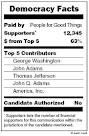
product label democracyThere is even less discussion on what we want from our corporations. Is it, for example, enough that their sole goals are to maximize the return to their shareholders?

This article suggests something citizens can do to spur these needed discussions and to make visible what corporations are actually doing and the effects of their actions. Here we are not calling on the government to mandate this transparency, rather we are calling on ordinary citizens and citizen organizations to act to make the actions of corporations more visible, more transparent.

Labeling the Corporation
We are used to the idea that many of the products we buy are labeled. For example, many processed foods are obliged to disclose their ingredients, and they are labeled so that we do not have to guess at what we are eating. Consumers are often encouraged to read the label, so they will know what they are buying.

Similarly, let us now insist on labeling and making visible what corporations are doing. Corporations affect us and our country through their decisions on outsourcing and on wages and pensions, and by what their goals are. Do they consider in their actions the effects on customers, their own employees, the communities in which they operate, and on the country that sustains them with its laws? Or do they only consider shareholder value?

Do they pioneer with new and valuable products, and if they do, how do they decide where those products are made? Or, in the realm of services, do they exploit the ignorance of their customers to either give them loans they cannot repay or investment advice more tailored to corporate profits than to the welfare of the customers.

Let's label corporations with labels that tell us what they are actually doing.

How to Label the Corporation
We are not talking here about physical labels attached to products that corporations make, but about electronic labels attached to the corporations themselves.

But where would these labels come from? How would they be made? What would they look like? What would they do?

An example of corporate labeling already exists. It was created by a cooperative effort between the Zicklin Center for Business Ethics Research at The Wharton School of the University of Pennsylvania and the Center for Political Accountability (CPA). While this is a label that only describes the political spending activities of corporations, the methodology can be applied equally well to other corporate actions.

Together the two organizations developed a set of twenty-nine criteria by which the corporate approach to managing, overseeing and disclosing political expenditures could be judged. The criteria covered disclosure of the range of a company's political spending -- contributions to candidates, Party committees and ballot initiatives as well as payments to trade associations and other tax exempt entities organized for political purposes -- and its policies and practices for associated decision making and oversight.

They then scored the top 100 U.S. corporations on all twenty-nine criteria, and for each company the weighted scores for the individual criteria were combined into a single rating, specifically, the CPA-Zicklin Index of Corporate Political Accountability and Disclosure.

Before the Index was made public each company was informed of its rating and had the opportunity to dialog with CPA about them. This also gave the company the opportunity to make changes in the policies and practices they were publicly posting on their website. Only after that was the rating made public. The result is that you can see today this well thought out rating of the top 100 U.S. companies on the CPA website and also, for those who want it, a detailed d of how it was determined.

We believe that something very much like this can be done for other corporate activities.
The essential step is to work out criteria about which you want information, then see what information can be obtained for each company. It was important to the CPA-Zicklin effort, that a corporation not providing information to the public on a specific criterion would result in a score of zero on that criterion and thus a lower rating when the result is made public.

We suggest that civic organizations with a particular interest, label corporations on that interest., whether that is the environment, how they treat their employees, the quality of their goods, or the degree of outsourcing. They should then develop their criteria, and gather information; not always only from the corporations.. They should then produce a publicly available rating that is easy to link to.

Modern technology makes all this possible and more. People with a particular interest in a particular company could organize a Facebook page. There could also be Smartphone apps, similar to those that already exist for comparison shopping. Pointing the camera of a Smartphone at a product would immediately reveal the company that makes it and the rating given to that company by a selected website on a selected issue.

Any and all of these actions will contribute to making visible, transparent and discussible what our corporations are doing.

We are a nation of corporations, but our press and our conventional politics do not in any systematic way make visible the effect of corporate actions on the country. Let us as citizens make up for that significant omission.

Wednesday, July 14, 2010

Treat Reckless Corporate Behavior like Drunk-Driving

Tuesday, July 13, 2010 by The Guardian/UK
by Dean Baker

While BP has taken some heat over its spill in the Gulf, it is remarkable how limited the anger actually is. Many defenders of the company have made the obvious point: it was an accident. BP did not intend to have a massive spill that killed 11 people, devastated the Gulf ecosystem and threatens the livelihoods of hundreds of thousands of workers.

Of course this is true, but it is also true that a drunk driver who runs into a school bus did not intend to be involved in a fatal collision. As a society, we have no problem holding the drunk driver responsible for a predictable outcome of their recklessness. Driving while drunk dramatically increases the risk of an accident. This is why it is punished severely. A person who is responsible for a fatal accident while driving drunk can expect to face many years in jail. Even someone who drives drunk without being in an accident often faces jail time because of the risk they imposed on others.

This raises the question of why the public seems to accept that the top officials at BP, who cut corners and made risky gambles in their drilling plans, should be able to "get my life back," as BP chief executive Tony Hayward put it. The people who lost their livelihood as a result of BP's spill will not get their lives back, even if BP does pay compensation. Certainly the 11 workers killed in the original explosion will not get their lives back. Why should the people responsible for this carnage be able to resume their life of luxury?

There are two separate questions. The first is a narrow legal issue concerning the extent to which Hayward and other high level executives can be held criminally liable for the accident. It may be the case that the laws are written so that even if companies commit gross negligence that results in enormous harm, including multiple deaths, top officials are not criminally liable. This is a question about the status of current law. The second question is a moral and economic one about what the laws should look like.

From either standpoint, it is very difficult to see why we would want to say that reckless behaviour that would be punished with long prison sentences if done by an individual, somehow escapes serious sanction if done as part of a corporation's pursuit of profit. Do we give a get a "get out of jail free" card to people when they are wearing the hat of a top corporate executive? This makes no sense.

Just to take the extreme case, suppose that Tony Hayward was racing back to the office after a three-Martini lunch in order to prepare the paperwork for a big contract that he had just negotiated. On his way, he hits a school bus, killing 11 children. Would it make sense to absolve him of blame for these deaths because it was the result of his efforts to raise BP profits? And, if that doesn't make sense, why does it make sense to absolve him of responsibility for the deaths of 11 oil rig workers that was the direct result of his decision to cut corners in order to increase profits.

We can ask the same question about the responsibility of the top executives of the Massey Energy corporation, whose shoddy safety practices led to the explosion that cost 29 workers their lives. We should also ask why the top executives of the UtahAmerican Energy company weren't subject to criminal prosecution when their recklessness led to the deaths of six miners and 3 rescue workers in a mine collapse in 2007. In these cases and many others the problem was not simply bad luck. In all three cases, the accidents were the direct result of reckless behaviour on the part of the management of these companies. They ignored standard safety measures in order to save money.

Of course most acts of recklessness don't result in fatalities, just as the vast majority of incidents of drunk driving do not end in fatal collisions. Nonetheless, when they are caught, we still punish drunk drivers for their recklessness. This would be a good pattern to follow more generally. The executives of the major oil companies whose clean-up plans for the Gulf of Mexico involved procedures for rescuing walruses would find the matter far less humorous if it involved jail time. Is there any reason it should not?

The problem is that government has been controlled for far too long by soft-on-crime conservatives. They are willing to look the other way and give break after break to criminals, as long as they are the white-collar types who belong to the best country clubs.

This must come to an end. The country can't afford special privileges for high-class criminals. It is time to take a tough stand on criminals who inhabit the corporate suites. We have to tell the top executives at BP, Massey, Goldman Sachs and elsewhere that if you can't do the time, don't do the crime.