Showing posts with label emerging markets. Show all posts

Thursday, February 6, 2014

A Clear and Present Danger to Financial Stability

The Fed's Taper Sends Global Shares and Emerging Markets Tumbling
by MIKE WHITNEY


The selloff that began in May 2013, when the Fed announced its plan to scale back its asset purchases, resumed with a vengeance on Monday as global shares were slammed in heavy trading sending the Dow Jones for a 326 point-loss on the day. The proximate cause of the rout was a worse-than-expected manufacturing report and sluggish construction spending, but the underlying source of the trouble was the Fed’s decision to wind down QE which, according to Bloomberg news, “helped drive the S and P 500 up 157 percent from a 12-year low in 2009.” The Fed’s tightening has reversed the dynamic that pushed equities into the stratosphere and generated an unprecedented boom in the emerging markets. Now capital is fleeing the EMs to the safety of US Treasuries while jittery investors ditch stocks and wait to see if the storm passes or gradually gains strength.

The mood on Wall Street has turned bearish overnight as markets in Europe and Asia continue to hemorrhage led by another bloodletting on Japan’s Nikkei which has slumped by a full a 14 percent since its Dec. 30 peak. Societe Generale’s emerging market strategist, Benoit Anne, summed up the mood in a terse note to her clients saying, “There is no point spending too much time trying to pick and choose when faced with a severe market crisis like the one we are witnessing in front of our screens. Right now, sell everything.”

Markets have entered a new phase in the ongoing financial crisis, a crisis which originated on Wall Street where trillions of dollars of fraudulently-manufactured “toxic” assets were produced by a criminal bank cartel and sold to unsuspecting investors around the world. Rather than write down the losses and restructure the banking system, policymakers at the Central Bank and US Treasury opted to conceal the damage with massive bailouts, financial repression, zero rates and regular infusions of liquidity, all of which helped to hide the rot at the heart of the system. The Fed’s plan to taper has removed the veil and exposed the weakness of an undercapitalized system that has been made more unstable by 5 years of misguided policy. This is real source of the problem.

Just as the Fed’s uber-accommodationist policy lifted stocks to record highs in the months preceding its taper announcement, so too, the withdrawal of central bank support is likely to increase the pace of the decline. That is why we expect the taper to be implemented in a stutter-step manner, stopping and starting sporadically depending on conditions in the market. Naturally, this will undermine the Fed’s attempts to send investors a clear message about the direction of policy. It also means that new Fed chairman Janet Yellen is going to spend less time trying to maintain the Fed’s mandate of “price stability and full employment” then simply putting out fires. Here’s a clip from Naked Capitalism with some background on the turmoil:
“Since Bernanke started talking about “tapering off” Quantitative Easing, the bond markets have freaked out. This is a very logical reaction….Bernanke and other Federal Reserve economists appear bewildered by this phenomenon. The impression one gets from their follow-up comments is that they wished they could ask bond speculators “did you read the damn speech?” The answer, of course, is no and for good reason.

All investors need to know is the conditions under which QE … will be pursued has changed. Now the substantive change may actually be relatively minor, but that’s irrelevant to speculators. The reason is very simple: those holding assets with longer maturities will take huge capital losses with relatively small changes in interest rates ……It is better to exit now when those future changes are uncertain then take even more massive losses.” (“Market rout continues, proving abject failure of Fed’s forecasts and policies”, Naked Capitalism)

This is the logic of selling early even though the reduction of asset purchases is still in its opening phase. There’s no sense in waiting until the last minute and taking a chance of getting trampled in the stampede to the exits. Just cash in and relax.

The Fed’s trillion cash injections have created a fantasy world of ever-rising stock prices that’s gradually giving way to the emerging reality of dismal earnings, chronic-high unemployment, droopy incomes, stagnant wages, swollen P/E ratios and a bloated financial sector that requires a larger and larger share of the nation’s wealth to avoid another devastating collapse. This is the situation we find ourselves in today, a situation that is papered over with propaganda about meaningless data points that fail to identify the real source of the problem, which is the gigantic capital hole created by the toxic assets that have not yet been written down, but are still sucking the life out of the bedraggled economy via debt servicing, rate and liquidity subsidies, and the reshaping of economic policy to preserve zombie institutions which need to be euthanized.

The problem is not hard to grasp, in fact, most people will understand what’s going on by just reading this two-paragraph excerpt from an article which appeared in Forbes magazine back in February, 2009. Here’s a clip from the piece titled “Zombie Firms and Zombie Banks”:
”Beginning in 1991, Japan experienced a financial crisis that has been documented and studied by many. Japan’s crisis was triggered by a real estate and equity price bubble followed by a collapse of equity and real estate prices. But unlike the examples I cited above, Japanese policymakers met the crisis with prolonged denial and then, when conditions forced recognition of the severity of the problem, very halting steps to address it. Banks were not forced to recognize the condition of their balance sheets and were encouraged to continue lending to firms that were themselves unprofitable. Anil Kashyap labels these “zombie firms.”

Zombie banks continued to direct capital to zombie firms. This charade continued for more than a decade, with the result that the once-powerful Japanese economy was completely stagnant for that period. The government’s main response was to dramatically increase spending on infrastructure and frantically try to get Japanese households to save less and consume more. The resulting “lost decade” of economic growth cost Japan more than 20% of GDP.” (“Zombie Firms And Zombie Banks”, Thomas F. Cooley, Forbes)

Sound familiar? This same phenom is playing out in the US today. The Fed has spared no expense to perpetuate the illusion that the zombie banking system is solvent and that the trillions of dollars in losses from worthless assets has somehow vanished into thin air. But they haven’t vanished. They are either hidden-away via accounting trickery, passed off to gullible, yield-crazed investors, or transferred onto the Fed’s bulging balance sheet. In any event, the debts are real, they’re impeding the recovery, they’re sucking the life’s blood out of the economy, and they’re clear and present danger to financial stability.

The red ink has to be purged, just as the rickety, Potemkin banking system has to be put out of its misery. We need a fresh start.

Tuesday, February 4, 2014

Prelude to a Crash

Margin Debt Hits All-Time High in December
by MIKE WHITNEY

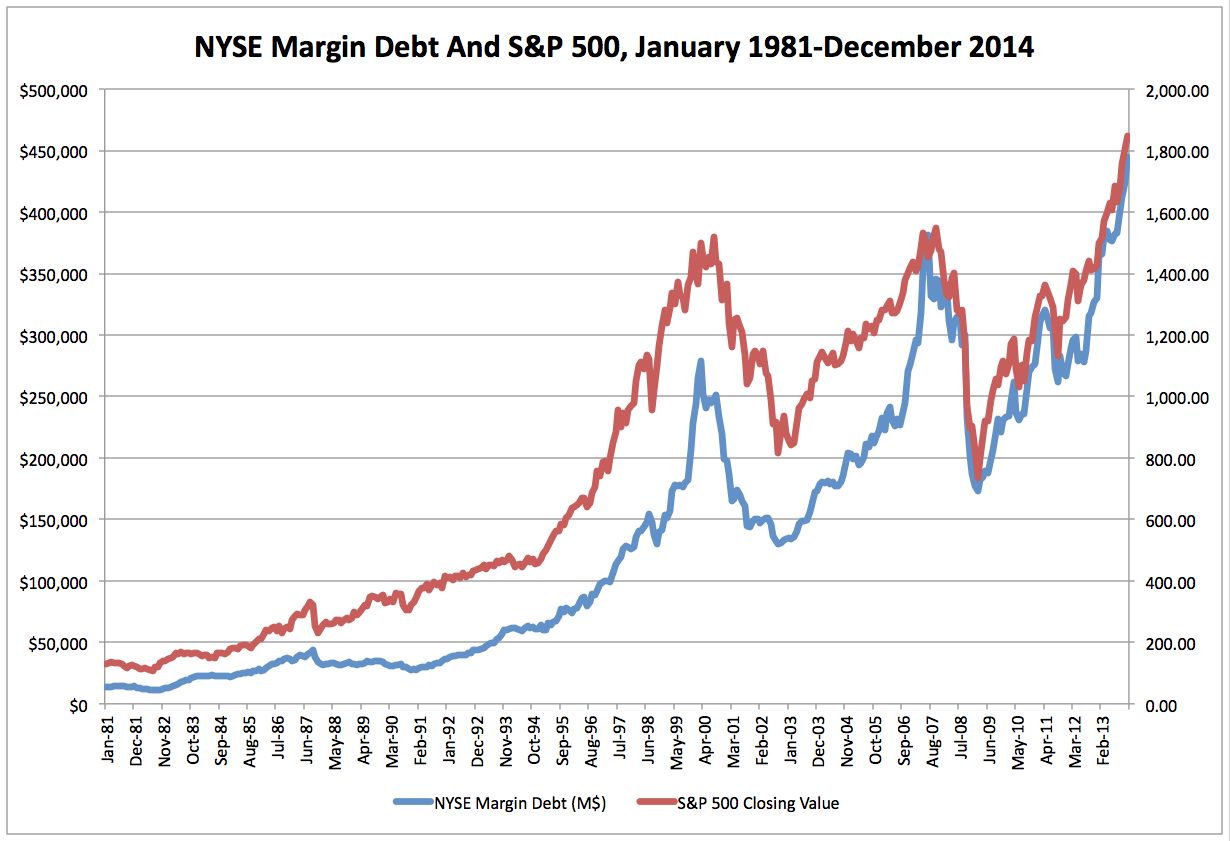
The Fed’s easy money policies have pushed margin debt on the New York Stock Exchange (NYSE) to record levels laying the groundwork for a severe correction or another violent market crash.

In December, margin debt rose by $21 billion to an all-time high of $445 billion.

Buying equities on margin, that is, with loads of borrowed cash, is a sign of excessive risk taking the likes of which invariably takes place whenever the Central Bank creates subsidies for speculation by keeping interest rates pegged below the rate of inflation or by pumping trillions of dollars into the bloated financial system through misguided liquidity programs like QE.

Investors have shrugged off dismal earnings reports, abnormally-high unemployment, flagging demand, droopy incomes, stagnant wages and swollen P/E ratios and loaded up on stocks confident that the Fed’s infusions of liquidity will keep prices going higher. It’s only a matter of time before they see the mistake they’ve made.

The chart below illustrates how zero rates and QE lead to excessive risk taking. The correlation between the stratospheric rise of margin debt and the Fed’s destabilizing monetary policy is hard to avoid. This is what bubblemaking looks like in real time.


Chart: Seeking Alpha.

In the minutes of the FOMC’s December meeting, FOMC officials acknowledge the froth they’ve created in financial assets which is why they’ve begun to scale back their asset purchases. The Fed hopes that by gradually winding down QE they’ll be able to stage a soft landing rather than a full-blown crash. Here’s an excerpt from the FOMC’s minutes:
“In their discussion of potential risks, several participants commented on the rise in forward price-to-earnings ratios for some smallcap stocks, the increased level of equity repurchases, or the rise in margin credit. One pointed to the increase in issuance of leveraged loans this year and the apparent decline in the average quality of such loans.”

There you have it, the Fed sees the results of its work; the distortions in P/E ratios, the exuberant stock buybacks (“equity repurchases”), the deterioration in the quality of leveraged loans, and the steady rise in margin debt. They see it all, all the bubbles they’ve created with their gargantuan $3 trillion surge of liquidity. Now they have started to reverse the policy by reducing their asset purchase from $85 bil to $65 bil per month, the effects of which can already be seen in the Emerging Markets.

The bubble in Emerging Markets has burst sending foreign currencies plunging and triggering a sharp reversal in capital flows. The hot money that flooded the EMs,–(which lowered the cost of borrowing for businesses and consumers)–is entirely attributable to the Fed’s policy. QE pushes down long-term interest rates forcing investors to search for higher yield in other markets. Thus, the cost of money drops in EMs creating a boom that abruptly ends when the policy changes (as it has).

Capital is fleeing EMs at an unprecedented pace precipitating a dramatic slowdown in economic activity, higher consumer prices and widespread public distress. The Fed is 100% responsible for the turmoil in emerging markets, a fact which even mainstream news outlets blandly admit. Here’s an excerpt from an article in Bloomberg just this week:
“Investors are pulling money from exchange-traded funds that track emerging markets at the fastest rate on record…More than $7 billion flowed from ETFs investing in developing-nation assets in January, the most since the securities were created, data compiled by Bloomberg show…

Emerging economies have benefited from cheap money as three rounds of Fed bond buying pushed capital into their borders in search of higher returns…

The Fed’s asset purchases had helped fuel a credit boom in developing nations from Turkey to Brazil. Accumulated capital inflows to developing-country’s debt markets since 2008 reached $1.1 trillion, or $470 billion more than their long-term trend, according to a study by the International Monetary Fund in October.” (“Record Cash Leaves Emerging Market ETFs on Lira Drop“, Bloomberg)

The Fed doesn’t care if other countries are hurt by its policies. What the Fed worries about is how the taper is going to effect Wall Street. If the slightest reduction in asset purchases causes this much turbulence abroad, then what’s it going to do to US stock and bond markets?

The answer, of course, is that stocks are going to fall…hard. It can’t be avoided. And while the amount of margin debt is not a reliable tool for calling a top; it’s safe to say that the recent spike in investor leverage has moved the arrow well into the red zone. Investors are going to cash out long before the Fed ends QE altogether, which means the selloff could persist for some time to come much like after the dot.com bubble popped and stocks drifted lower for a full year. Now check out this clip from Alhambra Investment Partners newsletter titled “The Year of Leverage”:
“For the year, total margin debt usage jumped by an almost incomprehensible $123 billion, while cash balances declined by $19 billion. That $142 billion leveraged bet on stocks far surpasses any twelve month period in history. The only times that were even close to as leveraged were the year leading up to June 2007 (-$89 billion) and the twelve months preceding February and March 2000 (-$77 billion). Both of those marked significant tops in the market.” ( Alhambra Investment Partners newsletter titled “The Year of Leverage“)

Repeat: “The $142 billion leveraged bet on stocks far surpasses any twelve month period in history.” 

Investors are “all-in” because they think that the Fed has their back. They think that Bernanke (or Yellen) will not allow stocks to fall too far without intervening. (This is called the “Bernanke Put”) So far, that’s been a winning strategy, but that might be changing. The Fed’s determination to taper suggests that it wants to withdraw its stimulus to avoid being blamed for the bursting bubble. (“Plausible deniability”?) That’s what’s driving the current policy. Here’s more on margin debt from Wolf Richter at Testosterone Pit:
“On the New York Stock Exchange, margin credit has been hitting new records for months. All three mega-crashes in my investing lifetime have been accompanied by record-setting peaks in margin debt. In September 1987, a month before the crash, margin credit peaked at 0.88% of GDP. In March 2000, when the crash began, margin credit peaked at 2.7% of GDP. In July 2007, three months before the downdraft started, margin credit peaked at 2.6% of GDP. Now, margin credit has already reached 2.5% of GDP.” (“Plagued By Indigestion, Fed Issues Asset-Bubble Warning”, Testosterone Pit)

Stock market crashes are always connected to massive leverage, loosey-goosey monetary policy and irrational exuberance (“excessive risk taking”), the toxic combo that presently rules the markets. The Federal Reserve is invariably the source of all bubblemaking and financial instability.

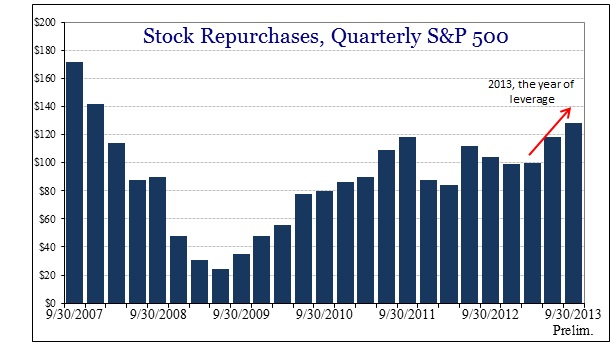
As we noted earlier, equity repurchases or stock buybacks are another sign of froth. Here’s an excellent summary on the topic by Alhambra Investment Partners:
“In the third quarter of 2013, share repurchases totaled $128.2 billion, the highest level since Q4 2007. For the twelve months ended in September 2013, aggregate share repurchases were an astounding $445.3 billion; the only twelve-month period greater than that total was the calendar year of 2007 and its $589 billion.

The common argument advanced in favor of such share repurchases is that companies are using cash to recognize undervalued stocks, but that is total hogwash…

…corporate managers are no different than the reviled stereotypical retail investor. Both leverage themselves further and further as the market goes higher, not in recognizing undervalued stocks or companies but in full froth of chasing obscene values via rationalizations.” ( Alhambra Investment Partners newsletter titled “The Year of Leverage”)


In other words, corporate managers are doing the same thing as your average margin investor. They are loading up on financial assets–not because they think they are a good value or because they expect higher earnings –but because Fed policy supports artificially-high prices. That’s what’s driving the bull market, the Fed’s thumb on the scale. Remove the thumb, and you have a whole new ballgame (as we see in the EMs). There’s also a bubble in high yield “junk” bonds which just had their second biggest year on record (Total issuance $324 billion) Investors are only too happy to dump their money into high-risk debt believing that companies never default or that the Fed will save the day again credit tightens and the dominoes start tumbling through the debt markets. According to Testosterone Pit:

“The cost of a high-yield bond on an absolute coupon basis is as low as it’s ever been,” explained Baratta, king of Blackstone’s $53 billion in private equity assets. Even the riskiest companies are selling the riskiest bonds at low yields… Why would anyone buy this crap?” (“Bubble Trouble: Record Junk Bond Issuance, A Barrage Of IPOs, “Out Of Whack” Valuations, And Grim Earnings Growth”, Testosterone Pit)

Why, indeed? Of course, the author is just being rhetorical, after all, he knows why people are piling into junk. It’s because the Fed has kept a gun to their heads for 5 years, forcing them to grab higher yield wherever they can find it. That’s how Bernanke’s dogwhistle monetary policy works. By slashing rates to zero, the Fed coerces investors to speculate on any type of garbage that’s available. That why junk “just had its second biggest year on record.” You can thank Bernanke.

Housing is also in a bubble due to the Fed’s zero rates, withheld inventory, government modification programs, and an unprecedented uptick in all-cash investors. Clearly, there’s never been a market more manipulated than housing. It’s a joke.

The surge of Wall Street liquidity has spilled over into housing distorting prices and reducing the number of firsttime homebuyers to an all-time low. The homeownership rate is actually falling even while prices climb higher, which is just one of many anomalies created by the Fed’s policy. (Who’s ever heard of a housing boom, where the number of firsttime homebuyers is dropping?)

Also, the Central Bank has purchased more than $1 trillion in mortgage-backed securities (MBS) via QE, which begs the question: How can housing prices NOT be in a bubble?

As we noted earlier, the Fed understands the impact its policies have had. They know the markets are overheated and they’re determined to do something about it. A recent article in Bloomberg explains the Fed’s plan for winding down QE “without doing damage to the economy”. Here’s a short excerpt from the piece:
“Janet Yellen probably will confront a test during her tenure as Federal Reserve chairman that both of her predecessors flunked: defusing asset bubbles without doing damage to the economy…

Yellen is ‘going to be trying to do something that no one has ever done,’ said Stephen Cecchetti, former economic adviser for the Bank for International Settlements, the Basel, Switzerland-based central bank for monetary authorities. She needs ‘to ensure that accommodative monetary policy doesn’t create significant financial stability risks,’ he said in an interview…

The Fed’s ‘first, second and third lines of defense” for dealing with such imbalances is to rely on supervision, regulation and so-called macro-prudential policies, such as mortgage loan-to-value restrictions, Bernanke told the Brookings Institution in Washington on Jan. 16. ….Only as a last resort would it consider raising interest rates.’ (“Yellen Faces Test Bernanke Failed: Ease Bubbles“, Bloomberg)

You got that?

So the Fed is going into the “bubble-deflating” biz.

Check.

And uber-dove Yellen is going to put things right. She’s going to eliminate the price distortions and gradually return the markets to normalcy.

Right, again.

She’s going to wind down QE and start to reduce the Fed’s $4 trillion balance sheet.

Oakie dokie.

And she’s going to do all of this without raising interest rates or sending stocks into freefall?

Right. It’s a pipedream. The first sign of trouble and old Yellen will be scuttling across the floor of the New York Stock Exchange with a punch bowl the size of Yankee Stadium.

You can bet on it.

Wednesday, January 29, 2014

The New Wave of Financial Instability

Is This the Big One? 
by MIKE WHITNEY

Global stocks were hammered on Friday for a second straight day on news of a slowdown in China and turbulence in emerging markets. The Dow Jones Industrials suffered its worse drubbing in more than two years, tumbling 318 points on Friday to end a 490 point two-day rout. Emerging markets currencies were whipsawed by capital flight as foreign investors fled to the safety of U.S. Treasuries. Turkey’s lira and the Argentine peso were particularly hard hit setting record lows in the 48 hour period. The scaling back of the Fed’s $85 billion per month asset purchase program, called QE, has altered the dynamic that made emerging markets the “engines for global growth”. The policy reversal has triggered a selloff in risk assets and sent EM currencies plunging. Here’s a summary from Bloomberg:
“The worst selloff in emerging-market currencies in five years is beginning to reveal the extent of the fallout from the Federal Reserve’s tapering of monetary stimulus, compounded by political and financial instability.

Investors are losing confidence in some of the biggest developing nations, extending the currency-market rout triggered last year when the Fed first signaled it would scale back stimulus. While Brazil, Russia, India, China and South Africa were the engines of global growth following the financial crisis in 2008, emerging markets now pose a threat to world financial stability.” (“Contagion Spreads in Emerging Markets as Crises Grow,” Bloomberg)

Paradoxically, Bloomberg editors blame the victims of the Fed’s failed policy for the current ructions in the markets. In an article titled, “What’s Behind the Emerging-Market Meltdown” the editors say,”emerging-market governments … should recognize that this week’s financial-market turmoil was, to varying degrees, their own fault.” … “the best way for emerging-market governments to restore confidence would be to improve their policies.”

Logically, one would assume that the editors would throw their support behind capital controls or other means of stemming the destructive flow of speculative capital into domestic markets. But that’s not the case. What the editors really want, is policies that trim deficits, slash public spending, and allow foreign investors to continue to wreak havoc on vulnerable economies that follow their free market diktats. The article is a defense of the status quo, of maintaining the same ruinous policies so that profit-taking can continue apace.

The Fed was warned early on that its uber-accommodative monetary policy was spilling over into emerging markets and creating conditions for another financial crisis. Take a look at this excerpt from an article in Bloomberg back in 2010 where Nobel prize winning economist, Joseph Stiglitz, explicitly warns the Fed of the dangers of QE.

Bloomberg:
“The U.S. Federal Reserve’s plan to boost purchases of bonds poses “considerable” risks by increasing capital inflows to emerging markets, Nobel Prize- winning economist Joseph Stiglitz said in Santiago today.

“All this liquidity that they’re creating is not going back to grow the American economy and is going to Asia and other emerging markets where it’s not wanted,” Stiglitz said…..Increased capital inflows could cause emerging market currencies to appreciate and could create asset bubbles, he said.” (“Stiglitz Says Fed Stimulus Poses `Considerable’ Risks for Emerging Markets,” Bloomberg, Dec 2010)

Events have unfolded exactly as Stiglitz predicted they would, which means the Fed is 100% responsible the carnage in the stock and currencies markets.

The policy has pumped nearly “$7 trillion of foreign funds” into EMs since QE was first launched in 2009. According to the Telegraph’s Ambrose Evans-Pritchard, “much of it “hot money” going into bonds, equities and liquid instruments that can be sold quickly….Officials are concerned that this footloose capital could leave fast in a crisis, setting off a cascade effect,” Pritchard adds ominously.

Whether last week’s bloodbath was just a prelude to a bigger crash is impossible to say, but it is worth noting that the Fed has only reduced its purchases by a mere $10 billion per month while still providing $75 billion every 30 days. That suggests that markets will probably face greater turmoil in the months ahead. Check out this clip from USA Today:
“Emerging markets need the hot money but capital is exiting now,” says (Blackrock’s Russ) Koesterich. “What you have is people saying, ‘I don’t want to own emerging markets.’…

The bigger fear is if the current crisis in currency markets morphs into a full-blown economic crisis and leads to financial contagion, says Matthias Kuhlmey, managing director of HighTower’s Global Investment Solutions.

“The currency story is fascinating and can be a slippery slope – be cautious,” says Kuhlmey, adding that the Asian crisis in the summer of 1997 that started with a sharp drop in the value of Thailand’s baht, turned into a broader economic crisis that engulfed Indonesian, South Korea and a handful of other countries. It also rocked financial markets.” (“Why emerging markets worry Wall Street,” USA Today)

So, is this the Big One, the beginning of the next financial crisis?

It’s too early to say, but investors and analysts are worried. Fed tightening (via “taper”) will be felt in markets around the world. The trouble in emerging markets will intensify deflationary pressures in the Eurozone and put a damper on China’s growth. Slower global growth, in turn, will create balance sheets problems for undercapitalized and over-leveraged banks and other financial institutions which will increase the probability of another Lehman Brothers-type default.

According to Reuters, a normalizing of interest rates in the US, (which most analysts expect) “could cut financial inflows to developing countries by as much as 80 percent for several months. In such a case, nearly a quarter of developing countries could experience sudden stops in their access to global capital, throwing some economies into a balance of payments or financial crisis, the Bank said.” (“Rout in emerging markets may only be in Phase One,” Reuters)

Clearly, the potential for another financial meltdown is quite real.

For more than four years, the Fed has buoyed stock prices and increased corporate margins through massive injections of free cash into the financial markets. Now the Central Bank wants to change the policy and ease its foot off the gas pedal. That’s causing investors to rethink their positions and take more money off the table. What started as a selloff in emerging markets could snowball into a broader panic that could wipe out the gains of the last four years.

The Federal Reserve is entirely responsible for this new wave of financial instability.

Wednesday, April 25, 2012

Nestlé Targets Developing Nations for Bottled Water, Infant Formula Sales

Wednesday, April 25, 2012 by Food & Water Watch Blogby Darcey Rakestraw


On Monday, Nestlé announced it had purchased Pfizer’s infant nutrition unit, which will strengthen their ability to sell infant formula in emerging markets, particularly in Asia. The move is not surprising, since 85 percent of Pfizer’s infant nutrition revenues came from developing countries, where Nestlé is also looking to expand its sales of bottled water.

How do we know this? Nestlé has declared both its Pure Life brand of bottled water and infant formula as Popularly Positioned Products (PPP) that target “less affluent consumers in emerging markets”. Two weeks ago, we mentioned Nestlé’s report outlining this strategy in this blog. For some reason, the report is no longer available on Nestlé’s site without the requisite log-in information. But we’ve reposted the document here.

Our executive director, Wenonah Hauter, released this statement in response to Nestlé’s purchase of Pfizer’s infant nutrition unit:
This renewed focus on growing the market for its infant formula products is troubling given the corporation’s track record of using dubious practices to market infant formula in developing countries, where it is often prepared in unhygienic conditions with unsafe water….Surely, it is no coincidence that many mothers will prepare the formula with bottled water—which will no doubt benefit Nestlé’s emerging market strategy. 
Selling bottled water to poor people, and pushing infant formula on poor but otherwise healthy mothers who may not have access to safe drinking water is doing what Nestlé does best: undermining public health in the name of profit.

For more on Nestlé’s plan to market bottled water in developing nations to offset the drop-off in sales from developed countries, read our report, Hanging on for Pure Life.