Friday, December 7, 2012 by Fairness and Accuracy In Reporting (FAIR)
 In October, the inevitable was announced: Struggling Newsweek magazine would be finished as a print publication as of the end of the year. But the last mass newsweekly left, Time, also made an announcement of sorts: It was out of the factchecking business.
“Who Is Telling the Truth? The Fact Wars,” read Time’s October 15 cover. With a setup like that, one might have hoped for a bold break from the campaign pack, an acknowledgment that facts matter, and that politicians who run on a record of resisting reality should be exposed.
Instead Time told a more familiar story, one in which both major parties commit comparable “factual recklessness,” because accuracy—and reality—are less important than the appearance of evenhandedness. In the article, and a subsequent response to critics, the magazine essentially waved the white flag in the journalistic war against political deception.
The cover story by Michael Scherer kicked off with some anecdotes meant to be representative. On the one hand, Obama complained about Romney’s repeated, highly publicized claims that the White House is doing away with work requirements under welfare. This was, at certain moments, a central part of the Republican campaign strategy. Scherer correctly noted Romney’s claims were false.
But then, hewing to the idea that one must find political lying in equal measure, he pivoted to a claim from the Obama camp—a campaign strategist’s offhand remark that, if Romney had misrepresented himself to securities regulators, that would be “a felony”—“a conditional accusation, but an accusation nonetheless,” Sherer explains, and justification enough for Romney’s team to “take its turn playing truth-teller.”
The two issues, though juxtaposed, are not remotely equivalent, illustrating one of the most common problems with media factchecking: the need to always be balanced, no matter how unbalanced reality might be. The losers in the Fact Wars, ironically, are the facts themselves.
Indeed, an entire sidebar piece by Alex Altman (“Who Lies More? Yet Another Close Contest”) seemed inspired by the same notion about perfectly symmetrical political lying. The feature chose 10 statements from each side to evaluate. It made for unusual comparisons, considering that one Romney claim was the hyperbolic “We are only inches away from no longer being a free economy.” Not to worry, Altman rated that “highly misleading.”
The equivalent Obama claim—“We do not need an outsourcing pioneer in the Oval office”—was a “distortion,” in Time’s judgment, because while Bain “invested in companies that outsourced jobs, it was not the first to do so,” and Romney was not “directly responsible” when this occurred. Altman got this wrong, actually—Romney was actively running Bain when it “owned companies that were pioneers in the practice of shipping work from the United States to overseas call centers and factories making computer components,” as the Washington Post (6/21/12) reported—but in any case, it’s hardly the same as declaring that the U.S. is on the verge of socialism.
Confronted by the obvious evidence that Romney’s lies and exaggerations were of a different order, Altman came up with a novel explanation:
This kind of analysis allows Scherer to confidently and categorically equate the two campaigns when it comes to reckless disregard for the truth:
Scherer does seem troubled by the sheer volume of political lying he detected in the campaign, and thinks he knows who’s to blame: the people. He wrote:
Blaming a lazy or partisan public for politicians’ lies seems more than a little odd, especially since there are people whose job it is to hold politicians accountable: Those people are called “journalists.” And if they do not make politicians pay a price for lying, those politicians are not likely to stop any time soon.
To hear Scherer tell it, though, that’s exactly what journalists have been doing. Unlike in previous campaign seasons, the press “has largely embraced the cause of correcting politicians when they run astray.” This year’s campaign “witnessed a historic increase in fact-checking efforts by the media, with dozens of reporters now focused full time on sniffing out falsehood.”
Some of that sniffing has been partisan, though, so Scherer offers this bizarre advice:
The problem, Scherer explains, is that voters doesn’t want to hear the “other side’s” factchecking: “Instead the public increasingly takes issue with those who deliver the facts.”
Ironically, he quotes former Al Gore press secretary Chris Lehane making the exact opposite point: “In the past, the press effectively played the role of umpire.... Now they are effectively in the bleachers.”
So maybe the real problem isn’t that the public has no love for “those who deliver the facts.” It might be—as Lehane says—that they don’t think journalists actually do that.
Reporters appear to be wedded to a set of “rules” that say they are not allowed to convey reality to their readers and viewers. On the Time Swampland blog (10/9/12), Scherer wrote in response to complaints about his cover story:
For Scherer, the biggest fear seems to be that the facts might pile up on one side. He approvingly quotes Brooks Jackson of FactCheck.org, who explains that truth-evaluating operations like his are only pretending to try to set firm standards by which political dishonesty can be measured:
How even a Time magazine cover story on factchecking can't find a way to tell the truth
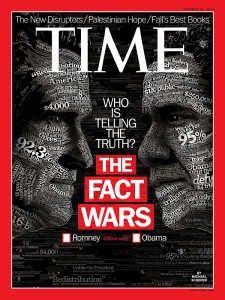 In October, the inevitable was announced: Struggling Newsweek magazine would be finished as a print publication as of the end of the year. But the last mass newsweekly left, Time, also made an announcement of sorts: It was out of the factchecking business.
“Who Is Telling the Truth? The Fact Wars,” read Time’s October 15 cover. With a setup like that, one might have hoped for a bold break from the campaign pack, an acknowledgment that facts matter, and that politicians who run on a record of resisting reality should be exposed.
Instead Time told a more familiar story, one in which both major parties commit comparable “factual recklessness,” because accuracy—and reality—are less important than the appearance of evenhandedness. In the article, and a subsequent response to critics, the magazine essentially waved the white flag in the journalistic war against political deception.
The cover story by Michael Scherer kicked off with some anecdotes meant to be representative. On the one hand, Obama complained about Romney’s repeated, highly publicized claims that the White House is doing away with work requirements under welfare. This was, at certain moments, a central part of the Republican campaign strategy. Scherer correctly noted Romney’s claims were false.
But then, hewing to the idea that one must find political lying in equal measure, he pivoted to a claim from the Obama camp—a campaign strategist’s offhand remark that, if Romney had misrepresented himself to securities regulators, that would be “a felony”—“a conditional accusation, but an accusation nonetheless,” Sherer explains, and justification enough for Romney’s team to “take its turn playing truth-teller.”
The two issues, though juxtaposed, are not remotely equivalent, illustrating one of the most common problems with media factchecking: the need to always be balanced, no matter how unbalanced reality might be. The losers in the Fact Wars, ironically, are the facts themselves.
Indeed, an entire sidebar piece by Alex Altman (“Who Lies More? Yet Another Close Contest”) seemed inspired by the same notion about perfectly symmetrical political lying. The feature chose 10 statements from each side to evaluate. It made for unusual comparisons, considering that one Romney claim was the hyperbolic “We are only inches away from no longer being a free economy.” Not to worry, Altman rated that “highly misleading.”
The equivalent Obama claim—“We do not need an outsourcing pioneer in the Oval office”—was a “distortion,” in Time’s judgment, because while Bain “invested in companies that outsourced jobs, it was not the first to do so,” and Romney was not “directly responsible” when this occurred. Altman got this wrong, actually—Romney was actively running Bain when it “owned companies that were pioneers in the practice of shipping work from the United States to overseas call centers and factories making computer components,” as the Washington Post (6/21/12) reported—but in any case, it’s hardly the same as declaring that the U.S. is on the verge of socialism.
Confronted by the obvious evidence that Romney’s lies and exaggerations were of a different order, Altman came up with a novel explanation:
Compared with the Obama campaign’s, the Romney operation’s misstatements are frequently more brazen. But sometimes the most effective lie is the one that is closest to the truth, and Obama’s team has often outdone Romney’s in the dark art of subtle distortion.So, to summarize: Romney lies more, and bigger. But Obama tells the more effective kind of lies: the ones that are more accurate. (No, Obama's lies are more sinister. Praising whistleblowers as heroes, then prosecuting more of them than ALL the presidents before him combined. Saying that marijuana legalization is a states' right, and that state law trumps federal law, then working on a way to overturn the recent Washington and Colorado elections which legalized marijuana use. It's one thing to report on the lack of factchecking, but saying both parties don't lie in similar ways to the same ends is being willfully ignorant.--jef)
This kind of analysis allows Scherer to confidently and categorically equate the two campaigns when it comes to reckless disregard for the truth:
Both of the men now running for the presidency claim that their opponent has a weak grasp of the facts and a demonstrated willingness to mislead voters. Both profess an abiding personal commitment to honesty and fair play. And both run campaigns that have repeatedly and willfully played the American people for fools, though their respective violations vary in scope and severity.In the last phrase, actually, Scherer acknowledges that one side may specialize in lying more than the other—but nowhere in the piece does he give any indication which side that might be. It’s an exercise for the reader, apparently.
Scherer does seem troubled by the sheer volume of political lying he detected in the campaign, and thinks he knows who’s to blame: the people. He wrote:
So what explains the factual reck-lessness of the campaigns? The most obvious answer can be found in the penalties, or lack thereof, for wander-ing astray. Voters just show less and less interest in punishing those who deceive. (because they are only allowed to vote for candidates from just 2 political parties, and they are both corrupt. So we the voters only get to decide from corrupt candidate A or corrupt candidate B. How does change presume to begin when its champions from which we are limited to choose are both corrupt to begin with?--jef)Scherer concludes that “until the voting public demands something else, not just from the politicians they oppose but also from the ones they support, there is little reason to suspect that will change.”
Blaming a lazy or partisan public for politicians’ lies seems more than a little odd, especially since there are people whose job it is to hold politicians accountable: Those people are called “journalists.” And if they do not make politicians pay a price for lying, those politicians are not likely to stop any time soon.
To hear Scherer tell it, though, that’s exactly what journalists have been doing. Unlike in previous campaign seasons, the press “has largely embraced the cause of correcting politicians when they run astray.” This year’s campaign “witnessed a historic increase in fact-checking efforts by the media, with dozens of reporters now focused full time on sniffing out falsehood.”
Some of that sniffing has been partisan, though, so Scherer offers this bizarre advice:
The pundits on MSNBC, the Huffington Post and the editorial page of the New York Times do a fine job of calling out the deceptions of Romney, but if you want to hear where Obama is going wrong, you might be better served on the Drudge Report, Fox News or the Wall Street Journal editorial page.Sure—if you want some factchecking of Barack Obama, watch an hour of Sean Hannity. It’s bizarre, but it’s what you’re left with once you buy the premise that it’s impossible to discern fact from fiction and the only option is to read coverage equally skewed in opposite directions.
The problem, Scherer explains, is that voters doesn’t want to hear the “other side’s” factchecking: “Instead the public increasingly takes issue with those who deliver the facts.”
Ironically, he quotes former Al Gore press secretary Chris Lehane making the exact opposite point: “In the past, the press effectively played the role of umpire.... Now they are effectively in the bleachers.”
So maybe the real problem isn’t that the public has no love for “those who deliver the facts.” It might be—as Lehane says—that they don’t think journalists actually do that.
Reporters appear to be wedded to a set of “rules” that say they are not allowed to convey reality to their readers and viewers. On the Time Swampland blog (10/9/12), Scherer wrote in response to complaints about his cover story:
I would love to be able to tell you that Mitt Romney is misleading more than Barack Obama or vice versa.... The problem is that there is no existing mechanism for carrying this sacred duty out in real time.... There are just too many subjective judgements that have to be made to come to any conclusion.This point of view, as Extra! editor Jim Naureckas responded (FAIR Blog, 10/9/12), should not be called impartiality or objectivity. It’s really “radical post-modernism—a denial that anything can ever really be known about the world, that all we really can do is report various claims about the world.”
For Scherer, the biggest fear seems to be that the facts might pile up on one side. He approvingly quotes Brooks Jackson of FactCheck.org, who explains that truth-evaluating operations like his are only pretending to try to set firm standards by which political dishonesty can be measured:
Even if we could come up with a scholarly and factual way to say that one candidate is being more deceptive than another, I think we probably wouldn’t just because it would look like we were endorsing the other candidate.So long as the fear of being seen as unfair defines the corporate media’s approach to factchecking, they will not be “those who deliver the facts.” Rather, they are people who carefully arrange each chip in an effort to create the illusion that they let the chips fall where they may.

