Tuesday, August 23, 2011

Hoping to Contact Extraterrestrials? Think Again

(Didn't Hawking already do this bit? Perhaps they've already been here, found us to be ridiculous, and bolted toward greener petri dishes...--jef)

Monday, August 22, 2011

Astronomers who have been searching for extraterrestrial intelligence for decades are suddenly saying such an encounter might not be a happy one.

Aliens might destroy life on Earth or plan to eat or enslave humans if they sense our civilization was expanding too rapidly and could harm others, according to a latest study.

The scenario was brought up in a joint study by Seth Baum, Jacob Haqq-Misra and Shawn Domagal-Goldman.

Researchers say extraterrestrials might behave the way we humans have behaved whenever we have discovered other previously unknown intelligent beings on Earth, like unfamiliar humans or chimpanzees and gorillas.

"Just as we did to those beings, the extraterrestrials might proceed to kill, infect, dissect, conquer, displace or enslave us, stuff us as specimens for their museums or pickle our skulls and use us for medical research," according to the study, which was published in the journal Acta Astronautica.

Why should we worry about aliens? The simple reason is that if they can find us, they would be more advanced than humans.

"A core concern is that ETI will learn of our presence and quickly travel to Earth to eat or enslave us," the study says.

The authors speculate that extraterrestrials might try to spread their beliefs through evangelism or to use humans for entertainment.

Just because an ETI civilization holds universalist ethics does not mean that it would never seek our harm. This is because ETI may be quite different from us and could conclude that harming us would help maximize whatever they value intrinsically.

For example, if ETI place intrinsic value on lives, then perhaps they could bring about more lives by destroying us and using our resources more efficiently for other lives. Other forms of intrinsic value may cause a universalist ETI to seek our harm or destruction as long as more value is produced without us than with us.

Aliens also could harm or destroy us if they believe we are a threat to other civilizations. Rapidly expanding civilizations may have a tendency to destroy other civilizations in the process, just as humanity has already destroyed many species on Earth.

Though this scenario might seem unlikely given the likelihood of our technological inferiority relative to other civilizations, we would be at the receiving end if ET thinks that our resources could be used more efficiently to generate or retain other civilizations.

Perhaps ETI is observing rapid and destructive expansion on Earth and could become concerned at our trajectory.

ETI might prefer that our civilization change its ways to survive, but if it doubts that our course can be changed, it may seek to preemptively destroy us to protect other civilizations from us.

A preemptive strike would be particularly likely in the early phases of our expansion because a civilization may become increasingly difficult to destroy as it continues to expand.

"Humanity may just now be entering the period in which its rapid civilizational expansion could be detected by an ETI because our expansion is changing the composition of Earth's atmosphere (e.g. via greenhouse gas emissions), which therefore changes the spectral signature of Earth," the study's authors say, Human civilization affects ecosystems so strongly that some ecologists have begun calling this epoch of Earth's history the anthropocene, a new and unprecedented phase in the planet's history.

If the goal is to maximize ecosystem health, then perhaps it would be better if humanity did not exist, or at least if it existed in significantly reduced form. Since at least some humans believe so, invoking universalist ethical principles, then it is likely that ETI might agree.

But since we don't know what kind of aliens we will end up meeting, there are certain steps humans should take when making contact, the authors urge. Those steps include not sharing details of our biology and DNA structure, and not appearing as if we are rapidly expanding off the Earth.

Hiding commercial real estate losses by laundering bad loans through the Fed

A banking system built on lies and deception
August 22, 2011


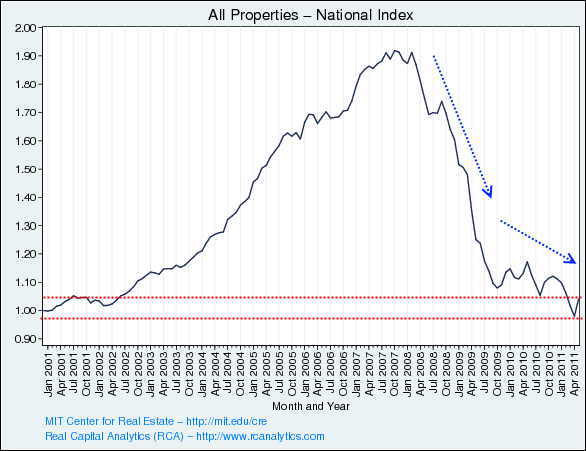
Part of the massive challenges facing our brittle financial system is the opaque and secretive nature of the Federal Reserve.  It is difficult enough to confront a challenge with all information present but make it purposely convoluted and dark and we have a crisis of historical proportions.  The recent market volatility is simply a dire reflection of a system unsure of what is going on.  Markets despise distrust and that is what we are finding.  A few years ago we were told that the banking system was fine yet we now have data showing over $1.2 trillion in emergency loans were made to countless too big to fail banks.  In other words we were being lied to by both the Federal Reserve and the giant banks that largely created and spread this financial crisis like wildfire.  As more information leaks out we are starting to get a grim picture of how the Federal Reserve assisted and is assisting banks not only to hide residential real estate loans but also toxic commercial real estate debtOver $3 trillion in commercial real estate (CRE) values has evaporated since the crisis took hold yet banks continue to tell the public all is well while shifting these toxic bets onto the taxpayer balance sheet.

The collapse in CRE values
mit cre data aug 2011
Source:  MIT

CRE values have already experienced a lost decade and are likely to remain depressed for years to come.  Many of these properties were developed with lofty aspirations and with future growth in mind yet an economy that is contracting has little use for more commercial space.  It is also the case that many of these CRE projects were designed for high flying easy money days.  Take for example some of the condo mix projects in Las Vegas.  Many now sit empty when they were once envisioned as selling for millions of dollars to high rolling aficionados.  Those days simply did not materialize because austerity is taking hold across the world because the debt bubble has burst.  The chart above is data collected monthly by MIT on CRE values.  It is rather obvious that the trajectory of CRE values has imploded since the crisis hit.  Yet somehow the Federal Reserve is openly shifting CRE debt onto its trillion dollar balance sheet even though it knows these are failed projects.  Why?  To aid and protect the banks it serves, not the nation’s economic wellbeing.

More problems ahead for CMBS
CMBS-Maturity-Graph
Source:      CRE Console

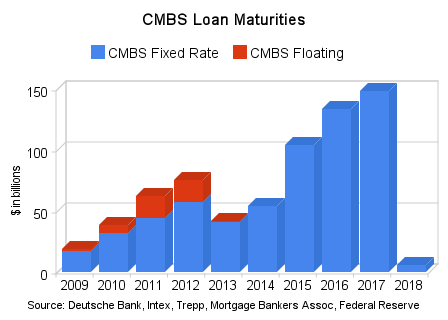
Many of the loans in the CRE market are bundled in CMBS similar to RMBS (residential mortgage backed securities).  As the chart above clearly highlights many of these will hit maturities in the years to come.  The problem then stands as who will take on the loans?  At the moment banks have been silently shifting these bad loans onto the Federal Reserve balance sheet for liquid assets.  This kind of behavior slowly but surely crushes the U.S. dollar as we comingle our safer investments with the toxic waste of the banking industry.  This can only go on for so long and the fact that the Fed balance sheet is still near a peak level above $2.8 trillion tells you that there are no sane buyers in the market for this waste.  All of this of course is kept in the shadows from the public.

After the housing burst then comes the CRE bust
double-bubble
Source:  The American

Many of the CRE projects were built with the idea that perma-growth in residential real estate would be unlimited.  Think of the cookie cutter malls and office parks built around towns in places like Arizona that overestimated population growth by leaps and bounds.  These CRE projects take years to complete and were likely started at the height of the mania only to come online with no one in the market as a buyer or anyone else that would want to lease the units out.  This is the dilemma.  Unlike a home, there is likely a bottom price, many of these CRE properties have very little value.  The chart above shows this common pattern when CRE bubbles burst.  So with $3 trillion in CRE values evaporating since 2008, why is the Federal Reserve not publicly talking about this?

Commercial and industrial loans contract
commercial and industrial loans

Banks might put on a happy face and say all is well in their balance sheet.  But just as we have found out with clear data the Fed was actively bailing out the banks behind closed doors while they openly conveyed to the public that all was well.  If all was well why in the world did they take on $1.2 trillion in emergency loans at the height of the crisis?


bloomberg data
Source:  Bloomberg

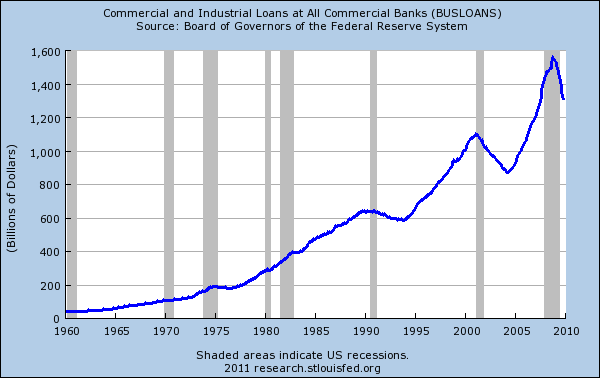
The fact that banks are lending less and borrowing from the Fed is simply a reflection to the financial balance sheet issues still being faced by the largest banks in the country.  The fact that these banks can use the Federal Reserve as some sophisticated way of laundering money into the nation’s financial bloodstream is troubling to say the least.  The data presented recently shows us and confirms exactly what many have believed for years and that is the Federal Reserve has been clandestinely bailing out the entire banking system and problems were not only systemic, but the entire system was polluted with bad loans and deception.  So with this data at hand, why would we trust the system that openly lied to the public at the peak of the crisis?

Schools Nationwide Cut Down to 4 Days/wk, Since Wealthy Refuse to Pay Fair Share

GOP's anti-tax attitude and budget cuts mean some states are closing schools on Fridays, leaving parents, workers and students in the lurch.
By Sarah Seltzer, AlterNet
Posted on August 23, 2011

I doubt there's any student in the world who would object to having Fridays off. But when it comes to policy, the increasing number of American schools moving to a four-day week is not necessarily news to jump for joy about. In fact, it's potentially devastating for parents, school workers and students all left in the lurch by budget cuts. And it's happening more and more, as state and local budgets shrink to tiny levels and raising taxes on the wealthy is somehow considered verboten.

This anti-school thinking is evidenced by the fact that a leading right-wing businessman wrote an op-ed yesterday in which he questioned his taxes going toward the existence of a Department of Education. "Do we really need an energy department or an education department at all?" the American Enterprise Institute's Harvey Golub wrote in the Wall Street Journal, while arguing, contra Warren Buffet, that taxes for the ultra-rich not be raised.

We need more revenue for education, Harvey. Just ask the growing group of parents who are stuck with their young school-age children on Mondays or Fridays because the schools can't even afford to open that day.

The Associated Press reports that the Irene-Wakonda School District in South Dakota is the latest to move to the four-day week, bringing the state close to having one-fourth of its districts on the reduced schedule.
“It got down to monetary reasons more than anything else,’’ Superintendent Larry Johnke said. The $50,000 savings will preserve a vocational education program that otherwise would have been scrapped.

The four-day school week is an increasingly visible example of the impact of state budget problems on rural education. This fall, fully one-fourth of South Dakota’s districts will have moved to some form of the abbreviated schedule. Only Colorado and Wyoming have a larger proportion of schools using a shortened week. According to one study, more than 120 school districts in 20 states, most in the west, now use four-day weeks.

The AP notes that while district officials are quick to tout the fact that there's no recorded difference in standardized testing and so on for the schools with the four-day schedule, "parents aren't convinced."

Last year, the Wall Street Journal ran a big feature on the movement toward shorter school weeks as well, including a map showing at least 16 states where the policy is allowed, including Colorado, Wyoming, Georgia and South Dakota. The piece's author found that no conclusive data could be pinpointed explaining where test scores go when Friday classes disappear.

But education advocates expressed grave concern, saying teachers had to fight to keep students focused during the newly longer days, and Randi Weingarten of the AFT noted that implementing reforms and new ideas was more difficult with the four-day week.

To be fair to energetic local educators, there are some advantages in a reduced-day schedule, particularly for older students in rural areas with long commutes, according to this 2010 piece in USA Today and this 2008 Time Magazine piece on the growing trend in rural districts from Maine to New York to Georgia to the Southwest, and even Hawaii. The practice can allow teachers more time to prepare and students more time to rest. Going to doctors' appointments, helping out around the family farm, and other reasons to skip school may lessen in frequency. And the remaining school days will by necessity be longer and involve more tutoring and activities, which could motivate students.

But it certainly isn't a cure-all for budget woes. Educators from other districts where the experiment has been tried have also said it was hard to keep up the pace of the curriculum and some have eventually abandoned the schedule, saying it wasn't worth the money "saved."
Many districts that have the shortened schedule say they've seen students who are less tired and more focused, which has helped raise test scores and attendance. But others say that not only did they not save a substantial amount of money by being off an extra day, they also saw students struggle because they weren't in class enough and didn't have enough contact with teachers.

The best conclusion that could be drawn from the small amount of research and reporting that's been done on the matter is this: pedagogically, there's no formula and each school and population will see different results from the shortened week. So the real question remains, why are schools even pushed to make this choice?

Regardless of what works academically for each school, the idea that many are being forced to shut down because of budget constraints is disturbing to say the least--and that's indeed the case for many of these schools, as the WSJ article notes:
Some schools, meanwhile, say they are turning to the four-day schedule as a last resort. In North Branch, Minn., school Superintendent Deb Henton said her 3,500-student district, facing a $1.3 million deficit, is simply out of options.

"We've repeatedly asked our residents to pay higher taxes, cut some of our staff, and we may even close one of our schools," she said. "What else can you really do?" Despite a "lot of opposition" from parents, she said, the district is set to adopt a four-day week for next school year.

Indeed, one of the groups hardest hit is working parents, who have to scramble for childcare on the extra day, an extra-tough task during the recession when many may need the time to work or look for work.

Another group hit hard? Bus drivers, cafeteria workers, maintenance staff and others whose smaller work-weeks may in fact be the main reason districts "save" money on the four-day week: they're gaining extra pockets in their budgets by cutting these staff members salaries by up to a fifth. This is hardly a rejuvenating measure, and combined with the hit to parents this loss of employment could certainly put a dent in small communities' financial well-being.

And presumably, for the day off to actually help schools academically, the facilities would still be open on the fifth day. If bus drivers and other staffers aren't around that fifth day because of budget cuts, then how can students get to school for extra help, or activities? It completely undercuts the point.

This lost day is only the tip of the iceberg when it comes to school budget cuts. But it underscores quite drastically the way budget cuts are decimating schools' ability to make choices that will best help students; instead, they're left playing defense. Texas, which has many districts with the four-day policy, is a particularly egregious example of the toll budget cuts have taken on education.

A local columnist explained how the 2011-'12 school year is going to begin for young Texans:
The massive cuts to public education approved last spring in Austin also will have long-lasting and devastating consequences for the children of our state. CPPP estimates that Texas schools must manage cuts, on average, of nearly $1,000 per student just when the needs of our students are increasing. Although earlier this month HISD restored some funding to schools that had been previously cut, the severity of the reductions mandated by the Legislature won't come to fruition for another year or longer. It is clear that dark times are ahead for the hard-working employees and families of Texas schools.

Paul Krugman made a similar point earlier this year when addressing Texas budget cuts, noting that the right-wing push to de-fund schools and hurt children will result in economic pain in the future: "The really striking thing about all this isn’t the cruelty — at this point you expect that — but the shortsightedness. What’s supposed to happen when today’s neglected children become tomorrow’s work force?"

TV Networks Are Out to Sell, Not Tell

Monday, August 22, 2011 by CommonDreams.org
'Monetizing' Electoral Politics
by Danny Schechter

Already the projections are in—not for who is going to win the election in 2012---but for how much it is likely to cost.

Public Radio International concludes: “Campaign spending in the 2012 US election could reach $6 or 7 billion dollars as outside groups pay for electoral influence.”

Here we are in the middle of a deep recession that’s getting deeper by the day, with austerity the unofficial slogan du jour while Republican scheme up new ways to trim, cut and decimate government spending, and parties are spending billions on political horse races.

They decry government spending but they don’t talk much about their own spending, do they?

And neither do the Democrats who are also backing an orgy of spending cuts if only to show their opponents how “responsible” they are.

As both parties slash spending that benefits people, they are in a manic overdrive effort to raise more for themselves and their campaigns.

PRI’s Here and Now program reported, “In 2008, Barack Obama raised some $778 million for his presidential bid. The total cost of the national election, including Presidential and Congressional, was about $5.3 billion. Since then, court decisions like Citizens United have made spending by outside groups easier.

"In 2012," Dave Levinthal, director of the Center for Responsive Politics told PRI's Here and now, "you're easily looking at 6, maybe even 7 billion dollars nationwide."

The Center for Responsive Politics has already reported that Wall Street “bundlers” have generated more money for the Obama campaign than they did four years ago even as anger with the financial behemoths grows in the base of the Democratic Party,

Spending by outside groups was about 4 times higher in 2010 than it was in 2006. Much of that can be attributed to new, looser campaign laws.

Levinthal explains that "the laws changed in a way that effectively allowed these outside groups to raise and spend unlimited sums of money to say whatever they want, to do it whenever they wanted to, and they could do it in as strong a term as they wanted to."

These developments get scant media attention for one good reason: the media is a prime beneficiary of a political system dominated by big money.

Much of these billions are raised for political advertising. The networks get it. No wonder, they are out to sell more than tell.

Listen to the editor of Cable Fax, an industry publication that is planning a Webinar to help TV executives “monetize” (i.e., make more money from) the 2012 elections and its vast “political spend.”

Here’s editor Amy Maclean pitching her media readers in high places:

“The 2012 elections will be here before you know it, so now is the perfect time to start planning your strategy and make sure to maximize your share of the political ad spend. Join us Tuesday, August 30 for our CableFAX Webinar: Monetize Election 2012: Advanced Political Advertising. You'll get sound advice and practical tips to make the most of interactivity and multiplatform campaigns.

“While cable's total of campaign ad dollars continues to climb to record levels, (emphasis mine) the next question is how to make that two-way plan more attractive to campaigns through the use of Video On Demand (VOD,) RFIs, online and other interactive elements.

“Last year, California Republican gubernatorial candidate Meg Whitman helped put RFI (Request for Information) political spots on the map, using the technology to allow viewers to request things such as bumper stickers and volunteer info. The innovation continues, with 2012 expected to really help the industry further distinguish itself with its advanced political advertising offerings.

“Additionally, the recent Citizens United Supreme Court case opened the way for corporations and unions to drop major coin to back candidates and issues.”

Cable Fax wants its readers to know how best to “navigate the race in November and drive additional advertising revenues,” i.e. (“drop coin” in their pockets.)

The irony is that while most TV networks insist they are bi-partisan and don’t flack for any candidates, their coverage is, in effect, flacking for themselves -- to bolster revenues by siphoning off as many political donations that they can slip and slide into their own coffers.

This corporate self-interest is rarely explained or even admitted but in a tough advertising market---with the economy in collapse mode---politics primes the media pump.

Campaigns are windfalls for broadcasters. The networks that oppose stimulus programs for workers with so many snarky stories, don’t oppose this stimulus for themselves.

Promoting elections has become an industry of its own and TV networks are at the center of it. They are not devoting much time to promoting voter registration or voter education. They don’t provided many free ads and in fact often refuse to run issue-oriented ads bought by activists.

This agenda is wrapped up in the mantle of enabling democracy but it is of course much more than that. Most of the coverage is about the personality parade and horse race, not the issues. It focuses on canddiates more than political organizing. There seems to be little concern with new measures like voter ID cards designed to suppress the vote, or electoral fraud designed to steal it.

The fact is that the political circus is good for business, not democracy. The Providence Phoenix reports, “Political coverage on television is diminishing, and revenue from political advertising is soaring. Critics say free airtime for candidates could help solve the problem:

Writes Ian Donnis, “The Alliance for Better Campaigns (ABC), a Washington, DC-based nonpartisan group that advocates for political campaigns that inform voters and increase their participation in the political process, is pushing a proposal that would force broadcasters to offer free air time to political candidates before elections -- in addition to increasing political coverage overall. Proponents say the idea is the next frontier in campaign-finance reform.

These proposals have been around for years, endorsed by former Presidents and the late Walter Cronkite, but they have gone nowhere. Why? Why should the networks give away air time when they are paid so handsomely for it?

“Nearly every democracy in the world has some kind of mandate for free television time during campaigns. Broadcasters can afford it: profit margins of 30 percent, 40 percent, and even 50 percent are common in broadcasting, according to Paul Taylor, the former Washington Post reporter who serves as president of the Alliance for Better Campaigns. And, since the Communications Act of 1934 was enacted, broadcasters' free and exclusive use of the airwaves has also been conditioned on their agreement to function as public trustees.”

Ha!

It’s hard not to conclude that their inaction, and unwillingness to reform their own practices, is caused by network’s own bottom-line greed--- always justified in the name of preserving the first amendment, of course.

The truth is our valiant TV networks are undermining democracy, not bolstering it. These campaigns create jobs for their own pollsters, pundits and partisans. This spectacle does not serve a public deeply disenchanted with sleaze in suits and political corruption,

Instead “monetized election coverage” is a fixture, a part of the problem. The New York Times reports in detail how Rick Perry’s high net worth donors benefited financially when state money went, tit for tat, into their businesses.

The watchdogs have become lapdogs when it comes to monitoring and disclosing their own agendas and profits.

Who will watch the watchers?

Significant Social Change...


To Surveil, with Love

Season 21 Episode 20

A bomb squad mistakenly blows up Homer's unattended gym bag, releasing radiation into the city and authorities react by suspending civil liberties. Wiggum and his men install surveillance cameras around Springfield and round up suspected terrorists, including groundskeeper Willie, but when monitoring the nonstop flow of video imagery proves to be too much, Wiggum enlists concerned citizens to help keep the city safe. Meanwhile, Lisa becomes fed up with being blonde, so she dyes her hair a dark color.


As 9-11's 10th Anniversary Approaches...

(Crashing into the 10 anniversary of 9-11, I watched a video the reminded me of some things that were never clearly addressed by the 9-11 commission. Remember the white van filled with explosives on the George Washington Bridge? Remember the witnesses who reported hearing other explosions (in addition to the two planes) below the WTC in the subway? Like maybe the operation included more than just the hijackers--that al Qaeda also might have had people on the ground setting off bombs in the subway underneath the WTC Towers to help weaken the structure and bring down the buildings. Because buildings DON'T just burn for a few hours and collapse. It's never happened before and there are many instances of jets hitting buildings. I don't think it's a conspiracy theory to consider that al Qaeda also might have had agents on the ground, either. Watch this 30+ minute video when you have some free time. It's not "crazy" and makes just a few assertions in the chapter I posted below. It just presents news footage from the day which mentions the explosions..--jef)


vidlink

Monday, August 22, 2011

Fed secretly loaned $1.2 trillion in public money to Wall St. firms


By Stephen C. Webster - RAW Story
Monday, August 22nd, 2011
An analysis of tens of thousands of documents obtained by Bloomberg through a Freedom of Information Act (FOIA) request shows that the U.S. Federal Reserve made approximately $1.2 trillion in loans from public money to support Wall Street firms in the midst of one of the worst financial crises ever.

Differing from the $16 trillion in loans made through asset swaps and preferred stock agreements, which were first revealed by a recent Government Accountability Office (GAO) audit mandated by Congress, these loans came from public money, representing the greatest largess of the financial sector during a crisis that threatened to pull the whole globalized system of finance to its knees.

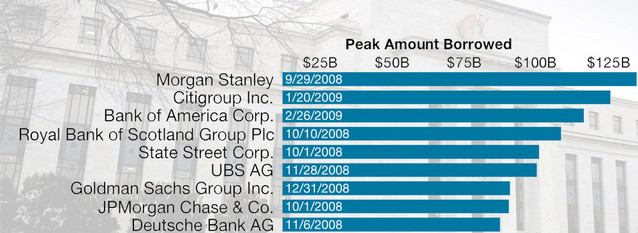
Made from August 2007 through April 2010, the largest borrowers included familiar names like Morgan Stanley, which took $107.3 billion; Citigroup at $99.5 billion; and Bank of America with $91.4 billion.

Foreign firms got a piece of the pie too: the Royal Bank of Scotland Plc was given $84.5 billion; UBS AG took $77.2 billion; and German bank Hypo Real Estate Holding AG took out $28.7 billion, according to Bloomberg.

The Fed claimed it suffered "no credit losses" on the emergency loans, insisting that it has even made back over $13 billion in interest and fees. The loans were made in secret, and not even disclosed to the GAO, to prevent the appearance of weakness in the system, the Bloomberg report said.

Why the Rich Should Pay Higher Taxes


Wealthy Americans will recoil at the suggestion, likely responding with the tired mantra that the top earners pay most of the income tax. But two points can be made in response to that: (1) federal income tax is only a small part of the burden on the middle class. Based on data from the Institute on Taxation and Economic Policy, the total of all state and local taxes, social security taxes, and excise taxes (gasoline, alcohol, tobacco) consumes 21% of the annual incomes of the poorest half of America. For the richest 1% of Americans, the same taxes consume 7% of their incomes. And (2) the richest people pay most of the federal income taxes because they've made ALMOST ALL the new income over the past 30 years. Based on Tax Foundation figures, the richest 1% has TRIPLED ITS SHARE of America's income since 1980, AFTER TAXES.

But there are better reasons why the rich should pay higher taxes.

Do we want our national parks sold to billionaires? Do we want programs for music and the arts eliminated from schools, so that only children of the wealthy can participate in them? (photo: Plashing Vole)

The very rich benefit most from national security, government-funded research, infrastructure, and property laws. Defending the country benefits the rich more, because they have more to defend. Taxpayer-funded research at the Defense Advanced Research Projects Agency (the Internet), the National Institute of Health (pharmaceuticals), and the National Science Foundation (the Digital Library Initiative) has laid a half-century foundation for their idea-building. The interstates and airports and FAA and TSA benefit people who have the money to travel.

Over a hundred years ago, Teddy Roosevelt, facing an epidemic of inequality not unlike today, reminded us that "Great corporations exist only because they are created and safeguarded by [democratic] institutions; and it is therefore our right and our duty to see that they work in harmony with these institutions."

Here's another good reason for the rich to pay more taxes: With the drop in tax revenue, funding for the preservation of American culture is disappearing. Do we want our national treasures deprived of maintenance because of budget cuts, as is currently happening in Italy? Do we want our national parks sold to billionaires? Do we want programs for music and the arts eliminated from schools, so that only children of the wealthy can participate in them?
The 1912 book "Promised Land" by Mary Antin revealed the wonder of a Russian immigrant coming to the U.S.: "In America, then, everything was free...light was free...music was free."

Not that capitalist markets don't have their place. But the current view of democracy has gone to the other extreme, in which individualism and personal gain trump societal responsibility, and growing inequality makes community support and safeguards unnecessary for the privileged elite.

Finally, back to the tax statistics. Why should financial earnings (i.e., capital gains) be taxed less than wage earnings from actual work? The richest 10% of Americans own over 80% of the stocks, the gains from which are taxed at a 15% rate. Most wage earners pay more.

Furthermore, over the past 15 years millionaires have seen their income tax rates drop from 30% to 22%. During approximately the same time period, American economic growth declined from an annual 3.2 percent rate to 1.7 percent. Lower taxes for the rich do not lead to productivity.

Will the rich stop investing or move to another country if their taxes are increased? Not likely. They have it too good here. As Warren Buffett recently stated, "I have worked with investors for 60 years and I have yet to see anyone - not even when capital gains rates were 39.9 percent in 1976-77 - shy away from a sensible investment because of the tax rate on the potential gain."

Mr. Buffett is admitting what everyone else is beginning to realize. The rich take much more than they pay for.

Sunday, August 21, 2011

Huntsman on GOP’s anti-science stances: ‘We have a huge problem’

Posted on 08.21.11 - RAW Replay
By Andrew Jones
 
If you are a prominent Republican Presidential candidate at the moment, Jon Huntsman made sure to target you on Sunday morning.

The former US ambassador to China appeared on ABC’s This Week and strongly criticized his rivals in the race for the GOP nomination, centering most of his attack on Mitt Romney, Rick Perry, and Michele Bachmann.

Huntsman pointed out the various flip flopping of the ex-Massachusetts governor when guest host Jake Tapper mentioned Romney’s change on the idea of a flat tax. “If we were to talk about his inconsistencies and the changes in various issues, we’ll be here all afternoon,” he said.

When Tapper asked Huntsman his thoughts on Perry’s continued skepticism on climate change, the one time Utah governor again did not refuse to throw a few verbal jabs.
“The minute the Republican party becomes the anti-science party, we have a huge problem,” he said. “When we take a position that isn’t willing to embrace evolution, when we take a position that basically runs counter to what 98 out of 100 climate scientists from what the National Academy of Scientists said on what is causing climate change, and man’s contribution to it, I think we find ourselves on the wrong side of science and in a losing position.”

Huntsman wasn’t finished on Perry, as he also commented on the Texas governor’s controversial statements about FED chairman Ben Bernanke earlier in the week. “I don’t know if that’s pre-secession Texas or post secession Texas,” he said.

And after giving his perspective on the leading male candidates for the GOP nomination, Huntsman than gave his thoughts on Rep. Bachmann’s promise that gas would be $2 if she became President. “We live in the real world, grounded in reality, and gas prices just aren’t going to rebound like that,” he said. “It’s completely unrealistic.”

Asked by Tapper whether he could trust Bachmann as President, Huntsman bluntly stated, “I wouldn’t necessarily trust any of my Republican opponents on a recent debate stage with me when every single one of them would have allowed this country to default.”

WATCH: Video from ABC, which aired on August 20, 2011.


Rick Perry’s Hardcore History of Investment in Porn

August 16, 2011 - PoliticusUSA

Here’s the story of how Rick Perry’s name became synonymous with “Teens with Tits” in some circles. I’ve tried to make this safe for work, but if it’s not, blame Rick Perry, for such are the perils of reporting on good “Christians” like Mr James Richard Perry. If your employer has a problem with this, tell them to see Rick Perry; it’s his money trail we’re following.

Perhaps when you see Rick Perry’s bouffant pompadour, you don’t immediately think “cheerleader”, but pom-pon carrier he was, albeit for Texas A & M instead of the Bush Yale pom-pons that heralded the destruction of America’s economy. But you’re all right with pom-pons on a man. To each their own. You might not be OK with the whole Lieutenant Governor to George W Bush thing. You might not be OK with Perry’s theocratic beliefs. But truthfully, when you picture the handsome, smirking Rick Perry and his Texas down home drawl, are you thinking about pornography?

“Teens Never Say No” kind of pornography? How about “Teens with Tits”? No? How about “Bisexual Barebacking Vol. 1” or “Big Tit Brotha Lovers 6”?

Kinda makes you all warm and family values-ish.

Rick Perry, God’s Chosen to pray Texas into prosperity, invested as a private citizen in Movie Gallery corporation to the tune of between 5-10k according to his 1995 personal financial reports. Movie Gallery was, at that time, the largest distributor of porn in America, and able to sell and rent regular videos for much cheaper than the competition due to their heady porn profit. The ultra conservative American Family Association (AFA), a self-described “Christian organization promoting the biblical ethic of decency in American society with primary emphasis on TV and other media” known for “(i)nitiating, encouraging Christian Activism,” but also now an officially designated hate group according to the Southern Poverty Law Center, begged the government to investigate Movie Gallery.

In the ensuing years, the AFA went so far as to undertake a national ad campaign to draw attention to Movie Gallery’s porn practices, and wrote the DoJ and state AG’s demanding, “DOJ and State Prosecutors throughout the country should begin immediate investigations to determine if the products and practices of Movie Gallery Video Stores violate Federal and State laws regarding distribution of obscene material. Movie Gallery is one of America’s largest retailers of hard-core sex videos. Their attempt to acquire family friendly neighborhood Hollywood Video stores across the U.S. poses a serious threat to our communities!”

The AFA has also boycotted such companies as 7-Eleven, Abercrombie & Fitch, American Airlines, American Girl, Blockbuster Video, Burger King, Calvin Klein, Carl’s Jr., Clorox, Comcast, Crest, Ford, Hallmark Cards, Kmart, Kraft Foods, S. C. Johnson & Son, Microsoft, MTV, Mary Kay, NutriSystem, Old Navy, IKEA, Sears, Pampers, Procter & Gamble, Target, Tide, Walt Disney Company, and PepsiCo with varying degrees of success.

Burt Orange Reports said it appeared as if local authorities in Texas dragged their feet responding to the cries for investigations, in spite of the fact that The Politics In Porn (note that this link from 2006 is no longer working and the domain name is now available — don’t say I never did anything for you) wrote, “Government Officials who have been given the evidence of this illegal operation are … the U.S. District attys for the Northern Districts of Alabama and Texas.”

Not only is the AFA is a core constituency of an extreme, far Christian-right candidate, but as Hrafnkell Haraldsson reported for PoliticusUSA, Perry teamed up with the AFA for his recent prayer day rally, “The Response, a Call to Prayer for a Nation in Crisis.” Just this March, we saw then Presidential candidacy hopefuls Newt Gingrich, Haley Barbour and Mike Huckabee courting the AFA by appearing on Bryan Fisher’s radio show. So it’s puzzling that Perry invested his money in something he must have been aware violated the very core of his alleged pro-life, pro-family, pro-conservative values. However, Perry put his holdings into a blind trust in 1998, and hence, no one knows if he is still profiting off of pornography. Perhaps the AFA doesn’t care if their Presidential pick is profiting off of pornography so allegedly obscene that they demanded the DoJ investigate.

Rick Perry later passed laws to help companies like Movie Gallery avoid “frivolous” tort suits, after they were sued for allegedly violating the law by illegally distributing porn across state lines. This move was seen by some as a move to protect his investment in Movie Gallery, as he used the very word Movie Gallery used (“frivolous”) regarding the lawsuits they were fighting at the time.

Written on Jun 26, 2006, the Burnt Orange Report elaborated on Perry’s porn problem:
Coincidentally, Rick Perry used similar language when signing the tort-reform bill that limited the liability—thereby increasing profits—of companies like Movie Gallery. Perry said the bill would “remov[e] the incentive for trial lawyers to file frivolous lawsuits.” Continuing Perry said, “we will save thousands of jobs, generate millions in new revenue to the state;” only some of those jobs come at the price of young girl’s physical and psychological health.
The AFA has undertaken a nationwide campaign—advertising in USA Today and Washington Post—urging government officials to investigate Movie Gallery. Many local authorities—like the U.S. Attorney in the Northern District of Texas—are allegedly dragging their feet. With Gov. Perry owning stock in Movie Gallery, his financial interests contravene the success of any such investigation….
“Titles that Gov. Perry helps bring to Texas’ shelves include Teens with Tits Vol. 1, Teen Power Vol. 4, and Teens Never Say No.
While many disagree over society’s correct policy towards pornography, Perry’s political posturing caters to pornography’s opponents. Duplicitously, Rick Perry’s supposed politics contravene the interests of his own pocketbook. There is the Governor who endorses a plan to monitor sex offenders with satellites; then there is businessman who enjoys profits by funding such titles as Bisexual Barebacking Vol. 1 and Big Tit Brotha Lovers 6. There is the proud husband and father who announced an award of $7.4 Million to the S.T.O.P. Violence Against Women Act programs; then there is the man who invested in North America’s largest pornography distributor. In the coming weeks, there will doubtlessly be the ignorant, apologetic Governor, but under that thin veneer of good hair is the cunning financier who still hides his assets in a blind trust fund.
Given that traditionally conservative states consume the most online porn, according to the Journal of Economic Perspectives (which looked at zip codes of credit cards used for online adult entertainment), we can’t assume that just because a group is against something in public they aren’t engaging in it in private. But the Dominionists like Perry and Bachmann are taking us a step down even from that perilous perch — to a place where women are expected to be subservient to the men in their life.

If you’re still slightly confused as to why the AFA isn’t calling Rick Perry out, and how conservatives can ignore such glaring hypocrisy, it’s because they worship at the altar of a political movement based on belief in authoritarianism and a sense of entitlement for “the Chosen”. Anything that Rick Perry, Michele Bachmann, or Sarah Palin do is OK. God said so.

And their cult-like followers will contort themselves into a breathless internet rage in order to explain to you that none of this matters, what really matters is that the President is a Muslim Socialists Kenyan Nazi. Apparently this line of “thinking” suffices for them because they are in a cult based on belief and not real values, but also because they have bought into the meme that these special leaders are exempt from accountability for what they say. This is why you see the outrage over “gotcha” journalism from the same folks.

What kind of man are we dealing with in Rick Perry? Is he still profiting off of what the AFA calls obscene pornography? Is he still making money off of titles like “Teens with Tits”? In keeping with this line of inquiry into his purported “family values”, we note that Perry also kept on the director of the Texas Film Commission who was disciplined for sexual harassment…twice.

The Statesman reported, “Gov. Rick Perry’s outgoing director of the Texas Film Commission has been allowed to stay on the job despite being disciplined for sexual harassment in 2009 and after a subsequent investigation found similar behavior again this year.”

What disturbs me about these two facts is how well they dovetail with the Dominionists’ ideas about women being subservient to the patriarch.

The twin balls of decorative fluff known as the cheerleader’s Pom-pons aptly sum up the depth of Rick Perry’s alleged Christian family values. On one hand, we have a man invested in and profiting off of what the AFA called “obscene pornography” and a man who allowed a man twice found guilty of sexual harassment to remain in his government position. On the other hand, this same man calls himself a “family-values” Christian, and nary a peep comes from the Right to call him out.

It’s not about whether you agree with conservative values or not (but this is often how the conservatives distract people from calling their leaders out, by making it about the alleged values rather than the failure to uphold said values), but rather whether or not the candidate actually stands for what they say they stand for.

If Rick Perry doesn’t walk the talk of a conservative Christian, just what does Rick Perry stand for?

Have You Ever Had Sex With Rick Perry? Newspaper Ad


How the U3 Unemployment Rate is Calculated


This video shows how the official (U3) unemployment doesn't tell the real story when it comes to unemployment.


And this shows how unemployment has gotten worse geographically, where it hit the hardest, and how hard. It only goes to 2010, but you get the picture:


The Story of Your Enslavement

Koch Brothers Exposed

World of Class Warfare


vidlink


vidlink

The government could raise $700 billion by either taking half of everything earned by the bottom 50% or by raising the marginal tax rate on the top two percent.

Moody's Staffer: We Were Pressured To Give Glowing Ratings To Derivatives

August 20, 2011 02:00 PM
Former Moody's Staffer Blows The Whistle
Anyone with half a brain knows that the ratings agencies (and not just Moody's) were deeply involved in covering up the whole industry built around toxic derivatives. My question, as always, is: What is anyone going to do about it? Is anyone at the top of this crappy pyramid scheme ever going to jail?
WASHINGTON (Reuters) - An ex-Moody's Corp derivatives analyst said the credit-rating agency intimidated and pressured analysts to issue glowing ratings of toxic complex, structured mortgage securities.
In a 78-page letter to the Securities and Exchange Commission, William Harrington outlined how the committees that make the ratings decisions are not independent and how managers often intimidated analysts.
"The management of Moody's, the management of Moody's Corporation and the board of Moody's Corporation are squarely responsible for the poor quality of previous Moody's opinions that ushered in the financial crisis," he wrote.
"The track record of management influence in committees speaks for itself -- it produced hollowed-out (collateralized debt obligation) opinions that were at great odds with the private opinions of committees and which were not durable for even a short period after publication," he added.
Harrington's August 8 letter, which was sent in response to a 517-page proposal by the SEC on credit-rating regulations, raises similar issues that are already at the heart of a Justice Department probe into McGraw-Hill's Standard & Poor's.
"We cannot emphasize strongly enough the importance Moody's places on the quality of our ratings and the integrity of our ratings process," said Moody's Corp spokesman Michael Adler. "For that very reason, we have robust protections in place to separate the commercial and analytical aspects of our business, and our ratings are assigned by a committee -- not by any individual analyst."
The Justice Department has been looking into what S&P analysts wanted to do with ratings during the financial crisis, and what they were told to do, according to one source familiar with the matter.

Americans Have A Right To Know Who Drove Up Gas Prices


Sen. Bernie Sanders Leaks Oil Trading Data

This is amazing, and although the article doesn't confirm it, the data must reflect market manipulation or Bernie wouldn't have leaked it:
WASHINGTON (Reuters) - Oil trading data that exposed the extensive positions speculators held in the run-up to record high prices in 2008 were intentionally leaked by a U.S. senator, sparking broader concern about industry confidentiality as Congress moves on Wall Street reform.
Senator Bernie Sanders, a staunch critic of oil speculators, leaked the information to a major newspaper in a move that has unsettled both regulators and Wall Street alike.
In a June 16 e-mail reviewed by Reuters, a senior policy adviser to Sanders discusses how his office received private data with the names and positions of traders and forwarded it exclusively to a Wall Street Journal reporter.
The e-mail, which also attaches two files with the data, was sent to Public Citizen's Tyson Slocum asking him to review it and speak with the newspaper about his observations.
In a statement from Sanders provided to Reuters, Sanders said he felt the data needed to be publicly aired.
"The CFTC has kept this information hidden from the American public for nearly three years," he said. "This is an outrage. The American people have a right to know exactly who caused gas prices to skyrocket in 2008 and who is causing them to spike today."
The leaked information has sparked concern at the Commodity Futures Trading Commission, which is legally prohibited from releasing confidential information that identifies trader positions and identities.
The leak also raises broader questions as U.S. regulators gear up to collect massive new amounts of private data from market players on everything from swaps and hedge funds to blueprints for how large financial firms can be liquidated. The breach of data could make Wall Street less reluctant to hand over sensitive information if they fear it is not appropriately safeguarded.
"This type of incident will have a chilling effect on derivatives trading in the U.S. because market participants will be reluctant to take the risk that their positions will be exposed to the public-and their competitors," John Damgard, president of the Futures Industry Association, said in a statement sent to Reuters.
Or to the Justice Department. But I wouldn't worry about that, Mr. Damgard. All you have to fear is the cold, hard light of day.

Matt Taibbi on SEC covering up Wall Street crimes

Rick Perry’s Superficial Extremism

The Texas governor’s record doesn’t live up to his rhetoric.
Texas Gov. Rick Perry often talks like he’s ready to refight the Alamo—this time against Washington. He rails about the stimulus and the expansion of federal power while flirting with the idea of devolving control of entitlements to the states.

So when Perry officially announced he was throwing in his 40-gallon hat for next year’s Republican presidential nomination, critics were quick to warn of his extremist, radical small-government views. But Perry’s suit-and-tie-Republican record doesn’t match up to his pistol-packing, Texas-sized rhetoric.

Many of the warnings concern Perry’s allegedly extreme federalism. After reading the governor’s book, Fed Up: Our Fight to Save America From Washington, The Washington Post’s Ezra Klein described the governor’s federalism as “radical in scope,” but “not thoughtless.” Mother Jones blogger Kevin Drum wondered whether Perry might be “too radical even for the Tea Party.” After investigating Perry’s positions on entitlements, Newsweek’s Andrew Romano reported that the governor “hints that he would do more to limit the power of the federal government—or at least attempt to do more—than any president since Calvin Coolidge.” At the Guardian, columnist Ana Marie Cox warned that if Perry got his way with federal regulation, “it would be total anarchy: Mad Max meets Dr. Moreau.” 

“More than any of his fellow contenders,” Cox wrote, “Perry represents a bruising roll of the dice on America's future.” Is Perry really such an outlier? Not really. While he's frequently willing to stake out heated rhetorical territory, his actual governance is relatively mild in comparison.

Take Perry’s position on the stimulus. In theory, he was vigorously opposed to the program. In practice, however, he was willing to collect. In 2009, he loudly rejected $555 million in federal unemployment aid. “The calls to take the (stimulus) money and sort out the consequences later are quite troubling to me,” he told The Houston Chronicle. Later, in a letter to President Obama, he highlighted his “vocal opposition” to the law, saying it “will burden future generations with unprecedented levels of debt.” In the same letter, however, Perry also agreed to take the stimulus funds, noting his promise to state residents that if a stimulus passed, he “would work to ensure that our citizens receive their fair share.” They got a bundle: In 2010, Perry relied on the $6 billion in federal stimulus funds he accepted to fill in big gaps in the state’s budget.

Indeed, despite his allegedly radical federalism, Perry has been more than happy to take—and seek out—federal handouts throughout his tenure in the governor’s mansion. In 2009, Cato Director of Tax Policy Studies Chris Edward noted that under Perry, Texas has been “an aggressive scavenger of federal grant dollars,” taking hundreds of millions in federal funds for drought assistance, homeland security, and local law enforcement. Does this sound like the record of an unusually anti-federal radical?

Newsweek’s Andrew Romano's description of Perry as a modern day Coolidge came as a result of the governor’s stated interest in devolving federal entitlement programs to the states. But on Medicaid, the major entitlement over which state governments have the most control, Perry’s talk-to-action ratio was familiarly lopsided.

It’s common enough for governors, especially Republicans, to criticize Medicaid’s mass of federal mandates and poor financing structure. But last year, Perry noisily and repeatedly raised the possibility of pulling his state out of the joint federal-state program entirely. “We need to get out of it,” he said of the program. “And with the budget shortfall we’re anticipating, we may have to act this year.”

But action of the sort he threatened was not forthcoming. In Texas’s most recent budget, Perry cut Medicaid provider rates and put off finding funding for an estimated $4.8 billion in expected spending. But the state is still very much enrolled in the program. In the end, reported The Washington Post’s Sarah Kliff, “there’s a pretty wide disconnect between what Perry says he would like to change about Medicaid in Texas and what he’s been able to accomplish.”

So why all the ominous warnings? It may have something to do with the press’s willingness to overinterpret Perry’s remarks. In 2009, for example, CNN posted a story headlined “Texas governor says secession possible.” Similar stories popped up in dozens of other publications; according to Politifact.com, at least 169 major newspaper articles linked Perry with the idea of Texas secession.

But contrary to what even presidential press secretary Jay Carney has since asserted, Perry didn’t actually threaten to pull his state out of the United States. Arguably, he said the opposite: “We’ve got a great union. There is absolutely no reason to dissolve it.” At most, he melodramatically referenced an old—and incorrect—understanding that Texas maintains a special right to leave the union at any time. That's typical for Perry, whose supposed extremism often looks a lot like a theatrical affectation—part practiced Texas swagger, part savvy political positioning.

Whatever the reason, though, Perry’s critics appear all too willing to believe that the gun-toting Texas governor—yes, he carries a hollow-point packed, laser-sight pistol with him, even while jogging—represents some unprecedented form of radicalism. Their worry seems to be that he’s ready to unload some of his deadly ammo into cherished federal programs from a White House perch. But if his record is any indication, Perry specializes more in rhetorical warning shots than serious small-government salvos.

Michele Bachmann: If We Don’t Completely Support Israel, God Will Curse Us


Doug Mataconis - Outside the Beltway

Apparently, Michele Bachmann bases  her foreign policy views on obscure quotes from a book written 5,000 years ago:

At a Republican Jewish Coalition event in Los Angeles last week, Rep. Michele Bachmann offered a candid view of her positions on Israel: Support for Israel is handed down by God and if the United States pulls back its support, America will cease to exist.

Here’s a transcript of some of her remarks at the RJC event:
I am convinced in my heart and in my mind that if the United States fails to stand with Israel, that is the end of the United States . . . [W]e have to show that we are inextricably entwined, that as a nation we have been blessed because of our relationship with Israel, and if we reject Israel, then there is a curse that comes into play. And my husband and I are both Christians, and we believe very strongly the verse from Genesis [Genesis 12:3], we believe very strongly that nations also receive blessings as they bless Israel. It is a strong and beautiful principle.

Right now in my own private Bible time, I am working through Isaiah . . . and there is continually a coming back to what God gave to Israel initially, which was the Torah and the Ten Commandments, and I have a wonderful quote from John Adams that if you will indulge me [while I find it] . . . [from his February 16, 1809 letter to François Adriaan van der Kemp]:

I will insist that the Hebrews have done more to civilize men than any other nation. If I were an atheist, and believed in blind eternal fate, I should still believe that fate had ordained the Jews to be the most essential instrument for civilizing the nations. If I were an atheist of the other sect, who believe or pretend to believe that all is ordered by chance, I should believe that chance had ordered the Jews to preserve and propagate to all mankind the doctrine of a supreme, intelligent, wise, almighty sovereign of the universe, which I believe to be the great essential principle of all morality, and consequently of all civilization.

. . . So that is a very long way to answer your question, but I believe that an explicit statement from us about our support for Israel as tied to American security, we would do well to do that.

Leaving aside the question of whether it would be a good idea to give any more political power to a person who apparently makes her foreign policy decisions based on religion rather than the facts on the ground and what might actually be in America’s national interest, I’ve really got to wonder if the author of this verse:

The LORD said to Abram: “Go forth from the land of your kinsfolk and from your father’s house to a land that I will show you. I will make of you a great nation, and I will bless you; I will make your name great, so that you will be a blessing. I will bless those who bless you and curse those who curse you. All the communities of the earth shall find blessing in you.

really meant to say Bibi Netanyahu, right or wrong. Somehow, I think not.

Texas Governor's Gay Sex Scandal Covered in Austin paper, the First Non-Internet Media Outlet to Report On It.

By Jackson Thoreau 
OpEdNews.com

Under the appropriate heading of "Naked City," the weekly Austin Chronicle became the first media source beyond Internet blogs and ezines to report on the alleged sex scandal involving Republican Texas Governor Rick Perry.

The Feb. 26 story by Michael King mentioned a "support rally" this week at the Governor's Mansion for Perry under the theme, "It's OK to Be Gay." The story mentions the numerous rumors that "the governor's marriage is in trouble, that his wife Anita has/will/may decide to divorce him, and that the issue is Rick's alleged infidelity, with one or another member of his administration of undetermined gender. [Rumors of this sort, about multitudinous politicians, circulate all the time, but the current Perry rumors are indeed extraordinary in their baroque detail and remarkable persistence.]"

King said he looked into the Perry rumors when they first surfaced some weeks ago and "found no evidence of any truth to any of them, whatsoever." He lamented that "nobody will go on the record." Did anyone involved in the story "go on the record" when everyone from Saturday Night Live to Reuters published the alleged affair rumor against John Kerry a few weeks ago? No, but of course, Kerry is a Democrat so the media and people in general believe the myth that Democrats are more likely to have extramarital affairs than Republicans.

King had this comment from Perry spokesperson Kathy Walt: "These are false, malicious, and hurtful rumors, and the Chronicle's own investigation acknowledges that fact."

King also wrote that "numerous other reporters, from here to New York, have looked into the rumors, with, as far as we know, an identical lack of results. Nor do we expect anything we say here to have any effect on the rumors, which have become entirely self-replicating as they echo through the blogosphere."

A note on this story: It is extremely difficult to find "evidence" of extramarital affairs unless one party spills the beans or it comes out in a court divorce document. In 2001, The Washington Post put two reporters to spy on former Democratic Maryland Gov. Parris Glendening, who was rumored to have had sex with Jennifer Crawford, his unmarried chief of staff, while he was separated from his wife. The Post reported in Sept. 2001 that Glendening eased out of Crawford's home early on a few mornings that summer.


Remember that Crawford was unmarried and Glendening was separated. Has any media outlet devoted similar resources to try to catch Perry, who says he is committed to his wife? No. Can anyone recall the media catching a Republican in an affair through such an investigation? I can't. And it's not like Republicans don't have affairs; read my essay at to learn about a few of them.

So just because some reporters found "no evidence" to support the rumors doesn't mean the rumors do not have some basis. It just might take more work to unearth some evidence-- such as reporters following Perry around 24 hours a day as they did to former Democratic Sen. Gary Hart, a potential 1988 presidential candidate, and Glendening - than these reporters can devote at the moment.

The Chronicle also pointed out how last year Perry signed the "Defense of Marriage Act," the Texas Legislature's "latest gratuitous demonstration that it believes gay and lesbian Texans deserve fewer rights than other citizens." The rumors have become stronger as Bush and other Republicans push for a Constitutional amendment to ensure that no gay couple marries.

The Chronicle's story mentioned how Perry and his wife spent Presidents Day weekend in the Bahamas with major political donors James and Cecelia Leininger and John and Bobbi Nau. The official story on this was it was a "working trip" paid for by "campaign funds" to discuss "public school finance." As the Chronicle pointed out, "That is, during a luxury retreat in the Bahamas, the governor discussed "public school finance" with a group of wealthy right-wing activists who have done everything in their power to undermine, or even abolish, public education."


Meanwhile, a blog written by Wick Allison, publisher/editor of D Magazine, a mainstream city magazine, mentioned that Geoff Connor, Perry's secretary of state and alleged playmate, threatened to track down the source of the rumor and sue. Republicans have blamed a Democratic operative in Houston.

This is from a strong Republican insider and apologist. Allison has given money to Republican candidates, such as $500 to Hillary Clinton's NY Senate opponent in 2000.
That would be an interesting lawsuit if Connor were to actually sue someone, wouldn't it? I doubt he would follow through since the gay stories would get further into the public record.
A politically-connected attorney in Texas told me he has known about Perry's gay side since the 1980s. And two district judges in Odessa told him that the rumor was always there when they served in the Legislature with Perry.

I don't care if he is gay or bi or whatever, what's appalling is the hypocrisy involved - Perry is going around condemning gays and signing laws against them in public while possibly doing something different in private.

And check out this statement in the Texas GOP's platform, the most extreme platform in the country, which also calls for abolishing Social Security, the Department of Education and others, along with getting the U.S. out of the U.N.: "The Party believes that the practice of sodomy tears at the fabric of society, contributes to the breakdown of the family unit, and leads to the spread of dangerous, communicable diseases. Homosexual behavior is contrary to the fundamental, unchanging truths that have been ordained by God, recognized by our country's founders, and shared by the majority of Texans." It also says, "The party opposes the decriminalization of sodomy."

Perry approved the statement, and all candidates who run as Republicans in Texas have to sign it, or forfeit financial support by the party. So if the homosexual encounter with Perry is true, I would think his own party's leaders would be making plans to get rid of him. I hear Perry won't run for governor again in 2006, even if these rumors die.

I also hear there is a court transcript or statement of facts in the Texas Court of Appeals that contains sworn testimony that former Waco Rep. Lane Denton had an encounter himself with Perry. Some reporters I know are checking on that.

Denton was found guilty in 1995 of diverting $67,201 from the Texas Department of Public Safety Officers Association while serving as its executive director in 1988-89. He received 20 years in prison, but his sentence was suspended, and he was placed on community supervision.

The Austin-based 3rd Court of Appeals, where the Perry document allegedly is, also ruled against Denton.

In the original trial, prosecutors said Denton funneled the trooper group's funds to a public relations company owned by New Orleans architect John Chrestia, who testified that he had been Mr. Denton's gay lover.

Blogs that have done great jobs in keeping this issue fresh include http://www.burntorangereport.com/archives/001102.html and datalounge.

Why is the story important in the battle to dethrone Bush? Why not focus on the economy or Iraq in attacking Bush?

Because with his support for a Constitutional amendment to crack down on gay rights, Bush has signaled that he plans to make "morality" and cultural issues a big part of his 2004 campaign. And pointing out the Republican hypocrisies-- which include charges of extramarital sex against Bush [see http://www.geocities.com/jacksonthor/knowrsex.html]  in this area is important to win this battle.

If Democrats can show that the very Republicans who blasted Clinton for having an extramarital affair in the 1990s have extramarital affairs of their own and might even be extra hypocrites in publicly bashing gays, then this supposed advantage in "morality" that Republicans seem to enjoy over Democrats can be negated. Like it or not, sex and extramarital affairs register more with many average voters who get most of their news from TV than Iraq or even the economy.

I'm not expecting the Kerry campaign to conduct this "expose the cultural Republican hypocrites" campaign. As far as I know, the Kerry campaign has nothing to do with spreading these rumors. People like me will do it and take the heat as muckrakers or mudslingers or whatever from the whining Republican babies who don't like to see their own tactics slammed back in their faces. As I have long said, many far-right Republicans can dish it out, but they can't take it.

Message to the Republican whiners: Don't be surprised and cry foul when your opponent plays by the rules you devise.

While I can't take credit for starting this Perry rumor, I have helped move it along. I see this campaign as part of my duty and my contribution to restore some legitimacy and sanity to the White House.

So a non-Internet media outlet has published this Perry story. Can we expect Reuters and others who jumped on the Kerry rumor to follow suit? It would be the fair thing to do, based on the precedent set with the Kerry rumor. But I'm not holding my breath.

Open mic catches Bank of America official vowing to ‘help’ Perry

Posted on 08.19.11
By Stephen C. Webster - RAW Replay

In what looked like a covert lobbying effort, a top Bank of America official brushed past Gov. Rick Perry (R) during a New Hampshire business breakfast on Wednesday, shook his hand and uttered the words, “Bank of America, we will help you out,” before walking away as if nothing had been said.

The brief exchange was caught by a CSPAN camera, but went unnoticed until the blog ZeroHedge pointed it out. ZeroHedge also correctly placed the man’s identity as James Mahoney, Bank of America’s director of public policy.

Confirming the man’s identity to Politico’s Ben Smith, a company spokesman said the offer of help was for “non-partisan policy expertise,” noting that Mahoney is a Democrat.

It still doesn’t make the footage any less creepy.

This video is from CSPAN, broadcast Wednesday, August 17, 2011.