Saturday, September 7, 2013

Hypocrite in Chief

Living in a Counterfactual Epoch
by JASON HIRTHLER


A hypocrite’s work is never done. Thus the need for our Nobel Prize bearing Commander in Chief to execute a needless and devastating war of aggression on a country preoccupied by its own civil war. He should pin that prize to his lapel when he announces his surgical strike on Syria. Let’s be clear: wars of aggression are, by the standards we set at the Nuremburg Nazi trials, the “supreme international crime.” Crimes for which Nazis were put to death. Anyone who pulls the trigger on a war of aggression is, by our own measure, a war criminal. But President Barack Obama needn’t worry about being isolated by his action—the annals of the American presidency are chock full of war criminals. He’ll have good company in the pantheon of imperial lore.

Of the numberless hypocrisies of the administration, this one is particularly crude. The White House claims to need to punish Syria’s Bashar al-Assad regime for the unproven use of chemical weapons (sarin) in Ghouta. Not only does this atrocity, committed by unidentified actors in a civil, ethnic, sectarian, and proxy conflict within Syria, somehow make Syria a national security threat to the United States, but it also suggests we deplore the use of chemical weapons. Neither is remotely true. I think the former could be true if we do bomb Syria, as it may incite Syrians to plot against the empire that slaughtered its men, women and children. The latter cannot be true by virtue of the fact that chemical weapons are a primary element in our military arsenal, and have been repeatedly handed over to unreliable allies or deployed ourselves, against Vietnam most notably, but recently against Iraq, Afghanistan, and Libya.

The author of the August 21st attack has yet to be identified. Suspects include Syria, one of the rebel groups, Saudi Arabia, and Israel. The White House report offered plenty of unverified claims said to be drawn from “streams of intelligence.” Nobody outside the beltway bubble is convinced. We can, however, have “high confidence” in our assessment that the U.S. will use chemical weapons itself if it attacks Syria. At least three sources of American firepower potentially threaten to deposit a destructive payload of depleted uranium on Syrian society and soil should we attack. Destroyers in the Eastern Mediterranean are likely to fire Tomahawk missiles, which have long been rumored to contain depleted uranium, either in their tip or wing. However, this has been disputed by the International Coalition to Ban Uranium Weapons (ICBUW). At the very least, Naval combat crafts are equipped with anti-missile Gatling guns that use shells with tungsten or depleted uranium. This has been conceded by the military itself. Likewise, A-10 anti-tank aircraft are known to use depleted uranium bullets.

Depleted uranium, although not outlawed by the International Convention of Chemical Weapons (ICCW), are uranium wastes, the leftovers from the uranium that can be usefully enriched (as Iran is prudently, or feverishly, doing this very moment, depending of who you believe). According to Global Research, depleted uranium found its way into the American arsenal thanks to the fact that there are enormous amounts of it leftover from the enrichment process, and that it is cheap to produce. (There is something deeply ironic here, although I’m not sure just what.) But the primary feature of DU is its armor-piercing capability. Not only is it the heaviest of elements, DU bullets keep their shape on impact, thanks to their hideous “self-sharpening ability”, and the fact that they burst into flame on impact, generating radioactive dust. This naturally finds its way into the lungs of those nearby (who are perhaps lending “material support” to rebels, instantly nominating themselves for a double-tap drone strike should the DU not do its lethal work fast enough). Depleted uranium often produces radioactive poisoning, and potentially cancer, as former workers at a U.S. arms plant unhappily discovered. It is also likely to generate deformities in the DNA of the local birth population, as Fallujah has lately experienced. This cruel fate is often referred to by the lovely phrase, “mutagenic potential.”

In any case, we’ve left enough in the ground in Iraq, Libya, and elsewhere for some viable case studies. Naturally, the development of leukemia in 76% of mice injected with DU, a study conducted by our own Armed Forces Radiobiology Institute, has been yawningly ignored by the Pentagon, although there is some suggestion that the upper echelons of international power have suppressed the growing movement to ban depleted uranium. The courageous claimant here is former WHO scientist Keith Baverstock, who eloquently concluded that, “politics has poisoned the well from which democracy must drink.” The wells from which multitudes of Arabs must drink, too.

But DU is only the leading villain in an ensemble cast of malign characters. Alongside it one can observe the flesh-eating effects of white phosphorous ‘shake-n-bake’ bombs, napalm and “mark 77 firebombs,” a mix of kerosene and polystyrene similar to napalm, all used to great effect in Iraq. American-made cluster bombs are an Israeli favorite, such as when it wants to blow up unsuspecting Arab farmers in southern Lebanon. Yet there they sit, our leaders Obama and Kerry, the urbane sophist and his zombie accomplice, mirroring our nation in miniature: a country whose signal conflicts seemed to carry the mantle of liberty, against the British then the Nazis, but which has since devolved, to borrow anthropologist F.G. Bailey’s phrase, into “a babel of inconsistent moralities.”

Largely owing to our commitment to chemical weapons, internationalist efforts to ban WMDs in the Middle East have met with typical disinterest. U.N. Security Council Resolution 687 twists in the wind. Agreed to in 1991 to provide a legal umbrella for the U.S. attack on Iraq, it calls for a WMD-free zone in the Middle East and the banning of chemical and biological weapons. Naturally, the looming regional hegemon Israel is the obvious roadblock to the realization of this initiative. In a forgotten instance of considerable irony, Syria proposed the same concept to the Security Council with a draft resolution in 2003, but then U.N. ambassador John Negroponte noted that we might consider it, but then hysterically added—as if snapping to his senses—that this didn’t mean we would “adopt it, embrace it or endorse it in any way, shape or form.” In other words, best to shelve it with all the other useful ideas the U.S. has nixed since the founding of the U.N.

If you’re looking for a link between our degraded civil rights and our depleted uranium, look no further. There it is, in the White House report and its dearth of actual evidence. If only they had added an addendum with the dozens of YouTube videos that factor heavily in their portfolio of supposition. But what reason is there, truly, for yours or my indefinite detention, for the continuous invasion of our privacy, the usurpation of legislative power (the people’s tribune) by that of the executive (the ghost of monarchy), and the evisceration of the sovereignty of other nations like Iraq, Libya, Afghanistan, and soon Syria? Whether shot from ships or fired from jets, depleted uranium bullets and shells will strike innocent targets with the same fact-less impunity with which our rights are denied. We live in a counterfactual epoch, where the shrill presence of conjecture disguises the voluminous absence of evidence. Hypocrites lie, victims die.

More Americans quit looking for work

 
A disappointing jobs report in the United States shows a large drop in the share of Americans who are either working or looking for work.

The nation's jobless rate was 7.3% in August, down slightly from 7.4% in July, the Labor Department said Friday in its monthly employment report.

But that small improvement was mostly the result of discouraged jobseekers who have given up looking for work. People who are not actively looking for employment are not considered as unemployed.

Some 312,000 people stopped looking for work in August, pushing the labor force participation rate to 63.2 percent, the lowest since 1978.

The labor force participation rate measures how many healthy, working-age people 16 and older are working or looking for jobs.

The participation rate has been declining for years because millions of Americans have quit searching for a job, a result of the weakest economic recovery since the Great Depression.

Meanwhile ,employees in the United States continue to express elevated concerns about their job security nearly five years after the global financial crisis.

The poll shows that millions of US workers are still worried about having their benefits and wages reduced, their hours cut back, and being laid off.

Moreover, most of the jobs created during the sluggish economic recovery have been part-time jobs in low-paying industries like retail stores and restaurants.

Such jobs leave consumers with less money to spend than do better-paying positions in industries such as manufacturing and construction, which have mostly shed jobs the past four months.

Fracking Away Our Water Supply

Fracking is how humanity commits suicide.


September 6, 2013 | By WakingTimes
Farron Cousins, DeSmogBlog
Waking Times


As many areas of the country experience severe droughts, the fight for clean, fresh water is becoming vital to survival for many American citizens. The problem has been made worse by the expansion of hydraulic fracturing (fracking), which gobbles up hundreds of millions (billions, according to some estimates) of gallons of potable water every month.

The state of Texas has become the prime example of what can happen when the natural gas industry is allowed to run roughshod over citizens. The state is currently experiencing one of the worst droughts in modern times, and certain areas have already had to resort to water rationing.

But the dwindling supply of fresh water in Texas has barely slowed down the natural gas industry’s fracking activities. Even as livestock are dying off, crops are withering, and citizens are having to purchase bottled water in order to quench their thirst, fracking companies are sucking fresh water out of the ground in order to satisfy their need to extract every ounce of natural gas from beneath the Texas soil.

The drought and water shortages in Texas have gotten so bad that some residents have said that on some days, they can turn on their faucets and nothing even comes out anymore.

But some residents aren’t bothered by the lack of water, or by the gas industry’s activities that are compounding the problem. In fact, they’ve figured out how to make a fortune off the disaster.

According to AmericaBlog, some Texas residents have begun to lease their property to the gas industry simply to dig wells and pump water. One man reported that he is leasing his land for a staggering $36,000 a month to the gas industry. This man is either the world’s greatest salesman, or the gas industry knows that they have created a problem that is only going to become worse in the very near future.

There is also the push-back from the dirty energy industry’s astroturf organizations. The industry front group Energy in Depth dismisses the claims that fracking uses too much water by making silly comparisons to the paltry amount of water used on golf courses, car washes, and even the water that flows from the Mississippi River into the Gulf of Mexico (which Energy in Depth apparently thinks is wasteful). However, they seem to overlook the fact that none of these activities (which all use less water than fracking) are pumping toxic chemical cocktails into the ground, further contaminating remaining water supplies as fracking does.

The reason the gas industry is allowed to use up all of Texas’ fresh water while residents goes thirsty is simple. They are one of the largest campaign donors and lobbying groups in the state, and few Texas politicians are willing to deny those hefty paychecks, or to stand up to the abuse that they are inflicting upon the state.

Texas is not alone, either. The state of Colorado is also willing to let the gas industry have access to water while denying that privilege to residents. Thanks to the effects of climate change, the Colorado River basin is drying up very quickly, starving aquifers that feed large portions of the Midwest. There is now a battle taking place in Colorado on who gets what’s left of the water – farmers, residents, or the gas industry.

The fracking / water shortage story is almost too ironic to believe. Americans are overly dependent on fossil fuels, which leads to climate change, which leads to droughts and water shortages, and the remaining water is then used up in our quest for more and more fossil fuels. It’s a self-sustaining cycle that can only be broken by embracing clean, renewable forms of energy. But in places like Texas, the state that oil built, the idea that renewables can win the day is laughable.

While independent media outlets have done a great job of telling this story, there is a separate, but related, component that has yet to be fully developed, and that is the problem of water privatization.

As the general concept of privatization continues to impact education, prisons, and national security, the impact that it is having on our water supply has been grossly overlooked.

All over the country, private companies are trying to take over the water delivery systems, which would be a disaster for American citizens. A prime example is the city of Atlanta, Georgia. Many years ago, they experimented with privatizing their water supply, and the results were less than flattering. Residents soon began to complain about dirty, brown water being delivered through their pipes, and some areas actually stopped being served altogether. The enormous public backlash prompted the city to cut the 20-year contract they had signed off after only a few years.

The same story unfolded in Detroit when they moved to privatize their water supply, and it was replayed again in states like Massachusetts, Ohio, and Detroit. Rate hikes, poor water quality, and the reduction in covered areas are all common when private companies take over the supply and delivery of water.

So that leaves us with a three-fold attack on the American water supply: There is the growing threat of water shortages from climate change, a problem that could be irreversible; The over-consumption of water from the natural gas industry; And the threat that private corporations pose when they try to take over our water.

Sadly, little is being done to mitigate this three-pronged assault on water. How many more livestock and crops will we sacrifice to the gas industry as they can continue to frack us right out of drinkable water?

Friday, September 6, 2013

Fracking has caused Over 100 Earthquakes in Ohio


Radiation at Fukushima Soars to Highest Level Yet


As officials tout 'ice wall' experiment, more lethal levels of radioactivity detected
- Andrea Germanos, staff writer

Record high radiation levels were detected at the disaster-stricken Fukushima nuclear plant, Japan's nuclear regulator and plant operator TEPCO said on Wednesday, raising more concerns that the spiraling catastrophe has no end in sight.

Officials said they had detected radiation of levels of 2,200 millisieverts per hour on Tuesday near contaminated water storage tanks. That's a rise of 20% from the previous high, the Guardian reports.

The announcement comes just days after officials said they had detected lethal radiation levels 18 times higher than previously documented because the testing equipment they were using could only read measurements of up to a maximum of 100 millisieverts per hour.

Reuters notes that "both [the 2,200 and 1,800] levels would be enough to kill an unprotected person within hours."

Also festering at the plant is the buildup of contaminated water, which has proven an unsustainable crisis. There has also been as a series of leaks from storage tanks and pipes.

Mycle Schneider, lead author for the World Nuclear Industry status reports, told BBC News last month that the problem of water leaks "is much worse than we have been led to believe, much worse." There are leaks "not just from the tanks. It is leaking out from the basements, it is leaking out from the cracks all over the place," he said. Further, the head of Japan's nuclear regulatory body warned on Monday that there may be no other option than to dump radioactive waste water into the Pacific.

In a desperate attempt to stop the leaks, Japanese Prime Minister Shinzo Abe announced Tuesday the government plans to invest nearly $500 million in a giant "ice wall" surrounding the plant.

Nuclear engineer Arjun Makhijani of the Institute for Energy and Environmental Research called the wall of ice plan a "risky experiment." Speaking on PBS Newshour, Makhijani explained:
I don't know that an ice wall like this has been tried before.

It's like building a dam underground, but with ice, by freezing all the poor water in the soil, all soil has -- so there's water coming in from uphill, through the side and going into the ocean, all underground. It's an aquifer. Some of that water contacts the molten fuel and is becoming contaminated.

And they hope to build -- to freeze the soil, basically, with a giant freezing machine, just like your freezer at home, put cooling coils in the soil, lots and lots of them. It takes an enormous amount of electricity and they would freeze it. Of course, it contains the water behind it like a dam, but eventually it's going to overtop the dam, as it did before. [...]

It is an experiment. And I think it's a risky experiment, because if the power fails, you know, just like if your -- when the power goes out with your refrigerator, everything will de-freeze in -- defrost in the freezer.

So, if this ice melts suddenly and it's blocking an enormous amount of contaminated water behind it, then you have got a problem. At the same time, you know, the tanks are themselves something of a threat, if there's another earthquake and this highly contaminated water gets into the ocean. And so they have a got a very -- couple of very, very serious problems of containing the water.

Last month, Makhijani warned, "This is an accident that’s shockingly not stopping."

Amidst the fight to contain the nuclear disaster, Japan is brushing aside concerns of radioactivity as it makes its bid to be the host of the 2020 Olympics.

“The radiation level in Tokyo is the same as London, New York and Paris,” said Tsunekazu Takeda, an IOC member and president of the Japanese Olympic committee. “It’s absolutely safe, 35 million people living there in very normal conditions. We have no worries.”

Drug Agents Have an NSA-Style Spying Problem

Thursday, September 5, 2013 by ACLU Blog
by Ezekial Edwards

Over the last few months, we've been bombarded with revelation after revelation about the NSA's unprecedented spying on Americans. But, according to The New York Times, the NSA's untethered snooping is eclipsed by the agents fighting in a war that began long before 9/11: the costly and failed War on Drugs.

The Drug Enforcement Administration's secret Hemisphere Project, news of which broke this week, allows drug law enforcement agencies broad access to billions of AT&T phone records going back a quarter century—to 1987. As The New York Times explained, "the scale and longevity of the data storage appears to be unmatched by other government programs, including the N.S.A.'s gathering of phone call logs under the Patriot Act."

Our government's mass telephonic data-mining has sparked immense and deserved outrage. But to those who have been targeted by the War on Drugs for the last several decades, the Hemisphere Project is only one in a long line of privacy-invading tactics employed by the U.S. government. Many other intrusions – such as the thousands of unconstitutional stops-and-frisks of people of color in cities across the country, the countless doors kicked in by police in search of drugs, the seizure and forfeiture of property of people never convicted of a crime – are representative of the kinds of common corporal intrusions that have been endured by many Americans, disproportionately of color, long before many post 9/11-era invasions of privacy became commonplace for all Americans.

Further, since 9/11, there has been an increasingly entrenched relationship between overreaching national security programs and domestic drug law enforcement policies. Each has fed on the other: the long-running drug war provided useful surveillance blueprints for the massive domestic spying programs that have sprouted up since 9/11. At the same time, domestic drug law enforcement agencies have seized upon the dismantling of basic constitutional protections over the past decade – in the name of national security – and pointed the resulting weapons toward America's own citizens.

It should not surprise us then that the Hemisphere Project is only the latest disclosure of mission creep.
We found out last month that the DEA secretly uses NSA surveillance data against Americans as part of its drug investigations – and then conceals its reliance on this foreign intelligence information. This practice jeopardizes the right to a fair trial for anyone facing criminal prosecution based on evidence derived from that surveillance data.

Or consider "sneak and peek" warrants, in which law enforcement enters a home or office when no one is present and conducts a search of the premises, without giving notice to the occupant beforehand. Provisions allowing for these warrants were included in the Patriot Act after government officials said they are necessary to fight terrorism, but 76% of "sneak and peeks" were used in drug investigations in 2010. (And that is no anomaly: from 2006-2009, 1,618 sneak and peek warrants were used in drug cases, 22 in fraud cases, and 15 in terrorism investigations). Further, the use of GPS tracking devices, aerial surveillance, and the militarization of police – often justified by national security needs – are instead often coopted as highly destructive components of our domestic drug war.

In keeping with the clandestine nature of our government's various spying programs, the DEA had delineated a series of steps to "keep the program under the radar" by instructing "all requestors … to never refer to Hemisphere in any official document" and "‘walling off' the information the government obtains from Hemisphere." This is all in the name of enforcing drug prohibition, a 40-year failure that has cost billions, led to the unnecessary incarceration of millions of Americans, and failed to make a significant dent in the use, availability, or potency of drugs.

Why has the DEA kept this surreptitious surveillance program in the shadows? Because, as with so many of government surveillance programs, Hemisphere raises serious constitutional questions. There is a strong argument that it is unreasonable under the Fourth Amendment for the government to outsource the automatic collection and storage of millions of Americans' phone records without any individualized suspicion and without court approval or oversight—simply so that law enforcement agencies have easy and immediate access in the future. Like the N.S.A.'s mass call-tracking program, such extensive and unlimited data gathering, particularly reaching back decades, allows the government to construct incredibly detailed and invasive pictures of our past and present lives.

Simply put, under the tired guise of protecting Americans from drugs, the U.S. government has secretly targeted and invaded the life and privacy of millions of its own citizens. The U.S. should be ending the War on Drugs, not expanding it by secretly outsourcing widespread surveillance.

New NSA Revelations: Internet Privacy Encryption Virtually 'Defeated'

Thursday, September 5, 2013 by Common Dreams
NSA builds 'industry relationships' to control encryption technologies, deteriorate privacy safeguards
- Jacob Chamberlain, staff writer

Internet privacy safeguards known as encryption technologies promised by email, online banking, and other such online databases have been virtually 'defeated' by the U.S. National Security Agency, according to new documents obtained by the Guardian, New York Times, and ProPublica.

According to the Guardian—which has reported extensively on the NSA's dragnet surveillance practices revealed by NSA whistleblower Edward Snowden—the NSA and its British counterparts the GCHQ have used "covert measures" to control and manipulate international encryption standards to tprivacyhe benefit of the NSA, largely through building "industry relationships" with many technology companies and internet service providers.

As joint reporting by ProPublica and the New York Times explains, according to the documents and interviews with industry officials, the NSA has deployed "custom-built, superfast computers to break codes" and began collaborating with "technology companies in the United States and abroad" to build 'backdoor' entry points into their products and introduce weaknesses into their encryption standards.

The records do not identify which specific companies have been working with the NSA to this extent. However, one document does reveal that a GCHQ team has been working to develop ways into encrypted traffic on the "big four" service providers, named as Hotmail, Google, Yahoo and Facebook.

"By deliberately undermining online security in a short-sighted effort to eavesdrop, the NSA is undermining the very fabric of the internet."

Through these relationships the NSA has become nearly immune to most encryption technologies, and has thus mastered the use of "supercomputers" to break encryption with "brute force," leaving a dying number of encryption technologies immune to NSA surveillance.

As one of the NSA documents obtained by the news agencies states, the NSA "actively engages US and foreign IT industries to covertly influence and/or overtly leverage their commercial products' designs," and in turn inserts "vulnerabilities into commercial encryption systems."

"US and British intelligence agencies have successfully cracked much of the online encryption relied upon by hundreds of millions of people to protect the privacy of their personal data, online transactions and emails," the Guardian reports.

"For the past decade, NSA has lead [sic] an aggressive, multi-pronged effort to break widely used internet encryption technologies," a 2010 GCHQ document states. "Vast amounts of encrypted internet data which have up till now been discarded are now exploitable."

"Cryptography forms the basis for trust online," said Bruce Schneier, an encryption specialist and fellow at Harvard's Berkman Center for Internet and Society. "By deliberately undermining online security in a short-sighted effort to eavesdrop, the NSA is undermining the very fabric of the internet."

The NSA's encryption busting program called "Sigint [signals intelligence] enabling" received $254.9 million in 2013 alone (compared to $20 million allotted to the previously exposed PRISM program).

“The encryption technologies that the NSA has exploited to enable its secret dragnet surveillance are the same technologies that protect our most sensitive information, including medical records, financial transactions, and commercial secrets,” stated Christopher Soghoian, principal technologist of the ACLU’s Speech, Privacy and Technology Project.

Soghoian continues:
Even as the NSA demands more powers to invade our privacy in the name of cybersecurity, it is making the internet less secure and exposing us to criminal hacking, foreign espionage, and unlawful surveillance. The NSA’s efforts to secretly defeat encryption are recklessly shortsighted and will further erode not only the United States’ reputation as a global champion of civil liberties and privacy but the economic competitiveness of its largest companies.

Senators Voting for Strikes on Syria Got More Defense Money

Thursday, September 5, 2013 by Common Dreams
New analysis shows big difference between Senate Foreign Relations Committee members who voted for and against military force against Assad.
- Andrea Germanos, staff writer

A new analysis offers a look at the difference between campaign contributions from defense contractors to the senators who voted Wednesday on whether to approve a strike on Syria.

The Senate Foreign Relations Committee members who voted 'yes' to a resolution authorizing military force "received, on average, 83 percent more campaign financing from defense contractors than lawmakers voting against war," Wired reported Thursday.

Based on data from OpenSecrets.org, the analysis showed the top recipients of contributions from defense industry employees and political action committees between 2007 and 2012 were Sen. John McCain (R-Ariz.) at $176,300 and Sen. Dick Durbin (D-Ill.) at $127,350, both of whom voted 'yes.'

The 'yes' voters received an average of nearly $72,850 from the industry over the five-year period, while the 'no' voters' average was just $39,770.
The committee passed the resolution 10-7, and a full vote on the resolution will likely head to Senate next week.

We Need to Talk About Prince Bandar

Chemical Weapons, False Flags and the Saudis' Hard Line
by PETER LEE


In the back and forth about Syria, there is surprisingly little discussion about Saudi Arabia’s Prince Bandar.

Even though Bandar apparently took over the Saudi covert account last year and has driven the Kingdom’s hard line against the Muslim Brotherhood in Egypt and Bashar Assad’s regime in Syria.

It’s also clear that Saudi Arabia has slipped the leash and is no longer a cooperative US ally. The general narrative is that the Saudis got disgusted and disillusioned by the Obama administration’s dithering in Egypt.

Maybe it wasn’t just dithering. Maybe the Obama administration was consistently supportive of civilian rule and insufficiently sedulous in the attention it paid to the Egyptian army and its role in assuring the institutional continuity (ahem) and stability of Egyptian political life.

It is also possible that the Saudis finally decided that it would not try to paper over the disagreements between the US and the KSA over persistent US support for the Morsi regime, especially since the Saudi government was determined to overwhelm US attempts to control the Egyptian military through withholding the US aid package of $1.2 billion by “flooding the zone” with a promise of $12 billion from Riyadh.

So a clean break was marked by a coup, a defiant massacre of America’s preferred political partners in Egypt, and orchestration of a vociferous and extremely public anti-US PR campaign that has made the Obama administration’s name mud in pro-coup activist circles.

My thoughts returned to Prince Bandar on the occasion of a piece on Kevin Drum’s blog about President Obama’s miserable Syrian options.

In a previous post I speculated that the Syrian gas attack might have been a false flag attack designed to force the Obama administration to intervene in Syria.

At the time I wasn’t aware of the reporting on Prince Bandar’s extensive involvement in Saudi Arabia’s Syria project, so I coyly referred to the hypothetical visitor as “Prince B—“. But based on Mour Malas’ August 25 piece in the Wall Street Journal—including the revelation that Saudi Arabia had already been trying to push the Obama administration over the chemical weapons red line several months ago—we can certainly fill in the blanks and speculate about Prince Bandar’s possible role in a false flag attack:
That winter, the Saudis also started trying to convince Western governments that Mr. Assad had crossed what President Barack Obama a year ago called a “red line”: the use of chemical weapons. Arab diplomats say Saudi agents flew an injured Syrian to Britain, where tests showed sarin gas exposure. Prince Bandar’s spy service, which concluded in February that Mr. Assad was using chemical weapons, relayed evidence to the U.S., which reached a similar conclusion four months later. The Assad regime denies using such weapons.

According to Malas, Saudi Arabia has also been repeatedly telling the Obama administration its stature in the Middle East is toast unless it acts firmly on Syria.

Connoisseurs of US Congressional diplomacy will also be pleased to know that Senator John McCain, who has been all over the airwaves pushing for a US response of regime-change dimensions and not a symbolic slap on the wrist, is hand-in-glove with Prince Bandar.

Anyway, as cited by Kevin Drum, Malas’ most recent piece fills in (boldface by Drum) some of the blanks, making the case that President Obama’s rather more genuine dithering on Syria resulted from the unwillingness to knock down the Assad regime until the U.S. and Syrian opposition moderates had gotten their act together and could field a plausible team to handle New Syria transition and governance.

The delay, in part, reflects a broader U.S. approach rarely discussed publicly but that underpins its decision-making, according to former and current U.S. officials: The Obama administration doesn’t want to tip the balance in favor of the opposition for fear the outcome may be even worse for U.S. interests than the current stalemate.

….The administration’s view can also be seen in White House planning for limited airstrikes—now awaiting congressional review—to punish Syrian President Bashar al-Assad for his alleged use of chemical weapons. Pentagon planners were instructed not to offer strike options that could help drive Mr. Assad from power: “The big concern is the wrong groups in the opposition would be able to take advantage of it,” a senior military officer said. The CIA declined to comment.

….Many rebel commanders say the aim of U.S. policy in Syria appears to be a prolonged stalemate that would buy the U.S. and its allies more time to empower moderates and choose whom to support….Israeli officials have told their American counterparts they would be happy to see its enemies Iran, the Lebanese Shiite militia Hezbollah and al Qaeda militants fight until they are weakened.

“Slow and steady” is manifestly not the strategy that Prince Bandar prefers in Syria. Given the dysfunction of the Syrian overseas opposition—as opposed to the murderous efficiency of the distinctly non-democratic jihadis—one can’t really blame him.

The Geneva peace talks, by the way—which embodied the US hopes of some kind of negotiated transition involving the Syrian opposition democratic goodniks—are not going ahead, thanks to the gas attack.

As the Russian media reported:
Earlier on Monday, Russian Foreign Minister Sergey Lavrov said the timing of the chemical attack “suited” the opposition, “who obviously do not want to negotiate peacefully”, instead they want to “sabotage” the talks.

“Why go to a conference if you believe that the regime’s infrastructure will all be destroyed anyway by allies, and then you can just march into Damascus unopposed, and take control?” said the official in Moscow.

Good question.

Anyway, Prince Bandar has been very active on the Syrian brief. He arranged the high profile shipment of arms to the rebels out of Croatia and also—according to disputed but plausible reports—unsuccessfully cajoled/threatened Vladimir Putin to drop Assad by promising that Saudi Arabia could in return deliver a) support for Russia’s gas export ambitions and b) hold in check the Chechen rebels who otherwise might do awful, awful things to Putin’s Olympics in Sochi.

Inevitably, there are also mumblings linking Saudi Arabia to the supply of sarin gas to the rebels.

Now, thanks to President Obama’s injudicious red line/chem munitions remark, he’s being forced to make a choice, to “get off the fence”.

Well, maybe the choice has been made for him. Maybe he got pushed off the fence. By Prince Bandar.

I think we are creeping closer to confirmation of the hypothesis I’ve been advancing since November of last year: that Saudi Arabia had not only decided to push the Qatar-backed Muslim Brotherhood out of the leadership of the Syrian opposition (something which has subsequently been confirmed and reconfirmed), but that the Saudi strategy for Syria involved regime collapse first, rejecting the strategy of cutting a deal with Assad to get him to the bargaining table after prolonged bleeding for some kind of negotiated capitulation and a democratic transition.

Anyway, in the proxy war for Syria it looks like we now have a debate between the rather conflicted but intensely risk-averse and regime-transition fixated Obama administration and Saudi Arabia + John McCain’s regime collapse advocacy.

And everybody’s waiting for Israel—which is uncomfortable with a jihadi-led insurrection but probably feels that clout and initiative are slipping out of President Obama’s fingers—to get off its fence and either push for a strike, a big strike, or nothing at all.

Wonder how that will work out.

In any case, if we’re talking about Syria, we need to talk about Prince Bandar.

Supporting al-Qaeda a Week Before 9/11 (Yeah, those Syrian Rebels? Al-Qaeda.)

We Will Never Forget?
by KEN KLIPPENSTEIN


In a twist of irony that has escaped mainstream commentators, one week away from 9/11, the US is considering a course of action that will empower al-Qaeda; i.e., bombing Syria. As terror expert Evan Kohlmann put it, “two of the most powerful insurgent factions in Syria are al-Qaeda factions.” (Kohlmann is an authority on the topic, having worked as a consultant in terrorism matters for the DoD, DOJ, FBI, and other law enforcement agencies.) These rebel factions will be the immediate beneficiaries of a strike against the Assad regime.

This wouldn’t be the first time that the intelligence community expected a US military operation to increase the likelihood of terror attacks against the US. As a letter from CIA Director George Tenet to the Senate Intelligence Committee chair revealed, it was anticipated that Bush’s invasion of Iraq would lead Saddam Hussein to be “much less constrained in adopting terrorist actions”; moreover, the invasion of Iraq was expected to raise the threat of attack by WMD from “low” to “pretty high”. And the intelligent experts were correct. Earlier this year, Dzhokhar Tsarnaev told the FBI that he and his brother carried out the Boston Marathon bombing because they “were angry about the U.S. wars in Afghanistan and Iraq”.

We can only hope the intelligence experts like Evan Kohlmann won’t be correct this time around.

If we had an authentic democracy—rule by the people—an attack wouldn’t happen, because strong majorities oppose intervening in Syria. Polls conducted by Reuters almost daily between May 31st and September 3rd indicate without exception that a strong majority of Americans are opposed to intervening in Syria—even if Syria used chemical weapons. Similarly, a poll conducted by the BBC shows that, in the UK, “71% of people thought Parliament made the right decision” to reject military action against Syria. Two thirds of respondents said they wouldn’t care if Parliament’s decision harmed UK-US relations.

Another poll shows that a stunning 80% of Americans believe that Obama should seek congressional approval for a strike on Syria. The Obama administration has interpreted this rather narrowly, having scheduled a congressional vote, but still insisting that Obama “has the right to [attack Syria] no matter what Congress does”, as Secretary of State John Kerry remarked. Obama said the same thing, albeit somewhat more tactfully: “I believe I have the authority to carry out this military action without specific congressional authorization”.

The polls pertaining to the prospective strike on Syria differ significantly from those regarding the US and UK support for the Iraq War. Back in 2003, a series of polls found that a majority of Britons supported the invasion of Iraq; Americans at the time supported the invasions by even larger majorities.

Simply put, there’s less support for a strike on Syria than there was for the invasion of Iraq—and we know how well the Iraq War turned out.

Yet public opinion and the threat of provoking terror attacks are not persuasive to the unfathomable wisdom of the Obama administration. As John Kerry said, a strike on Syria “is of great consequence to…all of us who care about enforcing the international norm with respect to chemical weapons.” Apparently Kerry is more concerned with international norms than international law, since attacking Syria without a U.N. Security Council resolution would violate the latter. In Obama’s words, the Security Council is “paralyzed”—which, by definition, means it won’t do what he tells it to do.

Matthew Waxman, writing for the Council on Foreign Relations—hardly a radical outfit—observes that, “despite treaties outlawing chemical weapons use, there is no precedent for using military intervention as a response to violations.”

To be fair to the Obama administration, we should listen to what US leaders have to say about chemical weapons; they’re experts on the matter. In Iraq alone, they used white phosphorous and depleted uranium munitions, which coincided with an explosion of birth defects throughout Iraq that “surpassed those of Hiroshima and Nagasaki after the nuclear attacks at the end of WWII”.

But Syria-sly folks...


And don't forget, "if they cross this line" and "I never gave them a line to cross--the world did."

He's nuts, get rid of him.

Saturday, August 31, 2013

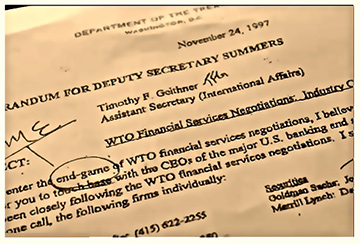
Larry Summers and the Secret “End-Game” Memo

August 26, 2013


palast1When a little birdie dropped the End Game memo through my window, its content was so explosive, so sick and plain evil, I just couldn’t believe it.

The Memo confirmed every conspiracy freak’s fantasy: that in the late 1990s, the top US Treasury officials secretly conspired with a small cabal of banker big-shots to rip apart financial regulation across the planet. When you see 26.3% unemployment in Spain, desperation and hunger in Greece, riots in Indonesia and Detroit in bankruptcy, go back to this End Game memo, the genesis of the blood and tears. The Treasury official playing the bankers’ secret End Game was Larry Summers. Today, Summers is Barack Obama’s leading choice for Chairman of the US Federal Reserve, the world’s central bank. If the confidential memo is authentic, then Summers shouldn’t be serving on the Fed, he should be serving hard time in some dungeon reserved for the criminally insane of the finance world.

The memo is authentic.

To get that confirmation, I would have to fly to Geneva and wangle a meeting with the Secretary General of the World Trade Organization, Pascal Lamy. I did. Lamy, the Generalissimo of Globalization, told me,
“The WTO was not created as some dark cabal of multinationals secretly cooking plots against the people…. We don’t have cigar-smoking, rich, crazy bankers negotiating.”

Then I showed him the memo.

It begins with Summers’ flunky, Timothy Geithner, reminding his boss to call the then most powerful CEOs on the planet and get them to order their lobbyist armies to march:
“As we enter the end-game of the WTO financial services negotiations, I believe it would be a good idea for you to touch base with the CEOs….”
To avoid Summers having to call his office to get the phone numbers (which, under US law, would have to appear on public logs), Geithner listed their private lines. And here they are:
Goldman Sachs: John Corzine (212)902-8281

Merrill Lynch: David Kamanski (212)449-6868

Bank of America, David Coulter (415)622-2255

Citibank: John Reed (212)559-2732

Chase Manhattan: Walter Shipley (212)270-1380

Lamy was right: They don’t smoke cigars. Go ahead and dial them. I did, and sure enough, got a cheery personal hello from Reed–cheery until I revealed I wasn’t Larry Summers. (Note: The other numbers were swiftly disconnected. And Corzine can’t be reached while he faces criminal charges.)

It’s not the little cabal of confabs held by Summers and the banksters that’s so troubling. The horror is in the purpose of the “end game” itself.

Let me explain:

The year was 1997. US Treasury Secretary Robert Rubin was pushing hard to de-regulate banks. That required, first, repeal of the Glass-Steagall Act to dismantle the barrier between commercial banks and investment banks. It was like replacing bank vaults with roulette wheels.

Second, the banks wanted the right to play a new high-risk game: “derivatives trading.” JP Morgan alone would soon carry $88 trillion of these pseudo-securities on its books as “assets.”

Deputy Treasury Secretary Summers (soon to replace Rubin as Secretary) body-blocked any attempt to control derivatives.

But what was the use of turning US banks into derivatives casinos if money would flee to nations with safer banking laws?

The answer conceived by the Big Bank Five: eliminate controls on banks in every nation on the planet – in one single move. It was as brilliant as it was insanely dangerous.

How could they pull off this mad caper? The bankers’ and Summers’ game was to use the Financial Services Agreement, an abstruse and benign addendum to the international trade agreements policed by the World Trade Organization.

Until the bankers began their play, the WTO agreements dealt simply with trade in goods–that is, my cars for your bananas. The new rules ginned-up by Summers and the banks would force all nations to accept trade in “bads” – toxic assets like financial derivatives.

Until the bankers’ re-draft of the FSA, each nation controlled and chartered the banks within their own borders. The new rules of the game would force every nation to open their markets to Citibank, JP Morgan and their derivatives “products.”

And all 156 nations in the WTO would have to smash down their own Glass-Steagall divisions between commercial savings banks and the investment banks that gamble with derivatives.

The job of turning the FSA into the bankers’ battering ram was given to Geithner, who was named Ambassador to the World Trade Organization.

Bankers Go Bananas

Why in the world would any nation agree to let its banking system be boarded and seized by financial pirates like JP Morgan?

The answer, in the case of Ecuador, was bananas. Ecuador was truly a banana republic. The yellow fruit was that nation’s life-and-death source of hard currency. If it refused to sign the new FSA, Ecuador could feed its bananas to the monkeys and go back into bankruptcy. Ecuador signed.

And so on–with every single nation bullied into signing.

Every nation but one, I should say. Brazil’s new President, Inacio Lula da Silva, refused. In retaliation, Brazil was threatened with a virtual embargo of its products by the European Union’s Trade Commissioner, one Peter Mandelson, according to another confidential memo I got my hands on. But Lula’s refusenik stance paid off for Brazil which, alone among Western nations, survived and thrived during the 2007-9 bank crisis.

China signed–but got its pound of flesh in return. It opened its banking sector a crack in return for access and control of the US auto parts and other markets. (Swiftly, two million US jobs shifted to China.)

The new FSA pulled the lid off the Pandora’s box of worldwide derivatives trade. Among the notorious transactions legalized: Goldman Sachs (where Treasury Secretary Rubin had been Co-Chairman) worked a secret euro-derivatives swap with Greece which, ultimately, destroyed that nation. Ecuador, its own banking sector de-regulated and demolished, exploded into riots. Argentina had to sell off its oil companies (to the Spanish) and water systems (to Enron) while its teachers hunted for food in garbage cans. Then, Bankers Gone Wild in the Eurozone dove head-first into derivatives pools without knowing how to swim–and the continent is now being sold off in tiny, cheap pieces to Germany.

Of course, it was not just threats that sold the FSA, but temptation as well. After all, every evil starts with one bite of an apple offered by a snake. The apple: The gleaming piles of lucre hidden in the FSA for local elites. The snake was named Larry.

Does all this evil and pain flow from a single memo? Of course not: the evil was The Game itself, as played by the banker clique. The memo only revealed their game-plan for checkmate.

And the memo reveals a lot about Summers and Obama.

While billions of sorry souls are still hurting from worldwide banker-made disaster, Rubin and Summers didn’t do too badly. Rubin’s deregulation of banks had permitted the creation of a financial monstrosity called “Citigroup.” Within weeks of leaving office, Rubin was named director, then Chairman of Citigroup—which went bankrupt while managing to pay Rubin a total of $126 million.

Then Rubin took on another post: as key campaign benefactor to a young State Senator, Barack Obama. Only days after his election as President, Obama, at Rubin’s insistence, gave Summers the odd post of US “Economics Tsar” and made Geithner his Tsarina (that is, Secretary of Treasury). In 2010, Summers gave up his royalist robes to return to “consulting” for Citibank and other creatures of bank deregulation whose payments have raised Summers’ net worth by $31 million since the “end-game” memo.

That Obama would, at Robert Rubin’s demand, now choose Summers to run the Federal Reserve Board means that, unfortunately, we are far from the end of the game.

America Totally Discredited

 Paul Craig Roberts
August 31, 2013

A foolish President Obama and moronic Secretary of State Kerry have handed the United States government its worst diplomatic defeat in history and destroyed the credibility of the Office of the President, the Department of State, and the entire executive branch. All are exposed as a collection of third-rate liars.

Intoxicated with hubris from past successful lies and deceptions used to destroy Iraq and Libya, Obama thought the US “superpower,” the “exceptional” and “indispensable” country, could pull it off again, this time in Syria.

But the rest of the world has learned to avoid Washington’s rush to war when there is no evidence. A foolish Obama was pushed far out on the limb by an incompetent and untrustworthy National Security Advisor, Susan Rice, and the pack of neoconservatives that support her, and the British Parliament cut the limb off.

What kind of fool would put himself in that vulnerable position?

Now Obama stands alone, isolated, trying to back away from his threat to attack without authorization from anyone–not from the UN, not from NATO, not from Congress who he ignored–a sovereign country. Under the Nuremberg Standard military aggression is a war crime. Washington has until now got away with its war crimes by cloaking them in UN or NATO approval. Despite these “approvals,” they remain war crimes.

But his National Security Advisor and the neocon warmongers are telling him that he must prove that he is a Real Man who can stand alone and commit war crimes all by himself without orchestrated cover from the UN or NATO or a cowardly US Congress. It is up to Obama, they insist, to establish for all time that the President of the United States is above all law. He, and he alone is the “decider,” the Caesar, who determines what is permissible. The Caesar of the “sole superpower” must now assert his authority over all law or Washington’s hegemony over the world is lost.

As I noted in an earlier column today, if Obama goes it alone, he will be harassed for the rest of his life as a war criminal who dares not leave the US. Indeed, a looming economic collapse could so alter the power and attitude of the United States that Obama could find himself brought to justice for his war crimes.

Regardless, the United States government has lost its credibility throughout the world and will never regain it, unless the Bush and Obama regimes are arrested and put on trial for their war crimes.

Obama’s destruction of US credibility goes far beyond diplomacy. It is likely that this autumn or winter, and almost certainly in 2014, the US will face severe economic crisis.

The long-term abuse of the US dollar’s reserve currency role by the Federal Reserve and US Treasury, the never-ending issuance of new debt and printing of dollars to finance it, the focus of US economic policy on bailing out the “banks too big to fail” regardless of the adverse impact on domestic and world economies and holders of US Treasury debt, the awaiting political crisis of the unresolved deficit and debt ceiling limit that will greet Congress’ return to Washington in September, collapsing job opportunities and a sinking economy all together present the government in Washington with a crisis that is too large for the available intelligence, knowledge, and courage to master.

When the proverbial hits the fan, the incompetent and corrupt Federal Reserve and the incompetent and corrupt US Treasury will have no more credibility than Obama and John Kerry.

The rest of the world–especially Washington’s bullied NATO puppet states–will take great delight in the discomfort of “the world’s sole superpower” that has been running on hubris ever since the Soviet collapse.

The world is not going to bail out Washington, now universally hated, with currency swaps, more loans, and foreign aid. Americans are going to pay heavily for their negligence, their inattention, their unconcern, and their ignorant belief that nothing can go wrong for them and that anything that does is temporary.

Two decades of jobs offshoring has left the US with a third world labor force employed in lowly paid domestic nontradable services, a workforce comparable to India’s of 40 years ago. Already the “world’s sole superpower” is afflicted with a large percentage of its population dependent on government welfare for survival. As the economy closes down, the government’s ability to meet the rising demands of survival diminishes. The rich will demand that the poor be sacrificed in the interest of the rich. And the political parties will comply.

Is this the reason that Homeland Security, a Nazi Gestapo institution, now has a large and growing para-military force equipped with tanks, drones, and billions of rounds of ammunition?

How long will it be before American citizens are shot down in their streets by “their” government as occurs frequently in Washington’s close allies in Egypt, Turkey, Bahrain?

Americans have neglected the requirements of liberty. Americans are so patriotic and so gullible that all the government has to do is to wrap itself in the flag, and the people, or too many of them, believe whatever lie the government tells. And the gullible people will defend the government’s lie to their death, indeed, to the death of the entire world.

If Americans keep believing the government’s lies, they have no future. If truth be known, Americans have already lost a livable future. The neocons’ “American Century” is over before it begun.

I have heard from educated and aware friends that the presstitute media on the evening news are beating the drums for war. This shows what paid whores the US media is and their total disconnect from reality. Anyone who wastes their time on the US media is a brainwashed idiot, a danger to humanity.

Is the White House idiot going to be a victim of his own careless presidential appointments?

Does he have no one to tell him how to escape the dilemma his moronic Secretary of State and National Security Advisor have put him in? Someone needs to tell the WH Fool that he must say that he accepts the conclusion of the world community that there is not sufficient evidence for launching a military attack on Syria and killing even more people than were killed in the alleged, but unproven, chemical attack, and that he awaits further and better evidence.

God help the moron and the unfortunate country that the fool represents.

Wrecking the Earth: Fracking has grave radiation risks few talk about

by Christopher Busby, who is an expert on the health effects of ionizing radiation and Scientific Secretary of the European Committee on Radiation Risk.

RT - August 28, 2013


Environmentalists point to various dangerous consequences of using fracking technology, but none can be compared to the issue of radiation exposure and radioactive contamination of the development areas it poses.

UK government plans to use fracking technology in populated areas of the country recently drew hundreds of people to the streets in protests. Protesters pointed to the dangerous example of the US, the worldwide leader in fracking, where hydraulic fracturing (which consumes vast amounts of water) led to areas of Arkansas, Colorado, New Mexico, Oklahoma, Texas, Utah and Wyoming facing a dire water crisis.

Fracking involves toxic chemicals being lowered into kilometer-deep holes drilled in the ground to isolate gas and oil from shale. The toxic chemicals can then float into lakes and rivers or contaminate the ground. Also, fracking produces a disproportionate amount of waste, including radioactive water, which then has to be dumped somewhere.

The key to fracking

Uranium is the key element to fracking, or hydraulic fracturing, to use its proper name. In the real-world version of Phineas Fogg’s “Eighty Days Around the World,” burning the ship’s masts and furniture to make steam, governments are now encouraging the oil and gas merchants to blast their way deep into the Earth to squeeze the last ounce of oil and gas from that poor creature. But there will be a terrible revenge. Locked up in the strata into which they pump the pressurized process water, to fracture and thus create the huge surface area sponge which will yield up its cargo of gas and oil, is a monstrous amount of natural uranium and its deadly daughter Radium-226. And vast amounts of the radioactive alpha emitting gas Radon-222, and its own daughters Bismuth 214, Lead-210 and the alpha emitter Polonium-210. Remember Polonium-210? That was the material used when a few millionths of a gram poisoned ex-Russian agent Alexander Litvinenko.

Deep down in the earth, there is a lot of radioactivity, which is safe enough, so long as it is not brought up to the surface. The technical term is NORM (Naturally Occurring Radioactive Material). When it is brought to the surface it becomes Technologically Enhanced, or TENORM, and it is a serious health problem near oil wells and gas production sites. It is in the production water, in the oil, in the gas, around the production sites, the groundwater, in the pipes and tanks – and in your kitchen.

The easy oil and gas deposits are those where there are subterranean reservoirs, and the oil and gas can obtained by drilling into the reservoir and then pumping down water to displace the oil back up the drill pipe. These are now running out, or are owned by people who control the flow and the price. But there are many other deposits, where the resource is spread throughout the rock, like water in a sponge. Fracking comprises any method employed to break up the solid rock, shale or sandstone to provide channels that allow the oil or gas in the strata to more easily be pumped to the surface. Fracking is not a new idea, but there are some new technologies being employed that make it easy to obtain gas economically from such hitherto unassailable rock sources. For reasons which I will outline, this development has some worrying aspects.

The gas or oil will not normally be available because it is trapped in and interspersed through solid rock. To get it out you have to drill horizontally along the solid organic clay material, the shale, (or whatever oil-bearing rock type is there) and then break that unto small pieces in various ways so that the gas or oil can be pushed by the water you pump in back to the well pipe and up to the surface. The methods of breaking up the rock and holding the subsequent channels apart vary; put together they are “fracking”.

The shale strata are between 1,000 and 8,000 feet deep. Owing the weight of rock above, the pressure on the rocks in the gas bearing strata at these depths is enormous. The drill has to pass a tube (the “gun”) along the stratum for as long a length as possible and then this has to become perforated along its length with holes that allow the gas or oil to get into the tube and up to the surface.

Historically difficult. But technology has come to the rescue in the manifestation of specially designed explosives called “shaped charges.” These are cone-shaped dense metal explosive devices that send the explosive energy in an enormously powerful directed jet of metal atoms that act as a drill and melt the rock or shale along the length of the jet. This creates a radially distributed set of channels along and around the length of the drill tube, in the shape of a bottle-cleaning brush. Once this is done, water containing a whole range of acids and chemical additives is injected under immense pressure and this is followed up by small balls and sand or grit, termed “proppant” like the pit props in a mine, to hold the channels formed open. The extreme pressure pushes the weight of the upper layers of rock upwards and releases the tension in the strata where the gas is trapped. It has been noticed that the effect of all this on geophysical stability of the local deep earth results in small earth tremors and shocks, noticed by people living nearby. But the real cause of these tremors may be more sinister.

Nuclear implications

The metal which was formerly employed for the shaped charge head or “gun” was copper. This creates a pressure of 300,000 atmospheres which pushes the rock aside by plastic deformation. But in 1984 a US patent (US 4441428) was filed by one Thomas Wilson, entitled “Conical Shaped Charge Liner of Depleted Uranium.” The patent begins: “this invention relates to a novel blasting device especially adapted for drilling oil and gas wells.” Wilson records that DU is 5-times as efficient as copper in terms of the length of the jetted hole, creating a pressure of 600,000 atmospheres. Because of the uranium’s greater chemical reactivity it actually creates new chemical compounds with the material in the rock (and the oil and gas).

The DU cuts through the rock like butter, just as the military versions of this technology, which we believe has been fitted to missiles can cut through concrete reinforced bunkers. The multiple-shaped charge explosions will certainly shake the ground. The earth tremors and earthquakes are then not so hard to explain. Where do the process water acids, chemical compounds end up? At the surface? In the local aquifer? In the local rivers? Yes. But where to the DU nanoparticles from the shaped charge end up? Perhaps the mix of process water and chemicals spilled at the surface. Perhaps in the oil or in the gas. In your kitchen? No one looks, but someone should, since we know from the Iraq wars what these things can do to human health.

In case you might think this is all scaremongering, academic and unrelated to fracking, another patent was filed more recently in 2011 (US Patent 20110000669) by Halliburton (think: oil, gas, armaments, missiles, Dick Cheney) entitled “Perforating gun assembly and method for controlling wellbore pressure during perforating”. The patent specifically refers to Depleted Uranium.

So not only is there a lot of natural radioactive material surfacing in the gas or oil stream, and the production water, there is the possibility also a lot of unnatural radioactivity coming up from the DU shaped charges. And besides the fact that Depleted Uranium is the most efficient of these shaped charge metals, let’s not forget the attraction to the US nuclear industry of a way of getting rid of its vast stocks of Depleted Uranium, or even natural Uranium, or even nuclear waste. I mean, who is going to look at the radioactivity in the process water? It will be radioactive from the Radium and Radon daughters anyway. You would need to carry out some sophisticated analysis to see if it contained any nasty man-made radionuclides, especially DU nanoparticles. Who will do that?

Fracking contamination

The issue of natural radioactivity and fracking gas was raised by my friend, Marvin Resnikoff, who was an expert on the NORM cases. He has examined the fracking situation in relation to the exploitation of the Marcellus Shale gas, New York State. He pointed out that there were two critical issues. There is the concentration of Radium-226 in the rock. Then there is the length of time it takes for the gas to get to the kitchen.

Radon has a half-life of about four days, and so if the gas takes a short time to get from the well production site to the consumer, then levels in the kitchen can be significant. He calculated that there would be between 1,000 and 30,000 extra lung cancers in New York State from such an exposure. And that no one in environmental protection agencies had paid any attention to this issue.

This is certainly of concern, but there are other issues. The process water (and chemicals) certainly contaminates the areas around the gas production machinery. In a recent court case I was involved with in Louisiana there was a gas distribution plant that was scarily radioactive, and the land around it was also radioactive. I also studied oil well production areas in a Kentucky court case. The process water dissolves Radium-226 and this precipitates as scale on the pipes and tanks and is left on the ground near the wellheads and distribution facilities. The transfer pipes are radioactive. One of the worst radionuclides left behind is the Radon daughter Lead-210 which has a longish half-life (22 years) and builds up in these situations as a fine dust. It gets into the gas stream as nanoparticles and I believe it remains in the gas stream. It decays to Bismuth-210 which immediately decays to the alpha emitter Polonium-210 with a half-life of 138 days.

Fracking will increase the amount of Radon in the extracted gas. Why? Because of the high surface area created by smashing up the rock. In the simple gas or oil well there is a big cavern. The radon seeps out of the wall which has a surface area equal to that of the cavern wall. But in the case of the fracked strata, the surface area out of which the Radon can seep is enormously enhanced. So a faster Radon transfer can occur.

Burning our ship

So I conclude that fracking carries with it some serious health issues relating to radiation exposure and local contamination, issues which, as Marvin Resnikoff points out in his articles, have not been addressed properly (or at all) by the environmental impact statements published by the operators, or by the Environmental Protection Agency in the USA. The well heads and distribution areas will become radioactively contaminated. Isolated wells along the south coast of England, the Texas-ification of Sussex being encouraged by Prime Minister David Cameron, will not be like windmills. The contamination from the process water will get into the groundwater and drinking water. And let’s not forget the Depleted Uranium.

I don’t want to be all negative: oil and gas are valuable resources, and techniques for increasing availability have to be applauded, even if examined with more caution than they have been. But let’s finish by stepping back from all of this and asking what it’s for. The short answer, of course, is that it’s for money and cheaper energy, security, independence in energy terms from remote suppliers. But we know what it’s really for. It is the necessary fuel for the continuing economic system, the market-forces-driven, short-attention-span, continued global extravaganza of manufacturing, working, buying and selling that life has now become. Of course this can’t last since (fracking or not) the fossil fuel (and other fuels) will eventually run out, and/or the limited biosphere will die off from the toxic waste products of the activity, something that is currently happening at a frightening rate. But fracking will buy them more time.

Changes in Mean Hourly Wages


Thursday, August 29, 2013

The Leveraged Buyout of America

Monday, August 26, 2013 by Common Dreams
Giant bank holding companies now own airports, toll roads, and ports; control power plants; and store and hoard vast quantities of commodities of all sorts. They are systematically buying up or gaining control of the essential lifelines of the economy. How have they pulled this off, and where have they gotten the money?
by Ellen Brown

In a letter to Federal Reserve Chairman Ben Bernanke dated June 27, 2013, US Representative Alan Grayson and three co-signers expressed concern about the expansion of large banks into what have traditionally been non-financial commercial spheres. Specifically:
[W]e are concerned about how large banks have recently expanded their businesses into such fields as electric power production, oil refining and distribution, owning and operating of public assets such as ports and airports, and even uranium mining.
After listing some disturbing examples, they observed:
According to legal scholar Saule Omarova, over the past five years, there has been a “quiet transformation of U.S. financial holding companies.” These financial services companies have become global merchants that seek to extract rent from any commercial or financial business activity within their reach. They have used legal authority in Graham-Leach-Bliley to subvert the “foundational principle of separation of banking from commerce”. . . .

It seems like there is a significant macro-economic risk in having a massive entity like, say JP Morgan, both issuing credit cards and mortgages, managing municipal bond offerings, selling gasoline and electric power, running large oil tankers, trading derivatives, and owning and operating airports, in multiple countries.

A “macro” risk indeed – not just to our economy but to our democracy and our individual and national sovereignty. Giant banks are buying up our country’s infrastructure – the power and supply chains that are vital to the economy. Aren’t there rules against that? And where are the banks getting the money?

How Banks Launder Money Through the Repo Market

In an illuminating series of articles on Seeking Alpha titledRepoed!, Colin Lokey argues that the investment arms of large Wall Street banks are using their “excess” deposits – the excess of deposits over loans – as collateral for borrowing in the repo market. Repos, or “repurchase agreements,” are used to raise short-term capital. Securities are sold to investors overnight and repurchased the next day, usually day after day.

The deposit-to-loan gap for all US banks is now about $2 trillion, and nearly half of this gap is in Bank of America, JP Morgan Chase, and Wells Fargo alone. It seems that the largest banks are using the majority of their deposits (along with the Federal Reserve’s quantitative easing dollars) not to back loans to individuals and businesses but to borrow for their own trading. Buying assets with borrowed money is called a “leveraged buyout.” The banks are leveraging our money to buy up ports, airports, toll roads, power, and massive stores of commodities.

Using these excess deposits directly for their own speculative trading would be blatantly illegal, but the banks have been able to avoid the appearance of impropriety by borrowing from the repo market. (See my earlier article here.) The banks’ excess deposits are first used to purchase Treasury bonds, agency securities, and other highly liquid, “safe” securities. These liquid assets are then pledged as collateral in repo transactions, allowing the banks to get “clean” cash to invest as they please. They can channel this laundered money into risky assets such as derivatives, corporate bonds, and equities (stock).

That means they can buy up companies. Lokey writes, “It is common knowledge that prop [proprietary] trading desks at banks can and do invest in a variety of assets, including stocks.” Prop trading desks invest for the banks’ own accounts. This was something that depository banks were forbidden to do by the New Deal-era Glass-Steagall Act but that was allowed in 1999 by the Gramm-Leach-Bliley Act, which repealed those portions of Glass-Steagall.

The result has been a massively risky $700-plus trillion speculative derivatives bubble. Lokey quotes from an article by Bill Frezza in the January 2013 Huffington Post titled “Too-Big-To-Fail Banks Gamble With Bernanke Bucks“:
If you think [the cash cushion from excess deposits] makes the banks less vulnerable to shock, think again. Much of this balance sheet cash has been hypothecated in the repo market, laundered through the off-the-books shadow banking system. This allows the proprietary trading desks at these “banks” to use that cash as collateral to take out loans to gamble with. In a process called hyper-hypothecation this pledged collateral gets pyramided, creating a ticking time bomb ready to go kablooey when the next panic comes around.

That Explains the Mountain of Excess Reserves

Historically, banks have attempted to maintain a loan-to-deposit ratio of close to 100%, meaning they were “fully loaned up” and making money on their deposits. Today, however, that ratio is only 72% on average; and for the big derivative banks, it is much lower. For JPMorgan, it is only 31%. The unlent portion represents the “excess deposits” available to be tapped as collateral for the repo market.

The Fed’s quantitative easing contributes to this collateral pool by converting less-liquid mortgage-backed securities into cash in the banks’ reserve accounts. This cash is not something the banks can spend for their own proprietary trading, but they can invest it in “safe” securities – Treasuries and similar securities that are also the sort of collateral acceptable in the repo market. Using this repo collateral, the banks can then acquire the laundered cash with which they can invest or speculate for their own accounts.

Lokey notes that US Treasuries are now being bought by banks in record quantities. These bonds stay on the banks’ books for Fed supervision purposes, even as they are being pledged to other parties to get cash via repo. The fact that such pledging is going on can be determined from the banks’ balance sheets, but it takes some detective work. Explaining the intricacies of this process, the evidence that it is being done, and how it is hidden in plain sight takes Lokey three articles, to which the reader is referred. Suffice it to say here that he makes a compelling case.

Can They Do That?

Countering the argument that “banks can’t really do anything with their excess reserves” and that “there is no evidence that they are being rehypothecated,” Lokey points to data coming to light in conjunction with JPMorgan’s $6 billion “London Whale” fiasco. He calls it “clear-cut proof that banks trade stocks (and virtually everything else) with excess deposits.” JPM’s London-based Chief Investment Office [CIO] reported:
JPMorgan’s businesses take in more in deposits that they make in loans and, as a result, the Firm has excess cash that must be invested to meet future liquidity needs and provide a reasonable return. The primary reponsibility of CIO, working with JPMorgan’s Treasury, is to manage this excess cash. CIO invests the bulk of JPMorgan’s excess cash in high credit quality, fixed income securities, such as municipal bonds, whole loans, and asset-backed securities, mortgage backed securities, corporate securities, sovereign securities, and collateralized loan obligations.

Lokey comments:

That passage is unequivocal — it is as unambiguous as it could possibly be. JPMorgan invests excess deposits in a variety of assets for its own account and as the above clearly indicates, there isn’t much they won’t invest those deposits in. Sure, the first things mentioned are “high quality fixed income securities,” but by the end of the list, deposits are being invested in corporate securities [stock] and CLOs [collateralized loan obligations]. . . . [T]he idea that deposits are invested only in Treasury bonds, agencies, or derivatives related to such “risk free” securities is patently false.

He adds:
[I]t is no coincidence that stocks have rallied as the Fed has pumped money into the coffers of the primary dealers while ICI data shows retail investors have pulled nearly a half trillion from U.S. equity funds over the same period. It is the banks that are propping stocks.

Another Argument for Public Banking

All this helps explain why the largest Wall Street banks have radically scaled back their lending to the local economy. It appears that JPMorgan’s loan-to-deposit ratio is only 31% not because the bank could find no creditworthy borrowers for the other 69% but because it can profit more from buying airports and commodities through its prop trading desk than from making loans to small local businesses.

Small and medium-sized businesses are responsible for creating most of the jobs in the economy, and they are struggling today to get the credit they need to operate. That is one of many reasons that banking needs to be a public utility. Publicly-owned banks can direct credit where it is needed in the local economy; can protect public funds from confiscation through “bail-ins” resulting from bad gambling in by big derivative banks; and can augment public coffers with banking revenues, allowing local governments to cut taxes, add services, and salvage public assets from fire-sale privatization. Publicly-owned banks have a long and successful history, and recent studies have found them to be the safest in the world.

As Representative Grayson and co-signers observed in their letter to Chairman Bernanke, the banking system is now dominated by “global merchants that seek to extract rent from any commercial or financial business activity within their reach.” They represent a return to a feudal landlord economy of unearned profits from rent-seeking. We need a banking system that focuses not on casino profiteering or feudal rent-seeking but on promoting economic and social well-being; and that is the mandate of the public banking sector globally.

US Requested Tens of Thousands of Facebook Users' Data in Just 6 Months

Tuesday, August 27, 2013 by Common Dreams
Report welcome, but "governments don't necessarily need intermediaries like Facebook, Google, and Microsoft to get our data."
- Andrea Germanos, staff writer

The U.S. requested data on between 20,000 and 21,000 Facebook users during the first six months of 2013, the social networking site announced on Tuesday.

"Whereas transparency reports detail lawful access requests, we are living in a world where governments exploit over-permissive, vague and outdated laws with impunity."

Facebook revealed the number of requests as part of its first-ever Global Government Requests Report.

While over 70 countries made user requests during the six-month period, the vast majority were from the U.S.. India came in second, requesting data on 4,144 users, and the U.K. came in third, requesting data on 2,337 users.

"Unlike other countries, which had an exact figure, the US data was given as a range due to it being forbidden for companies to disclose how many requests they have had," BBC News reported.

Facebook stated, "We continue to push the United States government to allow more transparency regarding these requests, including specific numbers and types of national security-related requests. We will publish updated information for the United States as soon as we obtain legal authorization to do so."

Though the "vast majority of these requests relate to criminal cases, such as robberies or kidnappings," the report includes "both criminal and national security requests," Facebook noted.

Writing on Facebook's new transparency information, TechCrunch reported Tuesday:
The Five Eyes group of nations that share signal intelligence (United Kingdom, the United States, Canada, Australia, and New Zealand) had at least 100 requests in the first six months of the year. New Zealand and Canada included. That matters. It indicates that countries participating in mass surveillance do so in every way possible. I think that the number of requests helps us understand the zeal of these nations to look into private activity.

UK-based surveillance watchdog Privacy International welcomed Facebook's transparency report, but said that greater legal protections must in place given the "terrifying reality—that governments don't necessarily need intermediaries like Facebook, Google, and Microsoft to get our data." They said in a statement:

we are left with a disturbingly hollow feeling regarding Facebook's gesture, and it has little to do with Facebook itself. Since documents leaked by Edward Snowden have been published and analysed, the veil has been lifted on what information governments actually collect about us. [...]

Whereas transparency reports detail lawful access requests, we are living in a world where governments exploit over-permissive, vague and outdated laws with impunity. What is needed is a new strong legal framework that all governments must abide by. Until then companies like Facebook are left with the burden of having to determine what information may be 'lawfully' demanded by each country, and deciding what they can or cannot release. This is too much to ask of these companies, and too great a trust to be placed in them.