




-
1The alleged bomber did not have a passport and was ushered past body scanners by a US Government agent. A scan would not have prevented the incident. Key witnesses Kurt & Lori Haskell flesh out their account of what happened before, during and after Flight 253. At first they were discredited by the FBI but after further investigation their story has been proven authentic. Read more here on their blog: http://haskellfamily.blogspot.com/2010/01/truth-about-flight-253-has-been.html
http://www.mlive.com/news/detroit/index.ssf/2009/12/flight_253_passenger_says_at_l.html
2Terra hertz radiation explained: http://www.technologyreview.com/blog/arxiv/24331/
3
4
Friday, March 19, 2010
Comic2Film
(I reordered the author's list and included my own picks. For the actual list, click the link. This could also be considered a must-read list of comics, too.-JP)
Comics That Should Be Adapted for the Screen
Nick Leshi (w/additions by jef)
Comics are a powerful medium, with legions of fans, and many earning critical accolades. Hollywood has adapted many of them for the big screen, including The Watchmen, Ghost World, Persepolis, From Hell, V for Vendetta, 300, Sin City, The League of Extraordinary Gentlemen, Road to Perdition, 30 Days of Night, A History of Violence, Wanted, Surrogates, and many more. But there is still a treasure trove of great graphic novels that remain to be brought to life as feature films.
Some are already under development, such as Y: The Last Man, Fables, Preacher, Scott Pilgrim, The Boys, Walking Dead (for TV)and ElfQuest. Here is a list of some comics that should be given the live-action adaptation treatment. (Note, I'm not including comics that I think are impossible to do without animation, like Maus or Bone.)
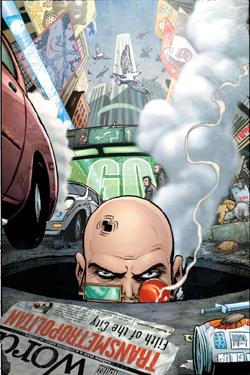
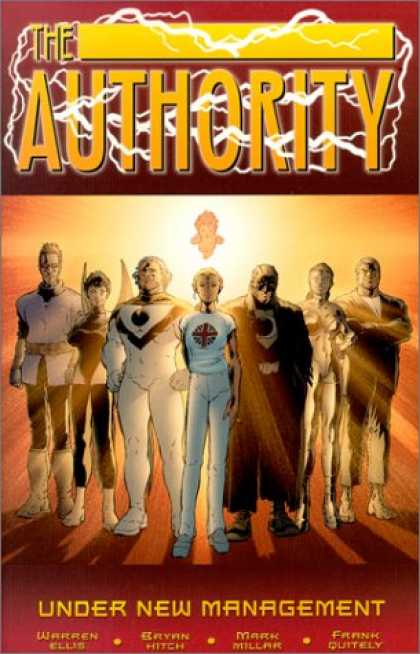
Transmetropolitan - Warren Ellis has written some incredible comics, including The Authority and Planetary, but Transmetropolitan, with art by Darick Robertson, is my favorite. Spider Jerusalem is a journalist who tells the truth in a futuristic world which resembles our own present. Returning to "The City" to face all the dangers and injustices and politics he had left behind. (would work better as a TV series on Showtime, HBO, or Siffy-jp)
 Batman: The Dark Knight Returns - Frank Miller's harsh, brooding, but imaginatively dystopian portrayal of the Caped Crusader is a high point in the history of comic books. Like Watchmen, many wonder if it could ever be properly adapted, but I say give it a shot. An old Batman coming out of retirement, a twisted Joker battling his nemesis one last time, a female Robin, a Superman who is a puppet of the goverment, a one-armed Green Arrow, and much more, all add up to an epic, mythic superhero adventure.
 Kingdom Come - This is one of my favorites -- writer Mark Waid explores the future of the DC Universe through an engaging tale that includes older versions of all the classic heroes. The highlight is a battle between Superman and Captain Marvel, and the climax is a nuclear detonation in the heart of Kansas. The artwork by Alex Ross is stunning.
The Sandman - Neil Gaiman has given us some amazing fantasy stories, some of which have already been made into great movies. The Sandman saga is probably his best work and I would love to see a good director tackle the challenge of adapting it. Multiple artists.(casting this would be a bitch and no matter who they cast, it will still piss off most of its hardcore fans; we all love "Death" as a cute little goth girl-jp)
***
 My list (includes the above, but below are my choices -jp)
Hellblazer: All His Engines - The one attempt to bring Hellblazer to screen (Constantine) was botched from the getgo when they cast Ted Theodore Logan (Keanu Reeves) as the title character, John Constantine, a blond hard drinking, chain smoking powerful mage from Liverpool, and Shia Lebouf as 'Chaz' ('Chas' is a London cabbie, same age as John--not a teenage kid too young to drive!), and it was downhill from there with a bad script and bad direction--but with the exceptions of great performances by the supporting cast of Tilda Swinton, Peter Stormaire and Rachel Weisz. The franchise should reboot with one of the best graphic novels ever published, much less the best Hellblazer story. AHE features John coming to the US with his best mate, Chas, and dealing with Aztec demons. Created by Alan Moore as a character in SwampThing. Hellblazer has had multiple writers and artists. It is DC Vertigo's longest running title.
 100 Bullets - A mysterious Agent Graves approaches someone who has been the victim of a terrible wrong, gives them the chance to set things right by providing them a handgun, the eponymous 100 bullets, and a dossier of the person primarily and personally responsible for the recipient's woes, and informs the candidate that the bullets are completely untraceable, and a law enforcement investigation which uncovers one of these bullets will immediately stop. That is the premise of 100 Bullets, a noir crime drama that includes the 13 Families of The Trust, who are essentially the Illuminati--old world money that rules everything, and "The Minutemen," a group of seven men (plus one "Agent") who serve as the enforcers and police of the Trust, who both protect the members of the Trust, and from each other. By Brian Azarello and Eduardo Risso.

WE3 - also by Morrison, there are rumors of the rights being acquired, but nothing else. It is about lost pets that are turned into high tech weapons used for covert military operations. It is one of the greatest comics ever. Art by Frank Quitely.



If we can't get single-payer...
We'll settle for the public option. Um, Mr. President, didn't you support that in your campaign?
BY TOM TOMORROW

BY TOM TOMORROW

Links
http://www.poptranslator.com/
Our Vanishing Wilderness
Potency
http://www.thatswhatbeasaid.com
Open Library
Alice in Wonderland, the original version hand-written and hand-drawn by Lewis Carroll posted online
Pr0n stars play D&D
Eating healthy on a limited budget
Our Vanishing Wilderness
Potency
http://www.thatswhatbeasaid.com
Open Library
Alice in Wonderland, the original version hand-written and hand-drawn by Lewis Carroll posted online
Pr0n stars play D&D
Eating healthy on a limited budget
Largest ever object put into quantum state
Scientists supersize quantum mechanics
Largest ever object put into quantum state
Geoff Brumfiel
A team of scientists has succeeded in putting an object large enough to be visible to the naked eye into a mixed quantum state of moving and not moving.
Andrew Cleland at the University of California, Santa Barbara, and his team cooled a tiny metal paddle until it reached its quantum mechanical 'ground state' — the lowest-energy state permitted by quantum mechanics. They then used the weird rules of quantum mechanics to simultaneously set the paddle moving while leaving it standing still. The experiment shows that the principles of quantum mechanics can apply to everyday objects as well as as atomic-scale particles.
The work is simultaneously being published online today in Nature and presented today at the American Physical Society's meeting in Portland, Oregon1.
According to quantum theory, particles act as waves rather than point masses on very small scales. This has dozens of bizarre consequences: it is impossible to know a particle's exact position and velocity through space, yet it is possible for the same particle to be doing two contradictory things simultaneously. Through a phenomenon known as 'superposition' a particle can be moving and stationary at the same time — at least until an outside force acts on it. Then it instantly chooses one of the two contradictory positions.
The paddle is around 30 micrometres long.O'Connell, A. D. et al.
But although the rules of quantum mechanics seem to apply at small scales, nobody has seen evidence of them on a large scale, where outside influences can more easily destroy fragile quantum states. "No one has shown to date that if you take a big object, with trillions of atoms in it, that quantum mechanics applies to its motion," Cleland says.
There is no obvious reason why the rules of quantum mechanics shouldn't apply to large objects. Erwin Schrödinger, one of the fathers of quantum mechanics, was so disturbed by the possibility of quantum weirdness on the large scale that he proposed his famous 'Schrödinger's cat' thought experiment. A cat is placed in a box with a vial of cyanide and a radioactive source. If the source decays, it triggers a device that will break the vial, killing the cat. During the time the box is shut, Schrödinger argued, the cat is in a superposition of alive and dead — an absurdity as far as he was concerned.
Wonderful weirdness
Cleland and his team took a more direct measure of quantum weirdness at the large scale. They began with a a tiny mechanical paddle, or 'quantum drum', around 30 micrometres long that vibrates when set in motion at a particular range of frequencies. Next they connected the paddle to a superconducting electrical circuit that obeyed the laws of quantum mechanics. They then cooled the system down to temperatures below one-tenth of a kelvin.
At this temperature, the paddle slipped into its quantum mechanical ground state. Using the quantum circuit, Cleland and his team verified that the paddle had no vibrational energy whatsoever. They then used the circuit to give the paddle a push and saw it wiggle at a very specific energy.
Next, the researchers put the quantum circuit into a superposition of 'push' and 'don't push', and connected it to the paddle. Through a series of careful measurements, they were able to show that the paddle was both vibrating and not vibrating simultaneously.
"It's wonderful," says Hailin Wang, a physicist at the University of Oregon in Eugene who has been working on a rival technique for putting an oscillator into the ground state. The work shows that the laws of quantum mechanics hold up as expected on a large scale. "It's good for physics for sure," Wang says.
So if trillions of atoms can be put into a quantum state, why don't we see double-decker buses simultaneously stopping and going? Cleland says he believes size does matter: the larger an object, the easier it is for outside forces to disrupt its quantum state.
"The environment is this huge, complex thing," says Cleland. "It's that interaction with this incredibly complex system that makes the quantum coherence vanish."
Still, he says, there's plenty of reasons to keep trying to get large objects into quantum states. Large quantum states could tell researchers more about the relationship between quantum mechanics and gravity — something that is not well understood. And quantum resonators could be useful for something, although Cleland admits he's not entirely sure what. "There might be some interesting application," he says. "But frankly, I don't have one now."
Largest ever object put into quantum state
Geoff Brumfiel
A team of scientists has succeeded in putting an object large enough to be visible to the naked eye into a mixed quantum state of moving and not moving.
Andrew Cleland at the University of California, Santa Barbara, and his team cooled a tiny metal paddle until it reached its quantum mechanical 'ground state' — the lowest-energy state permitted by quantum mechanics. They then used the weird rules of quantum mechanics to simultaneously set the paddle moving while leaving it standing still. The experiment shows that the principles of quantum mechanics can apply to everyday objects as well as as atomic-scale particles.
The work is simultaneously being published online today in Nature and presented today at the American Physical Society's meeting in Portland, Oregon1.
According to quantum theory, particles act as waves rather than point masses on very small scales. This has dozens of bizarre consequences: it is impossible to know a particle's exact position and velocity through space, yet it is possible for the same particle to be doing two contradictory things simultaneously. Through a phenomenon known as 'superposition' a particle can be moving and stationary at the same time — at least until an outside force acts on it. Then it instantly chooses one of the two contradictory positions.
The paddle is around 30 micrometres long.O'Connell, A. D. et al.
But although the rules of quantum mechanics seem to apply at small scales, nobody has seen evidence of them on a large scale, where outside influences can more easily destroy fragile quantum states. "No one has shown to date that if you take a big object, with trillions of atoms in it, that quantum mechanics applies to its motion," Cleland says.
There is no obvious reason why the rules of quantum mechanics shouldn't apply to large objects. Erwin Schrödinger, one of the fathers of quantum mechanics, was so disturbed by the possibility of quantum weirdness on the large scale that he proposed his famous 'Schrödinger's cat' thought experiment. A cat is placed in a box with a vial of cyanide and a radioactive source. If the source decays, it triggers a device that will break the vial, killing the cat. During the time the box is shut, Schrödinger argued, the cat is in a superposition of alive and dead — an absurdity as far as he was concerned.
Wonderful weirdness
Cleland and his team took a more direct measure of quantum weirdness at the large scale. They began with a a tiny mechanical paddle, or 'quantum drum', around 30 micrometres long that vibrates when set in motion at a particular range of frequencies. Next they connected the paddle to a superconducting electrical circuit that obeyed the laws of quantum mechanics. They then cooled the system down to temperatures below one-tenth of a kelvin.
At this temperature, the paddle slipped into its quantum mechanical ground state. Using the quantum circuit, Cleland and his team verified that the paddle had no vibrational energy whatsoever. They then used the circuit to give the paddle a push and saw it wiggle at a very specific energy.
Next, the researchers put the quantum circuit into a superposition of 'push' and 'don't push', and connected it to the paddle. Through a series of careful measurements, they were able to show that the paddle was both vibrating and not vibrating simultaneously.
"It's wonderful," says Hailin Wang, a physicist at the University of Oregon in Eugene who has been working on a rival technique for putting an oscillator into the ground state. The work shows that the laws of quantum mechanics hold up as expected on a large scale. "It's good for physics for sure," Wang says.
So if trillions of atoms can be put into a quantum state, why don't we see double-decker buses simultaneously stopping and going? Cleland says he believes size does matter: the larger an object, the easier it is for outside forces to disrupt its quantum state.
"The environment is this huge, complex thing," says Cleland. "It's that interaction with this incredibly complex system that makes the quantum coherence vanish."
Still, he says, there's plenty of reasons to keep trying to get large objects into quantum states. Large quantum states could tell researchers more about the relationship between quantum mechanics and gravity — something that is not well understood. And quantum resonators could be useful for something, although Cleland admits he's not entirely sure what. "There might be some interesting application," he says. "But frankly, I don't have one now."
Go your own way! USA's "Lindsay" to Israel's "Stevie"
(Just remember, even more powerful than the health insurance lobby, the pharmaceutical lobby, and maybe even the bank lobby, is AIPAC. They have so much sway over our legislative body, it's sickening. It's the source of power the neocons have...--jef)
Israel vs. America: Breaking Up Is Hard to Do
By Justin Raimondo
March 16, 2010
The brouhaha over what Hillary Clinton said was Israel’s calculated "insult" to the United States is escalating into what many characterize as a "crisis" in US-Israeli relations, a turning point in which the terms of the "special relationship" are about to undergo a major change. When Joe Biden berated his hosts for making the settlements announcement as he arrived on Israeli soil, it was as if a light bulb went off over his head:
"This is starting to get dangerous for us," Biden is reported to have said. "What you’re doing here undermines the security of our troops who are fighting in Iraq, Afghanistan and Pakistan. That endangers us and it endangers regional peace."
"Starting to get dangerous for us"? I find it difficult to believe this is the first time anyone in Washington has noticed the chief strategic consequence of the Iraq war, and that is what might be called the umbrella effect. Due to the heavy US presence in Iraq, the Mediterranean, and the Persian Gulf, Israel feels empowered to push a brazenly expansionist agenda. The umbrella effect was a key reason why the Israel lobby pushed hard for the invasion and occupation of Iraq: it put US soldiers in between the Israelis and their multifold enemies in the region.
Whether that was the intention all along is largely irrelevant. Ensconced smack dab in the middle of the Arab world, our troops were and are sitting ducks, useful to the Israelis because their presence diverts Arab anger and retaliation away from Israel and toward other targets – namely, American soldiers in Iraq.
Furthermore, the inevitable consequence of the invasion was to place US soldiers in a position where they could be dragged in to a wider war in the Middle East on Israel’s behalf. The conquest of Iraq implied a continuing and wider effort by the US to "transform" the region, a conflict that would, not so coincidentally, improve Israel’s position, and indeed this was the rhetoric employed by the Bush administration and its supporters in the run-up to the Iraq war.
The news that it was General David Petraeus, CENTCOM commander and author of the Iraq "surge," who raised the alarm over the regional consequences of Israeli intransigence back in January, is indicative of a point I have long made in this space: that ever since 9/11, objective circumstances required a US tilt away from Israel. That the impetus for a policy change is coming from Petraeus underscores the objective nature of the conditions forcing US policymakers to confront what has by now become a serious military problem.
Unfortunately for Petraeus and the US officer corps, this is a major domestic political problem for the Obama administration, which is loath to take on the Israel lobby – and with good reason. Which is why they’re backpedaling furiously, and denying Biden ever said or meant what he clearly did mean and did say.
The outcry in Congress, from Democrats as well as Republicans, in Israel’s defense has been almost comical in its outlandish support for a foreign country over one’s own: a kind of inverse Bizarro-patriotism of the sort that we haven’t seen since US leftists waved the flag of the National Liberation Front at antiwar rallies during the Vietnam era. The big difference being that this fifth column is enormously successful and influential, motivating Democrats to denounce a President and an administration of their own party, and orchestrating such an outcry that the Pentagon and the State Department will be forced to back down.
In any conflict between objective reality and political reality, when it comes to foreign policy the latter is bound to win out. That is why Israel and its lobby in America have invested so many resources into influencing US public opinion, and, more than that, setting the parameters of the debate – such as it is – over US policy in the Middle East, and US relations with the Jewish state.
The long arm of the Israelis reaches directly into the US via an active and well-funded lobby, which reflexively defends the actions of the Israeli government and seeks to discredit the Palestinian cause in every venue. Up until recently it was impossible to say this without being called all sorts of nasty names. More recently, however, while the nastiness has if anything escalated, the smear brigade is less successful at driving their opponents to the margins of public discourse. Objective reality – otherwise known as the truth – matters. Dead US soldiers whose demise could have been prevented matter greatly – and that somber reality can be masked by propaganda and "spin" only so long.
General Petraeus is concerned with the safety of his troops, and so it was the military that took the lead in this instance. Unfortunately, this is one battle that the politicians are none too eager to fight, and my guess is that this crisis will pass – although of course it will continue to bubble underground, periodically coming to the surface at key junctures, reminding our "leaders" that reality always has the last word.
Military and strategic imperatives demand a rupture, or at least a radical divergence, between the US and Israel: political reality forbids it. As the old song puts it: something’s gotta give.
Israel vs. America: Breaking Up Is Hard to Do
By Justin Raimondo
March 16, 2010
The brouhaha over what Hillary Clinton said was Israel’s calculated "insult" to the United States is escalating into what many characterize as a "crisis" in US-Israeli relations, a turning point in which the terms of the "special relationship" are about to undergo a major change. When Joe Biden berated his hosts for making the settlements announcement as he arrived on Israeli soil, it was as if a light bulb went off over his head:
"This is starting to get dangerous for us," Biden is reported to have said. "What you’re doing here undermines the security of our troops who are fighting in Iraq, Afghanistan and Pakistan. That endangers us and it endangers regional peace."
"Starting to get dangerous for us"? I find it difficult to believe this is the first time anyone in Washington has noticed the chief strategic consequence of the Iraq war, and that is what might be called the umbrella effect. Due to the heavy US presence in Iraq, the Mediterranean, and the Persian Gulf, Israel feels empowered to push a brazenly expansionist agenda. The umbrella effect was a key reason why the Israel lobby pushed hard for the invasion and occupation of Iraq: it put US soldiers in between the Israelis and their multifold enemies in the region.
Whether that was the intention all along is largely irrelevant. Ensconced smack dab in the middle of the Arab world, our troops were and are sitting ducks, useful to the Israelis because their presence diverts Arab anger and retaliation away from Israel and toward other targets – namely, American soldiers in Iraq.
Furthermore, the inevitable consequence of the invasion was to place US soldiers in a position where they could be dragged in to a wider war in the Middle East on Israel’s behalf. The conquest of Iraq implied a continuing and wider effort by the US to "transform" the region, a conflict that would, not so coincidentally, improve Israel’s position, and indeed this was the rhetoric employed by the Bush administration and its supporters in the run-up to the Iraq war.
The news that it was General David Petraeus, CENTCOM commander and author of the Iraq "surge," who raised the alarm over the regional consequences of Israeli intransigence back in January, is indicative of a point I have long made in this space: that ever since 9/11, objective circumstances required a US tilt away from Israel. That the impetus for a policy change is coming from Petraeus underscores the objective nature of the conditions forcing US policymakers to confront what has by now become a serious military problem.
Unfortunately for Petraeus and the US officer corps, this is a major domestic political problem for the Obama administration, which is loath to take on the Israel lobby – and with good reason. Which is why they’re backpedaling furiously, and denying Biden ever said or meant what he clearly did mean and did say.
The outcry in Congress, from Democrats as well as Republicans, in Israel’s defense has been almost comical in its outlandish support for a foreign country over one’s own: a kind of inverse Bizarro-patriotism of the sort that we haven’t seen since US leftists waved the flag of the National Liberation Front at antiwar rallies during the Vietnam era. The big difference being that this fifth column is enormously successful and influential, motivating Democrats to denounce a President and an administration of their own party, and orchestrating such an outcry that the Pentagon and the State Department will be forced to back down.
In any conflict between objective reality and political reality, when it comes to foreign policy the latter is bound to win out. That is why Israel and its lobby in America have invested so many resources into influencing US public opinion, and, more than that, setting the parameters of the debate – such as it is – over US policy in the Middle East, and US relations with the Jewish state.
The long arm of the Israelis reaches directly into the US via an active and well-funded lobby, which reflexively defends the actions of the Israeli government and seeks to discredit the Palestinian cause in every venue. Up until recently it was impossible to say this without being called all sorts of nasty names. More recently, however, while the nastiness has if anything escalated, the smear brigade is less successful at driving their opponents to the margins of public discourse. Objective reality – otherwise known as the truth – matters. Dead US soldiers whose demise could have been prevented matter greatly – and that somber reality can be masked by propaganda and "spin" only so long.
General Petraeus is concerned with the safety of his troops, and so it was the military that took the lead in this instance. Unfortunately, this is one battle that the politicians are none too eager to fight, and my guess is that this crisis will pass – although of course it will continue to bubble underground, periodically coming to the surface at key junctures, reminding our "leaders" that reality always has the last word.
Military and strategic imperatives demand a rupture, or at least a radical divergence, between the US and Israel: political reality forbids it. As the old song puts it: something’s gotta give.
"As long as we got each other..."
When State Capitalism Fails, We Have Each Other
by Darian Worden
Mar 16, 2010
Statists say that people can’t be trusted to interact with each other without someone lording over them. They view the state as a solution for inevitable problems of human relations. In reality people often work with each other, without rulers, to solve the problems created by rulers and statists.
Recently the number and size of homeless encampments has risen dramatically, creating scenes reminiscent of Great Depression era Hoovervilles – shanty towns named for the first president to administer over the Depression, Herbert Hoover.
Austrian School economists including Murray Rothbard have chronicled the government policies that led to the Great Depression. The short of it is the Federal Reserve greatly increased the supply of money, lowering interest rates and encouraging a boom of unsustainable investments. This led to a bust when it had to be paid for and the money supply was contracted.
Of course, a system designed to safeguard power and privilege through force, favoritism, regulation, and outright theft and murder is bound to get caught up at some time.
Herbert Hoover, a progressive with a history of supporting government intervention, believed that government should be an active player in economic recovery. His administration raised taxes, tariffs, and subsidies, and pushed for the creation of government programs and industrial cartels.
This of course failed. Government cannot create wealth, but can only redistribute it. And since government responds to the political pull of the powerful interests it serves, not to the demands of numerous actors of the market, it will disrupt, rather than encourage the creation of wealth.
If government can’t save us, who will? We will save each other through mutual aid, solidarity, and other enterprising activity.
House sharing is one response to rising housing expenses. Just having access to a solid structure and indoor plumbing can greatly increase living quality. One organization that works to connect people who need housing with people who are willing to share space (often to help meet expenses) is HomeSharing, Inc., which has operated in New Jersey for over 25 years. Craigslist and similar networks now connect people for whatever housing arrangements they might work out.
Free economies built from the ground up can enable more choice and accountability than the state-controlled economy. And they will enable people to be less vulnerable to the failures of state capitalism. Connecting with people via the internet and face-to-face communication can make this a viable option. Some opportunities include barter networks (including those that involve commodities like DelValley Silver), Really Free Markets where people give and take items as they want, local gardens, and the numerous examples of free exchange found in Kevin Carson’s Center for a Stateless Society paper “Society After State Capitalism.”
When people do things without asking permission, they might break laws. But mutual aid and solidarity can be used as weapons against authority. Working around the system to alleviate the problems it creates can build a strong position to challenge the system from.
“Counter-economics” is a term coined by Samuel Konkin to describe the economics of acting counter to the establishment. He advocated trading risk for profit to build non-coercive underground markets. Eventually organizations forming in these markets would be able to overcome the state, as the loss of economic control and popular support severely weakened state power.
Counter-economics is most useful as a strategic concept when it is not described as simply doing what is counter to the state’s commands (a reaction to the state), but is instead seen as actively building an economy that helps people live counter to authority. It is the economic basis for networks of free individuals resisting the imposition of authority.
Practicing solidarity and mutual aid can make the counter-economy a more attractive choice than the state-controlled economy. If you need help becoming autonomous then other people, knowing it is in their interest to include more people in libertarian action, will help you.
This is better than the statist system, in which most people are at best just another file for some bureaucrat trying to get through the day, another annoyance for some cop trying to do his job, another resource for some politician looking for glory – and at worst a target for thugs with government privilege or trash to be removed when in the way.
Liberty and solidarity can help people flourish better than statism and authority. When people assist each other without some lord stealing from them and giving only commands in return, the aid is mutual.
by Darian Worden
Mar 16, 2010
Statists say that people can’t be trusted to interact with each other without someone lording over them. They view the state as a solution for inevitable problems of human relations. In reality people often work with each other, without rulers, to solve the problems created by rulers and statists.
Recently the number and size of homeless encampments has risen dramatically, creating scenes reminiscent of Great Depression era Hoovervilles – shanty towns named for the first president to administer over the Depression, Herbert Hoover.
Austrian School economists including Murray Rothbard have chronicled the government policies that led to the Great Depression. The short of it is the Federal Reserve greatly increased the supply of money, lowering interest rates and encouraging a boom of unsustainable investments. This led to a bust when it had to be paid for and the money supply was contracted.
Of course, a system designed to safeguard power and privilege through force, favoritism, regulation, and outright theft and murder is bound to get caught up at some time.
Herbert Hoover, a progressive with a history of supporting government intervention, believed that government should be an active player in economic recovery. His administration raised taxes, tariffs, and subsidies, and pushed for the creation of government programs and industrial cartels.
This of course failed. Government cannot create wealth, but can only redistribute it. And since government responds to the political pull of the powerful interests it serves, not to the demands of numerous actors of the market, it will disrupt, rather than encourage the creation of wealth.
If government can’t save us, who will? We will save each other through mutual aid, solidarity, and other enterprising activity.
House sharing is one response to rising housing expenses. Just having access to a solid structure and indoor plumbing can greatly increase living quality. One organization that works to connect people who need housing with people who are willing to share space (often to help meet expenses) is HomeSharing, Inc., which has operated in New Jersey for over 25 years. Craigslist and similar networks now connect people for whatever housing arrangements they might work out.
Free economies built from the ground up can enable more choice and accountability than the state-controlled economy. And they will enable people to be less vulnerable to the failures of state capitalism. Connecting with people via the internet and face-to-face communication can make this a viable option. Some opportunities include barter networks (including those that involve commodities like DelValley Silver), Really Free Markets where people give and take items as they want, local gardens, and the numerous examples of free exchange found in Kevin Carson’s Center for a Stateless Society paper “Society After State Capitalism.”
When people do things without asking permission, they might break laws. But mutual aid and solidarity can be used as weapons against authority. Working around the system to alleviate the problems it creates can build a strong position to challenge the system from.
“Counter-economics” is a term coined by Samuel Konkin to describe the economics of acting counter to the establishment. He advocated trading risk for profit to build non-coercive underground markets. Eventually organizations forming in these markets would be able to overcome the state, as the loss of economic control and popular support severely weakened state power.
Counter-economics is most useful as a strategic concept when it is not described as simply doing what is counter to the state’s commands (a reaction to the state), but is instead seen as actively building an economy that helps people live counter to authority. It is the economic basis for networks of free individuals resisting the imposition of authority.
Practicing solidarity and mutual aid can make the counter-economy a more attractive choice than the state-controlled economy. If you need help becoming autonomous then other people, knowing it is in their interest to include more people in libertarian action, will help you.
This is better than the statist system, in which most people are at best just another file for some bureaucrat trying to get through the day, another annoyance for some cop trying to do his job, another resource for some politician looking for glory – and at worst a target for thugs with government privilege or trash to be removed when in the way.
Liberty and solidarity can help people flourish better than statism and authority. When people assist each other without some lord stealing from them and giving only commands in return, the aid is mutual.
Pre-Crime Policing
Allegedly “disgruntled” man has his guns seized, and “voluntarily” surrenders to two SWAT teams and dozens of police officers for a crime that hadn’t been committed
Pre-Crime Policing
Radley Balko | March 16, 2010
To hear them tell it, the five police agencies who apprehended 39-year-old Oregonian David Pyles early on the morning of March 8 thwarted another lone wolf mass murderer. The police "were able to successfully take a potentially volatile male subject into protective custody for a mental evaluation," announced a press release put out by the Medford, Oregon, police department. The subject had recently been placed on administrative leave from his job, was "very disgruntled," and had recently purchased several firearms. "Local Law Enforcement agencies were extremely concerned that the subject was planning retaliation against his employers," the release said. Fortunately, Pyles "voluntarily" turned himself over to police custody, and the legally purchased firearms "were seized for safekeeping."
This voluntary exchange involved two SWAT teams, police officers from Medford and nearby Roseburg, sheriff's deputies from Jackson and Douglas counties, and the Oregon State Police. Oregon State Police Sgt. Jeff Proulx explained to South Oregon's Mail Tribune why the operation was such a success: "Instead of being reactive, we took a proactive approach."
There's just one problem: David Pyles hadn't committed any crime, nor was he suspected of having committed one. The police never obtained a warrant for either search or arrest. They never consulted with a judge or mental health professional before sending out the military-style tactical teams to take Pyle in.
"They woke me up with a phone call at about 5:50 in the morning," Pyles told me in a phone interview Friday. "I looked out the window and saw the SWAT team pointing their guns at my house. The officer on the phone told me to turn myself in. I told them I would, on three conditions: I would not be handcuffed. I would not be taken off my property. And I would not be forced to get a mental health evaluation. He agreed. The second I stepped outside, they jumped me. Then they handcuffed me, took me off my property, and took me to get a mental health evaluation."
By noon the same day, Pyles had already been released from the Rogue Valley Medical Center with a clean bill of mental health. Four days later the Medford Police Department returned Pyle’s guns, despite telling him earlier in the week—falsely—that he'd need to undergo a second background check before he could get them back. On Friday the Medford Police Department put out a second press release, this time announcing that the agency had returned the "disgruntled" worker's guns, and "now considers this matter closed.
That seems unlikely. Pyles' case has spurred outrage in the gun rights community. Kevin Starrett of the Oregon Firearms Federation has been advising Pyles, and helped get his guns back. Oregon-based syndicated conservative talk radio host Lars Larson has taken up the story. And Pyles is now attorney shopping for a possible civil rights lawsuit.
At root behind this case and others like it is our naïve, hopeful, and sometimes even dangerous belief that every horrible shooting spree or lone-wolf act of terrorism can be prevented. We seem unable to accept the idea that bad people will occasionally do bad things. Every new mass shooting spurs an urge to assign blame beyond the shooter: What political ideology inspired him? Who missed the “warning signs,” and why wasn't he apprehended ahead of time? Gun retailers are scrutinized and vilified, even when they've complied with the law. In ensuing days and weeks, politicians mull new laws, often both ineffective and constricting on our liberty.
There's nothing wrong with looking for signs that someone is about to snap, and if he's putting up multiple red flags, we'd certainly want law enforcement to investigate, possibly to chat with the person and his friends and family. And obviously if someone has made specific threats, a criminal investigation should follow. But that's a far cry from what happened to Pyles.
Pyles' problems began last June after a series of grievances with his employer, the Oregon Department of Transportation. "This was always a professional thing for me," he says. "It was never personal. We were handling the grievances through the process stipulated in the union contract." Pyles declined to discuss the nature of the complaints, citing stipulations in his contract.
On March 4, Pyles was placed on administrative leave, which required him to work from home. On March 5, 6, and 7, after getting his income tax refund, he made three purchases of five firearms. Pyles describes himself as a gun enthusiast, who had already owned several weapons. All three new purchases required an Oregon background check, which would have prohibited the transactions had Pyles ever been convicted of a felony or a misdemeanor involving violence, or been committed by the state to a mental health institution. Pyles says he has no criminal record, and says he never threatened anyone in his office. (A specific threat of violence would have likely brought a criminal charge.) The Oregon State Police, the Medford Police Department, and the Oregon Department of Transportation did not respond to requests for comment.
"In my opinion, the apprehension of David Pyles was a violation of Oregon's kidnapping laws," says James Leuenberger, a criminal defense attorney who is also advising Pyles. "He definitely deserves to be compensated for what they did to him, but even if he wins a civil rights suit, that will just result in the officers' employers paying for their mistakes." That of course means the final tab will be paid by Oregon's taxpayers, not the offending cops. "I want these law enforcement officials held personally responsible," Leuenberger says. "I want them criminally charged."
It's hard to see that happening. Joseph Bloom, a psychiatrist at Oregon Health & Science University and a specialist in civil commitment law, says the police who apprehended and detained Pyles were likely acting under the cover of Oregon law. Bloom says the police are permitted to make a determination on their own to take someone in for a mental health evaluation—there's no requirement that they first consult with a judge or mental health professional. Bloom believes this is a wise policy. "It's important to remember that this is a civil process," he says. "There's no arrest, these people aren't being taking to jail. It's not a criminal action."
So SWAT teams, guns, and handcuffs...but not a criminal action? And what if Pyles had refused to "voluntarily" surrender to the police? "Well, yes," Bloom says. "I guess then it would become a criminal matter."
If what happened to Pyles is legal, in Oregon or elsewhere, we need to take a second look at the civil commitment power. Even setting aside the SWAT team overkill in Medford, there's something awfully discomfiting about granting government authorities the power to yank someone from their home and drag them in for a mental health evaluation based on a series of actions that were perfectly legal, especially with no prior oversight from a judge, or guidance from a psychiatrist.
"The idea that Pyles turned himself in voluntarily is ridiculous," says Starrett, the gun rights activist. "There's nothing voluntary about waking up to a SWAT team outside your home, then having a police negotiator call and suggest you surrender. They had no arrest warrant. But Pyles only had one option. If he didn't come out on his own, they were going to come in to get him."
Even if the apprehension of Pyles was legal, the seizure of his guns wasn't. Because civil commitment laws aren't criminal in nature, they don't carry authorization for the police to search a private residence. According to Pyles, he closed the door behind him as he left his home. Because the police didn't have a search warrant, they had no right to even enter Pyles' home, much less seize guns inside that he bought and possessed legally.
For a potential mass murderer, Pyles is remarkably placid and big-picture about what happened to him. "I've been looking for a new job for months," he says. "But given the economy, I'm pretty lucky to be getting a paycheck, even given all of this. For me, this is about civil rights. This seems like something the NRA and the ACLU can agree on. South Oregon is big gun country. If something like this can happen here, where just about everyone owns a gun, it can happen anywhere."
Problem-Reaction-Solution: Airport Body Scanner BS
How to cut through the bullshit: Body Scanners
When corporations and governments work to further their control agenda they will create diversion and provide their pre-arranged solution. It is also known as the Problem-Reaction-Solution formula.
In this first installment of the 'How to cut through the bullshit' series you will learn how you were lied to about Flight 253, how that staged event was used to further the implementation of body scanners, how scans are harmful to your health, how the data is stored and who benefits.
When corporations and governments work to further their control agenda they will create diversion and provide their pre-arranged solution. It is also known as the Problem-Reaction-Solution formula.
In this first installment of the 'How to cut through the bullshit' series you will learn how you were lied to about Flight 253, how that staged event was used to further the implementation of body scanners, how scans are harmful to your health, how the data is stored and who benefits.
Genetically Engineered Virus cited in Lawsuit Against Pfizer
Ex-Pfizer Worker Cites Genetically Engineered Virus In Lawsuit Over Firing
By EDMUND H. MAHONY
The Hartford Courant
March 14, 2010
Medical experts will be watching closely Monday when a scientist who says she has been intermittently paralyzed by a virus designed at the Pfizer laboratory where she worked in Groton opens a much anticipated trial that could raise questions about safety practices in the dynamic field of genetic engineering.
Organizations involved in workplace safety and responsible genetic research already have seized on the federal lawsuit by molecular biologist Becky McClain as an example of what they claim is evidence that risks caused by cutting-edge genetic manipulation have outstripped more slowly evolving government regulation of laboratories.
McClain, of Deep River, suspects she was inadvertently exposed, through work by a former Pfizer colleague in 2002 or 2003, to an engineered form of the lentivirus, a virus similar to the one that can lead to acquired immune deficiency syndrome, or AIDS. Medical experts working for McClain believe the virus has affected the way her body channels potassium, leading to a condition that causes complete paralysis as many as 12 times a month.
"If a worker in a plant as sophisticated as Pfizer is becoming infected with a genetically engineered virus, then I think the potential is everywhere," said Jeremy Gruber, president of the Council for Responsible Genetics, a public interest group created to explore the implications of genetic technologies.
"Genetically engineered viruses are commonly worked on at your average university," Gruber said. "The public has a right to know what regulations are in place and what regulations are required to fix an industrywide issue. We need to have a conversation about this. Ms. McClain's attempt to do that has been hampered at every turn, by the courts and by regulators."
Pfizer disputes all of McClain's claims and says it fired her in 2005 because she refused to come to work. The global pharmaceuticals manufacturer, with research labs in southeastern Connecticut, defends its safety practices and denies that McClain's physical disability is related to exposure at its Groton lab. The company says she did not link her disability to workplace exposure until after she was fired.
As a molecular biologist, McClain studied cells on a molecular level, manipulating genetic codes in an effort to develop vaccines. During the period at issue in the suit, McClain worked in Pfizer's Human Health Embryonic Stem Cells Technologies, Genomic and Proteomic Sciences and Exploratory Medicinal Sciences Group.
Hostile Exchanges
The sharp disagreement between McClain and her former employer mirrors a half-dozen or so years of hostile litigation leading to Monday's jury trial in Hartford before U.S. District Judge Vanessa L. Bryant. McClain will argue that she was wrongfully dismissed and is entitled to unspecified damages. In the run-up, Pfizer attacked McClain's legal claims, and she questioned the company's corporate integrity.
On the advice of her lawyers, McClain would not discuss her suit last week. Neither would her lawyers, nor those representing Pfizer.
But McClain has claimed in her suit and in earlier public statements that she was fired after experiencing symptoms of illness and after complaining to the U.S. Occupational Safety and Health Administration about safety in her Pfizer lab.
OSHA dismissed McClain's complaint. In a decision published after McClain's termination, the agency criticized her for refusing to return to work in spite of "Pfizer's substantial efforts" to address her concerns. In a speech last year to a labor safety group in California, McClain said she was told by an OSHA investigator that the federal agency's legal authority has not kept pace with developments in sophisticated medical research.
A series of angry, pretrial exchanges developed over McClain's efforts to compel Pfizer to give her precise information about the DNA sequencing of the engineered lentivirus she suspects infected her. Pfizer says it responded to all of McClain's requests, in accordance with the law. Her advocates called Pfizer's assertion preposterous and claimed the company has not produced — perhaps because it is subject to trademark — the sequencing data that could enable scientists to engineer a genetic cure.
Over the course of pretrial argument, the number and breadth of McClain's legal claims against Pfizer have been reduced from eight to two. Last month, Bryant dismissed the most significant of the eight claims: that willful and wanton misconduct by Pfizer resulted in lax laboratory procedures. McClain claimed laxity contributed to her exposure.
McClain's advocates point to language in Bryant's ruling that suggests the misconduct allegation was dismissed, at least in part, because state law requires such claims to be resolved by state workers' compensation rules. But Pfizer says Bryant's ruling is another vindication of its assertion that no evidence exists to support McClain's contention that she was infected by a viral exposure at Pfizer.
"We have thoroughly investigated Ms. McClain's claims and our investigation concluded that her workplace was safe and that she was not infected by any virologic materials while she was employed by Pfizer," company spokeswoman Elizabeth Power said.
Bryant's ruling means the trial will move forward under McClain's two remaining claims, both of which involve free speech protection. She says Pfizer fired her in violation of Connecticut's whistle-blower law after she raised questions about Pfizer lab safety to OSHA. And she claims her dismissal also was in retaliation for questions she raised in discussion with Pfizer colleagues about safety practices. In addition to performing her research duties, McClain served on a lab safety committee for at least part of the nine years she was employed by Pfizer.
Medical Evidence
Pfizer has taken the position that Bryant's ruling in March means no evidence will be admitted at the trial concerning McClain's health or her claim that it was destroyed by bad lab procedures. McClain's advocates, again, disagree. Because McClain is suing under a whistle-blower claim, they believe she will be allowed to present evidence about why she figuratively blew the whistle. If her health and safety are the reasons, they say, the judge could allow jurors to hear evidence in those areas.
In her suit, McClain says that Pfizer hired her in 1995 and that, in 2000, she became involved in human cellular research associated with vaccine development. She later learned, the suit says, that colleagues in her lab were working with infectious, genetically engineered viruses, including the lentivirus she suspects causes what her physician calls "acute intermittent paralysis."
The suit describes lab events that McClain suggests could have infected her.
The first involved the possible malfunction of a "laminar hood," a system designed to contain materials being subjected to scientific manipulation and to purify the air circulating around the materials. She said the hood began emitting a noxious odor at the same time she and several colleagues developed symptoms of illness, including nausea.
McClain said in the suit that, as a member of the lab safety committee, she reported the apparent hood malfunction. Judge Bryant said in a preliminary ruling that Pfizer took "various steps" to fix the hood and ultimately replaced it, twice.
Pfizer contends that the hood problem was resolved eight months after McClain reported it. But a long e-mail message by one of McClain's supervisors and the OSHA review corroborate McClain's contention that the problem persisted for a year. Before it was corrected, several people suffered from headaches, vomiting and nausea, including at least one member of the crew that cleaned the lab after work.
About two months after the hood problem was resolved, McClain says in the suit, she learned from a colleague that he was working "next to" her on "dangerous lentivirus material and embryonic stem cells." The work was being done on an open lab bench, unprotected by a biological containment system, the suit says, even though lentivirus work should have been done only under a protective "biological hood."
"I was shocked and appalled to find he had been using lentivirus materials on an open lab bench without biocontainment where I performed my office work (e.g. without gloves) in October 2003," McClain wrote in a legal filing.
On another occasion, she says, she encountered an unidentified experimental set-up consisting of cell cultures on her laboratory bench, but she cannot recall whether she touched it.
Pfizer has responded that any lentivirus studied in lab areas where McClain was present was not derived from a human infectious virus and was not infectious because it lacked genes for replication.
McClain says in the suit that she repeatedly raised laboratory safety issues following the hood malfunction, despite a warning from a supervisor that doing so could jeopardize her employment. She said she began suffering from "fatigue, suspicion of multiple sclerosis, joint pain, and numbness in her face as well as sleep difficulties" and took a medical leave in February 2004. She was fired about 11 months later.
The suit contends the dismissal was retaliation for her complaints about safety. In a speech a year ago, McClain asserted that some of the safety deficiencies she has criticized are the product of poor lab design — design that is nonetheless acceptable under OSHA rules.
Pfizer contends that McClain's dismissal was not related to her concern about safety. Rather, the company says, she was terminated for refusing to report back to work after the company made her repeated offers, including alternative employment opportunities, some in laboratories other than the one about which she had complained. Pfizer claims McClain was told in advance of her termination that she would be fired if she didn't return to work.
Even though jurors are unlikely to hear arguments that McClain's potassium disorder and related transient paralysis are attributable to exposure to an engineered virus, a network of laboratory safety advocates already is using the case as a rallying point. A group from San Francisco has planned a press conference outside the Hartford courthouse on Main Street at 12:15 p.m. Monday.
They say OSHA's inability to stay abreast of developments in sophisticated, molecular research techniques — as well as law protecting the confidentiality of proprietary discoveries — has neutralized the agency's ability to act as an effective regulator.
"This case shows a major flaw for workers in the biotech industry who have to prove where they got injured in order to receive workers' compensation," said Steve Zeltzer, one of the organizers.
By EDMUND H. MAHONY
The Hartford Courant
March 14, 2010
Medical experts will be watching closely Monday when a scientist who says she has been intermittently paralyzed by a virus designed at the Pfizer laboratory where she worked in Groton opens a much anticipated trial that could raise questions about safety practices in the dynamic field of genetic engineering.
Organizations involved in workplace safety and responsible genetic research already have seized on the federal lawsuit by molecular biologist Becky McClain as an example of what they claim is evidence that risks caused by cutting-edge genetic manipulation have outstripped more slowly evolving government regulation of laboratories.
McClain, of Deep River, suspects she was inadvertently exposed, through work by a former Pfizer colleague in 2002 or 2003, to an engineered form of the lentivirus, a virus similar to the one that can lead to acquired immune deficiency syndrome, or AIDS. Medical experts working for McClain believe the virus has affected the way her body channels potassium, leading to a condition that causes complete paralysis as many as 12 times a month.
"If a worker in a plant as sophisticated as Pfizer is becoming infected with a genetically engineered virus, then I think the potential is everywhere," said Jeremy Gruber, president of the Council for Responsible Genetics, a public interest group created to explore the implications of genetic technologies.
"Genetically engineered viruses are commonly worked on at your average university," Gruber said. "The public has a right to know what regulations are in place and what regulations are required to fix an industrywide issue. We need to have a conversation about this. Ms. McClain's attempt to do that has been hampered at every turn, by the courts and by regulators."
Pfizer disputes all of McClain's claims and says it fired her in 2005 because she refused to come to work. The global pharmaceuticals manufacturer, with research labs in southeastern Connecticut, defends its safety practices and denies that McClain's physical disability is related to exposure at its Groton lab. The company says she did not link her disability to workplace exposure until after she was fired.
As a molecular biologist, McClain studied cells on a molecular level, manipulating genetic codes in an effort to develop vaccines. During the period at issue in the suit, McClain worked in Pfizer's Human Health Embryonic Stem Cells Technologies, Genomic and Proteomic Sciences and Exploratory Medicinal Sciences Group.
Hostile Exchanges
The sharp disagreement between McClain and her former employer mirrors a half-dozen or so years of hostile litigation leading to Monday's jury trial in Hartford before U.S. District Judge Vanessa L. Bryant. McClain will argue that she was wrongfully dismissed and is entitled to unspecified damages. In the run-up, Pfizer attacked McClain's legal claims, and she questioned the company's corporate integrity.
On the advice of her lawyers, McClain would not discuss her suit last week. Neither would her lawyers, nor those representing Pfizer.
But McClain has claimed in her suit and in earlier public statements that she was fired after experiencing symptoms of illness and after complaining to the U.S. Occupational Safety and Health Administration about safety in her Pfizer lab.
OSHA dismissed McClain's complaint. In a decision published after McClain's termination, the agency criticized her for refusing to return to work in spite of "Pfizer's substantial efforts" to address her concerns. In a speech last year to a labor safety group in California, McClain said she was told by an OSHA investigator that the federal agency's legal authority has not kept pace with developments in sophisticated medical research.
A series of angry, pretrial exchanges developed over McClain's efforts to compel Pfizer to give her precise information about the DNA sequencing of the engineered lentivirus she suspects infected her. Pfizer says it responded to all of McClain's requests, in accordance with the law. Her advocates called Pfizer's assertion preposterous and claimed the company has not produced — perhaps because it is subject to trademark — the sequencing data that could enable scientists to engineer a genetic cure.
Over the course of pretrial argument, the number and breadth of McClain's legal claims against Pfizer have been reduced from eight to two. Last month, Bryant dismissed the most significant of the eight claims: that willful and wanton misconduct by Pfizer resulted in lax laboratory procedures. McClain claimed laxity contributed to her exposure.
McClain's advocates point to language in Bryant's ruling that suggests the misconduct allegation was dismissed, at least in part, because state law requires such claims to be resolved by state workers' compensation rules. But Pfizer says Bryant's ruling is another vindication of its assertion that no evidence exists to support McClain's contention that she was infected by a viral exposure at Pfizer.
"We have thoroughly investigated Ms. McClain's claims and our investigation concluded that her workplace was safe and that she was not infected by any virologic materials while she was employed by Pfizer," company spokeswoman Elizabeth Power said.
Bryant's ruling means the trial will move forward under McClain's two remaining claims, both of which involve free speech protection. She says Pfizer fired her in violation of Connecticut's whistle-blower law after she raised questions about Pfizer lab safety to OSHA. And she claims her dismissal also was in retaliation for questions she raised in discussion with Pfizer colleagues about safety practices. In addition to performing her research duties, McClain served on a lab safety committee for at least part of the nine years she was employed by Pfizer.
Medical Evidence
Pfizer has taken the position that Bryant's ruling in March means no evidence will be admitted at the trial concerning McClain's health or her claim that it was destroyed by bad lab procedures. McClain's advocates, again, disagree. Because McClain is suing under a whistle-blower claim, they believe she will be allowed to present evidence about why she figuratively blew the whistle. If her health and safety are the reasons, they say, the judge could allow jurors to hear evidence in those areas.
In her suit, McClain says that Pfizer hired her in 1995 and that, in 2000, she became involved in human cellular research associated with vaccine development. She later learned, the suit says, that colleagues in her lab were working with infectious, genetically engineered viruses, including the lentivirus she suspects causes what her physician calls "acute intermittent paralysis."
The suit describes lab events that McClain suggests could have infected her.
The first involved the possible malfunction of a "laminar hood," a system designed to contain materials being subjected to scientific manipulation and to purify the air circulating around the materials. She said the hood began emitting a noxious odor at the same time she and several colleagues developed symptoms of illness, including nausea.
McClain said in the suit that, as a member of the lab safety committee, she reported the apparent hood malfunction. Judge Bryant said in a preliminary ruling that Pfizer took "various steps" to fix the hood and ultimately replaced it, twice.
Pfizer contends that the hood problem was resolved eight months after McClain reported it. But a long e-mail message by one of McClain's supervisors and the OSHA review corroborate McClain's contention that the problem persisted for a year. Before it was corrected, several people suffered from headaches, vomiting and nausea, including at least one member of the crew that cleaned the lab after work.
About two months after the hood problem was resolved, McClain says in the suit, she learned from a colleague that he was working "next to" her on "dangerous lentivirus material and embryonic stem cells." The work was being done on an open lab bench, unprotected by a biological containment system, the suit says, even though lentivirus work should have been done only under a protective "biological hood."
"I was shocked and appalled to find he had been using lentivirus materials on an open lab bench without biocontainment where I performed my office work (e.g. without gloves) in October 2003," McClain wrote in a legal filing.
On another occasion, she says, she encountered an unidentified experimental set-up consisting of cell cultures on her laboratory bench, but she cannot recall whether she touched it.
Pfizer has responded that any lentivirus studied in lab areas where McClain was present was not derived from a human infectious virus and was not infectious because it lacked genes for replication.
McClain says in the suit that she repeatedly raised laboratory safety issues following the hood malfunction, despite a warning from a supervisor that doing so could jeopardize her employment. She said she began suffering from "fatigue, suspicion of multiple sclerosis, joint pain, and numbness in her face as well as sleep difficulties" and took a medical leave in February 2004. She was fired about 11 months later.
The suit contends the dismissal was retaliation for her complaints about safety. In a speech a year ago, McClain asserted that some of the safety deficiencies she has criticized are the product of poor lab design — design that is nonetheless acceptable under OSHA rules.
Pfizer contends that McClain's dismissal was not related to her concern about safety. Rather, the company says, she was terminated for refusing to report back to work after the company made her repeated offers, including alternative employment opportunities, some in laboratories other than the one about which she had complained. Pfizer claims McClain was told in advance of her termination that she would be fired if she didn't return to work.
Even though jurors are unlikely to hear arguments that McClain's potassium disorder and related transient paralysis are attributable to exposure to an engineered virus, a network of laboratory safety advocates already is using the case as a rallying point. A group from San Francisco has planned a press conference outside the Hartford courthouse on Main Street at 12:15 p.m. Monday.
They say OSHA's inability to stay abreast of developments in sophisticated, molecular research techniques — as well as law protecting the confidentiality of proprietary discoveries — has neutralized the agency's ability to act as an effective regulator.
"This case shows a major flaw for workers in the biotech industry who have to prove where they got injured in order to receive workers' compensation," said Steve Zeltzer, one of the organizers.
Americans Hate the New Airport Naked Body Scanners
We're so scared of trrrists that we succumb to being publicly humiliated for an upgrade in airport security--one which easily can be debated as to its effectiveness? It might have caught the underwear bomber, but it would not have caught the 9-11 hijackers. I'm a portly fellow, too, none too proud of my pear shape. I might just be done flying if this is yet another humiliating part of flying along with being stranded on a runway for 12+ hours, the shoe thing, being frisked, sniffed, and felt up, having your possessions rummaged through, and worse.
I'm not afraid of terrorists! Why are so many people afraid of terrorism? 9-11 was something truly out of the ordinary that no one (except for those in Bush's inner circle who had Richard Clarke's brief entitled "Bin Laden determined to crasha plane into a skyscraper") outside of political power could have foreseen. We have enough security in place to keep it from happening again. The fact that pilots keep the door to the cockpit locked the entire flight and the fact that air marshalls are now on more than half of all flights is enough to prevent most terrorist attacks on flights.
It's not perfect, but should be enough to abate this constant obsession with terrorists. That was one of the goals al Qaeda had on 9-11 (in addition to bankrupting the US...hmmmmm...)and what they want with every attack they make--make us so scared wechange our lives to accommodate that fear. And that means the terrorists have won the round because we are so consumed with the possibility of terrorist attacks, we let it make us afraid of them to the point of relinquishing our fundamental rights to privacy. It's the most quoted line with respect to security and freedom because it is the greatest line on that subject:
"Those who would trade freedom for security deserve neither freedom nor security."
--Ben Franklin
***
Rising wave of anger in response to virtual strip-search contradicts media spin

by Paul Joseph Watson
Despite establishment media spin that naked body scanners are being meekly accepted by a compliant public, documents released under the Freedom of Information Act reveal that there have been more than 600 formal complaints about the devices in the last year.
Furthermore, the documents reveal anger at TSA officials for refusing to offer passengers a pat-down alternative, as well as forcing children to go through machines which provide crisp images of genitalia, a particularly outrageous scenario in light of last week’s story concerning a TSA worker who was charged with multiple child sex crimes having raped an underage girl.
“Hundreds of U.S. air travelers have lodged complaints over use of full-body security scanners in the past year, charging they violate personal privacy and may be harmful to their health, documents released on Tuesday showed,” reports Reuters.
The Reuters piece amounts to little more than another whitewash of the issue, claiming that privacy filters blur sensitive areas of the body, an assertion contradicted by other journalists who investigated trials of the technology, as well as readily available sample imageswhich clearly show that the penis and testicles are visible.
The Transportation Security Administration also downplayed the issue as insignificant, claiming that over 600 complaints about body scanners which are installed in just 21 airports in the U.S. was an “infinitesimally small” number.
“I was not given an option to use the whole body screening device. Neither was anyone else. It appeared that everyone was being required to go through the devices, even children,” said one complaint from an unidentified traveler who flew through the Tulsa airport in May 2009.
As we reported last month, airport staff have also been accused of printing out and circulating naked images of famous people, a complete abuse of the “professionalism” we were promised would be exercised by those in control of these systems.
Courts have consistently found that strip searches are only legal when performed on a person who has already been found guilty of a crime or on arrestees pending trial where a reasonable suspicion has to exist that they are carrying a weapon. Subjecting masses of people to blanket strip searches in airports reverses the very notion of innocent until proven guilty.
Barring people from flying and essentially treating them like terrorists for refusing to be humiliated by the virtual strip search is a clear breach of the basic human right of freedom of movement.Security experts agree that such scanners would not even have stopped the incident that has been exploited to justify their widespread introduction – the Christmas Day underwear bomber.
Not only have the scanners proven to be a total violation of privacy, but major international radiation safety groups are now warning of the health risks they pose.
Despite governments claiming that backscatter x-ray systems produce radiation too low to pose a threat, the Inter-Agency Committee on Radiation Safety concluded in their report that governments must justify the use of the scanners and that a more accurate assessment of the health risks is needed.
Pregnant women and children should not be subject to scanning, according to the report, adding that governments should consider “other techniques to achieve the same end without the use of ionizing radiation.”
“The Committee cited the IAEA’s 1996 Basic Safety Standards agreement, drafted over three decades, that protects people from radiation. Frequent exposure to low doses of radiation can lead to cancer and birth defects, according to the U.S. Environmental Protection Agency,”reported Bloomberg.
We are joining the hundreds of other Americans who protested naked body scanners as an affront to privacy, dignity, and a health risk, by launching our naked body scanner contest in an effort to focus public attention on how we must stop these machines now before they are installed in the streets and become another tool of control and oppression as part of the prison planet being constructed around us.
Not only have authorities in Europe promised to roll out mobile body scanners on the streets to mass scan crowds of people, but Homeland Security has even gone a step further,developing Orwellian mind-reading devices that are set to be installed as part of unconstitutional checkpoints at public events.
We are offering our biggest prize fund ever of $15,000 for the entries that most successfully highlight the true agenda behind naked body scanners and where this is all heading unless we put our foot down now and help to build momentum behind public pressure to remove the scanners from airports.
***

Thursday, March 18, 2010
Possibly Humanity's Most Dangerous Moment
--One of my favorite 'worst-case' articles in a long time. too many people just drift through their lives oblivious to significant changes in the world. they think life will be like it is now, for forever, or for the rest of their lives. we are right now closer to a radical change in society than ever before due to: christian armageddon fundamentalists, doomsday cults, those who think the Mayan calendar means the end of the world (it really just counts down to the end of this "age"--the end of the Mayan calendar is the beginning of a new age according to their mythos, not the end of the world), third world nuclear conflicts, climate change scenarios, the corporate takeover of the world's super power countries, private security paramilitary forces, dwindling resources, oil dependency, changing weather patterns and the most severe storms in recorded history, the possible reversal of Earth's magnetic field, and so many other different factors that are really possible, not just fodder for conspiracy theory forums, as most scared people who want to seem "cool" dismiss them as. It's not "cool" to consider the possibilities of extremist idealogues doing something to jeopardize civilized society, so it can't possibly happen. Dream on...
-jp)
We Stand on the Cusp of one of Humanity's Most Dangerous Moments
By Chris Hedges, Adbusters
March 18, 2010
Aleksandr Herzen, speaking a century ago to a group of anarchists about how to overthrow the czar, reminded his listeners that it was not their job to save a dying system but to replace it: “We think we are the doctors. We are the disease.” All resistance must recognize that the body politic and global capitalism are dead. We should stop wasting energy trying to reform or appeal to it. This does not mean the end of resistance, but it does mean very different forms of resistance. It means turning our energies toward building sustainable communities to weather the coming crisis, since we will be unable to survive and resist without a cooperative effort.
These communities, if they retreat into a pure survivalist mode without linking themselves to the concentric circles of the wider community, the state and the planet, will become as morally and spiritually bankrupt as the corporate forces arrayed against us. All infrastructures we build, like the monasteries in the Middle Ages, should seek to keep alive the intellectual and artistic traditions that make a civil society, humanism and the common good possible. Access to parcels of agricultural land will be paramount. We will have to grasp, as the medieval monks did, that we cannot alter the larger culture around us, at least in the short term, but we may be able to retain the moral codes and culture for generations beyond ours. Resistance will be reduced to small, often imperceptible acts of defiance, as those who retained their integrity discovered in the long night of 20th-century fascism and communism.
We stand on the cusp of one of the bleakest periods in human history when the bright lights of a civilization blink out and we will descend for decades, if not centuries, into barbarity. The elites have successfully convinced us that we no longer have the capacity to understand the revealed truths presented before us or to fight back against the chaos caused by economic and environmental catastrophe. As long as the mass of bewildered and frightened people, fed images that permit them to perpetually hallucinate, exist in this state of barbarism, they may periodically strike out with a blind fury against increased state repression, widespread poverty and food shortages. But they will lack the ability and self-confidence to challenge in big and small ways the structures of control. The fantasy of widespread popular revolts and mass movements breaking the hegemony of the corporate state is just that – a fantasy.
My analysis comes close to the analysis of many anarchists. But there is a crucial difference. The anarchists do not understand the nature of violence. They grasp the extent of the rot in our cultural and political institutions, they know they must sever the tentacles of consumerism, but they naïvely believe that it can be countered with physical forms of resistance and acts of violence. There are debates within the anarchist movement – such as those on the destruction of property – but once you start using plastic explosives, innocent people get killed. And when anarchic violence begins to disrupt the mechanisms of governance, the power elite will use these acts, however minor, as an excuse to employ disproportionate and ruthless amounts of force against real and suspected agitators, only fueling the rage of the dispossessed.
I am not a pacifist. I know there are times, and even concede that this may eventually be one of them, when human beings are forced to respond to mounting repression with violence. I was in Sarajevo during the war in Bosnia. We knew precisely what the Serbian forces ringing the city would do to us if they broke through the defenses and trench system around the besieged city. We had the examples of the Drina Valley or the city of Vukovar, where about a third of the Muslim inhabitants had been killed and the rest herded into refugee or displacement camps. There are times when the only choice left is to pick up a weapon to defend your family, neighborhood and city. But those who proved most adept at defending Sarajevo invariably came from the criminal class. When they were not shooting at Serbian soldiers they were looting the apartments of ethnic Serbs in Sarajevo and often executing them, as well as terrorizing their fellow Muslims. When you ingest the poison of violence, even in a just cause, it corrupts, deforms and perverts you. Violence is a drug, indeed it is the most potent narcotic known to humankind. Those most addicted to violence are those who have access to weapons and a penchant for force. And these killers rise to the surface of any armed movement and contaminate it with the intoxicating and seductive power that comes with the ability to destroy. I have seen it in war after war. When you go down that road you end up pitting your monsters against their monsters. And the sensitive, the humane and the gentle, those who have a propensity to nurture and protect life, are marginalized and often killed. The romantic vision of war and violence is as prevalent among anarchists and the hard left as it is in the mainstream culture. Those who resist with force will not defeat the corporate state or sustain the cultural values that must be sustained if we are to have a future worth living. From my many years as a war correspondent in El Salvador, Guatemala, Gaza and Bosnia, I have seen that armed resistance movements are always mutations of the violence that spawned them. I am not naïve enough to think I could have avoided these armed movements had I been a landless Salvadoran or Guatemalan peasant, a Palestinian in Gaza or a Muslim in Sarajevo, but this violent response to repression is and always will be tragic. It must be avoided, although not at the expense of our own survival.
Democracy, a system ideally designed to challenge the status quo, has been corrupted and tamed to slavishly serve the status quo. We have undergone, as John Ralston Saul writes, a coup d’état in slow motion. And the coup is over. They won. We lost. The abject failure of activists to push corporate, industrialized states toward serious environmental reform, to thwart imperial adventurism or to build a humane policy toward the masses of the world’s poor stems from an inability to recognize the new realities of power. The paradigm of power has irrevocably altered and so must the paradigm of resistance alter.
Too many resistance movements continue to buy into the facade of electoral politics, parliaments, constitutions, bills of rights, lobbying and the appearance of a rational economy. The levers of power have become so contaminated that the needs and voices of citizens have become irrelevant. The election of Barack Obama was yet another triumph of propaganda over substance and a skillful manipulation and betrayal of the public by the mass media. We mistook style and ethnicity – an advertising tactic pioneered by the United Colors of Benetton and Calvin Klein – for progressive politics and genuine change. We confused how we were made to feel with knowledge. But the goal, as with all brands, was to make passive consumers mistake a brand for an experience. Obama, now a global celebrity, is a brand. He had almost no experience besides two years in the senate, lacked any moral core and was sold as all things to all people. The Obama campaign was named Advertising Age’s marketer of the year for 2008 and edged out runners-up Apple and Zappos.com. Take it from the professionals. Brand Obama is a marketer’s dream. President Obama does one thing and Brand Obama gets you to believe another. This is the essence of successful advertising. You buy or do what the advertisers want because of how they can make you feel.
We live in a culture characterized by what Benjamin DeMott called “junk politics.” Junk politics does not demand justice or the reparation of rights. It always personalizes issues rather than clarifying them. It eschews real debate for manufactured scandals, celebrity gossip and spectacles. It trumpets eternal optimism, endlessly praises our moral strength and character, and communicates in a feel-your-pain language. The result of junk politics is that nothing changes, “meaning zero interruption in the processes and practices that strengthen existing, interlocking systems of socioeconomic advantage.”
The cultural belief that we can make things happen by thinking, by visualizing, by wanting them, by tapping into our inner strength or by understanding that we are truly exceptional is magical thinking. We can always make more money, meet new quotas, consume more products and advance our career if we have enough faith. This magical thinking, preached to us across the political spectrum by Oprah, sports celebrities, Hollywood, self-help gurus and Christian demagogues, is largely responsible for our economic and environmental collapse, since any Cassandra who saw it coming was dismissed as “negative.” This belief, which allows men and women to behave and act like little children, discredits legitimate concerns and anxieties. It exacerbates despair and passivity. It fosters a state of self-delusion. The purpose, structure and goals of the corporate state are never seriously questioned. To question, to engage in criticism of the corporate collective, is to be obstructive and negative. And it has perverted the way we view ourselves, our nation and the natural world. The new paradigm of power, coupled with its bizarre ideology of limitless progress and impossible happiness, has turned whole nations, including the United States, into monsters.
We can march in Copenhagen. We can join Bill McKibben’s worldwide day of climate protests. We can compost in our backyards and hang our laundry out to dry. We can write letters to our elected officials and vote for Barack Obama, but the power elite is impervious to the charade of democratic participation. Power is in the hands of moral and intellectual trolls who are ruthlessly creating a system of neo-feudalism and killing the ecosystem that sustains the human species. And appealing to their better nature, or seeking to influence the internal levers of power, will no longer work.
We will not, especially in the United States, avoid our Götterdämmerung. Obama, like Canada’s Prime Minister Stephen Harper and the other heads of the industrialized nations, has proven as craven a tool of the corporate state as George W. Bush. Our democratic system has been transformed into what the political philosopher Sheldon Wolin labels inverted totalitarianism. Inverted totalitarianism, unlike classical totalitarianism, does not revolve around a demagogue or charismatic leader. It finds expression in the anonymity of the corporate state. It purports to cherish democracy, patriotism, a free press, parliamentary systems and constitutions while manipulating and corrupting internal levers to subvert and thwart democratic institutions. Political candidates are elected in popular votes by citizens but are ruled by armies of corporate lobbyists in Washington, Ottawa or other state capitals who author the legislation and get the legislators to pass it. A corporate media controls nearly everything we read, watch or hear and imposes a bland uniformity of opinion. Mass culture, owned and disseminated by corporations, diverts us with trivia, spectacles and celebrity gossip. In classical totalitarian regimes, such as Nazi fascism or Soviet communism, economics was subordinate to politics. “Under inverted totalitarianism the reverse is true,” Wolin writes. “Economics dominates politics – and with that domination comes different forms of ruthlessness.”
Inverted totalitarianism wields total power without resorting to cruder forms of control such as gulags, concentration camps or mass terror. It harnesses science and technology for its dark ends. It enforces ideological uniformity by using mass communication systems to instill profligate consumption as an inner compulsion and to substitute our illusions of ourselves for reality. It does not forcibly suppress dissidents, as long as those dissidents remain ineffectual. And as it diverts us it dismantles manufacturing bases, devastates communities, unleashes waves of human misery and ships jobs to countries where fascists and communists know how to keep workers in line. It does all this while waving the flag and mouthing patriotic slogans. “The United States has become the showcase of how democracy can be managed without appearing to be suppressed,” Wolin writes.
The practice and psychology of advertising, the rule of “market forces” in many arenas other than markets, the continuous technological advances that encourage elaborate fantasies (computer games, virtual avatars, space travel), the saturation by mass media and propaganda of every household and the takeover of the universities have rendered most of us hostages. The rot of imperialism, which is always incompatible with democracy, has seen the military and arms manufacturers monopolize $1 trillion a year in defense-related spending in the United States even as the nation faces economic collapse. Imperialism always militarizes domestic politics. And this militarization, as Wolin notes, combines with the cultural fantasies of hero worship and tales of individual prowess, eternal youthfulness, beauty through surgery, action measured in nanoseconds and a dream-laden culture of ever-expanding control and possibility to sever huge segments of the population from reality. Those who control the images control us. And while we have been entranced by the celluloid shadows on the walls of Plato’s cave, these corporate forces, extolling the benefits of privatization, have effectively dismantled the institutions of social democracy (Social Security, unions, welfare, public health services and public housing) and rolled back the social and political ideals of the New Deal. The proponents of globalization and unregulated capitalism do not waste time analyzing other ideologies. They have an ideology, or rather a plan of action that is defended by an ideology, and slavishly follow it. We on the left have dozens of analyses of competing ideologies without any coherent plan of our own. This has left us floundering while corporate forces ruthlessly dismantle civil society.
We are living through one of civilization’s great seismic reversals. The ideology of globalization, like all “inevitable” utopian visions, is being exposed as a fraud. The power elite, perplexed and confused, clings to the disastrous principles of globalization and its outdated language to mask the looming political and economic vacuum. The absurd idea that the marketplace alone should determine economic and political constructs led industrial nations to sacrifice other areas of human importance – from working conditions, to taxation, to child labor, to hunger, to health and pollution – on the altar of free trade. It left the world’s poor worse off and the United States with the largest deficits – which can never be repaid – in human history. The massive bailouts, stimulus packages, giveaways and short-term debt, along with imperial wars we can no longer afford, will leave the United States struggling to finance nearly $5 trillion in debt this year. This will require Washington to auction off about $96 billion in debt a week. Once China and the oil-rich states walk away from our debt, which one day has to happen, the Federal Reserve will become the buyer of last resort. The Fed has printed perhaps as much as two trillion new dollars in the last two years, and buying this much new debt will see it, in effect, print trillions more. This is when inflation, and most likely hyperinflation, will turn the dollar into junk. And at that point the entire system breaks down.
All traditional standards and beliefs are shattered in a severe economic crisis. The moral order is turned upside down. The honest and industrious are wiped out while the gangsters, profiteers and speculators walk away with millions. The elite will retreat, as Naomi Klein has written in The Shock Doctrine, into gated communities where they will have access to services, food, amenities and security denied to the rest of us. We will begin a period in human history when there will be only masters and serfs. The corporate forces, which will seek to make an alliance with the radical Christian right and other extremists, will use fear, chaos, the rage at the ruling elites and the specter of left-wing dissent and terrorism to impose draconian controls to ruthlessly extinguish opposition movements. And while they do it, they will be waving the American flag, chanting patriotic slogans, promising law and order and clutching the Christian cross. Totalitarianism, George Orwell pointed out, is not so much an age of faith but an age of schizophrenia. “A society becomes totalitarian when its structure becomes flagrantly artificial,” Orwell wrote. “That is when its ruling class has lost its function but succeeds in clinging to power by force or fraud.” Our elites have used fraud. Force is all they have left.
Our mediocre and bankrupt elite is desperately trying to save a system that cannot be saved. More importantly, they are trying to save themselves. All attempts to work within this decayed system and this class of power brokers will prove useless. And resistance must respond to the harsh new reality of a global, capitalist order that will cling to power through ever-mounting forms of brutal and overt repression. Once credit dries up for the average citizen, once massive joblessness creates a permanent and enraged underclass and the cheap manufactured goods that are the opiates of our commodity culture vanish, we will probably evolve into a system that more closely resembles classical totalitarianism. Cruder, more violent forms of repression will have to be employed as the softer mechanisms of control favored by inverted totalitarianism break down.
It is not accidental that the economic crisis will converge with the environmental crisis. In his book The Great Transformation (1944), Karl Polanyi laid out the devastating consequences – the depressions, wars and totalitarianism – that grow out of a so-called self-regulated free market. He grasped that “fascism, like socialism, was rooted in a market society that refused to function.” He warned that a financial system always devolves, without heavy government control, into a Mafia capitalism – and a Mafia political system – which is a good description of our financial and political structure. A self-regulating market, Polanyi wrote, turns human beings and the natural environment into commodities, a situation that ensures the destruction of both society and the natural environment. The free market’s assumption that nature and human beings are objects whose worth is determined by the market allows each to be exploited for profit until exhaustion or collapse. A society that no longer recognizes that nature and human life have a sacred dimension, an intrinsic value beyond monetary value, commits collective suicide. Such societies cannibalize themselves until they die. This is what we are undergoing.
If we build self-contained structures, ones that do as little harm as possible to the environment, we can weather the coming collapse. This task will be accomplished through the existence of small, physical enclaves that have access to sustainable agriculture, are able to sever themselves as much as possible from commercial culture and can be largely self-sufficient. These communities will have to build walls against electronic propaganda and fear that will be pumped out over the airwaves. Canada will probably be a more hospitable place to do this than the United States, given America’s strong undercurrent of violence. But in any country, those who survive will need isolated areas of land as well as distance from urban areas, which will see the food deserts in the inner cities, as well as savage violence, leach out across the urban landscape as produce and goods become prohibitively expensive and state repression becomes harsher and harsher.
The increasingly overt uses of force by the elites to maintain control should not end acts of resistance. Acts of resistance are moral acts. They begin because people of conscience understand the moral imperative to challenge systems of abuse and despotism. They should be carried out not because they are effective but because they are right. Those who begin these acts are always few in number and dismissed by those who hide their cowardice behind their cynicism. But resistance, however marginal, continues to affirm life in a world awash in death. It is the supreme act of faith, the highest form of spirituality and alone makes hope possible. Those who carried out great acts of resistance often sacrificed their security and comfort, often spent time in jail and in some cases were killed. They understood that to live in the fullest sense of the word, to exist as free and independent human beings, even under the darkest night of state repression, meant to defy injustice.
When the dissident Lutheran pastor Dietrich Bonhoeffer was taken from his cell in a Nazi prison to the gallows, his last words were: “This is for me the end, but also the beginning.” Bonhoeffer knew that most of the citizens in his nation were complicit through their silence in a vast enterprise of death. But however hopeless it appeared in the moment, he affirmed what we all must affirm. He did not avoid death. He did not, as a distinct individual, survive. But he understood that his resistance and even his death were acts of love. He fought and died for the sanctity of life. He gave, even to those who did not join him, another narrative, and his defiance ultimately condemned his executioners.
We must continue to resist, but do so now with the discomforting realization that significant change will probably never occur in our lifetime. This makes resistance harder. It shifts resistance from the tangible and the immediate to the amorphous and the indeterminate. But to give up acts of resistance is spiritual and intellectual death. It is to surrender to the dehumanizing ideology of totalitarian capitalism. Acts of resistance keep alive another narrative, sustain our integrity and empower others, who we may never meet, to stand up and carry the flame we pass to them. No act of resistance is useless, whether it is refusing to pay taxes, fighting for a Tobin tax, working to shift the neoclassical economics paradigm, revoking a corporate charter, holding global internet votes or using Twitter to catalyze a chain reaction of refusal against the neoliberal order. But we will have to resist and then find the faith that resistance is worthwhile, for we will not immediately alter the awful configuration of power. And in this long, long war a community to sustain us, emotionally and materially, will be the key to a life of defiance.
The philosopher Theodor Adorno wrote that the exclusive preoccupation with personal concerns and indifference to the suffering of others beyond the self-identified group is what ultimately made fascism and the Holocaust possible: “The inability to identify with others was unquestionably the most important psychological condition for the fact that something like Auschwitz could have occurred in the midst of more or less civilized and innocent people.”
The indifference to the plight of others and the supreme elevation of the self is what the corporate state seeks to instill in us. It uses fear, as well as hedonism, to thwart human compassion. We will have to continue to battle the mechanisms of the dominant culture, if for no other reason than to preserve through small, even tiny acts, our common humanity. We will have to resist the temptation to fold in on ourselves and to ignore the cruelty outside our door. Hope endures in these often imperceptible acts of defiance. This defiance, this capacity to say no, is what the psychopathic forces in control of our power systems seek to eradicate. As long as we are willing to defy these forces we have a chance, if not for ourselves, then at least for those who follow. As long as we defy these forces we remain alive. And for now this is the only victory possible.
-jp)
We Stand on the Cusp of one of Humanity's Most Dangerous Moments
By Chris Hedges, Adbusters
March 18, 2010
Aleksandr Herzen, speaking a century ago to a group of anarchists about how to overthrow the czar, reminded his listeners that it was not their job to save a dying system but to replace it: “We think we are the doctors. We are the disease.” All resistance must recognize that the body politic and global capitalism are dead. We should stop wasting energy trying to reform or appeal to it. This does not mean the end of resistance, but it does mean very different forms of resistance. It means turning our energies toward building sustainable communities to weather the coming crisis, since we will be unable to survive and resist without a cooperative effort.
These communities, if they retreat into a pure survivalist mode without linking themselves to the concentric circles of the wider community, the state and the planet, will become as morally and spiritually bankrupt as the corporate forces arrayed against us. All infrastructures we build, like the monasteries in the Middle Ages, should seek to keep alive the intellectual and artistic traditions that make a civil society, humanism and the common good possible. Access to parcels of agricultural land will be paramount. We will have to grasp, as the medieval monks did, that we cannot alter the larger culture around us, at least in the short term, but we may be able to retain the moral codes and culture for generations beyond ours. Resistance will be reduced to small, often imperceptible acts of defiance, as those who retained their integrity discovered in the long night of 20th-century fascism and communism.
We stand on the cusp of one of the bleakest periods in human history when the bright lights of a civilization blink out and we will descend for decades, if not centuries, into barbarity. The elites have successfully convinced us that we no longer have the capacity to understand the revealed truths presented before us or to fight back against the chaos caused by economic and environmental catastrophe. As long as the mass of bewildered and frightened people, fed images that permit them to perpetually hallucinate, exist in this state of barbarism, they may periodically strike out with a blind fury against increased state repression, widespread poverty and food shortages. But they will lack the ability and self-confidence to challenge in big and small ways the structures of control. The fantasy of widespread popular revolts and mass movements breaking the hegemony of the corporate state is just that – a fantasy.
My analysis comes close to the analysis of many anarchists. But there is a crucial difference. The anarchists do not understand the nature of violence. They grasp the extent of the rot in our cultural and political institutions, they know they must sever the tentacles of consumerism, but they naïvely believe that it can be countered with physical forms of resistance and acts of violence. There are debates within the anarchist movement – such as those on the destruction of property – but once you start using plastic explosives, innocent people get killed. And when anarchic violence begins to disrupt the mechanisms of governance, the power elite will use these acts, however minor, as an excuse to employ disproportionate and ruthless amounts of force against real and suspected agitators, only fueling the rage of the dispossessed.
I am not a pacifist. I know there are times, and even concede that this may eventually be one of them, when human beings are forced to respond to mounting repression with violence. I was in Sarajevo during the war in Bosnia. We knew precisely what the Serbian forces ringing the city would do to us if they broke through the defenses and trench system around the besieged city. We had the examples of the Drina Valley or the city of Vukovar, where about a third of the Muslim inhabitants had been killed and the rest herded into refugee or displacement camps. There are times when the only choice left is to pick up a weapon to defend your family, neighborhood and city. But those who proved most adept at defending Sarajevo invariably came from the criminal class. When they were not shooting at Serbian soldiers they were looting the apartments of ethnic Serbs in Sarajevo and often executing them, as well as terrorizing their fellow Muslims. When you ingest the poison of violence, even in a just cause, it corrupts, deforms and perverts you. Violence is a drug, indeed it is the most potent narcotic known to humankind. Those most addicted to violence are those who have access to weapons and a penchant for force. And these killers rise to the surface of any armed movement and contaminate it with the intoxicating and seductive power that comes with the ability to destroy. I have seen it in war after war. When you go down that road you end up pitting your monsters against their monsters. And the sensitive, the humane and the gentle, those who have a propensity to nurture and protect life, are marginalized and often killed. The romantic vision of war and violence is as prevalent among anarchists and the hard left as it is in the mainstream culture. Those who resist with force will not defeat the corporate state or sustain the cultural values that must be sustained if we are to have a future worth living. From my many years as a war correspondent in El Salvador, Guatemala, Gaza and Bosnia, I have seen that armed resistance movements are always mutations of the violence that spawned them. I am not naïve enough to think I could have avoided these armed movements had I been a landless Salvadoran or Guatemalan peasant, a Palestinian in Gaza or a Muslim in Sarajevo, but this violent response to repression is and always will be tragic. It must be avoided, although not at the expense of our own survival.
Democracy, a system ideally designed to challenge the status quo, has been corrupted and tamed to slavishly serve the status quo. We have undergone, as John Ralston Saul writes, a coup d’état in slow motion. And the coup is over. They won. We lost. The abject failure of activists to push corporate, industrialized states toward serious environmental reform, to thwart imperial adventurism or to build a humane policy toward the masses of the world’s poor stems from an inability to recognize the new realities of power. The paradigm of power has irrevocably altered and so must the paradigm of resistance alter.
Too many resistance movements continue to buy into the facade of electoral politics, parliaments, constitutions, bills of rights, lobbying and the appearance of a rational economy. The levers of power have become so contaminated that the needs and voices of citizens have become irrelevant. The election of Barack Obama was yet another triumph of propaganda over substance and a skillful manipulation and betrayal of the public by the mass media. We mistook style and ethnicity – an advertising tactic pioneered by the United Colors of Benetton and Calvin Klein – for progressive politics and genuine change. We confused how we were made to feel with knowledge. But the goal, as with all brands, was to make passive consumers mistake a brand for an experience. Obama, now a global celebrity, is a brand. He had almost no experience besides two years in the senate, lacked any moral core and was sold as all things to all people. The Obama campaign was named Advertising Age’s marketer of the year for 2008 and edged out runners-up Apple and Zappos.com. Take it from the professionals. Brand Obama is a marketer’s dream. President Obama does one thing and Brand Obama gets you to believe another. This is the essence of successful advertising. You buy or do what the advertisers want because of how they can make you feel.
We live in a culture characterized by what Benjamin DeMott called “junk politics.” Junk politics does not demand justice or the reparation of rights. It always personalizes issues rather than clarifying them. It eschews real debate for manufactured scandals, celebrity gossip and spectacles. It trumpets eternal optimism, endlessly praises our moral strength and character, and communicates in a feel-your-pain language. The result of junk politics is that nothing changes, “meaning zero interruption in the processes and practices that strengthen existing, interlocking systems of socioeconomic advantage.”
The cultural belief that we can make things happen by thinking, by visualizing, by wanting them, by tapping into our inner strength or by understanding that we are truly exceptional is magical thinking. We can always make more money, meet new quotas, consume more products and advance our career if we have enough faith. This magical thinking, preached to us across the political spectrum by Oprah, sports celebrities, Hollywood, self-help gurus and Christian demagogues, is largely responsible for our economic and environmental collapse, since any Cassandra who saw it coming was dismissed as “negative.” This belief, which allows men and women to behave and act like little children, discredits legitimate concerns and anxieties. It exacerbates despair and passivity. It fosters a state of self-delusion. The purpose, structure and goals of the corporate state are never seriously questioned. To question, to engage in criticism of the corporate collective, is to be obstructive and negative. And it has perverted the way we view ourselves, our nation and the natural world. The new paradigm of power, coupled with its bizarre ideology of limitless progress and impossible happiness, has turned whole nations, including the United States, into monsters.
We can march in Copenhagen. We can join Bill McKibben’s worldwide day of climate protests. We can compost in our backyards and hang our laundry out to dry. We can write letters to our elected officials and vote for Barack Obama, but the power elite is impervious to the charade of democratic participation. Power is in the hands of moral and intellectual trolls who are ruthlessly creating a system of neo-feudalism and killing the ecosystem that sustains the human species. And appealing to their better nature, or seeking to influence the internal levers of power, will no longer work.
We will not, especially in the United States, avoid our Götterdämmerung. Obama, like Canada’s Prime Minister Stephen Harper and the other heads of the industrialized nations, has proven as craven a tool of the corporate state as George W. Bush. Our democratic system has been transformed into what the political philosopher Sheldon Wolin labels inverted totalitarianism. Inverted totalitarianism, unlike classical totalitarianism, does not revolve around a demagogue or charismatic leader. It finds expression in the anonymity of the corporate state. It purports to cherish democracy, patriotism, a free press, parliamentary systems and constitutions while manipulating and corrupting internal levers to subvert and thwart democratic institutions. Political candidates are elected in popular votes by citizens but are ruled by armies of corporate lobbyists in Washington, Ottawa or other state capitals who author the legislation and get the legislators to pass it. A corporate media controls nearly everything we read, watch or hear and imposes a bland uniformity of opinion. Mass culture, owned and disseminated by corporations, diverts us with trivia, spectacles and celebrity gossip. In classical totalitarian regimes, such as Nazi fascism or Soviet communism, economics was subordinate to politics. “Under inverted totalitarianism the reverse is true,” Wolin writes. “Economics dominates politics – and with that domination comes different forms of ruthlessness.”
Inverted totalitarianism wields total power without resorting to cruder forms of control such as gulags, concentration camps or mass terror. It harnesses science and technology for its dark ends. It enforces ideological uniformity by using mass communication systems to instill profligate consumption as an inner compulsion and to substitute our illusions of ourselves for reality. It does not forcibly suppress dissidents, as long as those dissidents remain ineffectual. And as it diverts us it dismantles manufacturing bases, devastates communities, unleashes waves of human misery and ships jobs to countries where fascists and communists know how to keep workers in line. It does all this while waving the flag and mouthing patriotic slogans. “The United States has become the showcase of how democracy can be managed without appearing to be suppressed,” Wolin writes.
The practice and psychology of advertising, the rule of “market forces” in many arenas other than markets, the continuous technological advances that encourage elaborate fantasies (computer games, virtual avatars, space travel), the saturation by mass media and propaganda of every household and the takeover of the universities have rendered most of us hostages. The rot of imperialism, which is always incompatible with democracy, has seen the military and arms manufacturers monopolize $1 trillion a year in defense-related spending in the United States even as the nation faces economic collapse. Imperialism always militarizes domestic politics. And this militarization, as Wolin notes, combines with the cultural fantasies of hero worship and tales of individual prowess, eternal youthfulness, beauty through surgery, action measured in nanoseconds and a dream-laden culture of ever-expanding control and possibility to sever huge segments of the population from reality. Those who control the images control us. And while we have been entranced by the celluloid shadows on the walls of Plato’s cave, these corporate forces, extolling the benefits of privatization, have effectively dismantled the institutions of social democracy (Social Security, unions, welfare, public health services and public housing) and rolled back the social and political ideals of the New Deal. The proponents of globalization and unregulated capitalism do not waste time analyzing other ideologies. They have an ideology, or rather a plan of action that is defended by an ideology, and slavishly follow it. We on the left have dozens of analyses of competing ideologies without any coherent plan of our own. This has left us floundering while corporate forces ruthlessly dismantle civil society.
We are living through one of civilization’s great seismic reversals. The ideology of globalization, like all “inevitable” utopian visions, is being exposed as a fraud. The power elite, perplexed and confused, clings to the disastrous principles of globalization and its outdated language to mask the looming political and economic vacuum. The absurd idea that the marketplace alone should determine economic and political constructs led industrial nations to sacrifice other areas of human importance – from working conditions, to taxation, to child labor, to hunger, to health and pollution – on the altar of free trade. It left the world’s poor worse off and the United States with the largest deficits – which can never be repaid – in human history. The massive bailouts, stimulus packages, giveaways and short-term debt, along with imperial wars we can no longer afford, will leave the United States struggling to finance nearly $5 trillion in debt this year. This will require Washington to auction off about $96 billion in debt a week. Once China and the oil-rich states walk away from our debt, which one day has to happen, the Federal Reserve will become the buyer of last resort. The Fed has printed perhaps as much as two trillion new dollars in the last two years, and buying this much new debt will see it, in effect, print trillions more. This is when inflation, and most likely hyperinflation, will turn the dollar into junk. And at that point the entire system breaks down.
All traditional standards and beliefs are shattered in a severe economic crisis. The moral order is turned upside down. The honest and industrious are wiped out while the gangsters, profiteers and speculators walk away with millions. The elite will retreat, as Naomi Klein has written in The Shock Doctrine, into gated communities where they will have access to services, food, amenities and security denied to the rest of us. We will begin a period in human history when there will be only masters and serfs. The corporate forces, which will seek to make an alliance with the radical Christian right and other extremists, will use fear, chaos, the rage at the ruling elites and the specter of left-wing dissent and terrorism to impose draconian controls to ruthlessly extinguish opposition movements. And while they do it, they will be waving the American flag, chanting patriotic slogans, promising law and order and clutching the Christian cross. Totalitarianism, George Orwell pointed out, is not so much an age of faith but an age of schizophrenia. “A society becomes totalitarian when its structure becomes flagrantly artificial,” Orwell wrote. “That is when its ruling class has lost its function but succeeds in clinging to power by force or fraud.” Our elites have used fraud. Force is all they have left.
Our mediocre and bankrupt elite is desperately trying to save a system that cannot be saved. More importantly, they are trying to save themselves. All attempts to work within this decayed system and this class of power brokers will prove useless. And resistance must respond to the harsh new reality of a global, capitalist order that will cling to power through ever-mounting forms of brutal and overt repression. Once credit dries up for the average citizen, once massive joblessness creates a permanent and enraged underclass and the cheap manufactured goods that are the opiates of our commodity culture vanish, we will probably evolve into a system that more closely resembles classical totalitarianism. Cruder, more violent forms of repression will have to be employed as the softer mechanisms of control favored by inverted totalitarianism break down.
It is not accidental that the economic crisis will converge with the environmental crisis. In his book The Great Transformation (1944), Karl Polanyi laid out the devastating consequences – the depressions, wars and totalitarianism – that grow out of a so-called self-regulated free market. He grasped that “fascism, like socialism, was rooted in a market society that refused to function.” He warned that a financial system always devolves, without heavy government control, into a Mafia capitalism – and a Mafia political system – which is a good description of our financial and political structure. A self-regulating market, Polanyi wrote, turns human beings and the natural environment into commodities, a situation that ensures the destruction of both society and the natural environment. The free market’s assumption that nature and human beings are objects whose worth is determined by the market allows each to be exploited for profit until exhaustion or collapse. A society that no longer recognizes that nature and human life have a sacred dimension, an intrinsic value beyond monetary value, commits collective suicide. Such societies cannibalize themselves until they die. This is what we are undergoing.
If we build self-contained structures, ones that do as little harm as possible to the environment, we can weather the coming collapse. This task will be accomplished through the existence of small, physical enclaves that have access to sustainable agriculture, are able to sever themselves as much as possible from commercial culture and can be largely self-sufficient. These communities will have to build walls against electronic propaganda and fear that will be pumped out over the airwaves. Canada will probably be a more hospitable place to do this than the United States, given America’s strong undercurrent of violence. But in any country, those who survive will need isolated areas of land as well as distance from urban areas, which will see the food deserts in the inner cities, as well as savage violence, leach out across the urban landscape as produce and goods become prohibitively expensive and state repression becomes harsher and harsher.
The increasingly overt uses of force by the elites to maintain control should not end acts of resistance. Acts of resistance are moral acts. They begin because people of conscience understand the moral imperative to challenge systems of abuse and despotism. They should be carried out not because they are effective but because they are right. Those who begin these acts are always few in number and dismissed by those who hide their cowardice behind their cynicism. But resistance, however marginal, continues to affirm life in a world awash in death. It is the supreme act of faith, the highest form of spirituality and alone makes hope possible. Those who carried out great acts of resistance often sacrificed their security and comfort, often spent time in jail and in some cases were killed. They understood that to live in the fullest sense of the word, to exist as free and independent human beings, even under the darkest night of state repression, meant to defy injustice.
When the dissident Lutheran pastor Dietrich Bonhoeffer was taken from his cell in a Nazi prison to the gallows, his last words were: “This is for me the end, but also the beginning.” Bonhoeffer knew that most of the citizens in his nation were complicit through their silence in a vast enterprise of death. But however hopeless it appeared in the moment, he affirmed what we all must affirm. He did not avoid death. He did not, as a distinct individual, survive. But he understood that his resistance and even his death were acts of love. He fought and died for the sanctity of life. He gave, even to those who did not join him, another narrative, and his defiance ultimately condemned his executioners.
We must continue to resist, but do so now with the discomforting realization that significant change will probably never occur in our lifetime. This makes resistance harder. It shifts resistance from the tangible and the immediate to the amorphous and the indeterminate. But to give up acts of resistance is spiritual and intellectual death. It is to surrender to the dehumanizing ideology of totalitarian capitalism. Acts of resistance keep alive another narrative, sustain our integrity and empower others, who we may never meet, to stand up and carry the flame we pass to them. No act of resistance is useless, whether it is refusing to pay taxes, fighting for a Tobin tax, working to shift the neoclassical economics paradigm, revoking a corporate charter, holding global internet votes or using Twitter to catalyze a chain reaction of refusal against the neoliberal order. But we will have to resist and then find the faith that resistance is worthwhile, for we will not immediately alter the awful configuration of power. And in this long, long war a community to sustain us, emotionally and materially, will be the key to a life of defiance.
The philosopher Theodor Adorno wrote that the exclusive preoccupation with personal concerns and indifference to the suffering of others beyond the self-identified group is what ultimately made fascism and the Holocaust possible: “The inability to identify with others was unquestionably the most important psychological condition for the fact that something like Auschwitz could have occurred in the midst of more or less civilized and innocent people.”
The indifference to the plight of others and the supreme elevation of the self is what the corporate state seeks to instill in us. It uses fear, as well as hedonism, to thwart human compassion. We will have to continue to battle the mechanisms of the dominant culture, if for no other reason than to preserve through small, even tiny acts, our common humanity. We will have to resist the temptation to fold in on ourselves and to ignore the cruelty outside our door. Hope endures in these often imperceptible acts of defiance. This defiance, this capacity to say no, is what the psychopathic forces in control of our power systems seek to eradicate. As long as we are willing to defy these forces we have a chance, if not for ourselves, then at least for those who follow. As long as we defy these forces we remain alive. And for now this is the only victory possible.
How Our Entire Economy Became a Ponzi Scheme
How Our Entire Economy Became a Ponzi Scheme
By Andy Kroll, Tomdispatch.com
March 18, 2010
Every great American boom and bust makes and breaks its share of crooks. The past decade -- call it the Ponzi Era -- has been no different, except for the gargantuan scale of white-collar crime. A vast wave of financial fraud swelled in the first years of the new century. Then, in 2008, with the subprime mortgage collapse, it crashed on the shore as a full-scale global economic meltdown. As that wave receded, it left hundreds of Ponzi and pyramid schemes, as well as other get-rich-quick rackets that helped fuel our recent economic frenzy, flopping on the beach.
The high-water marks from that crime wave, those places where the corruption reached its zenith, are still visible today, like the 17th floor of 885 Third Avenue in midtown Manhattan, the nerve center of investment firm Bernard L. Madoff Investment Securities -- and, as it turned out, a $65 billion Ponzi scheme, the largest in history. Or Stanfordville, a sprawling compound on the Caribbean island of Antigua named for its wealthy owner, a garrulous Texan named Allen Stanford who built it with funds from his own $8 billion Ponzi scheme. Or the bizarrely fortified law office -- security cards, surveillance cameras, hidden microphones, a private elevator -- of Florida attorney Scott Rothstein, who duped friends and investors out of $1.2 billion.
The more typical marks of the Ponzi Era, though, aren’t as easy to see. Williamston, Michigan, for instance, lacks towering skyscrapers, Italian sports cars, million-dollar mansions, and massive security systems. A quiet town 15 miles from Lansing, the state capital, Williamston is little more than a cross-hatching of a dozen or so streets. A “DOLLAR TIME$” store sits near Williamston’s main intersection -- locals affectionally call it the "four corners" -- and its main drag is lined with worn brick buildings passed on from one business to the next like fading, hand-me-down jeans. It’s here, far from New York or Antigua, that thanks to two brothers seized by a financial fever dream, the Ponzi Era made its truest, deepest American mark.
Jay and Eric Merkle, active church members and successful local businessmen, were well known among Williamston’s residents. In 2004, the brothers discovered that an oil-and-gas venture, which they had invested in and which promised them quick, lucrative returns, was a scam. They’d been duped. Their next move should have been simple: turn in the crooks and get on with their lives, their pockets a few dollars lighter. Jay and Eric, however, grasped the spirit of their age and made another decision entirely -- they teamed up with the guys who had ripped them off, in the process switching from prey to predator.
That first venture actually floundered, but in 2005, court records show, they started their own Ponzi scheme, Platinum Business Industries (PBI). Based in Williamston, PBI claimed it was socking its investors’ money into lucrative oil and gas exploration opportunities in Oklahoma and Texas, and it promised the investors absurdly high returns -- 6% a month, or 72% a year. Despite such promises, the brothers assured town locals handing over their hard-earned dollars that little risk was involved. Even if the energy exploration didn’t pay off, the land acquired by PBI was valuable and could be sold to offset any losses.
Like Madoff in Palm Beach, the Merkles in Williamston exploited local ties -- church and family -- to reel in new investors; and like Madoff's investment fund, PBI, too, was a complete sham, and a classic Ponzi scheme -- that is, an investment scam in which existing investors’ returns are paid for with money from new investors. In the case of PBI, there was no energy exploration in Oklahoma and Texas.
Some of the money they received from later investors the Merkles used to pay off earlier ones and give their scheme the look of success. But in their case, there was a rub. The Merkles were distinctly creatures of the Ponzi Era: they evidently couldn’t help themselves. Even as they ran their own Ponzi racket, documents show, they were getting fleeced. What they weren't paying out in fake returns the Merkles bet on high-yield, get-rich-quick schemes in the U.S. and abroad that had nothing to do with oil and gas -- and other Ponzi schemers and con artists were robbing them blind.
Their financial crime spree collapsed in 2008. Dead-broke, with investigators closing in, they told investors that various foreign governments and banks had frozen their assets. The brothers then asked them to wire more than a million dollars to Nigeria, Ghana, and other countries as “fees” to release their money, even as they warned them against cooperating with an FBI investigation. Then, on a brisk autumn day in October 2008, the feds arrested to the two brothers; the game was up. In all, via PBI and other scams, they had duped more than 600 investors out of $50 million, robbing some of their life savings.
When compared to Madoff’s or Stanford’s heists, that sum was little more than pocket change. But the Merkle brothers caught the true, democratic spirit of a decade of an unrestrained magical thinking that infected rich and poor, successful and ne’er-do-well, the financially savvy and neophytes who couldn’t tell a stock from a bond. Think of their story as a parable for the Ponzi Era: they were taken, decided to become takers, took others, then got taken again. In the rush for the pot of gold at rainbow’s end, they bet everything Main Street had to offer, believing they could get away with it.
Thanks to an open credit spigot, a booming housing market, and visions of unimaginable wealth on Wall Street, practically everyone in the United States in the past decade seemed to aspire to get rich -- and quick. Perfectly ordinary people refinanced their homes, refinanced again, and used the money they got to stake themselves at the crooked casino table of American life. Some rolled the dice in stocks, bonds, and second homes. For millions more, the gamble took the form of “investment opportunities” that promised wealth in a hurry, opportunities now exposed as little more than financial con jobs. “People were shooting for that home run,” says Peter Henning, a law professor at Wayne State University and white-collar crime expert. “They were saying, ‘I’m just as smart as Warren Buffet.’”
Today, with easy credit and the buy-now-pay-tomorrow culture that it spawned in the dustbin of history, the Ponzis and pyramid schemes of the past decade can be seen for what they really were. Not a week seems to go by without the Securities and Exchange Commission (SEC) or the FBI or law enforcement officials busting another get-rich hustle. Yet the full scope of the criminality of the Ponzi Era remains elusive; no one yet knows just how widespread those Ponzi schemes were -- and how many may remain, hidden or in plain sight.
Beyond the headliners like Madoff and Stanford, Americans may not actually be aware of just how many schemes of this sort were abroad in our land -- but it probably doesn’t matter much either. Disillusionment with the past decade is such that many Americans now simply assume that our world is little but a giant Ponzi scheme.
Ponzis, Ponzis, Everywhere
The wave of financial crime may have peaked in 2005 or 2006, but the detritus of such collapsed schemes has left regulators and investigators ever busier. Almost four times as many Ponzi schemes broke down in 2009 -- 150 -- as in 2008 -- 40. According to the Associated Press, the FBI began more than 2,100 securities fraud cases last year, an increase from 1,750 the year before. The SEC likewise dealt out 82% more restraining orders against Ponzi schemes and similar frauds in 2009 than the previous year.
2008 belonged to Madoff, but 2009 and 2010 have displayed a far more eclectic cast of crooks. We learned of mini Madoff, Miami Madoff, and Montreal Madoff, of Ponzis targeting African Americans, Haitian Americans, and Cuban Americans. There were fraudulent real-estate schemes and farm-grain schemes. Some were banal, like a Ponzi built on investments in state-worker uniforms or one that siphoned off retirement funds from bus drivers. Others were sexier, like the high-profile Florida race-car driver who, investigators say, swindled investors for $5 millionclaiming to peddle iron-ore contracts, or the clutch of professional athletes, among them the National Football League’s Michael Vick, allegedly fleecedfor $3 million by an elite “adviser” offering guidance on buying luxury properties and private jets. There were Ponzis piled atop each other, like a recent Detroit scam described by a state official as “a multiheaded Ponzi hydra.”
Faltering Ponzis have spread woe in Dallas and Boca Raton, Livermore and Long Island, Seattle and Atlanta. And the legacy of the past decade’s procession of white-collar criminals has indelibly marked our society in ways that go far beyond the financial losses they caused to their unfortunate investors.
Just use the word “Madoff” and see if you don’t inspire a visceral sense of revulsion in your listeners. (So notorious is the name that Bernie’s daughter-in-law wants to legally change her daughter’s last name from Madoff to Morgan to avoid “additional humiliation.”) Indeed, the Ponzi scheme is now so imprinted on the American imagination that it has, to some extent, become a prism through which we interpret the world.
The World’s a Ponzi, and We’re All Getting Duped
A decade ago, few Americans would have described the world around them in Ponzi terms, if they even knew what it was. Today, it’s become increasingly commonplace to describe American politics as a series of massive, plain-as-day Ponzi schemes. Medicare, for instance, or Social Security are regularly deemed Ponzis by right-wing protestors railing against the spread of big government. “It’s become part of the political nomenclature,” says law professor Henning. “That may be the greatest effect Madoff had. He’s now taken a term of art and made it into common public discourse.”
Last month, for instance, Tim Pawlenty, the drawling Minnesota governor and potential Republican presidential candidate, described not just Social Security and Medicare but all federal government spending as the “Ponzi scheme on the Potomac.” That scheme, Pawlenty wrote, “sooner or later” will
“come crashing down, and the loss will be mammoth... Ponzi schemes succeed because people want to believe in a free lunch as long as the easy money is rolling in. But a day of reckoning always arrives, and ours is right around the corner. The sooner we open our eyes, the sooner we can clean up this mess."
The inexorable rise of our closest economic competitor, China, is apparently a massive Ponzi, too. According to some journalists and analysts, that country’s success has been built on a bloated stock market, a growing housing bubble, cheap labor, and the promise of increasing returns. If so, it’s undoubtedly the greatest heist ever pulled in plain sight, involving the duping of China’s billion-plus inhabitants and the billions more worldwide whose lifestyles wouldn’t exist without the Middle Kingdom’s industrial rise.
To some, the Ponzi scheme knows no borders at all. Joe Romm, a climate science expert and blogger at ClimateProgress.org -- a left-leaning website, since the Ponzi mindset is bipartisan -- casts our current climate nightmare as a global Ponzi. By devouring natural resources now and cavalierly spewing greenhouse gases to poison the planet’s future, Romm says, we’re mortgaging the lives of future generations:
"You can get this burst of wealth that we have created from this rapacious behavior. But it has to collapse, unless adults stand up and say, ‘This is a Ponzi scheme. We have not generated real wealth, and we are destroying a livable climate...'"
What does it mean that we so eagerly slap the label “Ponzi scheme” on those things that most frustrate, infuriate, or confound us? Why do so many Americans feel like hapless investors who have thrown away their life savings to pay off guys at the top whose only goal is to screw over everybody else?
It’s an unmistakable sign, at the very least, of a deep, simmering distrust and disillusionment, a dark undercurrent of despair spreading through our culture, whether voiced by Governor Pawlenty or a newspaper reader in rural Ohio who wrote in a letter to the editor that Social Security "is, by definition, a Ponzi scheme." Today, for Americans, the literal Ponzi schemers may be the least of it. Sooner or later, they usually go to jail. But the distrust they sparked has made its way to the very kings of finance, who, like the Ponzi-schemers, were not so long ago going to make us all rich, who struck the match and then stoked the flames of the financial crisis, who created oblique financial products like collateralized debt obligations and pick-a-pay subprime mortgages, and then walked away unscathed with multi-million dollar salaries and bonuses in their pockets.
The distrust extends as well to the government that finally jailed Madoff and is prosecuting Stanford, but has dealt a free pass to Lloyd Blankfein of Goldman Sachs and Dick Fuld of Lehman Brothers. What might be thought of as an American Ponzi mood can be seen in the rise of anti-government groups like the burgeoning Tea Party movement. The scattered “patriot” groups that comprise the Tea Partiers passionately claim the president, the Democrats, and even the Republicans are “stealing” their country and liberty from them; in some cases, they are prepared to take up arms against what they see as fraud of the largest order, which they term “socialist tyranny.”
Most disquieting in the Ponzi Era is the disillusionment it has bred, the sense that people you know or work with could be ripping you off. In Bernie Madoff’s case, there’s a possibility he deceived his own wife and children. The Merkle brothers exploited members of their church and extended family. "You work hard your whole life to be smart with your money and save and then it is taken by someone you know,” said a resident of tiny Van Wert, Ohio, who'd been duped by the Merkles. “People need to be warned that it can happen in Van Wert, too."
How long it will take for that embedded distrust to dissipate is anyone’s guess. As the victims of Madoff can attest, justice is bittersweet in the wake of a Ponzi scheme: the ringleader may spend his life in prison, his belongings publicly auctioned off as a form of catharsis as much as restitution, but investors are rarely made whole again. The scars remain.
Ours is now a Ponzi nation. There is a new mood in the land. Just how it will play out is unknown, but a sense of having been conned is still spreading -- as if not just surprising numbers of investors, but the whole country had experienced the last days of a giant Ponzi scheme. With it goes a feeling that what we’ve been living through, even in “the best of times,” wasn’t an American dream, but pure nightmare. Welcome to America, sucker.
By Andy Kroll, Tomdispatch.com
March 18, 2010
Every great American boom and bust makes and breaks its share of crooks. The past decade -- call it the Ponzi Era -- has been no different, except for the gargantuan scale of white-collar crime. A vast wave of financial fraud swelled in the first years of the new century. Then, in 2008, with the subprime mortgage collapse, it crashed on the shore as a full-scale global economic meltdown. As that wave receded, it left hundreds of Ponzi and pyramid schemes, as well as other get-rich-quick rackets that helped fuel our recent economic frenzy, flopping on the beach.
The high-water marks from that crime wave, those places where the corruption reached its zenith, are still visible today, like the 17th floor of 885 Third Avenue in midtown Manhattan, the nerve center of investment firm Bernard L. Madoff Investment Securities -- and, as it turned out, a $65 billion Ponzi scheme, the largest in history. Or Stanfordville, a sprawling compound on the Caribbean island of Antigua named for its wealthy owner, a garrulous Texan named Allen Stanford who built it with funds from his own $8 billion Ponzi scheme. Or the bizarrely fortified law office -- security cards, surveillance cameras, hidden microphones, a private elevator -- of Florida attorney Scott Rothstein, who duped friends and investors out of $1.2 billion.
The more typical marks of the Ponzi Era, though, aren’t as easy to see. Williamston, Michigan, for instance, lacks towering skyscrapers, Italian sports cars, million-dollar mansions, and massive security systems. A quiet town 15 miles from Lansing, the state capital, Williamston is little more than a cross-hatching of a dozen or so streets. A “DOLLAR TIME$” store sits near Williamston’s main intersection -- locals affectionally call it the "four corners" -- and its main drag is lined with worn brick buildings passed on from one business to the next like fading, hand-me-down jeans. It’s here, far from New York or Antigua, that thanks to two brothers seized by a financial fever dream, the Ponzi Era made its truest, deepest American mark.
Jay and Eric Merkle, active church members and successful local businessmen, were well known among Williamston’s residents. In 2004, the brothers discovered that an oil-and-gas venture, which they had invested in and which promised them quick, lucrative returns, was a scam. They’d been duped. Their next move should have been simple: turn in the crooks and get on with their lives, their pockets a few dollars lighter. Jay and Eric, however, grasped the spirit of their age and made another decision entirely -- they teamed up with the guys who had ripped them off, in the process switching from prey to predator.
That first venture actually floundered, but in 2005, court records show, they started their own Ponzi scheme, Platinum Business Industries (PBI). Based in Williamston, PBI claimed it was socking its investors’ money into lucrative oil and gas exploration opportunities in Oklahoma and Texas, and it promised the investors absurdly high returns -- 6% a month, or 72% a year. Despite such promises, the brothers assured town locals handing over their hard-earned dollars that little risk was involved. Even if the energy exploration didn’t pay off, the land acquired by PBI was valuable and could be sold to offset any losses.
Like Madoff in Palm Beach, the Merkles in Williamston exploited local ties -- church and family -- to reel in new investors; and like Madoff's investment fund, PBI, too, was a complete sham, and a classic Ponzi scheme -- that is, an investment scam in which existing investors’ returns are paid for with money from new investors. In the case of PBI, there was no energy exploration in Oklahoma and Texas.
Some of the money they received from later investors the Merkles used to pay off earlier ones and give their scheme the look of success. But in their case, there was a rub. The Merkles were distinctly creatures of the Ponzi Era: they evidently couldn’t help themselves. Even as they ran their own Ponzi racket, documents show, they were getting fleeced. What they weren't paying out in fake returns the Merkles bet on high-yield, get-rich-quick schemes in the U.S. and abroad that had nothing to do with oil and gas -- and other Ponzi schemers and con artists were robbing them blind.
Their financial crime spree collapsed in 2008. Dead-broke, with investigators closing in, they told investors that various foreign governments and banks had frozen their assets. The brothers then asked them to wire more than a million dollars to Nigeria, Ghana, and other countries as “fees” to release their money, even as they warned them against cooperating with an FBI investigation. Then, on a brisk autumn day in October 2008, the feds arrested to the two brothers; the game was up. In all, via PBI and other scams, they had duped more than 600 investors out of $50 million, robbing some of their life savings.
When compared to Madoff’s or Stanford’s heists, that sum was little more than pocket change. But the Merkle brothers caught the true, democratic spirit of a decade of an unrestrained magical thinking that infected rich and poor, successful and ne’er-do-well, the financially savvy and neophytes who couldn’t tell a stock from a bond. Think of their story as a parable for the Ponzi Era: they were taken, decided to become takers, took others, then got taken again. In the rush for the pot of gold at rainbow’s end, they bet everything Main Street had to offer, believing they could get away with it.
Thanks to an open credit spigot, a booming housing market, and visions of unimaginable wealth on Wall Street, practically everyone in the United States in the past decade seemed to aspire to get rich -- and quick. Perfectly ordinary people refinanced their homes, refinanced again, and used the money they got to stake themselves at the crooked casino table of American life. Some rolled the dice in stocks, bonds, and second homes. For millions more, the gamble took the form of “investment opportunities” that promised wealth in a hurry, opportunities now exposed as little more than financial con jobs. “People were shooting for that home run,” says Peter Henning, a law professor at Wayne State University and white-collar crime expert. “They were saying, ‘I’m just as smart as Warren Buffet.’”
Today, with easy credit and the buy-now-pay-tomorrow culture that it spawned in the dustbin of history, the Ponzis and pyramid schemes of the past decade can be seen for what they really were. Not a week seems to go by without the Securities and Exchange Commission (SEC) or the FBI or law enforcement officials busting another get-rich hustle. Yet the full scope of the criminality of the Ponzi Era remains elusive; no one yet knows just how widespread those Ponzi schemes were -- and how many may remain, hidden or in plain sight.
Beyond the headliners like Madoff and Stanford, Americans may not actually be aware of just how many schemes of this sort were abroad in our land -- but it probably doesn’t matter much either. Disillusionment with the past decade is such that many Americans now simply assume that our world is little but a giant Ponzi scheme.
Ponzis, Ponzis, Everywhere
The wave of financial crime may have peaked in 2005 or 2006, but the detritus of such collapsed schemes has left regulators and investigators ever busier. Almost four times as many Ponzi schemes broke down in 2009 -- 150 -- as in 2008 -- 40. According to the Associated Press, the FBI began more than 2,100 securities fraud cases last year, an increase from 1,750 the year before. The SEC likewise dealt out 82% more restraining orders against Ponzi schemes and similar frauds in 2009 than the previous year.
2008 belonged to Madoff, but 2009 and 2010 have displayed a far more eclectic cast of crooks. We learned of mini Madoff, Miami Madoff, and Montreal Madoff, of Ponzis targeting African Americans, Haitian Americans, and Cuban Americans. There were fraudulent real-estate schemes and farm-grain schemes. Some were banal, like a Ponzi built on investments in state-worker uniforms or one that siphoned off retirement funds from bus drivers. Others were sexier, like the high-profile Florida race-car driver who, investigators say, swindled investors for $5 millionclaiming to peddle iron-ore contracts, or the clutch of professional athletes, among them the National Football League’s Michael Vick, allegedly fleecedfor $3 million by an elite “adviser” offering guidance on buying luxury properties and private jets. There were Ponzis piled atop each other, like a recent Detroit scam described by a state official as “a multiheaded Ponzi hydra.”
Faltering Ponzis have spread woe in Dallas and Boca Raton, Livermore and Long Island, Seattle and Atlanta. And the legacy of the past decade’s procession of white-collar criminals has indelibly marked our society in ways that go far beyond the financial losses they caused to their unfortunate investors.
Just use the word “Madoff” and see if you don’t inspire a visceral sense of revulsion in your listeners. (So notorious is the name that Bernie’s daughter-in-law wants to legally change her daughter’s last name from Madoff to Morgan to avoid “additional humiliation.”) Indeed, the Ponzi scheme is now so imprinted on the American imagination that it has, to some extent, become a prism through which we interpret the world.
The World’s a Ponzi, and We’re All Getting Duped
A decade ago, few Americans would have described the world around them in Ponzi terms, if they even knew what it was. Today, it’s become increasingly commonplace to describe American politics as a series of massive, plain-as-day Ponzi schemes. Medicare, for instance, or Social Security are regularly deemed Ponzis by right-wing protestors railing against the spread of big government. “It’s become part of the political nomenclature,” says law professor Henning. “That may be the greatest effect Madoff had. He’s now taken a term of art and made it into common public discourse.”
Last month, for instance, Tim Pawlenty, the drawling Minnesota governor and potential Republican presidential candidate, described not just Social Security and Medicare but all federal government spending as the “Ponzi scheme on the Potomac.” That scheme, Pawlenty wrote, “sooner or later” will
“come crashing down, and the loss will be mammoth... Ponzi schemes succeed because people want to believe in a free lunch as long as the easy money is rolling in. But a day of reckoning always arrives, and ours is right around the corner. The sooner we open our eyes, the sooner we can clean up this mess."
The inexorable rise of our closest economic competitor, China, is apparently a massive Ponzi, too. According to some journalists and analysts, that country’s success has been built on a bloated stock market, a growing housing bubble, cheap labor, and the promise of increasing returns. If so, it’s undoubtedly the greatest heist ever pulled in plain sight, involving the duping of China’s billion-plus inhabitants and the billions more worldwide whose lifestyles wouldn’t exist without the Middle Kingdom’s industrial rise.
To some, the Ponzi scheme knows no borders at all. Joe Romm, a climate science expert and blogger at ClimateProgress.org -- a left-leaning website, since the Ponzi mindset is bipartisan -- casts our current climate nightmare as a global Ponzi. By devouring natural resources now and cavalierly spewing greenhouse gases to poison the planet’s future, Romm says, we’re mortgaging the lives of future generations:
"You can get this burst of wealth that we have created from this rapacious behavior. But it has to collapse, unless adults stand up and say, ‘This is a Ponzi scheme. We have not generated real wealth, and we are destroying a livable climate...'"
What does it mean that we so eagerly slap the label “Ponzi scheme” on those things that most frustrate, infuriate, or confound us? Why do so many Americans feel like hapless investors who have thrown away their life savings to pay off guys at the top whose only goal is to screw over everybody else?
It’s an unmistakable sign, at the very least, of a deep, simmering distrust and disillusionment, a dark undercurrent of despair spreading through our culture, whether voiced by Governor Pawlenty or a newspaper reader in rural Ohio who wrote in a letter to the editor that Social Security "is, by definition, a Ponzi scheme." Today, for Americans, the literal Ponzi schemers may be the least of it. Sooner or later, they usually go to jail. But the distrust they sparked has made its way to the very kings of finance, who, like the Ponzi-schemers, were not so long ago going to make us all rich, who struck the match and then stoked the flames of the financial crisis, who created oblique financial products like collateralized debt obligations and pick-a-pay subprime mortgages, and then walked away unscathed with multi-million dollar salaries and bonuses in their pockets.
The distrust extends as well to the government that finally jailed Madoff and is prosecuting Stanford, but has dealt a free pass to Lloyd Blankfein of Goldman Sachs and Dick Fuld of Lehman Brothers. What might be thought of as an American Ponzi mood can be seen in the rise of anti-government groups like the burgeoning Tea Party movement. The scattered “patriot” groups that comprise the Tea Partiers passionately claim the president, the Democrats, and even the Republicans are “stealing” their country and liberty from them; in some cases, they are prepared to take up arms against what they see as fraud of the largest order, which they term “socialist tyranny.”
Most disquieting in the Ponzi Era is the disillusionment it has bred, the sense that people you know or work with could be ripping you off. In Bernie Madoff’s case, there’s a possibility he deceived his own wife and children. The Merkle brothers exploited members of their church and extended family. "You work hard your whole life to be smart with your money and save and then it is taken by someone you know,” said a resident of tiny Van Wert, Ohio, who'd been duped by the Merkles. “People need to be warned that it can happen in Van Wert, too."
How long it will take for that embedded distrust to dissipate is anyone’s guess. As the victims of Madoff can attest, justice is bittersweet in the wake of a Ponzi scheme: the ringleader may spend his life in prison, his belongings publicly auctioned off as a form of catharsis as much as restitution, but investors are rarely made whole again. The scars remain.
Ours is now a Ponzi nation. There is a new mood in the land. Just how it will play out is unknown, but a sense of having been conned is still spreading -- as if not just surprising numbers of investors, but the whole country had experienced the last days of a giant Ponzi scheme. With it goes a feeling that what we’ve been living through, even in “the best of times,” wasn’t an American dream, but pure nightmare. Welcome to America, sucker.
Subscribe to:
Posts (Atom)