Saturday, August 2, 2014

What’s So Bad About Casual Drug Use?

Most people who try cocaine don't go on to become addicts
By Nick Gillespie TIME

So Representative Trey Radel, the Republican from Florida, a self-styled “conservative voice” in Congress, has pleaded guilty to a misdemeanor charge of cocaine possession. And Toronto’s city council has stripped Mayor Rob Ford of much of his power after it came out that he had smoked crack (never mind that Ford’s well-known drunken antics were not cause for such censure).

Rather than arguing whether such figures are hypocrites (Radel voted in favor of mandatory drug testing for food-stamp beneficiaries) or debating how they should attempt damage control (he’s also pledged to enter a substance-abuse program after paying a fine and receiving a year’s probation), let’s ask a more basic question: What’s so scandalous about casual drug use?

Yes, some substances are illegal (though as the case of marijuana shows, this status is subject to change). But absent other indicators of dangerous and antisocial behavior — like driving while intoxicated — why should snorting coke be treated any differently than, say, drinking a beer?

Prohibitionists typically deny the very possibility of responsible or voluntary use of currently illegal substances. They argue that drugs such as coke, heroin, ecstasy, methamphetamine and even marijuana are verboten precisely because they simply can’t be used casually. Any use either already constitutes abuse or quickly leads to it. “Drugs are not dangerous because they are illegal,” former drug czar William Bennett and former Health, Education and Welfare Secretary Joseph Califano wrote in a 2011 Wall Street Journal op-ed, “they are illegal because they are dangerous.”

Nearly 50% of people have tried an illegal drug at least once, yet most don’t repeat the experience. With cocaine, most who have tried it not only don’t go on to became addicts under even the most expansive possible definition of the term, they don’t even go on to become regular users.

According to the latest National Survey on Drug Use and Health, 14.5% of Americans ages 12 and older have tried cocaine at least once, but just 1.8% report using the drug recreationally in the past year. And just 0.6% have used it in the past 30 days, which would seem to be the minimal definition of a casual user.

The same pattern is true for heroin, which is typically talked about as magically addictive. Fear of the drug is surely one of the reasons why just 1.8% of Americans have ever tried it at all. But only 0.3% report using it in the past year and just 0.1% in the past month. That pattern simply shouldn’t be possible if these drugs were as addictive as commonly thought.

In the early 1970s, researcher Lee N. Robins led a study commissioned by the Department of Defense that followed tens of thousands of Vietnam War veterans as they returned to the U.S. Use of narcotics and heroin was rampant among soldiers stationed in Southeast Asia, with as many 20% showing signs of addiction. Yet during the first year back, “only 5% of those who had been addicted in Vietnam were addicted in the U.S.” and “at three years, only 12% of those addicted in Vietnam had been addicted at any time in the three years since return, and for those readdicted, the addiction had usually been very brief.” It wasn’t for lack of access to junk, either: half of the returning addicts said they’d tried heroin at least once since arriving back home.

As my Reason colleague Jacob Sullum has documented, such take-it-or-leave-it findings are common in drug research. In his 2004 book Saying Yes and other places, he’s detailed work in which researchers find a surprising range among heroin users, including a study that concluded, “It seems possible for young people from a number of different backgrounds, family patterns and educational abilities to use heroin occasionally without becoming addicted.”

It’s also true that regular drug users can often function quite well. Sigmund Freud used cocaine habitually for years, and his first major scientific publication was about the wonders of the drug (he eventually forsook it). Another pioneering late 19th and early 20th century man of medicine, William Halsted, was dependent on cocaine and morphine during an illustrious career that revolutionized and modernized surgical techniques.

None of this is a brief for snorting cocaine, shooting heroin or smoking marijuana (a substance that 58% of Americans think should be legal for recreational use) any more than it is a plea for drinking single-malt whiskey or pinot noir.

But in an age in which we are expected to use legal drugs (like beer) and prescription medications (Adderall) responsibly, it’s time to extend that same notion to currently illegal substances whose effects and properties are widely misunderstood. Indeed, the effects of coke, heroin and the rest are a mystery partly because their outlaw status makes it difficult both to research them and have honest discussions about them.

Radel has announced that he’ll be taking a leave of absence from Congress while he enters rehab. Perhaps he does need to sober up — that’s really for him and his family to decide — but it’s far from clear that his problem is particular to cocaine or illegal drugs. Indeed, in announcing his plans, he didn’t blame cocaine for his troubles but “the disease of alcoholism,” which he says led him to make really bad decisions. And alcohol, after all, is perfectly legal.

Thursday, July 31, 2014

Positively un-American tax dodges


Bigtime companies are moving their “headquarters” overseas to dodge billions in taxes … that means the rest of us pay their share.

Ah, July! What a great month for those of us who celebrate American exceptionalism. There’s the lead-up to the Fourth, countrywide Independence Day celebrations including my town’s local Revolutionary War reenactment and fireworks, the enjoyable days of high summer, and, for the fortunate, the prospect of some time at the beach.

Sorry, but this year, July isn’t going to work for me. That’s because of a new kind of American corporate exceptionalism: companies that have decided to desert our country to avoid paying taxes but expect to keep receiving the full array of benefits that being American confers, and that everyone else is paying for.

Yes, leaving the country–a process that tax techies call inversion–is perfectly legal. A company does this by reincorporating in a place like Ireland, where the corporate tax rate is 12.5%, compared with 35% in the U.S. Inversion also makes it easier to divert what would normally be U.S. earnings to foreign, lower-tax locales. But being legal isn’t the same as being right. If a few companies invert, it’s irritating but no big deal for our society. But mass inversion is a whole other thing, and that’s where we’re heading.

We’ve also got a second, related problem, which I call the “never-heres.” They include formerly private companies like Accenture ACN , a consulting firm that was spun off from Arthur Andersen, and disc-drive maker Seagate STX , which began as a U.S. company, went private in a 2000 buyout and was moved to the Cayman Islands, went public in 2002, then moved to Ireland from the Caymans in 2010. Firms like these can duck lots of U.S. taxes without being accused of having deserted our country because technically they were never here. So far, by Fortune’s count, some 60 U.S. companies have chosen the never-here or the inversion route, and others are lining up to leave.

All of this threatens to undermine our tax base, with projected losses in the billions. It also threatens to undermine the American public’s already shrinking respect for big corporations.

Inverters, of course, have a different view of things. It goes something like this: The U.S. tax rate is too high, and uncompetitive. Unlike many other countries, the U.S. taxes all profits worldwide, not just those earned here. A domicile abroad can offer a more competitive corporate tax rate. Fiduciary duty to shareholders requires that companies maximize returns.

My answer: Fight to fix the tax code, but don’t desert the country. And I define “fiduciary duty” as the obligation to produce the best long-term results for shareholders, not “get the stock price up today.” Undermining the finances of the federal government by inverting helps undermine our economy. And that’s a bad thing, in the long run, for companies that do business in America.

Finally, there’s reputational risk. I wouldn’t be surprised to see someone in Washington call public hearings and ask CEOs of inverters and would-be inverters why they think it’s okay for them to remain U.S. citizens while their companies renounce citizenship. Imagine the reaction! And the punitive legislation it could spark.


WATCH: Inversion: How some major U.S. companies are dodging taxes

Fortune contacted every company on our list of tax avoiders and asked why they incorporated overseas. Four of them–Carnival CCL , Garmin GRMN , Invesco IVZ , and XL XL –said they were never U.S. companies. In other words, they are never-heres. Five more–Actavis ACT , Allegion ALLE , Eaton ETN , Ingersoll Rand IR , and Perrigo PRGO –said they inverted mainly for strategic purposes. The tenth, Nabors NBR , refused to respond to our multiple requests.

Companies that have gone the inversion or never-here route but that act American include household names like Garmin, Michael Kors KORS , Carnival, and Nielsen NLSN . Pfizer PFE , the giant pharmaceutical company, tried to invert this spring, but the deal fell through. Medtronic MDT , the big medical-device company, is trying to invert, of which more later. Walgreen WAG is talking about inverting too–it’s easier to boost earnings by playing tax games than by fixing the way you run your stores.


TAX.07.21.14.rev


Then there’s the “Can you believe this?” factor. Carnival, a Panama-based company with headquarters in Miami, was happy to have the U.S. Coast Guard, for which it doesn’t pay its fair share, help rescue its burning Carnival Triumph. (It later reimbursed Uncle Sam.) Alexander Cutler, chief executive of Eaton, a Cleveland company that he inverted to Ireland, told the City Club of Cleveland, without a trace of irony, that to fix our nation’s budget problems, we need to close “those loopholes in the tax system.” Inversions, I guess, aren’t loopholes.

Before we proceed, a brief confessional rant: The spectacle of American corporations deserting our country to dodge taxes while expecting to get the same benefits that good corporate citizens get makes me deeply angry. It’s the same way that I felt when idiots and incompetents in Washington brought us to the brink of defaulting on our national debt in the summer of 2011, the last time that I wrote anything angry at remotely this length. (See “American Idiots.”) Except that this is worse.

Inverters don’t hesitate to take advantage of the great things that make America America: our deep financial markets, our democracy and rule of law, our military might, our intellectual and physical infrastructure, our national research programs, all the terrific places our country offers for employees and their families to live. But inverters do hesitate–totally–when it’s time to ante up their fair share of financial support of our system.

Inverting a company, which is done in the name of “shareholder value”–a euphemism for a higher stock price–is way more offensive to me than even the most disgusting (albeit not illegal) tax games that companies like Apple AAPL and GE GE play to siphon earnings out of the U.S. At least those companies remain American. It may be for technical reasons that I won’t bore you with–but I don’t care. What matters is the result. Apple and GE remain American. Inverters are deserters.

Even though I understand inversion intellectually, I have trouble dealing with it emotionally. Maybe it’s because of my background: I’m the grandson of immigrants, and I’m profoundly grateful that this country took my family in. Watching companies walk out just to cut their taxes turns my stomach.

Okay, rant over.

The current poster child for inversion outrage is Medtronic Inc., the multinational Minnesota medical-device company that once exuded a cleaner-than-clean image but now proposes to move its nominal headquarters to Ireland by paying a fat premium price to purchase Covidien COV , itself a faux-Irish firm that is run from Massachusetts except for income-taxpaying purposes. For that, it’s based in Dublin. That’s where the new Medtronic PLC would be based, while its real headquarters would remain on Medtronic Parkway in Minneapolis. Of course, the company is unlikely to return any of the $484 million worth of contracts the federal government says it has awarded Medtronic over the past five years.

If the Medtronic deal goes through, which seems likely, it will open the floodgates. Congress could close them, as we’ll see–but that would require our representatives and senators to get their act together. Good luck with that.

Now let’s have a look at some of the more interesting aspects of the proposed Medtronic-Covidien marriage. I’m not trying to pick on Medtronic–but its decision to become the biggest company to invert makes it fair journalistic game.

Medtronic is one of those U.S. companies with a ton of cash offshore: something like $14 billion. That’s money on which U.S. income tax hasn’t been paid. Medtronic told me it would have to pay $3.5 billion to $4.2 billion to the IRS if it brought that money into the U.S.: That’s the difference between the 35% U.S. tax rate and the 5% to 10% it has paid to other countries. Among other things, inverting would let Medtronic PLC use offshore cash to pay dividends without subjecting the money to U.S. corporate tax.

I especially love a little-noticed multimillion-dollar goody that Medtronic is giving its board members and top executives. Years ago, in order to discourage inversions, Congress imposed a 15% excise tax on the value of options and restricted stock owned by top officers and board members of inverting companies. Guess what? Medtronic says it’s going to give the affected people enough money to pay the tax.

We’re talking major money–major money that I’m glad to say isn’t tax-deductible to Medtronic. The company wouldn’t tell me how much this would cost its stockholders. So I did my own back-of-the-envelope math, starting with chief executive Omar Ishrak. Using numbers from Medtronic’s 2014 proxy statement and adjusting for its stock price when I was writing this, I figure that his options and restricted shares are worth at least $40 million, and the “equity incentive plan awards” that he might get are worth another $23 million. Allow for the fact that Medtronic will “gross up” Ishrak et al. by giving them enough money to cover both the excise tax and the tax due on their excise tax subsidy, and you end up with $7.1 million to $11.2 million just for Ishrak. And something more than $60 million for Medtronic as a whole.

Why does Medtronic feel the need to shell out this money? The company’s answer: “Medtronic has agreed to indemnify directors and executive officers for such excise tax because they should not be discouraged from taking actions that they believe are in the best interests of Medtronic and its shareholders.”

But you know what, folks? These people are fiduciaries, who are legally required to put shareholders’ interests ahead of their own. If they believe that inverting is the right thing to do (which, it should be obvious by now, I don’t) they ought to pay any expenses they incur out of their own pockets, not the shareholders’. It’s not as if these people lack the means to pay–the directors get $220,000 a year (and up) in cash and stock for a part-time job, and Ishrak gets a typical hefty CEO package.

One more thing: Normally, a company’s shareholders don’t have to pay capital gains tax if their firm makes an acquisition. But because this is an inversion, Medtronic shareholders will be treated as if they’ve sold their shares and will owe taxes on their gains. However, the deal won’t give them any cash with which to pay the tab.

The company asked me to mention that its executives and directors, like other holders, will be subject to gains tax on shares that they own outright, and Medtronic won’t compensate them for it. Okay. Consider it mentioned.

Second, the company contends that this deal will be so good for shareholders that it will more than offset their tax cost triggered by the board’s decision to invert. Well, we’ll see.

A major barrier to inversion used to be that companies moving offshore were kicked out of the Standard & Poor’s 500 index. Given that more than 10% (by my estimate) of the S&P 500 stocks are owned by indexers, getting tossed out of the index–or being added to it–makes a big, short-term difference in share price. In 2008 and 2009, S&P, which has a few never-heres, tossed nine companies off the 500 for inverting. But four years ago, S&P changed course, for business reasons. Companies were angry at being excluded, and index investors wanted to own some of the excluded companies. Moreover, S&P feared that a competitor would set up a more inclusive, rival index.

So in June 2010, S&P changed its definition of American. Now all it takes to be in the S&P 500 is to trade on a U.S. market, be considered a U.S. filer by the Securities and Exchange Commission, and have a plurality of business and/or assets in the U.S.

The result: S&P now has 28 non-American companies in the 500.

How much money are we talking about inverters sucking out of the U.S. Treasury? There’s no number available for the tax revenue losses caused by inverters and never-heres so far. But it’s clearly in the billions. Congress’s Joint Committee on Taxation projects that failing to limit inversions will cost the Treasury an additional $19.5 billion over 10 years–a number that seems way low, given the looming stampede. But even $19.5 billion–$ 2billion a year–is a lot, if you look at it the right way. It’s enough to cover what Uncle Sam spends on programs to help homeless veterans and to conduct research to create better prosthetic arms and legs for our wounded warriors.

Rep. Sandy Levin (D-Mich.) and his brother, Sen. Carl Levin (D-Mich.), have introduced legislation that would stop Medtronic in its tracks by making inversions harder. Under current law, adopted in 2004 as an inversion stopper, a U.S. company can invert only if it is doing significant business in its new domicile and shareholders of the foreign company it buys to do the inversion own at least 20% of the combined firm.

The Levins propose to require that foreign-firm shareholders own at least 50% of the combined company for it to be able to invert and also that the company’s management change. This would really slow down inversions–but the chances of Congress passing the Levin legislation are somewhere between slim and none.

Conventional wisdom holds that companies are inverting now because they’ve despaired of getting clean-cut reform that would widen the tax base and lower rates. But John Buckley, former chief Democratic tax counsel for the House Ways and Means Committee, has a different view. Buckley thinks that we’re seeing an inversion wave not because there’s no prospect of tax reform but because there is a prospect of reform. If reform comes, he says, there will be winners and losers–and it’s the likely losers-to-be that are inverting. “Even minimal tax reform would hurt a lot of these companies badly,” he says.

For example, Buckley says, a company that inverts before reform takes effect will be able to suck income out of the U.S. to lower-tax locales much more easily than if it were still a U.S. company. “A revenue-neutral tax reform requires there to be winners and losers,” Buckley says. “But by inverting, the companies that would be losers are taking themselves out of the equation … They’re taking advantage of both U.S. individual taxpayers and other corporations.”

If you’re a typical CEO who has read this far, about now you’re shaking your head and thinking, “What a jerk! Just cut my tax rate and I’ll stay.” To which I say, “I wouldn’t bet on it.” In the widely hailed 1986 tax reform act, Congress cut the corporate rate to 34% (now 35%) from 46%, and closed some loopholes. Corporate America was happy–for awhile. Now, with Ireland at 12.5% and Britain at 20% (or less, if you make a deal), 35% is intolerable. Let’s say we cut the rate to 25%, the wished-for number I hear bandied about. Other countries are lower, and could go lower still in order to lure our companies. Is Corporate America willing to pay any corporate rate above zero? I wonder.

So what do we need? I’ll offer you a bipartisan solution–no, I’m not kidding. For starters, we need to tighten inversion rules as proposed by Sandy and Carl Levin, who are both bigtime Democrats. That would buy time to erect a more rational corporate tax structure than we have now–bolstered, I hope, by input from tough-minded tax techies.

We also need loophole tighteners along the lines of proposals in the Republican-sponsored, dead-on-arrival Tax Reform Act of 2014. One part would have imposed a tax of 8.75% a year on cash and cash equivalents held offshore, and 3.5% a year on other retained offshore earnings.

Another thing we need to do–which the SEC or the Financial Accounting Standards Board could do in a heartbeat, but won’t–is require publicly traded U.S. companies and U.S. subsidiaries of publicly traded foreign companies to disclose two numbers from the tax returns they file with the IRS: their U.S. taxable income for a given year, and how much income tax they owed. This would take perhaps one person-hour a year per company.

That way we would know what firms actually pay instead of having to guess at it. Then we could compare and contrast companies’ income tax payments.

What we don’t need is another one-time “tax holiday,” like the one being proposed by Sen. Harry Reid (D-Nev.), to let companies pay 9.5% rather than 35% to bring earnings held offshore into the U.S. It would be the second time in a decade we’ve done that, and would signal tax avoiders that they should keep sending tons of money offshore, then wait for a tax holiday–presumably not on the Fourth of July–to bring it back.

Until–and unless–we somehow get our act together on corporate tax reform, companies will keep leaving our country. Those that try to do the right thing and act like good American corporate citizens will come under increasing pressure to invert, if only to fend off possible attacks by corporate pirates–I’m sorry, “activist investors”–who see inversion as a way to get a quick uptick in their targets’ stock price.

Now, two brief rays of sunshine: one in England, one here.

Starbucks SBUX , embarrassed by a 2012 Reuters exposé showing that it paid little or no taxes in England despite telling shareholders it made big profits there, has recently apologized and now makes substantial British tax payments. And eBay EBAY , God bless it, decided to bring $9 billion of offshore cash into the U.S. and pay taxes on it.

So I’m feeling a bit better about July than when I started writing this. In any event, a happy summer to you and yours.

Thursday, July 10, 2014

Free Market Hipocrisy


1M gallons of oil-drilling byproducts leaked into N. Dakota drinking water

July 10, 2014 RT


A North Dakota pipeline has hemorrhaged about 1 million gallons of oil-drilling saltwater into the ground of a native Indian reservation, with some of the byproduct suspected to have leaked into a lake that provides drinking water.

The spill of a toxic byproduct of oil and natural gas production at the Fort Berthold Indian Reservation was discovered on Tuesday.

The cleanup is expected to last for weeks, according to Miranda Jones, vice president of environmental safety at Crestwood Midstream Services Inc. A subsidiary of Crestwood - Aero Pipeline LLC - owns the underground pipeline.

Jones believes the leak started over the Fourth of July weekend, but was only detected when the company was sorting through production loss reports, according to AP.

"This is something no company wants on their record, and we are working diligently to clean it up," Jones said.

Yet Karolin Rockvoy, a McKenzie County emergency manager, visited the site of the leak and said, based on the amount of devastation done to local vegetation, the spill had probably gone undetected for some time.

The pipeline was not equipped with technology that alerts operators of a leak, Jones said. Last year, the state legislature rejected legislation mandating pipeline flow meters and cutoff switches.

It is as yet unknown how much of this saltwater - between 10 and 30 times saltier than sea water and considered an environmental hazard by the state of North Dakota - found its way into Bear Den Bay, which leads to Lake Sakakawea.

The lake supplies water for the reservation, where the Mandan, Hidatsa, and Arikara tribes live in an area of western North Dakota that is experiencing an unprecedented drilling boom.

Crestwood Midstream Services Inc. and tribal officials maintain, though, that the spill is controlled and has not impacted the lake.

"We have a berm and a dike around it, around that bay area, to keep it from going into the lake," said the Three Affiliated Tribes Chairman Tex Hall.

The briny saltwater byproduct from drilling could contain petroleum and residue from hydraulic fracturing, or fracking, an energy intensive process that involves the injection of highly pressurized water, sand, and chemicals into layers of rock. The practice concerns geologists, and human and environmental health officials alike.

Kris Roberts, environmental geologist with the North Dakota Department of Health, said the spill had already caused widespread damage at the site.

"We've got dead trees, dead grasses, dead bushes, dying bushes," he said, according to AP.

Saltwater spills in the state have increased as the North Dakota energy boom has evolved. The state produced 25.5 million barrels of brine in 2012. There were 141 pipeline leaks reported in the state that same year, 99 of which spilled around 8,000 barrels of saltwater, AP reports.

State regulators say about 6,150 barrels of the leaked saltwater were recovered. One barrel equals 42 gallons of fluid.

Drilling at the Fort Berthold Indian Reservation represents a major portion of the state’s oil production, as more than 300,000 of North Dakota’s 1 million barrels of oil produced daily come from the area, according to figures from the state’s Department of Mineral Resources.

Possibly the worst environmental disaster ever in the state occurred in 2006, when a broken oil pipeline leaked more than a million gallons of saltwater into a creek, aquifer, and pond. Saltwater from the rupture spewed unnoticed for weeks into a tributary of the Yellowstone River near Alexander, North Dakota, causing the death of many fish, turtles, and plants.

Cleanup efforts connected with that spill are ongoing.

Saltwater pipelines in western North Dakota have since been connected in an elaborate network that empties into hundreds of disposal wells, where the brine is permanently stored underground.

Fracking wastewater injected into storage wells has been linked to drastically increased seismic activity in areas with similar energy booms as North Dakota, including Oklahoma.

The US Geological Survey has said that “the injected wastewater counteracts the frictional forces on faults and, in effect, ‘pries them apart’, thereby facilitating earthquake slip.”

Blackwater’s Death Machine

The Privatization of Repression
by NORMAN POLLACK


Obama is excellent at multitasking in navigating the waters of international politics, seeking to construct a political-structural framework of American global hegemony, formally (for who knows the full extent of the forces standing behind him?) presiding over a Juggernaut of irresponsible power in which the US seemingly thwarted in one theater of operations then springs up in another. Obama the jumping jack, but with malice aforethought, ever moving forward through intervention, carefully-delineated war (at least that is the claim), regime change, drone assassination, CIA-JSOC joint-paramilitary operations, alliance systems to rationalize the internationalization of American power (as with NATO and “friends and allies”) often bilaterally arranged, affording joint-exercises and lucrative arms sales, and not least, the subject of this article, the use of PRIVATE ARMIES, which have an increasingly important role as occupation forces and for guarding US interests, facilities, and personnel worldwide.

By multitasking, I mean proving oneself at being adept in the service of ruling groups and the needs and objectives of the political economy, from establishing beachheads for business (commercial-financial penetration) to presenting a counterrevolutionary front onto the world on behalf of the security of US and global capitalism, wrapped in the protective shell of military omnipotence. This entails awareness of multiple pressure points, either to be worked with or destroyed, a geopolitical landscape itself forever in motion, so that, if not Russia, then China, if not China, then Iraq and Afghanistan, etc., etc., which is entirely befitting one who presides over US-defined processes of industrial and trade expansion within a world system unwilling to accept, because of its increasingly multipolar structure, American supervision. This still sporadic, but now more and more resolute, resistance to unconditional US supremacy in all that affects the world system, conforming in power-terms to the realities of structural change occurring over the last several decades, places emphasis on FORCE in maintaining its suzerainty. Diplomacy be damned (except as camouflaged in liberal rhetoric to cover the relentless application of power), humanitarianism now being the spearhead for intervention and the expansion of spheres of influence.

This is not to suggest Obama’s expertise in international politics and economics; he has a pedestrian mind (run-of-the-mill intelligence, impressionable when confronted by financial and military arcanum), nimble mental processes (except becoming congealed when his considerable defense-mechanisms go up), antennae out for what sells, personally ingratiates, or aligns with instruments of power, genial on the surface, harboring desires for recognition based on an imagined sense of hurt and deprivation which gives license for belligerence, power, cruelty in national and world affairs. Consider his engagement with drone assassination, the vaporization of fellow human beings thousands of miles away, or the impoverishment and growing underclass his actions support, again, fellow human beings, as policy further enriches the already very wealthy. His psychological attachment to power brings him closer to financial, military, and intelligence elites, leading to an aggressive role in the massive surveillance of the American people, contrariwise, the near-absolute secrecy of government, in which transparency per se is feared as a form of terrorism (witness the fulsome use of the Espionage Act against whistleblowers).

To know Obama is to understand better the relationship between the government and Blackwater, which is a particularly vicious form of private army, free-wheeling, trigger-happy, cloaked in patriotism, and demanding and receiving for itself complete immunity for the crimes it commits. These, however, are not crimes in ordinary parlance, because sanctioned by, and done in the name of, the government, which shares its ideology of force, righteousness, superiority. Mowing down the innocent, along with engaging in promiscuity on the government’s time, both revealed by investigators, are o.k., so long as counterterrorism can be a screen by which to hide behind. Under Obama’s umbrella, Blackwater was safe because deemed essential—and because there was a tinge of fear about going against it. When strength for questionable purposes is asked, one turns to the strongest, which follows an authoritarian mindset characteristic of the society.

Damage control is one area of his expertise bound to arise, given his record of war, drone assassination, regime change, and now, the use of private contractors, who are accorded (as are the military), through the status-of-forces agreements imposed where American intervention occurs, diplomatic immunity from punishment for the commission of crimes in the assigned country. Getting away with murder is both figurative and literal. A notorious case, in September 2007, occurred when Blackwater trucks entered a busy Baghdad traffic circle and, in a hurry and given prior immunity for their actions, simply cleared the way through spraying the area with machine-gun fire and killing 17 Iraqis. The “Ugly American” of the 1950s was Adonis compared with these mercenaries, themselves well-connected both with right-wing support in Congress and the Executive, and doing guard duty at foreign embassies as well as working with the CIA in conducting armed drone missions of assassination.

A private army, its usage is interrelated with the militarism-driven public policy that has shaped the confrontational posture toward Russia and China, and the broader context of counterrevolution where “Enemies” become defined and visited upon by all the majesty of military might. Proceed with impunity is the watchword for American forces, whether at an Iraqi traffic circle, a Pakistan or Yemen funeral procession (by definition bad guys because at the burial of the Bad Guy we just vaporized via a drone strike), or the numerous black-hole prisons around the globe recruited through rendition. Civilian or military, it makes little difference: impunity bears the imprimatur of Exceptionalism.

***

When Matt Apuzzo’s article in The Times appeared, “In a U.S. Court, Iraqis Accuse Blackwater of Killings in 2007,” (June 25), the readers in their Comments for the most part blamed Bush for the massacre yet, not the event so much as the cover-up, seeing no relation whatever to Obama and his administration for the subsequent fate of the perpetrators (nil) or participation in the cover-up. Obama, DOJ, Pentagon, even the media, a deafening silence, now broken, but Obama as always sheathed in protective armor. A century-and-a-third ago, ruling groups used Pinkertons to suppress the American labor movement (the Great Railroad Strikes of 1877). Now, ruling groups, better organized, more powerful, use a different private army, Blackwater, to class and systemic hegemony, a similar end, only on a broader basis, across the globe, directly reaching or affecting a wider constituency, all who stand in the way, or even seem to, of US foreign policy. The privatization of repression remains a constant in American history, whether as goons and scabs making up private armies or corporate executives in three-piece suits under marching orders to squeeze every bit of life from the masses through consumerism, indebtedness, and stagnant wages–a social system therefore whose motivating impulse is the differentiation of rich and poor, the former, more concentrated through time, the latter, more numerous.

Barrington Moore’s concept of legitimated violence, in Social Origins of Dictatorship and Democracy, has resonance to our topic—the interrelatedness of actions and developments criminal in any meaningful sense yet falling inside and protected by the law as, if nothing else, the normalization of power, indeed, power as a law to itself, no questions asked, either by political leaders or most historians. Thus falling under his concept, for present purposes, would be a political economy making for the formation of an underclass of today at home and worldwide, and the gunning down of people at a Baghdad intersection, or for that matter, the Washington tricksters seeking to trap Putin and Russia into false moves justifying massive retaliation in the name of an international system they themselves are eroding if not destroying in the name of a higher law, yes, the “moral” utility of Exceptionalism. All of the foregoing come to mind as derivable from Moore’s classification of crimes which Authority in its prerogatives and power defines as noncrimes, erasing lines between the private and public spheres of life, just so long as the System has been served, refined, perpetuated.

Obama is the perfect dramatis personae in microcosm of one who thrives on a legal order to camouflage his illegal acts—which of course cannot be judged illegal because, as in massive surveillance he has a dummy court, the FISA Court, to back him up, and in drone assassination, the presumably authoritative memos of DOJ and the Office of Legal Counsel. So, too, Blackwater, with pick-and-choose justifications from the myriad operations of government and stretched-out interpretations of Congress. Obama did not invent the System, its practices, or its rationales, but neither did he qualify or oppose their workings. To blame Bush for being on the ground floor when Blackwater members exploded in Bagdhad, and stop there, begs the question of what Obama did or didn’t do for six going on seven years after as the CRIME festered in at least the eyes of the victims’ families and Iraqis in general, if not a world encouraged to forget and/or bought off to look the other way. Obama is USG in fact as well as in symbol, and, under his watch, there is a matter of accountability for repression in continuous effect, whatever its origins. One wonders how many other acts of legitimated violence occurred and still occur during his reign, by Blackwater, CIA-JSOC operations, or the use of embargoes to bring civilian populations to their knees?

***

Apuzzo writes, “The Nisour Square shooting is a signature point in the Iraq war, one that inflamed anti-American sentiment abroad and contributed to the impression that Americans were reckless and unaccountable. The Iraqi government wanted to prosecute the security contractors in Iraq, but the American government refused to allow it.” I must comment at the outset: not only was our stooge-Iraqi government incensed enough by the evident crime to want to prosecute, but USG, by the very terms of the intervention, forbade it. Of the latter point, civilian contractors, coming under the status-of-forces agreements or similar exonerative measures binding local authorities NOT to prosecute for crimes committed in their jurisdiction, are or should be considered war criminals (and the nation employing them, guilty of war crimes) every bit as much as if they were members of the armed forces. In fact, we see government prosecution a solemn farce, and perhaps the use of civilians a deliberate ploy to fend off international condemnation calling for a proper accounting of the nation itself.

The Bush administration in 2008 began a half-hearted effort carried out by DOJ: “When the Justice Department indicted five former Blackwater guards in 2008 and reached a plea deal with a sixth, prosecutors said it was a message that, whether in a war zone or not, nobody was above the law.” Not so, more like damage control because the offense was so flagrant that to do nothing was not an option. Apuzzo notes: “But the case has suffered repeated setbacks, frequently of the government’s own making. In Iraq, the delays contributed to the impression that Blackwater operated with impunity. Prosecutors ultimately dropped charges against one guard, citing a lack of evidence, and have gone to trial against the remaining four.” Yet, given the 17 deaths, the paucity and downgrading of the charges is nauseating, especially when the reporter observes: “For the most part, the horrors of the Nisour Square shooting are uncontested. Nobody disputes that a team of Blackwater guards, working for the State Department [under Hilary, I might add, the firm’s services continued], drove four armored trucks into a busy traffic circle and opened fire.” Of the four standing trial, three faced manslaughter charges, and the fourth, a murder charge.

Even there, the protracted nature of the trial, along with the multiplicity of witnesses brought over one at a time or in small numbers, created conditions which opened the way for inconsistency in testimony, chiefly turning on which of the five fired the first shot, by which to determine the murder charge. Under the circumstances, the defense had a field day gladly jumping into the confusion to discredit witnesses. Too, because the travel arrangements were courtesy of the FBI, I am mistrustful, having observed at first hand during Mississippi Freedom Summer their devotion to civil liberties and the rule of law: browbeat the complainant, not the perpetrator. Bush’s DOJ initiated the prosecution, yet without providing the substantive underpinnings, but six years later, the trickle of witnesses finally begins. My point, however, going back to civilian contractors and questionable court proceedings, is that privatization, in so wide a stretch of society, should not, as seems to happen, be a get-out-of-jail card. More basic still, why such puny charges, instead of handing over the defendants to the International Criminal Court?

The answer is self-explanatory: Obama’s rule-of-thumb, never admit wrongdoing, is similar in spirit and procedure to the Israelis, i.e., never prosecute one of your own, no matter how heinous the crime. For one, using live ammunition to shoot down children throwing stones, for the other, clearing intersections with machine-gun fire, either from impatience for traffic delay or cold-blooded enjoyment of shooting down civilians. It is difficult to determine who learns from whom, Americans learning from Israelis, or Israelis, from Americans. Occurrences of “collateral damage” are so numerous as not to draw attention, much less, if attention is drawn, to call for punishment, the victim’s alleged inferiority often assumed.

(These remarks may seem inappropriate and insensitive in light of the discovery of the bodies of the three Israeli youths who were murdered. I mourn their loss and grieve for their loved ones. But the larger picture does not change. Repression is a sickly force; one speculates that respect for and fair-treatment of the Palestinians would never have brought about the tragedies found on a daily basis. Like the deaths of Schwerner, Chaney, and Goodman, the moral lessons of respect for human life and dignity have not been learned, and perhaps cannot be when the structure of society encourages violence and hatred. As if to underscore the tragedy of domination, cause and consequence of repression in the first place, we see the reprisal, the murder of a Palestinian youth burned alive as shown by forensic evidence, whose death I also mourn, and record here the words of Ahmad Tibi, a Palestinian member of the Israeli Parliament, who contrasts the three-week search for the kidnappers and the actions to find Muhammad Abu Khdeir’s killer or killers: “It’s an ordinary message that the life of Jewish Israelis is much more valuable than the life of others, especially Palestinians. This is a double standard, both moral and political, and it’s part of the anger in the street here, about what the Israelis are doing to our lives.”)

On shooting down civilians in Nisour Square,this is the trial testimony of Sarhan Moniem, a traffic officer, who “held up two hands, showing how he pleaded with the American security contractors to stop.” Apuzzo continues: “’There was a lady. She was screaming and weeping about her son and asking for help,’ Mr. Moniem said. He showed the jurors how she had cradled her dead son’s head on her shoulder. ‘I asked her to open the door so I could help her. But she was paying attention only to her son.’”

Another witness, the first in the trial, Mohammed Kinani, “broke down last week [yes after nearly seven years from the time of the shooting, the trial has just begun in Washington, near the Capitol] as he talked about his 9-year-old son, Ali, who was shot in the head while riding in the back seat of the family car. Mr. Kinani sobbed so uncontrollably that Judge Royce C. Lambeth sent the jury out of the room.” The reporter adds, “The next day, one juror said she had been too haunted to sleep. The judge excused her from service.” Wouldst Obama be “too haunted to sleep,” for the crimes he has committed against humanity, and he, too, be “excused…from service” by the American people.

Finally, Majed Gharbawi, a 55-year-old commodity trader, testified, on the 24th, that “he was riding in a small truck with his friend Osama Abbas when the shooting started directly in front of them. Mr. Gharbawi tried to run away and was hit in the abdomen. As he slumped to the ground, he said, he saw another man who had been shot. ’He was screaming and praying to god, for Allah to save him from this calamity,’ Mr. Gharbawi testified. In Islam, he explained, it is customary for the dying to say a final prayer. ‘So I told him, let’s do that together.’”

Apuzzo concludes the witness’s testimony, a passage I would like to see tacked up in the room off the Situation Room, purported to be where Obama and his advisers look over the hit list for the next round of assassinations—the White House analogue to Blackwater practices in constructing a methodology of death: “As Mr. Gharbawi lay in the street, Mr. Abbas also tried to run. He did not make it far. ‘His body was shaking violently as the bullets were piercing him and hitting the sidewalk,’ Mr. Gharbawi said. He said the American security guards kept shooting at Mr. Abbas EVEN AFTER HE WAS ON THE GROUND, CLEARLY DEAD.” (caps., mine)

Who are the true psychopaths, the ones doing the shootings, those who hire them—in the name of the people—to do the shootings, the American people complicit in the enterprise of global hegemony—or all three, and the framework for legitimating war, intervention, murder, social and economic pillage, in our name?

My New York Times Comment on the Apuzzo article, same date, follows:
The shootings occurred in Sept. 2007. Why nearly seven years delay? Blackwater is pure American, a privatization of mercenaries, murder, and intervention. The State Dept. in all this time has done nothing and probably still keeps Blackwater on the payroll (under its new corporate name and logo). Is it any wonder the US is increasingly despised in the world? Private armies with license to kill, quite a testimony to American democracy.

With the FBI handling details, one can suppose a whitewash. Habeas corpus rights denied to detainees previews the US judicial system (as does the FISA Court), so how expect justice to be done? Clearing that intersection with machine guns was reported at the time as Blackwater impatience to get through a crowded area. Allowed for seven years to remain out of sight speaks volumes about the status of forces agreement, the cynicism of intervention, and yes, the cover-up of US criminal activity.

I’m sorry Moniem and fellow Iraqis participate in this farce. They are hoodwinked. There will be no justice, merely damage control. And what of countless other unjustified killings, which will not even see the semblance of prosecution? Blackwater on one hand, Obama, with his hit list and targeted assassination on the other, and in between, CIA-JSOC paramilitary operations geared to regime change, together constitute the package of Obama’s liberal humanitarianism, bringing democracy to the ignorant at gunpoint.

Virtual Economy’s Phantom Job Gains Are Based on Statistical Fraud


And More Fraud Is in the Works
July 7, 2014 |
Paul Craig Roberts

Washington can’t stop lying. Don’t be convinced by last Thursday’s job report that it is your fault if you don’t have a job. Those 288,000 jobs and 6.1% unemployment rate are more fiction than reality.

In his analysis of the June Labor Data from the Bureau of Labor Statistics, John Williams (www.ShadowStats.com) wrote that the 288,000 June jobs and 6.1% unemployment rate are “far removed from common experience and underlying reality.” Payrolls were overstated by “massive, hidden shifts in seasonal adjustments,” and the Birth-Death model added the usual phantom jobs.

Williams reports that “the seasonal factors are changed each and every month as part of the concurrent seasonal-adjustment process, which is tantamount to a fraud,” as the changes in the seasonal factors can inflate the jobs number. While the headline numbers always are on a new basis, the prior reporting is not revised so as to be consistent.

The monthly unemployment rates are not comparable, so one doesn’t know whether the official U.3 rate (the headline rate that the financial press reports) went up or down. Moreover, the rate does not count discouraged workers who, unable to find a job, cease looking. To be counted among the U.3 unemployed, the person must have actively looked for work during the four weeks prior to the survey.  


The U.3 rate(the headline rate that the financial press reports)  automatically declines as people who have been unable to find jobs cease trying to find one and thereby cease to be counted as unemployed.

There is a second official measure of unemployment that includes people who have been discouraged for less than one year. That rate, known as U.6, is seldom reported and is double the 6.1% rate.
Since 1994 there has been no official measure than includes discouraged people who have not looked for a job for more than a year.  


Including all discouraged workers produces an unemployment rate that currently stands at 23.1%, almost four times the rate that the financial press reports.

What you can take away from this is the opposite of what the presstitute media would have you believe. The measured rate of unemployment can decline simply because large numbers of the unemployed become discouraged workers, cease looking for work, and cease to be counted in the U.3 and U.6 measures of the unemployment rate.

The decline in the employment-population ratio from 63% prior to the 2008 downturn to 59% today reflects the growth in discouraged workers. Indeed, the ratio has not recovered its previous level during the alleged recovery, an indication that the recovery is an illusion created by the understated measure of inflation that is used to deflate nominal GDP growth.

Another indication that there has been no recovery is that Sentier Research’s index of real median household income continued to decline for two years after the alleged recovery began in June 2009. There has been a slight upturn in real median household income since June 2011, but income remains far below the pre-recession level.

The Birth-Death model adds an average of 62,000 jobs to the reported payroll jobs numbers each month. This arbitrary boost to the payroll jobs numbers is in addition to the Bureau of Labor Statistics’ underlying assumption that unreported jobs lost to business failures are matched by unreported new jobs from new business startups, an assumption that does not well fit an economy that fell into recession and is unable to recover.

John Williams concludes that in current BLS reporting, “the aggregate average overstatement of employment change easily exceeds 200,000 jobs per month.”

In other words, the economy did not gain 288,000 new jobs last month. But let’s assume the economy did gain 288,000 jobs and exam where the claimed jobs are reported to be.

Of the alleged 288,000 new jobs, 16,000, or 5.5 percent are in manufacturing, which is not very promising for engineers and blue collar workers. Growth in goods producing jobs has almost disappeared from the US economy. As explained below, to alter this problem the government is going to change definitions in order to artificially inflate manufacturing jobs.

In June private services account for 82 percent of the supposed new jobs. The jobs are found mainly in non-tradable domestic services that pay little and cannot be exported to help to close the large US trade deficit.

Wholesale and retail trade account for 55,300 jobs. Do you believe sales are this strong when retailers are closing stores and when shopping malls are closing?

Insurance contributed 8,500 jobs.

As so few can purchase homes, “real estate rental and leasing” contributed 8,500 jobs.

Professional and business services contributed 67,000 jobs, but 57% of these jobs were in employment services, temporary help services, and services to buildings and dwellings.
That old standby, education and health services, accounted for 33,700 jobs consisting mainly of ambulatory health care services jobs and social assistance jobs of which three-quarters are in child day care services.

The other old standby, waitresses and bartenders, gave us 32,800 jobs, and amusements, gambling, and recreation gave us 3,500 jobs.

Local government, principally education, gave us 22,000 jobs.

So, where are the jobs for university graduates? They are practically non-existent. Think of all the MBAs, but June had only 2,300 jobs for management of companies and enterprises.

Think of the struggle to get into law and medical schools. There’s no job payoff. June had jobs for 1,200 in legal services, which includes receptionists and para-legals. Where are all the law school graduates finding jobs?

Offices of physicians  hired 4,000 people. Outpatient care centers hired 700 people. Nursing care facilities hired 2,400 people. So where are the jobs for the medical school graduates?

Aside from all the exaggerations in the jobs numbers of which ShadowStats.com has informed us, just taking the jobs as reported, what kind of economy do these jobs indicate: a superpower whose pretensions are to exercise hegemony over the world or an economy in which opportunities are disappearing and incomes are falling?

Do you think that this jobs picture would be the same if the government in Washington cared about you instead of the mega-rich?

Some interesting numbers can be calculated from table A.9 in the BLS press release. John Williams advises that the BLS is inconsistent in the methods it uses to tabulate the data in table A.9 and that the data is also afflicted by seasonal adjustment problems. However, as the unemployment rate and payroll jobs are reported regardless of their problems, we can also report the BLS finding that in June 523,000 full-time jobs disappeared and 800,000 part time jobs appeared.

Employers are terminating full-time employment and replacing the jobs with part-time employment in order to come in under the 50-person full time employment that makes employers responsible for fringe benefits such as health care.

Americans are already experiencing difficulties making ends meet, despite the alleged “recovery.” If yet another half million Americans have been forced onto part-time pay with consequent loss of health care and other benefits, consumer demand is further compressed, with the consequence, unless hidden by statistical trickery, of a 2nd quarter negative GDP and thus officially the reappearance of recession.

What will the government do if a recession cannot be hidden? If years of unprecedented money printing and Keynesian fiscal deficits have not brought recovery, what will bring recovery? How far down will US living standards fall for the 99% in order that the 1% can become ever more mega-rich while Washington wastes our diminishing substance exercising hegemony over the world?

Just as Washington lied to you about Saddam Hussein’s weapons of mass destruction, Assad’s use of chemical weapons, Russian invasion of Ukraine, Waco, and any number of false flag or nonexistent attacks such as Tonkin Gulf, Washington lies to you about jobs and economic recovery. Don’t believe the spin that you are unemployed because you are shiftless and prefer government handouts to work. The government does not want you to know that you are unemployed because the corporations offshored American jobs to foreigners and because economic policy only serves the oversized banks and the one percent.

The federal governments Economic Classification Policy Committee has come up with a proposal to redefine fact as fantasy in order to hide offshoring’s contribution to the US trade deficit, artificially inflate the number of US manufacturing jobs, and redefine foreign-made manufactured products as US manufactured products. For example, Apple iPhones made in China and sold in Europe would be reported as a US export of manufactured goods. Read Ben Beachy’s important report on this blatant statistical fraud in CounterPunch’s July 4th weekend edition.

China will not agree that the Apple brand name means that the phones are not Chinese production. If  Obama succeeds with this fraud, the iPhones would be counted twice, once by China and once by the US, and the double-counting would exaggerate world GDP.

For years I have exposed the absurd claim that offshoring is merely the operation of free trade, and I have exposed the incompetent studies by such as Michael Porter at Harvard and Matthew Slaughter at Dartmouth that claimed to prove that the US was benefitting from offshoring its manufacturing. My book published in 2012 in Germany and in 2013 in the US, The Failure of Laissez Faire Capitalism and Economic Dissolution of the West, proves that offshoring has dismantled the ladders of upward mobility that made the US an opportunity society and is responsible for the decline in US economic growth. The lost jobs and decline in the middle class has contributed to the rise in income inequality, the destruction of tax base for cities and states, and loss of population in America’s once great manufacturing centers.

For the most part economists have turned a blind eye. Economists serve the globalists. It pays them well.

The corruption in present-day America is total. Psychologists and anthropologists serve war and torture. Economists serve globalism and US financial hegemony. Physicists and chemists serve the war industries. Physicists and computer geeks serve NSA. The media serves the government and the corporations. The political parties serve the six powerful private interest groups that rule the country.

No one serves truth and liberty. 

The Deteriorating Economic Outlook

July 8, 2014

Paul Craig Roberts, Dave Kranzler, and John Williams

The third and final estimate (until the annual GDP revisions) of first quarter 2014 real GDP growth released June 25 by the US Bureau of Economic Analysis was a 2.9% contraction in GDP growth, a 5.5 percentage point difference from the January forecast of 2.6% growth. Apparently, the first quarter contraction was dismissed by those speculating in equities as weather related, as stock averages rose with the bad news.

Stock market participants might be in for a second quarter surprise. The result of many years of changes made to the official inflation measures is a substantially understated inflation rate. John Williams (www.shadowstats.com) provides inflation estimates based on previous official methodology when the Consumer Price Index still represented the cost of a constant standard of living. The 1.26% inflation measure used to deflate first quarter nominal GDP is unrealistic, as Americans who make purchases are aware.

A reasonable correction to the understated deflator gives a much higher first quarter contraction. The two main causes of inflation’s understatement are the substitution principle introduced during the Clinton regime and the hedonic adjustments ongoing since the 1980s that redefine price rises as quality improvements. Correcting for excessive hedonic adjustments gives a first quarter real GDP contraction of 5%. Correcting for hedonic and substitution adjustments gives a first quarter real GDP contraction of 8.5%.

Realistic economic analysis is a rarity. The financial press echoes Wall Street, and Wall Street economists are paid to help sell financial instruments. Gloomy analysis is frowned upon. Even negative quarters are given a positive spin.

Years of understatement of inflation has resulted in years of overstatement of GDP growth. Thinking about the many years of misstatement, we realized that the typical computation in nominal terms of the ratio of debt to GDP is seriously misleading.

Consider that debt is issued in nominal terms and repaid in nominal terms (except for a few Treasury bonds with inflation adjustments). However, nominal wealth or nominal GDP overstates real economic strength. The debt is growing, but both the nominal and real values of the output of goods and services are not keeping up with the rise in debt.

To understand how risky the rise of debt is, nominal debt must be compared to real GDP. Spin masters might dismiss this computation as comparing apples to oranges, but such a charge constitutes denial that the ratio of nominal debt to nominal GDP understates the wealth dilution caused by the government’s ability to issue and repay debt in nominal dollars. We know that inflation favors debtors, because debts can be repaid in inflated dollars.

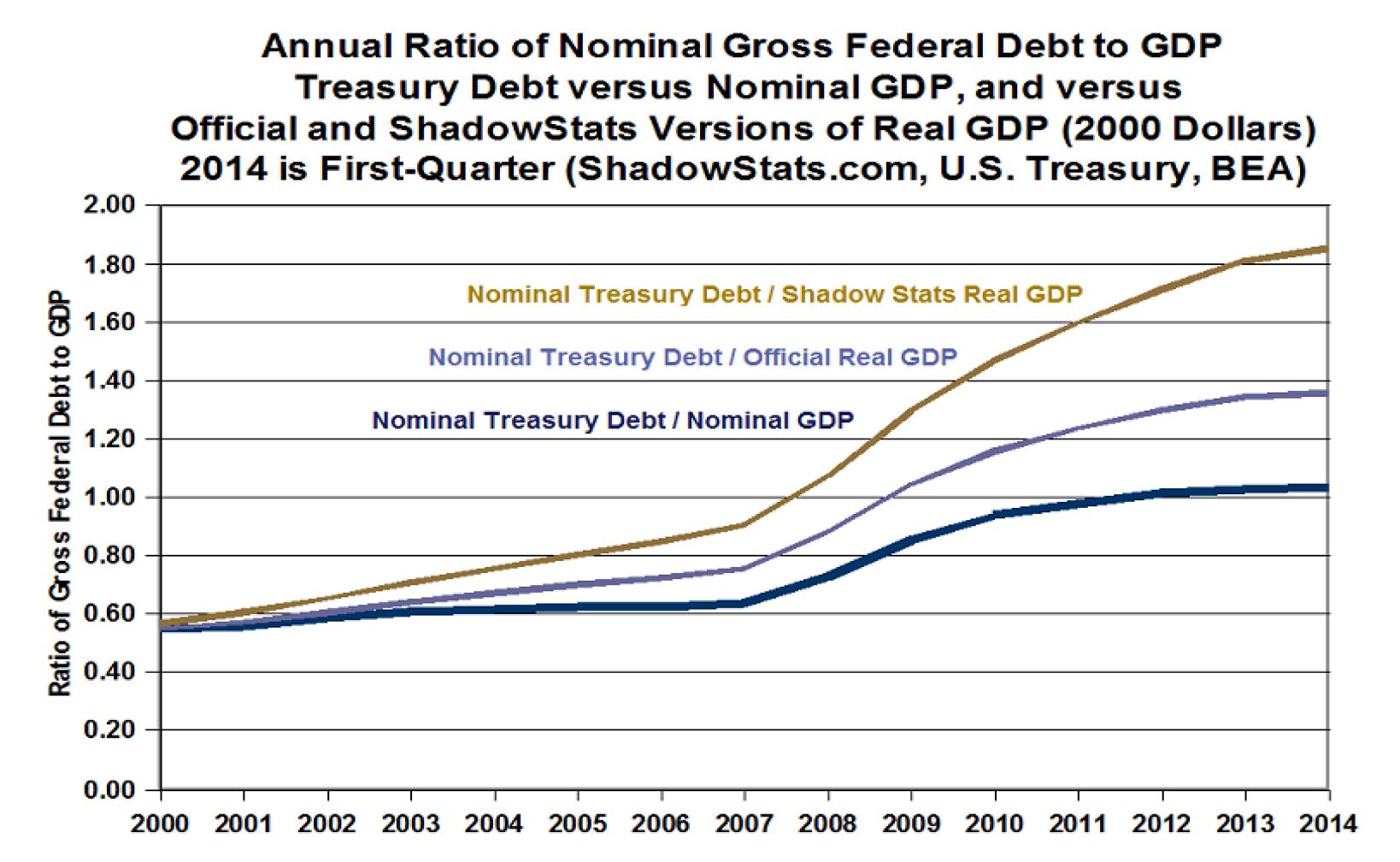
The graph below shows three different debt to GDP ratios. The bottom line is nominal debt to nominal GDP, the financial press ratio. The middle line is the ratio of nominal debt to the official measure of real GDP. The top line is the ratio of nominal GDP to Shadowstats’ corrected measure of real GDP that puts back in some of the inflation that is no longer included in official measures. The basis for this corrected measure is also 2000, but as the GDP number for 2000 is lower due to correction, this graph begins with the ratio at a slightly higher point.


The nominal debt to GDP ratio shows that as of the end of the first quarter of 2014 total US Treasury debt outstanding is 103 percent of US GDP.

The ratio of Treasury debt to official real GDP shows debt at 136% of GDP.

The ratio of debt to real GDP deflated with more a more realistic measure of inflation, one more in keeping with the experience of consumers, puts US public debt at 185% of GDP. In other words, the burden of US debt on the real economy is almost twice the burden that is normally perceived.

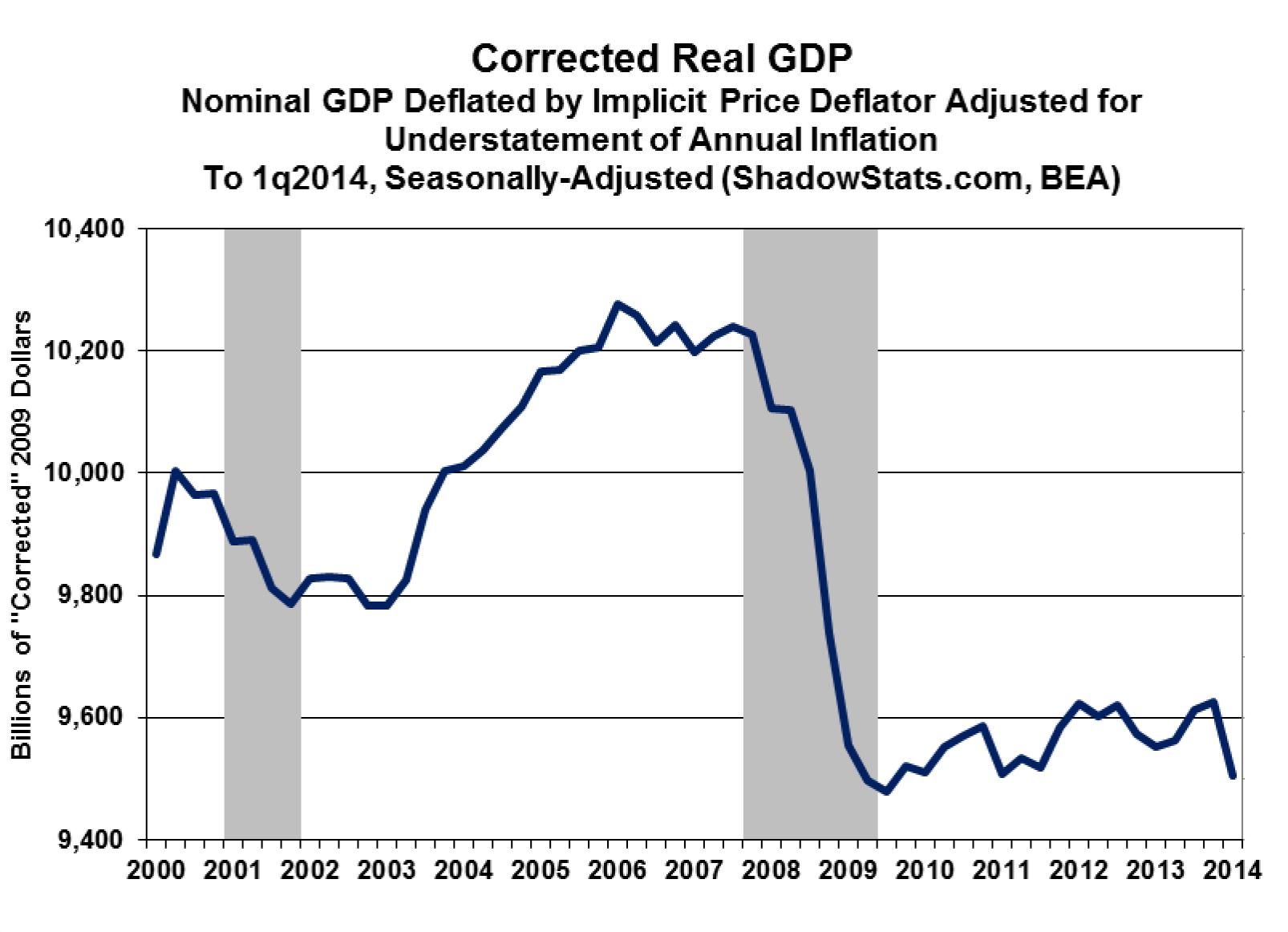
The Shadowstats adjustment we made to real GDP does not fully correct for what we believe has been a growing understatement of inflation since the 1980s. The adjustment we made corrects the implicit price deflator for a two-percentage point understatement of annual inflation due to hedonic distortion. Real GDP with this correction since 2000 looks like this:


We have calculated the ratios of US public debt to nominal GDP and to two measures of real GDP. The ratios of debt to GDP would be much higher if we used total credit outstanding, or total public and private debt, and if we used the government’s unfunded liabilities. The fact seems clear that debt is a major and unappreciated issue for the US economy. The enormous debt, especially with the middle class economy largely offshored, implies substantially lower living standards for the 99 percent.

The first quarter contraction, especially our corrected number, implies a second quarter negative real GDP. In other words, the years of Quantitative Easing (money printing) by the Federal Reserve has not resulted in economic recovery from the 2008 downturn and has not prevented further contraction.

Massive money creation and huge fiscal deficits have protected the balance sheets of “banks too big to fail” but have harmed the American people. Retirees and pension funds have been deprived for years of interest income as the Federal Reserve engineered zero or negative interest rates for the sake of a handful of oversized banks.

The extraordinary creation of new dollars diluted the dollars held by peoples, companies, institutions, and central banks throughout the world, raising fears that the dollar would lose exchange value and its role as world reserve currency.

Washington’s use of financial sanctions to force other countries to bend to Washington’s will is causing countries to leave the dollar payments system. Russian President Vladimir Putin’s advisor has said that the dollar must be crashed as the only way to prevent US aggression. The Chinese have called for “de-americanizing the world.”

The imperialistic US Foreign Account Tax Compliance Act (FATCA), which comes into full force July 1, 2015, imposes such heavy reporting costs on foreign financial institutions that these institutions might opt out of dollar transactions. All together, the result could be a serious tumble in the value of the US dollar, more wealth contraction, higher inflation via import prices, and less US wealth available to support US debt.

In view of this reality, why is Washington pushing its puppet in Kiev toward war with Russia? Why is Washington pushing NATO to spend more money and build more bases on which to deploy more troops in the Baltics and Eastern Europe, especially when Washington’s contribution will be the largest part of the cost? Why is Washington re-entering the Middle East conflict that Washington began by inciting Sunni and Shia against one another? Why is Washington constructing new naval and air bases from the Philippines to Vietnam in order to encircle China?

If Washington is this unaware of its budget constraints and its financial predicament, it cannot be long before Americans experience economic catastrophe.

Monday, July 7, 2014

Study Finds That Products Made with High-fructose Corn Syrup Contain Mercury

By Robert Preidt, USAToday

Almost half of tested samples of commercial high-fructose corn syrup (HFCS) contained mercury, which was also found in nearly a third of 55 popular brand-name food and beverage products where HFCS is the first- or second-highest labeled ingredient, according to two new U.S. studies.

HFCS has replaced sugar as the sweetener in many beverages and foods such as breads, cereals, breakfast bars, lunch meats, yogurts, soups and condiments. On average, Americans consume about 12 teaspoons per day of HFCS, but teens and other high consumers can take in 80% more HFCS than average.

"Mercury is toxic in all its forms. Given how much high-fructose corn syrup is consumed by children, it could be a significant additional source of mercury never before considered. We are calling for immediate changes by industry and the [U.S. Food and Drug Administration] to help stop this avoidable mercury contamination of the food supply," the Institute for Agriculture and Trade Policy's Dr. David Wallinga, a co-author of both studies, said in a prepared statement.

In the first study, published in current issue of Environmental Health, researchers found detectable levels of mercury in nine of 20 samples of commercial HFCS.

And in the second study, the Institute for Agriculture and Trade Policy (IATP), a non-profit watchdog group, found that nearly one in three of 55 brand-name foods contained mercury. The chemical was found most commonly in HFCS-containing dairy products, dressings and condiments.

But an organization representing the refiners is disputing the results published in Environmental Health.

"This study appears to be based on outdated information of dubious significance," said Audrae Erickson, president of the Corn Refiners Association, in a statement. "Our industry has used mercury-free versions of the two re-agents mentioned in the study, hydrochloric acid and caustic soda, for several years. These mercury-free re-agents perform important functions, including adjusting pH balances."

However, the IATP told the Minneapolis Star Tribune that four plants in Georgia, Tennessee, Ohio and West Virginia still use "mercury-cell" technology that can lead to contamination.

IATP's Ben Lilliston also told HealthDay that the Environmental Health findings were based on information gathered by the FDA in 2005.

And the group's own study, while not peer-reviewed, was based on products "bought off the shelf in the autumn of 2008," Lilliston added.

The use of mercury-contaminated caustic soda in the production of HFCS is common. The contamination occurs when mercury cells are used to produce caustic soda.

"The bad news is that nobody knows whether or not their soda or snack food contains HFCS made from ingredients like caustic soda contaminated with mercury. The good news is that mercury-free HFCS ingredients exist. Food companies just need a good push to only use those ingredients," Wallinga said in his prepared statement.

Just 4 fracking wastewater sites cause 20 percent of all central US earthquakes – study

RT
Published time: July 04, 2014

Just four wastewater wells in Oklahoma – where energy companies dump water after completing the hydraulic fracturing process – have caused scores of earthquakes this year, some 30 km from the site, according to a new study by top US universities.

The report, published in Science magazine, focused on the Midwestern state, which has produced 45 percent of the country’s magnitude 3 or bigger seismic shocks in the past five years – with the numbers rising rapidly to match the intensification of fracking activities in the area.

While hydraulic fracturing, or fracking, – which involves pressuring rock formations with liquid until they crack, and then extracting the oil and gas within – poses an inherent risk of earthquakes, according to the authors, the biggest culprits were the wastewater wells, where the liquids used for fracking are pumped, once a reservoir is opened.

“The disposed fluids are capable of contributing to the seismic activity,” Katie Keranen, a geophysics professor at Cornell, and the lead author of the study, told The Oklahoman newspaper.

“These wells are capable. That doesn’t exclude anything else from contributing, but we have no reason to think these are tectonic. They don’t match tectonic activity in other areas. It does seem these are just linked to wastewater. Our research focuses on wastewater and shows it is sufficient.”

Because of a paucity of real data from the thousands of sites in Oklahoma, the team, which included a member from the US Geological Survey, used a three-dimensional model of the underground formations in the area, and then combined that with real liquid injection rates in the area.

There are more than 4,500 active disposal wells in the state, but scientists found that of those, four large wells collectively responsible for pumping 5 million barrels – the equivalent of more than 200 Olympic swimming pools – of liquid into the ground each month, exceed a threshold beyond which disproportionately large earthquakes can happen.

“These really big wells have the biggest impacts on the system,” said Geoffrey Abers, one of the authors, and a professor at Columbia University's Lamont-Doherty Earth Observator.

“The earthquakes themselves seem to occur on small discrete faults. As the pressure builds up in the sedimentary formation that they are pumped into... They put that fault over the edge by jacking up the pore pressure.”

The researchers have not named the four sites, though they are located around Oklahoma City. This is particularly alarming, as the academics say that the impact of the earthquake in their model was as far as 22 miles away (the previous limit was thought to be about, and also could happen even after the disposal well was shut down.

This is a situation where the pumping starts months or a couple of years before the earthquakes are observed at all,” said Abers.

New Dominion, which operates the biggest wastewater wells in the state, has dismissed the simulation used to draw the conclusions.

"An initial review reflects it is premised on certain false assumptions," said company spokesman Jack Money. "At best these incorrect assumptions are irresponsible."

The oil and gas industry – which directly or indirectly employs 1 in 6 in the formerly lagging state – has also urged caution.

“As an industry, we’ve been saying we need more data and we need to work with regulators and others to help determine what is causing the significant increase in seismic activity,” said Chad Warmington, president of the Oklahoma Oil and Gas Association. “But to unequivocally link it to wastewater injections, I think there still needs to be more research.”

Between 1967 and 2000, there was an average of 21 earthquakes of a magnitude greater than 3.0 – considered strong enough to be noticed - in Oklahoma. Last year there were over a hundred, and this year there have been more than 200.

State industry regulator, the Oklahoma Corporation Commission, said it would not comment on the findings until it had a chance to examine them carefully.

Corporations Are Religious People


Guerilla Open Access Manifesto


Guerilla Open Access Manifesto 

Information is power. But like all power, there are those who want to keep it for themselves. The world's entire scientific and cultural heritage, published over centuries in books and journals, is increasingly being digitized and locked up by a handful of private corporations. Want to read the papers featuring the most famous results of the sciences? You'll need to send enormous amounts to publishers like Reed Elsevier. 

There are those struggling to change this. The Open Access Movement has fought valiantly to ensure that scientists do not sign their copyrights away but instead ensure their work is published on the Internet, under terms that allow anyone to access it. But even under the best scenarios, their work will only apply to things published in the future. Everything up until now will have been lost. 

That is too high a price to pay. Forcing academics to pay money to read the work of their colleagues? Scanning entire libraries but only allowing the folks at Google to read them? Providing scientific articles to those at elite universities in the First World, but not to children in the Global South? It's outrageous and unacceptable. 

"I agree," many say, "but what can we do? The companies hold the copyrights, they make enormous amounts of money by charging for access, and it's perfectly legal — there's nothing we can do to stop them." But there is something we can, something that's already being done: we can fight back. 

Those with access to these resources — students, librarians, scientists — you have been given a privilege. You get to feed at this banquet of knowledge while the rest of the world is locked out. But you need not — indeed, morally, you cannot — keep this privilege for yourselves. You have a duty to share it with the world. And you have: trading passwords with colleagues, filling download requests for friends. 

Meanwhile, those who have been locked out are not standing idly by. You have been sneaking through holes and climbing over fences, liberating the information locked up by the publishers and sharing them with your friends. 

But all of this action goes on in the dark, hidden underground. It's called stealing or piracy, as if sharing a wealth of knowledge were the moral equivalent of plundering a ship and murdering its crew. But sharing isn't immoral — it's a moral imperative. Only those blinded by greed would refuse to let a friend make a copy. 

Large corporations, of course, are blinded by greed. The laws under which they operate require it — their shareholders would revolt at anything less. And the politicians they have bought off back them, passing laws giving them the exclusive power to decide who can make copies. 

There is no justice in following unjust laws. It's time to come into the light and, in the grand tradition of civil disobedience, declare our opposition to this private theft of public culture. 

We need to take information, wherever it is stored, make our copies and share them with the world. We need to take stuff that's out of copyright and add it to the archive. We need to buy secret databases and put them on the Web. We need to download scientific journals and upload them to file sharing networks. We need to fight for Guerilla Open Access. 

With enough of us, around the world, we'll not just send a strong message opposing the privatization of knowledge — we'll make it a thing of the past. Will you join us? 

Aaron Swartz July 2008, Eremo, Italy

Tuesday, June 17, 2014

‘Inventing terrorists’: New study reveals FBI set up terrorism-related prosecutions

RT
June 16, 2014 11:43
 
Nearly 95 per cent of terrorist arrests have been the result of FBI foiling its own entrapment plots as a part of the so-called post-9/11 War on Terror, a new study revealed.

According to the report entitled ‘Inventing Terrorists: The Lawfare of Preemptive Prosecution’, the majority of arrests involved the unjust prosecution of targeted Muslim Americans.

The 175-page study by Muslim advocacy group SALAM analyzes 399 individuals in cases included on the list of the US Department of Justice from 2001 to 2010.

“According to this study’s classification, the number of preemptive prosecution cases is 289 out of 399, or 72.4 percent. The number of elements of preemptive prosecution cases is 87 out of 399, or 21.8 percent. Combining preemptive prosecution cases and elements of preemptive prosecution cases, the total number of such cases on the DOJ list is 376, or 94.2 percent,” the report concluded.
 
The authors define ‘preemptive prosecution’ as “a law enforcement strategy adopted after 9/11, to target and prosecute individuals or organizations whose beliefs, ideology, or religious affiliations raise security concerns for the government.”
 

Nearly 25 percent of cases (99 of 399) contained material support charges. Another almost 30 per cent of cases consisted of conspiracy charges. More than 17 per cent of the analyzed cases (71 of 399 cases) involved sting operations. Over 16 percent of cases (65 of 399 cases) included false statement or perjury charges, and around six percent of cases involved immigration-related charges.

According to the report, since 9/11 only 11 cases posed “potentially significant” threat to the United States.

“Only three were successful (the [Tamerlan and Dzhokhar] Tsarnaev brothers and Major Nidal Hasan), accounting for 17 deaths and several hundred injuries,” the paper says.

One of the FBI’s strategies involved “using agents provocateur to actively entrap targets in criminal plots manufactured and controlled by the government.”
 
“The government uses agents provocateur to target individuals who express dissident ideologies and then provides those provocateurs 25 with fake (harmless) missiles, bombs, guns, money, encouragement, friendship, and the technical and strategic planning necessary to see if the targeted individual can be manipulated into planning violent or criminal action,” the report concluded.

The government could also choose to use “minor ‘technical’ crimes,” such as errors on immigration forms, an alleged false statement to a government official, gun possession, tax or financial issues, etc., to go after someone for their “ideology.”
 
“What they were trying to do is to convince the American public that there is this large army of potential terrorists that they should all be very-very scared about. They are very much engaged in world-wide surveillance and this surveillance is very valuable to them. They can learn a lot about all sorts of things and in a sense control issues to their advantage,” Steven Downs, an attorney for Project SALAM, which issued the report, told RT. “And the entire legal justification for that depends on there being a war on terror. Without a war on terror they have no right to do this. So they have to keep this war on terror going, they have to keep finding people and arresting them and locking them up and scarring everybody.”
 
In the conclusion, authors of the report offered the US government several recommendations that the DOJ "should employ" to change the present unfair terrorism laws. A total seven recommendations call on the US government to accurately identify people who offer material support for terrorism, strengthening the “entrapment” defense in the courts; abolish “terror-enhanced sentencing” that triples or quadruples jail time in cases linked to terrorist acts; disallow secret court proceedings, and immediately notifying defendants if any evidence in their case is derived from secret surveillance.

Income Inequality by State

http://www.reuters.com/subjects/income-inequality/list

What Makes the United States So Unequal?

By Robert J.S. Ross

If governments did nothing, Western Europe and the United States would have similar levels of inequality. But governments don’t sit on the sidelines. They collect taxes. They provide social programs. They take steps that can lessen the amount of market inequality. The difference: Governments in European and other high-income societies do much more to reduce inequality than the United States.

Comparisons among the high-income countries usually show the United States as the most unequal.

Comparisons of income inequality among the high income countries usually show the United States as the most unequal, as measured by a standard index called the Gini coefficient. A Gini value of 100 means that all the income is held by one household. A value of 0, on the other hand, means that all income is equally shared.

For the United States, the Gini coefficient runs about 38, according to the OECD, the economic policy tank for the rich countries, or about 48, according to the U.S. Census Bureau. The American Gini rating has risen sharply in the last generation, after falling gradually in the middle of the twentieth century.

By comparison, the Nordic countries– Sweden, Denmark, Norway – have among the lowest Gini coefficients, in the 25-27 range, while Germany has a Gini of 29 and France, 28.

Comparisons that show the United States as the most unequal of high-income societies typically take into account the income households have from market-based activity (work and investments) and government transfer programs (Social Security and unemployment compensation, for instance) and subtract away taxes. Researchers call the end result from these calculations “post tax and transfer” or “disposable” income.

Political decisions determine taxes and transfers. Public policies, everything from minimum wage to labor laws, also influence market-based income. So we should expect inequality levels to differ among developed nations. Even so, the actual differences among developed nations can be surprising.
Political decisions determine taxes and transfers.

On the yardstick of market-based income, the level of inequality in the United States does not come off as particularly extreme. The United States ranks eighth most unequal among the 26 countries that reported 2010 data to the OECD. The United States sports about 7 percent more market-based inequality than the average of all OECD nations.

The extreme inequality status of the United States only kicks in when we go beyond market-based income and look at tax and transfer policies.

In the United States, taxes and transfers are doing much less to reduce inequality than these policies are doing in other developed nations. On average, rich countries’ tax and transfer policies reduce inequality by about 36 percent. The figure in the United States: only about 24 percent.

In Sweden, market-based inequality shows a Gini of about 44, but the disposable income Gini sits at a much more equal 27, a reduction of 39 percent in inequality. In the United States, the market Gini comes in about 50. The disposable income Gini: just 38 in the OECD data, a reduction of only 24 percent.

Over the last generation, major changes in U.S. tax and transfer policies – mainly cuts in the tax rates on high incomes – have actually served to increase inequality.

Inequality, to be sure, is increasing in almost all high-income countries, the consequence of the triumph of global capitalism and its neoliberal policy package: market dominance, privatization, and deregulation. But even in this company, the United States stands out for the depth of its commitment to policies – particularly tax policies – that favor the rich.
The United States stands out for its policies that favor the rich.

Many Americans are, not surprisingly, concerned about excessive taxes. Ours, after all, has been a nation forged in a struggle against a grasping, remote, tax-hungry overlord. Yet when we compare ourselves to other countries about as rich and democratic as we are, it appears we are not highly taxed. Our total taxation level stands at about 24 percent of GDP (the total value of national production and income), a level significantly lower than the 34 percent average of the other high-ncome countries.

Why should we care about how little our tax system reduces inequality? Among the world’s high-income countries, the British epidemiologists Richard Wilkinson and Kate Pickett have powerfully pointed out in The Spirit Level, the more unequal societies – and regions within countries – have more violence, infant mortality, lower life expectancies, and more mental illness. Societies that are more equal, on the other hand, have more trust among people. Our levels of inequality produce fractured community and social resentment, and they drive sour and even violent politics.

Inequality has become like the weather: Everybody talks about it but no one does anything. Unlike the weather, we can fix this mess and heal these wounds. To do so, we may need a reminder from Supreme Court Justice Oliver Wendell Holmes, Jr.: “Taxes are what we pay for civilized society.”