Monday, April 7, 2014

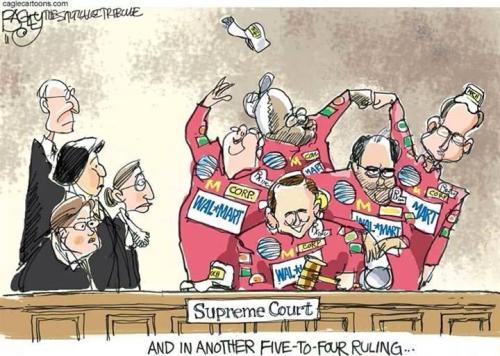
How We Can Fight Back Against the Supreme Court


Let me start by quoting two great men and a crook that died the other day.

"The issue today is the same as it has been throughout all history, whether man shall be allowed to govern himself or be ruled by a small elite." -- Thomas Jefferson

When asked if his payments to politicians had worked,  


Charles Keating replied, "I want to say in the most forceful way I can: I certainly hope so."

When asked outside of Independence Hall if we have a republic or a monarchy, Benjamin Franklin replied, "A republic, if you can keep it."

Well, here we are, aren't we? Right at the point where we are about to find out whether we can keep it or not. The Supreme Court has decided that a small amount of people will get to control our entire political system. Which politician or political party can resist hundreds of millions of dollars put in at once? Maybe one person can resist, maybe one party can resist for a small period of time, but eventually they will succumb.

In Congressional races, 95 percent of the time the person with more money wins. It doesn't matter if they are a Republican or Democrat, conservative or liberal. It doesn't matter what their ideas are or what their ideology is. It doesn't matter what they think at all. You have more money and you will win 19 out of 20 times.

Justice Anthony Kennedy destroyed our republic. We knew Alito, Scalia, Roberts and Thomas were corporate robots. We knew they were going to say disingenuously that corporations or billionaires pouring in millions into our politicians' pockets wouldn't lead to corruption. What an unbelievable joke. But it turns out that Kennedy was the biggest joke of all. He claims that millions in campaign donations won't even result in the appearance of corruption. Can anyone with a shred of intelligence honestly believe that?

So, it was nice while it lasted. Democracy at the national level is dead now. We have replaced it with an open auction. This will not at some future date lead to a worst case scenario. We're already living in that scenario.

You don't have to worry about the top 1 percent. Now, the 0.00024 percent of the country who donate over a $100,000 to politicians will rule us all. Because even the federal limit of $123,200 per election cycle has now been eliminated by the McCutcheon decision. They can now spend unlimited money "contributing" to our politicians.

So, how do we escape this worst case scenario? Congress is corrupt and the Supreme Court is even worse. Luckily, there is one thing above them -- the constitution. Every generation of Americans has amended the constitution so that we may have a more perfect union. Except one. Us.

We must get money out of politics. We must amend.

At The Young Turks, we already knew how bad the situation was because every political story we covered had the same exact answer -- find which side has more money and you'll know who is going to win. So, I founded Wolf PAC, which has only one, unstoppable mission -- amend the constitution to get the corrupting influence of money out of politics. We're not interested in awareness -- we're already quite aware of how screwed we are. We're not interested in consciousness raising or being a respected institution inside Washington, DC. We're interested in results!

I didn't pick the name Wolf PAC by accident. I picked it so we could be super aggressive. I don't want to negotiate with the power brokers in Washington; I want to tear them down. The lobbyists, the special interests, the donors and the politicians who cater to them are what's wrong with our country. They robbed us of our representative government. It's time we stood up and took it back. Let's over turn their apple cart.

Our founding fathers were geniuses. They put a certain provision in the constitution because they knew that a day like this would come. We have never had to use it yet. But we have threatened it many times and that threat has been incredibly effective just as many times. The clause is Article V of the constitution and it says that you don't necessarily need 2/3 of Congress to propose an amendment. You can have 2/3 of the states circumvent a corrupted Washington and propose a convention to get the same amendment. You don't need Washington at all. 34 states propose a convention for this specific issue. 38 states ratify that amendment. And we have our democracy back.

Now, this is the point in the movie when you say -- but that's impossible. The suffragist movement got women the right to vote when they couldn't vote in the first place. Now, that was impossible. And they still got it done.

In fact, four out of the last ten amendments were proposed by Congress because of the threat of an imminent convention. We can make these guys bend to our will. They're not supposed to be the boss of us. We are supposed to live in a democracy where we control our own fate. We are supposed to be the home of liberty. And we can be that again.

Let me tell you what we've done so far without anyone noticing. We have introduced a resolution calling for this convention in ten states and have over 100 state legislators sponsoring and supporting these resolutions all across the country. We have an army of 13,000 volunteers. We are legion and we are coming.

Tell me again what isn't possible.

We were told in Vermont that we had a zero percent chance of getting this resolution passed in the state Senate. That was a week before we got it passed 28-2. How did we turn the impossible into the inevitable? How did we get true bipartisanship on this issue? Well, we have over 90 percent of the American people on our side. Republicans, Democrats, libertarians and independents all agree on only one thing -- our national politicians are bought. When the bills are introduced we get a natural avalanche of support. At the state level, an army of citizens turn out to be hard to resist.

In one of the states where we had success, our volunteers got a politician to do something he didn't want to do. The pressure of angry, concerned citizens clearly switched his position. One of those volunteers wrote me an email afterward and said, "It feels so good to get the power back."

We have gone for so long without being able to affect the course of our government, we have gone so long feeling powerless that we have forgotten what our birthright is. We are born free men and women in this country. If we rise up together, we can be that again.

Join us. Join the fight. Get up, let's get them back!

Thursday, April 3, 2014

SCOTUS Strikes Down Political Spending Limits for Rich Donors

The US govt is corrupt in every branch, every level. Wealth owns everyone and everything. Democracy--game over....


The New Citizens United
 Wednesday, 02 April 2014
By Mike Ludwig, Truthout


Demonstrations were held across the country Wednesday as the Supreme Court continued chipping away at federal campaign finance reforms with a 5-4 ruling striking down the federal cap on the total amount of money an individual donor can spend supporting candidates and political parties during a two-year election cycle.

The ruling, which split the high court along ideological lines, eliminates the aggregate the cap on the total amount of money an individual can donate to candidates and party fundraising committees during an election season, which was set at $123,200 for 2013 and 2014. That cap was so high that only a several hundred mega-rich donors reached it during the last election cycle.

Campaign finance watchdogs now estimate that a single wealthy donor could spread up to $3.6 million among candidates, party committees and some political action groups affiliated with a single party during a single election cycle. A single donor could theoretically spend twice that amount by supporting candidates and committees from both parties, according to the Sunlight Foundation.

Conservatives are hailing the ruling as a victory for free speech. Liberals and progressives say the ruling will only increase the corrupting influence that ultra-rich donors can have on politicians, dealing yet another fundamental blow to the legitimacy of American democracy. Activists organized about 140 demonstrations and events in 38 states to protest the ruling and call for legislative action.

The ruling is not as sweeping as the Supreme Court's infamous 2010 Citizens United decision, which removed caps on the amount of money that corporations and unions can spend influencing federal elections and unleashed a tidal wave of corporate campaign cash that made the 2012 elections by far the most expensive in history.

But the ruling - one of several rulings under Chief Justice John Roberts that have eroded federal and state campaign finance laws in recent years - surely will increase the ability of rich Americans to impact elections.

The ruling also could inflate the power of joint fundraising committees, which take large donations from donors and funnel the cash to candidates and party committees with full knowledge of who signed the original check.

"Eliminating these limits will now allow a single politician to solicit, and a single donor to give, up to $3.6 million through the use of joint fundraising committees," said Michael Walden, president of the Brennan Center for Justice. "Following the Citizens United decision, this will further inundate a political system already flush with cash, marginalize average voters, and elevate those who can afford to buy political access."

Wednesday's ruling in McCutcheon vs. Federal Election Commission does not touch limits on the amount of money an individual can give to a single federal candidate, which currently is set at $2,600.

Free Speech or Plutocracy?

The majority opinion, delivered by Roberts, claims these limits on individual donations will keep political corruption in check. The Roberts opinion, which was supported by the court's conservative justices, argues that the cap on the total amount and individual can spend during an election cycle can prevent a donor from giving to as many candidates as he or she chooses, which violates free speech rights under the First Amendment.

Like the Citizens United ruling, the majority opinion views political speech and the money spent by wealthy donors to support candidates and influence elections as one and the same.

"Contributing money to a candidate is an exercise of an individual’s right to participate in the electoral process through both political expression and political association," Roberts wrote for the majority. " ... The Government may no more restrict how many candidates or causes a donor may support than it may tell a newspaper how many candidates it may endorse."

Writing for the four dissenting justices on the liberal side of the bench, Justice Stephen Breyer argued that the ruling created a "loophole" allowing rich donors to donate millions to candidates and parties, and, coupled with the Citizens United ruling, "eviscerates our Nation’s campaign finance laws, leaving a remnant incapable of dealing with the grave problems of democratic legitimacy that those laws were intended to resolve."

The case was brought before the court by the national Republican Party and Shaun McCutcheon; a wealthy businessman from Alabama who argued the cap on aggregate donations violated his First Amendment rights by prevented him from donating to Republican candidates he wanted to support in recent elections.

"Today, the court made clear that restraints on the political speech of those whose views you don't like must fail; free speech is the right of all Americans and not a revocable grant from the government of the day," said Dan Backer, the lead political counsel for McCutcheon and the Republican Party.

Campaign finance reformers, however, said the ruling is not a victory for free speech. It's a victory for the plutocracy.

"No matter what five Supreme Court justices say, the First Amendment was never intended to provide a giant megaphone for the wealthiest to use to shout down the rest of us," said Robert Weissman, president of Public Citizen, a progressive watchdog group that supports campaign finance reforms. "Our only hope of overturning this McCutcheon travesty - along with Citizens United - is if millions of Americans band together in saying 'Enough!' to plutocracy."

Growing Grass-Roots Momentum

For several years, a broad grass-roots movement has pushed to overturn Citizens United, either through legislation or amending the Constitution to declare that money spent influencing elections is not the same as free speech. Activists also are pushing for federal legislation that would amplify the impact of small political donations made by average Americans.

Jonah Minkoff-Zern, an activist with Public Citizen who helped organize protests in response to the McCutcheon decision, said the ruling would only spark more grassroots momentum.

"The rallies are a way for us to say, this is not going to be a dark day in history but a day of organizing hope and a call for change," Minkoff-Zern told Truthout.

In recent years, lawmakers in at least 16 states have passed resolutions calling for a constitutional amendment to overturn Citizens United. Minkhoff-Zern said at least 150 members of Congress have signed on in support of similar resolutions.

Monday, March 31, 2014

The Economic Scam of the Century

Government Backing for Toxic Mortgage Securities?
by MIKE WHITNEY
The leaders of the U.S. Senate Banking Committee,  Sen. Tim Johnson (D., S.D.) and Sen. Mike Crapo (R., Idaho),  released a draft bill on Sunday that would provide explicit government guarantees on mortgage-backed securities (MBS) generated by privately-owned banks and financial institutions. The gigantic giveaway to Wall Street would put US taxpayers on the hook for 90 percent of the losses on toxic MBS the likes of which crashed the financial system in 2008 plunging the economy into the deepest slump since the Great Depression. Proponents of the bill say that new rules by the Consumer Financial Protection Bureau (CFPB) –which set standards for a “qualified mortgage” (QM)– assure that borrowers will be able to repay their loans thus reducing the chances of a similar meltdown in the future. However, those QE rules were largely shaped by lobbyists and attorneys from the banking industry who eviscerated strict underwriting requirements– like high FICO scores and 20 percent down payments– in order to lend freely to borrowers who may be less able to repay their loans.  Additionally, a particularly lethal clause has been inserted into the bill that would provide blanket coverage for all MBS  (whether they met the CFPB’s QE standard or not) in the event of another financial crisis. Here’s the paragraph:
“Sec.305. Authority to protect taxpayers in unusual and exigent market conditions….
If the Corporation, the Chairman of the Federal Reserve Board of Governors and the Secretary of the Treasury, in consultation with the Secretary of Housing and Urban Development, determine that unusual and exigent circumstances threaten mortgage credit availability within the U.S. housing market, FMIC may provide insurance on covered securities that do not meet the requirements under section 302 including those for first loss position of private market holders.” (“Freddie And Fannie Reform – The Monster Has Arrived”, Zero Hedge)
In other words, if the bill passes,  US taxpayers will be responsible for any and all bailouts deemed necessary by the regulators mentioned above.  And, since all of those regulators are in Wall Street’s hip-pocket, there’s no question what they’ll do when the time comes. They’ll bailout they’re fatcat buddies and dump the losses on John Q. Public.

If you can’t believe what you are reading or if you think that the system is so thoroughly corrupt it can’t be fixed; you’re not alone. This latest outrage just confirms that the Congress, the executive and all the chief regulators are mere marionettes performing whatever task is asked of them by their Wall Street paymasters.

The stated goal of the Johnson-Crapo bill is to “overhaul” mortgage giants Fannie Mae and Freddie Mac so that “private capital can play the central role in home finance.” (That’s how Barack Obama summed it up.) Of course, that’s not really the purpose at all. The real objective is to hand over the profit-generating mechanism to the private banks (Fannie and Freddie have been raking in the dough for the last three years) while the red ink is passed on to the public. That’s what’s really going on.

According to the Wall Street Journal,  the bill will
“construct an elaborate new platform by which a number of private-sector entities, together with a privately held but federally regulated utility, would replace key roles long played by Fannie and Freddie….”
“The legislation replaces the mortgage-finance giants with a new system in which the government would continue to play a potentially significant role insuring U.S. home loans.” (“Plan for Mortgage Giants Takes Shape”, Wall Street Journal) 
“Significant role”? What significant role? (Here’s where it gets interesting.)

The WSJ:
“The Senate bill would repurpose the firms’ existing regulator as a new “Federal Mortgage Insurance Corp.” and charge the agency with approving new firms to pool loans into securities. Those firms could then purchase federal insurance to guarantee payments to investors in those bonds. The FMIC would insure mortgage bonds much the way the Federal Deposit Insurance Corp. provides bank-deposit insurance.”
Unbelievable. So they want to turn F and F into an insurance company that backs up the garbage mortgages created by the same banks that just ripped us all off for trillions of dollars on the same freaking swindle?

You can’t be serious?

More from the WSJ: 
“Mortgage guarantors would be required to maintain a 10% capital buffer against losses and to have that capital extinguished before the federal insurance would be triggered.”

10 percent? What the hell difference does 10 percent make; that’s a drop in the bucket.  If the banks are going to issue mortgages to people who can’t repay the debt, then they need to cover the damn losses themselves, otherwise they shouldn’t be in the banking biz to begin with, right?

This is such an outrageous, in-your-face ripoff, it shouldn’t even require a response. These jokers should be laughed out of the senate. All the same,  the bill is moving forward, and President Twoface has thrown his weight behind it. Is there sort of illicit, under-the-table, villainous activity this man won’t support?

Not when it comes to his big bank buddies, there isn’t. Now check out this clip from an article by economist Dean Baker. Baker refers to the Corker-Warner bill, but the Crapo-Johnson fiasco is roughly the same deal. Here’s Baker:
“The Corker-Warner bill does much more than just eliminate Fannie and Freddie. In their place, it would establish a system whereby private financial institutions could issue mortgage-backed securities (MBS) that carry a government guarantee. In the event that a large number of mortgages in the MBS went bad, the investors would be on the hook for losses up to 10 percent of its value, after that point the government gets the tab.
If you think that sounds like a reasonable system, then you must not have been around during the housing crash and ensuing financial crisis. At the peak of the crisis in 2008-2009 the worst subprime MBS were selling at 30-40 cents on the dollar. This means the government would have been picking up a large tab under the Corker-Warner system, even if investors had been forced to eat a loss equal to 10 percent of the MBS price.
The pre-crisis financial structure gave banks an enormous incentive to package low quality and even fraudulent mortgages into MBS. The system laid out in the Corker-Warner bill would make these incentives even larger. The biggest difference is that now the banks can tell investors that their MBS come with a government guarantee, so that they most they stand to lose is 10 percent of the purchase price.” (“The disastrous idea for privatizing Fannie and Freddie”, Dean Baker, Al Jazeera)
Just ponder that last part for a minute: “The bill would make these incentives even larger.”

Do you really think we should create bigger incentives for these dirtbags to rip us off? Does that make sense to you? Here’s more from Baker:
“The changes in financial regulation are also unlikely to provide much protection. In the immediate wake of the crisis there were demands securitizers keep a substantial stake in the mortgages they put into their pools, to ensure that they had an incentive to only securitize good mortgages. Some reformers were demanding as much as a 20 percent stake in every mortgage.
Over the course of the debate on the Dodd-Frank bill and subsequent rules writing this stake got ever smaller. Instead of being 20 percent, it was decided that securitizers only had to keep a 5 percent stake. And for mortgages meeting certain standards they wouldn’t have to keep any stake at all.
Originally only mortgages in which the homeowner had a down payment of 20 percent or more passed this good mortgage standard. That cutoff got lowered to 10 percent and then was lowered further to 5 percent. Even though mortgages with just 5 percent down are four times as likely to default as mortgages with 20 percent or more down, securitizers will not be required to keep any stake in them when they put them into a MBS.”
Hold on there, Dean. You mean Dodd Frank didn’t ”put things right”?  What the heck? I thought that “tough new regulations” assured us that the banks wouldn’t blow up the system again in five years or so. Was that all baloney?

Yep, sure was. 100% baloney. Once the banks unleashed their army of attorneys and lobbyists on Capital Hill,  new regulations didn’t stand a chance. They turned Dodd Frank into mincemeat and now we’re back to square one.

And don’t expect the ratings agencies to help out either because they’re in the same shape they were before the crash. No changes at all.  They still get paid by the guys who issue the mortgage-backed securities (MBS) which is about the same as if you paid the salary of the guy who grades your midterm exam. Do you think that might cloud his judgment a bit? You’re damn right, it would; just like paying the ratings agencies guarantees you’ll get the rating you want. The whole system sucks.

And as far as the new Consumer Financial Protection Bureau, well, you guessed it. The banks played a role in drafting the new “Qualified Mortgage” standard too, which is really no standard at all, since no self-respecting lender would ever use the same criteria for issuing a loan or mortgage. For example, no banker is going to say, “Heck, Josh, we don’t need your credit scores. We don’t need a down-payment. We’re all friends here, right? So, how much do you need for that mortgage old buddy, $300,000, $400,000, $500,000.  You name it. The sky’s the limit.”

No down payment? No credit scores? And they have the audacity to call this a qualified mortgage?
Qualified for what? Qualified for sticking it to the taxpayers?  The real purpose of the qualified mortgage is to protect the banks from their own shifty deals. That’s what it’s all about. It provides them with “safe harbor” in the event that the borrower defaults. What does that mean?

It means that the government can’t get its money back if the loan blows up.   The qualified mortgage actually protects the banks, not the consumer. That’s why it’s such a farce,  just like Dodd Frank is a farce. Nothing has changed. Nothing. In fact, it’s gotten worse. Now we’re on the hook for whatever losses the banks run up peddling mortgage credit to anyone who can fog a mirror.

We’ll leave the last word for Dean Baker, since he seems like the only guy in America who has figured out what the hell is going on:
“In short, the Corker-Warner plan to privatize Fannie and Freddie is essentially a proposal to reinstitute the structure of incentives that gave us the housing bubble and the financial crisis, but this time with the added fuel of an explicit government guarantee on the subprime MBS. If that doesn’t sound like a great idea to you then you haven’t spent enough time around powerful people in Washington.”
The Johnson-Crapo bill doesn’t have anything to do with “winding down” Fannie and Freddie or “overhauling” the mortgage finance industry. It’s a bald-face ripoff engineered by two chiseling senators who are putting the country at risk to beef up Wall Street’s bottom line.

It’s the scam of the century.

How Much War Does Washington Want?

by PAUL CRAIG ROBERTS


I doubt that the Ukraine crisis precipitated by Washington’s overthrow of the democratic government is over. Washington has won the propaganda war everywhere outside of Russia and Ukraine itself. Within Ukraine people are aware that the coup has made them worse off. The Crimea has already separated from the US puppet government in Kiev and rejoined Russia. Other parts of Russian Ukraine could follow.

In Kiev itself where the unelected, imposed-by-Washington dictatorial government resides, extreme right-wing Ukrainian nationalists, whose roots go back to fighting for National Socialist Germany, are at work intimidating public prosecutors, media editors, and the US imposed “government” itself. There is an abundance of videos available on the Internet, some made by the extreme nationalists themselves, that clearly reveal the intimidation of the imposed and unelected government installed by Washington.

In Kiev US bribes contend with naked neo-nazi force. Which will prevail?

The murder of ultra-nationalist Right Sector militant leader Myzychko by police of the acting Interior Minister of the American stooge government in Ukraine on March 25 has resulted in another Right Sector leader, Dmitry Yarosh, demanding the resignation of Arsen Avakov, the acting Interior Minister and the arrest of the police who killed Muzychko. Yarosh declared: “We cannot watch silently as the Interior Ministry works to undermine the revolution.” Right Sector organizer Roman Koval in Rovno, Ukraine, warned: “We will take revenge on Avakov for the death of our brother.”

How this will play out is uncertain at this time. The violence provided by the Right Sector and other ultra-nationalist groups was essential to the success of the Washington-backed coup in overthrowing the elected democratic government. But the Right Sector has emerged as both an embarrassment and a threat to the unelected coup government and to its Washington sponsors who are selling the Washington-installed puppet government as a progressive exercise in democracy. This sell is difficult when ultra-nationalist thugs are beating up the imposed government.

Could civil war break out in Kiev between the Right Sector and the government installed by Washington? We know that the Right Sector was sufficiently organized and disciplined to take over the protests. We don’t know how well organized is the Washington puppet government or what force this group has at its disposal. We don’t know whether Washington has provided mercenaries to protect the government Washington has installed. It is not clear at this time where the power balance lies between the Right Sector and the US stooge government.

The American, UK, Canadian, Australian, New Zealand, EU propaganda machine has blamed Putin for all the trouble. But so far the Russian government has not had to do anything except comply with the self-determination of the people in the Russian areas of Ukraine. Much of Ukraine, as it exists or existed today, consists of Russian territories added to Ukraine by Soviet rulers.

When Ukraine became independent with Russia’s agreement when the Soviet Union collapsed, had the Russian territories first been put back into Russia from whence they came, Washington’s coup would not have resulted in the same level of crisis.

Instead, under Washington’s pressure, the Russian territory was retained by Ukraine, and in compensation Russia was given a 50-year lease on Sevastopol, Russia’s Black Sea naval base.

The purpose of the Washington financed and orchestrated coup in Kiev was to put Ukraine, with its artificial boundaries, into the EU and NATO and to evict Russia from its warm water port and ring Russia with US missile bases. Washington and its European puppets described this as “bringing democracy to Ukraine.”

Ukraine already had democracy, a young one trying to put down roots, and Washington destroyed it. As Russian President Putin observed, overthrowing a brand new democracy destroys democracy. Washington’s coup established for Ukraine the precedent that force and propaganda rule, not democracy.

But Washington cares not for democracy, only for its agenda. And Russia, China, and Iran are in the way.

The neoconservatives, who have controlled US foreign policy since the Clinton regime, concluded that the Soviet collapse meant that History has chosen America as the socio-economic system for the world. They declared the US to be “exceptional” and “indispensable” and above international law. Washington had a free pass to invade, murder, destroy, and dominate. The neoconservative claims of “American exceptionalism” sound like Hitler’s claims for the German nation. When the White House sock puppet expressed in a speech the claim of American exceptionalism, Putin replied: “God made us all equal.”

Washington’s opinion is that the exceptional and indispensable nation–the US–is above not only all other nations but also above law. What Washington does is legal. What anyone else does in opposition is illegal.

Washington’s intervention in Ukraine has unleashed dark forces. Yulia Tymoshenko, the criminal Ukrainian oligarch, who braids her hair or hair piece over her head like a crown, was released from prison by Washington’s stooges and has not stopped putting her foot, or both feet, in her mouth. Her latest in her intercepted and leaked telephone conversation is her declaration that “it’s about time we grab our guns and go kill those damn Russians together with their leader.” She declared that not even scorched earth should be left where Russia stands.


Tymoshenko was sentenced to prison by Ukrainians, not by Russians. Contrast her extreme language and Russophobia with the calm measured tones of Putin, who reaffirms Russia’s interest to continue good relations with Ukraine.

On March 23 Tymoshenko was interviewed by the German newspaper, Bild, a mouthpiece for Washington. The crazed Tymoshenko declared that Putin was even more dangerous than Hitler.


This year 2014 is the 100th anniversary of World War 1. As my Oxford professor, Michael Polanyi, said, this was the war that destroyed Europe. He meant culturally and morally as well as physically. As John Maynard Keynes made clear in his prediction, the propagandistic way in which World War 1 was blamed on Germany and the “peace” that was imposed on Germany set up World War 2.

We are witnesses today to the same kind of propagandistic lies with regard to Russia that caused World War 1. In The Genesis Of The World War, Harry Elmer Barnes quotes the French chief editor of a French account of the organization of propaganda in France during World War 1. The French built a massive building called La Maison de la Presse. In this building images of people were created with hands cut off, tongues torn out, eyes gouged out, and skulls crushed with brains laid bare. These images were then photographed and “sent as unassailable evidence of German atrocities to all parts of the globe, where they did not fail to produce the desired effect.” Also provided were “fictitious photographs of bombarded French and Belgian churches, violated graves and monuments and scenes of ruins and desolation. The staging and painting of these scenes were done by the best scene-painters of the Paris Grand Opera.”

This vicious propaganda against Germany meant that Germany could be blamed for the war and that all of President Woodrow Wilson’s guarantees to Germany of no reparations and no territorial loss if Germany agreed to an armistice could be violated.

The propaganda success guaranteed that the peace settlement would be so one-sided as to set up the Second World War.

Russia has observed Washington’s strategic moves against Russian national interests and Russian sovereignty for two decades. What does Putin think when he hears the vicious anti-Russian propaganda based 100% in lies?

This is what Putin thinks: The Americans promised Gorbachev that they would not take NATO into Eastern Europe, but the Americans did. The Americans withdrew from the ABM Treaty, which prohibited escalating the arms race with anti-ballistic missile systems. The Americans arranged with Poland to deploy anti-ballistic missile bases on Poland’s border with Russia. The Americans tell us the fantastic lie that the purpose of American missile bases in Poland is to protect Europe from non-existent Iranian ICBMs. The Americans change their war doctrine to elevate nuclear weapons from a retaliatory deterrent to a pre-emptive first strike force. The Americans pretend that this change in war doctrine is directed at terrorists, but we know it is directed at Russia. The Americans have financed “color revolutions” in Georgia and Ukraine and hope to do so in the Russian Federation itself. The Americans support the terrorists in Chechnya. The Americans trained and equipped the Georgian military and gave it the green light to attack our peacekeepers in South Ossetia. The Americans have financed the overthrow of the elected government in Ukraine and blame me for the anxiety this caused among Crimeans who on their own volition fled Ukraine and returned to Russia from whence they came. Even Gorbachev said that Khrushchev should never have put Crimea into Ukraine. Solzhenitsyn said that Lenin should not have put Russian provinces into eastern and southern Ukraine. Now I have these Russian provinces agitating to return to Russia, and the Americans are blaming me for the consequences of their own reckless and irresponsible actions.

The Americans say I want to rebuild the Soviet Empire. Yet, the Americans witnessed me depart from Georgia when I had this former Russian province in my hands, thanks to the short-lived war instigated by the Americans.

There is no end to the American lies. I have done everything possible to respond to provocations in a low-key reasonable manner, offering to work things out diplomatically, as has my Foreign Minister Lavrov. But the Americans continue to provoke and to hide their provocations behind lies. The Americans brazenly bring to me a strategic threat in Ukraine. They intend to put Ukraine in NATO, the purpose of which expired with the Soviet collapse. They intend to put more missile bases on Russia’s borders, and they intended to evict Russia from its Black Sea naval base, its warm water port.

Americans have no intention of working anything out. They intend to subjugate Russia. Washington wants Russia powerless, surrounded with ABM bases that degrade our strategic deterrent to uselessness. These Americans will not work with me. They will not listen to me or to Russia’s Foreign Minister. They only hear their own call for American hegemony over the world. My only alternative is to prepare for war.

The government of China, having read Washington’s war plans for war against China and being fully away of Washington’s “pivot to Asia,” in which the “indispensable nation” announced its “safe-guarding of peace” by surrounding China with naval and air bases, understands that it has the same Washington enemy as does Russia.

What the entire world faces, every country, every individual regardless of their political orientation, is a Washington-engineered confrontation with Russia and China. This confrontation is enabled by Washington’s bought-and-paid-for European and UK puppet states. Without the cover provided by Europe, Washington’s acts of aggression would result in war crimes charges against the government in Washington. The world would not be able to enforce these charges without war, but Washington would be isolated.

The European, Canadian, Australian, New Zealand, and UK governments have betrayed not only their own peoples but also the peoples of the entire world by lending the support of Western Civilization to Washington’s lawlessness.

The propaganda that the West represents the hope of the world is a great lie.

BP, not Exxon, caused the Exxon Valdez disaster


By Greg Palast
March 2014 | Read the full story at TruthDig

 
Two decades ago I was the investigator for the legal team that sold you the bullshit that a drunken captain was the principal cause of the Exxon Valdez disaster, the oil tanker crackup that poisoned over a thousand miles of Alaska’s coastline 25 years ago today, on March 24, 1989.

The truth is far uglier, and the real culprit—British Petroleum, now BP—got away without a scratch to its reputation or to its pocketbook.

Just this month, the Obama administration authorized BP to return to drilling in the Gulf.

It would be worth the time of our ever-trusting regulators to take a look at my Exxon Valdez files on BP.  They would see a decades-long pattern of BP’s lies, bribes and cover-ups that led, inexorably, to the Deepwater Horizon blowout—and that continue today within BP’s worldwide oil operations.

Here’s a sample:

Palast’s investigation of BP opens his latest film, Vultures and Vote Rustlers. Pre-release editions are available on DVD and download for a donation to Palast’s foundation for investigative reporting at http://www.palastinvestigativefund.org
And read the complete untold story of the Exxon Valdez and Deepwater Horizon disasters in Palast’s Vultures’ Picnic, BBC Newsnight’s Culture Program’s Book of the Year.


Fraud No. 1: The Emergency Sucker Boat fraud
As the principal owner of the Alaska Pipeline and Terminal, BP, not Exxon, was designated by law to prevent oil spilled by the Exxon Valdez from hitting the beach. It was BP’s disastrous failures, more than Exxon’s, that allowed the oil to devastate Alaska’s coast.

Containing an oil spill—preventing spilled crude from spreading to the shore—is not rocket science.  All you need are rubbers and suckers. It works like this:

If a tanker, oil rig or pipe bursts open, you surround it with a giant rubber skirt known as “boom.” Then you suck the oil out through vacuum hoses on board special “containment” or “skimmer” ships.

The containment ship is the firetruck of oil spills. You simply don’t let tankers out of port unless a containment ship is ready to roll. It’s against the law.

But the law has never meant much to BP.

In May 1977, as the first tankers left Valdez, BP executives promised the state of Alaska that no tanker would leave port unless there were two containment barges at the ready and loaded with boom, with one placed near Bligh Island.

In fact, on March 24, 1989, when the Exxon Valdez ran aground, right at Bligh Island, the containment barge was far away in Valdez, locked in a dry dock, its boom and hoses under Alaskan ice. As a result, by the time the emergency oil spill vessel got to the stricken ship, the oil slick was a hundred miles in circumference and beyond control.

Two decades later, I watched fireboats uselessly spraying the burning oil on the Deepwater Horizon. Once again there were no BP skimmer barges, no boom surrounding the rig. Just as in Alaska, the promised spill containment operation was a con.

Fraud No. 2: Ghost Crews
There’s no sense having a fire truck without firemen. And so, years before the Exxon Valdez grounding, Alyeska, the oil company consortium headed by BP, promised the U.S. Department of the Interior and the U.S. Congress, under oath, that the oil shipper would employ a trained and equipped crew around the clock to jump from helicopters, if needed, to contain an oil spill. My clients, the Chugach Natives of Alaska, agreed to give up ownership of the land under the Port of Valdez to the oil companies in return for those jobs.

The night the Exxon Valdez grounded, Chugach Natives watched from the beach at nearby Tatitlek Village as the tanker headed into the reef. They could have prevented the disaster—but they were helpless: BP had fired them.

To save money, BP’s Alyeska simply drew up lists of nonexistent emergency spill response workers: an imaginary crew to man phantom emergency ships.

Fraud No. 3: Phantom Equipment
And the rubber boom? That was a phantom as well. BP’s Alyeska had promised that too, in writing. The equipment was supposed to be placed along the tanker route including Bligh Island—exactly the spot where the Exxon Valdez grounded.

And so, it was no surprise to me that 21 years later in the Gulf there were neither skimmers nor boom at the site of the Deepwater Horizon.

Cover-Up and Threats
Did BP’s top executives and partners know of the ghost response teams and phantom equipment ruse? Yes, we have the documents and insiders’ testimony. Just two examples from my bulging file cabinet:

In a confidential letter dated April 19, 1984, Capt. James Woodle, BP’s commander of the port at Valdez, warned that “due to a reduction in manning, age of equipment, limited training and lack of personnel, serious doubt exists that [we] would be able to contain and clean up effectively a medium or large size oil spill.”

In response, BP threatened the captain with a file on his marital infidelities (fabricated), fired him, then forced him to destroy his files. (I’ve got the letter—can’t tell you how.  Click here.)

In September 1984, before the Exxon Valdez disaster, BP’s shipping broker, Charles Hamel, was so concerned at what he saw as an immediate danger in Alaska that he flew by Concorde to London to warn BP’s chiefs of the looming emergency. In response, BP hired ex-CIA operatives to tap Hamel’s phone and intercept his mail. BP’s black ops team even ran a toy truck with a microphone into the air vents of a building where he was speaking with a congressman. (Ultimately, BP’s spooks were captured by a team of Navy SEALs.)

BP Gets Off Cheap
The team of attorneys representing the Natives and fishermen whose lives were destroyed by the tanker spill chose to hold back the true and ugly story of systematic fraud and penny-pinching negligence by BP and its partners. We focused instead on the simpler story of human frailty and error—“drunken skipper hits reef.”

We didn’t have a choice: Oil company chiefs had told our clients—Natives who were out of cash, isolated and desperate—that they wouldn’t get a dime unless we agreed not to use the “f-word”: fraud.

And BP? Who said crime doesn’t pay? BP walked away with a nominal payment to Alaska’s Natives, fishermen and towns of $125 million—100 percent of it covered by insurance.

The Oil is Still There
In 2010 for the U.K.’s Channel 4 Television, I returned to Alaska with filmmaker Richard Rowley. In the quiet rivulets of the islands within Prince William Sound, we kicked over some stones—and the place, two decades after the spill, smelled like a filthy gas station.

Maybe it’s time for the Obama Administration, eager to welcome BP back to plunder the Gulf, to wake up and smell the crude.

Insane in the Membrane


Tuesday, March 25, 2014

Bankers' Deaths Shine Light on Stress in Industry, Tunnel Vision

By Ben Moshinsky Mar 24, 2014
Bloomberg

Coroners in London are preparing to investigate two apparent suicides as unexpected deaths by finance workers around the world have raised concerns about mental health and stress levels in the industry.

The inquest into the death of William Broeksmit, 58, a retired Deutsche Bank AG (DBK) risk executive found dead in his London home in January, will start tomorrow. The inquest for Gabriel Magee, a 39-year-old vice president in technology operations at JPMorgan Chase (JPM) & Co., who died after falling from the firm’s 33-story London headquarters, is scheduled for late May.

The suicides were followed by others around the world, including at JPMorgan in Hong Kong, as well as Mike Dueker, the chief economist at Seattle-based Russell Investment Management Co. The financial world’s aggressive, hard-working culture may be hurting itself, professionals advising on mental health in the industry say.

At greatest risk are “those who have not cultivated friendships, networks, outside of their company,” said Stewart Black, professor of global leadership and strategy at IMD, a business school in Lausanne, Switzerland.

“A lot of executives keep their nose down, work hard, do great work and don’t really cultivate extra networks,” he said. “Those broader networks act as safety valves.”

Banks are starting to realize the scale of the problem, said Peter Rodgers, chairman of the City Mental Health Alliance, which counts Morgan Stanley (MS) and Bank of America Corp. among its members.

Cultural Change


When the group was set up last year banks, law firms and accountants including Goldman Sachs Group Inc. (GS), Linklaters LLP and KPMG LLP, “no one in the City was really talking” about mental health, Rodgers said. Now they have 18 firms on their list, including the Bank of England, the central bank.

The banking sector has “seen a number of initiatives” to improve staff well-being but they “need to be accepted by a cultural change at the very top,” said Rodgers, who is also deputy general counsel at KPMG.

Magee’s family didn’t return a phone call seeking comment. Ed Adler, a spokesman for the New York-based Broeksmit Family Foundation, also didn’t return a call seeking comment. Kathryn Haynes, spokeswoman for Deutsche Bank in London, and Jennifer Zuccarelli, a spokeswoman for JPMorgan, declined to comment.

Finance “does tend to have a long-hours culture,” said Emma Mamo, who leads workplace initiatives at Mind, a U.K. mental health charity. “People can’t keep doing long hours; you need perspective and downtime.”


‘Finest Minds’


Broeksmit died on Jan. 26 at his home in Chelsea, west London, according to a memo to employees obtained by Bloomberg News. Police said he was found hanging and they aren’t treating the death as suspicious.

“He was considered by many of his peers to be among the finest minds in the fields of risk and capital management,” Deutsche Bank’s co-CEOs Anshu Jain and Juergen Fitschen wrote in the memo. They said Broeksmit was “instrumental as a founder of our investment bank.”

Dueker was found dead at the side of a highway that leads to the Tacoma Narrows Bridge in Washington state, according to the Pierce County Sheriff’s Department. He was 50.

The reviews into the deaths of Broeksmit and Magee will be overseen by a coroner, whose role is to question witnesses and police to determine where, when, how and why sudden or unexplained deaths occur, including suicides.

Magee’s inquest will be held by Mary Hassell, the coroner who said practices at Bank of America Merrill Lynch’s London office may have been a factor in the death of 21-year-old intern Moritz Erhardt from an epileptic seizure last year.

5 A.M. E-Mail


“It may be that Moritz had been working so hard that his fatigue was a trigger for the seizure that killed him,” Hassell said at the Nov. 23 inquest. “But that is only a possibility.”

Erhardt was found unconscious in a shower at Claredale House, a student residence in East London, on Aug. 15. His parents told the coroner that their son contacted them the day before his death in a 5 a.m. e-mail and that they were worried he was working too hard and sleeping too little.

Hassell questioned Juergen Schroeder, Erhardt’s development officer at Merrill Lynch, about whether working late was necessary in investment banking.

“There is a general expectation in our profession,” Schroeder said.

Weekends Off


Bank of America told staff on Jan. 10 its junior bankers should take some weekends off. Christian Meissner, head of global corporate and investment banking at the lender, said in a memo to employees that analysts and associates should “take a minimum of four weekend days off per month.”

JPMorgan, which has had at least two suicides so far this year, isn’t a member of the City Mental Health Alliance and hasn’t publicly announced measures to deal with the aftermath of the deaths.

“JPMorgan haven’t come forward to us and we haven’t approached them either,” Rodgers said. “There’s a period of mourning. The last thing they need is us sticking our heads in. I’m confident they will come forward.”
Related:

It's Funny Cuz It's Sad...


Saturday, March 15, 2014

Justice Advocates Challenge Power of Multinational Corporations

March 8, 2014 by Inter Press Service
by Bryant Harris

WASHINGTON - Advocacy and accountability groups are urging the U.S. Congress to enact new mechanisms that would allow it to hold multinational corporations accountable for rights infringements abroad.

At a congressional briefing on Thursday, legal experts and advocates from Amnesty International, the International Corporate Accountability Roundtable (ICAR) and Earthrights International proposed measures Congress could take to ameliorate corporate abuses abroad.

“International law itself requires a country to provide a remedy to individuals who are harmed by citizens,” ICAR’s Gwynne Skinner, an associate professor of law at Willamette University College of Law, told IPS.

“So we’re failing if we’re not providing any remedies to victims who are hurt by our citizens and of course corporations are citizens now, right?” (Skinner was referring to a 2010 Supreme Court decision that allowed corporations to make unlimited political donations on the grounds that they are eligible for the same constitutional rights as individuals.)

Earthrights International and other legal advocacy groups have partnered to create a report card indexing the track record of each U.S. lawmaker on corporate accountability. Marco Simons, Earthrights International’s legal director, noted Congress’s lacklustre record on the issue.

“Unfortunately, so far the results have not been very pretty,” Simons said. “The average score in the Senate was 26.6 percent and 44.2 percent in the House. Twelve representatives and 45 senators received a score of zero.”

Representatives from Amnesty International called for increased transparency in corporate lobbying efforts.
“We understand that corporate lobbying is necessary, but at the same time there should be more transparency in that process in order to ensure justice.” —Seema Joshi, Amnesty Intl

“We are looking at a proposal to deftly deal with the corporate-government relationship,” said Seema Joshi, Amnesty International’s head of business and human rights. “We understand that corporate lobbying is necessary, but at the same time there should be more transparency in that process in order to ensure justice.”

Post-Kiobel

In particular, advocates are calling for reforms to the Alien Tort Statute (ATS), a unique law that allows foreign nationals to sue human rights abusers in U.S. courts. Last year, the Supreme Court significantly limited the scope of the statute against multinational corporations in a case known as Kiobel v. Royal Dutch Petroleum.

"Shell [a subsidiary of Royal Dutch Petroleum] and other multinational corporations are free to do business in the United States, and free to commit human rights abuses in other countries around the world, and not have any fear that the victims of those abuses would be able to gain access to a U.S. federal court to obtain justice for those abuses,” Simons said.

“This essentially contravenes the fundamental purpose of the Alien Tort Statute – to not provide protection in the United States for those who violate international law.”

In light of the Kiobel ruling, Earthrights and ICAR are calling on Congress to implement legislation that would explicitly allow victims to sue multinational corporations that operate in the United States for human rights abuses abroad, regardless of where in the world they’re based.

On Thursday, the panellists noted the difficulty in pursuing ATS cases against corporations irrespective of the Kiobel ruling, which often prompts plaintiffs to sue in state courts.

In Doe v. Unocal, another ATS case involving corporate complicity in the abuses of a military regime, Earthrights represented a client from Myanmar in the California court system after the case was thrown out of federal courts.

“Unocal and its partners contracted with the Burmese military regime to provide security and other services for their pipeline project,” Simons told IPS. “In the course of providing these services and, unfortunately very predictably, the Burmese soldiers conducted a series of human rights abuses, including widespread forced labour, torture, and killings.”

Another case, Al Shimari v. CACI, dealt with a private military contractor’s alleged use of torture in the interrogation of an Iraqi prisoner. After the federal courts dismissed that case, an appeal was likewise dismissed because of the precedent set by the Kiobel case.

Limited liability

In addition to ATS reform, ICAR’s Skinner proposed altering limited liability rules so parent corporations could be held liable for human rights abuses of smaller companies that they own.

“A parent company can have a wholly owned subsidiary – as shareholders, they own shares of that corporation – and then, of course, have no liability whatsoever except for the investment that they’ve made in that corporation,” Skinner said.

“Today what we see is this becoming a tool for large, transnational businesses to outsource the risk yet get all of the profit. So many very complex corporate organisations exist so that corporations have minimal risk but get these benefits.”

While some have argued that victims of human rights abuses should simply litigate in their own country, the Kiobel and Unocal cases indicate that many of the countries in question directly perpetrate the documented abuses themselves and have a weaker, more corrupt judicial system.

Skinner points to the relative strength of the U.S. judicial system as a reason why corporations are better off litigating in the United States rather than in developing countries.

She cites the lawsuit brought by Ecuadorians against Chevron, the U.S. oil company, for polluting the Lago Agrio region. This week, the judge ruled in favour of Chevron because of allegedly fraudulent evidence used by the prosecution.

“This kind of proves the point that corporations should actually want to be in front of United States courts,” Skinner told IPS.

“If you’re in front of a court in a country that’s not a developed country, you don’t know what you’re going to get. At least in the United States you’re going to get … a pretty fair trial. So isn’t it in a business’s interest to be in front of a U.S. court?”

Why Society Is More Unequal Than Ever


Five years after The Spirit Level, its authors argue that research backs up their views on the iniquity of inequality

by Richard Wilkinson and Kate Pickett
 
A lot has happened in the five years since we published our book, The Spirit Level. New Labour were still perhaps too relaxed about people becoming "filthy rich". And there was an assumption that inequality mattered only if it increased poverty, and that for most people "real" poverty was a thing of the past.

But so much has changed. In the aftermath of the financial crash and the emergence of Occupy, there has been a resurgence of interest in inequality. Around 80% of Britons now think the income gap is too large, and the message has been taken up by world leaders.

According to Barack Obama, income inequality is the "defining challenge of our times", while Pope Francis states that "inequality is the roots of social ills".

The unexpected success of The Spirit Level owes more to luck than judgment. Although serious non-fiction books rarely sell well, for a week or so we even outsold Jeremy Clarkson. We now feel a bit like the dog being wagged by its tail: in the past five years, we've given over 700 seminars and conference lectures. We've talked to academics, religious groups, thinktanks of both right and left, and to international agencies such as the UN, WHO, OECD, EU and ILO.

The truth is that human beings have deep-seated psychological responses to inequality and social hierarchy. The tendency to equate outward wealth with inner worth means that inequality colours our social perceptions. It invokes feelings of superiority and inferiority, dominance and subordination – which affect the way we relate to and treat each other.

As we looked at the data, it became clear that, as well as health and violence, almost all the problems that are more common at the bottom of the social ladder are more common in more unequal societies – including mental illness, drug addiction, obesity, loss of community life, imprisonment, unequal opportunities and poorer wellbeing for children. The effects of inequality are not confined to the poor. A growing body of research shows that inequality damages the social fabric of the whole society. When he found how far up the income scale the health effects of inequality went, Harvard professor Ichiro Kawachi, one of the foremost researchers in this field, described inequality as a social pollutant. The health and social problems we looked at are between twice and 10 times as common in more unequal societies. The differences are so large because inequality affects such a large proportion of the population.

To the political defenders of inequality, the idea that too much inequality was an obstacle to a better society was a monstrous suggestion. They accused us of conjuring up the evidence with smoke and mirrors.
But since our book, research confirming both the basic pattern and the social mechanisms has mushroomed. It's not just rich countries or US states where greater equality is beneficial, it is also important in poorer countries. Even the more equal provinces of China do better than the less equal ones.

Most important has been the rapid accumulation of evidence confirming the psychosocial processes through which inequality gets under the skin. When we were writing, evidence of causality often relied on psychological experiments that showed how extraordinarily sensitive people are to being looked down on and regarded as inferior.

They demonstrated that social relationships, insecurities about social status and how others see us have powerful effects on stress, cognitive performance and the emotions. Almost absent were studies explicitly linking income inequality to these psychological states in whole societies. But new studies have now filled that gap. That inequality damages family life is shown by higher rates of child abuse, and increased status competition is likely to explain the higher rates of bullying confirmed in schools in more unequal countries.
We showed that mental illnesses are more prevalent in more unequal societies: this has now been confirmed by more specific studies of depression and schizophrenia, as well as by evidence that your income ranking is a better predictor of developing illness than your absolute income.

Strengthening community life is hampered by the difficulty of breaking the ice between people, but greater inequality amplifies the impression that some people are worth so much more than others, making us all more anxious about how we are seen and judged. Some are so overcome by lack of confidence that social contact becomes an ordeal. Others try instead to enhance self-presentation and how they appear to others. US data also show that narcissism increased in line with inequality. The economic effects of inequality have also gained more attention. Research has shown that greater inequality leads to shorter spells of economic expansion and more frequent and severe boom-and-bust cycles that make economies more vulnerable to crisis. The International Monetary Fund suggests that reducing inequality and bolstering longer-term economic growth may be "two sides of the same coin". And development experts point out how inequality compromises poverty reduction.

Lastly, inequality is being taken up as an important environmental issue; because it drives status competition, it intensifies consumerism and adds to personal debt.

In Britain, one of the few signs of real progress are the fairness commissions set up by local government in many cities to recommend ways of reducing inequalities. Partly as a result, many local authorities and companies now pay the living wage. But the coalition government has failed to reverse the continuing tendency for the richest 1% to get richer faster than the rest of society. The Equality Trust calculates that the richest 100 people in Britain now have as much wealth as the poorest 30% of households. The top-to-bottom pay ratios of around 300:1 in the FTSE 100 companies is not diminishing.

It is hard to think of a more powerful way of telling people at the bottom that they are almost worthless than to pay them one-third of one percent of what the CEO in the same company gets. Politicians must recognise that reducing inequality is about improving the psychosocial wellbeing of the whole society.

GMOs: Ban Them or Label Them?


by Ronnie Cummins
 
'With no real market for GMOs, EU farmers have refused to grow them. EU activists point out that if meat, eggs and dairy products derived from animals fed GMO grains had to be labeled, there would be no GMOs in Europe. Period.' (File)Since the controversial introduction in the mid-nineties of genetically engineered (GE) food and crops, and the subsequent fast-tracking of those crops by the federal government—with no independent safety-testing or labeling required—there has been a lively debate among activists, both inside and outside the U.S., about how to drive these unhealthy and environmentally destructive “Frankenfoods” off the market.

Some campaigners have called for an outright ban of GE crops. In fact, several dozen nations, thousands of local governments in the EU, and six counties in the U.S. (in California, Washington and Hawaii) have created GMO-free zones by passing bans.

Other activists argue that strict mandatory labeling laws, similar to those in the EU, are all we need in order to rid the world of GMOs (Genetically Modified Organisms). Activists in this camp point out that very few products in countries that have mandatory GMO labeling laws contain GMOs, because once companies are required to label GMO ingredients, they reformulate their products to be GMO-free, rather than risk rejection by consumers.

Who’s right?

A review of two decades of anti-GMO campaigning in North America and Europe suggests that mandatory labeling and bans, or GMO-free zones, should be seen as complementary, rather than contradictory. And recent news about increased contamination of non-GMO crops by the growing number of USDA-approved GMO crops suggests that if we don’t implement labeling laws and bans sooner rather than later, we may run out of time to preserve organic and non-GMO farmers and their fields.

Bans and Mandatory Labeling Laws: Lessons from the EU

In the EU in the late-1990s, in what was the largest agricultural market in the world, anti-GMO campaigners, including Greenpeace and Friends of the Earth, at first tried to establish a sweeping production and import ban on all GMOs. They were unsuccessful, largely because politicians and bureaucrats argued that an outright ban of GMOs in the EU would violate World Trade Organization agreements and bring on serious economic retaliation from the U.S. government.

Leading consumer, environmental and farm groups pushing for a ban were successful, however, in forcing EU authorities to adopt significant GMO safety-testing regulations.  All GMOs, under EU law, are considered "novel foods" and are subject to extensive, case-by-case, science-based food evaluation by European regulatory officials. These regulations, much to the chagrin of Monsanto and the Gene Giants, have kept most GMOs, with the exception of animal feeds, out of the country.

EU regulations also permit member nations to establish GMO-free zones.  As of 2012 there are 169 regions and 4,713 municipalities that have declared themselves GMO-free zones in the EU. In addition to these GMO-free zones in the EU, at least 26 nations, including Switzerland, Australia, Austria, China, India, France, Germany, Hungary, Luxembourg, Greece, Bulgaria, Poland, Italy, Mexico, and Russia have banned GMOs entirely. Significant labeling and safety-testing procedures on GMOs have been put in place in approximately 60 countries.

Mandatory Labeling in the EU: The Crucial Blow to GMOs

Although EU grassroots forces failed to gain a continent-wide ban on the cultivation or import of GMOs, they were successful in pushing authorities to impose mandatory labeling of all genetically engineered foods, feeds and food ingredients in 1997. This, combined with strict pre-market safety-testing regulations, has marginalized or eliminated GMOs throughout the EU.

EU foods derived from animals raised on GMO feed, however—meat, eggs, and dairy products—do not have to be labeled in the EU. As a consequence, billions of dollars of GMO-tainted animal feeds, including corn, soybeans and canola, continue to be imported every year into the EU from the U.S., Canada, Brazil and Argentina. EU activists, in Germany and elsewhere, have now begun campaigning to eliminate this strategic loophole.

As the EU’s GMO food labeling law came into effect in 1997-98, activists switched gears, successfully pressuring many large supermarket chains, including Carrefour, Co-Op, Tesco, Waitrose  and Marks & Spencer, and food manufacturers, including Unilever and Nestlé, to pledge to remain GMO-free. Feeling the heat from grassroots campaigners and realizing that mandatory GMO labeling would be the “kiss of death” for their brand-name products and their reputations, every major EU supermarket, food manufacturing and restaurant chain, including U.S.-based multinationals such as General Mills, Kellogg’s, McDonald’s, Starbucks and Walmart, eliminated GMOs from their supply chains. As a consequence almost no GMO-derived foods, with the exception of meat and animal products, have been sold in EU retail stores or restaurants from 1997 until now.

With no real market for GMOs, EU farmers have refused to grow them. EU activists point out that if meat, eggs and dairy products derived from animals fed GMO grains had to be labeled, there would be no GMOs in Europe. Period.

Frankenfoods Fight Heats Up in the U.S.

In the U.S., the battle against GE foods and crops has been markedly more difficult. Since 1994, government regulatory agencies have refused to require labels on GMOs, or to require independent safety testing beyond the obviously biased research carried out by Monsanto and other genetic engineering companies themselves.

Despite government and industry opposition, and limited funding, a growing number of pro-organic and anti-GMO campaigners carried out a variety of public education, marketplace pressure and boycotts between 1994 and 2012 designed to either ban or label GMOs. Although GMO labeling bills, which according to numerous polls are supported by the overwhelming majority of Americans, were introduced in Congress over and over again during the past two decades, none have gathered more than nominal support from lawmakers And media coverage, at least until the California GMO labeling ballot initiative in 2012 (Proposition 37) and the Washington State ballot initiative in 2013 (I-522), has been generally sparse, with reporters routinely spouting industry propaganda that GMOs are safe, environmentally sustainable and necessary to feed a growing global population.

But the tide is beginning to turn. More farmers are rejecting GMO seeds, more consumers are demanding non-GMO foods, or at the least, labels on GMO foods. And the media is beginning to give the anti-GMO movement if not its fair share, at least substantially more ink than we’ve seen in decades.

Farmers Sound the Alarm about GMO Contamination

Between 1994-2012, the number of acres in the U.S. planted in GMO crops has grown significantly. Today, 169 million acres—almost half of all cultivated U.S. farmlands—are now growing GMO crops.

But despite the proliferation of GMO crops, we’re now seeing increased demand for non-GMO seeds. This is partly because farmers are growing frustrated with having to buy more and more pesticides and herbicides for GMO crops, as weeds and pests grow increasingly resistant to products like Monsanto’s Roundup.

But it’s also because organic and non-GMO farmers are speaking out about contamination of their crops by nearby GMO crops. Just this week, a new survey published by Food & Water Watch revealed that a third of U.S. organic farmers report problems with contamination from nearby GMO crops, and over half of the farmers surveyed said they’ve had grain shipments rejected because of contamination.

Consumers Demand non-GMO

Increasing demand for non-GMO crops also stems from consumers’ heightened concerns about health, which in turn is increasing demand for non-GMO and organic crops and foods. The turning point in the anti-GMO Movement in the U.S. came in 2012-13 when organic and anti-GE organizations, led by the Organic Consumers Association, Food Democracy Now, Center for Food Safety, Alliance for Natural Health and others, joined by a number of organic and natural health companies including Mercola.com, Dr. Bronner’s Soaps, Nature’s Path, Lundberg Family Farms, Natural News, and Nutiva, decided to bypass the federal government and launch high-profile, multi-million dollar state ballot initiative campaigns for mandatory labeling of GMOs in California and Washington State.

Although anti-GMO campaigners narrowly lost 51%-49% in both states, large genetic engineering and food corporations were forced to spend over $70 million ($12 million of which was illegally laundered by the Grocery Manufacturers Association in Washington). In addition GMA members, most of whom are high-profile food manufacturers, seriously damaged their brands and reputations by carrying out a misleading, dirty tricks advertising campaign that flooded the airwaves in California and Washington and antagonized millions of consumers—many of whom began boycotting their products and assailing their Facebook pages.

By 2012, thanks to the massive media coverage of the California GMO labeling initiative, organic foods and products reached $35 billion in sales, representing almost 5 percent of all grocery store sales, with non-GMO “natural” food sales reaching another $15 billion.

This growth in sales has not gone unnoticed by food manufacturers and retailers. Although 75-80 percent of all non-organic processed foods contain GMOs, General Mills, Kraft General Foods, Chipotle, Ben and Jerry’s and Whole Foods Market, responding to public concern and marketplace pressure, are now moving to eliminate GMOs from some or all of their brand name products.

Push for GMO Labeling Laws Continues

In the meantime, grassroots activists continue to push for mandatory labeling laws. In 2012-13, they lobbied legislators in 30 states, achieving partial success in Maine and Connecticut. In 2014 Vermont, Oregon and several others states appear poised to pass GMO labeling laws, while voters in five Oregon and California counties will attempt to pass GMO bans.

Frantically trying to head off the inevitable, the GMA and a powerful coalition of genetic engineering, industrial agriculture, restaurant, supermarket and junk food manufacturers have begun lobbying Congress to take away states’ rights to pass laws requiring GMO food labels. The GMA has also lobbied the FDA and Congress to allow the obviously fraudulent, though routine, industry practice of labeling or marketing GE-tainted foods as “natural.”

At the state level the GE Lobby, Big Food and the Farm Bureau are sponsoring bills to take away the right of counties and municipalities to pass laws banning GMOs or restricting hazardous industrial agriculture practices.

On the international front, genetic engineering, pharmaceutical and Big Food companies are attempting to subvert GMO labels or bans by “fast-tracking,” with no public input or discussion, transnational trade agreements such as the Trans Pacific Partnership (TPP) and the Trans Atlantic Free Trade Agreement (TAFTA). These so-called Free Trade agreements would allow multinational corporations such as Monsanto, Bayer and Dupont to sue local, state or even national governments that interfere with their profits, by passing laws regulating or banning GMOs or other controversial agricultural practices.

Although these profoundly pro-corporate and anti-consumer and anti-environmental trade agreements in theory can stop GMO labeling laws and bans from coming into effect, in political terms they are perceived by the majority of the body politic and even many state and local officials as highly authoritarian and anti-democratic. Similarly TPP and TAFTA are correctly perceived by many national political, environmental and labor leaders as undermining national sovereignty, sustainability and economic justice.

Why Both Labeling and Bans Are Necessary

Once GMOs foods are labeled, informed consumers will move to protect themselves and their families by not buying them. Once enough consumers shun GMO-tainted and labeled foods, stores will stop selling them and food manufacturers will stop putting GMO food ingredients in their products. However as the EU experience shows, labeling must eventually be comprehensive, with a requirement for meat, eggs and dairy products to be labeled if the animals have been fed GMO feed.

But food labeling alone cannot protect the environment, or non-GMO and organic farmers from GE drift and seed contamination. This is why county and regional bans on GMO cultivation and the creation of regional GMO-free zones are important. More than 80 percent of farmers surveyed by Food & Water Watch said they were “concerned” about contamination, while 60 percent said they were “very concerned.” Farmers said a lax U.S. Department of Agriculture (USDA) has been excessively influenced by the biotech industry.

The Food & Water Watch report comes just as the USDA has extended its public comment period on “coexistence” between GMO and non-GMO agriculture.

In the U.S. the largest food fight in history will soon intensify. Throwing gasoline on the fire, GE companies are arrogantly and foolhardily attempting to introduce genetically engineered fish, apples and “Agent Orange” (2,4 D) herbicide-resistant corn and soy on the market, just at the time when human health and environmental concerns are escalating. These new Frankenfoods and crops will survive in the marketplace only if there are no mandatory labeling laws and no legitimate safety testing.

But this “no labels” scenario is unlikely to continue. State legislative battles in Vermont, Oregon, and other states will likely reach critical mass in 2014, forcing industry and the federal government to finally adopt EU-type regulations and practices on GMOs. Once labeling is in place (including labels on meat, fish dairy, and eggs) genetic engineering companies, led by Monsanto, Dow, Dupont, Syngenta, Bayer, and BASF will have no choice but to abandon GMOs and gene-splicing, in favor of less controversial hybrid seed/cross-breeding practices (which do not require labels) such as “marker assisted breeding.”

If industry and government on the other hand dig in their heels, stomping on consumer, state, municipal and community rights, telling us to “shut up and eat your Frankenfoods,” America’s food revolution may turn into a full-scale rebellion.

America’s organic consumers and natural health advocates invite you to join us in this decisive battle to drive GMOs off the market and make the great transition to healthy and sustainable food and farming. Click here to make a donation to this cause, the Food Fight of Our Lives.

Jesus...


Monday, March 10, 2014

Bringing SOPA to the Trans-Pacific Partnership

Robert Holleyman in the Seat 
by BINOY KAMPMARK


The machinery to dominate global intellectual property by American fiat was further tightened by the announcement of Robert Holleyman as deputy US trade representative. President Obama’s announcement is just another reminder what sources of inspiration are governing the drive by Washington to control the downloading and dissemination of information via the Trans-Pacific Partnership. After all, Holleyman was a former lobbyist of the Stop Online Piracy Act (SOPA), the bill introduced by US Rep. Lamar S. Smith (R-Tx) to gift US law enforcement authorities with the means to combat copyright infringements.

Indeed, Holleyman’s own blurb as an author for The Huffington Post considers him as “one of the 50 most influential people in the intellectual property world”, an individual who “was instrumental in putting into place the global policy framework that today protects software under copyright law.” Such is the nature of mislabelled internationalism – Washington’s policy by another name.

Holleyman has also been heavily involved as a former president of the Business Software Alliance, a body representing the main software vendors including Apple, IBM, and Microsoft. Through the consortium, Holleyman unintentionally put the problems of SOPA, and its sister legislation, PROTECT-IP, in the bright spotlight. He found himself fighting, at least for a time, a losing battle. Protest against them was extensive, with January 18, 2012 featuring the “largest online protest in history”.[1] Congress took heed, shelving the bills. The vendors pondered the next move.

SOPA’s reach would have been global, enabling US law enforcement the means to target websites and individuals outside its jurisdiction. The carceral provisions of the bill were also hefty – five year prison terms for downloading unauthorised content.

It would have also been a rather formidable mechanism to insinuate censorship into the Internet. The legislation would allow the content provider or the US Justice Department to block sites hosting material supposedly in breach of copyright. Having such a provision would effectively overburden internet service providers to err on the side of caution and “over-block”[2] material. If ever you want to enshrine censorship, a fine way of doing so is frightening the hosts into censoring themselves.

The secret negotiations of the TPP have proven to be a feast of select company. The negotiators themselves, such as Stefan Selig[3], nominee for under-secretary for international trade at the Commerce Department, have a direct line to the Bank of America. Selig’s accounts have been inflated to the tune of $9.1 million in bonus pay and $5.1 million in incentive pay. Happy is the bank that can sue for diminished assets and target governments in courts of law.

The clubbable ones are the software demons who have been “cleared” to have briefings, some 700 “stakeholders”. The “cleared advisors”[4] also represent groups such as the Pharmaceutical Research and Manufacturers of America, the Entertainment Software Association, and the Recording Industry Association of America.

While the premise of having such vendors involved is ostensibly to protect innovation, the converse is true. The world of innovation does not matter to those who claim they have the ideas and want to protect them at cost. That is a recipe for sloppiness and envy.

The anti-democratic slant in the TPP process has also impressed itself upon observers. The press, and even members of Congress, have been kept at bay. Till parts of the treaty were published by WikiLeaks, elected officials could only view the document on visiting the Trade Representative Office. They would not be able[5] to reproduce or transcribe it.

While SOPA and its twin PIPA were shelved indefinitely, the Obama administration has decided shop in other forums to enforce some of their provisions. One way of doing so is through the faulty premise of free trade, which is simply another way of making some trade freer than others. The American firm features prominently in that guise of freedom.

Aspects of the leaked intellectual property chapter of the TPP so far indicate a model with SOPA trimmings. Provisions, for example, holding ISPs liable for hosting copyright infringement, have been preserved. The life of certain, corporate-owned copyrights will also be extended. In other words, this is SOPA by stealth, a process that “could not [be] achieved through an open democratic process.”[6]

The fact that the Obama administration has also sought to sideline Congress in the debate is indicative of that. As Henry Farrell[7] observed, “The United States appears to be using the non-transparent Trans-Pacific Partnership negotiations as a deliberate end run around Congress on intellectual property, to achieve a presumably unpopular set of policy goals.” Senate Democrats have been mindful of their shrinking role, and have blocked the president’s attempt to obtain “fast-track authorisation”.

The effect of such authorisation would give the administration scope to limit congressional consultation while using its prerogative powers. Congress would become, in effect, a chamber of marionettes. Appointments such as Holleyman’s show little change of heart away from that policy. The copyright vanguard, along with the dance of secrecy, is digging its heels in.


Notes. [1] http://sopastrike.com/ [2] http://cyberlaw.stanford.edu/blog/2011/11/stop-censorship-problems-sopa [3] http://www.scribd.com/doc/202241350/Stefan-M-Selig [4] http://www.washingtonpost.com/blogs/monkey-cage/wp/2013/11/15/five-key-questions-and-answers-about-the-leaked-tpp-text/ [5] http://www.mintpressnews.com/obama-chooses-sopa-lobbyist-to-negotiate-trans-pacific-partnership-treaty/180837/
[6]
http://www.washingtonpost.com/blogs/monkey-cage/wp/2013/11/15/five-key-questions-and-answers-about-the-leaked-tpp-text/

[7] http://www.washingtonpost.com/blogs/monkey-cage/wp/2013/11/15/five-key-questions-and-answers-about-the-leaked-tpp-text/