Saturday, March 15, 2014

GMOs: Ban Them or Label Them?


by Ronnie Cummins
 
'With no real market for GMOs, EU farmers have refused to grow them. EU activists point out that if meat, eggs and dairy products derived from animals fed GMO grains had to be labeled, there would be no GMOs in Europe. Period.' (File)Since the controversial introduction in the mid-nineties of genetically engineered (GE) food and crops, and the subsequent fast-tracking of those crops by the federal government—with no independent safety-testing or labeling required—there has been a lively debate among activists, both inside and outside the U.S., about how to drive these unhealthy and environmentally destructive “Frankenfoods” off the market.

Some campaigners have called for an outright ban of GE crops. In fact, several dozen nations, thousands of local governments in the EU, and six counties in the U.S. (in California, Washington and Hawaii) have created GMO-free zones by passing bans.

Other activists argue that strict mandatory labeling laws, similar to those in the EU, are all we need in order to rid the world of GMOs (Genetically Modified Organisms). Activists in this camp point out that very few products in countries that have mandatory GMO labeling laws contain GMOs, because once companies are required to label GMO ingredients, they reformulate their products to be GMO-free, rather than risk rejection by consumers.

Who’s right?

A review of two decades of anti-GMO campaigning in North America and Europe suggests that mandatory labeling and bans, or GMO-free zones, should be seen as complementary, rather than contradictory. And recent news about increased contamination of non-GMO crops by the growing number of USDA-approved GMO crops suggests that if we don’t implement labeling laws and bans sooner rather than later, we may run out of time to preserve organic and non-GMO farmers and their fields.

Bans and Mandatory Labeling Laws: Lessons from the EU

In the EU in the late-1990s, in what was the largest agricultural market in the world, anti-GMO campaigners, including Greenpeace and Friends of the Earth, at first tried to establish a sweeping production and import ban on all GMOs. They were unsuccessful, largely because politicians and bureaucrats argued that an outright ban of GMOs in the EU would violate World Trade Organization agreements and bring on serious economic retaliation from the U.S. government.

Leading consumer, environmental and farm groups pushing for a ban were successful, however, in forcing EU authorities to adopt significant GMO safety-testing regulations.  All GMOs, under EU law, are considered "novel foods" and are subject to extensive, case-by-case, science-based food evaluation by European regulatory officials. These regulations, much to the chagrin of Monsanto and the Gene Giants, have kept most GMOs, with the exception of animal feeds, out of the country.

EU regulations also permit member nations to establish GMO-free zones.  As of 2012 there are 169 regions and 4,713 municipalities that have declared themselves GMO-free zones in the EU. In addition to these GMO-free zones in the EU, at least 26 nations, including Switzerland, Australia, Austria, China, India, France, Germany, Hungary, Luxembourg, Greece, Bulgaria, Poland, Italy, Mexico, and Russia have banned GMOs entirely. Significant labeling and safety-testing procedures on GMOs have been put in place in approximately 60 countries.

Mandatory Labeling in the EU: The Crucial Blow to GMOs

Although EU grassroots forces failed to gain a continent-wide ban on the cultivation or import of GMOs, they were successful in pushing authorities to impose mandatory labeling of all genetically engineered foods, feeds and food ingredients in 1997. This, combined with strict pre-market safety-testing regulations, has marginalized or eliminated GMOs throughout the EU.

EU foods derived from animals raised on GMO feed, however—meat, eggs, and dairy products—do not have to be labeled in the EU. As a consequence, billions of dollars of GMO-tainted animal feeds, including corn, soybeans and canola, continue to be imported every year into the EU from the U.S., Canada, Brazil and Argentina. EU activists, in Germany and elsewhere, have now begun campaigning to eliminate this strategic loophole.

As the EU’s GMO food labeling law came into effect in 1997-98, activists switched gears, successfully pressuring many large supermarket chains, including Carrefour, Co-Op, Tesco, Waitrose  and Marks & Spencer, and food manufacturers, including Unilever and NestlĂ©, to pledge to remain GMO-free. Feeling the heat from grassroots campaigners and realizing that mandatory GMO labeling would be the “kiss of death” for their brand-name products and their reputations, every major EU supermarket, food manufacturing and restaurant chain, including U.S.-based multinationals such as General Mills, Kellogg’s, McDonald’s, Starbucks and Walmart, eliminated GMOs from their supply chains. As a consequence almost no GMO-derived foods, with the exception of meat and animal products, have been sold in EU retail stores or restaurants from 1997 until now.

With no real market for GMOs, EU farmers have refused to grow them. EU activists point out that if meat, eggs and dairy products derived from animals fed GMO grains had to be labeled, there would be no GMOs in Europe. Period.

Frankenfoods Fight Heats Up in the U.S.

In the U.S., the battle against GE foods and crops has been markedly more difficult. Since 1994, government regulatory agencies have refused to require labels on GMOs, or to require independent safety testing beyond the obviously biased research carried out by Monsanto and other genetic engineering companies themselves.

Despite government and industry opposition, and limited funding, a growing number of pro-organic and anti-GMO campaigners carried out a variety of public education, marketplace pressure and boycotts between 1994 and 2012 designed to either ban or label GMOs. Although GMO labeling bills, which according to numerous polls are supported by the overwhelming majority of Americans, were introduced in Congress over and over again during the past two decades, none have gathered more than nominal support from lawmakers And media coverage, at least until the California GMO labeling ballot initiative in 2012 (Proposition 37) and the Washington State ballot initiative in 2013 (I-522), has been generally sparse, with reporters routinely spouting industry propaganda that GMOs are safe, environmentally sustainable and necessary to feed a growing global population.

But the tide is beginning to turn. More farmers are rejecting GMO seeds, more consumers are demanding non-GMO foods, or at the least, labels on GMO foods. And the media is beginning to give the anti-GMO movement if not its fair share, at least substantially more ink than we’ve seen in decades.

Farmers Sound the Alarm about GMO Contamination

Between 1994-2012, the number of acres in the U.S. planted in GMO crops has grown significantly. Today, 169 million acres—almost half of all cultivated U.S. farmlands—are now growing GMO crops.

But despite the proliferation of GMO crops, we’re now seeing increased demand for non-GMO seeds. This is partly because farmers are growing frustrated with having to buy more and more pesticides and herbicides for GMO crops, as weeds and pests grow increasingly resistant to products like Monsanto’s Roundup.

But it’s also because organic and non-GMO farmers are speaking out about contamination of their crops by nearby GMO crops. Just this week, a new survey published by Food & Water Watch revealed that a third of U.S. organic farmers report problems with contamination from nearby GMO crops, and over half of the farmers surveyed said they’ve had grain shipments rejected because of contamination.

Consumers Demand non-GMO

Increasing demand for non-GMO crops also stems from consumers’ heightened concerns about health, which in turn is increasing demand for non-GMO and organic crops and foods. The turning point in the anti-GMO Movement in the U.S. came in 2012-13 when organic and anti-GE organizations, led by the Organic Consumers Association, Food Democracy Now, Center for Food Safety, Alliance for Natural Health and others, joined by a number of organic and natural health companies including Mercola.com, Dr. Bronner’s Soaps, Nature’s Path, Lundberg Family Farms, Natural News, and Nutiva, decided to bypass the federal government and launch high-profile, multi-million dollar state ballot initiative campaigns for mandatory labeling of GMOs in California and Washington State.

Although anti-GMO campaigners narrowly lost 51%-49% in both states, large genetic engineering and food corporations were forced to spend over $70 million ($12 million of which was illegally laundered by the Grocery Manufacturers Association in Washington). In addition GMA members, most of whom are high-profile food manufacturers, seriously damaged their brands and reputations by carrying out a misleading, dirty tricks advertising campaign that flooded the airwaves in California and Washington and antagonized millions of consumers—many of whom began boycotting their products and assailing their Facebook pages.

By 2012, thanks to the massive media coverage of the California GMO labeling initiative, organic foods and products reached $35 billion in sales, representing almost 5 percent of all grocery store sales, with non-GMO “natural” food sales reaching another $15 billion.

This growth in sales has not gone unnoticed by food manufacturers and retailers. Although 75-80 percent of all non-organic processed foods contain GMOs, General Mills, Kraft General Foods, Chipotle, Ben and Jerry’s and Whole Foods Market, responding to public concern and marketplace pressure, are now moving to eliminate GMOs from some or all of their brand name products.

Push for GMO Labeling Laws Continues

In the meantime, grassroots activists continue to push for mandatory labeling laws. In 2012-13, they lobbied legislators in 30 states, achieving partial success in Maine and Connecticut. In 2014 Vermont, Oregon and several others states appear poised to pass GMO labeling laws, while voters in five Oregon and California counties will attempt to pass GMO bans.

Frantically trying to head off the inevitable, the GMA and a powerful coalition of genetic engineering, industrial agriculture, restaurant, supermarket and junk food manufacturers have begun lobbying Congress to take away states’ rights to pass laws requiring GMO food labels. The GMA has also lobbied the FDA and Congress to allow the obviously fraudulent, though routine, industry practice of labeling or marketing GE-tainted foods as “natural.”

At the state level the GE Lobby, Big Food and the Farm Bureau are sponsoring bills to take away the right of counties and municipalities to pass laws banning GMOs or restricting hazardous industrial agriculture practices.

On the international front, genetic engineering, pharmaceutical and Big Food companies are attempting to subvert GMO labels or bans by “fast-tracking,” with no public input or discussion, transnational trade agreements such as the Trans Pacific Partnership (TPP) and the Trans Atlantic Free Trade Agreement (TAFTA). These so-called Free Trade agreements would allow multinational corporations such as Monsanto, Bayer and Dupont to sue local, state or even national governments that interfere with their profits, by passing laws regulating or banning GMOs or other controversial agricultural practices.

Although these profoundly pro-corporate and anti-consumer and anti-environmental trade agreements in theory can stop GMO labeling laws and bans from coming into effect, in political terms they are perceived by the majority of the body politic and even many state and local officials as highly authoritarian and anti-democratic. Similarly TPP and TAFTA are correctly perceived by many national political, environmental and labor leaders as undermining national sovereignty, sustainability and economic justice.

Why Both Labeling and Bans Are Necessary

Once GMOs foods are labeled, informed consumers will move to protect themselves and their families by not buying them. Once enough consumers shun GMO-tainted and labeled foods, stores will stop selling them and food manufacturers will stop putting GMO food ingredients in their products. However as the EU experience shows, labeling must eventually be comprehensive, with a requirement for meat, eggs and dairy products to be labeled if the animals have been fed GMO feed.

But food labeling alone cannot protect the environment, or non-GMO and organic farmers from GE drift and seed contamination. This is why county and regional bans on GMO cultivation and the creation of regional GMO-free zones are important. More than 80 percent of farmers surveyed by Food & Water Watch said they were “concerned” about contamination, while 60 percent said they were “very concerned.” Farmers said a lax U.S. Department of Agriculture (USDA) has been excessively influenced by the biotech industry.

The Food & Water Watch report comes just as the USDA has extended its public comment period on “coexistence” between GMO and non-GMO agriculture.

In the U.S. the largest food fight in history will soon intensify. Throwing gasoline on the fire, GE companies are arrogantly and foolhardily attempting to introduce genetically engineered fish, apples and “Agent Orange” (2,4 D) herbicide-resistant corn and soy on the market, just at the time when human health and environmental concerns are escalating. These new Frankenfoods and crops will survive in the marketplace only if there are no mandatory labeling laws and no legitimate safety testing.

But this “no labels” scenario is unlikely to continue. State legislative battles in Vermont, Oregon, and other states will likely reach critical mass in 2014, forcing industry and the federal government to finally adopt EU-type regulations and practices on GMOs. Once labeling is in place (including labels on meat, fish dairy, and eggs) genetic engineering companies, led by Monsanto, Dow, Dupont, Syngenta, Bayer, and BASF will have no choice but to abandon GMOs and gene-splicing, in favor of less controversial hybrid seed/cross-breeding practices (which do not require labels) such as “marker assisted breeding.”

If industry and government on the other hand dig in their heels, stomping on consumer, state, municipal and community rights, telling us to “shut up and eat your Frankenfoods,” America’s food revolution may turn into a full-scale rebellion.

America’s organic consumers and natural health advocates invite you to join us in this decisive battle to drive GMOs off the market and make the great transition to healthy and sustainable food and farming. Click here to make a donation to this cause, the Food Fight of Our Lives.

Jesus...


Monday, March 10, 2014

Bringing SOPA to the Trans-Pacific Partnership

Robert Holleyman in the Seat 
by BINOY KAMPMARK


The machinery to dominate global intellectual property by American fiat was further tightened by the announcement of Robert Holleyman as deputy US trade representative. President Obama’s announcement is just another reminder what sources of inspiration are governing the drive by Washington to control the downloading and dissemination of information via the Trans-Pacific Partnership. After all, Holleyman was a former lobbyist of the Stop Online Piracy Act (SOPA), the bill introduced by US Rep. Lamar S. Smith (R-Tx) to gift US law enforcement authorities with the means to combat copyright infringements.

Indeed, Holleyman’s own blurb as an author for The Huffington Post considers him as “one of the 50 most influential people in the intellectual property world”, an individual who “was instrumental in putting into place the global policy framework that today protects software under copyright law.” Such is the nature of mislabelled internationalism – Washington’s policy by another name.

Holleyman has also been heavily involved as a former president of the Business Software Alliance, a body representing the main software vendors including Apple, IBM, and Microsoft. Through the consortium, Holleyman unintentionally put the problems of SOPA, and its sister legislation, PROTECT-IP, in the bright spotlight. He found himself fighting, at least for a time, a losing battle. Protest against them was extensive, with January 18, 2012 featuring the “largest online protest in history”.[1] Congress took heed, shelving the bills. The vendors pondered the next move.

SOPA’s reach would have been global, enabling US law enforcement the means to target websites and individuals outside its jurisdiction. The carceral provisions of the bill were also hefty – five year prison terms for downloading unauthorised content.

It would have also been a rather formidable mechanism to insinuate censorship into the Internet. The legislation would allow the content provider or the US Justice Department to block sites hosting material supposedly in breach of copyright. Having such a provision would effectively overburden internet service providers to err on the side of caution and “over-block”[2] material. If ever you want to enshrine censorship, a fine way of doing so is frightening the hosts into censoring themselves.

The secret negotiations of the TPP have proven to be a feast of select company. The negotiators themselves, such as Stefan Selig[3], nominee for under-secretary for international trade at the Commerce Department, have a direct line to the Bank of America. Selig’s accounts have been inflated to the tune of $9.1 million in bonus pay and $5.1 million in incentive pay. Happy is the bank that can sue for diminished assets and target governments in courts of law.

The clubbable ones are the software demons who have been “cleared” to have briefings, some 700 “stakeholders”. The “cleared advisors”[4] also represent groups such as the Pharmaceutical Research and Manufacturers of America, the Entertainment Software Association, and the Recording Industry Association of America.

While the premise of having such vendors involved is ostensibly to protect innovation, the converse is true. The world of innovation does not matter to those who claim they have the ideas and want to protect them at cost. That is a recipe for sloppiness and envy.

The anti-democratic slant in the TPP process has also impressed itself upon observers. The press, and even members of Congress, have been kept at bay. Till parts of the treaty were published by WikiLeaks, elected officials could only view the document on visiting the Trade Representative Office. They would not be able[5] to reproduce or transcribe it.

While SOPA and its twin PIPA were shelved indefinitely, the Obama administration has decided shop in other forums to enforce some of their provisions. One way of doing so is through the faulty premise of free trade, which is simply another way of making some trade freer than others. The American firm features prominently in that guise of freedom.

Aspects of the leaked intellectual property chapter of the TPP so far indicate a model with SOPA trimmings. Provisions, for example, holding ISPs liable for hosting copyright infringement, have been preserved. The life of certain, corporate-owned copyrights will also be extended. In other words, this is SOPA by stealth, a process that “could not [be] achieved through an open democratic process.”[6]

The fact that the Obama administration has also sought to sideline Congress in the debate is indicative of that. As Henry Farrell[7] observed, “The United States appears to be using the non-transparent Trans-Pacific Partnership negotiations as a deliberate end run around Congress on intellectual property, to achieve a presumably unpopular set of policy goals.” Senate Democrats have been mindful of their shrinking role, and have blocked the president’s attempt to obtain “fast-track authorisation”.

The effect of such authorisation would give the administration scope to limit congressional consultation while using its prerogative powers. Congress would become, in effect, a chamber of marionettes. Appointments such as Holleyman’s show little change of heart away from that policy. The copyright vanguard, along with the dance of secrecy, is digging its heels in.


Notes. [1] http://sopastrike.com/ [2] http://cyberlaw.stanford.edu/blog/2011/11/stop-censorship-problems-sopa [3] http://www.scribd.com/doc/202241350/Stefan-M-Selig [4] http://www.washingtonpost.com/blogs/monkey-cage/wp/2013/11/15/five-key-questions-and-answers-about-the-leaked-tpp-text/ [5] http://www.mintpressnews.com/obama-chooses-sopa-lobbyist-to-negotiate-trans-pacific-partnership-treaty/180837/
[6]
http://www.washingtonpost.com/blogs/monkey-cage/wp/2013/11/15/five-key-questions-and-answers-about-the-leaked-tpp-text/

[7] http://www.washingtonpost.com/blogs/monkey-cage/wp/2013/11/15/five-key-questions-and-answers-about-the-leaked-tpp-text/


The Snowden Testimony

The European Spy Bazaar
by BINOY KAMPMARK


If you want to help me, help me by helping everyone: declare that the indiscriminate, bulk collection of private data by governments is a violation of our rights and must end.

-Edward Snowden, Testimony, Mar 7, 2014

The case of Edward Snowden is an object study about why whistleblowers have mountains to climb when it comes to revealing abuses within a system. Last Friday1, Snowden detailed a series of answers to submitted questions from the European Parliament outlining what those mountains were.

One particularly troubling one is the pressure exerted by the US intelligence community to spread the web of surveillance through its allies, notably by means of a “European bazaar” of intelligence transfer and sharing. “One of the foremost activities of the NSA’s FAD, or Foreign Affairs Division, is to pressure or incentivize EU member states to change their laws to enable mass surveillance.” Legal teams at the NSA and Britain’s GCHQ “work very hard to search for loopholes in laws and constitutional protections that they can use to justify indiscriminate, dragnet surveillance operations that were at best unwittingly authorised by lawmakers.”

Specific examples include pressure on Germany to degrade its G-10 law “to appease the NSA”, the effect of which would diminish civil liberties protected under the Constitution. Agreements are then made with various countries that seemingly protect their citizens while allowing the NSA to spy on others. Just because the NSA promises not to spy on German citizens in Germany does not mean they will not do so from Denmark. The noose is thereby tightened. Each “individual contribution is enabling the greater patchwork of mass surveillance against ordinary citizens as a whole.”

Snowden ventured no less than 10 times2 to make formal complaints about the various government spy programs before releasing information. The National Security Agency disputes3 such efforts claiming that, “after extensive investigation, including interviews with former NSA supervisors and co-workers, we have not found any evidence to support Mr. Snowden’s contention that he brought these matters to anyone’s attention.”

Presidential Policy Directive 194, a measure that supposedly grants federal employees scope to question classified programs, did not prove very useful. At a news conference in August, President Obama pointed out that Snowden might well have availed himself of “other avenues”, suggesting that PPD 194 was one.

The directive itself “prohibits retaliation against employees for reporting waste, fraud and abuse” and protects employees serving in the Intelligence community or those “eligible for access to classified information”. As with any of these directives, the measure is designed to avoid any disclosure outside the structured channels advocated by the President, keeping it within the remit of the Office of the Director of National Intelligence.

The impediment to Snowden was one that private contractors with access to government information find – the protective loop is simply not there. Governments can effectively evade the internal restrictions placed on their employees via an outsourcing mechanism. “As an employee of a private company rather than a direct employee of the US government, I was not protected by US whistleblower laws, and I would not have been protected from retaliation and legal sanction for revealing classified information about law breaking in accordance with the recommended process.”

The intelligence fraternity, like any other bound by oaths, is bound by self-assumptions of archaic loyalty and sinister practice. The very idea that aspects of it might be questioned is highly problematic. Snowden’s descriptions of reactions to his concerns fell into two camps. The first involved “well-meaning but hushed warnings not to ‘rock the boat’.” Remember the fates, he was cautioned, of those other NSA whistleblowers, such as Wiebe, Binney and Drake. “Everyone in the Intelligence Community is aware of what happens to people who report concerns about unlawful but authorised operations.” The second response tended to be the dismissive one – it was someone else’s problem. Besides, complaining about it would not necessarily result in ending the unlawful program while more than likely ending a career.

Snowden’s testimony put more meat on the body of the security states whose complexes he has so spectacularly exposed. It demonstrates the intelligence communities in question are not so much interested to abide by rules than evade them through agreements, forum shopping and outsourcing. They do so, of course, at the behest of their executives and not-so-bright parliamentarians.

While these programs have the effect of chipping away at the corpus of civil liberties, they are fundamentally worthless – “no western government has been able to present evidence showing that such programs are necessary.” People have tended to be saved, as Snowden ventures with the example of the Underwear Bomber, Umar Farouk Abdulmutallab, not through mass surveillance as good, old fashioned incompetence. Things as they stand are “the inevitable result of subordinating the rights of the voting public to the prerogatives of State Security Bureaus”.

Notes

Sunday Talking Heads and a Handbook for Homophobes


No Jobs, No Economy, No Prospects For Life


Over the decades various administrations, seeking to improve their economic record, monkeyed with economic statistics to the point that the statistics are no longer meaningful.  

According to Friday's (March 7) payroll jobs report, the US economy created 175,000 new jobs in February.  If you believe that, I have a bridge in Brooklyn that I'll let you have at a good price. 

Even if 175,000 jobs were created in February--remember now, February was a cold month whose low temperatures are used to explain poor housing and retail sales performance, yet somehow created 40,000 more jobs than needed to keep up with population growth--that is an insufficient amount to drop the unemployment rate.

To see how screwed up US economic statistics are, consider the reported unemployment rate (U.3) of 6.7 percent in comparison with the fact that there are about 6 million Americans who have been unable to find a job and are no longer counted as unemployed. These millions of unemployed are not included in the reported rate of unemployment.

John Williams (shadowstats.com) reports that the true rate of US unemployment is around 23 percent.  

Rather than examine the issue, the presstitute financial media trumpets the government's propaganda. In America there is no more of a financial media, except for Pam Martens and Nomi Prins, than a print and TV media.

The Economic Policy Institute reports that there are 1,360,000 unemployed men and women under 25, 2,8000,000 unemployed men and women aged 25-54, and 1,640,000 unemployed men and women 55 and over who are not counted as unemployed, because they have been unable to find a job after searching a long time and have given up looking.

Just as "your" government and "your" prostitute media lie to you about Ukraine, Putin, Saddam Hussein, Gaddafi, Iran, Pakistan, Yemen, Palestine, NSA, spying, torture, 9/11, Obamacare, and literally everything under the sun, "your" government lies to you about the economy and hides from you the perilous state of your economic existence.  If you are not among the One Percent, you have no future in America.

Let us have a look at the 175,000 claimed jobs. Are these the promised high-paying jobs of the "New Economy" that Washington and its economists pimps guaranteed us would take the place of the offshored manufacturing and tradable professional service jobs?

Afraid not.  In the many years that I have been observing the monthly payroll jobs reports and the BLS's future jobs projections, I have never seen even one of the "New Economy" jobs.  They simply do not exist.  Yet, the economics profession, an extremely deluded collection of morons, still believes in these jobs.

Again--how many times have I reported this same result--here are the jobs of the "New Economy":   

Of the 175,000 jobs claimed, 13,000 are taxpayer-supported government jobs.

Of the 162,000 private sector jobs claimed, a mere 22,000 or 13.6% are goods producing jobs or which 15,000 or 68% are in construction  The other 140,000 are service jobs.

Are these service jobs the promised high-pay "New Economy" jobs?  No, but judge for yourself.  14,800 are jobs in wholesale trade. Food and beverage stores accounted for 12,000 new jobs. The Federal Reserve accounted for 7,800 jobs in order to continue rigging every financial market, thus replacing capitalism with Federal Reserve Central Planning.

Accounting and bookkeeping services (it is tax time) gave the economy a short-lived 15,700 jobs. There were 24,400 temporary help jobs. The old standby, education and health services, delivered 33,000 jobs. Leisure and hospitality produced 25,000 jobs of which 21,200 are waitresses and bartenders who live on tips.

This has been the jobs profile of the "world's only superpower" for the entirely of the 21st century. Washington, wallowing in its arrogance and hubris, is unconcerned with its economic base. Washington believes its own propaganda about the (non-existent) recovery and America's economic power.  

Wednesday, March 5, 2014

Funny Ha Ha's


Psychiatry Now Admits It's Been Wrong in Big Ways - But Can It Change?

Wednesday, 05 March 2014 10:05 By Bruce E Levine, Truthout


When I interviewed investigative reporter Robert Whitaker in 2010 after the publication of his book Anatomy of an Epidemic: Magic Bullets, Psychiatric Drugs, and the Astonishing Rise of Mental Illness in America, he was not exactly a beloved figure within the psychiatry establishment. Whitaker had documented evidence that standard drug treatments were making many patients worse over the long term, and he detailed the lack of science behind these treatments.

Whitaker's sincerity about seeking better treatment options, his command of the facts, and his lack of anti-drug dogma compelled all but the most dogmatic psychiatrists to take him seriously.

For Anatomy of an Epidemic, Whitaker won the 2010 Investigative Reporters and Editors Book Award for best investigative journalism. This and other acclaim made it difficult for establishment psychiatry to ignore him, so he was invited to speak at many of their bastions, including a Harvard Medical School Grand Rounds at Massachusetts General Hospital, where he faced hostile audiences. However, Whitaker's sincerity about seeking better treatment options, his command of the facts and his lack of anti-drug dogma compelled all but the most dogmatic psychiatrists to take him seriously.

In the past four years, the psychiatry establishment has pivoted from first ignoring Whitaker to then debating him and attempting to discredit him to currently agreeing with many of his conclusions. But will Whitaker's success in changing minds result in a change for the better in treatment practices?

I was curious about Whitaker's take on the recent U-turns by major figures in the psychiatry establishment with respect to antipsychotic drug treatment, the validity of the "chemical imbalance" theory of mental illness and the validity of the DSM, psychiatry's diagnostic bible. And I was curious about Whitaker's sense of psychiatry's future direction.

Bruce Levine: In 2013, the director of the National Institute of Mental Health (NIMH), Thomas Insel, announced - without mentioning you -  that he agreed with your conclusion that psychiatry's standard treatment for people diagnosed with schizophrenia and other psychoses needs to change so as to better reflect the diversity in this population. Citing long-term treatment studies that you had previously documented, Insel came to the same conclusion that you had: In the long-term, not all, but many individuals who have been diagnosed with psychosis actually do better without antipsychotic medication. Was it gratifying for you to see the US government's highest-ranking mental health official agreeing with you? 

Robert Whitaker: Shortly before Thomas Insel wrote that blog, I had posted my own on madinamerica.com, related to a recent study by Lex Wunderink from the Netherlands. Wunderink had followed patients diagnosed with a psychotic disorder for seven years, and he reported that those randomized, at an early date, to a treatment protocol that involved tapering down to a very low dose or withdrawing from the medication altogether had much higher recovery rates than those maintained on a regular dose of an antipsychotic.

I wrote that in the wake of Wunderink's randomized study, if psychiatry wanted to maintain its claim that its treatments were evidence-based, and thus maintain any sort of moral authority over this medical domain, then it needed to amend its treatment protocols for antipsychotics. I don't know if Dr. Insel read my blog, but his post did nevertheless serve as a reply, and as you write, he did basically come to the same conclusion that I had been writing about for some time.

I suppose I took some measure of personal gratification from his blog, for it did provide a sense of a public acknowledgment that I had indeed been "right." But more important, I felt a new sense of optimism, hopeful that maybe psychiatry would now really address this issue, which is so important to the lives of so many people. A short while ago, The New York Times published a feature story on Dr. Insel, noting that he had recently raised a question about the long-term use of antipsychotics, which had caused a stir in psychiatry because it contradicted conventional wisdom. That is a sign that perhaps a new discussion is really opening up.

In Anatomy of an Epidemic, you also discussed the pseudoscience behind the "chemical imbalance" theories of mental illness - theories that made it easy to sell psychiatric drugs. In the last few years, I've noticed establishment psychiatry figures doing some major backpedaling on these chemical imbalance theories. For example, Ronald Pies, editor-in-chief emeritus of the Psychiatric Times stated in 2011, "In truth, the ‘chemical imbalance' notion was always a kind of urban legend - never a theory seriously propounded by well-informed psychiatrists." What's your take on this?


The "disease model," as a basis for making psychiatric diagnoses, has failed.


This is quite interesting and revealing, I would say. In a sense, Ronald Pies is right.Those psychiatrists who were "well informed" about investigations into the chemical imbalance theory of mental disorders knew it hadn't really panned out, with such findings dating back to the late 1970s and early 1980s. But why, then, did we as a society come to believe that mental disorders were due to chemical imbalances, which were then fixed by the drugs?

Dr. Pies puts the blame on the drug companies. But if you track the rise of this belief, it is easy to see that the American Psychiatric Association promoted it in some of their promotional materials to the public and that "well informed" psychiatrists often spoke of this metaphor in their interviews with the media. So what you find in this statement by Dr. Pies is a remarkable confession: Psychiatry, all along, knew that the evidence wasn't really there to support the chemical imbalance notion, that it was a hypothesis that hadn't panned out, and yet psychiatry failed to inform the public of that crucial fact.

The low-serotonin theory of depression has been so completely discredited by leading researchers that maintaining the story with the public has just become untenable.

By doing so, psychiatry allowed a "little white lie" to take hold in the public mind, which helped sell drugs and, of course, made it seem that psychiatry had magic bullets for psychiatric disorders. That is an astonishing betrayal of the trust that the public puts in a medical discipline; we don't expect to be misled in such a basic way.

But why now? Why are we hearing these admissions from Dr. Pies and others now? I am not sure, but I think there are two reasons.

One, the low-serotonin theory of depression has been so completely discredited by leading researchers that maintaining the story with the public has just become untenable. It is too easy for critics and the public to point to the scientific findings that contradict it.

Second, a number of pharmaceutical companies have shut down their research into psychiatric drugs [see Science, 2010], and they are doing so because, as they note, there is a lack of science providing good molecular targets for drug development. Even the drug companies are moving away from the chemical-imbalance story, and thus, what we are seeing now is the public collapse of a fabrication, which can no longer be maintained. In the statement by Dr. Pies, you see an effort by psychiatry to distance itself from that fabrication, putting the blame instead on the drug companies.

Challenging the validity of DSM is, in many ways, potentially much more of a paradigm-changer than are the scientific reports that detail how the medications may be causing long-term harm.

And recently, establishment psychiatrists have even been challenging the validity of psychiatry's diagnostic bible, the DSM. Last year, NIMH director Insel, citing the DSM's lack of scientific validity, stated that the "NIMH will be re-orienting its research away from DSM categories." And psychiatrist Allen Frances, the former chair of the DSM-4 task force, has been talking about how the DSM is a money machine for drug companies ("Last Plea To DSM-5: Save Grief From the Drug Companies"), and Frances thoroughly trashed the DSM-5 in his 2013 book Saving Normal.

I think this challenging of the validity of DSM is, in many ways, potentially much more of a paradigm-changer than are the scientific reports that detail how the medications may be causing long-term harm. Our current drug-based paradigm of care, which presents drugs as treatments for the symptoms of a "disease," stems from DSM III. The APA [American Psychiatric Association] and its leaders boasted that when DSM III was published in 1980, that the field had now adopted a "medical model," and thus its manual was now "scientific" in kind.

In fact, the APA had adopted a "disease model," and if you carefully read the DSM III manual, you saw that the authors acknowledged that very few of the diagnoses had been "validated." The APA's hope and expectation was that future research would validate the disorders, but that hasn't happened. Researchers haven't identified a characteristic pathology for the major mental disorders; no specific genes for the disorders have been found; and there isn't evidence that neatly separates one disorder from the next. The "disease model," as a basis for making psychiatric diagnoses, has failed.

We are now witnessing, in Insel's statements and those by Allen Frances, an acknowledgment of this failure. And here is why this is potentially such a paradigm-changer: The foundation of any medical specialty begins with its diagnostic manual, which should be both reliable and valid. If the disorders listed in a manual haven't been validated, then you can't conclude they are "real," in the sense of the disorders being unique illnesses, and the diagnoses being useful for prescribing an appropriate treatment.

Thus, when Insel states that the disorders haven't been validated, he is stating that the entire edifice that modern psychiatry is built upon is flawed, and unsupported by science. This is like the King of Psychiatry saying that the discipline has no clothes. If the public loses faith in the DSM and comes to see it as unscientific, then psychiatry has a real credibility problem on its hands, and that could prove to be fertile ground for real change.

So do you feel you have accomplished your mission? And can dissident mental health professionals - who have for years been talking about invalid diagnoses, pseudoscientific theories of mental illness, and drug treatments that cause moderate and acute problems to become severe and chronic ones - now have reasons to be optimistic about their profession? Or are you pessimistic that the recent admissions of establishment psychiatry will result in substantive changes in treatment? 

My "mission" would be to see that our society would actually build a system of care that was truly "science" based, particularly in its use of psychiatric drugs.

This is a good question, and I vacillate in my personal response between guarded optimism and complete pessimism. From an intellectual, scientific standpoint, I think psychiatry is facing a deep crisis. There is an understanding, within psychiatric research circles, that the DSM diagnoses haven't, in fact, been validated. And, at the very least, there is a recognition that psychiatry's drug treatments are inadequate. In 2009, Insel wrote an article stating: "For too many people, antipsychotics and antidepressants are not effective, and even when they are helpful, they reduce symptoms without eliciting recovery." And I do think that my book Anatomy of an Epidemic has contributed to an awareness of the limitations of the drugs, and at least a discussion, in some psychiatric circles, that the drugs may be worsening long-term outcomes.

But in terms of accomplishing my mission, well, I guess my "mission" would be to see that our society would actually build a system of care that was truly science-based, particularly in its use of psychiatric drugs. I think this is such an important story for our society and one of extraordinary moral importance when it comes to medicating children and adolescents, none of whom could be said to have really "consented" to such treatment. I turned madinamerica.com into a webzine with the hope that by providing a forum for a community of writers interested in "rethinking psychiatry" and combining their voices with reports of research that provide a foundation for such rethinking, it could become a real force for change. We'll see if that happens, but our readership is steadily increasing.

I should note, as you say, that dissident mental health professionals have been plugging away at promoting such change for a long time. I hope that madinamerica.com is providing that community a forum for voicing their criticisms and making them known to a larger audience.

And now for why I can be so pessimistic. Even as the intellectual foundation for our drug-based paradigm of care is collapsing, starting with the diagnostics, our society's use of these medications is increasing; the percentage of children and youth being medicated is increasing; and states are expanding their authority to forcibly treat people in outpatient settings with antipsychotics drugs. Disability numbers due to mental illness go up and up, and we don't see that as reason to change either. History does show that paradigms of psychiatric care can change, but, in a big-picture sense, I don't know how much is really changing here in the United States.

I think dissident mental health professionals also have to confront this question. Can they be hopeful that their professions will change their ways, and their teachings? I think so, but there is so much that needs to be done.

Any medical specialty has guild interests, meaning that it needs to protect the market value of its treatments.

Is it really possible for psychiatry to reform in any meaningful way given their complete embrace of the "medical model of mental illness," their idea that emotional and behavioral problems are caused by a bio-chemical defect of some type? Can they really reform when their profession as a financial enterprise rests on drug prescribing, electroshock and other bio-chemical-electrical treatments? Can psychiatry do anything but pay lip service to a more holistic/integrative view that includes psychological, spiritual, social, cultural and political realities?

I think we have to appreciate this fact: any medical specialty has guild interests, meaning that it needs to protect the market value of its treatments. If it is going to abandon one form of treatment, it needs to be able to replace it with another. It can't change if there is no replacement in the offing.

When the APA published DSM III, it basically ceded talk therapy to psychologists, counselors, social workers and so forth. Psychiatry's three domains, in the marketplace, were diagnostics, research and the prescribing of drugs. Now, 34 years later, we see that its diagnostics are being dismissed as invalid; its research has failed to identify the biology of mental disorders to validate its diagnostics; and its drug treatments are increasingly being seen as not very effective or even harmful. That is the story of a profession that has reason to feel insecure about its place in the marketplace.

Yet, as you suggest, this is why it is going to be so hard for psychiatry to reform. Diagnosis and the prescribing of drugs constitute the main function of psychiatrists today in our society. From a guild perspective, the profession needs to maintain the public's belief in the value of that function. So I don't believe it will be possible for psychiatry to change unless it identifies a new function that would be marketable, so to speak. Psychiatry needs to identify a change that would be consistent with its interests as a guild.
The one faint possibility I see - and this may seem counterintuitive - is for psychiatry to become the profession that provides a critical view of psychiatric drugs. Family doctors do most of the prescribing of psychiatric drugs today, without any real sense of their risks and benefits, and so psychiatrists could stake out a role as being the experts who know how to use the drugs in a very selective, cautious manner, and the experts who know how to incorporate such drug treatment into a holistic, integrated form of care. If the public sees the drugs as quite problematic, as medications that can serve a purpose - but only if prescribed in a very nuanced way - then it will want to turn to physicians who understand well the problems with the drugs and their limitations.

That is what I think must happen for psychiatry to change. Psychiatry must see a financial benefit from a proposed change, one consistent with guild interests.  

Tuesday, March 4, 2014

The Group of Thirty, Financial Crisis Kingpins

February 26, 2014
By Andrew Gavin Marshall


Following parts onetwo and three of the Global Power Project's Group of Thirty series, this fourth and final installment focuses on a few of the G30 members who have played outsized roles both in creating and managing various financial crises, providing a window on to the ideas, institutions and individuals who help steer this powerful global group.


The Assassin of Argentina

Prior to 2008, one of the most notable examples of a highly destructive financial crisis took place in Argentina which, heavily in debt, faced a large default and was brutally punished by financial markets and the speculative assault of global finance, otherwise known as "capital flight." Less known in the story of Argentina’s 1998 to 2002 economic catastrophe was the significant role played by just one man: Domingo Cavallo.

A longtime member of the Group of Thirty, Cavallo formerly served both as Governor of the Central Bank and Minister of Economy in Argentina. He has been referred to by Pulitzer Prize-winning economic researcher Daniel Yergin as “one of the most influential figures in recasting the relationship of state and marketplace in Latin America.”

Between 1976 and 1983, Argentina, ruled by a ruthless military dictatorship, was marred by excessive human rights abuses and persecution of intellectuals and dissidents during the so-called "Dirty War" in which as many as 30,000 people were killed or disappeared. The terror was reminiscent of nearby Chile, where a coup that brought dictator Augusto Pinochet to power in 1973, with the help of the CIA, provided a petri-dish experiment in the implementation of neoliberal "reforms." It was Chile’s dictatorship that set the example, and Argentina’s soon followed.

In a 2002 interview, Domingo Cavallo noted that, “The experience of Chile during the '80s was very instructive, I think, for most Latin American economies, and many politicians in Latin America, because Chile was successful by opening up and trying to expand their exports and in general their foreign trade and getting more integrated into the world economy... And of course we used, particularly here in Argentina, the experience of Chile to go ahead with our own reforms.”

Asked about the association between economic "reforms" in Chile and the ruthless dictatorship that implemented them, Cavallo explained, “There were discussions on the feasibility of implementing market reforms in a democracy. But in 1990... the first democratic president after Pinochet maintained the reforms and also tried to improve on them [and] it was demonstrated that itwould be possible to implement similar reforms under a democratic regime.”

What specific reforms was Cavallo referring to? Under Argentina's military dictatorship, Cavallo served for one year as Governor of the Central Bank in 1982, where he was responsible for implementing a state bailout of corporations and banks. After, Cavallo returned to academic life. But all that changed with the election of Carlos Menem in 1989, who served as president until 1999. In 1991, Menem appointed Cavallo as Minister for Economy, a position he held until 1996.

Cavallo led the neoliberal restructuring of Argentina: pegging the Argentine peso to the U.S. dollar, trying to reduce inflation, undertaking massive privatizations while opening up the economy to “free trade,” and deregulating financial markets. The New York Times in 1996 heaped praise on Cavallo for his “constructive” role in leading the economy “back to vitality and international respectability,” despite the fact that his reforms “brought high unemployment and painful reductions in social programs.”

Another NYT article credited Cavallo for the “stability” brought to Argentina through his “economic miracle,” while noting, without irony, that Cavallo’s miracle had “left million of Argentines... without a safety net” and with record-high unemployment, the emergence of urban slums, abandoned street children, over-crowded food banks, homeless shelters in churches, and even some people who were forced to eat cats in desperation. The "miracle” was so great, in fact, that despite all of the so-called stability it facilitated, President Menem ultimately dismissed Cavallo to the jubilation of tens of thousands of protesters in the streets. Though the people were pleased, financial markets expressed their disapproval.

With multiple economic and financial crises erupting around the world and in neighboring nations, Argentina, which pegged its currency to the U.S. dollar, found it could no longer compete. The touted neoliberal reforms were taking a toll as the country plunged into recession. Menem was replaced in 1999 by President Fernando De la Rua, who quickly sought support from the IMF to help repay the country’s debts owed to foreign – largely American – banks.

But Cavallo wasn't out. In 2001, he was re-appointed as the country's Minister of Economy just in time to receive emergency powers enabling him handle the country’s ongoing financial crisis that he helped to create. At that point, financial markets felt Argentina could not be trusted to repay its debt and the IMF refused to provide further loans, on the basis that the country had not implemented enough neoliberal reforms to meet its demands. The economy crashed and the “much-hated” Cavallo had to resign, as did the President, who fled by helicopter from the Casa Rosada as Argentines protested en masse.

Even the Federal Reserve Bank of San Francisco noted in 2002 that there was “some truth” to the view that “Argentina’s debt position would have been sustainable if only market uncertainty had not triggered a crisis." But, it added, had Argentina made the effort asked of it to reduce its debt, it could have avoided “potentially destabilizing shifts in market sentiment."


America’s Crisis-Causers

The role played by former Federal Reserve Chairman Alan Greenspan in creating the conditions that led to the 2008 global financial meltdown is known to many. What is less known is that Greenspan, too, is a former member of the Group of Thirty. Greenspan did not work alone, of course, in his efforts to deregulate the financial system and spur the growth of the derivatives markets, which laid the groundwork for the worst financial crisis in modern times. Larry Summers, who then served as deputy secretary and later Secretary of Treasury under Bill Clinton, was also very helpful in this regard. Summers, too, is a current member of the Group of Thirty.

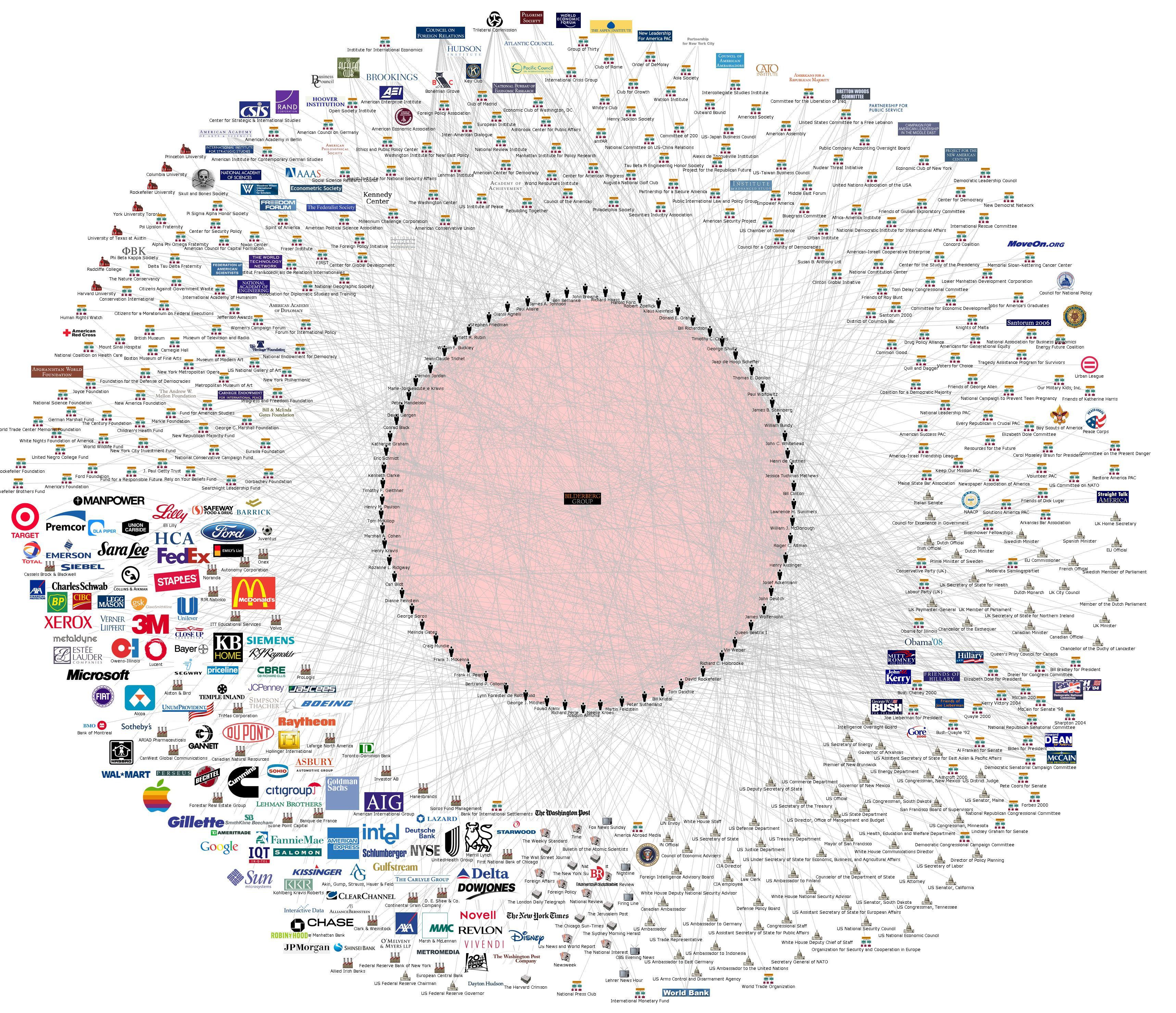
Currently serving as President Emeritus and as a professor at Harvard University, Summers was the former director of President Obama’s National Economic Council from 2009 to 2011. Previously, he was President of Harvard (2001 to 2009) and, prior to his positions during the Clinton administration he was Chief Economist at the World Bank (1991 to 1993). Currently, Summers is a member not only of the G30 but of the Council on Foreign Relations, the Trilateral Commission, and he was also a member of the Steering Committee of the Bilderberg Group.

While Chief Economist at the World Bank, Summers signed an infamous 1991 memo in which it was suggested that rich countries should dump their toxic waste and pollutants in the poorest African nations — because by the time the toxins spurred the growth of cancer in the local population, they would already statistically be dead due to already high mortality rates. The memo noted: “I think the economic logic behind dumping a load of toxic waste in the lowest wage country is impeccable and we should face up to that.”

When Summers later went to work for the Clinton administration under Treasury Secretary Robert Rubin, he along with Rubin and Fed Chairman Greenspan formed the "Three Marketeers," as Time referred to them, dedicated to “inventing a 21st century financial system” where they placed their “faith [in] financial markets.”

In the final two years of the Clinton presidency, Summers served as the Treasury Secretary alongside his deputy and protĂ©gĂ©, Timothy Geithner, another member of the G30 who would go on to make a mark on the financial crisis — largely by convincing President Obama to bail out the Wall Street banks that crashed the economy, with zero penalty to them. Under the Obama administration, Summers served for nearly two years as Chair of the National Economic Council and was a highly influential policymaker. In 2009, he had spoken at the highly influential ultra-conservative think tank, the Peterson Institute for International Economics, where he explained the administration’s approach to the economic recovery, noting that, “Our approach sought to go as much as possible with the grain of the market” as opposed to regulating markets.

When Summers left the Obama administration in late 2010, he returned to Wall Street and made a fortune working for the hedge fund D. E. Shaw & Co. and Citigroup. This past summer, he was considered Obama’s favorite pick to replace Ben Bernanke as Fed Chairman, but faced such stiff opposition within the Democratic Party that he withdrew his name, leaving Janet Yellen – the Vice Chair of the Fed and herself a former member of the Group of Thirty – to step in.

What we see, in this analysis of the Group of Thirty, are the connections between those in positions of power to respond to and manage economic and financial crises, and those in positions of power who created such crises. Naturally, as well, the G30's membership includes numerous bankers who, as fortune had it, shared handsomely in the profits of those crises. Put simply, the G30 can be thought above all as an exclusive club of financial crisis kingpins. And it is a club, no doubt, that will continue to play a significant and not altogether helpful role in global financial management for years to come — or until something is done to stop them.

Monday, March 3, 2014

The Real Job Killers

Saturday, March 1, 2014 by RobertReich.org
by Robert Reich


House Speaker John Boehner says raising the minimum wage is “bad policy” because it will cause job losses.

The U.S. Chamber of Commerce (conservative think tank) says a minimum wage increase would be a job killer. Republicans and the Chamber also say unions are job killers, workplace safety regulations are job killers, environmental regulations are job killers, and the Affordable Care Act is a job killer. The California Chamber of Commerce even publishes an annual list of “job killers,” including almost any measures that lift wages or protect workers and the environment.

Most of this is bunk.

When in 1996 I recommended the minimum wage be raised, Republicans and the Chamber screamed it would “kill jobs.” In fact, in the four years after it was raised, the U.S. economy created more jobs than were ever created in any four-year period.

For one thing, a higher minimum wage doesn’t necessarily increase business costs. It draws more job applicants into the labor market, giving employers more choice of whom to hire. As a result, employers often get more reliable workers who remain longer – thereby saving employers at least as much money as they spend on higher wages.

A higher wage can also help build employee morale, resulting in better performance. Gap, America’s largest clothing retailer, recently announced it would boost its hourly wage to $10. Wall Street approved. “You treat people well, they’ll treat your customers well,” said Dorothy Lakner, a Wall Street analyst. “Gap had a strong year last year compared to a lot of their peers. That sends a pretty strong message to employees that, ‘we had a good year, but you’re going to be rewarded too.’”

Even when raising the minimum wage — or bargaining for higher wages and better working conditions, or requiring businesses to provide safer workplaces or a cleaner environment — increases the cost of business, this doesn’t necessarily kill jobs.

Most companies today can easily absorb such costs without reducing payrolls. Corporate profits now account for the largest percentage of the economy on record. Large companies are sitting on more than $1.5 trillion in cash they don’t even know what to do with. Many are using their cash to buy back their own shares of stock – artificially increasing share value by reducing the number of shares traded on the market.

Walmart spent $7.6 billion last year buying back shares of its own stock — a move that papered over its falling profits. Had it used that money on wages instead, it could have given its workers a raise from around $9 an hour to almost $15. Arguably, that would have been a better use of the money over the long-term – not only improving worker loyalty and morale but also giving workers enough to buy more goods from Walmart (reminiscent of Henry Ford’s pay strategy a century ago).

There’s also a deeper issue here. Even assuming some of these measures might cause some job losses, does that mean we shouldn’t proceed with them?

Americans need jobs, but we also need minimally decent jobs. The nation could create millions of jobs tomorrow if we eliminated the minimum wage altogether and allowed employers to pay workers $1 an hour or less. But do we really want to do that?

Likewise, America could create lots of jobs if all health and safety regulations were repealed, but that would subject millions of workers to severe illness and injury.

Lots of jobs could be added if all environmental rules were eliminated, but that would result in the kind of air and water pollution that many people in poor nations have to contend with daily.

If the Affordable Care Act were repealed, hundreds of thousands of Americans would have to go back to working at jobs they don’t want but feel compelled to do in order to get health insurance.

We’d create jobs, but not progress. Progress requires creating more jobs that pay well, are safe, sustain the environment, and provide a modicum of security. If seeking to achieve a minimum level of decency ends up “killing” some jobs, then maybe those aren’t the kind of jobs we ought to try to preserve in the first place.

Finally, it’s important to remember the real source of job creation. Businesses hire more workers only when they have more customers. When they have fewer customers, they lay off workers. So the real job creators are consumers with enough money to buy.

Even Walmart may be starting to understand this. The company is “looking at” whether to support a minimum wage increase. David Tovar, a Walmart spokesman, noted that such a move would increase the company’s payroll costs but would also put more money in the pockets of some of Walmart’s customers.

In other words, forget what you’re hearing from the Republicans and the Chamber of Commerce. The real job killers in America are lousy jobs at lousy wages.

Obama’s Dumbest Plan Yet: Neo-Nazi Coup in Ukraine

by MIKE WHITNEY
Washington and Brussels … used a Nazi coup, carried out by insurgents, terrorists and politicians of Euromaidan to serve the geopolitical interests of the West.”
– Natalia Vitrenko, The Progressive Socialist Party of Ukraine
The United States helped defeat Nazism in World War 2. Obama helped bring it back.

As you probably know by now, Obama and Co. have ousted Ukraine’s democratically-elected president, Viktor Yanukovych, with the help of ultra-right, paramilitary, neo-Nazi gangs who seized and burned government offices, killed riot police, and spread mayhem and terror across the country. These are America’s new allies in the Great Game, the grand plan to “pivot to Asia” by pushing further eastward, toppling peaceful governments, securing vital pipeline corridors, accessing scarce oil and natural gas reserves and dismantling the Russian Federation consistent with the strategy proposed by geopolitical mastermind, Zbigniew Brzezinski. Brzezinski’s magnum opus–”The Grand Chessboard: American Primacy and it’s Geostrategic Imperatives” has become the Mein Kampf for aspiring western imperialists. It provides the basic blueprint for establishing US military-political-economic hegemony in the century’s most promising and prosperous region, Asia. In an article in Foreign Affairs Brzezinski laid out his ideas about neutralizing Russia by splitting the country into smaller parts, thus, allowing the US to maintain its dominant role in the region without threat of challenge or interference. Here’s an excerpt from the article:
“Given (Russia’s) size and diversity, a decentralized political system and free-market economics would be most likely to unleash the creative potential of the Russian people and Russia’s vast natural resources. A loosely confederated Russia — composed of a European Russia, a Siberian Republic, and a Far Eastern Republic — would also find it easier to cultivate closer economic relations with its neighbors. Each of the confederated entitles would be able to tap its local creative potential, stifled for centuries by Moscow’s heavy bureaucratic hand. In turn, a decentralized Russia would be less susceptible to imperial mobilization.” (Zbigniew Brzezinski,“A Geostrategy for Eurasia”)
Moscow is keenly aware of Washington’s divide and conquer strategy, but has downplayed the issue in order to avoid a confrontation. The US-backed coup in Ukraine means that that option is no longer feasible. Russia will have to respond to a provocation that threatens both its security and vital interests. Early reports suggest that Putin has already mobilized troops to the East and –according to Reuters “put fighter jets along its western borders on combat alert.” Here’s more from Reuters:
“The United States says any Russian military action would be a grave mistake. But Russia’s foreign ministry said in a statement that Moscow would defend the rights of its compatriots and react without compromise to any violation of those rights.” (Reuters)
There’s going to be a confrontation, it’s just a matter of whether the fighting will escalate or not.
In order to topple Yanukovych, the US had to tacitly support fanatical groups of neo-Nazi thugs and anti-Semites. And, even though “Interim Ukrainian President Oleksander Tuchynov has pledged to do everything in his power to protect the country’s Jewish community”; reports on the ground are not so encouraging. Here’s an excerpt from a statement by Natalia Vitrenko, of The Progressive Socialist Party of Ukraine that suggests the situation is much worse than what is being reported in the news:
“Across the country… People are being beaten and stoned, while undesirable members of the Verkhovna Rada of Ukraine are subject to mass intimidation and local officials see their families and children targeted by death threats if they do not support the installation of this new political power. The new Ukrainian authorities are massively burning the offices of political parties they do not like, and have publicly announced the threat of criminal prosecution and prohibition of political parties and public organizations that do not share the ideology and goals of the new regime.” (“USA and EU Are Erecting a Nazi Regime on Ukrainian Territory”, Natalia Vitrenko)
Earlier in the week, Israeli newspaper Haaretz reported that a Ukranian synagogue had been firebombed although the “Molotov cocktails struck the synagogue’s exterior stone walls and caused little damage”.
Another article in Haaretz referred to recent developments as “the new dilemma for Jews in Ukraine”. Here’s an excerpt from the article:
“The greatest worry now is not the uptick in anti-Semitic incidents but the major presence of ultra-nationalist movements, especially the prominence of the Svoboda party and Pravy Sektor (right sector) members among the demonstrators. Many of them are calling their political opponents “Zhids” and flying flags with neo-Nazi symbols. There have also been reports, from reliable sources, of these movements distributing freshly translated editions of Mein Kampf and the Protocols of the Elders of Zion in Independence Square.” (“Anti-Semitism, though a real threat, is being used by the Kremlin as a political football”, Haaretz)
Then there’s this, from Dr. Inna Rogatchi in Arutz Sheva:
“There is no secret concerning the real political agenda and programs of ultra-nationalist parties in Ukraine – there is nothing close to European values and goals there. One just should open existing documents and hear what the representatives of those parties proclaim daily. They are sharply anti-European, and highly racist. They have nothing to do with the values and practices of the civilized world…
Ukrainian Jewry is facing a real and serious threat….To empower the openly neo-Nazi movements in Europe by ignoring the threat they pose is an utterly risky business. People should not have to pay a terrible price – again – for the meekness and indifference of their leaders. As Ukraine today has become the tragic show-case for all of Europe with regards to breeding and allowing race-hatred to become a violent and uncontrollable force, it is impertive to handle the situation there in accordance with existing international law and norms of civilization.” (“Tea With Neo-Nazis: The Violent Nationalism in Ukraine“, Arutz Sheva)
Here’s a little more background on the topic by progressive analyst Stephen Lendmen from a February 25 post titled “New York Times: Supporting US Imperial Lawlessness”:
“Washington openly backs fascist Svoboda party leader Oleh Tyahnybok…In 2004, Tyahnybok was expelled from former President Viktor Yushchenko’s parliamentary faction. He was condemned for urging Ukrainians to fight against a “Muscovite-Jewish mafia.”
In 2005, he denounced “criminal activities” of “organized Jewry.” He outrageously claimed they plan “genocide” against Ukrainians.”…
Tyahnybok extremism didn’t deter Assistant Secretary of State for European and Eurasian Affairs Victoria Nuland. On February 6, she met openly with him and other anti-government leaders.
In early January, 15,000 ultranationalists held a torchlight march through Kiev. They did so to honor Nazi-era collaborator/mass murderer Stepan Bandera. Some wore uniforms a Wehrmacht Ukrainian division used in WW II. Others chanted “Ukraine above all” and “Bandera, come and bring order.” (Steve Lendman blog)
Of course, the US media has downplayed the fascistic-neo-Nazi “ethnic purity” element of the Ukrainian coup in order to focus on– what they think — are more “positive themes”, like the knocking down of statues of Lenin or banning Communist party members from participating in Parliament. As far as the media is concerned, these are all signs of progress.

Ukraine is gradually succumbing to the loving embrace of the New World Order where it will serve as another profit-generating cog in Wall Street’s wheel. That’s the theory, at least. It hasn’t occurred to the boneheads at the New York Times or Washington Post that Ukraine is rapidly descending into Mad Max-type anarchy which could spill over its borders into neighboring countries triggering violent conflagrations, social upheaval, regional instability or–god-help-us– WW3. The MSM sees nothing but silver linings as if everything was going according to plan. All of Eurasia, the Middle East and beyond are being pacified and integrated into one world government overseen by the unitary executive who defers to no one but the corporations and financial institutions who control the levers of power behind imperial shoji-screen.

What could go wrong?

Naturally, Russia is worried about developments in Ukraine, but is unsure how to react. Here’s how Russian PM Dmitry Medvedev summed it up the other day:
“We do not understand what is going on there. A real threat to our interests (exists) and to the lives and health of our citizens. Strictly speaking, today there is no one there to communicate with … If you think that people in black masks waving Kalashnikovs (represent) a government, then it will be difficult for us to work with such a government.”
Clearly, Moscow is confused and worried. No one expects the world’s only superpower to behave this irrationally, to hop-scotch across the planet creating one failed state after another, fomenting revolt, breeding hatred, and spreading misery wherever it goes. At present, the Obama team is operating at full-throttle trying to topple regimes in Syria, Venezuela, Ukraine, and god-knows where else. At the same time, failed operations in Afghanistan, Iraq and Libya have left all three countries in dire straights, ruled by regional warlords and armed militias. Medvedev has every right to be concerned.

Who wouldn’t be? The US has gone off the rails, stark raving mad. The architecture for global security has collapsed while the basic principals of international law have been jettisoned. The rampaging US juggernaut lurches from one violent confrontation to the next without rhyme or reason, destroying everything in its path, forcing millions to flee their own countries, and pushing the world closer to the abyss. Isn’t that reason enough to be concerned?

Now Obama has thrown-in with the Nazis. It’s just the icing on the cake.

Check out this blurb from Max Blumenthal’s latest titled “Is the U.S. Backing Neo-Nazis in Ukraine?”:
“Right Sector is a shadowy syndicate of self-described ‘autonomous nationalists’ identified by their skinhead style of dress, ascetic lifestyle, and fascination with street violence. Armed with riot shields and clubs, the group’s cadres have manned the front lines of the Euromaidan battles this month, filling the air with their signature chant: ‘Ukraine above all!’ In a recent Right Sector propaganda video the group promised to fight ‘against degeneration and totalitarian liberalism, for traditional national morality and family values.’
With Svoboda linked to a constellation of international neo-fascist parties through the Alliance of European National Movements, Right Sector is promising to lead its army of aimless, disillusioned young men on “a great European Reconquest.” (“Is the U.S. Backing Neo-Nazis in Ukraine?—Exposing troubling ties in the U.S. to overt Nazi and fascist protesters in Ukraine“, Max Blumenthal, AlterNet)
“Family values”? Where have we heard that before?

It’s clear, that Obama and his brainiac advisors think they have a handle on this thing and can train this den of vipers to click their heels and follow Washington’s directives, but it sounds like a bad bet to me. These are hard-core, died-in-the-wool, Nazi-extremists. They won’t be bought-off, co-opted or intimidated. They have an agenda and they aim to pursue that agenda to their last, dying breath.

Of all the dumb plans Washington has come up with in the couple years, this is the dumbest.

Reasons Monsanto's "Science" Doesn't Add Up

Monday, 03 March 2014
By Katherine Paul and Ronnie Cummins, Organic Consumers Association 

 
To hear the pesticide and junk food marketers of the world tell it, anyone who questions the value, legitimacy or safety of GMO crops is naĂŻve, anti-science and irrational to the point of hysteria.

But how long can Monsanto ignore the mounting actual scientific evidence that their technology is not only failing to live up to its promises, it’s putting public health at risk?

Jim Goodman, farmer, activist and member of the Organic Consumers Association policy advisory board, recently wrote about Monsanto’s deceptive use of the expression “sound science.”
But, ‘sound science’ has no scientific definition. It does not mean peer reviewed, or well documented research. ‘Sound science’ is only a term, an ideological term, used to support a particular point of view, policy statement or a technology. ‘Sound science’ is little more than the opinions of so-called “experts” representing corporate interests.
Simply put, ‘sound science’ always supports the position of industry over people, corporate profit over food safety, the environment and public health.

Here are five new reports and studies, published in the last two months, that blow huge holes in Monsanto’s “sound science” story. Reports of everything from Monsanto’s Roundup causing fatal, chronic kidney disease to how, contrary to industry claims, Roundup persists for years, contaminating soil, air and water. And oh-by-the-way, no, GMO crops will not feed the world, nor have they reduced the use of herbicides and pesticides.

1.   Monsanto’s Roundup linked to fatal, chronic kidney disease.
Article in Journal of Environmental Research and Public Health, February 2014

What happens when you mix glyphosate, the key active ingredient in Monsanto’s Roundup, with “hard” water? That is, water that contains metals, such as calcium, magnesium, strontium and iron, either found naturally in the soil, or resulting from the use of chemical fertilizers?

The glyphosate becomes “extremely toxic” to the kidneys.

That’s the theory put forth by researchers trying to uncover the mystery of thousands of deaths from chronic kidney disease among people in farming areas of Sri Lanka, El Salvador and Nicaragua.

2.   Monsanto’s Roundup persists in soil and water. U.S. Geological Survey report in Environmental Toxicology and Chemistry, February 2014

Monsanto has always insisted (despite evidence to the contrary) that its Roundup herbicide is benign, that its toxicity doesn’t persist.

But that’s only half the story, according to a study published this month in Environmental Toxicology and Chemistry. Researchers now say that if you study only the key active ingredient, glyphosate, you might, as Monsanto claims, determine that Roundup is benign.

But there are other ingredients in Roundup, including one called Aminomethylphosphonic acid, or AMPA. The study, called "Pesticides in Mississippi air and rain: A comparison between 1995 and 2007," found that glyphosate and its still-toxic byproduct, AMPA, were found in over 75 percent of the air and rain samples tested from Mississippi in 2007.

What does that mean for you? According to one analysis, “if you were breathing in the sampled air you would be inhaling approximately 2.5 nanograms of glyphosate per cubic meter of air. It has been estimated the average adult inhales approximately 388 cubic feet or 11 cubic meters of air per day, which would equal to 27.5 nanograms (billionths of a gram) of glyphosate a day.” Gasp.

3.   GMO crops have led to an increase in use of pesticides and herbicides. U.S. Department of Agriculture (USDA) report, February 2014.

The USDA, which gauging from its track record has never met a GMO crop it didn’t like, published a report substantiating what responsible, independent scientists have been saying along. Genetic engineering does not result in increased yields (as industry would have us believe)—but it has led to the increased (not decreased, as industry claims) use of pesticides and herbicides.

To be fair, the report gives overall favorable reviews to GMO crops. Not surprising, given the agency’s cozy relationship with Monsanto. But that makes it all the more telling that the once staunch-defender of GMO crops is now raising questions about industry’s long-term, decidedly unproven and unscientific, claims that biotechnology is the best thing since sliced (GMO wheat) bread.

Sustainable Pulse does a good job of sifting through the USDA’s report to reveal the agency’s criticisms of GMO crops.

4.   Pesticides are more dangerous than we thought.  Article in BioMed Research International, February 2014

More bad news on pesticides. A study published in BioMed Research International this month says that it’s not just the toxic chemicals we need to worry about in pesticides. It’s the inert ingredients, and how they interact with the active, toxic ingredients.

Typically, studies conducted to determine the safety of pesticides focus exclusively on the active ingredients. But scientists at the University of Caen tested eight commercial products, including Roundup, and found that nine of them were hundreds of times more toxic than their active ingredient alone.

Which product won the “Most Toxic” award? Monsanto’s Roundup, which was found to be “by far the most toxic of the herbicides and insecticides tested,” according to the study.

5. Small-Scale, organic farming needed to feed the world. U.N. Commission on Trade and Development (UNCTAD), Wake Up Before It Is Too Late, December 2013

In December 2013, the U.N. Commission on Trade and Development (UNCTAD) released the results of a lengthy, in-depth study that blows a huge hole in one of Monsanto’s favorite claims, that we need GMOs to feed the world. The study, entitled Wake Up Before it is Too Late, concluded with this warning: Small-scale organic farming is the only way to feed the world.

According to an analysis by one of the report’s contributors, the report contains in-depth sections on the shift toward more sustainable, resilient agriculture; livestock production and climate change; the importance of research and extension; the role of land use; and the role of reforming global trade rules.

More than 60 experts from around the world contributed to the report.

Clearly the evidence—real, scientific evidence—against GMO crops is mounting, when five new anti-GMO studies and reports surface in a matter of a couple of months.

How much more will it take before the USDA, U.S. Food & Drug Administration (FDA) and the U.S. Environmental Protection Agency stop supporting an industry under attack from the scientific community? And start putting public health before corporate profits?

In December, more than 200 scientists, physicians, and experts from relevant fields, signed a statement declaring that the biotech industry is deceiving the public when it claims that GMOs are safe. There is, the group said, no “scientific consensus” to support industry’s claims that GMOs are safe.

But as new studies surface every day, it’s become increasingly clear that among credible physicians and scientists, the consensus is that we’d better wake up, soon, to the risks and threats posed by a reckless technology that has been allowed to dominate our food and farming systems, unchecked, for far too long.