Wednesday, December 18, 2013

A simple "Financial Transaction Tax" could fund opportunities for all


Several pro football franchises have chosen chest-pounding team names meant to symbolize how big, powerful, ferocious, and scary they are--names like the Bears, Panthers, Ravens, and Lions. But, come on, such animalistic monikers are no longer intimidating in our modern world, so I suggest that teams upgrade to names that really would spark terror in the hearts of opponents: "Big Oil Frackers," for example, or "Monsanto Genetic Mutators," "Walmart Middle-Class Crushers," "Big Pharma Price Gougers," and "Wall Street Banksters."

Such corporate predators rule today's economic and political jungle, and a hail storm of statistics confirms the vast and long-term damage they're wreaking on the poor and middle class, our environment, democratic rights, and sense of justice.

Behind those stats, though, are living, breathing, striving humans--an entire nation of real people being knocked down and shut out, unable to realize the aspirations they have for themselves, their families, communities, culture, and country. The elites--to their eternal shame-- literally are stifling the enormous possibilities of America's grassroots people. That's why the public's approval rating of today's aloof Powers That Be is now (as a friend recently told me) "two digits lower than poisonous snakes."


Public anger at the raw selfishness of those ruling our economic and political systems is so severe that even Lloyd Blankfein flinched. The $21-million-a-year chief bankster at Goldman Sachs, Blankfein has presided over the bank's multiple acts of fraud against its own customers, grabbed a taxpayer bailout of $12.9 billion in 2008, lobbied furiously against legislation to restrain Wall Street's reckless greed (including especially fierce opposition to proposals for opposition to proposals for restricting CEO pay)--and then declared: "I'm doing God's work."

Last year, however, finally recognizing how despised they are by their fellow Americans, Blankfein and Gang felt an urgent need for an image makeover. Thus came a splashy PR push through the Goldman Sachs Foundation to portray themselves as-- Ta-Da! --"Magnanimous Philanthropists." Their foundation suddenly became America's fourth largest corporate charity, making $241 million in donations in 2012. Impressive, no?

No. That might sound like a big number, but it's a pittance in the pot for this giant, with revenue topping $34 billion last year--and profits of $7.48 billion. That means the bank's ballyhooed beneficence pans out to merely seven-tenths of one percent of its income. Pathetic. America's poor people put these gold sackers to shame, regularly donating an average of 3.2 percent of their meager incomes to charity--nearly five times more generous than the multimillionaire bankers.

Rich folks got your money with politics. You can get it back with politics.
----Woody Guthrie

Goldman's PR shtick (dubbed "reputation redemption" by the New York Times) is a sad replay of a gambit tried by the robber baron of old, John D. Rockefeller. In his later years, the billionaire tycoon carried a pocketful of dimes with him whenever he stepped out for a stroll. Along the way, he would occasionally stop someone walking by--especially if a child was with them--and he would dip into his stash and dole out a shiny dime. Newsreels of the day often showed the richest man in the world handing dimes to children, as if this public show might buff up his sour image.

But, worse, Goldman's slick executives are not even donating their own dimes! Rather than reaching into their own pockets, they're doling out their shareholders' money. Worse yet, it's also our money. By ours, I mean that Goldman's so-called "gifts" are deducted from the income taxes the bank owes, thus, shorting America's public treasury of funds that We The People need for schools, roads, clean water, and other public essentials.

MESSAGE TO WALL STREET: We don't want your hokey "charity." What we want is an end to your destructive greed, and we want an honest, restructured, decentralized banking system focused on the common good. Oh, and one more thing: We want our government back.

Re-fund America

The powerhouses of Wall Street have tunneled directly into the cloistered backrooms of Washington deal making, extracting trillions of dollars worth of government bailouts, special tax breaks, and regulatory favors every year. Yet, in a stupefying act of hypocrisy, they have also been the major force pushing policymakers to embrace extreme laissez-faire bunkum and to inflict the most austere budgetary minginess on the American people.

Through their lobbyists, front groups, economic shills, media hacks, and the politicians they've purchased, these pampered princes of high finance have gained a stranglehold on policy, choking off the public investment that our country desperately needs. In a nonstop drone, their operatives chant: "America is broke. Fiscal doom looms. Government spending is the cause. Austerity policies are our only hope."

And Washington is buying this snake oil. As we've seen, food stamp funding was stripped from the farm bill; benefits for the long-term unemployed are being allowed to expire; job training programs are being cut; Republicans are frantically trying to derail and defund Obamacare to keep millions of uninsured Americans from getting health coverage; and even Obama has said he's open to cuts in Social Security and Medicare.

Seeing all of this, George Will, the GOP's high priest of the plutocratic order, is exultant. In an October Fox News appearance, he declared victory for the laissez-fairyites, noting that they have taken control of Washington's conversation on public spending: "We are now talking entirely on Republican terms, in Republican vocabulary. No taxes, how much is the spending going to be cut? The federal workforce is being cut...."

No doubt the debate in Will's tiny circle is focused entirely on shrinking America into its dark vision of parsimonious plutocracy. But I find that most people, living way outside George's bubble of elites, have a far bigger vision of what America can be, and they're engaged in a less constipated conversation about ways to meet our country's budgetary needs.

If you review opinion polls, hear the results of door-to-door outreach campaigns, or just have a few real conversations at various chat & chew cafes, you'll tap into ordinary people's simmering anger at the Wall Street/Washington axis that's dictating a harsh normal of economic inequality, declining opportunity, and diminished democratic control. The elites are constantly monkeywrenching the public's ability to act together, thus limiting our nation's possibilities and causing America's present drift from world leader to mediocrity.

This goes against the very essence of America, from our egalitarian ideals to our can-do spirit. We must create a politics that directly confronts the narcissistic nabobs who're knocking down our people and our country--and rally an increasingly restive workaday majority to come together in an expansive, aggressive effort to Re-fund America. For example:
  • In the richest country in the history of the world, the USA ought to have the TOP public education system, not one of the worst among wealthy nations.
  • Forget dismantling Obamacare. Improve it to Medicare-for-all.
  • Let's re-establish our technological supremacy, from building the green economy of the future to reaching boldly again into outer space.
  • Our priceless system of public parks should be flourishing and expanding, not firing park rangers and locking entry gates.
  • Rather than succumbing to a bleak future of low-wage, part-time, temporary, no-security jobs, let's publicly invest in full employment, world-class skills, and technology that works for workers.
  • Restore democratic power with public financing of all election campaigns, enact labor law reforms so workers themselves can democratize the workplace, and encourage the development of co-ops as an alternative to corporate control of the economy.

That's an America that is worthy of us--a society of historic democratic vision, genuine opportunity for all, and a shared prosperity. Most people would feel good about bringing children into that world.
"Maybe so," snort the naysayers, "but where are you gonna get the money to pay for it?" Actually, the answer to that is obvious: Get it from where it went.

Follow Willie Sutton


Willie was the 20th Century outlaw who explained that he robbed banks because "That's where the money is." Today, though, bankers are the robbers. During the past 15 years or so, they've pulled off an unprecedented, mindboggling heist in broad daylight. They've stolen the bulk of our country's investment money, pilfered billions of dollars from consumers and small borrowers through fraud, snatched billions more through taxpayer subsidies and bailouts, and quietly siphoned additional trillions out of the Federal Reserve.

Astonishingly, they even stole Wall Street, a place that was lined not so long ago with respectable and cautious investment houses. Those financial firms performed an important and straightforward job: Making capital available to manufacturers, entrepreneurs, supermarkets, health facilities, and all sorts of other enterprises that produce goods or provide services. No more. They've been converted into global casinos that churn trillions of dollars through an ever-changing assortment of exotic, indecipherable gaming devices with gibberish names like "Synthetic Collateralized Debt Obligations."

These are not "investments." They are nothing but bets between the banks that invent the games and the very wealthy gamers who play them--bets that are riskier, less substantial, and much larger than even Vegas allows. They do not create anything for the real economy--i.e., making or doing something of actual, measurable value, something that advances the wider economy or benefits the general public.

The economic term for this activity is "market froth"--as in airy, insubstantial, and worthless. Today's chief players in this casino are called High Frequency Traders (HFTs), and they bring a manic, financially destabilizing nature to any stock, commodity, currency, or other market they enter. This is because they're not investing in a business, but rapidly scanning huge arrays of market prices, looking for, say, the momentary price of an obscure stock that they think could change this week, tomorrow morning, or even in the next minute. Then they buy a mass of that stock or commodity, and if the price changes as they suppose it will, they instantly sell it and cash in. The price might fluctuate by only pennies or fractions of pennies, but they've bet in such volume that they can make a killing on it, and then move on to the next target.

These sweeping, purely speculative financial transactions have been made possible by huge leaps in technology. It's all done by superfast computers controlled--not by humans--but by artificial intelligence that uses mathematical algorithms to search millions of prices at lightning speeds and place the bets automatically. Transaction times are measured in milliseconds. Essentially, this is a global network of "trading robots" that never sleep and whose sole function is to allow the wealthiest speculators to skim quick profits out of our markets--and also empower them to manipulate everything from stock prices to oil prices.

Yes, this is socially useless, predatory, dangerous, and ridiculous. Charlie Munger, a top investment associate of billionaire financial maestro Warren Buffett, says that high frequency traders "have all the social utility of a bunch of rats admitted to a granary."
Yet, the rats now rule. HFT is what "the market" has become. The sheer volume of stock transactions on just the two largest US exchanges (the New York Stock Exchange and the NASDAQ) is stratospheric: there are now more than 400 billion buy-or-sell trades made during the year. HFTs account for about 70 percent of that total, and the amount of money they cast into their high-speed gambles adds up to trillions of dollars a year.

An FTT on HFT


When I buy a $3 pack of toilet paper here in Austin, Texas, I pay an extra 8.25 percent in sales tax. If I buy a cuppa jo, book, bicycle, or blue jeans--same thing.

But if a high-roller in the HFT game buys $10 million worth of corporate stock, $10 million worth of oil futures, and $10 million worth of a Goldman Sachs package of derivatives--he or she pays zero tax on the sales.

First, it's a rank injustice that even the poorest among us are taxed on their purchases while millionaire Wall Streeters who make high-speed computerized purchases skate through this gaping loophole. Second, the profiteering churners and reckless speculators wrecked the country's economy, and they've never paid for the mess they made for so many millions of families that consequently lost jobs, homes, income, and hope. Third, this is a BIG idea that will let our society do big things again. Plugging this loophole with even a small sales tax on purchases by high frequency traders will generate the money America needs to do what needs to be done.

A Financial Transaction Tax. An FTT is not an idea whose time has come, but simply returned. From 1914 to 1966, our country taxed all sales and transfers of stock. The tax was doubled in the last year of Herbert Hoover's presidency to help us recover from the Great Depression. Today, 40 countries have FTTs, including the seven with the fastest-growing stock exchanges in the world. Seven members of the European Union (including Germany and France) voted for a financial transaction tax to help blunt rising poverty, restore services, and put people back to work.

This is no soak-the-rich-idea. Rather than asking the Wall Street crowd to join us in paying a six to 12 percent sales tax, the major FTT proposal gaining support in the US calls for a 0.5 percent assessment on stock transactions. That's 50 cents on a $100 stock buy, versus the $8.25 I would pay for a hundred-dollar bicycle.

Even at this miniscule rate, the huge volume of high speed trades means an FTT would net about $300-350 billion a year for our public treasury. Plus, it's a very progressive tax. Half of our country's stock is owned by the 1 percenters, and only a small number of them are in the HFT game. Ordinary folks who have small stakes in the markets, including those in mutual and pension funds, are called "buy-and-hold" investors--they only do trades every few months or years, not daily or hourly or even by the second, and they'll not be harmed. Rather it's the computerized churners of frothy speculation who will pony up the bulk of revenue from such a transaction tax.

An FTT is a straightforward, uncomplicated way for us to get a substantial chunk of our money back from high finance thieves, and we should make a concerted effort to put the idea on the front burner in 2014 and turn up the heat. Not only do its benefits merit the fight, but the fight itself would be politically popular. One clue to its political potential is that the mere mention of FTT to a Wall Street banker will evoke a shriek so shrill that the Mars rover hears it. That's because they know that this proposal would make them defend the indefensible: Themselves.

First, the sheer scope of Wall Street's self-serving casino business model would be exposed for all to see. Second, they would have to admit that they're increasingly dependent on (and, therefore, making our economy dependent on) the stark-raving insanity of robotic high frequency speculation. Third, it'll be completely ridiculous for them to argue that protecting the multi-trillion-dollar bets of rich market gamblers from this tax is more important than meeting our people's growing backlog of real needs.
Unsurprisingly, then, Koch-funded operatives and other defenders of privilege are rushing out articles that amount to Wall Street blah-blah-blah: "FTT would hurt poor pensioners, farmers, long-term investors, job creation, liquidity... and blah, blah, blah." Note that there's nary a mention of who'll really be pinged: Wall Street's gamblers and thieves. After all, to concede that they'll be hurt, even a little, would elicit a coast-to-coast shout of, "Yes!"

The campaign is on

The Financial Transaction Tax idea is blessed with broad support, ranging from Bill Gates to Occupy Wall Street to the Vatican, and it's been embraced by dozens of major economists, including Nobel laureates Joseph Stiglitz and Paul Krugman. But this fight will be won at the ground level of good politics, and that's well underway. Many grassroots groups and several progressives in Congress have already forged solid coalitions and are going to the country-side with a growing campaign to make Wall Street pay.

A major push is being made under the banner of the "Robin Hood Tax," led by National Nurses United, National People's Action, Health GAP, and Progressive Democrats of America. They and some 150 other organizations are backing the IPA. (This IPA is not a beer, though I suggest the organizers brew one to help popularize, cheer, and lubricate the cause.) It's the Inclusive Prosperity Act, a proposal by Rep. Keith Ellison and others for an FTT. Sen. Tom Harkin and Rep. Peter DeFazio have another version with a more modest tax rate.

This campaign offers a remarkable democratic opening. It widens America's public policy debate from the plutocrats' tired, narrow-minded mantra of defeat: "We're broke. Big undertakings are beyond us. Shrink all expectations for yourselves, your children, and your country's future." Instead, a new conversation can begin, saying: "Look under that rock. There's the money we need to invest in people. Let's get America moving again!"

A sales tax on speculators can deliver tangibles that people need but Wall Street says we can't afford--infrastructure, Social Security, education, good jobs, etc. Just as important, it can deliver intangibles that our nation needs but Wall Street tries to ignore--fairness, social cohesion, equal opportunity, etc. It's a holiday gift card for America's future--a gift that literally would keep on giving.

Tuesday, December 17, 2013

Decades Later, FDA Takes Action on Safety of Antibacterial Soaps

Oh, FDA...is there ANYTHING you won't approve without adequate testing to determine whether it's a health risk to the public? Public Service jobs don't pay well and have crazy turnover--gotta snag that cushy corporate corner office at one of the companies for whom you rubber stamp approval for everything they submit, doncha? Stack that paper!


“FDA is finally taking concerns about triclosan seriously."

- Andrea Germanos, staff writer


Commonly used antibacterial soaps are no better at killing germs than washing with plain soap and water, but may harm health and contribute to making bacteria resistant to antibiotics, the U.S. Food and Drug Administration announced Monday.

"New data suggest that the risks associated with long-term, daily use of antibacterial soaps may outweigh the benefits," Colleen Rogers, Ph.D., a lead microbiologist at FDA, said in a statement.

In its proposed rule issued Monday, the FDA states that makers of antibacterial soaps and body washes must now demonstrate the safety and effectiveness of those products, noting:
Several important scientific developments that affect the safety evaluation of these ingredients have occurred since FDA’s 1994 evaluation of the safety of consumer antiseptic active ingredients under the OTC Drug Review. New data suggest that the systemic exposure to these active ingredients is higher than previously thought, and new information about the potential risks from systemic absorption and long-term exposure have become available. New safety information also suggests that widespread antiseptic use can have an impact on the development of bacterial resistance.

Environmental and public health watchdog groups have long sounded the alarm about triclosan, a common anti-bacterial agent.

In 2008, Environmental Working Group found that
Triclosan has been linked to cancer in lab animals, has been targeted for removal from some stores in Europe for its health and environmental risks, and the American Medical Association recommends against its use in the home. It is also linked to liver and inhalation toxicity, and low levels of triclosan may disrupt the thyroid hormone system. Thyroid hormones are essential to proper growth and development, particularly for brain growth in utero and during infancy.
Triclosan breaks down into very toxic chemicals, including a form of dioxin; methyl triclosan, which is acutely toxic to aquatic life; and chloroform, a carcinogen formed when triclosan mixes with tap water that has been treated with chlorine. Scientists surveyed 85 U.S. rivers and streams, and found traces of triclosan in more than half.

Other studies indicate that it contributes to antibiotic-resistant bacteria.

According to reporting by Bloomberg, "Chemicals like triclosan were never intended for mass consumer use."

The FDA first proposed removing triclosan from some products 35 years ago, the Natural Resources Defense Council points out, but no final action from the FDA meant its use continued and grew.

In 2010, the NRDC sued the agency to make it issue a final rule on triclosan. Monday's proposal comes as a result of a settlement from that lawsuit.

“This is a good first step toward getting unsafe triclosan off the market,” said Mae Wu, an attorney in NRDC’s health program. “FDA is finally taking concerns about triclosan seriously."

While the proposed rule covers soaps and body washes, it leaves out products that don't use water like antibacterial wipes and sanitizers. The group Safer Chemicals Healthy Families points out that triclosan is widespread, and may also appear in products like toothpaste, cutting boards, yoga mats, textiles and household cleaners.

Big Pharma Markets to and Profits from a 'Can't-Pay-Attention Nation'

 Are you a child who would rather look out the window and imagine yourself flying or doing something else cool than doing math problems in school? Then you are psychologically ill. Here, drugs! Kids, remember--don't do drugs...except for these. They are just as bad as the ones they sell on your school playground and they don't make you better! In fact, all they do is turn you into an addict who will experience the pain of withdrawal symptoms once a rational human being with your better welfare in mind decides to save you by taking you off them. Doesn't that sound great? ~A.M.A.
Some of you might remember back in the days when it was illegal to advertise prescription drugs anywhere other than established medical journals and trade magazines, before Pharma companies started hiring strippers to make calls on doctors' offices and keep those ineffective overly prescribed drugs flowing to a nation of daydreaming overweight hypochondriacs. Oh, American Exceptionalism -- you are the greatest oxymoron/misnomer for a non-existent concept ever! Unless they changed the definition of exceptional to mean stupidly docile and unquestioningly gullible. Absurd, you say? Not anymore, folks. Not if you have a lot of money. Fun fact: the generic name for Adderall is "amphetamine salts." No attempt at misdirection there. You are making your child take a drug that would get you 10 years in prison if you bought it from anybody other than the legal corporate drug dealing establishments whose products actually have worse side effects than the illegal kind. And dig this: symptoms for ADHD are nearly as arbitrary as those for fybromyalgia or Lyme Disease--both of which were once considered non-ailments, malingerer's diseases. So, any random professional expert can observe a child acting like a child ("what? my child would rather be outside playing than inside at school being bored to death doing long division? Please prescribe a drug that will cause health complications later in life in addition to stunting their growth, killing their appetites and forming what might turn out to be a lifelong addiction, as well as creating a human now with a predilection toward addiction. A co-opted medical system profiting from selling useless AND dangerous chemicals as a bogus treatment for made-up illnesses. Another fun fact: for a drug to be approved by the FDA, all it has to demonstrate that it "as effective as the placebo," the sugar pill that makes "mind over matter" equally effective for your high cholesterol as the FDA approved $250 bottle of pills. So, if you get a disease, just convince yourself that consuming more sugar is the key to becoming healthy once again, Type II diabetes be damned.


Our Children are So Screwed

A twenty-year marketing campaign has made highly powerful stimulants into household names... and they're just getting started

- Jon Queally, staff writer


Having chemically-saturated the youth market, the drug marketeers for powerful stimulants like Adderall are now bringing their message to the adult masses. What came first: the disorder, the cure, or the marketing campaign to sell both?

“You’re talking about a product that’s having a major impact on brain chemistry. Parents are very susceptible to this type of stuff.” –Roger Griggs, pharma exec who now objects to ad campaigns

In the case of medicating a generation of children who were said to be "unusually hyperactive," the answer to that question is addressed by an in-depth investigation by the New York Times on Monday showing that the meteoric rise of diagnoses of attention deficit hyperactivity disorder (A.D.H.D.)—a trend that spawned a pharmaceutical gold rush over the last twenty years—was, in fact, fueled by an industry-led marketing campaign that targeted struggling children, worried parents, and an army of doctors willing to diagnose and prescribe.

And what's worse? The deep-pocketed, pill-pushers are now looking to expand.a 'Can't-Pay-Attention Nation'

As the Times reports:
The rise of A.D.H.D. diagnoses and prescriptions for stimulants over the years coincided with a remarkably successful two-decade campaign by pharmaceutical companies to publicize the syndrome and promote the pills to doctors, educators and parents. With the children’s market booming, the industry is now employing similar marketing techniques as it focuses on adult A.D.H.D., which could become even more profitable.

Dr. Keith Conners, a psychologist and professor emeritus at Duke University—who called the rising rates “a national disaster of dangerous proportions”—points out that though A.D.H.D is likely to occur in about 5 percent of the population, recent data from the Centers for Disease Control and Prevention show that the diagnosis had been made in 15 percent of high school-age children, and that the number of children on medication for the disorder soared from 600,000 in 1990 to 3.5 million today.
“The numbers make it look like an epidemic. Well, it’s not. It’s preposterous,” he told the Times in an interview. “This is a concoction to justify the giving out of medication at unprecedented and unjustifiable levels.”

In example after example, the marketing push created by the drug manufacturers show happy children and happy parents citing the wonders of the drugs, which go by their increasingly well-known names—stimulants like Adderall, Concerta, Focalin and Vyvanse, and nonstimulants like Intuniv and Strattera. As the Times reports,  


every single one of the companies who market these pills has been fined by the FDA for false advertising.

"The decision to start long-term medication should be motivated by observations of patients and physicians, not stimulated by rosy ads." –Kurt Stange, professor of family medicine

But the ads keep coming, it seems, because the ads work.

According to the Times:
Profits for the A.D.H.D. drug industry have soared. Sales of stimulant medication in 2012 were nearly $9 billion, more than five times the $1.7 billion a decade before, according to the data company IMS Health.

Even Roger Griggs, the pharmaceutical executive who introduced Adderall in 1994, said he strongly opposes marketing stimulants to the general public because of their dangers. He calls them “nuclear bombs,” warranted only under extreme circumstances and when carefully overseen by a physician.

Psychiatric breakdown and suicidal thoughts are the most rare and extreme results of stimulant addiction, but those horror stories are far outnumbered by people who, seeking to study or work longer hours, cannot sleep for days, lose their appetite or hallucinate. More can simply become habituated to the pills and feel they cannot cope without them.

According to Griggs and others, the idea that drugs like Adderall are being marketed directly to the public is perhaps the key flaw.

“There’s no way in God’s green earth we would ever promote” a controlled substance like Adderall directly to consumers, Mr. Griggs said as he was shown several advertisements. “You’re talking about a product that’s having a major impact on brain chemistry. Parents are very susceptible to this type of stuff.”

And Kurt Stange, a professor of family medicine and community health at Case Western Reserve University, agrees and recommends that this practice be banned.

In an op-ed published alongside the Times reporting, Stange writes:
Drugs have harms as well as benefits, and the harms are greater when drugs are indiscriminately prescribed. Consumer advertising, delivered to the masses as a shotgun blast, rather than as specific information to concerned patients or caregivers, results in more prescriptions and less appropriate prescribing.
There is no evidence that consumer ads improve treatment quality or result in earlier provision of needed care. Research has shown that the ads convey an unbalanced picture, with benefits and emotional appeals given far greater weight than risks. Clinicians can work to override these miscues, but this steals precious time from activities that can provide real benefit to patients. In the packed agenda of the patient visit, in which so many real concerns and evidence-based care are available to make a difference in people's lives, the intrusion of marketing risks harm.

Advertising also provokes a subtle shift in our culture -- toward seeking a pill for every ill. While there are many for whom stimulants and other medications can be a godsend, the case of attention deficit hyperactivity disorder is a prime example of how, too often, a pill substitutes for more human responses to distress. U.S. clinicians prescribe stimulant medication for A.D.H.D. at a rate 25 times that of their European counterparts. The complex decision to start a long-term medication should be motivated by the observations of teachers and parents and children, in the context of a relationship with a caring clinician − not stimulated by rosy ads.

 ~~~~~~~~~~~~~~

Isn't your child's health worth the risk of further increasing the obscene wealth of the officers, board and shareholders of  FDA approved and sanctioned legal corporate drug dealers? 

Why do you hate America?

'Snowden Vindicated': Judge Rules Against 'Indiscriminate' NSA Spying

Monday, December 16, 2013 by Common Dreams
Snowden: "Today, a secret program authorized by a secret court was, when exposed to the light of day, found to violate Americans’ rights."
- Sarah Lazare, staff writer

In the biggest legal blow to the National Security Council since the dragnet spying scandal broke in June, a federal judge ruled Monday that the U.S. government "almost certainly" violated the constitution by mass collecting data on nearly every single phone call within or to the United States.

“Today, a secret program authorized by a secret court was, when exposed to the light of day, found to violate Americans’ rights," declared NSA whistleblower Edward Snowden in a statement on the ruling released by journalist Glenn Greenwald Monday afternoon. "It is the first of many."
"This is a vindication for our fellow citizen Edward Snowden who came forward because he believed the government was violating our constitutional rights." –Glenn Greenwald, journalist

In a 68-page statement released Monday, U.S. District Court Judge Richard Leon issued stinging criticisms of NSA metadata snooping, declaring, “I cannot imagine a more ‘indiscriminate’ and ‘arbitrary invasion’ than this systematic and high-tech collection and retention of personal data on virtually every single citizen for purposes of querying it and analyzing it without judicial approval."

Leon, who was appointed by former President George W. Bush, ruled in response to a lawsuit brought by conservative activist Larry Klayman that phone metadata collection violates Fourth Amendment protections against unlawful searches and seizures without demonstrating any role in preventing "terrorist" attacks.

Leon granted Klayman's demand for a temporary injunction on the grounds that the lawsuit was likely to win. Yet, he did not immediately implement his ruling, pending a government appeal.

Nonetheless, Leon's opinion is being widely lauded as "the first significant legal setback for the NSA’s surveillance program since it was disclosed in June," as Josh Gerstein writes for Politico.

Because it takes aim at a 1979 Supreme Court ruling that the Obama administration says justifies the NSA secret spying, Leon's legal argument could have far-reaching consequences. "If upheld on appeal, the judge's reasoning could force the spy agency to reconsider other domestic spying programs that involve warrantless collection of "metadata" about Americans' communication," writes Andrea Peterson for The Washington Post.

The ruling is certain to "influence other federal courts hearing similar arguments from the American Civil Liberties Union," write Spencer Ackerman and Dan Roberts in The Guardian.

“This is a strongly worded and carefully reasoned decision that ultimately concludes, absolutely correctly, that the NSA’s call-tracking program can’t be squared with the Constitution," declared ACLU Deputy Legal Director Jameel Jaffer in a statement emailed to Common Dreams. "We hope that Judge Leon’s thoughtful ruling will inform the larger conversation about the proper scope of government surveillance powers, especially the debate in Congress about the reforms necessary to bring the NSA’s surveillance activities back in line with the Constitution."

Snowden and his supporters say the ruling underscores the vital importance of Snowden's revelations.

“I acted on my belief that the N.S.A.'s mass surveillance programs would not withstand a constitutional challenge, and that the American public deserved a chance to see these issues determined by open courts,” said Snowden.

"This [ruling] is a vindication of the constitutional rights of American citizens, who had intimate information collected about us without our consent," said Glenn Greenwald on a Monday MSNBC interview about Leon's ruling.

He added, "This is a vindication for our fellow citizen Edward Snowden who came forward because he believed the government was violating our constitutional rights."

City of Dallas effectively bans fracking

RT - December 13, 2013

The Dallas City Council passed Wednesday new restrictions that bar hydraulic fracturing within 1,500 feet of a home, school, church, and other protected areas. The new rules effectively ban the practice within the city.

The council approved the ordinance in a vote of 9-6, with Mayor Mike Rawlings voting for it.

The city is on the edge of the Barnett Shale area, predicted to be a treasure trove of onshore natural gas reserves. However, the new limit placed on hydraulic fracturing - known as fracking - effectively bans the practice.

“[W]e might as well save a lot of paper and write a one-line ordinance that says there will be no gas drilling in the city of Dallas,” said council member Lee Kleinman, who opposed the measure. “That would be a much easier ordinance to have.”

A gas industry representative for Trinity East, a Barnett Shale gas company that was prepared to drill, lamented the measure as a death for prospects in Dallas.

“You just can’t drill under these conditions,” said Dallas Cothrum, according to CBS DFW. “It’d require more than 250-acres of property and in an urban area it’s just not possible.”

Petroleum engineer Bill Crowder of Dallas indicated that the economic and legal wrangling over fracking in the city is not yet over.

“I want you to look me in the eye next February or March,” he said, according to the Dallas Morning News, “when I ask you, ‘What the heck were you thinking?’”

Another council member, who supported the limits, said the ordinance doesn’t ban drilling, but is aimed at keeping residents safe.

“I think this is about making sure people are protected in their neighborhoods,” council member Carolyn Davis said, according to KERA News. “It is the right thing to do.”

Dallas had previously outlawed fracking within 300 feet of protected areas.

The new ordinance keeps protections on parkland and flood plains, though KERA News reported that the ordinance does allow for drilling in parks if certain requirements are followed and the Texas Parks and Wildlife Department gives its mandatory approval.

The council also passed Wednesday an amendment that calls for a two-thirds majority vote to override the measure.

Hydraulic fracking is the highly controversial process of injecting water, sand, and various chemicals into layers of rock in hopes of releasing oil and gas deep underground. The practice is opposed worldwide, as shown by global protests against fracking in October, for its damning environmental impacts.

Supporters say it brings jobs and opportunities for energy independence, though detractors have pointed to exaggerated employment claims.

The latest move by Dallas highlights similar aims in other cities to ban fracking. Voters in four cities in the state of Colorado recently succeeded in either banning or suspending hydraulic fracturing, despite heavy spending by the oil and gas industry to the tune of $870,000 to defeat the measures.

All four of those measures passed in Colorado will face legal challenges by the fracking industry along with the office of Governor John Hickenlooper, which has expressed the position that the municipalities lack the authority to determine the use of the state’s natural resources.

The Turnkey Totalitarian State


Politics is Funny? (It is when you're a cynical bastard like me)


Friday, December 6, 2013

3D Printed Organs and Batteries in the Not-too Distant Future

Kyle Maxey | November  2013
Engineering.com

Surveys conducted by the German Organ Transplantation Foundation (DSO) say the number of organ transplant donors has plummeted 18 percent in the past year. With the demand for organ transplants increasingly overtaking supply, physicians are hopeful that new technologies (such as 3D printing) could one day fill in these gaps.

As a first big step, researchers at the Fraunhofer Institute for Interfacial Engineering and Biotechnology (IGB) in Stuttgart recently announced that they’ve created a bio-ink suitable for printing a number of tissue types.

The key to the new ink’s versatility is its gelatin base. Gelatin, a derivative of collagen, is one of the main constituents of human tissues. While gelatin is normally in a gelatinous state at room temperature, the IGB researchers have created a way to keep the material in a liquid form. This makes it easier for the 3D printer to manipulate the material, depositing it onto a sterile sheet where it can then be cured with a UV light and rendered solid.

According to the IGB, “researchers can control the chemical modification of the biological molecules so that the resulting gels have differing strengths and swelling characteristics. The properties of natural tissue can therefore be imitated – from solid cartilage to soft adipose tissue.”

While 3D printed organs are still a long way off, IGB’s material is an important step forward in this burgeoning medical field. “Only once we are successful in producing tissue that can be nourished through a system of blood vessels can printing larger tissue structures become feasible,” says IGB researcher Dr. Kirsten Borcher.

In the coming decades, the population of elderly people will dramatically rise around the world, increasing the demand for advanced biotechnology. If 3D printing technology can mature in time to meet these growing demands, it will find a huge market and be able to contribute to a higher quality of life.


By Mike Orcutt | November 2013
MIT Technology Review

By making the basic building blocks of batteries out of ink, Harvard materials scientist Jennifer Lewis is laying the groundwork for lithium-ion batteries and other high-performing electronics that can be produced with 3-D printers.

Although the technology is still at an early stage, the ability to print batteries and other electronics could make it possible to manufacture new kinds of devices. Think of self-powered biomedical sensors, affixed to the skin, that would continuously transmit vital signs to a smartphone. Or existing products could be made more simply and efficiently.

For example, the plastic shell of a hearing aid is already 3-D printed for a custom fit inside a wearer’s ear. But the electronics are manufactured separately, and the batteries are often the type that must be replaced frequently. If the electronics and a rechargeable battery were printed together, the final product could be made more rapidly and seamlessly.

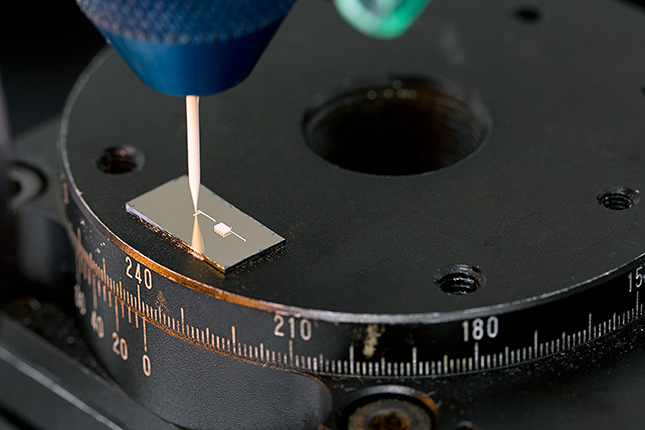
Lewis has taken two important steps toward printing electronic devices. First, she has invented an arsenal of what she calls functional inks that can solidify into batteries and simple components, including electrodes, wires, and antennas. Second, she has developed nozzles and high-pressure extruders that squeeze out the batteries and other components from an industrial-grade 3-D printer. Lewis’s inks use suspended nanoparticles of the desired materials, such as compounds of lithium for batteries and silver for wires. These materials are mixed into a variety of solutions, and the resulting inks are nearly solid when unperturbed but flow when a certain amount of pressure is applied. Once printed, the materials return to solid form. Printing a battery from a single nozzle can take minutes, but Lewis’s custom 3-D printing technology can deposit inks from hundreds of nozzles at the same time.

The printing technology works at room temperature, not the high temperatures normally required to work with high-performing electronics. That makes it possible to print the materials on plastic without causing damage. The battery materials themselves aren’t revolutionary, she says; “this is really more a revolution in the way things are manufactured.”

Her printed lithium-ion batteries are as tiny as one millimeter square but perform as well as commercial batteries, because Lewis can render microscale architectures, and position structures with 100-nanometer accuracy, to mirror the structures of much bigger batteries.

Lewis’s group holds eight patents for its inks and is working on licensing and commercializing the technology in the next few years. Although she says the initial plan is to provide tools for manufacturers, she may eventually produce a low-end printer for hobbyists.

Facebook's Future Plans for Data Collection Beyond Imagination

Facebook's dark plans for the future are given away in its patent applications.
December 4, 2013 | Alternet (via Counterpunch)

“No one knows who will live in this cage in the future, or whether at the end of this tremendous development, entirely new prophets will arise, or there will be a great rebirth of old ideas and ideals, or, if neither, mechanized petrification, embellished with a sort of convulsive self-importance. For of the fast stage of this cultural development, it might well be truly said: ‘Specialists without spirit, sensualists without heart; this nullity imagines that it has attained a level of civilization never before achieved.’”
—Max Weber, 1905

On November 12,  Facebook, Inc. filed its 178th patent application for a consumer profiling technique the company calls “inferring household income for users of a social networking system.”

“The amount of information gathered from users,” explain Facebook programmers Justin Voskuhl and Ramesh Vyaghrapuri in their patent application, “is staggering — information describing recent moves to a new city, graduations, births, engagements, marriages, and the like.” Facebook and other so-called tech companies have been warehousing all of this information since their respective inceptions. In Facebook’s case, its data vault includes information posted as early as 2004, when the site first went live. Now in a single month the amount of information forever recorded by Facebook —dinner plans, vacation destinations, emotional states, sexual activity, political views, etc.— far surpasses what was recorded during the company’s first several years of operation. And while no one outside of the company knows for certain, it is believed that Facebook has amassed one of the widest and deepest databases in history. Facebook has over 1,189,000,000 “monthly active users” around the world as of October 2013, providing considerable width of data. And Facebook has stored away trillions and trillions of missives and images, and logged other data about the lives of this billion plus statistical sample of humanity. Adjusting for bogus or duplicate accounts it all adds up to about 1/7th of humanity from which some kind of data has been recorded.

According to Facebook’s programmers like Voskuhl and Vyaghrapuri, of all the clever uses they have already applied this pile of data toward, Facebook has so far “lacked tools to synthesize this information about users for targeting advertisements based on their perceived income.” Now they have such a tool thanks to the retention and analysis of variable the company’s positivist specialists believe are correlated with income levels.

They’ll have many more tools within the next year to run similar predictions. Indeed, Facebook, Google, Yahoo, Twitter, and the hundreds of smaller tech lesser-known tech firms that now control the main portals of social, economic, and political life on the web (which is now to say everywhere as all economic and much social activity is made cyber) are only getting started. The Big Data analytics revolution has barely begun, and these firms are just beginning to tinker with rational-instrumental methods of predicting and manipulating human behavior.

There are few, if any, government regulations restricting their imaginations at this point. Indeed, the U.S. President himself is a true believer in Big Data; the brain of Obama’s election team was a now famous “cave” filled with young Ivy League men (and a few women) sucking up electioneering information and crunching demographic and consumer data to target individual voters with appeals timed to maximize the probability of a vote for the new Big Blue, not IBM, but the Democratic Party’s candidate of “Hope” and “Change.” The halls of power are enraptured by the potential of rational-instrumental methods paired with unprecedented access to data that describes the social lives of hundreds of millions.

Facebook’s intellectual property portfolio reads like cliff notes summarizing the aspirations of all corporations in capitalist modernity; to optimize efficiency in order to maximize profits and reduce or externalize risk. Unlike most other corporations, and unlike previous phases in the development of rational bureaucracies, Facebook and its tech peers have accumulated never before seen quantities of information about individuals and groups. Recent breakthroughs in networked computing make analysis of these gigantic data sets fast and cheap. Facebook’s patent holdings are just a taste of what’s arriving here and now.

The way you type, the rate, common mistakes, intervals between certain characters, is all unique, like your fingerprint, and there are already cyber robots that can identify you as you peck away at keys. Facebook has even patented methods of individual identification with obviously cybernetic overtones, where the machine becomes an appendage of the person. U.S. Patents 8,306,256, 8,472,662, and 8,503,718, all filed within the last year, allow Facebook’s web robots to identify a user based on the unique pixelation and other characteristics of their smartphone’s camera. Identification of the subject is the first step toward building a useful data set to file among the billion or so other user logs. Then comes analysis, then prediction, then efforts to influence a parting of money.
The way you type, the rate, common mistakes, intervals between certain characters, is all unique, like your fingerprint, and there are already cyber robots that can identify you as you peck away at keys.

Many Facebook patents pertain to advertising techniques that are designed and targeted, and continuously redesigned with ever-finer calibrations by robot programs, to be absorbed by the gazes of individuals as they scroll and swipe across their Facebook feeds, or on third party web sites.

Speaking of feeds, U.S. Patent 8,352,859, Facebook’s system for “Dynamically providing a feed of stories about a user of a social networking system” is used by the company to organize the constantly updated posts and activities inputted by a user’s “friends.” Of course embedded in this system are means of inserting advertisements. According to Facebook’s programmers, a user’s feeds are frequently injected with “a depiction of a product, a depiction of a logo, a display of a trademark, an inducement to buy a product, an inducement to buy a service, an inducement to invest, an offer for sale, a product description, trade promotion, a survey, a political message, an opinion, a public service announcement, news, a religious message, educational information, a coupon, entertainment, a file of data, an article, a book, a picture, travel information, and the like.” That’s a long list for sure, but what gets injected is more often than not whatever will boost revenues for Facebook.

The advantage here, according to Facebook, is that “rather than having to initiate calls or emails to learn news of another user, a user of a social networking website may passively receive alerts to new postings by other users.” The web robot knows best. Sit back and relax and let sociality wash over you, passively. This is merely one of Facebook’s many “systems for tailoring connections between various users” so that these connections ripple with ads uncannily resonant with desires and needs revealed in the quietly observed flow of e-mails, texts, images, and clicks captured forever in dark inaccessible servers of Facebook, Google and the like. These communications services are free in order to control the freedom of data that might otherwise crash about randomly, generating few opportunities for sales.

Where this fails Facebook ratchets up the probability of influencing the user to behave as a predictable consumer. “Targeted advertisements often fail to earn a user’s trust in the advertised product,” explain Facebook’s programmers in U.S. Patent 8,527,344, filed in September of this year. “For example, the user may be skeptical of the claims made by the advertisement. Thus, targeted advertisements may not be very effective in selling an advertised product.” Facebook’s computer programmers who now profess mastery over sociological forces add that even celebrity endorsements are viewed with skepticism by the savvy citizen of the modulated Internet. They’re probably right.

Facebook’s solution is to mobilize its users as trusted advertisers in their own right. “Unlike advertisements, most users seek and read content generated by their friends within the social networking system; thus,” concludes Facebook’s mathematicians of human inducement, “advertisements generated by a friend of the user are more likely to catch the attention of the user, increasing the effectiveness of the advertisement.” That Facebook’s current So-And-So-likes-BrandX ads are often so clumsy and ineffective does not negate the qualitative shift in this model of advertising and the possibilities of un-freedom it evokes.

Forget iPhones and applications, the tech industry’s core consumer product is now advertising. Their essential practice is mass surveillance conducted in real time through continuous and multiple sensors that pass, for most people, entirely unnoticed. The autonomy and unpredictability of the individual —in Facebook’s language the individual is the “user”— is their fundamental business problem. Reducing autonomy via surveillance and predictive algorithms that can placate existing desires, and even stimulate and mold new desires is the tech industry’s reason for being. Selling their capacious surveillance and consumer stimulus capabilities to the highest bidder is the ultimate end.

Sounds too dystopian? Perhaps, and this is by no means the world we live in, not yet. It is, however, a tendency rooted in the tech economy. The advent of mobile, hand-held, wirelessly networked computers, called “smartphones,” is still so new that the technology, and its services feel like a parallel universe, a new layer of existence added upon our existing social relationships, business activities, and political affiliations. In many ways it feels liberating and often playful. Our devices can map geographic routes, identify places and things, provide information about almost anything in real time, respond to our voices, and replace our wallets. Who hasn’t consulted “Dr. Google” to answer a pressing question? Everyone and everything is seemingly within reach and there is a kind of freedom to this utility.

Most of Facebook’s “users” have only been registered on the web site since 2010, and so the quintessential social network feels new and fun, and although perhaps fraught with some privacy concerns, it does not altogether feel like a threat to the autonomy of the individual. To say it is, is a cliche sci-fi nightmare narrative of tech-bureaucracy, and we all tell one another that the reality is more complex.

Privacy continues, however, too be too narrowly conceptualized as a liberal right against incursions of government, and while the tech companies have certainly been involved in a good deal of old-fashioned mass surveillance for the sake of our federal Big Brother, there’s another means of dissolving privacy that is more fundamental to the goals of the tech companies and more threatening to social creativity and political freedom.

Georgetown University law professor Julie Cohen notes that pervasive surveillance is inimical to the spaces of privacy that are required for liberal democracy, but she adds importantly, that the surveillance and advertising strategies of the tech industry goes further.

“A society that permits the unchecked ascendancy of surveillance infrastructures, which dampen and modulate behavioral variability, cannot hope to maintain a vibrant tradition of cultural and technical innovation,” writes Cohen in a forthcoming Harvard Law Review article:
“Modulation” is Cohen’s term for the tech industry’s practice of using algorithms and other logical machine operations to mine an individual’s data so as to continuously personalize information streams. Facebook’s patents are largely techniques of modulation, as are Google’s and the rest of the industry leaders. Facebook conducts meticulous surveillance on users, collects their data, tracks their movements on the web, and feeds the individual specific content that is determined to best resonate with their desires, behaviors, and predicted future movements. The point is to perfect the form and function of the rational-instrumental bureaucracy as defined by Max Weber: to constantly ratchet up efficiency, calculability, predictability, and control. If they succeed in their own terms, the tech companies stand to create a feedback loop made perfectly to fit each an every one of us, an increasingly closed systems of personal development in which the great algorithms in the cloud endlessly tailor the psychological and social inputs of humans who lose the gift of randomness and irrationality.

“It is modulation, not privacy, that poses the greater threat to innovative practice. Regimes of pervasively distributed surveillance and modulation seek to mold individual preferences and behavior in ways that reduce the serendipity and the freedom to tinker on which innovation thrives.” 
Cohen has pointed out the obvious irony here, not that it’s easy to miss; the tech industry is uncritically labeled America’s hothouse of innovation, but it may in fact be killing innovation by disenchanting the world and locking inspiration in an cage.

If there were limits to the reach of the tech industry’s surveillance and stimuli strategies it would indeed be less worrisome. Only parts of our lives would be subject to this modulation, and it could therefore benefit us. But the industry aspires to totalitarian visions in which universal data sets are constantly mobilized to transform an individual’s interface with society, family, the economy, and other institutions. The tech industry’s luminaries are clear in their desire to observe and log everything, and use every “data point” to establish optimum efficiency in life as the pursuit of consumer happiness. Consumer happiness is, in turn, a step toward the rational pursuit of maximum corporate profit. We are told that the “Internet of things” is arriving, that soon every object will have embedded within it a computer that is networked to the sublime cloud, and that the physical environment will be made “smart” through the same strategy of modulation so that we might be made free not just in cyberspace, but also in the meatspace.

Whereas the Internet of the late 1990s matured as an archipelago of innumerable disjointed and disconnected web sites and databases, today’s Internet is gripped by a handful of giant companies that observe much of the traffic and communications, and which deliver much of the information from an Android phone or laptop computer, to distant servers, and back. The future Internet being built by the tech giants —putting aside the Internet of things for the moment— is already well into its beta testing phase. It’s a seamlessly integrated quilt of web sites and apps that all absorb “user” data, everything from clicks and keywords to biometric voice identification and geolocation.

United States Patent 8,572,174, another of Facebook’s recent inventions, allows the company to personalize a web page outside of Facebook’s own system with content from Facebook’s databases. Facebook is selling what the company calls its “rich set of social information” to third party web sites in order to “provide personalized content for their users based on social information about those users that is maintained by, or otherwise accessible to, the social networking system.” Facebook’s users generated this rich social information, worth many billions of dollars as recent quarterly earnings of the company attest.

In this way the entire Internet becomes Facebook.
The totalitarian ambition here is obvious, and it can be read in the securities filings, patent applications, and other non-sanitized business documents crafted by the tech industry for the financial analysts who supply the capital for further so-called innovation. Everywhere you go on the web, with your phone or tablet, you’re a “user,” and your social network data will be mined every second by every application, site, and service to “enhance your experience,” as Facebook and others say. The tech industry’s leaders aim to expand this into the physical world, creating modulated advertising and environmental experiences as cameras and sensors track our movements.

Facebook and the rest of the tech industry fear autonomy and unpredictability.
The ultimate expression of these irrational variables that cannot be mined with algorithmic methods is absence from the networks of surveillance in which data is collected.

One of Facebook’s preventative measures is United States Patent 8,560,962, “promoting participation of low-activity users in social networking system.” This novel invention devised by programmers in Facebook’s Palo Alto and San Francisco offices involves a “process of inducing interactions,” that are meant to maximize the amount of “user-generated content” on Facebook by getting lapsed users to return, and stimulating all users to produce more and more data. User generated content is, after all, worth billions. Think twice before you hit “like” next time, or tap that conspicuously placed “share” button; a machine likely put that content and interaction before your eyes after a logical operation determined it to have the highest probability of tempting you to add to the data stream, thereby increasing corporate revenues.

Facebook’s patents on techniques of modulating “user” behavior are few compared to the real giants of the tech industry’s surveillance and influence agenda. Amazon, Microsoft, and of course Google hold some of the most fundamental patents using personal data to attempt to shape an individual’s behavior into predictable consumptive patterns. Smaller specialized firms like Choicestream and Gist Communications have filed dozens more applications for modulation techniques. The rate of this so-called innovation is rapidly telescoping.

Perhaps we do know who will live in the iron cage. It might very well be a cage made of our own user generated content, paradoxically ushering in a new era of possibilities in shopping convenience and the delivery of satisfactory experiences even while it eradicates many degrees of chance, and pain, and struggle (the motive forces of human progress) in a robot-powered quest to have us construct identities and relationships that yield to prediction and computer-generated suggestion. Defense of individual privacy and autonomy today is rightly motivated by the reach of an Orwellian security state (the NSA, FBI, CIA). This surveillance changes our behavior by chilling us, by telling us we are always being watched by authority. Authority thereby represses in us whatever might happen to be defined as “crime,” or any anti-social behavior at the moment. But what about the surveillance that does not seek to repress us, the watching computer eyes and ears that instead hope to stimulate a particular set of monetized behaviors in us with the intimate knowledge gained from our every online utterance, even our facial expressions and finger movements?

Dallas Police Rule Change Gives Officers 72 Hours To Get Their Stories Straight After Shooting Citizens

from the "Accountability-is-for-bullet-riddled-civilians dept"
Techdirt

The Dallas Police Department can't seem to get its officers' statements on shootings to agree with recordings of the incidents. So, it's doing what any forward thinking law enforcement agency would do -- changing the rules.
Any Dallas officer involved in a police shooting — whether the officer fired a weapon or witnessed the gunfire — will now have the right to remain silent for 72 hours under a new department policy.

And even before they give a statement about the shooting, the officers can watch any available video before they give a statement.
Very convenient. This policy change, which was ushered in under the cover of the Thanksgiving holiday, will help ensure that DPD officers don't find their statements directly contradicted by the inconveniently unblinking eye of the camera, as happened just recently.

On October 14th, Dallas police officer Cardan Spencer shot a mentally ill man four times in the stomach. According to Spencer's partner, Christopher Watson (who wrote the report), the man (Bobby Gerald Bennett) moved "in a threatening manner" towards him and the other officer. Watson's statement even went so far as to say Bennett "lunged" at them. A statement released by the DPD a few hours after the shooting claimed the situation "escalated."

A surveillance camera caught the entire confrontation on tape. Less than 20 seconds pass before Spencer opens fire. See if you can catch a glimpse of the "lunge" or the "escalation."


Bennett never lunges. He doesn't do anything more threatening than stand up from the chair he was sitting in. Four bullets later, Bennett is on the ground. Somehow, being shot four times by a DPD officer is "aggravated assault," a charge the DPD pressed (it was later dropped) while Bennett was still in critical condition.

As a result of this, Spencer was fired and Watson suspended for making false statements. But this was only after Bennett's mother took the video to the media. Before she did this, DPD Chief David Brown watched the video and claimed his own officer's statement trumped his lying eyes.
"The unfortunate thing here is that Officer Watson's statement really overrode what the video showed," Brown said. "We had not at that point determined if the video captured the entire incident, or if the video had not been altered in any way. We put a lot of credibility on officer's statements until we have other evidence to prove otherwise."
Not so much anymore. Former DPD officer Cardan Spencer may be facing assault charges for shooting Bennett. Perhaps the saddest aspect of this whole debacle is the fact that Bennett's mother called the police because she was afraid her son (who has mental issues and was off his medication) might hurt himself.

As this has caused the DPD considerable embarrassment (not the least of which is the chief claiming a recording of the shooting is less trustworthy than statements given by an officer later suspended for making false statements), the only solution was (apparently) to buy time for officers to fix their narratives should inconvenient recordings surface.

Supposedly, this 72-hour waiting period is better for memory. Chief Brown refers to research by Alexis Artwohl which indicates recall of traumatic events increases over time. Immediate statements may be less accurate. That may be, but this report has been available since 2002 and there hasn't been a large shift in policies regarding police shootings across the nation. This looks like nothing more than someone finding the justification they need to install an insular policy that will allow bad cops to be even worse. This gives shelter to liars by allowing them to craft a plausible narrative that can't be undone by a single surveillance video.

This also doesn't explain why police insist on questioning suspects and eyewitnesses immediately after a criminal incident. But Artwohl has an explanation.
Artwohl, the memory expert, said officers treat civilian witnesses differently because officers won’t always be able to find the person again. That usually isn’t true of officers, she said.
Unsurprisingly, attorneys for the Dallas Police Association "applauded" Chief Brown's application of an additional layer of paint to the thin blue line. Anything that makes it easier to defend cops who are threatened by people standing motionless is a win for the PD's lawyers.

Defense attorney Mark Bennett flips the scenario to show just how outrageous this policy would be if it was applied to anyone else.
As a result of this incident, the Dallas Police Department changed its policy regarding gang-related shootings. Instead of pressing gang members for statements immediately after shootings, police officers will advise them that they have seventy-two hours to get together and make up a story, and will provide them, during that time, with any video the police can find, so that they can conform their stories to the video.

It makes no sense, does it, that police policy should not just permit but encourage members of a criminal street gang who witness a gang-related shooting to take three days to talk to each other and their lawyers and review the facts that are beyond dispute before making a statement?

It makes sense only if the police want the perpetrators of such shootings to walk free. The idea would be farcical if the criminal street gang were anything other than the police.
It's a farce, alright. The DPD has just ensured no one will trust the narratives constructed by its officers. And every citizen who's been paying attention will know to hang onto their recordings for at least 72 hours, rather than see it twisted into "evidence" that keeps bad cops employed.

TEPCO to Dump Fukushima Radiation Into the Pacific Ocean

by WashingtonsBlog

TEPCO is planning on dumping all of the radioactive water stored at Fukushima into the ocean.

The industry-controlled nuclear regulators are pushing for dumping the radiation, as well.

As EneNews reports:
Juan Carlos Lentijo, head of IAEA’s mission to Fukushima Daiichi, Dec. 4, 2013: “Controlled discharge is a regular practice in all the nuclear facilities in the world. And what we are trying to say here is to consider this as one of the options to contribute to a good balance of risks and to stabilize the facility for the long term.”

Shunichi Tanaka, chairman of Japan’s Nuclear Regulation Authority, Dec. 4, 2013: “You cannot keep storing the water forever. We have to make choice comparing all risks involved.”

Xinhua, Dec. 4, 2013: Lentijo said that TEPCO should weigh the possible damaging effects of discharging toxic water against the total risks involved in the overall decommissioning work process. [...] Tanaka highlighted the fact that while highly radioactive water could be decontaminated in around seven years, the amount of water containing tritium will keep rising, topping 700,000 tons in two years. [...] nuclear experts have repeatedly pointed out that [tritium] is still a significant radiation hazard when inhaled, ingested via food or water, or absorbed through the skin. [...] fisherman, industries and fisheries bodies in the Fukushima area and beyond in Japan’s northeast, have collectively baulked at the idea of releasing toxic water into the sea [...] TEPCO will be duty-bound to submit assessments of the safety and environmental impact [...]

NHK, Dec. 4, 2013: IAEA team leader Juan Carlos Lentijo [...] said it is necessary and indispensable to assess the impact the tritium discharge might have on human health and the environment, and to get government approval as well as consent from concerned people.

Japan Times, Dec. 4, 2013: “Of course . . . public acceptance for this purpose is necessary,” said Lentijo, adding strict monitoring of the impact of the discharge would also be essential.

AFP, Dec. 4, 2013: [L]ocal fishermen, neighbouring countries and environmental groups all oppose the idea.

See also: Gundersen: They want to dump all Fukushima’s radioactive water in Pacific — Tepco: It will be diluted, then released — Professor suggests pumping it out in deep ocean (VIDEOS)

In the real world, there is no safe level of radiation.

And there are alternatives.

Dr. Arjun Makhijani – a recognized expert on nuclear power, who has testified before Congress, served as an expert witness in Nuclear Regulatory Commission proceedings, and has been interviewed by many of the largest news organizations – told PBS in March:
We actually sent a proposal to Japan two years ago, some colleagues of mine and I, saying you should park a supertanker or a large tanker offshore, and put the water in it, and send it off someplace else so that the water treatment and the water management is not such a huge, constant issue. But [the Japanese declined].

TEPCO – with no financial incentive to actually fix things – has been  irresponsible and has only been pretending to contain Fukushima. And see this.

Instead of doing something to contain the radiation, they’re going to dump it.


Thursday, December 5, 2013

Facebook isn’t Your Friend

The Unvarnished Truth
by DAVID CRONIN


A few days ago, I was told by the organisers of a “social media” festival that the hashtag was my “new best friend“. As I’ve never hugged a hashtag or cried on the shoulders of one, I felt it was important to question this “wisdom”.

Like millions of others, I’m addicted to Facebook and, to a lesser degree, Twitter. I check these websites so frequently that I often forget they are owned by vast corporations.

Some of these firms’ activities are inherently anti-democratic.

Facebook’s Brussels office is headed by Erika Mann, a former German member of the European Parliament. She has long fought to enable the interests of big business triumph over those of ordinary people.

During her 15 years as an MEP, Mann continuously advocated that the European Union should liberalise its trade with the United States.

At one point, it seemed that her calls were being ignored by political leaders on both sides of the Atlantic. All that changed in February this year, when Barack Obama expressed his support for such an agreement during his State of the Union address. Talks aimed at reaching a very broad trade and investment deal were formally launched in July.

Now wearing her Facebook hat, Erika Mann is still extolling the apparent virtues of “free” trade at every available opportunity.

In April, she spoke at a conference in Dublin, where Facebook’s international headquarters are located. Mann argued that it would be “extremely important” for an eventual deal to make the standards faced by internet companies in the EU and US “more coherent”.

While Mann claimed that she did not wish to see standards becoming “identical”, it is highly improbable that she will be pushing for more robust rules. Facebook recently submitted detailed recommendations to MEPs about how to weaken a new data protection law.
Information leaked by the courageous whistleblower Edward Snowden demonstrated that Facebook has been helping the National Security Agency to undertake espionage on a massive scale.

Before those revelations were made, Erika Mann claimed that Facebook was “leading the way” both in protecting privacy and in helping the digital sector to flourish. Her assurances now appear risible.

Facebook isn’t alone in hoping that the trade agreement will lead to “regulatory convergence” on different sides of the Atlantic. The European Commission has drawn up a paper for the talks, which indicates its willingness to copy and paste demands made by the car industry. The paper suggests that whenever either the EU or the US feels the need to have new rules on the amount of pollution vehicles may cause, they will consult each other with a view to finding a common approach.

In practice, this is a recipe for preventing Europe from having tougher emissions standards than the US.

Few qualms

Mann has few, if any, qualms about lobbying her former colleagues. She has spoken at events within the European Parliament’s buildings on a number of dossiers.

Last year, she addressed a conference on data protection organised by one of the assembly’s committees. She also spoke at a reception sponsored by the beer industry, during which she voiced support for “voluntary initiatives” undertaken by those behemoths of booze eager to portray themselves as responsible.

That wasn’t simply a case of Mann meeting some old pals for a knees-up. Facebook had clinched a huge advertising contract with Diageo – owner of Guinness and Smirnoff – a few months earlier.

Her participation in the beer-fuelled reception involved sending a signal to law-makers that they should abandon any plans they may have to ban or restrict the marketing of alcohol. The idea that the drinks industry can be expected to behave responsibly is, of course, daft. The only objective of corporations is to amass as much money as they can.

Following a scandal in 2011 in which a few MEPs were recorded stating they would be happy to receive bribes from journalists posing as lobbyists, the European Parliament drew up a code of conduct. In theory, the code applies to both sitting and former MEPs.

And yet a Parliament spokeswoman told me: “from what I gather of your description of Mrs Mann’s activities, it doesn’t seem that she has breached the code of conduct”.

The code states that former MEPs should not benefit from the Parliament’s “facilities” if they wish to engage in lobbying “directly linked” to EU law-making. According to the spokeswoman, this clause did not relate merely to accessing the Parliament’s buildings but to such perks as use of its car-parks and libraries.

If Mann is undertaking lobbying on the Parliament’s premises, there is strong prima facie evidence that she is not playing by the rules. But it seems that the Parliament’s administration is happy to overlook how former MEPs are usurping democracy by cajoling their old colleagues into tweaking laws to placate certain vested interests.

A leaked internal paper from the European Commission indicated that it plans to make extensive use of Twitter and Facebook to sell the so-called benefits of a trans-Atlantic trade deal.

Fortunately, the Commission’s officials aren’t the only people who know to tweet, share and “like”.

Given that Facebook’s Brussels office wants a trade deal to be concluded, it behoves those of us opposing the deal to flood the pages of Facebook with the unvarnished truth. We should spare no effort in calling out the lobbyists seeking to destroy the last vestiges of our democracy.

The Stock Market Bubble

Back to the Future on Wall Street
by MIKE WHITNEY


Wall Street is buzzing, and it’s all about bubbles.

In fact, according to Google Trends, interest in the term “stock bubble” was higher in November 2013 than anytime since October 2008.

And that should be expected given that the Dow Jones just broke through the 16,000-mark while the NASDAQ sailed-past the 4,000 milestone for the first time in 13 years. And did I mention that S&P 500 just closed above 1,800 for an all-time high?

While surging stocks are not proof of a bubble, they do draw attention to the condition of the underlying economy which is still in deep distress 5 years after the recession "ended." With "official" unemployment at 7.2% (and real unemployment twice that figure), GDP barley growing, droopy personal consumption, flagging durable goods, shrinking revenues, flatlining wages, falling incomes, widening inequality, plunging consumer sentiment, 47 million Americans on food stamps, and myriad other signs of persistent economic stagnation; the so called “recovery” is anything but robust. So where are stocks getting the oomph to keep rising?

That’s not a question that bothers the bubble deniers who have started popping up on the business channels like they did prior to the housing and the dot.com busts. These so called “experts” assure the public that all the bubble talk is just scaremongering by disgruntled Cassandras who don’t understand that current valuations are reasonable. They say that soaring prices reflect “strong fundamentals.

Uh huh.

Last week, serial bubblemaker, Alan Greenspan, made an appearance on Bloomberg TV where he scoffed at the idea of a stock bubble saying, “It’s a little on the upside, (But) “This does not have the characteristics, as far as I’m concerned, of a stock market bubble.”

There you have it from Maestro himself. No bubble here. Move along now.

Others, however, are not as confident as Greenspan. They think stock prices have less to do with fundamentals than they do with the Fed’s uber-accommodative policy which has kept short-term rates set below the rate of inflation for 5 years straight, providing a subsidy for risk taking. They also point to Fed chairman Ben Bernanke’s $85 billion per month asset purchase program, called QE, which has expanded the Fed’s balance sheet by $3 trillion lifting stock and bond prices across the board. Stock prices are based on Central Bank intervention. Fundamentals have nothing to do with it, nothing at all.

As for the bubble; judge for yourself:

Margin debt on the New York Stock Exchange is currently at its highest level ever. It’s even higher than before the crash in 2007. When investors borrow a lot of dough to buy stocks, you’re in a bubble, right? Because that’s what a bubble is, tons of credit pushing up prices. And when something bad happens, like the Lehman Brothers default, then all the over-extended borrowers have to dump their stocks pronto, which causes firesales, panics and financial meltdowns. Been there, done that.

So why is there so much margin debt now, you ask?

Because of zero rates. Because of QE. Because speculators think the Fed will keep prices high by pumping more liquidity into the system. It’s called the Bernanke Put, the belief that the Fed will prevent stocks from falling too fast, too far. Margin debt is a reasonable reaction to the Fed’s policy, which is why the Fed is ultimately responsible for the risky behavior.

Now check this out from the New York Times:
“Since the dark days of 2008, the Nasdaq has risen more than 150 percent, twice as much as the old-school Dow industrials. Money has been pouring into social media stocks. As of Friday, Twitter had risen nearly 60 percent since it went public only a few weeks earlier.

Once again, new “metrics” are being applied to justify stratospheric valuations. Twitter is losing money. A price-to-earnings ratio? There is no E in the P/E. But its stock is trading at 20-odd times the company’s annual sales. Good enough….

Eight months ago, Snapchat was valued at $70 million. Today, it is valued at $4 billion, even though it has zero revenue. Six months ago, Pinterest was valued at $2.5 billion. Today, it is valued at $3.8 billion — and no revenue there, either. And last week news broke that Dropbox was said to be seeking a new round of funding that would value the company at $8 billion, up from $4 billion a year ago.” (“Disruptions: If It Looks Like a Bubble and Floats Like a Bubble”, New York Times)

Did you catch that? A company with zero revenue is worth $3 billion more today than it was 8 months ago. So we’re back to the bad old days of the dot.com bust. This is the result of low rates and QE. It has nothing to do with fundamentals. We’re not talking earnings here. We’re talking manipulation, intervention, and central planning.
 
Then there’s this from the Wall Street Journal:
“Investment funds aimed at individual investors are barreling into collateralized loan obligations, a complex and volatile type of security that was shaken by the financial crisis.

Lured by annual returns of as high as 20%, some mutual-fund managers are buying CLOs through investment funds that purchase stakes in loans to companies with low credit ratings…. …

The biggest buyers of these securities usually are hedge funds, insurers and banks. But mutual funds and business-development companies, which pitch themselves to individual, or retail, investors, have collected more than $60 billion in money from clients this year, according to Keefe, Bruyette & Woods, Inc. and fund-data provider Lipper.

CLO returns are higher than on corporate bonds and other loans, but CLO prices could plunge if the risk rises that companies will run into trouble repaying their loans. That happened in 2011, and some fund managers say retail investors are mostly unaware that the firms they invest in are buying CLOs…” (“Volatile Loan Securities Are Luring Fund Managers Again”, Wall Street Journal)
So the big boys are climbing further out the risk curve to scratch out a higher rate of return on their investments; investments which–by the way– will eventually cost ”retail investors” (you and me) a bundle. 
 
And the reason these financial institutions are engaging in such risky behavior is because rates have been stuck at zero for 5 years, forcing them to look for higher yield wherever they can find it. It’s all part of the Fed’s Pavlovian conditioning. First you turn the interest rate dial to zero, then you juice stock’s prices with QE. And then you wait for the suckers (Mom and Pop) to reenter the market so you can cut them down like corn stalks in a combine. Works every time, just take a look:
“One development that has experts concerned is the return of individual investors, who are known for getting into the stock market near peaks…One way to measure their activity is to look at net inflows into stock mutual funds (excluding exchange-traded funds). When investors put more into stock funds than they take out, it’s called a net inflow. When they withdraw more than they invest, it’s a net outflow.

This year, net inflows totaled $176 billion through Nov. 20, according to Lipper…Most of that money is coming from bank accounts and money market funds…”

So the sheeple are about to get sheared again, right? Just like Bernanke and his Wall Street buddies planned from the get go. But, guess what? Just as Mom and Pop are getting back into stocks again, the big boys are getting out. Take a look at this report from BofAML from the Macronomics blogsite:

”BofAML clients were net sellers of US stocks for the fifth consecutive week, in the amount of $2.3bn. Net sales were led by institutional clients, who returned to net selling following a week of muted buying.

Institutional clients remain the biggest net sellers year-to-date, with cumulative net sales of over $23bn—larger than in either 2008 or 2010. …..Hedge funds were also net sellers for the second consecutive week, while private clients returned to net buying after a week of selling. This group has been a net buyer for 23 of the past 26 weeks.” (“Credit: All that glitters, ain’t gold”, Macronomics)

How do you like that? So once the chickens get lured back into the henhouse, the door slams shut and the fox fires up the stove for another big feed. Isn’t this how it always works out?

Now check this out in Forbes about ”cov lite” loans:

“Covenant-lite loan activity in 2013 is smashing all records, and appears to be picking up speed. Through Aug. 8 there has been $162 billion of covenant-lite loan issuance in the U.S., more than five times the amount seen at this point in 2012, and easily topping the $86 billion of cov-lite deals logged all of last year.” (“Cov lites” soar to new record”, Forbes)

Unfortunately, cov lites are a particularly lethal form of lending which strips “typical lender protections” from credit agreements. Here’s the scoop from the New York Times:

“Leveraged loans became popular before the 2008 collapse but nearly disappeared afterward, regarded as a symbol of unbridled lending. But they started to return in 2010 and are now back in force, with volumes of $548.4 billion this year through Nov. 14, already exceeding the precrisis level of $535.2 billion in 2007.

The type of leveraged loans that Learfield took out are known as covenant-lite, financial lingo for loans that lack the tripwires that could alert investors to any potential financial troubles at the company that could affect repayment. More than half of all leveraged loans issued this year have been the so-called cov-lite types, double the level seen in 2007 on the eve of the credit crash.” (“New Boom in Subprime Loans, for Smaller Businesses”, New York Times)

So, let’s recap: The Fed has managed to spark another surge in risky lending (that “exceeds precrisis levels”) that threatens to blow up in investors faces leaving them less prepared for retirement than they are today.

Check.

And there’s more. Take a look at the recent stock buyback frenzy, which is where companies buy their own stock to goose the price instead of investing in plants, equipment, hiring, or any other type of useful, productive activity. This is from Bloomberg:
“Multiple expansion through share buybacks have been driving indeed the stock market higher greater than earnings have. …. Buybacks rose by 18% Quarter-over-quarter to $118 billion in 2013, up 11% year-over-year to $218 billion.”  (Bloomberg)

Even so, Greenspan sees no bubble. Stock prices are based on good old fundamentals, like earnings. What could be more fundamental than earnings, right?

Take a look at this from the Testosterone Pit:
“Corporate earnings will grow this year at their lowest level since 2009. Revenue growth at public companies is almost non-existent. Companies are buying back stock at a record pace to boost per-share earnings.”  (“What Really Bothers Me About this Stock Market”,  Michael Lombardi, Testosterone Pit)
Huh? So earnings aren’t so hot either?

Apparently not. And that means the fundamentals are actually weak, which makes sense since the economy is in the crapper.

Then we ARE in a bubble, after all?

Yep. And when it bursts it’s going to cost a lot of people a lot of money.  Just like last time.

Funnies for the Holidays