Monday, September 30, 2013

The Police State of America

‘Freedom’s just another word...’
by DAVE LINDORFF

I no longer recognize my country.

Back in 1997, after two years living in China, and five more living in Hong Kong, during which time, as a correspondent for Business Week magazine, I slipped in and out of China regularly as a journalist to report on developments there, I got a good dose of life in a totalitarian society. When I alit from the plane in Philadelphia where my family and I were about to start a new chapter of our lives, I remember feeling like a big weight had been lifted off my chest.

The sense of freedom was palpable.

Almost immediately, though I got an inkling that something was amiss. An art teacher in Upper Dublin, the suburban town where we had bought a house, had just been arrested, charged with theft of $400 in school art supplies. Of course, my initial reaction was, “Great school district we’re in, if the teachers are stealing from the school!”

The teacher, Lou Ann Merkel, who had been arrested and briefly jailed pending arraignment, was fired and was facing trial on a felony charge of stealing public property. But in a few weeks, as I followed the story in the local weekly paper, it became clear that there had really been no theft (she was taking old supplies which were being replaced with new ones, intending to bring them to a local community center used by low-income children who went there for day care and after-school care. Moreover, when stopped by the principal and told that the old supplies had to be put in the dumpster, she grudgingly complied. She was arrested anyway later, at her home). I learned over subsequent weeks of news reports that Merkel actually was being hounded by an obsessive power-tripping school administration simply for being an “activist” and outspoken teacher. A school board hearing I attended was packed in December of that year with over a hundred angry parents and former students of Merkel’s demanding that the board drop its case against her. It did not, but a county judge had the good sense to do exactly that, ruling that “no crime occurred here.” (Merkel, who got her job back with back pay, later sued the school district and won a significant judgement against it.)

This was one small example of government tyranny run amok but since then I have seen it become the norm in a United States where people are now being arrested for almost everything — kids jailed without trial for shoplifting, hitchhikers jailed for arguing, correctly, with cops that it is not illegal for them to thumb for a ride, non-white youths in many cities stopped and frisked for “walking while black or hispanic” and then getting busted on trumped up charges (resisting arrest, assaulting an officer, disturbing the peace, etc.) when the cops find no guns or drugs on them, protesters beaten and gassed and jailed for simply trying to exercise their First Amendment rights.

But that is just the surface.

As a journalist working in China, I had to watch my back all the time. Spies from the Ministry of State Security (China’s KGB) or one of the local Public Security Bureaus that operate under its jurisdiction would secretly follow my movements, and would keep track of whoever I interviewed. In one case, after my departure, they badly beat a source to the point that he had to be hospitalized for reconstructive surgery to his crushed cheek bones (his entire groin region was also left black and blue after his brutal beating). The man’s offense? He had shown me around a rural region where peasants were improving their lives by sending some of their children off to the city to do construction jobs.

I thought this kind of monitoring and intimidation of sources was a nightmare back then in China.

Now it’s happening here in the US, only worse. Not only is the National Security Agency monitoring every phone call I make, every email I sent, every person I interview and every article I write–something Chinese police were not capable of at least in those days–but the agency can be watching what I write at this moment, as a type these letters on my keyboard.

How do I know they’re watching me? Well, of course I can’t know for certain, because they won’t tell me on the grounds of “national security,” which has rendered the Freedom of Information Act moribund. But courageous leakers from within the NSA, most notably Edward Snowden, have released documentary evidence proving that the super-secretive spy agency has been monitoring all communications between Americans and foreign contacts, most notably with countries like Russia or Iran or other nations which the US views as “enemies.”

In my case, as a journalist, I write often on international issues, as when I broke the story exposing an arrested killer in Lahore, Pakistan as a CIA operative, or wrote about how Israeli commandos executed a 19-year-old unarmed American peace activist in their raid on a Turkish-flagged peace flotilla headed for Gaza. I am also an occasional guest on news programs on RT-TV, the Russian state television news network, and on Iran’s state-owned Press TV. For one year, ending about a year ago, I was contracted to write a weekly column for PressTV’s English-language website, for which I was paid $200 per column. Because of US sanctions against Iran’s banking business, Press TV said they would pay me quarterly, rather than monthly, to minimize the paperwork hassles. This meant that for a year I was getting wire transfer of about $2600 every quarter from an Iranian bank. You can be sure I was on the NSA’s radar for that, if nothing else.

(Interestingly, I had more editorial freedom with that job than I’ve ever had writing for any news organization in the US. I picked my own topics for columns, Press TV agreed not to make any changes, or cuts, in my pieces, and I got paid in full whether they ran a story or not. Only once in the course of a year of columns did they not run a piece — an article I did on the debate over the death penalty in the US. The editor claimed that it was too “US-focused” and that it would “not be of interest” to Press TV readers. Even articles I wrote that included criticisms of Iranian policy ran unaltered.)

Even if everything I say on the phone or write on my computer, every site I visit online, every place I travel, every person I interview, is not being monitored by the NSA, the fact that we know the government is doing this, and is capable of doing this thanks to billions of dollars being spent in secret on massive super-computer arrays in Maryland and Utah, the damage is done. I have to assume that it is being done, and adjust my mind and my working methods to that reality. Recent arrests, convictions and lengthy sentences handed out to journalists’ sources also mean I have to assume that my promises of anonimity to sources — a key to any good investigative journalism — are empty. The reality is that unless I resort to secret meetings in person with sources, or start using throw-away cell phones, the NSA can find out who I am communicating with.

A total police state may not exist (yet) in the US in the sense of the one I lived in for a while in China, where people get taken away without charge, not to be seen again for years, if ever, and where people get executed without even the semblance of a fair trial on trumped-up charges of corruption or assaulting an officer or threatening state security. But because of the extent of the spying secretly being done now in the US by the NSA, the FBI and other US “law-enforcement” and national “security” agencies, we have to live now as though it is happening.

Because it could be happening to any one of us, and because all that data they are collecting could be used later against us.

Not only that, but the data being collected can be manipulated, clipped and doctored, so as to make us look guilty of something when we are not.

Make no mistake. What happened to Lou Ann Merkel was an example of a police state at work. A courageous woman who dared to speak out against subtle and sometimes not so subtle racism in the school where she worked, and someone who dares to speak her mind on any topic, was threatened with jail by a school superintendent who felt he had absolute power and who in fact had the power to have her arrested on his say so on trumped-up charges.

Today we are all Lou Ann Merkel. Step out of line or stand on principle and we lose jobs, face arrest, and become the targets of the NSA’s spy machine.

(Incidentally, by way of full disclosure, Lou Ann is a friend and the wife of my ThisCantBeHappening! colleague John Grant. I met them both at that Upper Dublin School Board hearing mentioned above.)

There is one difference between China, the police state I lived in and reported on back in the 1990s, and the US police state of today. In China, everyone knows they are living in a totalitarian society. There is no confusion about that. Chinese people know that their news is controlled, that they are being watched and monitored on phone and online, and that if they step out of line there will be dire consequences for them and their families. Many do anyway, or resist in smaller ways.

In the US, most Americans remain blissfully unaware of how their freedoms have been stolen or surrendered. While they may say they don’t trust the government and don’t believe the news, they actually do to a remarkable extent. That’s the only explanation for society allowing — even encouraging — the government to continue to execute people based on a findings of a court system that is clearly corrupt to the core. It’s the only reason so many people say they support government spying to keep us “safe from terrorism.” It’s the only reason local communities, like mine here in Upper Dublin, keep voting more money for small armies of police officers equipped with M-16s and SWAT gear in places that violent crime is almost unheard of.

The United States is not China, or the former German Democratic Republic (East Germany). Not yet. But I’m afraid we are almost there, and in some ways we are in a worse place than the peoples of those societies, because so many of us here in the so-called “Land of the Free and the Brave” are living with eyes willfully closed to what is happening to us and to our country.

Americans can still wake up. We seem to have done that in the latest attempt by the war-mongers in Washington to launch yet another bloody war in the Middle East. But there is still far too much sleep-walking going on.

Benjamin Franklin once famously said: “Those who would give up essential liberty to purchase a little temporary safety deserve neither liberty nor safety.”
We Americans have been surrendering our liberty since the dawn of the national security state in 1947. The process accelerated with President Nixon’s “war” on crime and especially his “war” on drugs, which militarized police. Things grew worse under subsequent presidents, including President Reagan, who accelerated the “Drug War,
 and President Clinton, who gutted habeas corpus. Presidents George W. Bush and current President Obama have stolen more freedom from Americans than any leaders in the country’s history, with the acquiescence of most citizens.

Clearly we are not safer now. And as Franklin warned so presciently, when it comes to our liberties, we are now in danger of losing it all.

As it is, I no longer recognize the country I grew up in and in which I began my journalism career.

Some Facts You Should Know About Fukushima

A Letter to All Young Athletes Who Dream of Coming to Tokyo in 2020
by TAKASHI HIROSE

 On September 7, 2013 Japan’s Prime Minister Shinzo Abe said to the 125th session of the International Olympic Committee, the following:
Some may have concerns about Fukushima. Let me assure you, the situation is under control. It has never done and will never do any damage to Tokyo.

This will surely be remembered as one of the great lies of modern times. In Japan some people call it the “Abesolute Lie”. Believing it, the IOC decided to bring the 2020 Olympics to Tokyo.

Japanese government spokespersons defend Abe’s statement by saying that radiation levels in the Pacific Ocean have not yet exceeded safety standards.

This recalls the old story of the man who jumped off a ten-storey building and, as he passed each storey, could be heard saying, “So far, so good”.

We are talking, remember, about the Pacific Ocean – the greatest body of water on earth, and for all we know, in the universe. Tokyo Electric Power Company – TEPCO – has been pouring water through its melted-down reactor at Fukushima and into the ocean for two and a half years, and so far the Pacific Ocean has been able to dilute that down to below the safety standard. So far so good. But there is no prospect in sight of turning off the water.

Here are eight things you need to know.


A letter to All Young Athletes ENGLISH (1)_html_7c908f6a


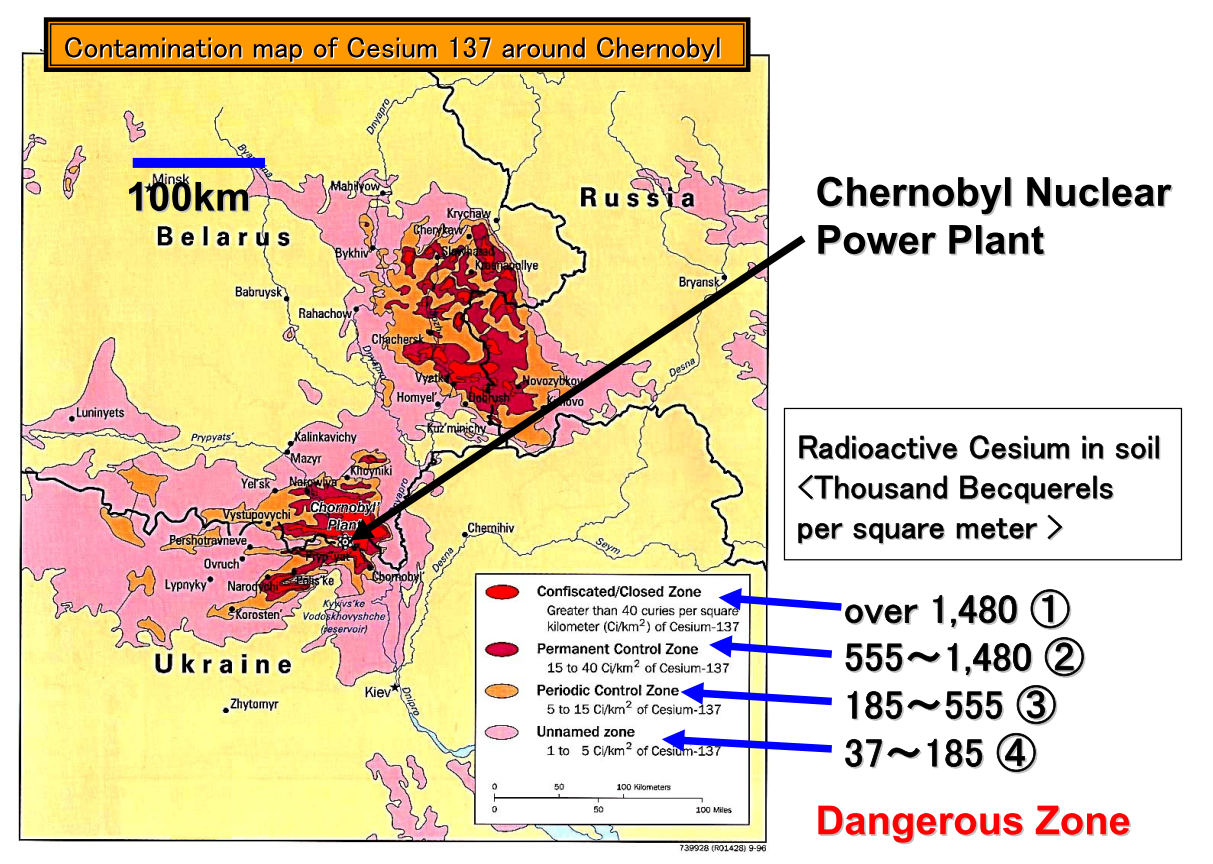
1. In a residential area park in Tokyo, 230 km from Fukushima, the soil was found to have a radiation level of 92,335 Becquerels per square meter. This is a dangerous level, comparable to what is found around Chernobyl ④ zone (the site of a nuclear catastrophe in 1986). One reason this level of pollution is found in the capital is that between Tokyo and Fukushima there are no mountains high enough to block radioactive clouds. In the capital people who understand the danger absolutely avoid eating food produced in eastern Japan.


A letter to All Young Athletes ENGLISH (1)_html_2ccd6755


2. Inside Fukushima Daiichi Nuclear Reactors #1 – #3 the pipes (which had circulated cooling water) are broken, which caused a meltdown. This means the nuclear fuel overheated, melted, and continued to melt anything it touched. Thus it melted through the bottom of the reactor, and then through the concrete floor of the building, and sank into the ground. As mentioned above, for two and a half years TEPCO workers have been desperately pouring water into the reactor, but it is not known whether the water is actually reaching the melted fuel. If a middle-strength earthquake comes, it is likely to destroy totally the already damaged building. And as a matter of fact, in the last two and a half years earthquakes have continued to hit Fukushima. (And as an additional matter of fact, just as this letter was being written Fukushima was hit by another middle-strength earthquake, but it seems that the building held up one more time. So far so good.) Especially dangerous is Reactor #4, where a large amount of nuclear fuel is being held in a pool, like another disaster waiting for its moment.

3. The cooling water being poured into the reactor is now considered the big problem in Japan. Newspapers and TV stations that previously strove to conceal the danger of nuclear power, are now reporting on this danger every day, and criticizing Shinzo Abe for the lie he told the IOC. The issue is that the highly irradiated water is entering and mixing with the ground water, and this leakage can’t be stopped, so it is spilling into the outer ocean. It is a situation impossible to control. In August, 2013 (the month prior to Abe’s IOC speech) within the site of Fukushima Daiichi Reactor, radiation was measured at 8500 micro Sieverts per hour. That is enough to kill anyone who stayed there for a month. This makes it a very hard place for the workers to get anything done. In Ohkuma-machi, the town where the Daiichi Nuclear Reactor is located, the radiation was measured in July, 2013 (two months before Abe’s talk) at 320 micro Sieverts per hour. This level of radiation would kill a person in two and a half years. Thus, over an area many kilometers wide, ghost towns are increasing.

4. For the sake of the 2020 Tokyo Olympics, an important fact has been left out from reports that go abroad. Only the fact that irradiated water is leaking onto the surface of the ground around the reactor is reported. But deep under the surface the ground water is also being irradiated, and the ground water flows out to sea and mixes with the seawater through sea-bottom springs. It is too late to do anything about this.

5. If you go to the big central fish market near Tokyo and measure the radiation in the air, it registers at about 0.05 micro Sieverts – a little higher than normal level. But if you measure the radiation near the place where the instrument that measures the radiation of the fish is located, the level is two or three times greater (2013 measurement). Vegetables and fish from around the Tokyo area, even if they are irradiated, are not thrown away. This is because the level established by the Japanese Government for permissible radiation in food – which if exceeded the food must not be sold – is the same as the permissible level of radiation in low-level radioactive wastes. Which is to say, in Japan today, as the entire country has been contaminated, we have no choice but to put irradiated garbage on the dinner table. The distribution of irradiated food is also a problem. Food from near Fukushima will be sent to another prefecture, and then sent on, relabeled as produced in the second prefecture. In particular, food distributed by the major food companies, and food served in expensive restaurants, is almost never tested for radiation.

6. In Japan, the only radiation from Fukushima Daiichi Nuclear Reactors that is being measured is the radioactive cesium. However large amounts of strontium 90 and tritium are spreading all over Japan. Strontium and tritium’s radiation consists of beta rays, and are very difficult to measure. However both are extremely dangerous: strontium can cause leukemia, and tritium can cause chromosome disorder.

7. More dangerous still: in order, they say, to get rid of the pollution that has fallen over the wide area of Eastern Japan, they are scraping off the top layer of the soil, and putting it in plastic bags as garbage. Great mountains of these plastic bags, all weather-beaten, are sitting in fields in Eastern Japan subject of course to attack by heavy rain and typhoons. Eventually the plastic will split open and the contents will come spilling out. When that happens, there will be no place left to take them.

8. On 21 September, 2013 (again, as this letter was being composed) the newspaper Tokyo Shimbun reported that Tokyo Governor Naoki Inose said at a press conference that what Abe expressed to the IOC was his intention to get the situation under control. “It is not,” Inose said, “under control now.”

American Workers: Hanging on by the Skin of Their Teeth

by MIKE WHITNEY

After five years of Obama’s economic recovery, the American people are as gloomy as ever. According to a Bloomberg National Poll that was released this week, fewer people “are optimistic about the job market” or “the housing market” or “anticipate improvement in the economy’s strength over the next year.” Also, only 38 percent think that President Obama is doing enough “to make people feel more economically secure.” Worst of all, Bloomberg pollsters found that 68 percent of interviewees thought the country was “headed in the wrong direction”.

So why is everyone so miserable? Are things really that bad or have we turned into a nation of crybabies?

The reason people are so pessimistic is because the economy is still in the doldrums and no one’s doing anything about it. That’s it in a nutshell. Survey after survey have shown that what people really care about is jobs, but no one in Washington is listening. In fact, jobs aren’t even on Obama’s radar. Just look at his record. He’s worse than any president in modern times. Take a look at this graph.

More than 600,000 good-paying public sector jobs have been slashed during Obama’s tenure as president. That’s worse than Bush, worse than Clinton, worse than Reagan, worse than anyone, except maybe Hoover. Is that Obama’s goal, to one-up Herbert Hoover?

Obama has done everything he could to make the lives of working people as wretched as possible. Do you remember the Card Check sellout or the Wisconsin “flyover” when Governor Scott Walker was eviscerating collective bargaining rights for public sector unions and Obama blew kisses from Airforce One on his way to a campaign speech in Minnesota? Nice touch, Barry. Or what about the “Job’s Czar” fiasco, when Obama appointed GE’s outsourcing mandarin Jeffrey Immelt to the new position just in time for GE to lay off another 950 workers at their locomotive plant in Pennsylvania. That’s tells you what Obama really thinks about labor.

What Obama cares about is trimming the deficits and keeping Wall Street happy. That’s it. But the people who elected him don’t want him to cut the deficits, because cutting the deficits prolongs the slump and costs jobs. What they want is more stimulus, so people can find work, feed their families, and have some basic security. That’s what they want, but they’re not going to get it from Obama because he doesn’t work for them. He works for the stuffed shirts who flank him on the golf course at Martha’s Vineyard or the big shots who chow down with him at his $100,000-per-plate campaign jamborees. That’s his real constituency. Everyone else can take a flying fu** for all he cares.

Then there’s the Fed. Most people don’t think the Fed’s goofy programs work at all. They think it’s all a big ruse. They think Bernanke is just printing money and giving it to his criminal friends on Wall Street (which he is, of course.) Have you seen this in the New York Times:
“Only one in three Americans has confidence in the Federal Reserve’s ability to promote economic growth, while little more than a third think the Fed is spinning its wheels, according to a New York Times/CBS News poll….

The Fed has been trying for five years to speed the nation’s recovery from the Great Recession by reducing borrowing costs to the lowest levels on record….

Most Americans, it would appear, remain either unaware or unpersuaded.” (“Majority of Americans Doubt Benefits of Fed Stimulus“, New York Times)

“Unpersuaded”? Are you kidding me? Most Americans think they’re getting fleeced; unpersuaded has nothing to do with it. They’re not taken in by the QE-mumbo jumbo. They may not grasp the finer-points, but they get the gist of it, which is that the Fed has run up a big $3 trillion bill every penny of which has gone to chiseling shysters on Wall Street. They get that! Everyone gets that! Sure, if you want to get into the weeds about POMO or the byzantine aspects of the asset-purchase program, you might detect a bit of confusion, but –I assure you–the average Joe knows what’s going on. He knows all this quantitative jabberwocky is pure bunkum and that he’s getting schtooped bigtime. You don’t need a sheepskin from Princeton to know when you’ve been had.

And that’s why everyone is so pessimistic, because they know that the Fed, the administration and the media are all lying to them 24-7. That’s why–as Bloomberg discovered–”Americans are losing faith in the nation’s economic recovery.” Because they don’t see any recovery. As far as they’re concerned, the economy is still in recession. After all, they’re still underwater on their mortgages, Grandpa Jack just took a job at a fast-food joint to pay for his wife’s heart medication, and junior is camped out in the basement until he can get a handle on his $45,000 heap of college loans. So where’s the recovery?

Nobody needs Bloomberg to point out how grim things are for the ordinary people. They see it firsthand every damn day.
Did you catch the news on Wal-Mart this week? It’s another story that helps explain why everyone’s so down-in-the-mouth. Here’s what happened: Wal-Mart’s stock tanked shortly after they announced that their “inventory growth …had outstripped sales gains in the second quarter…. Merchandise has been piling up because consumers have been spending less freely than Wal-Mart projected….” (Bloomberg)

Okay, so the video games and Barbie dolls are piling up to the rafters because part-time wage slaves who typically shop at Wal-Mart are too broke to buy anything but the basic necessities. Is that what we’re hearing?

Indeed. “We are managing our inventory appropriately,” David Tovar, a Wal-Mart spokesman, said today in a telephone interview. “We feel good about our inventory position.”

Sure, you do, Dave. Here’s more from Bloomberg:
“US. chains are already bracing for a tough holiday season, when sales are projected to rise 2.4 percent, the smallest gain since 2009, according to ShopperTrak, a Chicago-based firm. Wal-Mart cut its annual profit forecast after same-store sales fell 0.3 percent in the second quarter. …

Wal-Mart’s order pullback is affecting suppliers in various categories, including general merchandise and apparel, said the supplier, who has worked with Wal-Mart for almost two decades and asked not to be named to protect his relationship with the company. He said he couldn’t recall the retailer ever planning ordering reductions two quarters in advance.” (“Wal-Mart Cutting Orders as Unsold Merchandise Piles Up”, Bloomberg)

So we’re back to 2009?

Looks like it. When the nation’s biggest retailer starts trimming its sails, it ripples through the whole industry. It means softer demand, shorter hours, and more layoffs. Get ready for a lean Christmas.

The Walmart story just shows that people are at the end of their rope. For the most part, these are the working poor, the people the Democratic Party threw overboard a couple decades ago when they decided to hop in bed with Wall Street. Now their hardscrabble existence is becoming unbearable; they can’t even scrape together enough cash to shop the discount stores. That means we’re about one step from becoming a nation of dumpster divers. Don’t believe it? Then check out this clip from CNN Money:
“Roughly three-quarters of Americans are living paycheck-to-paycheck, with little to no emergency savings, according to a survey released by Bankrate.com Monday. Fewer than one in four Americans have enough money in their savings account to cover at least six months of expenses, enough to help cushion the blow of a job loss, medical emergency or some other unexpected event, according to the survey of 1,000 adults. Meanwhile, 50% of those surveyed have less than a three-month cushion and 27% had no savings at all..

Last week, online lender CashNetUSA said 22% of the 1,000 people it recently surveyed had less than $100 in savings to cover an emergency, while 46% had less than $800. After paying debts and taking care of housing, car and child care-related expenses, the respondents said there just isn’t enough money left over for saving more.” (“76% of Americans are living paycheck-to-paycheck“, CNN Money)

Savings? What’s that? Do you really think people can save money on $30,000 or $40,000 a year feeding a family of four?

Dream on. Even an unexpected trip to the vet with pet Fido is enough to push the family budget into the red for months to come. Savings? Don’t make me laugh.

The truth is, most people are hanging on by the skin of their teeth. They can’t make ends meet on their crappy wages and they’re too broke to quit. There’s no way out. It’s obvious in all the data. And it’s hurting the economy, too, because spending drives growth, but you can’t spend when you’re busted. Economist Stephen Roach made a good point in a recent article at Project Syndicate. He said,
“In the 22 quarters since early 2008, real personal-consumption expenditure, which accounts for about 70% of US GDP, has grown at an average annual rate of just 1.1%, easily the weakest period of consumer demand in the post-World War II era.” (It’s also a) “massive slowdown from the pre-crisis pace of 3.6% annual real consumption growth from 1996 to 2007.” (“Occupy QE“, Stephen S. Roach, Project Syndicate)

So the economy is getting hammered because consumption is down. And working people are getting hammered because jobs are scarce and wages are flat. But we live in the richest country in the world, right?

Right. So what’s wrong with this picture?

People Want Full Medicare for All

Time for Single Payer
by RALPH NADER


Freshman Senator Ted Cruz (R-Texas), who somehow got through Princeton and Harvard Law School, is the best news the defaulting Democratic Party has had in years.

As the Texas bull in the Senate china shop, he has been making a majority of his Republican colleagues cringe with his bare-knuckle antics and language. His 21 hour talkathon on the Senate floor demanding the defunding of Obamacare made his Republican colleagues gasp. His Nazi appeasement analogies, and threats to shut down were especially embarrassing.

After listening to his lengthy rant on the Senate Floor on Tuesday and Wednesday, one comes away with two distinct impressions. Ted Cruz cannot resist inserting himself here, there and everywhere. And nothing is too trivial for Senator Talkathon. He likes White Castle hamburgers, he loves pancakes; he talked about what he liked to read as a little boy, where he’s traveled, what clothes he wears and other trivia.

You’d think he would have used his time to talk specifically about the suffering that uninsured people and their children are going through, especially in the Lone Star State. Or about what could replace Obamacare other than his repeated “free market” solution, which is to say the “pay or die” profiteering, tax-subsidized corporate system.

It was puzzling why he never mentioned that during his two days of talking, over two hundred Americans died, on average, because they couldn’t afford health insurance to get diagnoses and timely treatment. (A peer reviewed study by Harvard Medical School researchers estimated about 45,000 die annually for lack of affordable health insurance every year.)

The other reaction to Senator Cruz was that many of his more specific objections to Obamacare – its mind-numbing complexity, opposition by formerly supportive labor unions, and employers reacting by reducing worker hours below 30 hours a week to escape some of the law’s requirements – are well-taken and completely correctible by single-payer health insurance, as provided in Canada. Single-payer, or full Medicare for all, with free choice of physician and hospital has been the majority choice of Americans for decades. Even a majority of doctors and nurses favor it.

Single-payer’s advantage is that everybody is in, nobody is out. It is far more efficient, allows for better outcomes, saves lives, prevents injuries and illnesses, relieves people of severe anxieties and wasted time spent figuring out often fraud-ridden, inscrutable computerized bills and allows for the collection of pattern-detecting data to spot harmful trends.

For example, in Canada, full Medicare covers everyone at half the per capita cost that Americans pay even though 50 million Americans are still not covered. The U.S. per capita figure is almost $9,000 a year and over 17% of our total GDP. In Canada, administrative costs are much lower.

Symbolically, the single-payer legislation that passed in Canada over four decades ago was 13 pages long, compared to over two thousand pages for Obamacare.

Critics of Canada’s system charge it with delays for patients. For some elective procedures, provinces that were under-investing have experienced some delays until Ottawa raised its contributions. Canada spends just over 10% of its GDP on healthcare, by comparison.

But in the U.S. not being able to pay for treatment is the biggest problem. And in the U.S., who hasn’t heard of delays in various areas of the country due to lack of primary care physicians or other specialties? I have many friends and relatives in Canada who have not complained of delays for routine, essential or emergency treatments.

For those who prefer to believe hard-bitten businesspeople, Matt Miller, writing yesterday in The Washington Post, interviewed big business executives – David Beatty who ran the giant Weston Foods and Roger Martin long-time consultant to large U.S. companies in Canada. They were highly approving of the Canadian system and are baffled at the way the U.S. has twisted itself in such a wasteful, harmful and discriminatory system.

Mr. Beatty wondered why U.S. companies “‘want to be in the business of providing health care anyway’ (‘that’s a government function,’ he says simply).”

Mr. Martin, an avowed capitalist, who has experienced healthcare in the U.S. and Canada, according to Mr. Miller, called Canadian Medicare “incredibly hassle-free,” by comparison. (In Canada, single-payer means government insurance and private delivery of healthcare under cost controls). Now Dean of the business school at the University of Toronto, Mr. Martin told reporter Miller: “I literally have a hard time thinking of what would be better than a single-payer system.”

So why the U.S. is the only Western country without some version of a single-payer system?

Most concessionary Democrats, including Barack Obama and Hillary Clinton, have said in the past that they prefer single-payer, but that the corporate forces against it cannot be overcome. (They use phrases like “single-payer is not practical.”)

But with the Cruz crew in Congress going berserk against Obamacare, now is the time to press again for the far superior single-payer model. Or at least get single-payer into the public discussion. Unfortunately, even some of the major citizen groups organized for single-payer, behind H.R. 676, are keeping quiet, not wanting to undercut Obama and the Congressional Democrats.

Go to Single Payer Action and connect with the movement that does not play debilitating politics and seeks your engagement.

Sunday, September 29, 2013

Americans warned bank 'bail-ins' coming

Experts say institutions will grab deposits without warning

WASHINGTON – With the United States facing a $17 trillion debt and an acidic debate in Washington over raising that debt limit on top of a potential government shutdown, Congress could mimic recent European action to let banks initiate a “bail-in” to blunt future failures, experts say.

Previously the federal government has taken taxes from consumers, or borrowed the money, to hand out to troubled banks. This could be a little different, and could allow banks to reach directly into consumers’ bank accounts for their cash.

Authority to allow bank “bail-ins” would be in lieu of approving any future taxpayer bailouts of banks that would be in dire need of recapitalization in order to survive.

Some financial experts contend that banks already have the legal authority to confiscate depositors’ money without warning, and at their discretion.

Financial analyst Jim Sinclair warned that the U.S. banks most likely to be “bailed-in” by their depositors are those institutions that received government bail-out funds in 2008-2009.

Such a “bail-in” means all savings of individuals over the insured amount would be confiscated to offset such a failure.

“Bail-ins are coming to North America without any doubt, and will be remembered as the ‘Great Leveling,’ of the ‘great Flushing’ (of Lehman Brothers),” Sinclair said. “Not only can it happen here, but it will happen here.

“It stands on legal grounds by legal precedent both in the U.S., Canada and the U.K.”

Sinclair is chairman and chief executive officer of Tanzania Royalty Exploration Corp. and is the son of Bertram Seligman, whose family started Goldman Sachs, Solomon Brothers, Lehman Brothers, Bache Group and other major investment banking firms.

Some of the major banks which received federal bailout money included Bank of America, Citigroup and JPMorgan Chase.

“When major banks fail, they are going to bail them out by grabbing the money that is in your bank accounts,” according to financial expert Michael Snyder. “This is going to absolutely shatter faith in the banking system and it is actually going to make it far more likely that we will see major bank failures all over the Western world.”

Given the dire financial straits the U.S. finds itself in, these financial experts say that Congress could look at the example of the European Parliament, which recently started to consider action that would allow banks to confiscate depositors’ holdings above 100,000 euros. Generally, funds up to that level are insured.

Finance ministers of the 27-member European Union in June had approved forcing bondholders, shareholders and large depositors with more than 100,000 euros in their accounts to make the financial sacrifice before turning to the government for help with taxpayer funds.

Depositors with less than 100,000 euros would be protected. Considering protection of small depositors a top priority, the E.U. ministers took pride in saying that their action would shield them.

“The E.U. has made a big step towards putting in place the most comprehensive framework for dealing with bank crises in the world,” said Michel Barnier, E.U. commissioner for internal market and services.

The plan as approved outlines a hierarchy of rescuing struggling banks. The first will be bondholders, followed by shareholders and then large depositors.

Among large depositors, there is a hierarchy of whose money would be selected first, with small and medium-sized businesses being protected like small depositors.

“This agreement will effectively move us from ad hoc ‘bail-outs’ to structured and clearly defined ‘bail-ins,’” said Michael Noonan, Ireland’s finance minister.

The European Parliament is expected to finalize the plan by the end of the year.

The purpose of this “bail-in,” patterned after the Cyprus model, is to offset the need for continued taxpayer bailouts that have come under increasing criticism of the more economically well-off countries such as Germany.

Last March, Cyprus had agreed to tap large depositors at its two leading banks for some 10 billion euros in an effort to obtain another 10 billion European Union bailout.

While this action prevented the collapse of Cyprus’ two top banks, the Bank of Cyprus and Popular Bank of Cyprus, it greatly upset depositors with savings more than 100,000 euros.

WND recently revealed that the practice of “bail-ins” by Cyprus a year ago was beginning to spread to other nations as large depositors began to see their balances plunge literally overnight.

A “bail-in,” as opposed to a bailout that countries especially in Europe have been seeking from the International Monetary Fund and the European Union, is a recognition that such outside monetary injections won’t be forthcoming.

Sinclair said that the recent confiscation of customer deposits in Cyprus was not a “one-off, desperate idea of a few Eurozone ‘troika’ officials scrambling to salvage their balance sheets.”

“A joint paper by the U.S. federal Deposit Insurance Corporation (FDIC) and the Bank of England (BOE) dated December 10, 2012 shows, that these plans have been long in the making, that they originated with the G20 Financial Stability Board in Basel, Switzerland, and that the result will be to deliver clear title to the banks of depositor funds,” Sinclair said.

He pointed that while few depositors are aware, banks legally own the depositors’ funds as soon as they are put in the bank.

“Our money becomes the bank’s, and we become unsecured creditors holding IOUs or promises to pay,” Sinclair said.

“But until now, the bank has been obligated to pay the money back on demand in the form of cash,” he said. “Under the FDIC-BOE plan, our IOUs will be converted into ‘bank equity.’ The bank will get the money and we will get stock in the bank.”

“With any luck,” Sinclair said, “we may be able to sell the stock to someone else, but when and at what price? Most people keep a deposit account so they can have ready cash to pay the bills.”

Such plans already are being used, or under consideration, in New Zealand, Poland, Canada and several other countries.

AIPAC 101


uh oh, criticize anything to do with Israel and you are a racist! Israel's people are cool, it's their government that sucks ass. And their govt has way too much sway with the US govt. That is some suck.

Sunday, September 22, 2013

Larry Summers: Goldman Sacked

By Greg Palast for Vice Magazine
Monday, 16 September 2013

Joseph Stiglitz couldn't believe his ears. Here they were in the White House, with President Bill Clinton asking the chiefs of the US Treasury for guidance on the life and death of America's economy, when the Deputy Secretary of the Treasury Larry Summers turns to his boss, Secretary Robert Rubin, and says, "What would Goldman think of that?"

Huh?

Then, at another meeting, Summers said it again: What would Goldman think?

A shocked Stiglitz, then Chairman of the President's Council of Economic Advisors, told me he’d turned to Summers, and asked if Summers thought it appropriate to decide US economic policy based on “what Goldman thought.” As opposed to say, the facts, or say, the needs of the American public, you know, all that stuff that we heard in Cabinet meetings on The West Wing.

Summers looked at Stiglitz like Stiglitz was some kind of naive fool who'd read too many civics books.

R.I.P. Larry Summers
On Sunday afternoon, facing a revolt by his own party’s senators, Obama dumped Larry as likely replacement for Ben Bernanke as Chairman of the Federal Reserve Board.

Until news came that Summers’ torch had been snuffed, I was going to write another column about Larry, the Typhoid Mary of Economics. (My first, in The Guardian, 15 years ago, warned that “Summers is, in fact, a colony of aliens sent to Earth to turn humans into a cheap source of protein.”)

But the fact that Obama even tried to shove Summers down the planet’s throat tells us more about Obama than Summers—and whom Obama works for. Hint: You aren’t one of them.

All these Cabinet discussions back in the 1990s requiring the blessing of Goldman Sachs revolved around the Rubin-Summers idea of ending regulation of the US banking system. To free the US economy, Summers argued, all you'd have to do is allow commercial banks to bet government-guaranteed savings on new "derivatives products," let banks sell high-risk sub-prime mortgage securities and cut their reserves against losses.

What could possibly go wrong?
Stiglitz, who would go on to win the Nobel Prize in Economics, tried to tell them exactly what would go wrong. But when he tried, he was replaced and exiled.

Summers did more than ask Rubin to channel the spirit of Goldman: Summers secretly called and met with Goldman's new CEO at the time, Jon Corzine, to plan out the planet’s financial deregulation. I’m not guessing: I have the confidential memo to Summers reminding him to call Corzine.

[For the complete story of that memo and a copy of it, read “The Confidential Memo at the Heart of the Global Financial Crisis”.]

Summers, as Treasury official, can call any banker he damn well pleases. But not secretly. And absolutely not to scheme over details of policies that could make a bank billions. And Goldman did make billions on those plans.

Example: Goldman and clients pocketed $4 billion on the collapse of “synthetic collateralized debt obligations”—flim-flam feathers sold to suckers and dimwits i.e. the bankers at RBS. (See Did Fabrice Tourre Really Create The Global Financial Crisis?)

Goldman also cashed in big on the implosion of Greece’s debt via secret derivatives trades permitted by Summers’ decriminalization of such cross-border financial gaming.

The collapse of the euro-zone and the US mortgage market caused by Bankers Gone Wild was made possible only by Treasury Secretary Summers lobbying for the Commodities Futures Modernization Act which banned regulators from controlling the 100,000% increase in derivatives assets, especially super-risky "naked" credit-default swaps.

The CMFA was the financial equivalent of a fire department banning smoke alarms.

Summers took over the Treasury's reins from Rubin who’d left to become director of a strange new financial behemoth: The combine of Citibank with and an investment bank, Travelers. The new bank beast went bankrupt and required $50 billion in bail-out funds. (Goldman did not require any bail-out funds–but took $10 billion anyway.)

Other banks-turned-casinos followed Citi into insolvency. Most got bail-outs ... and got Larry Summers–or, at least, Larry's lips for "consulting" or for gold-plated speaking gigs.

Derivatives trader D.E. Shaw paid Summers $5 million for a couple of years of "part-time" work. This added to payments from Citigroup, Goldman and other finance houses, raising the net worth of this once penurious professor to more than $31 million.

Foreclosure fills the Golden Sacks
When Summers left Treasury in 2000, The New York Times reports that a grateful Rubin got Summers the post of President of Harvard University—from which Summers was fired. He gambled away over half a billion dollars of the university’s endowment on those crazy derivatives he’d legalized. (Given Summers’ almost pathological inability to understand finance, it was most odd that, while President of the university, he suggested that humans with vaginas aren’t very good with numbers.)

In 2009, Summers, Daddy of the Deregulation Disaster, returned to the Cabinet in triumph. Barack Obama crowned him “Economics Tsar,” allowing Summers to run the Treasury without having to be questioned by Congress in a formal confirmation hearing.

As Economics Tsar in Obama's first term, did Summers redeem himself?

Not a chance.

In 2008, both Democrat Hillary Clinton and Republican John McCain called for using the $300 billion remaining in the "bail-out' fund for a foreclosure-blocking program identical to the one Franklin Roosevelt had used to pull the US out of the Great Depression. But Tsar Larry would have none of it, although banks had been given $400 billion from the same fund.

Indeed, on the advice of Summers and his wee assistant, Treasury Secretary Tim Geithner, Obama spent only $7 billon of the $300 billion available to save US homeowners.

What would Goldman think?
As noted, Goldman and clients pocketed billions as a result of Obama’s abandonment of 3.9 million families whose homes were repossessed during his first term. While American homeowners were drowning, Tsar Summers torpedoed their lifeboat: a plan to prevent foreclosures by forcing banks to write-off the overcharges in predatory sub-prime mortgages. Notably, Summers’ action (and Obama's inaction) saved Citibank billions.

Loan Shark Larry
The deregulation disaster machinery is not done with mangling Americans. While not-for-profit credit unions, lenders of last resort for working people and the poor in the US, have been under legal and political attack, a new kind of banking operation has bubbled out of the minds of the grifters looking for a way to make loan-sharking legit.

One new outfit, for example, called “Lending Club,” has figured out a way to collect fees for arranging loans charging as much as 29%. Lending Club claims it cannot and should not be regulated by the Federal Reserve or other banking police. The recent addition to its Board of Directors: Larry Summers.

If you want to know why Obama would choose such a grifter and gamer to head the Fed, you have to ask, Who picked Obama? Ten years ago, Barry Obama was a nothing, a State Senator from the South Side of Chicago.

But then, he got lucky. A local bank, Superior, was shut down by regulators for mortgage shenanigans ripping off Black folk. The bank’s Chairwoman, Penny Pritzker was so angry at regulators, she decided to eliminate them: and that required a new President.

The billionaires connected Obama to Jamie Dimon of J.P. Morgan, but most importantly to Robert Rubin, former Treasury Secretary, but most important, former CEO of Goldman Sachs and mentor of Larry Summers. Without Rubin’s blessing and overwhelming fundraising power, Obama would still be arguing over zoning on Halsted Street.

Rubin picked Obama and Obama picks whom Rubin picks for him.

Because, in the end, Obama knows he must choose a Fed chief based on the answer to one question: What would Goldman think?

Thursday, September 19, 2013

Fox News Sells Fracking as ‘Incredibly Good for Our Environment”

Corporate Propaganda September 16, 2013 | By WakingTimes
Alex Pietrowski, Staff Writer
“Nature doesn’t give us a clean environment.”
Recently on Fox News, Alex Epstein, the founder of the Center for Industrial Progress, and author of the book, Fossil Fuels Improve the Planet, argues in favor of hydraulic gas fracturing, or fracking, as it has become known. This is the technique of extracting natural gas and oil from layers of underground shale rock by pressure-injecting an undisclosed mixture of water and chemicals deep into the ground.

This particular segment serves as an outstanding example of what corporate propaganda looks like and how the media triggers our cultural programming to stimulate fear/desire conditioning, in order to persuade us into conforming to a selected position on an issue.

The clip begins with the graphic of a printing press rolling out unlimited dollar bills across the screen and the Fox host framing the conversation, asking their central question about fracking
“…its being called a modern day gold rush… reducing the need for foreign oil. With so many opportunities to frack in the Unites States, could this technology be a new path to American wealth?”

A New Path to American Wealth?
The guest, Epstein, is introduced and hails fracking as a technological revolution as important to society as the invention of the computer, explaining how we are sitting on a Texas sized amount of shale rock that should be extracted for the benefit of all.

The host goes on to explain ‘one of the big stories this week,’ a report issued by somebody about the economic benefits of fracking and how in high fracking areas they are already seeing a ‘trickling down’ of this vast wealth to the average person. Wages are supposedly up, U.S. tax revenues are up, disposable income is up, and the question is asked by the host…
“… is this really going to affect my own wallet, is fracking really going to help me save more money and live a better life?”
There are close-ups of dollar bills hovering in the background.
The central concern over fracking, for those who oppose it, is not that the economy will suffer if we don’t frack, but rather the damage it does to the environment; making people sick, contaminating water and causing droughts, drying up aquifers and causing earthquakes. This question was raised by the host, and addressed by Epstein:
“…fracking is actually incredibly good for our environment, and there’s two reasons. One is that this rock right here [holds up a piece of black oil shale rock], this exists 5000 feet away from ground water, so the last thing that’s going to contaminate your ground water is a fracking operation. But #2, look at the places in the world with the best environments. They’re the places that use the most energy, because nature doesn’t give us a clean environment. We have to clean it up, that takes a lot of energy to purify the water, to grow crops, to make the word a better place, and that’s why I titled my book, Fossil Fuels Improve the Planet.”
The host closes by stating that the EPA claims that there is no evidence that fracking ‘contaminates gravel,’ whatever that means, and so the question seems resolved to these two, and the closing postulation of the issue is offered:
“…gonna be interesting to see if we get lower energy bills across this country as a result of fracking if it takes hold.”
Clip from Media Matters:


Propaganda Is Exactly This

Propaganda according to WIKI:

“Propaganda is a form of communication aimed towards influencing the attitude of the community toward some cause or position by presenting only one side of an argument. Propaganda statements may be partly false and partly true. Propaganda is usually repeated and dispersed over a wide variety of media in order to create the chosen result in audience attitudes.”

Propaganda according to Merriam-Webster:

2: the spreading of ideas, information, or rumor for the purpose of helping or injuring an institution, a cause, or a person

3: ideas, facts, or allegations spread deliberately to further one’s cause or to damage an opposing cause; also : a public action having such an effect

You Decide!

This short piece of corporate propaganda is aimed at triggering our programmed fear of economic insecurity, and our programmed desire to be monetarily wealthy. By appealing to both our fear of loss and need for gain, this attempts to persuade the viewer that an increase in fracking is supportive of prosperity and personal security, and therefore a good idea. There is inadequate representation of the other sides of this argument, and there clearly is strong bias toward fracking and the oil and gas industry.

In the era of alternative media, where individuals have picked up the torch of journalistic integrity, is it any wonder why alternative news sources are winning out over the corporate model that offers us brain-washing like this that Fox and Friends presents here?

So much more to the Story

As with any issue where there is a tremendous amount of money to be made by those with entrenched connections, there is alwasys so much more than what is routinely spoken of in the mainline press, and, as usual, opposing viewpoints are easily found. Here are a few other angles on the issue of fracking, highlighting some of the well-founded concerns of people not approached for comment in this Fox news segment:

The Greatest Debt Crisis The World Has Ever Seen Is Coming

September 17th, 2013
By Michael Snyder


U.S. National Debt 2013


The largest mountain of debt in the history of the world just continues to grow even larger, and everyone knows that this colossal debt spiral is not going to end well. But we all keep playing along because nobody wants the party to end. Right now, there is an unprecedented ocean of red ink covering the planet. Globally, governments have never been in so much debt, corporations have never been in so much debt and consumers have never been in so much debt. But every time someone suggests that this is a problem and that we should at least try to get debt levels to settle down a bit, people start screaming that “austerity” will hurt the global economy. And of course it will. But we can’t continue to live way, way above our means indefinitely. Well, we can try, but at some point this entire house of cards is going to come crashing down and we are going to be facing the greatest economic crisis the world has ever seen.

It is kind of like watching a slow-motion train wreck that you have no chance of possibly stopping that you know will end up killing lots of innocent people. This debt crisis is going to end up destroying the global financial system, but there is not a thing that you or I can do to prevent it from happening. The unprecedented debt binge that we are witnessing right now is going to continue until someday we hit a brick wall of financial disaster. We can yell and we can scream, but it isn’t going to stop what is happening.

As the Telegraph recently noted, even the Bank for International Settlements is warning that debt levels are way too high. According to the BIS, total public and private debt levels are now 30 percent higher than they were in 2008…
“This looks like to me like 2007 all over again, but even worse,” said William White, the BIS’s former chief economist, famous for flagging the wild behavior in the debt markets before the global storm hit in 2008.

“All the previous imbalances are still there. Total public and private debt levels are 30pc higher as a share of GDP in the advanced economies than they were then, and we have added a whole new problem with bubbles in emerging markets that are ending in a boom-bust cycle,” said Mr White, now chairman of the OECD’s Economic Development and Review Committee.

The BIS can see the disaster coming, but even they have no chance of preventing it.

For the rest of this article, I am going to focus on government debt, but please keep in mind that corporate debt and consumer debt are also totally out of control globally. It would be very hard to overstate the nightmare that we are facing.

But of course national governments are the biggest offenders when it comes to debt…


Asia

Japan now has a debt to GDP ratio of more than 211 percent, and as Simon Black of the Sovereign Man blog recently detailed, they are rapidly heading toward a national financial meltdown…

Looking purely at the numbers, Japan’s medium-term fundamentals are among the bleakest in the world.

Total government debt amounts to over 200% of the country’s entire GDP– a figure so large that the Japanese government spends 51.5% of the 43 trillion yen ($430 billion) they collect in tax revenue just to pay interest!

Perhaps even more astounding is that ‘primary balance expenses,’ i.e. normal government expenditures, totaled 70.3 trillion yen, or 163% of tax revenue.

The only way they’ve managed to stay afloat is by issuing more debt, which makes the problem even worse. In fact, 46% of the 2013 budget is being financed by debt.

These guys are running out of rope. And fast.

China is facing a different sort of a problem. In that nation, the growth of private domestic debt is wildly out of control.

According to a recent World Bank report, private domestic debt in China has grown from 9 trillion dollars in 2008 to 23 trillion dollars today.

There is no way that is sustainable, and at some point that massive bubble is going to burst.


Europe

Even though some European nations have supposedly implemented “austerity measures” in recent years, debt levels continue to rise rapidly. The following are some numbers that were recently released which show that government debt to GDP ratios for some of the most financially troubled nations in Europe are absolutely soaring
  • Euroarea: 92.2%, up from 88.2% a year ago
  • Greece: 160.5%, up from 136.5% a year ago
  • Italy: 130.3%; up from 123.8% a year ago
  • Portugal: 127.2%, up from 112.3% a year ago
  • Ireland: 125.1%, up from 106.8% a year ago
  • Spain: 88.2%, up from 73.0% a year ago
  • Netherlands: 72.0%, up from 66.7% a year ago
Anyone that tells you that the crisis in Europe is “over” is lying to you. The debt crisis is getting worse, not better.


The United States

The biggest mountain of debt of all can be found in the United States.

30 years ago, the national debt was a little bit above a trillion dollars.

Today, it is rapidly approaching 17 trillion dollars.

At this point, the U.S. already has more government debt per capita than Greece, Portugal, Italy, Ireland or Spain. And since Barack Obama entered the White House, the debt to GDP level has soared to unprecedented heights…


National Debt As A Percentage Of GDP


Sadly, this is just the beginning.

One reason for this is that the U.S. is facing some tremendous demographic challenges in the years ahead.

In other words, our population is getting older.

It is being projected that the number of Americans on Social Security will rise from 57 million today to more than 100 million in 25 years.

How in the world are we possibly going to pay for that?

Already, we are very heavily dependent on foreigners to pay our bills.

According to the U.S. Treasury, foreigners hold approximately 5.6 trillion dollarsof our debt at this point.

China and Russia account for about one-fourth of that total. Right now, China owns approximately 1.275 trillion dollars of our debt, and Russia owns approximately 138 billion dollars of our debt.

So what would happen if we went to war with Syria and they decided to quit borrowing from us and they started dumping our debt instead?

That is a very good question.

And actually, according to Zero Hedge foreigners have already started to dump a little bit of our debt…
Today’s TIC data showed something disturbing: for the fourth month in a row, foreigners were net sellers of US Treasury paper in July, as total foreign holdings declined from $5.600 trillion to $5.590 trillion which represents 49% of total marketable debt (including the debt owned by the Fed of course). In other words, since peaking at $5.724 trillion in March, foreign-held debt has declined by $134 trillion, at a time when yields have surged on fears the Fed’s tapering of its own purchases of bonds will mean less Fed frontrunning opportunities.

We certainly cannot afford for that to continue, because we desperately need other nations to finance our reckless spending.

Our debt is wildly out of control, and the only way we can keep the entire system from collapsing is to go into even more debt.

As I noted recently, if the U.S. national debt was reduced to a stack of one dollar bills it would circle the earth at the equator 45 times.

That is a whole lot of money.

But most Americans do not consider it to be a problem because disaster has not struck yet.

Unfortunately, they simply don’t understand how quickly an exponential problem can overwhelm you. I think that the following illustration from Simon Black is particularly helpful…

Let’s say you’re at a party in a small apartment that’s about 500 square feet in size. Then suddenly, at 11pm, a pipe bursts, starting a trickle into the living room.

Aside from the petty annoyance, would you feel like you were in danger? Probably not. This is a linear problem– the rate at which the water is leaking is more or less constant, so the guests can keep partying through the night without worry.

But let’s assume that it’s an exponential leak.

At first, there’s just one drop of water. But each minute, the rate doubles. So by 11:01pm, there’s 2 drops. By 11:02, 4 drops. And so forth.

By 11:27pm, there’s only six inches of standing water. Yet by 11:31pm, just four minutes later, the entire room is under nearly 8 feet of water. And the party’s over.

For nearly half an hour, it all seemed safe and manageable.People had all the time in the world to leave, right up until the bitter end. 11:27, 11:28, 11:29. Then it all went from benign to deadly in a matter of minutes.

By the time that our politicians and the talking heads on the mainstream media admit that we have a debt emergency on our hands, it will probably be far, far too late.

The greatest debt crisis the world has ever seen is coming, and there is nothing that anyone can do to stop it.

But you can take measures to get prepared for it.

Please get prepared while you still can.

The Surveillance Industry


Sunday, September 15, 2013

Triple Play: Sports, Politics & Greed


Triple Play: Sports, Politics & Greed
 from BillMoyers.com on Vimeo.


The NFL recently announced it would pay out $765 million to settle a lawsuit from thousands of former players suffering from concussions and related brain trauma. A large sum, but a small percentage of the billions the football league and other professional sports franchises haul in for their owners. The vast gap between sports tycoons and the everyday fans who shell out hard-earned cash to watch their athlete heroes on the field is yet another reflection of the gross inequality between the one percent and the rest of society and another example of how inextricably linked sports and politics are in our lives.
“There’s always so much happening in the world of sports and there’s always so many different ways in which sports not just reflects our lives but shapes our lives,” Zirin tells Moyers. “It shapes our understanding of things like racism, sexism, homophobia. It shapes our understanding of our country, it shapes our understanding of corporations and what’s happening to our cities. In so many different ways sports stories are stories of American life in the 21st century.”

Fukushima is Out of Control says TEPCO Official

Friday, September 13, 2013 by Common Dreams
Statement contradicts assurances of Japanese PM, comes as fresh steam is spotted billowing from reactor
- Sarah Lazare


"I’m sorry, but we consider the situation is not under control."

Those were the words of Kazuhiko Yamashita, executive-level fellow for Fukushima plant operator Tokyo Electric Power Company when he was pressed by the opposition Democratic Party of Japan.

His statements directly contradict the claims of Japanese Prime Minister Shinzō Abe, who assured the International Olympic Committee meeting in Buenos Aires Saturday that the situation is under control.

TEPCO officials moved quickly to cover Yamashita's tracks, releasing a statement Friday declaring
It is our understanding that the Prime Minister intended his statement ‘the situation is under control’ to mean that the impact of radioactive materials is limited to the area within the port of the power station, and that the densities of radioactive materials on the surrounding waters are far below the referential densities and have not been on continuous upward trends. According to this understanding, we share the same views.

Yet, all evidence suggests that the crisis is far beyond the current abilities of the Japanese government and operator TEPCO to contain it.

Each day brings new disasters, with fresh reports on Friday that steam is billowing from a reactor. Radiation levels at the plant were found to be 18 times higher than TEPCO previously claimed, climbing to a high of 1800 millisieverts per hour—enough to kill a person in just four hours.

TEPCO has poured thousands of tons of water to cool the melted reactors, yet has no sustainable plan for storing it once contaminated. The temporary tanks where the radioactive water is currently being held are springing leaks, releasing the water into the groundwater, and by extension, the sea. TEPCO says it has resorted to patching tank leaks with plastic tape.

The Japanese government announced in early September it will invest $500 million to build a giant 'wall of ice' surrounding the plant. Yet, experts predict it will take at least 2 years to complete, and there is no evidence that this is enough to stem what has become a ballooning crisis.

The disaster was touched off by Japan's March 2011 earthquake and tsunami that led to the meltdown of fuel-rods at several reactors and continues to unleash toxic radiation into the air and sea. Over 160,000 people have been evacuated, transforming nearby areas into ghost towns in the worst nuclear disaster since Chernobyl. The Japanese government has been criticized for moving to re-start other nuclear facilities as the Fukushima crisis spirals.

Internet S.O.S.


Saturday, September 14, 2013 by Media Citizen
by Tim Karr


Last week we learned that U.S. and British intelligence agencies have broken the back of digital encryption — the coded technology hundreds of millions of Internet users rely on to keep their communications private.

Is the Internet on life support?

Over the weekend, Der Spiegel reported that the NSA and its British counterpart are also hacking into smartphones to monitor our daily lives in ways that wouldn’t have been possible before the age of the iPhone.

This news, just the latest revelations from the files of Edward Snowden, only heighten our sense that we can no longer assume anything we say or do online is secure.

But that’s not all. In a case that was heard in a U.S. federal appeals court on Monday, telecommunications colossus Verizon is arguing that it has the First Amendment right to block and censor Internet users. (That’s right. Verizon is claiming that, as a corporation, it has the free speech right to silence the online expression of everybody else.)
It's come to this. Government and corporate forces have joined to chip away at two pillars of the open Internet: the control of our personal data and our right to connect and communicate without censorship or interference.

The Surveillance Industrial Complex

A series of reports coordinated among the Guardian, the New York Times and ProPublica revealed that the NSA and its British counterpart have secretly unlocked encryption technologies used by popular online services, including Google, Facebook and Microsoft.

Using National Security Letters and other secret court orders, intelligence agencies can wedge their way onto the large telecommunications networks that move most of the world’s Internet traffic. Getting access to the data is only half the challenge. To read and sort these communications, the NSA works with a lesser-known assortment of security vendors that filter through mountains of data, target references and patterns of interest and crack codes designed to safeguard user identity and content.

Many of the companies that ply this trade are only now being exposed through “Spyfiles,” collaboration among WikiLeaks, Corporate Watch and Privacy International designed to shed light on the multibillion-dollar industry. According to the latest documents provided by Edward Snowden, U.S. intelligence agencies alone spend $250 million each year to use these companies’ commercial security products for mass surveillance.

Without safeguards that protect users from surveillance and censorship, the Internet’s DNA will change in ways that no longer foster openness, free expression and innovation.It’s part of a sprawling complex of companies, lobbyists and government officials seeking to rewire the Internet in ways that wrest control over content away from Internet users.

While motivations may differ, the result is the same: a communications network that works against the Interests of many for the benefit of the few.

Tearing the Fabric

The Internet wasn’t meant to be like this. Bruce Schneier, an encryption fellow at Harvard's Berkman Center for Internet and Society, writes that the NSA and the companies it works with are “undermining the very fabric of the Internet.”

Telecommunications companies are doing their part by giving spy agencies access to our data. They’re also bankrolling a multimillion-dollar lobbying effort to destroy Net Neutrality — the one rule that prohibits Internet service providers from blocking or degrading our ability to connect to one another, share information and use the online services of our choosing.

If Verizon wins its case in Washington, ISPs will be able to prioritize certain online content while degrading user access to sites and services that the big companies don’t like.

It’s a business that puts at risk the most integral function of the World Wide Web. Sir Tim Berners-Lee, the Web’s pioneer, saw the network as a “blank canvas” — upon which anyone could contribute, communicate and innovate without permission.

Berners-Lee’s invention relied on an open protocol that gave everyday users power over the network. This networking principle has far-reaching political implications, favoring systems that are more decentralized and democratic.

Without safeguards that protect users from surveillance and censorship, the Internet’s DNA will change in ways that no longer foster openness, free expression and innovation.

Media Policy

If we’ve learned anything during the Summer of Snowden, it’s that corporations and governments alone can’t be trusted to be good stewards of the Internet. We need media policies that protect our privacy and promote access to open networks.

The fight for these policies is being led by a diverse and bipartisan alliance of civil liberties and communications-rights organizations, including the ACLU, EFF, Free Press and Public Knowledge.

We’re not alone. Millions joined the call for Net Neutrality in 2010; millions more stood up to defend the Internet against the PIPA and SOPA Web-censorship bills in 2012. The battle to protect users’ privacy has engaged new audiences as we've learned more about the extent of the NSA's mass surveillance.

In each of these arenas, we’re working to stop bad laws, amend others and implement new policies that put Internet users first.

A grassroots movement is fueling this fight. If you haven’t joined us yet, now’s the time to step up and save the Internet.

US, Russia Reach Deal on Syria's Chemical Weapons


Despite agreement, US still holds to possibility of military force

- Andrea Germanos


The U.S. and Russia reached a deal on a process to remove or destroy Syria's chemical weapons by mid-2014, officials for the two countries announced in Geneva on Saturday.

After a third day of talks, U.S. Secretary of State John Kerry and Russian Foreign Minister Sergei Lavrov outlined the details of the deal, including a condition that Syria must provide a comprehensive list of its chemical weapons stockpiles within a week.

Kerry told reporters, "I have no doubt that the combination of the threat of force and the willingness to pursue diplomacy helped to bring us to this moment."

Echoing Kerry, President Obama said on Saturday, "This this plan emerged only with a credible threat of U.S. military action."

However, as Howard Friel and Noam Chomsky have pointed out, the threats of force against Syria the U.S. has issued are illegal.

Obama also emphasized that the deal did not mean that the possibility of force was off the table. "We will maintain our military posture in the region to keep the pressure on the Assad regime," he said. "If diplomacy fails, the United States and the international community must remain prepared to act."

The "Framework for Elimination of Syrian Chemical Weapons" released by the State Department on Saturday states, in part:
In furtherance of the objective to eliminate the Syrian chemical weapons program, the United States and the Russian Federation have reached a shared assessment of the amount and type of chemical weapons involved, and are committed to the immediate international control over chemical weapons and their components in Syria. The United States and the Russian Federation expect Syria to submit, within a week, a comprehensive listing, including names, types, and quantities of its chemical weapons agents, types of munitions, and location and form of storage, production, and research and development facilities.

We further determined that the most effective control of these weapons may be achieved by removal of the largest amounts of weapons feasible, under OPCW [Organization for the Prohibition of Chemical] supervision, and their destruction outside of Syria, if possible. We set ambitious goals for the removal and destruction of all categories of CW related materials and equipment with the objective of completing such removal and destruction in the first half of 2014. In addition to chemical weapons, stocks of chemical weapons agents, their precursors, specialized CW equipment, and CW munitions themselves, the elimination process must include the facilities for the development and production of these weapons. The views of both sides in this regard are set forth in Annex B.

The United States and the Russian Federation have further decided that to achieve accountability for their chemical weapons, the Syrians must provide the OPCW, the UN, and other supporting personnel with the immediate and unfettered right to inspect any and all sites in Syria. The extraordinary procedures to be proposed by the United States and the Russian Federation for adoption by the OPCW Executive Council and reinforced by a UN Security Council resolution, as described above, should include a mechanism to ensure this right.

Agence France-Presse reports:
Kerry said that Russia and the United States had agreed on the circumstances under which they might request a Security Council resolution under Chapter 7, which can authorise both military and non-military sanctions.

But Lavrov emphasised that the agreement did not include any automatic use of force if Damascus fails to comply, but rather would refer any Syrian violations to the United Nations for review.

Just how all the weapons would be safely destroyed is unclear, as the New York Times writes:
Security will be a major worry for the inspectors who are tasked with implementing the agreement; no precedent exists for inspection, removal and destruction of a large chemical weapons stockpile during a raging civil war. Mr. Lavrov said the agreement would require the cooperation of Syrian rebels and not just the government of President Bashar al-Assad.

In addition, as the Guardian's Peter Beaumont writes, "deeper divisions remain," the U.S. still clings to a possible threat of force, and while the agreement seems to be a step forward, the ongoing human catastrophe appears to have no end in sight:

Even as the two men spoke it was clear, from comments by Barack Obama and other officials that the red lines on all sides remain where they were at the beginning of this week.
The US – in the comments of both Kerry and Obama – still hold up the "possibility" of the threat of force if there is non-compliance from Syria, a step back in its military posture from a week ago. Definitions of full compliance, in any case, are likely to be contested over the coming months. [...]

The wider war, which has claimed over 100,000 lives on both sides and displaced 6.6 million, will continue with conventional weapons. And in the event of non-compliance the same arguments seen over recent months will be revisited. [...]

In other words, for all the apparent progress, the can of the Syrian war has been kicked down the road by the imposition of various conditions, many of which surround the key issues. There may be no more chemical attacks but for the foreseeable future the war and the humanitarian catastrophe will continue.

The Pesky Poor

Saturday, September 14, 2013 by Common Dreams
by Christopher Brauchli

If a free society cannot help the many who are poor
It cannot save the few who are rich.

— John F. Kennedy, Inaugural Address
One of the questions the curious voter from time to time wonders, is how a person can distinguish good government handouts from bad government handouts. The answer to that question is not as obvious as it would seem to be to the uninitiated. The question was most recently posed (and answered) by U.S. Representative, Stephen Fincher, a member of the House of Representatives from the 8th Congressional District in Tennessee.

Mr. Fincher has distinguished himself by standing up for the right of the poor to prove their self-sufficiency by not partaking of the food stamp program. Because the poor are not always as motivated as they should be and in the case of parents with children but without funds to care for them, unable to keep their lives together, Mr. Fincher believes they should work harder to earn what they require to live as he, and others like him, do. The problem he is helping them address is their dependence on the Supplemental Nutrition Assistance Program formerly known as the food stamp program.

According to the Department of Agriculture, an estimated 14.5 percent of American households “were food insecure” some time during 2012.” The Department of Agriculture says people who are food insecure have 26% less money to spend on food than households where hunger is not a member of the family. People who have food “security” are people who have access “at all times to enough food for an active, healthy life.” As a result of the recession from which the country is slowly recovering, almost 48 million Americans out of a population of 313.9 million are now receiving food stamps to help them avoid becoming “food insecure.” As part of the budget negotiations that are taking place during the rare times when members of Congress are not on vacation, Republicans are proposing that the Supplemental Nutrition Assistance Program formerly known as the food stamp program be itself reduced by $40 billion over the next 10 years. If that goal is met it is estimated that in excess of four million people will lose their food stamps and join the ranks of the “food insecure.” The legislation that the House hopes will accomplish this is part of the 2013 Farm Subsidies Bill that the House hopes to vote on by the end of September. One of the enthusiastic supporters of the bill and its attendant cuts to the food stamps program is Mr. Fincher.

Mr. Fincher is a member of the House Committee on Agriculture and in May he and many of his colleagues on that Committee voted in favor of a bill that increases farm subsidies for crop insurance and decreases funding for food stamps. Following his vote in May he explained it saying: “The role of citizens, of Christianity, of humanity, is to take care of each other, not for Washington to steal from those in the country and give to others in the country.” Quoting the Bible to explain what might otherwise be seen as excessively stingy he said: “The one who is unwilling to work shall not eat.” Eating is not the same thing as farming. Farming is what produces the stuff that those who can afford it eat and helping farmers with subsidies is not, as Mr. Fincher would be the first to tell you, the same as stealing from those in the country and giving to others in the country.

According to the Environmental Working Group, a research organization that keeps track of government subsidies, Mr. Fincher is one of the biggest beneficiaries of federal farm subsidies. Between1995 and 2012 Fincher Farms in Tennessee received payments totaling $4,180,287, almost all of that from commodity subsidies. In collecting those subsidies his farm was one of the ten percent in Tennessee that collected 87 percent of all subsidies paid in that state. Seventy eight percent of Tennessee farms received no subsidies.

Of course neither the farm program nor food stamps are without their limits. Assistance under the food stamp program comes to an end if the recipient has modest amounts of income calculated under formulae published by the federal government. The gross income for a family of three must be below 130 percent of the poverty line or $25,400 a year, its net income must be below the poverty line and it must have assets of $2000 or less in order to qualify for food stamps. Similarly, there are limits on how much a farmer can earn before losing subsidies. A farmer, like Mr. Fincher, who earns more than $750,000 in farm income or $500,000 in non-farm income is no longer eligible to participate in the farm subsidy program.

There are just a few weeks left before the fiscal year comes to a close. It appears likely that Congress may extend the farm bill for another year. If it gets to a vote it is obvious how Mr. Fincher will vote. After all, he’s a farmer, not a filcher like the hungry and the poor.