Thursday, August 29, 2013

US Requested Tens of Thousands of Facebook Users' Data in Just 6 Months

Tuesday, August 27, 2013 by Common Dreams
Report welcome, but "governments don't necessarily need intermediaries like Facebook, Google, and Microsoft to get our data."
- Andrea Germanos, staff writer

The U.S. requested data on between 20,000 and 21,000 Facebook users during the first six months of 2013, the social networking site announced on Tuesday.

"Whereas transparency reports detail lawful access requests, we are living in a world where governments exploit over-permissive, vague and outdated laws with impunity."

Facebook revealed the number of requests as part of its first-ever Global Government Requests Report.

While over 70 countries made user requests during the six-month period, the vast majority were from the U.S.. India came in second, requesting data on 4,144 users, and the U.K. came in third, requesting data on 2,337 users.

"Unlike other countries, which had an exact figure, the US data was given as a range due to it being forbidden for companies to disclose how many requests they have had," BBC News reported.

Facebook stated, "We continue to push the United States government to allow more transparency regarding these requests, including specific numbers and types of national security-related requests. We will publish updated information for the United States as soon as we obtain legal authorization to do so."

Though the "vast majority of these requests relate to criminal cases, such as robberies or kidnappings," the report includes "both criminal and national security requests," Facebook noted.

Writing on Facebook's new transparency information, TechCrunch reported Tuesday:
The “Five Eyes” group of nations that share signal intelligence (United Kingdom, the United States, Canada, Australia, and New Zealand) had at least 100 requests in the first six months of the year. New Zealand and Canada included. That matters. It indicates that countries participating in mass surveillance do so in every way possible. I think that the number of requests helps us understand the zeal of these nations to look into private activity.

UK-based surveillance watchdog Privacy International welcomed Facebook's transparency report, but said that greater legal protections must in place given the "terrifying reality—that governments don't necessarily need intermediaries like Facebook, Google, and Microsoft to get our data." They said in a statement:

we are left with a disturbingly hollow feeling regarding Facebook's gesture, and it has little to do with Facebook itself. Since documents leaked by Edward Snowden have been published and analysed, the veil has been lifted on what information governments actually collect about us. [...]

Whereas transparency reports detail lawful access requests, we are living in a world where governments exploit over-permissive, vague and outdated laws with impunity. What is needed is a new strong legal framework that all governments must abide by. Until then companies like Facebook are left with the burden of having to determine what information may be 'lawfully' demanded by each country, and deciding what they can or cannot release. This is too much to ask of these companies, and too great a trust to be placed in them.

In Rush to Strike Syria, US Tried to Derail UN Probe

Wednesday, August 28, 2013 by Inter Press Service
by Gareth Porter

WASHINGTON - After initially insisting that Syria give United Nations investigators unimpeded access to the site of an alleged nerve gas attack, the administration of President Barack Obama reversed its position on Sunday and tried unsuccessfully to get the U.N. to call off its investigation.

The administration’s reversal, which came within hours of the deal reached between Syria and the U.N., was reported by the Wall Street Journal Monday and effectively confirmed by a State Department spokesperson later that day.

In his press appearance Monday, Secretary of State John Kerry, who intervened with U.N. Secretary-General Ban Ki-Moon to call off the investigation, dismissed the U.N. investigation as coming too late to obtain valid evidence on the attack that Syrian opposition sources claimed killed as many 1,300 people.

The sudden reversal and overt hostility toward the U.N. investigation, which coincides with indications that the administration is planning a major military strike against Syria in the coming days, suggests that the administration sees the U.N. as hindering its plans for an attack.

Kerry asserted Monday that he had warned Syrian Foreign Minister Moallem last Thursday that Syria had to give the U.N. team immediate access to the site and stop the shelling there, which he said was “systematically destroying evidence”. He called the Syria-U.N. deal to allow investigators unrestricted access “too late to be credible”.

After the deal was announced on Sunday, however, Kerry pushed Ban in a phone call to call off the investigation completely.

The Wall Street Journal reported the pressure on Ban without mentioning Kerry by name. It said unnamed “U.S. officials” had told the secretary-general that it was “no longer safe for the inspectors to remain in Syria and that their mission was pointless.”

But Ban, who has generally been regarded as a pliable instrument of U.S. policy, refused to withdraw the U.N. team and instead “stood firm on principle”, the Journal reported. He was said to have ordered the U.N. inspectors to “continue their work”.

The Journal said “U.S. officials” also told the secretary-general that the United States “didn’t think the inspectors would be able to collect viable evidence due to the passage of time and damage from subsequent shelling.”

The State Department spokesperson, Marie Harf, confirmed to reporters that Kerry had spoken with Ban over the weekend. She also confirmed the gist of the U.S. position on the investigation. “We believe that it’s been too long and there’s been too much destruction of the area for the investigation to be credible,” she said.

That claim echoed a statement by an unnamed “senior official” to the Washington Post Sunday that the evidence had been “significantly corrupted” by the regime’s shelling of the area.

“[W]e don’t at this point have confidence that the U.N. can conduct a credible inquiry into what happened,” said Harf, “We are concerned that the Syrian regime will use this as a delay tactic to continue shelling and destroying evidence in the area.”

Harf did not explain, however, how the Syrian agreement to a ceasefire and unimpeded access to the area of the alleged chemical weapons attack could represent a continuation in “shelling and destroying evidence”.

Despite the U.S. effort to portray the Syrian government policy as one of “delay”, the formal request from the United Nations for access to the site did not go to the Syrian government until Angela Kane, U.N. High Representative for Disarmament Affairs, arrived in Damascus on Saturday, as Ban’s spokesman, Farhan Haq, conceded in a briefing in New York Tuesday.

Syrian Foreign Minister Walid al-Muallem said in a press conference Tuesday that Syria had not been asked by the United Nations for access to the East Ghouta area until Kane presented it on Saturday. Syria agreed to provide access and to a ceasefire the following day.

Haq sharply disagreed with the argument made by Kerry and the State Department that it was too late to obtain evidence of the nature of the Aug. 21 incident.

“Sarin can be detected for up to months after its use,” he said.

Specialists on chemical weapons also suggested in interviews with IPS that the U.N. investigating team, under a highly regarded Swedish specialist Ake Sellstom and including several experts borrowed from the Organisation for the Prevention of Chemical Weapons, should be able to either confirm or disprove the charge of an attack with nerve or another chemical weapon within a matter of days.

Ralph Trapp, a consultant on proliferation of chemical and biological weapons, said he was “reasonably confident” that the U.N. team could clarify what had happened.

“They can definitely answer the question [of] whether there was a chemical attack, and they can tell which chemical was used,” he said, by collecting samples from blood, urine and hair of victims. There was even “some chance” of finding chemical residue from ammunition pieces or craters where they landed.

Trapp said it would take “several days” to complete an analysis.

Steve Johnson, who runs a programme in chemical, biological and radiological weapons forensics at Cranfield University in the United Kingdom, said that by the end of the week the U.N. might be able to answer whether “people died of a nerve agent.”

Johnson said the team, if pushed, could produce “some kind of view” on that issue within 24 to 48 hours.

Dan Kastesza, a 20-year veteran of the U.S. Army Chemical Corps and a former adviser to the White House on chemical and biological weapons proliferation, told IPS the team will not be looking for traces of the nerve gas sarin in blood samples but rather chemicals produced when sarin degrades.

But Kastesza said that once samples arrive at laboratories, specialists could make a determination “in a day or two” about whether a nerve agent or other chemical weapons had been used.

The real reason for the Obama administration’s hostility toward the U.N. investigation appears to be the fear that the Syrian government’s decision to allow the team access to the area indicates that it knows that U.N. investigators will not find evidence of a nerve gas attack.

The administration’s effort to discredit the investigation recalls the George W. Bush administration’s rejection of the position of U.N. inspectors in 2002 and 2003 after they found no evidence of any weapons of mass destruction in Iraq and the administration’s refusal to give inspectors more time to fully rule out the existence of an active Iraqi WMD programme.

In both cases, the administration had made up its mind to go to war and wanted no information that could contradict that policy to arise.

Twisted Illogic: Killing Civilians to Protect Civilians

August 29, 2013
The Warped Logic of the Syrian Bombing Mission 
by MARJORIE COHN and JEANNE MIRER


The drums of war are beating again. The Obama administration will reportedly launch a military strike to punish Syria’s Assad government for its alleged use of chemical weapons. A military attack would invariably kill civilians for the ostensible purpose of showing the Syrian government that killing civilians is wrong. “What we are talking about here is a potential response . . . to this specific violation of international norms,” declared White House press secretary Jay Carney. But a military intervention by the United States in Syria to punish the government would violate international law.

For the United States to threaten to and/or launch a military strike as a reprisal is a blatant violation of the United Nations Charter. The Charter requires countries to settle their international disputes peacefully. Article 2(4) makes it illegal for any country to either use force or threaten to use force against another country. Article 2(7) prohibits intervention in an internal or domestic dispute in another country. The only time military force is lawful under the Charter is when the Security Council approves it, or under Article 51, which allows a country to defend itself if attacked. “The use of chemical weapons within Syria is not an armed attack on the United States,” according to Notre Dame law professor Mary Ellen O’Connell.

The United States and the international community have failed to take constructive steps to promote peace-making efforts, which could have brought the crisis in Syria to an end. The big powers instead have waged a proxy war to give their “side” a stronger hand in future negotiations, evaluating the situation only in terms of geopolitical concerns. The result has been to once again demonstrate that military solutions to political and economic problems are no solution at all. In the meantime, the fans of enmity between religious factions have been inflamed to such a degree that the demonization of each by the other has created fertile ground for slaughter and excuses for not negotiating with anyone with “blood on their hands.”

Despite U.S. claims of “little doubt that Assad used these weapons,” there is significant doubt among the international community about which side employed chemical weapons. Many view the so-called rebels as trying to create a situation to provoke U.S. intervention against Assad. Indeed, in May, Carla del Ponte, former international prosecutor and current UN commissioner on Syria, concluded that opposition forces used sarin gas against civilians.

The use of any type of chemical weapon by any party would constitute a war crime. Chemical weapons that kill and maim people are illegal and their use violates the laws of war. The illegality of chemical and poisoned weapons was first established by the Hague regulations of 1899 and Hague Convention of 1907. It was reiterated in the Geneva Convention of 1925 and the Chemical Weapons Convention. The Rome Statute for the International Criminal Court specifically states that employing “poison or poisoned weapons” and “asphyxiating, poisonous or other gases, and all analogous liquids, materials or devices” are war crimes, under Article 8. The prohibition on the use of these weapons is an international norm regardless of whether any convention has been ratified. As these weapons do not distinguish between military combatants and civilians, they violate the principle of distinction and the ban on weapons which cause unnecessary suffering and death contained in the Hague Convention. Under the Nuremberg Principles, violations of the laws of war are war crimes.

The self-righteousness of the United States about the alleged use of chemical weapons by Assad is hypocritical. The United States used napalm and employed massive amounts of chemical weapons in the form of Agent Orange in Vietnam, which continues to affect countless people over many generations. Recently declassified CIA documents reveal U.S. complicity in Saddam Hussein’s use of chemical weapons during the Iran-Iraq war, according to Foreign Policy: “In contrast to today’s wrenching debate over whether the United States should intervene to stop alleged chemical weapons attacks by the Syrian government, the United States applied a cold calculus three decades ago to Hussein’s widespread use of chemical weapons against his enemies and his own people. The Reagan administration decided that it was better to let the attacks continue if they might turn the tide of the war. And even if they were discovered, the CIA wagered that international outrage and condemnation would be muted.”

In Iraq and Afghanistan, the United States used cluster bombs, depleted uranium, and white phosphorous gas. Cluster bomb cannisters contain tiny bomblets, which can spread over a vast area. Unexploded cluster bombs are frequently picked up by children and explode, resulting in serious injury or death. Depleted uranium (DU) weapons spread high levels of radiation over vast areas of land. In Iraq, there has been a sharp increase in Leukemia and birth defects, probably due to DU. White phosphorous gas melts the skin and burns to the bone. The Geneva Convention Relative to the Protection of Civilian Persons in time of War (Geneva IV) classifies “willfully causing great suffering or serious injury to body or health” as a grave breach, which constitutes a war crime.

The use of chemical weapons, regardless of the purpose, is atrocious, no matter the feigned justification. A government’s use of such weapons against its own people is particularly reprehensible. Secretary of State John Kerry said that the purported attack by Assad’s forces “defies any code of morality” and should “shock the conscience of the world.” He went on to say that “there must be accountability for those who would use the world’s most heinous weapons against the world’s most vulnerable people.”

Yet the U.S. militarily occupied over 75% of the Puerto Rican island of Vieques for 60 years, during which time the Navy routinely practiced with, and used, Agent Orange, depleted uranium, napalm and other toxic chemicals and metals such as TNT and mercury. This occurred within a couple of miles of a civilian population that included thousands of U.S. citizens. The people of Vieques have lived under the colonial rule of the United States now for 115 years and suffer from terminal health conditions such as elevated rates of cancer, hypertension, respiratory and skin illnesses and kidney failure. While Secretary Kerry calls for accountability by the Assad government, the U.S. Navy has yet to admit, much less seek atonement, for decades of bombing and biochemical warfare on Vieques.

The U.S. government’s moral outrage at the use of these weapons falls flat as it refuses to take responsibility for its own violations.

President Barack Obama admitted, “If the U.S. goes in and attacks another country without a UN mandate and without clear evidence that can be presented, then there are questions in terms of whether international law supports it . . .” The Obama administration is studying the 1999 “NATO air war in Kosovo as a possible blueprint for acting without a mandate from the United Nations,” the New York Times reported. But NATO’s Kosovo bombing also violated the UN Charter as the Security Council never approved it, and it was not carried out in self-defense. The UN Charter does not permit the use of military force for “humanitarian interventions.” Humanitarian concerns do not constitute self-defense. In fact, humanitarian concerns should spur the international community to seek peace and end the suffering, not increase military attacks, which could endanger peace in the entire region.

Moreover, as Phyllis Bennis of the Institute for Policy Studies and David Wildman of Human Rights & Racial Justice for the Global Ministries of the United Methodist Church wrote, “Does anyone really believe that a military strike on an alleged chemical weapons factory would help the Syrian people, would save any lives, would help bring an end to this horrific civil war”?

Military strikes will likely result in the escalation of Syria’s civil war. “Let’s be clear,” Bennis and Wildman note. “Any U.S. military attack, cruise missiles or anything else, will not be to protect civilians – it will mean taking sides once again in a bloody, complicated civil war.” Anthony Cordesman, military analyst from the Center for Strategic and International Studies, asks, “Can you do damage with cruise missiles? Yes. Can you stop them from having chemical weapons capability? I would think the answer would be no.”

The United States and its allies must refrain from military intervention in Syria and take affirmative steps to promote a durable ceasefire and a political solution consistent with international law. If the U.S. government were truly interested in fomenting peace and promoting accountability, it should apologize to and compensate the victims of its own use of chemical weapons around the world.

The Subterfuge of Syrian Chemical Weapons (Well it worked in Iraq, right?)

August 29, 2013
Investigating a Forgone Conclusion
by NICOLA NASSER


The U.S. Secretary of State John Kerry on this August 26 removed the sword of the alleged Syrian chemical weapons from its sheath and let the snow ball of this subterfuge for a military aggression on Syria roll unchecked, raising the stakes from asking whether “it will happen” to “when” it will happen, promising that President Barack Obama “will be making an informed decision about how” to take on Syria and warning not to make a “mistake” because Obama “believes there must be accountability,” making clear that a U.S. – led military action is in the making and imminent.

A 20 member UN independent commission of inquiry, headed by UN High Representative for Disarmament Affairs, Angela Kane, and led by the Swedish scientist and the veteran “inspector” for the UNSCOM and UNMOVIC inspection regimes in Iraq, Ake Sellstrom, arrived in Damascus on August 24 for a fourteen – day mission to investigate whether or not chemical weapons were used in Syria.

The fact that this UN mission is in Syria in response to an official request sent by the Syrian government to the UN Security Council on March 19, 2013 to investigate the first chemical attack, which was launched then from the positions of the U.S. – sponsored armed gangs fighting the Syrian regime on the government – held northern town of Khan al_A’ssal, as well as the fact that the U.S. for five months opposed such an investigation unless the UN adopts it as an “inspection” mission all over Syria, are self – evident enough facts to leave no doubt about the real intentions of the United States.

The timing of the reported chemical attack in the eastern suburbs of the Syrian capital on August 21 coincided first with the arrival of the UN investigators in Damascus and second with launching what the Syrian Arab Army (SAA) codenamed the “Reinforcement of the Shield of the Capital” (RSC) military operation to root out the armed gangs operating in the same area, consisting of al-Qaeda – linked Islamists, but mainly of the Jabhat al-Nusra, which the U.S. listed as a terrorist organization last December.

In view of the progress of the RSC operation, following a series of other successful operations by the SAA since their strategic breakthrough in al-Qusayr in June this year, which sealed off the borders with Lebanon through which rebels used to infiltrate, it was noteworthy that the American, French, British and German leaders as well as their Turkish, Qatari and Saudi Arabian allies demanded an immediate “ceasefire,” allegedly to allow and facilitate the mission of the UN investigators; alternatively, if the RSC operation did not stop, the Syrian government was accused by them of “systematically” destroying the evidence.

The Syrian foreign minister Walid al-Muallem in his press conference in Damascus on Tuesday reiterated what his government had previously confirmed: The RSC operation will continue.

The Declared Goal

The U.S. – led threats of an imminent military action was the only option left for the western backers of the rebels in Syria; their declared goal is to stem the accelerating successes of the SAA and to return the balance of power to the status quo ante.

When the 18th Chairman of the U.S. Joint Chiefs of Staff, General Martin E. Dempsey, before the reportedly chemical attack last week, admitted that the Syrian army was “gaining momentum,” he did not “think it’ll be sustainable,” not because he was drawing on the facts on the ground, but most likely because he was privy to what was in store with his co- decision makers in Washington.

Maintaining a “balance of power” on the ground is a U.S. precondition to engage in and allow negotiations to solve the Syrian conflict peacefully. The U.S. cannot co – host with Russia the repeatedly postponed Geneva – 2 peace conference on Syria unless the military status quo on the ground is deprived of the gains won by the SAA.

Therefore, the U.S. is impatient to give “enough time” to the UN investigators to finish their mission with conclusive or inconclusive evidence, as requested by the UN Secretary General Ban Ki – moon on Wednesday. The UN envoy for Syria, al-Akhdar al-Ibrahimi, on the same day said that the military solution of the conflict is “impossible,” but his appeal for a peaceful solution fell on deaf ears in Washington, where plans are being worked out by leaps and bounds for an imminent military strike.

Such a strike would only exacerbate the conflict, which al-Ibrahimi on August 23 said it “is undoubtedly today the biggest threat to peace and security in the world.”

Would Obama decide on military action to take place while the UN investigators are still in Syria? The U.S. disrespect of the UN has several precedents to make the answer in the positive a realistic probability.

Time will tell however, some say within days, but if it takes place it will be an insult to the United Nations and the world community that will further hurt the international credibility of the United States, which is now pressured into military action as a “face saving move” presumably to save the credibility of its leader who has drawn publicly a “red line” on the use of chemical weapons in Syria at least five times during the last year.

Obama Gives In

Obama, the former professor of constitutional law, who as recently as August 22 warned in a CNN interview that “we have to take into account considerations” like a “U.N. mandate” supported by “international law” and “clear evidence,” seems ready now to strike without any respect to the three factors, which they only can give legitimacy to any U.S. – led strike against Syria.

The UN mandate and legitimacy cannot be provided by a decision taken by the NATO, which is led by the U.S. A selective “responsibility to protect” pretext for a unilateral U.S. – led intervention militarily cannot replace the UN charter and international law. A fig leaf political approval of an attack on Syria from the Arab League, which is now no more than a U.S. rubber stamp, cannot provide Obama with any credible “Arab” justification for a war on Syria; similar approvals in Libya and Iraq were counterproductive examples. Obama cannot draw on artificial legitimacy to justify what will be no more than a flagrant violation of international law and UN charter to cover up what will be merely a bare – to- all – to – see aggression.

Moreover, Obama seems even ready to bypass a U.S. constitutional obligation to consult with and get the consent of the Congress, now in a month – long recess until September 9.

According to the Los Angeles Times on Tuesday, Rep. Scott Rigell (R-Va.) has collected nearly three dozen signatures of House members to a letter he intended to send to the White House to remind the president that military action without a congressional vote “would violate the separation of powers that is clearly delineated in the Constitution.”

Obama told CNN: “Sometimes what we’ve seen is that folks will call for immediate action, jumping into stuff that does not turn out well, gets us mired in very difficult situations.”

Writing in the Los Angeles Times on August 27, Kathleen Hennessey, Michael A. Memoli and Christi Parsons said that the poison gas attack in the suburbs of the Syrian capital on August 21 was “testing” Obama’s views “as no previous crisis has done;” unfortunately Kerry announced Monday that the U.S. president has failed this test.

However, Kerry’s statement in his news conference in Washington Monday, which was described by mainstream media as “emotional” and “highly charged,” sounded like an official declaration that Obama had done with whatever “considerations” might prevent him from taking a decision to strike, even if he risks to get “mired in” exactly the “very difficult situations” he has been trying to avoid.

It was a declaration that Obama has at last given in to the warmongers who have been leading a media blitz that has been beating the drums of war on Syria for two and a half years now; Kerry only added “chemical fuel” to it.

Kerry Mobilizes Passive Public

On the one hand, Kerry’s statement was emotionally highly charged with the intention of defusing a mounting pressure for action that was exacerbated with the reported chemical attack in the suburbs of Damascus.

On the other, its emotionality was intended as a prelude to mobilize a passive public opinion for a possible imminent military action against Syria.

Several recent polls showed that the majority of Americans oppose U.S. involvement in the Syrian conflict, let alone militarily. In this week’s Reuters/Ipsos survey, only 25 percent of Americans said they would support U.S. intervention if Syrian President Bashar al-Assad’s forces used chemicals to attack civilians, while 46 percent would oppose it. About 60 percent of Americans surveyed said the United States should not intervene in Syria’s civil war, while just 9 percent thought Obama should act. A Pew Research Center poll taken June 12-16 found 70 percent of Americans opposed Obama’s decision to provide arms to Syrian rebels in response to smaller-scale chemical weapons attacks there; 68 percent said the U.S. military is “too over-committed” to get involved in the Syrian conflict.

If Kerry’s intention was to mount pressure on Syria, the country’s foreign minister Walid al-Muallem on Tuesday declared Syria will not yield to “blackmail” and its only option is to defend itself with whatever means are available, some of which will be a “surprise,” he said.

However, Kerry’s statement sounded not a message to Syria per se as much as it was a message to American, European and Arab warmongers, who ever since the Syrian crisis erupted have been lobbying his administration to take action against Syria long before the first chemical attack was launched from the positions of the U.S. – sponsored armed gangs on Khan al_A’ssal five months ago.

Investigating a Forgone Conclusion

In view of the Syrian government’s confirmation of the use of chemical weapons, Kerry’s statement on Monday that it “is real, that chemical weapons were used in Syria,” and the confirmation of their use by the Syrian so called “opposition” and its western and Arab sponsors, their use is already a forgone conclusion.

Is it not surprising and a waste of time then to send the UN independent commission of inquiry to investigate a forgone conclusion that all parties take for granted as a fact!

Kerry quoted Ban Ki – moon as saying last week that “the U.N. investigation will not determine who used these chemical weapons, only whether such weapons were used.”

If the investigators’ mandate is only to confirm what is already “is undeniable,” in Kerry’s words, why were the UN investigators stripped of the mandate of determining “who” used the chemical weapons in Syria, if not to leave it up to the U.S. & partners to decide in advance as a prejudged conclusion that “There’s no doubt who is responsible: The Syrian regime,” according to Vice President Joe Biden on Wednesday, to be consistent with their plans for a regime change in Damascus, and let the truth go to hell.

On Parallel Earth


Putin Orders Massive Strike Against Saudi Arabia If West Attacks Syria

god damn.

~~~~~~~~~~~

Posted by EU Times on Aug 27th, 2013

A grim “urgent action memorandum” issued today from the office of President Putin to the Armed Forces of the Russian Federation is ordering a “massive military strike” against Saudi Arabia in the event that the West attacks Syria.

According to Kremlin sources familiar with this extraordinary “war order,” Putin became “enraged” after his early August meeting with Saudi Prince Bandar bin Sultan who warned that if Russia did not accept the defeat of Syria, Saudi Arabia would unleash Chechen terrorists under their control to cause mass death and chaos during the Winter Olympics scheduled to be held 7-23 February 2014 in Sochi, Russia.

Lebanese newspaper As-Safir confirmed this amazing threat against Russia saying that Prince Bandar pledged to safeguard Russia’s naval base in Syria if the Assad regime is toppled, but he also hinted at Chechen terrorist attacks on Russia’s Winter Olympics in Sochi if there is no accord by stating: “I can give you a guarantee to protect the Winter Olympics next year. The Chechen groups that threaten the security of the games are controlled by us.”

Prince Bandar went on to say that Chechens operating in Syria were a pressure tool that could be switched on an off. “These groups do not scare us. We use them in the face of the Syrian regime but they will have no role in Syria’s political future.”

London’s The Telegraph News Service further reported today that Saudi Arabia has secretly offered Russia a sweeping deal to control the global oil market and safeguard Russia’s gas contracts, if the Kremlin backs away from the Assad regime in Syria, an offer Putin replied to by saying “Our stance on Assad will never change. We believe that the Syrian regime is the best speaker on behalf of the Syrian people, and not those liver eaters” [Putin said referring to footage showing a Jihadist rebel eating the heart and liver of a Syrian soldier HERE], and which Prince Bandar in turn warned that there can be “no escape from the military option” if Russia declines the olive branch.


Critical to note, and as we had previously reported on in our 28 January 2013 report “Obama Plan For World War III Stuns Russia,” the Federal Security Services (FSB) confirmed the validity of the released hacked emails of the British based defence company, Britam Defence that stunningly warned the Obama regime was preparing to unleash a series of attacks against both Syria and Iran in a move Russian intelligence experts warned could very well cause World War III.

According to this FSB report, Britam Defence, one of the largest private mercenary forces in the world, was the target of a “massive hack” of its computer files by an “unknown state sponsored entity” this past January who then released a number of critical emails between its top two executives, founder Philip Doughty and his Business Development Director David Goulding.

The two most concerning emails between Doughty and Goulding, this report says, states that the Obama regime has approved a “false flag” attack in Syria using chemical weapons, and that Britam has been approved to participate in the West’s warn on Iran, and as we can read:

Email 1: Phil, We’ve got a new offer. It’s about Syria again. Qataris propose an attractive deal and swear that the idea is approved by Washington. We’ll have to deliver a CW (chemical weapon) to Homs (Syria), a Soviet origin g-shell from Libya similar to those that Assad should have. They want us to deploy our Ukrainian personnel that should speak Russian and make a video record. Frankly, I don’t think it’s a good idea but the sums proposed are enormous. Your opinion? Kind regards David

Email 2: Phil, Please see attached details of preparatory measures concerning the Iranian issue. Participation of Britam in the operation is confirmed by the Saudis.

With the events now spiraling out of control in Syria, and London’s Independent News Service now reporting that Prince Bandar is “pushing for war,” Russian foreign ministry spokesman Alexander Lukashevich further warned the West today by stating, “Attempts to bypass the Security Council, once again to create artificial groundless excuses for a military intervention in the region are fraught with new suffering in Syria and catastrophic consequences for other countries of the Middle East and North Africa.”

Heedless of Russian warnings which have fallen on deaf ears, however, British Prime Minister David Cameron this morning recalled the British Parliament to vote on attacking Syria as the Obama regime abruptly cancelled their meeting with Russia scheduled for tomorrow on finding a path to peace for Syria, and the West begins its plans to attack the Syrian nation “within days.”

As Syria itself has warned that should it be attacked by the West there will be “global chaos,” the Western peoples themselves have not been told of the fact that on 17 May 2013, Putin ordered Russian military forces to “immediately move” from Local War to Regional War operational status and to be “fully prepared” to expand to Large-Scale War should either the US or EU enter into the Syrian Civil War, a situation they are still in at this very hour.

With Putin’s previous order, and as we had reported on in our 17 May report “Russia Issues “All-Out War” Alert Over Syria,” and now combined with his new ordering of massive retaliatory strikes against Saudi Arabia, any attack on Syria is viewed by Russia as being an attack on itself.

And as we had previously explained in great detail, the fight over Syria, being led by Saudi Arabia and Qatar and their lap-dog Western allies, has but one single objective: To break Russia’s hold on the European Union natural gas market which a pipeline through Syria would accomplish, and as reported by London’s Financial Times News Service this past June:


“The tiny gas-rich state of Qatar has spent as much as $3bn over the past two years supporting the rebellion in Syria, far exceeding any other government, but is now being nudged aside by Saudi Arabia as the prime source of arms to rebels.

The cost of Qatar’s intervention, its latest push to back an Arab revolt, amounts to a fraction of its international investment portfolio. But its financial support for the revolution that has turned into a vicious civil war dramatically overshadows western backing for the opposition.

Qatar [also] has proposed a gas pipeline from the Gulf to Turkey in a sign the emirate is considering a further expansion of exports from the world’s biggest gasfield after it finishes an ambitious programme to more than double its capacity to produce liquefied natural gas (LNG).”

And in what is, perhaps, the most unimaginable cause to start World War III over Syria was noted by Russian Foreign Ministry spokesman, Aleksandr Lukashevich who said this past week: “We’re getting more new evidence that this criminal act was of a provocative nature,” he stressed. “In particular, there are reports circulating on the Internet, in particular that the materials of the incident and accusations against government troops had been posted for several hours before the so-called attack. Thus, it was a pre-planned action.”

For the West to have so sloppily engineered yet another “false flag” attack to justify a war where they posted the videos of this so-called chemical weapons attack a full day before it was said to occur is the height of arrogance and disdain, but which their sleep-walking citizens, yet again, will fall for as they have done so many times in the past.

Source

U.S. Will Take Action In Syria Regardless of Support From Allies or U.N.

Wednesday, August 28, 2013
by Madison Ruppert
Activist Post

In a statement that brings to memory the attack on Iraq, the United States said that it will take action against Syria even if allies and the United Nations do not support the operation.

The attack would be a response to alleged chemical weapons use. Despite the lack of published findings by the UN investigators, Western nations have been calling for a response to the alleged attack and one report claimed that U.S., Israeli and Jordanian commandos are already on the ground in Syria.

Today the Syrian government called for an immediate UN investigation into three new alleged attacks, reportedly carried out by the rebels.

Yet the United States’ rhetoric has become increasingly bellicose today, with the Associated Press reporting that the U.S. will simply ignore the backing – or lack thereof – of the UN and allied nations.

Note: The Washington Post changed the AP story entirely. Here is the original version posted on another site.

On Wednesday, Britain proposed a draft resolution that would authorize a military operation against Syria but that effort was stymied by the continued opposition of Russia.

The Associated Press rightly notes that if the draft resolution was put to a vote, it “would almost certainly be vetoed by Russia and China, which have blocked past attempts to sanction President Bashar Assad’s regime.”

Indeed, Russia and China have presented the most significant obstacle to Western intervention in Syria for quite some time now.

Marie Harf, deputy spokeswoman for the State Department, said that the U.S. cannot be delayed in responding to the alleged attack by Russia’s opposition in the United Nations.

Russia maintained that a military strike on Syria without the approval of the UN Security Council would be a “crude violation” of international law, something which doesn’t seem to bother the U.S.

In the United States, “No War With Syria” rallies are scheduled for Saturday, August 31 in cities across the United States.

“The movement in no way support the actions of the Assad regime, but we recognize that US intervention will instigate more violence and suffering in Syria,” organizer Nick Bernabe said in a statement.

“As the U.S. is already hurting from a recession and perpetual wars, becoming involved in Syria will only create further destabilization in the Middle East and strip the people of the United States of desperately needed resources,” he added.

Opposition has also been voiced by former Congressman Dennis Kucinich, who said that a strike on Syrian President Bashar al-Assad’s forces would mean the U.S. was supporting al-Qaeda.

Saturday, August 24, 2013

Gangster State US/UK

Paul Craig Roberts

Recently I wrote about how the US reversed roles with the USSR and became the tyrant that terrifies the world. We have now had further confirmation of that fact. It comes from two extraordinary actions by Washington’s British puppet state.

David Miranda, the Brazilian partner of Glenn Greenwald, who is reporting on the illegal and unconstitutional spying by the National Stasi Agency, was seized, no doubt on Washington’s orders, by the puppet British government from the international transit zone of a London airport. Miranda had not entered the UK, but he was seized by UK authorities.  Washington’s UK puppets simply kidnapped him, threatened him for nine hours, and stole his computer, phones, and all his electronic equipment. As a smug US official told the media, “the purpose was to send a message.”

You might remember that Edward Snowden was stuck for some weeks in the international transit zone of the Moscow airport. Obama;s Administration repeatedly browbeat Russia’s President Putin to violate the law and kidnap Snowden for Obama. Unlike the once proud and law-abiding British, Putin refused to place Washington’s desires above law and human rights.

The second extraordinary violation occurred almost simultaneously with UK authorities appearing at the Guardian newspaper and illegally destroying the hard drives on the newspaper’s computers with the vain intention of preventing the newspaper from reporting further Snowden revelations of US/UK high criminality.

It is fashionable in the US and UK governments and among their sycophants to speak of “gangster state Russia.” But we all know who the gangsters are. The worst criminals of our time are the US and UK governments. Both are devoid of all integrity, all honor, all mercy, all humanity. Many members of both governments would have made perfect functionaries in Stalinist Russia or Nazi Germany.

This is extraordinary. It was the English who originated liberty. True, in 1215 it was the freedom of the barons’ rights from the king’s infringement, not the freedom of the commoner. But once the principle was established it spread into the entire society. By 1680 the legal revolution was complete. The king and the government were subject to law. The king and his government were no longer the law and above the law.

In the 13 colonies the Englishmen who populated them inherited this English achievement. When King George’s government refused the colonies the Rights of Englishmen, the colonists revolted, and the United States was born.

The descendants of these colonists now live in an America where their Constitutional protections have been overthrown by a tyrannical government that claims it is above the law. This raw fact has not stopped the US government or its puppets from continuing to cloak the war crime of military aggression in the faux language of “bringing freedom and democracy.” If the Obama and Cameron governments were in the dock at Nuremberg, the entirety of both governments would be convicted.

The question is: are there sufficient brainwashed people in both countries to sustain the US/UK myth that “freedom and democracy” are attained via war crimes?

There is no shortage of brainwashed Americans who love to be told that they are “indispensable” and “exceptional,” and therefore entitled to work their will on the world. It is difficult to discern in these clueless Americans much hope for the revival of liberty. But there is some indication that the British, who did not inherit liberty but had to fight for it for five centuries, might be more determined.

The British Home Affairs Committee, chaired by Keith Vaz, is demanding an explanation from Obama’s lap dog, the British prime minister. Also, Britain’s watchman over anti-terrorism enforcement, David Anderson, is demanding that the UK Home Office and police explain the illegal use of anti-terrorism laws against Miranda, who is not a terrorist or connected to terrorism in any way.

Brazil’s foreign minister has joined the fray, demanding that London explain why the UK violated its own law and abused a Brazilian citizen.

Of course, everyone knows that Washington forced its UK puppet to violate law in order to serve Washington. One wonders if the British will ever decide that they would be better off as a sovereign country.

The White House denied involvement in Miranda’s kidnapping, but refused to condemn the illegal action of its puppet.

As for the UK’s destruction of press freedom, the White House supports that, too. It is already happening here.

Meanwhile, get accustomed to the police state.

One in Three Americans is Poor — And Getting Little Relief

Dollars and Sense
By Jeanette Wicks-Lim

In 1995, a blue-ribbon panel of poverty experts selected by the National Academy of the Sciences (NAS) told us that the “current U.S. measure of poverty is demonstrably flawed judged by today’s knowledge; it needs to be replaced.” Critics have long pointed out shortcomings including the failure to adequately account for the effects of “safety net” programs and insensitivity to differences in the cost of living between different places.

The Census Bureau, the federal agency charged with publishing the official poverty numbers, has yet to replace the poverty line. However, in the last couple years it has published an alternative, the Supplemental Poverty Measure (SPM). The SPM is the product of over two decades of work to fix problems in the federal poverty line (FPL).
This new measure takes us one step forward, two steps back. On the one hand, it has some genuine improvements: The new measure makes clearer how the social safety net protects people from economic destitution. It adds basic living costs missing from the old measure. On the other hand, it does little to address the most important criticism of the poverty line: it is just too damned low. The fact that the poverty line has only now been subject to revision—50 years after the release of the first official poverty statistic—likely means that the SPM has effectively entrenched this major weakness of the official measure for another 50 years.

The 2011 official poverty rate is 15.1%. The new poverty measure presented—and missed by a wide margin—the opportunity to bring into public view how widespread the problem of poverty is for American families. If what we mean by poverty is the inability to meet one’s basic needs a more reasonable poverty line would tell us that 34% of Americans—more than one in three—are poor.

What’s in a Number?

The unemployment rate illustrates the power of official statistics. In the depths of the Great Recession, a new official statistic—the rate of underemployment, counting people working part time who want full-time work and discouraged workers as those who have just given up on looking for work—became part of every conversation about the economy. One in six workers (17%) counted as underemployed in December 2009, a much higher number than the 9.6% unemployment rate. The public had not been confronted with an employment shortage that large in recent memory; it made political leaders stand up and pay attention.

The supplemental poverty measure had the potential to do the same: a more reasonable poverty line—the bottom line level of income a household needs to avoid poverty—would uncover how endemic the problem of economic deprivation is here in the United States. That could shake up policymakers and get them to prioritize anti-poverty policies in their political agendas. Just as important, a more accurate count of the poor would acknowledge the experience of those struggling mightily to put food on the table or to keep the lights on. No one wants to be treated like “just a number,” but not being counted at all is surely worse.

With a couple of years of data now available, the SPM has begun to enter into anti-poverty policy debates. Now is a good time to take a closer look at what this measure is all about. The supplemental measure makes three major improvements to the official poverty line. It accounts for differences in the cost of living between different regions. It changes the way it calculates the standard of living necessary to avoid poverty. And it accounts more fully for benefits from safety net programs.

Different Poverty Lines for Cost-of-Living Differences

Everyone knows that $10,000 in a small city like Utica, New York, can stretch a lot farther than in New York City. In Utica, the typical monthly cost of rent for a two-bedroom apartment, including utilities, was about $650 during 2008-2011. The figure for New York City? Nearly double that at $1,100. Despite this, the official poverty line has been the same regardless of geographic location.The supplemental poverty measure adjusts the poverty income threshold by differences in housing costs in metropolitan and rural areas in each state—a step entirely missing in the old measure.

We can see how these adjustments make a real difference by simply comparing the official poverty and SPM rates by region. In 2011, according to the official poverty line, the Northeast had the lowest poverty rate (13.2%), the South had the highest (16.1%), and the Midwest and the West fell in between (14.1% and 15.9%, respectively). With cost-of-living differences factored in, the regions shuffled ranks. The SPM poverty rates of the Northeast and South look a lot more alike (15.0% and 16.0%, respectively). The Midwest’s cheaper living expenses pushed its SPM rate to the lowest among the four regions (12.8%). The West, on the other hand, had an SPM rate of 20.0%, making it the highest-poverty region.

Updating Today’s Living Costs

Obviously, household expenses have changed a lot over the last half-century. The original formula used to construct the official poverty line used a straightforward rule-of-thumb calculation: minimal food expenses time three. It’s been well-documented since then that food makes up a much smaller proportion of households’ budgets, something closer to one-fifth, as new living expenses have been added (e.g., childcare, as women entered the paid workforce in droves) and the costs of other expenses ballooned (e.g., transportation and medical care).

The new poverty measure takes these other critical expenses into account by doing the following. First, the SPM income threshold tallies up necessary spending on food, clothing, shelter and utilities. The other necessary expenses like work-related child care and medical bills are deducted from a household’s resources to meet the SPM income threshold. A household is then called poor if its resources fall below the threshold.

These non-discretionary expenses clearly take a real bite out of family budgets. For example, the “costs of working” cause the SPM poverty rate to rise to nearly doubles that of the official poverty rate among full-time year-round workers from less than 3% to over 5%. Bringing the Social Safety Net into Focus

Today’s largest national anti-poverty programs operate in the blind spot of the official poverty line. These include programs like Supplemental Nutrition Assistance Program (SNAP) and the Earned Income Tax credit (EITC). The supplemental measure does us a major service by showing in no uncertain terms how our current social safety net protects people from economic destitution. The reason for this is that the official poverty measure only counts cash income and pre-tax cash benefits (e.g., Social Security, Unemployment Insurance, and Temporary Assistance to Needy Families (TANF)) towards a household’s resources to get over the poverty line. The supplemental poverty measure, on the other hand, adds to a household’s resources near-cash government subsidies—programs that help families cover their expenditures on food (e.g. SNAP and the National School Lunch program), shelter (housing assistance from HUD) and utilities (Low Income Home Energy Assistance Program (LIHEAP))—as well as after-tax income subsidies (e.g., EITC). This update is long overdue since the 1996 Personal Responsibility and Work Opportunity Reconciliation Act (a.k.a., the Welfare Reform Act) largely replaced the traditional cash assistance program AFDC with after-tax and in-kind assistance.

Here are some figures for 2011 that illustrate the impact of each of twelve different economic assistance programs. Social Security, refundable tax credits (largely EITC but also the Child Tax Credit (CTC)), and SNAP benefits do the most to reduce poverty. In the absence of Social Security, the supplemental poverty rate would be 8.3 percentage points higher, shooting up from 16.1% to over 23.8%. Without refundable tax credits, the supplemental poverty rate would rise 2.8 percentage points, up to nearly 19%, with much of the difference being in child poverty. Finally, SNAP benefits prevent poverty across households from rising 1.5 percentage points. The SPM gives us the statistical ruler by which to measure the impact of the major anti-poverty programs of the day. This is crucial information for current political feuds about falling over fiscal cliffs and hitting debt ceilings.

A Meager Supplement

Unfortunately, the new poverty measure adds all these important details to a fundamentally flawed picture of poverty.

In November 2012, the Census Bureau published, for only the second time, a national poverty rate based on the Supplemental Poverty Measure: it stood at 16.1% (for 2011), just one percentage point higher than the official poverty rate of 15.1%. Why such a small difference? The fundamental problem is that the supplementary poverty measure, in defining the poverty line, builds from basically the same level of extreme economic deprivation as the old measure.

In an apples-to-apples comparison, the new supplemental measure effectively represents a poverty line roughly 30% higher than the official poverty income threshold for a family of four. For 2011, the official four-person poverty line was $22,800, an adjusted SPM income threshold—one that can be directly compared to the FPL—is about $30,500. Unfortunately, the NAS panel of poverty experts appears to have taken an arbitrarily conservative approach to setting poverty income threshold. Reasonably enough, NAS panel uses as their starting point how much households spend on the four essential items: food, clothing, shelter, and utilities. A self-proclaimed “judgment call,” they choose what they call a “reasonable range” of expenditures to mark poverty. What’s odd is that their judgment leans back toward the official poverty line – the measure they referred to as “demonstrably flawed.”

To justify this amount they show how their spending levels fall within the range of two other “expert budgets” (i.e., poverty income thresholds) in the poverty research. What they do not explain is why, among the ten alternative income thresholds they review in detail, they focus on two of the lower ones. In fact, one of these two income thresholds they describe as an “outlier at the low end.” The range of the ten thresholds actually spans between 9% and 53% more than the official poverty line; their recommended range for the threshold falls between 14% and 33% above the official poverty line.

Regardless of the NAS panel’s intention, the Inter-agency Technical Working group (ITWG) tasked with the job of producing the new poverty measure adopted the middle point of this “reasonable range” to establish the initial threshold for the revised poverty line. This conflicts with what we know about the level of economic deprivation that households experience in the range of the federal poverty line. In a 1999 book Hardship in America, researchers Heather Boushey, Chauna Brocht, Bethney Gunderson, and Jared Bernstein examined the rates and levels of economic hardship among officially poor households (with incomes less than the poverty line), near-poor households (with incomes between the poverty line and twice the poverty line), and not poor households (with incomes more than twice the poverty line).

As expected, they found high rates of economic distress among households classified as “officially poor.” For example, in 1996, 29% of poor households experienced one or more “critical” hardships such as missing meals, not getting necessary medical care, and having their utilities disconnected. Near-poor households experienced these types of economic crises only a little less frequently (25%). Only when households achieved incomes above twice the poverty line did the incidence of these economic problems fall substantially—down to 11%. (Unfortunately, the survey data on which the study was based have been discontinued, so more up-to-date figures are unavailable.) This pattern repeats for “serious” hardships that include being worried about having enough food, using the ER for health care due to lack of alternatives, and falling behind on housing payments. So if what we mean by poverty is the inability to meet one’s basic needs, then twice the poverty line—rather than the SPM’s 1.3 times—appears to be an excellent marker.

Let’s consider what the implied new poverty income threshold of $30,500 feels like for a family of four. (This, by the way, is about what a household would take in with two full-time minimum-wage jobs.)

This annual figure comes out to $585 per week. Consider a family living in a relatively low-cost area like rural Sandusky, Michigan. Based on the basic-family-budget details provided by the Economic Policy Institute, such a family typically needs to spend about $175 on food (this assumes they have a nearby grocery store, a stove at home, and the time to cook all their meals) and another $165 on rent for a two-bedroom apartment each week. This eats up 60% of their budget, leaving only about $245 to cover all other expenses. If they need childcare to work ($180), then this plus the taxes they have to pay on their earnings ($60) pretty much wipes out the rest. In other words, they have nothing left for such basic needs as telephone service, clothes, personal care products like soap and toilet paper, school supplies, out of pocket medical expenses, and transportation they may need to get to work. Would getting above this income threshold seem like escaping poverty to you?

For many federal subsidy programs this doesn’t seem like escaping poverty either. That’s why major anti-poverty programs like that National School Lunch program, Low Income Home Energy Assistance Program (LIHEAP), State Children’s Health Insurance Program (SCHIP) step in to help families with incomes up to twice the poverty line.

If the supplementary poverty measure tackled the fundamental problem of a much-too-low poverty line then it would likely draw an income threshold closer to 200% of the official poverty line (or for an apples-to-apples comparison, about 150% of the SPM income threshold). This would shift the landscape of poverty statistics and produce a poverty rate of an astounding one in three Americans.

Now What?

The Census Bureau’s supplemental measure doesn’t do what the underemployment rate did for the unemployment rate—that is, fill in the gap between the headline number and how many of us are actually falling through the cracks.

The poverty line does a poor job of telling us how many Americans are struggling to meet their basic needs. For those of us who fall into the “not poor” category but get struck with panic from time to time that we may not be able to make ends meet—with one bad medical emergency, one unexpected car repair, one unforeseen cutback in work hours—it makes us wonder, if we’re not poor or even near poor, why are we struggling so much? The official statistics betray this experience. The fact is that so many Americans are struggling because many more of us are poor or near-poor than the official statistics lead us to believe.

The official poverty line has only been changed—supplemented, that is—once since its establishment in 1963. What can we do to turn this potentially once-in-a-century reform into something more meaningful? One possibility: we should simply rename the supplemental poverty rates as the severe poverty rate. Households with economic resources below 150% of the new poverty line then can be counted as “poor.” By doing so, politicians and government officials would start to recognize what Americans have been struggling with: one-third of us are poor.

Sources: Kathleen Short, “The Research Supplemental Poverty Measure: 2011,” Current Population Report, U.S. Bureau of the Census, November 2012 (census.gov); Constance F. Citro and Robert T. Michael (eds.), Measuring Poverty: A New Approach, Washington D.C.: National Academy Press, 1995; Trudi Renwick, “Geographic Adjustments of Supplemental Poverty Measure Thresholds: Using the American Community Survey Five-Year Data on Housing Costs,” U.S. Bureau of the Census, January 2011 (census.gov).

Wednesday, August 21, 2013

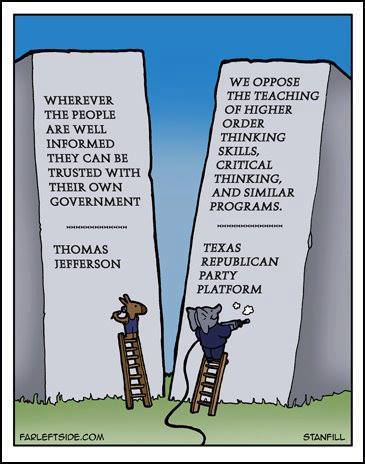
Texas Republican Party


IP Cloaking Violates Computer Fraud and Abuse Act, Judge Rules

By David Kravets WIRED
08.20.13

A federal judge has ruled that circumventing an IP address blockade to connect to a website is a breach of the Computer Fraud and Abuse Act, the same law that was used to prosecute Aaron Swartz before he committed suicide earlier this year.

The decision (.pdf) by U.S. District Judge Charles Breyer marks the first time a court has offered this interpretation of a highly controversial law that affords both criminal and civil penalties. Congress passed the law in 1984 to combat hackers.

The legal issue concerns 3Taps, a site that was scraping classified ads from Craigslist and republishing them without consent. Craigslist sent the San Francisco aggregator a cease-and-desist letter and blocked 3Taps’ IP addresses from accessing the site. After circumventing the IP blockade, 3Taps continued scraping and was sued under the CFAA, which has since Swartz’s death been the target of calls for reform by lawmakers and the public.

“3Taps asks this Court to hold that an owner of a publicly accessible website has no power to revoke the authorization of a specific user to access that website. However compelling 3Taps’ policy arguments, this Court cannot graft an exception on to the statute with no basis in the law’s language or this circuit’s interpretive precedent,” Breyer ruled.

Friday’s decision means 3Taps likely faces a civil-damages trial for the “unauthorized access” unless Craigslist settles out of court.

Hanni Fakhoury, an attorney with the Electronic Frontier Foundation, which filed a friend-of-the-court brief with the judge, said the decision has its pluses and minuses.
Moreover, by focusing on the IP blocking, the court essentially agreed with the basic principle we’ve suggested as a means to limit the reach of the CFAA: that there must be circumvention of a technological barrier before a person can be found to have ‘accessed’ information or data ‘without authorization.’ In fact one proposal to reform the CFAA currently before Congress, ‘Aaron’s Law,’ defines ‘access without authorization’ to mean precisely that: ‘knowingly circumventing one or more technological or physical measures that are designed to exclude or prevent unauthorized individuals from obtaining that information.’ The court adopted this idea in principle when it found that Craigslist’s CFAA claim was based on something more than violating the terms of service of a publicly accessible website, and indeed something more than the cease and desist letter alone.
But the minus, Fakhoury added: “We believe that the CFAA requires hacking—doing something that breaches a technological barrier, like cracking a password or taking advantage of a SQL injection. Changing your IP address is simply not hacking. That’s because masking your IP address is an easy, common thing to do.”

Breyer disagreed:
The banned user has to follow only one, clear rule: do not access the website. The notice issue becomes limited to how clearly the website owner communicates the banning. Here, Craigslist affirmatively communicated its decision to revoke 3Taps’ access through its cease-and-desist letter and IP blocking efforts. 3Taps never suggests that those measures did not put 3Taps on notice that Craigslist had banned 3Taps; indeed, 3Taps had to circumvent Craigslist’s IP blocking measures to continue scraping, so it indisputably knew that Craigslist did not want it accessing the website at all.
The judge added that he believes the decision isn’t going to penalize normal internet-surfing behavior:
Nor does prohibiting people from accessing websites they have been banned from threaten to criminalize large swaths of ordinary behavior. It is uncommon to navigate contemporary life without purportedly agreeing to some cryptic private use policy governing an employer’s computers or governing access to a computer connected to the internet. In contrast, the average person does not use “anonymous proxies” to bypass an IP block set up to enforce a banning communicated via personally-addressed cease-and-desist letter.

Orin Kerr, one of the country’s leading CFAA scholars, had this to say about the decision:
I think this analysis is somewhat misdirected. In my view, the fact that 3taps was on notice that Craiglist did not want them to access the Craigslist website is only relevant to show intent. From that perspective, Judge Breyer should have been clearer that the cease-and-desist letter couldn’t make visiting the website an “unauthorized access.” The letter is just a written statement of the owner’s wishes as to who can visit the site, just like Terms of Service. In my view, whether the facts of the 3Taps case amount to an unauthorized access hinges on the circumvention of IP blocking. If so, then the cease-and-desist letter shows that the act of unauthorized access was intentional; if not, then the letter does not have any relevance to the CFAA.

3Taps said (.pdf) it would obey Judge Breyer’s ruling. Ironically, however, the site announced it would continue accessing Craigslist’s classified adds.

Although craigslist may use the CFAA as currently interpreted to prevent 3taps from accessing its servers, 3taps can continue to function because directly accessing these servers is only one of three ways in which the information in question can be obtained. The other two, crowdsourcing and public search results, require no such access to Craigslist’s servers and thus obviate the need to engage in conduct that may implicate the CFAA. Going forward, 3taps will operate based on its understanding that if it does not access Craigslist’s servers, it has a right to collect public information originally posted on Craigslist’s website.

The Computer Fraud and Abuse Act was passed in 1984 to enhance the government’s ability to prosecute hackers who accessed computers to steal information or to disrupt or destroy computer functionality. The government, however, has interpreted the anti-hacking provisions to include activities such as violating a website’s terms of service or a company’s computer usage policy.

One of the latest criminal prosecutions under the act concerned Andrew “Weev” Auerheimer, who was sentenced to 3.5 years in prison for obtaining the personal data of more than 100,000 iPad owners from AT&T’s publicly accessible website.

This Modern World


The NSA: ‘The Abyss From Which There Is No Return’

August 19, 2013 By John W. Whitehead

“The National Security Agency’s capability at any time could be turned around on the American people, and no American would have any privacy left, such is the capability to monitor everything: telephone conversations, telegrams, it doesn’t matter. There would be no place to hide. If a dictator ever took over, the N.S.A. could enable it to impose total tyranny, and there would be no way to fight back.”—Senator Frank Church (1975)

We now find ourselves operating in a strange paradigm where the government not only views the citizenry as suspects but treats them as suspects, as well. Thus, the news that the National Security Agency (NSA) is routinely operating outside of the law and overstepping its legal authority by carrying out surveillance on American citizens is not really much of a surprise. This is what happens when you give the government broad powers and allow government agencies to routinely sidestep the Constitution.

Indeed, as I document in my book, A Government of Wolves: The Emerging American Police State, these newly revealed privacy violations by the NSA are just the tip of the iceberg. Consider that the government’s Utah Data Center (UDC), the central hub of the NSA’s vast spying infrastructure, will be a clearinghouse and a depository for every imaginable kind of information—whether innocent or not, private or public—including communications, transactions and the like. In fact, anything and everything you’ve ever said or done, from the trivial to the damning—phone calls, Facebook posts, Twitter tweets, Google searches, emails, bookstore and grocery purchases, bank statements, commuter toll records, etc.—will be tracked, collected, catalogued and analyzed by the UDC’s supercomputers and teams of government agents.

By sifting through the detritus of your once-private life, the government will come to its own conclusions about who you are, where you fit in, and how best to deal with you should the need arise. Indeed, we are all becoming data collected in government files. Whether or not the surveillance is undertaken for “innocent” reasons, surveillance of all citizens, even the innocent sort, gradually poisons the soul of a nation. Surveillance limits personal options—denies freedom of choice—and increases the powers of those who are in a position to enjoy the fruits of this activity.

If this is the new “normal” in the United States, it is not friendly to freedom. Frankly, we are long past the point where we should be merely alarmed. These are no longer experiments on our freedoms. These are acts of aggression.

Senator Frank Church (D-Ida.), who served as the chairman of the Select Committee on Intelligence that investigated the National Security Agency in the 1970s, understood only too well the dangers inherent in allowing the government to overstep its authority in the name of national security. Church recognized that such surveillance powers “at any time could be turned around on the American people, and no American would have any privacy left, such is the capability to monitor everything: telephone conversations, telegrams, it doesn’t matter. There would be no place to hide.”

Noting that the NSA could enable a dictator “to impose total tyranny” upon an utterly defenseless American public, Church declared that he did not “want to see this country ever go across the bridge” of constitutional protection, congressional oversight and popular demand for privacy. He avowed that “we,” implicating both Congress and its constituency in this duty, “must see to it that this agency and all agencies that possess this technology operate within the law and under proper supervision, so that we never cross over that abyss. That is the abyss from which there is no return.”

Unfortunately, we have long since crossed over into that abyss, first under George W. Bush, who, among other things, authorized the NSA to listen in on the domestic phone calls of American citizens in the wake of the 9/11 attacks, and now under President Obama, whose administration has done more to undermine the Fourth Amendment’s guarantee of privacy and bodily integrity than any prior administration. Incredibly, many of those who were the most vocal in criticizing Bush for attempting to sidestep the Constitution have gone curiously silent in the face of Obama’s repeated violations.

Whether he intended it or not, it well may be that Obama, moving into the home stretch and looking to establish a lasting “legacy” to characterize his time in office, is remembered as the president who put the final chains in place to imprison us in an electronic concentration camp from which there is no escape. Yet none of this could have been possible without the NSA, which is able to operate outside the constitutional system of checks and balances because Congress has never passed a law defining its responsibilities and obligations.

The constitutional accountability clause found in Article 1, section 9, clause 7 of the Constitution demands that government agencies function within the bounds of the Constitution. It does so by empowering the people’s representatives in Congress to know what governmental agencies are actually doing by way of an accounting of their spending and also requiring full disclosure of their activities. However, because agencies such as the NSA operate with “black ops” (or secret) budgets, they are not accountable to Congress.

In his book Body of Secrets, the second installment of the most extensively researched inquiry into the NSA, author James Bamford describes the NSA as “a strange and invisible city unlike any on earth” that lies beyond a specially constructed and perpetually guarded exit ramp off the Baltimore-Washington Parkway. “It contains what is probably the largest body of secrets ever created.”

Bamford’s use of the word “probably” is significant since the size of the NSA’s staff, budget and buildings is kept secret from the public. Intelligence experts estimate that the agency employs around 38,000 people, with a starting salary of $50,000 for its entry-level mathematicians, computer scientists and engineers. Its role in the intelligence enterprise and its massive budget dwarf those of its better-known counterpart, the Central Intelligence Agency (CIA). The NSA’s website provides its own benchmarks:

Neither the number of employees nor the size of the Agency’s budget can be publicly disclosed. However, if the NSA/CSS were considered a corporation in terms of dollars spent, floor space occupied, and personnel employed, it would rank in the top 10 percent of the Fortune 500 companies.

If the NSA’s size seems daunting, its scope is disconcerting, especially as it pertains to surveillance activities domestically. The first inkling of this came in December 2005 when the New York Times reported that President Bush had secretly authorized the NSA to monitor international phone calls and email messages initiated by individuals (including American citizens) in the United States. Bush signed the executive order in 2002, under the pretext of needing to act quickly and secretly to detect communication among terrorists and their contacts and to quell future attacks in the aftermath of September 11, 2001.

The New York Times story forced President Bush to admit that he had secretly instructed the NSA to wiretap Americans’ domestic communications with international parties without seeking a FISA warrant or congressional approval. The New York Times had already sat on its story for a full year due to White House pressure not to publish its findings. It would be another six months before USA Today delivered the second and most significant piece of the puzzle, namely that the NSA had been secretly collecting the phone records of tens of millions of Americans who used the national “private” networks AT&T, Verizon and BellSouth.

It would be another seven years before Americans were given undeniable proof—thanks to NSA whistleblower Edward Snowden—that the NSA had not only broken privacy rules or overstepped its legal authority thousands of times every year but was actively working to flout attempts at oversight and accountability, aided and abetted in this subterfuge by the Obama administration.

Then again, all Snowden really did was confirm what we already suspected was happening. We already knew the NSA was technologically capable of spying on us. We also knew that the agency had, since the 1960s, routinely spied on various political groups and dissidents.

So if we already knew that the government was spying on us, what’s the big deal? And more to the point, as I often hear many Americans ask, if you’re not doing anything wrong, why should you care?

The big deal is simply this: once you allow the government to start breaking the law, no matter how seemingly justifiable the reason, you relinquish the contract between you and the government which establishes that the government works for and obeys you, the citizen—the employer—the master. And once the government starts operating outside the law, answerable to no one but itself, there’s no way to rein it back in, short of revolution.

As for those who are not worried about the government filming you when you drive, listening to your phone calls, using satellites to track your movements and drones to further spy on you, you’d better start worrying. At a time when the average American breaks at least three laws a day without knowing it thanks to the glut of laws being added to the books every year, there’s a pretty good chance that if the government chose to target you for breaking the law, they’d be able to come up with something without much effort.

Then again, for those who insist they’re not doing anything wrong, per se, perhaps they should be. Because if you’re not doing anything wrong, it just might mean that you’re not doing anything at all, which is how we got into this mess in the first place.

Sunday, August 18, 2013

The “Bankization” of America

Friday, August 16, 2013 by Campaign for America's Future Blog
by Richard Eskow


The share of our national income which goes to corporate profit is the highest it’s been since they started tracking it in 1929, while the share going to people – as salary and wages – is the lowest. And the percentage of that corporate profit which goes to Wall Street is also the highest on record.

We’re becoming a financialized economy. Never before has the manipulation of money counted for so much and the real-world economy of people and consumer goods counted for so little.

And none of it is an accident.

When Wall Street catches a cold …

The Wall Street Journal reported this Thursday that “Stock and bond prices tumbled after stronger-than-expected economic data …”

Why would good news about the economy cause the stock market to fall? The sentences continues: “… raised investor anxiety about a pullback next month in central-bank support for financial markets …”

Investors had been relying on the Federal Reserve to keep pumping up the stock market’s record run, but some mildly favorable economic reports raised fears were raised that the Fed’s market-friendly interventions might come to an end.

“We’re getting another knee-jerk reaction to fears of tapering,” a market analyst told the Journal, referring to the Fed’s monthly purchase of $85 billion in bonds. As Reuters reported last month, “Many on Wall Street believe the Federal Reserve’s monetary policy is behind record corporate earnings and the stock market’s surge to all-time highs this year.”

When Wall Street catches a cold – when it even might catch a cold — the economy catches pneumonia.

Reality Bites

Meanwhile, the “real” economy – the one where people live, and work, and buy things – has suffered even as Wall Street and the stock market have boomed. That trend continued this week, too, Wal-Mart announced disappointing sales and lowered its projections. Its Chief Financial Officer observed that “The retail environment remains challenging in the U.S. and our international markets, as customers are cautious in their spending.”

Cisco also lowered its sales expectations. As the Journal article notes, these announcements added to the fear that the Fed’s interventions might wind down.

This stock market story illustrates the gulf between a stock-market economy increasingly driven by the banking industry – an economy which has been booming, today’s news notwithstanding – and a human economy wracked by consumer fears, falling wages, joblessness, and low-level jobs for a growing number of people who are working.

The gulf between these two economies drove this morning’s stock market story. It’s also driving the long-term depression-like misery which holds millions of Americans in its grip.

This is not the playing out of some divinely-decreed order. The financialization of the US economy is the result of very deliberate governmental choices. Unless different choices are made going forward, we will continue to become a “Bankistan” whose wealth and economic fate is increasingly hijacked by Wall Street.

Financialized

The Federal Reserve’s data on corporate profits were helpfully compiled by a contributor to the investment site The Motley Fool, who notes that financial profits were 11 percent of total corporate profits in the US back in 1947, the first year these numbers were compiled.

These profits soared in the first decade of the 21st Century. After taking a hit in the crisis of 2008 – a crisis which the banking industry caused – they rose again and are now at record highs. Their share of total corporate profits has risen from 11 percent to 42 percent, as of the latest report, and the Fed expects them to keep rising.

Here’s how that looks:


The money nowadays isn’t in manufacturing, or retail, or any of the other traditionally jobs-producing industries. The money now is in money.

How did this happen?

A series of policy decisions enabled this explosive growth, including the deregulation of Wall Street; the repeal of Glass-Steagall, which separated bank customers’ money from money which the bank could invest for its own profit; runaway banker salaries and bonuses, which prompted the “best and the brightest” to flock to Wall Street and apply their ingenuity to flouting the rules; and government’s increasing unwillingness to indict bankers for criminal behavior.

And then, when banker criminality and incompetence created the crisis of 2008, they were rescued by the government without being held financially or legally accountable for their wrongdoing.

The Federal Reserve continues to pursue stimulus policies that moderately help the economy as a whole, but which emphasize the economic health of banks and publicly-traded corporations over that of companies that hire workers – and therefore increase the consumption of consumer goods.

Profit by the slice …

Banks have a bigger share of the corporate-profit pie – and that pie’s bigger than ever. As Floyd Norris notes in the New York Times, the government’s revised estimate of wage and salary income is 42.6 percent of GDP, which matches the 2010 figure as the lowest percentage since this data was first captured in 1929.

Using the latest revisions to the national income and product account (NIPA) data produced by the Bureau of Economic Analysis, Norris also notes that corporate profits are now 9.6 percent of GDP. That’s the highest since these figures were first captured.

As Norris also notes, corporate taxes rose slightly in 2012 as a percentage of GDP but are still well below their historical averages. That’s not an accident either.

Meanwhile, as this chart shows, unemployment remains horrendous:


Wages actually fell for most people after the 2008 crisis, as high-income individuals (the top 1 percent) captured all of the economic gains created by the government-sponsored recovery – and even enlarged their share, capturing 121 percent of the recovery as the rest of the country fell behind.

Indebted

You might think that financial institutions feel indebted to the public for rescuing them. But the opposite is true: We’re indebted to them. According to the latest report from the New York Federal Reserve, auto loan balances increased by $20 billion over the previous quarter while credit card balances and student loan debt increased by $8 billion each.

The falling rates of mortgage debt, driven by range of factors which included falling housing values and foreclosures, resulted in an overall decline in total indebtedness. But these figures show that our household debt in many key areas continues to rise.

As wages and salaries decline, people are struggling to keep up with the way of life they once know. So they fall deeper in debt – a debt which allows them, and the banks, to delay the day of reckoning once again.

Fixing a Hole

These figures paint the picture of an economy that has become seriously unbalanced in favor of the banks – “financialized,” as observers increasingly describe it. How can the economy be rebalanced?

Many solutions are well-known to bank reformers and well-informed voters: Reinstate Glass-Steagall, or something very much like it. Insist on strong regulatory oversight of the banking sector, and give regulators the authority to do their jobs. End “too big to fail” banks, instead of encouraging their consolidation (as the government has done in recent years). Prosecute criminal bankers.

Other solutions are equally important. The interbank database and shell company called MERS must be ended, so that financial institutions can’t collude against consumers and the states. The Federal Reserve must demand that banks perform their central economic function – responsible lending to consumers and job-creating businesses – rather than reward them for speculation and other forms of non-productive profiteering.

(That’s why the choice of Federal Reserve head is so important.)

Genuine shareholder reform is also needed, so bankers don’t overpay themselves at shareholder expense or use the bank’s coffers as a “get out of jail” card for massive settlements caused by their own misdeeds.

Lastly, no comprehensive solution can be found until banks and other corporations are once again taxed at reasonable levels and the revenues are used to create well-paying jobs for the American middle class.

A healthy economy needs banks that lend, and consumers with the money to buy. Until that happens we’ll be living in a highly-financialized “Bankistan” that excludes most of its citizens from sharing in the American dream.