Showing posts with label systemic corruption. Show all posts

Friday, October 24, 2014

Shielded from Justice: The High Cost of Living in a Police State

By John W. Whitehead
October 14, 2014

“It’s been over five months since the night a SWAT team broke into the house in which we were staying…We were staying with relatives and my whole family was sleeping in one room. My husband and I, our three daughters and our baby (nicknamed “Baby Bou Bou”) in his crib. Dressed like soldiers, they broke down the door. The SWAT officers tossed a flashbang grenade into the room. It landed in Baby Bou Bou’s crib, blowing a hole in his face and chest that took months to heal and covering his entire body with scars.

“Doctors tell us that my son will have to have double reconstructive surgeries twice a year, every year for the next 20 years… [I]n five short months our family has taken on nearly $900,000 in medical bills, some of which have now gone into collections… After initially offering to cover the medical expenses, the county has since refused to cover any of our medical costs, all of which would never have happened if the SWAT team hadn’t broken into the home.”—Alecia Phonesavanh

Who pays the price for the police shootings that leave unarmed citizens dead or injured, for the SWAT team raids that leave doors splintered, homes trashed, pets murdered, and family members traumatized and injured, if not dead?

I’m not just talking about the price that must be paid in hard-earned dollars, whether by taxpayers or the victims, in attempting to restore what was vandalized and broken by police. It’s also the things that can’t be so easily calculated to a decimal point: the broken bones that will never quite heal right, the children’s nightmares at night, the uneasy sleep, the broken family heirlooms, the loss of faith in a system that was supposed to serve and protect you, the grief for loved ones whose lives were cut short.

Baby Bou Bou may have survived the misdirected SWAT team raid that left him with a hole in his face and extensive scars on his body, but he will be the one to pay the price for the rest of his life for the SWAT team’s blunder in launching a flashbang grenade into his crib. And even though the SWAT team was wrong about the person they were after, even though they failed to find any drugs in the home they’d raided, and even though they may have regretted the fact that Baby Bou Bou got hurt, it will still be the Phonesavanh family who will pay and pay and pay for the endless surgeries every year to reconstruct their son’s face as he grows from toddler to boy to teenager to man. Already, they have racked up more than $900,000 in medical bills. Incredibly, government officials refused to cover the family’s medical expenses.

That is just one family’s experience, the price they must pay for living in a police state. Tally their pain, their loss and their medical bills, and add it to that of the hundreds of other families in cities and towns across the nation who are similarly reeling from the blows inflicted by the government’s standing armies, and you will find yourself reeling. For many of these individuals, there can never be any amount of reparation sufficient to make up for the lives lost or shattered.

As for those who do get “paid back,” at least in monetary terms for their heartache and loss, it’s the taxpayers who are footing the bill to the tune of millions of dollars. Incredibly, these cases hardly impact the police department’s budget. As journalist Aviva Shen points out, “individual officers are rarely held accountable for their abuses, either by the police department or in court… Internally, police departments rarely investigate complaints of misconduct, let alone punish the accused officers. Because cities insulate police officers and departments from the financial consequences for their actions, police on the street have little incentive to avoid unnecessary force, and their departments may not feel the need to crack down on repeat offenders. And so the bill for taxpayers keeps growing.”

For example, Baltimore taxpayers have paid roughly $5.7 million since 2011 over lawsuits stemming from police abuses, with an additional $5.8 million going towards legal fees. That’s money that could have been spent on a state-of-the-art recreation center or renovations at more than 30 playgrounds. As the Baltimore Sun reports: “Victims include a 15-year-old boy riding a dirt bike, a 26-year-old pregnant accountant who had witnessed a beating, a 50-year-old woman selling church raffle tickets, a 65-year-old church deacon rolling a cigarette and an 87-year-old grandmother aiding her wounded grandson… Officers have battered dozens of residents who suffered broken bones — jaws, noses, arms, legs, ankles — head trauma, organ failure, and even death, coming during questionable arrests. Some residents were beaten while handcuffed; others were thrown to the pavement.”

New York taxpayers have shelled out almost $1,130 per year per police officer (there are 34,500 officers in the NYPD) to address charges of misconduct. That translates to $38 million every year just to clean up after these so-called public servants. Over a 10-year-period, Oakland, Calif., taxpayers were made to cough up more than $57 million (curiously enough, the same amount as the city’s deficit back in 2011) in order to settle accounts with alleged victims of police abuse.

Chicago taxpayers were asked to pay out nearly $33 million on one day alone to victims of police misconduct, with one person slated to receive $22.5 million, potentially the largest single amount settled on any one victim. The City has paid more than half a billion dollars to victims over the course of a decade. The Chicago City Council actually had to borrow $100 million just to pay off lawsuits arising over police misconduct in 2013. The city’s payout for 2014 should be in the same ballpark, especially with cases pending such as the one involving the man who was reportedly sodomized by a police officer’s gun in order to force him to “cooperate.”

Over 78% of the funds paid out by Denver taxpayers over the course of a decade arose as a result of alleged abuse or excessive use of force by the Denver police and sheriff departments. Meanwhile, taxpayers in Ferguson, Missouri, are being asked to pay $40 million in compensation—more than the city’s entire budget—for police officers treating them “‘as if they were war combatants,’ using tactics like beating, rubber bullets, pepper spray, and stun grenades, while the plaintiffs were peacefully protesting, sitting in a McDonalds, and in one case walking down the street to visit relatives.”

That’s just a small sampling of the most egregious payouts, but just about every community—large and small—feels the pinch when it comes to compensating victims who have been subjected to deadly or excessive force by police. The ones who rarely ever feel the pinch are the officers accused or convicted of wrongdoing, “even if they are disciplined or terminated by their department, criminally prosecuted, or even imprisoned.”

Indeed, a study published in the NYU Law Review reveals that 99.8% of the monies paid in settlements and judgments in police misconduct cases never come out of the officers’ own pockets, even when state laws require them to be held liable. Moreover, these officers rarely ever have to pay for their own legal defense. As law professor Joanna C. Schwartz notes, police officers are more likely to be struck by lightning than be made financially liable for their actions.

Schwartz references a case in which three Denver police officers chased and then beat a 16-year-old boy, stomping “on the boy’s back while using a fence for leverage, breaking his ribs and causing him to suffer kidney damage and a lacerated liver.” The cost to Denver taxpayers to settle the lawsuit: $885,000. The amount the officers contributed: 0.

Kathryn Johnston, 92 years old, was shot and killed during a SWAT team raid that went awry. Attempting to cover their backs, the officers falsely claimed Johnston’s home was the site of a cocaine sale and went so far as to plant marijuana in the house to support their claim. The cost to Atlanta taxpayers to settle the lawsuit: $4.9 million. The amount the officers contributed: 0.

Meanwhile, in Albuquerque, a police officer was convicted of raping a woman in his police car, in addition to sexually assaulting four other women and girls, physically abusing two additional women, and kidnapping or falsely imprisoning five men and boys. The cost to the Albuquerque taxpayers to settle the lawsuit: $1,000,000. The amount the officer contributed: 0.

In its report on police brutality and accountability in the United States, Human Rights Watch notes that taxpayers actually pay three times for officers who repeatedly commit abuses: “once to cover their salaries while they commit abuses; next to pay settlements or civil jury awards against officers; and a third time through payments into police ‘defense’ funds provided by the cities.”

A large part of the problem can be chalked up to influential police unions and laws providing for qualified immunity, which invariably allow officers to walk away without paying a dime for their wrongdoing. Conveniently, those deciding whether a police officer should be immune from having to personally pay for misbehavior on the job all belong to the same system, all cronies with a vested interest in protecting the police and their infamous code of silence: city and county attorneys, police commissioners, city councils and judges.

In a nutshell, the U.S. Supreme Court’s reasoning when it comes to qualified immunity for government officials (not just police officers) is essentially that these officials might be too cautious in carrying out their duties if there was a risk that they might be held personally liable for wrongdoing on the job. Frankly, we’d be far better off if government officials operated under the constant fear that there would be ramifications for wrongdoing on the job. As it now stands, we’ve got way too many lawbreakers, scoundrels, cheats and thugs on the government’s payroll, (many of whom are actually elected to office).

So what’s the solution, if any, to a system so clearly rigged that it allows rogue cops who engage in excessive force to wreak havoc with no fear of financial consequences? As HRW concludes:
The excessive use of force by police officers, including unjustified shootings, severe beatings, fatal chokings, and rough treatment, persists because overwhelming barriers to accountability make it possible for officers who commit human rights violations to escape due punishment and often to repeat their offenses…. Officers with long records of abuse, policies that are overly vague, training that is substandard, and screening that is inadequate all create opportunities for abuse. Perhaps most important, and consistently lacking, is a system of oversight in which supervisors hold their charges accountable for mistreatment and are themselves reviewed and evaluated, in part, by how they deal with subordinate officers who commit human rights violations. Those who claim that each high-profile case of abuse by a “rogue” officer is an aberration are missing the point: problem officers frequently persist because the accountability systems are so seriously flawed.

Unfortunately, we’re so far gone as a nation in terms of cronyism, corruption and unequal justice that there’s little hope of reformation working from the top down. As I point out in A Government of Wolves: The Emerging American Police State, if any change is to be made, if any hope for accountability is to be realized it must begin, as always, at the local level, with local police departments and governing bodies, where the average citizen can still, with sufficient reinforcements, make his voice heard.

So the next time you hear of a police shooting in your town of an unarmed citizen, don’t just shrug helplessly and turn the page or switch the channel. Form a coalition of concerned citizens and call your prosecutor’s office, email the police department, speak out at your city council meeting, urge your local paper to cover the story from both sides, blog about it, stage a protest, demand transparency and accountability—whatever you do, make sure you send the message loud and clear that you do not want your taxpayer dollars supporting illegal and abusive behavior.

Wednesday, October 1, 2014

Corporations ‘the cancer’ that are slowly killing American middle-class, ‘Wire’ creator David Simon

John Mulholland, The Observer
28 Sep 2014

The writer’s next show, Show Me a Hero, is the true story of a battle over public housing that convulsed New York in the 80s. Here, on location in Manhattan, he talks about how money corrupts US politics, the erosion of the working class, why it’s a crime to be poor in America – and why he likes to argue

At the end of a long day scouting locations for his new TV miniseries, David Simon is sitting in his Upper West Side office in New York describing the type of person who needn’t bother tuning in to his new show. He’s speaking as a TV writer but also as a citizen angered by a political system that he thinks fails many of his fellow countrymen.

“People who think we’re being well governed at the moment… well, there’s no reason for them to watch. People who look at the inertia of Washington, at the partisanship, at the divisive and polarised discourse… people who think that’s the way to build a just society, well, don’t watch the show, because I got nothin’ for you.”

If, on the other hand, “You’re starting to believe that even the vernacular we’re using to argue about solutions to problems is dysfunctional, watch this show because I think it’s a perfect metaphor for what the American government is no longer capable of doing – addressing problems in a utilitarian fashion for the good of most people. American politics has left the room when it comes to finding solutions for our problems.”

Show Me a Hero, which will appear on screens late next year or in spring 2016, is based on a non-fiction book of the same name by former New York Times writer Lisa Belkin. It marks the time, says Simon, when American politics left the room.

The 1999 book’s subtitle, “a tale of murder, suicide, race and redemption” hints at the drama involved. Belkin documents the story through a series of interviews with many of the principals involved. It’s a tale of political and personal destruction that convulsed Yonkers, a city of 200,000 people just 40 minutes’ drive north of Manhattan. At its heart was a row about public housing for low-income residents being built in a part of Yonkers almost exclusively reserved for the wealthy.

Show Me a Hero shows how the fallout engulfed the New York body politic and ultimately brought unwanted national attention to Yonkers. When the dispute was finally settled the New York Times noted how the bitter row “had opened an ugly chapter in the city’s history, tearing apart neighbourhoods, building and destroying political careers and unleashing a heated court battle that nearly drove Yonkers to bankruptcy”.

On a bright, sunny morning last week the Schlobohm housing project, in west Yonkers, the largest low-income public housing site in the city and one of the principal locations for Show Me a Hero, is quiet. Except, that is, for Simon, his director Paul Haggis and other crew members who are here to scrutinise backgrounds, visualise scenes and figure out what angle offers the best view of the Hudson river in the near distance. Schlobohm is one of half a dozen stops they will make as they crisscross the city to finalise locations before four months of filming, which starts this week.

As the crew sweeps through a communal space that doubles as a car park, they pass by a mural. Painted on the side of a low wall that circles the area are five words in large, childlike lettering. They add colour to an urban landscape dominated by the red brick of the low- and high-rises. Spaced about a metre apart, they read “Unity”, “Harmony”, “Peace”, “Pride”, “Safe”.

But when the FBI’s New York field office writes about Schlobohm, it uses a different set of words. One of the most recent entries on its website is headed: “Three charged in connection with December 2013 homicide”. It lays bare the cycle of violence that is visited on places such as this when it notes that the arrest of two dozen gang members two years before had paved the way for a rival to thrive in their absence.

“In late June and early July 2012, federal authorities arrested 20 members of the Strip Boyz on charges of narcotics distribution and/or firearm offences… the arrests of the Strip Boyz left GMF [rival gang the Grimy Motherfuckers] dominant in the Schlobohm housing project.”

If the FBI’s reports were reduced to five words they might read “Narcotics”, “Gangs”, “Murder”, “Shooting”, and “Trafficking”.

The story of Schlobohm to be told by David Simonstarts in 1980, when the local Yonkers branch of the National Association for the Advancement of Coloured People (NAACP), backed by the US justice department, sued the city of Yonkers. The lawsuit alleged that the city’s housing and school policies had, over a period of 40 years, purposely segregated black and Hispanic residents from its more affluent white neighbours. It claimed that Yonkers deliberately placed its poorer (non-white) residents in the west of the city, while the east side remained predominantly white.

In 1985, US federal court judge Leonard Sand ruled in favour of the NAACP and instructed Yonkers to build 200 units of public housing on the east side. That’s when the trouble started.

The six-part miniseries will follow what happened from 1987 to 1994 as local residents and politicians defied the court order in a series of increasingly vocal and public demonstrations that brought the issues of race, housing and deprivation in Yonkers on to the national agenda.

An ABC news report broadcast at the time gives a glimpse of how divisive the dispute was. It features one of the residents at a Save Yonkers meeting (a man named Jack Tracy) making his position clear: “I lived with blacks, I delivered newspapers to blacks, but I can’t live next to what the government has in these projects. If the government wants to put criminals and dope-pushers in the projects I can’t live next to them. The federal judge can find me guilty, the supreme court can find me guilty… but if they think they’re going to integrate with Jack Tracy and his family, they’re going to have to build projects 60 miles north, 80 miles north, they can build them in Maine or wherever they want but I will not live next to a project. And if it means going to Canada, or back to Ireland that is what I will do. That ain’t why I am living in this country.”

In the fury and noise that engulfed Yonkers’s east side, what Jack Tracy and others failed to hear was that the judge’s proposal was not for old style “projects” (ie large-scale, densely populated, high-rise public housing) but for 200 two-storey houses to be distributed in small groups across the east side.

Later in the morning, after we have left Schlobohm and passed on to the noticeably more affluent (and white) east side of Yonkers, Simon and his crew stop at another location. Simon points to a small row of innocuous two-storey houses on this pleasant, leafy street. He says: “Look. That’s them, those are some of the houses. That’s what Yonkers tore itself apart over. And you wouldn’t even know they were public housing.”

What attracted Simon to this story was not the issues of housing or race or deprivation but something more fundamental – the dysfunction of the American political system. The story, Simon says, is tailor-made for showing how US politics now runs on fear and money, two forces that are slowly corroding American society.

“What intrigued me about the story was that it’s an almost perfectly allegorical argument about how our political processes are no longer equipped to recognise or solve problems. You have this mid-size American city, Yonkers, that didn’t have terrifying racial dynamics before the controversy. It had problems like any city but there was no reason that fear should be such an effective currency in the political process. And yet fear and money are the only currencies in the American political process that get their due any more. Nothing makes people more stupid and foolish than money and fear.”

The effect was to split the city in half. The east side set about protecting the value of its homes, livelihoods, children and way of life from the perceived threat from the west side. Looking now at the small clusters of neat, low-rise homes that were eventually built on the east side, its difficult to understand why the fury reached such a pitch.

For Simon, the answer is clear. “Politicians can gain so much by invoking fear and because money is at the core of that fear and the people who are the most frightened were looking towards their real-estate values, the values of their neighbourhoods and what they might personally lose if the neighbourhood went south. Money and fear paralysed Yonkers politically, and caused untold damage to the city’s reputation.”

For Simon, the story of Yonkers is telling for another reason – its timing marks the period in American history when a consensus fractured. The social compact between capital and labour was starting to break. From the 1980s onwards capital won virtually all of its battles with the labour unions in America.

This is a point forcefully made by ex-Clinton labour secretary Robert Reich in his recent film, Inequality for All. He dates the busting of the labour unions and the rupture of the social compact to Ronald Reagan’s firing of 11,000 air traffic controllers in 1981. From then on, the idea that a market-driven society would mutually benefit those who held the capital and those who provided the labour was no longer in place, he says. For Simon, this is the point at which the shared community of interests that walked side by side as the American economy surged after the second world war came apart. The collective will that bound together communities, cities and, ultimately, America started to erode.

“What was required in Yonkers was to ask: ‘Are we all in this together or are we not all in this together?’ Is there a society or is there no society, because if there is no society, well, that’s the approach that says ‘Fuck ’em, I got mine’. And Yonkers coincides with the rise of ‘Fuck ’em I got mine’ in America.

“That’s the notion that the markets will solve everything. Leave me alone. I want maximum liberty, I want maximum freedom. Those words have such power in America. On the other hand ‘responsibility’ or ‘society’ or ‘community’ are words that are increasingly held in disfavour in the United States. And that’s a recipe for cooking up a second-rate society, one that does not engage with the notion of collective responsibility. We’re only as good a society as how we treat those who are most vulnerable and nobody’s more vulnerable than our poor. To be poor is not a crime, except in America.”

These are not new themes in Simon’s work. The Wire was a grand tour of the institutions that were failing Americans, from politics to journalism, and from education to the criminal justice system. It was also an indictment of how capital had decisively won its war against American labour, with enduring consequences for America’s working class. This is the issue that most exercises Simon.

In his long and brilliant introductory essay to the 2009 book The Wire: Truth Be Told (a collection of essays by people involved in the making of the series), Simon wrote: “The Wire depicts a world in which capital has triumphed completely, labour has been marginalised and moneyed interests have purchased enough political infrastructure to prevent reform. It is a world in which the rules and values of the free market and maximised profit have been mistaken for a social framework, a world where institutions themselves are paramount and everyday human beings matter less.

“Unemployed and under-employed, idle at a west Baltimore soup kitchen or dead-ended at some strip-mall cash register – these are the excess Americans. The economy staggers along without them, and without anyone in this society truly or sincerely regarding their desperation. Ex-steelworkers and ex-longshoremen, street dealers and street addicts, and an army of young men hired to chase and jail the dealers and addicts, whores and johns and men to run the whores and coerce the johns – and all of them unnecessary and apart from the new millennium economic model that long ago declared them irrelevant.

“This is the world of The Wire, the America left behind.”

But Simon acknowledges that this wider message may have been lost on some of those who watched the highly acclaimed series, set among the politicians, police, press and drug dealers of Baltimore.

“Sure, there’s people who watch The Wire and go ‘Man I love all these fuckin’ characters but I hate it when the politics comes on… I just want to see the badasses shoot each other.’ And it’s like yeah, well, OK, I get it, you know, I get it, but I didn’t leave journalism to write fuckin’ television for you because that’s just horrific.”

He expresses relief, and some amusement, that the cable channel HBO continues to commission his work in spite of the relatively low ratings his TV work attracts (The Wire, belatedly through word of mouth, drew in a healthy audience. Subsequent series, though highly acclaimed, including Generation Kill and Treme, fared less well).

He jokes about “getting a 2% share” of audience, but appears untroubled about how long his shelf life as a TV writer might be. “You got to commit to something. If you’re a writer you got to write something. You might as well believe in it.”

HBO seems to believe in it too. That much is clear the next day when Simon and co-writer Bill Zorzi (who has been working on Show Me a Hero, on and off, for 10 years) are the star attractions at a start of production meeting in HBO’s Manhattan headquarters. There are close to 50 people here, and another 10 are looped in on a screen from LA. Haggis jokes that “he’s never seen this many people in a room before”.

Before Simon addresses the room, senior HBO executive Kary Antholis steps forward to speak. One of the executives closest to Simon’s projects, he is wholehearted in his praise. “This project is among the most meaningful that David has ever done. In its reflections on race, politics and community, I think it will be a powerful story and will make an important contribution to this country’s social dialogue. It’s one of the great legacies of HBO that we make these contributions to our social dialogue… I believe that Treme lives in that legacy, so does Generation Kill, and The Wire. I am very proud and grateful that David is doing these series for HBO.”

When Simon speaks he emphasises why Show Me a Hero is so prescient. But he goes further too, in pointing out precisely what it is that has gummed up the US political machine. “The most dysfunctional part of the government is Congress, the most loathed institution in America (with approval ratings of 7%), but they are unrepentant about that. The reason to do this project is that it speaks exactly to what is wrong with our country. It happens that this story is about 200 houses that needed to be built, but substitute any other issue… immigration, budgetary issues, almost any foreign policy or environmental issue that requires any systematic action, or thought, and you see it. This is a country that can get nothing done.”

Simon argues forcefully that it’s the US Congress which smothers the body politic and destroys its capacity for action. Money has tilted the balance of power by inserting itself into the political system and now has the power to influence Congress – and the legislation that governs how society organises itself.

“You can buy congressmen so fast. Ideas have nothing to do with it. And that’s the part that’s broken. And that was the part that was broken in Yonkers.

“It has to change. When capital also is entitled to buy the government, that same government that might in some way create the basic standards of behaviour, everything from child labour to environmental protection, to workplace safety, to minimum wages that are consistent with the cost of living… Well eventually it’s going to get to the point where it’s so fuckin’ bad that people are going to throw a brick.”

Simon, at 54, is driven. Driven to write about the issues that exercise him. And driven to engage in intellectual combat. He relishes argument, and thrives on the mental exercise that debate provides. You get a strong sense that, left to his own devices and left all alone, it wouldn’t be long before he was picking a fight with himself. It’s a thirst for intellectual friction, and appetite for a dialectic, that drives all of his work. Plots, characters and narrative are all very well, but only in that they are part of a toolkit needed to construct an argument. Simon is never going to sit down and write a TV drama about people per se: his work will always be about something more elemental, more structural.

Writing in 2009 about the impulses that drove The Wire, he said: “The Wire had ambitions elsewhere. Character is essential for all good drama, and plotting is just as fundamental. But ultimately, the storytelling that speaks to our current condition, that grapples with the basic realities and contradictions of our immediate world – these are stories that, in the end, have some chance of presenting a social, and even political, argument. And to be honest, The Wire was not merely trying to tell a good story or two. We were very much trying to pick a fight.”

Simon has been picking fights since he was a young kid growing up in Washington. He learned his way around an argument at an early age while sitting at his family dinner table. It was how you gained your spurs (your “moxie”) in the Simon family: by holding your own in intellectual fisticuffs. “I lived in a house where argument was sport. Dinner discussions were about what was going on in the world. Not everybody was expected to agree, because then you couldn’t have a good argument, but if people didn’t agree, then you could have a good argument.”

Simon remembers the day he came of age intellectually. In his telling, it sounds like a duel, a rite-of-passage moment. “I was having an argument in my uncle Hank’s house in New York, and I would stake myself out against my father and two of my uncles. I must have been 17 and I just knew they were wrong. And I held them off to a draw for about an hour and a half in my uncle’s den. And I remember my uncle Hank turning to my father and saying, “Who knew he had a brain?” It was the biggest thing for my uncle Hank; it was how you earned moxie in my house.”

The web has given Simon another place to pick fights. Having lain dormant and then only been used for professional announcements, davidsimon.com has now become a place where Simon has, over the last few years, written occasional often coruscating posts on anything from the NSA to the policing of the Ferguson riots. Given time he will engage at length with some of those who post comments. The engagement is robust. He pushes, and is willing to be pushed, if he thinks contributors (and he himself) will learn, develop and mature their argument. It’s the family dinner table again.

When he was setting out what davidsimon.com would become, he wrote, with unerring honesty: “Those who know me understand that while it’s refreshing to meet people with no opinions, I’m not that fellow – I like to argue. I don’t like to argue personally, but rather I like pursuing a good ranging argument.”

Although limited by time and a work schedule that, alongside Show Me a Hero, sees Simon wrestling with three other development projects for HBO, including one about the New York sex industry in the 70s (not to mention a theatre project involving the songs of the Pogues), he still finds time for occasional posts. What he relishes is the opportunity to write in long-form and to develop an argument, see a thought grow, mature and ripen. “I guess what you’re hoping, the equivalent of what often resulted at my family’s dinner table, was that the argument goes somewhere, that it has legs. This is why you engage with people on ideas. At its best ideas can build, arguments can develop.”

The fight that David Simon has most often picked in recent years – and one he will address when he delivers the keynote talk at the Observer Ideas festival next month – is how the power of the market has trumped all other priorities in his country, and destroyed the values that brought America together.

“My conviction is that what made us great as an economic power was transforming our working class into a middle class and making them this economic engine that not only bought all the shit that they needed, but a lot of stuff they didn’t. By the middle of the century, or a little later, the American workforce had been launched into middle-class status and had discretionary income and the ability to construct a future that allowed the next generation to maintain that upward mobility and even advance further on it. That’s a pretty good dream. That’s more than a dream. But it’s no longer true. We’ve been disassembling that middle class slowly by degrees.”

For typical middle-class Americans, the squeeze is on. The certainties they had come to expect no longer exist. Late capitalism is unable to provide the generation-on-generation wealth advances that many had come to assume was normal. The new normal is something very different.

“Now you have an existing upper middle class or upper class that is politically powerful, quite moneyed and is larger than at any time. It’s not just the 1%, it’s the 10%, the 20% that have been carried higher up on the pyramid and who are in those industries that have caught the wave of the information age and for them the American dream seems uninterrupted. What they’re not noticing is that the people who used to be able to send their kids to college and hold down a mortgage on a factory wage or on a mid-level administrative [job] or on a civil servant’s salary, that they’re being crushed.”

Simon is not an outlier in his criticism of the American body politic or in his reflections on unfettered capitalism and the rise of inequality. What is marked is how many voices have joined this debate in the US.

For the last two years the New York Times has been running a series on inequality, curated by the venerable economist Joseph Stiglitz, entitled The Great Divide. It has featured contributions from academics, business people and politicians.

Stiglitz recently wrote about the fracturing of the same postwar consensus, and how it came about. “Corporate interests argued for getting rid of regulations, even when those regulations had done so much to protect and improve our environment, our safety, our health and the economy itself.

“But this ideology was hypocritical. The bankers, among the strongest advocates of laissez-faire economics, were only too willing to accept hundreds of billions of dollars from the government in the bailouts that have been a recurring feature of the global economy since the beginning of the Thatcher-Reagan era of ‘free’ markets and deregulation.

“The American political system is overrun by money. Economic inequality translates into political inequality, and political inequality yields increasing economic inequality.”

More recently, Robert Reich contributed an essay to Salon.com entitled “American democracy is diseased – how we can wrest back power from our corporate overlords”, in which he addresses the same issue. “We entered a vicious cycle in which political power became more concentrated in moneyed interests that used the power to their advantage – getting tax cuts, expanding tax loopholes, benefiting from corporate welfare and free-trade agreements, slicing safety nets, enacting anti-union legislation, and reducing public investments. These moves further concentrated economic gains at the top, while leaving out most of the rest of America.”

Simon is not sanguine about what it will take for corporate and political America (increasingly one and the same) to recognise that if the story continues in this vein it will not end well.

“I think in some ways the cancer is going to have to go a little higher. It’s going to start crawling up above the knee and people are going to have to start looking around and thinking ‘I thought I was exempt. I didn’t know they were coming for me’.

“It’s happened to the manufacturing class, it’s happened to the poor. Now it’s happening to reporters and schoolteachers and firefighters and cops and social workers and state employees and even certain levels of academics. And that’s new. That’s not the American dream.”

Simon reserves particular contempt for the forces in America that have helped strip labour of its dignity, who refuse to see the benefits, or necessity, of people collectively organising in order to protect their interest.

“Unions are part of the equation. They’re not the whole equation – the unions needed to lose as many battles as they won, but they needed to win some. And the demonisation of them has been an astonishing achievement of political disrepute in the west, and particularly in my country.”

Back in his Upper West Side office, Simon is now starting to seem fatigued by a long day of scouting locations, of being photographed, of being interviewed and, frankly, of being angry. It’s time to bring a close to the interview. But Simon’s sense of humour and self-deprecation is still very much intact.

When, at the very close of the conversation, he is asked how, or when, this TV career ends, he replies: “Well, I have enough to keep writing these miniseries nobody will watch for as long as HBO will allow nobody to watch them.” When it’s put to him that the story in development about New York’s sex industry is a sure winner, he retorts: “Just watch that one not get made either.”

In his 2009 introduction to The Wire: Truth Be Told, Simon concluded his essay by referring to The Wire as “an angry show, but that anger comes honestly”.

It’s difficult to think of a more fitting way to describe David Simon.


Sunday, August 31, 2014

America’s Corrupt Institutions

Paul Craig Roberts

Every public institution in the United States and most private ones are corrupt.

To tell this story would be a multi-book task. Lawrence Stratton and I have written one small volume of the story. Our book, The Tyranny of Good Intentions, now with two editions and multiple printings, documents the corruption of law in the United States and has been cited in rulings by Federal District and Appeal Court judges.
Law is just one public institution, but it is a corner stone of society. When law goes, everything goes.

Only about 4 percent of federal felony cases go to trial. Almost all, 96 percent, are settled by negotiated plea bargains. Law & Order Conservatives condemn plea bargains for the wrong reason. They think plea bargains let criminals off easy.

In fact, plea bargains are used by prosecutors to convict the innocent along with the guilty. Plea bargains eliminate juries and time-consuming trials, that is, plea bargains eliminate all work on the part of prosecutors and police and lead to high conviction rates for prosecutors, the main indicator of their career success. Once upon a time, prosecutors pursued justice. They carefully examined police investigations and only indicted suspects whose conviction they thought could be obtained by a jury. Sloppy police work was discarded.

No more. Once indicted and provided with a lawyer, the defendant learns that his lawyer has no intention of defending him before a jury. The lawyer knows that the chances of getting even a totally innocent defendant found not guilty is slim to non-existent. Prosecutors, with the consent of judges, suborn perjury for which they are permitted to pay with money and dropped charges against real criminals, and prosecutors routinely withhold evidence favorable to the defendant. If a prosecutor detects that a defendant intends to fight, the prosecutor piles on charges until the defendant’s lawyer convinces the defendant that no jury will dismiss all of so many charges and that the one or two that the jury convicts on will bring a much longer sentence than the lawyer can negotiate. The lawyer tells the defendant that if you go to trail, you will be using up the time of prosecutors and judges, and the inconvenience that you cause them will send you away for many a year.

In some state and local courts it is still possible on occasion to get an almost fair trial if you can afford an attorney well enough connected to provide it. But even in non-federal courts the system is stacked against the defendant. Many prisons have been privatized, and privatized prisons require high incarceration rates in order to be profitable. The same holds for juvenile detention prisons. Not long ago two Pennsylvania judges were convicted for accepting payments from private detention prisons for each kid they sentenced.

Judges prefer plea bargains despite the fact that plea bargains amount to self-incrimination, because plea bargains dispense with time-consuming trials that cause backed-up and crowded court dockets. Trials also demand far more work on the part of a judge than accepting a plea bargain.

The fact of the matter is that in America today you are expected to convict yourself. Even your lawyer expects it. The torture is not physical; it is psychological. The system is severely biased against the defendant. Conviction by a jury brings a much heavier sentence than conviction by a deal that the defendant’s attorney negotiates with the prosecutor’s office. All the prosecutor wants is a conviction. Give him his conviction for his record as an effective prosecutor, and you get off lighter.

The injustice lies in the fact that the rule applies to the innocent as well as to the guilty.
The prosecutor and often the judge do not care whether you are innocent or guilty, and your lawyer knows that it does not matter to the outcome.

The police have learned that such a small number of cases go to trial that their evidence is seldom tested in court. Consequently, often police simply look for someone who might have committed the crime based on past criminal records, select someone with a record, and offer him or her up as the perpetrator of the crime. This police practice is one explanation for high recidivism rates.

In the totally corrupt American criminal justice (sic) system, anyone indicted, no matter how innocent, is almost certain to be convicted.

Let’s take the case of Alabama Democratic Governor Don Siegelman. Judging by the reported evidence in the media and testimony by those familiar with the case, Don Siegelman, a popular Democratic governor of Alabama was a victim of a Karl Rove operation to instruct Democrats that their political party would not be permitted a comeback in executive authority in the Republican South.

There is no doubt but that the Alabama Republican newspapers and TV stations are political tools. And there is little doubt that former Republican US Attorneys Alice Martin and Leura Canary and Republican US federal district court judge Mark Fuller were willing participants in Karl Rove’s political campaign to purge the South of popular democrats.

Republican US district court judge Mark Fuller was arrested in Atlanta this month for beating his wife in an Atlanta hotel. The judge, in whose honor courts must rise, was charged with battery and taken to the Fulton County jail at 2:30AM Sunday morning August 10. If you look at the mug shot of Mark Fuller, he doesn’t inspire confidence. http://www.bradblog.com/?p=10748 Fuller was a bitter enemy of Siegelman and should have recused himself from Siegelman’s trial, but ethical behavior required more integrity than Fuller has.

Among many, Scott Horton, a professor of law at Columbia University has provided much information in Harper’s magazine involving the corruption of Fuller and the Republican prosecuting attorneys, Alice Martin and Leura Canary. See: http://harpers.org/blog/2008/02/another-abusive-prosecution-by-alice-martin/ and http://harpers.org/blog/2008/02/cbs-more-prosecutorial-misconduct-in-siegelman-case-alleged/ and http://harpers.org/blog/2007/08/judge-fuller-and-the-trial-of-don-siegelman/ and http://harpers.org/blog/2007/06/siegelman-sentenced-riley-rushes-to-washington/ and http://harpers.org/blog/2007/10/karl-rove-linked-to-siegelman-prosecution/ and http://harpers.org/blog/2007/12/karl-rove-william-canary-and-the-siegelman-case/ and http://harpers.org/blog/2008/02/rove-and-siegelman/ and http://harpers.org/blog/2007/08/the-pork-barrel-world-of-judge-mark-fuller/ and see OpEdNews February 6, 2012, “Why did Karl Rove and his GOP Thugs target Don Siegelman in Alabama?” and http://www.huffingtonpost.com/bennett-l-gershman/why-is-don-siegelman_b_3094147.html

Google the case and you will see everything but justice.

The Republican frame-up of Siegelman is so obvious that various courts have overturned some of the bogus convictions. But the way “justice” works in America makes courts fearful of discrediting the criminal justice (sic) system by coming down hard on an obvious frame-up. To make the fact obvious that federal courts are used for political reasons is detrimental to the myth of justice in which gullible Americans believe.

Siegelman’s innocence is so obvious that 113 former state attorneys general have come out in his support. These attorneys general together with federal judges and members of Congress have written to Obama and to US attorney general Eric Holder urging Siegelman’s release from prison. Instead of releasing the innocent Siegelman, Obama and Holder have protected the Republican frameup of a Democratic governor.

Remember, what did President George W. Bush do when his vice president’s chief aid was convicted for the felony of revealing the name of a secret CIA operative? Bush wiped out the sentence of Cheney’s convicted operative. He remained convicted, but served no sentence.

Remember, President George H. W. Bush’s administration pardoned the neoconservative criminals in the Reagan administration who were convicted by the Reagan administration for crimes related to Iran-Contra.

So why hasn’t the Obama regime pardoned former Alabama Governor Don Siegelman who unlike other pardoned parties is actually innocent? Siegleman was bringing the Democratic Party back in the corrupt Republican state of Alabama. He was a successful governor who would have been US senator, and Karl Rove apparently exterminated him politically in order to protect the Republican hold on the South.

It is extremely ironic that the formerly solid Democratic South, plundered, looted, and raped by Republican armies, votes Republican. If anything shows the insouciance of a people, the South’s Republican vote is the best demonstration. The South votes for a party that destroyed the South and its culture. There is no greater evidence of a people totally ignorant of, or indifferent to, their history than the Southern people who vote Republican.

Obama can’t pardon Siegelman, which Justice requires, because Obama cannot confront the self-protective mechanism in the Justice (sic) Department. Obama is too weak of a person to stand up for Justice. Obama has acquiesced to the Republican and DOJ frame-up of a popular Democratic Governor.

Justice in America? It is not worth 5 cents on the New York stock exchange.

If you want to stand up for justice, click here: http://www.gofundme.com/Railroading-Don-Siegelman

Police are as remote from concerns of justice as are prosecutors. Generally speaking, while there might be a few exceptions, the ranks of the police seem to be filled with violent psychopaths. The police seldom show any self-control and their violent nature makes police a great threat to society. Invariably, police bring violence to the scene: https://www.youtube.com/watch?v=IlY9C6pzxKc

Killing unarmed black men seems to be a police specialty. http://truth-out.org/news/item/25815-lapd-refusal-to-release-information-on-in-custody-deaths-feeds-community-mistrust

Assaults and killings by police seldom make it beyond the local news. The lack of national coverage of crimes committed by police against the public leaves Americans with the incorrect impression that the use of excessive force by police is an occasional and unfortunate result but not a real problem. Police apologists say that an occasional mistake is the price of being safe. But police violence is an expression of police culture, not an unfortunate mistake, and what we hear is only the tip of the iceberg. http://rare.us/story/5-reasons-the-police-brutality-in-ferguson-is-just-the-tip-of-the-iceberg/

The large number of violent acts that police commit against members of the public are not entirely the fault of the police. It is well known that bullies and psychopaths are attracted to the power over others conveyed by a police badge. Considering this known fact, police should receive training in anger management. Instead, they are trained to regard the public as an enemy against whom the police should take no chances. Police are trained to subdue a suspect with violence and question the suspect later when the suspect is under control in jail. This procedure means that even those who are totally innocent bear all the risks of being confronted by police.

Governments, media, and citizens are also responsible. They have allowed police to be militarized and to be inappropriately trained. Indeed, city, county, state, and federal governments have removed all barriers to the use of excessive force by police. Handed such power, the police use it.

In response to my column about Ferguson, former police officers wrote to me to report that they left the police force because they could not accept the culture of violence that is now ingrained in police departments. What these former police officers could not accept causes no problem for the Fox “News” talking heads. http://rare.us/story/jon-stewart-returns-with-powerful-ferguson-monologue-aimed-at-fox-news/

Can police departments be cleansed of their violent culture? Can prosecutors serve justice instead of career? Can Fox “News” talking heads cease being racists? Don’t hold your breath.

Thursday, July 10, 2014

Blackwater’s Death Machine

The Privatization of Repression
by NORMAN POLLACK


Obama is excellent at multitasking in navigating the waters of international politics, seeking to construct a political-structural framework of American global hegemony, formally (for who knows the full extent of the forces standing behind him?) presiding over a Juggernaut of irresponsible power in which the US seemingly thwarted in one theater of operations then springs up in another. Obama the jumping jack, but with malice aforethought, ever moving forward through intervention, carefully-delineated war (at least that is the claim), regime change, drone assassination, CIA-JSOC joint-paramilitary operations, alliance systems to rationalize the internationalization of American power (as with NATO and “friends and allies”) often bilaterally arranged, affording joint-exercises and lucrative arms sales, and not least, the subject of this article, the use of PRIVATE ARMIES, which have an increasingly important role as occupation forces and for guarding US interests, facilities, and personnel worldwide.

By multitasking, I mean proving oneself at being adept in the service of ruling groups and the needs and objectives of the political economy, from establishing beachheads for business (commercial-financial penetration) to presenting a counterrevolutionary front onto the world on behalf of the security of US and global capitalism, wrapped in the protective shell of military omnipotence. This entails awareness of multiple pressure points, either to be worked with or destroyed, a geopolitical landscape itself forever in motion, so that, if not Russia, then China, if not China, then Iraq and Afghanistan, etc., etc., which is entirely befitting one who presides over US-defined processes of industrial and trade expansion within a world system unwilling to accept, because of its increasingly multipolar structure, American supervision. This still sporadic, but now more and more resolute, resistance to unconditional US supremacy in all that affects the world system, conforming in power-terms to the realities of structural change occurring over the last several decades, places emphasis on FORCE in maintaining its suzerainty. Diplomacy be damned (except as camouflaged in liberal rhetoric to cover the relentless application of power), humanitarianism now being the spearhead for intervention and the expansion of spheres of influence.

This is not to suggest Obama’s expertise in international politics and economics; he has a pedestrian mind (run-of-the-mill intelligence, impressionable when confronted by financial and military arcanum), nimble mental processes (except becoming congealed when his considerable defense-mechanisms go up), antennae out for what sells, personally ingratiates, or aligns with instruments of power, genial on the surface, harboring desires for recognition based on an imagined sense of hurt and deprivation which gives license for belligerence, power, cruelty in national and world affairs. Consider his engagement with drone assassination, the vaporization of fellow human beings thousands of miles away, or the impoverishment and growing underclass his actions support, again, fellow human beings, as policy further enriches the already very wealthy. His psychological attachment to power brings him closer to financial, military, and intelligence elites, leading to an aggressive role in the massive surveillance of the American people, contrariwise, the near-absolute secrecy of government, in which transparency per se is feared as a form of terrorism (witness the fulsome use of the Espionage Act against whistleblowers).

To know Obama is to understand better the relationship between the government and Blackwater, which is a particularly vicious form of private army, free-wheeling, trigger-happy, cloaked in patriotism, and demanding and receiving for itself complete immunity for the crimes it commits. These, however, are not crimes in ordinary parlance, because sanctioned by, and done in the name of, the government, which shares its ideology of force, righteousness, superiority. Mowing down the innocent, along with engaging in promiscuity on the government’s time, both revealed by investigators, are o.k., so long as counterterrorism can be a screen by which to hide behind. Under Obama’s umbrella, Blackwater was safe because deemed essential—and because there was a tinge of fear about going against it. When strength for questionable purposes is asked, one turns to the strongest, which follows an authoritarian mindset characteristic of the society.

Damage control is one area of his expertise bound to arise, given his record of war, drone assassination, regime change, and now, the use of private contractors, who are accorded (as are the military), through the status-of-forces agreements imposed where American intervention occurs, diplomatic immunity from punishment for the commission of crimes in the assigned country. Getting away with murder is both figurative and literal. A notorious case, in September 2007, occurred when Blackwater trucks entered a busy Baghdad traffic circle and, in a hurry and given prior immunity for their actions, simply cleared the way through spraying the area with machine-gun fire and killing 17 Iraqis. The “Ugly American” of the 1950s was Adonis compared with these mercenaries, themselves well-connected both with right-wing support in Congress and the Executive, and doing guard duty at foreign embassies as well as working with the CIA in conducting armed drone missions of assassination.

A private army, its usage is interrelated with the militarism-driven public policy that has shaped the confrontational posture toward Russia and China, and the broader context of counterrevolution where “Enemies” become defined and visited upon by all the majesty of military might. Proceed with impunity is the watchword for American forces, whether at an Iraqi traffic circle, a Pakistan or Yemen funeral procession (by definition bad guys because at the burial of the Bad Guy we just vaporized via a drone strike), or the numerous black-hole prisons around the globe recruited through rendition. Civilian or military, it makes little difference: impunity bears the imprimatur of Exceptionalism.

***

When Matt Apuzzo’s article in The Times appeared, “In a U.S. Court, Iraqis Accuse Blackwater of Killings in 2007,” (June 25), the readers in their Comments for the most part blamed Bush for the massacre yet, not the event so much as the cover-up, seeing no relation whatever to Obama and his administration for the subsequent fate of the perpetrators (nil) or participation in the cover-up. Obama, DOJ, Pentagon, even the media, a deafening silence, now broken, but Obama as always sheathed in protective armor. A century-and-a-third ago, ruling groups used Pinkertons to suppress the American labor movement (the Great Railroad Strikes of 1877). Now, ruling groups, better organized, more powerful, use a different private army, Blackwater, to class and systemic hegemony, a similar end, only on a broader basis, across the globe, directly reaching or affecting a wider constituency, all who stand in the way, or even seem to, of US foreign policy. The privatization of repression remains a constant in American history, whether as goons and scabs making up private armies or corporate executives in three-piece suits under marching orders to squeeze every bit of life from the masses through consumerism, indebtedness, and stagnant wages–a social system therefore whose motivating impulse is the differentiation of rich and poor, the former, more concentrated through time, the latter, more numerous.

Barrington Moore’s concept of legitimated violence, in Social Origins of Dictatorship and Democracy, has resonance to our topic—the interrelatedness of actions and developments criminal in any meaningful sense yet falling inside and protected by the law as, if nothing else, the normalization of power, indeed, power as a law to itself, no questions asked, either by political leaders or most historians. Thus falling under his concept, for present purposes, would be a political economy making for the formation of an underclass of today at home and worldwide, and the gunning down of people at a Baghdad intersection, or for that matter, the Washington tricksters seeking to trap Putin and Russia into false moves justifying massive retaliation in the name of an international system they themselves are eroding if not destroying in the name of a higher law, yes, the “moral” utility of Exceptionalism. All of the foregoing come to mind as derivable from Moore’s classification of crimes which Authority in its prerogatives and power defines as noncrimes, erasing lines between the private and public spheres of life, just so long as the System has been served, refined, perpetuated.

Obama is the perfect dramatis personae in microcosm of one who thrives on a legal order to camouflage his illegal acts—which of course cannot be judged illegal because, as in massive surveillance he has a dummy court, the FISA Court, to back him up, and in drone assassination, the presumably authoritative memos of DOJ and the Office of Legal Counsel. So, too, Blackwater, with pick-and-choose justifications from the myriad operations of government and stretched-out interpretations of Congress. Obama did not invent the System, its practices, or its rationales, but neither did he qualify or oppose their workings. To blame Bush for being on the ground floor when Blackwater members exploded in Bagdhad, and stop there, begs the question of what Obama did or didn’t do for six going on seven years after as the CRIME festered in at least the eyes of the victims’ families and Iraqis in general, if not a world encouraged to forget and/or bought off to look the other way. Obama is USG in fact as well as in symbol, and, under his watch, there is a matter of accountability for repression in continuous effect, whatever its origins. One wonders how many other acts of legitimated violence occurred and still occur during his reign, by Blackwater, CIA-JSOC operations, or the use of embargoes to bring civilian populations to their knees?

***

Apuzzo writes, “The Nisour Square shooting is a signature point in the Iraq war, one that inflamed anti-American sentiment abroad and contributed to the impression that Americans were reckless and unaccountable. The Iraqi government wanted to prosecute the security contractors in Iraq, but the American government refused to allow it.” I must comment at the outset: not only was our stooge-Iraqi government incensed enough by the evident crime to want to prosecute, but USG, by the very terms of the intervention, forbade it. Of the latter point, civilian contractors, coming under the status-of-forces agreements or similar exonerative measures binding local authorities NOT to prosecute for crimes committed in their jurisdiction, are or should be considered war criminals (and the nation employing them, guilty of war crimes) every bit as much as if they were members of the armed forces. In fact, we see government prosecution a solemn farce, and perhaps the use of civilians a deliberate ploy to fend off international condemnation calling for a proper accounting of the nation itself.

The Bush administration in 2008 began a half-hearted effort carried out by DOJ: “When the Justice Department indicted five former Blackwater guards in 2008 and reached a plea deal with a sixth, prosecutors said it was a message that, whether in a war zone or not, nobody was above the law.” Not so, more like damage control because the offense was so flagrant that to do nothing was not an option. Apuzzo notes: “But the case has suffered repeated setbacks, frequently of the government’s own making. In Iraq, the delays contributed to the impression that Blackwater operated with impunity. Prosecutors ultimately dropped charges against one guard, citing a lack of evidence, and have gone to trial against the remaining four.” Yet, given the 17 deaths, the paucity and downgrading of the charges is nauseating, especially when the reporter observes: “For the most part, the horrors of the Nisour Square shooting are uncontested. Nobody disputes that a team of Blackwater guards, working for the State Department [under Hilary, I might add, the firm’s services continued], drove four armored trucks into a busy traffic circle and opened fire.” Of the four standing trial, three faced manslaughter charges, and the fourth, a murder charge.

Even there, the protracted nature of the trial, along with the multiplicity of witnesses brought over one at a time or in small numbers, created conditions which opened the way for inconsistency in testimony, chiefly turning on which of the five fired the first shot, by which to determine the murder charge. Under the circumstances, the defense had a field day gladly jumping into the confusion to discredit witnesses. Too, because the travel arrangements were courtesy of the FBI, I am mistrustful, having observed at first hand during Mississippi Freedom Summer their devotion to civil liberties and the rule of law: browbeat the complainant, not the perpetrator. Bush’s DOJ initiated the prosecution, yet without providing the substantive underpinnings, but six years later, the trickle of witnesses finally begins. My point, however, going back to civilian contractors and questionable court proceedings, is that privatization, in so wide a stretch of society, should not, as seems to happen, be a get-out-of-jail card. More basic still, why such puny charges, instead of handing over the defendants to the International Criminal Court?

The answer is self-explanatory: Obama’s rule-of-thumb, never admit wrongdoing, is similar in spirit and procedure to the Israelis, i.e., never prosecute one of your own, no matter how heinous the crime. For one, using live ammunition to shoot down children throwing stones, for the other, clearing intersections with machine-gun fire, either from impatience for traffic delay or cold-blooded enjoyment of shooting down civilians. It is difficult to determine who learns from whom, Americans learning from Israelis, or Israelis, from Americans. Occurrences of “collateral damage” are so numerous as not to draw attention, much less, if attention is drawn, to call for punishment, the victim’s alleged inferiority often assumed.

(These remarks may seem inappropriate and insensitive in light of the discovery of the bodies of the three Israeli youths who were murdered. I mourn their loss and grieve for their loved ones. But the larger picture does not change. Repression is a sickly force; one speculates that respect for and fair-treatment of the Palestinians would never have brought about the tragedies found on a daily basis. Like the deaths of Schwerner, Chaney, and Goodman, the moral lessons of respect for human life and dignity have not been learned, and perhaps cannot be when the structure of society encourages violence and hatred. As if to underscore the tragedy of domination, cause and consequence of repression in the first place, we see the reprisal, the murder of a Palestinian youth burned alive as shown by forensic evidence, whose death I also mourn, and record here the words of Ahmad Tibi, a Palestinian member of the Israeli Parliament, who contrasts the three-week search for the kidnappers and the actions to find Muhammad Abu Khdeir’s killer or killers: “It’s an ordinary message that the life of Jewish Israelis is much more valuable than the life of others, especially Palestinians. This is a double standard, both moral and political, and it’s part of the anger in the street here, about what the Israelis are doing to our lives.”)

On shooting down civilians in Nisour Square,this is the trial testimony of Sarhan Moniem, a traffic officer, who “held up two hands, showing how he pleaded with the American security contractors to stop.” Apuzzo continues: “’There was a lady. She was screaming and weeping about her son and asking for help,’ Mr. Moniem said. He showed the jurors how she had cradled her dead son’s head on her shoulder. ‘I asked her to open the door so I could help her. But she was paying attention only to her son.’”

Another witness, the first in the trial, Mohammed Kinani, “broke down last week [yes after nearly seven years from the time of the shooting, the trial has just begun in Washington, near the Capitol] as he talked about his 9-year-old son, Ali, who was shot in the head while riding in the back seat of the family car. Mr. Kinani sobbed so uncontrollably that Judge Royce C. Lambeth sent the jury out of the room.” The reporter adds, “The next day, one juror said she had been too haunted to sleep. The judge excused her from service.” Wouldst Obama be “too haunted to sleep,” for the crimes he has committed against humanity, and he, too, be “excused…from service” by the American people.

Finally, Majed Gharbawi, a 55-year-old commodity trader, testified, on the 24th, that “he was riding in a small truck with his friend Osama Abbas when the shooting started directly in front of them. Mr. Gharbawi tried to run away and was hit in the abdomen. As he slumped to the ground, he said, he saw another man who had been shot. ’He was screaming and praying to god, for Allah to save him from this calamity,’ Mr. Gharbawi testified. In Islam, he explained, it is customary for the dying to say a final prayer. ‘So I told him, let’s do that together.’”

Apuzzo concludes the witness’s testimony, a passage I would like to see tacked up in the room off the Situation Room, purported to be where Obama and his advisers look over the hit list for the next round of assassinations—the White House analogue to Blackwater practices in constructing a methodology of death: “As Mr. Gharbawi lay in the street, Mr. Abbas also tried to run. He did not make it far. ‘His body was shaking violently as the bullets were piercing him and hitting the sidewalk,’ Mr. Gharbawi said. He said the American security guards kept shooting at Mr. Abbas EVEN AFTER HE WAS ON THE GROUND, CLEARLY DEAD.” (caps., mine)

Who are the true psychopaths, the ones doing the shootings, those who hire them—in the name of the people—to do the shootings, the American people complicit in the enterprise of global hegemony—or all three, and the framework for legitimating war, intervention, murder, social and economic pillage, in our name?

My New York Times Comment on the Apuzzo article, same date, follows:
The shootings occurred in Sept. 2007. Why nearly seven years delay? Blackwater is pure American, a privatization of mercenaries, murder, and intervention. The State Dept. in all this time has done nothing and probably still keeps Blackwater on the payroll (under its new corporate name and logo). Is it any wonder the US is increasingly despised in the world? Private armies with license to kill, quite a testimony to American democracy.

With the FBI handling details, one can suppose a whitewash. Habeas corpus rights denied to detainees previews the US judicial system (as does the FISA Court), so how expect justice to be done? Clearing that intersection with machine guns was reported at the time as Blackwater impatience to get through a crowded area. Allowed for seven years to remain out of sight speaks volumes about the status of forces agreement, the cynicism of intervention, and yes, the cover-up of US criminal activity.

I’m sorry Moniem and fellow Iraqis participate in this farce. They are hoodwinked. There will be no justice, merely damage control. And what of countless other unjustified killings, which will not even see the semblance of prosecution? Blackwater on one hand, Obama, with his hit list and targeted assassination on the other, and in between, CIA-JSOC paramilitary operations geared to regime change, together constitute the package of Obama’s liberal humanitarianism, bringing democracy to the ignorant at gunpoint.

Thursday, April 3, 2014

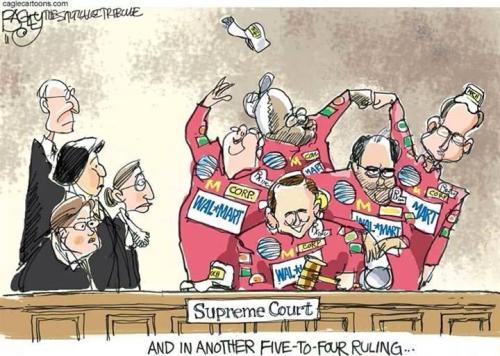
SCOTUS Strikes Down Political Spending Limits for Rich Donors

The US govt is corrupt in every branch, every level. Wealth owns everyone and everything. Democracy--game over....


The New Citizens United
 Wednesday, 02 April 2014
By Mike Ludwig, Truthout


Demonstrations were held across the country Wednesday as the Supreme Court continued chipping away at federal campaign finance reforms with a 5-4 ruling striking down the federal cap on the total amount of money an individual donor can spend supporting candidates and political parties during a two-year election cycle.

The ruling, which split the high court along ideological lines, eliminates the aggregate the cap on the total amount of money an individual can donate to candidates and party fundraising committees during an election season, which was set at $123,200 for 2013 and 2014. That cap was so high that only a several hundred mega-rich donors reached it during the last election cycle.

Campaign finance watchdogs now estimate that a single wealthy donor could spread up to $3.6 million among candidates, party committees and some political action groups affiliated with a single party during a single election cycle. A single donor could theoretically spend twice that amount by supporting candidates and committees from both parties, according to the Sunlight Foundation.

Conservatives are hailing the ruling as a victory for free speech. Liberals and progressives say the ruling will only increase the corrupting influence that ultra-rich donors can have on politicians, dealing yet another fundamental blow to the legitimacy of American democracy. Activists organized about 140 demonstrations and events in 38 states to protest the ruling and call for legislative action.

The ruling is not as sweeping as the Supreme Court's infamous 2010 Citizens United decision, which removed caps on the amount of money that corporations and unions can spend influencing federal elections and unleashed a tidal wave of corporate campaign cash that made the 2012 elections by far the most expensive in history.

But the ruling - one of several rulings under Chief Justice John Roberts that have eroded federal and state campaign finance laws in recent years - surely will increase the ability of rich Americans to impact elections.

The ruling also could inflate the power of joint fundraising committees, which take large donations from donors and funnel the cash to candidates and party committees with full knowledge of who signed the original check.

"Eliminating these limits will now allow a single politician to solicit, and a single donor to give, up to $3.6 million through the use of joint fundraising committees," said Michael Walden, president of the Brennan Center for Justice. "Following the Citizens United decision, this will further inundate a political system already flush with cash, marginalize average voters, and elevate those who can afford to buy political access."

Wednesday's ruling in McCutcheon vs. Federal Election Commission does not touch limits on the amount of money an individual can give to a single federal candidate, which currently is set at $2,600.

Free Speech or Plutocracy?

The majority opinion, delivered by Roberts, claims these limits on individual donations will keep political corruption in check. The Roberts opinion, which was supported by the court's conservative justices, argues that the cap on the total amount and individual can spend during an election cycle can prevent a donor from giving to as many candidates as he or she chooses, which violates free speech rights under the First Amendment.

Like the Citizens United ruling, the majority opinion views political speech and the money spent by wealthy donors to support candidates and influence elections as one and the same.

"Contributing money to a candidate is an exercise of an individual’s right to participate in the electoral process through both political expression and political association," Roberts wrote for the majority. " ... The Government may no more restrict how many candidates or causes a donor may support than it may tell a newspaper how many candidates it may endorse."

Writing for the four dissenting justices on the liberal side of the bench, Justice Stephen Breyer argued that the ruling created a "loophole" allowing rich donors to donate millions to candidates and parties, and, coupled with the Citizens United ruling, "eviscerates our Nation’s campaign finance laws, leaving a remnant incapable of dealing with the grave problems of democratic legitimacy that those laws were intended to resolve."

The case was brought before the court by the national Republican Party and Shaun McCutcheon; a wealthy businessman from Alabama who argued the cap on aggregate donations violated his First Amendment rights by prevented him from donating to Republican candidates he wanted to support in recent elections.

"Today, the court made clear that restraints on the political speech of those whose views you don't like must fail; free speech is the right of all Americans and not a revocable grant from the government of the day," said Dan Backer, the lead political counsel for McCutcheon and the Republican Party.

Campaign finance reformers, however, said the ruling is not a victory for free speech. It's a victory for the plutocracy.

"No matter what five Supreme Court justices say, the First Amendment was never intended to provide a giant megaphone for the wealthiest to use to shout down the rest of us," said Robert Weissman, president of Public Citizen, a progressive watchdog group that supports campaign finance reforms. "Our only hope of overturning this McCutcheon travesty - along with Citizens United - is if millions of Americans band together in saying 'Enough!' to plutocracy."

Growing Grass-Roots Momentum

For several years, a broad grass-roots movement has pushed to overturn Citizens United, either through legislation or amending the Constitution to declare that money spent influencing elections is not the same as free speech. Activists also are pushing for federal legislation that would amplify the impact of small political donations made by average Americans.

Jonah Minkoff-Zern, an activist with Public Citizen who helped organize protests in response to the McCutcheon decision, said the ruling would only spark more grassroots momentum.

"The rallies are a way for us to say, this is not going to be a dark day in history but a day of organizing hope and a call for change," Minkoff-Zern told Truthout.

In recent years, lawmakers in at least 16 states have passed resolutions calling for a constitutional amendment to overturn Citizens United. Minkhoff-Zern said at least 150 members of Congress have signed on in support of similar resolutions.

Monday, April 1, 2013

Truth Is Offensive

March 31, 2013 — Paul Craig Roberts

In America truth is offensive. If you tell the truth, you are offensive.

I am offensive. Michael Hudson is offensive. Gerald Celente is offensive. Herman Daly is offensive. Nomi Prins is offensive. Pam Martens is offensive. Chris Hedges is offensive. Chris Floyd is offensive. John Pilger is offensive. Noam Chomsky is offensive. Harvey Silverglate is offensive. Naomi Wolf is offensive. Stephen Lendman is offensive. David Ray Griffin is offensive. Ellen Brown is offensive.

Fortunately, many others are offensive. But how long before being offensive becomes
being “an enemy of the state”?

Throughout history truth tellers have suffered and court historians have prospered. It is
the same today. Gerald Celente illustrates this brilliantly in the next issue of the Trends
Journal.


Over the past 35 years I have learned this lesson as a columnist. If you tell readers
what is really going on, they want to know why you can’t be positive. Why are you telling
us that there are bad happenings that can’t be remedied? Don’t you know that God
gave Americans the power to fix all wrongs? What are you? Some kind of idiot, an anti-American, a pinko-liberal-commie? If you hate America so much, why don’t you move to Cuba, Iran or China (or to wherever the current bogyman is located)?

The ancient Greeks understood this well. In Greek mythology, Cassandra was the prophetess who no one believed despite her 100 percent record of being right. Telling the truth to Americans or to Europeans is just as expensive as telling the truth to the Greeks in ancient mythology.

In America and everywhere in the Western world or the entire world, telling the truth is
unpopular. Indeed, in the USA telling the truth has been criminalized. Look for example at Bradley Manning, held for two years in prison without bail and without a trial in violation of the US Constitution, tortured for one year of his illegal confinement in violation of US and international law, and now put on trial by corrupt prosecutors for aiding “enemies of the US” by revealing the truth, as required of him by the US military code. US soldiers are required to report war crimes. When Bradley Manning’s superiors showed themselves to be indifferent to war crimes, Manning reported the crimes via WikiLeaks. What else does a soldier with a sense of duty and a moral conscience do when the chain of command is corrupt?
Julian Assange is another example. WikiLeaks has taken up the reporting function that the Western media has abandoned. Remember, the New York Times did publish the Pentagon Papers in 1971, which undermined the lies Washington had told both to the public and to Congress to justify the costly Vietnam War. But today no newspaper or TV channel any longer accepts the responsibility to truthfully inform the public. Julian Assange stepped into the vacuum and was immediately demonized, not merely by Washington but also by left-wing and right-wing media, including Internet. It was a combination of jealousy, ignorance, and doing Washington’s bidding.

Without WikiLeaks and Assange the world would know essentially nothing. Spin from Washington, the presstitute media, and the puppet state medias would prevail. So the word went out to destroy Julian Assange.

It is amazing how many people and Internet sites obeyed Washington’s command. Assange has been so demonized that even though he has been granted political asylum by Ecuador, the British government, obeying its Washington master, refuses to allow him safe passage out of the London Ecuador Embassy. Is Assange destined to live out his life inside the Ecuador Embassy in London?

Will Assange be a replay of Cardinal Jozsef Mindszenty who on November 4, 1956, sought asylum in the US embassy in Budapest as Soviet tanks poured into Hungary to put down the anti-communist revolution? Cardinal Mindszenty lived for 15 years in the US embassy. Today it is “freedom and democracy” Amerika that is copying Soviet practices during the cold war.

In contrast with “freedom and democracy” US and UK, the “authoritarian,” “communist,” “oppressive” Chinese government when confronted with Chinese dissident Chen Guangcheng’s defection to the US embassy in Beijing, let him go.

It is an upside down world when America and the British refuse to obey international law, but the Chinese communists uphold international law.

Insouciant americans are undisturbed that alleged terrorists are tortured, held indefinitely in prison without due process, and executed on the whim of some executive branch official without due process of law.

Most americans go along with unaccountable murder, torture, and detention without evidence, which proclaims their gullibility to the entire world. There has never in history been a population as unaware as Americans. The world is amazed that an insouciant people became, if only for a short time, a superpower.

The world needs intelligence and leadership in order to avoid catastrophe, but America can provide neither intelligence nor leadership. America is a lost land where nuclear weapons are in the hands of those who are concerned only with their own power. Washington is the enemy of the entire world and encompasses the largest concentration of evil on the planet.
Where is the good to rise up against the evil?

Thursday, November 1, 2012

The Inequality Gap

Silly Tales Economists Like to Tell
by DEAN BAKER

There is no serious dispute that the United States has seen a massive increase in inequality over the last three decades. However there is a major dispute over the causes of this rise in inequality.

The explanation most popular in elite and policy circles is that the rise in inequality was simply the natural working of the economy. Their story is that the explosion of information technology and globalization have increased demand for highly-skilled workers while sharply reducing the demand for less-educated workers.

While the first part of this story is at best questionable, the second part should invite ridicule and derision. It doesn’t pass the laugh test.

As far as the technology story, yes information technologies have displaced large amounts of less-skilled labor. So did the technologies that preceded them. There are hundreds of books and articles from the 1950s and 1960s that expressed grave concerns that automation would leave much of the workforce unemployed. Is there evidence that the displacement is taking place more rapidly today than in that era? If so, it is not showing up on our productivity data.

More germane to the issue at hand, unlike the earlier wave of technology, computerization offers the potential for displacing vast amounts of highly skilled labor. Legal research that might have previously required a highly skilled lawyer can now be done by an intelligent college grad and a good search engine. Medical diagnosis and the interpretation of test results that may have previously required a physician, and quite possibly a highly paid specialist, can now be done by technical specialists who may not even have a college education.

There is no reason to believe that current technologies are replacing comparatively more less-educated workers than highly educated workers. The fact that lawyers and doctors largely control how their professions are practiced almost certainly has much more to do with the demand for their services.

If the technology explanation for inequality is weak, the globalization part of the story is positively pernicious. The basic story is that globalization has integrated a huge labor force of billions of workers in developing countries into the world economy. These workers are able to fill many of the jobs that used to provide middle-class living standards to workers in the United States and will accept a fraction of the wage. This makes many formerly middle-class jobs uncompetitive in the world economy given current wages and currency values.

This part of the story is true. The part that our elite leave out is that there are tens of millions of bright and highly educated workers in the developing world who could fill most of the top-paying jobs in the U.S. economy: doctors, lawyers, accountants, etc. These workers are also willing to work for a small fraction of the wages of their U.S. counterparts since they come from poor countries with much lower standards of living.

The reason why the manufacturing workers, construction workers, and restaurant workers lose their jobs to low-paid workers from the developing world, and doctors and lawyers don’t, is that doctors and lawyers use their political power to limit the extent to which they are exposed to competition from their low-paid counterparts in the developing world.  
Our trade policy has been explicitly designed to remove barriers that prevent General Electric and other companies from moving their manufacturing operations to Mexico, China or other developing countries. By contrast, many of the barriers that make it difficult for foreign professionals to work in the United States have actually been strengthened in the last two decades.
If economics was an honest profession, economists would focus their efforts on documenting the waste associated with protectionist barriers for professionals. They devoted endless research studies to estimating the cost to consumers of tariffs on products like shoes and tires. It speaks to the incredible corruption of the economics profession that there are not hundreds of studies showing the loss to consumers from the barriers to trade in physicians’ services. If trade could bring down the wages of physicians in the United States just to European levels, it would save consumers close to $100 billion a year.

But economists are not rewarded for studying the economy. That is why almost everyone in the profession missed the $8 trillion housing bubble, the collapse of which stands to cost the country more than $7 trillion in lost output according to the Congressional Budget Office. (That comes to around $60,000 per household.)

Few if any economists lost their six-figure paychecks for this disastrous mistake. But most economists are not paid for knowing about the economy. They are paid for telling stories that justify giving more money to rich people. Hence we can look forward to many more people telling us that all the money going to the rich was just the natural workings of the economy. When it comes to all the government rules and regulations that shifted income upward, they just don’t know what you’re talking about.

Monday, July 16, 2012

This Global Financial Fraud and Its Gatekeepers


The media's 'bad apple' thesis no longer works. We're seeing systemic corruption in banking – and systemic collusion
by Naomi Wolf
 
Last fall, I argued that the violent reaction to Occupy and other protests around the world had to do with the 1%ers' fear of the rank and file exposing massive fraud if they ever managed get their hands on the books. At that time, I had no evidence of this motivation beyond the fact that financial system reform and increased transparency were at the top of many protesters' list of demands.

But this week presents a sick-making trove of new data that abundantly fills in this hypothesis and confirms this picture. The notion that the entire global financial system is riddled with systemic fraud – and that key players in the gatekeeper roles, both in finance and in government, including regulatory bodies, know it and choose to quietly sustain this reality – is one that would have only recently seemed like the frenzied hypothesis of tinhat-wearers, but this week's headlines make such a conclusion, sadly, inevitable.

The New York Times business section on 12 July shows multiple exposes of systemic fraud throughout banks: banks colluding with other banks in manipulation of interest rates, regulators aware of systemic fraud, and key government officials (at least one banker who became the most key government official) aware of it and colluding as well. Fraud in banks has been understood conventionally and, I would say, messaged as a glitch. As in London Mayor Boris Johnson's full-throated defense of Barclay's leadership last week, bank fraud is portrayed as a case, when it surfaces, of a few "bad apples" gone astray.

In the New York Times business section, we read that the HSBC banking group is being fined up to $1bn, for not preventing money-laundering (a highly profitable activity not to prevent) between 2004 and 2010 – a six years' long "oops". In another article that day, Republican Senator Charles Grassley says of the financial group Peregrine capital: "This is a company that is on top of things." The article goes onto explain that at Peregrine Financial, "regulators discovered about $215m in customer money was missing." Its founder now faces criminal charges. Later, the article mentions that this revelation comes a few months after MF Global "lost" more than $1bn in clients' money.

What is weird is how these reports so consistently describe the activity that led to all this vanishing cash as simple bumbling: "regulators missed the red flag for years." They note that a Peregrine client alerted the firm's primary regulator in 2004 and another raised issues with the regulator five years later – yet "signs of trouble seemingly missed for years", muses the Times headline.

A page later, "Wells Fargo will Settle Mortgage Bias Charges" as that bank agrees to pay $175m in fines resulting from its having – again, very lucratively – charged African-American and Hispanic mortgagees costlier rates on their subprime mortgages than their counterparts who were white and had the same credit scores. Remember, this was a time when "Wall Street firms developed a huge demand for subprime loans that they purchased and bundled into securities for investors, creating financial incentives for lenders to make such loans." So, Wells Fargo was profiting from overcharging minority clients and profiting from products based on the higher-than-average bad loan rate expected. The piece discreetly ends mentioning that a Bank of America lawsuit of $335m and a Sun Trust mortgage settlement of $21m for having engaged is similar kinds of discrimination.

Are all these examples of oversight failure and banking fraud just big ol' mistakes? Are the regulators simply distracted?

The top headline of the day's news sums up why it is not that simple: "Geithner Tried to Curb Bank's Rate Rigging in 2008". The story reports that when Timothy Geithner, at the time he ran the Federal Reserve Bank of New York, learned of "problems" with how interest rates were fixed in London, the financial center at the heart of the Libor Barclays scandal. He let "top British authorities" know of the issues and wrote an email to his counterparts suggesting reforms. Were his actions ethical, or prudent? A possible interpretation of Geithner's action is that he was "covering his ass", without serious expectation of effecting reform of what he knew to be systemic abuse.

And what, in fact, happened? Barclays kept reporting false rates, seeking to boost its profit.

Last month, the bank agreed to pay $450m to US and UK authorities for manipulating the Libor and other key benchmarks, upon which great swaths of the economy depended. This manipulation is alleged in numerous lawsuits to have defrauded thousands of bank clients. So Geithner's "warnings came too late, and his efforts did not stop the illegal activity".

And then what happened? Did Geithner, presumably frustrated that his warnings had gone unheeded, call a press conference? No. He stayed silent, as a practice that now looks as if several major banks also perpetrated, continued.

And then what happened? Tim Geithner became Treasury Secretary. At which point, he still did nothing.

It is very hard, looking at the elaborate edifices of fraud that are emerging across the financial system, to ignore the possibility that this kind of silence – "the willingness to not rock the boat" – is simply rewarded by promotion to ever higher positions, ever greater authority. If you learn that rate-rigging and regulatory failures are systemic, but stay quiet, well, perhaps you have shown that you are genuinely reliable and deserve membership of the club.

Whatever motivated Geithner's silence, or that of the "government official" in the emails to Barclays, this much is obvious: the mainstream media need to drop their narratives of "Gosh, another oversight". The financial sector's corruption must be recognized as systemic.

Meanwhile, Britain is sleepwalking in a march toward total email surveillance, even as the US brings forward new proposals to punish whistleblowers by extending the Espionage Act. In an electronic world, evidence of these crimes lasts forever – if people get their hands on the books. In the Libor case, notably, a major crime has not been greeted by much demand at the top for criminal prosecutions. That asymmetry is one of the insurance policies of power.

Another is to crack down on citizens' protest.