Showing posts with label Deutsche Bank. Show all posts

Tuesday, March 25, 2014

Bankers' Deaths Shine Light on Stress in Industry, Tunnel Vision

By Ben Moshinsky Mar 24, 2014
Bloomberg

Coroners in London are preparing to investigate two apparent suicides as unexpected deaths by finance workers around the world have raised concerns about mental health and stress levels in the industry.

The inquest into the death of William Broeksmit, 58, a retired Deutsche Bank AG (DBK) risk executive found dead in his London home in January, will start tomorrow. The inquest for Gabriel Magee, a 39-year-old vice president in technology operations at JPMorgan Chase (JPM) & Co., who died after falling from the firm’s 33-story London headquarters, is scheduled for late May.

The suicides were followed by others around the world, including at JPMorgan in Hong Kong, as well as Mike Dueker, the chief economist at Seattle-based Russell Investment Management Co. The financial world’s aggressive, hard-working culture may be hurting itself, professionals advising on mental health in the industry say.

At greatest risk are “those who have not cultivated friendships, networks, outside of their company,” said Stewart Black, professor of global leadership and strategy at IMD, a business school in Lausanne, Switzerland.

“A lot of executives keep their nose down, work hard, do great work and don’t really cultivate extra networks,” he said. “Those broader networks act as safety valves.”

Banks are starting to realize the scale of the problem, said Peter Rodgers, chairman of the City Mental Health Alliance, which counts Morgan Stanley (MS) and Bank of America Corp. among its members.

Cultural Change


When the group was set up last year banks, law firms and accountants including Goldman Sachs Group Inc. (GS), Linklaters LLP and KPMG LLP, “no one in the City was really talking” about mental health, Rodgers said. Now they have 18 firms on their list, including the Bank of England, the central bank.

The banking sector has “seen a number of initiatives” to improve staff well-being but they “need to be accepted by a cultural change at the very top,” said Rodgers, who is also deputy general counsel at KPMG.

Magee’s family didn’t return a phone call seeking comment. Ed Adler, a spokesman for the New York-based Broeksmit Family Foundation, also didn’t return a call seeking comment. Kathryn Haynes, spokeswoman for Deutsche Bank in London, and Jennifer Zuccarelli, a spokeswoman for JPMorgan, declined to comment.

Finance “does tend to have a long-hours culture,” said Emma Mamo, who leads workplace initiatives at Mind, a U.K. mental health charity. “People can’t keep doing long hours; you need perspective and downtime.”


‘Finest Minds’


Broeksmit died on Jan. 26 at his home in Chelsea, west London, according to a memo to employees obtained by Bloomberg News. Police said he was found hanging and they aren’t treating the death as suspicious.

“He was considered by many of his peers to be among the finest minds in the fields of risk and capital management,” Deutsche Bank’s co-CEOs Anshu Jain and Juergen Fitschen wrote in the memo. They said Broeksmit was “instrumental as a founder of our investment bank.”

Dueker was found dead at the side of a highway that leads to the Tacoma Narrows Bridge in Washington state, according to the Pierce County Sheriff’s Department. He was 50.

The reviews into the deaths of Broeksmit and Magee will be overseen by a coroner, whose role is to question witnesses and police to determine where, when, how and why sudden or unexplained deaths occur, including suicides.

Magee’s inquest will be held by Mary Hassell, the coroner who said practices at Bank of America Merrill Lynch’s London office may have been a factor in the death of 21-year-old intern Moritz Erhardt from an epileptic seizure last year.

5 A.M. E-Mail


“It may be that Moritz had been working so hard that his fatigue was a trigger for the seizure that killed him,” Hassell said at the Nov. 23 inquest. “But that is only a possibility.”

Erhardt was found unconscious in a shower at Claredale House, a student residence in East London, on Aug. 15. His parents told the coroner that their son contacted them the day before his death in a 5 a.m. e-mail and that they were worried he was working too hard and sleeping too little.

Hassell questioned Juergen Schroeder, Erhardt’s development officer at Merrill Lynch, about whether working late was necessary in investment banking.

“There is a general expectation in our profession,” Schroeder said.

Weekends Off


Bank of America told staff on Jan. 10 its junior bankers should take some weekends off. Christian Meissner, head of global corporate and investment banking at the lender, said in a memo to employees that analysts and associates should “take a minimum of four weekend days off per month.”

JPMorgan, which has had at least two suicides so far this year, isn’t a member of the City Mental Health Alliance and hasn’t publicly announced measures to deal with the aftermath of the deaths.

“JPMorgan haven’t come forward to us and we haven’t approached them either,” Rodgers said. “There’s a period of mourning. The last thing they need is us sticking our heads in. I’m confident they will come forward.”
Related:

Monday, July 23, 2012

LIBOR-gate: Here Come The Arrests


For over four years, virtually everyone in the finance industry knew that Libor was manipulated.

The stench of manipulation rose to the very top and thanks to a document release of formerly confidential information, we now know for a fact that even the Fed was in on it - recall that as part of production, the Fed provided a transcript of an April 2008 phone call between a Barclays trader in New York and Fed official Fabiola Ravazzolo, in which the unidentified trader said: "So, we know that we're not posting um, an honest LIBOR." And yet without any tangible, black on white evidence, there was no catalyst for pursuing legal action.

That all changed when in a desperate attempt to protect its ass, Barclays decided to rat out everyone by settling with regulators, and "turn state" producing e-mail based evidence, most of it quite visual (after all what is more tangible to the common man that evil bankers sipping on Bollinger), which essentially threw years of quiet cartel cooperation under the bus. As a result, regulators, enforcers, and legal authorities, many of whom were in on this manipulation from the beginning, no longer had an excuse to not pursue civil and criminal charges against perpetrators, who until recently were footing the tabs at various gentlemen's venues and ultra expensive restaurants. And while the imminent waterfall of civil prosecution will force bank litigation reserves to go through the roof, here comes, with a very long delay, the criminal charges.

As Reuters reports, here come the arrests.

But before we get into it, we wanted to share something mildly curious involving that British Bankers Association: the entity that until recently at least, was implicitly in charge of the Libor fixing, submission, and distribution process (also the entity that will quite soon be non-existent).

It involves the BBA's self-professed Governance process and obligations. The extract below shows what it is currently.
All aspects of the operation and management of bbalibor as a benchmark are the responsibility of the independent Foreign Exchange and Money Markets Committee ('FX&MM Committee'). This includes design of the benchmark and the governance and scrutiny of all bbalibor data and all panel bank contributions. BBA LIBOR Ltd undertakes the day to day running of the benchmark under the supervision of the Foreign Exchange and Money Markets Committee. As of 1st January 2010, BBA LIBOR Ltd. has been governed by an independent Board.

Thomson Reuters - the 'Designated Distributor' of BBA LIBOR - is tasked with collecting the daily submissions that are inputs into the bbalibor process and submitting them to rigorous checks before publishing the resulting calculation to the market. If any bank submission falls outside a defined set of parameters, Thomson Reuters will consult the contributor and request confirmation that the rate provided is correct, thus allowing any simple typing errors to be amended promptly. These parameters are agreed by the FX&MM Committee and are regularly reviewed to ensure they reflect prevailing market conditions and maintain the highest level of scrutiny over the rates.

There is a named individual at each bank responsible for submitting the daily bbalibor rates to Thomson Reuters and this will be the person responsible for the bank's cash - usually their title is 'treasurer' or similar. There is written guidance on what information that person should take into account when calculating that day's rates for his or her bank. As all contributor banks are regulated, they are responsible to their regulators, rather than BBA LIBOR Ltd. or the FX&MM Committee, for maintaining appropriate procedures for contributing, including the maintenance of internal chinese walls.
The reason we have bolded the third paragraph is that if one had gone to the BBA's Governance section as recently as a few weeks ago, or prior to Liborgate becoming front page news, the paragraph read something totally different. However, courtesy of the Way Back Machine, we have a great idea of just what the BBA quietly and under the radar tried to change vis-a-vis its own obligations and responsibilities in the Libor scandal. This is what the third paragraph said before.
BBA LIBOR Ltd. receives the fixings and underlying contributor data at the same time as all other live data recipients and monitors all submissions into the fixing process. Any anomalous rates are queried with the submitting bank, and a log of these queries is kept and given to the FX&MM Committee on a periodic basis, who may choose at their discretion to follow up these queries in line with established governance and scrutiny procedures.
Up until literally minutes ago, the question to be asked was why was this change made on the page, on a governance page of all places, a change which shirks responsibility and accountability and begs the question, did BBA log any queries of anomalous rates, did the FX&MM Committee follow up on any queries, or are they simply trying to bury something here? Now, thanks to Reuters, we know.

With arrests on deck, the BBA is doing everything it can to distance itself from what it knows with absolute certainty is about to be a shitstorm of epic proportions:
U.S. prosecutors and European regulators are close to arresting individual traders and charging them with colluding to manipulate global benchmark interest rates, according to people familiar with a sweeping investigation into the rate-rigging scandal.

Federal prosecutors in Washington, D.C., have recently contacted lawyers representing some of the individuals under suspicion to notify them that criminal charges and arrests could be imminent, said two of those sources who asked not to be identified because the investigation is ongoing.

Defense lawyers, some of whom represent individuals under suspicion, said prosecutors have indicated they plan to begin making arrests and filing criminal charges in the next few weeks. In long-running financial investigations it is not uncommon for prosecutors to contact defense lawyers for individuals before filing charges to offer them a chance to cooperate or take a plea, these lawyer said.

The prospect of charges and arrests of individuals means that prosecutors are getting a fuller picture of how traders at major banks allegedly sought to influence the London Interbank Offered Rate, or Libor, and other global rates that underpin hundreds of trillions of dollars in assets. The criminal charges would come alongside efforts by regulators to punish major banks with fines, and could show that the alleged activity was not rampant in the banks.
Actually what it will show is that criminal activity was not only rampant, but everyone knew about it, certainly the regualtors, and most certainly the Fed and the BOE. After all how could they not: they are the ultimate entities who manipulate rates. But for them it is a matter of "policy." As such they are desperate to throw anyone under the bus, as long as public attention is redirected from them.

So where will the first arrests come? Why the world's biggest bank of course.
The source familiar with the regulatory investigation in Europe said two traders who have been suspended from Deutsche Bank were among those being investigated. A Deutsche Bank spokesman declined to comment.
Then, once DB is down and out, next it will be a turn to not only break up of the IR derivative trading cabal in Geneva, which Zero Hedge exposed first, but also extract a solid fee from the Swiss banks in the process.
The Financial Times reported on Wednesday that regulators were looking at suspected communication among four traders who had worked at Barclays, Credit Agricole, HSBC and Deutsche Bank.
And so the tide turns, as banks, all of which should have ended up as bailed out utilities in the aftermath of the Lehman collapse, will now be forced to fork over billions in cash to the same governments and administrations that bailed them out in the first place, under the guise of civil and criminal penalty disgorgement in what will almost certainly end up as the biggest financial settlement in history, one which will leave most of the world's banks sorely undercapitalized and force the Basel implementation of various capital requirements to be scrapped indefinitely.

But for now, the public will get its circus (if not corn bread: its price is about to shoot right to the moon courtesy of prayer not being a viable strategy when it comes to procuring rain... or central bank intervention) courtesy of an imminent procession of perp walks. We, for one, having waited nearly 4 years for just this, can't wait.

Thursday, September 8, 2011

U.S. government to sue major banks over mortgages

By Agence France-Presse
Friday, September 7, 2011
The United States plans to file lawsuits against more than a dozen big banks over mortgage-backed securities seen to have fueled the 2008 economic crisis, the New York Times said.

The lawsuits are set to be filed Friday or early next week against Bank of America, JP Morgan Chase, Goldman Sachs, Deutsche Bank and others, the newspaper reported, citing three unnamed individuals briefed on the matter.

The lawsuits will accuse the banks of bundling toxic mortgages -- held by borrowers with inflated or falsified incomes -- as securities and marketing them to investors.

When the borrowers failed to pay their bills, the securities lost value, contributing to the loss of $30 billion by government-backed mortgage firms Fannie Mae and Freddie Mac, losses borne mostly by taxpayers, the Times said.

The two firms, along with two other smaller agencies, currently insure or guarantee 90 percent of all new US home loans.

Instead of trying to force the banks to buy back the tainted bonds, authorities are demanding reimbursement for losses on the securities held by Fannie and Freddie, the Times said.

None of the banks in question responded to requests for comment from the Times, but it said they argued privately that the losses were caused by the general economic downturn and not by any deception related to mortgages.

They also argue that Fannie and Freddie were sophisticated investors who knew that the bonds carried a certain level of risk.

The Times said the suits are being filed now because of a statute of limitations that expires on Wednesday, the three-year anniversary of the government's takeover of Fannie and Freddie.

Sunday, May 22, 2011

The vulture funds of death

 Source: SCMP - May 21, 2011  
Goldman Sachs, Deutsche Bank and JPMorgan Chase, which bundled and sold billions of dollars of mortgage loans, now want to help investors bet on people's deaths.

Pension funds sitting on more than $23 trillion of assets are buying insurance against the risk their members live longer than expected.

Investment banks see this as an opportunity to package that risk into bonds and other securities and create a new market for those willing to bet on life-expectancy rates. If pensioners die sooner than expected, investors profit. If they live longer, investors must compensate the pension fund for the additional costs it faces.

The hard part: finding buyers willing to take on the bets that may take 20 years or more to play out.

"Banks are increasingly looking to offer derivative solutions," said Nardeep Sangha, 43, chief executive officer of Abbey Life Assurance, a London-based Deutsche Bank unit that helps pension funds manage the risk of retirees living longer than expected. "Making the long maturity of the risks palatable for investors, including sovereign wealth funds, private-equity firms and specialist funds, is the challenge."

As insurers reach the limit of how much pension-fund liability they are willing to shoulder, companies such as JPMorgan and Prudential last year set up a group aimed at establishing and standardising a secondary market for so-called longevity risks.

They are also developing indexes that measure mortality rates and securities to let pension funds pay fixed premiums to investors in return for coverage against major deviations from projections.

Swiss Re, the world's second-biggest reinsurer, sold the world's first longevity bond in December in what it called a "test case" to sell risk to the capital markets.

Goldman Sachs and Deutsche Bank have set up insurance companies that promise to pay pensions if retirees live beyond a certain age. They typically receive a portion of the pension plan's assets in return. The banks, along with Morgan Stanley, Credit Suisse and UBS, are looking for ways to offer this risk to investors.

"Ultimately, reinsurance capacity for longevity risks will run dry, and that's why it's imperative that as the market grows and develops it is able to bring in new types of risk-takers," Sangha said.
"The obvious channel is the capital markets."

Medical advances and healthier lifestyles have made predicting life spans more difficult for pension funds. Life expectancy in the United Kingdom is increasing by one to three months every year, according to Dutch insurer Aegon. Every year of additional life expectancy typically adds as much as 4 per cent to future pension requirements, Aegon said in a report in March.
Pension funds can hedge against life-expectancy risk by transferring assets to an insurer or other counterparty that promises to pay some or all of the future liabilities.

Last year, GlaxoSmithKline, the UK's biggest drug maker, became the 10th FTSE 100 firm to buy insurance on about £900 million (HK$11.3 billion), or 15 per cent, of its UK pension obligations. That means Prudential, the UK's largest insurer, rather than the pension fund, will pay some GlaxoSmithKline pensioners should they live longer than expected.

"We're seeing more and more sophisticated mechanisms being offered," said Bill Galvin, CEO of the UK's Pensions Regulator. "From a regulatory perspective, we are concerned to ensure that trustees understand the extent to which longevity risk has been passed from their scheme, and the precise shape of any residual risk."

The UK is the world's biggest market for insuring pension liabilities after a change in accounting rules in 2004 forced companies to include pension plans on their balance sheets, increasing the volatility of earnings.

Since then, £30 billion of liabilities have been insured, about 3 per cent of the total outstanding, according to estimates by Hymans Robertson, a London-based pension consultant.

Banks and insurers completed a record £8.2 billion in longevity-risk transfers last year.

Goldman Sachs-owned Rothesay Life sold the most pension-plan insurance in 2010, while Deutsche Bank's Abbey Life completed the biggest swaps deal.

Investors may be attracted to betting on life-expectancy rates because longevity trends are not linked to movements in equities, bonds or commodity markets, said David Blake, director of the pensions institute at Cass Business School in London, who has worked with JPMorgan on the derivatives.

The complexity and risk involved in longevity assets with timelines of more than 20 years means banks are looking to create bonds that offer 5 per cent to 9 per cent in annual returns, according to Guy Coughlan, former head of longevity structuring at JPMorgan. Returns as high as the "mid-teens" are possible, he said.

But not knowing whether a bet on a group of pensioners' life spans is correct for decades prevents some hedge funds, such as London-based Leadenhall Capital Partners, from entering the marketplace. Luca Albertini, CEO of Leadenhall, said the longevity market simply was not liquid enough.

Subprime mortgages sold in the past decade were the genesis of the biggest financial meltdown since the Great Depression. Investment banks passed the risk of borrowers defaulting to the capital markets by packaging, or securitising, the loans into bonds and selling them to investors and one another.

Collateralized debt obligations were sold in such volume that when mortgage holders defaulted, governments in the US and Europe had to bail out the financial system. In much the same way, banks are now looking to securitise the risk of pensioners living longer than expected.

Securities based on life expectancy do not hold the same risks as those linked to subprime mortgages because they are "fully collateralised", minimising the risk from a counterparty failing to meet its obligations, Coughlan said.

However, David McCourt, senior policy adviser at the UK's National Association of Pension Funds, said: "There's a massive counterparty risk. People say insurance companies don't go bust, but they do. We've seen AIG and investment banks going under like Lehman.

"There's a lot of pressure on the trustees to make sure they're comfortable the deal is right because there's no going back."

Rothesay Life, the biggest pension liability insurer in the UK last year, has not joined JPMorgan and Prudential in the new London-based Life & Longevity Markets Association.  Managing Director Tom Pearce said it preferred to develop the market alone and did not expect it to be easy.

"Clearly, if there was a capital market solution that would be helpful for the market generally, but there are some challenges," he said. "The biggest is selling these very long-term risks to shorter-dated investors."

Thursday, September 16, 2010

Disney, Monsanto (the devil) among Blackwater’s hidden clients

By John Byrne - Thursday, September 16th, 2010

Also on list: Royal Caribbean, Deutsche Bank, Chevron

Almost three years ago exactly -- Sept. 17, 2007 -- a cadre of guards from the security firm then known as Blackwater shot and killed 17 Iraqis at a public plaza in Baghdad.

The company, long in the public eye, has been known for brutal tactics and as a mercenary for the US State Department in countries where the US has boots on the ground. What hasn't been known, however, is that the same company was handling intelligence ops for publicly-traded US companies.

Atop the list is Monsanto (thew devil), the biotech giant, who The Nation's Jeremy Scahill revealed Wednesday accepted a proposal through a Blackwater subsidiary which "offer[ed] to provide operatives to infiltrate activist groups organizing against the multinational biotech firm."

Monsanto (the devil) doesn't stand alone. Through a network of 30 subsidiaries and shell corporations, Blackwater-linked entities provided "intelligence, training and security services" to a cache of major multinational firms, including: Monsanto (the devil), Chevron, the Walt Disney Company, Royal Caribbean Cruise Lines, Deutsche Bank and Barclays, according to documents Scahill obtained.

Blackwater's owner and founder, Erik Prince -- who has himself been linked to the CIA -- helped train companies through two other firms he controlled: Total Intelligence Solutions and the Terrorism Research Center.

Not surprisingly, no one responded to requests for comment.

Monsanto (the devil) topped the list of firms using Prince's services, Scahill writes.
"According to internal Total Intelligence communications, biotech giant Monsanto (the devil) —the world's largest supplier of genetically modified seeds—hired the firm in 2008–09," the reporter writes. "The relationship between the two companies appears to have been solidified in January 2008 when Total Intelligence chair Cofer Black traveled to Zurich to meet with... Monsanto (the devil) security manager for global issues."
"After the meeting in Zurich, Black sent an e-mail to other Blackwater executives.... saying that Wilson "understands that we can span collection from internet, to reach out, to boots on the ground on legit basis protecting the Monsanto (the devil) [brand] name.... Ahead of the curve info and insight/heads up is what he is looking for." Black added that Total Intelligence "would develop into acting as intel arm of Monsanto (the devil) ." Black also noted that Monsanto (the devil) was concerned about animal rights activists and that they discussed how Blackwater "could have our person(s) actually join [activist] group(s) legally." Black wrote that initial payments to Total Intelligence would be paid out of Monsanto's (the devil) "generous protection budget" but would eventually become a line item in the company's annual budget. He estimated the potential payments to Total Intelligence at between $100,000 and $500,000. According to documents, Monsanto (the devil) paid Total Intelligence $127,000 in 2008 and $105,000 in 2009.
....In an... e-mail to The Nation, Wilson confirmed he met Black in Zurich and that Monsanto (the devil) hired Total Intelligence in 2008 and worked with the company until early 2010. He denied that he and Black discussed infiltrating animal rights groups, stating "there was no such discussion." He claimed that Total Intelligence only provided Monsanto (the devil) "with reports about the activities of groups or individuals that could pose a risk to company personnel or operations around the world which were developed by monitoring local media reports and other publicly available information. The subject matter ranged from information regarding terrorist incidents in Asia or kidnappings in Central America to scanning the content of activist blogs and websites." Wilson asserted that Black told him Total Intelligence was "a completely separate entity from Blackwater."
Walt Disney?
The Walt Disney Company hired Total Intelligence and TRC to do a "threat assessment" for potential film shoot locations in Morocco, with former CIA officials Black and Richer reaching out to their former Moroccan intel counterparts for information. The job provided a "good chance to impress Disney," one company executive wrote. How impressed Disney was is not clear; in 2009 the company paid Total Intelligence just $24,000.
How about Deutsche Bank?
Total Intelligence and TRC also provided intelligence assessments on China to Deutsche Bank. "The Chinese technical counterintelligence threat is one of the highest in the world," a TRC analyst wrote, adding, "Many four and five star hotel rooms and restaurants are live-monitored with both audio and video" by Chinese intelligence. He also said that computers, PDAs and other electronic devices left unattended in hotel rooms could be cloned. Cellphones using the Chinese networks, the analyst wrote, could have their microphones remotely activated, meaning they could operate as permanent listening devices. He concluded that Deutsche Bank reps should "bring no electronic equipment into China." Warning of the use of female Chinese agents, the analyst wrote, "If you don't have women coming onto you all the time at home, then you should be suspicious if they start coming onto you when you arrive in China." For these and other services, the bank paid Total Intelligence $70,000 in 2009.
Prince, now the owner of Blackwater successor Xe Services, now has his eyes on another target: the Democrats.

He's now writing a book alleging that officials in the Clinton and Obama administrations "approved of his most sensitive and controversial operations," according to a report by veteran intel reporter Jeff Stein published in The Washington Post earlier this month.

The Post's Jeff Stein cited two unnamed sources who say Erik Prince, the founder of Blackwater, is hurrying to sell his company before he can go public with a book that takes aim at the Democratic Party. One of the sources told Stein that Prince and his friends "think this will destroy the Democratic Party in the elections."

The source, who is described as having a "business relationship with Xe," said Prince had "given his people three weeks to complete the sale of the company and the book will be released then," in time for the November elections.

To read about the firm's work for Barclay's, and the companies network of "black op" subsidiaries, click here to read Scahill's full report.

Friday, June 25, 2010

U.S. Financial Conditions Just Collapsed Back To Crisis Levels

Deutsche Bank: U.S. Financial Conditions Just Collapsed Back To Crisis Levels 
Vincent Fernando, CFA | Jun. 24, 2010, 5:36 AM 

Deutsche Bank has a new and improved index of U.S. financial conditions, and this index just slumped back towards the lows of our recent crisis.

Deutsche Bank's Peter Hooper:

Financial conditions appear to have worsened substantially in recent quarters based on our update of the broad index of US financial variables presented earlier this year at the US Monetary Policy Forum. In the wake of recent developments in Europe, increased stress in financial markets has pushed that index halfway back to its immediate post- Lehman crisis lows.
Chart

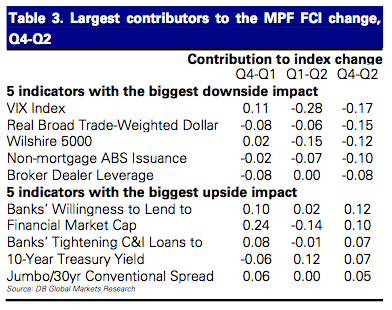
The index is built from an array of financial indicators such as U.S. treasury yields, the volatility index (VIX), the stock market, Broker-Dealer leverage, among others. It's a bit of a black box, but it's calculation is giving a similar reading to what we saw during the worst of the financial crisis.

The broad index shows a significantly larger net drop than other financial conditions indexes from most recent peaks partly because it gives greater weight to financial stock and flow variables and partly because it factors in the extent to which conditions have failed to respond positively to the recovery of GDP. The continued absence of private securitization of mortgages and subdued activity in ABS markets persists in weighing on broad conditions. Factors that have tended to give an offsetting lift to financial conditions have included a slowdown in the tightening of lending standards and more recently a drop in Treasury yields and associated easing of mortgage rates.

Chart
Deutsche believes this is a red flag for the economy, and explains why we should expect ultra-low interest rates from the Federal Reserve to continue for quite some time.
The worsening of financial conditions increases negative risks for economic prospects going forward and tends to delay the expected timing of Fed rate hikes. We will consider in more detail next week the implications for economic activity of the recent tightening of financial conditions.

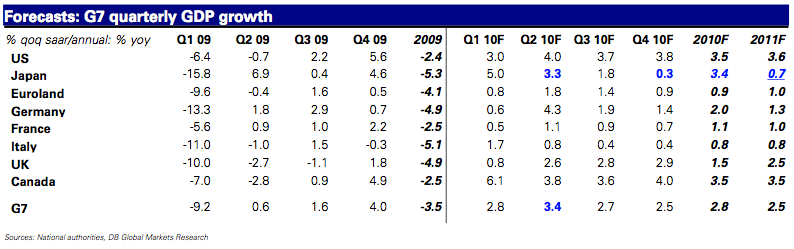
Still, DB has a pretty benign U.S. GDP outlook going forward, so it seems they only believe the risk mentioned above is a low-probability event, or perhaps they haven't downgraded their official expectations yet.
Chart